×
Request Free Sample ×

Kindly complete the form below to receive a free sample of this Report

* Please use a valid business email

Leading companies partner with us for data-driven Insights

clients tt-cursor
Hero Background
English
Chinese
French
Japanese
Korean
German
Spanish

Oilfield Casing Spools Market Share

ID: MRFR/EnP/8619-HCR
111 Pages
Anshula Mandaokar
February 2026

Oilfield Casing Spools Market Research Report by Type (Stainless Steel and Low Alloy Steel), by Casing Size (8” to 10”, 10.1” to 12”, 12.1” to 15”, 15.1” to 18” and Above 18”), by Working Pressure (Below 2000 PSI, 2001 PSI to 3000 PSI, 3001 PSI to 5000 PSI and Above 5000 PSI), Flange Pressure (11” to 13”, 13.1” to 15”, 15.1” to 18” and Above 18”) and Region (North America, Europe, Asia-Pacific, Middle East & Africa and South America) - Forecast 2030

Share:
Download PDF ×

We do not share your information with anyone. However, we may send you emails based on your report interest from time to time. You may contact us at any time to opt-out.

Oilfield Casing Spools Market Infographic
Purchase Options

Market Share

Oilfield Casing Spools Market Share Analysis

The oilfield casing spools market has been influenced by several key trends, reflecting the dynamic nature of the oil and gas industry. Casing spools play a crucial role in oilfield operations, providing support and sealing for wellheads and casing strings. One notable trend in this market is the increasing demand for more technologically advanced and durable casing spools. Oil and gas exploration and production activities are expanding into more challenging environments, such as deepwater and high-pressure/high-temperature (HP/HT) reservoirs. This has led to the need for casing spools capable of withstanding extreme conditions while ensuring reliable wellhead integrity and safety.

Moreover, there's a growing emphasis on cost-effective and time-efficient solutions within the oilfield casing spools market. Companies operating in the oil and gas sector are increasingly focused on optimizing operational efficiencies and reducing downtime. As a result, there's a trend towards the development of casing spools that streamline installation processes, minimize maintenance requirements, and offer easier access for well interventions. Manufacturers are innovating to design casing spools that facilitate quicker installation and allow for swift adjustments and replacements when needed, ultimately reducing operational costs and improving overall efficiency.

Additionally, the market is witnessing advancements in materials and manufacturing techniques for casing spools. There's a shift towards utilizing high-grade materials, such as corrosion-resistant alloys and advanced composites, to enhance the durability and longevity of casing spools, especially in harsh operating conditions. Furthermore, the adoption of advanced manufacturing processes, including 3D printing and precision machining, is enabling the production of casing spools with intricate designs and precise tolerances, ensuring superior performance and reliability.

Furthermore, the growing focus on environmental sustainability and regulatory compliance is influencing the oilfield casing spools market. There's an increased scrutiny on minimizing environmental impact throughout the entire oil and gas extraction process. As a result, there's a trend towards developing casing spools that adhere to stringent environmental standards, including leak prevention and emission control measures. Manufacturers are designing spools with improved sealing technologies to prevent leaks and reduce the risk of environmental contamination, aligning with industry regulations and environmental conservation efforts.

Moreover, technological advancements, such as digitalization and IoT integration, are starting to make inroads into the oilfield casing spools market. Companies are exploring the incorporation of sensors and monitoring systems into casing spools to enable real-time data collection and remote monitoring of wellhead conditions. This trend towards smart casing spools allows for proactive maintenance, early detection of potential issues, and better decision-making, contributing to enhanced operational efficiency and safety.

The oilfield casing spools market is evolving in response to various factors, including technological advancements, operational efficiency demands, environmental considerations, and regulatory requirements. The focus on designing robust, cost-effective, and environmentally friendly casing spools capable of withstanding challenging operating conditions continues to drive innovation within the industry. As oil and gas exploration ventures into more complex terrains, the market for advanced and reliable casing spools is expected to witness continued growth and development in the foreseeable future.

Author
Anshula Mandaokar
Team Lead - Research

Anshula Mandaokar holds an academic degree in Chemical Engineering and has been contributing to the field for more than 5 years. She has expertise in Market Research and Business Consulting and serves as a Team Lead for a reputed Market Research firm under the Chemicals and Materials domain spectrum. She has worked on multiple projects, generating explicit results in a quick turnaround time. Her understanding of data interpretation justifies her role as a leader.

Leave a Comment

FAQs

What is the expected growth rate of the market?

The market is expected to grow at a 5.51% CAGR during the forecast period in 2035.

Who are the key contenders profiled in the global oilfield casing pool market?

Key contenders profiled in the global oilfield casing pool market include Baker Hughes, a GE Co. LLC, Schlumberger Ltd, Delta US Corp. LLC, Sentry Wellhead Systems LLC, Shaanxi FYPE Rigid Machinery Co. Ltd, The Weir Group Plc, Uztel SA , Worldwide Oilfield Machine Inc, Jiangsu HongFei Petroleum Machinery Manufacturing Co. Ltd, Yantai Jereh Oilfield, Services Group Co. Ltd., and Jereh Group.

What are the different types of oilfield casing pool?

Low alloy steel and stainless steel are the different types of oilfield casing pool.

What are the key factors driving the oilfield casing pool market?

Increasing oil and gas exploration is driving the oilfield casing pool market.

Which region is expecting the most significant growth during the period 2022-2030?

The North American market is expected to dominate the market operations during the forecast period

Market Summary

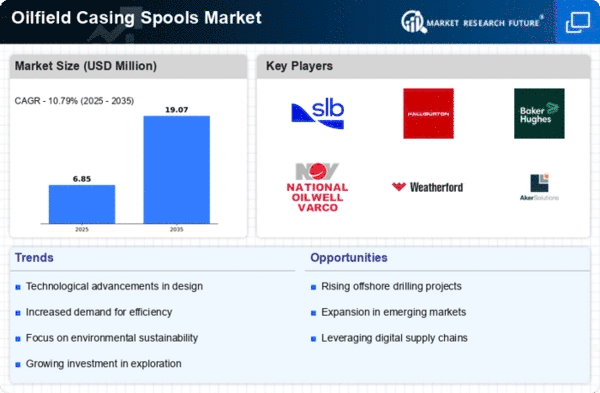
As per MRFR analysis, the Oilfield Casing Spools Market Size was estimated at 6.18 USD Million in 2024. The Oilfield Casing Spools industry is projected to grow from 6.84 in 2025 to 19.07 by 2035, exhibiting a compound annual growth rate (CAGR) of 10.79 during the forecast period 2025 - 2035.

Key Market Trends & Highlights

The Oilfield Casing Spools Market is poised for growth driven by technological advancements and increasing demand.

  • Technological advancements are reshaping the oilfield casing spools market, enhancing efficiency and performance. North America remains the largest market, while Asia-Pacific is emerging as the fastest-growing region in this sector. Production operations dominate the market, yet drilling operations are witnessing the fastest growth trajectory. Rising demand for oil and gas, coupled with increased investment in oilfield infrastructure, drives market expansion.

Market Size & Forecast

2024 Market Size 6.18 (USD Million)
2035 Market Size 19.07 (USD Million)
CAGR (2025 - 2035) 10.79%
Largest Regional Market Share in 2024 North America

Major Players

Schlumberger (US), <a href="google.com/search?q=Oilfield+Casing+Spools%2BHalliburton&amp;rlz=1C1CHBD_enIN1183IN1183&amp;oq=Oilfield+Casing+Spools%2BHalliburton&amp;gs_lcrp=EgZjaHJvbWUyBggAEEUYOTIHCAEQIRigATIHCAIQIRiPAtIBCDE5MTZqMGo0qAIAsAIA&amp;sourceid=chrome&amp;ie=UTF-8">Halliburton</a> (US), National Oilwell Varco (US), Weatherford International (IE), <a href="https://www.bakerhughes.com/completions/well-monitoring-and-analytics/spooling-services">Baker Hughes</a> (US), Aker Solutions (NO), Tenaris (AR), Oceaneering International (US), Cameron International (US)

Market Trends

The Oilfield Casing Spools Market is currently experiencing a dynamic phase characterized by evolving technologies and increasing demand for efficient drilling solutions. As exploration and production activities expand globally, the need for reliable casing spools has become paramount. These components play a crucial role in ensuring the integrity of wellbore operations, thereby enhancing safety and operational efficiency. 

The Oilfield Casing Spools Market appears to be influenced by various factors, including advancements in materials and manufacturing processes, which may lead to improved performance and durability of casing spools. Furthermore, the growing emphasis on sustainable practices within the oil and gas sector suggests a potential shift towards eco-friendly materials and designs in the production of these essential components. In addition, the Oilfield Casing Spools Market seems to be shaped by the increasing complexity of drilling operations. 

As companies seek to access deeper and more challenging reservoirs, the demand for specialized casing spools that can withstand extreme conditions is likely to rise. This trend indicates a need for innovation and adaptation within the industry, as manufacturers strive to meet the specific requirements of modern drilling techniques.

Overall, the Oilfield Casing Spools Market is poised for growth, driven by technological advancements and the ongoing evolution of drilling practices, which may redefine the landscape of oilfield operations in the coming years.

Technological Advancements

The Oilfield Casing Spools Market is witnessing a surge in technological innovations aimed at enhancing the performance and reliability of casing spools. Manufacturers are increasingly adopting advanced materials and engineering techniques to produce spools that can withstand extreme conditions, thereby improving overall operational efficiency.

Sustainability Initiatives

There is a growing trend towards sustainability within the Oilfield Casing Spools Market, as companies seek to minimize their environmental impact. This shift is prompting manufacturers to explore eco-friendly materials and production methods, aligning with the broader industry focus on reducing carbon footprints.

Increased Competition

The competitive landscape of the Oilfield Casing Spools Market is intensifying, with numerous players striving to differentiate their offerings. This competition is likely to spur innovation, leading to the development of specialized products that cater to the unique requirements of various drilling applications.

Oilfield Casing Spools Market Market Drivers

Technological Advancements

Technological innovations play a pivotal role in shaping the Global Oilfield Casing Spools Market Industry. The introduction of advanced materials and manufacturing techniques enhances the performance and reliability of casing spools. For instance, the development of composite materials offers improved resistance to corrosion and pressure, which is crucial in harsh drilling environments. Furthermore, automation and digitalization in oilfield operations streamline processes, reducing costs and increasing efficiency. As these technologies continue to evolve, they are expected to drive market growth, with projections indicating a compound annual growth rate of 6.04% from 2025 to 2035, underscoring the importance of innovation in this sector.

Market Trends and Projections

The Global Oilfield Casing Spools Market Industry is projected to experience substantial growth over the next decade. With a market value expected to reach 7.28 USD Billion in 2024 and 13.9 USD Billion by 2035, the industry is on a promising trajectory. The anticipated compound annual growth rate of 6.04% from 2025 to 2035 indicates a robust expansion phase. This growth is driven by various factors, including rising energy demands, technological advancements, and increased investments in exploration activities. As the market evolves, it is essential for stakeholders to monitor these trends and adapt their strategies accordingly to capitalize on emerging opportunities.

Rising Demand for Oil and Gas

The Global Oilfield Casing Spools Market Industry is experiencing a surge in demand driven by the increasing need for oil and gas. As economies worldwide continue to develop, the consumption of energy resources rises, prompting exploration and production activities. This trend is particularly evident in regions such as North America and the Middle East, where significant investments are being made in oil extraction technologies. The market is projected to reach 7.28 USD Billion in 2024, reflecting the industry's robust growth trajectory. This demand is likely to sustain the need for advanced casing spools, which are essential for maintaining well integrity during drilling operations.

Regulatory Frameworks and Standards

The Global Oilfield Casing Spools Market Industry is significantly influenced by stringent regulatory frameworks and safety standards. Governments and regulatory bodies worldwide impose guidelines to ensure the safe and efficient operation of oil and gas extraction activities. Compliance with these regulations necessitates the use of high-quality casing spools that meet specific safety and performance criteria. For example, the American Petroleum Institute (API) sets standards that casing spools must adhere to, promoting safety and environmental protection. As regulations become more rigorous, the demand for compliant casing spools is expected to rise, further driving market growth and ensuring the integrity of oilfield operations.

Market Dynamics and Competitive Landscape

The Global Oilfield Casing Spools Market Industry is characterized by dynamic market conditions and a competitive landscape. Key players are continually striving to enhance their product offerings and expand their market presence through strategic partnerships and mergers. This competitive environment fosters innovation, leading to the development of advanced casing spool designs that cater to diverse operational needs. Additionally, the entry of new players into the market intensifies competition, prompting existing companies to improve their service quality and product reliability. As the market evolves, these dynamics are likely to shape the future of the casing spools industry, influencing pricing strategies and customer preferences.

Increasing Investments in Exploration Activities

The Global Oilfield Casing Spools Market Industry benefits from the growing investments in exploration and production activities. As oil prices stabilize, companies are more inclined to invest in new drilling projects, particularly in untapped reserves. Regions such as Africa and South America are witnessing increased exploration efforts, leading to a higher demand for casing spools. This trend is expected to contribute to the market's expansion, with projections indicating a market value of 13.9 USD Billion by 2035. The influx of capital into exploration activities not only boosts the demand for casing spools but also encourages the development of innovative solutions to enhance drilling efficiency.

Market Segment Insights

By Application: Production Operations (Largest) vs. Drilling Operations (Fastest-Growing)

In the Oilfield Casing Spools Market, the application segment is primarily dominated by Production Operations, which holds a significant market share due to the rising demand for efficient extraction processes. Drilling Operations closely follows, showcasing a robust presence fueled by the continuous search for new oil reserves. Well Completion, while critical, contributes a smaller proportion to the overall market share but plays an essential role in ensuring the profitability of drilling and production activities.

Production Operations: Dominant vs. Drilling Operations: Emerging

Production Operations stand out as the dominant force within the Oilfield Casing Spools Market, largely attributed to their pivotal role in enhancing oil extraction efficiencies. This segment benefits from advancements in technology and techniques that optimize the production lifecycle. In contrast, Drilling Operations are increasingly recognized as an emerging segment, characterized by rapid innovation and the implementation of smart drilling technologies. This growth is driven by the need for more effective exploration strategies, particularly in geographically challenging areas, indicating a shift towards more sustainable extraction practices. Together, these segments illustrate a dynamic landscape within the market, influencing investment decisions and operational strategies.

By Type: Single Casing Spool (Largest) vs. Double Casing Spool (Fastest-Growing)

In the Oilfield Casing Spools Market, Single Casing Spools currently dominate the market share, owing to their widespread usage in various drilling operations. Their simplicity and reliability make them preferred choices among operators, leading to a substantial presence in the market. On the other hand, Double Casing Spools are gaining traction due to their enhanced design that allows for better control and safety in drilling applications, appealing to operators looking for advanced solutions.

Casing Spools: Single (Dominant) vs. Double (Emerging)

Single Casing Spools are recognized as the dominant segment in the market due to their established technology and reliability. They are typically used for shallow to mid-depth wells and are preferred in standard drilling conditions. In contrast, Double Casing Spools are emerging as a significant player, offering advantages such as improved safety and adaptability to harsher drilling environments. Their growth is driven by increasing demand for enhanced safety features and operational efficiency in drilling operations, making them a promising option for modern oilfield applications.

By Material: Steel (Largest) vs. Composite (Fastest-Growing)

In the Oilfield Casing Spools Market, the distribution of market share among material types reveals that steel remains the dominant player, accounting for a significant share due to its durability and strength in offshore environments. Aluminum, despite being lighter and resistant to corrosion, holds a smaller portion of the market. Composite materials, although previously less common, are quickly gaining traction as they offer enhanced performance characteristics, positioning them as a noteworthy contender in this segment.

Material: Steel (Dominant) vs. Composite (Emerging)

Steel is characterized by its high strength-to-weight ratio and has been the preferred choice for oilfield casing spools due to its reliable performance in harsh conditions. With excellent resistance to deformation and fatigue, it ensures longevity in service. On the other hand, composite materials are emerging due to advancements in manufacturing techniques and material science, leading to lighter, corrosion-resistant options that can outperform traditional materials in specific applications. This growing interest in composites indicates a shift towards more innovative solutions, aligning with industry efforts to enhance efficiency and reduce environmental impact.

By Pressure Rating: High Pressure (Largest) vs. Medium Pressure (Fastest-Growing)

The Oilfield Casing Spools Market shows a clear distribution in pressure rating segments, with high pressure being the predominant choice among users, reflecting its critical role in deepwater drilling operations. Medium pressure, while smaller in share, is gaining traction as operators seek to optimize costs while maintaining efficiency. Low pressure caters to specific applications but constitutes the least significant segment in terms of overall market share.

High Pressure (Dominant) vs. Medium Pressure (Emerging)

The high pressure segment remains at the forefront of the Oilfield Casing Spools Market, dominating due to its essential application in the exploration and production of hydrocarbons from challenging reservoirs. This segment is characterized by its ability to withstand extreme conditions, ensuring operational integrity and safety during drilling. Conversely, the medium pressure segment is emerging as a viable option for cost-effective projects, especially in less demanding environments. It is increasingly favored by operators looking to balance performance with budget considerations, thus experiencing rapid growth as technology advances improve its reliability.

By End User: Oil and Gas Companies (Largest) vs. Contractors (Fastest-Growing)

In the Oilfield Casing Spools Market, the distribution of market share among end users reveals that Oil and Gas Companies hold the largest segment. This dominant position is attributed to their extensive operational needs for casing spools in drilling activities, making them the primary consumers in the market. In contrast, Contractors are steadily gaining ground, representing a growing share of the market as they increasingly engage in development projects that incorporate advanced casing spool technologies. The growth trends within this segment are driven by the resurgence of global oil production and the ongoing need for infrastructure upgrades in aging fields. As Oil and Gas Companies continue to invest in exploration and production to meet rising energy demands, Contractors benefit from this uptick in activity through project acquisitions and enhanced service offerings. Moreover, innovations in casing spool technology, aimed at efficiency and reliability, are expected to further propel the involvement of Contractors in the Oilfield Casing Spools Market.

Oil and Gas Companies (Dominant) vs. Contractors (Emerging)

Oil and Gas Companies are the dominant end users in the Oilfield Casing Spools Market, leveraging their established operational frameworks and significant resource investments. These companies prioritize the procurement of casing spools that ensure safety and operational efficiency during drilling processes, thus reinforcing their leadership position. Conversely, Contractors operate as emerging players in this segment, increasingly recognized for their agility and expertise in executing complex projects. Their focus on innovative techniques and technologies allows them to provide specialized services that align with industry standards. As the market evolves, both segments are expected to adapt their strategies, where Oil and Gas Companies focus on maximizing existing operations, and Contractors strive to capture new opportunities through technological advancements and enhanced service capabilities.

Get more detailed insights about Oilfield Casing Spools Market Research Report - Global Forecast till 2035

Regional Insights

North America : Market Leader in Casing Spools

North America continues to lead the Oilfield Casing Spools market, holding a significant share of 3.1 billion in 2024. The region's growth is driven by increasing drilling activities, technological advancements, and supportive regulatory frameworks. The demand for efficient casing solutions is further fueled by the rise in shale oil production and the need for enhanced recovery techniques. Regulatory support for sustainable practices also plays a crucial role in market expansion. The competitive landscape in North America is robust, featuring key players such as Schlumberger, Halliburton, and Baker Hughes. These companies are at the forefront of innovation, providing advanced casing solutions tailored to meet the evolving needs of the oil and gas industry. The presence of established firms and ongoing investments in R&D contribute to the region's market dominance, ensuring a steady supply of high-quality casing spools to meet growing demand.

Europe : Emerging Market with Growth Potential

Europe's Oilfield Casing Spools market is valued at 1.5 billion, reflecting a growing interest in oil and gas exploration. The region is witnessing a resurgence in drilling activities, driven by the need for energy security and diversification of energy sources. Regulatory initiatives aimed at reducing carbon emissions are also catalyzing investments in advanced casing technologies, enhancing operational efficiency and safety in drilling operations. Leading countries in this market include the UK, Norway, and Germany, where significant investments are being made in oilfield infrastructure. The competitive landscape features both established players and emerging companies, fostering innovation and collaboration. Key players like Aker Solutions and Weatherford International are actively involved in developing sustainable casing solutions, positioning Europe as a vital player in The Oilfield Casing Spools.

Asia-Pacific : Rapidly Growing Oilfield Market

The Asia-Pacific region, with a market size of 1.3 billion, is experiencing rapid growth in the Oilfield Casing Spools market. This growth is primarily driven by increasing exploration and production activities, particularly in countries like China and India. The region's demand for casing spools is further supported by government initiatives aimed at boosting domestic oil production and reducing reliance on imports. Regulatory frameworks are evolving to encourage investment in oilfield technologies, enhancing market prospects. China and India are the leading countries in this market, with significant investments in oil and gas infrastructure. The competitive landscape is characterized by a mix of local and international players, including Tenaris and Oceaneering International. These companies are focusing on innovation and cost-effective solutions to cater to the growing demand for casing spools, ensuring a competitive edge in the market.

Middle East and Africa : Resource-Rich Oilfield Landscape

The Middle East and Africa region, valued at 0.28 billion, is a strategic hub for oil production, significantly influencing The Oilfield Casing Spools. The region's growth is driven by vast oil reserves and ongoing investments in oilfield infrastructure. Countries like Saudi Arabia and the UAE are leading the charge, focusing on enhancing production capabilities and adopting advanced technologies to improve efficiency and safety in drilling operations. The competitive landscape in this region is dominated by major oil-producing nations, with key players such as National Oilwell Varco and Cameron International actively participating in the market. The presence of these companies, coupled with government support for oilfield development, positions the Middle East and Africa as a critical player in the global oil and gas sector, ensuring a steady demand for casing spools.

Key Players and Competitive Insights

The Oilfield Casing Spools Market is characterized by a competitive landscape that is increasingly shaped by technological advancements and strategic collaborations. Key players such as Schlumberger (US), Halliburton (US), and Baker Hughes (US) are at the forefront, leveraging innovation and operational efficiencies to enhance their market positions. Schlumberger (US) focuses on digital transformation, integrating advanced data analytics into its operations to optimize drilling processes. Meanwhile, Halliburton (US) emphasizes strategic partnerships, particularly in emerging markets, to expand its footprint and enhance service delivery. Baker Hughes (US) is also notable for its commitment to sustainability, investing in eco-friendly technologies that align with global energy transition goals. Collectively, these strategies foster a dynamic competitive environment, where innovation and sustainability are paramount.
In terms of business tactics, companies are increasingly localizing manufacturing and optimizing supply chains to enhance responsiveness to market demands. The market structure appears moderately fragmented, with several key players exerting considerable influence. This fragmentation allows for niche players to emerge, yet the dominance of major companies ensures that competitive pressures remain robust. The collective actions of these firms shape a landscape where agility and adaptability are crucial for success.
In November Schlumberger (US) announced a partnership with a leading technology firm to develop AI-driven solutions for real-time monitoring of casing spools. This strategic move is likely to enhance operational efficiency and reduce downtime, positioning Schlumberger as a leader in technological innovation within the market. The integration of AI into their offerings may also provide a competitive edge in attracting clients seeking advanced solutions.
In October Halliburton (US) expanded its operations in the Middle East by acquiring a local casing spool manufacturer. This acquisition not only strengthens Halliburton's supply chain but also enhances its ability to serve regional clients more effectively. The strategic importance of this move lies in the potential for increased market share and improved service delivery in a region that is pivotal for oil and gas production.
In September Baker Hughes (US) launched a new line of environmentally friendly casing spools designed to minimize ecological impact. This initiative aligns with the growing emphasis on sustainability in the energy sector and positions Baker Hughes as a forward-thinking player committed to reducing its carbon footprint. The launch is indicative of a broader trend where companies are increasingly prioritizing sustainable practices to meet regulatory requirements and consumer expectations.
As of December the competitive trends in the Oilfield Casing Spools Market are heavily influenced by digitalization, sustainability, and the integration of AI technologies. Strategic alliances are becoming more prevalent, as companies recognize the value of collaboration in driving innovation and enhancing operational capabilities. Looking ahead, competitive differentiation is expected to evolve, with a notable shift from price-based competition to a focus on technological innovation and supply chain reliability. This transition underscores the importance of adaptability and forward-thinking strategies in navigating the complexities of the market.

Key Companies in the Oilfield Casing Spools Market include

Industry Developments

    • Companies such as Shell Brasil Petróleo Ltd. in February 2019 started a Lula North Deepwater project in Santos Basin in Brazil. The rise in popularity of deep-water offshore drilling activities is also expected to boost the growth of the oilfield casing spools market during the forecast period. However, the volatility in the prices of crude oil limits market growth.
    • Baker Hughes is a prominent company that offers oilfield casing spools for deploying downhole instrumentation and monitoring systems with low risk and high reliability.
    • Deltacrp is another prominent oilfield casing spools market company that offers oilfield casing spools such as C22, C22L, C29, C29L, C29IL casing head spools.
    • Hfpm-CN is offering oilfield casing spools such as C-22 casing spools, and C-29 casing spools, among others, internationally.

Future Outlook

Oilfield Casing Spools Market Future Outlook

The Oilfield Casing Spools Market analysis reveals that this market is projected to grow at a 10.79% CAGR from 2024 to 2035, driven by technological advancements, increasing oil exploration activities, and rising demand for efficient drilling solutions.<br> The future of the Oilfield Casing Spools Market is driven by the expansion of unconventional drilling and the rise in offshore exploration. As operators target deeper and higher-pressure reservoirs, the oilfield casing spools market is shifting toward high-grade stainless steel and corrosion-resistant alloys. Furthermore, the integration of smart sensors into the oilfield casing spools market will enhance real-time pressure monitoring and improve wellhead safety.

New opportunities lie in:

  • <p>Development of advanced composite casing spools for enhanced durability. Integration of IoT technology for real-time monitoring and maintenance. Expansion into emerging markets with tailored casing solutions.</p>

By 2035, Oilfield Casing Spools Market is expected to achieve substantial growth, reflecting evolving industry demands.

Market Segmentation

Oilfield Casing Spools Market Type Outlook

  • Single Casing Spool
  • Double Casing Spool
  • Multi Casing Spool

Oilfield Casing Spools Market End User Outlook

  • Oil and Gas Companies
  • Service Providers
  • Contractors

Oilfield Casing Spools Market Material Outlook

  • Steel
  • Aluminum
  • Composite

Oilfield Casing Spools Market Application Outlook

  • Drilling Operations
  • Production Operations
  • Well Completion

Oilfield Casing Spools Market Pressure Rating Outlook

  • Low Pressure
  • Medium Pressure
  • High Pressure

Report Scope

MARKET SIZE 2024 6.18(USD Million)
MARKET SIZE 2025 6.84(USD Million)
MARKET SIZE 2035 19.07(USD Million)
COMPOUND ANNUAL GROWTH RATE (CAGR) 10.79% (2025 - 2035)
REPORT COVERAGE Revenue Forecast, Competitive Landscape, Growth Factors, and Trends
BASE YEAR 2024
Market Forecast Period 2025 - 2035
Historical Data 2019 - 2024
Market Forecast Units USD Million
Key Companies Profiled Schlumberger (US), Halliburton (US), Baker Hughes (US), National Oilwell Varco (US), Weatherford International (IE), Aker Solutions (NO), Tenaris (AR), Oceaneering International (US), Cameron International (US)
Segments Covered Application, Type, Material, Pressure Rating, End User
Key Market Opportunities Integration of advanced materials and automation technologies enhances efficiency in the Oilfield Casing Spools Market.
Key Market Dynamics Technological advancements and regulatory changes drive innovation and competition in the Oilfield Casing Spools Market.
Countries Covered North America, Europe, APAC, South America, MEA

FAQs

What is the expected growth rate of the market?

The market is expected to grow at a 5.51% CAGR during the forecast period in 2035.

Who are the key contenders profiled in the global oilfield casing pool market?

Key contenders profiled in the global oilfield casing pool market include Baker Hughes, a GE Co. LLC, Schlumberger Ltd, Delta US Corp. LLC, Sentry Wellhead Systems LLC, Shaanxi FYPE Rigid Machinery Co. Ltd, The Weir Group Plc, Uztel SA , Worldwide Oilfield Machine Inc, Jiangsu HongFei Petroleum Machinery Manufacturing Co. Ltd, Yantai Jereh Oilfield, Services Group Co. Ltd., and Jereh Group.

What are the different types of oilfield casing pool?

Low alloy steel and stainless steel are the different types of oilfield casing pool.

What are the key factors driving the oilfield casing pool market?

Increasing oil and gas exploration is driving the oilfield casing pool market.

Which region is expecting the most significant growth during the period 2022-2030?

The North American market is expected to dominate the market operations during the forecast period

  1. SECTION I: EXECUTIVE SUMMARY AND KEY HIGHLIGHTS
    1. EXECUTIVE SUMMARY
      1. Market Overview
      2. Key Findings
      3. Market Segmentation
      4. Competitive Landscape
      5. Challenges and Opportunities
      6. Future Outlook 2
  2. SECTION II: SCOPING, METHODOLOGY AND MARKET STRUCTURE
    1. MARKET INTRODUCTION
      1. Definition
      2. Scope of the study
    2. RESEARCH METHODOLOGY
      1. Overview
      2. Data Mining
      3. Secondary Research
      4. Primary Research
      5. Forecasting Model
      6. Market Size Estimation
      7. Data Triangulation
      8. Validation 3
  3. SECTION III: QUALITATIVE ANALYSIS
    1. MARKET DYNAMICS
      1. Overview
      2. Drivers
      3. Restraints
      4. Opportunities
    2. MARKET FACTOR ANALYSIS
      1. Value chain Analysis
      2. Porter's Five Forces Analysis
      3. COVID-19 Impact Analysis
  4. SECTION IV: QUANTITATIVE ANALYSIS
    1. Energy & Power, BY Application (USD Million)
      1. Drilling Operations
      2. Production Operations
      3. Well Completion
    2. Energy & Power, BY Type (USD Million)
      1. Single Casing Spool
      2. Double Casing Spool
      3. Multi Casing Spool
    3. Energy & Power, BY Material (USD Million)
      1. Steel
      2. Aluminum
      3. Composite
    4. Energy & Power, BY Pressure Rating (USD Million)
      1. Low Pressure
      2. Medium Pressure
      3. High Pressure
    5. Energy & Power, BY End User (USD Million)
      1. Oil and Gas Companies
      2. Service Providers
      3. Contractors
    6. Energy & Power, BY Region (USD Million)
      1. North America
      2. Europe
      3. APAC
      4. South America
      5. MEA
  5. SECTION V: COMPETITIVE ANALYSIS
    1. Competitive Landscape
      1. Overview
      2. Competitive Analysis
      3. Market share Analysis
      4. Major Growth Strategy in the Energy & Power
      5. Competitive Benchmarking
      6. Leading Players in Terms of Number of Developments in the Energy & Power
      7. Key developments and growth strategies
      8. Major Players Financial Matrix
    2. Company Profiles
      1. Schlumberger (US)
      2. Halliburton (US)
      3. Baker Hughes (US)
      4. National Oilwell Varco (US)
      5. Weatherford International (IE)
      6. Aker Solutions (NO)
      7. Tenaris (AR)
      8. Oceaneering International (US)
      9. Cameron International (US)
    3. Appendix
      1. References
      2. Related Reports

Energy & Power Market Segmentation

Energy & Power By Application (USD Million, 2025-2035)

  • Drilling Operations
  • Production Operations
  • Well Completion

Energy & Power By Type (USD Million, 2025-2035)

  • Single Casing Spool
  • Double Casing Spool
  • Multi Casing Spool

Energy & Power By Material (USD Million, 2025-2035)

  • Steel
  • Aluminum
  • Composite

Energy & Power By Pressure Rating (USD Million, 2025-2035)

  • Low Pressure
  • Medium Pressure
  • High Pressure

Energy & Power By End User (USD Million, 2025-2035)

  • Oil and Gas Companies
  • Service Providers
  • Contractors
Infographic

Free Sample Request

Kindly complete the form below to receive a free sample of this Report

Get Free Sample

Customer Strories

Compare Licence

×
Features License Type
Single User Multiuser License Enterprise User
Price $4,950 $5,950 $7,250
Maximum User Access Limit 1 User Upto 10 Users Unrestricted Access Throughout the Organization
Free Customization
Direct Access to Analyst
Deliverable Format
Platform Access
Discount on Next Purchase 10% 15% 15%
Printable Versions