×
Request Free Sample ×

Kindly complete the form below to receive a free sample of this Report

* Please use a valid business email

Leading companies partner with us for data-driven Insights

clients tt-cursor
Hero Background
English
Chinese
French
Japanese
Korean
German
Spanish

Oil Shale Market Trends

ID: MRFR/CnM/9976-HCR
128 Pages
Garvit Vyas
February 2026

Oil Shale Market Research Report Information By Process (Extraction (mining), Retorting, and Refining), By Method (In-Situ and Ex-Situ), By Product (Diesel Fuel, Gasoline Fuel, Liquid Petroleum Gas, Kerosene and Others), By End Users (Automobile Fuel, Chemical Industry, Cement Industry and Others), And By Region (North America, Europe, Asia-Pacific, Latin America and Middle East & Africa) - Forecast Till 2035

Share:
Download PDF ×

We do not share your information with anyone. However, we may send you emails based on your report interest from time to time. You may contact us at any time to opt-out.

Oil Shale Market Infographic
Purchase Options

Market Trends

Key Emerging Trends in the Oil Shale Market

The market of oil shale has been going through a rapid evolutionary process influenced by a dome of geopolitical factors, technological advents, and global energy consumption. In the last years, the market has been subject to volatility affected by oil prices’ change, environmental worries and search for energy independence. A significant idea emerging today has been that of the rise of the use of nontraditional energy sources in which oil shale is cited as a game-changer.

Due to the U.S. shale oil breaking of important areas such as the U.S., there has been a significant effect on the global market. The extraction of oil from shale, which is known as fracking, has become the main factor in the increase of the oil supply, and it has influenced the way the market is currently working. This booming of shale oil extracting in some countries has not only brought energy independence for those countries but also has changed the oil prices on a larger scale.

Environmental factors, among many other, have a central role in driving the oil shale market. Oil shale extraction and processing requires the implementation of intricate technology that has proven controversial with regards to environmental mitigation. For the world to become environmentally aware, laws and policies getting introduced in this matter. Tightened environmental regulations can limit the commercial feasibility and viability of oil shale operations, thus inciting oil companies to invest in cleaner and more environment-friendly technologies.

The oil shale market is also determined by the geopolitical phenomena. Oil shale distribution across regions can result in reconfiguring international economies and political structures. Countries owning considerable oil shale fields may become more influential on the geopolitical stage as they become trade partners in the oil market. On the other hand, geopolitical tensions and conflicts in oil producing areas may affect the stability of oil shale supply chains, resulting in unsteady oil prices and market trends.

Technological breakthroughs are key elements for oil shale market uplifting. Research and development continually strive to optimize extractive methods, to minimize environmental trails and to increase efficiency. Installeries of new drilling equipment, reservoir characterization, and recovery process could play a key role in increasing the productivity and competitiveness of the oil shale industry. The implementation of innovative technologies will most probably be the powerful factor in obtaining the long-term success in the field of oil shale projects.


Author
Garvit Vyas
Analyst

Explore the profile of Garvit Vyas, one of our esteemed authors at Market Research Future, and access their expert research contributions in the field of market research and industry analysis

Leave a Comment

FAQs

What is the projected market valuation of The Global Oil Shale by 2035?

<p>The projected market valuation for The Global Oil Shale is 7.872 USD Billion by 2035.</p>

What was the market valuation of The Global Oil Shale in 2024?

<p>The overall market valuation of The Global Oil Shale was 3.675 USD Billion in 2024.</p>

What is the expected CAGR for The Global Oil Shale during the forecast period 2025 - 2035?

<p>The expected CAGR for The Global Oil Shale during the forecast period 2025 - 2035 is 7.17%.</p>

Which companies are considered key players in The Global Oil Shale?

<p>Key players in The Global Oil Shale include ExxonMobil, Royal Dutch Shell, Chevron, TotalEnergies, ConocoPhillips, BHP, EOG Resources, Pioneer Natural Resources, and Suncor Energy.</p>

What are the main segments of The Global Oil Shale?

<p>The main segments of The Global Oil Shale include Process, Method, Product, and End User.</p>

What was the valuation for the Extraction segment in The Global Oil Shale in 2024?

<p>The valuation for the Extraction segment in The Global Oil Shale was 1.5 USD Billion in 2024.</p>

What is the projected valuation for the In-Situ method by 2035?

<p>The projected valuation for the In-Situ method in The Global Oil Shale is 4.5 USD Billion by 2035.</p>

How much is the Gasoline product segment expected to be valued at by 2035?

<p>The Gasoline product segment is expected to be valued at 3.2 USD Billion by 2035.</p>

What is the projected valuation for the Chemical Industry end user segment by 2035?

<p>The projected valuation for the Chemical Industry end user segment is 2.5 USD Billion by 2035.</p>

What was the valuation for the Retorting process segment in 2024?

<p>The valuation for the Retorting process segment in The Global Oil Shale was 1.2 USD Billion in 2024.</p>

Market Summary

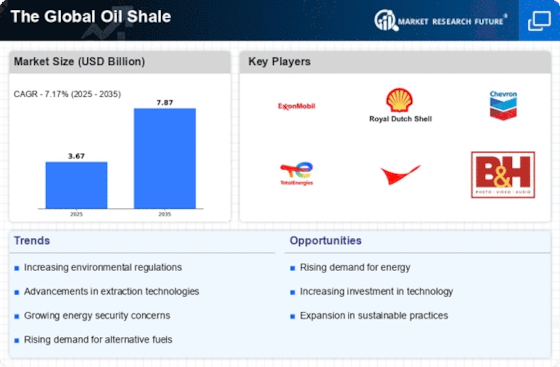
As per Market Research Future analysis, The Global Oil Shale Market Size was estimated at 3.675 USD Billion in 2024. The oil shale industry is projected to grow from 3.939 USD Billion in 2025 to 7.872 USD Billion by 2035, exhibiting a compound annual growth rate (CAGR) of 7.17% during the forecast period 2025 - 2035

Key Market Trends & Highlights

The Global Oil Shale Market is poised for growth driven by technological advancements and increasing energy demands.

  • Technological advancements in extraction methods are enhancing efficiency and reducing costs in the North American market. The Asia-Pacific region is experiencing rapid growth, driven by rising energy demands and a focus on energy security. The extraction segment remains the largest, while the retorting segment is emerging as the fastest-growing due to innovative processing techniques. Rising energy demand and supportive government policies are key drivers propelling the market forward.

Market Size & Forecast

2024 Market Size 3.675 (USD Billion)
2035 Market Size 7.872 (USD Billion)
CAGR (2025 - 2035) 7.17%
Largest Regional Market Share in 2024 North America

Major Players

ExxonMobil (US), Royal Dutch Shell (GB), Chevron (US), TotalEnergies (FR), ConocoPhillips (US), BHP (AU), EOG Resources (US), Pioneer Natural Resources (US), Suncor Energy (CA)

Market Trends

The Global Oil Shale Market is currently experiencing a period of transformation, driven by advancements in extraction technologies and a growing emphasis on energy security. As nations seek to diversify their energy portfolios, oil shale presents a viable alternative to conventional fossil fuels. This market appears to be gaining traction, particularly in regions rich in oil shale deposits, where governments are incentivizing exploration and production. The interplay between environmental concerns and the need for energy independence is shaping the landscape, leading to increased investment in sustainable extraction methods. Moreover, The Global Oil Shale Market is likely to witness a shift in consumer preferences, as stakeholders become more aware of the environmental implications of fossil fuel consumption. This awareness may drive innovation in cleaner extraction techniques and promote the development of oil shale as a more sustainable energy source. The market's future seems to hinge on balancing economic viability with ecological responsibility, suggesting that companies operating within this sector must adapt to evolving regulatory frameworks and public sentiment. As the world transitions towards a more sustainable energy future, the role of oil shale could become increasingly pivotal, potentially reshaping energy dynamics on a global scale.

Technological Advancements in Extraction Methods

Recent innovations in extraction technologies are enhancing the efficiency and sustainability of oil shale production. These advancements may lead to reduced environmental impacts and lower operational costs, making oil shale a more attractive option for energy generation.

Increased Focus on Energy Security

As geopolitical tensions and supply chain vulnerabilities persist, nations are prioritizing energy security. This trend is likely to drive investments in domestic oil shale resources, allowing countries to reduce dependence on foreign energy supplies.

Growing Environmental Awareness

The rising consciousness regarding climate change and environmental degradation is influencing the oil shale sector. Stakeholders are increasingly advocating for cleaner extraction practices, which could reshape industry standards and consumer expectations.

Oil Shale Market Market Drivers

Rising Energy Demand

The increasing The Global Oil Shale Industry. As populations grow and economies expand, the need for energy sources intensifies. According to recent estimates, energy consumption is projected to rise by approximately 30% by 2040. This surge in demand compels nations to explore alternative energy sources, including oil shale, which is abundant in various regions. The Oil Shale Market is likely to benefit from this trend, as countries seek to diversify their energy portfolios and reduce reliance on conventional fossil fuels. Furthermore, the strategic importance of oil shale resources may lead to increased investments in extraction technologies, thereby enhancing production capabilities and market growth.

Government Policies and Incentives

Government policies and incentives play a crucial role in shaping the Oil Shale Market. Many countries are implementing favorable regulations to promote the development of unconventional oil resources, including oil shale. For instance, tax incentives, subsidies, and research grants are being offered to companies engaged in oil shale exploration and production. These initiatives aim to stimulate investment and innovation in extraction technologies, which could lead to more efficient and environmentally friendly methods. As a result, the Oil Shale Market is likely to experience growth driven by supportive governmental frameworks that encourage sustainable energy practices and enhance energy independence.

Investment in Research and Development

Investment in research and development is a key driver for the Oil Shale Market. As the demand for cleaner and more efficient energy sources grows, companies and governments are allocating resources to innovate and improve oil shale extraction and processing methods. This focus on R&D is likely to yield breakthroughs that enhance the economic feasibility of oil shale projects. For instance, advancements in carbon capture and storage technologies could mitigate environmental concerns associated with oil shale production. Consequently, the Oil Shale Market stands to benefit from increased investment in R&D, which may lead to more sustainable practices and greater market acceptance.

Technological Innovations in Processing

Technological innovations in processing techniques are transforming the Oil Shale Market. Advances in extraction and processing technologies, such as in-situ retorting and solvent extraction, are enhancing the efficiency and economic viability of oil shale production. These innovations not only reduce operational costs but also minimize environmental impacts associated with traditional extraction methods. The market is witnessing a shift towards more sustainable practices, which could attract investment and foster growth. As companies adopt these cutting-edge technologies, the Oil Shale Market is expected to expand, providing a reliable source of energy while addressing environmental concerns.

Geopolitical Factors and Resource Accessibility

Geopolitical factors significantly influence the Oil Shale Market, particularly in regions rich in oil shale deposits. The accessibility of these resources is often affected by political stability, trade relations, and regulatory environments. Countries with abundant oil shale reserves may leverage these resources to enhance their energy security and reduce dependence on imported oil. This strategic positioning can lead to increased exploration and production activities, thereby driving market growth. Additionally, geopolitical tensions may prompt nations to invest in domestic oil shale development as a means of ensuring energy independence, further bolstering the Oil Shale Market.

Market Segment Insights

By Process: Extraction (Largest) vs. Retorting (Fastest-Growing)

In The Global Oil Shale Market, the extraction segment (mining) has established itself as the largest contributor. This segment accounts for significant share due to the ongoing demand for oil production and the need for raw materials derived from oil shale. Retorting follows as the fastest-growing segment, driven by advancements in technology and increasing investments in the enhancement of retorting processes, which facilitate the transformation of oil shale into usable oil.

Extraction (Dominant) vs. Retorting (Emerging)

The extraction segment is characterized by established mining practices and techniques, leading to large-scale production capabilities. Its dominance in the market stems from the necessity of acquiring raw oil shale, which serves as the basis for oil production. On the other hand, retorting is emerging as a critical process fueled by technological enhancements and innovations. As methods improve and become more efficient, retorting is expected to capture a larger market share, reflecting the industry's pivot towards cleaner and more efficient conversion techniques, ultimately widening its application in the oil shale sector.

By Method: In-Situ (Largest) vs. Ex-Situ (Fastest-Growing)

In The Global Oil Shale Market, the distribution of market share between the In-Situ and Ex-Situ methods reveals a clear dominance of In-Situ techniques. In-Situ processes, characterized by their ability to minimize environmental disruption and lower operational costs, continue to hold the largest share in the market. Meanwhile, the Ex-Situ method is increasingly gaining traction, driven by advancements in processing technologies that enhance its efficiency and yield. As oil demand fluctuates, these methods present varying advantages that cater to diverse operational needs in oil shale extraction, positioning them distinctly within the market landscape.

Method: In-Situ (Dominant) vs. Ex-Situ (Emerging)

In-Situ extraction is marked by its favored efficiency and reduced environmental footprints, permitting oil recovery directly from the ground without extensive surface disturbance. This method leverages thermal processes to convert kerogen within the shale into crude oil, thus capitalizing on existing geological formations. Conversely, the Ex-Situ method is beginning to emerge rapidly, operating by mining the oil shale and processing it above ground. This method, while traditionally less popular, has seen substantial innovations that promise improved recovery rates and operational viability. The ongoing advancements suggest that Ex-Situ could complement or compete with In-Situ techniques amidst shifting market conditions.

By Product: Gasoline (Largest) vs. Diesel (Fastest-Growing)

In The Global Oil Shale Market, the product segmentation reveals that gasoline dominates market share, accounting for a substantial portion of oil shale production. This dominance is primarily due to the high demand for gasoline in transportation and personal vehicles across the globe. Diesel follows, representing a significant but smaller share, primarily driven by its utilities in commercial transport and logistics sectors. Kerosene and other products contribute to the market but hold lesser shares compared to gasoline and diesel. Looking into growth trends, diesel is currently the fastest-growing segment in the oil shale market, attributed to the increased usage of diesel engines in transportation and industrial activities. Factors such as environmental regulations promoting cleaner fuels and the push for energy efficiency are also propelling diesel's demand. On the other hand, gasoline remains steadfast as the market leader, although its growth is more stable compared to the rapidly expanding diesel segment.

Gasoline (Dominant) vs. Kerosene (Emerging)

Gasoline remains the dominant product in The Global Oil Shale Market due to its extensive applications and high consumer demand. It is preferred for its efficiency and availability, making it the go-to fuel for personal and commercial vehicles. As an established player, gasoline benefits from widespread infrastructure and distribution networks. On the other hand, kerosene is emerging as a relevant segment, particularly in developing regions where it is often used for heating and cooking. Its growth is supported by the increasing need for accessible energy sources in rural areas. While gasoline enjoys the status of a market leader, kerosene's market position is evolving, influenced by trends in energy consumption and environmental sustainability.

By End User: Automobile Fuel (Largest) vs. Chemical Industry (Fastest-Growing)

In The Global Oil Shale Market, the end user segment shows diverse applications, with automobile fuel leading as the dominant application. This segment significantly captures the market share as the demand for alternative fuels rises amidst stringent environmental regulations and the transition to cleaner energy sources. The <a href="https://www.marketresearchfuture.com/reports/global-chemical-industry-33564">chemical industry</a> follows suit, leveraging oil shale for various chemical feedstocks, thereby presenting a substantial portion of the market.

Automobile Fuel (Dominant) vs. Chemical Industry (Emerging)

The automobile fuel segment remains the cornerstone of The Global Oil Shale Market, driven by an increasing preference for energy independence and sustainable fuel alternatives. This segment is characterized by its robust infrastructure for extraction and processing, gaining traction due to advances in technology enhancing oil yield from shale deposits. Conversely, the chemical industry presents an emerging opportunity, utilizing oil shale to produce essential chemicals while adapting to evolving regulations. As innovation in shale extraction and processing techniques continues to evolve, the chemical industry is expected to grow rapidly, reflecting a strategic shift towards utilizing unconventional resources.

Get more detailed insights about Oil Shale Market Research Report—Global Forecast till 2035

Regional Insights

By Region, the study segments the market into North America, Europe, Asia-Pacific and Latin America and Middle East & Africa.

North America dominates the world market where the United States has significant oil shale resources, primarily within the Green River Formation in Wyoming, Utah and Colorado. According to EIA, oil shale resources underlie a total area of 16,000 square miles and represent the largest known concentration of oil shale in the world and have become the largest exporter of oil shale.

In Europe countries like Russia have a wide range of oil shale resources and are also big exporters of oil shale. According to the EIA report, Russia has a 75 billion barrels share of oil resources and is also a major exporter of oil shale after the USA.

Further, the major countries studied are The USA, Canada, Germany, France, UK, Italy, Spain, China, Japan, India, Australia, Argentina, Brazil, Mexico, South Africa and GCC countries.

Key Players and Competitive Insights

Major market players are focusing on the R&D of the oil shale to refine it so to make it more efficient fuel to use. Majorly companies are also been focused on the extraction of the oil shale from the rocks as it is not an easy process to extract and a lot of water is been polluted in the extraction. New technology in In-Situ like fracturing in which oil is converted into the ground itself and then pumped out, in this process there is no need to extract rock and crush them. New advance technologies fracturing of rocks is done so to extract the oil more efficiently. ExxonMobil Corporation (ExxonMobil) is an American multinational oil & gas corporation. It performs crude oil refinement, makes lube base stocks and finished lubricants, transports, trades, and sells petroleum products. Additionally, the business produces and sells a wide range of specialty goods in addition to commodity petrochemicals such olefins, aromatics, polyethylene, and polypropylene plastics. High-performance fuels and lubricant products made by ExxonMobil power global transportation, increase efficiency, and lower the entire life-cycle emissions of our clients. It runs through a network of production facilities, transit hubs, and distribution facilities. North America, Latin America, Asia Pacific, Europe, the Middle East, and Africa are all operational regions for the company. Chevron Corporation (Chevron) is an integrated oil & gas company. It operates along the whole value chain of the oil & gas industry, from exploration and production to storage and pipeline transportation to refining, marketing, and distribution of oil and gas products. With quality base oils as their foundation, Chevron lubricants has more than 30 years of experience producing finished lubricants. Customers on five continents rely on Chevron lubricants to deliver great, dependable performance in a variety of operating circumstances, whether they need motor oil for the family car or lubricants for heavy industrial equipment. The company also sells petrochemicals and additives. The company searches for, produces, and transports crude oil and natural gas. It also refines, markets, and distributes transportation fuels and lubricants. In the areas where it operates, Chevron has stakes in gas-to-liquid facilities. North America, South America, Europe, Asia, the Middle East, and Africa are all operational hubs for the organization.

Key Companies in the Oil Shale Market include

Industry Developments

  • Q3 2025: Milbank LLP is advising YPF S.A. in connection with its definitive agreement with Total Austral S.A., an affiliate of TotalEnergies, to acquire a 45% interest in Rincón La Ceniza and La Escalonada, two unconventional oil and gas blocks located in Argentina, for $500 million. YPF S.A. signed a definitive agreement to acquire a 45% stake in two unconventional oil and gas blocks in Argentina from Total Austral S.A., for $500 million, expanding its presence in the oil shale sector.
  • Q3 2025: EOG Resources today announced a definitive agreement to acquire Encino Acquisition Partners (EAP) for $5.6 billion. EOG Resources agreed to acquire Encino Acquisition Partners for $5.6 billion, adding 675,000 net acres in the Utica shale play and significantly increasing its undeveloped resource base.
  • Q3 2025: Occidental has raised $950 million through recent Permian asset sales and repaid $7.5 billion in debt since July 2024, continuing its post-CrownRock strategy to streamline operations and strengthen its balance sheet. Occidental Petroleum completed $950 million in Permian asset sales and repaid $7.5 billion in debt, as part of its ongoing strategy to optimize its shale portfolio and improve financial stability.
  • Q3 2025: Civitas Resources has sold $435 million in non-core DJ Basin assets and named Wouter van Kempen as interim CEO, aligning its portfolio strategy with leadership changes and a focus on debt reduction and shareholder value. Civitas Resources divested $435 million in non-core DJ Basin assets and appointed Wouter van Kempen as interim CEO, reflecting a strategic shift in its shale operations and leadership.
  • Q4 2024: Matterhorn Express Pipeline, which began transporting natural gas in October 2024, is expected to alleviate some bottlenecks. The Matterhorn Express Pipeline commenced operations in October 2024, increasing takeaway capacity for natural gas from the Permian Basin and addressing infrastructure bottlenecks in shale production.

Future Outlook

Oil Shale Market Future Outlook

The Global Oil Shale Market is projected to grow at a 7.17% CAGR from 2025 to 2035, driven by technological advancements, increasing energy demand, and environmental considerations.

New opportunities lie in:

  • <p>Investment in advanced extraction technologies to enhance yield efficiency. Development of sustainable oil shale processing methods to reduce environmental impact. Expansion into emerging markets with untapped oil shale reserves.</p>

By 2035, the market is expected to solidify its position as a key energy source.

Market Segmentation

Oil Shale Market Method Outlook

  • In-Situ
  • Ex-Situ

Oil Shale Market Process Outlook

  • Extraction (mining)
  • Retorting
  • Refining

Oil Shale Market Product Outlook

  • Gasoline
  • Diesel
  • Kerosene
  • Others

Oil Shale Market End User Outlook

  • Automobile Fuel
  • Chemical Industry
  • Cement Industry
  • Others

Report Scope

MARKET SIZE 2024 3.675(USD Billion)
MARKET SIZE 2025 3.939(USD Billion)
MARKET SIZE 2035 7.872(USD Billion)
COMPOUND ANNUAL GROWTH RATE (CAGR) 7.17% (2025 - 2035)
REPORT COVERAGE Revenue Forecast, Competitive Landscape, Growth Factors, and Trends
BASE YEAR 2024
Market Forecast Period 2025 - 2035
Historical Data 2019 - 2024
Market Forecast Units USD Billion
Key Companies Profiled ExxonMobil (US), Royal Dutch Shell (GB), Chevron (US), TotalEnergies (FR), ConocoPhillips (US), BHP (AU), EOG Resources (US), Pioneer Natural Resources (US), Suncor Energy (CA)
Segments Covered Process, Method, Product, End Users, Region
Key Market Opportunities Advancements in extraction technologies enhance efficiency in The Global Oil Shale.
Key Market Dynamics Technological advancements in extraction methods are reshaping competitive dynamics within the oil shale market.
Countries Covered North America, Europe, APAC, South America, MEA

FAQs

What is the projected market valuation of The Global Oil Shale by 2035?

<p>The projected market valuation for The Global Oil Shale is 7.872 USD Billion by 2035.</p>

What was the market valuation of The Global Oil Shale in 2024?

<p>The overall market valuation of The Global Oil Shale was 3.675 USD Billion in 2024.</p>

What is the expected CAGR for The Global Oil Shale during the forecast period 2025 - 2035?

<p>The expected CAGR for The Global Oil Shale during the forecast period 2025 - 2035 is 7.17%.</p>

Which companies are considered key players in The Global Oil Shale?

<p>Key players in The Global Oil Shale include ExxonMobil, Royal Dutch Shell, Chevron, TotalEnergies, ConocoPhillips, BHP, EOG Resources, Pioneer Natural Resources, and Suncor Energy.</p>

What are the main segments of The Global Oil Shale?

<p>The main segments of The Global Oil Shale include Process, Method, Product, and End User.</p>

What was the valuation for the Extraction segment in The Global Oil Shale in 2024?

<p>The valuation for the Extraction segment in The Global Oil Shale was 1.5 USD Billion in 2024.</p>

What is the projected valuation for the In-Situ method by 2035?

<p>The projected valuation for the In-Situ method in The Global Oil Shale is 4.5 USD Billion by 2035.</p>

How much is the Gasoline product segment expected to be valued at by 2035?

<p>The Gasoline product segment is expected to be valued at 3.2 USD Billion by 2035.</p>

What is the projected valuation for the Chemical Industry end user segment by 2035?

<p>The projected valuation for the Chemical Industry end user segment is 2.5 USD Billion by 2035.</p>

What was the valuation for the Retorting process segment in 2024?

<p>The valuation for the Retorting process segment in The Global Oil Shale was 1.2 USD Billion in 2024.</p>

  1. SECTION I: EXECUTIVE SUMMARY AND KEY HIGHLIGHTS
    1. | 1.1 EXECUTIVE SUMMARY
    2. | | 1.1.1 Market Overview
    3. | | 1.1.2 Key Findings
    4. | | 1.1.3 Market Segmentation
    5. | | 1.1.4 Competitive Landscape
    6. | | 1.1.5 Challenges and Opportunities
    7. | | 1.1.6 Future Outlook
  2. SECTION II: SCOPING, METHODOLOGY AND MARKET STRUCTURE
    1. | 2.1 MARKET INTRODUCTION
    2. | | 2.1.1 Definition
    3. | | 2.1.2 Scope of the study
    4. | | | 2.1.2.1 Research Objective
    5. | | | 2.1.2.2 Assumption
    6. | | | 2.1.2.3 Limitations
    7. | 2.2 RESEARCH METHODOLOGY
    8. | | 2.2.1 Overview
    9. | | 2.2.2 Data Mining
    10. | | 2.2.3 Secondary Research
    11. | | 2.2.4 Primary Research
    12. | | | 2.2.4.1 Primary Interviews and Information Gathering Process
    13. | | | 2.2.4.2 Breakdown of Primary Respondents
    14. | | 2.2.5 Forecasting Model
    15. | | 2.2.6 Market Size Estimation
    16. | | | 2.2.6.1 Bottom-Up Approach
    17. | | | 2.2.6.2 Top-Down Approach
    18. | | 2.2.7 Data Triangulation
    19. | | 2.2.8 Validation
  3. SECTION III: QUALITATIVE ANALYSIS
    1. | 3.1 MARKET DYNAMICS
    2. | | 3.1.1 Overview
    3. | | 3.1.2 Drivers
    4. | | 3.1.3 Restraints
    5. | | 3.1.4 Opportunities
    6. | 3.2 MARKET FACTOR ANALYSIS
    7. | | 3.2.1 Value chain Analysis
    8. | | 3.2.2 Porter's Five Forces Analysis
    9. | | | 3.2.2.1 Bargaining Power of Suppliers
    10. | | | 3.2.2.2 Bargaining Power of Buyers
    11. | | | 3.2.2.3 Threat of New Entrants
    12. | | | 3.2.2.4 Threat of Substitutes
    13. | | | 3.2.2.5 Intensity of Rivalry
    14. | | 3.2.3 COVID-19 Impact Analysis
    15. | | | 3.2.3.1 Market Impact Analysis
    16. | | | 3.2.3.2 Regional Impact
    17. | | | 3.2.3.3 Opportunity and Threat Analysis
  4. SECTION IV: QUANTITATIVE ANALYSIS
    1. | 4.1 Chemicals and Materials, BY Process (USD Billion)
    2. | | 4.1.1 Extraction (mining)
    3. | | 4.1.2 Retorting
    4. | | 4.1.3 Refining
    5. | 4.2 Chemicals and Materials, BY Method (USD Billion)
    6. | | 4.2.1 In-Situ
    7. | | 4.2.2 Ex-Situ
    8. | 4.3 Chemicals and Materials, BY Product (USD Billion)
    9. | | 4.3.1 Gasoline
    10. | | 4.3.2 Diesel
    11. | | 4.3.3 Kerosene
    12. | | 4.3.4 Others
    13. | 4.4 Chemicals and Materials, BY End User (USD Billion)
    14. | | 4.4.1 Automobile Fuel
    15. | | 4.4.2 Chemical Industry
    16. | | 4.4.3 Cement Industry
    17. | | 4.4.4 Others
    18. | 4.5 Chemicals and Materials, BY Region (USD Billion)
    19. | | 4.5.1 North America
    20. | | | 4.5.1.1 US
    21. | | | 4.5.1.2 Canada
    22. | | 4.5.2 Europe
    23. | | | 4.5.2.1 Germany
    24. | | | 4.5.2.2 UK
    25. | | | 4.5.2.3 France
    26. | | | 4.5.2.4 Russia
    27. | | | 4.5.2.5 Italy
    28. | | | 4.5.2.6 Spain
    29. | | | 4.5.2.7 Rest of Europe
    30. | | 4.5.3 APAC
    31. | | | 4.5.3.1 China
    32. | | | 4.5.3.2 India
    33. | | | 4.5.3.3 Japan
    34. | | | 4.5.3.4 South Korea
    35. | | | 4.5.3.5 Malaysia
    36. | | | 4.5.3.6 Thailand
    37. | | | 4.5.3.7 Indonesia
    38. | | | 4.5.3.8 Rest of APAC
    39. | | 4.5.4 South America
    40. | | | 4.5.4.1 Brazil
    41. | | | 4.5.4.2 Mexico
    42. | | | 4.5.4.3 Argentina
    43. | | | 4.5.4.4 Rest of South America
    44. | | 4.5.5 MEA
    45. | | | 4.5.5.1 GCC Countries
    46. | | | 4.5.5.2 South Africa
    47. | | | 4.5.5.3 Rest of MEA
  5. SECTION V: COMPETITIVE ANALYSIS
    1. | 5.1 Competitive Landscape
    2. | | 5.1.1 Overview
    3. | | 5.1.2 Competitive Analysis
    4. | | 5.1.3 Market share Analysis
    5. | | 5.1.4 Major Growth Strategy in the Chemicals and Materials
    6. | | 5.1.5 Competitive Benchmarking
    7. | | 5.1.6 Leading Players in Terms of Number of Developments in the Chemicals and Materials
    8. | | 5.1.7 Key developments and growth strategies
    9. | | | 5.1.7.1 New Product Launch/Service Deployment
    10. | | | 5.1.7.2 Merger & Acquisitions
    11. | | | 5.1.7.3 Joint Ventures
    12. | | 5.1.8 Major Players Financial Matrix
    13. | | | 5.1.8.1 Sales and Operating Income
    14. | | | 5.1.8.2 Major Players R&D Expenditure. 2023
    15. | 5.2 Company Profiles
    16. | | 5.2.1 ExxonMobil (US)
    17. | | | 5.2.1.1 Financial Overview
    18. | | | 5.2.1.2 Products Offered
    19. | | | 5.2.1.3 Key Developments
    20. | | | 5.2.1.4 SWOT Analysis
    21. | | | 5.2.1.5 Key Strategies
    22. | | 5.2.2 Royal Dutch Shell (GB)
    23. | | | 5.2.2.1 Financial Overview
    24. | | | 5.2.2.2 Products Offered
    25. | | | 5.2.2.3 Key Developments
    26. | | | 5.2.2.4 SWOT Analysis
    27. | | | 5.2.2.5 Key Strategies
    28. | | 5.2.3 Chevron (US)
    29. | | | 5.2.3.1 Financial Overview
    30. | | | 5.2.3.2 Products Offered
    31. | | | 5.2.3.3 Key Developments
    32. | | | 5.2.3.4 SWOT Analysis
    33. | | | 5.2.3.5 Key Strategies
    34. | | 5.2.4 TotalEnergies (FR)
    35. | | | 5.2.4.1 Financial Overview
    36. | | | 5.2.4.2 Products Offered
    37. | | | 5.2.4.3 Key Developments
    38. | | | 5.2.4.4 SWOT Analysis
    39. | | | 5.2.4.5 Key Strategies
    40. | | 5.2.5 ConocoPhillips (US)
    41. | | | 5.2.5.1 Financial Overview
    42. | | | 5.2.5.2 Products Offered
    43. | | | 5.2.5.3 Key Developments
    44. | | | 5.2.5.4 SWOT Analysis
    45. | | | 5.2.5.5 Key Strategies
    46. | | 5.2.6 BHP (AU)
    47. | | | 5.2.6.1 Financial Overview
    48. | | | 5.2.6.2 Products Offered
    49. | | | 5.2.6.3 Key Developments
    50. | | | 5.2.6.4 SWOT Analysis
    51. | | | 5.2.6.5 Key Strategies
    52. | | 5.2.7 EOG Resources (US)
    53. | | | 5.2.7.1 Financial Overview
    54. | | | 5.2.7.2 Products Offered
    55. | | | 5.2.7.3 Key Developments
    56. | | | 5.2.7.4 SWOT Analysis
    57. | | | 5.2.7.5 Key Strategies
    58. | | 5.2.8 Pioneer Natural Resources (US)
    59. | | | 5.2.8.1 Financial Overview
    60. | | | 5.2.8.2 Products Offered
    61. | | | 5.2.8.3 Key Developments
    62. | | | 5.2.8.4 SWOT Analysis
    63. | | | 5.2.8.5 Key Strategies
    64. | | 5.2.9 Suncor Energy (CA)
    65. | | | 5.2.9.1 Financial Overview
    66. | | | 5.2.9.2 Products Offered
    67. | | | 5.2.9.3 Key Developments
    68. | | | 5.2.9.4 SWOT Analysis
    69. | | | 5.2.9.5 Key Strategies
    70. | 5.3 Appendix
    71. | | 5.3.1 References
    72. | | 5.3.2 Related Reports
  6. LIST OF FIGURES
    1. | 6.1 MARKET SYNOPSIS
    2. | 6.2 NORTH AMERICA MARKET ANALYSIS
    3. | 6.3 US MARKET ANALYSIS BY PROCESS
    4. | 6.4 US MARKET ANALYSIS BY METHOD
    5. | 6.5 US MARKET ANALYSIS BY PRODUCT
    6. | 6.6 US MARKET ANALYSIS BY END USER
    7. | 6.7 CANADA MARKET ANALYSIS BY PROCESS
    8. | 6.8 CANADA MARKET ANALYSIS BY METHOD
    9. | 6.9 CANADA MARKET ANALYSIS BY PRODUCT
    10. | 6.10 CANADA MARKET ANALYSIS BY END USER
    11. | 6.11 EUROPE MARKET ANALYSIS
    12. | 6.12 GERMANY MARKET ANALYSIS BY PROCESS
    13. | 6.13 GERMANY MARKET ANALYSIS BY METHOD
    14. | 6.14 GERMANY MARKET ANALYSIS BY PRODUCT
    15. | 6.15 GERMANY MARKET ANALYSIS BY END USER
    16. | 6.16 UK MARKET ANALYSIS BY PROCESS
    17. | 6.17 UK MARKET ANALYSIS BY METHOD
    18. | 6.18 UK MARKET ANALYSIS BY PRODUCT
    19. | 6.19 UK MARKET ANALYSIS BY END USER
    20. | 6.20 FRANCE MARKET ANALYSIS BY PROCESS
    21. | 6.21 FRANCE MARKET ANALYSIS BY METHOD
    22. | 6.22 FRANCE MARKET ANALYSIS BY PRODUCT
    23. | 6.23 FRANCE MARKET ANALYSIS BY END USER
    24. | 6.24 RUSSIA MARKET ANALYSIS BY PROCESS
    25. | 6.25 RUSSIA MARKET ANALYSIS BY METHOD
    26. | 6.26 RUSSIA MARKET ANALYSIS BY PRODUCT
    27. | 6.27 RUSSIA MARKET ANALYSIS BY END USER
    28. | 6.28 ITALY MARKET ANALYSIS BY PROCESS
    29. | 6.29 ITALY MARKET ANALYSIS BY METHOD
    30. | 6.30 ITALY MARKET ANALYSIS BY PRODUCT
    31. | 6.31 ITALY MARKET ANALYSIS BY END USER
    32. | 6.32 SPAIN MARKET ANALYSIS BY PROCESS
    33. | 6.33 SPAIN MARKET ANALYSIS BY METHOD
    34. | 6.34 SPAIN MARKET ANALYSIS BY PRODUCT
    35. | 6.35 SPAIN MARKET ANALYSIS BY END USER
    36. | 6.36 REST OF EUROPE MARKET ANALYSIS BY PROCESS
    37. | 6.37 REST OF EUROPE MARKET ANALYSIS BY METHOD
    38. | 6.38 REST OF EUROPE MARKET ANALYSIS BY PRODUCT
    39. | 6.39 REST OF EUROPE MARKET ANALYSIS BY END USER
    40. | 6.40 APAC MARKET ANALYSIS
    41. | 6.41 CHINA MARKET ANALYSIS BY PROCESS
    42. | 6.42 CHINA MARKET ANALYSIS BY METHOD
    43. | 6.43 CHINA MARKET ANALYSIS BY PRODUCT
    44. | 6.44 CHINA MARKET ANALYSIS BY END USER
    45. | 6.45 INDIA MARKET ANALYSIS BY PROCESS
    46. | 6.46 INDIA MARKET ANALYSIS BY METHOD
    47. | 6.47 INDIA MARKET ANALYSIS BY PRODUCT
    48. | 6.48 INDIA MARKET ANALYSIS BY END USER
    49. | 6.49 JAPAN MARKET ANALYSIS BY PROCESS
    50. | 6.50 JAPAN MARKET ANALYSIS BY METHOD
    51. | 6.51 JAPAN MARKET ANALYSIS BY PRODUCT
    52. | 6.52 JAPAN MARKET ANALYSIS BY END USER
    53. | 6.53 SOUTH KOREA MARKET ANALYSIS BY PROCESS
    54. | 6.54 SOUTH KOREA MARKET ANALYSIS BY METHOD
    55. | 6.55 SOUTH KOREA MARKET ANALYSIS BY PRODUCT
    56. | 6.56 SOUTH KOREA MARKET ANALYSIS BY END USER
    57. | 6.57 MALAYSIA MARKET ANALYSIS BY PROCESS
    58. | 6.58 MALAYSIA MARKET ANALYSIS BY METHOD
    59. | 6.59 MALAYSIA MARKET ANALYSIS BY PRODUCT
    60. | 6.60 MALAYSIA MARKET ANALYSIS BY END USER
    61. | 6.61 THAILAND MARKET ANALYSIS BY PROCESS
    62. | 6.62 THAILAND MARKET ANALYSIS BY METHOD
    63. | 6.63 THAILAND MARKET ANALYSIS BY PRODUCT
    64. | 6.64 THAILAND MARKET ANALYSIS BY END USER
    65. | 6.65 INDONESIA MARKET ANALYSIS BY PROCESS
    66. | 6.66 INDONESIA MARKET ANALYSIS BY METHOD
    67. | 6.67 INDONESIA MARKET ANALYSIS BY PRODUCT
    68. | 6.68 INDONESIA MARKET ANALYSIS BY END USER
    69. | 6.69 REST OF APAC MARKET ANALYSIS BY PROCESS
    70. | 6.70 REST OF APAC MARKET ANALYSIS BY METHOD
    71. | 6.71 REST OF APAC MARKET ANALYSIS BY PRODUCT
    72. | 6.72 REST OF APAC MARKET ANALYSIS BY END USER
    73. | 6.73 SOUTH AMERICA MARKET ANALYSIS
    74. | 6.74 BRAZIL MARKET ANALYSIS BY PROCESS
    75. | 6.75 BRAZIL MARKET ANALYSIS BY METHOD
    76. | 6.76 BRAZIL MARKET ANALYSIS BY PRODUCT
    77. | 6.77 BRAZIL MARKET ANALYSIS BY END USER
    78. | 6.78 MEXICO MARKET ANALYSIS BY PROCESS
    79. | 6.79 MEXICO MARKET ANALYSIS BY METHOD
    80. | 6.80 MEXICO MARKET ANALYSIS BY PRODUCT
    81. | 6.81 MEXICO MARKET ANALYSIS BY END USER
    82. | 6.82 ARGENTINA MARKET ANALYSIS BY PROCESS
    83. | 6.83 ARGENTINA MARKET ANALYSIS BY METHOD
    84. | 6.84 ARGENTINA MARKET ANALYSIS BY PRODUCT
    85. | 6.85 ARGENTINA MARKET ANALYSIS BY END USER
    86. | 6.86 REST OF SOUTH AMERICA MARKET ANALYSIS BY PROCESS
    87. | 6.87 REST OF SOUTH AMERICA MARKET ANALYSIS BY METHOD
    88. | 6.88 REST OF SOUTH AMERICA MARKET ANALYSIS BY PRODUCT
    89. | 6.89 REST OF SOUTH AMERICA MARKET ANALYSIS BY END USER
    90. | 6.90 MEA MARKET ANALYSIS
    91. | 6.91 GCC COUNTRIES MARKET ANALYSIS BY PROCESS
    92. | 6.92 GCC COUNTRIES MARKET ANALYSIS BY METHOD
    93. | 6.93 GCC COUNTRIES MARKET ANALYSIS BY PRODUCT
    94. | 6.94 GCC COUNTRIES MARKET ANALYSIS BY END USER
    95. | 6.95 SOUTH AFRICA MARKET ANALYSIS BY PROCESS
    96. | 6.96 SOUTH AFRICA MARKET ANALYSIS BY METHOD
    97. | 6.97 SOUTH AFRICA MARKET ANALYSIS BY PRODUCT
    98. | 6.98 SOUTH AFRICA MARKET ANALYSIS BY END USER
    99. | 6.99 REST OF MEA MARKET ANALYSIS BY PROCESS
    100. | 6.100 REST OF MEA MARKET ANALYSIS BY METHOD
    101. | 6.101 REST OF MEA MARKET ANALYSIS BY PRODUCT
    102. | 6.102 REST OF MEA MARKET ANALYSIS BY END USER
    103. | 6.103 KEY BUYING CRITERIA OF CHEMICALS AND MATERIALS
    104. | 6.104 RESEARCH PROCESS OF MRFR
    105. | 6.105 DRO ANALYSIS OF CHEMICALS AND MATERIALS
    106. | 6.106 DRIVERS IMPACT ANALYSIS: CHEMICALS AND MATERIALS
    107. | 6.107 RESTRAINTS IMPACT ANALYSIS: CHEMICALS AND MATERIALS
    108. | 6.108 SUPPLY / VALUE CHAIN: CHEMICALS AND MATERIALS
    109. | 6.109 CHEMICALS AND MATERIALS, BY PROCESS, 2024 (% SHARE)
    110. | 6.110 CHEMICALS AND MATERIALS, BY PROCESS, 2024 TO 2035 (USD Billion)
    111. | 6.111 CHEMICALS AND MATERIALS, BY METHOD, 2024 (% SHARE)
    112. | 6.112 CHEMICALS AND MATERIALS, BY METHOD, 2024 TO 2035 (USD Billion)
    113. | 6.113 CHEMICALS AND MATERIALS, BY PRODUCT, 2024 (% SHARE)
    114. | 6.114 CHEMICALS AND MATERIALS, BY PRODUCT, 2024 TO 2035 (USD Billion)
    115. | 6.115 CHEMICALS AND MATERIALS, BY END USER, 2024 (% SHARE)
    116. | 6.116 CHEMICALS AND MATERIALS, BY END USER, 2024 TO 2035 (USD Billion)
    117. | 6.117 BENCHMARKING OF MAJOR COMPETITORS
  7. LIST OF TABLES
    1. | 7.1 LIST OF ASSUMPTIONS
    2. | | 7.1.1
    3. | 7.2 North America MARKET SIZE ESTIMATES; FORECAST
    4. | | 7.2.1 BY PROCESS, 2025-2035 (USD Billion)
    5. | | 7.2.2 BY METHOD, 2025-2035 (USD Billion)
    6. | | 7.2.3 BY PRODUCT, 2025-2035 (USD Billion)
    7. | | 7.2.4 BY END USER, 2025-2035 (USD Billion)
    8. | 7.3 US MARKET SIZE ESTIMATES; FORECAST
    9. | | 7.3.1 BY PROCESS, 2025-2035 (USD Billion)
    10. | | 7.3.2 BY METHOD, 2025-2035 (USD Billion)
    11. | | 7.3.3 BY PRODUCT, 2025-2035 (USD Billion)
    12. | | 7.3.4 BY END USER, 2025-2035 (USD Billion)
    13. | 7.4 Canada MARKET SIZE ESTIMATES; FORECAST
    14. | | 7.4.1 BY PROCESS, 2025-2035 (USD Billion)
    15. | | 7.4.2 BY METHOD, 2025-2035 (USD Billion)
    16. | | 7.4.3 BY PRODUCT, 2025-2035 (USD Billion)
    17. | | 7.4.4 BY END USER, 2025-2035 (USD Billion)
    18. | 7.5 Europe MARKET SIZE ESTIMATES; FORECAST
    19. | | 7.5.1 BY PROCESS, 2025-2035 (USD Billion)
    20. | | 7.5.2 BY METHOD, 2025-2035 (USD Billion)
    21. | | 7.5.3 BY PRODUCT, 2025-2035 (USD Billion)
    22. | | 7.5.4 BY END USER, 2025-2035 (USD Billion)
    23. | 7.6 Germany MARKET SIZE ESTIMATES; FORECAST
    24. | | 7.6.1 BY PROCESS, 2025-2035 (USD Billion)
    25. | | 7.6.2 BY METHOD, 2025-2035 (USD Billion)
    26. | | 7.6.3 BY PRODUCT, 2025-2035 (USD Billion)
    27. | | 7.6.4 BY END USER, 2025-2035 (USD Billion)
    28. | 7.7 UK MARKET SIZE ESTIMATES; FORECAST
    29. | | 7.7.1 BY PROCESS, 2025-2035 (USD Billion)
    30. | | 7.7.2 BY METHOD, 2025-2035 (USD Billion)
    31. | | 7.7.3 BY PRODUCT, 2025-2035 (USD Billion)
    32. | | 7.7.4 BY END USER, 2025-2035 (USD Billion)
    33. | 7.8 France MARKET SIZE ESTIMATES; FORECAST
    34. | | 7.8.1 BY PROCESS, 2025-2035 (USD Billion)
    35. | | 7.8.2 BY METHOD, 2025-2035 (USD Billion)
    36. | | 7.8.3 BY PRODUCT, 2025-2035 (USD Billion)
    37. | | 7.8.4 BY END USER, 2025-2035 (USD Billion)
    38. | 7.9 Russia MARKET SIZE ESTIMATES; FORECAST
    39. | | 7.9.1 BY PROCESS, 2025-2035 (USD Billion)
    40. | | 7.9.2 BY METHOD, 2025-2035 (USD Billion)
    41. | | 7.9.3 BY PRODUCT, 2025-2035 (USD Billion)
    42. | | 7.9.4 BY END USER, 2025-2035 (USD Billion)
    43. | 7.10 Italy MARKET SIZE ESTIMATES; FORECAST
    44. | | 7.10.1 BY PROCESS, 2025-2035 (USD Billion)
    45. | | 7.10.2 BY METHOD, 2025-2035 (USD Billion)
    46. | | 7.10.3 BY PRODUCT, 2025-2035 (USD Billion)
    47. | | 7.10.4 BY END USER, 2025-2035 (USD Billion)
    48. | 7.11 Spain MARKET SIZE ESTIMATES; FORECAST
    49. | | 7.11.1 BY PROCESS, 2025-2035 (USD Billion)
    50. | | 7.11.2 BY METHOD, 2025-2035 (USD Billion)
    51. | | 7.11.3 BY PRODUCT, 2025-2035 (USD Billion)
    52. | | 7.11.4 BY END USER, 2025-2035 (USD Billion)
    53. | 7.12 Rest of Europe MARKET SIZE ESTIMATES; FORECAST
    54. | | 7.12.1 BY PROCESS, 2025-2035 (USD Billion)
    55. | | 7.12.2 BY METHOD, 2025-2035 (USD Billion)
    56. | | 7.12.3 BY PRODUCT, 2025-2035 (USD Billion)
    57. | | 7.12.4 BY END USER, 2025-2035 (USD Billion)
    58. | 7.13 APAC MARKET SIZE ESTIMATES; FORECAST
    59. | | 7.13.1 BY PROCESS, 2025-2035 (USD Billion)
    60. | | 7.13.2 BY METHOD, 2025-2035 (USD Billion)
    61. | | 7.13.3 BY PRODUCT, 2025-2035 (USD Billion)
    62. | | 7.13.4 BY END USER, 2025-2035 (USD Billion)
    63. | 7.14 China MARKET SIZE ESTIMATES; FORECAST
    64. | | 7.14.1 BY PROCESS, 2025-2035 (USD Billion)
    65. | | 7.14.2 BY METHOD, 2025-2035 (USD Billion)
    66. | | 7.14.3 BY PRODUCT, 2025-2035 (USD Billion)
    67. | | 7.14.4 BY END USER, 2025-2035 (USD Billion)
    68. | 7.15 India MARKET SIZE ESTIMATES; FORECAST
    69. | | 7.15.1 BY PROCESS, 2025-2035 (USD Billion)
    70. | | 7.15.2 BY METHOD, 2025-2035 (USD Billion)
    71. | | 7.15.3 BY PRODUCT, 2025-2035 (USD Billion)
    72. | | 7.15.4 BY END USER, 2025-2035 (USD Billion)
    73. | 7.16 Japan MARKET SIZE ESTIMATES; FORECAST
    74. | | 7.16.1 BY PROCESS, 2025-2035 (USD Billion)
    75. | | 7.16.2 BY METHOD, 2025-2035 (USD Billion)
    76. | | 7.16.3 BY PRODUCT, 2025-2035 (USD Billion)
    77. | | 7.16.4 BY END USER, 2025-2035 (USD Billion)
    78. | 7.17 South Korea MARKET SIZE ESTIMATES; FORECAST
    79. | | 7.17.1 BY PROCESS, 2025-2035 (USD Billion)
    80. | | 7.17.2 BY METHOD, 2025-2035 (USD Billion)
    81. | | 7.17.3 BY PRODUCT, 2025-2035 (USD Billion)
    82. | | 7.17.4 BY END USER, 2025-2035 (USD Billion)
    83. | 7.18 Malaysia MARKET SIZE ESTIMATES; FORECAST
    84. | | 7.18.1 BY PROCESS, 2025-2035 (USD Billion)
    85. | | 7.18.2 BY METHOD, 2025-2035 (USD Billion)
    86. | | 7.18.3 BY PRODUCT, 2025-2035 (USD Billion)
    87. | | 7.18.4 BY END USER, 2025-2035 (USD Billion)
    88. | 7.19 Thailand MARKET SIZE ESTIMATES; FORECAST
    89. | | 7.19.1 BY PROCESS, 2025-2035 (USD Billion)
    90. | | 7.19.2 BY METHOD, 2025-2035 (USD Billion)
    91. | | 7.19.3 BY PRODUCT, 2025-2035 (USD Billion)
    92. | | 7.19.4 BY END USER, 2025-2035 (USD Billion)
    93. | 7.20 Indonesia MARKET SIZE ESTIMATES; FORECAST
    94. | | 7.20.1 BY PROCESS, 2025-2035 (USD Billion)
    95. | | 7.20.2 BY METHOD, 2025-2035 (USD Billion)
    96. | | 7.20.3 BY PRODUCT, 2025-2035 (USD Billion)
    97. | | 7.20.4 BY END USER, 2025-2035 (USD Billion)
    98. | 7.21 Rest of APAC MARKET SIZE ESTIMATES; FORECAST
    99. | | 7.21.1 BY PROCESS, 2025-2035 (USD Billion)
    100. | | 7.21.2 BY METHOD, 2025-2035 (USD Billion)
    101. | | 7.21.3 BY PRODUCT, 2025-2035 (USD Billion)
    102. | | 7.21.4 BY END USER, 2025-2035 (USD Billion)
    103. | 7.22 South America MARKET SIZE ESTIMATES; FORECAST
    104. | | 7.22.1 BY PROCESS, 2025-2035 (USD Billion)
    105. | | 7.22.2 BY METHOD, 2025-2035 (USD Billion)
    106. | | 7.22.3 BY PRODUCT, 2025-2035 (USD Billion)
    107. | | 7.22.4 BY END USER, 2025-2035 (USD Billion)
    108. | 7.23 Brazil MARKET SIZE ESTIMATES; FORECAST
    109. | | 7.23.1 BY PROCESS, 2025-2035 (USD Billion)
    110. | | 7.23.2 BY METHOD, 2025-2035 (USD Billion)
    111. | | 7.23.3 BY PRODUCT, 2025-2035 (USD Billion)
    112. | | 7.23.4 BY END USER, 2025-2035 (USD Billion)
    113. | 7.24 Mexico MARKET SIZE ESTIMATES; FORECAST
    114. | | 7.24.1 BY PROCESS, 2025-2035 (USD Billion)
    115. | | 7.24.2 BY METHOD, 2025-2035 (USD Billion)
    116. | | 7.24.3 BY PRODUCT, 2025-2035 (USD Billion)
    117. | | 7.24.4 BY END USER, 2025-2035 (USD Billion)
    118. | 7.25 Argentina MARKET SIZE ESTIMATES; FORECAST
    119. | | 7.25.1 BY PROCESS, 2025-2035 (USD Billion)
    120. | | 7.25.2 BY METHOD, 2025-2035 (USD Billion)
    121. | | 7.25.3 BY PRODUCT, 2025-2035 (USD Billion)
    122. | | 7.25.4 BY END USER, 2025-2035 (USD Billion)
    123. | 7.26 Rest of South America MARKET SIZE ESTIMATES; FORECAST
    124. | | 7.26.1 BY PROCESS, 2025-2035 (USD Billion)
    125. | | 7.26.2 BY METHOD, 2025-2035 (USD Billion)
    126. | | 7.26.3 BY PRODUCT, 2025-2035 (USD Billion)
    127. | | 7.26.4 BY END USER, 2025-2035 (USD Billion)
    128. | 7.27 MEA MARKET SIZE ESTIMATES; FORECAST
    129. | | 7.27.1 BY PROCESS, 2025-2035 (USD Billion)
    130. | | 7.27.2 BY METHOD, 2025-2035 (USD Billion)
    131. | | 7.27.3 BY PRODUCT, 2025-2035 (USD Billion)
    132. | | 7.27.4 BY END USER, 2025-2035 (USD Billion)
    133. | 7.28 GCC Countries MARKET SIZE ESTIMATES; FORECAST
    134. | | 7.28.1 BY PROCESS, 2025-2035 (USD Billion)
    135. | | 7.28.2 BY METHOD, 2025-2035 (USD Billion)
    136. | | 7.28.3 BY PRODUCT, 2025-2035 (USD Billion)
    137. | | 7.28.4 BY END USER, 2025-2035 (USD Billion)
    138. | 7.29 South Africa MARKET SIZE ESTIMATES; FORECAST
    139. | | 7.29.1 BY PROCESS, 2025-2035 (USD Billion)
    140. | | 7.29.2 BY METHOD, 2025-2035 (USD Billion)
    141. | | 7.29.3 BY PRODUCT, 2025-2035 (USD Billion)
    142. | | 7.29.4 BY END USER, 2025-2035 (USD Billion)
    143. | 7.30 Rest of MEA MARKET SIZE ESTIMATES; FORECAST
    144. | | 7.30.1 BY PROCESS, 2025-2035 (USD Billion)
    145. | | 7.30.2 BY METHOD, 2025-2035 (USD Billion)
    146. | | 7.30.3 BY PRODUCT, 2025-2035 (USD Billion)
    147. | | 7.30.4 BY END USER, 2025-2035 (USD Billion)
    148. | 7.31 PRODUCT LAUNCH/PRODUCT DEVELOPMENT/APPROVAL
    149. | | 7.31.1
    150. | 7.32 ACQUISITION/PARTNERSHIP
    151. | | 7.32.1

Chemicals and Materials Market Segmentation

Chemicals and Materials By Process (USD Billion, 2025-2035)

  • Extraction (mining)
  • Retorting
  • Refining

Chemicals and Materials By Method (USD Billion, 2025-2035)

  • In-Situ
  • Ex-Situ

Chemicals and Materials By Product (USD Billion, 2025-2035)

  • Gasoline
  • Diesel
  • Kerosene
  • Others

Chemicals and Materials By End User (USD Billion, 2025-2035)

  • Automobile Fuel
  • Chemical Industry
  • Cement Industry
  • Others
Infographic

Free Sample Request

Kindly complete the form below to receive a free sample of this Report

Get Free Sample

Customer Strories

Compare Licence

×
Features License Type
Single User Multiuser License Enterprise User
Price $4,950 $5,950 $7,250
Maximum User Access Limit 1 User Upto 10 Users Unrestricted Access Throughout the Organization
Free Customization
Direct Access to Analyst
Deliverable Format
Platform Access
Discount on Next Purchase 10% 15% 15%
Printable Versions