×
Request Free Sample ×

Kindly complete the form below to receive a free sample of this Report

* Please use a valid business email

Leading companies partner with us for data-driven Insights

clients tt-cursor
Hero Background
English
Chinese
French
Japanese
Korean
German
Spanish

Offshore Supply Vessels Market Analysis

ID: MRFR/EnP/1535-CR
128 Pages
Anshula Mandaokar
March 2024

Offshore Supply Vessels Market Size, Share & Growth Analysis Report By Type (Anchor Handling Tug Supply Vessel, Platform Supply Vessel, Multipurpose Support Vessel, Standby & Rescue Vessel, Seismic Vessel, Others), By Application (Shallow Water, Deep Water) and By Region (North America, Europe, Asia Pacific, Latin America, Middle East & Africa) - Trends & Industry Forecast to 2035

Share:
Download PDF ×

We do not share your information with anyone. However, we may send you emails based on your report interest from time to time. You may contact us at any time to opt-out.

Offshore Supply Vessels Market Infographic
×
Offshore Supply Vessels Market Infographic Full View
Purchase Options

Market Analysis

Offshore Supply Vessels Market (Global, 2024)

Introduction

Offshore Supply Vessels market is set to play a key role in supporting the growing offshore oil and gas industry and expanding offshore wind farms. In this market, the demand for specialized vessels capable of transporting supplies, equipment and personnel to offshore platforms is becoming increasingly critical. The market is characterized by a wide range of vessel types, including platform supply vessels, anchor-handling tug supply vessels and crew boats, each of which is designed to meet specific operational requirements. The constant technological improvements, coupled with a growing emphasis on efficiency and the environment, are driving innovation in the market. Moreover, the prevailing political and regulatory climate, the fluctuation in energy prices and the impact of technological developments are all influencing the market, requiring a detailed understanding of the trends and challenges faced by the industry. The Offshore Supply Vessels market is set to undergo significant changes as it adapts to these complexities, thereby reflecting the broader shifts in global energy consumption and production.

PESTLE Analysis

Political
In 2024, the market for offshore supply vessels will be influenced mainly by political tensions, particularly in the regions of the world with large oil and gas reserves. The United States, for example, has allocated $ 1 billion to the strengthening of the security of the seas in the Gulf of Mexico. This will have a direct impact on the offshore supply vessels' operational environment. In addition, the European Union has imposed stricter regulations on ship emissions. It requires a reduction of greenhouse gas emissions by ships by at least 55 per cent by 2030. This will affect the operating costs and compliance costs of the companies operating in this field.
Economic
In 2024, the world economy had recovered from the pandemic, with oil prices fluctuating around $ 75 a barrel. It was this price that was of prime importance to the offshore supply industry, because it directly influenced offshore drilling and production. The International Maritime Organization reported that the average daily operating costs for offshore support vessels had risen to about $ 15,000. This increase was largely due to higher fuel and maintenance costs, which shipowners needed to take into account in their budgeting.
Social
The market for offshore supply vessels is increasingly influenced by the environment and the drive for sustainable development. In 2024, the survey shows that 68% of consumers are more likely to support companies that show commitment to reducing their carbon footprint. This trend is leading operators to invest in hybrid systems, which can cost up to $2 million per vessel, in order to meet the requirements of consumers and the pressure from the authorities.
Technological
Offshore supply vessels are being transformed by technological innovations. In 2024, the number of vessels with some level of automation is expected to increase to about 30% of newbuildings. This development is driven by the potential for savings in crew costs, which can be up to a million dollars per year per vessel. In addition, improvements in satellite communications have made it possible to send more data in real time, thus increasing operational efficiency and safety in offshore operations.
Legal
The legal framework governing offshore supply vessels is becoming more and more complex, with new regulations being enacted to meet the demands of safety and the environment. In 2024 the International Maritime Organization (IMO) introduced a new set of regulations for offshore vessels, the International Safety Management Code, which affected more than 10,000 vessels worldwide. It is now a matter of international law that if a vessel does not comply with the regulations, the fines can reach more than $500,000.
Environmental
The international regulations on the environment are tightened up in 2024. The International Maritime Organization fixes a limit of 0.5% on the sulfur content of fuel oil used for shipping. This regulation has a major impact on the market for offshore supply ships. The operators are forced to switch to low-sulfur fuels, which can increase the cost of fuel by up to 20 per cent. The trend towards greater environmental consciousness also increases the investment in eco-friendly technology. The maritime industry is expected to invest about three billion dollars over the next five years in research and development of green technology.

Porter's Five Forces

Threat of New Entrants
Barriers to entry: The offshore supply vessels market has a medium barrier to entry because of the significant investment needed for building and maintaining vessels. Also, the need for compliance with regulations and for maritime skills may deter new entrants. The growing demand for offshore energy resources may, however, attract new players to the market, thereby increasing competition.
Bargaining Power of Suppliers
The bargaining power of suppliers on the market for offshore supply vessels is relatively low. There are a large number of suppliers of the materials and components needed for shipbuilding and repair, which weakens their bargaining power. Also, the use of standard equipment further weakens their position and enables shipowners to obtain good terms.
Bargaining Power of Buyers
In the offshore support market, buyers have considerable power over suppliers because of the presence of many service suppliers and the ease with which customers can change between them. High competition among the shipowners means that prices are sensitive, and buyers can use this to negotiate a better contract. Also, the increasing demand for cost-effective solutions further increases the power of buyers.
Threat of Substitutes
The threat of substitutes in the offshore supply vessel market is moderate. There are several alternatives for transporting personnel and goods, such as helicopters or transport from land. But these alternatives may not be as efficient or cost-effective in offshore operations. However, technological development and alternative energy sources may represent a threat to the traditional offshore supply vessel.
Competitive Rivalry
Competition in the offshore supply vessel market is high, driven by numerous competitors vying for market share. Price competition is intense, and service differentiation is important to meet changing customer requirements. Competition will remain high as companies continue to seek to improve the capabilities and efficiency of their fleets.

SWOT Analysis

Strengths

  • Established infrastructure and logistics for offshore operations.
  • Diverse fleet capabilities catering to various sectors such as oil, gas, and renewable energy.
  • Strong demand driven by increasing offshore exploration and production activities.

Weaknesses

  • High operational costs and maintenance expenses.
  • Vulnerability to fluctuations in oil prices affecting demand.
  • Limited availability of skilled workforce in specialized maritime operations.

Opportunities

  • Growth in renewable energy projects, particularly offshore wind farms.
  • Technological advancements leading to more efficient vessel designs.
  • Expansion into emerging markets with untapped offshore resources.

Threats

  • Intensifying competition from alternative energy sources.
  • Regulatory changes and environmental concerns impacting operations.
  • Geopolitical tensions affecting offshore exploration activities.

Summary

In 2024, the offshore supply vessels market is characterized by strong demand and well-established service facilities. However, challenges such as high operating costs and market volatility have to be faced. Opportunities include the development of offshore wind and technological progress. Threats include competition from alternative energy sources and regulatory requirements. Strategically, innovation and market development could increase the resilience and profitability.

Author
Anshula Mandaokar
Team Lead - Research

Anshula Mandaokar holds an academic degree in Chemical Engineering and has been contributing to the field for more than 5 years. She has expertise in Market Research and Business Consulting and serves as a Team Lead for a reputed Market Research firm under the Chemicals and Materials domain spectrum. She has worked on multiple projects, generating explicit results in a quick turnaround time. Her understanding of data interpretation justifies her role as a leader.

Leave a Comment

FAQs

How much is the Offshore Supply Vessels Market?

Offshore Supply Vessels Market Size is US$ 12,071.94 Mn in 2023.

What is the growth rate of the Offshore Supply Vessels Market?

Growth rate of the Offshore Supply Vessels Market is 5.94% by 2032.

Which region held the largest market share in the Offshore Supply Vessels Market?

North America region held the largest market share in the Offshore Supply Vessels Market.

Who are the key players in the Offshore Supply Vessels Market?

key players in the Offshore Supply Vessels Market are: A.P. Moller - Maersk AS (Denmark), Siem Offshore AS (Norway), SEACOR Marine (US), Tidewater (US), Solstad Farstad (Norway), Bourbon Offshore (France), Havila Shipping (Norway), Vroon B. V. (Netherlands), Edison Chouest Offshore (US), Abdon Callais Offshore LLC (US)

Which Type had the largest market share in the Offshore Supply Vessels Market?

Anchor Handling Tug Supply Vessel Type had the largest market share in the Offshore Supply Vessels Market.

Which Application had the largest market share in the Offshore Supply Vessels Market?

Shallow Water Application had the largest market share in the Offshore Supply Vessels Market.

Market Summary

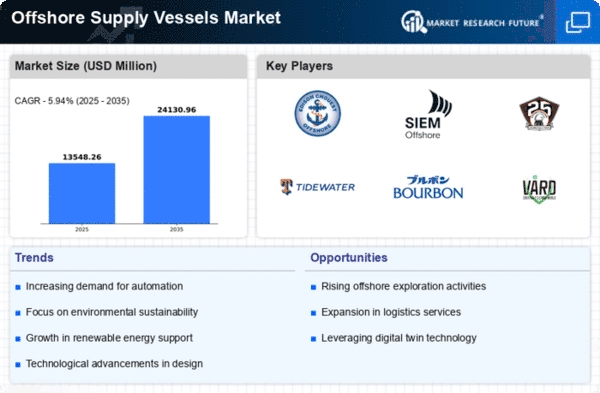
As per MRFR analysis, the Offshore Supply Vessels Market Size was estimated at 12788.62 USD Million in 2024. The Offshore Supply Vessels industry is projected to grow from 13548.52 in 2025 to 24130.96 by 2035, exhibiting a compound annual growth rate (CAGR) of 5.94 during the forecast period 2025 - 2035.

Key Market Trends & Highlights

The Offshore Supply Vessels Market is poised for growth driven by technological advancements and sustainability initiatives.

  • North America remains the largest market for offshore supply vessels, primarily due to its extensive oil and gas exploration activities. The Asia-Pacific region is emerging as the fastest-growing market, fueled by increasing investments in renewable energy projects. The oil and gas exploration segment continues to dominate the market, while the crew boat segment is experiencing rapid growth. Key market drivers include the rising demand for energy resources and the expansion of offshore wind energy projects.

Market Size & Forecast

2024 Market Size 12788.62 (USD Million)
2035 Market Size 24130.96 (USD Million)
CAGR (2025 - 2035) 5.94%
Largest Regional Market Share in 2024 North America

Major Players

Edison Chouest Offshore (US), Siem Offshore (NO), Hornbeck Offshore Services (US), Tidewater Inc. (US), Bourbon Corporation (FR), Vard Group (NO), Swire Pacific Offshore (SG), DOF Subsea (NO), Seacor Marine Holdings (US)

Market Trends

The Offshore Supply Vessels Market is currently experiencing a dynamic evolution, driven by various factors that shape its landscape. The demand for offshore supply vessels is closely linked to the activities in the oil and gas sector, as well as renewable energy initiatives. As exploration and production activities expand into deeper waters, the need for specialized vessels that can support these operations becomes increasingly critical. Furthermore, advancements in technology are enhancing the capabilities of these vessels, allowing for more efficient and safer operations. This trend suggests a growing emphasis on innovation within the industry, which may lead to the development of more sophisticated vessel designs and functionalities. In addition to technological advancements, environmental considerations are becoming paramount in the Offshore Supply Vessels Market. Regulatory frameworks are evolving to promote sustainability, compelling operators to adopt greener practices. This shift may result in a gradual transition towards vessels that utilize alternative fuels and incorporate energy-efficient designs. As stakeholders prioritize environmental responsibility, the market could witness a rise in demand for vessels that align with these values. Overall, the Offshore Supply Vessels Market appears poised for growth, influenced by technological progress and a commitment to sustainability.

Technological Advancements

The Offshore Supply Vessels Market is witnessing a surge in technological innovations that enhance operational efficiency. These advancements include automation, improved navigation systems, and enhanced safety features. Such developments not only streamline operations but also reduce costs, making vessels more competitive in the market.

Sustainability Initiatives

There is a growing trend towards sustainability within the Offshore Supply Vessels Market. Operators are increasingly adopting eco-friendly practices, driven by regulatory pressures and market demand for greener solutions. This shift may lead to the development of vessels that utilize alternative energy sources and incorporate sustainable materials.

Market Diversification

The Offshore Supply Vessels Market is diversifying as it expands beyond traditional oil and gas applications. The rise of renewable energy projects, such as offshore wind farms, is creating new opportunities for supply vessels. This diversification indicates a broader scope for market growth and the potential for new service offerings.

Offshore Supply Vessels Market Market Drivers

Market Growth Projections

The Global Offshore Supply Vessels Market Industry is poised for substantial growth, with projections indicating a market value of 12.8 USD Billion in 2024 and an anticipated increase to 24.1 USD Billion by 2035. The compound annual growth rate is expected to be 5.94% from 2025 to 2035, reflecting the industry's resilience and adaptability to changing market dynamics. This growth trajectory is influenced by various factors, including technological advancements, regulatory support, and increasing demand for offshore energy solutions.

Increasing Demand for Renewable Energy

The Global Offshore Supply Vessels Market Industry is experiencing a notable surge in demand due to the increasing focus on renewable energy sources, particularly offshore wind farms. Governments worldwide are investing heavily in renewable energy projects, which necessitate the use of specialized vessels for the transportation of equipment and personnel. For instance, the European Union aims to generate 300 GW of offshore wind energy by 2030, driving the need for offshore supply vessels. This trend is expected to contribute significantly to the market's growth, with projections indicating a market value of 12.8 USD Billion in 2024 and a potential rise to 24.1 USD Billion by 2035.

Regulatory Support for Maritime Operations

Regulatory frameworks supporting maritime operations are playing a crucial role in shaping the Global Offshore Supply Vessels Market Industry. Governments are implementing policies that promote safe and efficient maritime practices, which in turn encourages investment in offshore supply vessels. For instance, the International Maritime Organization has established guidelines aimed at reducing greenhouse gas emissions from shipping, prompting vessel operators to upgrade their fleets. This regulatory support not only enhances operational safety but also aligns with global sustainability objectives, fostering a conducive environment for market growth.

Technological Advancements in Vessel Design

Technological innovations in vessel design and construction are propelling the Global Offshore Supply Vessels Market Industry forward. Enhanced vessel capabilities, such as dynamic positioning systems and improved fuel efficiency, are becoming increasingly prevalent. These advancements not only optimize operational efficiency but also reduce environmental impact, aligning with global sustainability goals. For example, the introduction of hybrid vessels is expected to lower emissions significantly. As the industry embraces these technologies, it is likely to attract more investments, thereby supporting the anticipated compound annual growth rate of 5.94% from 2025 to 2035.

Expansion of Offshore Oil and Gas Exploration

The Global Offshore Supply Vessels Market Industry is significantly influenced by the expansion of offshore oil and gas exploration activities. As energy demands continue to rise, companies are increasingly investing in offshore drilling projects, particularly in regions such as the Gulf of Mexico and the North Sea. This expansion necessitates a robust supply chain, including offshore supply vessels for logistics and support. The International Energy Agency projects that offshore oil production will account for a substantial portion of global oil supply, further driving the demand for specialized vessels in this sector.

Rising Investment in Infrastructure Development

The Global Offshore Supply Vessels Market Industry is benefiting from rising investments in infrastructure development, particularly in coastal regions. Governments and private entities are increasingly funding projects that require offshore supply vessels for construction and maintenance. For example, the development of ports and marine terminals necessitates the use of specialized vessels for transporting materials and personnel. This trend is expected to bolster the market, as infrastructure projects are projected to increase significantly in the coming years, creating a steady demand for offshore supply vessels.

Market Segment Insights

By Application: Oil and Gas Exploration (Largest) vs. Renewable Energy Support (Fastest-Growing)

In the Offshore Supply Vessels Market, the oil and gas exploration segment remains the largest, commanding a significant share due to ongoing global demand for energy resources. This segment has a well-established infrastructure, resulting in a steady influx of vessels dedicated to exploration and drilling activities. In contrast, the renewable energy support segment has surfaced as a rapidly growing area, driven by increasing investments in offshore wind farms and solar energy projects, attracting new entrants and innovations in vessel design.

Oil and Gas Exploration (Dominant) vs. Renewable Energy Support (Emerging)

Oil and Gas Exploration is the dominant segment in the Offshore Supply Vessels Market, characterized by a mature fleet of specialized vessels tailored for the demanding nature of exploration and production activities. These vessels are equipped with advanced technology to handle challenging environments. Conversely, Renewable Energy Support represents an emerging segment that is gaining momentum as nations shift towards sustainable energy. The demand for support vessels in this sector is being propelled by government incentives and technological advancements, highlighting a growing transition in maritime operations.

By Vessel Type: Platform Supply Vessel (Largest) vs. Crew Boat (Fastest-Growing)

The Offshore Supply Vessels Market showcases a diverse array of vessel types, each serving unique operational needs within the offshore industry. Among these, the Platform Supply Vessel (PSV) holds the largest market share, primarily due to its versatile capabilities in transporting equipment and supplies to offshore platforms. In contrast, Crew Boats are experiencing significant growth, driven by increasing offshore operations that demand rapid transportation of personnel to and from rigs and installations. Growth trends within the Offshore Supply Vessels segment indicate a rising investment in offshore oil and gas exploration and renewable energy projects. The need for efficient logistical support has further fueled the demand for specialized vessels like Anchor Handling Tug Supply Vessels and Diving Support Vessels. As energy companies expand their offshore operations, the role of these vessels becomes increasingly vital, reflecting a shift towards more robust supply chain solutions within maritime logistics.

Platform Supply Vessel (Dominant) vs. Diving Support Vessel (Emerging)

The Platform Supply Vessel (PSV) is pivotal in the Offshore Supply Vessels market due to its essential role in supporting offshore oil and gas operations, making it the dominant segment. PSVs are designed to carry cargo, equipment, and supplies, making them indispensable for logistical needs in offshore environments. Their specifications enable performance across various weather conditions, enhancing operational efficiency. On the other hand, Diving Support Vessels (DSVs) represent an emerging yet critical segment, tailored for underwater construction and repair tasks. With an increase in subsea activities, the demand for DSVs is on the rise, as they incorporate advanced diving technology and support systems enabling safe and effective underwater operations. This contrast highlights how traditional and emerging vessels are adapting to meet evolving offshore demands.

By End Use: Offshore Oil and Gas Industry (Largest) vs. Renewable Energy Sector (Fastest-Growing)

The Offshore Supply Vessels Market is significantly shaped by its end-use segments, with the Offshore Oil and Gas Industry holding the largest share. This industry continues to dominate due to increasing exploration and production activities in deepwater and ultra-deepwater regions. Meanwhile, the Renewable Energy Sector is emerging rapidly, driven by the growing global shift toward sustainable energy solutions, which emphasizes the need for specialized vessels to support offshore wind farms and marine energy projects. The Marine Research Institutions and Government and Defense sectors also play vital roles, albeit with comparatively smaller shares. Commercial Shipping represents a steady but vital component, ensuring logistical support across these industries.

Offshore Oil and Gas Industry (Dominant) vs. Renewable Energy Sector (Emerging)

The Offshore Oil and Gas Industry is a powerhouse within the Offshore Supply Vessels Market, characterized by its robust demand for a diverse fleet of support vessels, including platform supply vessels, anchor handling tug supply boats, and emergency response vessels. This segment thrives on large-scale offshore drilling operations, necessitating advanced vessel technology and operational efficiency. In contrast, the Renewable Energy Sector is rapidly becoming an emerging player, fueled by increased investments in renewable infrastructure. This sector demands specialized vessels for the installation and maintenance of offshore wind and solar farms, showcasing unique operational requirements such as dynamic positioning and crew transfer capabilities. The competition between these segments represents a dynamic shift in the market landscape.

Get more detailed insights about Offshore Supply Vessels Market Research Report – Forecast to 2035

Regional Insights

North America : Market Leader in Offshore Vessels

North America is poised to maintain its leadership in the Offshore Supply Vessels market, holding a significant market share of 6400.0 in 2024. The region's growth is driven by increasing offshore exploration activities, particularly in the Gulf of Mexico, and a robust regulatory framework that supports sustainable practices. The demand for advanced vessels equipped with cutting-edge technology is also on the rise, further propelling market expansion. The competitive landscape in North America is characterized by key players such as Edison Chouest Offshore, Hornbeck Offshore Services, and Tidewater Inc. These companies are leveraging innovative technologies and strategic partnerships to enhance their service offerings. The presence of a well-established supply chain and infrastructure further strengthens the market position, making North America a hub for offshore supply vessel operations.

Europe : Emerging Market with Growth Potential

Europe's Offshore Supply Vessels market is experiencing significant growth, with a market size of 3500.0. The region benefits from a strong focus on renewable energy projects, particularly offshore wind farms, which are driving demand for specialized vessels. Regulatory support from the European Union aimed at reducing carbon emissions is also a catalyst for market growth, encouraging investments in eco-friendly technologies and practices. Leading countries in this region include Norway, the UK, and France, where companies like Bourbon Corporation and Siem Offshore are prominent. The competitive landscape is evolving, with a mix of established players and new entrants focusing on innovation and sustainability. The presence of advanced shipyards and a skilled workforce further enhances Europe's position in The Offshore Supply Vessels.

Asia-Pacific : Rapidly Growing Offshore Market

The Asia-Pacific region is witnessing rapid growth in the Offshore Supply Vessels market, with a market size of 2500.0. This growth is primarily driven by increasing offshore oil and gas exploration activities, particularly in countries like Australia and India. Additionally, the region's focus on expanding its renewable energy sector, including offshore wind projects, is creating new opportunities for vessel operators. Regulatory frameworks are gradually evolving to support these initiatives, enhancing market prospects. Key players in the Asia-Pacific market include Swire Pacific Offshore and DOF Subsea, which are capitalizing on the growing demand for offshore services. The competitive landscape is marked by a mix of local and international companies, all vying for market share. As investments in infrastructure and technology continue to rise, the region is set to become a significant player in The Offshore Supply Vessels.

Middle East and Africa : Emerging Market with Unique Challenges

The Offshore Supply Vessels market in the Middle East and Africa is relatively nascent, with a market size of 388.62. However, the region is gradually emerging as a key player due to increasing investments in oil and gas exploration, particularly in countries like Nigeria and Saudi Arabia. Regulatory frameworks are being developed to enhance operational efficiency and safety standards, which are crucial for attracting foreign investments and fostering growth. Leading countries in this region include Nigeria and South Africa, where local companies are beginning to establish a foothold in the offshore supply sector. The competitive landscape is characterized by a mix of established firms and new entrants, all aiming to capitalize on the region's untapped potential. As infrastructure improves and regulatory support strengthens, the Middle East and Africa are poised for significant growth in the offshore supply vessel market.

Key Players and Competitive Insights

The Offshore Supply Vessels Market is currently characterized by a dynamic competitive landscape, driven by increasing demand for energy resources and the need for efficient logistics in offshore operations. Key players such as Edison Chouest Offshore (US), Tidewater Inc. (US), and Bourbon Corporation (FR) are strategically positioning themselves through innovation and regional expansion. Edison Chouest Offshore (US) has focused on enhancing its fleet capabilities, while Tidewater Inc. (US) has been investing in digital transformation to optimize operational efficiency. Bourbon Corporation (FR) appears to be leveraging partnerships to expand its service offerings, collectively shaping a competitive environment that emphasizes technological advancement and operational excellence.
In terms of business tactics, companies are increasingly localizing manufacturing and optimizing supply chains to enhance responsiveness to market demands. The market structure is moderately fragmented, with several key players exerting influence over pricing and service standards. This fragmentation allows for niche players to thrive, while larger companies leverage economies of scale to maintain competitive advantages.
In November 2025, Tidewater Inc. (US) announced a strategic partnership with a leading technology firm to integrate AI-driven analytics into its fleet management systems. This move is likely to enhance operational efficiency and reduce costs, positioning Tidewater as a frontrunner in adopting cutting-edge technologies within the sector. The integration of AI could potentially streamline logistics and improve decision-making processes, thereby increasing overall competitiveness.
In October 2025, Bourbon Corporation (FR) expanded its operations in the Asia-Pacific region by acquiring a local supply vessel company. This acquisition is significant as it not only broadens Bourbon's geographical footprint but also enhances its service capabilities in a rapidly growing market. The strategic importance of this move lies in Bourbon's ability to tap into emerging opportunities in offshore energy projects, which are expected to proliferate in the coming years.
In September 2025, Edison Chouest Offshore (US) launched a new class of environmentally friendly supply vessels designed to meet stringent emissions regulations. This initiative reflects a growing trend towards sustainability in the Offshore Supply Vessels Market, as companies seek to align with global environmental standards. The introduction of such vessels may provide Edison Chouest with a competitive edge, appealing to clients prioritizing sustainability in their operations.
As of December 2025, the Offshore Supply Vessels Market is witnessing trends such as digitalization, sustainability, and AI integration, which are redefining competitive dynamics. Strategic alliances are increasingly shaping the landscape, enabling companies to pool resources and expertise. Looking ahead, competitive differentiation is likely to evolve from traditional price-based competition to a focus on innovation, technology, and supply chain reliability. This shift underscores the importance of adaptability and forward-thinking strategies in navigating the complexities of the market.

Key Companies in the Offshore Supply Vessels Market include

Industry Developments

  • Q2 2024: Maersk Supply Service wins major contract for offshore wind farm support in North Sea Maersk Supply Service announced it has secured a multi-year contract to provide offshore support vessels for a new wind farm project in the North Sea, expanding its renewable energy portfolio.
  • Q2 2024: DOF Subsea secures $80 million contract for subsea support vessels in Brazil DOF Subsea revealed it has been awarded an $80 million contract to supply subsea support vessels for Petrobras operations off the coast of Brazil.
  • Q3 2024: Solstad Offshore announces partnership with Equinor for offshore vessel decarbonization Solstad Offshore and Equinor entered a strategic partnership to develop and deploy low-emission offshore support vessels for North Sea operations.
  • Q3 2024: Bourbon Offshore launches new hybrid-electric support vessel Bourbon Offshore unveiled its first hybrid-electric offshore support vessel, designed to reduce emissions and improve operational efficiency in offshore oil and wind projects.
  • Q4 2024: Vroon Offshore Services appoints new CEO to lead fleet modernization Vroon Offshore Services announced the appointment of a new CEO, tasked with overseeing the company's fleet modernization and expansion into renewable energy support.
  • Q4 2024: Siem Offshore secures long-term contract with Shell for North Sea support vessels Siem Offshore reported a new long-term contract with Shell to provide offshore support vessels for North Sea oil and gas operations.
  • Q1 2025: Eidesvik Offshore raises $50 million in new equity funding to expand vessel fleet Eidesvik Offshore completed a $50 million equity funding round to finance the acquisition of new offshore support vessels for both oil and wind projects.
  • Q1 2025: Havila Shipping wins contract for offshore support in Barents Sea Havila Shipping announced it has secured a contract to provide offshore support vessels for exploration activities in the Barents Sea.
  • Q2 2025: Swire Pacific Offshore completes acquisition of two new anchor handling tug supply vessels Swire Pacific Offshore confirmed the acquisition of two new anchor handling tug supply vessels to strengthen its fleet for global offshore operations.
  • Q2 2025: Tidewater Inc. opens new operations center in Singapore to support Asia-Pacific fleet Tidewater Inc. inaugurated a new operations center in Singapore, enhancing its support capabilities for offshore vessels operating in the Asia-Pacific region.
  • Q3 2025: Hornbeck Offshore Services announces $100 million debt refinancing to support fleet renewal Hornbeck Offshore Services completed a $100 million debt refinancing, aimed at funding the renewal and upgrade of its offshore support vessel fleet.
  • Q3 2025: Island Offshore secures contract extension for supply vessels in Norwegian Sea Island Offshore announced a contract extension for its supply vessels supporting oil and gas operations in the Norwegian Sea.

Future Outlook

Offshore Supply Vessels Market Future Outlook

The Offshore Supply Vessels Market is projected to grow at a 5.94% CAGR from 2025 to 2035, driven by increasing offshore exploration and renewable energy investments.

New opportunities lie in:

  • Development of autonomous supply vessels for enhanced operational efficiency.
  • Integration of advanced tracking systems for real-time fleet management.
  • Expansion into emerging markets with untapped offshore resources.

By 2035, the Offshore Supply Vessels Market is expected to be robust, reflecting substantial growth and innovation.

Market Segmentation

Offshore Supply Vessels Market End Use Outlook

  • Offshore Oil and Gas Industry
  • Marine Research Institutions
  • Renewable Energy Sector
  • Government and Defense
  • Commercial Shipping

Offshore Supply Vessels Market Application Outlook

  • Oil and Gas Exploration
  • Renewable Energy Support
  • Subsea Construction
  • Logistics and Supply Chain
  • Research and Survey

Offshore Supply Vessels Market Vessel Type Outlook

  • Platform Supply Vessel
  • Anchor Handling Tug Supply Vessel
  • Multipurpose Supply Vessel
  • Crew Boat
  • Diving Support Vessel

Report Scope

MARKET SIZE 2024 12788.62(USD Million)
MARKET SIZE 2025 13548.52(USD Million)
MARKET SIZE 2035 24130.96(USD Million)
COMPOUND ANNUAL GROWTH RATE (CAGR) 5.94% (2025 - 2035)
REPORT COVERAGE Revenue Forecast, Competitive Landscape, Growth Factors, and Trends
BASE YEAR 2024
Market Forecast Period 2025 - 2035
Historical Data 2019 - 2024
Market Forecast Units USD Million
Key Companies Profiled Edison Chouest Offshore (US), Siem Offshore (NO), Hornbeck Offshore Services (US), Tidewater Inc. (US), Bourbon Corporation (FR), Vard Group (NO), Swire Pacific Offshore (SG), DOF Subsea (NO), Seacor Marine Holdings (US)
Segments Covered Application, Vessel Type, End Use
Key Market Opportunities Integration of advanced automation and digitalization technologies in Offshore Supply Vessels Market operations.
Key Market Dynamics Technological advancements and regulatory changes drive innovation and competition in the Offshore Supply Vessels Market.
Countries Covered North America, Europe, APAC, South America, MEA

FAQs

How much is the Offshore Supply Vessels Market?

Offshore Supply Vessels Market Size is US$ 12,071.94 Mn in 2023.

What is the growth rate of the Offshore Supply Vessels Market?

Growth rate of the Offshore Supply Vessels Market is 5.94% by 2032.

Which region held the largest market share in the Offshore Supply Vessels Market?

North America region held the largest market share in the Offshore Supply Vessels Market.

Who are the key players in the Offshore Supply Vessels Market?

key players in the Offshore Supply Vessels Market are: A.P. Moller - Maersk AS (Denmark), Siem Offshore AS (Norway), SEACOR Marine (US), Tidewater (US), Solstad Farstad (Norway), Bourbon Offshore (France), Havila Shipping (Norway), Vroon B. V. (Netherlands), Edison Chouest Offshore (US), Abdon Callais Offshore LLC (US)

Which Type had the largest market share in the Offshore Supply Vessels Market?

Anchor Handling Tug Supply Vessel Type had the largest market share in the Offshore Supply Vessels Market.

Which Application had the largest market share in the Offshore Supply Vessels Market?

Shallow Water Application had the largest market share in the Offshore Supply Vessels Market.

  1. SECTION I: EXECUTIVE SUMMARY AND KEY HIGHLIGHTS
    1. | 1.1 EXECUTIVE SUMMARY
    2. | 1.1.1 Market Overview
    3. | 1.1.2 Key Findings
    4. | 1.1.3 Market Segmentation
    5. | 1.1.4 Competitive Landscape
    6. | 1.1.5 Challenges and Opportunities
    7. | 1.1.6 Future Outlook
  2. SECTION II: SCOPING, METHODOLOGY AND MARKET STRUCTURE
    1. | 2.1 MARKET INTRODUCTION
    2. | 2.1.1 Definition
    3. | 2.1.2 Scope of the study
    4. |-- 2.1.2.1 Research Objective
    5. |-- 2.1.2.2 Assumption
    6. |-- 2.1.2.3 Limitations
    7. | 2.2 RESEARCH METHODOLOGY
    8. | 2.2.1 Overview
    9. | 2.2.2 Data Mining
    10. | 2.2.3 Secondary Research
    11. | 2.2.4 Primary Research
    12. |-- 2.2.4.1 Primary Interviews and Information Gathering Process
    13. |-- 2.2.4.2 Breakdown of Primary Respondents
    14. | 2.2.5 Forecasting Model
    15. | 2.2.6 Market Size Estimation
    16. |-- 2.2.6.1 Bottom-Up Approach
    17. |-- 2.2.6.2 Top-Down Approach
    18. | 2.2.7 Data Triangulation
    19. | 2.2.8 Validation
  3. SECTION III: QUALITATIVE ANALYSIS
    1. | 3.1 MARKET DYNAMICS
    2. | 3.1.1 Overview
    3. | 3.1.2 Drivers
    4. | 3.1.3 Restraints
    5. | 3.1.4 Opportunities
    6. | 3.2 MARKET FACTOR ANALYSIS
    7. | 3.2.1 Value chain Analysis
    8. | 3.2.2 Porter's Five Forces Analysis
    9. |-- 3.2.2.1 Bargaining Power of Suppliers
    10. |-- 3.2.2.2 Bargaining Power of Buyers
    11. |-- 3.2.2.3 Threat of New Entrants
    12. |-- 3.2.2.4 Threat of Substitutes
    13. |-- 3.2.2.5 Intensity of Rivalry
    14. | 3.2.3 COVID-19 Impact Analysis
    15. |-- 3.2.3.1 Market Impact Analysis
    16. |-- 3.2.3.2 Regional Impact
    17. |-- 3.2.3.3 Opportunity and Threat Analysis
  4. SECTION IV: QUANTITATIVE ANALYSIS
    1. | 4.1 Energy & Power, BY Application (USD Million)
    2. | 4.1.1 Oil and Gas Exploration
    3. | 4.1.2 Renewable Energy Support
    4. | 4.1.3 Subsea Construction
    5. | 4.1.4 Logistics and Supply Chain
    6. | 4.1.5 Research and Survey
    7. | 4.2 Energy & Power, BY Vessel Type (USD Million)
    8. | 4.2.1 Platform Supply Vessel
    9. | 4.2.2 Anchor Handling Tug Supply Vessel
    10. | 4.2.3 Multipurpose Supply Vessel
    11. | 4.2.4 Crew Boat
    12. | 4.2.5 Diving Support Vessel
    13. | 4.3 Energy & Power, BY End Use (USD Million)
    14. | 4.3.1 Offshore Oil and Gas Industry
    15. | 4.3.2 Marine Research Institutions
    16. | 4.3.3 Renewable Energy Sector
    17. | 4.3.4 Government and Defense
    18. | 4.3.5 Commercial Shipping
    19. | 4.4 Energy & Power, BY Region (USD Million)
    20. | 4.4.1 North America
    21. |-- 4.4.1.1 US
    22. |-- 4.4.1.2 Canada
    23. | 4.4.2 Europe
    24. |-- 4.4.2.1 Germany
    25. |-- 4.4.2.2 UK
    26. |-- 4.4.2.3 France
    27. |-- 4.4.2.4 Russia
    28. |-- 4.4.2.5 Italy
    29. |-- 4.4.2.6 Spain
    30. |-- 4.4.2.7 Rest of Europe
    31. | 4.4.3 APAC
    32. |-- 4.4.3.1 China
    33. |-- 4.4.3.2 India
    34. |-- 4.4.3.3 Japan
    35. |-- 4.4.3.4 South Korea
    36. |-- 4.4.3.5 Malaysia
    37. |-- 4.4.3.6 Thailand
    38. |-- 4.4.3.7 Indonesia
    39. |-- 4.4.3.8 Rest of APAC
    40. | 4.4.4 South America
    41. |-- 4.4.4.1 Brazil
    42. |-- 4.4.4.2 Mexico
    43. |-- 4.4.4.3 Argentina
    44. |-- 4.4.4.4 Rest of South America
    45. | 4.4.5 MEA
    46. |-- 4.4.5.1 GCC Countries
    47. |-- 4.4.5.2 South Africa
    48. |-- 4.4.5.3 Rest of MEA
  5. SECTION V: COMPETITIVE ANALYSIS
    1. | 5.1 Competitive Landscape
    2. | 5.1.1 Overview
    3. | 5.1.2 Competitive Analysis
    4. | 5.1.3 Market share Analysis
    5. | 5.1.4 Major Growth Strategy in the Energy & Power
    6. | 5.1.5 Competitive Benchmarking
    7. | 5.1.6 Leading Players in Terms of Number of Developments in the Energy & Power
    8. | 5.1.7 Key developments and growth strategies
    9. |-- 5.1.7.1 New Product Launch/Service Deployment
    10. |-- 5.1.7.2 Merger & Acquisitions
    11. |-- 5.1.7.3 Joint Ventures
    12. | 5.1.8 Major Players Financial Matrix
    13. |-- 5.1.8.1 Sales and Operating Income
    14. |-- 5.1.8.2 Major Players R&D Expenditure. 2023
    15. | 5.2 Company Profiles
    16. | 5.2.1 Edison Chouest Offshore (US)
    17. |-- 5.2.1.1 Financial Overview
    18. |-- 5.2.1.2 Products Offered
    19. |-- 5.2.1.3 Key Developments
    20. |-- 5.2.1.4 SWOT Analysis
    21. |-- 5.2.1.5 Key Strategies
    22. | 5.2.2 Siem Offshore (NO)
    23. |-- 5.2.2.1 Financial Overview
    24. |-- 5.2.2.2 Products Offered
    25. |-- 5.2.2.3 Key Developments
    26. |-- 5.2.2.4 SWOT Analysis
    27. |-- 5.2.2.5 Key Strategies
    28. | 5.2.3 Hornbeck Offshore Services (US)
    29. |-- 5.2.3.1 Financial Overview
    30. |-- 5.2.3.2 Products Offered
    31. |-- 5.2.3.3 Key Developments
    32. |-- 5.2.3.4 SWOT Analysis
    33. |-- 5.2.3.5 Key Strategies
    34. | 5.2.4 Tidewater Inc. (US)
    35. |-- 5.2.4.1 Financial Overview
    36. |-- 5.2.4.2 Products Offered
    37. |-- 5.2.4.3 Key Developments
    38. |-- 5.2.4.4 SWOT Analysis
    39. |-- 5.2.4.5 Key Strategies
    40. | 5.2.5 Bourbon Corporation (FR)
    41. |-- 5.2.5.1 Financial Overview
    42. |-- 5.2.5.2 Products Offered
    43. |-- 5.2.5.3 Key Developments
    44. |-- 5.2.5.4 SWOT Analysis
    45. |-- 5.2.5.5 Key Strategies
    46. | 5.2.6 Vard Group (NO)
    47. |-- 5.2.6.1 Financial Overview
    48. |-- 5.2.6.2 Products Offered
    49. |-- 5.2.6.3 Key Developments
    50. |-- 5.2.6.4 SWOT Analysis
    51. |-- 5.2.6.5 Key Strategies
    52. | 5.2.7 Swire Pacific Offshore (SG)
    53. |-- 5.2.7.1 Financial Overview
    54. |-- 5.2.7.2 Products Offered
    55. |-- 5.2.7.3 Key Developments
    56. |-- 5.2.7.4 SWOT Analysis
    57. |-- 5.2.7.5 Key Strategies
    58. | 5.2.8 DOF Subsea (NO)
    59. |-- 5.2.8.1 Financial Overview
    60. |-- 5.2.8.2 Products Offered
    61. |-- 5.2.8.3 Key Developments
    62. |-- 5.2.8.4 SWOT Analysis
    63. |-- 5.2.8.5 Key Strategies
    64. | 5.2.9 Seacor Marine Holdings (US)
    65. |-- 5.2.9.1 Financial Overview
    66. |-- 5.2.9.2 Products Offered
    67. |-- 5.2.9.3 Key Developments
    68. |-- 5.2.9.4 SWOT Analysis
    69. |-- 5.2.9.5 Key Strategies
    70. | 5.3 Appendix
    71. | 5.3.1 References
    72. | 5.3.2 Related Reports

Energy & Power Market Segmentation

Energy & Power By Application (USD Million, 2025-2035)

  • Oil and Gas Exploration
  • Renewable Energy Support
  • Subsea Construction
  • Logistics and Supply Chain
  • Research and Survey

Energy & Power By Vessel Type (USD Million, 2025-2035)

  • Platform Supply Vessel
  • Anchor Handling Tug Supply Vessel
  • Multipurpose Supply Vessel
  • Crew Boat
  • Diving Support Vessel

Energy & Power By End Use (USD Million, 2025-2035)

  • Offshore Oil and Gas Industry
  • Marine Research Institutions
  • Renewable Energy Sector
  • Government and Defense
  • Commercial Shipping
Infographic

Free Sample Request

Kindly complete the form below to receive a free sample of this Report

Get Free Sample

Customer Strories

Compare Licence

×
Features License Type
Single User Multiuser License Enterprise User
Price $4,950 $5,950 $7,250
Maximum User Access Limit 1 User Upto 10 Users Unrestricted Access Throughout the Organization
Free Customization
Direct Access to Analyst
Deliverable Format
Platform Access
Discount on Next Purchase 10% 15% 15%
Printable Versions