Request Free Sample ×

Kindly complete the form below to receive a free sample of this Report

* Please use a valid business email

Leading companies partner with us for data-driven Insights

clients tt-cursor
Hero Background
English
Chinese
French
Japanese
Korean
German
Spanish

Nuclear Magnetic Resonance Spectrometer Market Share

ID: MRFR/HC/10575-HCR
111 Pages
Satyendra Maurya
April 2026

Nuclear Magnetic Resonance (NMR) Spectrometer Market Research Report Information Product (Instruments and Consumables), Type (Low-field (NMR) Spectroscopy and High-field (NMR) Spectroscopy), End-use (Academic, Pharmaceutical & Biotech Companies, Agriculture & Food, Chemical Industry and Others) And By Region (North America, Europe, Asia-Pacific, And Rest Of The World) –Market Forecast Till 2035

Share:
Download PDF ×

We do not share your information with anyone. However, we may send you emails based on your report interest from time to time. You may contact us at any time to opt-out.

Nuclear Magnetic Resonance Spectrometer Market Infographic
Purchase Options

Market Share

Nuclear Magnetic Resonance Spectrometer Market Share Analysis

Product Differentiation: Technology Advancements: Companies focus on incorporating the latest technological features in their Nuclear Magnetic Resonance (NMR) spectrometers, offering enhanced sensitivity, resolution, and user-friendly interfaces. Application-Specific Models: Tailoring NMR spectrometers for specific applications, such as pharmaceutical research, chemical analysis, or material characterization, helps capture distinct market segments. Cost Leadership: Efficient Manufacturing Processes: Optimizing production workflows and adopting cost-effective manufacturing methods allow companies to offer competitive prices, attracting budget-conscious customers. Economies of Scale: Maximizing production volumes enables cost reduction per unit, giving companies a pricing advantage in the market. Market Segmentation: Industry-Focused Solutions: Identifying and addressing the unique needs of different industries, such as academia, pharmaceuticals, or food and beverage, helps companies tailor NMR spectrometers for specific applications within each sector. Varied Spectrometer Sizes: Offering a range of spectrometer sizes, from benchtop to high-field systems, caters to diverse user requirements and expands market reach. Innovation: Advanced Software Capabilities: Continuous improvement of software functionalities, data analysis algorithms, and automation features enhances the overall performance of NMR spectrometers, attracting research institutions and industries seeking cutting-edge solutions. Integration with Other Technologies: Exploring synergies with complementary technologies, such as mass spectrometry or chromatography, positions companies as providers of comprehensive analytical solutions. Strategic Partnerships: Collaborations with Research Institutions: Partnering with academic and research institutions for joint projects and technology development not only enhances product innovation but also establishes credibility and industry influence. Distribution Agreements: Forming strategic alliances with well-established distributors or entering into partnerships with regional players helps expand market reach and penetration. Brand Building and Marketing: Educational Initiatives: Conducting workshops, webinars, and training programs on NMR spectroscopy builds brand authority and fosters a user community, influencing purchasing decisions. Targeted Marketing Campaigns: Utilizing digital marketing and targeted advertising to highlight product features, customer testimonials, and industry endorsements enhances brand visibility and recognition. Geographical Expansion: Regional Adaptation: Adapting NMR spectrometers to meet regional standards and compliance requirements enables companies to navigate diverse regulatory landscapes. Local Service Support: Establishing a robust network of service and support centers in key geographic locations ensures timely maintenance and customer satisfaction. Customer Relationship Management: After-Sales Support: Offering comprehensive after-sales services, including technical support, training, and maintenance contracts, enhances customer loyalty and encourages repeat business. User Community Engagement: Creating online forums, discussion groups, and knowledge-sharing platforms fosters a sense of community among NMR spectrometer users, facilitating feedback and product improvement. Environmental Sustainability: Green Manufacturing Practices: Embracing eco-friendly manufacturing processes and materials aligns with the growing demand for sustainable solutions in the analytical instruments market. Energy-Efficient Designs: Developing energy-efficient NMR spectrometers reduces the environmental impact and appeals to environmentally conscious customers. Customization Services: Tailored Solutions: Offering customization options, such as specialized probe configurations or unique experimental setups, meets the specific requirements of research projects and industries with unique needs. Consultative Sales Approach: Engaging in consultative sales to understand the specific needs of customers and recommending tailored solutions reinforces customer satisfaction and loyalty.

Author
Author Profile
Satyendra Maurya
Research Analyst

An accomplished research analyst with high proficiency in market forecasting, data visualization, competitive benchmarking, and others. He holds a pronounced track record in research and consulting projects for sectors such as life sciences, medical devices, and healthcare IT. His capabilities in qualitative and quantitative analysis have resulted in positive client outcomes. Working on niche market trends, opportunities, sales, and forecasted value is part of his skill set.

Leave a Comment

FAQs

What is the projected market valuation for the Nuclear Magnetic Resonance (NMR) Spectrometer Market in 2035?

<p>The projected market valuation for the Nuclear Magnetic Resonance (NMR) Spectrometer Market in 2035 is 1.31 USD Billion.</p>

What was the market valuation for the NMR Spectrometer Market in 2024?

<p>The market valuation for the NMR Spectrometer Market in 2024 was 0.7269 USD Billion.</p>

What is the expected CAGR for the NMR Spectrometer Market during the forecast period 2025 - 2035?

<p>The expected CAGR for the NMR Spectrometer Market during the forecast period 2025 - 2035 is 5.5%.</p>

Which companies are considered key players in the NMR Spectrometer Market?

<p>Key players in the NMR Spectrometer Market include Bruker, Thermo Fisher Scientific, Agilent Technologies, JEOL, Oxford Instruments, Magritek, Nanalysis Scientific Corp, and Anasazi Instruments.</p>

What are the two main product segments in the NMR Spectrometer Market?

<p>The two main product segments in the NMR Spectrometer Market are Instruments and Consumables.</p>

What was the valuation of the Instruments segment in 2024?

<p>The valuation of the Instruments segment in 2024 was 0.4369 USD Billion.</p>

How does the valuation of the High-field NMR Spectroscopy segment compare to Low-field NMR Spectroscopy in 2024?

In 2024, the valuation of the High-field NMR Spectroscopy segment was 0.5092 USD Billion, significantly higher than the Low-field segment, which was 0.2177 USD Billion.

What end-use segment had the highest valuation in 2024 within the NMR Spectrometer Market?

The Pharmaceutical &amp; Biotech Companies end-use segment had the highest valuation in 2024, amounting to 0.2908 USD Billion.

What is the projected growth trend for the Consumables segment from 2024 to 2035?

The Consumables segment is projected to grow from 0.29 USD Billion in 2024 to 0.5235 USD Billion by 2035.

Which end-use segment is expected to show the least growth in the NMR Spectrometer Market by 2035?

The Agriculture &amp; Food end-use segment is expected to show the least growth, with a projected valuation of 0.131 USD Billion by 2035.

Market Summary

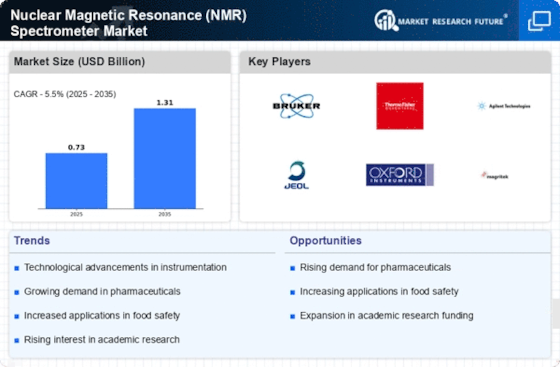
As per Market Research Future analysis, the Nuclear Magnetic Resonance (NMR) Spectrometer Market Size was estimated at 0.7269 USD Billion in 2024. The NMR Spectrometer industry is projected to grow from USD 0.7669 Billion in 2025 to USD 1.31 Billion by 2035, exhibiting a compound annual growth rate (CAGR) of 5.5% during the forecast period 2025 - 2035

Key Market Trends & Highlights

The Nuclear Magnetic Resonance (NMR) Spectrometer Market is poised for growth driven by technological advancements and expanding applications.

  • Technological advancements in NMR systems are enhancing analytical capabilities and precision.
  • The pharmaceutical sector is increasingly adopting NMR spectrometers for drug development and quality control.
  • Compact NMR solutions are gaining traction, particularly in research institutions and laboratories.
  • Rising demand in research institutions and expansion in pharmaceutical applications are key drivers of market growth.

Market Size & Forecast

2024 Market Size 0.7269 (USD Billion)
2035 Market Size 1.31 (USD Billion)
CAGR (2025 - 2035) 5.5%
Largest Regional Market Share in 2024 North America

Major Players

Bruker (DE), Thermo Fisher Scientific (US), Agilent Technologies (US), JEOL (JP), Oxford Instruments (GB), Magritek (NZ), Nanalysis Scientific Corp (CA), Anasazi Instruments (US)

Market Trends

The Nuclear Magnetic Resonance (NMR) Spectrometer Market is currently experiencing a phase of dynamic evolution, driven by advancements in technology and increasing applications across various sectors. The integration of automation and artificial intelligence into NMR systems appears to enhance their efficiency and accuracy, making them more appealing to researchers and industries alike. Furthermore, the growing emphasis on drug discovery and development in pharmaceuticals is likely to propel demand for NMR spectrometers, as these instruments play a crucial role in molecular characterization and analysis. Additionally, the rising focus on quality control in food and beverage industries suggests a potential increase in the adoption of NMR technology for ensuring product safety and compliance with regulatory standards. Moreover, the market landscape is characterized by a shift towards compact and portable NMR spectrometers, which may cater to the needs of smaller laboratories and field applications. This trend indicates a broader accessibility of NMR technology, allowing a wider range of users to benefit from its capabilities. As environmental concerns gain prominence, the development of eco-friendly NMR solutions could also emerge as a significant trend, aligning with global sustainability goals. Overall, the Nuclear Magnetic Resonance (NMR) Spectrometer Market is poised for growth, influenced by technological innovations and evolving user requirements.

Technological Advancements

Recent innovations in NMR technology, including automation and AI integration, are enhancing the performance and usability of spectrometers. These advancements are likely to attract a broader user base, facilitating more efficient research and analysis.

Increased Applications in Pharmaceuticals

The demand for NMR spectrometers is expected to rise due to their critical role in drug discovery and development. As pharmaceutical companies focus on molecular analysis, the relevance of NMR technology in this sector continues to grow.

Shift Towards Compact Solutions

The trend towards smaller, portable NMR spectrometers is becoming more pronounced, making the technology accessible to smaller laboratories and field applications. This shift may democratize the use of NMR, expanding its reach across various industries.

Nuclear Magnetic Resonance Spectrometer Market Market Drivers

Rising Demand in Research Institutions

The Nuclear Magnetic Resonance (NMR) Spectrometer Market is experiencing a notable increase in demand from research institutions. These entities are increasingly utilizing NMR spectrometers for various applications, including structural biology, material science, and chemistry. The ability of NMR to provide detailed molecular information is driving this trend. According to recent data, the market for NMR spectrometers in research settings is projected to grow at a compound annual growth rate of approximately 6.5% over the next few years. This growth is attributed to the need for advanced analytical techniques that can deliver precise results, thereby enhancing research outcomes. As research institutions continue to expand their capabilities, the demand for sophisticated NMR spectrometers is likely to rise, further propelling the market forward.

Expansion in Pharmaceutical Applications

The Nuclear Magnetic Resonance (NMR) Spectrometer Market is significantly influenced by its expanding applications in the pharmaceutical sector. NMR spectrometers are essential for drug discovery, development, and quality control processes. The ability to analyze complex mixtures and determine the structure of compounds makes NMR an invaluable tool in pharmaceuticals. Recent statistics indicate that the pharmaceutical segment accounts for a substantial share of the NMR market, with expectations of continued growth as new drugs are developed. The increasing focus on personalized medicine and the need for rigorous testing protocols are likely to further drive the adoption of NMR technology in this sector. As pharmaceutical companies seek to enhance their research and development capabilities, the demand for advanced NMR spectrometers is anticipated to rise.

Technological Innovations in NMR Systems

Technological innovations are playing a pivotal role in shaping the Nuclear Magnetic Resonance (NMR) Spectrometer Market. Recent advancements in hardware and software have led to the development of more efficient and user-friendly NMR systems. Innovations such as cryoprobes and high-field magnets are enhancing sensitivity and resolution, making NMR a more attractive option for various applications. The introduction of automated systems and advanced data processing software is also streamlining workflows, thereby increasing productivity in laboratories. Market data suggests that these technological advancements are expected to contribute to a growth rate of around 7% in the NMR market over the next few years. As researchers and industries seek to leverage these innovations, the demand for state-of-the-art NMR spectrometers is likely to escalate.

Growing Interest in Food and Beverage Testing

The Nuclear Magnetic Resonance (NMR) Spectrometer Market is witnessing a surge in interest from the food and beverage sector. NMR technology is increasingly being utilized for quality control, authenticity testing, and nutritional analysis of food products. The ability to provide detailed information about the composition of food items is driving this trend. Recent market analysis indicates that the food and beverage segment is expected to grow significantly, with NMR spectrometers being adopted for their non-destructive testing capabilities. As consumers become more health-conscious and demand transparency regarding food ingredients, the need for reliable testing methods is likely to increase. This growing interest in food safety and quality assurance is anticipated to bolster the NMR market in the coming years.

Increased Investment in Analytical Instruments

The Nuclear Magnetic Resonance (NMR) Spectrometer Market is benefiting from increased investment in analytical instruments across various sectors. Governments and private organizations are allocating more resources towards research and development, particularly in fields such as healthcare, environmental science, and materials research. This trend is fostering a favorable environment for the adoption of advanced analytical techniques, including NMR spectroscopy. Market data suggests that the overall investment in analytical instruments is projected to rise, with NMR spectrometers being a key focus due to their versatility and precision. As funding for scientific research continues to grow, the demand for NMR spectrometers is likely to see a corresponding increase, further driving market expansion.

Market Segment Insights

By Product: Instruments (Largest) vs. Consumables (Fastest-Growing)

In the Nuclear Magnetic Resonance (NMR) Spectrometer Market, Instruments represent the largest share of the product segment, encompassing a wide range of advanced spectrometers that are central to research and analytical applications. These instruments are designed for high precision and durability, catering primarily to laboratories and research institutions where reliable performance is essential. On the other hand, Consumables, which include various reagents and sample holders, are experiencing rapid growth as more laboratories adopt NMR technology for diverse applications, driving demand for quality consumables that support effective experimentation.

Instruments (Dominant) vs. Consumables (Emerging)

The Instruments segment in the NMR Spectrometer Market is marked by a robust selection of sophisticated spectrometers that serve as the backbone of NMR analysis. Offering unparalleled resolution and sensitivity, these devices are widely utilized in academic and industrial laboratories. In contrast, the Consumables segment, including reagents, tubes, and kits, is emerging out of increased NMR application versatility across sectors such as pharmaceuticals, materials science, and biological research. The growth of this segment is propelled by the need for specialized consumables that enhance the efficiency and outcomes of NMR experiments, reflecting the shifting dynamics towards supporting technologies that complement core instrumentation.

By Type: Low-field (NMR) Spectroscopy (Largest) vs. High-field (NMR) Spectroscopy (Fastest-Growing)

The Nuclear Magnetic Resonance (NMR) spectrometer market is segmented into Low-field and High-field Spectroscopy types. Currently, Low-field NMR Spectroscopy holds the largest share of the market, favored for its cost-effectiveness and ease of use in various applications, including academic research and quality control. In contrast, High-field NMR Spectroscopy, while having a smaller market share, is rapidly gaining traction due to its superior resolution and sensitivity, making it essential for complex molecular analysis in pharmaceuticals and materials science.

Spectroscopy: Low-field (Dominant) vs. High-field (Emerging)

Low-field NMR Spectroscopy is recognized for its affordability and user-friendly nature, making it a dominant choice among small laboratories and educational institutions. It excels in routine analysis and qualitative assessments, appealing to users with limited budgets. On the other hand, High-field NMR Spectroscopy, characterized by advanced technology and capabilities, is emerging as a vital tool in high-stakes research settings. Its ability to provide detailed structural information and analyze intricate samples makes it indispensable in drug discovery and development, pushing its adoption rate to rise sharply in recent years.

By End-use: Pharmaceutical & Biotech Companies (Largest) vs. Agriculture & Food (Fastest-Growing)

In the Nuclear Magnetic Resonance (NMR) Spectrometer Market, the distribution of market share among the end-use segments reveals that Pharmaceutical & Biotech Companies command the largest share, reflecting the crucial role of NMR in drug development and molecular analysis. This segment extensively utilizes NMR for structural elucidation and quality control, reinforcing its dominance in the market. On the other hand, the Agriculture & Food sector is emerging swiftly, highlighting its increasing reliance on NMR technology for food safety testing and quality assurance, thus capturing significant attention from industry stakeholders.

Pharmaceutical & Biotech Companies (Dominant) vs. Agriculture & Food (Emerging)

The Pharmaceutical & Biotech Companies segment represents the cornerstone of the NMR Spectrometer Market, attributed to their rigorous demands for precise analytical techniques in drug development and research. This segment benefits from advancements in NMR technology, allowing for higher sensitivity and resolution in molecular characterization. In contrast, the Agriculture & Food sector is the fastest-growing segment, driven by rising consumer demands for food safety and quality, making NMR a preferred method for analyzing complex food matrices. As regulations tighten globally around food safety, the importance of NMR continues to grow, positioning the Agriculture & Food segment as a key player in the evolving landscape of the NMR market.

Get more detailed insights about Nuclear Magnetic Resonance Spectrometer Market Research Report - Forecast to 2035

Regional Insights

North America : Innovation and Research Hub

North America is the largest market for Nuclear Magnetic Resonance (NMR) spectrometers, holding approximately 45% of the global market share. The region's growth is driven by significant investments in research and development, particularly in pharmaceuticals and biotechnology. Regulatory support from agencies like the FDA further catalyzes demand for advanced analytical instruments, ensuring compliance and quality in drug development. The United States is the dominant player in this market, with key companies such as Thermo Fisher Scientific and Agilent Technologies leading the charge. Canada also contributes significantly, with a growing focus on academic research and industrial applications. The competitive landscape is characterized by innovation, with companies continuously enhancing their product offerings to meet the evolving needs of various sectors.

Europe : Regulatory Framework and Innovation

Europe is the second-largest market for Nuclear Magnetic Resonance (NMR) spectrometers, accounting for approximately 30% of the global market share. The region benefits from a robust regulatory framework that encourages innovation and ensures high-quality standards in scientific research. Countries like Germany and the UK are at the forefront, with increasing investments in healthcare and life sciences driving demand for advanced analytical tools. Germany leads the market, supported by key players such as Bruker and Oxford Instruments, while the UK follows closely with a strong emphasis on academic research. The competitive landscape is marked by collaborations between industry and academia, fostering innovation. The European market is also characterized by a growing trend towards miniaturization and automation in NMR technology, enhancing usability and efficiency.

Asia-Pacific : Emerging Market Potential

Asia-Pacific is witnessing rapid growth in the Nuclear Magnetic Resonance (NMR) spectrometer market, driven by increasing investments in healthcare and pharmaceuticals. The region holds approximately 20% of the global market share, with countries like China and Japan leading the charge. The growing focus on research and development, coupled with supportive government initiatives, is propelling demand for advanced analytical instruments in various sectors. China is the largest market in the region, with significant contributions from local manufacturers and international players like JEOL and Agilent Technologies. Japan follows closely, emphasizing innovation in NMR technology. The competitive landscape is evolving, with a rise in collaborations and partnerships aimed at enhancing product offerings and expanding market reach. The region's potential for growth is substantial, driven by increasing awareness and adoption of NMR technology across various industries.

Middle East and Africa : Resource-Rich and Growing Demand

The Middle East and Africa region is gradually emerging in the Nuclear Magnetic Resonance (NMR) spectrometer market, holding approximately 5% of the global market share. The growth is primarily driven by increasing investments in healthcare and research initiatives, particularly in countries like South Africa and the UAE. Government support for scientific research and development is fostering a conducive environment for the adoption of advanced analytical technologies. South Africa is the leading market in this region, with a growing focus on academic research and industrial applications. The presence of key players is limited but expanding, with international companies beginning to establish a foothold. The competitive landscape is characterized by a mix of local and international players, with increasing collaborations aimed at enhancing technological capabilities and market penetration. The region's potential for growth is promising, driven by rising demand for quality research and development.

Key Players and Competitive Insights

Leading market players are investing heavily in research and development in order to expand their product lines, which will help the nuclear magnetic resonance (NMR) spectrometer market, grow even more. Market participants are also undertaking a variety of strategic activities to expand their footprint, with important market developments including new product launches, contractual agreements, mergers and acquisitions, higher investments, and collaboration with other organizations. To expand and survive in a more competitive and rising market climate, Nuclear magnetic resonance nmr spectrometer industry must offer cost-effective items.
Manufacturing locally to minimize operational costs is one of the key business tactics used by manufacturers in the nuclear magnetic resonance (NMR) spectrometer industry to benefit clients and increase the market sector. In recent years, the nuclear magnetic resonance (NMR) spectrometer industry has offered some of the most significant advantages to medicine. Major players in the Nuclear magnetic resonance nmr spectrometer market, including JEOL Ltd., Thermo Fisher Scientific Inc., Bruker, Magritek, Oxford Instruments, Nanalysis Corp., Anasazi Instruments, Inc., QOneTec, Advanced Magnetic Resonance Limited and others, are attempting to increase market demand by investing in research and development operations.
JEOL Ltd (JEOL) is a supplier of instruments and equipment for electron optics. The business produces, markets, develops, and conducts research on scientific and metrology instruments, semiconductor equipment, industrial equipment, and medical equipment for high-quality scientific and industrial research and development. In addition, it buys and sells peripherals in addition to processing, maintaining, and offering services for related goods and components. The firm offers these services to many different industries, including those in the fields of aerospace, automotive, agriculture, biotechnology, chemicals, medical, metals and mining, energy, pharmaceuticals, semiconductors, electronics, environment, and forensics.
The Americas, Europe, Asia, and Australasia are the regions where Joel sells its products. The headquarters of JEOL are located close to Akishima in Tokyo, Japan.
Thermo Fisher Scientific Inc. (Thermo Fisher) delivers medical equipment, analytical instruments, reagents and consumables, software, and services to satisfy the demands of challenging analytical challenges in research, diagnostics, and clinical laboratories. It offers solutions for cellular biology, synthetic biology, and flow cytometry. Mass spectrometry, genetic sequencing, electron microscopy, protein, and molecular biology research equipment are just a few of the many products that the company sells.
The company offers services to companies in the environmental, industrial quality, and process control sectors, as well as to academic and research institutes, governmental organizations, pharmaceutical and biotech companies, clinical diagnostic laboratories, and environmental companies. It provides its products and services through its direct sales force, online sales, and third-party distributors across the Americas, Asia-Pacific, and Europe. The headquarters of Thermo Fisher are located in Waltham, Massachusetts, in the US.

Key Companies in the Nuclear Magnetic Resonance Spectrometer Market include

Industry Developments

April 2023: JEOL Ltd. announced launch of a new Cryogen Reclamation System for Nuclear Magnetic Resonance.

April 2022: With the aid of electron, probe, and optical microscopy, users will be able to highlight the key characteristics of samples using a new software line that Horiba and Digital Surf have developed together.

February 2022: A new product from Bruker has been released that can analyze a sizable protein sample using high-field (NMR). With the new 8mm trosy cryoprobe, precise results are possible.

Future Outlook

Nuclear Magnetic Resonance Spectrometer Market Future Outlook

The Nuclear Magnetic Resonance (NMR) Spectrometer Market is projected to grow at a 5.5% CAGR from 2025 to 2035, driven by advancements in technology and increasing applications in pharmaceuticals and materials science.

New opportunities lie in:

  • Development of compact, portable NMR systems for field applications.
  • Integration of AI for enhanced data analysis and interpretation.
  • Expansion into emerging markets with tailored product offerings.

By 2035, the NMR spectrometer market is expected to achieve robust growth, solidifying its position in various industries.

Market Segmentation

Nuclear Magnetic Resonance Spectrometer Market Type Outlook

  • Low-field (NMR) Spectroscopy
  • High-field (NMR) Spectroscopy

Nuclear Magnetic Resonance Spectrometer Market End-use Outlook

  • Academic
  • Pharmaceutical & Biotech Companies
  • Agriculture & Food
  • Chemical Industry
  • Others

Nuclear Magnetic Resonance Spectrometer Market Product Outlook

  • Instruments
  • Consumables

Report Scope

MARKET SIZE 2024 0.7269(USD Billion)
MARKET SIZE 2025 0.7669(USD Billion)
MARKET SIZE 2035 1.31(USD Billion)
COMPOUND ANNUAL GROWTH RATE (CAGR) 5.5% (2025 - 2035)
REPORT COVERAGE Revenue Forecast, Competitive Landscape, Growth Factors, and Trends
BASE YEAR 2024
Market Forecast Period 2025 - 2035
Historical Data 2019 - 2024
Market Forecast Units USD Billion
Key Companies Profiled Bruker (DE), Thermo Fisher Scientific (US), Agilent Technologies (US), JEOL (JP), Oxford Instruments (GB), Magritek (NZ), Nanalysis Scientific Corp (CA), Anasazi Instruments (US)
Segments Covered Region
Key Market Opportunities Advancements in miniaturization and automation enhance accessibility in the Nuclear Magnetic Resonance (NMR) Spectrometer Market.
Key Market Dynamics Technological advancements and regulatory changes drive innovation and competition in the Nuclear Magnetic Resonance Spectrometer Market.
Countries Covered North America, Europe, APAC, South America, MEA

FAQs

What is the projected market valuation for the Nuclear Magnetic Resonance (NMR) Spectrometer Market in 2035?

<p>The projected market valuation for the Nuclear Magnetic Resonance (NMR) Spectrometer Market in 2035 is 1.31 USD Billion.</p>

What was the market valuation for the NMR Spectrometer Market in 2024?

<p>The market valuation for the NMR Spectrometer Market in 2024 was 0.7269 USD Billion.</p>

What is the expected CAGR for the NMR Spectrometer Market during the forecast period 2025 - 2035?

<p>The expected CAGR for the NMR Spectrometer Market during the forecast period 2025 - 2035 is 5.5%.</p>

Which companies are considered key players in the NMR Spectrometer Market?

<p>Key players in the NMR Spectrometer Market include Bruker, Thermo Fisher Scientific, Agilent Technologies, JEOL, Oxford Instruments, Magritek, Nanalysis Scientific Corp, and Anasazi Instruments.</p>

What are the two main product segments in the NMR Spectrometer Market?

<p>The two main product segments in the NMR Spectrometer Market are Instruments and Consumables.</p>

What was the valuation of the Instruments segment in 2024?

<p>The valuation of the Instruments segment in 2024 was 0.4369 USD Billion.</p>

How does the valuation of the High-field NMR Spectroscopy segment compare to Low-field NMR Spectroscopy in 2024?

In 2024, the valuation of the High-field NMR Spectroscopy segment was 0.5092 USD Billion, significantly higher than the Low-field segment, which was 0.2177 USD Billion.

What end-use segment had the highest valuation in 2024 within the NMR Spectrometer Market?

The Pharmaceutical &amp; Biotech Companies end-use segment had the highest valuation in 2024, amounting to 0.2908 USD Billion.

What is the projected growth trend for the Consumables segment from 2024 to 2035?

The Consumables segment is projected to grow from 0.29 USD Billion in 2024 to 0.5235 USD Billion by 2035.

Which end-use segment is expected to show the least growth in the NMR Spectrometer Market by 2035?

The Agriculture &amp; Food end-use segment is expected to show the least growth, with a projected valuation of 0.131 USD Billion by 2035.

  1. SECTION I: EXECUTIVE SUMMARY AND KEY HIGHLIGHTS
    1. | 1.1 EXECUTIVE SUMMARY
    2. | | 1.1.1 Market Overview
    3. | | 1.1.2 Key Findings
    4. | | 1.1.3 Market Segmentation
    5. | | 1.1.4 Competitive Landscape
    6. | | 1.1.5 Challenges and Opportunities
    7. | | 1.1.6 Future Outlook
  2. SECTION II: SCOPING, METHODOLOGY AND MARKET STRUCTURE
    1. | 2.1 MARKET INTRODUCTION
    2. | | 2.1.1 Definition
    3. | | 2.1.2 Scope of the study
    4. | | | 2.1.2.1 Research Objective
    5. | | | 2.1.2.2 Assumption
    6. | | | 2.1.2.3 Limitations
    7. | 2.2 RESEARCH METHODOLOGY
    8. | | 2.2.1 Overview
    9. | | 2.2.2 Data Mining
    10. | | 2.2.3 Secondary Research
    11. | | 2.2.4 Primary Research
    12. | | | 2.2.4.1 Primary Interviews and Information Gathering Process
    13. | | | 2.2.4.2 Breakdown of Primary Respondents
    14. | | 2.2.5 Forecasting Model
    15. | | 2.2.6 Market Size Estimation
    16. | | | 2.2.6.1 Bottom-Up Approach
    17. | | | 2.2.6.2 Top-Down Approach
    18. | | 2.2.7 Data Triangulation
    19. | | 2.2.8 Validation
  3. SECTION III: QUALITATIVE ANALYSIS
    1. | 3.1 MARKET DYNAMICS
    2. | | 3.1.1 Overview
    3. | | 3.1.2 Drivers
    4. | | 3.1.3 Restraints
    5. | | 3.1.4 Opportunities
    6. | 3.2 MARKET FACTOR ANALYSIS
    7. | | 3.2.1 Value chain Analysis
    8. | | 3.2.2 Porter's Five Forces Analysis
    9. | | | 3.2.2.1 Bargaining Power of Suppliers
    10. | | | 3.2.2.2 Bargaining Power of Buyers
    11. | | | 3.2.2.3 Threat of New Entrants
    12. | | | 3.2.2.4 Threat of Substitutes
    13. | | | 3.2.2.5 Intensity of Rivalry
    14. | | 3.2.3 COVID-19 Impact Analysis
    15. | | | 3.2.3.1 Market Impact Analysis
    16. | | | 3.2.3.2 Regional Impact
    17. | | | 3.2.3.3 Opportunity and Threat Analysis
  4. SECTION IV: QUANTITATIVE ANALYSIS
    1. | 4.1 Chemicals and Materials, BY Product (USD Billion)
    2. | | 4.1.1 Instruments
    3. | | 4.1.2 Consumables
    4. | 4.2 Chemicals and Materials, BY Type (USD Billion)
    5. | | 4.2.1 Low-field (NMR) Spectroscopy
    6. | | 4.2.2 High-field (NMR) Spectroscopy
    7. | 4.3 Chemicals and Materials, BY End-use (USD Billion)
    8. | | 4.3.1 Academic
    9. | | 4.3.2 Pharmaceutical & Biotech Companies
    10. | | 4.3.3 Agriculture & Food
    11. | | 4.3.4 Chemical Industry
    12. | | 4.3.5 Others
    13. | 4.4 Chemicals and Materials, BY Region (USD Billion)
    14. | | 4.4.1 North America
    15. | | | 4.4.1.1 US
    16. | | | 4.4.1.2 Canada
    17. | | 4.4.2 Europe
    18. | | | 4.4.2.1 Germany
    19. | | | 4.4.2.2 UK
    20. | | | 4.4.2.3 France
    21. | | | 4.4.2.4 Russia
    22. | | | 4.4.2.5 Italy
    23. | | | 4.4.2.6 Spain
    24. | | | 4.4.2.7 Rest of Europe
    25. | | 4.4.3 APAC
    26. | | | 4.4.3.1 China
    27. | | | 4.4.3.2 India
    28. | | | 4.4.3.3 Japan
    29. | | | 4.4.3.4 South Korea
    30. | | | 4.4.3.5 Malaysia
    31. | | | 4.4.3.6 Thailand
    32. | | | 4.4.3.7 Indonesia
    33. | | | 4.4.3.8 Rest of APAC
    34. | | 4.4.4 South America
    35. | | | 4.4.4.1 Brazil
    36. | | | 4.4.4.2 Mexico
    37. | | | 4.4.4.3 Argentina
    38. | | | 4.4.4.4 Rest of South America
    39. | | 4.4.5 MEA
    40. | | | 4.4.5.1 GCC Countries
    41. | | | 4.4.5.2 South Africa
    42. | | | 4.4.5.3 Rest of MEA
  5. SECTION V: COMPETITIVE ANALYSIS
    1. | 5.1 Competitive Landscape
    2. | | 5.1.1 Overview
    3. | | 5.1.2 Competitive Analysis
    4. | | 5.1.3 Market share Analysis
    5. | | 5.1.4 Major Growth Strategy in the Chemicals and Materials
    6. | | 5.1.5 Competitive Benchmarking
    7. | | 5.1.6 Leading Players in Terms of Number of Developments in the Chemicals and Materials
    8. | | 5.1.7 Key developments and growth strategies
    9. | | | 5.1.7.1 New Product Launch/Service Deployment
    10. | | | 5.1.7.2 Merger & Acquisitions
    11. | | | 5.1.7.3 Joint Ventures
    12. | | 5.1.8 Major Players Financial Matrix
    13. | | | 5.1.8.1 Sales and Operating Income
    14. | | | 5.1.8.2 Major Players R&D Expenditure. 2023
    15. | 5.2 Company Profiles
    16. | | 5.2.1 Bruker (DE)
    17. | | | 5.2.1.1 Financial Overview
    18. | | | 5.2.1.2 Products Offered
    19. | | | 5.2.1.3 Key Developments
    20. | | | 5.2.1.4 SWOT Analysis
    21. | | | 5.2.1.5 Key Strategies
    22. | | 5.2.2 Thermo Fisher Scientific (US)
    23. | | | 5.2.2.1 Financial Overview
    24. | | | 5.2.2.2 Products Offered
    25. | | | 5.2.2.3 Key Developments
    26. | | | 5.2.2.4 SWOT Analysis
    27. | | | 5.2.2.5 Key Strategies
    28. | | 5.2.3 Agilent Technologies (US)
    29. | | | 5.2.3.1 Financial Overview
    30. | | | 5.2.3.2 Products Offered
    31. | | | 5.2.3.3 Key Developments
    32. | | | 5.2.3.4 SWOT Analysis
    33. | | | 5.2.3.5 Key Strategies
    34. | | 5.2.4 JEOL (JP)
    35. | | | 5.2.4.1 Financial Overview
    36. | | | 5.2.4.2 Products Offered
    37. | | | 5.2.4.3 Key Developments
    38. | | | 5.2.4.4 SWOT Analysis
    39. | | | 5.2.4.5 Key Strategies
    40. | | 5.2.5 Oxford Instruments (GB)
    41. | | | 5.2.5.1 Financial Overview
    42. | | | 5.2.5.2 Products Offered
    43. | | | 5.2.5.3 Key Developments
    44. | | | 5.2.5.4 SWOT Analysis
    45. | | | 5.2.5.5 Key Strategies
    46. | | 5.2.6 Magritek (NZ)
    47. | | | 5.2.6.1 Financial Overview
    48. | | | 5.2.6.2 Products Offered
    49. | | | 5.2.6.3 Key Developments
    50. | | | 5.2.6.4 SWOT Analysis
    51. | | | 5.2.6.5 Key Strategies
    52. | | 5.2.7 Nanalysis Scientific Corp (CA)
    53. | | | 5.2.7.1 Financial Overview
    54. | | | 5.2.7.2 Products Offered
    55. | | | 5.2.7.3 Key Developments
    56. | | | 5.2.7.4 SWOT Analysis
    57. | | | 5.2.7.5 Key Strategies
    58. | | 5.2.8 Anasazi Instruments (US)
    59. | | | 5.2.8.1 Financial Overview
    60. | | | 5.2.8.2 Products Offered
    61. | | | 5.2.8.3 Key Developments
    62. | | | 5.2.8.4 SWOT Analysis
    63. | | | 5.2.8.5 Key Strategies
    64. | 5.3 Appendix
    65. | | 5.3.1 References
    66. | | 5.3.2 Related Reports
  6. LIST OF FIGURES
    1. | 6.1 MARKET SYNOPSIS
    2. | 6.2 NORTH AMERICA MARKET ANALYSIS
    3. | 6.3 US MARKET ANALYSIS BY PRODUCT
    4. | 6.4 US MARKET ANALYSIS BY TYPE
    5. | 6.5 US MARKET ANALYSIS BY END-USE
    6. | 6.6 CANADA MARKET ANALYSIS BY PRODUCT
    7. | 6.7 CANADA MARKET ANALYSIS BY TYPE
    8. | 6.8 CANADA MARKET ANALYSIS BY END-USE
    9. | 6.9 EUROPE MARKET ANALYSIS
    10. | 6.10 GERMANY MARKET ANALYSIS BY PRODUCT
    11. | 6.11 GERMANY MARKET ANALYSIS BY TYPE
    12. | 6.12 GERMANY MARKET ANALYSIS BY END-USE
    13. | 6.13 UK MARKET ANALYSIS BY PRODUCT
    14. | 6.14 UK MARKET ANALYSIS BY TYPE
    15. | 6.15 UK MARKET ANALYSIS BY END-USE
    16. | 6.16 FRANCE MARKET ANALYSIS BY PRODUCT
    17. | 6.17 FRANCE MARKET ANALYSIS BY TYPE
    18. | 6.18 FRANCE MARKET ANALYSIS BY END-USE
    19. | 6.19 RUSSIA MARKET ANALYSIS BY PRODUCT
    20. | 6.20 RUSSIA MARKET ANALYSIS BY TYPE
    21. | 6.21 RUSSIA MARKET ANALYSIS BY END-USE
    22. | 6.22 ITALY MARKET ANALYSIS BY PRODUCT
    23. | 6.23 ITALY MARKET ANALYSIS BY TYPE
    24. | 6.24 ITALY MARKET ANALYSIS BY END-USE
    25. | 6.25 SPAIN MARKET ANALYSIS BY PRODUCT
    26. | 6.26 SPAIN MARKET ANALYSIS BY TYPE
    27. | 6.27 SPAIN MARKET ANALYSIS BY END-USE
    28. | 6.28 REST OF EUROPE MARKET ANALYSIS BY PRODUCT
    29. | 6.29 REST OF EUROPE MARKET ANALYSIS BY TYPE
    30. | 6.30 REST OF EUROPE MARKET ANALYSIS BY END-USE
    31. | 6.31 APAC MARKET ANALYSIS
    32. | 6.32 CHINA MARKET ANALYSIS BY PRODUCT
    33. | 6.33 CHINA MARKET ANALYSIS BY TYPE
    34. | 6.34 CHINA MARKET ANALYSIS BY END-USE
    35. | 6.35 INDIA MARKET ANALYSIS BY PRODUCT
    36. | 6.36 INDIA MARKET ANALYSIS BY TYPE
    37. | 6.37 INDIA MARKET ANALYSIS BY END-USE
    38. | 6.38 JAPAN MARKET ANALYSIS BY PRODUCT
    39. | 6.39 JAPAN MARKET ANALYSIS BY TYPE
    40. | 6.40 JAPAN MARKET ANALYSIS BY END-USE
    41. | 6.41 SOUTH KOREA MARKET ANALYSIS BY PRODUCT
    42. | 6.42 SOUTH KOREA MARKET ANALYSIS BY TYPE
    43. | 6.43 SOUTH KOREA MARKET ANALYSIS BY END-USE
    44. | 6.44 MALAYSIA MARKET ANALYSIS BY PRODUCT
    45. | 6.45 MALAYSIA MARKET ANALYSIS BY TYPE
    46. | 6.46 MALAYSIA MARKET ANALYSIS BY END-USE
    47. | 6.47 THAILAND MARKET ANALYSIS BY PRODUCT
    48. | 6.48 THAILAND MARKET ANALYSIS BY TYPE
    49. | 6.49 THAILAND MARKET ANALYSIS BY END-USE
    50. | 6.50 INDONESIA MARKET ANALYSIS BY PRODUCT
    51. | 6.51 INDONESIA MARKET ANALYSIS BY TYPE
    52. | 6.52 INDONESIA MARKET ANALYSIS BY END-USE
    53. | 6.53 REST OF APAC MARKET ANALYSIS BY PRODUCT
    54. | 6.54 REST OF APAC MARKET ANALYSIS BY TYPE
    55. | 6.55 REST OF APAC MARKET ANALYSIS BY END-USE
    56. | 6.56 SOUTH AMERICA MARKET ANALYSIS
    57. | 6.57 BRAZIL MARKET ANALYSIS BY PRODUCT
    58. | 6.58 BRAZIL MARKET ANALYSIS BY TYPE
    59. | 6.59 BRAZIL MARKET ANALYSIS BY END-USE
    60. | 6.60 MEXICO MARKET ANALYSIS BY PRODUCT
    61. | 6.61 MEXICO MARKET ANALYSIS BY TYPE
    62. | 6.62 MEXICO MARKET ANALYSIS BY END-USE
    63. | 6.63 ARGENTINA MARKET ANALYSIS BY PRODUCT
    64. | 6.64 ARGENTINA MARKET ANALYSIS BY TYPE
    65. | 6.65 ARGENTINA MARKET ANALYSIS BY END-USE
    66. | 6.66 REST OF SOUTH AMERICA MARKET ANALYSIS BY PRODUCT
    67. | 6.67 REST OF SOUTH AMERICA MARKET ANALYSIS BY TYPE
    68. | 6.68 REST OF SOUTH AMERICA MARKET ANALYSIS BY END-USE
    69. | 6.69 MEA MARKET ANALYSIS
    70. | 6.70 GCC COUNTRIES MARKET ANALYSIS BY PRODUCT
    71. | 6.71 GCC COUNTRIES MARKET ANALYSIS BY TYPE
    72. | 6.72 GCC COUNTRIES MARKET ANALYSIS BY END-USE
    73. | 6.73 SOUTH AFRICA MARKET ANALYSIS BY PRODUCT
    74. | 6.74 SOUTH AFRICA MARKET ANALYSIS BY TYPE
    75. | 6.75 SOUTH AFRICA MARKET ANALYSIS BY END-USE
    76. | 6.76 REST OF MEA MARKET ANALYSIS BY PRODUCT
    77. | 6.77 REST OF MEA MARKET ANALYSIS BY TYPE
    78. | 6.78 REST OF MEA MARKET ANALYSIS BY END-USE
    79. | 6.79 KEY BUYING CRITERIA OF CHEMICALS AND MATERIALS
    80. | 6.80 RESEARCH PROCESS OF MRFR
    81. | 6.81 DRO ANALYSIS OF CHEMICALS AND MATERIALS
    82. | 6.82 DRIVERS IMPACT ANALYSIS: CHEMICALS AND MATERIALS
    83. | 6.83 RESTRAINTS IMPACT ANALYSIS: CHEMICALS AND MATERIALS
    84. | 6.84 SUPPLY / VALUE CHAIN: CHEMICALS AND MATERIALS
    85. | 6.85 CHEMICALS AND MATERIALS, BY PRODUCT, 2024 (% SHARE)
    86. | 6.86 CHEMICALS AND MATERIALS, BY PRODUCT, 2024 TO 2035 (USD Billion)
    87. | 6.87 CHEMICALS AND MATERIALS, BY TYPE, 2024 (% SHARE)
    88. | 6.88 CHEMICALS AND MATERIALS, BY TYPE, 2024 TO 2035 (USD Billion)
    89. | 6.89 CHEMICALS AND MATERIALS, BY END-USE, 2024 (% SHARE)
    90. | 6.90 CHEMICALS AND MATERIALS, BY END-USE, 2024 TO 2035 (USD Billion)
    91. | 6.91 BENCHMARKING OF MAJOR COMPETITORS
  7. LIST OF TABLES
    1. | 7.1 LIST OF ASSUMPTIONS
    2. | | 7.1.1
    3. | 7.2 North America MARKET SIZE ESTIMATES; FORECAST
    4. | | 7.2.1 BY PRODUCT, 2025-2035 (USD Billion)
    5. | | 7.2.2 BY TYPE, 2025-2035 (USD Billion)
    6. | | 7.2.3 BY END-USE, 2025-2035 (USD Billion)
    7. | 7.3 US MARKET SIZE ESTIMATES; FORECAST
    8. | | 7.3.1 BY PRODUCT, 2025-2035 (USD Billion)
    9. | | 7.3.2 BY TYPE, 2025-2035 (USD Billion)
    10. | | 7.3.3 BY END-USE, 2025-2035 (USD Billion)
    11. | 7.4 Canada MARKET SIZE ESTIMATES; FORECAST
    12. | | 7.4.1 BY PRODUCT, 2025-2035 (USD Billion)
    13. | | 7.4.2 BY TYPE, 2025-2035 (USD Billion)
    14. | | 7.4.3 BY END-USE, 2025-2035 (USD Billion)
    15. | 7.5 Europe MARKET SIZE ESTIMATES; FORECAST
    16. | | 7.5.1 BY PRODUCT, 2025-2035 (USD Billion)
    17. | | 7.5.2 BY TYPE, 2025-2035 (USD Billion)
    18. | | 7.5.3 BY END-USE, 2025-2035 (USD Billion)
    19. | 7.6 Germany MARKET SIZE ESTIMATES; FORECAST
    20. | | 7.6.1 BY PRODUCT, 2025-2035 (USD Billion)
    21. | | 7.6.2 BY TYPE, 2025-2035 (USD Billion)
    22. | | 7.6.3 BY END-USE, 2025-2035 (USD Billion)
    23. | 7.7 UK MARKET SIZE ESTIMATES; FORECAST
    24. | | 7.7.1 BY PRODUCT, 2025-2035 (USD Billion)
    25. | | 7.7.2 BY TYPE, 2025-2035 (USD Billion)
    26. | | 7.7.3 BY END-USE, 2025-2035 (USD Billion)
    27. | 7.8 France MARKET SIZE ESTIMATES; FORECAST
    28. | | 7.8.1 BY PRODUCT, 2025-2035 (USD Billion)
    29. | | 7.8.2 BY TYPE, 2025-2035 (USD Billion)
    30. | | 7.8.3 BY END-USE, 2025-2035 (USD Billion)
    31. | 7.9 Russia MARKET SIZE ESTIMATES; FORECAST
    32. | | 7.9.1 BY PRODUCT, 2025-2035 (USD Billion)
    33. | | 7.9.2 BY TYPE, 2025-2035 (USD Billion)
    34. | | 7.9.3 BY END-USE, 2025-2035 (USD Billion)
    35. | 7.10 Italy MARKET SIZE ESTIMATES; FORECAST
    36. | | 7.10.1 BY PRODUCT, 2025-2035 (USD Billion)
    37. | | 7.10.2 BY TYPE, 2025-2035 (USD Billion)
    38. | | 7.10.3 BY END-USE, 2025-2035 (USD Billion)
    39. | 7.11 Spain MARKET SIZE ESTIMATES; FORECAST
    40. | | 7.11.1 BY PRODUCT, 2025-2035 (USD Billion)
    41. | | 7.11.2 BY TYPE, 2025-2035 (USD Billion)
    42. | | 7.11.3 BY END-USE, 2025-2035 (USD Billion)
    43. | 7.12 Rest of Europe MARKET SIZE ESTIMATES; FORECAST
    44. | | 7.12.1 BY PRODUCT, 2025-2035 (USD Billion)
    45. | | 7.12.2 BY TYPE, 2025-2035 (USD Billion)
    46. | | 7.12.3 BY END-USE, 2025-2035 (USD Billion)
    47. | 7.13 APAC MARKET SIZE ESTIMATES; FORECAST
    48. | | 7.13.1 BY PRODUCT, 2025-2035 (USD Billion)
    49. | | 7.13.2 BY TYPE, 2025-2035 (USD Billion)
    50. | | 7.13.3 BY END-USE, 2025-2035 (USD Billion)
    51. | 7.14 China MARKET SIZE ESTIMATES; FORECAST
    52. | | 7.14.1 BY PRODUCT, 2025-2035 (USD Billion)
    53. | | 7.14.2 BY TYPE, 2025-2035 (USD Billion)
    54. | | 7.14.3 BY END-USE, 2025-2035 (USD Billion)
    55. | 7.15 India MARKET SIZE ESTIMATES; FORECAST
    56. | | 7.15.1 BY PRODUCT, 2025-2035 (USD Billion)
    57. | | 7.15.2 BY TYPE, 2025-2035 (USD Billion)
    58. | | 7.15.3 BY END-USE, 2025-2035 (USD Billion)
    59. | 7.16 Japan MARKET SIZE ESTIMATES; FORECAST
    60. | | 7.16.1 BY PRODUCT, 2025-2035 (USD Billion)
    61. | | 7.16.2 BY TYPE, 2025-2035 (USD Billion)
    62. | | 7.16.3 BY END-USE, 2025-2035 (USD Billion)
    63. | 7.17 South Korea MARKET SIZE ESTIMATES; FORECAST
    64. | | 7.17.1 BY PRODUCT, 2025-2035 (USD Billion)
    65. | | 7.17.2 BY TYPE, 2025-2035 (USD Billion)
    66. | | 7.17.3 BY END-USE, 2025-2035 (USD Billion)
    67. | 7.18 Malaysia MARKET SIZE ESTIMATES; FORECAST
    68. | | 7.18.1 BY PRODUCT, 2025-2035 (USD Billion)
    69. | | 7.18.2 BY TYPE, 2025-2035 (USD Billion)
    70. | | 7.18.3 BY END-USE, 2025-2035 (USD Billion)
    71. | 7.19 Thailand MARKET SIZE ESTIMATES; FORECAST
    72. | | 7.19.1 BY PRODUCT, 2025-2035 (USD Billion)
    73. | | 7.19.2 BY TYPE, 2025-2035 (USD Billion)
    74. | | 7.19.3 BY END-USE, 2025-2035 (USD Billion)
    75. | 7.20 Indonesia MARKET SIZE ESTIMATES; FORECAST
    76. | | 7.20.1 BY PRODUCT, 2025-2035 (USD Billion)
    77. | | 7.20.2 BY TYPE, 2025-2035 (USD Billion)
    78. | | 7.20.3 BY END-USE, 2025-2035 (USD Billion)
    79. | 7.21 Rest of APAC MARKET SIZE ESTIMATES; FORECAST
    80. | | 7.21.1 BY PRODUCT, 2025-2035 (USD Billion)
    81. | | 7.21.2 BY TYPE, 2025-2035 (USD Billion)
    82. | | 7.21.3 BY END-USE, 2025-2035 (USD Billion)
    83. | 7.22 South America MARKET SIZE ESTIMATES; FORECAST
    84. | | 7.22.1 BY PRODUCT, 2025-2035 (USD Billion)
    85. | | 7.22.2 BY TYPE, 2025-2035 (USD Billion)
    86. | | 7.22.3 BY END-USE, 2025-2035 (USD Billion)
    87. | 7.23 Brazil MARKET SIZE ESTIMATES; FORECAST
    88. | | 7.23.1 BY PRODUCT, 2025-2035 (USD Billion)
    89. | | 7.23.2 BY TYPE, 2025-2035 (USD Billion)
    90. | | 7.23.3 BY END-USE, 2025-2035 (USD Billion)
    91. | 7.24 Mexico MARKET SIZE ESTIMATES; FORECAST
    92. | | 7.24.1 BY PRODUCT, 2025-2035 (USD Billion)
    93. | | 7.24.2 BY TYPE, 2025-2035 (USD Billion)
    94. | | 7.24.3 BY END-USE, 2025-2035 (USD Billion)
    95. | 7.25 Argentina MARKET SIZE ESTIMATES; FORECAST
    96. | | 7.25.1 BY PRODUCT, 2025-2035 (USD Billion)
    97. | | 7.25.2 BY TYPE, 2025-2035 (USD Billion)
    98. | | 7.25.3 BY END-USE, 2025-2035 (USD Billion)
    99. | 7.26 Rest of South America MARKET SIZE ESTIMATES; FORECAST
    100. | | 7.26.1 BY PRODUCT, 2025-2035 (USD Billion)
    101. | | 7.26.2 BY TYPE, 2025-2035 (USD Billion)
    102. | | 7.26.3 BY END-USE, 2025-2035 (USD Billion)
    103. | 7.27 MEA MARKET SIZE ESTIMATES; FORECAST
    104. | | 7.27.1 BY PRODUCT, 2025-2035 (USD Billion)
    105. | | 7.27.2 BY TYPE, 2025-2035 (USD Billion)
    106. | | 7.27.3 BY END-USE, 2025-2035 (USD Billion)
    107. | 7.28 GCC Countries MARKET SIZE ESTIMATES; FORECAST
    108. | | 7.28.1 BY PRODUCT, 2025-2035 (USD Billion)
    109. | | 7.28.2 BY TYPE, 2025-2035 (USD Billion)
    110. | | 7.28.3 BY END-USE, 2025-2035 (USD Billion)
    111. | 7.29 South Africa MARKET SIZE ESTIMATES; FORECAST
    112. | | 7.29.1 BY PRODUCT, 2025-2035 (USD Billion)
    113. | | 7.29.2 BY TYPE, 2025-2035 (USD Billion)
    114. | | 7.29.3 BY END-USE, 2025-2035 (USD Billion)
    115. | 7.30 Rest of MEA MARKET SIZE ESTIMATES; FORECAST
    116. | | 7.30.1 BY PRODUCT, 2025-2035 (USD Billion)
    117. | | 7.30.2 BY TYPE, 2025-2035 (USD Billion)
    118. | | 7.30.3 BY END-USE, 2025-2035 (USD Billion)
    119. | 7.31 PRODUCT LAUNCH/PRODUCT DEVELOPMENT/APPROVAL
    120. | | 7.31.1
    121. | 7.32 ACQUISITION/PARTNERSHIP
    122. | | 7.32.1

Chemicals and Materials Market Segmentation

Chemicals and Materials By Product (USD Billion, 2025-2035)

  • Instruments
  • Consumables

Chemicals and Materials By Type (USD Billion, 2025-2035)

  • Low-field (NMR) Spectroscopy
  • High-field (NMR) Spectroscopy

Chemicals and Materials By End-use (USD Billion, 2025-2035)

  • Academic
  • Pharmaceutical & Biotech Companies
  • Agriculture & Food
  • Chemical Industry
  • Others
Infographic

Free Sample Request

Kindly complete the form below to receive a free sample of this Report

Get Free Sample

Customer Strories

Compare Licence

×
Features License Type
Single User Multiuser License Enterprise User
Price $4,950 $5,950 $7,250
Maximum User Access Limit 1 User Upto 10 Users Unrestricted Access Throughout the Organization
Free Customization
Direct Access to Analyst
Deliverable Format
Platform Access
Discount on Next Purchase 10% 15% 15%
Printable Versions
%>