

Request Free Sample ×

Kindly complete the form below to receive a free sample of this Report

* Please use a valid business email

Leading companies partner with us for data-driven Insights

clients tt-cursor
Hero Background
English
Chinese
French
Japanese
Korean
German
Spanish

North American Industrial Chocolate Market Trends

ID: MRFR/FnB/1140-CR
130 Pages
Pradeep Nandi
March 2017

North-American Industrial Chocolate Market Size, Share, Industry Trend & Analysis Research Report Information by Type (Dark, Milk and White), by Application (Chocolate Bars and Flavoring Ingredients) and by Country - Forecast to 2035

Share:
Download PDF ×

We do not share your information with anyone. However, we may send you emails based on your report interest from time to time. You may contact us at any time to opt-out.

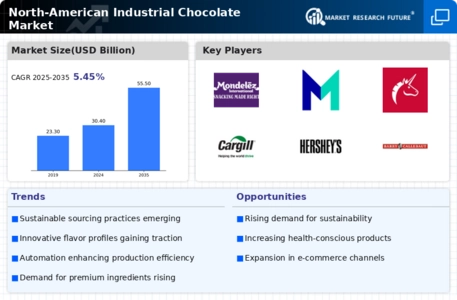
North American Industrial Chocolate Market Infographic
Purchase Options

Market Trends

Key Emerging Trends in the North American Industrial Chocolate Market

The North-American industrial chocolate market has been witnessing significant trends that are shaping the industry's landscape. One prominent trend is the increasing demand for premium and specialty chocolates. Consumers are becoming more discerning, seeking unique flavors, ethically sourced ingredients, and high-quality cocoa. This shift has led manufacturers to focus on innovation, introducing new and exotic varieties to cater to the evolving preferences of consumers.

Another noteworthy trend is the rising awareness of health and wellness, influencing the formulation of industrial chocolate products. With an increasing number of consumers becoming health-conscious, there has been a surge in the demand for dark chocolates and products with reduced sugar content. Manufacturers are responding by incorporating functional ingredients, such as antioxidants and natural sweeteners, to enhance the nutritional profile of their offerings.

Furthermore, sustainability has become a key driver in the North-American industrial chocolate market. Consumers are increasingly concerned about the environmental and social impact of their food choices. As a result, there is a growing demand for chocolates produced using sustainable and responsibly sourced cocoa. Industry players are responding by adopting ethical sourcing practices, promoting fair trade, and obtaining certifications to communicate their commitment to sustainability.

The impact of digitalization on the industrial chocolate market cannot be ignored. E-commerce platforms and online retail channels have become vital for reaching a broader consumer base. The convenience of online shopping, coupled with the ability to explore a wide range of products, has contributed to the growth of chocolate sales through digital platforms. Manufacturers are investing in online marketing strategies and digital storefronts to enhance their visibility and engage with consumers directly.

Moreover, clean labeling has emerged as a significant trend in response to consumer demand for transparency in food products. Consumers are increasingly scrutinizing product labels, seeking clear and understandable ingredient lists. As a result, industrial chocolate manufacturers are adapting by simplifying their ingredient decks, eliminating artificial additives, and using cleaner, more natural formulations. This shift aligns with the broader clean eating movement and reinforces consumer trust in the quality of chocolate products.

The North-American industrial chocolate market is also experiencing a surge in demand for personalized and customized chocolate products. Consumers are seeking unique and tailored experiences, driving manufacturers to offer customizable options in terms of flavors, shapes, and packaging. This trend caters to the desire for individuality and uniqueness, allowing consumers to express their preferences in the products they purchase.

Author
Author Profile
Pradeep Nandi
Senior Research Analyst

I have a bachelor's degree in mechanical engineering and an MBA. I have more than two years of expertise in the retail, food, and beverage, chemical, and material industries, and hence have developed a sound cross-domain expertise. A firm believer in lifelong learning and sharing of knowledge. Having a proclivity for hatching ideas and trying to absorb as much information as possible in a short amount of time. Introducing corporates to the data and insight, which enables them to move from probability to possibility, has been my key areas of interest. 

Leave a Comment

FAQs

What is the current valuation of the North America Industrial Chocolate Market?

<p>As of 2024, the market valuation was 5.46 USD Billion.</p>

What is the projected market size for the North America Industrial Chocolate Market by 2035?

<p>The market is expected to reach a valuation of 7.16 USD Billion by 2035.</p>

What is the expected CAGR for the North America Industrial Chocolate Market during the forecast period 2025 - 2035?

<p>The anticipated CAGR for this market is 2.49% from 2025 to 2035.</p>

Which companies are the key players in the North America Industrial Chocolate Market?

<p>Key players include Mars, Inc., Mondelez International, Cargill, Inc., and Hershey Company, among others.</p>

What are the main application segments of the North America Industrial Chocolate Market?

<p>The primary application segments include Confectionery, Bakery, Dairy, Ice Cream, and Beverages.</p>

How did the Confectionery segment perform in terms of valuation from 2024 to 2026?

<p>The Confectionery segment increased from 2.18 USD Billion in 2024 to 2.83 USD Billion in 2026.</p>

What is the valuation of the Dark Chocolate segment in 2026?

<p>The Dark Chocolate segment is projected to reach 2.1 USD Billion in 2026.</p>

What is the expected growth for the Bakery segment by 2026?

<p>The Bakery segment is likely to grow from 1.25 USD Billion in 2024 to 1.63 USD Billion in 2026.</p>

What are the projected valuations for the Food Industry end-use segment by 2035?

<p>The Food Industry end-use segment is expected to grow from 3.0 USD Billion in 2024 to 4.0 USD Billion by 2035.</p>

What types of chocolate are included in the North America Industrial Chocolate Market?

<p>The market includes Dark Chocolate, Milk Chocolate, White Chocolate, and Ruby Chocolate.</p>

Market Summary

As per analysis, the North America Industrial Chocolate Market is projected to grow from USD 5.61 Billion in 2025 to USD 7.16 Billion by 2035, exhibiting a compound annual growth rate (CAGR) of 2.49% during the forecast period (2025 - 2035).

Key Market Trends & Highlights

The North America Industrial Chocolate Market is experiencing a dynamic shift towards premiumization and health-conscious offerings.

  • The US remains the largest market for industrial chocolate, driven by robust demand in the confectionery sector.
  • Canada is emerging as the fastest-growing region, with increasing consumer interest in innovative chocolate products.
  • The confectionery segment dominates the market, while the bakery segment is witnessing rapid growth due to evolving consumer preferences.
  • Key market drivers include the rising demand for confectionery products and a growing interest in sustainable practices.

Market Size & Forecast

2024 Market Size 5.46 (USD Billion)
2035 Market Size 7.16 (USD Billion)
CAGR (2025 - 2035) 2.49%

Major Players

<p>Mars, Inc. (US), Mondelez International (US), Cargill, Inc. (US), Hershey Company (US), Barry Callebaut (CH), Ferrero Group (IT), Ghirardelli Chocolate Company (US), Lindt & Sprüngli (CH), Nestle S.A. (CH)</p>

Market Trends

The North America Industrial Chocolate Market is currently experiencing a dynamic evolution, driven by shifting consumer preferences and an increasing demand for high-quality chocolate products. The market appears to be influenced by a growing inclination towards premium and artisanal chocolates, as consumers seek unique flavors and sustainable sourcing practices. This trend suggests that manufacturers may need to adapt their offerings to cater to a more discerning clientele, potentially leading to innovations in product development and marketing strategies. Furthermore, the rise of health-conscious consumers is prompting a shift towards dark chocolate and organic options, which could reshape the competitive landscape in the coming years. In addition to changing consumer tastes, the North America Industrial Chocolate Market is also witnessing advancements in production technologies. These innovations may enhance efficiency and reduce costs, allowing manufacturers to meet the increasing demand without compromising quality. Moreover, the emphasis on sustainability is likely to drive companies to adopt eco-friendly practices, from sourcing raw materials to packaging. As the market continues to evolve, stakeholders must remain vigilant and responsive to these trends to maintain a competitive edge and capitalize on emerging opportunities.

Shift Towards Premium Products

The North America Industrial Chocolate Market is seeing a notable shift towards premium and artisanal chocolate products. Consumers are increasingly seeking unique flavors and high-quality ingredients, which may compel manufacturers to innovate and diversify their offerings.

Health-Conscious Choices

There is a growing trend among consumers in North America towards health-conscious chocolate options, particularly dark chocolate and organic varieties. This shift suggests that manufacturers might need to reformulate products to align with these preferences.

Sustainability Initiatives

Sustainability is becoming a focal point in the North America Industrial Chocolate Market. Companies are likely to adopt eco-friendly practices in sourcing and production, responding to consumer demand for environmentally responsible products.

North American Industrial Chocolate Market Market Drivers

Expansion of E-commerce Platforms

The rise of e-commerce platforms is significantly influencing the North America Industrial Chocolate Market. With the increasing preference for online shopping, particularly post-pandemic, chocolate manufacturers are leveraging digital channels to reach a broader audience. Data indicates that online sales of chocolate products have surged, with e-commerce accounting for nearly 20% of total chocolate sales in North America. This shift not only provides convenience for consumers but also allows manufacturers to showcase a wider range of products, including artisanal and specialty chocolates. As e-commerce continues to expand, the North America Industrial Chocolate Market is likely to see enhanced sales and brand visibility, fostering competition among traditional retailers and online platforms.

Innovations in Product Development

Innovation plays a crucial role in shaping the North America Industrial Chocolate Market. Manufacturers are increasingly investing in research and development to create unique chocolate products that cater to evolving consumer tastes. This includes the introduction of functional chocolates infused with health benefits, such as added vitamins or superfoods. Recent market analysis suggests that the functional chocolate segment is expected to grow by over 6% annually, reflecting a shift towards healthier indulgence. Additionally, advancements in production technology are enabling manufacturers to enhance product quality and reduce costs. As a result, the North America Industrial Chocolate Market is poised for growth, driven by continuous innovation and the introduction of novel products.

Rising Interest in Sustainable Practices

Sustainability has emerged as a pivotal driver in the North America Industrial Chocolate Market. Consumers are increasingly concerned about the environmental impact of their purchases, prompting manufacturers to adopt sustainable sourcing and production practices. This trend is reflected in the growing demand for ethically sourced cocoa, with a significant portion of consumers willing to pay a premium for products that meet sustainability standards. Recent surveys indicate that approximately 60% of North American consumers prioritize sustainability when purchasing chocolate. Consequently, companies that embrace sustainable practices are likely to gain a competitive edge in the market. The North America Industrial Chocolate Market is thus adapting to these consumer preferences, fostering a more responsible and eco-friendly approach to chocolate production.

Growing Demand for Confectionery Products

The North America Industrial Chocolate Market is experiencing a notable increase in demand for confectionery products. This surge is driven by changing consumer preferences, particularly among younger demographics who favor innovative and indulgent chocolate offerings. According to recent data, the confectionery sector in North America is projected to grow at a compound annual growth rate (CAGR) of approximately 4.5% over the next five years. This growth is likely to be fueled by the introduction of new flavors and formats, as well as the expansion of distribution channels. As manufacturers respond to this demand, the North America Industrial Chocolate Market is expected to benefit from enhanced production capabilities and product diversification, ultimately leading to increased market share and profitability.

Regulatory Support for Food Safety Standards

Regulatory frameworks play a vital role in the North America Industrial Chocolate Market, particularly concerning food safety standards. Government agencies, such as the Food and Drug Administration (FDA), enforce stringent regulations that ensure the safety and quality of chocolate products. Compliance with these regulations not only protects consumers but also enhances the credibility of manufacturers. Recent updates to food safety guidelines have prompted companies to invest in quality assurance processes, thereby improving product integrity. As the regulatory landscape evolves, the North America Industrial Chocolate Market is likely to benefit from increased consumer trust and loyalty, ultimately driving market growth and stability.

Market Segment Insights

By Application: Confectionery (Largest) vs. Bakery (Fastest-Growing)

<p>In the North America Industrial Chocolate Market, the application segments play a crucial role in shaping market dynamics. The <a href="https://www.marketresearchfuture.com/reports/confectionery-market-16095" target="_blank" title="confectionery">confectionery</a> sector continues to hold the largest market share, primarily driven by the high demand for chocolate products in various forms, including bars, truffles, and pralines. The bakery segment, while smaller, is rapidly increasing its share as more consumers opt for chocolate-infused baked goods, driven by evolving taste preferences and the rise of artisanal baking.</p>

<p>Confectionery: Dominant vs. Bakery: Emerging</p>

<p>The confectionery segment is characterized by its traditional chocolate products that remain a favorite among consumers of all ages. This segment benefits from extensive distribution networks and established brands that consistently innovate their offerings. On the other hand, the bakery segment is emerging as a strong player in the market, fueled by trends in premiumization and health-conscious baking. This segment appeals to a younger demographic interested in unique flavor combinations and quality ingredients, driving growth in chocolate-based pastries, cookies, and cakes.</p>

By Type: Milk Chocolate (Largest) vs. Dark Chocolate (Fastest-Growing)

<p>In the North America Industrial Chocolate Market, the market share distribution reveals that Milk Chocolate leads as the largest segment, driven by its widespread popularity in various applications including confectionery and baking. The appeal of Milk Chocolate is enhanced by its creamy texture and balanced sweetness, making it a staple ingredient for product formulations across multiple categories. Dark Chocolate follows as a significant contributor, while White and Ruby Chocolates occupy niche positions within the market, often targeted towards specific consumer preferences and premium product lines. Growth trends indicate that Dark Chocolate is emerging as the fastest-growing segment within the industrial chocolate landscape. Factors such as increasing consumer awareness regarding health benefits associated with dark chocolate's higher cocoa content and lower sugar levels are propelling this segment's expansion. Additionally, the trend towards sustainability and premiumization is encouraging manufacturers to innovate dark chocolate products, catering to evolving customer tastes. Furthermore, rising demand for organic and ethically sourced dark chocolate reflects changing consumer values in the North American market.</p>

<p>Milk Chocolate (Dominant) vs. White Chocolate (Emerging)</p>

<p>Milk Chocolate is recognized as the dominant force in the North America Industrial Chocolate Market, frequently utilized in a vast array of applications, from snacks to desserts due to its appealing taste and texture. Its consistency and well-accepted flavor profile make it a favored choice among manufacturers, leading to significant market penetration. On the other hand, White Chocolate, while less prevalent, is seen as an emerging segment, gaining traction particularly among consumers seeking sweeter, milder options with a creamy experience. This evolving demand is driven by innovative product development, with many brands introducing white chocolate varieties in creative formats, appealing to adventurous palates. This contrast between the dominance of Milk Chocolate and the emerging nature of White Chocolate underscores the diversifying preferences in the North American industrial chocolate market.</p>

By Form: Solid (Largest) vs. Liquid (Fastest-Growing)

<p>In the North America Industrial Chocolate Market, the segment values are categorized into solid, liquid, and powder forms. The solid form dominates the market, leveraging its versatility in various applications such as confectionery, baking, and snack foods. It is favored for its rich texture and flavor profile, which are essential in consumer products. Meanwhile, liquid chocolate, while currently a smaller segment, is rapidly gaining traction due to its ease of use in a variety of applications including dips, toppings, and beverages, driven by convenience and innovative culinary trends. Growth trends in the industrial chocolate segment are primarily influenced by changing consumer preferences, health consciousness, and the increasing demand for convenience foods. The liquid segment, identified as the fastest-growing category, benefits from the rise of ready-to-use products in food service sectors, while the solid form remains a stable choice for traditional chocolate applications. Manufacturers are adapting their product offerings to meet the evolving needs of consumers, including the development of organic and specialty chocolates, further driving growth in both segments.</p>

<p>Solid (Dominant) vs. Liquid (Emerging)</p>

<p>The solid form of industrial chocolate is well-established and continues to dominate the North America market due to its wide-ranging applications in confectionery and baking. This segment stands out for its rich flavor, extensive product variety, and flexibility in formulation, accommodating a spectrum of consumer tastes and preferences. In contrast, the liquid form is emerging as a significant player, particularly appealing in food service and gourmet sectors. It is favored for its ease of incorporation into various culinary applications, such as sauces and beverages. Both segments cater to specific customer needs, with solid chocolate appealing to traditionalists and liquid chocolate attracting innovative culinary enthusiasts seeking convenience and new experiences.</p>

By End Use: Food Industry (Largest) vs. Cosmetics (Fastest-Growing)

<p>In the North America Industrial Chocolate Market, the Food Industry is the largest segment, holding a significant majority share. This sector encompasses various applications, including confectionery products, baked goods, and other food items, driving substantial demand for industrial chocolate. In contrast, the Cosmetics segment, although smaller in share, is exhibiting rapid growth as manufacturers increasingly incorporate chocolate-based ingredients for their cosmetic formulations, recognizing the benefits of chocolate's antioxidant properties and appealing fragrances.</p>

<p>Food Industry: Largest vs. Cosmetics: Fastest-Growing</p>

<p>The Food Industry remains the dominant force in the North America Industrial Chocolate Market, characterized by a vast array of applications including sweet treats, snacks, and bakery products. The demand for high-quality chocolate in this segment is bolstered by consumer preferences for indulgent flavors and premium experiences. On the other hand, the Cosmetics segment represents an emerging market, fueled by innovative product development and increased consumer awareness regarding skincare ingredients. Brands are leveraging the nourishing properties of cocoa, paving the way for unique offerings that enhance skin health. The rapid growth in this area reflects a broader trend towards natural, cruelty-free ingredients, positioning the Cosmetics segment as a potential powerhouse in the coming years.</p>

Get more detailed insights about North-American Industrial Chocolate Market Research Report - Forecast to 2035

Regional Insights

US : Leading Market Share and Innovation

The US industrial chocolate market holds a commanding share of 4.2% in North America, driven by increasing demand for premium and specialty chocolates. Key growth drivers include rising consumer preferences for high-quality ingredients and sustainable sourcing practices. Regulatory support for food safety and quality standards further enhances market stability. Additionally, robust infrastructure and logistics networks facilitate efficient distribution and production processes, contributing to a thriving industrial environment.

Canada : Sustainable Practices and Local Demand

Canada's industrial chocolate market, with a share of 1.26%, is characterized by a growing interest in organic and ethically sourced products. The market is supported by government initiatives promoting local agriculture and sustainability. Demand trends indicate a shift towards healthier options, with consumers increasingly favoring dark chocolate and reduced sugar products. Infrastructure improvements in transportation and manufacturing are also enhancing market accessibility and efficiency.

Key Players and Competitive Insights

The Industrial Chocolate Market in North America is characterized by a competitive landscape that is both dynamic and multifaceted. Key growth drivers include increasing consumer demand for premium chocolate products, the rise of health-conscious options, and the ongoing trend towards sustainable sourcing. Major players such as Mars, Inc. (US), Mondelez International (US), and Cargill, Inc. (US) are strategically positioned to leverage these trends. Mars, Inc. (US) focuses on innovation in product development, particularly in the realm of plant-based chocolates, while Mondelez International (US) emphasizes regional expansion and digital transformation to enhance its market reach. Cargill, Inc. (US) is actively pursuing partnerships to optimize its supply chain and improve sustainability practices, collectively shaping a competitive environment that is increasingly focused on consumer preferences and operational efficiency.

Key business tactics within this market include localizing manufacturing to reduce costs and enhance responsiveness to consumer demands. The competitive structure appears moderately fragmented, with several key players exerting influence over market dynamics. This fragmentation allows for niche players to thrive, while larger companies capitalize on economies of scale and brand recognition. The collective influence of these key players fosters a competitive atmosphere where innovation and sustainability are paramount.

In November 2025, Mars, Inc. (US) announced a significant investment in a new facility dedicated to producing plant-based chocolate alternatives. This strategic move is likely to position the company favorably within the growing segment of health-conscious consumers, reflecting a broader industry trend towards plant-based offerings. The investment not only enhances Mars's product portfolio but also aligns with sustainability goals, potentially attracting a new demographic of environmentally aware consumers.

In December 2025, Mondelez International (US) launched a new digital platform aimed at streamlining its supply chain operations. This initiative is indicative of the company's commitment to digital transformation, which may enhance operational efficiency and responsiveness to market changes. By leveraging technology, Mondelez appears poised to improve its competitive edge, particularly in an era where agility and speed to market are increasingly critical.

In January 2026, Cargill, Inc. (US) entered into a strategic partnership with a leading cocoa supplier to enhance its sustainable sourcing practices. This collaboration is expected to bolster Cargill's reputation as a responsible player in the market, aligning with consumer expectations for ethical sourcing. Such partnerships may also serve to mitigate supply chain risks, ensuring a more reliable flow of raw materials in an increasingly volatile market.

As of January 2026, current competitive trends in the Industrial Chocolate Market are heavily influenced by digitalization, sustainability, and the integration of AI technologies. Strategic alliances are becoming more prevalent, as companies seek to enhance their capabilities and market positioning. The competitive differentiation is likely to evolve from traditional price-based competition towards a focus on innovation, technology, and supply chain reliability. This shift suggests that companies that prioritize these aspects may gain a significant advantage in the marketplace.

Key Companies in the North American Industrial Chocolate Market include

Industry Developments

dairy

Future Outlook

North American Industrial Chocolate Market Future Outlook

The North America <a href="https://www.marketresearchfuture.com/reports/industrial-chocolate-market-67007" target="_blank" title="industrial chocolate">Industrial Chocolate</a> Market is projected to grow at a 2.49% CAGR from 2025 to 2035, driven by increasing demand for premium products and innovative applications.

New opportunities lie in:

  • Expansion into plant-based chocolate alternatives
  • Development of customized chocolate formulations for B2B clients
  • Investment in sustainable sourcing and production technologies

By 2035, the market is expected to solidify its position as a leader in innovative chocolate solutions.

Market Segmentation

North American Industrial Chocolate Market Form Outlook

  • Solid
  • Liquid
  • Powder

North American Industrial Chocolate Market Type Outlook

  • Dark Chocolate
  • Milk Chocolate
  • White Chocolate
  • Ruby Chocolate

North American Industrial Chocolate Market End Use Outlook

  • Food Industry
  • Cosmetics
  • Pharmaceuticals

North American Industrial Chocolate Market Application Outlook

  • Confectionery
  • Bakery
  • Dairy
  • Ice Cream
  • Beverages

Report Scope

MARKET SIZE 2024 5.46(USD Billion)
MARKET SIZE 2025 5.61(USD Billion)
MARKET SIZE 2035 7.16(USD Billion)
COMPOUND ANNUAL GROWTH RATE (CAGR) 2.49% (2024 - 2035)
REPORT COVERAGE Revenue Forecast, Competitive Landscape, Growth Factors, and Trends
BASE YEAR 2024
Market Forecast Period 2025 - 2035
Historical Data 2019 - 2024
Market Forecast Units USD Billion
Key Companies Profiled Mars, Inc. (US), Mondelez International (US), Cargill, Inc. (US), Hershey Company (US), Barry Callebaut (CH), Ferrero Group (IT), Ghirardelli Chocolate Company (US), Lindt & Sprüngli (CH), Nestle S.A. (CH)
Segments Covered Application, Type, Form, End Use
Key Market Opportunities Growing demand for sustainable and ethically sourced ingredients in the North America Industrial Chocolate Market.
Key Market Dynamics Rising demand for sustainable sourcing drives innovation and competition in the North America Industrial Chocolate Market.
Countries Covered US, Canada

FAQs

What is the current valuation of the North America Industrial Chocolate Market?

<p>As of 2024, the market valuation was 5.46 USD Billion.</p>

What is the projected market size for the North America Industrial Chocolate Market by 2035?

<p>The market is expected to reach a valuation of 7.16 USD Billion by 2035.</p>

What is the expected CAGR for the North America Industrial Chocolate Market during the forecast period 2025 - 2035?

<p>The anticipated CAGR for this market is 2.49% from 2025 to 2035.</p>

Which companies are the key players in the North America Industrial Chocolate Market?

<p>Key players include Mars, Inc., Mondelez International, Cargill, Inc., and Hershey Company, among others.</p>

What are the main application segments of the North America Industrial Chocolate Market?

<p>The primary application segments include Confectionery, Bakery, Dairy, Ice Cream, and Beverages.</p>

How did the Confectionery segment perform in terms of valuation from 2024 to 2026?

<p>The Confectionery segment increased from 2.18 USD Billion in 2024 to 2.83 USD Billion in 2026.</p>

What is the valuation of the Dark Chocolate segment in 2026?

<p>The Dark Chocolate segment is projected to reach 2.1 USD Billion in 2026.</p>

What is the expected growth for the Bakery segment by 2026?

<p>The Bakery segment is likely to grow from 1.25 USD Billion in 2024 to 1.63 USD Billion in 2026.</p>

What are the projected valuations for the Food Industry end-use segment by 2035?

<p>The Food Industry end-use segment is expected to grow from 3.0 USD Billion in 2024 to 4.0 USD Billion by 2035.</p>

What types of chocolate are included in the North America Industrial Chocolate Market?

<p>The market includes Dark Chocolate, Milk Chocolate, White Chocolate, and Ruby Chocolate.</p>

  1. SECTION I: EXECUTIVE SUMMARY AND KEY HIGHLIGHTS
    1. | 1.1 EXECUTIVE SUMMARY
    2. | | 1.1.1 Market Overview
    3. | | 1.1.2 Key Findings
    4. | | 1.1.3 Market Segmentation
    5. | | 1.1.4 Competitive Landscape
    6. | | 1.1.5 Challenges and Opportunities
    7. | | 1.1.6 Future Outlook
  2. SECTION II: SCOPING, METHODOLOGY AND MARKET STRUCTURE
    1. | 2.1 MARKET INTRODUCTION
    2. | | 2.1.1 Definition
    3. | | 2.1.2 Scope of the study
    4. | | | 2.1.2.1 Research Objective
    5. | | | 2.1.2.2 Assumption
    6. | | | 2.1.2.3 Limitations
    7. | 2.2 RESEARCH METHODOLOGY
    8. | | 2.2.1 Overview
    9. | | 2.2.2 Data Mining
    10. | | 2.2.3 Secondary Research
    11. | | 2.2.4 Primary Research
    12. | | | 2.2.4.1 Primary Interviews and Information Gathering Process
    13. | | | 2.2.4.2 Breakdown of Primary Respondents
    14. | | 2.2.5 Forecasting Model
    15. | | 2.2.6 Market Size Estimation
    16. | | | 2.2.6.1 Bottom-Up Approach
    17. | | | 2.2.6.2 Top-Down Approach
    18. | | 2.2.7 Data Triangulation
    19. | | 2.2.8 Validation
  3. SECTION III: QUALITATIVE ANALYSIS
    1. | 3.1 MARKET DYNAMICS
    2. | | 3.1.1 Overview
    3. | | 3.1.2 Drivers
    4. | | 3.1.3 Restraints
    5. | | 3.1.4 Opportunities
    6. | 3.2 MARKET FACTOR ANALYSIS
    7. | | 3.2.1 Value chain Analysis
    8. | | 3.2.2 Porter's Five Forces Analysis
    9. | | | 3.2.2.1 Bargaining Power of Suppliers
    10. | | | 3.2.2.2 Bargaining Power of Buyers
    11. | | | 3.2.2.3 Threat of New Entrants
    12. | | | 3.2.2.4 Threat of Substitutes
    13. | | | 3.2.2.5 Intensity of Rivalry
    14. | | 3.2.3 COVID-19 Impact Analysis
    15. | | | 3.2.3.1 Market Impact Analysis
    16. | | | 3.2.3.2 Regional Impact
    17. | | | 3.2.3.3 Opportunity and Threat Analysis
  4. SECTION IV: QUANTITATIVE ANALYSIS
    1. | 4.1 Food, Beverages & Nutrition, BY Application (USD Billion)
    2. | | 4.1.1 Confectionery
    3. | | 4.1.2 Bakery
    4. | | 4.1.3 Dairy
    5. | | 4.1.4 Ice Cream
    6. | | 4.1.5 Beverages
    7. | 4.2 Food, Beverages & Nutrition, BY Type (USD Billion)
    8. | | 4.2.1 Dark Chocolate
    9. | | 4.2.2 Milk Chocolate
    10. | | 4.2.3 White Chocolate
    11. | | 4.2.4 Ruby Chocolate
    12. | 4.3 Food, Beverages & Nutrition, BY Form (USD Billion)
    13. | | 4.3.1 Solid
    14. | | 4.3.2 Liquid
    15. | | 4.3.3 Powder
    16. | 4.4 Food, Beverages & Nutrition, BY End Use (USD Billion)
    17. | | 4.4.1 Food Industry
    18. | | 4.4.2 Cosmetics
    19. | | 4.4.3 Pharmaceuticals
  5. SECTION V: COMPETITIVE ANALYSIS
    1. | 5.1 Competitive Landscape
    2. | | 5.1.1 Overview
    3. | | 5.1.2 Competitive Analysis
    4. | | 5.1.3 Market share Analysis
    5. | | 5.1.4 Major Growth Strategy in the Food, Beverages & Nutrition
    6. | | 5.1.5 Competitive Benchmarking
    7. | | 5.1.6 Leading Players in Terms of Number of Developments in the Food, Beverages & Nutrition
    8. | | 5.1.7 Key developments and growth strategies
    9. | | | 5.1.7.1 New Product Launch/Service Deployment
    10. | | | 5.1.7.2 Merger & Acquisitions
    11. | | | 5.1.7.3 Joint Ventures
    12. | | 5.1.8 Major Players Financial Matrix
    13. | | | 5.1.8.1 Sales and Operating Income
    14. | | | 5.1.8.2 Major Players R&D Expenditure. 2023
    15. | 5.2 Company Profiles
    16. | | 5.2.1 Mars, Inc. (US)
    17. | | | 5.2.1.1 Financial Overview
    18. | | | 5.2.1.2 Products Offered
    19. | | | 5.2.1.3 Key Developments
    20. | | | 5.2.1.4 SWOT Analysis
    21. | | | 5.2.1.5 Key Strategies
    22. | | 5.2.2 Mondelez International (US)
    23. | | | 5.2.2.1 Financial Overview
    24. | | | 5.2.2.2 Products Offered
    25. | | | 5.2.2.3 Key Developments
    26. | | | 5.2.2.4 SWOT Analysis
    27. | | | 5.2.2.5 Key Strategies
    28. | | 5.2.3 Cargill, Inc. (US)
    29. | | | 5.2.3.1 Financial Overview
    30. | | | 5.2.3.2 Products Offered
    31. | | | 5.2.3.3 Key Developments
    32. | | | 5.2.3.4 SWOT Analysis
    33. | | | 5.2.3.5 Key Strategies
    34. | | 5.2.4 Hershey Company (US)
    35. | | | 5.2.4.1 Financial Overview
    36. | | | 5.2.4.2 Products Offered
    37. | | | 5.2.4.3 Key Developments
    38. | | | 5.2.4.4 SWOT Analysis
    39. | | | 5.2.4.5 Key Strategies
    40. | | 5.2.5 Barry Callebaut (CH)
    41. | | | 5.2.5.1 Financial Overview
    42. | | | 5.2.5.2 Products Offered
    43. | | | 5.2.5.3 Key Developments
    44. | | | 5.2.5.4 SWOT Analysis
    45. | | | 5.2.5.5 Key Strategies
    46. | | 5.2.6 Ferrero Group (IT)
    47. | | | 5.2.6.1 Financial Overview
    48. | | | 5.2.6.2 Products Offered
    49. | | | 5.2.6.3 Key Developments
    50. | | | 5.2.6.4 SWOT Analysis
    51. | | | 5.2.6.5 Key Strategies
    52. | | 5.2.7 Ghirardelli Chocolate Company (US)
    53. | | | 5.2.7.1 Financial Overview
    54. | | | 5.2.7.2 Products Offered
    55. | | | 5.2.7.3 Key Developments
    56. | | | 5.2.7.4 SWOT Analysis
    57. | | | 5.2.7.5 Key Strategies
    58. | | 5.2.8 Lindt & Sprüngli (CH)
    59. | | | 5.2.8.1 Financial Overview
    60. | | | 5.2.8.2 Products Offered
    61. | | | 5.2.8.3 Key Developments
    62. | | | 5.2.8.4 SWOT Analysis
    63. | | | 5.2.8.5 Key Strategies
    64. | | 5.2.9 Nestle S.A. (CH)
    65. | | | 5.2.9.1 Financial Overview
    66. | | | 5.2.9.2 Products Offered
    67. | | | 5.2.9.3 Key Developments
    68. | | | 5.2.9.4 SWOT Analysis
    69. | | | 5.2.9.5 Key Strategies
    70. | 5.3 Appendix
    71. | | 5.3.1 References
    72. | | 5.3.2 Related Reports
  6. LIST OF FIGURES
    1. | 6.1 MARKET SYNOPSIS
    2. | 6.2 NORTH AMERICA MARKET ANALYSIS BY APPLICATION
    3. | 6.3 NORTH AMERICA MARKET ANALYSIS BY TYPE
    4. | 6.4 NORTH AMERICA MARKET ANALYSIS BY FORM
    5. | 6.5 NORTH AMERICA MARKET ANALYSIS BY END USE
    6. | 6.6 KEY BUYING CRITERIA OF FOOD, BEVERAGES & NUTRITION
    7. | 6.7 RESEARCH PROCESS OF MRFR
    8. | 6.8 DRO ANALYSIS OF FOOD, BEVERAGES & NUTRITION
    9. | 6.9 DRIVERS IMPACT ANALYSIS: FOOD, BEVERAGES & NUTRITION
    10. | 6.10 RESTRAINTS IMPACT ANALYSIS: FOOD, BEVERAGES & NUTRITION
    11. | 6.11 SUPPLY / VALUE CHAIN: FOOD, BEVERAGES & NUTRITION
    12. | 6.12 FOOD, BEVERAGES & NUTRITION, BY APPLICATION, 2024 (% SHARE)
    13. | 6.13 FOOD, BEVERAGES & NUTRITION, BY APPLICATION, 2024 TO 2035 (USD Billion)
    14. | 6.14 FOOD, BEVERAGES & NUTRITION, BY TYPE, 2024 (% SHARE)
    15. | 6.15 FOOD, BEVERAGES & NUTRITION, BY TYPE, 2024 TO 2035 (USD Billion)
    16. | 6.16 FOOD, BEVERAGES & NUTRITION, BY FORM, 2024 (% SHARE)
    17. | 6.17 FOOD, BEVERAGES & NUTRITION, BY FORM, 2024 TO 2035 (USD Billion)
    18. | 6.18 FOOD, BEVERAGES & NUTRITION, BY END USE, 2024 (% SHARE)
    19. | 6.19 FOOD, BEVERAGES & NUTRITION, BY END USE, 2024 TO 2035 (USD Billion)
    20. | 6.20 BENCHMARKING OF MAJOR COMPETITORS
  7. LIST OF TABLES
    1. | 7.1 LIST OF ASSUMPTIONS
    2. | | 7.1.1
    3. | 7.2 North America MARKET SIZE ESTIMATES; FORECAST
    4. | | 7.2.1 BY APPLICATION, 2026-2035 (USD Billion)
    5. | | 7.2.2 BY TYPE, 2026-2035 (USD Billion)
    6. | | 7.2.3 BY FORM, 2026-2035 (USD Billion)
    7. | | 7.2.4 BY END USE, 2026-2035 (USD Billion)
    8. | 7.3 PRODUCT LAUNCH/PRODUCT DEVELOPMENT/APPROVAL
    9. | | 7.3.1
    10. | 7.4 ACQUISITION/PARTNERSHIP
    11. | | 7.4.1

North America Food, Beverages & Nutrition Market Segmentation

Food, Beverages & Nutrition By Application (USD Billion, 2026-2035)

  • Confectionery
  • Bakery
  • Dairy
  • Ice Cream
  • Beverages

Food, Beverages & Nutrition By Type (USD Billion, 2026-2035)

  • Dark Chocolate
  • Milk Chocolate
  • White Chocolate
  • Ruby Chocolate

Food, Beverages & Nutrition By Form (USD Billion, 2026-2035)

  • Solid
  • Liquid
  • Powder

Food, Beverages & Nutrition By End Use (USD Billion, 2026-2035)

  • Food Industry
  • Cosmetics
  • Pharmaceuticals
Infographic

Free Sample Request

Kindly complete the form below to receive a free sample of this Report

Get Free Sample

Customer Strories

Compare Licence

×
Features License Type
Single User Multiuser License Enterprise User
Price $4,950 $5,950 $7,250
Maximum User Access Limit 1 User Upto 10 Users Unrestricted Access Throughout the Organization
Free Customization
Direct Access to Analyst
Deliverable Format
Platform Access
Discount on Next Purchase 10% 15% 15%
Printable Versions















