×
Request Free Sample ×

Kindly complete the form below to receive a free sample of this Report

* Please use a valid business email

Leading companies partner with us for data-driven Insights

clients tt-cursor
Hero Background
English
Chinese
French
Japanese
Korean
German
Spanish

North America Adblue Market Analysis

ID: MRFR/CnM/10942-HCR
128 Pages
Chitranshi Jaiswal
October 2025

North America Adblue Market Research Report Information By Type (Packaging, Equipment, and Others), By Usage Method (Pre-combustion, Post-combustion, and Others), By Application (Commercial Vehicles, Cars and Passenger Vehicles, Non-Road Mobile Machines, Railways, and Others) –and North America Market Forecast Till 2035.

Share:
Download PDF ×

We do not share your information with anyone. However, we may send you emails based on your report interest from time to time. You may contact us at any time to opt-out.

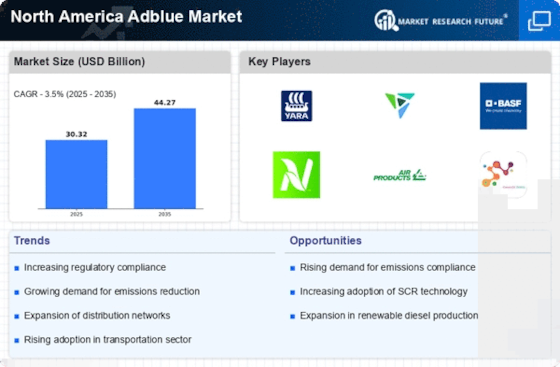
North America Adblue Market Infographic
×
North America Adblue Market Infographic Full View
Purchase Options

Market Analysis

In-depth Analysis of North America Adblue Market Industry Landscape

In North America especially United States and Canada, governments are putting in place stringent emission standards for vehicles to address air pollution concerns and climate change mitigation efforts. Consequently, the demand for Adblue has increased as it is a crucial ingredient in ensuring compliance with these exacting emission requirements. The dynamics of Adblue market in North America are significantly influenced by the technological advancements made in vehicle emission control systems. The inclusion of SCR technology into diesel engines together with advancements in Adblue injection systems has enhanced nitrogen oxide reduction efficiency. This contributes to the overall dynamism of the market as automobile manufacturers focus on innovation aimed at improving performance and reliability of their car’s Adbul system. The competitive landscape is another factor that strongly affects market dynamics through competition from multiple manufacturers and suppliers who supply Adblue to North America. Differentiation based on product quality, distribution networks, and strategic alliances make the whole industry more competitive. Companies that invest in production capacity, ensure reliable supply chain management and offer comprehensive solutions to customers have an upper hand over other competitors within this rapidly evolving marketplace. Regulatory influences shape developments within the market for Adblue Market North America. Vehicle manufacturers and fleet operators must comply with emission standards set by environmental agencies for them to remain relevant in this industry. Thus, changes in emission standards bring changes into how pollutions should be handled by those operating within it thus influencing its general dynamic. Factors such as fuel prices and vehicle sales directly affect consumption levels of ad blue products Economic factors such as fuel prices influence adblue consumption while type or kind of vehicles in the market determines how much of adblue will be sold. Additionally, economic conditions that relate to transport and logistics also shape its dynamics. Consumer preferences within the automotive industry contribute to Adblue’s market dynamics. Increasingly, consumers and businesses prefer vehicles equipped with emission control systems utilizing AdBlue as environmental consciousness rises. Accordingly, auto manufacturers that focus on sustainability and offer cars with sophisticated emission reduction technologies will likely experience increased demand in the market. Similarly, global trends such as sustainable transportation movements and growth of electric cars have an impact on the North American Adblue Market dynamics. Electric vehicles are posing a serious challenge to internal combustion engines especially diesel engines in certain applications that has so far been unable to overcome them. Diesel engines still require Adblue for reducing emissions which makes it one of the best ways towards cleaner and more sustainable transportation.
Author
Chitranshi Jaiswal
Research Analyst Level I

In her 3 years of experience in the market research field, she has handled critical cross-domain projects. She has an in-depth knowledge of market estimation & analysis, problem-solving, primary as well as secondary research, and team management.She holds an engineering degree and is an MBA professional from a well-known university, capable of evaluating the market and competitive conditions. An exceptional strategist with excellent communication skills and a passion for delivering cutting-edge & practical insights for the market. Proficient in multi-tasking, and can successfully deal with competing demands, while maintaining complete confidentiality. Generated business through active client and project development, networking, and high-quality responses. Her knowledge and skills have helped in making solid business decisions, securing funding from investors, and avoiding business failures.

Leave a Comment

FAQs

What is the current valuation of the North America Ad Blue Market?

<p>The North America Ad Blue Market was valued at 35.9 USD Billion in 2024.</p>

What is the projected market valuation for the North America Ad Blue Market by 2035?

<p>The market is projected to reach 63.8 USD Billion by 2035.</p>

What is the expected CAGR for the North America Ad Blue Market during the forecast period?

<p>The expected CAGR for the North America Ad Blue Market from 2025 to 2035 is 5.37%.</p>

Which companies are considered key players in the North America Ad Blue Market?

<p>Key players include Yara International ASA, CF Industries Holdings Inc, Nutrien Ltd, and BASF SE.</p>

What are the main application segments of the North America Ad Blue Market?

<p>The main application segments include Automotive, Industrial, Agricultural, and Marine.</p>

Market Summary

As per analysis, the North America Ad Blue Market is projected to grow from USD 35.9 Billion in 2024 to USD 63.8 Billion by 2035, exhibiting a compound annual growth rate (CAGR) of 5.37% during the forecast period (2025 - 2035).

Key Market Trends & Highlights

The North America Ad Blue Market is poised for robust growth driven by regulatory compliance and technological advancements.

  • The United States remains the largest market for Ad Blue, reflecting a strong regulatory framework that mandates emissions control.
  • Canada is emerging as the fastest-growing region, with increasing investments in environmental sustainability initiatives.
  • The automotive segment dominates the market, while the agricultural machinery segment is witnessing rapid growth due to rising awareness of emissions regulations.
  • Key market drivers include regulatory compliance and the rising demand from the automotive sector, which is propelling overall market expansion.

Market Size & Forecast

2024 Market Size 35.9 (USD Billion)
2035 Market Size 63.8 (USD Billion)
CAGR (2025 - 2035) 5.37%

Major Players

<p>Yara International ASA (NO), CF Industries Holdings Inc (US), Nutrien Ltd (CA), BASF SE (DE), Air Products and Chemicals Inc (US), GreenChem (NL), Koch Industries Inc (US), Groupe Charles André (FR)</p>

Market Trends

The North America Ad Blue Market is currently experiencing a notable transformation, driven by increasing regulatory pressures aimed at reducing nitrogen oxide emissions from diesel engines. This shift is largely influenced by stringent environmental policies implemented by various governmental bodies, which encourage the adoption of cleaner technologies in the transportation sector. As a result, the demand for Ad Blue, a solution that helps in the reduction of harmful emissions, is on the rise. Furthermore, the growing awareness among consumers and businesses regarding environmental sustainability is propelling the market forward. Companies are increasingly investing in infrastructure to ensure the availability of Ad Blue at fueling stations, thereby enhancing accessibility for end-users. In addition to regulatory influences, the North America Ad Blue Market is also shaped by advancements in technology. Innovations in production processes and distribution methods are likely to improve efficiency and reduce costs, making Ad Blue more accessible to a broader audience. The market appears poised for growth as more stakeholders recognize the importance of compliance with environmental standards. Overall, the North America Ad Blue Market is evolving, with a focus on sustainability and technological advancement, which may lead to a more robust and environmentally friendly transportation sector in the near future.

Regulatory Compliance Driving Demand

The North America Ad Blue Market is significantly influenced by stringent regulations aimed at reducing emissions from diesel vehicles. Government mandates encourage the use of Ad Blue, which is essential for meeting these environmental standards. As compliance becomes increasingly critical, the demand for Ad Blue is expected to rise, prompting suppliers to enhance their distribution networks.

Technological Advancements in Production

Innovations in the production of Ad Blue are likely to play a crucial role in shaping the North America Ad Blue Market. Enhanced manufacturing processes may lead to improved quality and reduced costs, making the product more accessible. This technological progress could facilitate wider adoption among consumers and businesses alike.

Growing Consumer Awareness

There is a noticeable increase in consumer awareness regarding environmental issues, which is positively impacting the North America Ad Blue Market. As individuals and companies become more conscious of their carbon footprints, the demand for Ad Blue is expected to grow. This trend suggests a shift towards more sustainable practices in the transportation sector.

North America Adblue Market Market Drivers

Growing Consumer Awareness

Consumer awareness regarding the environmental impact of diesel emissions is a pivotal driver for the North America Ad Blue Market. As public knowledge about air quality and health issues associated with nitrogen oxides increases, more consumers are advocating for cleaner alternatives. This shift in consumer behavior is prompting fleet operators and vehicle manufacturers to prioritize the use of Ad Blue in their operations. In 2025, it is estimated that the demand for Ad Blue will rise by 6% as consumers push for compliance with environmental standards. The North America Ad Blue Market is thus positioned to benefit from this heightened awareness, as it aligns with broader sustainability goals. This trend not only fosters a more environmentally conscious market but also encourages innovation in product offerings.

Expansion of Distribution Networks

The expansion of distribution networks is a crucial factor propelling the North America Ad Blue Market. As demand for Ad Blue increases, companies are investing in logistics and supply chain enhancements to ensure product availability across various regions. In 2025, the market is expected to witness a 7% growth in distribution capabilities, driven by partnerships with fuel stations and retail outlets. This strategic expansion allows for easier access to Ad Blue for consumers and fleet operators, thereby facilitating compliance with regulatory requirements. Moreover, improved distribution networks can lead to reduced transportation costs, which may positively impact pricing strategies within the North America Ad Blue Market. As companies continue to optimize their supply chains, the market is likely to see a more robust infrastructure supporting Ad Blue availability.

Regulatory Compliance Driving Demand

The North America Ad Blue Market is experiencing a surge in demand due to stringent regulatory frameworks aimed at reducing nitrogen oxide emissions from diesel engines. The Environmental Protection Agency (EPA) has implemented regulations that necessitate the use of Ad Blue in heavy-duty vehicles, thereby driving market growth. In 2025, the market was valued at approximately USD 1.2 billion, reflecting a compound annual growth rate of 5.5% from 2021. This regulatory push not only compels manufacturers to adopt Ad Blue but also encourages fleet operators to comply with environmental standards, thus enhancing the overall market landscape. As regulations become more rigorous, the North America Ad Blue Market is likely to see increased investments in production and distribution, further solidifying its position in the automotive sector.

Rising Demand from Automotive Sector

The automotive sector's increasing reliance on diesel engines is a significant driver for the North America Ad Blue Market. As manufacturers produce more diesel vehicles to meet consumer preferences for fuel efficiency, the need for Ad Blue becomes paramount. In 2025, the market is projected to grow by 8% as automotive companies integrate Ad Blue systems into their new models. This trend is further supported by the growing popularity of heavy-duty trucks and commercial vehicles, which are often required to use Ad Blue to comply with emissions standards. The North America Ad Blue Market is thus poised for growth as automotive manufacturers prioritize the incorporation of Ad Blue technology, ensuring that their vehicles meet both performance and environmental criteria.

Technological Advancements in Production

Innovations in the production of Ad Blue are significantly influencing the North America Ad Blue Market. Advanced manufacturing techniques, such as the use of high-purity urea and optimized distribution systems, are enhancing the quality and availability of Ad Blue. In 2025, the market is projected to grow as manufacturers adopt these technologies to meet rising demand. The introduction of automated blending systems and real-time quality monitoring ensures that the product meets stringent specifications, thereby increasing consumer confidence. Furthermore, these advancements may lead to cost reductions in production, allowing for competitive pricing in the North America Ad Blue Market. As technology continues to evolve, it is anticipated that the market will benefit from improved efficiency and sustainability, attracting more players to the industry.

Market Segment Insights

By Application: Automotive (Largest) vs. Agricultural (Fastest-Growing)

<p>In the North America Ad Blue Market, the Automotive segment holds the largest share, driven by stringent emission regulations that mandate the use of SCR systems. This segment benefits from a robust demand for cleaner and more efficient vehicles, as automakers increasingly adopt Ad Blue to comply with environmental standards. Meanwhile, the Agricultural segment is emerging rapidly, as farmers seek to enhance the performance of diesel engines in agricultural machinery, contributing to significant growth in this area.</p>

<p>Automotive: Dominant vs. Agricultural: Emerging</p>

<p>The Automotive segment is characterized by its dominance in the North America Ad Blue Market, supported by a significant number of light-duty and heavy-duty vehicles incorporating SCR technology. This segment is not only the largest but also showcases a commitment from vehicle manufacturers to reduce nitrogen oxide emissions. Conversely, the Agricultural segment is marked as an emerging player, fueled by the need for sustainable farming practices and the integration of advanced emission control technologies in agricultural equipment. As environmental awareness grows, farmers are increasingly adopting Ad Blue to improve engine efficiency and reduce their carbon footprint, making this segment poised for fast-paced growth.</p>

By End Use: Commercial Vehicles (Largest) vs. Agricultural Machinery (Fastest-Growing)

<p>In the North America Ad Blue Market, the end-use segment is led by commercial vehicles, which command the largest share due to their extensive usage in transportation and logistics. The demand for Ad Blue in this sector is driven by stringent emission regulations and the increasing adoption of diesel vehicles. Conversely, agricultural machinery is witnessing rapid growth, fueled by innovations in farming technology and rising awareness of sustainable agricultural practices. Although it currently holds a smaller market share compared to commercial vehicles, its accelerated uptake indicates a promising future. The growth trends within the end-use segments are shaped by various factors. Commercial vehicles continue to dominate, driven by large fleets requiring compliance with environmental standards. On the other hand, agricultural machinery is emerging as the fastest-growing sector, supported by government initiatives promoting clean energy and efficiency in farming. The revitalization of the construction industry further amplifies demand in this segment, showcasing significant potential in the coming years.</p>

<p>Commercial Vehicles (Dominant) vs. Agricultural Machinery (Emerging)</p>

<p>The commercial vehicles segment stands out as the dominant force in the North America Ad Blue Market, primarily due to the high consumption rates among long-haul trucks and delivery vehicles that rely on diesel engines. This segment benefits from the robust logistics and transportation infrastructure in North America, emphasizing the necessity for low-emission solutions. In contrast, the agricultural machinery segment is recognized as an emerging player, driven by advances in technology that enhance productivity and reduce environmental impact. Farmers are increasingly adopting Ad Blue to comply with regulations and achieve greater fuel efficiency. The distinction lies in their market position; while commercial vehicles secure stable demand, agricultural machinery is rapidly catching up as the industry evolves.</p>

By Distribution Channel: Direct Sales (Largest) vs. Online Sales (Fastest-Growing)

<p>In the North America Ad Blue Market, the distribution of sales across various channels exhibits significant stratification. Direct sales constitute the largest segment, capturing a considerable share of the market owing to established relationships between suppliers and large-scale consumers such as transportation and logistics companies. This segment benefits from the trust built over years of trading. On the other hand, retail and online sales are also crucial, but they collectively hold a smaller portion of the overall market, positioning them as secondary when compared to the dominance of direct sales.</p>

<p>Retail (Dominant) vs. Online Sales (Emerging)</p>

<p>Retail sales of Ad Blue are well-established in the North American market, largely due to partnerships with automotive supply stores and gas stations. These retail points provide easy access to end-users, particularly fleet operators and individual vehicle owners. Meanwhile, online sales are emerging as a significant contender, leveraging the growing trend of e-commerce and the convenience it offers consumers. Online platforms expand reach, making it easier for customers to procure Ad Blue without geographical constraints. This trend is increasingly appealing to a tech-savvy generation that values convenience and efficiency. The competition between retail and online channels is indicative of broader shifts in consumer behavior, where accessibility and service convenience are key.</p>

By Formulation Type: Standard Ad Blue (Largest) vs. Premium Ad Blue (Fastest-Growing)

<p>In the North America Ad Blue market, Standard Ad Blue emerges as the largest formulation type, capturing a significant portion of the market share due to its widespread use in diesel vehicles and fleet operations. This formulation is highly preferred for conventional applications, leading to a consistent demand. Meanwhile, Premium Ad Blue has been gaining traction, notably in the automotive sector, driven by the increasing emphasis on emission reductions and regulatory compliance, which impacts the purchasing decisions of more environmentally conscious consumers and businesses. As the market evolves, Premium Ad Blue is positioned as the fastest-growing segment, propelled by enhanced formulations that offer improved performance and reduced environmental impact. Advances in technology are leading to higher efficiency in SCR (Selective Catalytic Reduction) systems, boosting the adoption of Premium Ad Blue. Additionally, the growing number of vehicles equipped with advanced emission control technologies is expected to further escalate the demand for this formulation type in the coming years.</p>

<p>Standard Ad Blue (Dominant) vs. Premium Ad Blue (Emerging)</p>

<p>Standard Ad Blue has established a dominant position in the North America market due to its cost-effectiveness and reliability. This formulation is well-accepted across various industries, especially among logistics and transportation sectors that prioritize affordability and performance. In contrast, Premium Ad Blue represents an emerging trend, focusing on superior quality and performance. This formulation is often sought by businesses aiming for higher efficiency and compliance with stringent emission regulations. The premium formulation is commonly associated with advanced diesel engines that demand better quality Ad Blue for optimal SCR system function. The market is witnessing a gradual shift as consumers and enterprises increasingly recognize the value of Premium Ad Blue, indicating a potential growth trajectory that may redefine market dynamics in the coming years.</p>

By Packaging Type: Bulk Containers (Largest) vs. Drum Packaging (Fastest-Growing)

<p>In the North America Ad Blue Market, the packaging type segment showcases a diverse array of options, with bulk containers leading in market share. These bulk containers are primarily utilized by large-scale consumers, offering significant advantages in terms of efficiency and logistics. Drum packaging holds a notable position as well, catering to medium-sized enterprises and offering flexibility and ease of handling. Together, these packaging types significantly influence the overall distribution dynamics in the market. Growth trends in the packaging type segment are driven by the increasing demand for Ad Blue in transportation and industrial applications. Bulk containers continue to dominate due to their cost-effectiveness for high-volume users, while drum packaging is experiencing rapid growth as industries seek more manageable solutions. The overall demand for pollution control and regulatory compliance further fuels the adoption of both packaging types, with manufacturers focusing on innovative solutions to meet customer needs.</p>

<p>Bulk Containers (Dominant) vs. Drum Packaging (Emerging)</p>

<p>In the North America Ad Blue Market, bulk containers are recognized as the dominant packaging solution, primarily due to their efficiency in large-scale supply chains. These containers are designed for high-volume distribution, making them ideal for commercial users who require significant quantities of Ad Blue. On the other hand, drum packaging is emerging as a viable option for smaller operations, offering convenience and flexibility for those who may not need bulk quantities but still want reliable access to Ad Blue. The drum packaging segment is characterized by its ease of handling, which appeals to a variety of industries including agriculture and automotive services, thus creating a balanced dynamic in the packaging market.</p>

Get more detailed insights about North America Adblue Market Research Report - Forecast by 2035

Regional Insights

US : Robust Growth and Demand Trends

The US holds a commanding 30.0% market share in the North American Ad Blue market, driven by stringent emissions regulations and a growing focus on sustainability. Key growth drivers include the increasing adoption of diesel vehicles and government initiatives aimed at reducing nitrogen oxide emissions. Infrastructure improvements, particularly in transportation and logistics, further bolster demand, as industries seek to comply with environmental standards and enhance operational efficiency.

Canada : Sustainable Practices on the Rise

Canada's Ad Blue market, with a 5.9% share, is gradually expanding due to increasing environmental awareness and regulatory support for cleaner fuels. The demand is particularly driven by the transportation sector, where provinces like Ontario and Alberta are implementing policies to reduce emissions. The Canadian government is actively promoting the use of Ad Blue through incentives and educational programs, fostering a favorable environment for market growth.

Key Players and Competitive Insights

The Ad Blue Market in North America is characterized by a competitive landscape that is increasingly shaped by innovation, sustainability, and strategic partnerships. Key players such as Yara International ASA (NO), CF Industries Holdings Inc (US), and Nutrien Ltd (CA) are actively pursuing strategies that emphasize operational efficiency and environmental responsibility. Yara International ASA (NO) has positioned itself as a leader in sustainable practices, focusing on reducing carbon emissions through advanced production techniques. Meanwhile, CF Industries Holdings Inc (US) is enhancing its market presence by investing in digital transformation initiatives aimed at optimizing supply chain management and improving customer engagement. Nutrien Ltd (CA) is also expanding its footprint by leveraging partnerships with local distributors to enhance accessibility and service delivery, thereby shaping a competitive environment that prioritizes customer-centric solutions.

The business tactics employed by these companies reflect a moderately fragmented market structure, where localized manufacturing and supply chain optimization are pivotal. The collective influence of these key players is evident in their ability to adapt to regional demands while maintaining competitive pricing. This dynamic fosters a competitive atmosphere where innovation and operational excellence are paramount, allowing companies to differentiate themselves in a crowded marketplace.

In December 2025, Yara International ASA (NO) announced a strategic partnership with a leading technology firm to develop AI-driven solutions for optimizing Ad Blue production processes. This collaboration is expected to enhance operational efficiency and reduce production costs, thereby reinforcing Yara's commitment to sustainability and innovation. The integration of AI technologies could potentially revolutionize production methodologies, positioning Yara as a frontrunner in the market.

In November 2025, CF Industries Holdings Inc (US) unveiled a new facility dedicated to the production of Ad Blue, which is anticipated to significantly increase its output capacity. This expansion aligns with the company's strategy to meet the growing demand for emissions-reducing solutions in the transportation sector. By bolstering its production capabilities, CF Industries aims to solidify its market position and respond effectively to regulatory pressures regarding emissions.

In October 2025, Nutrien Ltd (CA) launched a new initiative focused on enhancing the distribution of Ad Blue across North America. This initiative involves collaborating with regional logistics partners to streamline supply chains and improve delivery times. Such strategic actions are indicative of Nutrien's commitment to ensuring product availability and customer satisfaction, which are critical in a market where timely access to Ad Blue is essential for compliance with environmental regulations.

As of January 2026, the competitive trends in the Ad Blue Market are increasingly influenced by digitalization, sustainability, and the integration of advanced technologies. Strategic alliances are becoming more prevalent, as companies recognize the importance of collaboration in driving innovation and enhancing operational capabilities. Looking ahead, the competitive differentiation in this market is likely to evolve from traditional price-based competition to a focus on technological advancements, supply chain reliability, and sustainable practices. This shift underscores the necessity for companies to innovate continuously and adapt to changing market dynamics.

Key Companies in the North America Adblue Market include

Industry Developments

Future Outlook

North America Adblue Market Future Outlook

The North America Ad Blue Market is projected to grow at a 5.37% CAGR from 2025 to 2035, driven by stringent emissions regulations and increasing diesel vehicle adoption.

New opportunities lie in:

  • Expansion of distribution networks for urban and rural markets.
  • Development of innovative Ad Blue formulations for enhanced performance.
  • Investment in automated refueling solutions for commercial fleets.

By 2035, the market is expected to be robust, driven by regulatory compliance and technological advancements.

Market Segmentation

North America Adblue Market End Use Outlook

  • Commercial Vehicles
  • Passenger Vehicles
  • Construction Equipment
  • Agricultural Machinery

North America Adblue Market Application Outlook

  • Automotive
  • Industrial
  • Agricultural
  • Marine

North America Adblue Market Packaging Type Outlook

  • Bulk Containers
  • Drum Packaging
  • Bottle Packaging

North America Adblue Market Formulation Type Outlook

  • Standard Ad Blue
  • Premium Ad Blue
  • Custom Ad Blue

North America Adblue Market Distribution Channel Outlook

  • Direct Sales
  • Retail
  • Online Sales

Report Scope

MARKET SIZE 202435.9(USD Billion)
MARKET SIZE 202538.02(USD Billion)
MARKET SIZE 203563.8(USD Billion)
COMPOUND ANNUAL GROWTH RATE (CAGR)5.37% (2024 - 2035)
REPORT COVERAGERevenue Forecast, Competitive Landscape, Growth Factors, and Trends
BASE YEAR2024
Market Forecast Period2025 - 2035
Historical Data2019 - 2024
Market Forecast UnitsUSD Billion
Key Companies ProfiledYara International ASA (NO), CF Industries Holdings Inc (US), Nutrien Ltd (CA), BASF SE (DE), Air Products and Chemicals Inc (US), GreenChem (NL), Koch Industries Inc (US), Groupe Charles André (FR)
Segments CoveredApplication, End Use, Distribution Channel, Formulation Type, Packaging Type
Key Market OpportunitiesIncreasing demand for cleaner emissions drives growth in the North America Ad Blue Market.
Key Market DynamicsRegulatory pressures drive increased adoption of Ad Blue in North America's heavy-duty vehicle sector.
Countries CoveredUS, Canada

FAQs

What is the current valuation of the North America Ad Blue Market?

<p>The North America Ad Blue Market was valued at 35.9 USD Billion in 2024.</p>

What is the projected market valuation for the North America Ad Blue Market by 2035?

<p>The market is projected to reach 63.8 USD Billion by 2035.</p>

What is the expected CAGR for the North America Ad Blue Market during the forecast period?

<p>The expected CAGR for the North America Ad Blue Market from 2025 to 2035 is 5.37%.</p>

Which companies are considered key players in the North America Ad Blue Market?

<p>Key players include Yara International ASA, CF Industries Holdings Inc, Nutrien Ltd, and BASF SE.</p>

What are the main application segments of the North America Ad Blue Market?

<p>The main application segments include Automotive, Industrial, Agricultural, and Marine.</p>

  1. SECTION I: EXECUTIVE SUMMARY AND KEY HIGHLIGHTS
    1. EXECUTIVE SUMMARY
      1. Market Overview
      2. Key Findings
      3. Market Segmentation
      4. Competitive Landscape
      5. Challenges and Opportunities
      6. Future Outlook
  2. SECTION II: SCOPING, METHODOLOGY AND MARKET STRUCTURE
    1. MARKET INTRODUCTION
      1. Definition
      2. Scope of the study
    2. RESEARCH METHODOLOGY
      1. Overview
      2. Data Mining
      3. Secondary Research
      4. Primary Research
      5. Forecasting Model
      6. Market Size Estimation
      7. Data Triangulation
      8. Validation
  3. SECTION III: QUALITATIVE ANALYSIS
    1. MARKET DYNAMICS
      1. Overview
      2. Drivers
      3. Restraints
      4. Opportunities
    2. MARKET FACTOR ANALYSIS
      1. Value chain Analysis
      2. Porter's Five Forces Analysis
      3. COVID-19 Impact Analysis
  4. SECTION IV: QUANTITATIVE ANALYSIS
    1. Chemicals and Materials, BY Type (USD Billion)
      1. Packaging
      2. Equipment
      3. Others
    2. Chemicals and Materials, BY Usage Method (USD Billion)
      1. Pre-combustion
      2. Post-combustion
      3. Others
    3. Chemicals and Materials, BY Application (USD Billion)
      1. Commercial Vehicles
      2. Cars and Passenger Vehicles
      3. Non-Road Mobile Machines
      4. Railways
      5. Others
    4. Chemicals and Materials, BY Region (USD Billion)
      1. North America
      2. Europe
      3. APAC
      4. South America
      5. MEA
  5. SECTION V: COMPETITIVE ANALYSIS
    1. Competitive Landscape
      1. Overview
      2. Competitive Analysis
      3. Market share Analysis
      4. Major Growth Strategy in the Chemicals and Materials
      5. Competitive Benchmarking
      6. Leading Players in Terms of Number of Developments in the Chemicals and Materials
      7. Key developments and growth strategies
      8. Major Players Financial Matrix
    2. Company Profiles
      1. Yara International (NO)
      2. CF Industries (US)
      3. BASF (DE)
      4. Nutrien (CA)
      5. Air Products and Chemicals (US)
      6. GreenChem (NL)
      7. Koch Industries (US)
      8. Linde (DE)
    3. Appendix
      1. References
      2. Related Reports
  6. LIST OF FIGURES
    1. MARKET SYNOPSIS
    2. NORTH AMERICA MARKET ANALYSIS
    3. US MARKET ANALYSIS BY TYPE
    4. US MARKET ANALYSIS BY USAGE METHOD
    5. US MARKET ANALYSIS BY APPLICATION
    6. CANADA MARKET ANALYSIS BY TYPE
    7. CANADA MARKET ANALYSIS BY USAGE METHOD
    8. CANADA MARKET ANALYSIS BY APPLICATION
    9. EUROPE MARKET ANALYSIS
    10. GERMANY MARKET ANALYSIS BY TYPE
    11. GERMANY MARKET ANALYSIS BY USAGE METHOD
    12. GERMANY MARKET ANALYSIS BY APPLICATION
    13. UK MARKET ANALYSIS BY TYPE
    14. UK MARKET ANALYSIS BY USAGE METHOD
    15. UK MARKET ANALYSIS BY APPLICATION
    16. FRANCE MARKET ANALYSIS BY TYPE
    17. FRANCE MARKET ANALYSIS BY USAGE METHOD
    18. FRANCE MARKET ANALYSIS BY APPLICATION
    19. RUSSIA MARKET ANALYSIS BY TYPE
    20. RUSSIA MARKET ANALYSIS BY USAGE METHOD
    21. RUSSIA MARKET ANALYSIS BY APPLICATION
    22. ITALY MARKET ANALYSIS BY TYPE
    23. ITALY MARKET ANALYSIS BY USAGE METHOD
    24. ITALY MARKET ANALYSIS BY APPLICATION
    25. SPAIN MARKET ANALYSIS BY TYPE
    26. SPAIN MARKET ANALYSIS BY USAGE METHOD
    27. SPAIN MARKET ANALYSIS BY APPLICATION
    28. REST OF EUROPE MARKET ANALYSIS BY TYPE
    29. REST OF EUROPE MARKET ANALYSIS BY USAGE METHOD
    30. REST OF EUROPE MARKET ANALYSIS BY APPLICATION
    31. APAC MARKET ANALYSIS
    32. CHINA MARKET ANALYSIS BY TYPE
    33. CHINA MARKET ANALYSIS BY USAGE METHOD
    34. CHINA MARKET ANALYSIS BY APPLICATION
    35. INDIA MARKET ANALYSIS BY TYPE
    36. INDIA MARKET ANALYSIS BY USAGE METHOD
    37. INDIA MARKET ANALYSIS BY APPLICATION
    38. JAPAN MARKET ANALYSIS BY TYPE
    39. JAPAN MARKET ANALYSIS BY USAGE METHOD
    40. JAPAN MARKET ANALYSIS BY APPLICATION
    41. SOUTH KOREA MARKET ANALYSIS BY TYPE
    42. SOUTH KOREA MARKET ANALYSIS BY USAGE METHOD
    43. SOUTH KOREA MARKET ANALYSIS BY APPLICATION
    44. MALAYSIA MARKET ANALYSIS BY TYPE
    45. MALAYSIA MARKET ANALYSIS BY USAGE METHOD
    46. MALAYSIA MARKET ANALYSIS BY APPLICATION
    47. THAILAND MARKET ANALYSIS BY TYPE
    48. THAILAND MARKET ANALYSIS BY USAGE METHOD
    49. THAILAND MARKET ANALYSIS BY APPLICATION
    50. INDONESIA MARKET ANALYSIS BY TYPE
    51. INDONESIA MARKET ANALYSIS BY USAGE METHOD
    52. INDONESIA MARKET ANALYSIS BY APPLICATION
    53. REST OF APAC MARKET ANALYSIS BY TYPE
    54. REST OF APAC MARKET ANALYSIS BY USAGE METHOD
    55. REST OF APAC MARKET ANALYSIS BY APPLICATION
    56. SOUTH AMERICA MARKET ANALYSIS
    57. BRAZIL MARKET ANALYSIS BY TYPE
    58. BRAZIL MARKET ANALYSIS BY USAGE METHOD
    59. BRAZIL MARKET ANALYSIS BY APPLICATION
    60. MEXICO MARKET ANALYSIS BY TYPE
    61. MEXICO MARKET ANALYSIS BY USAGE METHOD
    62. MEXICO MARKET ANALYSIS BY APPLICATION
    63. ARGENTINA MARKET ANALYSIS BY TYPE
    64. ARGENTINA MARKET ANALYSIS BY USAGE METHOD
    65. ARGENTINA MARKET ANALYSIS BY APPLICATION
    66. REST OF SOUTH AMERICA MARKET ANALYSIS BY TYPE
    67. REST OF SOUTH AMERICA MARKET ANALYSIS BY USAGE METHOD
    68. REST OF SOUTH AMERICA MARKET ANALYSIS BY APPLICATION
    69. MEA MARKET ANALYSIS
    70. GCC COUNTRIES MARKET ANALYSIS BY TYPE
    71. GCC COUNTRIES MARKET ANALYSIS BY USAGE METHOD
    72. GCC COUNTRIES MARKET ANALYSIS BY APPLICATION
    73. SOUTH AFRICA MARKET ANALYSIS BY TYPE
    74. SOUTH AFRICA MARKET ANALYSIS BY USAGE METHOD
    75. SOUTH AFRICA MARKET ANALYSIS BY APPLICATION
    76. REST OF MEA MARKET ANALYSIS BY TYPE
    77. REST OF MEA MARKET ANALYSIS BY USAGE METHOD
    78. REST OF MEA MARKET ANALYSIS BY APPLICATION
    79. KEY BUYING CRITERIA OF CHEMICALS AND MATERIALS
    80. RESEARCH PROCESS OF MRFR
    81. DRO ANALYSIS OF CHEMICALS AND MATERIALS
    82. DRIVERS IMPACT ANALYSIS: CHEMICALS AND MATERIALS
    83. RESTRAINTS IMPACT ANALYSIS: CHEMICALS AND MATERIALS
    84. SUPPLY / VALUE CHAIN: CHEMICALS AND MATERIALS
    85. CHEMICALS AND MATERIALS, BY TYPE, 2024 (% SHARE)
    86. CHEMICALS AND MATERIALS, BY TYPE, 2024 TO 2035 (USD Billion)
    87. CHEMICALS AND MATERIALS, BY USAGE METHOD, 2024 (% SHARE)
    88. CHEMICALS AND MATERIALS, BY USAGE METHOD, 2024 TO 2035 (USD Billion)
    89. CHEMICALS AND MATERIALS, BY APPLICATION, 2024 (% SHARE)
    90. CHEMICALS AND MATERIALS, BY APPLICATION, 2024 TO 2035 (USD Billion)
    91. BENCHMARKING OF MAJOR COMPETITORS
  7. LIST OF TABLES
    1. LIST OF ASSUMPTIONS
    2. North America MARKET SIZE ESTIMATES; FORECAST
      1. BY TYPE, 2025-2035 (USD Billion)
      2. BY USAGE METHOD, 2025-2035 (USD Billion)
      3. BY APPLICATION, 2025-2035 (USD Billion)
    3. US MARKET SIZE ESTIMATES; FORECAST
      1. BY TYPE, 2025-2035 (USD Billion)
      2. BY USAGE METHOD, 2025-2035 (USD Billion)
      3. BY APPLICATION, 2025-2035 (USD Billion)
    4. Canada MARKET SIZE ESTIMATES; FORECAST
      1. BY TYPE, 2025-2035 (USD Billion)
      2. BY USAGE METHOD, 2025-2035 (USD Billion)
      3. BY APPLICATION, 2025-2035 (USD Billion)
    5. Europe MARKET SIZE ESTIMATES; FORECAST
      1. BY TYPE, 2025-2035 (USD Billion)
      2. BY USAGE METHOD, 2025-2035 (USD Billion)
      3. BY APPLICATION, 2025-2035 (USD Billion)
    6. Germany MARKET SIZE ESTIMATES; FORECAST
      1. BY TYPE, 2025-2035 (USD Billion)
      2. BY USAGE METHOD, 2025-2035 (USD Billion)
      3. BY APPLICATION, 2025-2035 (USD Billion)
    7. UK MARKET SIZE ESTIMATES; FORECAST
      1. BY TYPE, 2025-2035 (USD Billion)
      2. BY USAGE METHOD, 2025-2035 (USD Billion)
      3. BY APPLICATION, 2025-2035 (USD Billion)
    8. France MARKET SIZE ESTIMATES; FORECAST
      1. BY TYPE, 2025-2035 (USD Billion)
      2. BY USAGE METHOD, 2025-2035 (USD Billion)
      3. BY APPLICATION, 2025-2035 (USD Billion)
    9. Russia MARKET SIZE ESTIMATES; FORECAST
      1. BY TYPE, 2025-2035 (USD Billion)
      2. BY USAGE METHOD, 2025-2035 (USD Billion)
      3. BY APPLICATION, 2025-2035 (USD Billion)
    10. Italy MARKET SIZE ESTIMATES; FORECAST
      1. BY TYPE, 2025-2035 (USD Billion)
      2. BY USAGE METHOD, 2025-2035 (USD Billion)
      3. BY APPLICATION, 2025-2035 (USD Billion)
    11. Spain MARKET SIZE ESTIMATES; FORECAST
      1. BY TYPE, 2025-2035 (USD Billion)
      2. BY USAGE METHOD, 2025-2035 (USD Billion)
      3. BY APPLICATION, 2025-2035 (USD Billion)
    12. Rest of Europe MARKET SIZE ESTIMATES; FORECAST
      1. BY TYPE, 2025-2035 (USD Billion)
      2. BY USAGE METHOD, 2025-2035 (USD Billion)
      3. BY APPLICATION, 2025-2035 (USD Billion)
    13. APAC MARKET SIZE ESTIMATES; FORECAST
      1. BY TYPE, 2025-2035 (USD Billion)
      2. BY USAGE METHOD, 2025-2035 (USD Billion)
      3. BY APPLICATION, 2025-2035 (USD Billion)
    14. China MARKET SIZE ESTIMATES; FORECAST
      1. BY TYPE, 2025-2035 (USD Billion)
      2. BY USAGE METHOD, 2025-2035 (USD Billion)
      3. BY APPLICATION, 2025-2035 (USD Billion)
    15. India MARKET SIZE ESTIMATES; FORECAST
      1. BY TYPE, 2025-2035 (USD Billion)
      2. BY USAGE METHOD, 2025-2035 (USD Billion)
      3. BY APPLICATION, 2025-2035 (USD Billion)
    16. Japan MARKET SIZE ESTIMATES; FORECAST
      1. BY TYPE, 2025-2035 (USD Billion)
      2. BY USAGE METHOD, 2025-2035 (USD Billion)
      3. BY APPLICATION, 2025-2035 (USD Billion)
    17. South Korea MARKET SIZE ESTIMATES; FORECAST
      1. BY TYPE, 2025-2035 (USD Billion)
      2. BY USAGE METHOD, 2025-2035 (USD Billion)
      3. BY APPLICATION, 2025-2035 (USD Billion)
    18. Malaysia MARKET SIZE ESTIMATES; FORECAST
      1. BY TYPE, 2025-2035 (USD Billion)
      2. BY USAGE METHOD, 2025-2035 (USD Billion)
      3. BY APPLICATION, 2025-2035 (USD Billion)
    19. Thailand MARKET SIZE ESTIMATES; FORECAST
      1. BY TYPE, 2025-2035 (USD Billion)
      2. BY USAGE METHOD, 2025-2035 (USD Billion)
      3. BY APPLICATION, 2025-2035 (USD Billion)
    20. Indonesia MARKET SIZE ESTIMATES; FORECAST
      1. BY TYPE, 2025-2035 (USD Billion)
      2. BY USAGE METHOD, 2025-2035 (USD Billion)
      3. BY APPLICATION, 2025-2035 (USD Billion)
    21. Rest of APAC MARKET SIZE ESTIMATES; FORECAST
      1. BY TYPE, 2025-2035 (USD Billion)
      2. BY USAGE METHOD, 2025-2035 (USD Billion)
      3. BY APPLICATION, 2025-2035 (USD Billion)
    22. South America MARKET SIZE ESTIMATES; FORECAST
      1. BY TYPE, 2025-2035 (USD Billion)
      2. BY USAGE METHOD, 2025-2035 (USD Billion)
      3. BY APPLICATION, 2025-2035 (USD Billion)
    23. Brazil MARKET SIZE ESTIMATES; FORECAST
      1. BY TYPE, 2025-2035 (USD Billion)
      2. BY USAGE METHOD, 2025-2035 (USD Billion)
      3. BY APPLICATION, 2025-2035 (USD Billion)
    24. Mexico MARKET SIZE ESTIMATES; FORECAST
      1. BY TYPE, 2025-2035 (USD Billion)
      2. BY USAGE METHOD, 2025-2035 (USD Billion)
      3. BY APPLICATION, 2025-2035 (USD Billion)
    25. Argentina MARKET SIZE ESTIMATES; FORECAST
      1. BY TYPE, 2025-2035 (USD Billion)
      2. BY USAGE METHOD, 2025-2035 (USD Billion)
      3. BY APPLICATION, 2025-2035 (USD Billion)
    26. Rest of South America MARKET SIZE ESTIMATES; FORECAST
      1. BY TYPE, 2025-2035 (USD Billion)
      2. BY USAGE METHOD, 2025-2035 (USD Billion)
      3. BY APPLICATION, 2025-2035 (USD Billion)
    27. MEA MARKET SIZE ESTIMATES; FORECAST
      1. BY TYPE, 2025-2035 (USD Billion)
      2. BY USAGE METHOD, 2025-2035 (USD Billion)
      3. BY APPLICATION, 2025-2035 (USD Billion)
    28. GCC Countries MARKET SIZE ESTIMATES; FORECAST
      1. BY TYPE, 2025-2035 (USD Billion)
      2. BY USAGE METHOD, 2025-2035 (USD Billion)
      3. BY APPLICATION, 2025-2035 (USD Billion)
    29. South Africa MARKET SIZE ESTIMATES; FORECAST
      1. BY TYPE, 2025-2035 (USD Billion)
      2. BY USAGE METHOD, 2025-2035 (USD Billion)
      3. BY APPLICATION, 2025-2035 (USD Billion)
    30. Rest of MEA MARKET SIZE ESTIMATES; FORECAST
      1. BY TYPE, 2025-2035 (USD Billion)
      2. BY USAGE METHOD, 2025-2035 (USD Billion)
      3. BY APPLICATION, 2025-2035 (USD Billion)
    31. PRODUCT LAUNCH/PRODUCT DEVELOPMENT/APPROVAL
    32. ACQUISITION/PARTNERSHIP

North America Adblue Market Segmentation

Market Segmentation Overview

  • Detailed segmentation data will be available in the full report
  • Comprehensive analysis by multiple parameters
  • Regional and country-level breakdowns
  • Market size forecasts by segment
Infographic

Free Sample Request

Kindly complete the form below to receive a free sample of this Report

Get Free Sample

Customer Strories

Compare Licence

×
Features License Type
Single User Multiuser License Enterprise User
Price $4,950 $5,950 $7,250
Maximum User Access Limit 1 User Upto 10 Users Unrestricted Access Throughout the Organization
Free Customization
Direct Access to Analyst
Deliverable Format
Platform Access
Discount on Next Purchase 10% 15% 15%
Printable Versions