
Request Free Sample ×

Kindly complete the form below to receive a free sample of this Report

* Please use a valid business email

Leading companies partner with us for data-driven Insights

clients tt-cursor
Hero Background
English
Chinese
French
Japanese
Korean
German
Spanish

Non Lethal Weapons Market Analysis

ID: MRFR/AD/0845-CR
103 Pages
Shubham Munde
Last Updated: April 06, 2026

Non-Lethal Weapons Market Size, Share, Industry Trend & Analysis Report by Type (Direct Contact Weapons and Directed Energy Weapons), by Disabling Mechanism (Impact, Irritant Chemicals and Intense Sound/Light), by End-User (Law Enforcement and Military) and by Region Forecast to 2035

Share:
Download PDF ×

We do not share your information with anyone. However, we may send you emails based on your report interest from time to time. You may contact us at any time to opt-out.

Non Lethal Weapons Market Infographic
Purchase Options

Market Analysis

In-depth Analysis of Non Lethal Weapons Market Industry Landscape

The Non-Lethal Weapons (NLW) market is influenced by a multitude of factors that collectively shape its growth, adoption, and evolution. One of the primary market factors is the increasing global focus on civilian protection and law enforcement with minimized fatalities. As governments and law enforcement agencies prioritize the safety of civilians and aim to avoid lethal force when possible, the demand for non-lethal alternatives rises. NLW offer a crucial means to incapacitate or deter threats without causing permanent harm, aligning with the broader societal and regulatory emphasis on minimizing casualties.

Having shed its non-lethal past, the weapons market is now aiming for an 8.2% growth blast-off, projected to soar from a cool USD 5.65 billion in 2019 to a stellar USD 8.37 billion by 2028. This surge is fueled by evolving market trends, propelled by the desire for less-lethal options that still pack a punch in crowd control, riot suppression, and self-defense situations. Prepare for a future where these non-lethal weapons dominate the market landscape, ensuring safety with a responsible bang.Technological advancements play a pivotal role in shaping the market factors of NLW. Innovations in materials, electronics, and propulsion systems contribute to the development of more sophisticated and effective non-lethal technologies. Manufacturers invest heavily in research and development to stay ahead of technological trends, providing law enforcement, military, and security forces with cutting-edge NLW solutions. The rapid pace of technological innovation is a key factor influencing the competitive landscape and overall market dynamics of non-lethal weapons.

The geopolitical landscape and security concerns are significant factors influencing the NLW market. Nations facing various security threats, both domestically and internationally, seek versatile tools for managing conflicts and crises without resorting to lethal force. NLW provide a strategic option for addressing threats in diverse operational environments, contributing to increased procurement by defense and law enforcement agencies. The geopolitical factors, including regional tensions and global security challenges, influence the strategic importance of non-lethal solutions in national defense and security strategies.

Human rights considerations and ethical concerns are integral factors shaping the NLW market dynamics. The responsible and ethical use of force is paramount, and non-lethal alternatives offer a means to address security challenges while respecting fundamental human rights. Compliance with ethical guidelines and adherence to international human rights standards contribute to the market factors by establishing a framework for the development, trade, and deployment of NLW. The incorporation of ethical considerations into defense and law enforcement practices enhances the credibility and acceptance of non-lethal technologies.

The need for versatile NLW options for law enforcement and military applications is a significant market factor. Security forces require a range of non-lethal capabilities tailored to diverse operational environments, including riot control, crowd management, and perimeter defense. The market dynamics are influenced by the demand for NLW that can be adapted to different scenarios, providing security forces with flexible and effective tools for addressing evolving threats.

Regulatory frameworks and international agreements play a crucial role in shaping the market factors of NLW. The use of NLW is subject to legal and ethical considerations, with international conventions and agreements influencing their development, trade, and deployment. Compliance with regulatory standards ensures the responsible and lawful use of NLW, contributing to market factors such as public acceptance, government procurement decisions, and adherence to international norms.

Operational efficiency and the pursuit of cost-effective solutions are significant factors driving the NLW market. NLW technologies offer advantages in terms of minimizing the risk of lethal consequences, reducing collateral damage, and providing law enforcement and military forces with versatile tools. The demand is influenced by the recognition of NLW as valuable investments for optimizing force options, reducing the reliance on lethal force, and enhancing overall operational efficiency.

Market competition and industry collaborations are notable trends influencing the market factors of NLW. Companies in the market often engage in collaborations, partnerships, and strategic alliances to leverage collective expertise and resources. These collaborations aim to advance technology, streamline certification processes, and ensure the seamless integration of NLW into various operational contexts. The dynamics of industry collaborations contribute to a more comprehensive and effective NLW ecosystem, fostering advancements in technology and expanding the market reach of non-lethal solutions.


Author
Author Profile
Shubham Munde
Team Lead - Research

Shubham brings over 7 years of expertise in Market Intelligence and Strategic Consulting, with a strong focus on the Automotive, Aerospace, and Defense sectors. Backed by a solid foundation in semiconductors, electronics, and software, he has successfully delivered high-impact syndicated and custom research on a global scale. His core strengths include market sizing, forecasting, competitive intelligence, consumer insights, and supply chain mapping. Widely recognized for developing scalable growth strategies, Shubham empowers clients to navigate complex markets and achieve a lasting competitive edge. Trusted by start-ups and Fortune 500 companies alike, he consistently converts challenges into strategic opportunities that drive sustainable growth.

Leave a Comment

FAQs

What is the projected market valuation of the Global Non-Lethal Weapons Market by 2035?

<p>The projected market valuation for the Global Non-Lethal Weapons Market is 24.96 USD Billion by 2035.</p>

What was the market valuation of the Global Non-Lethal Weapons Market in 2024?

<p>The overall market valuation was 10.07 USD Billion in 2024.</p>

What is the expected CAGR for the Global Non-Lethal Weapons Market during the forecast period 2025 - 2035?

<p>The expected CAGR for the Global Non-Lethal Weapons Market during the forecast period 2025 - 2035 is 8.6%.</p>

Which companies are considered key players in the Global Non-Lethal Weapons Market?

<p>Key players in the market include Lockheed Martin, Raytheon Technologies, BAE Systems, and Northrop Grumman.</p>

What are the projected valuations for the Military and Law Enforcement segments by 2035?

<p>The Military segment is projected to reach 9.99 USD Billion, while the Law Enforcement segment is expected to reach 14.97 USD Billion by 2035.</p>

What product types are included in the Global Non-Lethal Weapons Market?

<p>Product types include Direct Contact Weapons and Directed Energy Weapons, with projected valuations of 7.25 USD Billion and 17.71 USD Billion respectively by 2035.</p>

How do the market technologies break down in terms of projected valuations by 2035?

<p>By 2035, projected valuations for market technologies include Electromagnetic at 6.12 USD Billion, Mechanical at 4.88 USD Billion, Kinetic at 7.36 USD Billion, and Chemicals at 6.6 USD Billion.</p>

What trends are influencing the growth of the Global Non-Lethal Weapons Market?

<p>Trends influencing growth include increasing demand for non-lethal options in military and law enforcement applications, as well as advancements in technology.</p>

How does the Global Non-Lethal Weapons Market compare to other defense sectors?

<p>The Global Non-Lethal Weapons Market appears to be growing at a robust pace, with a projected valuation increase from 10.07 USD Billion in 2024 to 24.96 USD Billion by 2035.</p>

What role do companies like Taser International and Rheinmetall AG play in the market?

<p>Companies like Taser International and Rheinmetall AG are pivotal in driving innovation and expanding product offerings within the Global Non-Lethal Weapons Market.</p>

Market Summary

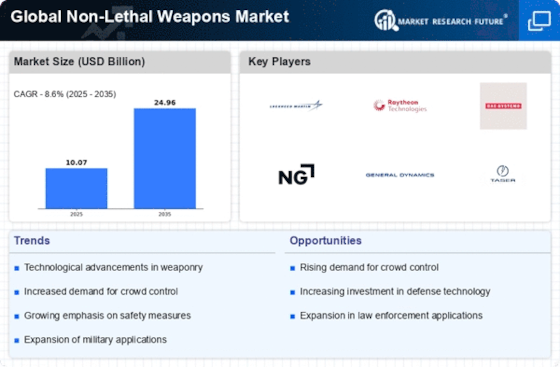
As per Market Research Future analysis, the Global Non-Lethal Weapons Market Size was estimated at 10.07 USD Billion in 2024. The non-lethal weapons industry is projected to grow from 10.94 USD Billion in 2025 to 24.96 USD Billion by 2035, exhibiting a compound annual growth rate (CAGR) of 8.6% during the forecast period 2025 - 2035

Key Market Trends & Highlights

The Global Non-Lethal Weapons Market is poised for substantial growth driven by technological advancements and evolving security needs.

  • Technological advancements are enhancing the effectiveness and versatility of non-lethal weapons, particularly in military applications. North America remains the largest market for non-lethal weapons, while the Asia-Pacific region is experiencing the fastest growth due to rising security concerns. The military segment continues to dominate the market, whereas the law enforcement segment is rapidly expanding as agencies modernize their approaches. Increasing demand for crowd control solutions and a growing focus on law enforcement modernization are key drivers propelling market growth.

Market Size & Forecast

2024 Market Size 10.07 (USD Billion)
2035 Market Size 24.96 (USD Billion)
CAGR (2025 - 2035) 8.6%
Largest Regional Market Share in 2024 North America

Major Players

<a href="https://www.lockheedmartin.com/en-us/products.html">Lockheed Martin</a> (US), Raytheon Technologies (US), BAE Systems (GB), Northrop Grumman (US), General Dynamics (US), Taser International (US), Rheinmetall AG (DE), FN Herstal (BE), Nonlethal Technologies (US)

Market Trends

The Global Non-Lethal Weapons Market is currently experiencing a notable evolution, driven by a variety of factors including technological advancements and changing security dynamics. As nations increasingly prioritize the safety of civilians while maintaining order, the demand for non-lethal options appears to be on the rise. This market encompasses a diverse range of products, including but not limited to, stun guns, tear gas, and sonic weapons, which are designed to incapacitate rather than cause permanent harm. The integration of innovative technologies, such as smart munitions and advanced crowd control systems, suggests a shift towards more sophisticated solutions that can effectively address modern security challenges. Moreover, the Global Non-Lethal Weapons Market seems to be influenced by a growing emphasis on human rights and ethical considerations in law enforcement and military operations. As public scrutiny increases, there is a potential for greater regulatory oversight, which may shape the development and deployment of these weapons. Additionally, the rise of non-state actors and asymmetric warfare scenarios indicates a need for adaptable and versatile non-lethal solutions. Consequently, stakeholders in this market must navigate a complex landscape, balancing operational effectiveness with ethical implications, while also responding to evolving threats and societal expectations.

Technological Advancements

The ongoing integration of cutting-edge technologies into non-lethal weaponry is reshaping the landscape of the Global Non-Lethal Weapons Market. Innovations such as smart munitions and enhanced targeting systems are likely to improve the effectiveness and precision of these tools, thereby increasing their appeal to law enforcement and military agencies.

Regulatory and Ethical Considerations

As the Global Non-Lethal Weapons Market expands, there appears to be a growing focus on regulatory frameworks and ethical implications surrounding their use. This trend suggests that manufacturers and users may face increased scrutiny regarding the deployment of non-lethal options, necessitating a careful balance between operational needs and human rights.

Emerging Security Threats

The rise of unconventional security threats, including terrorism and civil unrest, is driving demand for versatile non-lethal solutions. This trend indicates that the Global Non-Lethal Weapons Market must adapt to address the complexities of modern conflict scenarios, potentially leading to the development of new products tailored to specific operational requirements.

Non Lethal Weapons Market Market Drivers

Advancements in Technology

Technological advancements play a crucial role in shaping the Global Non-Lethal Weapons Market. Innovations in materials and delivery systems have led to the development of more effective and reliable non-lethal weapons. For instance, the integration of smart technology into non-lethal devices enhances their precision and reduces the risk of unintended injuries. The market is witnessing a surge in the adoption of electroshock weapons and acoustic devices, which are designed to incapacitate individuals without causing lasting damage. As these technologies evolve, they are expected to attract significant investment, with projections indicating that the market could expand to USD 7 billion by 2026. This technological evolution not only improves the efficacy of non-lethal weapons but also addresses concerns regarding their ethical use.

Rising Awareness of Human Rights

The increasing awareness of human rights issues is influencing the Global Non-Lethal Weapons Market. As societies become more conscious of the implications of using lethal force, there is a growing demand for alternatives that can effectively manage conflicts without causing permanent harm. This shift in public sentiment is prompting governments and law enforcement agencies to explore non-lethal options as a means of ensuring compliance with human rights standards. The market is responding to this demand, with projections indicating a potential market size of USD 6.2 billion by 2025. This trend suggests that non-lethal weapons are not only seen as tools for law enforcement but also as instruments that can help uphold ethical standards in policing.

Emerging Security Threats and Terrorism

The rise of emerging security threats, including terrorism and civil unrest, is a critical driver in the Global Non-Lethal Weapons Market. As the nature of threats evolves, law enforcement and military agencies are increasingly recognizing the need for non-lethal options to address these challenges. Non-lethal weapons provide a means to incapacitate suspects without resorting to lethal force, thereby reducing the risk of escalation during confrontations. The market is projected to grow significantly, with estimates suggesting a value of USD 7.5 billion by 2026. This growth is indicative of a broader strategy to enhance security measures while adhering to international norms regarding the use of force. The focus on non-lethal solutions is likely to become more pronounced as agencies seek to adapt to the changing landscape of security threats.

Increasing Demand for Crowd Control Solutions

The rising need for effective crowd control solutions is a pivotal driver in the Global Non-Lethal Weapons Market. As urbanization accelerates and public gatherings become more frequent, law enforcement agencies are increasingly seeking non-lethal options to manage large crowds. This trend is underscored by the fact that the market for non-lethal weapons is projected to reach USD 6.5 billion by 2025, reflecting a compound annual growth rate of approximately 5.5%. Non-lethal weapons, such as tear gas and rubber bullets, are preferred for their ability to disperse crowds without causing permanent harm, thus aligning with public safety objectives. Consequently, the demand for innovative crowd control technologies is likely to continue growing, further propelling the market forward.

Growing Focus on Law Enforcement Modernization

The modernization of law enforcement agencies is a significant driver in the Global Non-Lethal Weapons Market. Governments worldwide are increasingly investing in upgrading their policing strategies to incorporate non-lethal options. This shift is driven by a desire to enhance public safety while minimizing fatalities during law enforcement operations. Reports suggest that the market for non-lethal weapons is expected to grow at a steady pace, with a projected value of USD 6.8 billion by 2025. This growth is indicative of a broader trend towards adopting non-lethal measures in policing, as agencies seek to balance effective law enforcement with community relations. The emphasis on training and equipping officers with non-lethal tools is likely to further stimulate market growth.

Market Segment Insights

By End-User Industry: Military (Largest) vs. Law Enforcement (Fastest-Growing)

In the Global Non-Lethal Weapons Market Analysis, the Military segment holds a significant share, reflecting its established utilization of non-lethal technologies for conflict and peacekeeping missions. This segment is characterized by the need for versatile and effective tools that can incapacitate adversaries without causing permanent harm. Conversely, the Law Enforcement segment has seen an increasing adoption rate, primarily due to growing concerns over public safety and the need for less lethal engagement options in civilian scenarios. This growth trajectory illustrates a shift towards more humane methods in law enforcement practices. The dynamics of this segment are influenced by several key factors including advancements in technology, rising civil unrest, and increasing focus on human rights within law enforcement practices. The global push towards accountability in policing has driven demand for effective, low-lethality solutions. In addition, ongoing military investments in research and development are enhancing the capabilities of non-lethal weaponry, thereby facilitating broader applications across both military and law enforcement sectors, ultimately shaping a comprehensive market growth landscape.

Military (Dominant) vs. Law Enforcement (Emerging)

The Military segment represents a dominant force within the Global Non-Lethal Weapons Market, leveraging advanced technology to deploy tools such as tasers, rubber bullets, and chemical agents effectively. This segment prioritizes safety, ensuring that engagement strategies limit harm while achieving operational objectives. In contrast, the Law Enforcement sector is emerging as a critical player, driven by a societal shift towards more humane policing methods in urban settings. Law enforcement agencies are increasingly turning to non-lethal options to mitigate escalating tensions during protests and public demonstrations, aiming to maintain order without excessive force. As public scrutiny over policing practices intensifies, the demand for non-lethal solutions in law enforcement is projected to grow significantly, contributing to its rapid ascent within the market.

By Product Types: Direct Contact Weapons (Largest) vs. Directed Energy Weapons (Fastest-Growing)

In the Global Non-Lethal Weapons Market Report, the segment of Direct Contact Weapons is recognized as the largest product type, catering to a broad range of law enforcement and military applications. This category includes traditional weaponry such as batons and rubber bullets, widely utilized for crowd control and self-<a href="https://www.marketresearchfuture.com/reports/defense-market-34071" target="_blank" rel="noopener">defense</a>. On the other hand, Directed Energy Weapons, including tasers and laser-based systems, are gaining traction and are classified as the fastest-growing segment due to their advanced technological attributes and effectiveness in incapacitating targets without permanent harm.

Direct Contact Weapons (Dominant) vs. Directed Energy Weapons (Emerging)

Direct Contact Weapons hold a dominant position in the Global Non-Lethal Weapons Market, characterized by their established reliability and wide acceptance across various sectors. These weapons are primarily used for restraint and control, appealing to law enforcement agencies worldwide. In contrast, Directed Energy Weapons are emerging as a significant player, driven by technological innovations that enhance user safety and operational efficiency. The growing preference for non-lethal options in policing and military operations fuels the demand for directed energy solutions, underpinning their status as a fast-growing category in the market.

By Market Technology: Electromagnetic (Largest) vs. Mechanical (Fastest-Growing)

In the Global Non-Lethal Weapons Market Analysis, the distribution of market share among technologies reveals that Electromagnetic systems dominate the segment, driven by their advanced capabilities and reliability. Mechanical technologies follow, carving out a significant presence as they are increasingly integrated into diverse law enforcement and military applications. This growing importance is indicative of a broader trend towards non-lethal solutions in defense, where the preference for technologies that minimize casualties is propelling their adoption.

Technology: Electromagnetic (Dominant) vs. Mechanical (Emerging)

Electromagnetic technologies are recognized for their effectiveness in crowd control and area denial, providing powerful, safe alternatives to lethal force. They are characterized by their capability to disable electronic systems, thus protecting personnel without inflicting harm. On the other hand, Mechanical technologies, characterized by tools like batons and nets, are rapidly evolving. Their position in the market is bolstered by innovations and enhanced user safety, indicating a notable shift towards integrating user-operated, non-lethal equipment in law enforcement and security strategies.

Get more detailed insights about Non-Lethal Weapons Market Report Information – Forecast to 2035

Regional Insights

North America : Market Leader in Non-Lethal Weapons

North America is the largest market for non-lethal weapons, accounting for approximately 45% of the global market share. The region's growth is driven by increasing defense budgets, rising demand for crowd control solutions, and stringent regulations promoting non-lethal options. The U.S. government actively supports the development of non-lethal technologies, enhancing their adoption in law enforcement and military applications. Key players in this region include Lockheed Martin, Raytheon Technologies, and Taser International, which are at the forefront of innovation. The competitive landscape is characterized by significant investments in research and development, leading to advanced product offerings. The U.S. remains the dominant force, while Canada is also emerging as a notable player in the non-lethal weapons sector.

Europe : Growing Demand for Safety Solutions

Europe is witnessing a growing demand for non-lethal weapons, holding approximately 30% of the global market share. The region's growth is fueled by increasing concerns over public safety, rising civil unrest, and the need for effective crowd control measures. Regulatory frameworks in countries like Germany and the UK are evolving to support the use of non-lethal options in law enforcement, enhancing market potential. Leading countries in this region include Germany, the UK, and France, with key players such as Rheinmetall AG and FN Herstal driving innovation. The competitive landscape is marked by collaborations between government agencies and private firms to develop advanced non-lethal solutions. The focus on safety and human rights is shaping the market, leading to a surge in demand for effective non-lethal technologies.

Asia-Pacific : Emerging Powerhouse in Defense

Asia-Pacific is rapidly emerging as a significant player in the non-lethal weapons market, accounting for about 20% of the global share. The region's growth is driven by increasing defense expenditures, urbanization, and rising concerns over public safety. Countries like India and Japan are investing in non-lethal technologies to enhance their law enforcement capabilities, supported by favorable government policies promoting such solutions. China, India, and Japan are the leading countries in this market, with a competitive landscape featuring both domestic and international players. Companies are focusing on developing innovative non-lethal solutions tailored to regional needs. The presence of key players like Nonlethal Technologies is further enhancing the market's growth potential, as they adapt to the unique challenges faced in the region.

Middle East and Africa : Resource-Rich Frontier for Innovation

The Middle East and Africa region is gradually expanding its non-lethal weapons market, holding approximately 5% of the global share. The growth is driven by increasing security concerns, ongoing conflicts, and the need for effective crowd control measures. Governments in this region are recognizing the importance of non-lethal options to maintain order while minimizing casualties, leading to supportive regulatory frameworks. Countries like South Africa and the UAE are at the forefront of adopting non-lethal technologies, with a competitive landscape that includes both local and international firms. The presence of key players is growing, as they seek to address the unique security challenges faced in the region. The focus on innovative solutions is expected to drive further market expansion in the coming years.

Key Players and Competitive Insights

The Global Non-Lethal Weapons Market is characterized by a dynamic competitive landscape, driven by increasing demand for crowd control, law enforcement, and military applications. Key players such as Lockheed Martin (US), Raytheon Technologies (US), and Rheinmetall AG (DE) are strategically positioned to leverage technological advancements and expand their market share. Lockheed Martin (US) focuses on innovation in non-lethal technologies, particularly in the development of advanced directed energy systems, while Raytheon Technologies (US) emphasizes partnerships with governmental agencies to enhance its product offerings. Rheinmetall AG (DE) is actively pursuing regional expansion, particularly in Europe, to capitalize on the growing demand for non-lethal solutions in civil security and defense sectors. Collectively, these strategies contribute to a competitive environment that is increasingly focused on technological innovation and strategic partnerships.

The market structure appears moderately fragmented, with several key players vying for dominance. Companies are adopting various business tactics, such as localizing manufacturing and optimizing supply chains, to enhance operational efficiency and reduce costs. This competitive structure allows for a diverse range of products and solutions, catering to the specific needs of different regions and sectors. The influence of major players is significant, as they set industry standards and drive innovation, thereby shaping the overall market dynamics.

In August 2025, Lockheed Martin (US) announced a collaboration with a leading technology firm to develop next-generation non-lethal weapons systems utilizing artificial intelligence. This strategic move is likely to enhance Lockheed Martin's capabilities in creating more effective and adaptable solutions for law enforcement and military applications. The integration of AI into non-lethal systems could potentially revolutionize operational effectiveness, allowing for more precise and controlled responses in various scenarios.

In September 2025, Raytheon Technologies (US) unveiled a new line of non-lethal crowd control devices designed for urban environments. This launch reflects the company's commitment to addressing the evolving needs of law enforcement agencies. By focusing on urban-centric solutions, Raytheon Technologies is positioning itself to capture a growing segment of the market that requires specialized equipment for managing civil unrest and large gatherings.

In July 2025, Rheinmetall AG (DE) secured a significant contract with a European government for the supply of non-lethal defense systems. This contract not only underscores Rheinmetall's strong foothold in the European market but also highlights the increasing reliance on non-lethal options in national defense strategies. The successful execution of this contract could enhance Rheinmetall's reputation and open doors for further opportunities within the region.

As of October 2025, current trends in the Global Non-Lethal Weapons Market indicate a shift towards digitalization, sustainability, and the integration of advanced technologies such as AI. Strategic alliances among key players are becoming increasingly important, as they enable companies to pool resources and expertise to innovate more effectively. Looking ahead, competitive differentiation is likely to evolve from traditional price-based competition to a focus on technological innovation, reliability in supply chains, and the ability to meet specific customer needs. This transition suggests that companies that prioritize innovation and adaptability will be better positioned to thrive in the evolving landscape.

Key Companies in the Non Lethal Weapons Market include

Industry Developments

The rising investments in the market segments are helping in improving the quality of the segment products and further, enhancing their ability to meet the rising needs of the  target audience especially during the forecast period that will be ending in 2028. In 2017, The law enforcement segment had been accounted to emerge and grow as the largest market share as these organizations are mostly ordered for processes like restraining, subduing, or incapacitating the threat that is associated rather than neutralizing the same.

The APAC region, as a part of the  non-lethal weapons market share, of expected to exhibit the highest degree of growth rate in the non-lethal weapons market operations during the historic forecast period that had ended in 2019. The  market is likely to carry similar trends and hence, the APAC region is likely to register a prominent market growth. The Asian-Pacific market is expected to grow at the highest CAGR because of the measures that have been taken by several Asia-Pacific countries such as India, China, Australia, South Korea, and others benefitting the market size during the period.

The directed energy weapons  market segment is likely to be growing at a higher market CAGR in comparison with the direct contact weapons due to rising advancements and developments in laser technologies followed by microwave-based weapons, such as active denial systems or ‘pain ray’ weapons. This will help propel the market size during the ongoing forecast period of 2021-2028.

Intended Audience

Non-Lethal Weapon producers, dealers, and manufacturers Component demand groups, sellers, and providers Ammunitions producers and manufacturers Defense companies and organizations Research firms and institutions Regulatory companies and bodies


Future Outlook

Non Lethal Weapons Market Future Outlook

The Global Non-Lethal Weapons Market is projected to grow at 8.6% CAGR from 2025 to 2035, driven by increasing demand for crowd control and enhanced law enforcement capabilities.

New opportunities lie in:

  • <p>Development of advanced electroshock weapons for personal <a href="https://www.marketresearchfuture.com/reports/defense-market-34071" target="_blank" rel="noopener">defense</a> markets.</p>
  • <p> </p>
  • <p>Integration of non-lethal systems in military training programs.</p>
  • <p>Expansion of non-lethal weaponry in private security sectors.</p>

By 2035, the market is expected to solidify its position as a critical component of global security strategies.

Market Segmentation

Non Lethal Weapons Market Product Types Outlook

  • Direct Contact Weapons
  • Directed Energy Weapons

Non Lethal Weapons Market End-User Industry Outlook

  • Military
  • Law Enforcement

Non Lethal Weapons Market Market Technology Outlook

  • Electromagnetic
  • Mechanical
  • Kinetic
  • Chemicals

Report Scope

MARKET SIZE 2024 10.07(USD Billion)
MARKET SIZE 2025 10.94(USD Billion)
MARKET SIZE 2035 24.96(USD Billion)
COMPOUND ANNUAL GROWTH RATE (CAGR) 8.6% (2025 - 2035)
REPORT COVERAGE Revenue Forecast, Competitive Landscape, Growth Factors, and Trends
BASE YEAR 2024
Market Forecast Period 2025 - 2035
Historical Data 2019 - 2024
Market Forecast Units USD Billion
Key Companies Profiled Lockheed Martin (US), Raytheon Technologies (US), BAE Systems (GB), Northrop Grumman (US), General Dynamics (US), Taser International (US), Rheinmetall AG (DE), FN Herstal (BE), Nonlethal Technologies (US)
Segments Covered Type, Disabling Mechanism, End-User, Region Forecast to 2035
Key Market Opportunities Advancements in crowd control technologies drive growth in the Global Non-Lethal Weapons Market.
Key Market Dynamics Rising demand for crowd control solutions drives innovation and regulatory scrutiny in the non-lethal weapons sector.
Countries Covered North America, Europe, APAC, South America, MEA

FAQs

What is the projected market valuation of the Global Non-Lethal Weapons Market by 2035?

<p>The projected market valuation for the Global Non-Lethal Weapons Market is 24.96 USD Billion by 2035.</p>

What was the market valuation of the Global Non-Lethal Weapons Market in 2024?

<p>The overall market valuation was 10.07 USD Billion in 2024.</p>

What is the expected CAGR for the Global Non-Lethal Weapons Market during the forecast period 2025 - 2035?

<p>The expected CAGR for the Global Non-Lethal Weapons Market during the forecast period 2025 - 2035 is 8.6%.</p>

Which companies are considered key players in the Global Non-Lethal Weapons Market?

<p>Key players in the market include Lockheed Martin, Raytheon Technologies, BAE Systems, and Northrop Grumman.</p>

What are the projected valuations for the Military and Law Enforcement segments by 2035?

<p>The Military segment is projected to reach 9.99 USD Billion, while the Law Enforcement segment is expected to reach 14.97 USD Billion by 2035.</p>

What product types are included in the Global Non-Lethal Weapons Market?

<p>Product types include Direct Contact Weapons and Directed Energy Weapons, with projected valuations of 7.25 USD Billion and 17.71 USD Billion respectively by 2035.</p>

How do the market technologies break down in terms of projected valuations by 2035?

<p>By 2035, projected valuations for market technologies include Electromagnetic at 6.12 USD Billion, Mechanical at 4.88 USD Billion, Kinetic at 7.36 USD Billion, and Chemicals at 6.6 USD Billion.</p>

What trends are influencing the growth of the Global Non-Lethal Weapons Market?

<p>Trends influencing growth include increasing demand for non-lethal options in military and law enforcement applications, as well as advancements in technology.</p>

How does the Global Non-Lethal Weapons Market compare to other defense sectors?

<p>The Global Non-Lethal Weapons Market appears to be growing at a robust pace, with a projected valuation increase from 10.07 USD Billion in 2024 to 24.96 USD Billion by 2035.</p>

What role do companies like Taser International and Rheinmetall AG play in the market?

<p>Companies like Taser International and Rheinmetall AG are pivotal in driving innovation and expanding product offerings within the Global Non-Lethal Weapons Market.</p>

  1. SECTION I: EXECUTIVE SUMMARY AND KEY HIGHLIGHTS
    1. | 1.1 EXECUTIVE SUMMARY
    2. | | 1.1.1 Market Overview
    3. | | 1.1.2 Key Findings
    4. | | 1.1.3 Market Segmentation
    5. | | 1.1.4 Competitive Landscape
    6. | | 1.1.5 Challenges and Opportunities
    7. | | 1.1.6 Future Outlook
  2. SECTION II: SCOPING, METHODOLOGY AND MARKET STRUCTURE
    1. | 2.1 MARKET INTRODUCTION
    2. | | 2.1.1 Definition
    3. | | 2.1.2 Scope of the study
    4. | | | 2.1.2.1 Research Objective
    5. | | | 2.1.2.2 Assumption
    6. | | | 2.1.2.3 Limitations
    7. | 2.2 RESEARCH METHODOLOGY
    8. | | 2.2.1 Overview
    9. | | 2.2.2 Data Mining
    10. | | 2.2.3 Secondary Research
    11. | | 2.2.4 Primary Research
    12. | | | 2.2.4.1 Primary Interviews and Information Gathering Process
    13. | | | 2.2.4.2 Breakdown of Primary Respondents
    14. | | 2.2.5 Forecasting Model
    15. | | 2.2.6 Market Size Estimation
    16. | | | 2.2.6.1 Bottom-Up Approach
    17. | | | 2.2.6.2 Top-Down Approach
    18. | | 2.2.7 Data Triangulation
    19. | | 2.2.8 Validation
  3. SECTION III: QUALITATIVE ANALYSIS
    1. | 3.1 MARKET DYNAMICS
    2. | | 3.1.1 Overview
    3. | | 3.1.2 Drivers
    4. | | 3.1.3 Restraints
    5. | | 3.1.4 Opportunities
    6. | 3.2 MARKET FACTOR ANALYSIS
    7. | | 3.2.1 Value chain Analysis
    8. | | 3.2.2 Porter's Five Forces Analysis
    9. | | | 3.2.2.1 Bargaining Power of Suppliers
    10. | | | 3.2.2.2 Bargaining Power of Buyers
    11. | | | 3.2.2.3 Threat of New Entrants
    12. | | | 3.2.2.4 Threat of Substitutes
    13. | | | 3.2.2.5 Intensity of Rivalry
    14. | | 3.2.3 COVID-19 Impact Analysis
    15. | | | 3.2.3.1 Market Impact Analysis
    16. | | | 3.2.3.2 Regional Impact
    17. | | | 3.2.3.3 Opportunity and Threat Analysis
  4. SECTION IV: QUANTITATIVE ANALYSIS
    1. | 4.1 Aerospace & Defense, BY End-User Industry (USD Billion)
    2. | | 4.1.1 Military
    3. | | 4.1.2 Law Enforcement
    4. | 4.2 Aerospace & Defense, BY Product Types (USD Billion)
    5. | | 4.2.1 Direct Contact Weapons
    6. | | 4.2.2 Directed Energy Weapons
    7. | 4.3 Aerospace & Defense, BY Market Technology (USD Billion)
    8. | | 4.3.1 Electromagnetic
    9. | | 4.3.2 Mechanical
    10. | | 4.3.3 Kinetic
    11. | | 4.3.4 Chemicals
    12. | 4.4 Aerospace & Defense, BY Region (USD Billion)
    13. | | 4.4.1 North America
    14. | | | 4.4.1.1 US
    15. | | | 4.4.1.2 Canada
    16. | | 4.4.2 Europe
    17. | | | 4.4.2.1 Germany
    18. | | | 4.4.2.2 UK
    19. | | | 4.4.2.3 France
    20. | | | 4.4.2.4 Russia
    21. | | | 4.4.2.5 Italy
    22. | | | 4.4.2.6 Spain
    23. | | | 4.4.2.7 Rest of Europe
    24. | | 4.4.3 APAC
    25. | | | 4.4.3.1 China
    26. | | | 4.4.3.2 India
    27. | | | 4.4.3.3 Japan
    28. | | | 4.4.3.4 South Korea
    29. | | | 4.4.3.5 Malaysia
    30. | | | 4.4.3.6 Thailand
    31. | | | 4.4.3.7 Indonesia
    32. | | | 4.4.3.8 Rest of APAC
    33. | | 4.4.4 South America
    34. | | | 4.4.4.1 Brazil
    35. | | | 4.4.4.2 Mexico
    36. | | | 4.4.4.3 Argentina
    37. | | | 4.4.4.4 Rest of South America
    38. | | 4.4.5 MEA
    39. | | | 4.4.5.1 GCC Countries
    40. | | | 4.4.5.2 South Africa
    41. | | | 4.4.5.3 Rest of MEA
  5. SECTION V: COMPETITIVE ANALYSIS
    1. | 5.1 Competitive Landscape
    2. | | 5.1.1 Overview
    3. | | 5.1.2 Competitive Analysis
    4. | | 5.1.3 Market share Analysis
    5. | | 5.1.4 Major Growth Strategy in the Aerospace & Defense
    6. | | 5.1.5 Competitive Benchmarking
    7. | | 5.1.6 Leading Players in Terms of Number of Developments in the Aerospace & Defense
    8. | | 5.1.7 Key developments and growth strategies
    9. | | | 5.1.7.1 New Product Launch/Service Deployment
    10. | | | 5.1.7.2 Merger & Acquisitions
    11. | | | 5.1.7.3 Joint Ventures
    12. | | 5.1.8 Major Players Financial Matrix
    13. | | | 5.1.8.1 Sales and Operating Income
    14. | | | 5.1.8.2 Major Players R&D Expenditure. 2023
    15. | 5.2 Company Profiles
    16. | | 5.2.1 Lockheed Martin (US)
    17. | | | 5.2.1.1 Financial Overview
    18. | | | 5.2.1.2 Products Offered
    19. | | | 5.2.1.3 Key Developments
    20. | | | 5.2.1.4 SWOT Analysis
    21. | | | 5.2.1.5 Key Strategies
    22. | | 5.2.2 Raytheon Technologies (US)
    23. | | | 5.2.2.1 Financial Overview
    24. | | | 5.2.2.2 Products Offered
    25. | | | 5.2.2.3 Key Developments
    26. | | | 5.2.2.4 SWOT Analysis
    27. | | | 5.2.2.5 Key Strategies
    28. | | 5.2.3 BAE Systems (GB)
    29. | | | 5.2.3.1 Financial Overview
    30. | | | 5.2.3.2 Products Offered
    31. | | | 5.2.3.3 Key Developments
    32. | | | 5.2.3.4 SWOT Analysis
    33. | | | 5.2.3.5 Key Strategies
    34. | | 5.2.4 Northrop Grumman (US)
    35. | | | 5.2.4.1 Financial Overview
    36. | | | 5.2.4.2 Products Offered
    37. | | | 5.2.4.3 Key Developments
    38. | | | 5.2.4.4 SWOT Analysis
    39. | | | 5.2.4.5 Key Strategies
    40. | | 5.2.5 General Dynamics (US)
    41. | | | 5.2.5.1 Financial Overview
    42. | | | 5.2.5.2 Products Offered
    43. | | | 5.2.5.3 Key Developments
    44. | | | 5.2.5.4 SWOT Analysis
    45. | | | 5.2.5.5 Key Strategies
    46. | | 5.2.6 Taser International (US)
    47. | | | 5.2.6.1 Financial Overview
    48. | | | 5.2.6.2 Products Offered
    49. | | | 5.2.6.3 Key Developments
    50. | | | 5.2.6.4 SWOT Analysis
    51. | | | 5.2.6.5 Key Strategies
    52. | | 5.2.7 Rheinmetall AG (DE)
    53. | | | 5.2.7.1 Financial Overview
    54. | | | 5.2.7.2 Products Offered
    55. | | | 5.2.7.3 Key Developments
    56. | | | 5.2.7.4 SWOT Analysis
    57. | | | 5.2.7.5 Key Strategies
    58. | | 5.2.8 FN Herstal (BE)
    59. | | | 5.2.8.1 Financial Overview
    60. | | | 5.2.8.2 Products Offered
    61. | | | 5.2.8.3 Key Developments
    62. | | | 5.2.8.4 SWOT Analysis
    63. | | | 5.2.8.5 Key Strategies
    64. | | 5.2.9 Nonlethal Technologies (US)
    65. | | | 5.2.9.1 Financial Overview
    66. | | | 5.2.9.2 Products Offered
    67. | | | 5.2.9.3 Key Developments
    68. | | | 5.2.9.4 SWOT Analysis
    69. | | | 5.2.9.5 Key Strategies
    70. | 5.3 Appendix
    71. | | 5.3.1 References
    72. | | 5.3.2 Related Reports
  6. LIST OF FIGURES
    1. | 6.1 MARKET SYNOPSIS
    2. | 6.2 NORTH AMERICA MARKET ANALYSIS
    3. | 6.3 US MARKET ANALYSIS BY END-USER INDUSTRY
    4. | 6.4 US MARKET ANALYSIS BY PRODUCT TYPES
    5. | 6.5 US MARKET ANALYSIS BY MARKET TECHNOLOGY
    6. | 6.6 CANADA MARKET ANALYSIS BY END-USER INDUSTRY
    7. | 6.7 CANADA MARKET ANALYSIS BY PRODUCT TYPES
    8. | 6.8 CANADA MARKET ANALYSIS BY MARKET TECHNOLOGY
    9. | 6.9 EUROPE MARKET ANALYSIS
    10. | 6.10 GERMANY MARKET ANALYSIS BY END-USER INDUSTRY
    11. | 6.11 GERMANY MARKET ANALYSIS BY PRODUCT TYPES
    12. | 6.12 GERMANY MARKET ANALYSIS BY MARKET TECHNOLOGY
    13. | 6.13 UK MARKET ANALYSIS BY END-USER INDUSTRY
    14. | 6.14 UK MARKET ANALYSIS BY PRODUCT TYPES
    15. | 6.15 UK MARKET ANALYSIS BY MARKET TECHNOLOGY
    16. | 6.16 FRANCE MARKET ANALYSIS BY END-USER INDUSTRY
    17. | 6.17 FRANCE MARKET ANALYSIS BY PRODUCT TYPES
    18. | 6.18 FRANCE MARKET ANALYSIS BY MARKET TECHNOLOGY
    19. | 6.19 RUSSIA MARKET ANALYSIS BY END-USER INDUSTRY
    20. | 6.20 RUSSIA MARKET ANALYSIS BY PRODUCT TYPES
    21. | 6.21 RUSSIA MARKET ANALYSIS BY MARKET TECHNOLOGY
    22. | 6.22 ITALY MARKET ANALYSIS BY END-USER INDUSTRY
    23. | 6.23 ITALY MARKET ANALYSIS BY PRODUCT TYPES
    24. | 6.24 ITALY MARKET ANALYSIS BY MARKET TECHNOLOGY
    25. | 6.25 SPAIN MARKET ANALYSIS BY END-USER INDUSTRY
    26. | 6.26 SPAIN MARKET ANALYSIS BY PRODUCT TYPES
    27. | 6.27 SPAIN MARKET ANALYSIS BY MARKET TECHNOLOGY
    28. | 6.28 REST OF EUROPE MARKET ANALYSIS BY END-USER INDUSTRY
    29. | 6.29 REST OF EUROPE MARKET ANALYSIS BY PRODUCT TYPES
    30. | 6.30 REST OF EUROPE MARKET ANALYSIS BY MARKET TECHNOLOGY
    31. | 6.31 APAC MARKET ANALYSIS
    32. | 6.32 CHINA MARKET ANALYSIS BY END-USER INDUSTRY
    33. | 6.33 CHINA MARKET ANALYSIS BY PRODUCT TYPES
    34. | 6.34 CHINA MARKET ANALYSIS BY MARKET TECHNOLOGY
    35. | 6.35 INDIA MARKET ANALYSIS BY END-USER INDUSTRY
    36. | 6.36 INDIA MARKET ANALYSIS BY PRODUCT TYPES
    37. | 6.37 INDIA MARKET ANALYSIS BY MARKET TECHNOLOGY
    38. | 6.38 JAPAN MARKET ANALYSIS BY END-USER INDUSTRY
    39. | 6.39 JAPAN MARKET ANALYSIS BY PRODUCT TYPES
    40. | 6.40 JAPAN MARKET ANALYSIS BY MARKET TECHNOLOGY
    41. | 6.41 SOUTH KOREA MARKET ANALYSIS BY END-USER INDUSTRY
    42. | 6.42 SOUTH KOREA MARKET ANALYSIS BY PRODUCT TYPES
    43. | 6.43 SOUTH KOREA MARKET ANALYSIS BY MARKET TECHNOLOGY
    44. | 6.44 MALAYSIA MARKET ANALYSIS BY END-USER INDUSTRY
    45. | 6.45 MALAYSIA MARKET ANALYSIS BY PRODUCT TYPES
    46. | 6.46 MALAYSIA MARKET ANALYSIS BY MARKET TECHNOLOGY
    47. | 6.47 THAILAND MARKET ANALYSIS BY END-USER INDUSTRY
    48. | 6.48 THAILAND MARKET ANALYSIS BY PRODUCT TYPES
    49. | 6.49 THAILAND MARKET ANALYSIS BY MARKET TECHNOLOGY
    50. | 6.50 INDONESIA MARKET ANALYSIS BY END-USER INDUSTRY
    51. | 6.51 INDONESIA MARKET ANALYSIS BY PRODUCT TYPES
    52. | 6.52 INDONESIA MARKET ANALYSIS BY MARKET TECHNOLOGY
    53. | 6.53 REST OF APAC MARKET ANALYSIS BY END-USER INDUSTRY
    54. | 6.54 REST OF APAC MARKET ANALYSIS BY PRODUCT TYPES
    55. | 6.55 REST OF APAC MARKET ANALYSIS BY MARKET TECHNOLOGY
    56. | 6.56 SOUTH AMERICA MARKET ANALYSIS
    57. | 6.57 BRAZIL MARKET ANALYSIS BY END-USER INDUSTRY
    58. | 6.58 BRAZIL MARKET ANALYSIS BY PRODUCT TYPES
    59. | 6.59 BRAZIL MARKET ANALYSIS BY MARKET TECHNOLOGY
    60. | 6.60 MEXICO MARKET ANALYSIS BY END-USER INDUSTRY
    61. | 6.61 MEXICO MARKET ANALYSIS BY PRODUCT TYPES
    62. | 6.62 MEXICO MARKET ANALYSIS BY MARKET TECHNOLOGY
    63. | 6.63 ARGENTINA MARKET ANALYSIS BY END-USER INDUSTRY
    64. | 6.64 ARGENTINA MARKET ANALYSIS BY PRODUCT TYPES
    65. | 6.65 ARGENTINA MARKET ANALYSIS BY MARKET TECHNOLOGY
    66. | 6.66 REST OF SOUTH AMERICA MARKET ANALYSIS BY END-USER INDUSTRY
    67. | 6.67 REST OF SOUTH AMERICA MARKET ANALYSIS BY PRODUCT TYPES
    68. | 6.68 REST OF SOUTH AMERICA MARKET ANALYSIS BY MARKET TECHNOLOGY
    69. | 6.69 MEA MARKET ANALYSIS
    70. | 6.70 GCC COUNTRIES MARKET ANALYSIS BY END-USER INDUSTRY
    71. | 6.71 GCC COUNTRIES MARKET ANALYSIS BY PRODUCT TYPES
    72. | 6.72 GCC COUNTRIES MARKET ANALYSIS BY MARKET TECHNOLOGY
    73. | 6.73 SOUTH AFRICA MARKET ANALYSIS BY END-USER INDUSTRY
    74. | 6.74 SOUTH AFRICA MARKET ANALYSIS BY PRODUCT TYPES
    75. | 6.75 SOUTH AFRICA MARKET ANALYSIS BY MARKET TECHNOLOGY
    76. | 6.76 REST OF MEA MARKET ANALYSIS BY END-USER INDUSTRY
    77. | 6.77 REST OF MEA MARKET ANALYSIS BY PRODUCT TYPES
    78. | 6.78 REST OF MEA MARKET ANALYSIS BY MARKET TECHNOLOGY
    79. | 6.79 KEY BUYING CRITERIA OF AEROSPACE & DEFENSE
    80. | 6.80 RESEARCH PROCESS OF MRFR
    81. | 6.81 DRO ANALYSIS OF AEROSPACE & DEFENSE
    82. | 6.82 DRIVERS IMPACT ANALYSIS: AEROSPACE & DEFENSE
    83. | 6.83 RESTRAINTS IMPACT ANALYSIS: AEROSPACE & DEFENSE
    84. | 6.84 SUPPLY / VALUE CHAIN: AEROSPACE & DEFENSE
    85. | 6.85 AEROSPACE & DEFENSE, BY END-USER INDUSTRY, 2024 (% SHARE)
    86. | 6.86 AEROSPACE & DEFENSE, BY END-USER INDUSTRY, 2024 TO 2035 (USD Billion)
    87. | 6.87 AEROSPACE & DEFENSE, BY PRODUCT TYPES, 2024 (% SHARE)
    88. | 6.88 AEROSPACE & DEFENSE, BY PRODUCT TYPES, 2024 TO 2035 (USD Billion)
    89. | 6.89 AEROSPACE & DEFENSE, BY MARKET TECHNOLOGY, 2024 (% SHARE)
    90. | 6.90 AEROSPACE & DEFENSE, BY MARKET TECHNOLOGY, 2024 TO 2035 (USD Billion)
    91. | 6.91 BENCHMARKING OF MAJOR COMPETITORS
  7. LIST OF TABLES
    1. | 7.1 LIST OF ASSUMPTIONS
    2. | | 7.1.1
    3. | 7.2 North America MARKET SIZE ESTIMATES; FORECAST
    4. | | 7.2.1 BY END-USER INDUSTRY, 2025-2035 (USD Billion)
    5. | | 7.2.2 BY PRODUCT TYPES, 2025-2035 (USD Billion)
    6. | | 7.2.3 BY MARKET TECHNOLOGY, 2025-2035 (USD Billion)
    7. | 7.3 US MARKET SIZE ESTIMATES; FORECAST
    8. | | 7.3.1 BY END-USER INDUSTRY, 2025-2035 (USD Billion)
    9. | | 7.3.2 BY PRODUCT TYPES, 2025-2035 (USD Billion)
    10. | | 7.3.3 BY MARKET TECHNOLOGY, 2025-2035 (USD Billion)
    11. | 7.4 Canada MARKET SIZE ESTIMATES; FORECAST
    12. | | 7.4.1 BY END-USER INDUSTRY, 2025-2035 (USD Billion)
    13. | | 7.4.2 BY PRODUCT TYPES, 2025-2035 (USD Billion)
    14. | | 7.4.3 BY MARKET TECHNOLOGY, 2025-2035 (USD Billion)
    15. | 7.5 Europe MARKET SIZE ESTIMATES; FORECAST
    16. | | 7.5.1 BY END-USER INDUSTRY, 2025-2035 (USD Billion)
    17. | | 7.5.2 BY PRODUCT TYPES, 2025-2035 (USD Billion)
    18. | | 7.5.3 BY MARKET TECHNOLOGY, 2025-2035 (USD Billion)
    19. | 7.6 Germany MARKET SIZE ESTIMATES; FORECAST
    20. | | 7.6.1 BY END-USER INDUSTRY, 2025-2035 (USD Billion)
    21. | | 7.6.2 BY PRODUCT TYPES, 2025-2035 (USD Billion)
    22. | | 7.6.3 BY MARKET TECHNOLOGY, 2025-2035 (USD Billion)
    23. | 7.7 UK MARKET SIZE ESTIMATES; FORECAST
    24. | | 7.7.1 BY END-USER INDUSTRY, 2025-2035 (USD Billion)
    25. | | 7.7.2 BY PRODUCT TYPES, 2025-2035 (USD Billion)
    26. | | 7.7.3 BY MARKET TECHNOLOGY, 2025-2035 (USD Billion)
    27. | 7.8 France MARKET SIZE ESTIMATES; FORECAST
    28. | | 7.8.1 BY END-USER INDUSTRY, 2025-2035 (USD Billion)
    29. | | 7.8.2 BY PRODUCT TYPES, 2025-2035 (USD Billion)
    30. | | 7.8.3 BY MARKET TECHNOLOGY, 2025-2035 (USD Billion)
    31. | 7.9 Russia MARKET SIZE ESTIMATES; FORECAST
    32. | | 7.9.1 BY END-USER INDUSTRY, 2025-2035 (USD Billion)
    33. | | 7.9.2 BY PRODUCT TYPES, 2025-2035 (USD Billion)
    34. | | 7.9.3 BY MARKET TECHNOLOGY, 2025-2035 (USD Billion)
    35. | 7.10 Italy MARKET SIZE ESTIMATES; FORECAST
    36. | | 7.10.1 BY END-USER INDUSTRY, 2025-2035 (USD Billion)
    37. | | 7.10.2 BY PRODUCT TYPES, 2025-2035 (USD Billion)
    38. | | 7.10.3 BY MARKET TECHNOLOGY, 2025-2035 (USD Billion)
    39. | 7.11 Spain MARKET SIZE ESTIMATES; FORECAST
    40. | | 7.11.1 BY END-USER INDUSTRY, 2025-2035 (USD Billion)
    41. | | 7.11.2 BY PRODUCT TYPES, 2025-2035 (USD Billion)
    42. | | 7.11.3 BY MARKET TECHNOLOGY, 2025-2035 (USD Billion)
    43. | 7.12 Rest of Europe MARKET SIZE ESTIMATES; FORECAST
    44. | | 7.12.1 BY END-USER INDUSTRY, 2025-2035 (USD Billion)
    45. | | 7.12.2 BY PRODUCT TYPES, 2025-2035 (USD Billion)
    46. | | 7.12.3 BY MARKET TECHNOLOGY, 2025-2035 (USD Billion)
    47. | 7.13 APAC MARKET SIZE ESTIMATES; FORECAST
    48. | | 7.13.1 BY END-USER INDUSTRY, 2025-2035 (USD Billion)
    49. | | 7.13.2 BY PRODUCT TYPES, 2025-2035 (USD Billion)
    50. | | 7.13.3 BY MARKET TECHNOLOGY, 2025-2035 (USD Billion)
    51. | 7.14 China MARKET SIZE ESTIMATES; FORECAST
    52. | | 7.14.1 BY END-USER INDUSTRY, 2025-2035 (USD Billion)
    53. | | 7.14.2 BY PRODUCT TYPES, 2025-2035 (USD Billion)
    54. | | 7.14.3 BY MARKET TECHNOLOGY, 2025-2035 (USD Billion)
    55. | 7.15 India MARKET SIZE ESTIMATES; FORECAST
    56. | | 7.15.1 BY END-USER INDUSTRY, 2025-2035 (USD Billion)
    57. | | 7.15.2 BY PRODUCT TYPES, 2025-2035 (USD Billion)
    58. | | 7.15.3 BY MARKET TECHNOLOGY, 2025-2035 (USD Billion)
    59. | 7.16 Japan MARKET SIZE ESTIMATES; FORECAST
    60. | | 7.16.1 BY END-USER INDUSTRY, 2025-2035 (USD Billion)
    61. | | 7.16.2 BY PRODUCT TYPES, 2025-2035 (USD Billion)
    62. | | 7.16.3 BY MARKET TECHNOLOGY, 2025-2035 (USD Billion)
    63. | 7.17 South Korea MARKET SIZE ESTIMATES; FORECAST
    64. | | 7.17.1 BY END-USER INDUSTRY, 2025-2035 (USD Billion)
    65. | | 7.17.2 BY PRODUCT TYPES, 2025-2035 (USD Billion)
    66. | | 7.17.3 BY MARKET TECHNOLOGY, 2025-2035 (USD Billion)
    67. | 7.18 Malaysia MARKET SIZE ESTIMATES; FORECAST
    68. | | 7.18.1 BY END-USER INDUSTRY, 2025-2035 (USD Billion)
    69. | | 7.18.2 BY PRODUCT TYPES, 2025-2035 (USD Billion)
    70. | | 7.18.3 BY MARKET TECHNOLOGY, 2025-2035 (USD Billion)
    71. | 7.19 Thailand MARKET SIZE ESTIMATES; FORECAST
    72. | | 7.19.1 BY END-USER INDUSTRY, 2025-2035 (USD Billion)
    73. | | 7.19.2 BY PRODUCT TYPES, 2025-2035 (USD Billion)
    74. | | 7.19.3 BY MARKET TECHNOLOGY, 2025-2035 (USD Billion)
    75. | 7.20 Indonesia MARKET SIZE ESTIMATES; FORECAST
    76. | | 7.20.1 BY END-USER INDUSTRY, 2025-2035 (USD Billion)
    77. | | 7.20.2 BY PRODUCT TYPES, 2025-2035 (USD Billion)
    78. | | 7.20.3 BY MARKET TECHNOLOGY, 2025-2035 (USD Billion)
    79. | 7.21 Rest of APAC MARKET SIZE ESTIMATES; FORECAST
    80. | | 7.21.1 BY END-USER INDUSTRY, 2025-2035 (USD Billion)
    81. | | 7.21.2 BY PRODUCT TYPES, 2025-2035 (USD Billion)
    82. | | 7.21.3 BY MARKET TECHNOLOGY, 2025-2035 (USD Billion)
    83. | 7.22 South America MARKET SIZE ESTIMATES; FORECAST
    84. | | 7.22.1 BY END-USER INDUSTRY, 2025-2035 (USD Billion)
    85. | | 7.22.2 BY PRODUCT TYPES, 2025-2035 (USD Billion)
    86. | | 7.22.3 BY MARKET TECHNOLOGY, 2025-2035 (USD Billion)
    87. | 7.23 Brazil MARKET SIZE ESTIMATES; FORECAST
    88. | | 7.23.1 BY END-USER INDUSTRY, 2025-2035 (USD Billion)
    89. | | 7.23.2 BY PRODUCT TYPES, 2025-2035 (USD Billion)
    90. | | 7.23.3 BY MARKET TECHNOLOGY, 2025-2035 (USD Billion)
    91. | 7.24 Mexico MARKET SIZE ESTIMATES; FORECAST
    92. | | 7.24.1 BY END-USER INDUSTRY, 2025-2035 (USD Billion)
    93. | | 7.24.2 BY PRODUCT TYPES, 2025-2035 (USD Billion)
    94. | | 7.24.3 BY MARKET TECHNOLOGY, 2025-2035 (USD Billion)
    95. | 7.25 Argentina MARKET SIZE ESTIMATES; FORECAST
    96. | | 7.25.1 BY END-USER INDUSTRY, 2025-2035 (USD Billion)
    97. | | 7.25.2 BY PRODUCT TYPES, 2025-2035 (USD Billion)
    98. | | 7.25.3 BY MARKET TECHNOLOGY, 2025-2035 (USD Billion)
    99. | 7.26 Rest of South America MARKET SIZE ESTIMATES; FORECAST
    100. | | 7.26.1 BY END-USER INDUSTRY, 2025-2035 (USD Billion)
    101. | | 7.26.2 BY PRODUCT TYPES, 2025-2035 (USD Billion)
    102. | | 7.26.3 BY MARKET TECHNOLOGY, 2025-2035 (USD Billion)
    103. | 7.27 MEA MARKET SIZE ESTIMATES; FORECAST
    104. | | 7.27.1 BY END-USER INDUSTRY, 2025-2035 (USD Billion)
    105. | | 7.27.2 BY PRODUCT TYPES, 2025-2035 (USD Billion)
    106. | | 7.27.3 BY MARKET TECHNOLOGY, 2025-2035 (USD Billion)
    107. | 7.28 GCC Countries MARKET SIZE ESTIMATES; FORECAST
    108. | | 7.28.1 BY END-USER INDUSTRY, 2025-2035 (USD Billion)
    109. | | 7.28.2 BY PRODUCT TYPES, 2025-2035 (USD Billion)
    110. | | 7.28.3 BY MARKET TECHNOLOGY, 2025-2035 (USD Billion)
    111. | 7.29 South Africa MARKET SIZE ESTIMATES; FORECAST
    112. | | 7.29.1 BY END-USER INDUSTRY, 2025-2035 (USD Billion)
    113. | | 7.29.2 BY PRODUCT TYPES, 2025-2035 (USD Billion)
    114. | | 7.29.3 BY MARKET TECHNOLOGY, 2025-2035 (USD Billion)
    115. | 7.30 Rest of MEA MARKET SIZE ESTIMATES; FORECAST
    116. | | 7.30.1 BY END-USER INDUSTRY, 2025-2035 (USD Billion)
    117. | | 7.30.2 BY PRODUCT TYPES, 2025-2035 (USD Billion)
    118. | | 7.30.3 BY MARKET TECHNOLOGY, 2025-2035 (USD Billion)
    119. | 7.31 PRODUCT LAUNCH/PRODUCT DEVELOPMENT/APPROVAL
    120. | | 7.31.1
    121. | 7.32 ACQUISITION/PARTNERSHIP
    122. | | 7.32.1

Aerospace & Defense Market Segmentation

Aerospace & Defense By End-User Industry (USD Billion, 2025-2035)

  • Military
  • Law Enforcement

Aerospace & Defense By Product Types (USD Billion, 2025-2035)

  • Direct Contact Weapons
  • Directed Energy Weapons

Aerospace & Defense By Market Technology (USD Billion, 2025-2035)

  • Electromagnetic
  • Mechanical
  • Kinetic
  • Chemicals
Infographic

Free Sample Request

Kindly complete the form below to receive a free sample of this Report

Get Free Sample

Customer Strories

Compare Licence

×
Features License Type
Single User Multiuser License Enterprise User
Price $4,950 $5,950 $7,250
Maximum User Access Limit 1 User Upto 10 Users Unrestricted Access Throughout the Organization
Free Customization
Direct Access to Analyst
Deliverable Format
Platform Access
Discount on Next Purchase 10% 15% 15%
Printable Versions