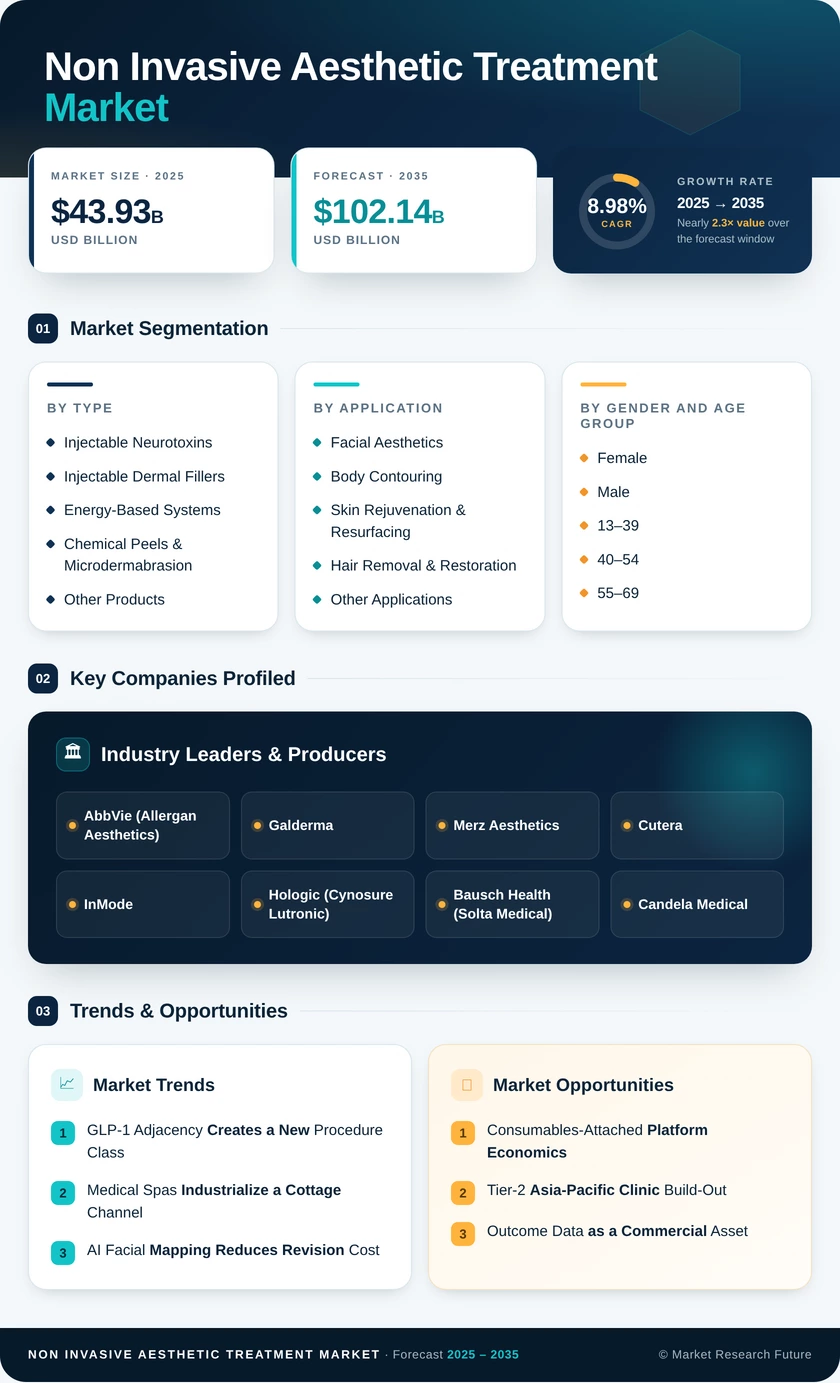
Segmentation Quick Reference
| Dimension | Sub-Segments | Dominant Segment | Fastest Growing Segment |
| By Product Type | Injectable Neurotoxins (Botulinum Toxin Type A and More); Injectable Dermal Fillers; Energy-Based Systems; Chemical Peels & Microdermabrasion; Other Products | Injectable Neurotoxins | Energy-Based Systems |
| By End User | Dermatology & Plastic-Surgery Clinics; Medical Spas; Hospitals; Home-Use & Other Settings | Dermatology & Plastic-Surgery Clinics | Medical Spas |
| By Gender | Female; Male | Female | Male |
| By Age Group | 13–39; 40–54; 55–69; 70+ | 40–54 | 13–39 |
| By Application | Facial Aesthetics; Body Contouring; Skin Rejuvenation & Resurfacing; Hair Removal & Restoration; Other Applications | Facial Aesthetics | Body Contouring |
| By Geography | North America; Europe; Asia-Pacific; South America; Middle East & Africa | North America | Asia-Pacific |
Market Segmentation Overview
By Product Type
| Sub-Segment | Key Trend |
| Injectable Neurotoxins | Unit price deflation offset by volume and longer-duration formulations |
| Injectable Dermal Fillers | Shift toward biostimulatory products over pure hyaluronic acid volume |
| Energy-Based Systems | Multimodal chassis replacing single-indication devices |
| Chemical Peels & Microdermabrasion | Entry-price funnel product for first-time patients |
| Other Products | Thread lifts and mesotherapy adjuncts gaining regional traction |
Product mix is rebalancing away from single-purchase injectables toward capital platforms with attached consumables, a shift that changes both clinic economics and manufacturer revenue quality.
By End User
| Sub-Segment | Key Trend |
| Dermatology & Plastic-Surgery Clinics | Retain complex cases and premium pricing power |
| Medical Spas | Consolidation and membership billing drive fastest expansion |
| Hospitals | Reconstructive adjacency creates partial reimbursement pathways |
| Home-Use & Other Settings | Positioned as maintenance between professional sessions |
Channel structure is professionalizing rapidly, with multi-site operators imposing device standardization that favours vendors able to service national fleets.
By Gender
| Sub-Segment | Key Trend |
| Female | Remains the revenue base with high repeat frequency |
| Male | Jawline definition and hair restoration drive above-average growth |
Male participation is rising from a small base and reshapes clinic marketing, consultation design, and treatment-room scheduling assumptions.
By Age Group
| Sub-Segment | Key Trend |
| 13–39 | Preventative treatment and social-media-influenced uptake |
| 40–54 | Peak disposable income supports the largest revenue pool |
| 55–69 | Focus shifts to laxity correction and skin quality |
| 70+ | Steady maintenance treatment demand |
Earlier first-treatment age extends patient lifetime value materially, which is why clinics are investing in loyalty structures rather than one-off promotions.
By Application
| Sub-Segment | Key Trend |
| Facial Aesthetics | Highest visible return per dollar sustains dominance |
| Body Contouring | Post-pharmacological weight-loss laxity creates new demand |
| Skin Rejuvenation & Resurfacing | Pigmentation and texture correction broadening across skin types |
| Hair Removal & Restoration | Multi-session protocols deliver predictable recurring revenue |
| Other Applications | Vascular and scar indications open medical-adjacent pathways |
Application mix is broadening beyond the face for the first time in a decade, and body work is now the segment attracting the most new device development.
By Geography
| Sub-Segment | Key Trend |
| North America | Med-spa consolidation and cash-pay resilience |
| Europe | Regulatory compliance cost favouring established portfolios |
| Asia-Pacific | Tier-2 city capacity build-out and domestic manufacturing strength |
| South America | High procedure volumes at lower average pricing, tourism inflow |
| Middle East & Africa | Sovereign health investment funding premium clinic infrastructure |
Geographic growth is decoupling from geographic revenue: mature markets still hold the money, while Asia-Pacific and the Gulf are adding the capacity that will shift the balance after 2030.


 Noah Malgeri
Co-Founder

 Peter Groot koerkamp
Account and Business Manager

 Younghwan Choi
Senior Retail Manager

 Mark Irwin
Management Consultant

 Akif Moroglu
Strategy & Business Development Director

 Guilherme Gomes Martins
Product Management Director

 Joseph Aguayo
Sales Operations & Pricing Manager

 La Terria Dodd
Program Support Specialist

 Rob Kooiker
Group Product Manager HVAC & Fire Protection GMA