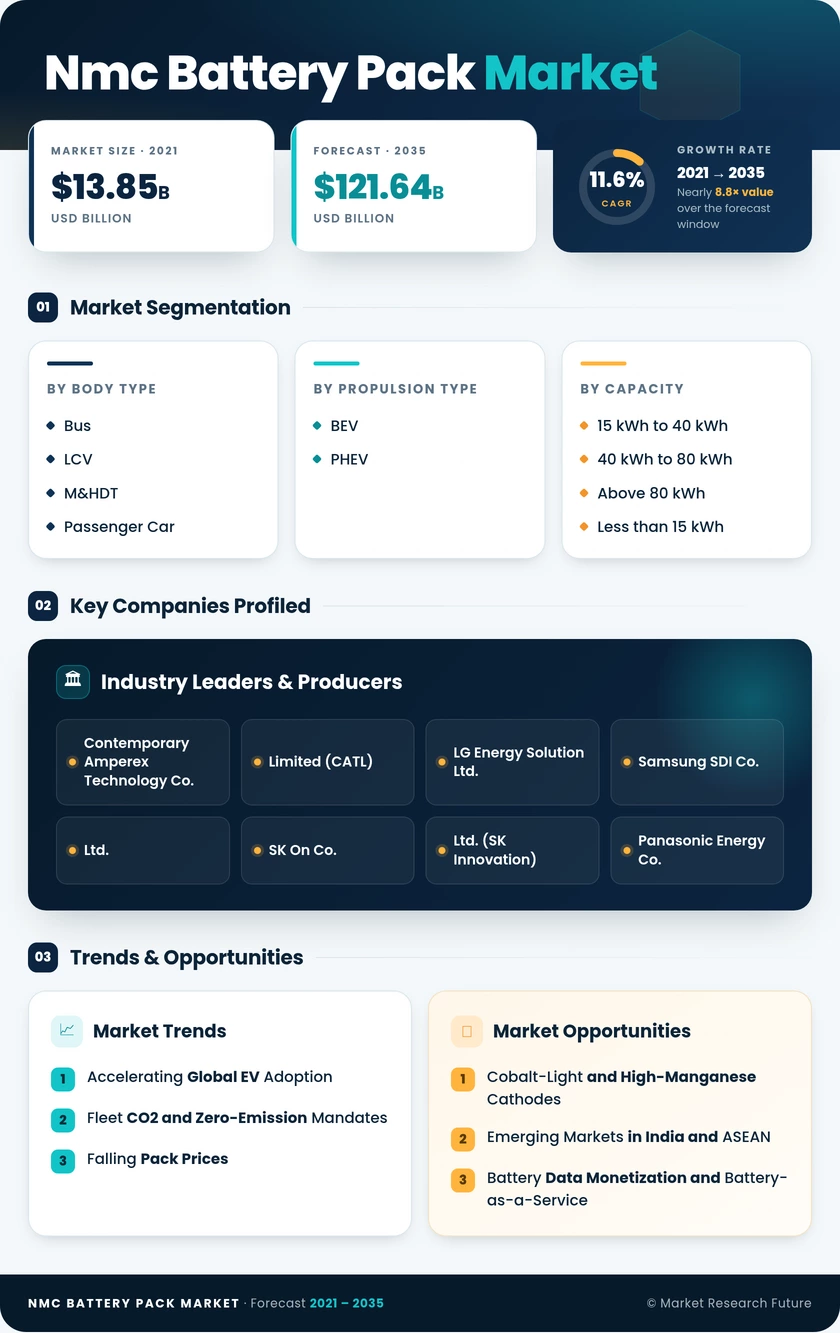
Segmentation Quick Reference
| Dimension | Sub-Segments | Dominant Segment | Fastest Growing Segment |
|---|---|---|---|
| By Body Type | Bus, LCV, M&HDT, Passenger Car | Passenger Car (74.6% share) | M&HDT (16.4% CAGR) |
| By Propulsion Type | BEV, PHEV | BEV (81.2% share) | PHEV (12.8% CAGR) |
| By Capacity | 15 kWh to 40 kWh, 40 kWh to 80 kWh, Above 80 kWh, Less than 15 kWh | 40 kWh to 80 kWh (52.7% share) | Above 80 kWh (14.6% CAGR) |
| By Battery Form | Cylindrical, Pouch, Prismatic | Prismatic (46.8% share) | Cylindrical (15.3% CAGR) |
| By Method | Laser, Wire | Wire (61.5% share) | Laser (15.8% CAGR) |
| By Component | Anode, Cathode, Electrolyte, Separator | Cathode (48.9% share) | Anode (13.4% CAGR) |
| By Material Type | Cobalt, Lithium, Manganese, Natural Graphite, Nickel, Other Materials | Nickel (34.2% share) | Lithium (13.7% CAGR) |
| By Region | North America, Europe, Asia-Pacific, South America, Middle East & Africa | Asia-Pacific (58.4% share) | North America (14.2% CAGR) |
Market Segmentation Overview
By Body Type
| Sub-Segment | Key Trend |
|---|---|
| Bus | Municipal fleet electrification tenders |
| LCV | Last-mile delivery fleet conversion |
| M&HDT | Long-haul trucks enabled by megawatt charging |
| Passenger Car | Long-range crossovers and premium sedans |
Passenger Car leads because consumer EVs need dense packs to deliver combustion-equivalent range in limited floor space. M&HDT grows fastest as EU heavy-duty CO2 targets force truck makers to electrify, and payload limits favor NMC over heavier LFP packs. Bus and LCV demand follows public procurement and delivery fleet budgets.
By Propulsion Type
| Sub-Segment | Key Trend |
|---|---|
| BEV | Mandate-driven volume in Europe, China, and California |
| PHEV | Larger packs in extended-range trucks and SUVs |
BEV dominates because each battery electric vehicle carries several times the capacity of a plug-in hybrid, and zero-emission mandates lock in its volume. PHEV grows faster as automakers launch extended-range models with packs above 25 kWh, where NMC's lower weight per kWh offers a clear packaging advantage.
By Capacity
| Sub-Segment | Key Trend |
|---|---|
| 15 kWh to 40 kWh | Compact EVs facing LFP competition |
| 40 kWh to 80 kWh | Mainstream BEV pack size |
| Above 80 kWh | Premium SUVs and electric pickups |
| Less than 15 kWh | Hybrid and small-vehicle applications |
40 kWh to 80 kWh leads because it matches the pack size of most mainstream crossovers and sedans. Above 80 kWh grows fastest as premium buyers demand 500-plus kilometres of range, a requirement that rewards NMC's energy density. 15 kWh to 40 kWh packs face the strongest pressure from cheaper LFP cells.
By Battery Form
| Sub-Segment | Key Trend |
|---|---|
| Cylindrical | Scale-up of 46-series large-format cells |
| Pouch | Flexible packaging for Korean and U.S. platforms |
| Prismatic | Standard format for Chinese and European OEMs |
Prismatic leads because its rigid casing simplifies cell-to-pack integration and suits Chinese and European assembly lines. Cylindrical grows fastest as 46-series cells from Tesla, Panasonic, and BMW suppliers cut part counts and improve thermal management. Pouch cells hold steady in established American and Korean programs.
By Method
| Sub-Segment | Key Trend |
|---|---|
| Laser | Automated high-strength joining for large-format cells |
| Wire | Proven, low-cost bonding for cylindrical modules |
Wire bonding leads on its low cost and long track record with small cylindrical cells. Laser welding grows fastest because large-format cells and cell-to-pack designs need stronger, lower-resistance joints at higher line speeds. Higher equipment cost slows laser adoption among smaller pack assemblers.
By Component
| Sub-Segment | Key Trend |
|---|---|
| Anode | Silicon-graphite blends for fast charging |
| Cathode | Shift to high-nickel, low-cobalt formulations |
| Electrolyte | High-voltage additive packages |
| Separator | Ceramic-coated layers for thermal safety |
Cathode leads because nickel, cobalt, and lithium make it the costliest component in every NMC cell. Anode grows fastest as silicon-blended graphite lifts energy density and charging speed. Electrolyte and separator suppliers benefit from higher-voltage cathodes that demand better stability and thermal protection.
By Material Type
| Sub-Segment | Key Trend |
|---|---|
| Cobalt | Declining intensity per kWh |
| Lithium | Volume-led growth across chemistries |
| Manganese | High-manganese cathode development |
| Natural Graphite | Anode supply diversification outside China |
| Nickel | Rising share in 8- and 9-series cathodes |
| Other Materials | Aluminium, copper, and binder demand |
Nickel leads because high-nickel cathodes now dominate new NMC cell designs. Lithium grows fastest as every additional kWh of capacity requires it regardless of cathode mix. Cobalt's share keeps falling as suppliers cut it from cathodes, while manganese gains from emerging cobalt-light chemistries.


 Noah Malgeri
Co-Founder

 Peter Groot koerkamp
Account and Business Manager

 Younghwan Choi
Senior Retail Manager

 Mark Irwin
Management Consultant

 Akif Moroglu
Strategy & Business Development Director

 Guilherme Gomes Martins
Product Management Director

 Joseph Aguayo
Sales Operations & Pricing Manager

 La Terria Dodd
Program Support Specialist

 Rob Kooiker
Group Product Manager HVAC & Fire Protection GMA