Request Free Sample ×

Kindly complete the form below to receive a free sample of this Report

* Please use a valid business email

Leading companies partner with us for data-driven Insights

clients tt-cursor
Hero Background
English
Chinese
French
Japanese
Korean
German
Spanish

Nitric Oxide Test Market Size

ID: MRFR/LS/3400-HCR
110 Pages
Vikita Thakur
April 2026

Nitric Oxide Test Market Research Report Information: By Type (Nitric Oxide Test Strips, Nitric Oxide Monitor), Indication (Asthma, Chronic Obstructive Pulmonary Disease, Cystic Fibrosis, Pulmonary Arterial Hypertension), End User (Hospitals) - Forecast till 2035

Share:
Download PDF ×

We do not share your information with anyone. However, we may send you emails based on your report interest from time to time. You may contact us at any time to opt-out.

Nitric Oxide Test Market Infographic
Purchase Options

Nitric Oxide Test Size

Nitric Oxide Test Market Growth Projections and Opportunities

The Nitric Oxide Test Market is influenced by the clinical significance of nitric oxide (NO) in respiration issues. Nitric oxide serves as a biomarker for conditions consisting of asthma and chronic obstructive pulmonary disease (COPD), riding the demand for NO checks inside the prognosis and control of those breathing diseases. The growing occurrence of breathing illnesses globally contributes to the expansion of the Nitric Oxide Test Market. As the burden of conditions like asthma and COPD rises, healthcare carriers depend upon NO tests for accurate analysis, tracking, and personalized remedy strategies. Continuous advancements in diagnostic technology enhance the accuracy and accessibility of Nitric Oxide Testing. Innovations in portable and non-invasive NO checking-out gadgets contribute to the increase in the market, making it less complicated for healthcare experts to assess respiratory situations in numerous settings. Nitric Oxide Testing finds programs in pediatric breathing care. NO levels are often monitored in kids with bronchial asthma or other respiratory conditions, contributing to the demand for NO assessments in pediatric healthcare settings and increasing the market's scope. Ongoing studies and the development of sports in breathing remedies contribute to the evolution of Nitric Oxide Testing. Collaborations between academia and industry players result in the development of novel NO checking out technology, fostering market growth and innovation. Nitric oxide's function in cardiovascular fitness monitoring provides an extra size to the market. As NO levels are related to vascular features, the Nitric Oxide Test is applied in assessing cardiovascular health, increasing its programs past breathing disorders. The Nitric Oxide Test Market is prompted by regulatory compliance and efforts to standardize testing procedures. Adherence to regulatory standards ensures the reliability and accuracy of NO testing out, instills self-assurance in healthcare experts, and contributes to market recognition. Collaborations and partnerships between diagnostic device manufacturers, healthcare establishments, and research agencies contribute to market increase. These collaborations facilitate the improvement of recent NO checking out technology, enlargement of product portfolios, and extended market penetration for key gamers in the Nitric Oxide Test Market.
Nitric Oxide Test Market Size Graph
Author
Author Profile
Vikita Thakur
Senior Research Analyst

She holds an experience of about 5+ years in market research and business consulting projects for sectors such as life sciences, medical devices, and healthcare IT. She possesses a robust background in data analysis, market estimation, competitive intelligence, pipeline analysis market trend identification, and consumer behavior insights. Her expertise lies in technical Sales support, client interaction and project management, designing and implementing market research studies, conducting competitive analysis, and synthesizing complex data into actionable recommendations that drive business growth.

Leave a Comment

FAQs

What is the current valuation of the Nitric Oxide Test Market?

<p>The Nitric Oxide Test Market was valued at 1.6 USD Billion in 2024.</p>

What is the projected market size for the Nitric Oxide Test Market by 2035?

<p>The market is projected to reach approximately 3.361 USD Billion by 2035.</p>

What is the expected CAGR for the Nitric Oxide Test Market during the forecast period?

<p>The expected CAGR for the Nitric Oxide Test Market from 2025 to 2035 is 6.98%.</p>

Which product segments are included in the Nitric Oxide Test Market?

<p>Key product segments include Nitric oxide test strips, Nitric oxide monitors, and others, with values ranging from 0.32 to 1.36 USD Billion.</p>

What are the primary indications for Nitric Oxide testing?

<p>Primary indications include Chronic obstructive pulmonary disease, Asthma, and Pulmonary arterial hypertension, with market values from 0.16 to 0.99 USD Billion.</p>

Who are the leading players in the Nitric Oxide Test Market?

Leading players include Abbott Laboratories, Siemens Healthineers, and Roche Diagnostics, among others.

What are the main end-user segments for Nitric Oxide testing?

Main end-user segments consist of Diagnostic centers, Hospitals &amp; clinics, and Home care settings, with values from 0.24 to 1.36 USD Billion.

How does the market for Nitric Oxide monitors compare to test strips?

The market for Nitric oxide monitors and test strips is projected to be equal, both valued at 1.36 USD Billion by 2035.

What growth trends are anticipated for the Nitric Oxide Test Market?

The market appears to be on a growth trajectory, potentially doubling in size from 2024 to 2035.

What factors could influence the growth of the Nitric Oxide Test Market?

Factors influencing growth may include advancements in diagnostic technology and increasing prevalence of respiratory diseases.

Market Summary

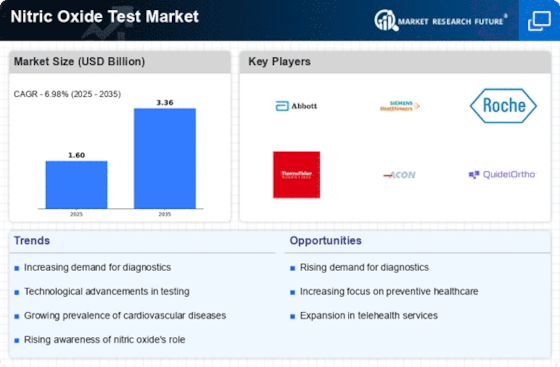
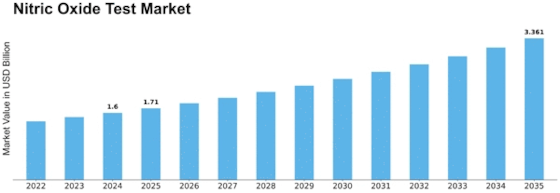
As per Market Research Future analysis, the Nitric Oxide Test Market Size was estimated at 1.6 USD Billion in 2024. The Nitric Oxide Test industry is projected to grow from USD 1.712 Billion in 2025 to USD 3.361 Billion by 2035, exhibiting a compound annual growth rate (CAGR) of 6.98% during the forecast period 2025 - 2035

Key Market Trends & Highlights

The Nitric Oxide Test Market is experiencing robust growth driven by technological advancements and increasing health awareness.

  • Technological advancements in testing methods are reshaping the Nitric Oxide Test Market, particularly in North America. The growing focus on preventive healthcare is propelling demand for nitric oxide testing, especially in the Asia-Pacific region. Nitric Oxide Test Market Strips remain the largest segment, while Nitric Oxide Monitors are emerging as the fastest-growing segment. Key market drivers include technological innovations in diagnostic tools and the increasing prevalence of respiratory disorders.

Market Size & Forecast

2024 Market Size 1.6 (USD Billion)
2035 Market Size 3.361 (USD Billion)
CAGR (2025 - 2035) 6.98%
Largest Regional Market Share in 2024 America

Major Players

Abbott Laboratories (US), Siemens Healthineers (DE), Roche Diagnostics (CH), <a href="https://www.thermofisher.com/order/catalog/product/in/en/EMSNO">Thermo Fisher Scientific</a> (US), <a href="https://www.aconlabs.com/">Acon Laboratories </a>(US), QuidelOrtho Corporation (US), Bio-Rad Laboratories (US), F. Hoffmann-La Roche AG (CH), Medtronic (IE)

Market Trends

The Nitric Oxide Test Market is currently experiencing a notable evolution, driven by increasing awareness regarding the importance of nitric oxide in various physiological processes. This compound plays a crucial role in cardiovascular health, immune response, and neurotransmission, which has led to a growing demand for accurate testing methods. As healthcare professionals and researchers seek to understand the implications of nitric oxide levels in patients, the market is likely to expand, fostering innovation in testing technologies. Furthermore, advancements in diagnostic tools and methodologies are anticipated to enhance the precision and reliability of nitric oxide testing, thereby attracting more stakeholders to this sector. In addition, the rising prevalence of chronic diseases, such as hypertension and diabetes, appears to be influencing the Nitric Oxide Test Market positively. As these conditions are often associated with altered nitric oxide production, healthcare providers are increasingly incorporating nitric oxide tests into routine assessments. This trend suggests a shift towards more personalized medicine, where understanding an individual's nitric oxide levels could lead to tailored treatment plans. Overall, the Nitric Oxide Test Market seems poised for growth, driven by technological advancements and a heightened focus on preventive healthcare measures.

Technological Advancements in Testing Methods

Recent innovations in testing technologies are likely to enhance the accuracy and efficiency of nitric oxide measurements. New devices and methodologies may provide quicker results, making it easier for healthcare providers to assess patient conditions.

Growing Focus on Preventive Healthcare

There is an increasing emphasis on preventive healthcare strategies, which could drive demand for nitric oxide testing. By understanding nitric oxide levels, healthcare professionals may better manage and prevent chronic diseases.

Rising Awareness of Nitric Oxide's Role in Health

As research continues to unveil the significance of nitric oxide in various bodily functions, awareness among both healthcare providers and patients is likely to grow. This heightened understanding may lead to increased testing and monitoring.

Nitric Oxide Test Market Market Drivers

Growing Demand for Personalized Medicine

The Nitric Oxide Test Market is poised for growth due to the increasing demand for personalized medicine. As healthcare shifts towards tailored treatment plans, the role of nitric oxide as a biomarker for various diseases becomes more pronounced. Personalized medicine relies on precise diagnostic tools to determine the most effective treatment strategies for individual patients. Nitric oxide tests provide valuable insights into a patient's health status, enabling healthcare providers to make informed decisions. The market for personalized medicine is projected to grow at a compound annual growth rate (CAGR) of 12% over the next five years, which is likely to positively impact the Nitric Oxide Test Market as more healthcare facilities adopt these tests to enhance patient care.

Regulatory Support for Diagnostic Innovations

The Nitric Oxide Test Market is experiencing favorable regulatory support that encourages the development and adoption of innovative diagnostic tests. Regulatory bodies are increasingly recognizing the importance of nitric oxide testing in clinical practice, leading to streamlined approval processes for new testing technologies. This supportive regulatory environment fosters innovation and encourages manufacturers to invest in the development of advanced nitric oxide testing solutions. As a result, the Nitric Oxide Test Market is likely to witness an influx of new products that meet regulatory standards, enhancing the overall market landscape. Analysts predict that this trend could lead to a 10% increase in market growth as new entrants and innovations emerge in the coming years.

Technological Innovations in Diagnostic Tools

The Nitric Oxide Test Market is experiencing a surge in technological innovations that enhance diagnostic accuracy and efficiency. Advanced testing methods, such as point-of-care testing and non-invasive techniques, are becoming increasingly prevalent. These innovations not only streamline the testing process but also reduce the time required for results, which is crucial in clinical settings. The integration of artificial intelligence and machine learning in data analysis further augments the reliability of nitric oxide measurements. As a result, healthcare providers are more inclined to adopt these advanced diagnostic tools, thereby propelling the growth of the Nitric Oxide Test Market. Market data indicates that the adoption of such technologies could lead to a projected increase in market size by approximately 15% over the next five years.

Increasing Prevalence of Respiratory Disorders

The Nitric Oxide Test Market is significantly influenced by the rising prevalence of respiratory disorders, including asthma and chronic obstructive pulmonary disease (COPD). These conditions are often associated with impaired nitric oxide production, making nitric oxide testing a valuable diagnostic tool. As the incidence of these disorders continues to rise, healthcare professionals are increasingly utilizing nitric oxide tests to monitor and manage patient conditions effectively. According to recent statistics, the number of individuals diagnosed with asthma has increased by over 10% in the last decade, highlighting the growing need for effective diagnostic solutions. This trend is likely to drive demand within the Nitric Oxide Test Market, as early detection and management of respiratory issues become paramount.

Expansion of Research and Development Activities

The Nitric Oxide Test Market is benefiting from an expansion in research and development activities focused on nitric oxide's physiological roles and its implications in various health conditions. Increased funding from both public and private sectors is facilitating innovative research that explores the therapeutic potential of nitric oxide in cardiovascular diseases, diabetes, and neurodegenerative disorders. This burgeoning interest in nitric oxide research is likely to lead to the development of new testing methodologies and applications, thereby broadening the scope of the Nitric Oxide Test Market. Market analysts suggest that the ongoing research could result in a 20% increase in the number of nitric oxide-related products and services available in the next few years.

Market Segment Insights

By Product: Nitric Oxide Test Strips (Largest) vs. Nitric Oxide Monitors (Fastest-Growing)

The Nitric Oxide Test Market exhibits a diverse distribution among its key product segments. Nitric oxide test strips hold a substantial share due to their widespread adoption for home and clinical settings. Meanwhile, nitric oxide monitors, though smaller in market share, are gaining traction as more healthcare facilities seek advanced monitoring capabilities to ensure patient safety and optimal treatment adaptations. Other products have also carved out a niche, appealing to specific consumer needs or applications. In terms of growth trends, the demand for nitric oxide test strips is expected to remain stable due to their affordability and ease of use. However, the segment for nitric oxide monitors is projected to experience rapid expansion, driven by innovations in technology and an increasing focus on chronic conditions that require close monitoring. Regulatory advancements and greater awareness of nitric oxide's therapeutic potential further fuel this market segment, fostering a competitive landscape filled with opportunities for growth and development.

Nitric Oxide Test Strips (Dominant) vs. Nitric Oxide Monitors (Emerging)

Nitric oxide test strips represent the dominant force within the product segment of the market, primarily owing to their user-friendly design and affordability. These strips are widely utilized across various settings, from personal health management to clinical diagnostics, providing ease of access to users who need immediate results. In contrast, the emerging segment of nitric oxide monitors is carving out its presence in hospitals and specialized clinics where continuous monitoring of nitric oxide levels is critical. These monitors integrate advanced technology features that enhance functionality, with enhanced accuracy and real-time data tracking. The growth in telemedicine and remote patient monitoring has also bolstered the appeal of nitric oxide monitors, positioning them as vital tools in modern healthcare.

By Indication: Chronic Obstructive Pulmonary Disease (Largest) vs. Asthma (Fastest-Growing)

In the Nitric Oxide Test Market, the indication segment demonstrates a diverse distribution of market share among various conditions. Chronic Obstructive Pulmonary Disease (COPD) continues to dominate this segment, representing the largest share due to its high prevalence and severe health implications. Following closely, asthma has emerged as a rapidly growing segment driven by rising diagnosis rates and increasing awareness regarding the importance of nitric oxide testing in managing the condition. Other indications such as pulmonary arterial hypertension, cystic fibrosis, and others hold smaller but significant proportions within this landscape, contributing to the overall expansion of the market.

Chronic Obstructive Pulmonary Disease (Dominant) vs. Cystic Fibrosis (Emerging)

Chronic Obstructive Pulmonary Disease (COPD) is characterized by chronic obstruction of lung airflow, significantly limiting breathing and leading to severe health complications. It remains the dominant indication in the Nitric Oxide Test Market with a substantial share owing to the considerable number of patients and the critical need for effective diagnostic solutions. In contrast, cystic fibrosis, although smaller in market share, presents as an emerging indication within this sector. The disease is genetically inherited, affecting the lungs and digestive system, thereby necessitating advanced testing like nitric oxide measurement to monitor and manage various health aspects. As awareness around personalized treatment options increases, the market position for cystic fibrosis continues to gain traction, presenting growth opportunities.

By End-user: Hospitals & Clinics (Largest) vs. Home Care Settings (Fastest-Growing)

In the Nitric Oxide Test Market, the distribution among end-user segments reveals that Hospitals &amp; Clinics hold the largest share due to their robust infrastructure and established protocols for diagnostic tests. Diagnostic centers also contribute significantly, but their market presence is overshadowed by the extensive utilization of nitric oxide testing in hospitals. Home care settings are emerging rapidly, reflecting a shift toward more personalized healthcare approaches, although they currently account for a smaller portion of the market.

End-user: Hospitals &amp; Clinics (Dominant) vs. Home Care Settings (Emerging)

Hospitals &amp; Clinics represent a dominant force in the Nitric Oxide Test Market, driven by their capacity to adopt advanced technologies and a high volume of diagnostic needs. Their established patient-care pathways and integration of nitric oxide testing into treatment protocols maintain a strong demand. In contrast, Home Care Settings have gained traction as a rapidly emerging segment, primarily fueled by the growing preference for at-home healthcare services and increased awareness of the importance of monitoring nitric oxide levels for various health conditions. This shift highlights a trend toward accessible, patient-centric care that prioritizes convenience and comfort.

Get more detailed insights about Nitric Oxide Test Market Research Report - Forecast Till 2035

Regional Insights

North America : Market Leader in Innovation

North America is the largest market for Nitric Oxide tests, holding approximately 45% of the global market share. The region's growth is driven by increasing prevalence of respiratory diseases, advancements in diagnostic technologies, and supportive regulatory frameworks. The demand for rapid and accurate testing solutions is further fueled by the ongoing focus on public health and safety, particularly in the wake of recent health crises. The United States is the primary contributor to this market, with significant investments in healthcare infrastructure and research. Key players such as Abbott Laboratories and Thermo Fisher Scientific are leading the charge, enhancing their product offerings and expanding their market reach. The competitive landscape is characterized by continuous innovation and strategic partnerships aimed at improving diagnostic accuracy and patient outcomes.

Europe : Emerging Market with Growth Potential

Europe is the second-largest market for Nitric Oxide tests, accounting for approximately 30% of the global share. The region's growth is propelled by increasing awareness of respiratory conditions and the implementation of stringent health regulations. The European Union's focus on improving healthcare standards and accessibility is a significant catalyst for market expansion, encouraging investments in advanced diagnostic technologies. Leading countries in this region include Germany, France, and the UK, where healthcare systems are increasingly adopting innovative testing solutions. Major players like Siemens Healthineers and Roche Diagnostics are actively involved in enhancing their product portfolios. The competitive landscape is marked by collaborations and partnerships aimed at addressing the growing demand for efficient diagnostic tools. The European Medicines Agency emphasizes the importance of innovation in diagnostics, stating that "the development of new diagnostic tests is crucial for improving patient care and outcomes."

Asia-Pacific : Rapidly Growing Market Segment

Asia-Pacific is witnessing rapid growth in the Nitric Oxide test market, holding about 20% of the global share. The region's expansion is driven by rising healthcare expenditures, increasing prevalence of chronic diseases, and a growing emphasis on preventive healthcare. Countries like China and India are leading this growth, supported by government initiatives aimed at enhancing healthcare infrastructure and accessibility to diagnostic services. China is the largest market in this region, with significant investments in healthcare technology and research. The competitive landscape features both local and international players, including Acon Laboratories and QuidelOrtho Corporation, who are focusing on product innovation and market penetration. The region's market dynamics are characterized by a shift towards more advanced and efficient diagnostic solutions, catering to the increasing demand for timely and accurate testing.

Middle East and Africa : Untapped Potential in Diagnostics

The Middle East and Africa region represents an emerging market for Nitric Oxide tests, holding approximately 5% of the global share. The growth in this region is hindered by challenges such as limited healthcare infrastructure and varying regulatory environments. However, increasing awareness of respiratory diseases and the need for improved diagnostic solutions are driving demand. Government initiatives aimed at enhancing healthcare access are expected to catalyze market growth in the coming years. Countries like South Africa and the UAE are at the forefront of this market, with efforts to improve healthcare systems and diagnostic capabilities. The competitive landscape is evolving, with both local and international players seeking to establish a foothold. Companies like Bio-Rad Laboratories are exploring opportunities to expand their presence in this region, focusing on partnerships and collaborations to address the unique challenges faced in the healthcare sector.

Key Players and Competitive Insights

The Nitric Oxide Test Market is currently characterized by a dynamic competitive landscape, driven by increasing demand for accurate diagnostic tools and advancements in technology. Key players such as Abbott Laboratories (US), Siemens Healthineers (DE), and Roche Diagnostics (CH) are strategically positioned to leverage innovation and expand their market presence. Abbott Laboratories (US) focuses on enhancing its product portfolio through continuous research and development, while Siemens Healthineers (DE) emphasizes digital transformation and integrated healthcare solutions. Roche Diagnostics (CH) is known for its commitment to precision medicine, which aligns with the growing trend towards personalized healthcare. Collectively, these strategies contribute to a competitive environment that is increasingly focused on technological advancement and patient-centric solutions.

In terms of business tactics, companies are localizing manufacturing and optimizing supply chains to enhance efficiency and reduce costs. The market structure appears moderately fragmented, with several players vying for market share. However, the influence of major companies is significant, as they set industry standards and drive innovation. This competitive structure fosters an environment where smaller firms may struggle to keep pace with the rapid advancements and regulatory requirements dictated by the larger entities.

In August 2025, Siemens Healthineers (DE) announced a partnership with a leading telehealth provider to integrate nitric oxide testing into remote patient monitoring systems. This strategic move is likely to enhance patient access to diagnostic services, particularly in underserved regions, thereby expanding Siemens' market reach and reinforcing its commitment to digital health solutions. The integration of nitric oxide testing into telehealth platforms may also streamline workflows and improve patient outcomes, positioning Siemens as a leader in innovative healthcare delivery.

In September 2025, Roche Diagnostics (CH) launched a new nitric oxide test that utilizes advanced biomarker technology, significantly improving the accuracy and speed of results. This development not only strengthens Roche's product offerings but also aligns with the increasing demand for rapid diagnostics in clinical settings. The introduction of this test could potentially reshape the competitive landscape by setting new benchmarks for accuracy and efficiency, compelling other players to innovate in response.

In October 2025, Abbott Laboratories (US) unveiled a strategic initiative aimed at enhancing its supply chain resilience through the adoption of AI-driven analytics. This initiative is expected to optimize inventory management and reduce lead times, thereby improving overall operational efficiency. By investing in technology that enhances supply chain reliability, Abbott is likely to gain a competitive edge, particularly in a market where timely access to diagnostic tools is critical.

As of October 2025, the competitive trends in the Nitric Oxide Test Market are increasingly defined by digitalization, sustainability, and the integration of artificial intelligence. Strategic alliances are becoming more prevalent, as companies recognize the value of collaboration in driving innovation and expanding market reach. Looking ahead, competitive differentiation is expected to evolve from traditional price-based competition towards a focus on technological innovation, enhanced patient outcomes, and robust supply chain management. This shift underscores the importance of adaptability and forward-thinking strategies in navigating the complexities of the modern healthcare landscape.

Key Companies in the Nitric Oxide Test Market include

Industry Developments

January 2021:

the UK, the popular organization Canada-based SaNotize Research and Development started the clinical trials of their nasal spray at Ashford and St Peter's Hospital NHS Foundation Trust in Surrey, to fight against COVID-19.

October 2020:

researchers found a compound produced naturally in the body, nitric oxide may be a possible cure for COVID-19 patients. Further, a few research states that inhaling nitric oxide gas improves the medical condition of the patients. But this oxide also contains the spread of the virus.


Future Outlook

Nitric Oxide Test Market Future Outlook

The Nitric Oxide Test Market is projected to grow at a 6.98% CAGR from 2025 to 2035, driven by increasing demand for diagnostic tools and advancements in medical technology.

New opportunities lie in:

  • <p>Development of portable nitric oxide testing devices for home use. Integration of nitric oxide tests in telehealth platforms for remote monitoring. Partnerships with pharmaceutical companies for nitric oxide-based therapies.</p>

By 2035, the Nitric Oxide Test Market is expected to achieve substantial growth and innovation.

Market Segmentation

Nitric Oxide Test Market Product Outlook

  • Nitric oxide test strips
  • Nitric oxide monitors
  • Others

Nitric Oxide Test Market End-user Outlook

  • Diagnostic centers
  • Hospitals & clinics
  • Home care settings
  • Others

Nitric Oxide Test Market Indication Outlook

  • Chronic obstructive pulmonary disease
  • Asthma
  • Pulmonary arterial hypertension
  • Cystic fibrosis
  • Others

Report Scope

MARKET SIZE 2024 1.6(USD Billion)
MARKET SIZE 2025 1.712(USD Billion)
MARKET SIZE 2035 3.361(USD Billion)
COMPOUND ANNUAL GROWTH RATE (CAGR) 6.98% (2025 - 2035)
REPORT COVERAGE Revenue Forecast, Competitive Landscape, Growth Factors, and Trends
BASE YEAR 2024
Market Forecast Period 2025 - 2035
Historical Data 2019 - 2024
Market Forecast Units USD Billion
Key Companies Profiled Abbott Laboratories (US), Siemens Healthineers (DE), Roche Diagnostics (CH), Thermo Fisher Scientific (US), Acon Laboratories (US), QuidelOrtho Corporation (US), Bio-Rad Laboratories (US), F. Hoffmann-La Roche AG (CH), Medtronic (IE)
Segments Covered Type
Key Market Opportunities Advancements in point-of-care testing technologies enhance accessibility in the Nitric Oxide Test Market.

Key Market Dynamics Rising demand for non-invasive diagnostic tools drives innovation in the Nitric Oxide Test Market.

Countries Covered North America, Europe, APAC, South America, MEA

FAQs

What is the current valuation of the Nitric Oxide Test Market?

<p>The Nitric Oxide Test Market was valued at 1.6 USD Billion in 2024.</p>

What is the projected market size for the Nitric Oxide Test Market by 2035?

<p>The market is projected to reach approximately 3.361 USD Billion by 2035.</p>

What is the expected CAGR for the Nitric Oxide Test Market during the forecast period?

<p>The expected CAGR for the Nitric Oxide Test Market from 2025 to 2035 is 6.98%.</p>

Which product segments are included in the Nitric Oxide Test Market?

<p>Key product segments include Nitric oxide test strips, Nitric oxide monitors, and others, with values ranging from 0.32 to 1.36 USD Billion.</p>

What are the primary indications for Nitric Oxide testing?

<p>Primary indications include Chronic obstructive pulmonary disease, Asthma, and Pulmonary arterial hypertension, with market values from 0.16 to 0.99 USD Billion.</p>

Who are the leading players in the Nitric Oxide Test Market?

Leading players include Abbott Laboratories, Siemens Healthineers, and Roche Diagnostics, among others.

What are the main end-user segments for Nitric Oxide testing?

Main end-user segments consist of Diagnostic centers, Hospitals &amp; clinics, and Home care settings, with values from 0.24 to 1.36 USD Billion.

How does the market for Nitric Oxide monitors compare to test strips?

The market for Nitric oxide monitors and test strips is projected to be equal, both valued at 1.36 USD Billion by 2035.

What growth trends are anticipated for the Nitric Oxide Test Market?

The market appears to be on a growth trajectory, potentially doubling in size from 2024 to 2035.

What factors could influence the growth of the Nitric Oxide Test Market?

Factors influencing growth may include advancements in diagnostic technology and increasing prevalence of respiratory diseases.

  1. SECTION I: EXECUTIVE SUMMARY AND KEY HIGHLIGHTS
    1. | 1.1 EXECUTIVE SUMMARY
    2. | | 1.1.1 Market Overview
    3. | | 1.1.2 Key Findings
    4. | | 1.1.3 Market Segmentation
    5. | | 1.1.4 Competitive Landscape
    6. | | 1.1.5 Challenges and Opportunities
    7. | | 1.1.6 Future Outlook
  2. SECTION II: SCOPING, METHODOLOGY AND MARKET STRUCTURE
    1. | 2.1 MARKET INTRODUCTION
    2. | | 2.1.1 Definition
    3. | | 2.1.2 Scope of the study
    4. | | | 2.1.2.1 Research Objective
    5. | | | 2.1.2.2 Assumption
    6. | | | 2.1.2.3 Limitations
    7. | 2.2 RESEARCH METHODOLOGY
    8. | | 2.2.1 Overview
    9. | | 2.2.2 Data Mining
    10. | | 2.2.3 Secondary Research
    11. | | 2.2.4 Primary Research
    12. | | | 2.2.4.1 Primary Interviews and Information Gathering Process
    13. | | | 2.2.4.2 Breakdown of Primary Respondents
    14. | | 2.2.5 Forecasting Model
    15. | | 2.2.6 Market Size Estimation
    16. | | | 2.2.6.1 Bottom-Up Approach
    17. | | | 2.2.6.2 Top-Down Approach
    18. | | 2.2.7 Data Triangulation
    19. | | 2.2.8 Validation
  3. SECTION III: QUALITATIVE ANALYSIS
    1. | 3.1 MARKET DYNAMICS
    2. | | 3.1.1 Overview
    3. | | 3.1.2 Drivers
    4. | | 3.1.3 Restraints
    5. | | 3.1.4 Opportunities
    6. | 3.2 MARKET FACTOR ANALYSIS
    7. | | 3.2.1 Value chain Analysis
    8. | | 3.2.2 Porter's Five Forces Analysis
    9. | | | 3.2.2.1 Bargaining Power of Suppliers
    10. | | | 3.2.2.2 Bargaining Power of Buyers
    11. | | | 3.2.2.3 Threat of New Entrants
    12. | | | 3.2.2.4 Threat of Substitutes
    13. | | | 3.2.2.5 Intensity of Rivalry
    14. | | 3.2.3 COVID-19 Impact Analysis
    15. | | | 3.2.3.1 Market Impact Analysis
    16. | | | 3.2.3.2 Regional Impact
    17. | | | 3.2.3.3 Opportunity and Threat Analysis
  4. SECTION IV: QUANTITATIVE ANALYSIS
    1. | 4.1 Healthcare, BY Product (USD Billion)
    2. | | 4.1.1 Nitric oxide test strips
    3. | | 4.1.2 Nitric oxide monitors
    4. | | 4.1.3 Others
    5. | 4.2 Healthcare, BY Indication (USD Billion)
    6. | | 4.2.1 Chronic obstructive pulmonary disease
    7. | | 4.2.2 Asthma
    8. | | 4.2.3 Pulmonary arterial hypertension
    9. | | 4.2.4 Cystic fibrosis
    10. | | 4.2.5 Others
    11. | 4.3 Healthcare, BY End-user (USD Billion)
    12. | | 4.3.1 Diagnostic centers
    13. | | 4.3.2 Hospitals & clinics
    14. | | 4.3.3 Home care settings
    15. | | 4.3.4 Others
    16. | 4.4 Healthcare, BY Region (USD Billion)
    17. | | 4.4.1 North America
    18. | | | 4.4.1.1 US
    19. | | | 4.4.1.2 Canada
    20. | | 4.4.2 Europe
    21. | | | 4.4.2.1 Germany
    22. | | | 4.4.2.2 UK
    23. | | | 4.4.2.3 France
    24. | | | 4.4.2.4 Russia
    25. | | | 4.4.2.5 Italy
    26. | | | 4.4.2.6 Spain
    27. | | | 4.4.2.7 Rest of Europe
    28. | | 4.4.3 APAC
    29. | | | 4.4.3.1 China
    30. | | | 4.4.3.2 India
    31. | | | 4.4.3.3 Japan
    32. | | | 4.4.3.4 South Korea
    33. | | | 4.4.3.5 Malaysia
    34. | | | 4.4.3.6 Thailand
    35. | | | 4.4.3.7 Indonesia
    36. | | | 4.4.3.8 Rest of APAC
    37. | | 4.4.4 South America
    38. | | | 4.4.4.1 Brazil
    39. | | | 4.4.4.2 Mexico
    40. | | | 4.4.4.3 Argentina
    41. | | | 4.4.4.4 Rest of South America
    42. | | 4.4.5 MEA
    43. | | | 4.4.5.1 GCC Countries
    44. | | | 4.4.5.2 South Africa
    45. | | | 4.4.5.3 Rest of MEA
  5. SECTION V: COMPETITIVE ANALYSIS
    1. | 5.1 Competitive Landscape
    2. | | 5.1.1 Overview
    3. | | 5.1.2 Competitive Analysis
    4. | | 5.1.3 Market share Analysis
    5. | | 5.1.4 Major Growth Strategy in the Healthcare
    6. | | 5.1.5 Competitive Benchmarking
    7. | | 5.1.6 Leading Players in Terms of Number of Developments in the Healthcare
    8. | | 5.1.7 Key developments and growth strategies
    9. | | | 5.1.7.1 New Product Launch/Service Deployment
    10. | | | 5.1.7.2 Merger & Acquisitions
    11. | | | 5.1.7.3 Joint Ventures
    12. | | 5.1.8 Major Players Financial Matrix
    13. | | | 5.1.8.1 Sales and Operating Income
    14. | | | 5.1.8.2 Major Players R&D Expenditure. 2023
    15. | 5.2 Company Profiles
    16. | | 5.2.1 Abbott Laboratories (US)
    17. | | | 5.2.1.1 Financial Overview
    18. | | | 5.2.1.2 Products Offered
    19. | | | 5.2.1.3 Key Developments
    20. | | | 5.2.1.4 SWOT Analysis
    21. | | | 5.2.1.5 Key Strategies
    22. | | 5.2.2 Siemens Healthineers (DE)
    23. | | | 5.2.2.1 Financial Overview
    24. | | | 5.2.2.2 Products Offered
    25. | | | 5.2.2.3 Key Developments
    26. | | | 5.2.2.4 SWOT Analysis
    27. | | | 5.2.2.5 Key Strategies
    28. | | 5.2.3 Roche Diagnostics (CH)
    29. | | | 5.2.3.1 Financial Overview
    30. | | | 5.2.3.2 Products Offered
    31. | | | 5.2.3.3 Key Developments
    32. | | | 5.2.3.4 SWOT Analysis
    33. | | | 5.2.3.5 Key Strategies
    34. | | 5.2.4 Thermo Fisher Scientific (US)
    35. | | | 5.2.4.1 Financial Overview
    36. | | | 5.2.4.2 Products Offered
    37. | | | 5.2.4.3 Key Developments
    38. | | | 5.2.4.4 SWOT Analysis
    39. | | | 5.2.4.5 Key Strategies
    40. | | 5.2.5 Acon Laboratories (US)
    41. | | | 5.2.5.1 Financial Overview
    42. | | | 5.2.5.2 Products Offered
    43. | | | 5.2.5.3 Key Developments
    44. | | | 5.2.5.4 SWOT Analysis
    45. | | | 5.2.5.5 Key Strategies
    46. | | 5.2.6 QuidelOrtho Corporation (US)
    47. | | | 5.2.6.1 Financial Overview
    48. | | | 5.2.6.2 Products Offered
    49. | | | 5.2.6.3 Key Developments
    50. | | | 5.2.6.4 SWOT Analysis
    51. | | | 5.2.6.5 Key Strategies
    52. | | 5.2.7 Bio-Rad Laboratories (US)
    53. | | | 5.2.7.1 Financial Overview
    54. | | | 5.2.7.2 Products Offered
    55. | | | 5.2.7.3 Key Developments
    56. | | | 5.2.7.4 SWOT Analysis
    57. | | | 5.2.7.5 Key Strategies
    58. | | 5.2.8 F. Hoffmann-La Roche AG (CH)
    59. | | | 5.2.8.1 Financial Overview
    60. | | | 5.2.8.2 Products Offered
    61. | | | 5.2.8.3 Key Developments
    62. | | | 5.2.8.4 SWOT Analysis
    63. | | | 5.2.8.5 Key Strategies
    64. | | 5.2.9 Medtronic (IE)
    65. | | | 5.2.9.1 Financial Overview
    66. | | | 5.2.9.2 Products Offered
    67. | | | 5.2.9.3 Key Developments
    68. | | | 5.2.9.4 SWOT Analysis
    69. | | | 5.2.9.5 Key Strategies
    70. | 5.3 Appendix
    71. | | 5.3.1 References
    72. | | 5.3.2 Related Reports
  6. LIST OF FIGURES
    1. | 6.1 MARKET SYNOPSIS
    2. | 6.2 NORTH AMERICA MARKET ANALYSIS
    3. | 6.3 US MARKET ANALYSIS BY PRODUCT
    4. | 6.4 US MARKET ANALYSIS BY INDICATION
    5. | 6.5 US MARKET ANALYSIS BY END-USER
    6. | 6.6 CANADA MARKET ANALYSIS BY PRODUCT
    7. | 6.7 CANADA MARKET ANALYSIS BY INDICATION
    8. | 6.8 CANADA MARKET ANALYSIS BY END-USER
    9. | 6.9 EUROPE MARKET ANALYSIS
    10. | 6.10 GERMANY MARKET ANALYSIS BY PRODUCT
    11. | 6.11 GERMANY MARKET ANALYSIS BY INDICATION
    12. | 6.12 GERMANY MARKET ANALYSIS BY END-USER
    13. | 6.13 UK MARKET ANALYSIS BY PRODUCT
    14. | 6.14 UK MARKET ANALYSIS BY INDICATION
    15. | 6.15 UK MARKET ANALYSIS BY END-USER
    16. | 6.16 FRANCE MARKET ANALYSIS BY PRODUCT
    17. | 6.17 FRANCE MARKET ANALYSIS BY INDICATION
    18. | 6.18 FRANCE MARKET ANALYSIS BY END-USER
    19. | 6.19 RUSSIA MARKET ANALYSIS BY PRODUCT
    20. | 6.20 RUSSIA MARKET ANALYSIS BY INDICATION
    21. | 6.21 RUSSIA MARKET ANALYSIS BY END-USER
    22. | 6.22 ITALY MARKET ANALYSIS BY PRODUCT
    23. | 6.23 ITALY MARKET ANALYSIS BY INDICATION
    24. | 6.24 ITALY MARKET ANALYSIS BY END-USER
    25. | 6.25 SPAIN MARKET ANALYSIS BY PRODUCT
    26. | 6.26 SPAIN MARKET ANALYSIS BY INDICATION
    27. | 6.27 SPAIN MARKET ANALYSIS BY END-USER
    28. | 6.28 REST OF EUROPE MARKET ANALYSIS BY PRODUCT
    29. | 6.29 REST OF EUROPE MARKET ANALYSIS BY INDICATION
    30. | 6.30 REST OF EUROPE MARKET ANALYSIS BY END-USER
    31. | 6.31 APAC MARKET ANALYSIS
    32. | 6.32 CHINA MARKET ANALYSIS BY PRODUCT
    33. | 6.33 CHINA MARKET ANALYSIS BY INDICATION
    34. | 6.34 CHINA MARKET ANALYSIS BY END-USER
    35. | 6.35 INDIA MARKET ANALYSIS BY PRODUCT
    36. | 6.36 INDIA MARKET ANALYSIS BY INDICATION
    37. | 6.37 INDIA MARKET ANALYSIS BY END-USER
    38. | 6.38 JAPAN MARKET ANALYSIS BY PRODUCT
    39. | 6.39 JAPAN MARKET ANALYSIS BY INDICATION
    40. | 6.40 JAPAN MARKET ANALYSIS BY END-USER
    41. | 6.41 SOUTH KOREA MARKET ANALYSIS BY PRODUCT
    42. | 6.42 SOUTH KOREA MARKET ANALYSIS BY INDICATION
    43. | 6.43 SOUTH KOREA MARKET ANALYSIS BY END-USER
    44. | 6.44 MALAYSIA MARKET ANALYSIS BY PRODUCT
    45. | 6.45 MALAYSIA MARKET ANALYSIS BY INDICATION
    46. | 6.46 MALAYSIA MARKET ANALYSIS BY END-USER
    47. | 6.47 THAILAND MARKET ANALYSIS BY PRODUCT
    48. | 6.48 THAILAND MARKET ANALYSIS BY INDICATION
    49. | 6.49 THAILAND MARKET ANALYSIS BY END-USER
    50. | 6.50 INDONESIA MARKET ANALYSIS BY PRODUCT
    51. | 6.51 INDONESIA MARKET ANALYSIS BY INDICATION
    52. | 6.52 INDONESIA MARKET ANALYSIS BY END-USER
    53. | 6.53 REST OF APAC MARKET ANALYSIS BY PRODUCT
    54. | 6.54 REST OF APAC MARKET ANALYSIS BY INDICATION
    55. | 6.55 REST OF APAC MARKET ANALYSIS BY END-USER
    56. | 6.56 SOUTH AMERICA MARKET ANALYSIS
    57. | 6.57 BRAZIL MARKET ANALYSIS BY PRODUCT
    58. | 6.58 BRAZIL MARKET ANALYSIS BY INDICATION
    59. | 6.59 BRAZIL MARKET ANALYSIS BY END-USER
    60. | 6.60 MEXICO MARKET ANALYSIS BY PRODUCT
    61. | 6.61 MEXICO MARKET ANALYSIS BY INDICATION
    62. | 6.62 MEXICO MARKET ANALYSIS BY END-USER
    63. | 6.63 ARGENTINA MARKET ANALYSIS BY PRODUCT
    64. | 6.64 ARGENTINA MARKET ANALYSIS BY INDICATION
    65. | 6.65 ARGENTINA MARKET ANALYSIS BY END-USER
    66. | 6.66 REST OF SOUTH AMERICA MARKET ANALYSIS BY PRODUCT
    67. | 6.67 REST OF SOUTH AMERICA MARKET ANALYSIS BY INDICATION
    68. | 6.68 REST OF SOUTH AMERICA MARKET ANALYSIS BY END-USER
    69. | 6.69 MEA MARKET ANALYSIS
    70. | 6.70 GCC COUNTRIES MARKET ANALYSIS BY PRODUCT
    71. | 6.71 GCC COUNTRIES MARKET ANALYSIS BY INDICATION
    72. | 6.72 GCC COUNTRIES MARKET ANALYSIS BY END-USER
    73. | 6.73 SOUTH AFRICA MARKET ANALYSIS BY PRODUCT
    74. | 6.74 SOUTH AFRICA MARKET ANALYSIS BY INDICATION
    75. | 6.75 SOUTH AFRICA MARKET ANALYSIS BY END-USER
    76. | 6.76 REST OF MEA MARKET ANALYSIS BY PRODUCT
    77. | 6.77 REST OF MEA MARKET ANALYSIS BY INDICATION
    78. | 6.78 REST OF MEA MARKET ANALYSIS BY END-USER
    79. | 6.79 KEY BUYING CRITERIA OF HEALTHCARE
    80. | 6.80 RESEARCH PROCESS OF MRFR
    81. | 6.81 DRO ANALYSIS OF HEALTHCARE
    82. | 6.82 DRIVERS IMPACT ANALYSIS: HEALTHCARE
    83. | 6.83 RESTRAINTS IMPACT ANALYSIS: HEALTHCARE
    84. | 6.84 SUPPLY / VALUE CHAIN: HEALTHCARE
    85. | 6.85 HEALTHCARE, BY PRODUCT, 2024 (% SHARE)
    86. | 6.86 HEALTHCARE, BY PRODUCT, 2024 TO 2035 (USD Billion)
    87. | 6.87 HEALTHCARE, BY INDICATION, 2024 (% SHARE)
    88. | 6.88 HEALTHCARE, BY INDICATION, 2024 TO 2035 (USD Billion)
    89. | 6.89 HEALTHCARE, BY END-USER, 2024 (% SHARE)
    90. | 6.90 HEALTHCARE, BY END-USER, 2024 TO 2035 (USD Billion)
    91. | 6.91 BENCHMARKING OF MAJOR COMPETITORS
  7. LIST OF TABLES
    1. | 7.1 LIST OF ASSUMPTIONS
    2. | | 7.1.1
    3. | 7.2 North America MARKET SIZE ESTIMATES; FORECAST
    4. | | 7.2.1 BY PRODUCT, 2025-2035 (USD Billion)
    5. | | 7.2.2 BY INDICATION, 2025-2035 (USD Billion)
    6. | | 7.2.3 BY END-USER, 2025-2035 (USD Billion)
    7. | 7.3 US MARKET SIZE ESTIMATES; FORECAST
    8. | | 7.3.1 BY PRODUCT, 2025-2035 (USD Billion)
    9. | | 7.3.2 BY INDICATION, 2025-2035 (USD Billion)
    10. | | 7.3.3 BY END-USER, 2025-2035 (USD Billion)
    11. | 7.4 Canada MARKET SIZE ESTIMATES; FORECAST
    12. | | 7.4.1 BY PRODUCT, 2025-2035 (USD Billion)
    13. | | 7.4.2 BY INDICATION, 2025-2035 (USD Billion)
    14. | | 7.4.3 BY END-USER, 2025-2035 (USD Billion)
    15. | 7.5 Europe MARKET SIZE ESTIMATES; FORECAST
    16. | | 7.5.1 BY PRODUCT, 2025-2035 (USD Billion)
    17. | | 7.5.2 BY INDICATION, 2025-2035 (USD Billion)
    18. | | 7.5.3 BY END-USER, 2025-2035 (USD Billion)
    19. | 7.6 Germany MARKET SIZE ESTIMATES; FORECAST
    20. | | 7.6.1 BY PRODUCT, 2025-2035 (USD Billion)
    21. | | 7.6.2 BY INDICATION, 2025-2035 (USD Billion)
    22. | | 7.6.3 BY END-USER, 2025-2035 (USD Billion)
    23. | 7.7 UK MARKET SIZE ESTIMATES; FORECAST
    24. | | 7.7.1 BY PRODUCT, 2025-2035 (USD Billion)
    25. | | 7.7.2 BY INDICATION, 2025-2035 (USD Billion)
    26. | | 7.7.3 BY END-USER, 2025-2035 (USD Billion)
    27. | 7.8 France MARKET SIZE ESTIMATES; FORECAST
    28. | | 7.8.1 BY PRODUCT, 2025-2035 (USD Billion)
    29. | | 7.8.2 BY INDICATION, 2025-2035 (USD Billion)
    30. | | 7.8.3 BY END-USER, 2025-2035 (USD Billion)
    31. | 7.9 Russia MARKET SIZE ESTIMATES; FORECAST
    32. | | 7.9.1 BY PRODUCT, 2025-2035 (USD Billion)
    33. | | 7.9.2 BY INDICATION, 2025-2035 (USD Billion)
    34. | | 7.9.3 BY END-USER, 2025-2035 (USD Billion)
    35. | 7.10 Italy MARKET SIZE ESTIMATES; FORECAST
    36. | | 7.10.1 BY PRODUCT, 2025-2035 (USD Billion)
    37. | | 7.10.2 BY INDICATION, 2025-2035 (USD Billion)
    38. | | 7.10.3 BY END-USER, 2025-2035 (USD Billion)
    39. | 7.11 Spain MARKET SIZE ESTIMATES; FORECAST
    40. | | 7.11.1 BY PRODUCT, 2025-2035 (USD Billion)
    41. | | 7.11.2 BY INDICATION, 2025-2035 (USD Billion)
    42. | | 7.11.3 BY END-USER, 2025-2035 (USD Billion)
    43. | 7.12 Rest of Europe MARKET SIZE ESTIMATES; FORECAST
    44. | | 7.12.1 BY PRODUCT, 2025-2035 (USD Billion)
    45. | | 7.12.2 BY INDICATION, 2025-2035 (USD Billion)
    46. | | 7.12.3 BY END-USER, 2025-2035 (USD Billion)
    47. | 7.13 APAC MARKET SIZE ESTIMATES; FORECAST
    48. | | 7.13.1 BY PRODUCT, 2025-2035 (USD Billion)
    49. | | 7.13.2 BY INDICATION, 2025-2035 (USD Billion)
    50. | | 7.13.3 BY END-USER, 2025-2035 (USD Billion)
    51. | 7.14 China MARKET SIZE ESTIMATES; FORECAST
    52. | | 7.14.1 BY PRODUCT, 2025-2035 (USD Billion)
    53. | | 7.14.2 BY INDICATION, 2025-2035 (USD Billion)
    54. | | 7.14.3 BY END-USER, 2025-2035 (USD Billion)
    55. | 7.15 India MARKET SIZE ESTIMATES; FORECAST
    56. | | 7.15.1 BY PRODUCT, 2025-2035 (USD Billion)
    57. | | 7.15.2 BY INDICATION, 2025-2035 (USD Billion)
    58. | | 7.15.3 BY END-USER, 2025-2035 (USD Billion)
    59. | 7.16 Japan MARKET SIZE ESTIMATES; FORECAST
    60. | | 7.16.1 BY PRODUCT, 2025-2035 (USD Billion)
    61. | | 7.16.2 BY INDICATION, 2025-2035 (USD Billion)
    62. | | 7.16.3 BY END-USER, 2025-2035 (USD Billion)
    63. | 7.17 South Korea MARKET SIZE ESTIMATES; FORECAST
    64. | | 7.17.1 BY PRODUCT, 2025-2035 (USD Billion)
    65. | | 7.17.2 BY INDICATION, 2025-2035 (USD Billion)
    66. | | 7.17.3 BY END-USER, 2025-2035 (USD Billion)
    67. | 7.18 Malaysia MARKET SIZE ESTIMATES; FORECAST
    68. | | 7.18.1 BY PRODUCT, 2025-2035 (USD Billion)
    69. | | 7.18.2 BY INDICATION, 2025-2035 (USD Billion)
    70. | | 7.18.3 BY END-USER, 2025-2035 (USD Billion)
    71. | 7.19 Thailand MARKET SIZE ESTIMATES; FORECAST
    72. | | 7.19.1 BY PRODUCT, 2025-2035 (USD Billion)
    73. | | 7.19.2 BY INDICATION, 2025-2035 (USD Billion)
    74. | | 7.19.3 BY END-USER, 2025-2035 (USD Billion)
    75. | 7.20 Indonesia MARKET SIZE ESTIMATES; FORECAST
    76. | | 7.20.1 BY PRODUCT, 2025-2035 (USD Billion)
    77. | | 7.20.2 BY INDICATION, 2025-2035 (USD Billion)
    78. | | 7.20.3 BY END-USER, 2025-2035 (USD Billion)
    79. | 7.21 Rest of APAC MARKET SIZE ESTIMATES; FORECAST
    80. | | 7.21.1 BY PRODUCT, 2025-2035 (USD Billion)
    81. | | 7.21.2 BY INDICATION, 2025-2035 (USD Billion)
    82. | | 7.21.3 BY END-USER, 2025-2035 (USD Billion)
    83. | 7.22 South America MARKET SIZE ESTIMATES; FORECAST
    84. | | 7.22.1 BY PRODUCT, 2025-2035 (USD Billion)
    85. | | 7.22.2 BY INDICATION, 2025-2035 (USD Billion)
    86. | | 7.22.3 BY END-USER, 2025-2035 (USD Billion)
    87. | 7.23 Brazil MARKET SIZE ESTIMATES; FORECAST
    88. | | 7.23.1 BY PRODUCT, 2025-2035 (USD Billion)
    89. | | 7.23.2 BY INDICATION, 2025-2035 (USD Billion)
    90. | | 7.23.3 BY END-USER, 2025-2035 (USD Billion)
    91. | 7.24 Mexico MARKET SIZE ESTIMATES; FORECAST
    92. | | 7.24.1 BY PRODUCT, 2025-2035 (USD Billion)
    93. | | 7.24.2 BY INDICATION, 2025-2035 (USD Billion)
    94. | | 7.24.3 BY END-USER, 2025-2035 (USD Billion)
    95. | 7.25 Argentina MARKET SIZE ESTIMATES; FORECAST
    96. | | 7.25.1 BY PRODUCT, 2025-2035 (USD Billion)
    97. | | 7.25.2 BY INDICATION, 2025-2035 (USD Billion)
    98. | | 7.25.3 BY END-USER, 2025-2035 (USD Billion)
    99. | 7.26 Rest of South America MARKET SIZE ESTIMATES; FORECAST
    100. | | 7.26.1 BY PRODUCT, 2025-2035 (USD Billion)
    101. | | 7.26.2 BY INDICATION, 2025-2035 (USD Billion)
    102. | | 7.26.3 BY END-USER, 2025-2035 (USD Billion)
    103. | 7.27 MEA MARKET SIZE ESTIMATES; FORECAST
    104. | | 7.27.1 BY PRODUCT, 2025-2035 (USD Billion)
    105. | | 7.27.2 BY INDICATION, 2025-2035 (USD Billion)
    106. | | 7.27.3 BY END-USER, 2025-2035 (USD Billion)
    107. | 7.28 GCC Countries MARKET SIZE ESTIMATES; FORECAST
    108. | | 7.28.1 BY PRODUCT, 2025-2035 (USD Billion)
    109. | | 7.28.2 BY INDICATION, 2025-2035 (USD Billion)
    110. | | 7.28.3 BY END-USER, 2025-2035 (USD Billion)
    111. | 7.29 South Africa MARKET SIZE ESTIMATES; FORECAST
    112. | | 7.29.1 BY PRODUCT, 2025-2035 (USD Billion)
    113. | | 7.29.2 BY INDICATION, 2025-2035 (USD Billion)
    114. | | 7.29.3 BY END-USER, 2025-2035 (USD Billion)
    115. | 7.30 Rest of MEA MARKET SIZE ESTIMATES; FORECAST
    116. | | 7.30.1 BY PRODUCT, 2025-2035 (USD Billion)
    117. | | 7.30.2 BY INDICATION, 2025-2035 (USD Billion)
    118. | | 7.30.3 BY END-USER, 2025-2035 (USD Billion)
    119. | 7.31 PRODUCT LAUNCH/PRODUCT DEVELOPMENT/APPROVAL
    120. | | 7.31.1
    121. | 7.32 ACQUISITION/PARTNERSHIP
    122. | | 7.32.1

Healthcare Market Segmentation

Healthcare By Product (USD Billion, 2025-2035)

  • Nitric oxide test strips
  • Nitric oxide monitors
  • Others

Healthcare By Indication (USD Billion, 2025-2035)

  • Chronic obstructive pulmonary disease
  • Asthma
  • Pulmonary arterial hypertension
  • Cystic fibrosis
  • Others

Healthcare By End-user (USD Billion, 2025-2035)

  • Diagnostic centers
  • Hospitals & clinics
  • Home care settings
  • Others
Infographic

Free Sample Request

Kindly complete the form below to receive a free sample of this Report

Get Free Sample

Customer Strories

Compare Licence

×
Features License Type
Single User Multiuser License Enterprise User
Price $4,950 $5,950 $7,250
Maximum User Access Limit 1 User Upto 10 Users Unrestricted Access Throughout the Organization
Free Customization
Direct Access to Analyst
Deliverable Format
Platform Access
Discount on Next Purchase 10% 15% 15%
Printable Versions
%>