Request Free Sample ×

Kindly complete the form below to receive a free sample of this Report

* Please use a valid business email

Leading companies partner with us for data-driven Insights

clients tt-cursor
Hero Background
English
Chinese
French
Japanese
Korean
German
Spanish

Nickel Hydroxide Market Analysis

ID: MRFR/CnM/0548-CR
110 Pages
Priya Nagrale
June 2023

Nickel Hydroxide Market Research Report Information By End-Use Industry (Automotive, Electronic, and Chemical), By Application (Batteries and Catalyst), And By Region (North America, Europe, Asia-Pacific, And Rest Of The World) –Market Forecast Till 2035.

Share:
Download PDF ×

We do not share your information with anyone. However, we may send you emails based on your report interest from time to time. You may contact us at any time to opt-out.

Nickel Hydroxide Market Infographic
Purchase Options

Market Analysis

In-depth Analysis of Nickel Hydroxide Market Industry Landscape

Nickel possesses remarkable qualities, including exceptional ductility, corrosion resistance, and hardness, making it an ideal choice for electroplating metal surfaces. The process of electro nickel plating not only enhances the brightness and overall appearance of a product but also allows for diverse finishes such as matte, pearl, satin, semi-bright, and completely bright, catering to various aesthetic preferences.

This electroplating technique is widely employed in diverse industries, including consumer electronics, furniture manufacturing, and aircraft production. The versatility of nickel electroplating lies in its ability to impart numerous benefits to coated surfaces. These advantages encompass increased resistance to corrosion, enhanced hardness, superior strength, resistance to wear, and improved ductility.

One notable application of nickel electroplating is in the field of consumer electronics, where it plays a crucial role in ensuring the durability and aesthetic appeal of electronic devices. The process creates a highly conductive surface with notable corrosion resistance and solderability, making it particularly well-suited for electronic components like printed circuit boards (PCBs), microprocessors, and connectors.

In the realm of PCB circuits, nickel plating serves as a key element in enhancing reliability and functionality. It provides a conductive surface that facilitates soldering, ensuring secure connections within the electronic circuitry. The electronics industry heavily relies on nickel plating for components such as connectors, contacts, microprocessors, and integrated circuits due to the stringent specifications these elements require.

For instance, the corrosion resistance offered by nickel plating is crucial in preventing degradation over time, ensuring the longevity and reliability of electronic components. Additionally, nickel plating acts as a barrier layer, preventing the migration of metals into copper, a vital aspect in maintaining the integrity of the circuit. It also serves as a preventive measure against the formation of "whiskers," minute protrusions that could potentially lead to short circuits.

In electronic applications, electroless nickel plating is frequently used in conjunction with an additional layer of gold, providing added protection against corrosion. This combination is commonly employed in printed circuit boards, where the gold layer further safeguards the components from environmental factors.

Beyond its applications in electronics, nickel hydroxide extends its utility to various processes, including photocatalysis, electrocatalysis, and electrosynthesis, showcasing the diverse range of functions nickel compounds can fulfill.

Moreover, in scenarios where surfaces endure heavy wear, such as switch contacts, contacts, or plug gold, nickel is utilized as the substrate coating for gold. This combination significantly enhances wear resistance, ensuring the durability of these components.

In essence, nickel's role in electroplating goes beyond mere aesthetics, extending into the realms of functionality, reliability, and longevity, making it an indispensable element in various industries where the demands for performance and durability are high. Whether in consumer electronics or aircraft manufacturing, the versatile properties of nickel contribute significantly to the quality and longevity of diverse products and components.

Author
Author Profile
Priya Nagrale
Senior Research Analyst

With an experience of over five years in market research industry (Chemicals & Materials domain), I gather and analyze market data from diverse sources to produce results, which are then presented back to a client. Also, provide recommendations based on the findings. As a Senior Research Analyst, I perform quality checks (QC) for market estimations, QC for reports, and handle queries and work extensively on client customizations. Also, handle the responsibilities of client proposals, report planning, report finalization, and execution

Leave a Comment

FAQs

What is the projected market valuation of the Nickel Hydroxide Market by 2035?

<p>The Nickel Hydroxide Market is projected to reach a valuation of 3.744 USD Billion by 2035.</p>

What was the market valuation of Nickel Hydroxide in 2024?

<p>In 2024, the Nickel Hydroxide Market was valued at 2.13 USD Billion.</p>

What is the expected CAGR for the Nickel Hydroxide Market from 2025 to 2035?

<p>The expected CAGR for the Nickel Hydroxide Market during the forecast period 2025 - 2035 is 5.26%.</p>

Which companies are considered key players in the Nickel Hydroxide Market?

<p>Key players in the Nickel Hydroxide Market include Sumitomo Metal Mining Co, Norilsk Nickel, and Jinchuan Group International Resources Co Ltd.</p>

What are the projected valuations for the Automotive segment of the Nickel Hydroxide Market by 2035?

<p>The Automotive segment is projected to grow from 0.85 USD Billion to 1.5 USD Billion by 2035.</p>

How is the Electronics segment of the Nickel Hydroxide Market expected to perform by 2035?

<p>The Electronics segment is expected to increase from 0.65 USD Billion to 1.2 USD Billion by 2035.</p>

What is the anticipated growth for the Batteries application in the Nickel Hydroxide Market?

The Batteries application is projected to grow from 1.3 USD Billion to 2.3 USD Billion by 2035.

What is the expected valuation for the Catalysts application by 2035?

The Catalysts application is expected to rise from 0.83 USD Billion to 1.44 USD Billion by 2035.

How does the Nickel Hydroxide Market's growth compare across different segments?

The Nickel Hydroxide Market shows varied growth, with Batteries and Automotive segments likely experiencing the most significant increases.

What factors may influence the growth of the Nickel Hydroxide Market in the coming years?

Factors such as advancements in battery technology and increasing demand in the automotive sector may influence the Nickel Hydroxide Market's growth.

Market Summary

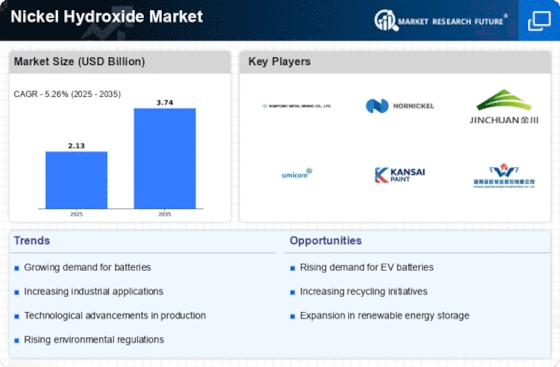
As per Market Research Future analysis, the Nickel Hydroxide Market Size was estimated at 2.13 USD Billion in 2024. The Nickel Hydroxide industry is projected to grow from 2.242 USD Billion in 2025 to 3.744 USD Billion by 2035, exhibiting a compound annual growth rate (CAGR) of 5.26% during the forecast period 2025 - 2035

Key Market Trends & Highlights

The Nickel Hydroxide Market is poised for substantial growth driven by the electric vehicle sector and technological advancements.

  • The demand for nickel hydroxide is surging due to the rising adoption of electric vehicles, particularly in North America. Technological innovations in production processes are enhancing the efficiency and sustainability of nickel hydroxide manufacturing. Regulatory support for sustainable practices is fostering market growth, especially in the Asia-Pacific region. Key market drivers include the expansion of electric vehicle infrastructure and increasing adoption of renewable energy sources.

Market Size & Forecast

2024 Market Size 2.13 (USD Billion)
2035 Market Size 3.744 (USD Billion)
CAGR (2025 - 2035) 5.26%
Largest Regional Market Share in 2024 Asia Pacific

Major Players

Sumitomo Metal Mining Co (JP), Norilsk Nickel (RU), Jinchuan Group International Resources Co Ltd (CN), Umicore (BE), Shenzhen Zhenhua Chemical Industry Co Ltd (CN), Tianjin Teda Ganghua Chemical Co Ltd (CN), Kansai Paint Co Ltd (JP), Hunan Jinwang Technology Co Ltd (CN)

Market Trends

The nickel hydroxide market is currently experiencing a dynamic phase characterized by evolving demand patterns and continuous technological advancements. The increasing use of nickel hydroxide in battery manufacturing, particularly for electric vehicles and hybrid energy systems, is a key factor driving the expansion of the nickel hydroxide market size. As the global transition toward clean energy and electrification accelerates, industries are investing in improved battery chemistries and materials that enhance energy density and durability. These developments are shaping emerging nickel hydroxide market trends, as manufacturers focus on improving production efficiency and performance characteristics.

In addition, regulatory frameworks that promote environmentally responsible materials are influencing the growth of the nickel hydroxide market. Governments across various regions are implementing policies that encourage the adoption of sustainable energy storage technologies. These initiatives are contributing to the steady increase in nickel hydroxide market size, particularly in sectors such as renewable energy storage and electric mobility. Growing awareness of environmental sustainability and resource efficiency is also reinforcing positive nickel hydroxide market trends, encouraging industries to adopt advanced materials for cleaner technologies.

Rising Demand for Electric Vehicles

The demand for nickel hydroxide is significantly driven by the growing electric vehicle market. As manufacturers seek efficient battery solutions, nickel hydroxide's role in battery production is becoming increasingly vital.

Technological Innovations in Production

Advancements in production techniques for nickel hydroxide are likely to enhance its quality and reduce costs. These innovations may lead to more efficient manufacturing processes, thereby attracting new applications.

Regulatory Support for Sustainable Practices

Government policies promoting sustainability are influencing the Nickel Hydroxide Market. Increased regulations favoring eco-friendly materials may boost the adoption of nickel hydroxide in various industries.

Nickel Hydroxide Market Market Drivers

Rising Demand for Consumer Electronics

The rising demand for consumer electronics is another significant driver for the Nickel Hydroxide Market. As the global market for smartphones, laptops, and other electronic devices continues to expand, the need for efficient and reliable batteries is paramount. Nickel hydroxide is a key component in the production of rechargeable batteries used in these devices. Recent market analyses indicate that the consumer electronics sector is expected to grow at a steady pace, further fueling the demand for nickel-based batteries. This trend suggests a promising outlook for the Nickel Hydroxide Market, as manufacturers strive to meet the increasing requirements of the consumer electronics market.

Increasing Adoption of Renewable Energy

The Nickel Hydroxide Market is experiencing a notable surge due to the increasing adoption of renewable energy sources. As nations strive to reduce carbon emissions, the demand for energy storage solutions, particularly in the form of nickel-based batteries, is on the rise. Nickel hydroxide plays a crucial role in the production of nickel-cadmium and nickel-metal hydride batteries, which are essential for energy storage systems. According to recent data, the energy storage market is projected to grow significantly, with nickel-based batteries expected to capture a substantial share. This trend indicates a robust future for the Nickel Hydroxide Market, as manufacturers seek to meet the growing demand for efficient and sustainable energy storage solutions.

Expansion of Electric Vehicle Infrastructure

The expansion of electric vehicle infrastructure is a pivotal driver for the Nickel Hydroxide Market. As governments and private sectors invest heavily in charging stations and battery technology, the need for high-performance batteries is escalating. Nickel hydroxide is integral to the production of batteries that power electric vehicles, which are becoming increasingly popular among consumers. Recent statistics suggest that the electric vehicle market is anticipated to grow at a compound annual growth rate of over 20% in the coming years. This growth is likely to bolster the Nickel Hydroxide Market, as manufacturers ramp up production to meet the rising demand for nickel-based batteries in electric vehicles.

Government Initiatives for Sustainable Development

Government initiatives aimed at promoting sustainable development are playing a crucial role in shaping the Nickel Hydroxide Market. Many countries are implementing policies that encourage the use of environmentally friendly materials and technologies, particularly in the battery sector. Nickel hydroxide, being a more sustainable option compared to other materials, is gaining traction among manufacturers. Recent reports indicate that investments in sustainable battery technologies are on the rise, with governments providing incentives for research and development. This supportive regulatory environment is likely to enhance the growth prospects of the Nickel Hydroxide Market, as companies align their strategies with sustainability goals.

Technological Advancements in Battery Manufacturing

Technological advancements in battery manufacturing are significantly influencing the Nickel Hydroxide Market. Innovations in production techniques and materials are enhancing the efficiency and performance of nickel-based batteries. For instance, the development of new nickel hydroxide formulations is improving energy density and cycle life, making these batteries more competitive in various applications. The market for nickel hydroxide is projected to witness a growth rate of approximately 5% annually, driven by these advancements. As manufacturers adopt cutting-edge technologies, the Nickel Hydroxide Market is poised for expansion, catering to the evolving needs of battery manufacturers and end-users alike.

Market Segment Insights

By End-Use Industry: Automotive (Largest) vs. Electronics (Fastest-Growing)

The Nickel Hydroxide Market exhibits a diverse share distribution across its key end-use industries, prominently featuring Automotive, Electronics, and Chemical sectors. The Automotive industry holds the largest share within this segment, reflecting its established reliance on nickel hydroxide for battery manufacturing and electric vehicle (EV) applications. Electronics, while smaller currently, is rapidly gaining traction as innovations in electric devices drive the demand for high-performance battery materials.

Automotive (Dominant) vs. Electronics (Emerging)

The Automotive sector stands as the dominant force in the Nickel Hydroxide Market, primarily due to its critical application in nickel-metal hydride batteries, essential for powering hybrid and electric vehicles. As the automotive industry increasingly shifts towards sustainability, the demand for nickel hydroxide is anticipated to surge, propelled by governmental regulations and consumer preferences for greener technologies. In contrast, the Electronics sector is emerging vigorously, driven by advancements in technology and a growing need for efficient energy storage solutions in <a href="https://www.marketresearchfuture.com/reports/consumer-electronics-market-66318" target="_blank" title="consumer electronics">consumer electronics</a>, mobile phones, and laptops. This sector's agility to adapt to new technological trends positions it as a valuable segment poised for rapid growth.

By Application: Batteries (Largest) vs. Catalysts (Fastest-Growing)

In the Nickel Hydroxide Market, the 'Batteries' segment holds the largest share, driven by the increasing demand for electric vehicles and energy storage systems. The use of nickel hydroxide in rechargeable batteries, particularly nickel-metal hydride (NiMH) batteries, positions this segment as a key player in the market dynamics. As battery technology advances, the reliance on nickel hydroxide continues to strengthen, contributing significantly to its market presence. Conversely, the 'Catalysts' segment is recognized as the fastest-growing area within the nickel hydroxide market. This growth is fueled by the escalating need for efficient chemical processes and environmental regulations promoting cleaner production methods. Nickel hydroxide catalysts are gaining traction in various industrial applications, enhancing reaction rates and improving overall efficiencies, which solidifies their emergence in the market.

Batteries (Dominant) vs. Catalysts (Emerging)

The Batteries segment, particularly through nickel-metal hydride (NiMH) technology, has established dominance in the Nickel Hydroxide Market. This is owing to its pivotal role in hybrid vehicles and renewable energy storage, making it integral to sustainable energy solutions. The stability and efficiency of nickel hydroxide in battery applications further enhance its market position. On the other hand, the Catalysts segment is emerging rapidly, driven by advancements in catalytic processes and increased industrial adoption. Nickel hydroxide catalysts are being utilized to improve chemical reaction efficiencies and reduce by-products, making them highly sought after in industries focused on sustainability. This contrasts with the batteries segment, showcasing the diverse applications and growth potential within the nickel hydroxide market.

Get more detailed insights about Nickel Hydroxide Market- Forecast to 2035

Regional Insights

North America : Innovation and Sustainability Focus

North America is witnessing a significant surge in the demand for nickel hydroxide, driven by the increasing adoption of electric vehicles (EVs) and renewable energy storage solutions. The region holds approximately 25% of the global market share, with the United States being the largest market, followed by Canada. Regulatory support for clean energy initiatives and EV incentives are key growth catalysts, propelling the market forward. The competitive landscape in North America is characterized by the presence of major players such as Sumitomo Metal Mining Co and Norilsk Nickel. These companies are investing in sustainable practices and innovative technologies to enhance production efficiency. The U.S. and Canada are focusing on local sourcing and production to reduce dependency on imports, further strengthening their market positions. The emphasis on sustainability is expected to drive future growth in the region.

Europe : Regulatory Support and Innovation

Europe is emerging as a key player in the nickel hydroxide market, driven by stringent environmental regulations and a strong push towards electric mobility. The region accounts for approximately 30% of the global market share, with Germany and France leading the charge. The European Union's Green Deal and various national policies are fostering innovation and investment in sustainable technologies, significantly boosting demand for nickel hydroxide in battery production. Leading countries in Europe, particularly Germany, are home to major manufacturers like Umicore and Kansai Paint Co. The competitive landscape is marked by collaborations between automotive and chemical companies to develop advanced battery technologies. The focus on recycling and sustainable sourcing of nickel is also gaining traction, ensuring a robust supply chain that meets regulatory standards. This strategic alignment is expected to enhance Europe's position in the global market.

Asia-Pacific : Emerging Market Dynamics

The Asia-Pacific region is witnessing rapid growth in the nickel hydroxide market, primarily driven by the booming electric vehicle sector and increasing industrial applications. This region holds around 40% of the global market share, with China being the largest contributor, followed by Japan. Government initiatives promoting electric mobility and battery production are key drivers of this growth, alongside rising investments in renewable energy technologies. China, Japan, and South Korea are leading countries in this market, with key players like Jinchuan Group and Shenzhen Zhenhua Chemical Industry Co Ltd dominating the landscape. The competitive environment is characterized by aggressive expansion strategies and technological advancements aimed at improving production efficiency. Additionally, the region is focusing on establishing a robust supply chain to support the growing demand for nickel hydroxide in various applications, ensuring long-term sustainability and growth.

Middle East and Africa : Resource-Rich Opportunities

The Middle East and Africa region is gradually emerging in the nickel hydroxide market, driven by the increasing demand for electric vehicles and battery technologies. This region currently holds about 5% of the global market share, with South Africa being the most significant player due to its rich mineral resources. The growing focus on sustainable energy solutions and government initiatives to promote electric mobility are expected to catalyze market growth in the coming years. South Africa is home to several key players, including Norilsk Nickel, which is investing in local production capabilities. The competitive landscape is still developing, with opportunities for new entrants to establish themselves in the market. As the region seeks to diversify its economy and reduce reliance on fossil fuels, the nickel hydroxide market is poised for growth, supported by favorable regulatory frameworks and investment in infrastructure.

Key Players and Competitive Insights

Leading market players are investing heavily in research and development to expand their product lines, which will help the Nickel Hydroxide Market grow even more. Market participants are also undertaking various strategic activities to expand their footprint, with important market developments including new product launches, contractual agreements, mergers and acquisitions, higher investments, and collaboration with other organizations. The Nickel Hydroxide industry must offer cost-effective items to spread and survive in a more competitive and rising market climate. Manufacturing locally to minimize operational costs is one of the key business tactics manufacturers use in the Nickel Hydroxide industry to benefit clients and increase the market sector. The Nickel Hydroxide industry has offered some of the most significant medical advantages in recent years. Major players in the Nickel Hydroxide Market, including Sigma-Aldrich Inc., Norilsk Nickel, Alt Cobalt and Nickel Products Co.Ltd., Nippy Chemicals, Jilin Jien Nickel Industry Co. Ltd., American Elements, Tinchem Enterprise, Kelong, Umicore, Triveni Chemicals, SUMITOMO METAL MINING CO. LTD., Tanaka Chemical Corporation, ZincFive Inc., Changsha Xinye Industrial Co. Ltd., and others, are attempting to raise market demand by contributing in research and development operations. Nippy Chemicals Co, Ltd., founded in 2002, and located in Hyderabad, Telangana, India, manufactures raw materials for batteries, different specialty chemicals, and other raw materials for the pharma industry. The products included are ethoxy benzoic acid, amino methyl propyl pyrazole carboxamide, methyl phenyl bromide, etc. It is one of the biggest chemical manufacturing companies all over the world. Nippy Chemicals is adopting various changes to tap the top market in the market by innovating their product, developing more products, and developing a new production method. Norilsk Nickel, also known as Nornickel, founded in 1993 located in Moscow, Russia, is a Russian nickel and palladium mining and smelting company. Its operations are in Norilsk Talnakh, Niket in Zapolyamy, western Finland, and South Africa. It is the world's largest producer of nickel and copper. The products included are nickel, copper, palladium, gold, platinum, cobalt, coal, silver, rhodium, tellurium, selenium, iridium, and ruthenium. Norilsk Nickel, commonly known as Norn Nickel, a leader in the nickel industry, has decided to increase its battery raw materials manufacturing capacity.

Key Companies in the Nickel Hydroxide Market include

Industry Developments

Jiangmen Chancsun Umicore Industry Co. Ltd is spending a lot on research and development, which will reward the company in the long run through increased sales and more profit margins.

China accounts for the fastest market growth rate and value during the forecasted period, followed by India; hence, the Asia-Pacific region accounts for the largest market share.

Japan's Sumitomo Metal Mining is investing several US$ million to increase its material manufacturing capacity. It has a vision for developing a new nickel-based cathodic material facility in western Japan.

Future Outlook

Nickel Hydroxide Market Future Outlook

The Nickel Hydroxide Market is projected to grow at a 5.26% CAGR from 2025 to 2035, driven by increasing demand in electric vehicle batteries and <a href="https://www.marketresearchfuture.com/reports/renewable-energy-market-1515" target="_blank" title="renewable energy">renewable energy</a> storage.

New opportunities lie in:

  • <p>Expansion into emerging markets with electric vehicle infrastructure development. Investment in R&amp;D for high-purity nickel hydroxide production processes. Partnerships with battery manufacturers for tailored nickel hydroxide solutions.</p>

By 2035, the Nickel Hydroxide Market is expected to solidify its position as a key player in the energy transition.

Market Segmentation

Nickel Hydroxide Market Application Outlook

  • Batteries
  • Catalysts

Nickel Hydroxide Market End-Use Industry Outlook

  • Automotive
  • Electronics
  • Chemical

Report Scope

MARKET SIZE 2024 2.13(USD Billion)
MARKET SIZE 2025 2.242(USD Billion)
MARKET SIZE 2035 3.744(USD Billion)
COMPOUND ANNUAL GROWTH RATE (CAGR) 5.26% (2025 - 2035)
REPORT COVERAGE Revenue Forecast, Competitive Landscape, Growth Factors, and Trends
BASE YEAR 2024
Market Forecast Period 2025 - 2035
Historical Data 2019 - 2024
Market Forecast Units USD Billion
Key Companies Profiled Sumitomo Metal Mining Co (JP), Norilsk Nickel (RU), Jinchuan Group International Resources Co Ltd (CN), Umicore (BE), Shenzhen Zhenhua Chemical Industry Co Ltd (CN), Tianjin Teda Ganghua Chemical Co Ltd (CN), Kansai Paint Co Ltd (JP), Hunan Jinwang Technology Co Ltd (CN)
Segments Covered End-Use Industry, Application, Region
Key Market Opportunities Growing demand for electric vehicle batteries drives expansion in the Nickel Hydroxide Market.
Key Market Dynamics Rising demand for electric vehicle batteries drives growth in the Nickel Hydroxide Market amid evolving regulatory frameworks.
Countries Covered North America, Europe, APAC, South America, MEA

FAQs

What is the projected market valuation of the Nickel Hydroxide Market by 2035?

<p>The Nickel Hydroxide Market is projected to reach a valuation of 3.744 USD Billion by 2035.</p>

What was the market valuation of Nickel Hydroxide in 2024?

<p>In 2024, the Nickel Hydroxide Market was valued at 2.13 USD Billion.</p>

What is the expected CAGR for the Nickel Hydroxide Market from 2025 to 2035?

<p>The expected CAGR for the Nickel Hydroxide Market during the forecast period 2025 - 2035 is 5.26%.</p>

Which companies are considered key players in the Nickel Hydroxide Market?

<p>Key players in the Nickel Hydroxide Market include Sumitomo Metal Mining Co, Norilsk Nickel, and Jinchuan Group International Resources Co Ltd.</p>

What are the projected valuations for the Automotive segment of the Nickel Hydroxide Market by 2035?

<p>The Automotive segment is projected to grow from 0.85 USD Billion to 1.5 USD Billion by 2035.</p>

How is the Electronics segment of the Nickel Hydroxide Market expected to perform by 2035?

<p>The Electronics segment is expected to increase from 0.65 USD Billion to 1.2 USD Billion by 2035.</p>

What is the anticipated growth for the Batteries application in the Nickel Hydroxide Market?

The Batteries application is projected to grow from 1.3 USD Billion to 2.3 USD Billion by 2035.

What is the expected valuation for the Catalysts application by 2035?

The Catalysts application is expected to rise from 0.83 USD Billion to 1.44 USD Billion by 2035.

How does the Nickel Hydroxide Market's growth compare across different segments?

The Nickel Hydroxide Market shows varied growth, with Batteries and Automotive segments likely experiencing the most significant increases.

What factors may influence the growth of the Nickel Hydroxide Market in the coming years?

Factors such as advancements in battery technology and increasing demand in the automotive sector may influence the Nickel Hydroxide Market's growth.

  1. SECTION I: EXECUTIVE SUMMARY AND KEY HIGHLIGHTS
    1. | 1.1 EXECUTIVE SUMMARY
    2. | | 1.1.1 Market Overview
    3. | | 1.1.2 Key Findings
    4. | | 1.1.3 Market Segmentation
    5. | | 1.1.4 Competitive Landscape
    6. | | 1.1.5 Challenges and Opportunities
    7. | | 1.1.6 Future Outlook
  2. SECTION II: SCOPING, METHODOLOGY AND MARKET STRUCTURE
    1. | 2.1 MARKET INTRODUCTION
    2. | | 2.1.1 Definition
    3. | | 2.1.2 Scope of the study
    4. | | | 2.1.2.1 Research Objective
    5. | | | 2.1.2.2 Assumption
    6. | | | 2.1.2.3 Limitations
    7. | 2.2 RESEARCH METHODOLOGY
    8. | | 2.2.1 Overview
    9. | | 2.2.2 Data Mining
    10. | | 2.2.3 Secondary Research
    11. | | 2.2.4 Primary Research
    12. | | | 2.2.4.1 Primary Interviews and Information Gathering Process
    13. | | | 2.2.4.2 Breakdown of Primary Respondents
    14. | | 2.2.5 Forecasting Model
    15. | | 2.2.6 Market Size Estimation
    16. | | | 2.2.6.1 Bottom-Up Approach
    17. | | | 2.2.6.2 Top-Down Approach
    18. | | 2.2.7 Data Triangulation
    19. | | 2.2.8 Validation
  3. SECTION III: QUALITATIVE ANALYSIS
    1. | 3.1 MARKET DYNAMICS
    2. | | 3.1.1 Overview
    3. | | 3.1.2 Drivers
    4. | | 3.1.3 Restraints
    5. | | 3.1.4 Opportunities
    6. | 3.2 MARKET FACTOR ANALYSIS
    7. | | 3.2.1 Value chain Analysis
    8. | | 3.2.2 Porter's Five Forces Analysis
    9. | | | 3.2.2.1 Bargaining Power of Suppliers
    10. | | | 3.2.2.2 Bargaining Power of Buyers
    11. | | | 3.2.2.3 Threat of New Entrants
    12. | | | 3.2.2.4 Threat of Substitutes
    13. | | | 3.2.2.5 Intensity of Rivalry
    14. | | 3.2.3 COVID-19 Impact Analysis
    15. | | | 3.2.3.1 Market Impact Analysis
    16. | | | 3.2.3.2 Regional Impact
    17. | | | 3.2.3.3 Opportunity and Threat Analysis
  4. SECTION IV: QUANTITATIVE ANALYSIS
    1. | 4.1 Chemicals and Materials, BY End-Use Industry (USD Billion)
    2. | | 4.1.1 Automotive
    3. | | 4.1.2 Electronics
    4. | | 4.1.3 Chemical
    5. | 4.2 Chemicals and Materials, BY Application (USD Billion)
    6. | | 4.2.1 Batteries
    7. | | 4.2.2 Catalysts
    8. | 4.3 Chemicals and Materials, BY Region (USD Billion)
    9. | | 4.3.1 North America
    10. | | | 4.3.1.1 US
    11. | | | 4.3.1.2 Canada
    12. | | 4.3.2 Europe
    13. | | | 4.3.2.1 Germany
    14. | | | 4.3.2.2 UK
    15. | | | 4.3.2.3 France
    16. | | | 4.3.2.4 Russia
    17. | | | 4.3.2.5 Italy
    18. | | | 4.3.2.6 Spain
    19. | | | 4.3.2.7 Rest of Europe
    20. | | 4.3.3 APAC
    21. | | | 4.3.3.1 China
    22. | | | 4.3.3.2 India
    23. | | | 4.3.3.3 Japan
    24. | | | 4.3.3.4 South Korea
    25. | | | 4.3.3.5 Malaysia
    26. | | | 4.3.3.6 Thailand
    27. | | | 4.3.3.7 Indonesia
    28. | | | 4.3.3.8 Rest of APAC
    29. | | 4.3.4 South America
    30. | | | 4.3.4.1 Brazil
    31. | | | 4.3.4.2 Mexico
    32. | | | 4.3.4.3 Argentina
    33. | | | 4.3.4.4 Rest of South America
    34. | | 4.3.5 MEA
    35. | | | 4.3.5.1 GCC Countries
    36. | | | 4.3.5.2 South Africa
    37. | | | 4.3.5.3 Rest of MEA
  5. SECTION V: COMPETITIVE ANALYSIS
    1. | 5.1 Competitive Landscape
    2. | | 5.1.1 Overview
    3. | | 5.1.2 Competitive Analysis
    4. | | 5.1.3 Market share Analysis
    5. | | 5.1.4 Major Growth Strategy in the Chemicals and Materials
    6. | | 5.1.5 Competitive Benchmarking
    7. | | 5.1.6 Leading Players in Terms of Number of Developments in the Chemicals and Materials
    8. | | 5.1.7 Key developments and growth strategies
    9. | | | 5.1.7.1 New Product Launch/Service Deployment
    10. | | | 5.1.7.2 Merger & Acquisitions
    11. | | | 5.1.7.3 Joint Ventures
    12. | | 5.1.8 Major Players Financial Matrix
    13. | | | 5.1.8.1 Sales and Operating Income
    14. | | | 5.1.8.2 Major Players R&D Expenditure. 2023
    15. | 5.2 Company Profiles
    16. | | 5.2.1 Sumitomo Metal Mining Co (JP)
    17. | | | 5.2.1.1 Financial Overview
    18. | | | 5.2.1.2 Products Offered
    19. | | | 5.2.1.3 Key Developments
    20. | | | 5.2.1.4 SWOT Analysis
    21. | | | 5.2.1.5 Key Strategies
    22. | | 5.2.2 Norilsk Nickel (RU)
    23. | | | 5.2.2.1 Financial Overview
    24. | | | 5.2.2.2 Products Offered
    25. | | | 5.2.2.3 Key Developments
    26. | | | 5.2.2.4 SWOT Analysis
    27. | | | 5.2.2.5 Key Strategies
    28. | | 5.2.3 Jinchuan Group International Resources Co Ltd (CN)
    29. | | | 5.2.3.1 Financial Overview
    30. | | | 5.2.3.2 Products Offered
    31. | | | 5.2.3.3 Key Developments
    32. | | | 5.2.3.4 SWOT Analysis
    33. | | | 5.2.3.5 Key Strategies
    34. | | 5.2.4 Umicore (BE)
    35. | | | 5.2.4.1 Financial Overview
    36. | | | 5.2.4.2 Products Offered
    37. | | | 5.2.4.3 Key Developments
    38. | | | 5.2.4.4 SWOT Analysis
    39. | | | 5.2.4.5 Key Strategies
    40. | | 5.2.5 Shenzhen Zhenhua Chemical Industry Co Ltd (CN)
    41. | | | 5.2.5.1 Financial Overview
    42. | | | 5.2.5.2 Products Offered
    43. | | | 5.2.5.3 Key Developments
    44. | | | 5.2.5.4 SWOT Analysis
    45. | | | 5.2.5.5 Key Strategies
    46. | | 5.2.6 Tianjin Teda Ganghua Chemical Co Ltd (CN)
    47. | | | 5.2.6.1 Financial Overview
    48. | | | 5.2.6.2 Products Offered
    49. | | | 5.2.6.3 Key Developments
    50. | | | 5.2.6.4 SWOT Analysis
    51. | | | 5.2.6.5 Key Strategies
    52. | | 5.2.7 Kansai Paint Co Ltd (JP)
    53. | | | 5.2.7.1 Financial Overview
    54. | | | 5.2.7.2 Products Offered
    55. | | | 5.2.7.3 Key Developments
    56. | | | 5.2.7.4 SWOT Analysis
    57. | | | 5.2.7.5 Key Strategies
    58. | | 5.2.8 Hunan Jinwang Technology Co Ltd (CN)
    59. | | | 5.2.8.1 Financial Overview
    60. | | | 5.2.8.2 Products Offered
    61. | | | 5.2.8.3 Key Developments
    62. | | | 5.2.8.4 SWOT Analysis
    63. | | | 5.2.8.5 Key Strategies
    64. | 5.3 Appendix
    65. | | 5.3.1 References
    66. | | 5.3.2 Related Reports
  6. LIST OF FIGURES
    1. | 6.1 MARKET SYNOPSIS
    2. | 6.2 NORTH AMERICA MARKET ANALYSIS
    3. | 6.3 US MARKET ANALYSIS BY END-USE INDUSTRY
    4. | 6.4 US MARKET ANALYSIS BY APPLICATION
    5. | 6.5 CANADA MARKET ANALYSIS BY END-USE INDUSTRY
    6. | 6.6 CANADA MARKET ANALYSIS BY APPLICATION
    7. | 6.7 EUROPE MARKET ANALYSIS
    8. | 6.8 GERMANY MARKET ANALYSIS BY END-USE INDUSTRY
    9. | 6.9 GERMANY MARKET ANALYSIS BY APPLICATION
    10. | 6.10 UK MARKET ANALYSIS BY END-USE INDUSTRY
    11. | 6.11 UK MARKET ANALYSIS BY APPLICATION
    12. | 6.12 FRANCE MARKET ANALYSIS BY END-USE INDUSTRY
    13. | 6.13 FRANCE MARKET ANALYSIS BY APPLICATION
    14. | 6.14 RUSSIA MARKET ANALYSIS BY END-USE INDUSTRY
    15. | 6.15 RUSSIA MARKET ANALYSIS BY APPLICATION
    16. | 6.16 ITALY MARKET ANALYSIS BY END-USE INDUSTRY
    17. | 6.17 ITALY MARKET ANALYSIS BY APPLICATION
    18. | 6.18 SPAIN MARKET ANALYSIS BY END-USE INDUSTRY
    19. | 6.19 SPAIN MARKET ANALYSIS BY APPLICATION
    20. | 6.20 REST OF EUROPE MARKET ANALYSIS BY END-USE INDUSTRY
    21. | 6.21 REST OF EUROPE MARKET ANALYSIS BY APPLICATION
    22. | 6.22 APAC MARKET ANALYSIS
    23. | 6.23 CHINA MARKET ANALYSIS BY END-USE INDUSTRY
    24. | 6.24 CHINA MARKET ANALYSIS BY APPLICATION
    25. | 6.25 INDIA MARKET ANALYSIS BY END-USE INDUSTRY
    26. | 6.26 INDIA MARKET ANALYSIS BY APPLICATION
    27. | 6.27 JAPAN MARKET ANALYSIS BY END-USE INDUSTRY
    28. | 6.28 JAPAN MARKET ANALYSIS BY APPLICATION
    29. | 6.29 SOUTH KOREA MARKET ANALYSIS BY END-USE INDUSTRY
    30. | 6.30 SOUTH KOREA MARKET ANALYSIS BY APPLICATION
    31. | 6.31 MALAYSIA MARKET ANALYSIS BY END-USE INDUSTRY
    32. | 6.32 MALAYSIA MARKET ANALYSIS BY APPLICATION
    33. | 6.33 THAILAND MARKET ANALYSIS BY END-USE INDUSTRY
    34. | 6.34 THAILAND MARKET ANALYSIS BY APPLICATION
    35. | 6.35 INDONESIA MARKET ANALYSIS BY END-USE INDUSTRY
    36. | 6.36 INDONESIA MARKET ANALYSIS BY APPLICATION
    37. | 6.37 REST OF APAC MARKET ANALYSIS BY END-USE INDUSTRY
    38. | 6.38 REST OF APAC MARKET ANALYSIS BY APPLICATION
    39. | 6.39 SOUTH AMERICA MARKET ANALYSIS
    40. | 6.40 BRAZIL MARKET ANALYSIS BY END-USE INDUSTRY
    41. | 6.41 BRAZIL MARKET ANALYSIS BY APPLICATION
    42. | 6.42 MEXICO MARKET ANALYSIS BY END-USE INDUSTRY
    43. | 6.43 MEXICO MARKET ANALYSIS BY APPLICATION
    44. | 6.44 ARGENTINA MARKET ANALYSIS BY END-USE INDUSTRY
    45. | 6.45 ARGENTINA MARKET ANALYSIS BY APPLICATION
    46. | 6.46 REST OF SOUTH AMERICA MARKET ANALYSIS BY END-USE INDUSTRY
    47. | 6.47 REST OF SOUTH AMERICA MARKET ANALYSIS BY APPLICATION
    48. | 6.48 MEA MARKET ANALYSIS
    49. | 6.49 GCC COUNTRIES MARKET ANALYSIS BY END-USE INDUSTRY
    50. | 6.50 GCC COUNTRIES MARKET ANALYSIS BY APPLICATION
    51. | 6.51 SOUTH AFRICA MARKET ANALYSIS BY END-USE INDUSTRY
    52. | 6.52 SOUTH AFRICA MARKET ANALYSIS BY APPLICATION
    53. | 6.53 REST OF MEA MARKET ANALYSIS BY END-USE INDUSTRY
    54. | 6.54 REST OF MEA MARKET ANALYSIS BY APPLICATION
    55. | 6.55 KEY BUYING CRITERIA OF CHEMICALS AND MATERIALS
    56. | 6.56 RESEARCH PROCESS OF MRFR
    57. | 6.57 DRO ANALYSIS OF CHEMICALS AND MATERIALS
    58. | 6.58 DRIVERS IMPACT ANALYSIS: CHEMICALS AND MATERIALS
    59. | 6.59 RESTRAINTS IMPACT ANALYSIS: CHEMICALS AND MATERIALS
    60. | 6.60 SUPPLY / VALUE CHAIN: CHEMICALS AND MATERIALS
    61. | 6.61 CHEMICALS AND MATERIALS, BY END-USE INDUSTRY, 2024 (% SHARE)
    62. | 6.62 CHEMICALS AND MATERIALS, BY END-USE INDUSTRY, 2024 TO 2035 (USD Billion)
    63. | 6.63 CHEMICALS AND MATERIALS, BY APPLICATION, 2024 (% SHARE)
    64. | 6.64 CHEMICALS AND MATERIALS, BY APPLICATION, 2024 TO 2035 (USD Billion)
    65. | 6.65 BENCHMARKING OF MAJOR COMPETITORS
  7. LIST OF TABLES
    1. | 7.1 LIST OF ASSUMPTIONS
    2. | | 7.1.1
    3. | 7.2 North America MARKET SIZE ESTIMATES; FORECAST
    4. | | 7.2.1 BY END-USE INDUSTRY, 2025-2035 (USD Billion)
    5. | | 7.2.2 BY APPLICATION, 2025-2035 (USD Billion)
    6. | 7.3 US MARKET SIZE ESTIMATES; FORECAST
    7. | | 7.3.1 BY END-USE INDUSTRY, 2025-2035 (USD Billion)
    8. | | 7.3.2 BY APPLICATION, 2025-2035 (USD Billion)
    9. | 7.4 Canada MARKET SIZE ESTIMATES; FORECAST
    10. | | 7.4.1 BY END-USE INDUSTRY, 2025-2035 (USD Billion)
    11. | | 7.4.2 BY APPLICATION, 2025-2035 (USD Billion)
    12. | 7.5 Europe MARKET SIZE ESTIMATES; FORECAST
    13. | | 7.5.1 BY END-USE INDUSTRY, 2025-2035 (USD Billion)
    14. | | 7.5.2 BY APPLICATION, 2025-2035 (USD Billion)
    15. | 7.6 Germany MARKET SIZE ESTIMATES; FORECAST
    16. | | 7.6.1 BY END-USE INDUSTRY, 2025-2035 (USD Billion)
    17. | | 7.6.2 BY APPLICATION, 2025-2035 (USD Billion)
    18. | 7.7 UK MARKET SIZE ESTIMATES; FORECAST
    19. | | 7.7.1 BY END-USE INDUSTRY, 2025-2035 (USD Billion)
    20. | | 7.7.2 BY APPLICATION, 2025-2035 (USD Billion)
    21. | 7.8 France MARKET SIZE ESTIMATES; FORECAST
    22. | | 7.8.1 BY END-USE INDUSTRY, 2025-2035 (USD Billion)
    23. | | 7.8.2 BY APPLICATION, 2025-2035 (USD Billion)
    24. | 7.9 Russia MARKET SIZE ESTIMATES; FORECAST
    25. | | 7.9.1 BY END-USE INDUSTRY, 2025-2035 (USD Billion)
    26. | | 7.9.2 BY APPLICATION, 2025-2035 (USD Billion)
    27. | 7.10 Italy MARKET SIZE ESTIMATES; FORECAST
    28. | | 7.10.1 BY END-USE INDUSTRY, 2025-2035 (USD Billion)
    29. | | 7.10.2 BY APPLICATION, 2025-2035 (USD Billion)
    30. | 7.11 Spain MARKET SIZE ESTIMATES; FORECAST
    31. | | 7.11.1 BY END-USE INDUSTRY, 2025-2035 (USD Billion)
    32. | | 7.11.2 BY APPLICATION, 2025-2035 (USD Billion)
    33. | 7.12 Rest of Europe MARKET SIZE ESTIMATES; FORECAST
    34. | | 7.12.1 BY END-USE INDUSTRY, 2025-2035 (USD Billion)
    35. | | 7.12.2 BY APPLICATION, 2025-2035 (USD Billion)
    36. | 7.13 APAC MARKET SIZE ESTIMATES; FORECAST
    37. | | 7.13.1 BY END-USE INDUSTRY, 2025-2035 (USD Billion)
    38. | | 7.13.2 BY APPLICATION, 2025-2035 (USD Billion)
    39. | 7.14 China MARKET SIZE ESTIMATES; FORECAST
    40. | | 7.14.1 BY END-USE INDUSTRY, 2025-2035 (USD Billion)
    41. | | 7.14.2 BY APPLICATION, 2025-2035 (USD Billion)
    42. | 7.15 India MARKET SIZE ESTIMATES; FORECAST
    43. | | 7.15.1 BY END-USE INDUSTRY, 2025-2035 (USD Billion)
    44. | | 7.15.2 BY APPLICATION, 2025-2035 (USD Billion)
    45. | 7.16 Japan MARKET SIZE ESTIMATES; FORECAST
    46. | | 7.16.1 BY END-USE INDUSTRY, 2025-2035 (USD Billion)
    47. | | 7.16.2 BY APPLICATION, 2025-2035 (USD Billion)
    48. | 7.17 South Korea MARKET SIZE ESTIMATES; FORECAST
    49. | | 7.17.1 BY END-USE INDUSTRY, 2025-2035 (USD Billion)
    50. | | 7.17.2 BY APPLICATION, 2025-2035 (USD Billion)
    51. | 7.18 Malaysia MARKET SIZE ESTIMATES; FORECAST
    52. | | 7.18.1 BY END-USE INDUSTRY, 2025-2035 (USD Billion)
    53. | | 7.18.2 BY APPLICATION, 2025-2035 (USD Billion)
    54. | 7.19 Thailand MARKET SIZE ESTIMATES; FORECAST
    55. | | 7.19.1 BY END-USE INDUSTRY, 2025-2035 (USD Billion)
    56. | | 7.19.2 BY APPLICATION, 2025-2035 (USD Billion)
    57. | 7.20 Indonesia MARKET SIZE ESTIMATES; FORECAST
    58. | | 7.20.1 BY END-USE INDUSTRY, 2025-2035 (USD Billion)
    59. | | 7.20.2 BY APPLICATION, 2025-2035 (USD Billion)
    60. | 7.21 Rest of APAC MARKET SIZE ESTIMATES; FORECAST
    61. | | 7.21.1 BY END-USE INDUSTRY, 2025-2035 (USD Billion)
    62. | | 7.21.2 BY APPLICATION, 2025-2035 (USD Billion)
    63. | 7.22 South America MARKET SIZE ESTIMATES; FORECAST
    64. | | 7.22.1 BY END-USE INDUSTRY, 2025-2035 (USD Billion)
    65. | | 7.22.2 BY APPLICATION, 2025-2035 (USD Billion)
    66. | 7.23 Brazil MARKET SIZE ESTIMATES; FORECAST
    67. | | 7.23.1 BY END-USE INDUSTRY, 2025-2035 (USD Billion)
    68. | | 7.23.2 BY APPLICATION, 2025-2035 (USD Billion)
    69. | 7.24 Mexico MARKET SIZE ESTIMATES; FORECAST
    70. | | 7.24.1 BY END-USE INDUSTRY, 2025-2035 (USD Billion)
    71. | | 7.24.2 BY APPLICATION, 2025-2035 (USD Billion)
    72. | 7.25 Argentina MARKET SIZE ESTIMATES; FORECAST
    73. | | 7.25.1 BY END-USE INDUSTRY, 2025-2035 (USD Billion)
    74. | | 7.25.2 BY APPLICATION, 2025-2035 (USD Billion)
    75. | 7.26 Rest of South America MARKET SIZE ESTIMATES; FORECAST
    76. | | 7.26.1 BY END-USE INDUSTRY, 2025-2035 (USD Billion)
    77. | | 7.26.2 BY APPLICATION, 2025-2035 (USD Billion)
    78. | 7.27 MEA MARKET SIZE ESTIMATES; FORECAST
    79. | | 7.27.1 BY END-USE INDUSTRY, 2025-2035 (USD Billion)
    80. | | 7.27.2 BY APPLICATION, 2025-2035 (USD Billion)
    81. | 7.28 GCC Countries MARKET SIZE ESTIMATES; FORECAST
    82. | | 7.28.1 BY END-USE INDUSTRY, 2025-2035 (USD Billion)
    83. | | 7.28.2 BY APPLICATION, 2025-2035 (USD Billion)
    84. | 7.29 South Africa MARKET SIZE ESTIMATES; FORECAST
    85. | | 7.29.1 BY END-USE INDUSTRY, 2025-2035 (USD Billion)
    86. | | 7.29.2 BY APPLICATION, 2025-2035 (USD Billion)
    87. | 7.30 Rest of MEA MARKET SIZE ESTIMATES; FORECAST
    88. | | 7.30.1 BY END-USE INDUSTRY, 2025-2035 (USD Billion)
    89. | | 7.30.2 BY APPLICATION, 2025-2035 (USD Billion)
    90. | 7.31 PRODUCT LAUNCH/PRODUCT DEVELOPMENT/APPROVAL
    91. | | 7.31.1
    92. | 7.32 ACQUISITION/PARTNERSHIP
    93. | | 7.32.1

Chemicals and Materials Market Segmentation

Chemicals and Materials By End-Use Industry (USD Billion, 2025-2035)

  • Automotive
  • Electronics
  • Chemical

Chemicals and Materials By Application (USD Billion, 2025-2035)

  • Batteries
  • Catalysts
Infographic

Free Sample Request

Kindly complete the form below to receive a free sample of this Report

Get Free Sample

Customer Strories

Compare Licence

×
Features License Type
Single User Multiuser License Enterprise User
Price $4,950 $5,950 $7,250
Maximum User Access Limit 1 User Upto 10 Users Unrestricted Access Throughout the Organization
Free Customization
Direct Access to Analyst
Deliverable Format
Platform Access
Discount on Next Purchase 10% 15% 15%
Printable Versions