Request Free Sample ×

Kindly complete the form below to receive a free sample of this Report

* Please use a valid business email

Leading companies partner with us for data-driven Insights

clients tt-cursor
Hero Background
English
Chinese
French
Japanese
Korean
German
Spanish

Neurorehabilitation Gaming Systems Market Share

ID: MRFR/HC/7264-CR
94 Pages
Vikita Thakur
Last Updated: January 30, 2026

Neurorehabilitation Gaming Systems Market Research Report Information by Component (Hardware and Software), Application (Stroke, Parkinson's Disease, Multiple Sclerosis, and others), Modality (PC and Tablet/Smartphone) and Region (Americas, Europe, Asia-Pacific and the Rest of the World) - Forecast till 2035

Share:
Download PDF ×

We do not share your information with anyone. However, we may send you emails based on your report interest from time to time. You may contact us at any time to opt-out.

Neurorehabilitation Gaming Systems Market Infographic
Purchase Options

Market Share

Neurorehabilitation Gaming Systems Market Share Analysis

The advancing age factor significantly amplifies the risk of various debilitating health conditions encompassing both physical and mental spheres, with profound economic implications. Alzheimer’s disease, a form of dementia characterized by severe impairments in memory, cognition, and behavior, stands as a prominent example. The United Nations' World Population Prospects reported a staggering 962 million individuals aged 60 and above globally in 2017, constituting approximately 13% of the global population.

Moreover, projections by the World Health Organization (WHO) suggest that the population aged 60 years and older will likely double from 12% in 2000 to an estimated 22% by 2050. Specifically, in the United States, over 20% of the population is anticipated to be aged 65 years or older by 2030. This demographic shift towards an increasingly aged population significantly impacts the neurorehabilitation gaming systems market due to the heightened vulnerability of older individuals to neurological disorders. Reports from the American Federation for Aging Research underline the prevalence of Alzheimer’s disease, affecting one in nine Americans above the age of 65. Furthermore, Alzheimer’s stands as the fifth leading cause of mortality among adults aged over 65, as noted by the same organization. Similarly, strokescenter.org statistics reveal that nearly three-quarters of all strokes occur in individuals over the age of 65. In March 2017, a systematic review published in the Journal of Sports and Health Science highlighted the potential of active video games (AVG) as rehabilitative tools for older patients. This review showcased randomized controlled trials indicating the positive effects of AVG-based rehabilitation on various facets of physical, psychological, and cognitive functioning among the elderly.

The swelling number of elderly individuals, coupled with an upsurge in research endeavors aimed at unraveling the benefits of neurorehabilitation gaming in enhancing the lives of the aged populace and restoring cognitive functions, serves as the impetus behind the market’s growth. The simultaneous rise in geriatric demographics and the expanding body of research exploring the potential of neurorehabilitation gaming systems for elderly populations signify a promising trajectory for market expansion. This intersection of demographic shifts and progressive research activities augurs well for advancements in neurorehabilitation strategies tailored to benefit the elderly, fostering optimism for the market’s continued growth and innovation.


Author
Author Profile
Vikita Thakur
Senior Research Analyst

She holds an experience of about 5+ years in market research and business consulting projects for sectors such as life sciences, medical devices, and healthcare IT. She possesses a robust background in data analysis, market estimation, competitive intelligence, pipeline analysis market trend identification, and consumer behavior insights. Her expertise lies in technical Sales support, client interaction and project management, designing and implementing market research studies, conducting competitive analysis, and synthesizing complex data into actionable recommendations that drive business growth.

Leave a Comment

FAQs

What is the current valuation of the Neurorehabilitation Gaming Systems Market?

<p>The market valuation was 1.716 USD Billion in 2024.</p>

What is the projected market size for the Neurorehabilitation Gaming Systems Market by 2035?

<p>The market is projected to reach 6.498 USD Billion by 2035.</p>

What is the expected CAGR for the Neurorehabilitation Gaming Systems Market during the forecast period?

<p>The expected CAGR for the market from 2025 to 2035 is 12.87%.</p>

Which applications are driving growth in the Neurorehabilitation Gaming Systems Market?

<p>Key applications include Parkinson's Disease, Multiple Sclerosis, and Brain Stroke, with valuations of 2.598, 1.956, and 1.482 USD Billion respectively by 2035.</p>

What are the main components of the Neurorehabilitation Gaming Systems Market?

<p>The market is segmented into Software and Hardware, with projected valuations of 2.598 and 3.9 USD Billion respectively by 2035.</p>

How do different modalities impact the Neurorehabilitation Gaming Systems Market?

The market is divided into Tablet/Smartphone and PC modalities, with expected valuations of 2.598 and 3.9 USD Billion respectively by 2035.

Who are the key players in the Neurorehabilitation Gaming Systems Market?

Key players include MediTouch, Brontes Processing, Kinesis Health Technologies, and others.

What role does technology play in the Neurorehabilitation Gaming Systems Market?

Technology advancements in gaming systems enhance rehabilitation outcomes, contributing to market growth.

How does the Neurorehabilitation Gaming Systems Market compare to other healthcare technology markets?

The Neurorehabilitation Gaming Systems Market shows robust growth potential, particularly with a projected CAGR of 12.87%.

What trends are influencing the Neurorehabilitation Gaming Systems Market?

Trends include increased adoption of gamified rehabilitation and advancements in virtual reality technologies.

Market Summary

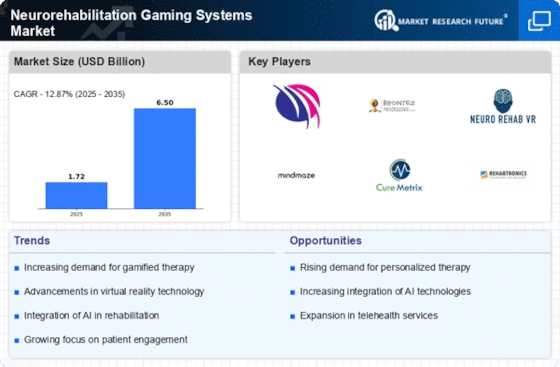
As per Market Research Future analysis, the Neurorehabilitation Gaming Systems Market Size was estimated at 1.716 USD Billion in 2024. The Neurorehabilitation Gaming Systems industry is projected to grow from 1.936 USD Billion in 2025 to 6.498 USD Billion by 2035, exhibiting a compound annual growth rate (CAGR) of 12.87% during the forecast period 2025 - 2035

Key Market Trends & Highlights

The Neurorehabilitation Gaming Systems Market is poised for substantial growth driven by technological advancements and increasing demand for personalized rehabilitation solutions.

  • The integration of advanced technologies is transforming rehabilitation practices, enhancing patient engagement and outcomes. Personalized rehabilitation approaches are gaining traction, catering to individual patient needs and preferences. Collaboration between stakeholders, including healthcare providers and technology developers, is fostering innovation in the market. Rising incidence of neurological disorders and increased investment in healthcare technologies are key drivers propelling market expansion.

Market Size & Forecast

2024 Market Size 1.716 (USD Billion)
2035 Market Size 6.498 (USD Billion)
CAGR (2025 - 2035) 12.87%
Largest Regional Market Share in 2024 Americas

Major Players

MediTouch (IL), Brontes Processing (US), Kinesis Health Technologies (IE), Neuro Rehab VR (US), MindMaze (CH), CureMetrix (US), Rehabtronics (CA), Virtual Reality Medical Center (US), Gamified Health (US)

Market Trends

The Neurorehabilitation Gaming Systems Market is currently experiencing a notable evolution, driven by advancements in technology and an increasing recognition of the benefits of gamified rehabilitation. This market encompasses a range of interactive systems designed to aid recovery for individuals with neurological impairments. The integration of virtual reality and augmented reality into rehabilitation practices appears to enhance patient engagement and motivation, which are critical factors in successful recovery.

Furthermore, the growing emphasis on personalized treatment plans suggests that these systems are becoming more tailored to individual needs, potentially leading to improved outcomes. In addition, the rising prevalence of neurological disorders is likely to fuel demand for innovative rehabilitation solutions. As healthcare providers seek effective methods to support patients, the Neurorehabilitation Gaming Systems Market may continue to expand. Collaboration between technology developers and healthcare professionals seems essential for creating effective tools that address the complexities of neurorehabilitation. Overall, the market is poised for growth, with ongoing research and development efforts likely to yield new and improved gaming systems that cater to diverse patient populations.

Integration of Advanced Technologies

The incorporation of cutting-edge technologies such as virtual reality and artificial intelligence into neurorehabilitation gaming systems is becoming increasingly prevalent. These innovations enhance the interactivity and effectiveness of rehabilitation exercises, making them more engaging for patients. As a result, the therapeutic experience is transformed, potentially leading to better recovery outcomes.

Focus on Personalized Rehabilitation

There is a growing trend towards customizing rehabilitation programs to meet the unique needs of individual patients. Neurorehabilitation gaming systems are evolving to offer tailored experiences that consider the specific challenges and goals of each user. This personalized approach may improve patient adherence and motivation, ultimately enhancing the rehabilitation process.

Collaboration Between Stakeholders

The Neurorehabilitation Gaming Systems Market is witnessing increased collaboration among various stakeholders, including healthcare providers, technology developers, and researchers. This partnership aims to create more effective rehabilitation tools and methodologies. By combining expertise from different fields, the market may see innovative solutions that address the multifaceted nature of neurorehabilitation.

Neurorehabilitation Gaming Systems Market Market Drivers

Rising Incidence of Neurological Disorders

The increasing prevalence of neurological disorders, such as stroke, traumatic brain injury, and neurodegenerative diseases, is a primary driver for the Neurorehabilitation Gaming Systems Market. According to recent statistics, approximately 795,000 individuals experience a stroke annually, leading to a significant demand for effective rehabilitation solutions. This growing patient population necessitates innovative therapeutic approaches, which neurorehabilitation gaming systems can provide. These systems offer engaging and interactive methods for recovery, potentially improving patient outcomes. As healthcare providers seek to enhance rehabilitation efficacy, the market for these gaming systems is likely to expand, driven by the urgent need for effective treatment options for neurological conditions.

Technological Advancements in Gaming Systems

Technological advancements in gaming systems are transforming the Neurorehabilitation Gaming Systems Market. Innovations such as virtual reality (VR), augmented reality (AR), and motion-sensing technologies are enhancing the interactivity and effectiveness of rehabilitation programs. These technologies allow for immersive experiences that can motivate patients and facilitate better engagement during therapy sessions. The integration of artificial intelligence (AI) into these systems also enables personalized rehabilitation plans tailored to individual patient needs. As these technologies continue to evolve, they are expected to drive market growth by providing more effective and enjoyable rehabilitation experiences, thereby attracting both patients and healthcare providers.

Increased Investment in Healthcare Technologies

Increased investment in healthcare technologies is a significant driver for the Neurorehabilitation Gaming Systems Market. Governments and private sectors are allocating substantial funds to develop advanced rehabilitation technologies, recognizing their potential to improve patient outcomes and reduce healthcare costs. This financial support is fostering innovation within the neurorehabilitation sector, leading to the development of more sophisticated gaming systems. As funding continues to flow into healthcare technology, the market for neurorehabilitation gaming systems is likely to experience robust growth, as new products and solutions emerge to meet the evolving needs of patients and healthcare providers.

Growing Awareness of Mental Health and Rehabilitation

There is a growing awareness of the importance of mental health and rehabilitation, which is positively influencing the Neurorehabilitation Gaming Systems Market. As society increasingly recognizes the impact of mental well-being on overall health, there is a corresponding rise in demand for innovative rehabilitation solutions. Neurorehabilitation gaming systems not only address physical recovery but also contribute to cognitive and emotional rehabilitation. This holistic approach is gaining traction among healthcare professionals and patients alike. Market data indicates that the mental health segment of rehabilitation is expanding, suggesting that neurorehabilitation gaming systems could play a crucial role in addressing these needs, thereby driving market growth.

Rising Demand for Home-Based Rehabilitation Solutions

The rising demand for home-based rehabilitation solutions is shaping the Neurorehabilitation Gaming Systems Market. Patients increasingly prefer the convenience and comfort of receiving rehabilitation at home, especially following hospital stays. Neurorehabilitation gaming systems offer an effective means for patients to engage in therapy from their residences, thus promoting adherence to rehabilitation programs. Market Research Future indicates that the home healthcare market is expanding, driven by the desire for personalized and accessible care. This trend suggests that neurorehabilitation gaming systems will play a pivotal role in meeting the needs of patients seeking effective home-based rehabilitation options, further propelling market growth.

Market Segment Insights

By Application: Parkinson's Disease (Largest) vs. Brain Stroke (Fastest-Growing)

In the Neurorehabilitation Gaming Systems Market, the application segment showcases a notable distribution among various conditions. Parkinson's Disease holds the largest market share, thanks to the increasing prevalence of this neurodegenerative condition and the effectiveness of gaming systems tailored for its rehabilitation. Meanwhile, Multiple Sclerosis and Other conditions also contribute to the market, but their impact is relatively smaller compared to Parkinson's Disease and Brain Stroke. Brain Stroke is gaining momentum due to a rise in awareness regarding rehabilitation technologies and the urgent need for recovery solutions in a rapidly aging population. The growth trends within the application segment are particularly driven by technological advancements in gaming systems, which offer engaging and interactive rehabilitation experiences tailored specifically for each condition. The rise in the geriatric population and the subsequent increase in neurodegenerative diseases like Parkinson's and the incidence of strokes further propel demand for these innovative solutions. Additionally, the rising investment in research and development aimed at improving the efficacy of rehabilitation techniques is expected to bolster growth, making Brain Stroke one of the fastest-growing segments in the market right now.

Parkinson's Disease: Dominant vs. Brain Stroke: Emerging

Parkinson's Disease continues to dominate the Neurorehabilitation Gaming Systems Market due to its established presence and significant market share. The tailored gaming systems specifically designed for patients with Parkinson's have shown remarkable effectiveness in improving motor skills and engagement, leading to a strong preference for these solutions among healthcare facilities. On the other hand, Brain Stroke is emerging as a significant segment owing to the increasing recognition of its rehabilitation needs. Innovative gaming systems addressing the unique challenges faced by stroke survivors are being developed rapidly, making it a forward-looking segment. As healthcare systems become more focused on personalized rehabilitation strategies, both segments hold distinct positions in the Neurorehabilitation Gaming Systems Market.

By Component: Software (Largest) vs. Hardware (Fastest-Growing)

In the Neurorehabilitation Gaming Systems Market, the component segment is primarily divided into software and hardware. Among these, software holds the largest market share due to its ability to provide versatile and customizable rehabilitation solutions. Software development has been increasingly prioritized, accommodating diverse therapeutic needs and enhancing user engagement. Meanwhile, hardware factors into the effective delivery of these software programs but lags behind in overall market share due to higher costs and longer development times. The growth trends indicate a significant uptick in the use of hardware within the sector, primarily driven by advancements in technology, such as virtual reality and motion-sensing devices. As rehabilitation techniques evolve, the demand for integrated hardware solutions is set to rise. This trend illustrates a shift towards more comprehensive gaming systems that facilitate immersive recovery experiences, which are crucial for effective neurorehabilitation and patient motivation.

Software (Dominant) vs. Hardware (Emerging)

The software component of the Neurorehabilitation Gaming Systems Market is characterized by its dominant position, providing innovative therapeutic platforms that emphasize user adaptability and engagement. With a variety of applications available that target different aspects of cognitive and physical rehabilitation, software solutions are crucial for tailoring experiences to individual patient needs. In contrast, hardware is regarded as an emerging area within this market. Innovations in gaming consoles and rehabilitation devices improve the interactive experience, helping to bridge the gap between effectiveness and user engagement. Although hardware has seen rising interest, it remains secondary to software in market share, yet its growth potential is significant as technology advances, positioning it as a complementary force to <a href="https://www.marketresearchfuture.com/reports/software-market-11924">software </a>functions.

By Modality: Tablet/Smartphone (Largest) vs. PC (Fastest-Growing)

In the Neurorehabilitation Gaming Systems Market, the 'Tablet/Smartphone' segment holds a significant share, dominating the modality preferences among users. This segment benefits from the widespread availability and convenience of portable devices, making them ideal for patients seeking rehabilitation solutions at home. Tablets and smartphones provide intuitive interfaces and accessibility, allowing users to engage with therapeutic games easily, driving adoption in this modality. In contrast, the 'PC' segment is rapidly catching up as the fastest-growing modality in neurorehabilitation gaming. This growth is fueled by advancements in processing power and graphics capabilities that enhance user experience. Furthermore, PCs facilitate more complex game designs and support multi-user environments, making them especially attractive for clinical settings, rehabilitation centers, and multiplayer therapy exercises.

Modality: Tablet/Smartphone (Dominant) vs. PC (Emerging)

The 'Tablet/Smartphone' modality is currently the dominant force in the Neurorehabilitation Gaming Systems Market, offering unparalleled accessibility and flexibility to users. Its portable nature allows individuals to participate in therapeutic gaming from the comfort of their homes or while on the go. The gaming applications developed for these devices are designed to engage patients in their rehabilitation process actively, ensuring higher compliance and motivation. On the other hand, the 'PC' modality represents the emerging segment, characterized by powerful hardware enabling immersive and interactive rehabilitation experiences. The complexity and variety of games available on PCs appeal especially to rehabilitation facilities, where multi-user setups are essential for collaborative therapy. As technology evolves, both modalities are expected to contribute to enhancing patient outcomes.

Get more detailed insights about Neurorehabilitation Gaming Systems Market Research Report - Forecast till 2035

Regional Insights

North America : Innovation and Investment Hub

North America is the largest market for neurorehabilitation gaming systems, holding approximately 45% of the global market share. The region benefits from advanced healthcare infrastructure, significant investments in technology, and a growing demand for innovative rehabilitation solutions. Regulatory support from agencies like the FDA further catalyzes market growth, ensuring safety and efficacy in new products. The United States and Canada are the leading countries in this sector, with numerous key players such as MediTouch, Neuro Rehab VR, and Rehabtronics. The competitive landscape is characterized by continuous innovation and collaboration between technology firms and healthcare providers. This synergy enhances the development of effective rehabilitation solutions tailored to patient needs.

Europe : Emerging Market with Strong Growth

Europe is the second-largest market for neurorehabilitation gaming systems, accounting for about 30% of the global share. The region is witnessing a surge in demand driven by an aging population and increasing awareness of mental health issues. Regulatory frameworks, such as the EU Medical Device Regulation, are pivotal in ensuring product safety and efficacy, thus fostering market growth. Leading countries include Germany, France, and the UK, where companies like Kinesis Health Technologies and MindMaze are making significant strides. The competitive landscape is marked by a mix of established firms and startups, all vying to innovate and capture market share. Collaborative efforts between healthcare providers and tech companies are essential for developing effective rehabilitation solutions.

Asia-Pacific : Rapidly Growing Market Potential

Asia-Pacific is rapidly emerging as a significant player in the neurorehabilitation gaming systems market, holding around 20% of the global market share. The region's growth is driven by increasing healthcare expenditure, a rising prevalence of neurological disorders, and a growing acceptance of technology in rehabilitation. Countries like China and Japan are at the forefront, supported by government initiatives promoting advanced healthcare solutions. China and Japan are leading the charge, with a growing number of startups and established companies entering the market. The competitive landscape is diverse, featuring both local and international players. The presence of key firms like Gamified Health and Neuro Rehab VR highlights the region's potential for innovation and growth in neurorehabilitation technologies.

Middle East and Africa : Untapped Market with Opportunities

The Middle East and Africa represent an untapped market for neurorehabilitation gaming systems, holding approximately 5% of the global market share. The region's growth is hindered by limited healthcare infrastructure but is supported by increasing investments in health technology and rising awareness of rehabilitation needs. Countries like South Africa and the UAE are beginning to adopt advanced rehabilitation technologies, driven by government initiatives. South Africa and the UAE are the leading countries in this sector, with a growing number of healthcare providers exploring innovative solutions. The competitive landscape is still developing, with opportunities for both local and international players to establish a foothold. The presence of emerging companies indicates a promising future for neurorehabilitation technologies in the region.

Key Players and Competitive Insights

The Neurorehabilitation Gaming Systems Market is currently characterized by a dynamic competitive landscape, driven by technological advancements and an increasing demand for innovative rehabilitation solutions. Key players such as Neuro Rehab VR (US), MindMaze (CH), and Rehabtronics (CA) are at the forefront, each adopting distinct strategies to enhance their market positioning. Neuro Rehab VR (US) focuses on virtual reality applications to create immersive rehabilitation experiences, while MindMaze (CH) emphasizes the integration of neuroscience with gaming technology to improve patient outcomes. Rehabtronics (CA) is leveraging partnerships with healthcare providers to expand its reach and enhance service delivery, collectively shaping a competitive environment that prioritizes innovation and patient-centric solutions.

In terms of business tactics, companies are increasingly localizing manufacturing and optimizing supply chains to enhance operational efficiency. The market appears moderately fragmented, with several players vying for market share, yet the influence of major companies is palpable. Their strategic initiatives not only bolster their individual market positions but also contribute to a collective push towards more sophisticated and effective neurorehabilitation solutions.

In August 2025, Neuro Rehab VR (US) announced a partnership with a leading hospital network to implement its VR rehabilitation programs across multiple facilities. This strategic move is likely to enhance patient access to cutting-edge rehabilitation technologies, thereby solidifying Neuro Rehab VR's position as a leader in the market. The partnership underscores the growing recognition of VR's efficacy in rehabilitation, potentially setting a precedent for future collaborations in the industry.

In September 2025, MindMaze (CH) launched a new AI-driven platform designed to personalize rehabilitation programs based on real-time patient data. This initiative not only reflects a commitment to innovation but also positions MindMaze to capitalize on the increasing demand for tailored healthcare solutions. The integration of AI into rehabilitation practices may significantly improve patient engagement and outcomes, thereby enhancing the company's competitive edge.

In July 2025, Rehabtronics (CA) secured a significant investment to expand its product line and enhance its technological capabilities. This influx of capital is expected to facilitate the development of advanced gaming systems that cater to a broader range of neurorehabilitation needs. Such strategic investments are indicative of a trend where companies are prioritizing technological advancement to differentiate themselves in a crowded market.

As of October 2025, the competitive trends in the Neurorehabilitation Gaming Systems Market are increasingly defined by digitalization, AI integration, and a focus on sustainability. Strategic alliances are becoming more prevalent, as companies recognize the value of collaboration in driving innovation and expanding market reach. Looking ahead, it is anticipated that competitive differentiation will evolve from traditional price-based strategies to a focus on technological innovation, enhanced patient experiences, and reliable supply chains, ultimately reshaping the landscape of neurorehabilitation.

Key Companies in the Neurorehabilitation Gaming Systems Market include

Industry Developments

    • In the year 2018, Neofect introduced RAPAEL Comcog- a cognitive therapy in a digital platform in the U.S. RAPAEL Comcog is a cognitive rehabilitation program that improves memory and response. The software program helps to prohibit any cognitive decline through gaming systems. This program is already available in South Korea, largely use for neurorehabilitation therapies.
    • MindMaze, in the year 2018, announced its acquisition of Neuro Motor Innovations Corporations (NMI). It is expected that the acquisition will help MindMaze to develop its business and commercialize the technology of NMI for the treatment of various neurological diseases.


Future Outlook

Neurorehabilitation Gaming Systems Market Future Outlook

The Neurorehabilitation Gaming Systems Market is projected to grow at a 12.87% CAGR from 2025 to 2035, driven by technological advancements, increasing demand for rehabilitation solutions, and rising awareness of mental health.

New opportunities lie in:

  • <p>Development of AI-driven personalized rehabilitation programs Expansion into emerging markets with tailored solutions Partnerships with healthcare providers for integrated therapy solutions</p>

By 2035, the market is expected to achieve substantial growth, positioning itself as a leader in rehabilitation technology.

Market Segmentation

Neurorehabilitation Gaming Systems Market Modality Outlook

  • Tablet/Smartphone
  • PC

Neurorehabilitation Gaming Systems Market Component Outlook

  • Software
  • Hardware

Neurorehabilitation Gaming Systems Market Application Outlook

  • Parkinson's Disease
  • Multiple Sclerosis
  • Brain Stroke
  • Others

Report Scope

MARKET SIZE 2024 1.716(USD Billion)
MARKET SIZE 2025 1.936(USD Billion)
MARKET SIZE 2035 6.498(USD Billion)
COMPOUND ANNUAL GROWTH RATE (CAGR) 12.87% (2025 - 2035)
REPORT COVERAGE Revenue Forecast, Competitive Landscape, Growth Factors, and Trends
BASE YEAR 2024
Market Forecast Period 2025 - 2035
Historical Data 2019 - 2024
Market Forecast Units USD Billion
Key Companies Profiled MediTouch (IL), Brontes Processing (US), Kinesis Health Technologies (IE), Neuro Rehab VR (US), MindMaze (CH), CureMetrix (US), Rehabtronics (CA), Virtual Reality Medical Center (US), Gamified Health (US)
Segments Covered Component
Key Market Opportunities Integration of artificial intelligence enhances personalized therapy in the Neurorehabilitation Gaming Systems Market.
Key Market Dynamics Technological advancements drive innovation in neurorehabilitation gaming systems, enhancing patient engagement and therapeutic outcomes.
Countries Covered North America, Europe, APAC, South America, MEA

FAQs

What is the current valuation of the Neurorehabilitation Gaming Systems Market?

<p>The market valuation was 1.716 USD Billion in 2024.</p>

What is the projected market size for the Neurorehabilitation Gaming Systems Market by 2035?

<p>The market is projected to reach 6.498 USD Billion by 2035.</p>

What is the expected CAGR for the Neurorehabilitation Gaming Systems Market during the forecast period?

<p>The expected CAGR for the market from 2025 to 2035 is 12.87%.</p>

Which applications are driving growth in the Neurorehabilitation Gaming Systems Market?

<p>Key applications include Parkinson's Disease, Multiple Sclerosis, and Brain Stroke, with valuations of 2.598, 1.956, and 1.482 USD Billion respectively by 2035.</p>

What are the main components of the Neurorehabilitation Gaming Systems Market?

<p>The market is segmented into Software and Hardware, with projected valuations of 2.598 and 3.9 USD Billion respectively by 2035.</p>

How do different modalities impact the Neurorehabilitation Gaming Systems Market?

The market is divided into Tablet/Smartphone and PC modalities, with expected valuations of 2.598 and 3.9 USD Billion respectively by 2035.

Who are the key players in the Neurorehabilitation Gaming Systems Market?

Key players include MediTouch, Brontes Processing, Kinesis Health Technologies, and others.

What role does technology play in the Neurorehabilitation Gaming Systems Market?

Technology advancements in gaming systems enhance rehabilitation outcomes, contributing to market growth.

How does the Neurorehabilitation Gaming Systems Market compare to other healthcare technology markets?

The Neurorehabilitation Gaming Systems Market shows robust growth potential, particularly with a projected CAGR of 12.87%.

What trends are influencing the Neurorehabilitation Gaming Systems Market?

Trends include increased adoption of gamified rehabilitation and advancements in virtual reality technologies.

  1. SECTION I: EXECUTIVE SUMMARY AND KEY HIGHLIGHTS
    1. | 1.1 EXECUTIVE SUMMARY
    2. | | 1.1.1 Market Overview
    3. | | 1.1.2 Key Findings
    4. | | 1.1.3 Market Segmentation
    5. | | 1.1.4 Competitive Landscape
    6. | | 1.1.5 Challenges and Opportunities
    7. | | 1.1.6 Future Outlook
  2. SECTION II: SCOPING, METHODOLOGY AND MARKET STRUCTURE
    1. | 2.1 MARKET INTRODUCTION
    2. | | 2.1.1 Definition
    3. | | 2.1.2 Scope of the study
    4. | | | 2.1.2.1 Research Objective
    5. | | | 2.1.2.2 Assumption
    6. | | | 2.1.2.3 Limitations
    7. | 2.2 RESEARCH METHODOLOGY
    8. | | 2.2.1 Overview
    9. | | 2.2.2 Data Mining
    10. | | 2.2.3 Secondary Research
    11. | | 2.2.4 Primary Research
    12. | | | 2.2.4.1 Primary Interviews and Information Gathering Process
    13. | | | 2.2.4.2 Breakdown of Primary Respondents
    14. | | 2.2.5 Forecasting Model
    15. | | 2.2.6 Market Size Estimation
    16. | | | 2.2.6.1 Bottom-Up Approach
    17. | | | 2.2.6.2 Top-Down Approach
    18. | | 2.2.7 Data Triangulation
    19. | | 2.2.8 Validation
  3. SECTION III: QUALITATIVE ANALYSIS
    1. | 3.1 MARKET DYNAMICS
    2. | | 3.1.1 Overview
    3. | | 3.1.2 Drivers
    4. | | 3.1.3 Restraints
    5. | | 3.1.4 Opportunities
    6. | 3.2 MARKET FACTOR ANALYSIS
    7. | | 3.2.1 Value chain Analysis
    8. | | 3.2.2 Porter's Five Forces Analysis
    9. | | | 3.2.2.1 Bargaining Power of Suppliers
    10. | | | 3.2.2.2 Bargaining Power of Buyers
    11. | | | 3.2.2.3 Threat of New Entrants
    12. | | | 3.2.2.4 Threat of Substitutes
    13. | | | 3.2.2.5 Intensity of Rivalry
    14. | | 3.2.3 COVID-19 Impact Analysis
    15. | | | 3.2.3.1 Market Impact Analysis
    16. | | | 3.2.3.2 Regional Impact
    17. | | | 3.2.3.3 Opportunity and Threat Analysis
  4. SECTION IV: QUANTITATIVE ANALYSIS
    1. | 4.1 Healthcare, BY Application (USD Billion)
    2. | | 4.1.1 Parkinson's Disease
    3. | | 4.1.2 Multiple Sclerosis
    4. | | 4.1.3 Brain Stroke
    5. | | 4.1.4 Others
    6. | 4.2 Healthcare, BY Component (USD Billion)
    7. | | 4.2.1 Software
    8. | | 4.2.2 Hardware
    9. | 4.3 Healthcare, BY Modality (USD Billion)
    10. | | 4.3.1 Tablet/Smartphone
    11. | | 4.3.2 PC
    12. | 4.4 Healthcare, BY Region (USD Billion)
    13. | | 4.4.1 North America
    14. | | | 4.4.1.1 US
    15. | | | 4.4.1.2 Canada
    16. | | 4.4.2 Europe
    17. | | | 4.4.2.1 Germany
    18. | | | 4.4.2.2 UK
    19. | | | 4.4.2.3 France
    20. | | | 4.4.2.4 Russia
    21. | | | 4.4.2.5 Italy
    22. | | | 4.4.2.6 Spain
    23. | | | 4.4.2.7 Rest of Europe
    24. | | 4.4.3 APAC
    25. | | | 4.4.3.1 China
    26. | | | 4.4.3.2 India
    27. | | | 4.4.3.3 Japan
    28. | | | 4.4.3.4 South Korea
    29. | | | 4.4.3.5 Malaysia
    30. | | | 4.4.3.6 Thailand
    31. | | | 4.4.3.7 Indonesia
    32. | | | 4.4.3.8 Rest of APAC
    33. | | 4.4.4 South America
    34. | | | 4.4.4.1 Brazil
    35. | | | 4.4.4.2 Mexico
    36. | | | 4.4.4.3 Argentina
    37. | | | 4.4.4.4 Rest of South America
    38. | | 4.4.5 MEA
    39. | | | 4.4.5.1 GCC Countries
    40. | | | 4.4.5.2 South Africa
    41. | | | 4.4.5.3 Rest of MEA
  5. SECTION V: COMPETITIVE ANALYSIS
    1. | 5.1 Competitive Landscape
    2. | | 5.1.1 Overview
    3. | | 5.1.2 Competitive Analysis
    4. | | 5.1.3 Market share Analysis
    5. | | 5.1.4 Major Growth Strategy in the Healthcare
    6. | | 5.1.5 Competitive Benchmarking
    7. | | 5.1.6 Leading Players in Terms of Number of Developments in the Healthcare
    8. | | 5.1.7 Key developments and growth strategies
    9. | | | 5.1.7.1 New Product Launch/Service Deployment
    10. | | | 5.1.7.2 Merger & Acquisitions
    11. | | | 5.1.7.3 Joint Ventures
    12. | | 5.1.8 Major Players Financial Matrix
    13. | | | 5.1.8.1 Sales and Operating Income
    14. | | | 5.1.8.2 Major Players R&D Expenditure. 2023
    15. | 5.2 Company Profiles
    16. | | 5.2.1 MediTouch (IL)
    17. | | | 5.2.1.1 Financial Overview
    18. | | | 5.2.1.2 Products Offered
    19. | | | 5.2.1.3 Key Developments
    20. | | | 5.2.1.4 SWOT Analysis
    21. | | | 5.2.1.5 Key Strategies
    22. | | 5.2.2 Brontes Processing (US)
    23. | | | 5.2.2.1 Financial Overview
    24. | | | 5.2.2.2 Products Offered
    25. | | | 5.2.2.3 Key Developments
    26. | | | 5.2.2.4 SWOT Analysis
    27. | | | 5.2.2.5 Key Strategies
    28. | | 5.2.3 Kinesis Health Technologies (IE)
    29. | | | 5.2.3.1 Financial Overview
    30. | | | 5.2.3.2 Products Offered
    31. | | | 5.2.3.3 Key Developments
    32. | | | 5.2.3.4 SWOT Analysis
    33. | | | 5.2.3.5 Key Strategies
    34. | | 5.2.4 Neuro Rehab VR (US)
    35. | | | 5.2.4.1 Financial Overview
    36. | | | 5.2.4.2 Products Offered
    37. | | | 5.2.4.3 Key Developments
    38. | | | 5.2.4.4 SWOT Analysis
    39. | | | 5.2.4.5 Key Strategies
    40. | | 5.2.5 MindMaze (CH)
    41. | | | 5.2.5.1 Financial Overview
    42. | | | 5.2.5.2 Products Offered
    43. | | | 5.2.5.3 Key Developments
    44. | | | 5.2.5.4 SWOT Analysis
    45. | | | 5.2.5.5 Key Strategies
    46. | | 5.2.6 CureMetrix (US)
    47. | | | 5.2.6.1 Financial Overview
    48. | | | 5.2.6.2 Products Offered
    49. | | | 5.2.6.3 Key Developments
    50. | | | 5.2.6.4 SWOT Analysis
    51. | | | 5.2.6.5 Key Strategies
    52. | | 5.2.7 Rehabtronics (CA)
    53. | | | 5.2.7.1 Financial Overview
    54. | | | 5.2.7.2 Products Offered
    55. | | | 5.2.7.3 Key Developments
    56. | | | 5.2.7.4 SWOT Analysis
    57. | | | 5.2.7.5 Key Strategies
    58. | | 5.2.8 Virtual Reality Medical Center (US)
    59. | | | 5.2.8.1 Financial Overview
    60. | | | 5.2.8.2 Products Offered
    61. | | | 5.2.8.3 Key Developments
    62. | | | 5.2.8.4 SWOT Analysis
    63. | | | 5.2.8.5 Key Strategies
    64. | | 5.2.9 Gamified Health (US)
    65. | | | 5.2.9.1 Financial Overview
    66. | | | 5.2.9.2 Products Offered
    67. | | | 5.2.9.3 Key Developments
    68. | | | 5.2.9.4 SWOT Analysis
    69. | | | 5.2.9.5 Key Strategies
    70. | 5.3 Appendix
    71. | | 5.3.1 References
    72. | | 5.3.2 Related Reports
  6. LIST OF FIGURES
    1. | 6.1 MARKET SYNOPSIS
    2. | 6.2 NORTH AMERICA MARKET ANALYSIS
    3. | 6.3 US MARKET ANALYSIS BY APPLICATION
    4. | 6.4 US MARKET ANALYSIS BY COMPONENT
    5. | 6.5 US MARKET ANALYSIS BY MODALITY
    6. | 6.6 CANADA MARKET ANALYSIS BY APPLICATION
    7. | 6.7 CANADA MARKET ANALYSIS BY COMPONENT
    8. | 6.8 CANADA MARKET ANALYSIS BY MODALITY
    9. | 6.9 EUROPE MARKET ANALYSIS
    10. | 6.10 GERMANY MARKET ANALYSIS BY APPLICATION
    11. | 6.11 GERMANY MARKET ANALYSIS BY COMPONENT
    12. | 6.12 GERMANY MARKET ANALYSIS BY MODALITY
    13. | 6.13 UK MARKET ANALYSIS BY APPLICATION
    14. | 6.14 UK MARKET ANALYSIS BY COMPONENT
    15. | 6.15 UK MARKET ANALYSIS BY MODALITY
    16. | 6.16 FRANCE MARKET ANALYSIS BY APPLICATION
    17. | 6.17 FRANCE MARKET ANALYSIS BY COMPONENT
    18. | 6.18 FRANCE MARKET ANALYSIS BY MODALITY
    19. | 6.19 RUSSIA MARKET ANALYSIS BY APPLICATION
    20. | 6.20 RUSSIA MARKET ANALYSIS BY COMPONENT
    21. | 6.21 RUSSIA MARKET ANALYSIS BY MODALITY
    22. | 6.22 ITALY MARKET ANALYSIS BY APPLICATION
    23. | 6.23 ITALY MARKET ANALYSIS BY COMPONENT
    24. | 6.24 ITALY MARKET ANALYSIS BY MODALITY
    25. | 6.25 SPAIN MARKET ANALYSIS BY APPLICATION
    26. | 6.26 SPAIN MARKET ANALYSIS BY COMPONENT
    27. | 6.27 SPAIN MARKET ANALYSIS BY MODALITY
    28. | 6.28 REST OF EUROPE MARKET ANALYSIS BY APPLICATION
    29. | 6.29 REST OF EUROPE MARKET ANALYSIS BY COMPONENT
    30. | 6.30 REST OF EUROPE MARKET ANALYSIS BY MODALITY
    31. | 6.31 APAC MARKET ANALYSIS
    32. | 6.32 CHINA MARKET ANALYSIS BY APPLICATION
    33. | 6.33 CHINA MARKET ANALYSIS BY COMPONENT
    34. | 6.34 CHINA MARKET ANALYSIS BY MODALITY
    35. | 6.35 INDIA MARKET ANALYSIS BY APPLICATION
    36. | 6.36 INDIA MARKET ANALYSIS BY COMPONENT
    37. | 6.37 INDIA MARKET ANALYSIS BY MODALITY
    38. | 6.38 JAPAN MARKET ANALYSIS BY APPLICATION
    39. | 6.39 JAPAN MARKET ANALYSIS BY COMPONENT
    40. | 6.40 JAPAN MARKET ANALYSIS BY MODALITY
    41. | 6.41 SOUTH KOREA MARKET ANALYSIS BY APPLICATION
    42. | 6.42 SOUTH KOREA MARKET ANALYSIS BY COMPONENT
    43. | 6.43 SOUTH KOREA MARKET ANALYSIS BY MODALITY
    44. | 6.44 MALAYSIA MARKET ANALYSIS BY APPLICATION
    45. | 6.45 MALAYSIA MARKET ANALYSIS BY COMPONENT
    46. | 6.46 MALAYSIA MARKET ANALYSIS BY MODALITY
    47. | 6.47 THAILAND MARKET ANALYSIS BY APPLICATION
    48. | 6.48 THAILAND MARKET ANALYSIS BY COMPONENT
    49. | 6.49 THAILAND MARKET ANALYSIS BY MODALITY
    50. | 6.50 INDONESIA MARKET ANALYSIS BY APPLICATION
    51. | 6.51 INDONESIA MARKET ANALYSIS BY COMPONENT
    52. | 6.52 INDONESIA MARKET ANALYSIS BY MODALITY
    53. | 6.53 REST OF APAC MARKET ANALYSIS BY APPLICATION
    54. | 6.54 REST OF APAC MARKET ANALYSIS BY COMPONENT
    55. | 6.55 REST OF APAC MARKET ANALYSIS BY MODALITY
    56. | 6.56 SOUTH AMERICA MARKET ANALYSIS
    57. | 6.57 BRAZIL MARKET ANALYSIS BY APPLICATION
    58. | 6.58 BRAZIL MARKET ANALYSIS BY COMPONENT
    59. | 6.59 BRAZIL MARKET ANALYSIS BY MODALITY
    60. | 6.60 MEXICO MARKET ANALYSIS BY APPLICATION
    61. | 6.61 MEXICO MARKET ANALYSIS BY COMPONENT
    62. | 6.62 MEXICO MARKET ANALYSIS BY MODALITY
    63. | 6.63 ARGENTINA MARKET ANALYSIS BY APPLICATION
    64. | 6.64 ARGENTINA MARKET ANALYSIS BY COMPONENT
    65. | 6.65 ARGENTINA MARKET ANALYSIS BY MODALITY
    66. | 6.66 REST OF SOUTH AMERICA MARKET ANALYSIS BY APPLICATION
    67. | 6.67 REST OF SOUTH AMERICA MARKET ANALYSIS BY COMPONENT
    68. | 6.68 REST OF SOUTH AMERICA MARKET ANALYSIS BY MODALITY
    69. | 6.69 MEA MARKET ANALYSIS
    70. | 6.70 GCC COUNTRIES MARKET ANALYSIS BY APPLICATION
    71. | 6.71 GCC COUNTRIES MARKET ANALYSIS BY COMPONENT
    72. | 6.72 GCC COUNTRIES MARKET ANALYSIS BY MODALITY
    73. | 6.73 SOUTH AFRICA MARKET ANALYSIS BY APPLICATION
    74. | 6.74 SOUTH AFRICA MARKET ANALYSIS BY COMPONENT
    75. | 6.75 SOUTH AFRICA MARKET ANALYSIS BY MODALITY
    76. | 6.76 REST OF MEA MARKET ANALYSIS BY APPLICATION
    77. | 6.77 REST OF MEA MARKET ANALYSIS BY COMPONENT
    78. | 6.78 REST OF MEA MARKET ANALYSIS BY MODALITY
    79. | 6.79 KEY BUYING CRITERIA OF HEALTHCARE
    80. | 6.80 RESEARCH PROCESS OF MRFR
    81. | 6.81 DRO ANALYSIS OF HEALTHCARE
    82. | 6.82 DRIVERS IMPACT ANALYSIS: HEALTHCARE
    83. | 6.83 RESTRAINTS IMPACT ANALYSIS: HEALTHCARE
    84. | 6.84 SUPPLY / VALUE CHAIN: HEALTHCARE
    85. | 6.85 HEALTHCARE, BY APPLICATION, 2024 (% SHARE)
    86. | 6.86 HEALTHCARE, BY APPLICATION, 2024 TO 2035 (USD Billion)
    87. | 6.87 HEALTHCARE, BY COMPONENT, 2024 (% SHARE)
    88. | 6.88 HEALTHCARE, BY COMPONENT, 2024 TO 2035 (USD Billion)
    89. | 6.89 HEALTHCARE, BY MODALITY, 2024 (% SHARE)
    90. | 6.90 HEALTHCARE, BY MODALITY, 2024 TO 2035 (USD Billion)
    91. | 6.91 BENCHMARKING OF MAJOR COMPETITORS
  7. LIST OF TABLES
    1. | 7.1 LIST OF ASSUMPTIONS
    2. | | 7.1.1
    3. | 7.2 North America MARKET SIZE ESTIMATES; FORECAST
    4. | | 7.2.1 BY APPLICATION, 2025-2035 (USD Billion)
    5. | | 7.2.2 BY COMPONENT, 2025-2035 (USD Billion)
    6. | | 7.2.3 BY MODALITY, 2025-2035 (USD Billion)
    7. | 7.3 US MARKET SIZE ESTIMATES; FORECAST
    8. | | 7.3.1 BY APPLICATION, 2025-2035 (USD Billion)
    9. | | 7.3.2 BY COMPONENT, 2025-2035 (USD Billion)
    10. | | 7.3.3 BY MODALITY, 2025-2035 (USD Billion)
    11. | 7.4 Canada MARKET SIZE ESTIMATES; FORECAST
    12. | | 7.4.1 BY APPLICATION, 2025-2035 (USD Billion)
    13. | | 7.4.2 BY COMPONENT, 2025-2035 (USD Billion)
    14. | | 7.4.3 BY MODALITY, 2025-2035 (USD Billion)
    15. | 7.5 Europe MARKET SIZE ESTIMATES; FORECAST
    16. | | 7.5.1 BY APPLICATION, 2025-2035 (USD Billion)
    17. | | 7.5.2 BY COMPONENT, 2025-2035 (USD Billion)
    18. | | 7.5.3 BY MODALITY, 2025-2035 (USD Billion)
    19. | 7.6 Germany MARKET SIZE ESTIMATES; FORECAST
    20. | | 7.6.1 BY APPLICATION, 2025-2035 (USD Billion)
    21. | | 7.6.2 BY COMPONENT, 2025-2035 (USD Billion)
    22. | | 7.6.3 BY MODALITY, 2025-2035 (USD Billion)
    23. | 7.7 UK MARKET SIZE ESTIMATES; FORECAST
    24. | | 7.7.1 BY APPLICATION, 2025-2035 (USD Billion)
    25. | | 7.7.2 BY COMPONENT, 2025-2035 (USD Billion)
    26. | | 7.7.3 BY MODALITY, 2025-2035 (USD Billion)
    27. | 7.8 France MARKET SIZE ESTIMATES; FORECAST
    28. | | 7.8.1 BY APPLICATION, 2025-2035 (USD Billion)
    29. | | 7.8.2 BY COMPONENT, 2025-2035 (USD Billion)
    30. | | 7.8.3 BY MODALITY, 2025-2035 (USD Billion)
    31. | 7.9 Russia MARKET SIZE ESTIMATES; FORECAST
    32. | | 7.9.1 BY APPLICATION, 2025-2035 (USD Billion)
    33. | | 7.9.2 BY COMPONENT, 2025-2035 (USD Billion)
    34. | | 7.9.3 BY MODALITY, 2025-2035 (USD Billion)
    35. | 7.10 Italy MARKET SIZE ESTIMATES; FORECAST
    36. | | 7.10.1 BY APPLICATION, 2025-2035 (USD Billion)
    37. | | 7.10.2 BY COMPONENT, 2025-2035 (USD Billion)
    38. | | 7.10.3 BY MODALITY, 2025-2035 (USD Billion)
    39. | 7.11 Spain MARKET SIZE ESTIMATES; FORECAST
    40. | | 7.11.1 BY APPLICATION, 2025-2035 (USD Billion)
    41. | | 7.11.2 BY COMPONENT, 2025-2035 (USD Billion)
    42. | | 7.11.3 BY MODALITY, 2025-2035 (USD Billion)
    43. | 7.12 Rest of Europe MARKET SIZE ESTIMATES; FORECAST
    44. | | 7.12.1 BY APPLICATION, 2025-2035 (USD Billion)
    45. | | 7.12.2 BY COMPONENT, 2025-2035 (USD Billion)
    46. | | 7.12.3 BY MODALITY, 2025-2035 (USD Billion)
    47. | 7.13 APAC MARKET SIZE ESTIMATES; FORECAST
    48. | | 7.13.1 BY APPLICATION, 2025-2035 (USD Billion)
    49. | | 7.13.2 BY COMPONENT, 2025-2035 (USD Billion)
    50. | | 7.13.3 BY MODALITY, 2025-2035 (USD Billion)
    51. | 7.14 China MARKET SIZE ESTIMATES; FORECAST
    52. | | 7.14.1 BY APPLICATION, 2025-2035 (USD Billion)
    53. | | 7.14.2 BY COMPONENT, 2025-2035 (USD Billion)
    54. | | 7.14.3 BY MODALITY, 2025-2035 (USD Billion)
    55. | 7.15 India MARKET SIZE ESTIMATES; FORECAST
    56. | | 7.15.1 BY APPLICATION, 2025-2035 (USD Billion)
    57. | | 7.15.2 BY COMPONENT, 2025-2035 (USD Billion)
    58. | | 7.15.3 BY MODALITY, 2025-2035 (USD Billion)
    59. | 7.16 Japan MARKET SIZE ESTIMATES; FORECAST
    60. | | 7.16.1 BY APPLICATION, 2025-2035 (USD Billion)
    61. | | 7.16.2 BY COMPONENT, 2025-2035 (USD Billion)
    62. | | 7.16.3 BY MODALITY, 2025-2035 (USD Billion)
    63. | 7.17 South Korea MARKET SIZE ESTIMATES; FORECAST
    64. | | 7.17.1 BY APPLICATION, 2025-2035 (USD Billion)
    65. | | 7.17.2 BY COMPONENT, 2025-2035 (USD Billion)
    66. | | 7.17.3 BY MODALITY, 2025-2035 (USD Billion)
    67. | 7.18 Malaysia MARKET SIZE ESTIMATES; FORECAST
    68. | | 7.18.1 BY APPLICATION, 2025-2035 (USD Billion)
    69. | | 7.18.2 BY COMPONENT, 2025-2035 (USD Billion)
    70. | | 7.18.3 BY MODALITY, 2025-2035 (USD Billion)
    71. | 7.19 Thailand MARKET SIZE ESTIMATES; FORECAST
    72. | | 7.19.1 BY APPLICATION, 2025-2035 (USD Billion)
    73. | | 7.19.2 BY COMPONENT, 2025-2035 (USD Billion)
    74. | | 7.19.3 BY MODALITY, 2025-2035 (USD Billion)
    75. | 7.20 Indonesia MARKET SIZE ESTIMATES; FORECAST
    76. | | 7.20.1 BY APPLICATION, 2025-2035 (USD Billion)
    77. | | 7.20.2 BY COMPONENT, 2025-2035 (USD Billion)
    78. | | 7.20.3 BY MODALITY, 2025-2035 (USD Billion)
    79. | 7.21 Rest of APAC MARKET SIZE ESTIMATES; FORECAST
    80. | | 7.21.1 BY APPLICATION, 2025-2035 (USD Billion)
    81. | | 7.21.2 BY COMPONENT, 2025-2035 (USD Billion)
    82. | | 7.21.3 BY MODALITY, 2025-2035 (USD Billion)
    83. | 7.22 South America MARKET SIZE ESTIMATES; FORECAST
    84. | | 7.22.1 BY APPLICATION, 2025-2035 (USD Billion)
    85. | | 7.22.2 BY COMPONENT, 2025-2035 (USD Billion)
    86. | | 7.22.3 BY MODALITY, 2025-2035 (USD Billion)
    87. | 7.23 Brazil MARKET SIZE ESTIMATES; FORECAST
    88. | | 7.23.1 BY APPLICATION, 2025-2035 (USD Billion)
    89. | | 7.23.2 BY COMPONENT, 2025-2035 (USD Billion)
    90. | | 7.23.3 BY MODALITY, 2025-2035 (USD Billion)
    91. | 7.24 Mexico MARKET SIZE ESTIMATES; FORECAST
    92. | | 7.24.1 BY APPLICATION, 2025-2035 (USD Billion)
    93. | | 7.24.2 BY COMPONENT, 2025-2035 (USD Billion)
    94. | | 7.24.3 BY MODALITY, 2025-2035 (USD Billion)
    95. | 7.25 Argentina MARKET SIZE ESTIMATES; FORECAST
    96. | | 7.25.1 BY APPLICATION, 2025-2035 (USD Billion)
    97. | | 7.25.2 BY COMPONENT, 2025-2035 (USD Billion)
    98. | | 7.25.3 BY MODALITY, 2025-2035 (USD Billion)
    99. | 7.26 Rest of South America MARKET SIZE ESTIMATES; FORECAST
    100. | | 7.26.1 BY APPLICATION, 2025-2035 (USD Billion)
    101. | | 7.26.2 BY COMPONENT, 2025-2035 (USD Billion)
    102. | | 7.26.3 BY MODALITY, 2025-2035 (USD Billion)
    103. | 7.27 MEA MARKET SIZE ESTIMATES; FORECAST
    104. | | 7.27.1 BY APPLICATION, 2025-2035 (USD Billion)
    105. | | 7.27.2 BY COMPONENT, 2025-2035 (USD Billion)
    106. | | 7.27.3 BY MODALITY, 2025-2035 (USD Billion)
    107. | 7.28 GCC Countries MARKET SIZE ESTIMATES; FORECAST
    108. | | 7.28.1 BY APPLICATION, 2025-2035 (USD Billion)
    109. | | 7.28.2 BY COMPONENT, 2025-2035 (USD Billion)
    110. | | 7.28.3 BY MODALITY, 2025-2035 (USD Billion)
    111. | 7.29 South Africa MARKET SIZE ESTIMATES; FORECAST
    112. | | 7.29.1 BY APPLICATION, 2025-2035 (USD Billion)
    113. | | 7.29.2 BY COMPONENT, 2025-2035 (USD Billion)
    114. | | 7.29.3 BY MODALITY, 2025-2035 (USD Billion)
    115. | 7.30 Rest of MEA MARKET SIZE ESTIMATES; FORECAST
    116. | | 7.30.1 BY APPLICATION, 2025-2035 (USD Billion)
    117. | | 7.30.2 BY COMPONENT, 2025-2035 (USD Billion)
    118. | | 7.30.3 BY MODALITY, 2025-2035 (USD Billion)
    119. | 7.31 PRODUCT LAUNCH/PRODUCT DEVELOPMENT/APPROVAL
    120. | | 7.31.1
    121. | 7.32 ACQUISITION/PARTNERSHIP
    122. | | 7.32.1

Healthcare Market Segmentation

Healthcare By Application (USD Billion, 2025-2035)

  • Parkinson's Disease
  • Multiple Sclerosis
  • Brain Stroke
  • Others

Healthcare By Component (USD Billion, 2025-2035)

  • Software
  • Hardware

Healthcare By Modality (USD Billion, 2025-2035)

  • Tablet/Smartphone
  • PC
Infographic

Free Sample Request

Kindly complete the form below to receive a free sample of this Report

Get Free Sample

Customer Strories

Compare Licence

×
Features License Type
Single User Multiuser License Enterprise User
Price $4,950 $5,950 $7,250
Maximum User Access Limit 1 User Upto 10 Users Unrestricted Access Throughout the Organization
Free Customization
Direct Access to Analyst
Deliverable Format
Platform Access
Discount on Next Purchase 10% 15% 15%
Printable Versions