×
Request Free Sample ×

Kindly complete the form below to receive a free sample of this Report

* Please use a valid business email

Leading companies partner with us for data-driven Insights

clients tt-cursor
Hero Background

Neuro Navigation System Market

ID: MRFR/MED/32094-HCR
128 Pages
Rahul Gotadki
October 2025

Neuro Navigation System Market Research Report By Application (Craniotomy, Biopsy, Functional Neurosurgery, Neurovascular Surgery), By Technology (Electromagnetic Navigation, Optical Navigation, Ultrasound Navigation, Hybrid Navigation Systems), By End User (Hospitals, Ambulatory Surgical Centers, Research Institutes), By Product Type (Imaging Systems, Instruments, Software Solutions) and By Regional (North America, Europe, South America, Asia-Pacific, Middle East and Africa) - Forecast to 2035

Share:
Download PDF ×

We do not share your information with anyone. However, we may send you emails based on your report interest from time to time. You may contact us at any time to opt-out.

Neuro Navigation System Market Infographic
Purchase Options

Neuro Navigation System Market Summary

As per MRFR analysis, the Neuro Navigation System Market Size was estimated at 2.744 USD Billion in 2024. The Neuro Navigation System industry is projected to grow from 2.945 USD Billion in 2025 to 5.969 USD Billion by 2035, exhibiting a compound annual growth rate (CAGR) of 7.32 during the forecast period 2025 - 2035.

Key Market Trends & Highlights

The Neuro Navigation System Market is poised for substantial growth driven by technological advancements and increasing demand for minimally invasive procedures.

  • Technological advancements are enhancing the precision and efficacy of neuro navigation systems, particularly in North America.
  • Minimally invasive procedures are gaining traction, leading to a shift in surgical practices across the Asia-Pacific region.
  • The craniotomy segment remains the largest, while the biopsy segment is emerging as the fastest-growing area in the market.
  • Rising incidence of neurological disorders and growing demand for minimally invasive surgeries are key drivers propelling market expansion.

Market Size & Forecast

2024 Market Size 2.744 (USD Billion)
2035 Market Size 5.969 (USD Billion)
CAGR (2025 - 2035) 7.32%

Major Players

Medtronic (US), Brainlab (DE), Stryker (US), B. Braun (DE), Siemens Healthineers (DE), Philips (NL), GE Healthcare (US), Nico Corporation (US), Zebra Medical Vision (IL)

Neuro Navigation System Market Trends

The Neuro Navigation System Market is currently experiencing a transformative phase, driven by advancements in technology and an increasing demand for precision in surgical procedures. The integration of augmented reality and artificial intelligence into navigation systems appears to enhance the accuracy and efficiency of neurosurgical interventions. Furthermore, the growing prevalence of neurological disorders necessitates innovative solutions, thereby propelling the market forward. As healthcare providers seek to improve patient outcomes, the adoption of these sophisticated systems is likely to rise, indicating a shift towards more personalized and effective treatment options. In addition, the Neuro Navigation System Market seems to be influenced by the rising trend of minimally invasive surgeries. These procedures, which often require precise navigation, benefit significantly from the capabilities offered by modern neuro navigation systems. The collaboration between technology developers and healthcare professionals is fostering an environment ripe for innovation, suggesting that future developments may further refine surgical techniques. As the market evolves, it is essential to monitor these trends closely to understand their implications for both practitioners and patients alike.

Technological Advancements

Recent innovations in imaging technologies and software algorithms are enhancing the capabilities of neuro navigation systems. These advancements facilitate real-time tracking and visualization during surgical procedures, potentially improving surgical precision and patient safety.

Minimally Invasive Procedures

The increasing preference for minimally invasive surgical techniques is shaping the Neuro Navigation System Market. These procedures often require advanced navigation tools to ensure accuracy, leading to a higher demand for sophisticated navigation systems.

Collaborative Development

There is a growing trend of collaboration between technology firms and healthcare providers. This partnership aims to create tailored solutions that address specific surgical challenges, thereby driving the evolution of neuro navigation systems.

Neuro Navigation System Market Drivers

Technological Innovations in Imaging

Technological advancements in imaging modalities, such as MRI and CT scans, significantly influence the Neuro Navigation System Market. Enhanced imaging techniques provide detailed anatomical information, allowing for more accurate navigation during surgical procedures. The integration of real-time imaging with navigation systems has shown to improve surgical precision and reduce complications. As imaging technology continues to evolve, the demand for neuro navigation systems that can seamlessly integrate with these modalities is likely to increase. This synergy between imaging and navigation technologies is expected to drive market growth, as healthcare professionals increasingly rely on sophisticated tools to enhance surgical outcomes in the Neuro Navigation System Market.

Rising Awareness and Training Programs

The growing awareness of the benefits of neuro navigation systems among healthcare professionals is a significant driver of the Neuro Navigation System Market. Educational initiatives and training programs are increasingly emphasizing the importance of these technologies in enhancing surgical precision and patient safety. As more surgeons become proficient in using neuro navigation systems, the adoption rate is likely to increase. This trend is supported by various medical associations and institutions that advocate for the integration of advanced navigation technologies in surgical practices. The emphasis on training and awareness is expected to contribute to the sustained growth of the Neuro Navigation System Market.

Rising Incidence of Neurological Disorders

The increasing prevalence of neurological disorders, such as Alzheimer's disease, Parkinson's disease, and epilepsy, is a primary driver of the Neuro Navigation System Market. As the population ages, the demand for precise surgical interventions rises. According to recent data, neurological disorders affect millions worldwide, necessitating advanced surgical techniques. Neuro navigation systems enhance the accuracy of these procedures, thereby improving patient outcomes. The market is projected to grow as healthcare providers seek innovative solutions to address the complexities of neurological surgeries. This trend indicates a robust demand for neuro navigation technologies, which are essential for effective treatment planning and execution in the Neuro Navigation System Market.

Growing Demand for Minimally Invasive Surgeries

The shift towards minimally invasive surgical techniques is a notable trend impacting the Neuro Navigation System Market. These procedures offer numerous benefits, including reduced recovery times, lower risk of infection, and less postoperative pain. As surgeons adopt these techniques, the need for advanced navigation systems that facilitate precision in minimally invasive surgeries becomes apparent. The market for neuro navigation systems is likely to expand as healthcare facilities invest in technologies that support these evolving surgical practices. This demand reflects a broader movement within the medical community towards enhancing patient care through innovative surgical solutions in the Neuro Navigation System Market.

Increased Investment in Healthcare Infrastructure

Investment in healthcare infrastructure is a critical driver of the Neuro Navigation System Market. Governments and private entities are allocating substantial resources to enhance surgical facilities and adopt advanced technologies. This trend is particularly evident in emerging economies, where the demand for sophisticated medical equipment is on the rise. As healthcare systems modernize, the integration of neuro navigation systems becomes essential for improving surgical capabilities. The influx of capital into healthcare infrastructure is expected to bolster the market, as hospitals seek to provide cutting-edge care and improve surgical outcomes in the Neuro Navigation System Market.


Market Segment Insights

By Application: Craniotomy (Largest) vs. Biopsy (Fastest-Growing)

The neuro navigation system market is characterized by a diverse range of applications, with craniotomy currently holding the largest market share. This procedure is essential for accessing the brain and is pivotal in various surgeries, including tumor removals. Following closely is the biopsy application, which has witnessed robust growth due to increasing incidences of neurological disorders requiring precise tissue sampling for diagnosis. Other applications like functional neurosurgery and neurovascular surgery also contribute to the market, but their shares are comparatively smaller, reflecting the varying demands in neurosurgical interventions.

Craniotomy (Dominant) vs. Biopsy (Emerging)

Craniotomy remains the dominant application in the neuro navigation system market, primarily due to its critical role in comprehensive brain surgeries. Its extensive use in treating tumors and other brain conditions establishes its importance in neurosurgery. In contrast, biopsy is emerging rapidly, driven by an increasing focus on minimally invasive techniques and the rising requirement for accurate diagnostics. While craniotomy is associated with more complex procedures, biopsy simplifies tissue extraction, aligning with trends towards less invasive surgeries. The technological advancements in navigation systems are further supporting both applications, enhancing precision and safety during surgical procedures.

By Technology: Electromagnetic Navigation (Largest) vs. Optical Navigation (Fastest-Growing)

In the Neuro Navigation System Market, the distribution of market share among different technologies reveals that Electromagnetic Navigation currently holds the largest share, establishing itself as the preferred choice among healthcare providers. Conversely, Optical Navigation is emerging rapidly, capturing increasing attention due to advancements in precision and efficiency. Although less dominant, Optical Navigation's appeal stems from its innovative features that enhance surgical accuracy.

Technology: Electromagnetic Navigation (Dominant) vs. Optical Navigation (Emerging)

Electromagnetic Navigation is characterized by its reliance on magnetic fields and sensors to guide surgical instruments with high precision. This technology has been embraced widely in neurosurgery due to its reliability and effectiveness in a variety of procedures. In contrast, Optical Navigation is gaining traction as an emerging contender, leveraging advanced imaging techniques to improve surgical planning and execution. Its rapid adoption is driven by the demand for minimally invasive procedures and better patient outcomes. Together, these technologies highlight the evolving landscape of the Neuro Navigation System Market, reflecting diverse user needs and preferences.

By End User: Hospitals (Largest) vs. Ambulatory Surgical Centers (Fastest-Growing)

In the Neuro Navigation System Market, hospitals command the largest market share, reflecting their critical role in neurosurgical procedures. They are equipped with advanced technology and comprehensive facilities, making them the primary users of neuro navigation systems. Ambulatory surgical centers (ASCs) are on the rise, attracting patients seeking less invasive procedures and shorter recovery times. Their adoption of neuro navigation technology is fast-tracking market evolution, providing significant competition to traditional hospital settings.

Hospitals (Dominant) vs. Ambulatory Surgical Centers (Emerging)

Hospitals serve as the dominant end-user segment in the Neuro Navigation System Market due to their extensive infrastructure and access to specialist neurosurgeons. They leverage advanced neuro navigation systems to enhance surgical precision and improve patient outcomes. On the other hand, ambulatory surgical centers are emerging rapidly as a significant player, favored for their focus on outpatient procedures. They offer streamlined services and often lower costs, appealing to a growing patient base interested in quick recovery solutions. This shift emphasizes the increasing adaptability of neuro navigation technologies across diverse healthcare settings.

By Product Type: Imaging Systems (Largest) vs. Instruments (Fastest-Growing)

The Neuro Navigation System Market showcases a diverse product type segmentation, where Imaging Systems hold a significant portion of the market share. This segment has established itself as a vital tool in various neurosurgical procedures, facilitating accurate navigation and reducing the risk of complications. Instruments, while smaller in comparison, are making notable inroads, demonstrating their indispensable role in enhancing surgical precision and patient outcomes. Additionally, Software Solutions serve as a crucial backbone, providing the necessary data integration and visualization required for effective navigation during procedures.

Imaging Systems (Dominant) vs. Instruments (Emerging)

Imaging Systems are the dominant force in the Neuro Navigation System Market, leveraging advanced technologies like MRI and CT imaging to guide neurosurgeons with unprecedented accuracy. Their reliability and integration within surgical settings position them as the preferred choice for healthcare providers, ensuring optimal performance during complex surgeries. On the other hand, Instruments are emerging rapidly, with innovations that enhance surgical capabilities and increase efficiency. These tools are becoming essential in the operating room, showcasing adaptability and user-friendly designs. As surgical teams increasingly recognize the importance of precision, the demand for these instruments is expected to rise, positioning them strongly against other traditional offerings.

Get more detailed insights about Neuro Navigation System Market

Regional Insights

North America : Leading Innovation and Adoption

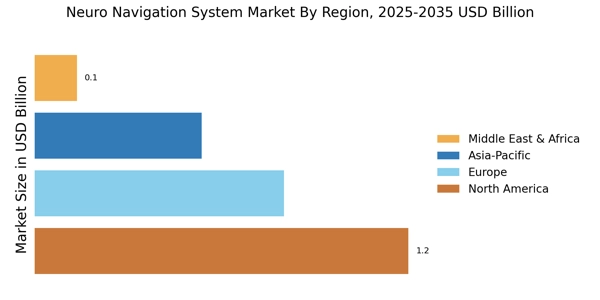
North America is the largest market for neuro navigation systems, holding approximately 45% of the global market share. The region's growth is driven by advanced healthcare infrastructure, increasing prevalence of neurological disorders, and significant investments in research and development. Regulatory support from agencies like the FDA further catalyzes innovation and adoption of new technologies, enhancing patient outcomes and operational efficiency. The United States is the primary contributor to this market, with key players such as Medtronic, Stryker, and GE Healthcare leading the competitive landscape. Canada also plays a significant role, focusing on improving healthcare access and technology integration. The presence of established companies and ongoing collaborations between healthcare providers and technology firms are pivotal in maintaining North America's leadership in neuro navigation systems.

Europe : Emerging Regulatory Frameworks

Europe is the second-largest market for neuro navigation systems, accounting for approximately 30% of the global market share. The region benefits from a robust healthcare system, increasing investments in medical technology, and a growing elderly population. Regulatory frameworks, such as the EU Medical Device Regulation, are enhancing safety and efficacy standards, thereby boosting market confidence and driving demand for advanced neuro navigation solutions. Germany, France, and the UK are the leading countries in this market, with companies like Brainlab and Siemens Healthineers at the forefront. The competitive landscape is characterized by a mix of established firms and innovative startups, fostering a dynamic environment for technological advancements. Collaborative efforts between public and private sectors are also instrumental in propelling growth in the neuro navigation sector across Europe.

Asia-Pacific : Rapid Growth and Adoption

Asia-Pacific is witnessing rapid growth in the neuro navigation system market, holding approximately 20% of the global market share. The region's expansion is fueled by increasing healthcare expenditure, rising awareness of neurological disorders, and advancements in medical technology. Countries like China and India are investing heavily in healthcare infrastructure, which is expected to further drive demand for neuro navigation systems in the coming years. China is the largest market in the region, followed by Japan and India. The competitive landscape is evolving, with both local and international players, including B. Braun and Philips, striving to capture market share. The presence of a large patient population and government initiatives to improve healthcare access are key factors contributing to the growth of neuro navigation systems in Asia-Pacific.

Middle East and Africa : Untapped Potential and Growth

The Middle East and Africa region is gradually emerging in the neuro navigation system market, currently holding about 5% of the global market share. The growth is driven by increasing healthcare investments, a rising prevalence of neurological disorders, and a focus on improving healthcare infrastructure. Governments in the region are prioritizing healthcare reforms, which are expected to create opportunities for advanced medical technologies, including neuro navigation systems. Countries like South Africa and the UAE are leading the market, with a growing number of healthcare facilities adopting advanced technologies. The competitive landscape is still developing, with opportunities for both local and international players to establish a foothold. Collaborations between governments and private sectors are essential for enhancing the availability and accessibility of neuro navigation systems in this region.

Neuro Navigation System Market Regional Image

Key Players and Competitive Insights

The Neuro Navigation System Market is currently characterized by a dynamic competitive landscape, driven by technological advancements and an increasing demand for precision in neurosurgery. Key players such as Medtronic (US), Brainlab (DE), and Stryker (US) are at the forefront, each adopting distinct strategies to enhance their market positioning. Medtronic (US) focuses on innovation through the development of advanced imaging technologies, while Brainlab (DE) emphasizes partnerships with healthcare providers to expand its reach. Stryker (US) is actively pursuing mergers and acquisitions to bolster its product portfolio, indicating a trend towards consolidation in the market. Collectively, these strategies contribute to a competitive environment that is increasingly centered on technological superiority and collaborative growth.

In terms of business tactics, companies are localizing manufacturing and optimizing supply chains to enhance operational efficiency. The Neuro Navigation System Market appears moderately fragmented, with several key players exerting influence over various segments. This fragmentation allows for niche players to thrive, while larger companies leverage their resources to capture significant market share. The collective influence of these key players shapes the market structure, fostering an environment where innovation and strategic partnerships are paramount.

In August 2025, Medtronic (US) announced the launch of its latest neuro navigation platform, which integrates artificial intelligence to enhance surgical precision. This strategic move not only reinforces Medtronic's commitment to innovation but also positions the company as a leader in the integration of AI within surgical tools. The introduction of this platform is likely to attract a broader customer base, as it addresses the growing demand for enhanced surgical outcomes.

In September 2025, Brainlab (DE) entered into a strategic partnership with a leading hospital network to implement its navigation systems across multiple facilities. This collaboration is indicative of Brainlab's strategy to expand its market presence through direct engagement with healthcare providers. By embedding its technology within hospital systems, Brainlab is likely to enhance its visibility and establish long-term relationships that could lead to increased sales and market penetration.

In July 2025, Stryker (US) completed the acquisition of a smaller neuro navigation technology firm, which is expected to enhance its product offerings significantly. This acquisition aligns with Stryker's strategy to consolidate its position in the market by integrating innovative technologies that complement its existing portfolio. The move is anticipated to provide Stryker with a competitive edge, particularly in the rapidly evolving landscape of neuro navigation systems.

As of October 2025, the Neuro Navigation System Market is witnessing trends such as digitalization, sustainability, and the integration of artificial intelligence. These trends are reshaping competitive dynamics, with companies increasingly forming strategic alliances to leverage shared expertise and resources. The shift from price-based competition to a focus on innovation and technology is evident, as companies strive to differentiate themselves through advanced solutions and reliable supply chains. Looking ahead, it is likely that competitive differentiation will continue to evolve, emphasizing the importance of technological advancements and strategic collaborations in driving market growth.

Key Companies in the Neuro Navigation System Market market include

Industry Developments

The Global Neuro Navigation System Market has witnessed significant developments recently, particularly in the area of technological advancements and product innovations. Companies such as Medtronic and Brainlab have introduced enhanced neuro-navigation systems that incorporate artificial intelligence to improve precision in neurosurgery. Siemens Healthineers has also expanded its portfolio by integrating advanced imaging technologies into its neuro-navigation offerings, enhancing real-time capabilities during surgical procedures.

In terms of mergers and acquisitions, Aesculap's acquisition of a small tech firm specializing in intraoperative imaging has been noted to bolster its market position, while Philips Healthcare recently completed a strategic partnership to leverage cutting-edge navigation technologies, which has garnered attention in the industry.

 Furthermore, Stryker has reported a steady increase in its market valuation following the launch of its latest navigation system, reflecting a growing consumer demand. These developments highlight an evolving landscape in the Global Neuro Navigation System Market, marked by innovation and strategic movements among key players like Accuray, Varian Medical Systems, and Olympus Corporation, all aiming to enhance surgical outcomes and improve patient care.

Future Outlook

Neuro Navigation System Market Future Outlook

The Neuro Navigation System Market is projected to grow at a 7.32% CAGR from 2024 to 2035, driven by technological advancements, increasing surgical precision, and rising demand for minimally invasive procedures.

New opportunities lie in:

  • Development of AI-driven navigation software for enhanced surgical outcomes.
  • Expansion into emerging markets with tailored neuro navigation solutions.
  • Partnerships with hospitals for integrated navigation systems in surgical suites.

By 2035, the Neuro Navigation System Market is expected to achieve substantial growth, reflecting its critical role in modern surgical practices.

Market Segmentation

Neuro Navigation System Market End User Outlook

  • Hospitals
  • Ambulatory Surgical Centers
  • Research Institutes

Neuro Navigation System Market Technology Outlook

  • Electromagnetic Navigation
  • Optical Navigation
  • Ultrasound Navigation
  • Hybrid Navigation Systems

Neuro Navigation System Market Application Outlook

  • Craniotomy
  • Biopsy
  • Functional Neurosurgery
  • Neurovascular Surgery

Neuro Navigation System Market Product Type Outlook

  • Imaging Systems
  • Instruments
  • Software Solutions

Report Scope

MARKET SIZE 20242.744(USD Billion)
MARKET SIZE 20252.945(USD Billion)
MARKET SIZE 20355.969(USD Billion)
COMPOUND ANNUAL GROWTH RATE (CAGR)7.32% (2024 - 2035)
REPORT COVERAGERevenue Forecast, Competitive Landscape, Growth Factors, and Trends
BASE YEAR2024
Market Forecast Period2025 - 2035
Historical Data2019 - 2024
Market Forecast UnitsUSD Billion
Key Companies ProfiledMarket analysis in progress
Segments CoveredMarket segmentation analysis in progress
Key Market OpportunitiesIntegration of artificial intelligence in Neuro Navigation System Market enhances precision and efficiency in surgical procedures.
Key Market DynamicsTechnological advancements and regulatory changes drive innovation and competition in the Neuro Navigation System market.
Countries CoveredNorth America, Europe, APAC, South America, MEA

Leave a Comment

FAQs

What is the projected market valuation of the Neuro Navigation System Market by 2035?

The Neuro Navigation System Market is projected to reach a valuation of 5.969 USD Billion by 2035.

What was the market valuation of the Neuro Navigation System Market in 2024?

In 2024, the Neuro Navigation System Market was valued at 2.744 USD Billion.

What is the expected CAGR for the Neuro Navigation System Market during the forecast period 2025 - 2035?

The expected CAGR for the Neuro Navigation System Market during the forecast period 2025 - 2035 is 7.32%.

Which application segment is anticipated to show significant growth in the Neuro Navigation System Market?

The Craniotomy application segment is anticipated to grow from 0.823 USD Billion in 2024 to 1.823 USD Billion by 2035.

What are the key technologies driving the Neuro Navigation System Market?

Key technologies include Electromagnetic Navigation, Optical Navigation, Ultrasound Navigation, and Hybrid Navigation Systems.

How do the end-user segments of the Neuro Navigation System Market compare in terms of valuation?

In 2024, Hospitals led with 1.375 USD Billion, while Ambulatory Surgical Centers and Research Institutes followed with 0.825 USD Billion and 0.544 USD Billion, respectively.

Which companies are considered key players in the Neuro Navigation System Market?

Key players include Medtronic, Brainlab, Stryker, B. Braun, Siemens Healthineers, Philips, GE Healthcare, Nico Corporation, and Zebra Medical Vision.

What is the projected growth for the Biopsy application segment in the Neuro Navigation System Market?

The Biopsy application segment is projected to grow from 0.549 USD Billion in 2024 to 1.249 USD Billion by 2035.

What product types are included in the Neuro Navigation System Market?

Product types include Imaging Systems, Instruments, and Software Solutions, with Imaging Systems and Instruments both valued at 0.823 USD Billion in 2024.

How does the Neuro Navigation System Market's growth compare across different technologies?

Electromagnetic Navigation is expected to grow from 0.823 USD Billion in 2024 to 1.823 USD Billion by 2035, indicating strong growth potential.

Download Free Sample

Kindly complete the form below to receive a free sample of this Report

Compare Licence

×
Features License Type
Single User Multiuser License Enterprise User
Price $4,950 $5,950 $7,250
Maximum User Access Limit 1 User Upto 10 Users Unrestricted Access Throughout the Organization
Free Customization
Direct Access to Analyst
Deliverable Format
Platform Access
Discount on Next Purchase 10% 15% 15%
Printable Versions