×
Hero Background
English
Chinese
French
Japanese
Korean
German
Spanish

Neopentyl Glycol Market Analysis

ID: MRFR/CnM/4661-HCR
100 Pages
Anshula Mandaokar
October 2025

Neopentyl Glycol Market Research Report Information by Physical Form (Flakes, Molten), By Production Method (Hydrogenation of HPA), By End Users (Paints & Coatings, Others), And By Region (North America, Europe, Asia-Pacific, And Rest Of The World) – Market Forecast Till 2035

Share:
Download PDF ×

We do not share your information with anyone. However, we may send you emails based on your report interest from time to time. You may contact us at any time to opt-out.

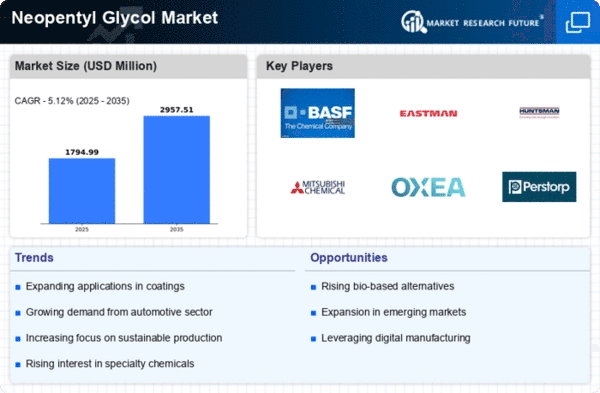
Neopentyl Glycol Market Infographic
Purchase Options

Market Analysis

In-depth Analysis of Neopentyl Glycol Market Industry Landscape

The Neopentyl Glycol (NPG) market is characterized by a complex interplay of various factors that influence its dynamics. NPG, a versatile chemical compound widely used in industries such as coatings, automotive, and plastics, exhibits a steady demand due to its exceptional properties. The market dynamics are shaped by factors like supply and demand, pricing, regulatory environment, and technological advancements.

Supply and demand dynamics play a crucial role in shaping the Neopentyl Glycol market. The production of NPG is primarily driven by the demand from end-use industries such as paints and coatings. The growth in construction and automotive sectors, especially in emerging economies, has fueled the demand for NPG as a key ingredient in high-performance coatings. Manufacturers must carefully balance production capacities with market demand to avoid overproduction or shortages, influencing the overall market dynamics.

Pricing is another pivotal factor influencing the Neopentyl Glycol market. The cost of raw materials, production processes, and market competition collectively determine the price of NPG. Fluctuations in raw material prices, such as isobutyraldehyde and formaldehyde, directly impact the overall production cost of NPG. Additionally, market competition and the presence of alternative products further influence pricing strategies adopted by manufacturers. Companies operating in the NPG market must navigate these pricing intricacies to maintain competitiveness and profitability.

The regulatory environment significantly shapes the market dynamics of Neopentyl Glycol. Stringent regulations regarding environmental impact, product safety, and quality standards influence the manufacturing processes and product formulations within the NPG industry. Compliance with these regulations not only ensures market access but also reflects the industry's commitment to sustainability and responsible practices. Companies that successfully navigate regulatory requirements gain a competitive edge and contribute to the overall positive perception of the Neopentyl Glycol market.

Technological advancements play a pivotal role in shaping the future dynamics of the Neopentyl Glycol market. Continuous research and development efforts focus on enhancing production processes, improving product performance, and exploring new applications. Innovations in green chemistry and sustainable manufacturing processes are gaining prominence, aligning with the growing emphasis on environmental consciousness. Companies investing in research and development to stay at the forefront of technological advancements are better positioned to meet evolving market demands and gain a competitive advantage.

The Neopentyl Glycol market is also influenced by global economic trends and geopolitical factors. Economic downturns or uncertainties can impact the demand for NPG, particularly in industries such as construction and automotive, which are sensitive to economic conditions. Moreover, geopolitical events affecting the supply chain, trade agreements, or market access can introduce uncertainties and reshape the competitive landscape of the Neopentyl Glycol market.
Author
Anshula Mandaokar
Team Lead - Research

Anshula Mandaokar holds an academic degree in Chemical Engineering and has been contributing to the field for more than 5 years. She has expertise in Market Research and Business Consulting and serves as a Team Lead for a reputed Market Research firm under the Chemicals and Materials domain spectrum. She has worked on multiple projects, generating explicit results in a quick turnaround time. Her understanding of data interpretation justifies her role as a leader.

Leave a Comment

FAQs

How much is the Neopentyl Glycol market?

The Neopentyl Glycol market size was valued at USD 1.71 Billion in 2024.

What is the growth rate of the Neopentyl Glycol market?

Neopentyl Glycol Market is projected to register a CAGR of 5.12% from 2025-2035

Which region held the largest market share in the Neopentyl Glycol market?

Asia Pacific had the largest share of the Neopentyl Glycol market.

Who are the key players in the Neopentyl Glycol market?

The key players in the market are BASF SE (Germany), Celanese Corporation (US), Eastman Chemical Company (US), LG Chem (South Korea), MITSUBISHI GAS CHEMICAL COMPANY, INC. (Japan), OXEA GmbH (Germany), Perstorp Orgnr (Sweden), Polioli S.p.A. (Italy), Oleon NV (Belgium), and Shandong Dongchen New Technology Co, Ltd. (China).

Which physical form led the Neopentyl Glycol market?

The Flakes categories dominated the market in 2024.

Which Production method led the Neopentyl Glycol market?

The Hydrogenation of HPA had the largest share in the market for Neopentyl Glycol.

Market Summary

As per MRFR analysis, the Neopentyl Glycol Market Size was estimated at 1707.56 USD Million in 2024. The Neopentyl Glycol industry is projected to grow from 1794.99 USD Million in 2025 to 2957.51 USD Million by 2035, exhibiting a compound annual growth rate (CAGR) of 5.12 during the forecast period 2025 - 2035.

Key Market Trends & Highlights

The Neopentyl Glycol Market is poised for growth driven by sustainability and technological advancements.

  • North America remains the largest market for Neopentyl Glycol, primarily due to its robust demand in coatings and adhesives.
  • Asia-Pacific is emerging as the fastest-growing region, fueled by increasing industrialization and urbanization.
  • The coatings segment continues to dominate the market, while the plastics segment is experiencing rapid growth due to diverse applications.
  • Rising demand in coatings and adhesives, along with an increased focus on sustainable products, are key drivers propelling market expansion.

Market Size & Forecast

2024 Market Size 1707.56 (USD Million)
2035 Market Size 2957.51 (USD Million)
CAGR (2025 - 2035) 5.12%
Largest Regional Market Share in 2024 North America

Major Players

<p>BASF SE (DE), Eastman Chemical Company (US), Huntsman Corporation (US), Mitsubishi Chemical Corporation (JP), Oxea GmbH (DE), Perstorp Holding AB (SE), SABIC (SA), Solvay SA (BE), Wacker Chemie AG (DE)</p>

Market Trends

The Neopentyl Glycol Market is currently experiencing a notable transformation, driven by various factors that influence its growth trajectory. This compound, primarily utilized in the production of resins, coatings, and plasticizers, has garnered attention due to its unique properties, such as low volatility and excellent thermal stability. As industries increasingly prioritize sustainability, the demand for eco-friendly alternatives has surged, prompting manufacturers to explore innovative production methods. Furthermore, the expansion of the automotive and construction sectors appears to bolster the market, as neopentyl glycol is integral to the formulation of high-performance materials that meet stringent regulatory standards. In addition to these dynamics, the Neopentyl Glycol Market is witnessing a shift towards diversification in applications. The rise of specialty chemicals and the growing emphasis on high-performance coatings indicate a potential for increased adoption across various industries. Moreover, the ongoing advancements in technology may enhance production efficiency, thereby reducing costs and improving product availability. As the market evolves, stakeholders must remain vigilant to emerging trends and consumer preferences, which could shape the future landscape of neopentyl glycol utilization.

Sustainability Initiatives

The Neopentyl Glycol Market is increasingly influenced by sustainability initiatives, as manufacturers seek to develop eco-friendly products. This trend reflects a broader commitment to reducing environmental impact, prompting companies to innovate in their production processes and raw material sourcing.

Technological Advancements

Technological advancements are playing a crucial role in the Neopentyl Glycol Market, with new methods enhancing production efficiency. These innovations may lead to cost reductions and improved product quality, thereby attracting a wider range of applications across various industries.

Diversification of Applications

The diversification of applications within the Neopentyl Glycol Market is notable, as industries such as automotive and construction increasingly adopt this compound. This trend suggests a growing recognition of neopentyl glycol's unique properties, which cater to the demands of high-performance materials.

Neopentyl Glycol Market Market Drivers

Expansion in Coatings and Paints

The Global Neopentyl Glycol Market Industry is significantly influenced by the expansion of the coatings and paints sector. Neopentyl glycol serves as a key ingredient in the formulation of alkyd resins, which are widely used in industrial and decorative coatings. The increasing demand for high-quality, durable coatings in various industries, including construction and manufacturing, propels the growth of neopentyl glycol. As sustainability becomes a priority, the shift towards eco-friendly coatings further enhances the market potential. The anticipated growth in this sector contributes to the overall market value, supporting the projected increase from 1.71 USD Billion in 2024 to 2.95 USD Billion by 2035.

Growing Demand in Automotive Sector

The Global Neopentyl Glycol Market Industry experiences a notable surge in demand driven by the automotive sector. Neopentyl glycol is utilized in the production of high-performance coatings and adhesives, which are essential for automotive applications. As the automotive industry increasingly focuses on lightweight materials and environmentally friendly solutions, the demand for neopentyl glycol is projected to rise. In 2024, the market value is estimated at 1.71 USD Billion, with expectations to reach 2.95 USD Billion by 2035, reflecting a compound annual growth rate (CAGR) of 5.09% from 2025 to 2035. This trend indicates a robust growth trajectory for neopentyl glycol in automotive applications.

Diverse Applications Across Industries

The Global Neopentyl Glycol Market Industry is characterized by its diverse applications across various sectors, including automotive, coatings, and plastics. Neopentyl glycol's versatility as a building block for resins and plasticizers makes it a valuable component in numerous formulations. As industries seek to enhance product performance and durability, the demand for neopentyl glycol continues to grow. This broad applicability not only supports the market's expansion but also mitigates risks associated with dependency on a single sector. The anticipated growth in applications across multiple industries is likely to sustain the market's upward trajectory, contributing to its projected increase in value.

Rising Demand for Sustainable Products

The Global Neopentyl Glycol Market Industry is witnessing a shift towards sustainable and bio-based products. As environmental regulations tighten globally, manufacturers are increasingly seeking alternatives to traditional petrochemical-based materials. Neopentyl glycol, with its potential for bio-based production, aligns with this trend. The growing consumer preference for eco-friendly products drives innovation and investment in sustainable neopentyl glycol production methods. This shift not only enhances the market's appeal but also positions neopentyl glycol as a viable option for manufacturers aiming to meet sustainability goals. Consequently, this trend is expected to contribute to the market's growth trajectory in the coming years.

Technological Advancements in Production

The Global Neopentyl Glycol Market Industry benefits from ongoing technological advancements in production processes. Innovations in chemical synthesis and processing techniques enhance the efficiency and yield of neopentyl glycol production. These advancements not only reduce production costs but also improve the quality of the final product, making it more attractive to manufacturers. As production becomes more efficient, the market is likely to see increased competition and a broader range of applications for neopentyl glycol. This evolution in production technology is expected to play a crucial role in supporting the market's growth, particularly as it aims to meet the rising global demand.

Market Segment Insights

By Application: Coatings (Largest) vs. Plastics (Fastest-Growing)

<p>In the Neopentyl Glycol Market, the application segment is diverse, with coatings dominating the landscape. Coatings represent the largest share, attributed to their extensive use in automotive, construction, and industrial sectors, where they serve as critical protective and aesthetic layers. Plastics, while not as dominant as coatings, have emerged as a rapidly growing segment, driven by their increasing use in packaging and consumer products. This growth showcases the dynamic nature of the market and the shifting demands of end-users.</p>

<p>Coatings (Dominant) vs. Plastics (Emerging)</p>

<p>The coatings segment of the Neopentyl Glycol market remains dominant due to its vital role in enhancing the durability and appearance of various surfaces. This segment is characterized by extensive use in automotive and architectural applications, where performance and aesthetic qualities are paramount. In contrast, the plastics segment is emerging as a crucial player, driven by innovations in material science and a rising trend toward lightweight and environmentally-friendly alternatives. The growing emphasis on sustainability is pushing manufacturers to explore neopentyl glycol-based plastics that offer both performance and eco-friendliness, thereby shaping the competitive landscape.</p>

By End Use Industry: Automotive (Largest) vs. Pharmaceuticals (Fastest-Growing)

<p>In the Neopentyl Glycol Market, the automotive industry holds the largest share, driven by its extensive applications in coatings, lubricants, and as antifreeze agents. This sector's dominance can be attributed to the growing demand for lightweight and durable materials that enhance vehicle performance. Following automotive, the construction and consumer goods industries also contribute significantly to market dynamics, showcasing diverse applications of neopentyl glycol as a building block for specialty chemicals.</p>

<p>Automotive: Dominant vs. Pharmaceuticals: Emerging</p>

<p>The automotive sector remains a dominant force in the neopentyl glycol market due to its critical role in manufacturing various automotive components. Neopentyl glycol is widely used for producing resins, plasticizers, and coatings, essential for performance enhancement and durability in vehicles. Meanwhile, the pharmaceuticals sector is emerging as a rapidly growing segment, propelled by increasing demand for synthetic intermediates in drug manufacturing. The integration of neopentyl glycol in pharmaceutical formulations is expanding, driven by its properties that improve the stability and efficacy of active ingredients.</p>

By Formulation Type: Water Based (Largest) vs. Powder Coatings (Fastest-Growing)

<p>In the Neopentyl Glycol Market, the formulation types exhibit varied market shares, with water-based formulations leading due to their eco-friendliness and regulatory compliance. Following closely are solvent-based formulations, which remain significant due to their effectiveness in various applications. Powder coatings and emulsions occupy substantial positions as well, while aerosols, though smaller, play a crucial role in niche markets. Over recent years, the adoption of more sustainable practices has shifted preferences toward water-based and emulsions, showcasing the evolving dynamics in consumer preferences. Market trends indicate that water-based formulations will continue to dominate, driven by a growing demand for safe, low-VOC products in industries such as coatings and adhesives. Meanwhile, powder coatings are witnessing the fastest growth due to advancements in technology, offering better performance characteristics. The rising focus on sustainability is propelling the development of eco-friendly formulations, making them more appealing to manufacturers and consumers alike. This indicates a shift towards innovative solutions that cater to market needs, thereby influencing market share dynamics.</p>

<p>Water Based (Dominant) vs. Aerosols (Emerging)</p>

<p>Water-based formulations are currently the dominant force in the Neopentyl Glycol Market, favored for their low toxicity and environmental compliance, making them ideal for consumer and industrial applications. These formulations align with the growing trend towards sustainable products, appealing to manufacturers seeking to minimize environmental impact. In contrast, aerosols represent an emerging segment, gaining traction due to their convenience and ease of use across various applications. While still a smaller segment, the aerosol market is characterized by innovation, with manufacturers developing advanced systems to enhance performance. Both segments exhibit distinct characteristics, but water-based formulations are preferred for their safety and regulatory advantages, positioning them as the leading choice in the market.</p>

By Chemical Properties: Hydrophobic (Largest) vs. Thermal Stability (Fastest-Growing)

<p>In the Neopentyl Glycol Market, the hydrophobic property dominates with a significant share among chemical properties, appealing to a wide range of applications in coatings and plastics. This preference is driven by the increasing need for moisture resistance in diverse industrial sectors, including automotive and construction. Conversely, thermal stability is emerging as the fastest-growing segment due to heightened demand in high-performance applications where materials must withstand extreme temperatures without degradation. As industries focus on product durability and performance, thermal stability's role has become increasingly critical.</p>

<p>Chemical Resistance (Dominant) vs. Low Volatility (Emerging)</p>

<p>Chemical resistance stands out as a dominant feature in the Neopentyl Glycol Market, owing to its pivotal role in ensuring material durability against harsh environments. This property is crucial for applications in adhesives, coatings, and sealants, where resistance to a variety of chemicals is essential. Low volatility has emerged as an important characteristic, particularly in the formulation of products where emissions and safety are paramount. As regulations become stricter and consumer preference shifts towards eco-friendly solutions, the negligible volatility enhances product appeal. Both properties are essential but cater to different market needs, influencing product development strategies and market positioning.</p>

Get more detailed insights about Neopentyl Glycol Market Research Report – Forecast to 2035

Regional Insights

North America : Market Leader in Neopentyl Glycol

North America is poised to maintain its leadership in the Neopentyl Glycol market, holding a significant share of 850.0 in 2025. The region's growth is driven by robust demand from the automotive and construction sectors, alongside stringent regulations promoting eco-friendly chemicals. The increasing adoption of Neopentyl Glycol in coatings and adhesives further fuels market expansion. The competitive landscape is characterized by major players such as BASF SE, Eastman Chemical Company, and Huntsman Corporation, which are investing in innovative production techniques. The U.S. remains the largest market, supported by a strong manufacturing base and favorable government policies. This environment fosters collaboration among key stakeholders, enhancing market dynamics.

Europe : Emerging Market with Growth Potential

Europe's Neopentyl Glycol market is projected to grow significantly, with a market size of 500.0 in 2025. The region benefits from increasing demand in the automotive and construction industries, driven by a shift towards sustainable materials. Regulatory frameworks, such as REACH, are encouraging the use of eco-friendly chemicals, further propelling market growth. Leading countries like Germany and France are at the forefront, with key players such as BASF SE and Wacker Chemie AG driving innovation. The competitive landscape is intensifying as companies focus on expanding their product portfolios and enhancing production capabilities. This strategic focus positions Europe as a vital player in The Neopentyl Glycol.

Asia-Pacific : Rapid Growth in Emerging Economies

The Asia-Pacific region is witnessing rapid growth in the Neopentyl Glycol market, with a projected size of 300.0 in 2025. This growth is fueled by rising industrialization and urbanization, particularly in countries like China and India. The demand for Neopentyl Glycol in coatings and plastics is increasing, driven by the region's expanding manufacturing sector. Regulatory support for sustainable practices is also a key driver. China stands out as a major player, with significant investments in chemical production. The competitive landscape includes companies like Mitsubishi Chemical Corporation and Oxea GmbH, which are enhancing their market presence through strategic partnerships and technological advancements. This dynamic environment is expected to foster further growth in the region.

Middle East and Africa : Emerging Market with Untapped Potential

The Middle East and Africa region is emerging as a potential market for Neopentyl Glycol, with a market size of 57.56 in 2025. The growth is driven by increasing industrial activities and a focus on diversifying economies away from oil dependency. The demand for Neopentyl Glycol in various applications, including coatings and plastics, is expected to rise as local industries expand. Countries like South Africa and Saudi Arabia are leading the charge, with investments in chemical manufacturing. The competitive landscape is evolving, with key players like SABIC and Perstorp Holding AB looking to capitalize on the region's growth potential. This presents opportunities for new entrants and existing players to strengthen their market positions.

Key Players and Competitive Insights

The Neopentyl Glycol Market is currently characterized by a competitive landscape that is both dynamic and multifaceted. Key growth drivers include the increasing demand for high-performance coatings, adhesives, and plastics, which are essential in various industries such as automotive, construction, and consumer goods. Major players like BASF SE (Germany), Eastman Chemical Company (US), and Huntsman Corporation (US) are strategically positioned to leverage these trends. BASF SE (Germany) focuses on innovation and sustainability, investing heavily in R&D to develop eco-friendly products. Meanwhile, Eastman Chemical Company (US) emphasizes digital transformation and supply chain optimization to enhance operational efficiency. Huntsman Corporation (US) is actively pursuing mergers and acquisitions to expand its product portfolio and market reach, thereby shaping a competitive environment that is increasingly reliant on technological advancements and strategic partnerships.

In terms of business tactics, companies are localizing manufacturing to reduce lead times and enhance responsiveness to market demands. The competitive structure of the Neopentyl Glycol Market appears moderately fragmented, with several key players exerting significant influence. This fragmentation allows for a diverse range of products and innovations, although it also intensifies competition among established and emerging firms.

In November 2025, BASF SE (Germany) announced the launch of a new line of bio-based Neopentyl Glycol, aimed at reducing carbon emissions in the production process. This strategic move not only aligns with global sustainability goals but also positions BASF as a leader in eco-friendly chemical solutions, potentially attracting environmentally conscious customers and partners.

In October 2025, Eastman Chemical Company (US) unveiled a state-of-the-art digital platform designed to streamline its supply chain operations. This initiative is expected to enhance transparency and efficiency, allowing Eastman to respond more swiftly to market fluctuations and customer needs. Such digital integration is likely to provide a competitive edge in an increasingly data-driven market.

In September 2025, Huntsman Corporation (US) completed the acquisition of a specialty chemical firm, which significantly bolstered its Neopentyl Glycol production capabilities. This acquisition is strategically important as it not only expands Huntsman's product offerings but also enhances its market presence, enabling the company to better serve its global customer base.

As of December 2025, current competitive trends in the Neopentyl Glycol Market are heavily influenced by digitalization, sustainability initiatives, and the integration of AI technologies. Strategic alliances among key players are increasingly shaping the landscape, fostering innovation and collaboration. Looking ahead, it is anticipated that competitive differentiation will evolve, shifting from traditional price-based competition to a focus on innovation, technological advancements, and supply chain reliability. This transition underscores the importance of adaptability and forward-thinking strategies in maintaining a competitive edge.

Key Companies in the Neopentyl Glycol Market market include

Industry Developments

In September 2020, BASF-YPC (a 50-50 joint venture between BASF and SINOPEC) expanded the production capacity of neopentyl glycol at its state of art Verbund site in Nanjing, China. The new expansion is aimed at strengthening the company's market position.

IN December 2021, QQ Chemicals, a manufacturer of oxo intermediates and OXO derivatives, increased the prices for neopentyl glycol.

Future Outlook

Neopentyl Glycol Market Future Outlook

<p>The Neopentyl Glycol Market is projected to grow at a 5.12% CAGR from 2024 to 2035, driven by increasing demand in coatings, adhesives, and plastics.</p>

New opportunities lie in:

  • <p>Expansion into bio-based neopentyl glycol production</p>
  • <p>Development of high-performance coatings for automotive applications</p>
  • <p>Strategic partnerships with key players in the adhesives sector</p>

<p>By 2035, the Neopentyl Glycol Market is expected to achieve robust growth and enhanced market positioning.</p>

Market Segmentation

Neopentyl Glycol Market Application Outlook

  • Coatings
  • Plastics
  • Adhesives
  • Textiles
  • Personal Care

Neopentyl Glycol Market End Use Industry Outlook

  • Automotive
  • Construction
  • Consumer Goods
  • Electronics
  • Pharmaceuticals

Neopentyl Glycol Market Formulation Type Outlook

  • Solvent Based
  • Water Based
  • Powder Coatings
  • Emulsions
  • Aerosols

Neopentyl Glycol Market Chemical Properties Outlook

  • Hydrophobic
  • Thermal Stability
  • Chemical Resistance
  • Low Volatility
  • Non-Toxic

Report Scope

MARKET SIZE 20241707.56(USD Million)
MARKET SIZE 20251794.99(USD Million)
MARKET SIZE 20352957.51(USD Million)
COMPOUND ANNUAL GROWTH RATE (CAGR)5.12% (2024 - 2035)
REPORT COVERAGERevenue Forecast, Competitive Landscape, Growth Factors, and Trends
BASE YEAR2024
Market Forecast Period2025 - 2035
Historical Data2019 - 2024
Market Forecast UnitsUSD Million
Key Companies ProfiledBASF SE (DE), Eastman Chemical Company (US), Huntsman Corporation (US), Mitsubishi Chemical Corporation (JP), Oxea GmbH (DE), Perstorp Holding AB (SE), SABIC (SA), Solvay SA (BE), Wacker Chemie AG (DE)
Segments CoveredApplication, End Use Industry, Formulation Type, Chemical Properties
Key Market OpportunitiesGrowing demand for sustainable and eco-friendly applications in the Neopentyl Glycol Market presents significant opportunities.
Key Market DynamicsRising demand for sustainable materials drives innovation and competition in the Neopentyl Glycol market.
Countries CoveredNorth America, Europe, APAC, South America, MEA

FAQs

How much is the Neopentyl Glycol market?

The Neopentyl Glycol market size was valued at USD 1.71 Billion in 2024.

What is the growth rate of the Neopentyl Glycol market?

Neopentyl Glycol Market is projected to register a CAGR of 5.12% from 2025-2035

Which region held the largest market share in the Neopentyl Glycol market?

Asia Pacific had the largest share of the Neopentyl Glycol market.

Who are the key players in the Neopentyl Glycol market?

The key players in the market are BASF SE (Germany), Celanese Corporation (US), Eastman Chemical Company (US), LG Chem (South Korea), MITSUBISHI GAS CHEMICAL COMPANY, INC. (Japan), OXEA GmbH (Germany), Perstorp Orgnr (Sweden), Polioli S.p.A. (Italy), Oleon NV (Belgium), and Shandong Dongchen New Technology Co, Ltd. (China).

Which physical form led the Neopentyl Glycol market?

The Flakes categories dominated the market in 2024.

Which Production method led the Neopentyl Glycol market?

The Hydrogenation of HPA had the largest share in the market for Neopentyl Glycol.

  1. Executive Summary
  2. Scope of the Report
    1. Market Definition
    2. Scope of the Study
      1. Research Objectives
      2. Assumptions & Limitations
    3. Markets Structure
  3. Market Research Methodology
    1. Research Process
    2. Secondary Research
    3. Primary Research
    4. Forecast Model
  4. Market Landscape
    1. Supply Chain Analysis
      1. Raw Material Suppliers
      2. Manufacturers/Producers
      3. Distributors/Retailers/Wholesalers/E-commerce
      4. End Users
    2. Porter’s Five Forces Analysis
      1. Threat of New Entrants
      2. Bargaining Power of Buyers
      3. Bargaining Power of Suppliers
      4. Threat of Substitutes
      5. Intensity of Competitive Rivalry
  5. Market Dynamics of Global Neopentyl Glycol Market
    1. Introduction
    2. Drivers
    3. Restraints
    4. Opportunities
    5. Challenges
    6. Trends/Technology
  6. Global Neopentyl Glycol Market by Type
    1. Introduction
    2. Molten
      1. Market Estimates & Forecast, 2025−2034
      2. Market Estimates & Forecast by Region, 2025−2034
    3. Flakes
      1. Market Estimates & Forecast, 2025−2034
      2. Market Estimates & Forecast by Region, 2025−2034
    4. Slurry
      1. Market Estimates & Forecast, 2025−2034
      2. Market Estimates & Forecast by Region, 2025−2034
  7. Global Neopentyl Glycol Market by Application
    1. Introduction
    2. Coatings
      1. Market Estimates & Forecast, 2025−2034
      2. Market Estimates & Forecast by Region, 2025−2034
    3. Adhesives & Sealants
      1. Market Estimates & Forecast, 2025−2034
      2. Market Estimates & Forecast by Region, 2025−2034
    4. Insulation
      1. Market Estimates & Forecast, 2025−2034
      2. Market Estimates & Forecast by Region, 2025−2034
    5. Plasticizers
      1. Market Estimates & Forecast, 2025−2034
      2. Market Estimates & Forecast by Region, 2025−2034
    6. Fibers
      1. Market Estimates & Forecast, 2025−2034
      2. Market Estimates & Forecast by Region, 2025−2034
    7. Agrochemicals
      1. Market Estimates & Forecast, 2025−2034
      2. Market Estimates & Forecast by Region, 2025−2034
    8. Fuel Additives
      1. Market Estimates & Forecast, 2025−2034
      2. Market Estimates & Forecast by Region, 2025−2034
    9. Dyes
      1. Market Estimates & Forecast, 2025−2034
      2. Market Estimates & Forecast by Region, 2025−2034
    10. Emollient
      1. Market Estimates & Forecast, 2025−2034
      2. Market Estimates & Forecast by Region, 2025−2034
    11. Others
      1. Market Estimates & Forecast, 2025−2034
      2. Market Estimates & Forecast by Region, 2025−2034
  8. Global Neopentyl Glycol Market, by End-use industry
    1. Introduction
    2. Paints & Coatings
      1. Market Estimates & Forecast, 2025−2034
      2. Market Estimates & Forecast by Region, 2025−2034
    3. Automotive
      1. Market Estimates & Forecast, 2025−2034
      2. Market Estimates & Forecast by Region, 2025−2034
    4. Construction
      1. Market Estimates & Forecast, 2025−2034
      2. Market Estimates & Forecast by Region, 2025−2034
    5. Chemicals
      1. Market Estimates & Forecast, 2025−2034
      2. Market Estimates & Forecast by Region, 2025−2034
    6. Plastics
      1. Market Estimates & Forecast, 2025−2034
      2. Market Estimates & Forecast by Region, 2025−2034
    7. Textiles
      1. Market Estimates & Forecast, 2025−2034
      2. Market Estimates & Forecast by Region, 2025−2034
    8. Pharmaceuticals
      1. Market Estimates & Forecast, 2025−2034
      2. Market Estimates & Forecast by Region, 2025−2034
    9. Cosmetics & Personal Care
      1. Market Estimates & Forecast, 2025−2034
      2. Market Estimates & Forecast by Region, 2025−2034
    10. Others
      1. Market Estimates & Forecast, 2025−2034
      2. Market Estimates & Forecast by Region, 2025−2034
  9. Global Neopentyl Glycol Market, by Region
    1. Introduction
    2. North America
      1. Market Estimates & Forecast, 2025−2034
      2. Market Estimates & Forecast by Type, 2025−2034
      3. Market Estimates & Forecast by Application, 2025−2034
      4. Market Estimates & Forecast by End-use Industry, 2025−2034
      5. U.S.
      6. Canada
    3. Europe
      1. Market Estimates & Forecast, 2025−2034
      2. Market Estimates & Forecast by Type, 2025−2034
      3. Market Estimates & Forecast by Application, 2025−2034
      4. Market Estimates & Forecast by End-use Industry, 2025−2034
      5. Germany
      6. France
      7. Italy
      8. Spain
      9. U.K.
      10. Russia
      11. Poland
    4. Asia Pacific
      1. Market Estimates & Forecast, 2025−2034
      2. Market Estimates & Forecast by Type, 2025−2034
      3. Market Estimates & Forecast by Application, 2025−2034
      4. Market Estimates & Forecast by End-use Industry, 2025−2034
      5. China
      6. India
      7. Japan
      8. Australia
      9. New Zealand
      10. Rest of Asia Pacific
    5. Middle East & Africa
      1. Market Estimates & Forecast, 2025−2034
      2. Market Estimates & Forecast by Type, 2025−2034
      3. Market Estimates & Forecast by Application, 2025−2034
      4. Market Estimates & Forecast by End-use Industry, 2025−2034
      5. Turkey
      6. Israel
      7. North Africa
      8. GCC
      9. Rest of Middle East & Africa
    6. Latin America
      1. Market Estimates & Forecast, 2025−2034
      2. Market Estimates & Forecast by Type, 2025−2034
      3. Market Estimates & Forecast by Application, 2025−2034
      4. Market Estimates & Forecast by End-use Industry, 2025−2034
      5. Brazil
      6. Mexico
      7. Argentina
      8. Rest of Latin America
  10. Company Landscape
    1. Introduction
    2. Market Strategy
    3. Key Development Analysis (Expansion/Merger & Acquisitions/Joint Venture/New Product Development/Agreement/Investment)
  11. Company Profiles
    1. BASF SE
      1. Company Overview
      2. Financial Updates
      3. Product/Business Segment Overview
      4. Strategy
      5. Key Developments
      6. SWOT Analysis
    2. Celanese Corporation
      1. Company Overview
      2. Financial Updates
      3. Product/Business Segment Overview
      4. Strategy
      5. Key Developments
      6. SWOT Analysis
    3. Eastman Chemical Company
      1. Company Overview
      2. Financial Updates
      3. Product/Business Segment Overview
      4. Strategy
      5. Key Developments
      6. SWOT Analysis
    4. LG Chem
      1. Company Overview
      2. Financial Updates
      3. Product/Business Segment Overview
      4. Strategy
      5. Key Developments
      6. SWOT Analysis
    5. MITSUBISHI GAS CHEMICAL COMPANY, INC.
      1. Company Overview
      2. Financial Updates
      3. Product/Business Segment Overview
      4. Strategy
      5. Key Developments
      6. SWOT Analysis
    6. OXEA GmbH
      1. Company Overview
      2. Financial Updates
      3. Product/Business Segment Overview
      4. Strategy
      5. Key Developments
      6. SWOT Analysis
    7. Perstorp Orgnr
      1. Company Overview
      2. Financial Updates
      3. Product/Business Segment Overview
      4. Strategy
      5. Key Developments
      6. SWOT Analysis
    8. Polioli S.p.A.
      1. Company Overview
      2. Financial Updates
      3. Product/Business Segment Overview
      4. Strategy
      5. Key Developments
      6. SWOT Analysis
    9. Oleon NV
      1. Company Overview
      2. Financial Updates
      3. Product/Business Segment Overview
      4. Strategy
      5. Key Developments
      6. SWOT Analysis
    10. Shandong Dongchen New Technology Co,Ltd.
      1. Company Overview
      2. Financial Updates
      3. Product/Business Segment Overview
      4. Strategy
      5. Key Developments
      6. SWOT Analysis
  12. Conclusion
  13. LIST OF TABLES
  14. Global Neopentyl Glycol market: By Region, 2025−2034
  15. North America Neopentyl Glycol market: By Country, 2025−2034
  16. Europe Neopentyl Glycol market: By Country, 2025−2034
  17. Asia-Pacific Neopentyl Glycol market: By Country, 2025−2034
  18. Middle East & Africa Neopentyl Glycol market: By Country, 2025−2034
  19. Latin America Neopentyl Glycol market: By Country, 2025−2034
  20. Global Neopentyl Glycol Type Market: By Regions, 2025−2034
  21. North America Neopentyl Glycol Type Market: By Country, 2025−2034
  22. Europe Neopentyl Glycol Type Market: By Country, 2025−2034
    1. Table10 Asia-Pacific Neopentyl Glycol Type Market: By Country, 2025−2034
    2. Table11 Middle East & Africa Neopentyl Glycol Type Market: By Country, 2025−2034
    3. Table12 Latin America Neopentyl Glycol Type Market: By Country, 2025−2034
    4. Table13 Global Neopentyl Glycol Application Market: By Regions, 2025−2034
    5. Table14 North America Neopentyl Glycol by Application Market: By Country, 2025−2034
    6. Table15 Europe Neopentyl Glycol Application Market: By Country, 2025−2034
    7. Table16 Asia-Pacific Neopentyl Glycol Application Market: By Country, 2025−2034
    8. Table17 Middle East & Africa Neopentyl Glycol Application Market: By Country, 2025−2034
    9. Table18 Latin America Neopentyl Glycol Application Market: By Country, 2025−2034
    10. Table19 Global Neopentyl Glycol End-use Industry Market: By Regions, 2025−2034
    11. Table20 North America Neopentyl Glycol End-use Industry Market: By Country, 2025−2034
    12. Table21 Europe Neopentyl Glycol End-use Industry Market: By Country, 2025−2034
    13. Table22 Asia-Pacific Neopentyl Glycol End-use Industry Market: By Country, 2025−2034
    14. Table23 Middle East & Africa Neopentyl Glycol End-use Industry Market: By Country, 2025−2034
    15. Table24 Latin America Neopentyl Glycol End-use Industry Market: By Country, 2025−2034
    16. Table25 Global Type Market: By Region, 2025−2034
    17. Table26 Global Application Market: By Region, 2025−2034
    18. Table27 Global End-use Industry Market: By Region, 2025−2034
  23. Table28 North America Neopentyl Glycol market, By Country
  24. Table29 North America Neopentyl Glycol market, By Type
  25. Table30 North America Neopentyl Glycol market, By Application
  26. Table31 North America Neopentyl Glycol market, By End-use Industry
  27. Table32 Europe: Neopentyl Glycol market, By Country
  28. Table33 Europe: Neopentyl Glycol market, By Type
  29. Table34 Europe: Neopentyl Glycol market, By Application
  30. Table35 Europe: Neopentyl Glycol market, By End-use Industry
  31. Table36 Asia-Pacific: Neopentyl Glycol market, By Country
  32. Table37 Asia-Pacific: Neopentyl Glycol market, By Type
  33. Table38 Asia-Pacific: Neopentyl Glycol market, By Application
  34. Table39 Asia-Pacific: Neopentyl Glycol market, By End-use Industry
  35. Table40 Middle East & Africa: Neopentyl Glycol market, By Country
  36. Table41 Middle East & Africa Neopentyl Glycol market, By Type
  37. Table42 Middle East & Africa Neopentyl Glycol market, By Application
  38. Table43 Middle East & Africa: Neopentyl Glycol market, By End-use Industry
  39. Table44 Latin America: Neopentyl Glycol market, By Country
  40. Table45 Latin America Neopentyl Glycol market, By Type
  41. Table46 Latin America Neopentyl Glycol market, By Application
  42. Table47 Latin America: Neopentyl Glycol market, By End-use Industry
  43. LIST OF FIGURES
  44. Global Neopentyl Glycol market segmentation
  45. Forecast Printing methodology
  46. Porter’s Five Forces Analysis of Global Neopentyl Glycol market
  47. Value Chain of Global Neopentyl Glycol market
  48. Share of Global Neopentyl Glycol market in 2020, by country (in %)
  49. Global Neopentyl Glycol market, 2025−2034,
  50. Global Neopentyl Glycol market size by Type, 2020
  51. Share of Global Neopentyl Glycol market by Type, 2025−2034
  52. Global Neopentyl Glycol market size by Application, 2020
  53. Share of Global Neopentyl Glycol market by Application, 2025−2034
  54. Global Neopentyl Glycol market size by End-use Industry, 2020
  55. Share of Global Neopentyl Glycol market by End-use Industry, 2025−2034

Neopentyl Glycol Physical form Outlook (USD Billion, 2019-2030)

  • Flakes
  • Molten
  • Slurry

Neopentyl Glycol Production method Outlook (USD Billion, 2019-2030)

  • HYDROGENATION OF HPA
  • Disproportionation

Neopentyl Glycol End-users Outlook (USD Billion, 2019-2030)

  • Paints & coatings
  • Automotive
  • Construction
  • Others

Neopentyl Glycol Regional Outlook (USD Billion, 2019-2030)

  • North America Outlook (USD Billion, 2019-2030)

    • North America Neopentyl Glycol by Physical form
      • Flakes
      • Molten
      • Slurry
    • North America Neopentyl Glycol by Production method

      • HYDROGENATION OF HPA
      • Disproportionation
    • North America Neopentyl Glycol by End-users

      • Paints & coatings
      • Automotive
      • Construction
      • Others
    • US Outlook (USD Billion, 2019-2030)

    • US Neopentyl Glycol by Physical form
      • Flakes
      • Molten
      • Slurry
    • US Neopentyl Glycol by Production method

      • HYDROGENATION OF HPA
      • Disproportionation
    • US Neopentyl Glycol by End-user
      • Paints & coatings
      • Automotive
      • Construction
      • Others
    • CANADA Outlook (USD Billion, 2019-2030)

    • CANADA Neopentyl Glycol by Physical form
      • Flakes
      • Molten
      • Slurry
    • CANADA Neopentyl Glycol by Production method

      • HYDROGENATION OF HPA
      • Disproportionation
    • CANADA Neopentyl Glycol by End-users

      • Paints & coatings
      • Automotive
      • Construction
      • Others
  • Europe Outlook (USD Billion, 2019-2030)

    • Europe Neopentyl Glycol by Physical form
      • Flakes
      • Molten
      • Slurry
    • Europe Neopentyl Glycol by Production method

      • HYDROGENATION OF HPA
      • Disproportionation
    • Europe Neopentyl Glycol by End-user

      • Paints & coatings
      • Automotive
      • Construction
      • Others
    • Germany Outlook (USD Billion, 2019-2030)

    • Germany Neopentyl Glycol by Physical form
      • Flakes
      • Molten
      • Slurry
    • Germany Neopentyl Glycol by Production method

      • HYDROGENATION OF HPA
      • Disproportionation
    • Germany Neopentyl Glycol by End-user

      • Paints & coatings
      • Automotive
      • Construction
      • Others
    • France Outlook (USD Billion, 2019-2030)

    • France Neopentyl Glycol by Physical form
      • Flakes
      • Molten
      • Slurry
    • France Neopentyl Glycol by Production method

      • HYDROGENATION OF HPA
      • Disproportionation
      • Oil & Gas
    • France Neopentyl Glycol by End-user

    • Paints & coatings

    • Automotive

    • Construction

    • Others

    • UK Outlook (USD Billion, 2019-2030)

    • UK Neopentyl Glycol by Physical form
      • Flakes
      • Molten
      • Slurry
    • UK Neopentyl Glycol by Production method

      • HYDROGENATION OF HPA
      • Disproportionation
    • UK Neopentyl Glycol by End-user

      • Paints & coatings
      • Automotive
      • Construction
      • Others
    • ITALY Outlook (USD Billion, 2019-2030)

    • ITALY Neopentyl Glycol by Physical form
      • Flakes
      • Molten
      • Slurry
    • ITALY Neopentyl Glycol by Production method

      • HYDROGENATION OF HPA
      • Disproportionation
    • ITALY Neopentyl Glycol by End-user

      • Paints & coatings
      • Automotive
      • Construction
      • Others
    • SPAIN Outlook (USD Billion, 2019-2030)

    • Spain Neopentyl Glycol by Physical form
      • Flakes
      • Molten
      • Slurry
    • Spain Neopentyl Glycol by Production method

      • HYDROGENATION OF HPA
      • Disproportionation
    • Spain Neopentyl Glycol by End-user

      • Paints & coatings
      • Automotive
      • Construction
      • Others
    • Rest Of Europe Outlook (USD Billion, 2019-2030)

    • REST OF EUROPE Neopentyl Glycol by Physical form
      • Flakes
      • Molten
      • Slurry
    • REST OF EUROPE Neopentyl Glycol by Production method

      • HYDROGENATION OF HPA
      • Disproportionation
    • REST OF EUROPE Neopentyl Glycol by end-user

      • Paints & coatings
      • Automotive
      • Construction
      • Others
  • Asia-Pacific Outlook (USD Billion, 2019-2030)

    • Asia-Pacific Neopentyl Glycol by Physical form
      • Flakes
      • Molten
      • Slurry
    • Asia-Pacific Neopentyl Glycol by Production method

      • HYDROGENATION OF HPA
      • Disproportionation
    • Asia-Pacific Neopentyl Glycol by End-user

      • Paints & coatings
      • Automotive
      • Construction
      • Others
    • China Outlook (USD Billion, 2019-2030)

    • China Neopentyl Glycol by Physical form
      • Flakes
      • Molten
      • Slurry
    • China Neopentyl Glycol by Production method

      • HYDROGENATION OF HPA
      • Disproportionation
    • China Neopentyl Glycol by End-user

      • Paints & coatings
      • Automotive
      • Construction
      • Others
    • Japan Outlook (USD Billion, 2019-2030)

    • Japan Neopentyl Glycol by Physical form
      • Flakes
      • Molten
      • Slurry
    • Japan Neopentyl Glycol by Production method

      • HYDROGENATION OF HPA
      • Disproportionation
    • Japan Neopentyl Glycol by End-user

      • Paints & coatings
      • Automotive
      • Construction
      • Others
    • India Outlook (USD Billion, 2019-2030)

    • India Neopentyl Glycol by Physical form
      • Flakes
      • Molten
      • Slurry
    • India Neopentyl Glycol by Production method

      • HYDROGENATION OF HPA
      • Disproportionation
    • India Neopentyl Glycol by End-user

      • Paints & coatings
      • Automotive
      • Construction
      • Others
    • Australia Outlook (USD Billion, 2019-2030)

    • Australia Neopentyl Glycol by Physical form
      • Flakes
      • Molten
      • Slurry
    • Australia Neopentyl Glycol by Production method

      • HYDROGENATION OF HPA
      • Disproportionation
    • Australia Neopentyl Glycol by End-user

      • Paints & coatings
      • Automotive
      • Construction
      • Others
    • Rest of Asia-Pacific Outlook (USD Billion, 2019-2030)

    • Rest of Asia-Pacific Low-Profile Additives by Physical form
      • Flakes
      • Molten
      • Slurry
    • Rest of Asia-Pacific Low-Profile Additives by Production method

      • HYDROGENATION OF HPA
      • Disproportionation
    • Rest of Asia-Pacific Low-Profile Additives by End-user

      • Paints & coatings
      • Automotive
      • Construction
      • Others
  • Rest of the World Outlook (USD Billion, 2019-2030)

    • Rest of the World Neopentyl Glycol by Physical form
      • Flakes
      • Molten
      • Slurry
    • Rest of the World Neopentyl Glycol by Production method

      • HYDROGENATION OF HPA
      • Disproportionation
    • Rest of the World Neopentyl Glycol by End-user

      • Paints & coatings
      • Automotive
      • Construction
      • Others

Middle East Outlook (USD Billion, 2019-2030)

    • Middle East Neopentyl Glycol by Physical form
      • Flakes
      • Molten
      • Slurry
    • Middle East Neopentyl Glycol by Production method

      • HYDROGENATION OF HPA
      • Disproportionation
    • Middle East Neopentyl Glycol by End-user

      • Paints & coatings
      • Automotive
      • Construction
      • Others
    • Africa Outlook (USD Billion, 2019-2030)

    • Africa Neopentyl Glycol by Physical form
      • Flakes
      • Molten
      • Slurry
    • Africa Neopentyl Glycol by Production method

      • HYDROGENATION OF HPA
      • Disproportionation
    • Africa Neopentyl Glycol by End-user

      • Paints & coatings
      • Automotive
      • Construction
      • Others
    • Latin America Outlook (USD Billion, 2019-2030)

    • Latin America Neopentyl Glycol by Physical form
      • Flakes
      • Molten
      • Slurry
    • Latin America Neopentyl Glycol by Production method

      • HYDROGENATION OF HPA
      • Disproportionation
    • Latin America Neopentyl Glycol by End-user

      • Paints & coatings
      • Automotive
      • Construction
      • Others

Infographic

Free Sample Request

Kindly complete the form below to receive a free sample of this Report

Get Free Sample

Customer Strories

Compare Licence

×
Features License Type
Single User Multiuser License Enterprise User
Price $4,950 $5,950 $7,250
Maximum User Access Limit 1 User Upto 10 Users Unrestricted Access Throughout the Organization
Free Customization
Direct Access to Analyst
Deliverable Format
Platform Access
Discount on Next Purchase 10% 15% 15%
Printable Versions