×
Hero Background
English
Chinese
French
Japanese
Korean
German
Spanish

Neonatal Thermoregulation Market Analysis

ID: MRFR/MED/5448-HCR
90 Pages
Rahul Gotadki
October 2025

Neonatal Thermoregulation Market Research Report Information by Product Type (warmer, neonatal incubators and neonatal cooling systems), by Modality (Open, Closed), by End-user (Hospitals, pediatric and neonatal intensive care units and others) - Forecast Till 2035

Share:
Download PDF ×

We do not share your information with anyone. However, we may send you emails based on your report interest from time to time. You may contact us at any time to opt-out.

Neonatal Thermoregulation Market Infographic
Purchase Options

Market Analysis

In-depth Analysis of Neonatal Thermoregulation Market Industry Landscape

The market dynamics of neonatal thermoregulation is shaped by a wide range of determinants that affect demand, supply and the overall rate of growth. The regulation of body temperature by neonate refers to a process which is important to be taken into consideration by physicians, especially with newborns. The growing prevalence of early births and the present tendencies to organize procedures in the field of preservation of good temperature inside newborns are likely to gain more and more popularity which will give rise to the demand of markets for the preterm monitoring devices.

A chief driver hastening the market shifts is the ever evolving invention of neonatal warming equipment. Developed to! The newest technologies in medical science have resulted into creation of devices that produce more accurate as well as controlled temperatures in newborns. Such breakthroughs increase patient safety and effectiveness of the work of these facilities. Hence, many healthcare entities decide to employ new highly advanced equipment in their neonatal units.

Further, neonatal healthcare is on the rise and being a part of the expanding healthcare system especially in developing areas is the main driving force behind the market. The impact of neonatal care on the developing world is high on the agenda of governments and healthcare organisations therefore more investments are made to neonatal facilities and the equipment used. The same has led to an increase in demand for neonatal thermo regulation devices that as a result have facilitated growth opportunities for the market.

The market structure also gets changed by growing awareness among doctors and nurses and parents that the long-term impact of temperature regulation on infants health could improve tremendously. Targeted initiatives in the field of education and awareness campaigns lead to an increase in the demand for more modern and comfortable neonatal warming systems and result in the growth of the market. Furthermore, parents in developing countries are capable of affording even expensive healthcare services when they have received rise in disposable income, thus stimulating the turnover of neonatal thermoregulation goods.

Although the problem of high prices for expensive perinatal heating gadgets, and low market progress awareness in certain regions, may be visible in some countries, they will not affect the growth of the market in the near future. Nevertheless, the affordably component remains the burning issue, in particular for developing economies that cannot stretch their budget to cover health. Many manufacturers and stakeholders in the neonatal thermoregulation market find the way out of existing difficulties through smart pricing, strategic partnerships and information programs targeted at the whole society in order to ensure wider use of the produced products.

The competitive landscape, though a significant aspect of the market dynamics, should be considered a critical factor here. The neonatal thermoregulation market can be defined as the market industry where different players compete to maintain its presence and search for innovation being considered as the most relevant. Tough rivalry is the key to constantly engage in the process of innovation and product development, resulting in the launch of cutting-edge products with increased capabilities. In addition, manufacturer and healthcare institutions’ teamwork and healthy partnerships play a part to continue the pace of the market growth.

Author
Rahul Gotadki
Assistant Manager

He holds an experience of about 7+ years in Market Research and Business Consulting, working under the spectrum of Life Sciences and Healthcare domains. Rahul conceptualizes and implements a scalable business strategy and provides strategic leadership to the clients. His expertise lies in market estimation, competitive intelligence, pipeline analysis, customer assessment, etc. In addition to the above, his other responsibility includes strategic tracking of high growth markets & advising clients on the potential areas of focus they could direct their business initiatives

Leave a Comment

Market Summary

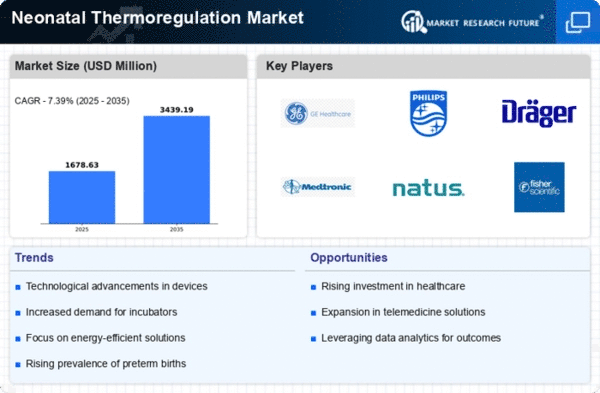
As per MRFR analysis, the Neonatal Thermoregulation Market Size was estimated at 1563.12 USD Million in 2024. The Neonatal Thermoregulation industry is projected to grow from 1696.54 in 2025 to 3439.19 by 2035, exhibiting a compound annual growth rate (CAGR) of 7.39 during the forecast period 2025 - 2035.

Key Market Trends & Highlights

The Neonatal Thermoregulation Market is poised for substantial growth driven by technological advancements and increasing healthcare investments.

  • Technological advancements in thermal management are reshaping neonatal care practices, particularly in North America. The focus on enhancing neonatal care standards is becoming increasingly pronounced, especially in the Asia-Pacific region. Incubators remain the largest segment, while radiant warmers are emerging as the fastest-growing category in neonatal thermoregulation. Rising incidence of premature births and increased investment in neonatal healthcare are key drivers propelling market expansion.

Market Size & Forecast

2024 Market Size 1563.12 (USD Million)
2035 Market Size 3439.19 (USD Million)
CAGR (2025 - 2035) 7.39%
Largest Regional Market Share in 2024 North America

Major Players

<p>GE Healthcare (US), Philips (NL), Dr&auml;ger (DE), Medtronic (US), Natus Medical (US), Fisher &amp; Paykel Healthcare (NZ), Smiths Medical (US), Masimo (US), Becton Dickinson (US)</p>

Market Trends

The Neonatal Thermoregulation Market is currently experiencing a notable evolution, driven by the increasing awareness of the critical importance of maintaining optimal body temperature in newborns. This market encompasses a range of products and technologies designed to prevent hypothermia and hyperthermia in neonates, which can lead to severe health complications. As healthcare providers prioritize the well-being of vulnerable infants, innovations in thermal management solutions are emerging. These advancements include the development of advanced incubators, warming devices, and monitoring systems that ensure precise temperature control. Furthermore, the integration of smart technologies into neonatal care is becoming more prevalent, allowing for real-time monitoring and data collection, which enhances clinical decision-making. In addition to technological advancements, the Neonatal Thermoregulation Market is influenced by the growing emphasis on neonatal care standards and guidelines established by health organizations. These guidelines advocate for the implementation of effective thermoregulation practices in hospitals and clinics, thereby driving demand for specialized equipment. The market landscape is also shaped by increasing investments in healthcare infrastructure, particularly in developing regions, where access to quality neonatal care is expanding. As a result, the Neonatal Thermoregulation Market is poised for continued growth, with a focus on improving outcomes for newborns through innovative solutions and enhanced care practices.

Technological Advancements in Thermal Management

The Neonatal Thermoregulation Market is witnessing a surge in technological innovations aimed at enhancing thermal management for newborns. New devices are being developed that offer improved temperature control and monitoring capabilities. These advancements not only ensure better care but also facilitate the integration of data analytics, which can lead to more informed clinical decisions.

Increased Focus on Neonatal Care Standards

There is a growing emphasis on adhering to neonatal care standards, which is influencing the Neonatal Thermoregulation Market. Health organizations are establishing guidelines that promote effective thermoregulation practices. This trend is driving hospitals to invest in specialized equipment that meets these standards, thereby improving overall neonatal care.

Expansion of Healthcare Infrastructure

The Neonatal Thermoregulation Market is also being shaped by the expansion of healthcare infrastructure, particularly in emerging economies. As access to quality neonatal care improves, there is a corresponding increase in demand for thermoregulation solutions. This trend indicates a potential for market growth as more facilities seek to enhance their neonatal care capabilities.

Neonatal Thermoregulation Market Market Drivers

Market Growth Projections

The Global Neonatal Thermoregulation Market Industry is projected to experience substantial growth over the coming years. With a market value expected to reach 33.4 USD Billion by 2035, the industry is poised for a robust expansion. This growth is supported by various factors, including technological advancements, increasing awareness of neonatal care, and government initiatives. The compound annual growth rate (CAGR) of 4.98% from 2025 to 2035 indicates a steady upward trajectory for the market. As healthcare systems worldwide prioritize neonatal health, the demand for thermoregulation solutions is likely to rise, reflecting the critical need for effective thermal management in neonatal care.

Government Initiatives and Funding

Government initiatives aimed at improving maternal and neonatal health are propelling the Global Neonatal Thermoregulation Market Industry. Various countries are implementing policies to enhance healthcare infrastructure, particularly in developing regions where neonatal mortality rates remain high. For example, funding programs for neonatal care equipment are being established to ensure that hospitals are equipped with necessary thermoregulation devices. These initiatives not only improve access to essential healthcare services but also stimulate market growth. As a result, the market is expected to experience a compound annual growth rate (CAGR) of 4.98% from 2025 to 2035, reflecting the positive impact of government support on neonatal health outcomes.

Increasing Awareness of Neonatal Care

The growing awareness of the importance of neonatal care among healthcare professionals and parents is influencing the Global Neonatal Thermoregulation Market Industry. Educational campaigns and training programs are being implemented to highlight the critical role of thermoregulation in preventing hypothermia and promoting healthy development in newborns. This heightened awareness is leading to increased demand for thermoregulation products and solutions in hospitals and home care settings. As healthcare providers prioritize the implementation of best practices in neonatal care, the market is likely to expand, aligning with the projected growth trajectory towards 33.4 USD Billion by 2035.

Rising Incidence of Neonatal Conditions

The increasing prevalence of neonatal conditions such as low birth weight and preterm births is driving the Global Neonatal Thermoregulation Market Industry. According to health statistics, approximately 15 million infants are born preterm each year, leading to heightened demand for effective thermoregulation solutions. These conditions often result in hypothermia, necessitating advanced thermal care technologies. As healthcare systems globally strive to improve neonatal outcomes, investments in thermoregulation devices are expected to rise. This trend is likely to contribute to the market's projected growth, with an estimated value of 19.6 USD Billion in 2024, reflecting a growing recognition of the importance of maintaining optimal body temperature in vulnerable newborns.

Rising Birth Rates in Developing Regions

The rising birth rates in developing regions are contributing to the expansion of the Global Neonatal Thermoregulation Market Industry. As populations grow, the demand for neonatal care services and equipment increases, particularly in areas with limited access to healthcare. Countries in Africa and Asia are experiencing significant increases in birth rates, necessitating the establishment of more healthcare facilities equipped with thermoregulation technologies. This trend is likely to drive market growth as healthcare providers seek to improve neonatal outcomes. The anticipated market value of 19.6 USD Billion in 2024 reflects the urgent need for effective thermoregulation solutions in these regions.

Technological Advancements in Thermoregulation Devices

Innovations in neonatal thermoregulation technologies are significantly influencing the Global Neonatal Thermoregulation Market Industry. The introduction of advanced incubators, warming beds, and temperature monitoring systems enhances the ability to maintain stable body temperatures in neonates. For instance, the integration of IoT technology in these devices allows for real-time monitoring and data collection, improving clinical outcomes. As hospitals and healthcare facilities adopt these cutting-edge solutions, the market is poised for growth. The anticipated increase in market value to 33.4 USD Billion by 2035 underscores the potential impact of these advancements on neonatal care, indicating a shift towards more efficient and effective thermal management.

Market Segment Insights

By Application: Incubator (Largest) vs. Radiant Warmer (Fastest-Growing)

<p>In the Neonatal Thermoregulation Market, the distribution of market share among the application segments reveals that incubators lead as the primary choice, catering to the comprehensive needs of premature infants. Radiant warmers, although having a smaller share, are witnessing rapid adoption due to their efficiency in providing targeted warmth. Thermal mattresses and heat shields also have significant roles but are generally more niche solutions within the segment.</p>

<p>Incubator (Dominant) vs. Radiant Warmer (Emerging)</p>

<p>Incubators dominate the Neonatal Thermoregulation Market due to their multifunctional capabilities, allowing for controlled environments that encompass warmth, humidity, and ventilation. They are essential in neonatal intensive care units (NICUs) for premature and low-birth-weight infants. Conversely, radiant warmers represent an emerging trend in thermoregulation, prized for their mobility and immediate heat provision. They cater to urgent situations where quick temperature regulation is required. As clinical practices evolve towards efficiency and rapid response for vulnerable newborns, both segments are adapting to harmonize their capabilities.</p>

By End Use: Hospitals (Largest) vs. Home Care (Fastest-Growing)

<p>In the Neonatal Thermoregulation Market, hospitals constitute the largest end-use segment due to their high patient inflow and comprehensive neonatal care services. Clinics and home care services follow, catering to a smaller yet significant share of the market. The presence of advanced medical facilities and specialized staff in hospitals enables them to dominate the segment, providing essential thermoregulation solutions for neonates requiring intensive monitoring and care. Clinics serve as accessible alternatives, while home care is gradually gaining traction as an extension of hospital services.</p>

<p>Hospitals (Dominant) vs. Home Care (Emerging)</p>

<p>Hospitals are the dominant players in the neonatal thermoregulation market, benefiting from advanced infrastructure, specialized medical teams, and high technology adoption rates. They offer a wide range of thermoregulation solutions, catering to critically ill neonates. In contrast, home care is emerging as a significant segment, driven by the rising preference for at-home recovery and post-discharge care. This trend is supported by advancements in portable thermoregulation devices and increasing awareness of neonatal care. Home care serves as a cost-effective option, allowing for personalized monitoring and fostering family involvement in the care of neonates, thus driving its growth.</p>

By Product Type: Electric Warmers (Largest) vs. Chemical Warmers (Fastest-Growing)

<p>In the Neonatal Thermoregulation Market, Electric Warmers hold the largest share, demonstrating significant preference among healthcare providers for their efficiency and reliability. These devices are designed to maintain optimal body temperature in neonates, making them essential in neonatal intensive care units. In contrast, Chemical Warmers are emerging rapidly, driven by their portability and ease of use, catering to specific clinical and transport situations where electrical power may not be available.</p>

<p>Electric Warmers (Dominant) vs. Chemical Warmers (Emerging)</p>

<p>Electric Warmers are known for offering precise temperature control and consistent heating, essential for the delicate needs of neonates. They are typically used in hospitals and clinics where a stable power source is available, ensuring safety and reliability. On the other hand, Chemical Warmers represent an emerging alternative, especially in scenarios where mobility and convenience are critical. They are lightweight, disposable, and can be activated without electricity, making them suitable for emergency transport. As healthcare settings evolve, the demand for both types of warmers is likely to grow, each serving unique aspects of neonatal care.</p>

By Technology: Convection Heating (Largest) vs. Radiant Heating (Fastest-Growing)

<p>In the Neonatal Thermoregulation Market, Convection Heating represents the largest segment, leveraging its effective heat transfer mechanism that maintains optimal body temperature for neonates. This technology plays a critical role in preventing hypothermia, ensuring that premature and low-birth-weight infants are kept warm in clinical settings. Radiant Heating, although smaller in market share, is the fastest-growing segment due to its non-contact heating feature, which reduces the risk of infection while providing direct warmth to the infant.</p>

<p>Technology: Convection Heating (Dominant) vs. Radiant Heating (Emerging)</p>

<p>Convection Heating stands out as the dominant technology in neonatal thermoregulation, characterized by its ability to create a warm air envelope around the infant, which is crucial for stabilizing body temperature. This method's efficiency and ease of use in incubators and warmers contribute to its widespread adoption. In contrast, Radiant Heating is an emerging technology that utilizes infrared radiation to warm infants without direct contact, minimizing the risk of thermal instability and infections. Its increasing prevalence in NICUs is driven by advancements that enhance its safety features and its ability to support immediate temperature regulation without cumbersome blankets or covers.</p>

By Patient Type: Premature Infants (Largest) vs. Low Birth Weight Infants (Fastest-Growing)

<p>In the Neonatal Thermoregulation Market, the distribution of patient types shows that premature infants constitute the largest share due to their critical need for temperature management immediately after birth. This segment dominates the market, as the rising incidence of preterm births continues to escalate globally. Low birth weight infants also account for a significant share, but their growth trajectory is notably impressive as hospitals enhance their thermal care capabilities to cater to their distinct needs. The growth trends in this segment are heavily influenced by advancements in neonatal care technology and increased awareness surrounding the importance of thermoregulation in reducing neonatal mortality rates. The demand for specialized thermal care solutions is particularly growing in regions with higher rates of preterm and low birth weight births, thus fostering a robust growth environment for these segments in the upcoming years.</p>

<p>Patient Type: Premature Infants (Dominant) vs. Term Infants (Emerging)</p>

<p>In the Neonatal Thermoregulation Market, premature infants are positioned as the dominant patient type due to their high-risk status and requirement for specialized thermal care solutions. These infants experience greater challenges in thermoregulation and thus need immediate and effective temperature management. On the other hand, term infants represent an emerging segment, as awareness grows about the need for maintaining ideal body temperature immediately after birth, especially in a hospital environment. Although term infants don't require the same level of intensive care as premature infants, increasing health professional education and a shift towards family-centered care are resulting in rising demand for thermoregulation products tailored to this group. Both segments highlight the ongoing evolution in neonatal care, driven by innovations in thermal management technologies.</p>

Get more detailed insights about Neonatal Thermoregulation Market Research Report - Global Forecast till 2035

Regional Insights

North America : Market Leader in Innovation

North America is poised to maintain its leadership in the neonatal thermoregulation market, holding a significant market share of $780.0M in 2024. The region's growth is driven by increasing neonatal care awareness, advancements in medical technology, and supportive government regulations. The rising incidence of preterm births and the demand for advanced healthcare solutions further fuel market expansion. Regulatory bodies are actively promoting standards that enhance neonatal care, ensuring a robust market environment. The competitive landscape in North America is characterized by the presence of key players such as GE Healthcare, Medtronic, and Natus Medical. These companies are at the forefront of innovation, offering advanced thermoregulation solutions that cater to the needs of healthcare providers. The U.S. remains the leading country, with a strong focus on research and development, ensuring that the region continues to set benchmarks in neonatal healthcare technology. The market is expected to grow as hospitals increasingly adopt sophisticated equipment to improve neonatal outcomes.

Europe : Emerging Market with Growth Potential

Europe's neonatal thermoregulation market is valued at $450.0M, reflecting a growing demand for advanced healthcare solutions. The region benefits from stringent healthcare regulations and a strong emphasis on neonatal care, which are key growth drivers. Increasing awareness of neonatal health issues and the rising number of preterm births are propelling the market forward. Regulatory frameworks are evolving to support innovative technologies that enhance patient care and safety, creating a conducive environment for market growth. Leading countries in Europe include Germany, France, and the UK, where significant investments in healthcare infrastructure are being made. The competitive landscape features major players like Philips and Dräger, who are innovating to meet the rising demand for effective thermoregulation solutions. The European market is characterized by collaborations between healthcare providers and technology firms, aimed at improving neonatal care standards. As regulations continue to evolve, the market is expected to expand further, driven by technological advancements and increased healthcare spending.

Asia-Pacific : Rapidly Growing Healthcare Sector

The Asia-Pacific neonatal thermoregulation market is valued at $280.0M, showcasing rapid growth driven by increasing healthcare investments and rising awareness of neonatal health. The region is witnessing a surge in the number of healthcare facilities, particularly in countries like China and India, which are focusing on improving neonatal care standards. Government initiatives aimed at reducing infant mortality rates are also contributing to market expansion, creating a favorable regulatory environment for new technologies. China and India are leading the charge in the Asia-Pacific region, with significant contributions from local and international players. Companies like Fisher & Paykel Healthcare and Masimo are expanding their presence, offering innovative solutions tailored to the needs of healthcare providers. The competitive landscape is becoming increasingly dynamic, with a focus on affordability and accessibility of neonatal care technologies. As the region continues to develop, the demand for advanced thermoregulation solutions is expected to rise significantly, driven by both public and private sector investments.

Middle East and Africa : Emerging Market with Challenges

The Middle East and Africa neonatal thermoregulation market is valued at $53.12M, reflecting a nascent but growing sector. The region faces challenges such as limited healthcare infrastructure and varying levels of access to advanced medical technologies. However, increasing awareness of neonatal health issues and government initiatives aimed at improving healthcare services are driving market growth. Regulatory bodies are beginning to implement standards that promote better neonatal care, which is essential for market development. Countries like South Africa and the UAE are leading the way in adopting advanced neonatal care solutions. The competitive landscape is characterized by a mix of local and international players, with companies like Becton Dickinson and Smiths Medical making strides in the market. As healthcare systems evolve, there is a growing emphasis on improving neonatal outcomes, which is expected to drive demand for thermoregulation solutions. The market is poised for growth as investments in healthcare infrastructure increase and awareness of neonatal care continues to rise.

Key Players and Competitive Insights

The Neonatal Thermoregulation Market is characterized by a dynamic competitive landscape, driven by the increasing demand for advanced neonatal care solutions. Key players such as GE Healthcare (US), Philips (NL), and Dräger (DE) are at the forefront, focusing on innovation and strategic partnerships to enhance their market presence. GE Healthcare (US) emphasizes technological advancements in its product offerings, while Philips (NL) is known for its commitment to sustainability and digital health solutions. Dräger (DE) leverages its expertise in medical technology to provide comprehensive solutions for neonatal care, thereby shaping a competitive environment that prioritizes quality and innovation.

In terms of business tactics, companies are increasingly localizing manufacturing and optimizing supply chains to enhance operational efficiency. The market appears moderately fragmented, with several players vying for market share. However, the collective influence of major companies like Medtronic (US) and Natus Medical (US) is notable, as they implement strategies that focus on regional expansion and product diversification, further intensifying competition.

In November 2025, GE Healthcare (US) announced the launch of a new line of neonatal incubators designed to improve thermal stability and reduce energy consumption. This strategic move is significant as it aligns with the growing emphasis on sustainability in healthcare, potentially positioning GE Healthcare as a leader in eco-friendly neonatal solutions. The introduction of these incubators may enhance patient outcomes while appealing to environmentally conscious healthcare providers.

In October 2025, Philips (NL) expanded its partnership with a leading hospital network to integrate its advanced monitoring systems into neonatal units. This collaboration is crucial as it not only enhances Philips' product visibility but also reinforces its commitment to improving neonatal care through technology. By embedding its solutions within hospital infrastructures, Philips is likely to strengthen its market position and foster long-term relationships with healthcare providers.

In September 2025, Dräger (DE) unveiled a new software platform aimed at optimizing neonatal care workflows. This platform integrates data analytics and AI to provide real-time insights into patient conditions. The strategic importance of this development lies in its potential to enhance clinical decision-making and improve patient outcomes, thereby solidifying Dräger's reputation as a pioneer in neonatal technology.

As of December 2025, current trends in the Neonatal Thermoregulation Market indicate a shift towards digitalization, sustainability, and AI integration. Strategic alliances among key players are shaping the competitive landscape, fostering innovation and collaboration. The focus appears to be shifting from price-based competition to differentiation through advanced technology and reliable supply chains. This evolution suggests that companies will increasingly prioritize innovation and quality, positioning themselves to meet the complex needs of neonatal care in the future.

Key Companies in the Neonatal Thermoregulation Market market include

Industry Developments

Future Outlook

Neonatal Thermoregulation Market Future Outlook

<p>The Neonatal Thermoregulation Market is projected to grow at a 7.39% CAGR from 2024 to 2035, driven by technological advancements, increasing neonatal care awareness, and rising preterm birth rates.</p>

New opportunities lie in:

  • <p>Development of advanced wearable thermoregulation devices for home care settings.</p>
  • <p>Integration of IoT technology for real-time temperature monitoring in hospitals.</p>
  • <p>Expansion of training programs for healthcare professionals on thermoregulation best practices.</p>

<p>By 2035, the Neonatal Thermoregulation Market is expected to achieve substantial growth, reflecting enhanced healthcare solutions.</p>

Market Segmentation

Neonatal Thermoregulation Market End Use Outlook

  • Hospitals
  • Clinics
  • Home Care

Neonatal Thermoregulation Market Technology Outlook

  • Convection Heating
  • Conductive Heating
  • Radiant Heating

Neonatal Thermoregulation Market Application Outlook

  • Incubator
  • Radiant Warmer
  • Thermal Mattress
  • Heat Shield

Neonatal Thermoregulation Market Patient Type Outlook

  • Premature Infants
  • Low Birth Weight Infants
  • Term Infants

Neonatal Thermoregulation Market Product Type Outlook

  • Electric Warmers
  • Chemical Warmers
  • Water-Based Warmers

Report Scope

MARKET SIZE 2024 1563.12(USD Million)
MARKET SIZE 2025 1696.54(USD Million)
MARKET SIZE 2035 3439.19(USD Million)
COMPOUND ANNUAL GROWTH RATE (CAGR) 7.39% (2024 - 2035)
REPORT COVERAGE Revenue Forecast, Competitive Landscape, Growth Factors, and Trends
BASE YEAR 2024
Market Forecast Period 2025 - 2035
Historical Data 2019 - 2024
Market Forecast Units USD Million
Key Companies Profiled GE Healthcare (US), Philips (NL), Dräger (DE), Medtronic (US), Natus Medical (US), Fisher & Paykel Healthcare (NZ), Smiths Medical (US), Masimo (US), Becton Dickinson (US)
Segments Covered Application, End Use, Product Type, Technology, Patient Type
Key Market Opportunities Integration of advanced monitoring technologies enhances neonatal care in the Neonatal Thermoregulation Market.
Key Market Dynamics Rising demand for advanced neonatal care technologies drives innovation and competition in the neonatal thermoregulation market.
Countries Covered North America, Europe, APAC, South America, MEA

FAQs

  1. Definition
    1. Scope of the Study
      1. Research Objective
      2. Assumptions
      3. Limitations
    2. Introduction
    3. Primary Research
    4. Secondary Research
    5. Market Size Estimation
    6. Drivers
    7. Restraints
    8. Opportunities
    9. Challenges
    10. Macroeconomic Indicators
    11. Equipment Trends & Assessment
    12. Porter’s Five Forces Analysis
      1. Bargaining Power of Suppliers
      2. Bargaining Power of Buyers
      3. Threat of New Entrants
      4. Threat of Substitutes
      5. Intensity of Rivalry
    13. Value Chain Analysis
    14. Investment Feasibility Analysis
    15. Pricing Analysis
  2. Chapter 6. Global Neonatal Thermoregulation Market, by Product Type
    1. Introduction
    2. Warmer
      1. Radiant Warmers
  3. Market Estimates & Forecast, by Region, 2020-2027
  4. Market Estimates & Forecast, by Country, 2020-2027
  5. Wall Mount Warmer
  6. Market Estimates & Forecast, by Region, 2020-2027
  7. Market Estimates & Forecast, by Country, 2020-2027
    1. Neonatal Incubators
      1. Intensive Care Incubator
  8. Market Estimates & Forecast, by Region, 2020-2027
  9. Market Estimates & Forecast, by Country, 2020-2027
  10. Transport Incubator
  11. Market Estimates & Forecast, by Region, 2020-2027
  12. Market Estimates & Forecast, by Country, 2020-2027
    1. Neonatal Cooling Systems
  13. Market Estimates & Forecast, by Region, 2020-2027
  14. Market Estimates & Forecast, by Country, 2020-2027
  15. Chapter 7. Global Neonatal Thermoregulation Market, by Modality
    1. Introduction
    2. Open
  16. Market Estimates & Forecast, by Region, 2020-2027
  17. Market Estimates & Forecast, by Country, 2020-2027
    1. Closed
  18. Market Estimates & Forecast, by Region, 2020-2027
  19. Market Estimates & Forecast, by Country, 2020-2027
  20. Chapter 8. Global Neonatal Thermoregulation Market, by End User
    1. Introduction
    2. Hospitals
  21. Market Estimates & Forecast, by Region, 2020-2027
  22. Market Estimates & Forecast, by Country, 2020-2027
    1. Pediatric and Neonatal Intensive Care Units
  23. Market Estimates & Forecast, by Region, 2020-2027
  24. Market Estimates & Forecast, by Country, 2020-2027
    1. Nursing Homes
  25. Market Estimates & Forecast, by Region, 2020-2027
  26. Market Estimates & Forecast, by Country, 2020-2027
    1. Others
  27. Market Estimates & Forecast, by Region, 2020-2027
  28. Market Estimates & Forecast, by Country, 2020-2027
  29. Chapter 9. Global Neonatal Thermoregulation Market, by Region
    1. Introduction
    2. Americas
      1. North America
      2. South America
    3. Europe
      1. Western Europe
      2. Eastern Europe
    4. Asia-Pacific
      1. Japan
      2. China
      3. India
      4. Australia
      5. South Korea
      6. Rest of Asia-Pacific
    5. Middle East & Africa
      1. Middle East
      2. Africa
    6. Chapter 10. Company Landscape
    7. Introduction
    8. Market Share Analysis
    9. Key Development & Strategies
    10. Chapter 11. Company Profiles
    11. GENERAL ELECTRIC COMPANY
      1. Company Overview
      2. Product Type Overview
      3. Financials Overview
      4. Key Developments
      5. SWOT Analysis
    12. Natus Medical Incorporated
      1. Company Overview
      2. Product Type Overview
      3. Financial Overview
      4. Key Developments
      5. SWOT Analysis
    13. INSPIRATION HEALTHCARE GROUP PLC.
      1. Company Overview
      2. Product Type Overview
      3. Financial Overview
      4. Key Development
      5. SWOT Analysis
    14. Koninklijke Philips N.V.
      1. Company Overview
      2. Product Type Overview
      3. Financial Overview
      4. Key Development
      5. SWOT Analysis
    15. Drägerwerk AG & Co. KGaA
      1. Company Overview
      2. Product Type Overview
      3. Financial overview
      4. Key Developments
      5. SWOT Analysis
    16. Fisher & Paykel Healthcare
      1. Company Overview
      2. Product Type Overview
      3. Financial Overview
      4. Key Developments
      5. SWOT Analysis
    17. International Biomedical, Ltd.
      1. Overview
      2. Product Type Overview
      3. Financial Overview
      4. Key Developments
      5. SWOT Analysis
    18. Atom Medical Corporation
      1. Overview
      2. Product Type Overview
      3. Financials
      4. Key Developments
      5. SWOT Analysis
    19. Fanem Ltda
      1. Overview
      2. Product Type Overview
      3. Financials
      4. Key Developments
      5. SWOT Analysis
    20. Novos Medical Systems
      1. Overview
      2. Product Type Overview
      3. Financials
      4. Key Developments
      5. SWOT Analysis
    21. Chapter 12 MRFR Conclusion
    22. Key Findings
      1. From CEO’s View point
      2. Unmet Needs of the Market
    23. Key Companies to Watch
    24. Predictions for the Neonatal Thermoregulation Industry
    25. Chapter 13. Appendix
  30. LIST OF TABLES
  31. Global Neonatal Thermoregulation Market Synopsis, 2020-2027
  32. Global Neonatal Thermoregulation Market Estimates and Forecast, 2020-2027 (USD Million)
  33. Global Neonatal Thermoregulation Market, by Region, 2020-2027 (USD Million)
  34. Global Neonatal Thermoregulation Market, by Product Type, 2020-2027 (USD Million)
  35. Global Neonatal Thermoregulation Market, by Modulation, 2020-2027 (USD Million)
  36. Global Neonatal Thermoregulation Market, by End User, 2020-2027 (USD Million)
  37. North America: Neonatal Thermoregulation Market, by Product Type, 2020-2027 (USD Million)
  38. North America: Neonatal Thermoregulation Market, by Modulation, 2020-2027 (USD Million)
  39. North America: Neonatal Thermoregulation Market, by End User, 2020-2027 (USD Million)
  40. US: Neonatal Thermoregulation Market, by Product Type, 2020-2027 (USD Million)
  41. US: Neonatal Thermoregulation Market, by Modulation, 2020-2027 (USD Million)
  42. US: Neonatal Thermoregulation Market, by End User, 2020-2027 (USD Million)
  43. Canada: Neonatal Thermoregulation Market, by Product Type, 2020-2027 (USD Million)
  44. Canada: Neonatal Thermoregulation Market, by Modulation, 2020-2027 (USD Million)
  45. Canada: Neonatal Thermoregulation Market, by End User, 2020-2027 (USD Million)
  46. South America: Neonatal Thermoregulation Market, by Product Type, 2020-2027 (USD Million)
  47. South America: Neonatal Thermoregulation Market, by Modulation, 2020-2027 (USD Million)
  48. South America: Neonatal Thermoregulation Market, by End User, 2020-2027 (USD Million)
  49. Europe: Neonatal Thermoregulation Market, by Product Type, 2020-2027 (USD Million)
  50. Europe: Neonatal Thermoregulation Market, by Modulation, 2020-2027 (USD Million)
  51. Europe: Neonatal Thermoregulation Market, by End User, 2020-2027 (USD Million)
  52. Western Europe: Neonatal Thermoregulation Market, by Product Type, 2020-2027 (USD Million)
  53. Western Europe: Neonatal Thermoregulation Market, by Modulation, 2020-2027 (USD Million)
  54. Western Europe: Neonatal Thermoregulation Market, by End User, 2020-2027 (USD Million)
  55. Eastern Europe: Neonatal Thermoregulation Market, by Product Type, 2020-2027 (USD Million) Table 26 Eastern Europe: Neonatal Thermoregulation Market, by Modulation, 2020-2027 (USD Million)
  56. Eastern Europe: Neonatal Thermoregulation Market, by End User, 2020-2027 (USD Million)
  57. Asia-Pacific: Neonatal Thermoregulation Market, by Product Type, 2020-2027 (USD Million) Table 29 Asia-Pacific: Neonatal Thermoregulation Market, by Modulation, 2020-2027 (USD Million)
  58. Asia-Pacific: Neonatal Thermoregulation Market, by End User, 2020-2027 (USD Million)
  59. Middle East & Africa: Neonatal Thermoregulation Market, by Product Type, 2020-2027 (USD Million) Table 32 Middle East & Africa: Neonatal Thermoregulation Market, by Modulation, 2020-2027 (USD Million)
  60. Middle East & Africa: Neonatal Thermoregulation Market, by End User, 2020-2027 (USD Million)
  61. LIST OF FIGURES
  62. Research Process
  63. Market Structure for Global Neonatal Thermoregulation Market
  64. Market Dynamics for Global Neonatal Thermoregulation Market
  65. Global Neonatal Thermoregulation Market Share, by Product Type, 2020
  66. Global Neonatal Thermoregulation Market Share, by Modulation, 2020
  67. Global Neonatal Thermoregulation Market Share, by End User, 2020
  68. Global Neonatal Thermoregulation Market Share, by Region, 2020
  69. North America: Neonatal Thermoregulation Market Share, by Country, 2020
  70. Europe: Neonatal Thermoregulation Market Share, by Country, 2020
  71. Asia-Pacific: Neonatal Thermoregulation Market Share, by Country, 2020
  72. Middle East & Africa: Neonatal Thermoregulation Market Share, by Country, 2020
  73. Global Neonatal Thermoregulation Market: Company Share Analysis, 2020 (%)
  74. GENERAL ELECTRIC COMPANY: Key Financials
  75. GENERAL ELECTRIC COMPANY: Segmental Revenue
  76. GENERAL ELECTRIC COMPANY: Geographical Revenue
  77. Natus Medical Incorporated: Key Financials
  78. Natus Medical Incorporated: Segmental Revenue
  79. Natus Medical Incorporated: Geographical Revenue
  80. INSPIRATION HEALTHCARE GROUP PLC: Key Financials
  81. INSPIRATION HEALTHCARE GROUP PLC: Segmental Revenue
  82. INSPIRATION HEALTHCARE GROUP PLC: Geographical Revenue
  83. Koninklijke Philips N.V.: Key Financials
  84. Koninklijke Philips N.V.: Segmental Revenue
  85. Koninklijke Philips N.V.: Geographical Revenue
  86. Drägerwerk AG & Co. KGaA: Key Financials
  87. Drägerwerk AG & Co. KGaA: Segmental Revenue
  88. Drägerwerk AG & Co. KGaA: Geographical Revenue
  89. Fisher & Paykel Healthcare: Key Financials
  90. Fisher & Paykel Healthcare: Segmental Revenue
  91. Fisher & Paykel Healthcare: Geographical Revenue
  92. International Biomedical, Ltd.: Key Financials
  93. International Biomedical, Ltd.: Segmental Revenue
  94. International Biomedical, Ltd.: Geographical Revenue
  95. Atom Medical Corporation: Key Financials
  96. Atom Medical Corporation: Segmental Revenue
  97. Atom Medical Corporation: Geographical Revenue
  98. Fanem Ltda: Key Financials
  99. Fanem Ltda: Segmental Revenue
  100. Fanem Ltda: Geographical Revenue
  101. Novos Medical Systems: Key Financials
  102. Novos Medical Systems: Segmental Revenue
  103. Novos Medical Systems: Geographical Revenue

Neonatal Thermoregulation Market Segmentation

Market Segmentation Overview

  • Detailed segmentation data will be available in the full report
  • Comprehensive analysis by multiple parameters
  • Regional and country-level breakdowns
  • Market size forecasts by segment
Infographic

Free Sample Request

Kindly complete the form below to receive a free sample of this Report

Get Free Sample

Customer Strories

Compare Licence

×
Features License Type
Single User Multiuser License Enterprise User
Price $4,950 $5,950 $7,250
Maximum User Access Limit 1 User Upto 10 Users Unrestricted Access Throughout the Organization
Free Customization
Direct Access to Analyst
Deliverable Format
Platform Access
Discount on Next Purchase 10% 15% 15%
Printable Versions