×
Hero Background
English
Chinese
French
Japanese
Korean
German
Spanish

Nausea Medicine Market Trends

ID: MRFR/Pharma/3105-CR
104 Pages
Rahul Gotadki
February 2021

Global Nausea Medicine Market Research Report Information By Type (Antagonists, Antihistamines, Cannabinoids and Others), By Mode of Administration (Intravenous, Oral and Transdermal), Indication (Oncology, Gastroesophageal Reflux Disease (GERD), Motion Sickness and Seasickness and Others), Distribution Channel (Hospitals Pharmacy/ Retail Pharmacy and Online), Region (Americas, Europe, Asia-Pacific, Middle East & Africa) - Forecast till 2035

Share:
Download PDF ×

We do not share your information with anyone. However, we may send you emails based on your report interest from time to time. You may contact us at any time to opt-out.

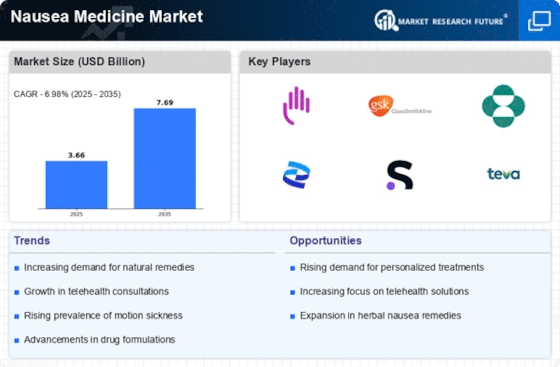
Nausea Medicine Market Infographic
Purchase Options

Market Trends

Key Emerging Trends in the Nausea Medicine Market

The market dynamics of the nausea medicine market are influenced by various factors that shape its growth, competition, and consumer demand. Nausea, a common symptom associated with various medical conditions such as motion sickness, pregnancy, chemotherapy, and gastrointestinal disorders, drives the demand for effective medications. The market is characterized by a wide range of products including over-the-counter (OTC) remedies like antihistamines, herbal supplements, and prescription medications such as antiemetics.

Consumer preferences and behavior play a crucial role in shaping market dynamics. Factors such as convenience, efficacy, safety, and cost influence consumers' choices when selecting nausea medications. For instance, individuals experiencing mild nausea may opt for OTC remedies due to their accessibility and affordability, while those with severe symptoms may seek prescription medications for stronger relief. Additionally, preferences for natural or organic remedies may drive demand for herbal supplements among health-conscious consumers.

Market competition intensifies as pharmaceutical companies vie for market share by introducing innovative products and marketing strategies. Research and development efforts focus on developing new formulations, improving drug delivery systems, and enhancing the efficacy of existing medications. Patents on proprietary formulations provide companies with a competitive edge, allowing them to capitalize on market demand and command premium prices. Furthermore, strategic alliances, mergers, and acquisitions enable companies to expand their product portfolios and market reach, consolidating their position in the nausea medicine market.

Regulatory frameworks governing the pharmaceutical industry also impact market dynamics. Stringent regulations set by health authorities ensure the safety, efficacy, and quality of nausea medications, thereby fostering consumer trust and confidence. Compliance with regulatory requirements entails significant investment in clinical trials, product testing, and manufacturing standards, influencing product development timelines and market entry strategies. Moreover, changes in regulatory policies, such as drug approvals, labeling requirements, and pricing regulations, can have profound effects on market dynamics, shaping competition and market access.

Global economic factors, including GDP growth, healthcare expenditure, and population demographics, contribute to market dynamics by influencing consumer purchasing power and healthcare access. Rising healthcare expenditures, particularly in emerging markets, drive demand for nausea medications as access to healthcare services improves and awareness of treatment options increases. Conversely, economic downturns and healthcare budget constraints may dampen market growth, leading consumers to prioritize essential healthcare needs over symptomatic relief for nausea.

Technological advancements and innovation drive market evolution by enabling the development of novel drug delivery systems, formulations, and therapeutic approaches. For instance, the emergence of wearable devices for drug delivery, such as transdermal patches and wearable injectors, offers patients convenient and non-invasive treatment options for managing nausea. Similarly, advances in pharmacogenomics and personalized medicine hold promise for tailoring nausea treatments to individual patient characteristics, optimizing efficacy and minimizing adverse effects.

Environmental factors, such as climate change and environmental pollution, also influence market dynamics indirectly by impacting health outcomes and the prevalence of conditions associated with nausea, such as foodborne illnesses and air pollution-related respiratory symptoms. Heightened awareness of environmental health risks may prompt individuals to seek preventive measures and treatments for nausea, driving demand for relevant medications and shaping market dynamics accordingly.


Author
Rahul Gotadki
Assistant Manager

He holds an experience of about 7+ years in Market Research and Business Consulting, working under the spectrum of Life Sciences and Healthcare domains. Rahul conceptualizes and implements a scalable business strategy and provides strategic leadership to the clients. His expertise lies in market estimation, competitive intelligence, pipeline analysis, customer assessment, etc. In addition to the above, his other responsibility includes strategic tracking of high growth markets & advising clients on the potential areas of focus they could direct their business initiatives

Leave a Comment

FAQs

What is the current valuation of the Nausea Medicine Market?

As of 2024, the Nausea Medicine Market was valued at 3.66 USD Billion.

What is the projected market size for the Nausea Medicine Market in 2035?

The market is projected to reach 7.688 USD Billion by 2035.

What is the expected CAGR for the Nausea Medicine Market from 2025 to 2035?

The expected CAGR for the Nausea Medicine Market during the forecast period 2025 - 2035 is 6.98%.

Which companies are the key players in the Nausea Medicine Market?

Key players include Bristol-Myers Squibb, GlaxoSmithKline, Merck & Co., Pfizer, Sanofi, Teva Pharmaceutical Industries, AstraZeneca, and Novartis.

Market Summary

As per MRFR analysis, the Nausea Medicine Market Size was estimated at 3.66 USD Billion in 2024. The Nausea Medicine industry is projected to grow from 3.915 USD Billion in 2025 to 7.688 USD Billion by 2035, exhibiting a compound annual growth rate (CAGR) of 6.98 during the forecast period 2025 - 2035.

Key Market Trends & Highlights

The Nausea Medicine Market is experiencing a transformative shift towards personalized and technologically integrated solutions.

  • The market is witnessing a rise in personalized medicine, tailoring treatments to individual patient needs.
  • There is an increased demand for over-the-counter solutions, particularly in North America, which remains the largest market.
  • Integration of technology in treatment is becoming prevalent, enhancing patient engagement and adherence.
  • The growing incidence of nausea-related conditions and rising awareness of nausea management are driving market expansion, particularly in the antihistamines and intravenous segments.

Market Size & Forecast

2024 Market Size 3.66 (USD Billion)
2035 Market Size 7.688 (USD Billion)
CAGR (2025 - 2035) 6.98%
Largest Regional Market Share in 2024 Americas

Major Players

<p>Bristol-Myers Squibb (US), GlaxoSmithKline (GB), Merck & Co. (US), Pfizer (US), Sanofi (FR), Teva Pharmaceutical Industries (IL), AstraZeneca (GB), Novartis (CH)</p>

Market Trends

The Nausea Medicine Market is currently experiencing a dynamic evolution, driven by various factors that influence consumer preferences and healthcare practices. The increasing prevalence of conditions that induce nausea, such as motion sickness, chemotherapy, and gastrointestinal disorders, appears to be a primary catalyst for growth. Furthermore, the rising awareness regarding the availability of effective treatments is likely to enhance market penetration. Innovations in drug formulations and delivery methods may also contribute to the expansion of this sector, as patients seek more convenient and effective solutions for managing their symptoms. In addition, the Nausea Medicine Market is witnessing a shift towards natural and herbal remedies, reflecting a broader trend in healthcare where consumers are increasingly inclined to explore alternative therapies. This inclination may be fueled by a desire for fewer side effects and a more holistic approach to health. As the market continues to evolve, it seems essential for stakeholders to remain attuned to these changing preferences and to adapt their strategies accordingly, ensuring that they meet the diverse needs of patients and healthcare providers alike.

Rise of Personalized Medicine

The Nausea Medicine Market is likely to see a growing emphasis on personalized medicine, where treatments are tailored to individual patient profiles. This trend may enhance the effectiveness of therapies, as healthcare providers increasingly recognize that a one-size-fits-all approach may not be optimal for managing nausea.

Increased Demand for Over-the-Counter Solutions

There appears to be a notable shift towards over-the-counter nausea medications, as consumers seek accessible and convenient options for symptom relief. This trend may reflect a broader consumer preference for self-care and the desire to manage health issues without the need for prescription medications.

Integration of Technology in Treatment

The integration of technology into the Nausea Medicine Market is becoming more pronounced, with digital health solutions and mobile applications potentially playing a role in symptom management. This trend may facilitate better patient engagement and adherence to treatment regimens, ultimately improving health outcomes.

Nausea Medicine Market Market Drivers

Expansion of E-commerce Platforms

The expansion of e-commerce platforms is transforming the way consumers access nausea medications, thereby impacting the Nausea Medicine Market. With the rise of online pharmacies and health-focused e-commerce sites, consumers now have greater access to a variety of nausea relief products. This trend is particularly relevant in regions where traditional pharmacies may be limited. The convenience of online shopping, coupled with the ability to compare prices and read reviews, is likely to drive sales in the nausea medicine sector. As e-commerce continues to grow, it may contribute to a significant increase in market penetration for nausea medications.

Rising Awareness of Nausea Management

There is a growing awareness regarding the importance of effective nausea management among healthcare professionals and patients alike, which is likely to propel the Nausea Medicine Market. Educational initiatives and campaigns aimed at informing the public about the various causes and treatments for nausea have contributed to this trend. As patients become more informed about their options, they are more inclined to seek medical advice and appropriate treatments. This increased awareness may lead to a higher demand for both prescription and over-the-counter nausea medications, thereby expanding the market further.

Advancements in Pharmaceutical Research

Recent advancements in pharmaceutical research and development are significantly influencing the Nausea Medicine Market. The introduction of novel drug formulations and delivery systems, such as transdermal patches and sublingual tablets, has enhanced the efficacy and convenience of nausea treatments. Furthermore, the market has witnessed a surge in clinical trials aimed at discovering new antiemetic agents, which could potentially offer improved outcomes for patients. As a result, the industry is expected to experience growth driven by these innovations, with a projected increase in market value reaching several billion dollars in the coming years.

Increased Focus on Preventive Healthcare

The increasing focus on preventive healthcare is emerging as a notable driver for the Nausea Medicine Market. As healthcare systems worldwide shift towards preventive measures, there is a growing emphasis on managing symptoms before they escalate into more severe conditions. This proactive approach encourages individuals to seek out nausea medications as a means of prevention, particularly in high-risk populations such as pregnant women and patients undergoing certain medical treatments. Consequently, this trend may lead to a sustained increase in demand for nausea medicines, as healthcare providers advocate for early intervention strategies.

Growing Incidence of Nausea-Related Conditions

The rising prevalence of nausea-related conditions, such as motion sickness, chemotherapy-induced nausea, and pregnancy-related nausea, appears to be a primary driver for the Nausea Medicine Market. According to recent estimates, approximately 30% of the population experiences motion sickness at some point in their lives. Additionally, the increasing number of cancer patients undergoing chemotherapy has led to a heightened demand for effective antiemetic medications. This trend suggests that as more individuals seek relief from nausea, the market for nausea medicines will likely expand, with pharmaceutical companies focusing on developing innovative solutions to address these conditions.

Market Segment Insights

By Type: Antihistamines (Largest) vs. Cannabinoids (Fastest-Growing)

<p>In the Nausea Medicine Market, the segment distribution reveals that Antihistamines hold the largest market share, being the most commonly utilized for treating nausea across various demographics. Their established efficacy and familiar presence in the market contribute to their dominance. Conversely, Cannabinoids are quickly emerging as a noteworthy alternative, appealing particularly to patients seeking more natural options for nausea relief, influenced by changing regulations and attitudes toward cannabis products.</p>

<p>Antihistamines (Dominant) vs. Cannabinoids (Emerging)</p>

<p>Antihistamines have well-established efficacy in managing nausea, particularly related to motion sickness, allergies, and post-operative situations, solidifying their position as the dominant player in the nausea medicine segment. They benefit from a broad range of available products, including both prescription and over-the-counter options, which cater to different patient needs. Meanwhile, Cannabinoids are rapidly gaining traction as an emerging segment, especially with the proliferation of cannabis products and growing research supporting their therapeutic potential for chemotherapy-induced nausea and chronic pain management. This segment's rapid growth is attributed to increasing acceptance and legalization in various regions, appealing to a demographic searching for holistic and alternative treatments.</p>

By Mode of Administration: Intravenous (Largest) vs. Oral (Fastest-Growing)

<p>In the Nausea Medicine Market, the mode of administration plays a pivotal role in defining consumer preferences and therapeutic outcomes. Intravenous administration currently holds the largest market share, as it provides rapid relief and is preferred in acute settings. On the other hand, oral administration is emerging strongly due to its convenience and patient compliance, appealing particularly to chronic nausea management. Despite being the largest, the intravenous segment faces competition from the faster-growing oral segment, which is increasingly gaining traction among healthcare providers and patients alike. The growth trends in the mode of administration segment are driven by an increase in outpatient procedures and the demand for home healthcare solutions. As more patients look for accessible and manageable options for nausea treatment, oral administration is becoming the preferred choice, leading to its rapid growth. Innovations in formulations and delivery methods are also enabling new oral therapies to enter the market, further fueling this upward trajectory. Furthermore, awareness around nausea management and treatment options is contributing to the overall expansion of both segments, with intravenous administration remaining critical in acute care scenarios.</p>

<p>Intravenous (Dominant) vs. Oral (Emerging)</p>

<p>The intravenous mode of administration represents the dominant player in the Nausea Medicine Market, primarily utilized in hospital settings for immediate nausea relief, making it essential for acute treatment scenarios, such as chemotherapy or postoperative care. Its ability to deliver medication directly into the bloodstream ensures quick action, thus catering effectively to patients requiring prompt management of severe nausea. Conversely, the oral mode of administration is categorized as an emerging option, gaining popularity for its ease of use and suitability for outpatient care. Many patients prefer oral medications for chronic conditions due to their less invasive nature and simplicity in self-administration, which fosters better adherence to treatment regimens. This growing preference for oral solutions reflects changing patient needs and influences the ongoing evolution of the nausea treatment landscape.</p>

By Indication: Oncology (Largest) vs. Motion Sickness And Seasickness (Fastest-Growing)

<p>In the Nausea Medicine Market, the 'Indication' segment is primarily dominated by Oncology, which holds the largest share due to the increasing prevalence of cancer and the associated need for effective nausea management during chemotherapy. Gastroesophageal Reflux Disease (GERD) follows as a significant contributor, as rising awareness and diagnosis drive demand for medications to manage nausea linked to this condition. Motion Sickness and Seasickness represent a smaller but increasingly important segment, with more consumers seeking out remedies as travel and recreational activities resume post-pandemic.</p>

<p>Oncology (Dominant) vs. Motion Sickness And Seasickness (Emerging)</p>

<p>The oncology segment is a powerhouse in the Nausea Medicine Market, fueled by the rising incidences of cancer diagnoses and the consequent increase in chemotherapy treatments that induce nausea. This segment continues to benefit from advancements in drug formulation and delivery methods, catering to the specific needs of patients undergoing treatment. In contrast, the motion sickness and seasickness segment is emerging robustly, driven by increasing consumer awareness and the growth of travel and outdoor activities. Innovative formulations targeting quick relief are appealing to these consumers, making this segment the fastest-growing, despite its smaller overall market share.</p>

By Distribution Channel: Pharmacy (Largest) vs. Online (Fastest-Growing)

<p>In the Nausea Medicine Market, distribution channels play a critical role in reaching consumers effectively. Hospitals Pharmacy holds the largest market share, serving as a key point for patients seeking immediate relief from nausea, particularly in acute care settings. Retail pharmacies also contribute significantly to this segment, providing access to over-the-counter options. Online distribution, while currently a smaller part of the overall market, is rapidly gaining traction as more consumers prefer the convenience of purchasing medications from home.</p>

<p>Pharmacy (Dominant) vs. Online (Emerging)</p>

<p>The Pharmacy segment remains dominant in the Nausea Medicine Market, driven by established relationships with healthcare providers and a strong physical presence that facilitates patient access to medications. Hospitals and retail pharmacies offer a comprehensive range of products, including prescription and over-the-counter nausea medications, ensuring immediate availability for patients. Conversely, the Online channel is emerging as a fast-growing alternative, appealing particularly to tech-savvy consumers and those seeking discreet purchase options. The convenience of home delivery and the ability to compare prices online are significant growth drivers for this segment, attracting a younger demographic that values accessibility.</p>

Get more detailed insights about Nausea Medicine Market Research Report - Global Forecast till 2035

Regional Insights

Key Companies in the Nausea Medicine Market market include

Industry Developments

Future Outlook

Nausea Medicine Market Future Outlook

<p>The Nausea Medicine Market is projected to grow at a 6.98% CAGR from 2024 to 2035, driven by increasing healthcare access, rising awareness, and innovative drug development.</p>

New opportunities lie in:

  • <p>Expansion of telehealth services for nausea management</p>
  • <p>Development of personalized medicine targeting specific nausea causes</p>
  • <p>Investment in biodegradable drug delivery systems for enhanced patient compliance</p>

<p>By 2035, the Nausea Medicine Market is expected to achieve substantial growth and innovation.</p>

Market Segmentation

Nausea Medicine Market Type Outlook

  • Antagonists
  • Antihistamines
  • Cannabinoids
  • Others

Nausea Medicine Market Indication Outlook

  • Oncology
  • Gastroesophageal Reflux Disease (GERD)
  • Motion Sickness And Seasickness
  • Others

Nausea Medicine Market Distribution Channel Outlook

  • Hospitals Pharmacy/ Retail Pharmacy
  • Online

Nausea Medicine Market Mode of Administration Outlook

  • Intravenous
  • Oral
  • Transdermal

Report Scope

MARKET SIZE 20243.66(USD Billion)
MARKET SIZE 20253.915(USD Billion)
MARKET SIZE 20357.688(USD Billion)
COMPOUND ANNUAL GROWTH RATE (CAGR)6.98% (2024 - 2035)
REPORT COVERAGERevenue Forecast, Competitive Landscape, Growth Factors, and Trends
BASE YEAR2024
Market Forecast Period2025 - 2035
Historical Data2019 - 2024
Market Forecast UnitsUSD Billion
Key Companies ProfiledMarket analysis in progress
Segments CoveredMarket segmentation analysis in progress
Key Market OpportunitiesEmergence of personalized medicine and digital therapeutics in the Nausea Medicine Market.
Key Market DynamicsRising consumer demand for effective nausea treatments drives innovation and competition among pharmaceutical companies.
Countries CoveredNorth America, Europe, APAC, South America, MEA

FAQs

What is the current valuation of the Nausea Medicine Market?

As of 2024, the Nausea Medicine Market was valued at 3.66 USD Billion.

What is the projected market size for the Nausea Medicine Market in 2035?

The market is projected to reach 7.688 USD Billion by 2035.

What is the expected CAGR for the Nausea Medicine Market from 2025 to 2035?

The expected CAGR for the Nausea Medicine Market during the forecast period 2025 - 2035 is 6.98%.

Which companies are the key players in the Nausea Medicine Market?

Key players include Bristol-Myers Squibb, GlaxoSmithKline, Merck & Co., Pfizer, Sanofi, Teva Pharmaceutical Industries, AstraZeneca, and Novartis.

  1. SECTION I: EXECUTIVE SUMMARY AND KEY HIGHLIGHTS
    1. EXECUTIVE SUMMARY
      1. Market Overview
      2. Key Findings
      3. Market Segmentation
      4. Competitive Landscape
      5. Challenges and Opportunities
      6. Future Outlook
  2. SECTION II: SCOPING, METHODOLOGY AND MARKET STRUCTURE
    1. MARKET INTRODUCTION
      1. Definition
      2. Scope of the study
    2. RESEARCH METHODOLOGY
      1. Overview
      2. Data Mining
      3. Secondary Research
      4. Primary Research
      5. Forecasting Model
      6. Market Size Estimation
      7. Data Triangulation
      8. Validation
  3. SECTION III: QUALITATIVE ANALYSIS
    1. MARKET DYNAMICS
      1. Overview
      2. Drivers
      3. Restraints
      4. Opportunities
    2. MARKET FACTOR ANALYSIS
      1. Value chain Analysis
      2. Porter's Five Forces Analysis
      3. COVID-19 Impact Analysis
  4. SECTION IV: QUANTITATIVE ANALYSIS
    1. Healthcare, BY Type (USD Billion)
      1. Antagonists
      2. Antihistamines
      3. Cannabinoids
      4. Others
    2. Healthcare, BY Mode of Administration (USD Billion)
      1. Intravenous
      2. Oral
      3. Transdermal
    3. Healthcare, BY Indication (USD Billion)
      1. Oncology
      2. Gastroesophageal Reflux Disease (GERD)
      3. Motion Sickness And Seasickness
      4. Others
    4. Healthcare, BY Distribution Channel (USD Billion)
      1. Hospitals Pharmacy/ Retail Pharmacy
      2. Online
    5. Healthcare, BY Region (USD Billion)
      1. North America
      2. Europe
      3. APAC
      4. South America
      5. MEA
  5. SECTION V: COMPETITIVE ANALYSIS
    1. Competitive Landscape
      1. Overview
      2. Competitive Analysis
      3. Market share Analysis
      4. Major Growth Strategy in the Healthcare
      5. Competitive Benchmarking
      6. Leading Players in Terms of Number of Developments in the Healthcare
      7. Key developments and growth strategies
      8. Major Players Financial Matrix
    2. Company Profiles
      1. Bristol-Myers Squibb (US)
      2. GlaxoSmithKline (GB)
      3. Merck & Co. (US)
      4. Pfizer (US)
      5. Sanofi (FR)
      6. Teva Pharmaceutical Industries (IL)
      7. AstraZeneca (GB)
      8. Novartis (CH)
    3. Appendix
      1. References
      2. Related Reports
  6. LIST OF FIGURES
    1. MARKET SYNOPSIS
    2. NORTH AMERICA MARKET ANALYSIS
    3. US MARKET ANALYSIS BY TYPE
    4. US MARKET ANALYSIS BY MODE OF ADMINISTRATION
    5. US MARKET ANALYSIS BY INDICATION
    6. US MARKET ANALYSIS BY DISTRIBUTION CHANNEL
    7. CANADA MARKET ANALYSIS BY TYPE
    8. CANADA MARKET ANALYSIS BY MODE OF ADMINISTRATION
    9. CANADA MARKET ANALYSIS BY INDICATION
    10. CANADA MARKET ANALYSIS BY DISTRIBUTION CHANNEL
    11. EUROPE MARKET ANALYSIS
    12. GERMANY MARKET ANALYSIS BY TYPE
    13. GERMANY MARKET ANALYSIS BY MODE OF ADMINISTRATION
    14. GERMANY MARKET ANALYSIS BY INDICATION
    15. GERMANY MARKET ANALYSIS BY DISTRIBUTION CHANNEL
    16. UK MARKET ANALYSIS BY TYPE
    17. UK MARKET ANALYSIS BY MODE OF ADMINISTRATION
    18. UK MARKET ANALYSIS BY INDICATION
    19. UK MARKET ANALYSIS BY DISTRIBUTION CHANNEL
    20. FRANCE MARKET ANALYSIS BY TYPE
    21. FRANCE MARKET ANALYSIS BY MODE OF ADMINISTRATION
    22. FRANCE MARKET ANALYSIS BY INDICATION
    23. FRANCE MARKET ANALYSIS BY DISTRIBUTION CHANNEL
    24. RUSSIA MARKET ANALYSIS BY TYPE
    25. RUSSIA MARKET ANALYSIS BY MODE OF ADMINISTRATION
    26. RUSSIA MARKET ANALYSIS BY INDICATION
    27. RUSSIA MARKET ANALYSIS BY DISTRIBUTION CHANNEL
    28. ITALY MARKET ANALYSIS BY TYPE
    29. ITALY MARKET ANALYSIS BY MODE OF ADMINISTRATION
    30. ITALY MARKET ANALYSIS BY INDICATION
    31. ITALY MARKET ANALYSIS BY DISTRIBUTION CHANNEL
    32. SPAIN MARKET ANALYSIS BY TYPE
    33. SPAIN MARKET ANALYSIS BY MODE OF ADMINISTRATION
    34. SPAIN MARKET ANALYSIS BY INDICATION
    35. SPAIN MARKET ANALYSIS BY DISTRIBUTION CHANNEL
    36. REST OF EUROPE MARKET ANALYSIS BY TYPE
    37. REST OF EUROPE MARKET ANALYSIS BY MODE OF ADMINISTRATION
    38. REST OF EUROPE MARKET ANALYSIS BY INDICATION
    39. REST OF EUROPE MARKET ANALYSIS BY DISTRIBUTION CHANNEL
    40. APAC MARKET ANALYSIS
    41. CHINA MARKET ANALYSIS BY TYPE
    42. CHINA MARKET ANALYSIS BY MODE OF ADMINISTRATION
    43. CHINA MARKET ANALYSIS BY INDICATION
    44. CHINA MARKET ANALYSIS BY DISTRIBUTION CHANNEL
    45. INDIA MARKET ANALYSIS BY TYPE
    46. INDIA MARKET ANALYSIS BY MODE OF ADMINISTRATION
    47. INDIA MARKET ANALYSIS BY INDICATION
    48. INDIA MARKET ANALYSIS BY DISTRIBUTION CHANNEL
    49. JAPAN MARKET ANALYSIS BY TYPE
    50. JAPAN MARKET ANALYSIS BY MODE OF ADMINISTRATION
    51. JAPAN MARKET ANALYSIS BY INDICATION
    52. JAPAN MARKET ANALYSIS BY DISTRIBUTION CHANNEL
    53. SOUTH KOREA MARKET ANALYSIS BY TYPE
    54. SOUTH KOREA MARKET ANALYSIS BY MODE OF ADMINISTRATION
    55. SOUTH KOREA MARKET ANALYSIS BY INDICATION
    56. SOUTH KOREA MARKET ANALYSIS BY DISTRIBUTION CHANNEL
    57. MALAYSIA MARKET ANALYSIS BY TYPE
    58. MALAYSIA MARKET ANALYSIS BY MODE OF ADMINISTRATION
    59. MALAYSIA MARKET ANALYSIS BY INDICATION
    60. MALAYSIA MARKET ANALYSIS BY DISTRIBUTION CHANNEL
    61. THAILAND MARKET ANALYSIS BY TYPE
    62. THAILAND MARKET ANALYSIS BY MODE OF ADMINISTRATION
    63. THAILAND MARKET ANALYSIS BY INDICATION
    64. THAILAND MARKET ANALYSIS BY DISTRIBUTION CHANNEL
    65. INDONESIA MARKET ANALYSIS BY TYPE
    66. INDONESIA MARKET ANALYSIS BY MODE OF ADMINISTRATION
    67. INDONESIA MARKET ANALYSIS BY INDICATION
    68. INDONESIA MARKET ANALYSIS BY DISTRIBUTION CHANNEL
    69. REST OF APAC MARKET ANALYSIS BY TYPE
    70. REST OF APAC MARKET ANALYSIS BY MODE OF ADMINISTRATION
    71. REST OF APAC MARKET ANALYSIS BY INDICATION
    72. REST OF APAC MARKET ANALYSIS BY DISTRIBUTION CHANNEL
    73. SOUTH AMERICA MARKET ANALYSIS
    74. BRAZIL MARKET ANALYSIS BY TYPE
    75. BRAZIL MARKET ANALYSIS BY MODE OF ADMINISTRATION
    76. BRAZIL MARKET ANALYSIS BY INDICATION
    77. BRAZIL MARKET ANALYSIS BY DISTRIBUTION CHANNEL
    78. MEXICO MARKET ANALYSIS BY TYPE
    79. MEXICO MARKET ANALYSIS BY MODE OF ADMINISTRATION
    80. MEXICO MARKET ANALYSIS BY INDICATION
    81. MEXICO MARKET ANALYSIS BY DISTRIBUTION CHANNEL
    82. ARGENTINA MARKET ANALYSIS BY TYPE
    83. ARGENTINA MARKET ANALYSIS BY MODE OF ADMINISTRATION
    84. ARGENTINA MARKET ANALYSIS BY INDICATION
    85. ARGENTINA MARKET ANALYSIS BY DISTRIBUTION CHANNEL
    86. REST OF SOUTH AMERICA MARKET ANALYSIS BY TYPE
    87. REST OF SOUTH AMERICA MARKET ANALYSIS BY MODE OF ADMINISTRATION
    88. REST OF SOUTH AMERICA MARKET ANALYSIS BY INDICATION
    89. REST OF SOUTH AMERICA MARKET ANALYSIS BY DISTRIBUTION CHANNEL
    90. MEA MARKET ANALYSIS
    91. GCC COUNTRIES MARKET ANALYSIS BY TYPE
    92. GCC COUNTRIES MARKET ANALYSIS BY MODE OF ADMINISTRATION
    93. GCC COUNTRIES MARKET ANALYSIS BY INDICATION
    94. GCC COUNTRIES MARKET ANALYSIS BY DISTRIBUTION CHANNEL
    95. SOUTH AFRICA MARKET ANALYSIS BY TYPE
    96. SOUTH AFRICA MARKET ANALYSIS BY MODE OF ADMINISTRATION
    97. SOUTH AFRICA MARKET ANALYSIS BY INDICATION
    98. SOUTH AFRICA MARKET ANALYSIS BY DISTRIBUTION CHANNEL
    99. REST OF MEA MARKET ANALYSIS BY TYPE
    100. REST OF MEA MARKET ANALYSIS BY MODE OF ADMINISTRATION
    101. REST OF MEA MARKET ANALYSIS BY INDICATION
    102. REST OF MEA MARKET ANALYSIS BY DISTRIBUTION CHANNEL
    103. KEY BUYING CRITERIA OF HEALTHCARE
    104. RESEARCH PROCESS OF MRFR
    105. DRO ANALYSIS OF HEALTHCARE
    106. DRIVERS IMPACT ANALYSIS: HEALTHCARE
    107. RESTRAINTS IMPACT ANALYSIS: HEALTHCARE
    108. SUPPLY / VALUE CHAIN: HEALTHCARE
    109. HEALTHCARE, BY TYPE, 2024 (% SHARE)
    110. HEALTHCARE, BY TYPE, 2024 TO 2035 (USD Billion)
    111. HEALTHCARE, BY MODE OF ADMINISTRATION, 2024 (% SHARE)
    112. HEALTHCARE, BY MODE OF ADMINISTRATION, 2024 TO 2035 (USD Billion)
    113. HEALTHCARE, BY INDICATION, 2024 (% SHARE)
    114. HEALTHCARE, BY INDICATION, 2024 TO 2035 (USD Billion)
    115. HEALTHCARE, BY DISTRIBUTION CHANNEL, 2024 (% SHARE)
    116. HEALTHCARE, BY DISTRIBUTION CHANNEL, 2024 TO 2035 (USD Billion)
    117. BENCHMARKING OF MAJOR COMPETITORS
  7. LIST OF TABLES
    1. LIST OF ASSUMPTIONS
    2. North America MARKET SIZE ESTIMATES; FORECAST
      1. BY TYPE, 2025-2035 (USD Billion)
      2. BY MODE OF ADMINISTRATION, 2025-2035 (USD Billion)
      3. BY INDICATION, 2025-2035 (USD Billion)
      4. BY DISTRIBUTION CHANNEL, 2025-2035 (USD Billion)
    3. US MARKET SIZE ESTIMATES; FORECAST
      1. BY TYPE, 2025-2035 (USD Billion)
      2. BY MODE OF ADMINISTRATION, 2025-2035 (USD Billion)
      3. BY INDICATION, 2025-2035 (USD Billion)
      4. BY DISTRIBUTION CHANNEL, 2025-2035 (USD Billion)
    4. Canada MARKET SIZE ESTIMATES; FORECAST
      1. BY TYPE, 2025-2035 (USD Billion)
      2. BY MODE OF ADMINISTRATION, 2025-2035 (USD Billion)
      3. BY INDICATION, 2025-2035 (USD Billion)
      4. BY DISTRIBUTION CHANNEL, 2025-2035 (USD Billion)
    5. Europe MARKET SIZE ESTIMATES; FORECAST
      1. BY TYPE, 2025-2035 (USD Billion)
      2. BY MODE OF ADMINISTRATION, 2025-2035 (USD Billion)
      3. BY INDICATION, 2025-2035 (USD Billion)
      4. BY DISTRIBUTION CHANNEL, 2025-2035 (USD Billion)
    6. Germany MARKET SIZE ESTIMATES; FORECAST
      1. BY TYPE, 2025-2035 (USD Billion)
      2. BY MODE OF ADMINISTRATION, 2025-2035 (USD Billion)
      3. BY INDICATION, 2025-2035 (USD Billion)
      4. BY DISTRIBUTION CHANNEL, 2025-2035 (USD Billion)
    7. UK MARKET SIZE ESTIMATES; FORECAST
      1. BY TYPE, 2025-2035 (USD Billion)
      2. BY MODE OF ADMINISTRATION, 2025-2035 (USD Billion)
      3. BY INDICATION, 2025-2035 (USD Billion)
      4. BY DISTRIBUTION CHANNEL, 2025-2035 (USD Billion)
    8. France MARKET SIZE ESTIMATES; FORECAST
      1. BY TYPE, 2025-2035 (USD Billion)
      2. BY MODE OF ADMINISTRATION, 2025-2035 (USD Billion)
      3. BY INDICATION, 2025-2035 (USD Billion)
      4. BY DISTRIBUTION CHANNEL, 2025-2035 (USD Billion)
    9. Russia MARKET SIZE ESTIMATES; FORECAST
      1. BY TYPE, 2025-2035 (USD Billion)
      2. BY MODE OF ADMINISTRATION, 2025-2035 (USD Billion)
      3. BY INDICATION, 2025-2035 (USD Billion)
      4. BY DISTRIBUTION CHANNEL, 2025-2035 (USD Billion)
    10. Italy MARKET SIZE ESTIMATES; FORECAST
      1. BY TYPE, 2025-2035 (USD Billion)
      2. BY MODE OF ADMINISTRATION, 2025-2035 (USD Billion)
      3. BY INDICATION, 2025-2035 (USD Billion)
      4. BY DISTRIBUTION CHANNEL, 2025-2035 (USD Billion)
    11. Spain MARKET SIZE ESTIMATES; FORECAST
      1. BY TYPE, 2025-2035 (USD Billion)
      2. BY MODE OF ADMINISTRATION, 2025-2035 (USD Billion)
      3. BY INDICATION, 2025-2035 (USD Billion)
      4. BY DISTRIBUTION CHANNEL, 2025-2035 (USD Billion)
    12. Rest of Europe MARKET SIZE ESTIMATES; FORECAST
      1. BY TYPE, 2025-2035 (USD Billion)
      2. BY MODE OF ADMINISTRATION, 2025-2035 (USD Billion)
      3. BY INDICATION, 2025-2035 (USD Billion)
      4. BY DISTRIBUTION CHANNEL, 2025-2035 (USD Billion)
    13. APAC MARKET SIZE ESTIMATES; FORECAST
      1. BY TYPE, 2025-2035 (USD Billion)
      2. BY MODE OF ADMINISTRATION, 2025-2035 (USD Billion)
      3. BY INDICATION, 2025-2035 (USD Billion)
      4. BY DISTRIBUTION CHANNEL, 2025-2035 (USD Billion)
    14. China MARKET SIZE ESTIMATES; FORECAST
      1. BY TYPE, 2025-2035 (USD Billion)
      2. BY MODE OF ADMINISTRATION, 2025-2035 (USD Billion)
      3. BY INDICATION, 2025-2035 (USD Billion)
      4. BY DISTRIBUTION CHANNEL, 2025-2035 (USD Billion)
    15. India MARKET SIZE ESTIMATES; FORECAST
      1. BY TYPE, 2025-2035 (USD Billion)
      2. BY MODE OF ADMINISTRATION, 2025-2035 (USD Billion)
      3. BY INDICATION, 2025-2035 (USD Billion)
      4. BY DISTRIBUTION CHANNEL, 2025-2035 (USD Billion)
    16. Japan MARKET SIZE ESTIMATES; FORECAST
      1. BY TYPE, 2025-2035 (USD Billion)
      2. BY MODE OF ADMINISTRATION, 2025-2035 (USD Billion)
      3. BY INDICATION, 2025-2035 (USD Billion)
      4. BY DISTRIBUTION CHANNEL, 2025-2035 (USD Billion)
    17. South Korea MARKET SIZE ESTIMATES; FORECAST
      1. BY TYPE, 2025-2035 (USD Billion)
      2. BY MODE OF ADMINISTRATION, 2025-2035 (USD Billion)
      3. BY INDICATION, 2025-2035 (USD Billion)
      4. BY DISTRIBUTION CHANNEL, 2025-2035 (USD Billion)
    18. Malaysia MARKET SIZE ESTIMATES; FORECAST
      1. BY TYPE, 2025-2035 (USD Billion)
      2. BY MODE OF ADMINISTRATION, 2025-2035 (USD Billion)
      3. BY INDICATION, 2025-2035 (USD Billion)
      4. BY DISTRIBUTION CHANNEL, 2025-2035 (USD Billion)
    19. Thailand MARKET SIZE ESTIMATES; FORECAST
      1. BY TYPE, 2025-2035 (USD Billion)
      2. BY MODE OF ADMINISTRATION, 2025-2035 (USD Billion)
      3. BY INDICATION, 2025-2035 (USD Billion)
      4. BY DISTRIBUTION CHANNEL, 2025-2035 (USD Billion)
    20. Indonesia MARKET SIZE ESTIMATES; FORECAST
      1. BY TYPE, 2025-2035 (USD Billion)
      2. BY MODE OF ADMINISTRATION, 2025-2035 (USD Billion)
      3. BY INDICATION, 2025-2035 (USD Billion)
      4. BY DISTRIBUTION CHANNEL, 2025-2035 (USD Billion)
    21. Rest of APAC MARKET SIZE ESTIMATES; FORECAST
      1. BY TYPE, 2025-2035 (USD Billion)
      2. BY MODE OF ADMINISTRATION, 2025-2035 (USD Billion)
      3. BY INDICATION, 2025-2035 (USD Billion)
      4. BY DISTRIBUTION CHANNEL, 2025-2035 (USD Billion)
    22. South America MARKET SIZE ESTIMATES; FORECAST
      1. BY TYPE, 2025-2035 (USD Billion)
      2. BY MODE OF ADMINISTRATION, 2025-2035 (USD Billion)
      3. BY INDICATION, 2025-2035 (USD Billion)
      4. BY DISTRIBUTION CHANNEL, 2025-2035 (USD Billion)
    23. Brazil MARKET SIZE ESTIMATES; FORECAST
      1. BY TYPE, 2025-2035 (USD Billion)
      2. BY MODE OF ADMINISTRATION, 2025-2035 (USD Billion)
      3. BY INDICATION, 2025-2035 (USD Billion)
      4. BY DISTRIBUTION CHANNEL, 2025-2035 (USD Billion)
    24. Mexico MARKET SIZE ESTIMATES; FORECAST
      1. BY TYPE, 2025-2035 (USD Billion)
      2. BY MODE OF ADMINISTRATION, 2025-2035 (USD Billion)
      3. BY INDICATION, 2025-2035 (USD Billion)
      4. BY DISTRIBUTION CHANNEL, 2025-2035 (USD Billion)
    25. Argentina MARKET SIZE ESTIMATES; FORECAST
      1. BY TYPE, 2025-2035 (USD Billion)
      2. BY MODE OF ADMINISTRATION, 2025-2035 (USD Billion)
      3. BY INDICATION, 2025-2035 (USD Billion)
      4. BY DISTRIBUTION CHANNEL, 2025-2035 (USD Billion)
    26. Rest of South America MARKET SIZE ESTIMATES; FORECAST
      1. BY TYPE, 2025-2035 (USD Billion)
      2. BY MODE OF ADMINISTRATION, 2025-2035 (USD Billion)
      3. BY INDICATION, 2025-2035 (USD Billion)
      4. BY DISTRIBUTION CHANNEL, 2025-2035 (USD Billion)
    27. MEA MARKET SIZE ESTIMATES; FORECAST
      1. BY TYPE, 2025-2035 (USD Billion)
      2. BY MODE OF ADMINISTRATION, 2025-2035 (USD Billion)
      3. BY INDICATION, 2025-2035 (USD Billion)
      4. BY DISTRIBUTION CHANNEL, 2025-2035 (USD Billion)
    28. GCC Countries MARKET SIZE ESTIMATES; FORECAST
      1. BY TYPE, 2025-2035 (USD Billion)
      2. BY MODE OF ADMINISTRATION, 2025-2035 (USD Billion)
      3. BY INDICATION, 2025-2035 (USD Billion)
      4. BY DISTRIBUTION CHANNEL, 2025-2035 (USD Billion)
    29. South Africa MARKET SIZE ESTIMATES; FORECAST
      1. BY TYPE, 2025-2035 (USD Billion)
      2. BY MODE OF ADMINISTRATION, 2025-2035 (USD Billion)
      3. BY INDICATION, 2025-2035 (USD Billion)
      4. BY DISTRIBUTION CHANNEL, 2025-2035 (USD Billion)
    30. Rest of MEA MARKET SIZE ESTIMATES; FORECAST
      1. BY TYPE, 2025-2035 (USD Billion)
      2. BY MODE OF ADMINISTRATION, 2025-2035 (USD Billion)
      3. BY INDICATION, 2025-2035 (USD Billion)
      4. BY DISTRIBUTION CHANNEL, 2025-2035 (USD Billion)
    31. PRODUCT LAUNCH/PRODUCT DEVELOPMENT/APPROVAL
    32. ACQUISITION/PARTNERSHIP

Nausea Medicine Market Segmentation

Market Segmentation Overview

  • Detailed segmentation data will be available in the full report
  • Comprehensive analysis by multiple parameters
  • Regional and country-level breakdowns
  • Market size forecasts by segment
Infographic

Free Sample Request

Kindly complete the form below to receive a free sample of this Report

Get Free Sample

Customer Strories

Compare Licence

×
Features License Type
Single User Multiuser License Enterprise User
Price $4,950 $5,950 $7,250
Maximum User Access Limit 1 User Upto 10 Users Unrestricted Access Throughout the Organization
Free Customization
Direct Access to Analyst
Deliverable Format
Platform Access
Discount on Next Purchase 10% 15% 15%
Printable Versions