×
Hero Background
English
Chinese
French
Japanese
Korean
German
Spanish

Mucormycosis Market Size

ID: MRFR/Pharma/3994-HCR
120 Pages
Rahul Gotadki
October 2025

Mucormycosis Market research report: by diagnosis (Rhizopus, Rhizomucor, Cunninghamella, Apophysomyces, Saksenaea, Lichtheimia, Mucor), Diagnosis (CT, MRI, tissue biopsy), Treatment (surgery, antifungal), End user - Forecast till 2035

Share:
Download PDF ×

We do not share your information with anyone. However, we may send you emails based on your report interest from time to time. You may contact us at any time to opt-out.

Mucormycosis Market Infographic
Purchase Options

Mucormycosis Size

Mucormycosis Market Growth Projections and Opportunities

Mucormycosis, a rare but serious fungal infection, has garnered increased attention in recent years, prompting a closer examination of the market factors influencing its dynamics. Several key elements contribute to the evolving landscape of the Mucormycosis market. Firstly, the prevalence of immunocompromised conditions, such as diabetes, organ transplantations, and hematological malignancies, significantly amplifies the risk of Mucormycosis. As these conditions become more widespread globally, the market for Mucormycosis treatment and management experiences a proportional surge in demand.

Moreover, the pharmaceutical and biotechnology sectors play a pivotal role in shaping the Mucormycosis market. Ongoing research and development efforts aimed at discovering innovative treatment modalities and therapies for Mucormycosis contribute to the market's dynamism. Investments in drug development, clinical trials, and the pursuit of more effective antifungal agents foster advancements that directly impact the market's growth trajectory. The collaboration between research institutions, pharmaceutical companies, and healthcare organizations becomes integral in addressing the unmet medical needs associated with Mucormycosis.

Additionally, the regulatory environment significantly influences the Mucormycosis market. Stringent regulatory frameworks governing drug approval processes, clinical trials, and healthcare practices impact the accessibility and availability of treatments. Regulatory agencies, such as the U.S. Food and Drug Administration (FDA) and the European Medicines Agency (EMA), set standards and guidelines that shape the landscape for pharmaceutical companies involved in Mucormycosis-related research and development. Compliance with these regulations becomes crucial for market players to bring new therapies to patients in a timely and efficient manner.

The awareness and education levels among healthcare professionals and the general public also contribute to the market dynamics of Mucormycosis. Increased awareness leads to early detection, better diagnosis, and improved patient outcomes. Educational initiatives, training programs, and awareness campaigns enhance the understanding of Mucormycosis risk factors, symptoms, and preventive measures. As knowledge about the disease spreads, there is a corresponding impact on the demand for diagnostic tools, antifungal medications, and supportive care, shaping the market to cater to the evolving needs of healthcare providers and patients alike.

Furthermore, the global epidemiological landscape and demographic factors influence the prevalence and incidence rates of Mucormycosis. Population demographics, urbanization trends, and healthcare infrastructure disparities contribute to variations in the disease burden across different regions. Developing countries with a higher prevalence of risk factors may experience a more significant demand for Mucormycosis-related products and services. This creates regional variations in the market, with distinct challenges and opportunities for stakeholders operating in different parts of the world.
Mucormycosis Market Size Graph
Author
Rahul Gotadki
Assistant Manager

He holds an experience of about 7+ years in Market Research and Business Consulting, working under the spectrum of Life Sciences and Healthcare domains. Rahul conceptualizes and implements a scalable business strategy and provides strategic leadership to the clients. His expertise lies in market estimation, competitive intelligence, pipeline analysis, customer assessment, etc. In addition to the above, his other responsibility includes strategic tracking of high growth markets & advising clients on the potential areas of focus they could direct their business initiatives

Leave a Comment

Market Summary

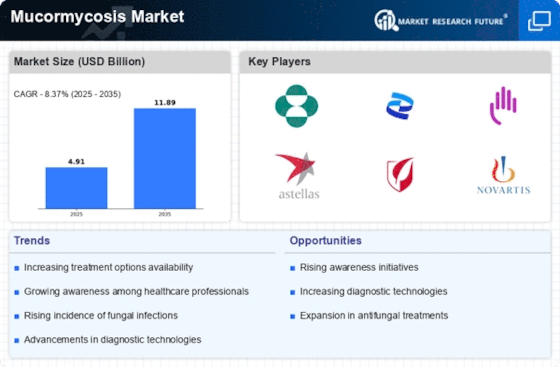
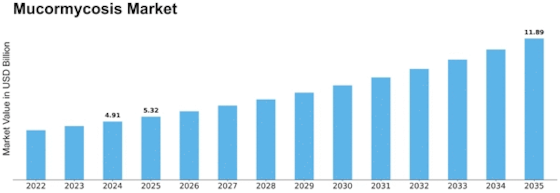
As per MRFR analysis, the Mucormycosis Market Size was estimated at 4.909 USD Billion in 2024. The Mucormycosis industry is projected to grow from 5.32 USD Billion in 2025 to 11.89 USD Billion by 2035, exhibiting a compound annual growth rate (CAGR) of 8.37 during the forecast period 2025 - 2035.

Key Market Trends & Highlights

The Mucormycosis Market is poised for growth driven by increasing awareness and advancements in treatment technologies.

  • The market is witnessing a rising incidence of immunocompromised patients, particularly in North America.
  • Advancements in diagnostic technologies are enhancing detection capabilities, with computed tomography (CT) remaining the largest segment.
  • Research and development efforts are intensifying, especially in the Asia-Pacific region, which is the fastest-growing market.
  • Key market drivers include increasing awareness of mucormycosis and the rising incidence of diabetes, which is fueling demand for effective treatment options.

Market Size & Forecast

2024 Market Size 4.909 (USD Billion)
2035 Market Size 11.89 (USD Billion)
CAGR (2025 - 2035) 8.37%
Largest Regional Market Share in 2024 Americas

Major Players

<p>Merck & Co. (US), Pfizer Inc. (US), Bristol-Myers Squibb (US), Astellas Pharma Inc. (JP), Gilead Sciences Inc. (US), Novartis AG (CH), Bayer AG (DE), Fujifilm Holdings Corporation (JP), Amgen Inc. (US)</p>

Market Trends

The Mucormycosis Market is currently experiencing notable shifts, driven by various factors that influence its dynamics. The increasing prevalence of immunocompromised patients, particularly those with underlying health conditions, appears to be a primary driver of market growth. Additionally, advancements in diagnostic techniques and treatment options may enhance the ability to identify and manage this fungal infection effectively. As healthcare systems evolve, the focus on improving patient outcomes and reducing mortality rates could lead to a more robust market environment. Furthermore, the rising awareness of mucormycosis among healthcare professionals and the general public suggests a potential increase in early diagnosis and treatment, which may further stimulate market expansion. Moreover, the Mucormycosis Market is likely to be influenced by ongoing research and development efforts aimed at discovering novel antifungal agents and therapies. The collaboration between pharmaceutical companies and research institutions may yield innovative solutions that address the challenges posed by this infection. As the global healthcare landscape continues to adapt, the Mucormycosis Market may witness a transformation characterized by enhanced treatment protocols and improved patient management strategies. This evolving scenario indicates a promising future for stakeholders involved in the market, as they navigate the complexities of this serious fungal disease.

Rising Incidence of Immunocompromised Patients

The Mucormycosis Market is likely to expand due to the increasing number of individuals with weakened immune systems. Conditions such as diabetes, cancer, and organ transplants contribute to a higher susceptibility to fungal infections. This trend may lead to a greater demand for effective treatment options and diagnostic tools.

Advancements in Diagnostic Technologies

Innovations in diagnostic methods are expected to play a crucial role in the Mucormycosis Market. Enhanced imaging techniques and molecular diagnostics may facilitate earlier detection of the infection, allowing for timely intervention. This could potentially improve patient outcomes and drive market growth.

Focus on Research and Development

The ongoing commitment to research and development in the field of antifungal therapies is anticipated to shape the Mucormycosis Market. Collaborative efforts between pharmaceutical companies and academic institutions may result in the introduction of new treatment modalities, addressing the challenges associated with this serious infection.

Mucormycosis Market Market Drivers

Emerging Research Initiatives

Emerging research initiatives focused on mucormycosis are poised to influence the Mucormycosis Market positively. Ongoing studies aimed at understanding the pathophysiology of mucormycosis and identifying novel therapeutic targets may lead to breakthroughs in treatment. Collaborative efforts among academic institutions, pharmaceutical companies, and healthcare organizations are likely to foster innovation in antifungal therapies. Additionally, research into the epidemiology and risk factors associated with mucormycosis could enhance prevention strategies and early detection methods. As these initiatives progress, they may not only improve clinical outcomes but also stimulate market growth by attracting funding and increasing interest in the Mucormycosis Market.

Growing Incidence of Diabetes

The growing incidence of diabetes is likely to be a significant driver for the Mucormycosis Market. Diabetes is a well-known risk factor for mucormycosis, as it compromises the immune system and creates an environment conducive to fungal infections. With the increasing prevalence of diabetes worldwide, the number of individuals at risk for mucormycosis is expected to rise correspondingly. This trend may lead to a higher demand for antifungal treatments and diagnostic services tailored to this vulnerable population. As healthcare providers focus on managing diabetes and its complications, the Mucormycosis Market could experience substantial growth driven by the need for effective interventions.

Rising Healthcare Expenditure

The increasing healthcare expenditure across various regions is anticipated to significantly impact the Mucormycosis Market. As governments and private sectors allocate more funds towards healthcare, there is a corresponding rise in the availability of advanced medical treatments and technologies. This trend is particularly relevant for mucormycosis, as enhanced funding can facilitate research and development of new antifungal therapies and diagnostic tools. Moreover, higher healthcare spending may lead to improved access to healthcare services, enabling timely diagnosis and treatment of mucormycosis. Consequently, this could result in a larger patient population seeking treatment, thereby driving growth in the Mucormycosis Market.

Increasing Awareness of Mucormycosis

The rising awareness regarding mucormycosis among healthcare professionals and the general public appears to be a pivotal driver in the Mucormycosis Market. Educational campaigns and initiatives by health organizations are likely to enhance understanding of the disease, its symptoms, and the importance of early diagnosis. This heightened awareness may lead to increased patient consultations and subsequent treatment, thereby expanding the market. Furthermore, the prevalence of mucormycosis in immunocompromised individuals, such as those with diabetes or undergoing chemotherapy, suggests a growing need for effective treatment options. As awareness continues to grow, the Mucormycosis Market could witness a surge in demand for antifungal therapies and diagnostic tools.

Technological Advancements in Treatment Options

Technological advancements in treatment options for mucormycosis are likely to play a crucial role in shaping the Mucormycosis Market. The development of novel antifungal agents and improved formulations may enhance treatment efficacy and patient outcomes. For instance, the introduction of liposomal amphotericin B has shown promise in treating mucormycosis, potentially leading to better survival rates. Additionally, the integration of personalized medicine approaches could optimize treatment regimens based on individual patient profiles. As these innovations emerge, they may not only improve therapeutic outcomes but also stimulate market growth by attracting investments and fostering competition among pharmaceutical companies in the Mucormycosis Market.

Market Segment Insights

Mucormycosis Market Species Insights

On the basis of the species, the mucormycosis market is segmented into Rhizopus, Rhizomucor, Cunninghamella, Apophysomyces, Saksenaea, Lichtheimia (formerly Absidia), and Mucor, and others.

Mucormycosis Market Diagnosis Insights

On the basis of the diagnosis, the market is segmented into Computed Tomography (CT), Magnetic resonance imaging (MRI), tissue biopsy, and others.

Mucormycosis Market Treatment Insights

On the basis of the treatment, the mucormycosis market is segmented into surgery, antifungal drugs, amphotericin B therapy, and others. The antifungal drugs is further categorized into posaconazole, isavuconazole, voriconazole, fluconazole, and flucytosine, and others.

Mucormycosis Market End User Insights

On the basis of the end-user, the mucormycosis market is segmented into hospitals & clinics, medical institutes, research organization, and others.

News

The mucormycosis market is divided into several categories according to the species, including Rhizopus, Rhizomucor, Cunninghamella, Apophysomyces, Saksenaea, Lichtheimia (formerly Absidia), and Mucor, among others. Depending on the diagnosis, the market is divided into computed tomography (CT), magnetic resonance imaging (MRI), tissue biopsy, and other categories. The mucormycosis market is divided into surgical procedures, anti-fungal medications, amphotericin B therapy, and other treatments. Posaconazole, isavuconazole, voriconazole, fluconazole, flucytosine, and other antifungal medications are further categorized. The mucormycosis market is divided into hospitals & clinics, healthcare institutes, research organizations, and others based on the end user.

Get more detailed insights about Mucormycosis Market Research Report- Forecast till 2035

Regional Insights

North America : Healthcare Innovation Leader

North America is poised to dominate the Mucormycosis Market, driven by advanced healthcare infrastructure, increasing prevalence of immunocompromised patients, and significant investments in research and development. The region holds approximately 45% of the global market share, with the United States being the largest contributor, followed by Canada, which accounts for around 15%. Regulatory support and initiatives to improve treatment accessibility further bolster market growth. The competitive landscape in North America is characterized by the presence of major pharmaceutical companies such as Merck & Co., Pfizer Inc., and Gilead Sciences. These key players are actively involved in developing innovative therapies and treatments for Mucormycosis Market. The region's focus on clinical trials and collaborations with healthcare institutions enhances the availability of effective treatment options, ensuring a robust market environment.

Europe : Emerging Treatment Hub

Europe is witnessing significant growth in the Mucormycosis Market, driven by increasing awareness of fungal infections and supportive regulatory frameworks. The region holds approximately 30% of the global market share, with Germany and the United Kingdom being the largest markets, accounting for 10% and 8% respectively. The European Medicines Agency (EMA) has been instrumental in facilitating the approval of new treatments, which is expected to further enhance market dynamics. Leading countries in Europe are focusing on improving healthcare access and treatment options for Mucormycosis Market. The competitive landscape includes key players like Bayer AG and Novartis AG, who are investing in research and development to introduce innovative therapies. Collaborative efforts among healthcare providers and pharmaceutical companies are also enhancing treatment protocols, ensuring better patient outcomes in the region.

Asia-Pacific : Rapidly Growing Market

The Asia-Pacific region is emerging as a significant player in the Mucormycosis Market, fueled by rising healthcare expenditures and increasing awareness of fungal infections. The region holds approximately 20% of the global market share, with India and Japan being the largest markets, contributing around 8% and 5% respectively. The growing population of immunocompromised individuals and the rise in diabetes cases are key factors driving demand for effective treatments in this region. In Asia-Pacific, the competitive landscape is evolving, with local and international players striving to capture market share. Companies like Astellas Pharma and Fujifilm Holdings are actively involved in developing innovative solutions for Mucormycosis Market. The region's focus on enhancing healthcare infrastructure and improving access to treatments is expected to further propel market growth, making it a vital area for future investments.

Middle East and Africa : Untapped Market Potential

The Middle East and Africa region presents untapped potential in the Mucormycosis Market, driven by increasing healthcare investments and rising awareness of fungal infections. The region holds approximately 5% of the global market share, with South Africa and the UAE being the largest contributors, accounting for around 2% each. The growing prevalence of diabetes and other immunocompromising conditions is expected to drive demand for effective treatments in this region. In this region, the competitive landscape is still developing, with a focus on improving healthcare access and treatment options. Local players are beginning to emerge, while international companies are exploring partnerships to enhance their market presence. The presence of key players is gradually increasing, and efforts to improve healthcare infrastructure are expected to create new opportunities for growth in the Mucormycosis Market.

Key Companies in the Mucormycosis Market market include

Industry Developments

Future Outlook

Mucormycosis Market Future Outlook

<p>The Mucormycosis Market is projected to grow at an 8.37% CAGR from 2024 to 2035, driven by increasing awareness, advancements in treatment options, and rising incidence rates.</p>

New opportunities lie in:

  • <p>Development of targeted antifungal therapies for high-risk populations.</p>
  • <p>Expansion of telemedicine platforms for remote patient monitoring.</p>
  • <p>Investment in advanced diagnostic technologies for early detection.</p>

<p>By 2035, the Mucormycosis Market is expected to achieve substantial growth and innovation.</p>

Market Segmentation

Mucormycosis Market Species Outlook

  • Rhizopus
  • Rhizomucor
  • Cunninghamella
  • Apophysomyces
  • Saksenaea
  • Lichtheimia (formerly Absidia)
  • Mucor
  • Others

Mucormycosis Market End User Outlook

  • Hospitals & Clinics
  • Medical Institutes
  • Research Organizations
  • Others

Mucormycosis Market Diagnosis Outlook

  • Computed Tomography (CT)
  • Magnetic Resonance Imaging (MRI)
  • Tissue Biopsy
  • Others

Mucormycosis Market Treatment Outlook

  • Surgery
  • Antifungal Drugs
  • Amphotericin B Therapy
  • Others

Report Scope

MARKET SIZE 20244.909(USD Billion)
MARKET SIZE 20255.32(USD Billion)
MARKET SIZE 203511.89(USD Billion)
COMPOUND ANNUAL GROWTH RATE (CAGR)8.37% (2024 - 2035)
REPORT COVERAGERevenue Forecast, Competitive Landscape, Growth Factors, and Trends
BASE YEAR2024
Market Forecast Period2025 - 2035
Historical Data2019 - 2024
Market Forecast UnitsUSD Billion
Key Companies ProfiledMarket analysis in progress
Segments CoveredMarket segmentation analysis in progress
Key Market OpportunitiesAdvancements in antifungal therapies and diagnostics enhance treatment options in the Mucormycosis Market.
Key Market DynamicsRising incidence of mucormycosis drives demand for innovative treatment options and enhances competitive dynamics among pharmaceutical companies.
Countries CoveredNorth America, Europe, APAC, South America, MEA

FAQs

  1. SECTION I: EXECUTIVE SUMMARY AND KEY HIGHLIGHTS
    1. EXECUTIVE SUMMARY
      1. Market Overview
      2. Key Findings
      3. Market Segmentation
      4. Competitive Landscape
      5. Challenges and Opportunities
      6. Future Outlook
  2. SECTION II: SCOPING, METHODOLOGY AND MARKET STRUCTURE
    1. MARKET INTRODUCTION
      1. Definition
      2. Scope of the study
    2. RESEARCH METHODOLOGY
      1. Overview
      2. Data Mining
      3. Secondary Research
      4. Primary Research
      5. Forecasting Model
      6. Market Size Estimation
      7. Data Triangulation
      8. Validation
  3. SECTION III: QUALITATIVE ANALYSIS
    1. MARKET DYNAMICS
      1. Overview
      2. Drivers
      3. Restraints
      4. Opportunities
    2. MARKET FACTOR ANALYSIS
      1. Value chain Analysis
      2. Porter's Five Forces Analysis
      3. COVID-19 Impact Analysis
  4. SECTION IV: QUANTITATIVE ANALYSIS
    1. Healthcare, BY Species (USD Billion)
      1. Rhizopus
      2. Rhizomucor
      3. Cunninghamella
      4. Apophysomyces
      5. Saksenaea
      6. Lichtheimia (formerly Absidia)
      7. Mucor
      8. Others
    2. Healthcare, BY Diagnosis (USD Billion)
      1. Computed Tomography (CT)
      2. Magnetic Resonance Imaging (MRI)
      3. Tissue Biopsy
      4. Others
    3. Healthcare, BY Treatment (USD Billion)
      1. Surgery
      2. Antifungal Drugs
      3. Amphotericin B Therapy
      4. Others
    4. Healthcare, BY End User (USD Billion)
      1. Hospitals & Clinics
      2. Medical Institutes
      3. Research Organizations
      4. Others
    5. Healthcare, BY Region (USD Billion)
      1. North America
      2. Europe
      3. APAC
      4. South America
      5. MEA
  5. SECTION V: COMPETITIVE ANALYSIS
    1. Competitive Landscape
      1. Overview
      2. Competitive Analysis
      3. Market share Analysis
      4. Major Growth Strategy in the Healthcare
      5. Competitive Benchmarking
      6. Leading Players in Terms of Number of Developments in the Healthcare
      7. Key developments and growth strategies
      8. Major Players Financial Matrix
    2. Company Profiles
      1. Merck & Co. (US)
      2. Pfizer Inc. (US)
      3. Bristol-Myers Squibb (US)
      4. Astellas Pharma Inc. (JP)
      5. Gilead Sciences Inc. (US)
      6. Novartis AG (CH)
      7. Bayer AG (DE)
      8. Fujifilm Holdings Corporation (JP)
      9. Amgen Inc. (US)
    3. Appendix
      1. References
      2. Related Reports
  6. LIST OF FIGURES
    1. MARKET SYNOPSIS
    2. NORTH AMERICA MARKET ANALYSIS
    3. US MARKET ANALYSIS BY SPECIES
    4. US MARKET ANALYSIS BY DIAGNOSIS
    5. US MARKET ANALYSIS BY TREATMENT
    6. US MARKET ANALYSIS BY END USER
    7. CANADA MARKET ANALYSIS BY SPECIES
    8. CANADA MARKET ANALYSIS BY DIAGNOSIS
    9. CANADA MARKET ANALYSIS BY TREATMENT
    10. CANADA MARKET ANALYSIS BY END USER
    11. EUROPE MARKET ANALYSIS
    12. GERMANY MARKET ANALYSIS BY SPECIES
    13. GERMANY MARKET ANALYSIS BY DIAGNOSIS
    14. GERMANY MARKET ANALYSIS BY TREATMENT
    15. GERMANY MARKET ANALYSIS BY END USER
    16. UK MARKET ANALYSIS BY SPECIES
    17. UK MARKET ANALYSIS BY DIAGNOSIS
    18. UK MARKET ANALYSIS BY TREATMENT
    19. UK MARKET ANALYSIS BY END USER
    20. FRANCE MARKET ANALYSIS BY SPECIES
    21. FRANCE MARKET ANALYSIS BY DIAGNOSIS
    22. FRANCE MARKET ANALYSIS BY TREATMENT
    23. FRANCE MARKET ANALYSIS BY END USER
    24. RUSSIA MARKET ANALYSIS BY SPECIES
    25. RUSSIA MARKET ANALYSIS BY DIAGNOSIS
    26. RUSSIA MARKET ANALYSIS BY TREATMENT
    27. RUSSIA MARKET ANALYSIS BY END USER
    28. ITALY MARKET ANALYSIS BY SPECIES
    29. ITALY MARKET ANALYSIS BY DIAGNOSIS
    30. ITALY MARKET ANALYSIS BY TREATMENT
    31. ITALY MARKET ANALYSIS BY END USER
    32. SPAIN MARKET ANALYSIS BY SPECIES
    33. SPAIN MARKET ANALYSIS BY DIAGNOSIS
    34. SPAIN MARKET ANALYSIS BY TREATMENT
    35. SPAIN MARKET ANALYSIS BY END USER
    36. REST OF EUROPE MARKET ANALYSIS BY SPECIES
    37. REST OF EUROPE MARKET ANALYSIS BY DIAGNOSIS
    38. REST OF EUROPE MARKET ANALYSIS BY TREATMENT
    39. REST OF EUROPE MARKET ANALYSIS BY END USER
    40. APAC MARKET ANALYSIS
    41. CHINA MARKET ANALYSIS BY SPECIES
    42. CHINA MARKET ANALYSIS BY DIAGNOSIS
    43. CHINA MARKET ANALYSIS BY TREATMENT
    44. CHINA MARKET ANALYSIS BY END USER
    45. INDIA MARKET ANALYSIS BY SPECIES
    46. INDIA MARKET ANALYSIS BY DIAGNOSIS
    47. INDIA MARKET ANALYSIS BY TREATMENT
    48. INDIA MARKET ANALYSIS BY END USER
    49. JAPAN MARKET ANALYSIS BY SPECIES
    50. JAPAN MARKET ANALYSIS BY DIAGNOSIS
    51. JAPAN MARKET ANALYSIS BY TREATMENT
    52. JAPAN MARKET ANALYSIS BY END USER
    53. SOUTH KOREA MARKET ANALYSIS BY SPECIES
    54. SOUTH KOREA MARKET ANALYSIS BY DIAGNOSIS
    55. SOUTH KOREA MARKET ANALYSIS BY TREATMENT
    56. SOUTH KOREA MARKET ANALYSIS BY END USER
    57. MALAYSIA MARKET ANALYSIS BY SPECIES
    58. MALAYSIA MARKET ANALYSIS BY DIAGNOSIS
    59. MALAYSIA MARKET ANALYSIS BY TREATMENT
    60. MALAYSIA MARKET ANALYSIS BY END USER
    61. THAILAND MARKET ANALYSIS BY SPECIES
    62. THAILAND MARKET ANALYSIS BY DIAGNOSIS
    63. THAILAND MARKET ANALYSIS BY TREATMENT
    64. THAILAND MARKET ANALYSIS BY END USER
    65. INDONESIA MARKET ANALYSIS BY SPECIES
    66. INDONESIA MARKET ANALYSIS BY DIAGNOSIS
    67. INDONESIA MARKET ANALYSIS BY TREATMENT
    68. INDONESIA MARKET ANALYSIS BY END USER
    69. REST OF APAC MARKET ANALYSIS BY SPECIES
    70. REST OF APAC MARKET ANALYSIS BY DIAGNOSIS
    71. REST OF APAC MARKET ANALYSIS BY TREATMENT
    72. REST OF APAC MARKET ANALYSIS BY END USER
    73. SOUTH AMERICA MARKET ANALYSIS
    74. BRAZIL MARKET ANALYSIS BY SPECIES
    75. BRAZIL MARKET ANALYSIS BY DIAGNOSIS
    76. BRAZIL MARKET ANALYSIS BY TREATMENT
    77. BRAZIL MARKET ANALYSIS BY END USER
    78. MEXICO MARKET ANALYSIS BY SPECIES
    79. MEXICO MARKET ANALYSIS BY DIAGNOSIS
    80. MEXICO MARKET ANALYSIS BY TREATMENT
    81. MEXICO MARKET ANALYSIS BY END USER
    82. ARGENTINA MARKET ANALYSIS BY SPECIES
    83. ARGENTINA MARKET ANALYSIS BY DIAGNOSIS
    84. ARGENTINA MARKET ANALYSIS BY TREATMENT
    85. ARGENTINA MARKET ANALYSIS BY END USER
    86. REST OF SOUTH AMERICA MARKET ANALYSIS BY SPECIES
    87. REST OF SOUTH AMERICA MARKET ANALYSIS BY DIAGNOSIS
    88. REST OF SOUTH AMERICA MARKET ANALYSIS BY TREATMENT
    89. REST OF SOUTH AMERICA MARKET ANALYSIS BY END USER
    90. MEA MARKET ANALYSIS
    91. GCC COUNTRIES MARKET ANALYSIS BY SPECIES
    92. GCC COUNTRIES MARKET ANALYSIS BY DIAGNOSIS
    93. GCC COUNTRIES MARKET ANALYSIS BY TREATMENT
    94. GCC COUNTRIES MARKET ANALYSIS BY END USER
    95. SOUTH AFRICA MARKET ANALYSIS BY SPECIES
    96. SOUTH AFRICA MARKET ANALYSIS BY DIAGNOSIS
    97. SOUTH AFRICA MARKET ANALYSIS BY TREATMENT
    98. SOUTH AFRICA MARKET ANALYSIS BY END USER
    99. REST OF MEA MARKET ANALYSIS BY SPECIES
    100. REST OF MEA MARKET ANALYSIS BY DIAGNOSIS
    101. REST OF MEA MARKET ANALYSIS BY TREATMENT
    102. REST OF MEA MARKET ANALYSIS BY END USER
    103. KEY BUYING CRITERIA OF HEALTHCARE
    104. RESEARCH PROCESS OF MRFR
    105. DRO ANALYSIS OF HEALTHCARE
    106. DRIVERS IMPACT ANALYSIS: HEALTHCARE
    107. RESTRAINTS IMPACT ANALYSIS: HEALTHCARE
    108. SUPPLY / VALUE CHAIN: HEALTHCARE
    109. HEALTHCARE, BY SPECIES, 2024 (% SHARE)
    110. HEALTHCARE, BY SPECIES, 2024 TO 2035 (USD Billion)
    111. HEALTHCARE, BY DIAGNOSIS, 2024 (% SHARE)
    112. HEALTHCARE, BY DIAGNOSIS, 2024 TO 2035 (USD Billion)
    113. HEALTHCARE, BY TREATMENT, 2024 (% SHARE)
    114. HEALTHCARE, BY TREATMENT, 2024 TO 2035 (USD Billion)
    115. HEALTHCARE, BY END USER, 2024 (% SHARE)
    116. HEALTHCARE, BY END USER, 2024 TO 2035 (USD Billion)
    117. BENCHMARKING OF MAJOR COMPETITORS
  7. LIST OF TABLES
    1. LIST OF ASSUMPTIONS
    2. North America MARKET SIZE ESTIMATES; FORECAST
      1. BY SPECIES, 2025-2035 (USD Billion)
      2. BY DIAGNOSIS, 2025-2035 (USD Billion)
      3. BY TREATMENT, 2025-2035 (USD Billion)
      4. BY END USER, 2025-2035 (USD Billion)
    3. US MARKET SIZE ESTIMATES; FORECAST
      1. BY SPECIES, 2025-2035 (USD Billion)
      2. BY DIAGNOSIS, 2025-2035 (USD Billion)
      3. BY TREATMENT, 2025-2035 (USD Billion)
      4. BY END USER, 2025-2035 (USD Billion)
    4. Canada MARKET SIZE ESTIMATES; FORECAST
      1. BY SPECIES, 2025-2035 (USD Billion)
      2. BY DIAGNOSIS, 2025-2035 (USD Billion)
      3. BY TREATMENT, 2025-2035 (USD Billion)
      4. BY END USER, 2025-2035 (USD Billion)
    5. Europe MARKET SIZE ESTIMATES; FORECAST
      1. BY SPECIES, 2025-2035 (USD Billion)
      2. BY DIAGNOSIS, 2025-2035 (USD Billion)
      3. BY TREATMENT, 2025-2035 (USD Billion)
      4. BY END USER, 2025-2035 (USD Billion)
    6. Germany MARKET SIZE ESTIMATES; FORECAST
      1. BY SPECIES, 2025-2035 (USD Billion)
      2. BY DIAGNOSIS, 2025-2035 (USD Billion)
      3. BY TREATMENT, 2025-2035 (USD Billion)
      4. BY END USER, 2025-2035 (USD Billion)
    7. UK MARKET SIZE ESTIMATES; FORECAST
      1. BY SPECIES, 2025-2035 (USD Billion)
      2. BY DIAGNOSIS, 2025-2035 (USD Billion)
      3. BY TREATMENT, 2025-2035 (USD Billion)
      4. BY END USER, 2025-2035 (USD Billion)
    8. France MARKET SIZE ESTIMATES; FORECAST
      1. BY SPECIES, 2025-2035 (USD Billion)
      2. BY DIAGNOSIS, 2025-2035 (USD Billion)
      3. BY TREATMENT, 2025-2035 (USD Billion)
      4. BY END USER, 2025-2035 (USD Billion)
    9. Russia MARKET SIZE ESTIMATES; FORECAST
      1. BY SPECIES, 2025-2035 (USD Billion)
      2. BY DIAGNOSIS, 2025-2035 (USD Billion)
      3. BY TREATMENT, 2025-2035 (USD Billion)
      4. BY END USER, 2025-2035 (USD Billion)
    10. Italy MARKET SIZE ESTIMATES; FORECAST
      1. BY SPECIES, 2025-2035 (USD Billion)
      2. BY DIAGNOSIS, 2025-2035 (USD Billion)
      3. BY TREATMENT, 2025-2035 (USD Billion)
      4. BY END USER, 2025-2035 (USD Billion)
    11. Spain MARKET SIZE ESTIMATES; FORECAST
      1. BY SPECIES, 2025-2035 (USD Billion)
      2. BY DIAGNOSIS, 2025-2035 (USD Billion)
      3. BY TREATMENT, 2025-2035 (USD Billion)
      4. BY END USER, 2025-2035 (USD Billion)
    12. Rest of Europe MARKET SIZE ESTIMATES; FORECAST
      1. BY SPECIES, 2025-2035 (USD Billion)
      2. BY DIAGNOSIS, 2025-2035 (USD Billion)
      3. BY TREATMENT, 2025-2035 (USD Billion)
      4. BY END USER, 2025-2035 (USD Billion)
    13. APAC MARKET SIZE ESTIMATES; FORECAST
      1. BY SPECIES, 2025-2035 (USD Billion)
      2. BY DIAGNOSIS, 2025-2035 (USD Billion)
      3. BY TREATMENT, 2025-2035 (USD Billion)
      4. BY END USER, 2025-2035 (USD Billion)
    14. China MARKET SIZE ESTIMATES; FORECAST
      1. BY SPECIES, 2025-2035 (USD Billion)
      2. BY DIAGNOSIS, 2025-2035 (USD Billion)
      3. BY TREATMENT, 2025-2035 (USD Billion)
      4. BY END USER, 2025-2035 (USD Billion)
    15. India MARKET SIZE ESTIMATES; FORECAST
      1. BY SPECIES, 2025-2035 (USD Billion)
      2. BY DIAGNOSIS, 2025-2035 (USD Billion)
      3. BY TREATMENT, 2025-2035 (USD Billion)
      4. BY END USER, 2025-2035 (USD Billion)
    16. Japan MARKET SIZE ESTIMATES; FORECAST
      1. BY SPECIES, 2025-2035 (USD Billion)
      2. BY DIAGNOSIS, 2025-2035 (USD Billion)
      3. BY TREATMENT, 2025-2035 (USD Billion)
      4. BY END USER, 2025-2035 (USD Billion)
    17. South Korea MARKET SIZE ESTIMATES; FORECAST
      1. BY SPECIES, 2025-2035 (USD Billion)
      2. BY DIAGNOSIS, 2025-2035 (USD Billion)
      3. BY TREATMENT, 2025-2035 (USD Billion)
      4. BY END USER, 2025-2035 (USD Billion)
    18. Malaysia MARKET SIZE ESTIMATES; FORECAST
      1. BY SPECIES, 2025-2035 (USD Billion)
      2. BY DIAGNOSIS, 2025-2035 (USD Billion)
      3. BY TREATMENT, 2025-2035 (USD Billion)
      4. BY END USER, 2025-2035 (USD Billion)
    19. Thailand MARKET SIZE ESTIMATES; FORECAST
      1. BY SPECIES, 2025-2035 (USD Billion)
      2. BY DIAGNOSIS, 2025-2035 (USD Billion)
      3. BY TREATMENT, 2025-2035 (USD Billion)
      4. BY END USER, 2025-2035 (USD Billion)
    20. Indonesia MARKET SIZE ESTIMATES; FORECAST
      1. BY SPECIES, 2025-2035 (USD Billion)
      2. BY DIAGNOSIS, 2025-2035 (USD Billion)
      3. BY TREATMENT, 2025-2035 (USD Billion)
      4. BY END USER, 2025-2035 (USD Billion)
    21. Rest of APAC MARKET SIZE ESTIMATES; FORECAST
      1. BY SPECIES, 2025-2035 (USD Billion)
      2. BY DIAGNOSIS, 2025-2035 (USD Billion)
      3. BY TREATMENT, 2025-2035 (USD Billion)
      4. BY END USER, 2025-2035 (USD Billion)
    22. South America MARKET SIZE ESTIMATES; FORECAST
      1. BY SPECIES, 2025-2035 (USD Billion)
      2. BY DIAGNOSIS, 2025-2035 (USD Billion)
      3. BY TREATMENT, 2025-2035 (USD Billion)
      4. BY END USER, 2025-2035 (USD Billion)
    23. Brazil MARKET SIZE ESTIMATES; FORECAST
      1. BY SPECIES, 2025-2035 (USD Billion)
      2. BY DIAGNOSIS, 2025-2035 (USD Billion)
      3. BY TREATMENT, 2025-2035 (USD Billion)
      4. BY END USER, 2025-2035 (USD Billion)
    24. Mexico MARKET SIZE ESTIMATES; FORECAST
      1. BY SPECIES, 2025-2035 (USD Billion)
      2. BY DIAGNOSIS, 2025-2035 (USD Billion)
      3. BY TREATMENT, 2025-2035 (USD Billion)
      4. BY END USER, 2025-2035 (USD Billion)
    25. Argentina MARKET SIZE ESTIMATES; FORECAST
      1. BY SPECIES, 2025-2035 (USD Billion)
      2. BY DIAGNOSIS, 2025-2035 (USD Billion)
      3. BY TREATMENT, 2025-2035 (USD Billion)
      4. BY END USER, 2025-2035 (USD Billion)
    26. Rest of South America MARKET SIZE ESTIMATES; FORECAST
      1. BY SPECIES, 2025-2035 (USD Billion)
      2. BY DIAGNOSIS, 2025-2035 (USD Billion)
      3. BY TREATMENT, 2025-2035 (USD Billion)
      4. BY END USER, 2025-2035 (USD Billion)
    27. MEA MARKET SIZE ESTIMATES; FORECAST
      1. BY SPECIES, 2025-2035 (USD Billion)
      2. BY DIAGNOSIS, 2025-2035 (USD Billion)
      3. BY TREATMENT, 2025-2035 (USD Billion)
      4. BY END USER, 2025-2035 (USD Billion)
    28. GCC Countries MARKET SIZE ESTIMATES; FORECAST
      1. BY SPECIES, 2025-2035 (USD Billion)
      2. BY DIAGNOSIS, 2025-2035 (USD Billion)
      3. BY TREATMENT, 2025-2035 (USD Billion)
      4. BY END USER, 2025-2035 (USD Billion)
    29. South Africa MARKET SIZE ESTIMATES; FORECAST
      1. BY SPECIES, 2025-2035 (USD Billion)
      2. BY DIAGNOSIS, 2025-2035 (USD Billion)
      3. BY TREATMENT, 2025-2035 (USD Billion)
      4. BY END USER, 2025-2035 (USD Billion)
    30. Rest of MEA MARKET SIZE ESTIMATES; FORECAST
      1. BY SPECIES, 2025-2035 (USD Billion)
      2. BY DIAGNOSIS, 2025-2035 (USD Billion)
      3. BY TREATMENT, 2025-2035 (USD Billion)
      4. BY END USER, 2025-2035 (USD Billion)
    31. PRODUCT LAUNCH/PRODUCT DEVELOPMENT/APPROVAL
    32. ACQUISITION/PARTNERSHIP

Mucormycosis Market Segmentation

Market Segmentation Overview

  • Detailed segmentation data will be available in the full report
  • Comprehensive analysis by multiple parameters
  • Regional and country-level breakdowns
  • Market size forecasts by segment
Infographic

Free Sample Request

Kindly complete the form below to receive a free sample of this Report

Get Free Sample

Customer Strories

Compare Licence

×
Features License Type
Single User Multiuser License Enterprise User
Price $4,950 $5,950 $7,250
Maximum User Access Limit 1 User Upto 10 Users Unrestricted Access Throughout the Organization
Free Customization
Direct Access to Analyst
Deliverable Format
Platform Access
Discount on Next Purchase 10% 15% 15%
Printable Versions