Request Free Sample ×

Kindly complete the form below to receive a free sample of this Report

* Please use a valid business email

Leading companies partner with us for data-driven Insights

clients tt-cursor
Hero Background
English
Chinese
French
Japanese
Korean
German
Spanish

MRAM Market Share

ID: MRFR/SEM/9176-CR
99 Pages
Ankit Gupta
August 2021

Magneto Resistive RAM (MRAM) Market Size, Share and Research Report By Product (STT and Toggle), By Application (Aerospace & Defense, Automotive, Robotics, Consumer Electronics, and Enterprise Storage), and By Region (North America, Europe, Asia-Pacific, And Rest Of The World) –Industry Forecast Till 2035

Share:
Download PDF ×

We do not share your information with anyone. However, we may send you emails based on your report interest from time to time. You may contact us at any time to opt-out.

MRAM Market Infographic
Purchase Options

Market Share

MRAM Market Share Analysis

Magneto-resistive RAM (MRAM) has emerged as a promising non-volatile memory technology, offering fast read and write speeds, low power consumption, and high endurance. In the competitive landscape of the MRAM market, companies employ various market share positioning strategies to gain a competitive edge. One common approach is differentiation, where companies focus on unique features or capabilities that set their MRAM products apart from competitors. This might include improvements in performance, durability, or integration with other technologies. By emphasizing these distinctive qualities, companies aim to attract customers who prioritize specific attributes in their applications.

Another prevalent strategy involves cost leadership, where companies strive to produce MRAM at a lower cost than their competitors. This could result from efficient manufacturing processes, economies of scale, or strategic partnerships with suppliers. Cost leadership allows companies to offer competitive prices, attracting budget-conscious customers and potentially capturing a larger share of the market. In the rapidly evolving landscape of semiconductor technologies, achieving cost leadership can be challenging, but it remains a key strategy for market positioning.

Market segmentation is another noteworthy strategy employed by MRAM manufacturers. By identifying and targeting specific market segments with tailored products, companies can better address the unique needs of different customer groups. For instance, some MRAM products may be optimized for use in automotive applications, while others may be designed for the industrial Internet of Things (IoT) sector. This segmentation strategy enables companies to concentrate their efforts on specific niches, building expertise and a strong presence in those areas.

Strategic alliances and partnerships also play a vital role in market share positioning within the MRAM sector. Collaborating with other companies or forming alliances with key industry players can provide access to complementary technologies, distribution channels, and a broader customer base. Such partnerships can enhance a company's overall competitiveness and contribute to its market share growth. For example, a partnership with a leading semiconductor manufacturer could facilitate the integration of MRAM into a wider range of electronic devices.

In addition to these strategies, innovation and continuous research and development efforts are crucial for sustaining a competitive position in the MRAM market. Companies that invest in advancing MRAM technology, exploring new applications, and staying ahead of industry trends are better positioned to capture market share. This could involve developing MRAM solutions for emerging technologies like artificial intelligence, edge computing, or 5G networks.


Furthermore, effective marketing and communication strategies are essential for creating awareness and building a positive brand image. Clear communication about the benefits and advantages of MRAM over competing technologies can influence customer perceptions and preferences. Companies that effectively convey the value proposition of their MRAM products are more likely to attract customers and secure a favorable market position.

Author
Author Profile
Ankit Gupta
Team Lead - Research

Ankit Gupta is a seasoned market intelligence and strategic research professional with over six plus years of experience in the ICT and Semiconductor industries. With academic roots in Telecom, Marketing, and Electronics, he blends technical insight with business strategy. Ankit has led 200+ projects, including work for Fortune 500 clients like Microsoft and Rio Tinto, covering market sizing, tech forecasting, and go-to-market strategies. Known for bridging engineering and enterprise decision-making, his insights support growth, innovation, and investment planning across diverse technology markets.

Leave a Comment

FAQs

What is the projected market valuation of the Magneto Resistive RAM (MRAM) market by 2035?

<p>The projected market valuation of the MRAM market by 2035 is 2.863 USD Billion.</p>

What was the market valuation of the MRAM market in 2024?

<p>The market valuation of the MRAM market in 2024 was 0.55 USD Billion.</p>

What is the expected CAGR for the MRAM market during the forecast period 2025 - 2035?

<p>The expected CAGR for the MRAM market during the forecast period 2025 - 2035 is 16.18%.</p>

Which companies are considered key players in the MRAM market?

<p>Key players in the MRAM market include Everspin Technologies, Intel Corporation, Samsung Electronics, and others.</p>

What are the projected revenue figures for the Toggle and STT product segments by 2035?

<p>The projected revenue figures for the Toggle and STT product segments by 2035 are 1.363 USD Billion and 1.5 USD Billion, respectively.</p>

How does the MRAM market perform in the consumer electronics application segment?

<p>The MRAM market in the consumer electronics application segment is projected to reach 1.2 USD Billion by 2035.</p>

What is the expected growth in the aerospace and defense application segment of the MRAM market?

The aerospace and defense application segment of the MRAM market is expected to grow to 0.5 USD Billion by 2035.

What is the anticipated market size for the automotive application segment by 2035?

The anticipated market size for the automotive application segment by 2035 is 0.4 USD Billion.

How does the robotics application segment contribute to the MRAM market?

The robotics application segment is projected to contribute 0.25 USD Billion to the MRAM market by 2035.

What is the expected market size for enterprise storage in the MRAM market by 2035?

The expected market size for enterprise storage in the MRAM market by 2035 is 0.5 USD Billion.

Market Summary

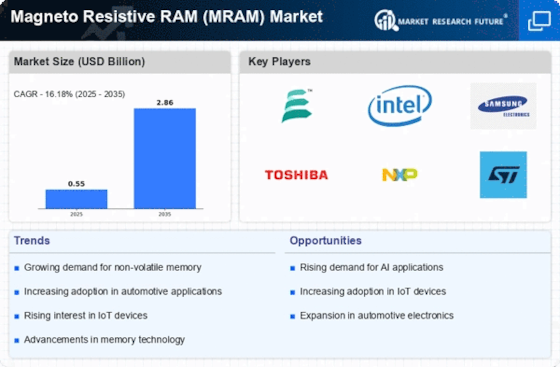
As per Market Research Future analysis, the Magneto Resistive RAM (MRAM Market) Market Size was estimated at 0.55 USD Billion in 2024. The MRAM industry is projected to grow from USD 0.639 Billion in 2025 to USD 2.863 Billion by 2035, exhibiting a compound annual growth rate (CAGR) of 16.18% during the forecast period 2025 - 2035

Key Market Trends & Highlights

The Magneto Resistive RAM (MRAM Market) market is poised for substantial growth driven by technological advancements and increasing application demands.

  • The demand for high-performance memory solutions is escalating, particularly in North America, which remains the largest market for MRAM Market. Integration with the Internet of Things (IoT) is fostering innovative applications, especially in the rapidly growing Asia-Pacific region. Energy efficiency and sustainability are becoming focal points, influencing the design and production of MRAM Market technologies. The rising need for non-volatile memory solutions and advancements in MRAM Market technology are key drivers, particularly in the automotive sector.

Market Size & Forecast

2024 Market Size 0.55 (USD Billion)
2035 Market Size 2.863 (USD Billion)
CAGR (2025 - 2035) 16.18%
Largest Regional Market Share in 2024 North America

Major Players

Everspin Technologies (US), Intel Corporation (US), Samsung Electronics (KR), Toshiba Corporation (JP), NXP Semiconductors (NL), STMicroelectronics (FR), Micron Technology (US), Western Digital Corporation (US), GlobalFoundries (US)

Market Trends

The Magneto Resistive RAM (MRAM Market) Market is currently experiencing a notable evolution, driven by advancements in memory technology and increasing demand for high-performance computing solutions. This market segment appears to be gaining traction due to its unique characteristics, such as non-volatility, high speed, and low power consumption. As industries continue to seek efficient alternatives to traditional memory types, MRAM Market is positioned to play a pivotal role in various applications, including consumer electronics, automotive systems, and data centers. Everspin Technologies is a leading provider of magneto resistive random-access memory (MRAM) solutions and has positioned itself as an innovator in non-volatile memory technologies.  The growing emphasis on energy efficiency and sustainability further enhances the appeal of MRAM Market, as it offers a promising solution for modern computing challenges. In addition, the Magneto Resistive RAM (MRAM Market) Market seems to be influenced by the rising trend of Internet of Things (IoT) devices, which require reliable and fast memory solutions.

The integration of MRAM Market in IoT applications could potentially lead to enhanced performance and longer battery life, making it an attractive option for manufacturers. Furthermore, ongoing research and development efforts are likely to yield innovative MRAM Market technologies, which may expand its applicability across diverse sectors. Overall, the future of the Magneto Resistive RAM (MRAM Market) Market appears bright, with numerous opportunities for growth and advancement on the horizon. Analysis of Everspin stock indicates its performance is closely tied to demand for advanced memory solutions, broader semiconductor market trends, and adoption of embedded MRAM in industrial, automotive, and enterprise applications.

Growing Demand for High-Performance Memory Solutions

The Magneto Resistive RAM (MRAM Market) Market is witnessing an increasing need for high-performance memory solutions. As applications in computing and data processing become more demanding, MRAM Market's unique attributes, such as speed and efficiency, are becoming more appealing to manufacturers and developers.

Integration with Internet of Things (IoT)

The rise of Internet of Things (IoT) devices is significantly impacting the Magneto Resistive RAM (MRAM Market) Market. MRAM Market's non-volatility and low power consumption make it a suitable choice for IoT applications, where reliable and efficient memory is essential for optimal performance.

Focus on Energy Efficiency and Sustainability

There is a growing emphasis on energy efficiency and sustainability within the Magneto Resistive RAM (MRAM Market) Market. As industries strive to reduce their carbon footprint, MRAM Market's low power requirements and potential for energy savings position it as a favorable alternative to traditional memory technologies.

MRAM Market Market Drivers

Advancements in MRAM Technology

Technological advancements in the Magneto Resistive RAM (MRAM Market) Market are playing a pivotal role in shaping its future. Innovations such as spin-transfer torque (STT) MRAM Market and other emerging technologies are enhancing the performance characteristics of MRAM Market, including speed, endurance, and scalability. These advancements are likely to attract a broader range of applications, from mobile devices to high-performance computing systems. The introduction of new materials and fabrication techniques is also contributing to the reduction of production costs, making MRAM Market more accessible to manufacturers. As a result, the market is expected to witness a significant increase in adoption rates, with projections indicating a potential market size exceeding USD 5 billion by 2030. This growth trajectory underscores the importance of continuous innovation in maintaining competitive advantage within the MRAM Market sector.

Focus on Data Security and Integrity

The Magneto Resistive RAM (MRAM Market) Market is increasingly focused on data security and integrity, which are paramount in today's digital landscape. As cyber threats become more sophisticated, the demand for memory solutions that offer enhanced security features is rising. MRAM Market's inherent non-volatility and resistance to data corruption make it a favorable choice for applications requiring high levels of data integrity, such as financial services and healthcare. The market is likely to see a shift towards MRAM Market as organizations prioritize secure memory solutions to protect sensitive information. This focus on data security is expected to drive market growth, with analysts projecting a potential increase in MRAM Market adoption across various sectors, further solidifying its position in the memory technology landscape.

Growing Demand for Edge Computing Solutions

The Magneto Resistive RAM (MRAM Market) Market is increasingly influenced by the growing demand for edge computing solutions. As organizations seek to process data closer to the source, the need for fast, reliable, and energy-efficient memory solutions becomes paramount. MRAM Market's ability to provide high-speed data access while maintaining low power consumption positions it as an ideal candidate for edge devices. The proliferation of IoT devices and the need for real-time data processing are expected to drive the MRAM Market, with forecasts indicating a potential market expansion of over 15% annually in the coming years. This trend highlights the critical role of MRAM Market in supporting the infrastructure of next-generation computing paradigms.

Rising Need for Non-Volatile Memory Solutions

The Magneto Resistive RAM (MRAM Market) Market is experiencing a notable surge in demand for non-volatile memory solutions. This trend is primarily driven by the increasing need for data retention without power, which is crucial for various applications, including automotive, consumer electronics, and industrial automation. As organizations seek to enhance data integrity and reliability, MRAM Market offers a compelling alternative to traditional memory technologies. The market is projected to grow at a compound annual growth rate (CAGR) of approximately 20% over the next five years, indicating a robust shift towards non-volatile solutions. This growth is further fueled by advancements in MRAM Market technology, which promise improved performance and reduced latency, making it an attractive option for developers and manufacturers alike.

Increasing Adoption in Automotive Applications

The Magneto Resistive RAM (MRAM Market) Market is witnessing a marked increase in adoption within the automotive sector. As vehicles become more sophisticated, the demand for reliable and efficient memory solutions is escalating. MRAM Market's unique characteristics, such as high speed, low power consumption, and non-volatility, make it particularly suitable for applications in advanced driver-assistance systems (ADAS) and autonomous vehicles. The automotive industry is projected to account for a significant share of the MRAM Market, with estimates suggesting that it could represent over 30% of total market revenue by 2028. This trend is indicative of a broader shift towards integrating advanced memory technologies in automotive design, driven by the need for enhanced safety and performance.

Market Segment Insights

By Product: STT (Largest) vs. Toggle (Fastest-Growing)

<p>In the Magneto Resistive RAM (MRAM) market, the product segment is predominantly led by Spin-Transfer Torque (STT) MRAM, which has established itself as the largest within this category. STT MRAM is well-regarded for its non-volatile characteristics and superior performance in various applications, contributing significantly to its market share. Meanwhile, Toggle MRAM is gaining traction as an emerging alternative, albeit with a smaller share. This segment is attracting interest due to its distinct advantages in low power consumption and speed, appealing to specific sectors within the market.</p>

<p>Product: STT (Dominant) vs. Toggle (Emerging)</p>

<p>Spin-Transfer Torque (STT) MRAM technology stands out as the dominant player in the MRAM market due to its efficient writing mechanism, allowing for high-density data storage with low power consumption. Its ability to retain information without power makes it suitable for a wide range of applications, from mobile devices to data centers. In contrast, Toggle MRAM, while classified as an emerging segment, boasts rapid write speeds and is being explored in niche markets. This technology is particularly appealing in automotive and embedded systems where performance and energy efficiency are critical. While STT MRAM holds the lead, the growth potential for Toggle MRAM is notable as demand for faster and more efficient memory solutions continues to rise.</p>

By Application: Aerospace & Defense (Largest) vs. Automotive (Fastest-Growing)

<p>The Magneto Resistive RAM (MRAM) market exhibits considerable diversification across its various applications, with Aerospace & Defense commanding the largest share due to stringent reliability requirements and high-performance criteria. This segment's need for robust, non-volatile memory solutions gives it a significant edge, as MRAM's advantages align seamlessly with the critical demands of these industries. Meanwhile, Automotive is rapidly gaining traction thanks to the rise of advanced driver-assistance systems (ADAS) and electric vehicles (EVs), which depend heavily on efficient memory solutions to enhance functionality and reliability.</p>

<p>Aerospace & Defense (Dominant) vs. Automotive (Emerging)</p>

<p>In the MRAM market, Aerospace & Defense stands as the dominant segment, characterized by its stringent requirements for reliability, speed, and endurance. This sector prioritizes non-volatile memory solutions that ensure operational continuity under extreme conditions, thus driving the adoption of MRAM technology. Conversely, the Automotive segment is emerging rapidly, driven by innovations in smart vehicle technologies and the growing emphasis on automotive electronics. With industries moving towards automation and connectivity, MRAM is becoming pivotal in enabling features like autonomous driving capabilities, making it a vital player in the automotive revolution.</p>

Get more detailed insights about Magneto resistive RAM (MRAM) Market Research Report - Forecast till 2035

Regional Insights

North America : Innovation and Market Leadership

North America is the largest market for Magneto Resistive RAM (MRAM Market), holding approximately 45% of the global market share. The region benefits from strong demand driven by advancements in data centers, automotive applications, and IoT devices. Regulatory support for semiconductor innovation and investment in research and development further catalyze growth. The U.S. government’s initiatives to bolster domestic semiconductor manufacturing are also significant drivers of market expansion. The competitive landscape in North America is robust, featuring key players such as Intel Corporation, Micron Technology, and Everspin Technologies. These companies are at the forefront of MRAM Market technology, focusing on enhancing performance and reducing costs. The presence of established tech hubs in California and Texas fosters collaboration and innovation, ensuring that North America remains a leader in the MRAM Market.

Europe : Emerging Market with Growth Potential

Europe is witnessing a growing interest in Magneto Resistive RAM (MRAM Market), accounting for approximately 30% of the global market share. The region's growth is fueled by increasing demand for energy-efficient memory solutions and the push for digital transformation across various sectors. European regulations promoting sustainable technology and innovation are also pivotal in driving market growth. Countries like Germany and France are leading the charge, supported by government initiatives aimed at enhancing semiconductor capabilities. Leading countries in Europe include Germany, France, and the Netherlands, where companies like STMicroelectronics and NXP Semiconductors are key players. The competitive landscape is characterized by strategic partnerships and collaborations aimed at advancing MRAM Market technology. The European Union's commitment to fostering a competitive semiconductor ecosystem further enhances the region's attractiveness for MRAM Market investments.

Asia-Pacific : Rapid Growth and Innovation

Asia-Pacific is rapidly emerging as a significant player in the Magneto Resistive RAM (MRAM Market) market, holding around 20% of the global market share. The region's growth is driven by increasing demand for consumer electronics, automotive applications, and advancements in AI technologies. Countries like South Korea and Japan are at the forefront, supported by government policies that encourage innovation and investment in semiconductor technologies. The region's focus on smart manufacturing and Industry 4.0 initiatives further propels market growth. Key players in Asia-Pacific include Samsung Electronics and Toshiba Corporation, which are investing heavily in MRAM Market research and development. The competitive landscape is marked by a strong emphasis on technological advancements and collaborations with local startups. As the region continues to innovate, it is poised to capture a larger share of The Magneto Resistive RAM (MRAM Market) in the coming years.

Middle East and Africa : Emerging Market with Untapped Potential

The Middle East and Africa (MEA) region is gradually emerging in the Magneto Resistive RAM (MRAM Market) market, currently holding about 5% of the global market share. The growth is primarily driven by increasing investments in technology infrastructure and a rising demand for advanced memory solutions in sectors like telecommunications and automotive. Government initiatives aimed at diversifying economies and promoting technology adoption are also contributing to market growth. Countries such as South Africa and the UAE are leading the way in this transformation. In the MEA region, the competitive landscape is still developing, with a focus on attracting foreign investment and fostering local startups. While the presence of major global players is limited, there is a growing interest in MRAM Market technology. As the region continues to invest in technology and innovation, it presents significant growth opportunities for MRAM Market manufacturers looking to expand their footprint.

Key Players and Competitive Insights

Leading market players are investing heavily in innovations and improved quality of processes to attract consumers, which will help the Magneto Resistive RAM (MRAM Market) market to expand further. Market players are also undertaking strategic steps to strengthen their global footprint, with important market developments including a strategic alliance with other organizations, mergers and acquisitions of players established locally, and higher investments. To expand its presence in the hyper-competitive, Magneto Resistive RAM (MRAM Market) industry must offer cost-effective quality electronic devices.
High manufacturing costs and labor shortages led companies to produce MRAM Market locally to minimize costs in the global MRAM industry to benefit consumers and capture market share. In recent years, the Magneto Resistive RAM (MRAM Market) industry has offered some of the most significant advantages to medicine. Investors tracking Everspin stock often consider industry indicators such as semiconductor capital expenditure trends, product adoption rates, and MRAM ecosystem partnerships to assess long-term growth potential. Developments at Everspin Technologies continue to influence competitive dynamics in the memory segment, particularly as customers seek durable, high-performance non-volatile memory alternatives.
Major players in the MRAM Market, including Toshiba Corporation (Japan), NVE Corporation (US), Everspin Technologies Inc. (US), Avalanche Technology Inc. (US), Spin Memory, Inc. (US), Honeywell International Inc. (US), Samsung Electronics Co. Ltd (South Korea), Numem Inc. (US), and Taiwan Semiconductor Manufacturing Company Limited (Taiwan), are attempting to expand market demand by forming strategic alliances with the organization as well as spending on R&D to produce innovative devices.
Samsung, established in 1938, is one of the largest producers of electrical goods worldwide. System components, digital media players, semiconductors, and utilities are just a few of the consumer and business electronics that Samsung concentrates on developing. Samsung, being one of the most well-known profitable brands in technology today, Samsung accounts for close to one-fifth of all South Korean exports.
In January the first MRAM Market-based in-memory computer system was displayed by Samsung Electronics.
The investigation carried out by the Samsung Advanced Institute of Technology (SAIT), Samsung hopes to use this technological innovation to merge storage and system semiconductors for artificial intelligence (AI) processors while increasing its market share.
Everspin Technologies, Inc., headquarters in Chandler, Arizona, is a global innovator in designing, producing, and commercial shipping of discrete and integrated MRAM Market and STT-MRAM Market. Everspin has established the largest and most rapidly expanding base of MRAM Market users in the world, with over 120 million MRAM Market and STT-MRAM Market products deployed in the data center, cloud storage, e, and transportation applications.
In May Everspin announced the EMxxLX xSPI MRAM Market, a non-volatile memory technology for industrial IoT and integrated devices.
It aims to give customers an alternative to SPI NOR/NAND flash with concentrations ranging from 8MB to 64MB and noticeably faster R/W data speeds of up to 400MB/s.

Key Companies in the MRAM Market include

Industry Developments

December 2022: Toshiba Electronic Devices and Storage Corporation will build a new back-end production facility for power semiconductors at its Himeji Operations - Semiconductor in Hyogo Prefecture, western Japan, by December 2022. This is expected to begin production in the spring of 2025 after starting construction in June 2024.

September 2022: Avalanche Technology collaborated with United Microelectronics Corporation (UMC) and made public P-SRAM memory devices by taking into account UMC’s 22nm process technology for high-reliability utilizations in September 2022. In accordance with Avalanche’s most recent STT-MRAM Market innovation, it gives more density, endurance and power efficiency than existing non-volatile technologies.

In 2022, Samsung Electronics made a major revelation, demonstrating the use of Magneto-resistive Random Access Memory (MRAM Market) for changing data processing paradigms. Samsung’s Advanced Institute of Technology conducted this project with collaborations from its Foundry Business and Semiconductor R&D Center as part of Samsung's strategy to integrate memory and system semiconductors to develop advanced AI chips that further enhance its market leadership position.

May 2022: Everspin released EMxxLX xSPI MRAM Market, an Industrial IoT and embedded systems non-volatile memory solution meant as alternative to SPI NOR/NAND flash with densities between 8MB and 64MB targeting up to 400MB/s R/W data rates by May 2022.

January 2022: Samsung Electronics, a global innovator in innovative semiconductor technology, exhibited the first in-memory computer system based on MRAM Market (Magneto-resistive Random Access Memory). In addition to the Samsung Electronics Foundry Business and Semiconductor R&D Center, the Samsung Advanced Institute of Technology (SAIT) conducted the study. Samsung plans to combine storage and system semiconductors for artificial intelligence (AI) chips with this technical advancement while bolstering its market share.

April 2022: One of the most significant advancements in AI over the past ten years has been the popularity of huge language models like OpenAI's GPT-3, Microsoft's MT-NLG, and Google's BERT.

Future Outlook

MRAM Market Future Outlook

The Magneto Resistive RAM (MRAM Market) market is projected to grow at a 16.18% CAGR from 2025 to 2035, driven by advancements in memory technology and increasing demand for high-performance computing.

New opportunities lie in:

  • <p>Development of hybrid MRAM Market solutions for IoT applications. Expansion into automotive sectors for advanced driver-assistance systems. Partnerships with AI firms to enhance data processing capabilities.</p>

By 2035, the MRAM Market is expected to achieve substantial growth, solidifying its role in next-generation memory solutions.

Market Segmentation

MRAM Market Product Outlook

  • STT
  • Toggle

MRAM Market Application Outlook

  • Aerospace & Defense
  • Automotive
  • Robotics
  • Consumer Electronics
  • Enterprise Storage

Report Scope

MARKET SIZE 2024 0.55(USD Billion)
MARKET SIZE 2025 0.639(USD Billion)
MARKET SIZE 2035 2.863(USD Billion)
COMPOUND ANNUAL GROWTH RATE (CAGR) 16.18% (2025 - 2035)
REPORT COVERAGE Revenue Forecast, Competitive Landscape, Growth Factors, and Trends
BASE YEAR 2024
Market Forecast Period 2025 - 2035
Historical Data 2019 - 2024
Market Forecast Units USD Billion
Key Companies Profiled Everspin Technologies (US), Intel Corporation (US), Samsung Electronics (KR), Toshiba Corporation (JP), NXP Semiconductors (NL), STMicroelectronics (FR), Micron Technology (US), Western Digital Corporation (US), GlobalFoundries (US)
Segments Covered Product, Application, Region
Key Market Opportunities Growing demand for energy-efficient memory solutions drives innovation in the Magneto Resistive RAM (MRAM) Market.
Key Market Dynamics Rising demand for energy-efficient memory solutions drives innovation and competition in the Magneto Resistive RAM market.
Countries Covered North America, Europe, APAC, South America, MEA

FAQs

What is the projected market valuation of the Magneto Resistive RAM (MRAM) market by 2035?

<p>The projected market valuation of the MRAM market by 2035 is 2.863 USD Billion.</p>

What was the market valuation of the MRAM market in 2024?

<p>The market valuation of the MRAM market in 2024 was 0.55 USD Billion.</p>

What is the expected CAGR for the MRAM market during the forecast period 2025 - 2035?

<p>The expected CAGR for the MRAM market during the forecast period 2025 - 2035 is 16.18%.</p>

Which companies are considered key players in the MRAM market?

<p>Key players in the MRAM market include Everspin Technologies, Intel Corporation, Samsung Electronics, and others.</p>

What are the projected revenue figures for the Toggle and STT product segments by 2035?

<p>The projected revenue figures for the Toggle and STT product segments by 2035 are 1.363 USD Billion and 1.5 USD Billion, respectively.</p>

How does the MRAM market perform in the consumer electronics application segment?

<p>The MRAM market in the consumer electronics application segment is projected to reach 1.2 USD Billion by 2035.</p>

What is the expected growth in the aerospace and defense application segment of the MRAM market?

The aerospace and defense application segment of the MRAM market is expected to grow to 0.5 USD Billion by 2035.

What is the anticipated market size for the automotive application segment by 2035?

The anticipated market size for the automotive application segment by 2035 is 0.4 USD Billion.

How does the robotics application segment contribute to the MRAM market?

The robotics application segment is projected to contribute 0.25 USD Billion to the MRAM market by 2035.

What is the expected market size for enterprise storage in the MRAM market by 2035?

The expected market size for enterprise storage in the MRAM market by 2035 is 0.5 USD Billion.

  1. SECTION I: EXECUTIVE SUMMARY AND KEY HIGHLIGHTS
    1. | 1.1 EXECUTIVE SUMMARY
    2. | | 1.1.1 Market Overview
    3. | | 1.1.2 Key Findings
    4. | | 1.1.3 Market Segmentation
    5. | | 1.1.4 Competitive Landscape
    6. | | 1.1.5 Challenges and Opportunities
    7. | | 1.1.6 Future Outlook
  2. SECTION II: SCOPING, METHODOLOGY AND MARKET STRUCTURE
    1. | 2.1 MARKET INTRODUCTION
    2. | | 2.1.1 Definition
    3. | | 2.1.2 Scope of the study
    4. | | | 2.1.2.1 Research Objective
    5. | | | 2.1.2.2 Assumption
    6. | | | 2.1.2.3 Limitations
    7. | 2.2 RESEARCH METHODOLOGY
    8. | | 2.2.1 Overview
    9. | | 2.2.2 Data Mining
    10. | | 2.2.3 Secondary Research
    11. | | 2.2.4 Primary Research
    12. | | | 2.2.4.1 Primary Interviews and Information Gathering Process
    13. | | | 2.2.4.2 Breakdown of Primary Respondents
    14. | | 2.2.5 Forecasting Model
    15. | | 2.2.6 Market Size Estimation
    16. | | | 2.2.6.1 Bottom-Up Approach
    17. | | | 2.2.6.2 Top-Down Approach
    18. | | 2.2.7 Data Triangulation
    19. | | 2.2.8 Validation
  3. SECTION III: QUALITATIVE ANALYSIS
    1. | 3.1 MARKET DYNAMICS
    2. | | 3.1.1 Overview
    3. | | 3.1.2 Drivers
    4. | | 3.1.3 Restraints
    5. | | 3.1.4 Opportunities
    6. | 3.2 MARKET FACTOR ANALYSIS
    7. | | 3.2.1 Value chain Analysis
    8. | | 3.2.2 Porter's Five Forces Analysis
    9. | | | 3.2.2.1 Bargaining Power of Suppliers
    10. | | | 3.2.2.2 Bargaining Power of Buyers
    11. | | | 3.2.2.3 Threat of New Entrants
    12. | | | 3.2.2.4 Threat of Substitutes
    13. | | | 3.2.2.5 Intensity of Rivalry
    14. | | 3.2.3 COVID-19 Impact Analysis
    15. | | | 3.2.3.1 Market Impact Analysis
    16. | | | 3.2.3.2 Regional Impact
    17. | | | 3.2.3.3 Opportunity and Threat Analysis
  4. SECTION IV: QUANTITATIVE ANALYSIS
    1. | 4.1 Semiconductor & Electronics, BY Product (USD Billion)
    2. | | 4.1.1 STT
    3. | | 4.1.2 Toggle
    4. | 4.2 Semiconductor & Electronics, BY Application (USD Billion)
    5. | | 4.2.1 Aerospace & Defense
    6. | | 4.2.2 Automotive
    7. | | 4.2.3 Robotics
    8. | | 4.2.4 Consumer Electronics
    9. | | 4.2.5 Enterprise Storage
    10. | 4.3 Semiconductor & Electronics, BY Region (USD Billion)
    11. | | 4.3.1 North America
    12. | | | 4.3.1.1 US
    13. | | | 4.3.1.2 Canada
    14. | | 4.3.2 Europe
    15. | | | 4.3.2.1 Germany
    16. | | | 4.3.2.2 UK
    17. | | | 4.3.2.3 France
    18. | | | 4.3.2.4 Russia
    19. | | | 4.3.2.5 Italy
    20. | | | 4.3.2.6 Spain
    21. | | | 4.3.2.7 Rest of Europe
    22. | | 4.3.3 APAC
    23. | | | 4.3.3.1 China
    24. | | | 4.3.3.2 India
    25. | | | 4.3.3.3 Japan
    26. | | | 4.3.3.4 South Korea
    27. | | | 4.3.3.5 Malaysia
    28. | | | 4.3.3.6 Thailand
    29. | | | 4.3.3.7 Indonesia
    30. | | | 4.3.3.8 Rest of APAC
    31. | | 4.3.4 South America
    32. | | | 4.3.4.1 Brazil
    33. | | | 4.3.4.2 Mexico
    34. | | | 4.3.4.3 Argentina
    35. | | | 4.3.4.4 Rest of South America
    36. | | 4.3.5 MEA
    37. | | | 4.3.5.1 GCC Countries
    38. | | | 4.3.5.2 South Africa
    39. | | | 4.3.5.3 Rest of MEA
  5. SECTION V: COMPETITIVE ANALYSIS
    1. | 5.1 Competitive Landscape
    2. | | 5.1.1 Overview
    3. | | 5.1.2 Competitive Analysis
    4. | | 5.1.3 Market share Analysis
    5. | | 5.1.4 Major Growth Strategy in the Semiconductor & Electronics
    6. | | 5.1.5 Competitive Benchmarking
    7. | | 5.1.6 Leading Players in Terms of Number of Developments in the Semiconductor & Electronics
    8. | | 5.1.7 Key developments and growth strategies
    9. | | | 5.1.7.1 New Product Launch/Service Deployment
    10. | | | 5.1.7.2 Merger & Acquisitions
    11. | | | 5.1.7.3 Joint Ventures
    12. | | 5.1.8 Major Players Financial Matrix
    13. | | | 5.1.8.1 Sales and Operating Income
    14. | | | 5.1.8.2 Major Players R&D Expenditure. 2023
    15. | 5.2 Company Profiles
    16. | | 5.2.1 Everspin Technologies (US)
    17. | | | 5.2.1.1 Financial Overview
    18. | | | 5.2.1.2 Products Offered
    19. | | | 5.2.1.3 Key Developments
    20. | | | 5.2.1.4 SWOT Analysis
    21. | | | 5.2.1.5 Key Strategies
    22. | | 5.2.2 Intel Corporation (US)
    23. | | | 5.2.2.1 Financial Overview
    24. | | | 5.2.2.2 Products Offered
    25. | | | 5.2.2.3 Key Developments
    26. | | | 5.2.2.4 SWOT Analysis
    27. | | | 5.2.2.5 Key Strategies
    28. | | 5.2.3 Samsung Electronics (KR)
    29. | | | 5.2.3.1 Financial Overview
    30. | | | 5.2.3.2 Products Offered
    31. | | | 5.2.3.3 Key Developments
    32. | | | 5.2.3.4 SWOT Analysis
    33. | | | 5.2.3.5 Key Strategies
    34. | | 5.2.4 Toshiba Corporation (JP)
    35. | | | 5.2.4.1 Financial Overview
    36. | | | 5.2.4.2 Products Offered
    37. | | | 5.2.4.3 Key Developments
    38. | | | 5.2.4.4 SWOT Analysis
    39. | | | 5.2.4.5 Key Strategies
    40. | | 5.2.5 NXP Semiconductors (NL)
    41. | | | 5.2.5.1 Financial Overview
    42. | | | 5.2.5.2 Products Offered
    43. | | | 5.2.5.3 Key Developments
    44. | | | 5.2.5.4 SWOT Analysis
    45. | | | 5.2.5.5 Key Strategies
    46. | | 5.2.6 STMicroelectronics (FR)
    47. | | | 5.2.6.1 Financial Overview
    48. | | | 5.2.6.2 Products Offered
    49. | | | 5.2.6.3 Key Developments
    50. | | | 5.2.6.4 SWOT Analysis
    51. | | | 5.2.6.5 Key Strategies
    52. | | 5.2.7 Micron Technology (US)
    53. | | | 5.2.7.1 Financial Overview
    54. | | | 5.2.7.2 Products Offered
    55. | | | 5.2.7.3 Key Developments
    56. | | | 5.2.7.4 SWOT Analysis
    57. | | | 5.2.7.5 Key Strategies
    58. | | 5.2.8 Western Digital Corporation (US)
    59. | | | 5.2.8.1 Financial Overview
    60. | | | 5.2.8.2 Products Offered
    61. | | | 5.2.8.3 Key Developments
    62. | | | 5.2.8.4 SWOT Analysis
    63. | | | 5.2.8.5 Key Strategies
    64. | | 5.2.9 GlobalFoundries (US)
    65. | | | 5.2.9.1 Financial Overview
    66. | | | 5.2.9.2 Products Offered
    67. | | | 5.2.9.3 Key Developments
    68. | | | 5.2.9.4 SWOT Analysis
    69. | | | 5.2.9.5 Key Strategies
    70. | 5.3 Appendix
    71. | | 5.3.1 References
    72. | | 5.3.2 Related Reports
  6. LIST OF FIGURES
    1. | 6.1 MARKET SYNOPSIS
    2. | 6.2 NORTH AMERICA MARKET ANALYSIS
    3. | 6.3 US MARKET ANALYSIS BY PRODUCT
    4. | 6.4 US MARKET ANALYSIS BY APPLICATION
    5. | 6.5 CANADA MARKET ANALYSIS BY PRODUCT
    6. | 6.6 CANADA MARKET ANALYSIS BY APPLICATION
    7. | 6.7 EUROPE MARKET ANALYSIS
    8. | 6.8 GERMANY MARKET ANALYSIS BY PRODUCT
    9. | 6.9 GERMANY MARKET ANALYSIS BY APPLICATION
    10. | 6.10 UK MARKET ANALYSIS BY PRODUCT
    11. | 6.11 UK MARKET ANALYSIS BY APPLICATION
    12. | 6.12 FRANCE MARKET ANALYSIS BY PRODUCT
    13. | 6.13 FRANCE MARKET ANALYSIS BY APPLICATION
    14. | 6.14 RUSSIA MARKET ANALYSIS BY PRODUCT
    15. | 6.15 RUSSIA MARKET ANALYSIS BY APPLICATION
    16. | 6.16 ITALY MARKET ANALYSIS BY PRODUCT
    17. | 6.17 ITALY MARKET ANALYSIS BY APPLICATION
    18. | 6.18 SPAIN MARKET ANALYSIS BY PRODUCT
    19. | 6.19 SPAIN MARKET ANALYSIS BY APPLICATION
    20. | 6.20 REST OF EUROPE MARKET ANALYSIS BY PRODUCT
    21. | 6.21 REST OF EUROPE MARKET ANALYSIS BY APPLICATION
    22. | 6.22 APAC MARKET ANALYSIS
    23. | 6.23 CHINA MARKET ANALYSIS BY PRODUCT
    24. | 6.24 CHINA MARKET ANALYSIS BY APPLICATION
    25. | 6.25 INDIA MARKET ANALYSIS BY PRODUCT
    26. | 6.26 INDIA MARKET ANALYSIS BY APPLICATION
    27. | 6.27 JAPAN MARKET ANALYSIS BY PRODUCT
    28. | 6.28 JAPAN MARKET ANALYSIS BY APPLICATION
    29. | 6.29 SOUTH KOREA MARKET ANALYSIS BY PRODUCT
    30. | 6.30 SOUTH KOREA MARKET ANALYSIS BY APPLICATION
    31. | 6.31 MALAYSIA MARKET ANALYSIS BY PRODUCT
    32. | 6.32 MALAYSIA MARKET ANALYSIS BY APPLICATION
    33. | 6.33 THAILAND MARKET ANALYSIS BY PRODUCT
    34. | 6.34 THAILAND MARKET ANALYSIS BY APPLICATION
    35. | 6.35 INDONESIA MARKET ANALYSIS BY PRODUCT
    36. | 6.36 INDONESIA MARKET ANALYSIS BY APPLICATION
    37. | 6.37 REST OF APAC MARKET ANALYSIS BY PRODUCT
    38. | 6.38 REST OF APAC MARKET ANALYSIS BY APPLICATION
    39. | 6.39 SOUTH AMERICA MARKET ANALYSIS
    40. | 6.40 BRAZIL MARKET ANALYSIS BY PRODUCT
    41. | 6.41 BRAZIL MARKET ANALYSIS BY APPLICATION
    42. | 6.42 MEXICO MARKET ANALYSIS BY PRODUCT
    43. | 6.43 MEXICO MARKET ANALYSIS BY APPLICATION
    44. | 6.44 ARGENTINA MARKET ANALYSIS BY PRODUCT
    45. | 6.45 ARGENTINA MARKET ANALYSIS BY APPLICATION
    46. | 6.46 REST OF SOUTH AMERICA MARKET ANALYSIS BY PRODUCT
    47. | 6.47 REST OF SOUTH AMERICA MARKET ANALYSIS BY APPLICATION
    48. | 6.48 MEA MARKET ANALYSIS
    49. | 6.49 GCC COUNTRIES MARKET ANALYSIS BY PRODUCT
    50. | 6.50 GCC COUNTRIES MARKET ANALYSIS BY APPLICATION
    51. | 6.51 SOUTH AFRICA MARKET ANALYSIS BY PRODUCT
    52. | 6.52 SOUTH AFRICA MARKET ANALYSIS BY APPLICATION
    53. | 6.53 REST OF MEA MARKET ANALYSIS BY PRODUCT
    54. | 6.54 REST OF MEA MARKET ANALYSIS BY APPLICATION
    55. | 6.55 KEY BUYING CRITERIA OF SEMICONDUCTOR & ELECTRONICS
    56. | 6.56 RESEARCH PROCESS OF MRFR
    57. | 6.57 DRO ANALYSIS OF SEMICONDUCTOR & ELECTRONICS
    58. | 6.58 DRIVERS IMPACT ANALYSIS: SEMICONDUCTOR & ELECTRONICS
    59. | 6.59 RESTRAINTS IMPACT ANALYSIS: SEMICONDUCTOR & ELECTRONICS
    60. | 6.60 SUPPLY / VALUE CHAIN: SEMICONDUCTOR & ELECTRONICS
    61. | 6.61 SEMICONDUCTOR & ELECTRONICS, BY PRODUCT, 2024 (% SHARE)
    62. | 6.62 SEMICONDUCTOR & ELECTRONICS, BY PRODUCT, 2024 TO 2035 (USD Billion)
    63. | 6.63 SEMICONDUCTOR & ELECTRONICS, BY APPLICATION, 2024 (% SHARE)
    64. | 6.64 SEMICONDUCTOR & ELECTRONICS, BY APPLICATION, 2024 TO 2035 (USD Billion)
    65. | 6.65 BENCHMARKING OF MAJOR COMPETITORS
  7. LIST OF TABLES
    1. | 7.1 LIST OF ASSUMPTIONS
    2. | | 7.1.1
    3. | 7.2 North America MARKET SIZE ESTIMATES; FORECAST
    4. | | 7.2.1 BY PRODUCT, 2025-2035 (USD Billion)
    5. | | 7.2.2 BY APPLICATION, 2025-2035 (USD Billion)
    6. | 7.3 US MARKET SIZE ESTIMATES; FORECAST
    7. | | 7.3.1 BY PRODUCT, 2025-2035 (USD Billion)
    8. | | 7.3.2 BY APPLICATION, 2025-2035 (USD Billion)
    9. | 7.4 Canada MARKET SIZE ESTIMATES; FORECAST
    10. | | 7.4.1 BY PRODUCT, 2025-2035 (USD Billion)
    11. | | 7.4.2 BY APPLICATION, 2025-2035 (USD Billion)
    12. | 7.5 Europe MARKET SIZE ESTIMATES; FORECAST
    13. | | 7.5.1 BY PRODUCT, 2025-2035 (USD Billion)
    14. | | 7.5.2 BY APPLICATION, 2025-2035 (USD Billion)
    15. | 7.6 Germany MARKET SIZE ESTIMATES; FORECAST
    16. | | 7.6.1 BY PRODUCT, 2025-2035 (USD Billion)
    17. | | 7.6.2 BY APPLICATION, 2025-2035 (USD Billion)
    18. | 7.7 UK MARKET SIZE ESTIMATES; FORECAST
    19. | | 7.7.1 BY PRODUCT, 2025-2035 (USD Billion)
    20. | | 7.7.2 BY APPLICATION, 2025-2035 (USD Billion)
    21. | 7.8 France MARKET SIZE ESTIMATES; FORECAST
    22. | | 7.8.1 BY PRODUCT, 2025-2035 (USD Billion)
    23. | | 7.8.2 BY APPLICATION, 2025-2035 (USD Billion)
    24. | 7.9 Russia MARKET SIZE ESTIMATES; FORECAST
    25. | | 7.9.1 BY PRODUCT, 2025-2035 (USD Billion)
    26. | | 7.9.2 BY APPLICATION, 2025-2035 (USD Billion)
    27. | 7.10 Italy MARKET SIZE ESTIMATES; FORECAST
    28. | | 7.10.1 BY PRODUCT, 2025-2035 (USD Billion)
    29. | | 7.10.2 BY APPLICATION, 2025-2035 (USD Billion)
    30. | 7.11 Spain MARKET SIZE ESTIMATES; FORECAST
    31. | | 7.11.1 BY PRODUCT, 2025-2035 (USD Billion)
    32. | | 7.11.2 BY APPLICATION, 2025-2035 (USD Billion)
    33. | 7.12 Rest of Europe MARKET SIZE ESTIMATES; FORECAST
    34. | | 7.12.1 BY PRODUCT, 2025-2035 (USD Billion)
    35. | | 7.12.2 BY APPLICATION, 2025-2035 (USD Billion)
    36. | 7.13 APAC MARKET SIZE ESTIMATES; FORECAST
    37. | | 7.13.1 BY PRODUCT, 2025-2035 (USD Billion)
    38. | | 7.13.2 BY APPLICATION, 2025-2035 (USD Billion)
    39. | 7.14 China MARKET SIZE ESTIMATES; FORECAST
    40. | | 7.14.1 BY PRODUCT, 2025-2035 (USD Billion)
    41. | | 7.14.2 BY APPLICATION, 2025-2035 (USD Billion)
    42. | 7.15 India MARKET SIZE ESTIMATES; FORECAST
    43. | | 7.15.1 BY PRODUCT, 2025-2035 (USD Billion)
    44. | | 7.15.2 BY APPLICATION, 2025-2035 (USD Billion)
    45. | 7.16 Japan MARKET SIZE ESTIMATES; FORECAST
    46. | | 7.16.1 BY PRODUCT, 2025-2035 (USD Billion)
    47. | | 7.16.2 BY APPLICATION, 2025-2035 (USD Billion)
    48. | 7.17 South Korea MARKET SIZE ESTIMATES; FORECAST
    49. | | 7.17.1 BY PRODUCT, 2025-2035 (USD Billion)
    50. | | 7.17.2 BY APPLICATION, 2025-2035 (USD Billion)
    51. | 7.18 Malaysia MARKET SIZE ESTIMATES; FORECAST
    52. | | 7.18.1 BY PRODUCT, 2025-2035 (USD Billion)
    53. | | 7.18.2 BY APPLICATION, 2025-2035 (USD Billion)
    54. | 7.19 Thailand MARKET SIZE ESTIMATES; FORECAST
    55. | | 7.19.1 BY PRODUCT, 2025-2035 (USD Billion)
    56. | | 7.19.2 BY APPLICATION, 2025-2035 (USD Billion)
    57. | 7.20 Indonesia MARKET SIZE ESTIMATES; FORECAST
    58. | | 7.20.1 BY PRODUCT, 2025-2035 (USD Billion)
    59. | | 7.20.2 BY APPLICATION, 2025-2035 (USD Billion)
    60. | 7.21 Rest of APAC MARKET SIZE ESTIMATES; FORECAST
    61. | | 7.21.1 BY PRODUCT, 2025-2035 (USD Billion)
    62. | | 7.21.2 BY APPLICATION, 2025-2035 (USD Billion)
    63. | 7.22 South America MARKET SIZE ESTIMATES; FORECAST
    64. | | 7.22.1 BY PRODUCT, 2025-2035 (USD Billion)
    65. | | 7.22.2 BY APPLICATION, 2025-2035 (USD Billion)
    66. | 7.23 Brazil MARKET SIZE ESTIMATES; FORECAST
    67. | | 7.23.1 BY PRODUCT, 2025-2035 (USD Billion)
    68. | | 7.23.2 BY APPLICATION, 2025-2035 (USD Billion)
    69. | 7.24 Mexico MARKET SIZE ESTIMATES; FORECAST
    70. | | 7.24.1 BY PRODUCT, 2025-2035 (USD Billion)
    71. | | 7.24.2 BY APPLICATION, 2025-2035 (USD Billion)
    72. | 7.25 Argentina MARKET SIZE ESTIMATES; FORECAST
    73. | | 7.25.1 BY PRODUCT, 2025-2035 (USD Billion)
    74. | | 7.25.2 BY APPLICATION, 2025-2035 (USD Billion)
    75. | 7.26 Rest of South America MARKET SIZE ESTIMATES; FORECAST
    76. | | 7.26.1 BY PRODUCT, 2025-2035 (USD Billion)
    77. | | 7.26.2 BY APPLICATION, 2025-2035 (USD Billion)
    78. | 7.27 MEA MARKET SIZE ESTIMATES; FORECAST
    79. | | 7.27.1 BY PRODUCT, 2025-2035 (USD Billion)
    80. | | 7.27.2 BY APPLICATION, 2025-2035 (USD Billion)
    81. | 7.28 GCC Countries MARKET SIZE ESTIMATES; FORECAST
    82. | | 7.28.1 BY PRODUCT, 2025-2035 (USD Billion)
    83. | | 7.28.2 BY APPLICATION, 2025-2035 (USD Billion)
    84. | 7.29 South Africa MARKET SIZE ESTIMATES; FORECAST
    85. | | 7.29.1 BY PRODUCT, 2025-2035 (USD Billion)
    86. | | 7.29.2 BY APPLICATION, 2025-2035 (USD Billion)
    87. | 7.30 Rest of MEA MARKET SIZE ESTIMATES; FORECAST
    88. | | 7.30.1 BY PRODUCT, 2025-2035 (USD Billion)
    89. | | 7.30.2 BY APPLICATION, 2025-2035 (USD Billion)
    90. | 7.31 PRODUCT LAUNCH/PRODUCT DEVELOPMENT/APPROVAL
    91. | | 7.31.1
    92. | 7.32 ACQUISITION/PARTNERSHIP
    93. | | 7.32.1

Semiconductor & Electronics Market Segmentation

Semiconductor & Electronics By Product (USD Billion, 2025-2035)

  • STT
  • Toggle

Semiconductor & Electronics By Application (USD Billion, 2025-2035)

  • Aerospace & Defense
  • Automotive
  • Robotics
  • Consumer Electronics
  • Enterprise Storage
Infographic

Free Sample Request

Kindly complete the form below to receive a free sample of this Report

Get Free Sample

Customer Strories

Compare Licence

×
Features License Type
Single User Multiuser License Enterprise User
Price $4,950 $5,950 $7,250
Maximum User Access Limit 1 User Upto 10 Users Unrestricted Access Throughout the Organization
Free Customization
Direct Access to Analyst
Deliverable Format
Platform Access
Discount on Next Purchase 10% 15% 15%
Printable Versions