×
Request Free Sample ×

Kindly complete the form below to receive a free sample of this Report

* Please use a valid business email

Leading companies partner with us for data-driven Insights

clients tt-cursor
Hero Background
English
Chinese
French
Japanese
Korean
German
Spanish

Modular Construction High Rise Buildings Market Trends

ID: MRFR/PCM/4736-CR
111 Pages
Sakshi Gupta
February 2020

Modular Construction for High Rise Buildings Market Research Report Information By Material (Steel), By Building Height (Up to 70 Meters), By Module Type (Bathroom Pods), And By Region (North America, Europe, Asia-Pacific, And Rest Of The World) –Market Forecast Till 2035

Share:
Download PDF ×

We do not share your information with anyone. However, we may send you emails based on your report interest from time to time. You may contact us at any time to opt-out.

Modular Construction High Rise Buildings Market Infographic
×
Modular Construction High Rise Buildings Market Infographic Full View
Purchase Options

Market Trends

Key Emerging Trends in the Modular Construction High Rise Buildings Market

The market patterns of modular construction for high-rise buildings are seeing a critical rise, driven by different elements that upgrade productivity, manageability, and cost-viability. This imaginative way to deal with construction is reshaping the land scene, with key markers pointing towards a promising future. Modular construction empowers high-rise buildings to be raised at an exceptional speed. The utilization of pre-assembled modules, developed off-site, considers equal work streams. This lessens in general construction time, fulfilling the developing need for appropriate undertaking delivery. The modular construction approach frequently brings about cost investment funds. By smoothing out the assembling process, limiting material waste, and exploiting economies of scale, engineers can accomplish a more spending plan friendly construction model contrasted with conventional techniques. This cost-viability is a vital driver in the rising reception of modular strategies. Modular construction offers modelers and engineers expanded plan adaptability. The capacity to fine-tune modules considers one of a kind and imaginative structure plan, testing the judgement that modular construction brings about uniform, box-like designs. This adaptability draws in designers looking to make high-rise buildings that are out on the lookout. The controlled climate of off-site manufacturing guarantees a higher level of value control. Every module goes through thorough testing and assessments during creation, limiting the possibilities of deformities. This quality affirmation is interesting to engineers and financial sponsors who focus on long haul strength and dependability in high-rise constructions. Throughout the long term, there has been a perceptual shift with respect to modular construction. At first connected with transitory or bad quality designs, modular procedures are acquiring acknowledgment for high-rise buildings. This adjustment of discernment is driven by effective contextual analyses, expanded consciousness of the advantages, and progressions in modular construction innovation. The modular construction pattern supports coordinated effort between different partners, including designers, specialists, producers, and project workers. This cooperative methodology smoothes out the construction process, encourages development, and guarantees that all gatherings are lined up with the task objectives, adding to the progress of modular high-rise projects.


Author
Sakshi Gupta
Research Analyst Level II

I have about two years of experience working in the consumer goods and retail industries and I am a biotech graduate.A tech-savvy analytically focused professional with a strong capabilities in identification, concept generation, and strategy evaluation. I can produce data-driven solutions while fusing unusual viewpoints with original concepts. I have been extensively working on business case studies, competitive & comparative analyses, and strategic reports. My primary areas of experience include client management, financial analysis, supply chain evaluation, market entry strategy evaluation, and estimating and forecasting market size.

Leave a Comment

FAQs

How much is the modular construction for high rise buildings market?

The modular construction for high rise buildings market size was valued at USD 6.5 Billion in 2022.

What is the growth rate of the modular construction for high rise buildings market?

Modular Construction High Rise Buildings Market is expected to grow with a CAGR of 5.6% in the period 2025-2035

Which region held the largest market share in the modular construction for high rise buildings market?

North America had the largest share in the Modular Construction for High Rise Buildings Market

Who are the key players in the modular construction for high rise buildings market?

The key players in the market are Walker Modular, Euro components Italia SPA, PUDA Industrial Co Ltd, Old castle Superpods, Neopod Systems, Intelligent Offsite, Interpod Offsite, The Pod System, B and T manufacturing and Elements Europe.

Which material led the modular construction for high rise buildings market?

The steel category dominated the Modular Construction for High Rise Buildings Market in 2022.

Which module type had the largest market share in the modular construction for high rise buildings market?

The bathroom pods category had the largest share in the Modular Construction for High Rise Buildings Market

Market Summary

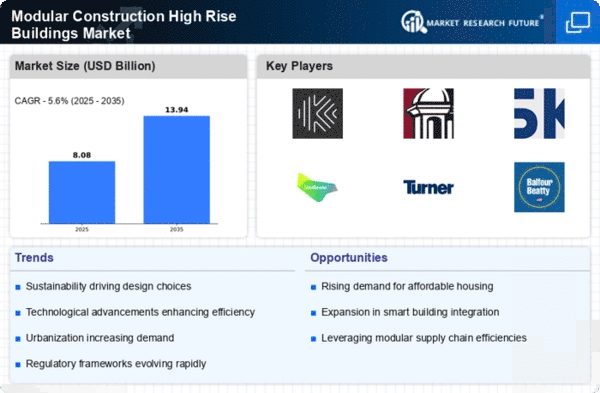
As per MRFR analysis, the Modular Construction High Rise Buildings Market was estimated at 7.65 USD Billion in 2024. The modular construction industry is projected to grow from 8.08 USD Billion in 2025 to 13.94 USD Billion by 2035, exhibiting a compound annual growth rate (CAGR) of 5.6 during the forecast period 2025 - 2035.

Key Market Trends & Highlights

The Modular Construction High Rise Buildings Market is experiencing a transformative shift towards sustainability and technological integration.

  • The market is increasingly driven by a focus on sustainability, with stakeholders prioritizing eco-friendly building practices.
  • Customization and flexibility in design are becoming essential, catering to diverse consumer preferences in the residential segment.
  • Integration of smart technologies is gaining traction, enhancing operational efficiency and user experience in commercial buildings.
  • Key market drivers include sustainability initiatives and urbanization trends, particularly evident in North America and the rapidly growing Asia-Pacific region.

Market Size & Forecast

2024 Market Size 7.65 (USD Billion)
2035 Market Size 13.94 (USD Billion)
CAGR (2025 - 2035) 5.6%
Largest Regional Market Share in 2024 North America

Major Players

Katerra (US), Modular Building Institute (US), Skanska (SE), Lendlease (AU), Turner Construction (US), Balfour Beatty (GB), Z Modular (US), Factory OS (US), Bouygues Construction (FR)

Market Trends

The Modular Construction High Rise Buildings Market is currently experiencing a transformative phase, characterized by a growing emphasis on sustainability and efficiency. This sector appears to be gaining traction due to its potential to reduce construction time and waste, while also addressing the increasing demand for urban housing solutions. As cities expand and populations rise, the need for innovative building methods becomes more pressing. Modular construction offers a viable alternative, allowing for the rapid assembly of high-rise structures that meet modern architectural standards. Furthermore, advancements in technology and materials are likely to enhance the appeal of modular buildings, making them a preferred choice for developers and investors alike. In addition to sustainability, the Modular Construction High Rise Buildings Market is witnessing a shift towards greater customization and flexibility in design. This trend suggests that stakeholders are increasingly recognizing the importance of tailoring structures to meet specific community needs and preferences. As a result, modular construction is not only about efficiency but also about creating spaces that resonate with their surroundings. The integration of smart technologies into modular designs may further elevate their functionality, potentially leading to smarter, more connected urban environments. Overall, the market appears poised for continued growth, driven by innovation and a commitment to meeting contemporary challenges in urban development.

Sustainability Focus

The emphasis on sustainable practices within the Modular Construction High Rise Buildings Market is becoming more pronounced. Stakeholders are increasingly prioritizing eco-friendly materials and energy-efficient designs, which align with global efforts to combat climate change. This trend indicates a shift towards greener construction methods that minimize environmental impact.

Customization and Flexibility

There is a notable trend towards customization in the Modular Construction High Rise Buildings Market. Developers are recognizing the importance of creating buildings that cater to specific community needs. This flexibility allows for unique designs that enhance the aesthetic and functional appeal of high-rise structures.

Integration of Smart Technologies

The incorporation of smart technologies into modular designs is gaining traction. This trend suggests that the Modular Construction High Rise Buildings Market is evolving to include features that enhance connectivity and efficiency. Smart systems may improve building management and user experience, making modular high-rises more attractive to potential occupants.

Modular Construction High Rise Buildings Market Market Drivers

Growing Urbanization

The Global Modular Construction for High Rise Buildings Market Industry is experiencing a surge due to rapid urbanization. As more people migrate to urban areas, the demand for housing and commercial spaces increases significantly. By 2024, the market is projected to reach 7.65 USD Billion, driven by the need for efficient construction solutions that can accommodate growing populations. Modular construction offers a viable alternative, allowing for quicker assembly and reduced labor costs. Cities worldwide are increasingly adopting modular techniques to address housing shortages, indicating a shift towards sustainable urban development.

Market Segment Insights

By Application: Residential (Largest) vs. Commercial (Fastest-Growing)

The Modular Construction High Rise Buildings Market exhibits a diverse distribution among four key application segments: Residential, Commercial, Industrial, and Institutional. Presently, the Residential sector holds the largest share, driven by increasing urbanization and the demand for affordable housing solutions. Following this is the Commercial segment, which is gaining traction due to rising investments in modular office spaces and retail establishments. The Industrial and Institutional segments, while smaller in market share, are also contributing significantly to the overall growth of the sector.

Residential (Dominant) vs. Commercial (Emerging)

The Residential segment stands out as the dominant player in the Modular Construction High Rise Buildings Market, primarily due to its established need for housing in urban areas. This segment benefits from advancements in construction technology, allowing for quicker build times and reduced costs. On the other hand, the Commercial segment is emerging rapidly, fueled by increasing demand for flexible office spaces and retail units that can be quickly deployed in urban settings. As businesses look for cost-effective and efficient building solutions, the Commercial sector presents a significant opportunity, positioning itself as a key growth driver alongside its residential counterpart.

By Construction Type: New Construction (Largest) vs. Renovation (Fastest-Growing)

The 'Modular Construction High Rise Buildings Market' shows a diverse distribution among its key construction type segments, with 'New Construction' leading the way as the dominant segment. This category encompasses a significant share of the market, driven by a rising demand for innovative architectural solutions that modular construction offers. Meanwhile, 'Renovation' is emerging rapidly, gaining traction as property owners and developers increasingly recognize the efficiency and cost-effectiveness of renovating existing structures through modular techniques.

Renovation (Dominant) vs. Expansion (Emerging)

In the current landscape of the Modular Construction High Rise Buildings Market, 'Renovation' stands as the dominant segment, reflecting a growing trend towards sustainable practices and efficient use of existing resources. This segment caters to the needs of urban areas where space is limited and the demand for modernized facilities is high. On the other hand, 'Expansion' is seen as an emerging opportunity, particularly in regions experiencing population growth. This segment focuses on the additions and enhancements to existing buildings, leveraging modular techniques to ensure speed and efficiency in construction, thereby attracting developers looking to maximize their existing investments.

By Building Height: High Rise (Largest) vs. Low Rise (Fastest-Growing)

In the Modular Construction High Rise Buildings Market, the distribution among building height segments shows High Rise structures leading with the largest market share. Their widespread acceptance in urban areas facilitates their dominance. Low Rise buildings, while historically less prominent, are witnessing significant growth, appealing to both residential and commercial sectors due to their affordability and quicker construction times. Mid Rise structures hold a moderate market share, catering to a niche demand that balances height and cost-effectiveness. Growth trends within this segment reflect a shift towards sustainability and urbanization. High Rise buildings are increasingly favored for their vertical efficiency in densely populated cities, leveraging modular construction for faster delivery. Conversely, Low Rise buildings are emerging as a preferred choice in suburban developments, driven by an increasing emphasis on affordable housing and community-centric projects. Both segments are benefiting from technological advancements in modular construction techniques, which enhance flexibility and reduce build times.

High Rise (Dominant) vs. Low Rise (Emerging)

High Rise modular constructions are recognized for their skyward expansion potential and ability to maximize limited urban space, resulting in their dominant position in the market. They combine innovative design with modular methodologies that streamline the construction process, enabling rapid deployment and reduced labor costs. Their attractiveness stems from not only space efficiency but also the ability to adhere to modern architectural trends that emphasize sustainability and aesthetics. Conversely, Low Rise modular buildings are capturing attention as an emerging solution for affordable living and flexible commercial spaces. Their rise is fueled by a growing desire for community-focused developments and less complex building regulations, appealing to both developers and consumers seeking economical housing solutions. This segment's evolution is supported by advancements in materials and construction techniques that allow for quality and speed.

By Material Type: Steel (Largest) vs. Concrete (Fastest-Growing)

In the Modular Construction High Rise Buildings Market, the material types exhibit distinct market share dynamics. Steel holds the largest share due to its high strength-to-weight ratio and adaptability in construction applications. This established preference stems from steel's ability to support complex designs while ensuring structural integrity. Conversely, concrete, although traditionally strong, is rapidly gaining traction as the fastest-growing material. Its versatility, cost-effectiveness, and improved properties, maintain its competitive edge amidst evolving construction techniques.

Material Type: Steel (Dominant) vs. Hybrid (Emerging)

Steel continues to be the dominant material in modular high-rise construction, attributed to its durability, recyclability, and the ability to create slender structures. Its prefabrication capabilities enhance construction speed and reduce labor costs, making it preferred for urban developments. On the other hand, hybrid systems incorporating steel and concrete are emerging. They combine the strengths of both materials, allowing for greater design flexibility and improved thermal performance. As sustainability becomes more critical, hybrid constructions are gaining popularity, driven by increasing demand for energy efficiency and eco-friendly practices.

By Design Complexity: Moderate (Largest) vs. Complex (Fastest-Growing)

In the Modular Construction High Rise Buildings Market, the design complexity plays a significant role in determining the preferences of developers and builders. The 'Moderate' design complexity segment currently commands the largest market share, demonstrating a robust preference among stakeholders for projects that balance ease of construction with architectural creativity. On the other hand, the 'Complex' design complexity segment is emerging strongly, catering to a niche that seeks innovative and customized solutions that can adapt to varied urban environments.

Design Complexity: Moderate (Dominant) vs. Complex (Emerging)

The 'Moderate' design complexity in the Modular Construction High Rise Buildings Market is characterized by its balance between operational efficiency and creative architectural solutions. This segment is favored for its adaptability, allowing for a variety of designs without significantly complicating the construction process. In contrast, the 'Complex' design complexity segment, which has been gaining ground, represents projects that are bespoke and intricate, often employing advanced materials and technologies. While this category comes with greater challenges and risks, its rapid growth is driven by the demand for unique, high-performance buildings that stand out in urban settings.

Get more detailed insights about Modular Construction for High Rise Buildings Market Research Report – Forecast to 2035

Regional Insights

North America : Market Leader in Modular Construction

North America is poised to maintain its leadership in the Modular Construction High Rise Buildings Market, holding a market size of $3.8 billion as of December 2025. The region's growth is driven by increasing urbanization, a push for sustainable building practices, and favorable regulations that encourage modular construction. The demand for faster project completion and cost efficiency further fuels this trend, making modular construction an attractive option for developers. The competitive landscape in North America is robust, featuring key players such as Katerra, Turner Construction, and Z Modular. The U.S. stands out as the leading country, with significant investments in modular technology and infrastructure. The Modular Building Institute plays a crucial role in promoting industry standards and best practices, ensuring that the market continues to evolve and meet the growing demands of urban development.

Europe : Emerging Market with Growth Potential

Europe is witnessing a significant rise in the Modular Construction High Rise Buildings Market, with a market size of €2.0 billion projected for December 2025. The region's growth is propelled by stringent environmental regulations and a strong emphasis on sustainability. Countries are increasingly adopting modular construction to meet housing demands while minimizing carbon footprints, thus driving market expansion. The European Union's initiatives to promote green building practices further catalyze this trend. Leading countries in this market include Germany, the UK, and France, where companies like Skanska and Bouygues Construction are making substantial contributions. The competitive landscape is characterized by a mix of established firms and innovative startups, all vying for a share of the growing market. The Modular Building Institute's efforts in Europe are vital for fostering collaboration and innovation within the sector.

Asia-Pacific : Rapid Growth in Construction Sector

The Asia-Pacific region is emerging as a significant player in the Modular Construction High Rise Buildings Market, with a market size of $1.7 billion expected by December 2025. The rapid urbanization and increasing population density in countries like China and India are key drivers of this growth. Additionally, government initiatives aimed at improving infrastructure and housing are creating a favorable environment for modular construction, which offers speed and efficiency in project delivery. China leads the region in modular construction, with substantial investments from companies like Lendlease and Factory OS. The competitive landscape is evolving, with both local and international players entering the market. As the demand for affordable housing rises, modular construction is becoming a viable solution, positioning the Asia-Pacific region for continued growth in this sector.

Middle East and Africa : Emerging Opportunities in Construction

The Middle East and Africa region is at the nascent stage of the Modular Construction High Rise Buildings Market, with a market size of $0.15 billion as of December 2025. The growth in this region is primarily driven by rapid urbanization and the need for efficient construction methods to meet the demands of a growing population. Governments are increasingly recognizing the benefits of modular construction, leading to supportive policies and investments in infrastructure development. Countries like the UAE and South Africa are leading the charge in adopting modular construction techniques. The competitive landscape is gradually evolving, with both local firms and international players exploring opportunities in this market. As the region continues to develop, modular construction is expected to play a crucial role in addressing housing shortages and enhancing urban infrastructure.

Key Players and Competitive Insights

The Modular Construction High Rise Buildings Market is currently characterized by a dynamic competitive landscape, driven by increasing urbanization, a growing emphasis on sustainability, and the need for rapid construction solutions. Key players such as Katerra (US), Skanska (SE), and Lendlease (AU) are strategically positioning themselves through innovation and partnerships. Katerra (US) has focused on integrating advanced technology into its construction processes, which enhances efficiency and reduces waste. Meanwhile, Skanska (SE) emphasizes sustainable building practices, aligning its operations with global environmental standards. Lendlease (AU) has adopted a regional expansion strategy, targeting emerging markets to capitalize on the rising demand for modular solutions. Collectively, these strategies contribute to a competitive environment that is increasingly focused on technological advancement and sustainability.In terms of business tactics, companies are localizing manufacturing to reduce transportation costs and optimize supply chains. This approach not only enhances operational efficiency but also allows for quicker response times to market demands. The market structure appears moderately fragmented, with several key players influencing trends and practices. The collective influence of these companies fosters a competitive atmosphere where innovation and sustainability are paramount.

In November Katerra (US) announced a partnership with a leading technology firm to develop a new modular construction platform that utilizes AI for project management. This strategic move is likely to enhance Katerra's operational efficiency and position it as a leader in the integration of technology within modular construction. The collaboration may also facilitate the development of smarter, more adaptable building designs, catering to the evolving needs of urban environments.

In October Skanska (SE) unveiled its latest sustainable high-rise project in Stockholm, which incorporates advanced energy-efficient technologies and sustainable materials. This initiative not only reinforces Skanska's commitment to sustainability but also showcases its ability to meet the growing demand for environmentally friendly construction solutions. The project is expected to serve as a benchmark for future developments in the region, potentially influencing industry standards.

In September Lendlease (AU) secured a significant contract for a modular high-rise development in Southeast Asia, marking a strategic expansion into a rapidly growing market. This move is indicative of Lendlease's proactive approach to capturing new opportunities and diversifying its portfolio. The project is anticipated to leverage local resources and expertise, thereby enhancing Lendlease's competitive edge in the region.

As of December current competitive trends in the Modular Construction High Rise Buildings Market are heavily influenced by digitalization, sustainability, and the integration of AI technologies. Strategic alliances are increasingly shaping the landscape, enabling companies to pool resources and expertise to drive innovation. The competitive differentiation is likely to evolve from traditional price-based competition towards a focus on technological advancements, sustainable practices, and supply chain reliability. This shift suggests that companies that prioritize innovation and adaptability will be better positioned to thrive in the future.

Key Companies in the Modular Construction High Rise Buildings Market include

Industry Developments

November 2021: Bathroom pods have been produced by Old Castle Sure Pods. It necessitates simple installation in dorms, facilities for assisted living, and therefore commercial projects. 

Future Outlook

Modular Construction High Rise Buildings Market Future Outlook

The Modular Construction High Rise Buildings Market is projected to grow at a 5.6% CAGR from 2025 to 2035, driven by urbanization, sustainability demands, and technological advancements.

New opportunities lie in:

  • Integration of smart building technologies for enhanced energy efficiency.
  • Development of modular components for rapid assembly and reduced labor costs.
  • Expansion into emerging markets with tailored modular solutions.

By 2035, the market is expected to solidify its position as a leader in innovative construction solutions.

Market Segmentation

Modular Construction High Rise Buildings Market Application Outlook

  • Residential
  • Commercial
  • Industrial
  • Institutional

Modular Construction High Rise Buildings Market Material Type Outlook

  • Steel
  • Concrete
  • Wood
  • Hybrid

Modular Construction High Rise Buildings Market Building Height Outlook

  • Low Rise
  • Mid Rise
  • High Rise

Modular Construction High Rise Buildings Market Construction Type Outlook

  • New Construction
  • Renovation
  • Expansion

Modular Construction High Rise Buildings Market Design Complexity Outlook

  • Simple
  • Moderate
  • Complex

Report Scope

MARKET SIZE 20247.65(USD Billion)
MARKET SIZE 20258.08(USD Billion)
MARKET SIZE 203513.94(USD Billion)
COMPOUND ANNUAL GROWTH RATE (CAGR)5.6% (2025 - 2035)
REPORT COVERAGERevenue Forecast, Competitive Landscape, Growth Factors, and Trends
BASE YEAR2024
Market Forecast Period2025 - 2035
Historical Data2019 - 2024
Market Forecast UnitsUSD Billion
Key Companies ProfiledKaterra (US), Modular Building Institute (US), Skanska (SE), Lendlease (AU), Turner Construction (US), Balfour Beatty (GB), Z Modular (US), Factory OS (US), Bouygues Construction (FR)
Segments CoveredApplication, Construction Type, Building Height, Material Type, Design Complexity
Key Market OpportunitiesIntegration of advanced technologies enhances efficiency and sustainability in the Modular Construction High Rise Buildings Market.
Key Market DynamicsRising demand for sustainable construction practices drives innovation in modular high-rise building technologies and materials.
Countries CoveredNorth America, Europe, APAC, South America, MEA

FAQs

How much is the modular construction for high rise buildings market?

The modular construction for high rise buildings market size was valued at USD 6.5 Billion in 2022.

What is the growth rate of the modular construction for high rise buildings market?

Modular Construction High Rise Buildings Market is expected to grow with a CAGR of 5.6% in the period 2025-2035

Which region held the largest market share in the modular construction for high rise buildings market?

North America had the largest share in the Modular Construction for High Rise Buildings Market

Who are the key players in the modular construction for high rise buildings market?

The key players in the market are Walker Modular, Euro components Italia SPA, PUDA Industrial Co Ltd, Old castle Superpods, Neopod Systems, Intelligent Offsite, Interpod Offsite, The Pod System, B and T manufacturing and Elements Europe.

Which material led the modular construction for high rise buildings market?

The steel category dominated the Modular Construction for High Rise Buildings Market in 2022.

Which module type had the largest market share in the modular construction for high rise buildings market?

The bathroom pods category had the largest share in the Modular Construction for High Rise Buildings Market

  1. SECTION I: EXECUTIVE SUMMARY AND KEY HIGHLIGHTS
    1. | 1.1 EXECUTIVE SUMMARY
    2. | 1.1.1 Market Overview
    3. | 1.1.2 Key Findings
    4. | 1.1.3 Market Segmentation
    5. | 1.1.4 Competitive Landscape
    6. | 1.1.5 Challenges and Opportunities
    7. | 1.1.6 Future Outlook
  2. SECTION II: SCOPING, METHODOLOGY AND MARKET STRUCTURE
    1. | 2.1 MARKET INTRODUCTION
    2. | 2.1.1 Definition
    3. | 2.1.2 Scope of the study
    4. |-- 2.1.2.1 Research Objective
    5. |-- 2.1.2.2 Assumption
    6. |-- 2.1.2.3 Limitations
    7. | 2.2 RESEARCH METHODOLOGY
    8. | 2.2.1 Overview
    9. | 2.2.2 Data Mining
    10. | 2.2.3 Secondary Research
    11. | 2.2.4 Primary Research
    12. |-- 2.2.4.1 Primary Interviews and Information Gathering Process
    13. |-- 2.2.4.2 Breakdown of Primary Respondents
    14. | 2.2.5 Forecasting Model
    15. | 2.2.6 Market Size Estimation
    16. |-- 2.2.6.1 Bottom-Up Approach
    17. |-- 2.2.6.2 Top-Down Approach
    18. | 2.2.7 Data Triangulation
    19. | 2.2.8 Validation
  3. SECTION III: QUALITATIVE ANALYSIS
    1. | 3.1 MARKET DYNAMICS
    2. | 3.1.1 Overview
    3. | 3.1.2 Drivers
    4. | 3.1.3 Restraints
    5. | 3.1.4 Opportunities
    6. | 3.2 MARKET FACTOR ANALYSIS
    7. | 3.2.1 Value chain Analysis
    8. | 3.2.2 Porter's Five Forces Analysis
    9. |-- 3.2.2.1 Bargaining Power of Suppliers
    10. |-- 3.2.2.2 Bargaining Power of Buyers
    11. |-- 3.2.2.3 Threat of New Entrants
    12. |-- 3.2.2.4 Threat of Substitutes
    13. |-- 3.2.2.5 Intensity of Rivalry
    14. | 3.2.3 COVID-19 Impact Analysis
    15. |-- 3.2.3.1 Market Impact Analysis
    16. |-- 3.2.3.2 Regional Impact
    17. |-- 3.2.3.3 Opportunity and Threat Analysis
  4. SECTION IV: QUANTITATIVE ANALYSIS
    1. | 4.1 Packaging & Transport, BY Application (USD Billion)
    2. | 4.1.1 Residential
    3. | 4.1.2 Commercial
    4. | 4.1.3 Industrial
    5. | 4.1.4 Institutional
    6. | 4.2 Packaging & Transport, BY Construction Type (USD Billion)
    7. | 4.2.1 New Construction
    8. | 4.2.2 Renovation
    9. | 4.2.3 Expansion
    10. | 4.3 Packaging & Transport, BY Building Height (USD Billion)
    11. | 4.3.1 Low Rise
    12. | 4.3.2 Mid Rise
    13. | 4.3.3 High Rise
    14. | 4.4 Packaging & Transport, BY Material Type (USD Billion)
    15. | 4.4.1 Steel
    16. | 4.4.2 Concrete
    17. | 4.4.3 Wood
    18. | 4.4.4 Hybrid
    19. | 4.5 Packaging & Transport, BY Design Complexity (USD Billion)
    20. | 4.5.1 Simple
    21. | 4.5.2 Moderate
    22. | 4.5.3 Complex
    23. | 4.6 Packaging & Transport, BY Region (USD Billion)
    24. | 4.6.1 North America
    25. |-- 4.6.1.1 US
    26. |-- 4.6.1.2 Canada
    27. | 4.6.2 Europe
    28. |-- 4.6.2.1 Germany
    29. |-- 4.6.2.2 UK
    30. |-- 4.6.2.3 France
    31. |-- 4.6.2.4 Russia
    32. |-- 4.6.2.5 Italy
    33. |-- 4.6.2.6 Spain
    34. |-- 4.6.2.7 Rest of Europe
    35. | 4.6.3 APAC
    36. |-- 4.6.3.1 China
    37. |-- 4.6.3.2 India
    38. |-- 4.6.3.3 Japan
    39. |-- 4.6.3.4 South Korea
    40. |-- 4.6.3.5 Malaysia
    41. |-- 4.6.3.6 Thailand
    42. |-- 4.6.3.7 Indonesia
    43. |-- 4.6.3.8 Rest of APAC
    44. | 4.6.4 South America
    45. |-- 4.6.4.1 Brazil
    46. |-- 4.6.4.2 Mexico
    47. |-- 4.6.4.3 Argentina
    48. |-- 4.6.4.4 Rest of South America
    49. | 4.6.5 MEA
    50. |-- 4.6.5.1 GCC Countries
    51. |-- 4.6.5.2 South Africa
    52. |-- 4.6.5.3 Rest of MEA
  5. SECTION V: COMPETITIVE ANALYSIS
    1. | 5.1 Competitive Landscape
    2. | 5.1.1 Overview
    3. | 5.1.2 Competitive Analysis
    4. | 5.1.3 Market share Analysis
    5. | 5.1.4 Major Growth Strategy in the Packaging & Transport
    6. | 5.1.5 Competitive Benchmarking
    7. | 5.1.6 Leading Players in Terms of Number of Developments in the Packaging & Transport
    8. | 5.1.7 Key developments and growth strategies
    9. |-- 5.1.7.1 New Product Launch/Service Deployment
    10. |-- 5.1.7.2 Merger & Acquisitions
    11. |-- 5.1.7.3 Joint Ventures
    12. | 5.1.8 Major Players Financial Matrix
    13. |-- 5.1.8.1 Sales and Operating Income
    14. |-- 5.1.8.2 Major Players R&D Expenditure. 2023
    15. | 5.2 Company Profiles
    16. | 5.2.1 Katerra (US)
    17. |-- 5.2.1.1 Financial Overview
    18. |-- 5.2.1.2 Products Offered
    19. |-- 5.2.1.3 Key Developments
    20. |-- 5.2.1.4 SWOT Analysis
    21. |-- 5.2.1.5 Key Strategies
    22. | 5.2.2 Modular Building Institute (US)
    23. |-- 5.2.2.1 Financial Overview
    24. |-- 5.2.2.2 Products Offered
    25. |-- 5.2.2.3 Key Developments
    26. |-- 5.2.2.4 SWOT Analysis
    27. |-- 5.2.2.5 Key Strategies
    28. | 5.2.3 Skanska (SE)
    29. |-- 5.2.3.1 Financial Overview
    30. |-- 5.2.3.2 Products Offered
    31. |-- 5.2.3.3 Key Developments
    32. |-- 5.2.3.4 SWOT Analysis
    33. |-- 5.2.3.5 Key Strategies
    34. | 5.2.4 Lendlease (AU)
    35. |-- 5.2.4.1 Financial Overview
    36. |-- 5.2.4.2 Products Offered
    37. |-- 5.2.4.3 Key Developments
    38. |-- 5.2.4.4 SWOT Analysis
    39. |-- 5.2.4.5 Key Strategies
    40. | 5.2.5 Turner Construction (US)
    41. |-- 5.2.5.1 Financial Overview
    42. |-- 5.2.5.2 Products Offered
    43. |-- 5.2.5.3 Key Developments
    44. |-- 5.2.5.4 SWOT Analysis
    45. |-- 5.2.5.5 Key Strategies
    46. | 5.2.6 Balfour Beatty (GB)
    47. |-- 5.2.6.1 Financial Overview
    48. |-- 5.2.6.2 Products Offered
    49. |-- 5.2.6.3 Key Developments
    50. |-- 5.2.6.4 SWOT Analysis
    51. |-- 5.2.6.5 Key Strategies
    52. | 5.2.7 Z Modular (US)
    53. |-- 5.2.7.1 Financial Overview
    54. |-- 5.2.7.2 Products Offered
    55. |-- 5.2.7.3 Key Developments
    56. |-- 5.2.7.4 SWOT Analysis
    57. |-- 5.2.7.5 Key Strategies
    58. | 5.2.8 Factory OS (US)
    59. |-- 5.2.8.1 Financial Overview
    60. |-- 5.2.8.2 Products Offered
    61. |-- 5.2.8.3 Key Developments
    62. |-- 5.2.8.4 SWOT Analysis
    63. |-- 5.2.8.5 Key Strategies
    64. | 5.2.9 Bouygues Construction (FR)
    65. |-- 5.2.9.1 Financial Overview
    66. |-- 5.2.9.2 Products Offered
    67. |-- 5.2.9.3 Key Developments
    68. |-- 5.2.9.4 SWOT Analysis
    69. |-- 5.2.9.5 Key Strategies
    70. | 5.3 Appendix
    71. | 5.3.1 References
    72. | 5.3.2 Related Reports

Packaging & Transport Market Segmentation

Packaging & Transport By Application (USD Billion, 2025-2035)

  • Residential
  • Commercial
  • Industrial
  • Institutional

Packaging & Transport By Construction Type (USD Billion, 2025-2035)

  • New Construction
  • Renovation
  • Expansion

Packaging & Transport By Building Height (USD Billion, 2025-2035)

  • Low Rise
  • Mid Rise
  • High Rise

Packaging & Transport By Material Type (USD Billion, 2025-2035)

  • Steel
  • Concrete
  • Wood
  • Hybrid

Packaging & Transport By Design Complexity (USD Billion, 2025-2035)

  • Simple
  • Moderate
  • Complex
Infographic

Free Sample Request

Kindly complete the form below to receive a free sample of this Report

Get Free Sample

Customer Strories

Compare Licence

×
Features License Type
Single User Multiuser License Enterprise User
Price $4,950 $5,950 $7,250
Maximum User Access Limit 1 User Upto 10 Users Unrestricted Access Throughout the Organization
Free Customization
Direct Access to Analyst
Deliverable Format
Platform Access
Discount on Next Purchase 10% 15% 15%
Printable Versions