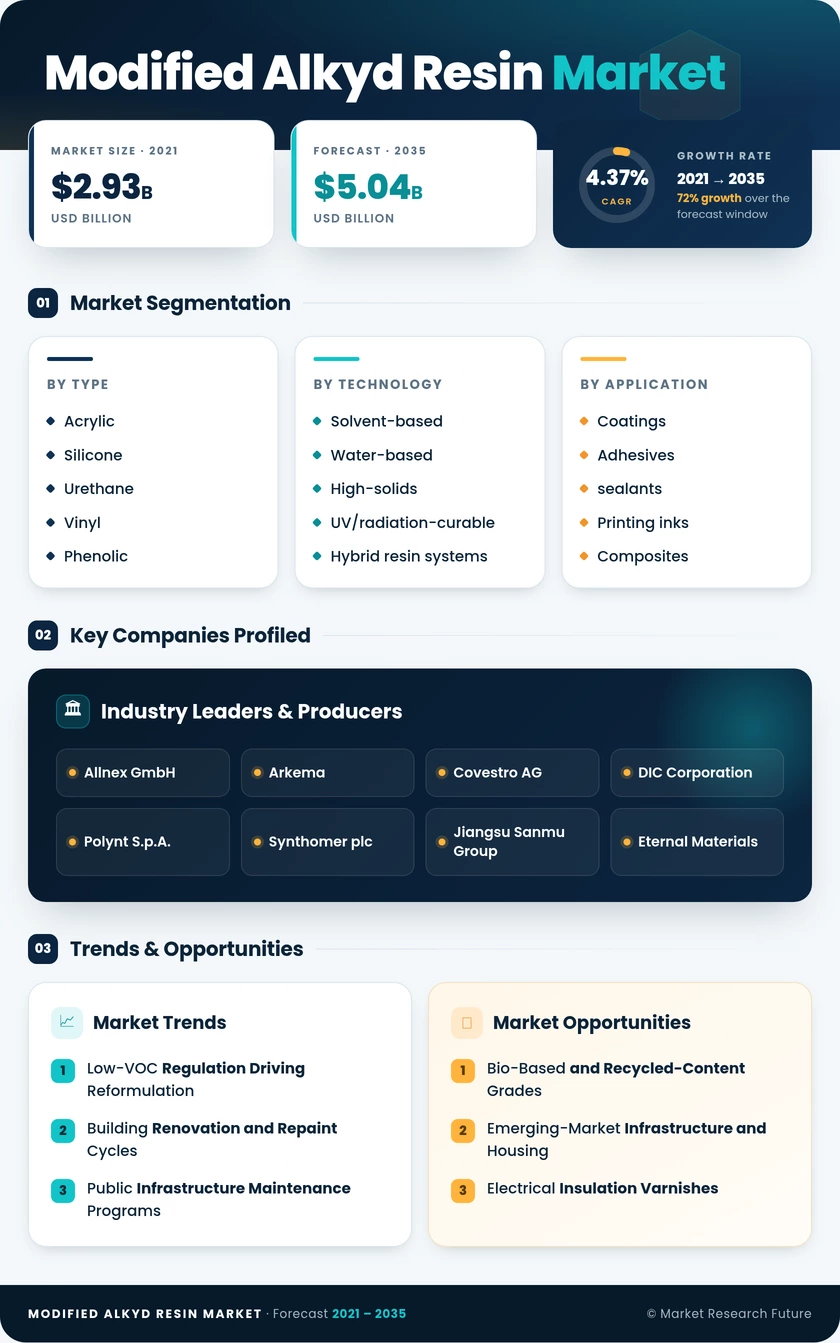
Modified Alkyd Resin Market (2026 - 2035)

ID: MRFR/CnM/3013-HCR 137 Pages Priya Nagrale Last Updated: November 18, 2026
Modified Alkyd Resin Market Research Report Information By Type (Acrylic, Silicone, Urethane, Vinyl, Phenolic, Polyamide, and Other Types), By Technology (Solvent-Based, Water-Based, High-Solids, UV/Radiation-Curable, and Hybrid Resin Systems), By Application (Coatings, Adhesives and Sealants, Printing Inks, Composites, Electrical Insulating Coatings, and Other Applications), By End-User Industry (Building and Construction, Automotive, Industrial Equipment, Marine, Furniture and Wood Finishing, Electrical and Electronics, Consumer Goods, and Other End-User Industries), And By Region (North America, Europe, Asia-Pacific, and Rest of the World) – Market Forecast Till 2035.
Modified Alkyd Resin Market
Market Size
Forecast Period2026-2035
CAGR (2026-2035)4.37%
2025 Market SizeUSD 3.33 Billion
2035 Market SizeUSD 5.04 Billion
Key Players
Allnex GmbH
Arkema
Covestro AG
DIC Corporation
Polynt S.p.A.
Synthomer plc
Opportunities
  • Bio-Based and Recycled-Content Grades
  • Emerging-Market Infrastructure and Housing
  • Electrical Insulation Varnishes
  1. 1 Market Summary | |
  2. 2 Key Report Takeaways | |
    1. 2.1 By Type | |
    2. 2.2 By Technology | |
    3. 2.3 By Application | |
    4. 2.4 By End-user Industry | |
    5. 2.5 By Region | |
  3. 3 Market Size and Forecast (2021–2035) | |
  4. 4 Driver Impact Analysis | |
    1. 4.1 Low-VOC Regulation Driving Reformulation | |
    2. 4.2 Building Renovation and Repaint Cycles | |
    3. 4.3 Public Infrastructure Maintenance Programs | |
    4. 4.4 Grid Expansion and Electrification | |
    5. 4.5 Industrial Equipment Renewal in Asia-Pacific | |
    6. 4.6 Demand for Renewable Content and Eco-Label Compliance | |
  5. 5 Restraints Impact Analysis | |
    1. 5.1 Vegetable Oil and Phthalic Anhydride Price Volatility | |
    2. 5.2 Substitution by Acrylic and Polyurethane Dispersions | |
    3. 5.3 Hazard Classification of Driers and Anti-Skinning Agents | |
    4. 5.4 Ultra-Low VOC Limits Restricting Solvent-Borne Portfolios | |
    5. 5.5 Drying and Performance Gaps in Water-Based Grades | |
  6. 6 Opportunities | |
    1. 6.1 Bio-Based and Recycled-Content Grades | |
    2. 6.2 Emerging-Market Infrastructure and Housing | |
    3. 6.3 Electrical Insulation Varnishes | |
    4. 6.4 Data-Driven Formulation Services and New Business Models | |
    5. 6.5 Drier-Ready Platforms Without Cobalt | |
  7. 7 Regional Market Share and Country-Level Analysis | |
    1. 7.1 North America | | |
      1. 7.1.1 United States | | |
      2. 7.1.2 Canada | | |
      3. 7.1.3 Mexico | |
    2. 7.2 Europe | | |
      1. 7.2.1 Germany | | |
      2. 7.2.2 United Kingdom | | |
      3. 7.2.3 France | | |
      4. 7.2.4 Italy | | |
      5. 7.2.5 Spain | | |
      6. 7.2.6 Nordic Countries | | |
      7. 7.2.7 Russia | | |
      8. 7.2.8 Rest of Europe | |
    3. 7.3 Asia-Pacific | | |
      1. 7.3.1 China | | |
      2. 7.3.2 India | | |
      3. 7.3.3 Japan | | |
      4. 7.3.4 South Korea | | |
      5. 7.3.5 ASEAN | | |
      6. 7.3.6 Rest of Asia-Pacific | |
    4. 7.4 South America | | |
      1. 7.4.1 Brazil | | |
      2. 7.4.2 Argentina | | |
      3. 7.4.3 Rest of South America | |
    5. 7.5 Middle East & Africa | | |
      1. 7.5.1 Saudi Arabia | | |
      2. 7.5.2 UAE | | |
      3. 7.5.3 South Africa | | |
      4. 7.5.4 Egypt | | |
      5. 7.5.5 Rest of Middle East & Africa | |
  8. 8 Future Outlook (2026–2035) | |
    1. 8.1 The Shift to Water-Based Grades Becomes Mainstream | |
    2. 8.2 Electrification Supports Specialty Demand | |
    3. 8.3 Sustainability Reporting and Circular Feedstocks | |
    4. 8.4 Digital and AI-Assisted Formulation | |
  9. 9 Segmentation Analysis | |
    1. 9.1 By Type | | |
      1. 9.1.1 Acrylic | | |
      2. 9.1.2 Silicone | | |
      3. 9.1.3 Urethane | | |
      4. 9.1.4 Vinyl | | |
      5. 9.1.5 Phenolic | | |
      6. 9.1.6 Polyamide | | |
      7. 9.1.7 Other types | |
    2. 9.2 By Technology | | |
      1. 9.2.1 Solvent-based | | |
      2. 9.2.2 Water-based | | |
      3. 9.2.3 High-solids | | |
      4. 9.2.4 UV/radiation-curable | | |
      5. 9.2.5 Hybrid resin systems | |
    3. 9.3 By Application | | |
      1. 9.3.1 Coatings | | |
      2. 9.3.2 Adhesives and sealants | | |
      3. 9.3.3 Printing inks | | |
      4. 9.3.4 Composites | | |
      5. 9.3.5 Electrical insulating coatings | | |
      6. 9.3.6 Other applications | |
    4. 9.4 By End-user Industry | | |
      1. 9.4.1 Building and construction | | |
      2. 9.4.2 Automotive | | |
      3. 9.4.3 Industrial equipment | | |
      4. 9.4.4 Marine | | |
      5. 9.4.5 Furniture and wood finishing | | |
      6. 9.4.6 Electrical and electronics | | |
      7. 9.4.7 Consumer goods | | |
      8. 9.4.8 Other end-user industries | |
  10. 10 Competitive Landscape | |
    1. 10.1 Market Concentration Analysis | |
    2. 10.2 Competitive Benchmarking Table | |
    3. 10.3 Company Profiles | | |
      1. 10.3.1 Allnex GmbH | | |
      2. 10.3.2 Arkema | | |
      3. 10.3.3 Covestro AG | | |
      4. 10.3.4 DIC Corporation | | |
      5. 10.3.5 Polynt S.p.A. | | |
      6. 10.3.6 Synthomer plc | | |
      7. 10.3.7 Jiangsu Sanmu Group | | |
      8. 10.3.8 Eternal Materials | | |
      9. 10.3.9 Engineered Polymer Solutions | | |
      10. 10.3.10 Deltech Corporation | |
  11. 11 Recent News & Developments | |
  12. 12 Report Scope and Methodology | |
  13. 13 Detailed Sources and Citations | |
  14. 14 Frequently Asked Questions (FAQs) | | LIST OF TABLES | |
  15. TABLE 1 Report Snapshot – Key Metrics, 2025–2035 | |
  16. TABLE 2 Global Market Size & Forecast, by Revenue, 2021–2035 (USD Billion) | |
  17. TABLE 3 Driver Impact Analysis, 2026–2035 | |
  18. TABLE 4 Restraints Impact Analysis, 2026–2035 | |
  19. TABLE 5 Regional Summary, by Share, 2025 | |
  20. TABLE 6 North America – Country-Level Analysis, 2025 | |
  21. TABLE 7 Europe – Country-Level Analysis, 2025 | |
  22. TABLE 8 Asia-Pacific – Country-Level Analysis, 2025 | |
  23. TABLE 9 South America – Country-Level Analysis, 2025 | |
  24. TABLE 10 Middle East & Africa – Country-Level Analysis, 2025 | |
  25. TABLE 11 Global Market Segmentation, by Type, 2025 | |
  26. TABLE 12 Global Market Segmentation, by Technology, 2025 | |
  27. TABLE 13 Global Market Segmentation, by Application, 2025 | |
  28. TABLE 14 Global Market Segmentation, by End-user Industry, 2025 | |
  29. TABLE 15 Competitive Benchmarking Table – Key Players | |
  30. TABLE 16 Report Scope and Methodology | |
  31. TABLE 17 Detailed Sources and Citations | |
  32. TABLE 18 Segmentation Quick Reference | |
  33. TABLE 19 Segmentation Overview – By Type | |
  34. TABLE 20 Segmentation Overview – By Technology | |
  35. TABLE 21 Segmentation Overview – By Application | |
  36. TABLE 22 Segmentation Overview – By End-user Industry | | LIST OF FIGURES | |
  37. FIGURE 1 Market Dynamics Overview – Drivers, Restraints and Opportunities | |
  38. FIGURE 2 Value Chain Analysis – Feedstocks to End-Use Coatings | |
  39. FIGURE 3 Porter's Five Forces Analysis | |
  40. FIGURE 4 Global Market Size Trend, 2021–2035 (USD Billion) | |
  41. FIGURE 5 Market Share by Type, 2025 (%) | |
  42. FIGURE 6 Market Share by Technology, 2025 (%) | |
  43. FIGURE 7 Market Share by Application, 2025 (%) | |
  44. FIGURE 8 Market Share by End-user Industry, 2025 (%) | |
  45. FIGURE 9 Regional Market Share, 2025 (%) | |
  46. FIGURE 10 Country-Level Share within Asia-Pacific, 2025 (%) | |
  47. FIGURE 11 Competitive Landscape – Estimated Revenue Share Ranges of Key Players | |
  48. FIGURE 12 Market Concentration Analysis

Segmentation Quick Reference

DimensionSub-SegmentsDominant SegmentFastest Growing Segment
By TypeAcrylic, Silicone, Urethane, Vinyl, Phenolic, Polyamide, Other typesAcrylic (30.7% share)Urethane (5.3% CAGR)
By TechnologySolvent-based, Water-based, High-solids, UV/radiation-curable, Hybrid resin systemsSolvent-based (58.1% share)Water-based (5.8% CAGR)
By ApplicationCoatings, Adhesives and sealants, Printing inks, Composites, Electrical insulating coatings, Other applicationsCoatings (68.3% share)Electrical insulating coatings (5.2% CAGR)
By End-user IndustryBuilding and construction, Automotive, Industrial equipment, Marine, Furniture and wood finishing, Electrical and electronics, Consumer goods, Other end-user industriesBuilding and construction (38.4% share)Electrical and electronics (5.4% CAGR)
By RegionNorth America, Europe, Asia-Pacific, South America, Middle East & AfricaAsia-Pacific (44.6% share)Asia-Pacific (5.1% CAGR)

Market Segmentation Overview

By Type

Sub-SegmentKey Trend
AcrylicPreferred for exterior durability and gloss retention
SiliconeServes high-temperature engine and exhaust coatings
UrethaneSingle-pack abrasion resistance for maintenance and refinish work
VinylSupports adhesion-critical ink formulations
PhenolicChemical resistance for metal packaging
PolyamideThixotropic behavior for inks and specialty coatings
Other typesStyrenated and epoxy-ester grades for niche uses

Acrylic leads with a 30.7% share because acrylic modification adds UV resistance and color retention while applicators keep familiar alkyd handling. Urethane grows fastest at a 5.3% CAGR, as infrastructure and equipment owners want abrasion resistance without mixing two-component systems. Silicone and phenolic grades remain heat- and chemical-resistance niches rather than volume drivers.

By Technology

Sub-SegmentKey Trend
Solvent-basedHolds marine and humid-climate applications
Water-basedGains from VOC rules and improved catalysts
High-solidsCuts solvent while keeping thick film build
UV/radiation-curableFast cure for wood and industrial lines
Hybrid resin systemsAlkyd-polyurethane and alkyd-acrylic performance blends

Solvent-based systems lead with a 58.1% share because contractors trust their adhesion and drying on difficult substrates and in humid conditions. Water-based technology grows fastest at a 5.8% CAGR, driven by Decopaint, EPA and Chinese VOC limits and by catalyst packages that shorten drying time. High-solids grades act as a bridge for users who are not ready to adopt water-based systems.

By Application

Sub-SegmentKey Trend
CoatingsBroad base across architectural, protective and wood finishing
Adhesives and sealantsConstruction sealants and laminating adhesives
Printing inksQuick-drying grades for metal and plastic substrates
CompositesSmall specialty laminate and molding outlet
Electrical insulating coatingsImpregnating varnishes for transformers and motors
Other applicationsTextile, leather and specialty uses

Coatings dominate with a 68.3% share because one resin family covers trim enamels, steel primers, wood finishes and marine topcoats. Electrical insulating coatings grow fastest at a 5.2% CAGR, as grid refurbishment and motor electrification raise demand for varnishes with proven dielectric strength. Printing inks rely on phenolic and vinyl modifications for fast drying.

By End-user Industry

Sub-SegmentKey Trend
Building and constructionRenovation and repaint cycles sustain demand.
AutomotiveRefinish primers and underbody coatings
Industrial equipmentEquipment renewal programs in China lift enamel use.
MarineMaintenance primers and topcoats
Furniture and wood finishing.Cabinetry and flooring finishes in export hubs
Electrical and electronicsInsulating varnishes for motors and transformers
Consumer goodsFinishes for appliances and metal goods
Other end-user industriesPackaging and agricultural uses

Building and construction leads with a 38.4% share, supported by renovation of doors, windows and structural steel in Europe and North America. Electrical and electronics grow fastest at a 5.4% CAGR, because production of transformers, motors and generators rises with grid investment and electrification. Industrial equipment adds steady demand through equipment renewal in Asia-Pacific.


Download PDF ×

We do not share your information with anyone. However, we may send you emails based on your report interest from time to time. You may contact us at any time to opt-out.