
Request Free Sample ×

Kindly complete the form below to receive a free sample of this Report

* Please use a valid business email

Leading companies partner with us for data-driven Insights

clients tt-cursor
Hero Background
English
Chinese
French
Japanese
Korean
German
Spanish

Mobile Workforce Management Market Analysis

ID: MRFR/ICT/3286-HCR
100 Pages
Ankit Gupta
December 2024

Mobile Workforce Management Market Research Report: Information By Deployment (Cloud And On-Premise), By End-User (BFSI, Communication, Logistics, Manufacturing, Procurement, And Others), By Tools (IOS, Android, MySQL, And Windows) And By Region (North America, Asia Pacific, Europe, And Rest Of The World) –Market Forecast Till 2035.

Share:
Download PDF ×

We do not share your information with anyone. However, we may send you emails based on your report interest from time to time. You may contact us at any time to opt-out.

Mobile Workforce Management Market Infographic
Purchase Options

Market Analysis

In-depth Analysis of Mobile Workforce Management Market Industry Landscape

The dynamics of the mobile workforce management market have changed significantly over recent years. Across various industries, businesses have realized the need to properly manage mobile labor especially due to rapid growth in technology which has made it possible for more people to have access to mobile devices. Consequently, demand for mobile workforce management solutions has surged with its resultant effect being tremendous growth within this industry.

One key driver for this specific industry is increased productivity and efficiency as a result of using mobiles amongst other reasons A business managing a virtual team faces special problems when trying to ensure that each employee performs optimally regardless of his or her location. Solutions for efficient tracking as well as better supervision of field workers therefore exist through use of such programs hence increasing efficiency and output.

The market dynamics for mobile workforce management market are further driven by the growing demand for data-driven insights. Increasingly, companies use analytics and reporting tools offered by mobile workforce management solutions to get useful information about labor force performance, resource allocation and operational efficiency. Consequently, these findings help a company make informed decisions on how best it can run its business through optimization of the labor force with respect to different sections of the organization. Furthermore, advanced technologies like artificial intelligence (AI) and machine learning (ML) are being incorporated leading to growth in this industry. For example, AI and ML algorithms that automate scheduling, optimize routes or predict maintenance needs among others have been used in designing Mobile workforce Management Solutions. Apart from enhancing efficiency, it also saves costs improving general user experience. With regard to competition; mobile workforce management market dynamics are characterized by intense competition among key players. Different vendors provide a variety of solutions depending on the sector they serve or size of industry concerned hence rivalry among them is stiff.


Author
Author Profile
Ankit Gupta
Team Lead - Research

Ankit Gupta is a seasoned market intelligence and strategic research professional with over six plus years of experience in the ICT and Semiconductor industries. With academic roots in Telecom, Marketing, and Electronics, he blends technical insight with business strategy. Ankit has led 200+ projects, including work for Fortune 500 clients like Microsoft and Rio Tinto, covering market sizing, tech forecasting, and go-to-market strategies. Known for bridging engineering and enterprise decision-making, his insights support growth, innovation, and investment planning across diverse technology markets.

Leave a Comment

FAQs

What is the projected market valuation of the Mobile Workforce Management Market by 2035?

<p>The Mobile Workforce Management Market is projected to reach approximately 19.79 USD Billion by 2035.</p>

What was the market valuation of the Mobile Workforce Management Market in 2024?

<p>In 2024, the Mobile Workforce Management Market was valued at 5.8 USD Billion.</p>

What is the expected CAGR for the Mobile Workforce Management Market during the forecast period 2025 - 2035?

<p>The expected CAGR for the Mobile Workforce Management Market during the forecast period 2025 - 2035 is 11.8%.</p>

Which deployment segment is anticipated to dominate the Mobile Workforce Management Market?

<p>The Cloud deployment segment is anticipated to dominate, with a projected growth from 3.48 USD Billion to 11.12 USD Billion.</p>

How does the Logistics sector contribute to the Mobile Workforce Management Market?

<p>The Logistics sector is expected to grow from 1.15 USD Billion in 2024 to 4.01 USD Billion by 2035.</p>

What are the key players in the Mobile Workforce Management Market?

<p>Key players in the Mobile Workforce Management Market include SAP, Oracle, IBM, Microsoft, and Salesforce.</p>

What is the projected growth of the On-Premise deployment segment by 2035?

The On-Premise deployment segment is projected to grow from 2.32 USD Billion to 8.67 USD Billion by 2035.

Which operating system tools are expected to see significant growth in the Mobile Workforce Management Market?

Android tools are expected to grow from 1.8 USD Billion to 6.0 USD Billion, indicating substantial market potential.

What is the anticipated growth for the BFSI sector within the Mobile Workforce Management Market?

The BFSI sector is projected to expand from 1.16 USD Billion in 2024 to 3.99 USD Billion by 2035.

How does the Mobile Workforce Management Market's growth compare across different end-user segments?

The Manufacturing segment is expected to grow from 1.04 USD Billion to 3.63 USD Billion, reflecting diverse growth across end-user segments.

Market Summary

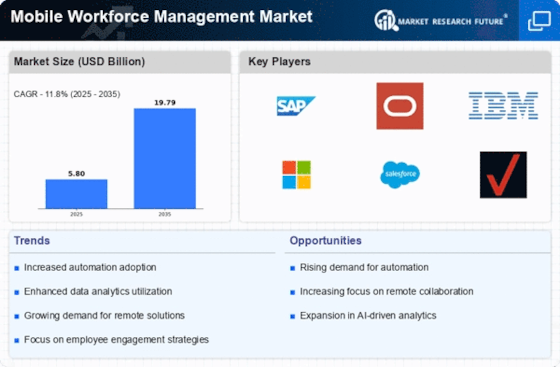
As per Market Research Future analysis, the Mobile Workforce Management Market Size was estimated at 5.8 USD Billion in 2024. The Mobile Workforce Management industry is projected to grow from 6.485 USD Billion in 2025 to 19.79 USD Billion by 2035, exhibiting a compound annual growth rate (CAGR) of 11.8% during the forecast period 2025 - 2035

Key Market Trends & Highlights

The Mobile Workforce Management Market is experiencing robust growth driven by technological advancements and evolving workforce needs.

  • The market is witnessing increased adoption of cloud-based solutions, particularly in North America, which remains the largest market. Employee engagement and satisfaction are becoming focal points for organizations, influencing their workforce management strategies. Integration of artificial intelligence and automation is reshaping operational efficiencies, especially in the logistics sector, which is the fastest-growing segment. Rising demand for remote work solutions and technological advancements in mobile applications are key drivers propelling market expansion.

Market Size & Forecast

2024 Market Size 5.8 (USD Billion)
2035 Market Size 19.79 (USD Billion)
CAGR (2025 - 2035) 11.8%
Largest Regional Market Share in 2024 North America

Major Players

SAP (DE), Oracle (US), IBM (US), Microsoft (US), Salesforce (US), Verizon (US), <a href="https://www.insidermonkey.com/blog/heres-what-you-need-to-know-about-servicetitan-inc-ttan-1664432/">ServiceTitan</a> (US), ClickSoftware (IL), MobiWork (US)

Market Trends

The Mobile Workforce Management Market is currently experiencing a transformative phase, driven by advancements in technology and the increasing need for operational efficiency. Organizations are increasingly adopting mobile solutions to streamline their workforce management processes, which include scheduling, tracking, and communication. This shift appears to be influenced by the growing demand for real-time data access and enhanced collaboration among teams. As businesses seek to optimize their resources, the integration of mobile applications into workforce management strategies seems to be a key focus area. Moreover, the rise of remote work and flexible job arrangements has further propelled the adoption of mobile workforce management solutions.

Companies are recognizing the necessity of equipping their employees with tools that facilitate productivity, regardless of location. This trend indicates a broader movement towards digital transformation, where organizations are leveraging mobile technologies to enhance employee engagement and improve service delivery. The Mobile Workforce Management Market is poised for continued growth as businesses adapt to evolving workforce dynamics and technological advancements. The mobile workforce management ecosystem is expanding rapidly as organizations adopt scalable mobile workforce management software to improve operational visibility. Demand for mobile workforce solutions is rising alongside the need for global workforce management capabilities in distributed operations. Modern enterprises increasingly rely on workforce management mobile platforms to enable real-time coordination of field teams. Organizations are deploying advanced mobile workforce management solutions to streamline scheduling, tracking, and collaboration. The evolution of mobile work management tools is enabling supervisors to function as real-time mobile workforce managers. 

Adoption of the mobile workforce management app model is accelerating due to increased remote accessibility. Enterprises are investing in integrated mobile workforce management systems to improve workforce allocation and performance monitoring. Advanced mobile workforce scheduling software enhances productivity by optimizing shift planning. Adoption of field workforce management software and mobile field management software is growing across logistics and service industries. Utilities increasingly deploy utility management software integrated with workforce mobility platforms. Demand for electric utility software is driving adoption of mobile workforce solutions in field-heavy sectors.

Increased Adoption of Cloud-Based Solutions

Organizations are increasingly turning to cloud-based mobile workforce management solutions. This trend suggests a preference for scalable and flexible systems that can be accessed from various devices, enhancing collaboration and data sharing.

Focus on Employee Engagement and Satisfaction

There is a growing emphasis on tools that enhance employee engagement within the Mobile Workforce Management Market. Companies are recognizing that satisfied employees are more productive, leading to the development of applications that prioritize user experience and feedback.

Integration of Artificial Intelligence and Automation

The integration of artificial intelligence and automation technologies is becoming more prevalent in mobile workforce management. This trend indicates a shift towards smarter solutions that can analyze data and optimize workforce operations, potentially leading to improved decision-making.

Mobile Workforce Management Market Market Drivers

Expansion of Service-Based Industries

The expansion of service-based industries is playing a pivotal role in the growth of the Mobile Workforce Management Market. As sectors such as healthcare, logistics, and field services continue to grow, the need for efficient workforce management solutions becomes increasingly apparent. Service-based industries often rely on a mobile workforce to deliver services directly to clients, making effective management essential for operational success. Recent data indicates that service-based industries are projected to grow by over 15% in the coming years, further driving the demand for mobile workforce management solutions. This expansion presents a significant opportunity for the Mobile Workforce Management Market to innovate and provide tailored solutions that meet the unique needs of these sectors.

Rising Demand for Remote Work Solutions

The Mobile Workforce Management Market is experiencing a notable surge in demand for remote work solutions. As organizations increasingly adopt flexible work arrangements, the need for effective management tools becomes paramount. According to recent data, approximately 70% of companies are now offering remote work options, which necessitates robust workforce management systems. These systems facilitate communication, task allocation, and performance tracking, ensuring that remote employees remain productive and engaged. The shift towards remote work is not merely a trend; it appears to be a fundamental change in how businesses operate. Consequently, the Mobile Workforce Management Market is likely to expand as companies seek to implement solutions that cater to this evolving work environment.

Growing Emphasis on Data-Driven Decision Making

The Mobile Workforce Management Market is increasingly shaped by a growing emphasis on data-driven decision making. Organizations are recognizing the value of data analytics in optimizing workforce performance and resource allocation. By leveraging data insights, companies can identify trends, forecast needs, and make informed decisions that enhance operational efficiency. Recent studies suggest that businesses utilizing data analytics in workforce management can achieve up to a 25% increase in productivity. This trend underscores the importance of integrating advanced analytics into mobile workforce management solutions, thereby driving growth in the Mobile Workforce Management Market as organizations seek to harness the power of data.

Technological Advancements in Mobile Applications

Technological advancements in mobile applications are significantly influencing the Mobile Workforce Management Market. The proliferation of smartphones and tablets has enabled organizations to deploy mobile workforce management solutions that enhance operational efficiency. Recent statistics indicate that mobile applications can improve productivity by up to 30%, as they allow employees to access critical information and tools on-the-go. This accessibility fosters real-time communication and collaboration among team members, which is essential in today's fast-paced business landscape. As technology continues to evolve, the Mobile Workforce Management Market is expected to witness further innovations, potentially leading to more sophisticated applications that integrate seamlessly with existing systems.

Increased Focus on Compliance and Regulatory Requirements

An increased focus on compliance and regulatory requirements is emerging as a critical driver in the Mobile Workforce Management Market. Organizations are under constant pressure to adhere to various labor laws and industry regulations, which necessitates the implementation of effective workforce management solutions. These solutions help ensure that companies remain compliant with regulations related to employee hours, safety standards, and data protection. As regulatory scrutiny intensifies, the demand for mobile workforce management tools that facilitate compliance is likely to rise. This trend not only protects organizations from potential legal issues but also enhances their reputation, thereby contributing to the growth of the Mobile Workforce Management Market.

Market Segment Insights

By Deployment: Cloud (Largest) vs. On-Premise (Fastest-Growing)

<p>In the Mobile Workforce Management Market, the deployment segment is primarily split between Cloud and On-Premise solutions. Cloud deployments dominate the market, offering scalable solutions that cater to the growing demand for mobile workforce management. The convenience of accessibility and lower operational costs associated with cloud-based solutions have made them the preferred choice among enterprises looking to enhance workforce efficiency and productivity.</p>

<p>Deployment: Cloud (Dominant) vs. On-Premise (Emerging)</p>

<p>Cloud deployment is characterized by its scalability, flexibility, and ease of access, making it the dominant choice for most organizations. It eliminates the need for substantial upfront investments in hardware and infrastructure, facilitating quicker deployment times and smoother updates. On the other hand, On-Premise solutions are experiencing rapid growth as they appeal to enterprises that prioritize security and total control over their data. While historically less flexible, the advancements in technology have enabled On-Premise solutions to evolve, making them a viable option for businesses requiring stringent regulatory compliance and data governance.</p>

By End-User: BFSI (Largest) vs. Logistics (Fastest-Growing)

<p>In the Mobile Workforce Management Market, the distribution of market share among different end-user segments showcases noteworthy trends. The BFSI (Banking, Financial Services, and Insurance) sector dominates the landscape, leveraging mobile management solutions to streamline operations and enhance service delivery. Following closely, sectors such as logistics and manufacturing are also significant players, utilizing these technologies to improve workforce productivity and manage resources more effectively.</p>

<p>BFSI: Dominant vs. Logistics: Emerging</p>

<p>The BFSI sector remains the dominant end-user in the Mobile Workforce Management Market due to its critical need for efficient, real-time data management and enhanced communication capabilities. Organizations within this sector prioritize customer service and regulatory compliance, driving the adoption of mobile solutions. Conversely, the logistics sector is emerging rapidly as a key player, with a focus on optimizing supply chain management through mobile tools. This segment is experiencing increased investment, necessitated by the growing demand for real-time tracking and delivery optimization, which is reshaping operational efficiency.</p>

By Tools: IOS (Largest) vs. Android (Fastest-Growing)

<p>In the Mobile Workforce Management Market, the tools segment is predominantly led by iOS, which commands a significant share due to its established user base in enterprises prioritizing mobile security and productivity. Android, gaining traction, is rapidly increasing its footprint, especially in industries that favor cost-effective solutions and a wider range of devices. Companies are increasingly adopting both platforms to ensure compatibility across diverse workforce tools.</p>

<p>IOS: Dominant vs. Android: Emerging</p>

<p>The characteristics of the iOS tool segment include its robustness and reliability, making it a favorite among organizations committed to maintaining high security and operational efficiency. It provides a seamless integration with enterprise-level applications, fostering enhanced productivity. In contrast, the Android segment is emerging with aggressive growth, appealing to businesses looking for flexibility and customization. Its open-source nature allows companies to build tailored applications, making Android a cost-effective option for mobile workforce management. As organizations seek solutions that combine affordability with functionality, Android's appeal is on the rise, ensuring it remains a pivotal player in the market.</p>

Get more detailed insights about Mobile Workforce Management Market – Global Forecast to 2035

Regional Insights

North America : Technology Adoption Leader

North America is the largest market for Mobile Workforce Management Market, holding approximately 45% of the global share. The region's growth is driven by rapid technological advancements, increasing demand for operational efficiency, and a strong focus on workforce optimization. Regulatory support for digital transformation initiatives further catalyzes market expansion, making it a hub for innovation in workforce management solutions. The United States and Canada are the leading countries in this region, with major players like SAP, Oracle, and Microsoft establishing a strong presence. The competitive landscape is characterized by continuous innovation and strategic partnerships among key players. The emphasis on cloud-based solutions and mobile applications is reshaping the market, ensuring that North America remains at the forefront of Mobile Workforce Management Market.

Europe : Emerging Market Dynamics

Europe is witnessing significant growth in the Mobile Workforce Management Market, accounting for approximately 30% of the global share. The region's expansion is fueled by increasing labor costs, a shift towards remote work, and stringent regulations promoting workforce efficiency. Countries like Germany and the UK are leading this growth, supported by government initiatives aimed at enhancing productivity and technological adoption in various sectors. Germany, the UK, and France are the primary markets within Europe, with a competitive landscape featuring key players such as SAP and Oracle. The presence of innovative startups and established firms is driving competition, leading to the development of advanced solutions tailored to meet diverse industry needs. The focus on sustainability and compliance with EU regulations further shapes the market dynamics, ensuring a robust growth trajectory.

Asia-Pacific : Rapid Growth and Innovation

Asia-Pacific is rapidly emerging as a significant player in the Mobile Workforce Management Market, holding around 20% of the global share. The region's growth is driven by increasing smartphone penetration, a burgeoning gig economy, and a rising demand for efficient workforce solutions. Countries like China and India are at the forefront, supported by government initiatives promoting digitalization and smart technologies in various sectors. China and India are the leading markets in this region, with a competitive landscape that includes both local and international players. The presence of companies like IBM and Microsoft highlights the region's potential for innovation and growth. The increasing focus on automation and data analytics is reshaping the market, ensuring that Asia-Pacific continues to evolve as a key player in Mobile Workforce Management Market solutions.

Middle East and Africa : Untapped Market Potential

The Middle East and Africa region is gradually emerging in the Mobile Workforce Management Market, accounting for approximately 5% of the global share. The growth is driven by increasing investments in technology, a young workforce, and a rising demand for efficient management solutions. Countries like South Africa and the UAE are leading this growth, supported by government initiatives aimed at enhancing workforce productivity and technological adoption. South Africa and the UAE are the primary markets in this region, with a competitive landscape that includes both local and international players. The presence of companies like ServiceTitan and ClickSoftware indicates the region's potential for growth. The focus on mobile solutions and cloud-based applications is reshaping the market, ensuring that the Middle East and Africa capitalize on emerging opportunities in Mobile Workforce Management Market.

Key Players and Competitive Insights

The large-scale R&D initiatives by significant industry participants to broaden their product lines have resulted in the growth of the market for mobile workforce management systems. Significant improvements in the market can be attained through agreements, mergers and acquisitions, greater investments, and cooperation with other organizations. Significant industrial companies meticulously prepare a range of initiatives to increase their reach. Mobile Workforce Management Market must offer services at fair costs to keep growing and thriving in a challenging and competitive market climate. Competition among workforce management system software vendors is accelerating innovation in mobile-first platforms.Solutions comparable to enterprise field service management systems demonstrate how integrated ecosystems enhance workforce efficiency.
Local production to cut operating costs is one of the primary strategies firms adopt in the Mobile Workforce Management Market to serve customers better and grow the market industry. Recently, the BFSI industry has greatly benefited from the market for mobile workforce management systems. Major corporations in the Mobile Workforce Management Market, including SAP SE (Germany), ServiceMax (U.S.), Verizon Wireless (U.S.), Actsoft Inc. (U.S), FeedHenry (Red Hat Inc.) (U.S.), and others, are trying to surge market demand by spending on research and development processes.
Fleet Complete, Inc. creates software solutions. The company provides IoT solutions for asset, fleet, and mobile workforce management. Canada is a market that Fleet Complete serves. The goal of Fleet Complete is to connect everything and everyone. Fleet Complete is a top international supplier of IoT solutions for mobile workforce management and linked commercial vehicles. In order to achieve the best possible health and productivity of assets and resources, firms can use Fleet Complete products to enhance safety standards, dispatching, fleet tracking, regulatory compliance, and mobile workforce management.
Fleet Complete is dedicated to sustaining the highest levels of excellence in both its goods and its customer service. Fleet Complete is the fastest-growing telematics supplier in the globe. General Motors' security and connectivity service OnStar Mexico announced in March 2021 that the Fleet Complete service would be introduced in Mexico. Companies can more efficiently manage their car fleets due to this new online platform. Fleet Complete is a top supplier of connected vehicle technology that offers vital solutions for managing assets, mobile workforces, and fleets.
Customer engagement solutions are provided by Verint Systems Inc. (Verint), which are implemented on several cloud platforms. Customer engagement solutions, forecasting and scheduling products, engagement orchestration, fraud and security solutions, conversational AI, knowledge management, quality and compliance, engagement channels, and experience management are just a few of the solutions Verint provides. It provides services to customers in various industries, including government, healthcare, utilities, and financial services. Data capture, machine learning, natural language processing, deep learning algorithms, automation, and artificial intelligence are among the markets its solutions serve. The company conducts business across the Americas, Europe, the Middle East, Africa, and Asia-Pacific.
US-based Verint has its headquarters in Melville, New York.
In November Verint announced the arrival of a new Workforce Management solution. The new Workforce Management system has been updated, is contemporary, and is simple. Time and effort are saved, user skills and linguistic abilities are improved, time zone changes are accommodated, employment needs are met, and Service Level Agreements (SLAs) are met.

Key Companies in the Mobile Workforce Management Market include

Industry Developments

  • Q2 2024: Skedulo raises $75M Series D to expand mobile workforce management platform Skedulo, a provider of mobile workforce management solutions, announced a $75 million Series D funding round led by SoftBank Vision Fund 2 to accelerate product development and global expansion.
  • Q2 2024: ServiceMax Announces Partnership with Salesforce to Enhance Mobile Workforce Management Market ServiceMax announced a strategic partnership with Salesforce to integrate its mobile workforce management platform with Salesforce Field Service, aiming to deliver improved scheduling and field operations for enterprise customers.
  • Q3 2024: Verizon Launches New Mobile Workforce Management Market Solution for 5G-Enabled Enterprises Verizon introduced a new mobile workforce management solution leveraging 5G connectivity, designed to optimize field service operations and real-time workforce tracking for enterprise clients.
  • Q3 2024: SAP acquires workforce management startup ClickMobile for undisclosed sum SAP announced the acquisition of ClickMobile, a mobile workforce management software provider, to strengthen its field service and workforce optimization offerings.
  • Q4 2024: ProntoForms Appoints New CEO to Drive Next Phase of Growth ProntoForms, a mobile forms and workforce management company, announced the appointment of a new Chief Executive Officer to lead its global expansion and product innovation strategy.
  • Q4 2024: Actsoft Launches Enhanced Mobile Workforce Management Market Platform with AI-Powered Scheduling Actsoft unveiled a major update to its mobile workforce management platform, introducing AI-powered scheduling and real-time analytics to improve field service efficiency.
  • Q1 2025: ServicePower Wins Major Contract with UK Utilities Provider for Mobile Workforce Management Market ServicePower announced it has secured a multi-year contract to provide its mobile workforce management software to a leading UK utilities provider, supporting field service operations across the country.
  • Q1 2025: Oracle launches new cloud-based mobile workforce management suite Oracle introduced a new cloud-based suite for mobile workforce management, targeting large enterprises seeking to modernize field service and employee scheduling.
  • Q2 2025: MobiWork Expands Global Footprint with New Office in Singapore MobiWork, a provider of mobile workforce management solutions, announced the opening of a new regional office in Singapore to support its growing customer base in Asia-Pacific.
  • Q2 2025: Pegasystems Partners with IBM to Deliver AI-Driven Mobile Workforce Solutions Pegasystems announced a partnership with IBM to co-develop AI-driven mobile workforce management solutions, aiming to enhance automation and decision-making for field service organizations.
  • Q3 2025: FieldAware acquired by Trimble to bolster mobile workforce management portfolio Trimble announced the acquisition of FieldAware, a mobile workforce management software company, to expand its offerings in field service and workforce optimization.
  • Q3 2025: TeleCommunications Systems Launches Next-Gen Mobile Workforce Management Market Platform TeleCommunications Systems introduced its next-generation mobile workforce management platform, featuring enhanced security and real-time communication tools for field teams.

Future Outlook

Mobile Workforce Management Market Future Outlook

The Mobile Workforce Management Market is projected to grow at 11.8% CAGR from 2025 to 2035, driven by technological advancements, increasing demand for operational efficiency, and workforce mobility.

New opportunities lie in:

  • <p>Integration of AI-driven analytics for real-time decision-making Development of mobile applications for remote team collaboration Expansion of IoT-enabled devices for enhanced field service management</p>

By 2035, the market is expected to be robust, reflecting substantial growth and innovation.

Market Segmentation

Mobile Workforce Management Market Tools Outlook

  • IOS
  • Android
  • MySQL
  • Windows

Mobile Workforce Management Market End-User Outlook

  • BFSI
  • Communication
  • Logistics
  • Manufacturing
  • Procurement
  • Others

Mobile Workforce Management Market Deployment Outlook

  • Cloud
  • On-Premise

Report Scope

MARKET SIZE 2024 5.8(USD Billion)
MARKET SIZE 2025 6.485(USD Billion)
MARKET SIZE 2035 19.79(USD Billion)
COMPOUND ANNUAL GROWTH RATE (CAGR) 11.8% (2025 - 2035)
REPORT COVERAGE Revenue Forecast, Competitive Landscape, Growth Factors, and Trends
BASE YEAR 2024
Market Forecast Period 2025 - 2035
Historical Data 2019 - 2024
Market Forecast Units USD Billion
Key Companies Profiled SAP (DE), Oracle (US), IBM (US), Microsoft (US), Salesforce (US), Verizon (US), ServiceTitan (US), ClickSoftware (IL), MobiWork (US)
Segments Covered Deployment, End-User, Tools, Region
Key Market Opportunities Integration of artificial intelligence and automation enhances efficiency in the Mobile Workforce Management Market.
Key Market Dynamics Rising demand for real-time data analytics drives innovation in Mobile Workforce Management solutions across various industries.
Countries Covered North America, Europe, APAC, South America, MEA

FAQs

What is the projected market valuation of the Mobile Workforce Management Market by 2035?

<p>The Mobile Workforce Management Market is projected to reach approximately 19.79 USD Billion by 2035.</p>

What was the market valuation of the Mobile Workforce Management Market in 2024?

<p>In 2024, the Mobile Workforce Management Market was valued at 5.8 USD Billion.</p>

What is the expected CAGR for the Mobile Workforce Management Market during the forecast period 2025 - 2035?

<p>The expected CAGR for the Mobile Workforce Management Market during the forecast period 2025 - 2035 is 11.8%.</p>

Which deployment segment is anticipated to dominate the Mobile Workforce Management Market?

<p>The Cloud deployment segment is anticipated to dominate, with a projected growth from 3.48 USD Billion to 11.12 USD Billion.</p>

How does the Logistics sector contribute to the Mobile Workforce Management Market?

<p>The Logistics sector is expected to grow from 1.15 USD Billion in 2024 to 4.01 USD Billion by 2035.</p>

What are the key players in the Mobile Workforce Management Market?

<p>Key players in the Mobile Workforce Management Market include SAP, Oracle, IBM, Microsoft, and Salesforce.</p>

What is the projected growth of the On-Premise deployment segment by 2035?

The On-Premise deployment segment is projected to grow from 2.32 USD Billion to 8.67 USD Billion by 2035.

Which operating system tools are expected to see significant growth in the Mobile Workforce Management Market?

Android tools are expected to grow from 1.8 USD Billion to 6.0 USD Billion, indicating substantial market potential.

What is the anticipated growth for the BFSI sector within the Mobile Workforce Management Market?

The BFSI sector is projected to expand from 1.16 USD Billion in 2024 to 3.99 USD Billion by 2035.

How does the Mobile Workforce Management Market's growth compare across different end-user segments?

The Manufacturing segment is expected to grow from 1.04 USD Billion to 3.63 USD Billion, reflecting diverse growth across end-user segments.

  1. SECTION I: EXECUTIVE SUMMARY AND KEY HIGHLIGHTS
    1. | 1.1 EXECUTIVE SUMMARY
    2. | | 1.1.1 Market Overview
    3. | | 1.1.2 Key Findings
    4. | | 1.1.3 Market Segmentation
    5. | | 1.1.4 Competitive Landscape
    6. | | 1.1.5 Challenges and Opportunities
    7. | | 1.1.6 Future Outlook
  2. SECTION II: SCOPING, METHODOLOGY AND MARKET STRUCTURE
    1. | 2.1 MARKET INTRODUCTION
    2. | | 2.1.1 Definition
    3. | | 2.1.2 Scope of the study
    4. | | | 2.1.2.1 Research Objective
    5. | | | 2.1.2.2 Assumption
    6. | | | 2.1.2.3 Limitations
    7. | 2.2 RESEARCH METHODOLOGY
    8. | | 2.2.1 Overview
    9. | | 2.2.2 Data Mining
    10. | | 2.2.3 Secondary Research
    11. | | 2.2.4 Primary Research
    12. | | | 2.2.4.1 Primary Interviews and Information Gathering Process
    13. | | | 2.2.4.2 Breakdown of Primary Respondents
    14. | | 2.2.5 Forecasting Model
    15. | | 2.2.6 Market Size Estimation
    16. | | | 2.2.6.1 Bottom-Up Approach
    17. | | | 2.2.6.2 Top-Down Approach
    18. | | 2.2.7 Data Triangulation
    19. | | 2.2.8 Validation
  3. SECTION III: QUALITATIVE ANALYSIS
    1. | 3.1 MARKET DYNAMICS
    2. | | 3.1.1 Overview
    3. | | 3.1.2 Drivers
    4. | | 3.1.3 Restraints
    5. | | 3.1.4 Opportunities
    6. | 3.2 MARKET FACTOR ANALYSIS
    7. | | 3.2.1 Value chain Analysis
    8. | | 3.2.2 Porter's Five Forces Analysis
    9. | | | 3.2.2.1 Bargaining Power of Suppliers
    10. | | | 3.2.2.2 Bargaining Power of Buyers
    11. | | | 3.2.2.3 Threat of New Entrants
    12. | | | 3.2.2.4 Threat of Substitutes
    13. | | | 3.2.2.5 Intensity of Rivalry
    14. | | 3.2.3 COVID-19 Impact Analysis
    15. | | | 3.2.3.1 Market Impact Analysis
    16. | | | 3.2.3.2 Regional Impact
    17. | | | 3.2.3.3 Opportunity and Threat Analysis
  4. SECTION IV: QUANTITATIVE ANALYSIS
    1. | 4.1 Information and Communications Technology, BY Deployment (USD Billion)
    2. | | 4.1.1 Cloud
    3. | | 4.1.2 On-Premise
    4. | 4.2 Information and Communications Technology, BY End-User (USD Billion)
    5. | | 4.2.1 BFSI
    6. | | 4.2.2 Communication
    7. | | 4.2.3 Logistics
    8. | | 4.2.4 Manufacturing
    9. | | 4.2.5 Procurement
    10. | | 4.2.6 Others
    11. | 4.3 Information and Communications Technology, BY Tools (USD Billion)
    12. | | 4.3.1 IOS
    13. | | 4.3.2 Android
    14. | | 4.3.3 MySQL
    15. | | 4.3.4 Windows
    16. | 4.4 Information and Communications Technology, BY Region (USD Billion)
    17. | | 4.4.1 North America
    18. | | | 4.4.1.1 US
    19. | | | 4.4.1.2 Canada
    20. | | 4.4.2 Europe
    21. | | | 4.4.2.1 Germany
    22. | | | 4.4.2.2 UK
    23. | | | 4.4.2.3 France
    24. | | | 4.4.2.4 Russia
    25. | | | 4.4.2.5 Italy
    26. | | | 4.4.2.6 Spain
    27. | | | 4.4.2.7 Rest of Europe
    28. | | 4.4.3 APAC
    29. | | | 4.4.3.1 China
    30. | | | 4.4.3.2 India
    31. | | | 4.4.3.3 Japan
    32. | | | 4.4.3.4 South Korea
    33. | | | 4.4.3.5 Malaysia
    34. | | | 4.4.3.6 Thailand
    35. | | | 4.4.3.7 Indonesia
    36. | | | 4.4.3.8 Rest of APAC
    37. | | 4.4.4 South America
    38. | | | 4.4.4.1 Brazil
    39. | | | 4.4.4.2 Mexico
    40. | | | 4.4.4.3 Argentina
    41. | | | 4.4.4.4 Rest of South America
    42. | | 4.4.5 MEA
    43. | | | 4.4.5.1 GCC Countries
    44. | | | 4.4.5.2 South Africa
    45. | | | 4.4.5.3 Rest of MEA
  5. SECTION V: COMPETITIVE ANALYSIS
    1. | 5.1 Competitive Landscape
    2. | | 5.1.1 Overview
    3. | | 5.1.2 Competitive Analysis
    4. | | 5.1.3 Market share Analysis
    5. | | 5.1.4 Major Growth Strategy in the Information and Communications Technology
    6. | | 5.1.5 Competitive Benchmarking
    7. | | 5.1.6 Leading Players in Terms of Number of Developments in the Information and Communications Technology
    8. | | 5.1.7 Key developments and growth strategies
    9. | | | 5.1.7.1 New Product Launch/Service Deployment
    10. | | | 5.1.7.2 Merger & Acquisitions
    11. | | | 5.1.7.3 Joint Ventures
    12. | | 5.1.8 Major Players Financial Matrix
    13. | | | 5.1.8.1 Sales and Operating Income
    14. | | | 5.1.8.2 Major Players R&D Expenditure. 2023
    15. | 5.2 Company Profiles
    16. | | 5.2.1 SAP (DE)
    17. | | | 5.2.1.1 Financial Overview
    18. | | | 5.2.1.2 Products Offered
    19. | | | 5.2.1.3 Key Developments
    20. | | | 5.2.1.4 SWOT Analysis
    21. | | | 5.2.1.5 Key Strategies
    22. | | 5.2.2 Oracle (US)
    23. | | | 5.2.2.1 Financial Overview
    24. | | | 5.2.2.2 Products Offered
    25. | | | 5.2.2.3 Key Developments
    26. | | | 5.2.2.4 SWOT Analysis
    27. | | | 5.2.2.5 Key Strategies
    28. | | 5.2.3 IBM (US)
    29. | | | 5.2.3.1 Financial Overview
    30. | | | 5.2.3.2 Products Offered
    31. | | | 5.2.3.3 Key Developments
    32. | | | 5.2.3.4 SWOT Analysis
    33. | | | 5.2.3.5 Key Strategies
    34. | | 5.2.4 Microsoft (US)
    35. | | | 5.2.4.1 Financial Overview
    36. | | | 5.2.4.2 Products Offered
    37. | | | 5.2.4.3 Key Developments
    38. | | | 5.2.4.4 SWOT Analysis
    39. | | | 5.2.4.5 Key Strategies
    40. | | 5.2.5 Salesforce (US)
    41. | | | 5.2.5.1 Financial Overview
    42. | | | 5.2.5.2 Products Offered
    43. | | | 5.2.5.3 Key Developments
    44. | | | 5.2.5.4 SWOT Analysis
    45. | | | 5.2.5.5 Key Strategies
    46. | | 5.2.6 Verizon (US)
    47. | | | 5.2.6.1 Financial Overview
    48. | | | 5.2.6.2 Products Offered
    49. | | | 5.2.6.3 Key Developments
    50. | | | 5.2.6.4 SWOT Analysis
    51. | | | 5.2.6.5 Key Strategies
    52. | | 5.2.7 ServiceTitan (US)
    53. | | | 5.2.7.1 Financial Overview
    54. | | | 5.2.7.2 Products Offered
    55. | | | 5.2.7.3 Key Developments
    56. | | | 5.2.7.4 SWOT Analysis
    57. | | | 5.2.7.5 Key Strategies
    58. | | 5.2.8 ClickSoftware (IL)
    59. | | | 5.2.8.1 Financial Overview
    60. | | | 5.2.8.2 Products Offered
    61. | | | 5.2.8.3 Key Developments
    62. | | | 5.2.8.4 SWOT Analysis
    63. | | | 5.2.8.5 Key Strategies
    64. | | 5.2.9 MobiWork (US)
    65. | | | 5.2.9.1 Financial Overview
    66. | | | 5.2.9.2 Products Offered
    67. | | | 5.2.9.3 Key Developments
    68. | | | 5.2.9.4 SWOT Analysis
    69. | | | 5.2.9.5 Key Strategies
    70. | 5.3 Appendix
    71. | | 5.3.1 References
    72. | | 5.3.2 Related Reports
  6. LIST OF FIGURES
    1. | 6.1 MARKET SYNOPSIS
    2. | 6.2 NORTH AMERICA MARKET ANALYSIS
    3. | 6.3 US MARKET ANALYSIS BY DEPLOYMENT
    4. | 6.4 US MARKET ANALYSIS BY END-USER
    5. | 6.5 US MARKET ANALYSIS BY TOOLS
    6. | 6.6 CANADA MARKET ANALYSIS BY DEPLOYMENT
    7. | 6.7 CANADA MARKET ANALYSIS BY END-USER
    8. | 6.8 CANADA MARKET ANALYSIS BY TOOLS
    9. | 6.9 EUROPE MARKET ANALYSIS
    10. | 6.10 GERMANY MARKET ANALYSIS BY DEPLOYMENT
    11. | 6.11 GERMANY MARKET ANALYSIS BY END-USER
    12. | 6.12 GERMANY MARKET ANALYSIS BY TOOLS
    13. | 6.13 UK MARKET ANALYSIS BY DEPLOYMENT
    14. | 6.14 UK MARKET ANALYSIS BY END-USER
    15. | 6.15 UK MARKET ANALYSIS BY TOOLS
    16. | 6.16 FRANCE MARKET ANALYSIS BY DEPLOYMENT
    17. | 6.17 FRANCE MARKET ANALYSIS BY END-USER
    18. | 6.18 FRANCE MARKET ANALYSIS BY TOOLS
    19. | 6.19 RUSSIA MARKET ANALYSIS BY DEPLOYMENT
    20. | 6.20 RUSSIA MARKET ANALYSIS BY END-USER
    21. | 6.21 RUSSIA MARKET ANALYSIS BY TOOLS
    22. | 6.22 ITALY MARKET ANALYSIS BY DEPLOYMENT
    23. | 6.23 ITALY MARKET ANALYSIS BY END-USER
    24. | 6.24 ITALY MARKET ANALYSIS BY TOOLS
    25. | 6.25 SPAIN MARKET ANALYSIS BY DEPLOYMENT
    26. | 6.26 SPAIN MARKET ANALYSIS BY END-USER
    27. | 6.27 SPAIN MARKET ANALYSIS BY TOOLS
    28. | 6.28 REST OF EUROPE MARKET ANALYSIS BY DEPLOYMENT
    29. | 6.29 REST OF EUROPE MARKET ANALYSIS BY END-USER
    30. | 6.30 REST OF EUROPE MARKET ANALYSIS BY TOOLS
    31. | 6.31 APAC MARKET ANALYSIS
    32. | 6.32 CHINA MARKET ANALYSIS BY DEPLOYMENT
    33. | 6.33 CHINA MARKET ANALYSIS BY END-USER
    34. | 6.34 CHINA MARKET ANALYSIS BY TOOLS
    35. | 6.35 INDIA MARKET ANALYSIS BY DEPLOYMENT
    36. | 6.36 INDIA MARKET ANALYSIS BY END-USER
    37. | 6.37 INDIA MARKET ANALYSIS BY TOOLS
    38. | 6.38 JAPAN MARKET ANALYSIS BY DEPLOYMENT
    39. | 6.39 JAPAN MARKET ANALYSIS BY END-USER
    40. | 6.40 JAPAN MARKET ANALYSIS BY TOOLS
    41. | 6.41 SOUTH KOREA MARKET ANALYSIS BY DEPLOYMENT
    42. | 6.42 SOUTH KOREA MARKET ANALYSIS BY END-USER
    43. | 6.43 SOUTH KOREA MARKET ANALYSIS BY TOOLS
    44. | 6.44 MALAYSIA MARKET ANALYSIS BY DEPLOYMENT
    45. | 6.45 MALAYSIA MARKET ANALYSIS BY END-USER
    46. | 6.46 MALAYSIA MARKET ANALYSIS BY TOOLS
    47. | 6.47 THAILAND MARKET ANALYSIS BY DEPLOYMENT
    48. | 6.48 THAILAND MARKET ANALYSIS BY END-USER
    49. | 6.49 THAILAND MARKET ANALYSIS BY TOOLS
    50. | 6.50 INDONESIA MARKET ANALYSIS BY DEPLOYMENT
    51. | 6.51 INDONESIA MARKET ANALYSIS BY END-USER
    52. | 6.52 INDONESIA MARKET ANALYSIS BY TOOLS
    53. | 6.53 REST OF APAC MARKET ANALYSIS BY DEPLOYMENT
    54. | 6.54 REST OF APAC MARKET ANALYSIS BY END-USER
    55. | 6.55 REST OF APAC MARKET ANALYSIS BY TOOLS
    56. | 6.56 SOUTH AMERICA MARKET ANALYSIS
    57. | 6.57 BRAZIL MARKET ANALYSIS BY DEPLOYMENT
    58. | 6.58 BRAZIL MARKET ANALYSIS BY END-USER
    59. | 6.59 BRAZIL MARKET ANALYSIS BY TOOLS
    60. | 6.60 MEXICO MARKET ANALYSIS BY DEPLOYMENT
    61. | 6.61 MEXICO MARKET ANALYSIS BY END-USER
    62. | 6.62 MEXICO MARKET ANALYSIS BY TOOLS
    63. | 6.63 ARGENTINA MARKET ANALYSIS BY DEPLOYMENT
    64. | 6.64 ARGENTINA MARKET ANALYSIS BY END-USER
    65. | 6.65 ARGENTINA MARKET ANALYSIS BY TOOLS
    66. | 6.66 REST OF SOUTH AMERICA MARKET ANALYSIS BY DEPLOYMENT
    67. | 6.67 REST OF SOUTH AMERICA MARKET ANALYSIS BY END-USER
    68. | 6.68 REST OF SOUTH AMERICA MARKET ANALYSIS BY TOOLS
    69. | 6.69 MEA MARKET ANALYSIS
    70. | 6.70 GCC COUNTRIES MARKET ANALYSIS BY DEPLOYMENT
    71. | 6.71 GCC COUNTRIES MARKET ANALYSIS BY END-USER
    72. | 6.72 GCC COUNTRIES MARKET ANALYSIS BY TOOLS
    73. | 6.73 SOUTH AFRICA MARKET ANALYSIS BY DEPLOYMENT
    74. | 6.74 SOUTH AFRICA MARKET ANALYSIS BY END-USER
    75. | 6.75 SOUTH AFRICA MARKET ANALYSIS BY TOOLS
    76. | 6.76 REST OF MEA MARKET ANALYSIS BY DEPLOYMENT
    77. | 6.77 REST OF MEA MARKET ANALYSIS BY END-USER
    78. | 6.78 REST OF MEA MARKET ANALYSIS BY TOOLS
    79. | 6.79 KEY BUYING CRITERIA OF INFORMATION AND COMMUNICATIONS TECHNOLOGY
    80. | 6.80 RESEARCH PROCESS OF MRFR
    81. | 6.81 DRO ANALYSIS OF INFORMATION AND COMMUNICATIONS TECHNOLOGY
    82. | 6.82 DRIVERS IMPACT ANALYSIS: INFORMATION AND COMMUNICATIONS TECHNOLOGY
    83. | 6.83 RESTRAINTS IMPACT ANALYSIS: INFORMATION AND COMMUNICATIONS TECHNOLOGY
    84. | 6.84 SUPPLY / VALUE CHAIN: INFORMATION AND COMMUNICATIONS TECHNOLOGY
    85. | 6.85 INFORMATION AND COMMUNICATIONS TECHNOLOGY, BY DEPLOYMENT, 2024 (% SHARE)
    86. | 6.86 INFORMATION AND COMMUNICATIONS TECHNOLOGY, BY DEPLOYMENT, 2024 TO 2035 (USD Billion)
    87. | 6.87 INFORMATION AND COMMUNICATIONS TECHNOLOGY, BY END-USER, 2024 (% SHARE)
    88. | 6.88 INFORMATION AND COMMUNICATIONS TECHNOLOGY, BY END-USER, 2024 TO 2035 (USD Billion)
    89. | 6.89 INFORMATION AND COMMUNICATIONS TECHNOLOGY, BY TOOLS, 2024 (% SHARE)
    90. | 6.90 INFORMATION AND COMMUNICATIONS TECHNOLOGY, BY TOOLS, 2024 TO 2035 (USD Billion)
    91. | 6.91 BENCHMARKING OF MAJOR COMPETITORS
  7. LIST OF TABLES
    1. | 7.1 LIST OF ASSUMPTIONS
    2. | | 7.1.1
    3. | 7.2 North America MARKET SIZE ESTIMATES; FORECAST
    4. | | 7.2.1 BY DEPLOYMENT, 2025-2035 (USD Billion)
    5. | | 7.2.2 BY END-USER, 2025-2035 (USD Billion)
    6. | | 7.2.3 BY TOOLS, 2025-2035 (USD Billion)
    7. | 7.3 US MARKET SIZE ESTIMATES; FORECAST
    8. | | 7.3.1 BY DEPLOYMENT, 2025-2035 (USD Billion)
    9. | | 7.3.2 BY END-USER, 2025-2035 (USD Billion)
    10. | | 7.3.3 BY TOOLS, 2025-2035 (USD Billion)
    11. | 7.4 Canada MARKET SIZE ESTIMATES; FORECAST
    12. | | 7.4.1 BY DEPLOYMENT, 2025-2035 (USD Billion)
    13. | | 7.4.2 BY END-USER, 2025-2035 (USD Billion)
    14. | | 7.4.3 BY TOOLS, 2025-2035 (USD Billion)
    15. | 7.5 Europe MARKET SIZE ESTIMATES; FORECAST
    16. | | 7.5.1 BY DEPLOYMENT, 2025-2035 (USD Billion)
    17. | | 7.5.2 BY END-USER, 2025-2035 (USD Billion)
    18. | | 7.5.3 BY TOOLS, 2025-2035 (USD Billion)
    19. | 7.6 Germany MARKET SIZE ESTIMATES; FORECAST
    20. | | 7.6.1 BY DEPLOYMENT, 2025-2035 (USD Billion)
    21. | | 7.6.2 BY END-USER, 2025-2035 (USD Billion)
    22. | | 7.6.3 BY TOOLS, 2025-2035 (USD Billion)
    23. | 7.7 UK MARKET SIZE ESTIMATES; FORECAST
    24. | | 7.7.1 BY DEPLOYMENT, 2025-2035 (USD Billion)
    25. | | 7.7.2 BY END-USER, 2025-2035 (USD Billion)
    26. | | 7.7.3 BY TOOLS, 2025-2035 (USD Billion)
    27. | 7.8 France MARKET SIZE ESTIMATES; FORECAST
    28. | | 7.8.1 BY DEPLOYMENT, 2025-2035 (USD Billion)
    29. | | 7.8.2 BY END-USER, 2025-2035 (USD Billion)
    30. | | 7.8.3 BY TOOLS, 2025-2035 (USD Billion)
    31. | 7.9 Russia MARKET SIZE ESTIMATES; FORECAST
    32. | | 7.9.1 BY DEPLOYMENT, 2025-2035 (USD Billion)
    33. | | 7.9.2 BY END-USER, 2025-2035 (USD Billion)
    34. | | 7.9.3 BY TOOLS, 2025-2035 (USD Billion)
    35. | 7.10 Italy MARKET SIZE ESTIMATES; FORECAST
    36. | | 7.10.1 BY DEPLOYMENT, 2025-2035 (USD Billion)
    37. | | 7.10.2 BY END-USER, 2025-2035 (USD Billion)
    38. | | 7.10.3 BY TOOLS, 2025-2035 (USD Billion)
    39. | 7.11 Spain MARKET SIZE ESTIMATES; FORECAST
    40. | | 7.11.1 BY DEPLOYMENT, 2025-2035 (USD Billion)
    41. | | 7.11.2 BY END-USER, 2025-2035 (USD Billion)
    42. | | 7.11.3 BY TOOLS, 2025-2035 (USD Billion)
    43. | 7.12 Rest of Europe MARKET SIZE ESTIMATES; FORECAST
    44. | | 7.12.1 BY DEPLOYMENT, 2025-2035 (USD Billion)
    45. | | 7.12.2 BY END-USER, 2025-2035 (USD Billion)
    46. | | 7.12.3 BY TOOLS, 2025-2035 (USD Billion)
    47. | 7.13 APAC MARKET SIZE ESTIMATES; FORECAST
    48. | | 7.13.1 BY DEPLOYMENT, 2025-2035 (USD Billion)
    49. | | 7.13.2 BY END-USER, 2025-2035 (USD Billion)
    50. | | 7.13.3 BY TOOLS, 2025-2035 (USD Billion)
    51. | 7.14 China MARKET SIZE ESTIMATES; FORECAST
    52. | | 7.14.1 BY DEPLOYMENT, 2025-2035 (USD Billion)
    53. | | 7.14.2 BY END-USER, 2025-2035 (USD Billion)
    54. | | 7.14.3 BY TOOLS, 2025-2035 (USD Billion)
    55. | 7.15 India MARKET SIZE ESTIMATES; FORECAST
    56. | | 7.15.1 BY DEPLOYMENT, 2025-2035 (USD Billion)
    57. | | 7.15.2 BY END-USER, 2025-2035 (USD Billion)
    58. | | 7.15.3 BY TOOLS, 2025-2035 (USD Billion)
    59. | 7.16 Japan MARKET SIZE ESTIMATES; FORECAST
    60. | | 7.16.1 BY DEPLOYMENT, 2025-2035 (USD Billion)
    61. | | 7.16.2 BY END-USER, 2025-2035 (USD Billion)
    62. | | 7.16.3 BY TOOLS, 2025-2035 (USD Billion)
    63. | 7.17 South Korea MARKET SIZE ESTIMATES; FORECAST
    64. | | 7.17.1 BY DEPLOYMENT, 2025-2035 (USD Billion)
    65. | | 7.17.2 BY END-USER, 2025-2035 (USD Billion)
    66. | | 7.17.3 BY TOOLS, 2025-2035 (USD Billion)
    67. | 7.18 Malaysia MARKET SIZE ESTIMATES; FORECAST
    68. | | 7.18.1 BY DEPLOYMENT, 2025-2035 (USD Billion)
    69. | | 7.18.2 BY END-USER, 2025-2035 (USD Billion)
    70. | | 7.18.3 BY TOOLS, 2025-2035 (USD Billion)
    71. | 7.19 Thailand MARKET SIZE ESTIMATES; FORECAST
    72. | | 7.19.1 BY DEPLOYMENT, 2025-2035 (USD Billion)
    73. | | 7.19.2 BY END-USER, 2025-2035 (USD Billion)
    74. | | 7.19.3 BY TOOLS, 2025-2035 (USD Billion)
    75. | 7.20 Indonesia MARKET SIZE ESTIMATES; FORECAST
    76. | | 7.20.1 BY DEPLOYMENT, 2025-2035 (USD Billion)
    77. | | 7.20.2 BY END-USER, 2025-2035 (USD Billion)
    78. | | 7.20.3 BY TOOLS, 2025-2035 (USD Billion)
    79. | 7.21 Rest of APAC MARKET SIZE ESTIMATES; FORECAST
    80. | | 7.21.1 BY DEPLOYMENT, 2025-2035 (USD Billion)
    81. | | 7.21.2 BY END-USER, 2025-2035 (USD Billion)
    82. | | 7.21.3 BY TOOLS, 2025-2035 (USD Billion)
    83. | 7.22 South America MARKET SIZE ESTIMATES; FORECAST
    84. | | 7.22.1 BY DEPLOYMENT, 2025-2035 (USD Billion)
    85. | | 7.22.2 BY END-USER, 2025-2035 (USD Billion)
    86. | | 7.22.3 BY TOOLS, 2025-2035 (USD Billion)
    87. | 7.23 Brazil MARKET SIZE ESTIMATES; FORECAST
    88. | | 7.23.1 BY DEPLOYMENT, 2025-2035 (USD Billion)
    89. | | 7.23.2 BY END-USER, 2025-2035 (USD Billion)
    90. | | 7.23.3 BY TOOLS, 2025-2035 (USD Billion)
    91. | 7.24 Mexico MARKET SIZE ESTIMATES; FORECAST
    92. | | 7.24.1 BY DEPLOYMENT, 2025-2035 (USD Billion)
    93. | | 7.24.2 BY END-USER, 2025-2035 (USD Billion)
    94. | | 7.24.3 BY TOOLS, 2025-2035 (USD Billion)
    95. | 7.25 Argentina MARKET SIZE ESTIMATES; FORECAST
    96. | | 7.25.1 BY DEPLOYMENT, 2025-2035 (USD Billion)
    97. | | 7.25.2 BY END-USER, 2025-2035 (USD Billion)
    98. | | 7.25.3 BY TOOLS, 2025-2035 (USD Billion)
    99. | 7.26 Rest of South America MARKET SIZE ESTIMATES; FORECAST
    100. | | 7.26.1 BY DEPLOYMENT, 2025-2035 (USD Billion)
    101. | | 7.26.2 BY END-USER, 2025-2035 (USD Billion)
    102. | | 7.26.3 BY TOOLS, 2025-2035 (USD Billion)
    103. | 7.27 MEA MARKET SIZE ESTIMATES; FORECAST
    104. | | 7.27.1 BY DEPLOYMENT, 2025-2035 (USD Billion)
    105. | | 7.27.2 BY END-USER, 2025-2035 (USD Billion)
    106. | | 7.27.3 BY TOOLS, 2025-2035 (USD Billion)
    107. | 7.28 GCC Countries MARKET SIZE ESTIMATES; FORECAST
    108. | | 7.28.1 BY DEPLOYMENT, 2025-2035 (USD Billion)
    109. | | 7.28.2 BY END-USER, 2025-2035 (USD Billion)
    110. | | 7.28.3 BY TOOLS, 2025-2035 (USD Billion)
    111. | 7.29 South Africa MARKET SIZE ESTIMATES; FORECAST
    112. | | 7.29.1 BY DEPLOYMENT, 2025-2035 (USD Billion)
    113. | | 7.29.2 BY END-USER, 2025-2035 (USD Billion)
    114. | | 7.29.3 BY TOOLS, 2025-2035 (USD Billion)
    115. | 7.30 Rest of MEA MARKET SIZE ESTIMATES; FORECAST
    116. | | 7.30.1 BY DEPLOYMENT, 2025-2035 (USD Billion)
    117. | | 7.30.2 BY END-USER, 2025-2035 (USD Billion)
    118. | | 7.30.3 BY TOOLS, 2025-2035 (USD Billion)
    119. | 7.31 PRODUCT LAUNCH/PRODUCT DEVELOPMENT/APPROVAL
    120. | | 7.31.1
    121. | 7.32 ACQUISITION/PARTNERSHIP
    122. | | 7.32.1

Information and Communications Technology Market Segmentation

Information and Communications Technology By Deployment (USD Billion, 2025-2035)

  • Cloud
  • On-Premise

Information and Communications Technology By End-User (USD Billion, 2025-2035)

  • BFSI
  • Communication
  • Logistics
  • Manufacturing
  • Procurement
  • Others

Information and Communications Technology By Tools (USD Billion, 2025-2035)

  • IOS
  • Android
  • MySQL
  • Windows
Infographic

Free Sample Request

Kindly complete the form below to receive a free sample of this Report

Get Free Sample

Customer Strories

Compare Licence

×
Features License Type
Single User Multiuser License Enterprise User
Price $4,950 $5,950 $7,250
Maximum User Access Limit 1 User Upto 10 Users Unrestricted Access Throughout the Organization
Free Customization
Direct Access to Analyst
Deliverable Format
Platform Access
Discount on Next Purchase 10% 15% 15%
Printable Versions