Request Free Sample ×

Kindly complete the form below to receive a free sample of this Report

* Please use a valid business email

Leading companies partner with us for data-driven Insights

clients tt-cursor
Hero Background
English
Chinese
French
Japanese
Korean
German
Spanish

Mobile Wallet Market Trends

ID: MRFR/ICT/1527-HCR
200 Pages
Aarti Dhapte
March 2026

Mobile Wallet Market Size, Share and Research Report: By Payment Method (Bank Transfer, Credit Card, Debit Card, Mobile Carrier Billing), By Technology (Near Field Communication, QR Code, Cloud-Based), By End-user (Retail, E-commerce, Utilities, Travel), By Platform (Android, iOS, Web-Based), and By Regional (North America, Europe, South America, Asia Pacific, Middle East and Africa) - Industry Forecast to 2035

Share:
Download PDF ×

We do not share your information with anyone. However, we may send you emails based on your report interest from time to time. You may contact us at any time to opt-out.

Mobile Wallet Market Infographic
Purchase Options

Market Trends

Key Emerging Trends in the Mobile Wallet Market

The mobile wallet market has seen huge development and advancement as of late, with shoppers progressively embracing the comfort and security presented by computerized installment arrangements. One of the noticeable market patterns is the flood in mobile wallet use driven by the broad reception of cell phones. As additional people all over the planet own and depend on cell phones, the openness of mobile wallets has extended, adding to the market's vertical direction.

Another key pattern molding the mobile wallet scene is the developing accentuation on contactless installments. The worldwide Coronavirus pandemic has sped up the shift towards contactless exchanges, with customers favoring more secure and more clean installment choices. Mobile wallets, outfitted with NFC (Close to Handle Correspondence) innovation, work with consistent contactless installments, lining up with the changing inclinations of shoppers.

Besides, the joining of trend setting innovations like biometrics and computerized reasoning has improved the security highlights of mobile wallets, cultivating expanded trust among clients. Biometric confirmation techniques, for example, unique mark acknowledgment and facial acknowledgment, add an additional layer of security, addressing concerns connected with misrepresentation and unapproved access. This increased security, combined with easy to use interfaces, has added to the far reaching acknowledgment of mobile wallets as a safe and helpful installment technique.

The mobile wallet market is likewise seeing a pattern towards interoperability and joint effort among different players in the monetary biological system. Organizations are progressively shaping organizations and partnerships to make a consistent and interconnected mobile installment foundation. This cooperation not just advantages shoppers by giving a more extensive and incorporated installment experience yet additionally advances the interoperability of mobile wallets across various stages and gadgets.

Besides, the incorporation of extra highlights inside mobile wallet applications is turning into an unmistakable pattern. Past conventional installment functionalities, mobile wallets are advancing into multifunctional stages that deal administrations, for example, planning devices, devotion projects, and even venture choices. This extension of elements means to make mobile wallets an indispensable piece of clients' monetary lives, giving them a comprehensive answer for dealing with their cash.

The ascent of computerized monetary standards and the developing revenue in National Bank Advanced Monetary standards (CBDCs) likewise influence the mobile wallet market. As states investigate and foster their computerized monetary standards, mobile wallets are probably going to assume a critical part in working with the utilization and exchanges of these computerized monetary forms. This pattern lines up with the more extensive shift towards a credit only economy, where computerized installment strategies, including mobile wallets, are supposed to overwhelm the monetary scene.

Author
Author Profile
Aarti Dhapte
AVP - Research

A consulting professional focused on helping businesses navigate complex markets through structured research and strategic insights. I partner with clients to solve high-impact business problems across market entry strategy, competitive intelligence, and opportunity assessment. Over the course of my experience, I have led and contributed to 100+ market research and consulting engagements, delivering insights across multiple industries and geographies, and supporting strategic decisions linked to $500M+ market opportunities. My core expertise lies in building robust market sizing, forecasting, and commercial models (top-down and bottom-up), alongside deep-dive competitive and industry analysis. I have played a key role in shaping go-to-market strategies, investment cases, and growth roadmaps, enabling clients to make confident, data-backed decisions in dynamic markets.

Leave a Comment

FAQs

What is the current valuation of the Mobile Wallet Market as of 2024?

<p>The Mobile Wallet Market was valued at 2731.11 USD Million in 2024.</p>

What is the projected market valuation for the Mobile Wallet Market in 2035?

<p>The market is projected to reach a valuation of 16432.41 USD Million by 2035.</p>

What is the expected CAGR for the Mobile Wallet Market during the forecast period 2025 - 2035?

<p>The expected CAGR for the Mobile Wallet Market during the forecast period 2025 - 2035 is 17.72%.</p>

Which companies are considered key players in the Mobile Wallet Market?

<p>Key players in the Mobile Wallet Market include Apple, Google, Samsung, PayPal, Alipay, WeChat Pay, Venmo, Zelle, and Square.</p>

What are the primary applications of mobile wallets in terms of market valuation?

<p>In 2024, Retail Payments led with 6465.0 USD Million, followed by Peer to Peer Transfers at 4895.0 USD Million.</p>

How do individuals and businesses utilize mobile wallets according to market segmentation?

<p>Individuals accounted for 6559.45 USD Million, while Small Businesses represented 3279.73 USD Million in 2024.</p>

What technologies are driving the Mobile Wallet Market's growth?

<p>In 2024, Cloud-Based Solutions contributed 4000.0 USD Million, followed by QR Code technology at 3500.0 USD Million.</p>

What payment methods are most commonly used in mobile wallets?

<p>In 2024, Debit Cards dominated with 5400.0 USD Million, while Credit Cards followed closely at 4800.0 USD Million.</p>

How does the Mobile Wallet Market's growth compare across different end users?

<p>Large Enterprises generated 4916.59 USD Million in 2024, indicating a robust demand for mobile wallet solutions.</p>

What trends are expected to shape the Mobile Wallet Market in the coming years?

<p>The market is likely to experience substantial growth driven by technological advancements and increasing consumer adoption through 2035.</p>

Market Summary

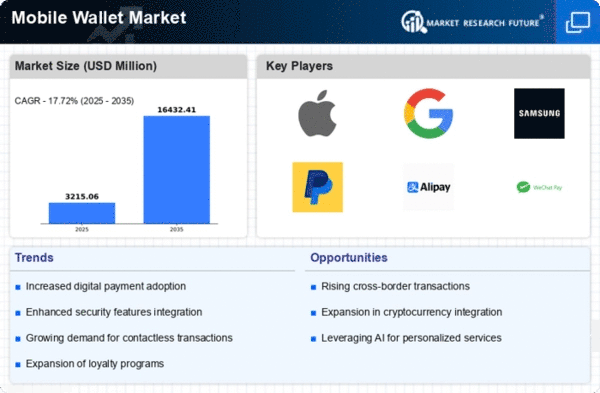
As per MRFR analysis, the Mobile Wallet Market Size was estimated at 2731.11 USD Million in 2024. The Mobile Wallet industry is projected to grow from 3215.07 in 2025 to 16432.41 by 2035, exhibiting a compound annual growth rate (CAGR) of 17.72% during the forecast period 2025 - 2035.

Key Market Trends & Highlights

The Mobile Wallet Market is experiencing robust growth driven by technological advancements and changing consumer preferences.

  • The adoption of contactless payments is witnessing a notable increase, particularly in North America. Integration of loyalty programs into mobile wallets is becoming a prevalent trend, enhancing user engagement. Enhanced security features are being prioritized to build consumer trust in mobile wallet transactions. Rising smartphone penetration and e-commerce growth are key drivers propelling the market forward.

Market Size & Forecast

2024 Market Size 2731.11 (USD Million)
2035 Market Size 16432.41 (USD Million)
CAGR (2025 - 2035) 17.72%
Largest Regional Market Share in 2024 Asia-Pacific

Major Players

Apple (US), Google (US), Samsung (KR), PayPal (US), Alipay (CN), WeChat Pay (CN), Venmo (US), Zelle (US), Square (US)

Market Trends

The Mobile Wallet Market is currently experiencing a transformative phase, characterized by rapid technological advancements and shifting consumer preferences. As digital payment solutions gain traction, the integration of mobile wallets into everyday transactions appears to be becoming increasingly prevalent. This trend is driven by the growing demand for convenience, security, and efficiency in financial transactions. Moreover, the proliferation of smartphones and internet connectivity has facilitated the widespread adoption of mobile wallets, enabling users to make payments seamlessly and securely. As a result, various sectors, including retail, transportation, and hospitality, are increasingly embracing mobile wallet solutions to enhance customer experiences and streamline operations. This report presents the most comprehensive wallet growth trends analysis, covering market size, technology adoption, and regional dynamics through 2035.

Strategic mobile wallet marketing initiatives, including cashback offers and loyalty integrations, are helping providers expand user adoption. The ewallet market is expanding rapidly as consumers shift toward secure, cashless, and mobile-first payment solutions. The broader wallet market is being reshaped by the increasing adoption of mobile and digital payment platforms. Innovation across the wallets market continues to enhance user convenience and transaction security. The digital wallet market serves as a foundational segment supporting the growth of mobile wallet platforms globally. Growth in the e wallet market is supported by rising demand for contactless payments and peer-to-peer transfer solutions.

In addition to technological innovations, regulatory frameworks are evolving to support the growth of the Mobile Wallet Market. Governments and financial institutions are recognizing the potential of digital payment systems to foster financial inclusion and stimulate economic growth. This regulatory support may lead to increased trust among consumers, further propelling the adoption of mobile wallets. Furthermore, partnerships between financial service providers and technology companies are likely to create new opportunities for innovation and expansion within the market. Overall, the Mobile Wallet Market appears poised for continued growth, driven by a combination of consumer demand, technological advancements, and supportive regulatory environments. The e-wallet market is expected to witness sustained growth due to enhanced security features and expanding merchant acceptance. The global digital wallet market is witnessing strong growth as mobile payments become an integral part of daily financial transactions.

The global mobile wallet market is projected to expand significantly through 2035, supported by increasing smartphone penetration and digital payment adoption. Google continues to strengthen its position, with increasing Google Wallet market share driven by Android integration and expanding merchant partnerships. The latest wallet trends include biometric authentication, blockchain-based payments, and integration with loyalty programs. The mobile wallet industry is undergoing rapid transformation due to technological innovation and evolving consumer payment preferences. This mobile wallet research provides in-depth insights into market trends, growth drivers, and competitive strategies.

Increased Adoption of Contactless Payments

The Mobile Wallet Market is witnessing a notable rise in the adoption of contactless payment methods. This trend reflects a growing consumer preference for quick and efficient transactions, allowing users to make payments with minimal physical interaction. As merchants increasingly support contactless technology, the convenience offered by mobile wallets is likely to enhance user experience.

Integration of Loyalty Programs

Another emerging trend within the Mobile Wallet Market is the integration of loyalty programs into mobile wallet applications. This development appears to encourage customer retention and engagement, as users can easily access rewards and discounts through their mobile wallets. Such integration may also provide businesses with valuable insights into consumer behavior.

Enhanced Security Features

The Mobile Wallet Market is also seeing advancements in security features, which are crucial for building consumer trust. Innovations such as biometric authentication and encryption technologies are becoming more prevalent, addressing concerns related to fraud and data breaches. As security measures improve, consumers may feel more confident in utilizing mobile wallets for their transactions.

Mobile Wallet Market Market Drivers

Market Growth Projections

The Global Mobile Wallet Market Industry is poised for substantial growth, with projections indicating a market size of 50 USD Billion by 2035. This anticipated growth reflects a compound annual growth rate (CAGR) of 8.28% from 2025 to 2035, driven by various factors including technological advancements, consumer preferences for digital payments, and increased smartphone penetration. The market dynamics suggest a robust trajectory as more consumers and businesses embrace mobile wallet solutions for their convenience and efficiency.

Enhanced Security Features

The emphasis on security in financial transactions is a critical driver for the Global Mobile Wallet Market Industry. Consumers are increasingly concerned about the safety of their financial data, prompting mobile wallet providers to implement advanced security measures such as biometric authentication and encryption. These features not only instill confidence among users but also encourage the adoption of mobile wallets as a secure payment option. As the Global Mobile Wallet Market Industry evolves, the focus on security is likely to contribute to its growth, with a projected market size of 50 USD Billion by 2035.

Growing E-commerce Adoption

The surge in e-commerce activities worldwide is a notable catalyst for the Global Mobile Wallet Market Industry. As online shopping becomes increasingly prevalent, consumers are seeking seamless payment solutions. Mobile wallets provide a convenient and secure method for transactions, which aligns with the preferences of modern shoppers. In 2024, the Global Mobile Wallet Market Industry is anticipated to benefit from this trend, with projections indicating a market size of 20.8 USD Billion. The integration of mobile wallets into e-commerce platforms enhances user experience and encourages further adoption, thereby driving market growth.

Increased Smartphone Penetration

The proliferation of smartphones globally serves as a primary driver for the Global Mobile Wallet Market Industry. As of 2024, the number of smartphone users is projected to reach approximately 6.8 billion, facilitating easier access to mobile wallet applications. This trend indicates that more consumers are likely to adopt mobile wallets for their convenience and security features. With the increasing reliance on mobile devices for everyday transactions, the Global Mobile Wallet Market Industry is expected to grow significantly, potentially reaching a valuation of 20.8 USD Billion in 2024.

Government Initiatives and Regulations

Government initiatives aimed at promoting digital payments are significantly influencing the Global Mobile Wallet Market Industry. Various countries are implementing policies to encourage cashless transactions, thereby fostering an environment conducive to mobile wallet adoption. For instance, initiatives that support financial inclusion and digital literacy are likely to enhance consumer trust in mobile wallets. As a result, the Global Mobile Wallet Market Industry is expected to experience robust growth, with a compound annual growth rate (CAGR) of 8.28% projected from 2025 to 2035, reflecting the positive impact of these regulatory frameworks.

Rising Demand for Contactless Payments

The increasing demand for contactless payment solutions is a substantial driver for the Global Mobile Wallet Market Industry. Consumers are gravitating towards quick and efficient payment methods that minimize physical contact, particularly in retail environments. Mobile wallets facilitate contactless transactions through technologies such as NFC (Near Field Communication), which enhances user convenience. This trend is expected to propel the Global Mobile Wallet Market Industry towards a valuation of 20.8 USD Billion in 2024, as more businesses adopt mobile wallet solutions to meet consumer preferences.

Market Segment Insights

By Application: Retail Payments (Largest) vs. Peer to Peer Transfers (Fastest-Growing)

In the Mobile Wallet Market, retail payments hold the largest share among application segments, predominantly driven by the growing adoption of contactless payment technologies and the increasing number of merchants accepting mobile wallets. This segment benefits from consumer convenience and the shift towards digital transactions, with users preferring faster, safer payment options over traditional cash. Conversely, peer-to-peer transfers are emerging as the fastest-growing segment, fueled by the rising popularity of sharing economy platforms and instantaneous money transfer options that cater to a younger demographic seeking seamless financial interactions. The growth trends for these segments reveal distinct drivers influencing their paths. Retail payments are bolstered by technological advancements and initiatives from major brands to integrate mobile payments into their platforms. In contrast, peer-to-peer transfers are encouraged by factors such as social networking, which facilitates easy sharing of expenses among friends and family. This reflects a shift in consumer behavior where convenience and speed are paramount, leading to increased engagement with mobile wallet functionalities in everyday financial transactions.

Retail Payments: Dominant vs. Peer to Peer Transfers: Emerging

Retail payments are characterized by their wide acceptance and integration into various retail environments, making them a staple in the mobile wallet ecosystem. This segment effectively captures consumer spending habits, with features like loyalty rewards enhancing user engagement. On the other hand, peer-to-peer transfers represent a rapidly expanding niche, leveraging social dynamics as users seek simple, quick ways to exchange money. This segment often introduces innovative features, such as real-time notifications and social feeds, appealing to millennials and Gen Z users. Together, these segments showcase a balance between established practices in retail and modern trends driving peer-to-peer interactions, paving the way for broader adoption of mobile wallets across diverse demographic groups.

By End User: Individuals (Largest) vs. Large Enterprises (Fastest-Growing)

<p>The mobile wallet market exhibits a diverse distribution among its end user segments, with individuals representing the largest share due to their widespread adoption and daily reliance on mobile payments. Small businesses and non-profit organizations follow, with a noticeable engagement in simplifying transaction processes. Large enterprises and government sectors are progressively integrating mobile wallets, focusing on enhancing operational efficiency and customer convenience. Growth trends indicate that large enterprises are the fastest-growing segment as they strive to digitize payments and offer seamless customer experiences. The shift in consumer behavior towards cashless solutions and the increasing need for speedier transactions drive this growth. Additionally, government initiatives promoting digital payments further accelerate the adoption of mobile wallets across various sectors.</p>

<p>Individuals (Dominant) vs. Large Enterprises (Emerging)</p>

<p>Individuals currently dominate the mobile wallet market due to their expansive usage for everyday transactions, underscoring the trend of cashless economies. Their preference for convenient payment solutions drives innovations in mobile wallet features, fostering competition among different service providers. Meanwhile, large enterprises are emerging players in this space, leveraging mobile wallets for operational efficiencies and enhanced customer engagement. They focus on integrating sophisticated technologies to better serve their customers, while tapping into the growing trend of digital payment acceptance. As these enterprises expand their mobile wallet capabilities, they enhance customer loyalty and operational productivity, thus positioning themselves as serious contenders in the mobile payments landscape.</p>

By Technology: Near Field Communication (Largest) vs. Blockchain Technology (Fastest-Growing)

<p>In the Mobile Wallet Market, Near Field Communication (NFC) has established itself as the leading technology, capturing the largest share due to its widespread adoption and integration across various mobile devices. Meanwhile, QR Code technology remains popular, especially in regions with limited infrastructure, while Cloud-Based Solutions offer flexibility and scalability. Blockchain Technology is gaining traction, particularly among security-conscious users, albeit from a smaller base.</p>

<p>Mobile Wallet Technology: NFC (Dominant) vs. Blockchain Technology (Emerging)</p>

<p>Near Field Communication (NFC) technology is recognized as the dominant player in the Mobile Wallet Market, providing seamless transactions through proximity-based communication, which consumers find convenient and secure. Its integration with smartphones allows users to pay effortlessly at contactless terminals and engage in peer-to-peer transfers. Conversely, Blockchain Technology is emerging as a significant disruptor, offering unparalleled security through decentralized transactions. Its capabilities in enabling cryptocurrency payments and fostering trust among users position it as a revolutionary force in the industry, attracting innovative startups and established financial institutions alike.</p>

By Payment Method: Credit Card (Largest) vs. Cryptocurrency (Fastest-Growing)

In the Mobile Wallet market, the distribution of payment methods showcases a diverse landscape with credit cards holding the largest share due to their widespread acceptance and consumer familiarity. Debit cards also have notable representation, appealing to users who prefer direct fund access, while bank transfers maintain a steady presence. In contrast, the use of cryptocurrency within mobile wallets, although smaller in the current market, is increasing rapidly as more consumers and merchants embrace digital currencies for transactions.

Credit Card (Dominant) vs. Cryptocurrency (Emerging)

Credit cards stand as the dominant payment method in the Mobile Wallet market, reflecting their strong integration into a wide array of digital platforms and consumer habits. This method benefits from robust security measures, extensive rewards programs, and user convenience, making it the preferred choice for many. On the other hand, cryptocurrency represents an emerging but rapidly growing market segment, appealing to tech-savvy consumers and those seeking decentralized financial solutions. As more wallets begin to support cryptocurrencies, usage is expected to fluctuate significantly, driven by shifts in regulatory attitudes and increasing merchant acceptance. Together, these payment methods are shaping the future landscape of mobile transactions.

Get more detailed insights about Mobile Wallet Market Research Report - Global Forecast to 2035

Regional Insights

North America : Digital Payment Leader

North America is witnessing significant growth in the mobile wallet market, driven by increasing smartphone penetration and consumer preference for cashless transactions. The market size is projected to reach $800.0 million by December 2025, reflecting a robust demand for digital payment solutions. Regulatory support for fintech innovations and enhanced security measures are further catalyzing this growth, making mobile wallets a preferred choice for consumers and businesses alike. The competitive landscape in North America is dominated by key players such as Apple, Google, and PayPal, who are continuously innovating to enhance user experience. The presence of established financial institutions and tech giants fosters a vibrant ecosystem for mobile wallets. As consumer trust in digital payments grows, the market is expected to expand, with companies like Venmo and Zelle gaining traction among younger demographics, further solidifying North America's position as a digital payment leader.

Europe : Emerging Digital Economy

Europe is rapidly evolving into a significant player in the mobile wallet market, with a projected market size of $600.0 million by December 2025. The growth is fueled by increasing consumer demand for seamless payment solutions and the rise of e-commerce. Regulatory frameworks, such as the EU's PSD2 directive, are enhancing competition and innovation in the fintech sector, thereby driving the adoption of mobile wallets across the region. Leading countries like Germany, France, and the UK are at the forefront of this transformation, with a growing number of consumers opting for mobile payment solutions. Key players, including Samsung and various local fintech startups, are actively competing to capture market share. The presence of diverse payment options and a strong regulatory environment are expected to propel the mobile wallet market further, making Europe a vibrant hub for digital finance.

Asia-Pacific : Global Market Leader

Asia-Pacific is the largest market for mobile wallets, with a projected size of $1200.0 million by December 2025. The region's growth is fueled by high smartphone penetration, a tech-savvy population, and the rapid expansion of e-commerce. Countries like China and India are leading the charge, with mobile wallets becoming a primary payment method. Regulatory support and government initiatives are also enhancing the ecosystem for digital payments, driving further adoption. China stands out with major players like Alipay and WeChat Pay dominating the market. The competitive landscape is vibrant, with numerous local and international players vying for market share. The presence of innovative solutions and a focus on user experience are key factors contributing to the region's leadership in the mobile wallet sector, making it a focal point for future growth. Asia-Pacific accounted for the largest digital wallet market share in 2024, driven by widespread smartphone adoption and government-led digital payment initiatives. Rapid growth in India is supported by the expansion of mobile wallet companies in India, driven by government-backed digital payment initiatives.

Middle East and Africa : Emerging Payment Solutions

The Middle East and Africa region is witnessing a gradual but promising growth in the mobile wallet market, with a projected size of $131.11 million by December 2025. This growth is driven by increasing smartphone penetration and a shift towards digital payment solutions, particularly in urban areas. Governments are also playing a crucial role by implementing policies that promote financial inclusion and digital transactions, which are essential for economic development in the region. Countries like South Africa and Kenya are leading the charge, with innovative mobile payment solutions gaining traction among consumers. The competitive landscape is characterized by both global players and local startups, creating a dynamic environment for mobile wallets. As awareness and acceptance of digital payments grow, the Middle East and Africa are poised for significant advancements in mobile wallet adoption, contributing to the region's economic transformation.

Key Players and Competitive Insights

The Mobile Wallet Market is currently characterized by a dynamic competitive landscape, driven by rapid technological advancements and shifting consumer preferences towards digital payment solutions. Major players such as Apple (US), Google (US), and Alipay (CN) are at the forefront, each adopting distinct strategies to enhance their market positioning. Apple (US) continues to innovate with its Apple Pay platform, focusing on seamless integration with its ecosystem of devices, while Google (US) emphasizes its Google Pay service by leveraging its extensive data analytics capabilities to personalize user experiences. Alipay (CN), on the other hand, is expanding its reach beyond China, targeting international markets through strategic partnerships, thereby enhancing its global footprint. Collectively, these strategies contribute to a competitive environment that is increasingly defined by technological innovation and user-centric services.In terms of business tactics, companies are increasingly localizing their operations to better cater to regional markets. This includes optimizing supply chains and enhancing customer service capabilities to meet local demands. The competitive structure of the Mobile Wallet Market appears moderately fragmented, with a mix of established players and emerging fintech startups. The influence of key players is substantial, as they not only set industry standards but also drive consumer adoption through aggressive marketing and strategic collaborations.
In November Apple (US) announced a significant partnership with a leading financial institution to enhance its Apple Pay service, allowing users to access exclusive financial products directly through the app. This move is strategically important as it not only broadens the service offerings available to Apple Pay users but also positions Apple (US) as a more comprehensive financial service provider, potentially increasing user engagement and loyalty.
In October Google (US) launched a new feature within Google Pay that utilizes AI to provide personalized budgeting advice based on users' spending habits. This innovation is likely to enhance user experience and retention, as it adds a layer of financial management that differentiates Google Pay from its competitors. By integrating AI, Google (US) is not only improving its service but also aligning with the growing trend of personalized financial solutions.
In September Alipay (CN) expanded its services to include cryptocurrency transactions, allowing users to buy and sell digital currencies directly through the app. This strategic move is indicative of Alipay's commitment to staying ahead of market trends and catering to the evolving preferences of tech-savvy consumers. By embracing cryptocurrency, Alipay (CN) is likely to attract a new demographic of users, further solidifying its position in the global market.
As of December the Mobile Wallet Market is witnessing trends that emphasize digitalization, sustainability, and the integration of AI technologies. Strategic alliances are increasingly shaping the competitive landscape, as companies recognize the value of collaboration in enhancing service offerings and expanding market reach. Looking ahead, competitive differentiation is expected to evolve, with a notable shift from price-based competition to a focus on innovation, technology, and supply chain reliability. This transition underscores the importance of adaptability and forward-thinking strategies in maintaining a competitive edge in the rapidly evolving Mobile Wallet Market.

Key Companies in the Mobile Wallet Market include

Industry Developments

With the help of the EU Digital Markets Act, PayPal introduced tap-to-pay functionality for iPhones in Germany in May 2025. This feature permits contactless Mastercard payments using the PayPal app, with the exception of Apple Watches, and expands NFC usage throughout the EU and beyond.PayPal marked its U.S. point-of-sale growth and deeper mobile wallet strategy in September 2024 by extending its in-person operations in the U.S. by integrating its debit card with Apple Pay, which included 5% cashback incentives on chosen transactions.

A strategic change in Google Wallet's digital wallet strategy was indicated in June 2025 when it stopped supporting PayPal for U.S. users (starting June 13) and prohibited new account linkages. The combined processing of over RMB 186 trillion over China's 2025 cross-border vacation season in June 2025 by WeChat Pay and Alipay strengthened the super-app's dominant position in consumer mobile banking.

Chinese merchants using WooCommerce may now handle RMB payments, vendor cash transfers, and international settlement using a single PayPal Payments Gateway thanks to PayPal's announcement of Complete Payments in China in December 2024.WeChat Pay will be supported by Chinese e-commerce behemoths Taobao and Tmall in September 2024, marking platform openness and ending years of payment exclusivity in China's digital wallet ecosystem.

Future Outlook

Mobile Wallet Market Future Outlook

The Mobile Wallet Market is projected to grow at a 17.72% CAGR from 2025 to 2035, driven by increasing smartphone penetration, enhanced security features, and growing consumer preference for digital payments.

New opportunities lie in:

  • <p>Integration of AI-driven fraud detection systems Expansion of mobile wallet services in emerging markets Partnerships with retail chains for loyalty programs</p>

By 2035, the Mobile Wallet Market is expected to be a dominant force in global financial transactions.

Market Segmentation

Mobile Wallet Market End User Outlook

  • Individuals
  • Small Businesses
  • Large Enterprises
  • Government

Mobile Wallet Market Technology Outlook

  • Near Field Communication
  • QR Code
  • Cloud-Based
  • Blockchain

Mobile Wallet Market Application Outlook

  • Retail Payments
  • Peer to Peer Transfers
  • Bill Payments
  • In-App Purchases

Mobile Wallet Market Payment Method Outlook

  • Credit Card
  • Debit Card
  • Bank Transfer
  • Cryptocurrency

Report Scope

MARKET SIZE 2024 2731.11(USD Million)
MARKET SIZE 2025 3215.07(USD Million)
MARKET SIZE 2035 16432.41(USD Million)
COMPOUND ANNUAL GROWTH RATE (CAGR) 17.72% (2025 - 2035)
REPORT COVERAGE Revenue Forecast, Competitive Landscape, Growth Factors, and Trends
BASE YEAR 2024
Market Forecast Period 2025 - 2035
Historical Data 2019 - 2024
Market Forecast Units USD Million
Key Companies Profiled Apple (US), Google (US), Samsung (KR), PayPal (US), Alipay (CN), WeChat Pay (CN), Venmo (US), Zelle (US), Square (US)
Segments Covered Application, Technology, End User, Payment Method
Key Market Opportunities Integration of advanced security features enhances consumer trust in the Mobile Wallet Market.
Key Market Dynamics Rising consumer preference for contactless payments drives innovation and competition in the Mobile Wallet Market.
Countries Covered North America, Europe, APAC, South America, MEA

FAQs

What is the current valuation of the Mobile Wallet Market as of 2024?

<p>The Mobile Wallet Market was valued at 2731.11 USD Million in 2024.</p>

What is the projected market valuation for the Mobile Wallet Market in 2035?

<p>The market is projected to reach a valuation of 16432.41 USD Million by 2035.</p>

What is the expected CAGR for the Mobile Wallet Market during the forecast period 2025 - 2035?

<p>The expected CAGR for the Mobile Wallet Market during the forecast period 2025 - 2035 is 17.72%.</p>

Which companies are considered key players in the Mobile Wallet Market?

<p>Key players in the Mobile Wallet Market include Apple, Google, Samsung, PayPal, Alipay, WeChat Pay, Venmo, Zelle, and Square.</p>

What are the primary applications of mobile wallets in terms of market valuation?

<p>In 2024, Retail Payments led with 6465.0 USD Million, followed by Peer to Peer Transfers at 4895.0 USD Million.</p>

How do individuals and businesses utilize mobile wallets according to market segmentation?

<p>Individuals accounted for 6559.45 USD Million, while Small Businesses represented 3279.73 USD Million in 2024.</p>

What technologies are driving the Mobile Wallet Market's growth?

<p>In 2024, Cloud-Based Solutions contributed 4000.0 USD Million, followed by QR Code technology at 3500.0 USD Million.</p>

What payment methods are most commonly used in mobile wallets?

<p>In 2024, Debit Cards dominated with 5400.0 USD Million, while Credit Cards followed closely at 4800.0 USD Million.</p>

How does the Mobile Wallet Market's growth compare across different end users?

<p>Large Enterprises generated 4916.59 USD Million in 2024, indicating a robust demand for mobile wallet solutions.</p>

What trends are expected to shape the Mobile Wallet Market in the coming years?

<p>The market is likely to experience substantial growth driven by technological advancements and increasing consumer adoption through 2035.</p>

  1. SECTION I: EXECUTIVE SUMMARY AND KEY HIGHLIGHTS
    1. | 1.1 EXECUTIVE SUMMARY
    2. | | 1.1.1 Market Overview
    3. | | 1.1.2 Key Findings
    4. | | 1.1.3 Market Segmentation
    5. | | 1.1.4 Competitive Landscape
    6. | | 1.1.5 Challenges and Opportunities
    7. | | 1.1.6 Future Outlook
  2. SECTION II: SCOPING, METHODOLOGY AND MARKET STRUCTURE
    1. | 2.1 MARKET INTRODUCTION
    2. | | 2.1.1 Definition
    3. | | 2.1.2 Scope of the study
    4. | | | 2.1.2.1 Research Objective
    5. | | | 2.1.2.2 Assumption
    6. | | | 2.1.2.3 Limitations
    7. | 2.2 RESEARCH METHODOLOGY
    8. | | 2.2.1 Overview
    9. | | 2.2.2 Data Mining
    10. | | 2.2.3 Secondary Research
    11. | | 2.2.4 Primary Research
    12. | | | 2.2.4.1 Primary Interviews and Information Gathering Process
    13. | | | 2.2.4.2 Breakdown of Primary Respondents
    14. | | 2.2.5 Forecasting Model
    15. | | 2.2.6 Market Size Estimation
    16. | | | 2.2.6.1 Bottom-Up Approach
    17. | | | 2.2.6.2 Top-Down Approach
    18. | | 2.2.7 Data Triangulation
    19. | | 2.2.8 Validation
  3. SECTION III: QUALITATIVE ANALYSIS
    1. | 3.1 MARKET DYNAMICS
    2. | | 3.1.1 Overview
    3. | | 3.1.2 Drivers
    4. | | 3.1.3 Restraints
    5. | | 3.1.4 Opportunities
    6. | 3.2 MARKET FACTOR ANALYSIS
    7. | | 3.2.1 Value chain Analysis
    8. | | 3.2.2 Porter's Five Forces Analysis
    9. | | | 3.2.2.1 Bargaining Power of Suppliers
    10. | | | 3.2.2.2 Bargaining Power of Buyers
    11. | | | 3.2.2.3 Threat of New Entrants
    12. | | | 3.2.2.4 Threat of Substitutes
    13. | | | 3.2.2.5 Intensity of Rivalry
    14. | | 3.2.3 COVID-19 Impact Analysis
    15. | | | 3.2.3.1 Market Impact Analysis
    16. | | | 3.2.3.2 Regional Impact
    17. | | | 3.2.3.3 Opportunity and Threat Analysis
  4. SECTION IV: QUANTITATIVE ANALYSIS
    1. | 4.1 Information and Communications Technology, BY Application (USD Million)
    2. | | 4.1.1 Retail Payments
    3. | | 4.1.2 Peer to Peer Transfers
    4. | | 4.1.3 Bill Payments
    5. | | 4.1.4 In-App Purchases
    6. | | 4.1.5 Ticketing Services
    7. | 4.2 Information and Communications Technology, BY End User (USD Million)
    8. | | 4.2.1 Individuals
    9. | | 4.2.2 Small Businesses
    10. | | 4.2.3 Large Enterprises
    11. | | 4.2.4 Government
    12. | | 4.2.5 Non-Profit Organizations
    13. | 4.3 Information and Communications Technology, BY Technology (USD Million)
    14. | | 4.3.1 Near Field Communication
    15. | | 4.3.2 QR Code
    16. | | 4.3.3 Cloud-Based Solutions
    17. | | 4.3.4 Blockchain Technology
    18. | | 4.3.5 Mobile Banking Integration
    19. | 4.4 Information and Communications Technology, BY Payment Method (USD Million)
    20. | | 4.4.1 Credit Card
    21. | | 4.4.2 Debit Card
    22. | | 4.4.3 Bank Transfer
    23. | | 4.4.4 Cryptocurrency
    24. | | 4.4.5 Prepaid Card
    25. | 4.5 Information and Communications Technology, BY Region (USD Million)
    26. | | 4.5.1 North America
    27. | | | 4.5.1.1 US
    28. | | | 4.5.1.2 Canada
    29. | | 4.5.2 Europe
    30. | | | 4.5.2.1 Germany
    31. | | | 4.5.2.2 UK
    32. | | | 4.5.2.3 France
    33. | | | 4.5.2.4 Russia
    34. | | | 4.5.2.5 Italy
    35. | | | 4.5.2.6 Spain
    36. | | | 4.5.2.7 Rest of Europe
    37. | | 4.5.3 APAC
    38. | | | 4.5.3.1 China
    39. | | | 4.5.3.2 India
    40. | | | 4.5.3.3 Japan
    41. | | | 4.5.3.4 South Korea
    42. | | | 4.5.3.5 Malaysia
    43. | | | 4.5.3.6 Thailand
    44. | | | 4.5.3.7 Indonesia
    45. | | | 4.5.3.8 Rest of APAC
    46. | | 4.5.4 South America
    47. | | | 4.5.4.1 Brazil
    48. | | | 4.5.4.2 Mexico
    49. | | | 4.5.4.3 Argentina
    50. | | | 4.5.4.4 Rest of South America
    51. | | 4.5.5 MEA
    52. | | | 4.5.5.1 GCC Countries
    53. | | | 4.5.5.2 South Africa
    54. | | | 4.5.5.3 Rest of MEA
  5. SECTION V: COMPETITIVE ANALYSIS
    1. | 5.1 Competitive Landscape
    2. | | 5.1.1 Overview
    3. | | 5.1.2 Competitive Analysis
    4. | | 5.1.3 Market share Analysis
    5. | | 5.1.4 Major Growth Strategy in the Information and Communications Technology
    6. | | 5.1.5 Competitive Benchmarking
    7. | | 5.1.6 Leading Players in Terms of Number of Developments in the Information and Communications Technology
    8. | | 5.1.7 Key developments and growth strategies
    9. | | | 5.1.7.1 New Product Launch/Service Deployment
    10. | | | 5.1.7.2 Merger & Acquisitions
    11. | | | 5.1.7.3 Joint Ventures
    12. | | 5.1.8 Major Players Financial Matrix
    13. | | | 5.1.8.1 Sales and Operating Income
    14. | | | 5.1.8.2 Major Players R&D Expenditure. 2023
    15. | 5.2 Company Profiles
    16. | | 5.2.1 Apple (US)
    17. | | | 5.2.1.1 Financial Overview
    18. | | | 5.2.1.2 Products Offered
    19. | | | 5.2.1.3 Key Developments
    20. | | | 5.2.1.4 SWOT Analysis
    21. | | | 5.2.1.5 Key Strategies
    22. | | 5.2.2 Google (US)
    23. | | | 5.2.2.1 Financial Overview
    24. | | | 5.2.2.2 Products Offered
    25. | | | 5.2.2.3 Key Developments
    26. | | | 5.2.2.4 SWOT Analysis
    27. | | | 5.2.2.5 Key Strategies
    28. | | 5.2.3 Samsung (KR)
    29. | | | 5.2.3.1 Financial Overview
    30. | | | 5.2.3.2 Products Offered
    31. | | | 5.2.3.3 Key Developments
    32. | | | 5.2.3.4 SWOT Analysis
    33. | | | 5.2.3.5 Key Strategies
    34. | | 5.2.4 PayPal (US)
    35. | | | 5.2.4.1 Financial Overview
    36. | | | 5.2.4.2 Products Offered
    37. | | | 5.2.4.3 Key Developments
    38. | | | 5.2.4.4 SWOT Analysis
    39. | | | 5.2.4.5 Key Strategies
    40. | | 5.2.5 Alipay (CN)
    41. | | | 5.2.5.1 Financial Overview
    42. | | | 5.2.5.2 Products Offered
    43. | | | 5.2.5.3 Key Developments
    44. | | | 5.2.5.4 SWOT Analysis
    45. | | | 5.2.5.5 Key Strategies
    46. | | 5.2.6 WeChat Pay (CN)
    47. | | | 5.2.6.1 Financial Overview
    48. | | | 5.2.6.2 Products Offered
    49. | | | 5.2.6.3 Key Developments
    50. | | | 5.2.6.4 SWOT Analysis
    51. | | | 5.2.6.5 Key Strategies
    52. | | 5.2.7 Venmo (US)
    53. | | | 5.2.7.1 Financial Overview
    54. | | | 5.2.7.2 Products Offered
    55. | | | 5.2.7.3 Key Developments
    56. | | | 5.2.7.4 SWOT Analysis
    57. | | | 5.2.7.5 Key Strategies
    58. | | 5.2.8 Zelle (US)
    59. | | | 5.2.8.1 Financial Overview
    60. | | | 5.2.8.2 Products Offered
    61. | | | 5.2.8.3 Key Developments
    62. | | | 5.2.8.4 SWOT Analysis
    63. | | | 5.2.8.5 Key Strategies
    64. | | 5.2.9 Square (US)
    65. | | | 5.2.9.1 Financial Overview
    66. | | | 5.2.9.2 Products Offered
    67. | | | 5.2.9.3 Key Developments
    68. | | | 5.2.9.4 SWOT Analysis
    69. | | | 5.2.9.5 Key Strategies
    70. | 5.3 Appendix
    71. | | 5.3.1 References
    72. | | 5.3.2 Related Reports
  6. LIST OF FIGURES
    1. | 6.1 MARKET SYNOPSIS
    2. | 6.2 NORTH AMERICA MARKET ANALYSIS
    3. | 6.3 US MARKET ANALYSIS BY APPLICATION
    4. | 6.4 US MARKET ANALYSIS BY END USER
    5. | 6.5 US MARKET ANALYSIS BY TECHNOLOGY
    6. | 6.6 US MARKET ANALYSIS BY PAYMENT METHOD
    7. | 6.7 CANADA MARKET ANALYSIS BY APPLICATION
    8. | 6.8 CANADA MARKET ANALYSIS BY END USER
    9. | 6.9 CANADA MARKET ANALYSIS BY TECHNOLOGY
    10. | 6.10 CANADA MARKET ANALYSIS BY PAYMENT METHOD
    11. | 6.11 EUROPE MARKET ANALYSIS
    12. | 6.12 GERMANY MARKET ANALYSIS BY APPLICATION
    13. | 6.13 GERMANY MARKET ANALYSIS BY END USER
    14. | 6.14 GERMANY MARKET ANALYSIS BY TECHNOLOGY
    15. | 6.15 GERMANY MARKET ANALYSIS BY PAYMENT METHOD
    16. | 6.16 UK MARKET ANALYSIS BY APPLICATION
    17. | 6.17 UK MARKET ANALYSIS BY END USER
    18. | 6.18 UK MARKET ANALYSIS BY TECHNOLOGY
    19. | 6.19 UK MARKET ANALYSIS BY PAYMENT METHOD
    20. | 6.20 FRANCE MARKET ANALYSIS BY APPLICATION
    21. | 6.21 FRANCE MARKET ANALYSIS BY END USER
    22. | 6.22 FRANCE MARKET ANALYSIS BY TECHNOLOGY
    23. | 6.23 FRANCE MARKET ANALYSIS BY PAYMENT METHOD
    24. | 6.24 RUSSIA MARKET ANALYSIS BY APPLICATION
    25. | 6.25 RUSSIA MARKET ANALYSIS BY END USER
    26. | 6.26 RUSSIA MARKET ANALYSIS BY TECHNOLOGY
    27. | 6.27 RUSSIA MARKET ANALYSIS BY PAYMENT METHOD
    28. | 6.28 ITALY MARKET ANALYSIS BY APPLICATION
    29. | 6.29 ITALY MARKET ANALYSIS BY END USER
    30. | 6.30 ITALY MARKET ANALYSIS BY TECHNOLOGY
    31. | 6.31 ITALY MARKET ANALYSIS BY PAYMENT METHOD
    32. | 6.32 SPAIN MARKET ANALYSIS BY APPLICATION
    33. | 6.33 SPAIN MARKET ANALYSIS BY END USER
    34. | 6.34 SPAIN MARKET ANALYSIS BY TECHNOLOGY
    35. | 6.35 SPAIN MARKET ANALYSIS BY PAYMENT METHOD
    36. | 6.36 REST OF EUROPE MARKET ANALYSIS BY APPLICATION
    37. | 6.37 REST OF EUROPE MARKET ANALYSIS BY END USER
    38. | 6.38 REST OF EUROPE MARKET ANALYSIS BY TECHNOLOGY
    39. | 6.39 REST OF EUROPE MARKET ANALYSIS BY PAYMENT METHOD
    40. | 6.40 APAC MARKET ANALYSIS
    41. | 6.41 CHINA MARKET ANALYSIS BY APPLICATION
    42. | 6.42 CHINA MARKET ANALYSIS BY END USER
    43. | 6.43 CHINA MARKET ANALYSIS BY TECHNOLOGY
    44. | 6.44 CHINA MARKET ANALYSIS BY PAYMENT METHOD
    45. | 6.45 INDIA MARKET ANALYSIS BY APPLICATION
    46. | 6.46 INDIA MARKET ANALYSIS BY END USER
    47. | 6.47 INDIA MARKET ANALYSIS BY TECHNOLOGY
    48. | 6.48 INDIA MARKET ANALYSIS BY PAYMENT METHOD
    49. | 6.49 JAPAN MARKET ANALYSIS BY APPLICATION
    50. | 6.50 JAPAN MARKET ANALYSIS BY END USER
    51. | 6.51 JAPAN MARKET ANALYSIS BY TECHNOLOGY
    52. | 6.52 JAPAN MARKET ANALYSIS BY PAYMENT METHOD
    53. | 6.53 SOUTH KOREA MARKET ANALYSIS BY APPLICATION
    54. | 6.54 SOUTH KOREA MARKET ANALYSIS BY END USER
    55. | 6.55 SOUTH KOREA MARKET ANALYSIS BY TECHNOLOGY
    56. | 6.56 SOUTH KOREA MARKET ANALYSIS BY PAYMENT METHOD
    57. | 6.57 MALAYSIA MARKET ANALYSIS BY APPLICATION
    58. | 6.58 MALAYSIA MARKET ANALYSIS BY END USER
    59. | 6.59 MALAYSIA MARKET ANALYSIS BY TECHNOLOGY
    60. | 6.60 MALAYSIA MARKET ANALYSIS BY PAYMENT METHOD
    61. | 6.61 THAILAND MARKET ANALYSIS BY APPLICATION
    62. | 6.62 THAILAND MARKET ANALYSIS BY END USER
    63. | 6.63 THAILAND MARKET ANALYSIS BY TECHNOLOGY
    64. | 6.64 THAILAND MARKET ANALYSIS BY PAYMENT METHOD
    65. | 6.65 INDONESIA MARKET ANALYSIS BY APPLICATION
    66. | 6.66 INDONESIA MARKET ANALYSIS BY END USER
    67. | 6.67 INDONESIA MARKET ANALYSIS BY TECHNOLOGY
    68. | 6.68 INDONESIA MARKET ANALYSIS BY PAYMENT METHOD
    69. | 6.69 REST OF APAC MARKET ANALYSIS BY APPLICATION
    70. | 6.70 REST OF APAC MARKET ANALYSIS BY END USER
    71. | 6.71 REST OF APAC MARKET ANALYSIS BY TECHNOLOGY
    72. | 6.72 REST OF APAC MARKET ANALYSIS BY PAYMENT METHOD
    73. | 6.73 SOUTH AMERICA MARKET ANALYSIS
    74. | 6.74 BRAZIL MARKET ANALYSIS BY APPLICATION
    75. | 6.75 BRAZIL MARKET ANALYSIS BY END USER
    76. | 6.76 BRAZIL MARKET ANALYSIS BY TECHNOLOGY
    77. | 6.77 BRAZIL MARKET ANALYSIS BY PAYMENT METHOD
    78. | 6.78 MEXICO MARKET ANALYSIS BY APPLICATION
    79. | 6.79 MEXICO MARKET ANALYSIS BY END USER
    80. | 6.80 MEXICO MARKET ANALYSIS BY TECHNOLOGY
    81. | 6.81 MEXICO MARKET ANALYSIS BY PAYMENT METHOD
    82. | 6.82 ARGENTINA MARKET ANALYSIS BY APPLICATION
    83. | 6.83 ARGENTINA MARKET ANALYSIS BY END USER
    84. | 6.84 ARGENTINA MARKET ANALYSIS BY TECHNOLOGY
    85. | 6.85 ARGENTINA MARKET ANALYSIS BY PAYMENT METHOD
    86. | 6.86 REST OF SOUTH AMERICA MARKET ANALYSIS BY APPLICATION
    87. | 6.87 REST OF SOUTH AMERICA MARKET ANALYSIS BY END USER
    88. | 6.88 REST OF SOUTH AMERICA MARKET ANALYSIS BY TECHNOLOGY
    89. | 6.89 REST OF SOUTH AMERICA MARKET ANALYSIS BY PAYMENT METHOD
    90. | 6.90 MEA MARKET ANALYSIS
    91. | 6.91 GCC COUNTRIES MARKET ANALYSIS BY APPLICATION
    92. | 6.92 GCC COUNTRIES MARKET ANALYSIS BY END USER
    93. | 6.93 GCC COUNTRIES MARKET ANALYSIS BY TECHNOLOGY
    94. | 6.94 GCC COUNTRIES MARKET ANALYSIS BY PAYMENT METHOD
    95. | 6.95 SOUTH AFRICA MARKET ANALYSIS BY APPLICATION
    96. | 6.96 SOUTH AFRICA MARKET ANALYSIS BY END USER
    97. | 6.97 SOUTH AFRICA MARKET ANALYSIS BY TECHNOLOGY
    98. | 6.98 SOUTH AFRICA MARKET ANALYSIS BY PAYMENT METHOD
    99. | 6.99 REST OF MEA MARKET ANALYSIS BY APPLICATION
    100. | 6.100 REST OF MEA MARKET ANALYSIS BY END USER
    101. | 6.101 REST OF MEA MARKET ANALYSIS BY TECHNOLOGY
    102. | 6.102 REST OF MEA MARKET ANALYSIS BY PAYMENT METHOD
    103. | 6.103 KEY BUYING CRITERIA OF INFORMATION AND COMMUNICATIONS TECHNOLOGY
    104. | 6.104 RESEARCH PROCESS OF MRFR
    105. | 6.105 DRO ANALYSIS OF INFORMATION AND COMMUNICATIONS TECHNOLOGY
    106. | 6.106 DRIVERS IMPACT ANALYSIS: INFORMATION AND COMMUNICATIONS TECHNOLOGY
    107. | 6.107 RESTRAINTS IMPACT ANALYSIS: INFORMATION AND COMMUNICATIONS TECHNOLOGY
    108. | 6.108 SUPPLY / VALUE CHAIN: INFORMATION AND COMMUNICATIONS TECHNOLOGY
    109. | 6.109 INFORMATION AND COMMUNICATIONS TECHNOLOGY, BY APPLICATION, 2024 (% SHARE)
    110. | 6.110 INFORMATION AND COMMUNICATIONS TECHNOLOGY, BY APPLICATION, 2024 TO 2035 (USD Million)
    111. | 6.111 INFORMATION AND COMMUNICATIONS TECHNOLOGY, BY END USER, 2024 (% SHARE)
    112. | 6.112 INFORMATION AND COMMUNICATIONS TECHNOLOGY, BY END USER, 2024 TO 2035 (USD Million)
    113. | 6.113 INFORMATION AND COMMUNICATIONS TECHNOLOGY, BY TECHNOLOGY, 2024 (% SHARE)
    114. | 6.114 INFORMATION AND COMMUNICATIONS TECHNOLOGY, BY TECHNOLOGY, 2024 TO 2035 (USD Million)
    115. | 6.115 INFORMATION AND COMMUNICATIONS TECHNOLOGY, BY PAYMENT METHOD, 2024 (% SHARE)
    116. | 6.116 INFORMATION AND COMMUNICATIONS TECHNOLOGY, BY PAYMENT METHOD, 2024 TO 2035 (USD Million)
    117. | 6.117 BENCHMARKING OF MAJOR COMPETITORS
  7. LIST OF TABLES
    1. | 7.1 LIST OF ASSUMPTIONS
    2. | | 7.1.1
    3. | 7.2 North America MARKET SIZE ESTIMATES; FORECAST
    4. | | 7.2.1 BY APPLICATION, 2025-2035 (USD Million)
    5. | | 7.2.2 BY END USER, 2025-2035 (USD Million)
    6. | | 7.2.3 BY TECHNOLOGY, 2025-2035 (USD Million)
    7. | | 7.2.4 BY PAYMENT METHOD, 2025-2035 (USD Million)
    8. | 7.3 US MARKET SIZE ESTIMATES; FORECAST
    9. | | 7.3.1 BY APPLICATION, 2025-2035 (USD Million)
    10. | | 7.3.2 BY END USER, 2025-2035 (USD Million)
    11. | | 7.3.3 BY TECHNOLOGY, 2025-2035 (USD Million)
    12. | | 7.3.4 BY PAYMENT METHOD, 2025-2035 (USD Million)
    13. | 7.4 Canada MARKET SIZE ESTIMATES; FORECAST
    14. | | 7.4.1 BY APPLICATION, 2025-2035 (USD Million)
    15. | | 7.4.2 BY END USER, 2025-2035 (USD Million)
    16. | | 7.4.3 BY TECHNOLOGY, 2025-2035 (USD Million)
    17. | | 7.4.4 BY PAYMENT METHOD, 2025-2035 (USD Million)
    18. | 7.5 Europe MARKET SIZE ESTIMATES; FORECAST
    19. | | 7.5.1 BY APPLICATION, 2025-2035 (USD Million)
    20. | | 7.5.2 BY END USER, 2025-2035 (USD Million)
    21. | | 7.5.3 BY TECHNOLOGY, 2025-2035 (USD Million)
    22. | | 7.5.4 BY PAYMENT METHOD, 2025-2035 (USD Million)
    23. | 7.6 Germany MARKET SIZE ESTIMATES; FORECAST
    24. | | 7.6.1 BY APPLICATION, 2025-2035 (USD Million)
    25. | | 7.6.2 BY END USER, 2025-2035 (USD Million)
    26. | | 7.6.3 BY TECHNOLOGY, 2025-2035 (USD Million)
    27. | | 7.6.4 BY PAYMENT METHOD, 2025-2035 (USD Million)
    28. | 7.7 UK MARKET SIZE ESTIMATES; FORECAST
    29. | | 7.7.1 BY APPLICATION, 2025-2035 (USD Million)
    30. | | 7.7.2 BY END USER, 2025-2035 (USD Million)
    31. | | 7.7.3 BY TECHNOLOGY, 2025-2035 (USD Million)
    32. | | 7.7.4 BY PAYMENT METHOD, 2025-2035 (USD Million)
    33. | 7.8 France MARKET SIZE ESTIMATES; FORECAST
    34. | | 7.8.1 BY APPLICATION, 2025-2035 (USD Million)
    35. | | 7.8.2 BY END USER, 2025-2035 (USD Million)
    36. | | 7.8.3 BY TECHNOLOGY, 2025-2035 (USD Million)
    37. | | 7.8.4 BY PAYMENT METHOD, 2025-2035 (USD Million)
    38. | 7.9 Russia MARKET SIZE ESTIMATES; FORECAST
    39. | | 7.9.1 BY APPLICATION, 2025-2035 (USD Million)
    40. | | 7.9.2 BY END USER, 2025-2035 (USD Million)
    41. | | 7.9.3 BY TECHNOLOGY, 2025-2035 (USD Million)
    42. | | 7.9.4 BY PAYMENT METHOD, 2025-2035 (USD Million)
    43. | 7.10 Italy MARKET SIZE ESTIMATES; FORECAST
    44. | | 7.10.1 BY APPLICATION, 2025-2035 (USD Million)
    45. | | 7.10.2 BY END USER, 2025-2035 (USD Million)
    46. | | 7.10.3 BY TECHNOLOGY, 2025-2035 (USD Million)
    47. | | 7.10.4 BY PAYMENT METHOD, 2025-2035 (USD Million)
    48. | 7.11 Spain MARKET SIZE ESTIMATES; FORECAST
    49. | | 7.11.1 BY APPLICATION, 2025-2035 (USD Million)
    50. | | 7.11.2 BY END USER, 2025-2035 (USD Million)
    51. | | 7.11.3 BY TECHNOLOGY, 2025-2035 (USD Million)
    52. | | 7.11.4 BY PAYMENT METHOD, 2025-2035 (USD Million)
    53. | 7.12 Rest of Europe MARKET SIZE ESTIMATES; FORECAST
    54. | | 7.12.1 BY APPLICATION, 2025-2035 (USD Million)
    55. | | 7.12.2 BY END USER, 2025-2035 (USD Million)
    56. | | 7.12.3 BY TECHNOLOGY, 2025-2035 (USD Million)
    57. | | 7.12.4 BY PAYMENT METHOD, 2025-2035 (USD Million)
    58. | 7.13 APAC MARKET SIZE ESTIMATES; FORECAST
    59. | | 7.13.1 BY APPLICATION, 2025-2035 (USD Million)
    60. | | 7.13.2 BY END USER, 2025-2035 (USD Million)
    61. | | 7.13.3 BY TECHNOLOGY, 2025-2035 (USD Million)
    62. | | 7.13.4 BY PAYMENT METHOD, 2025-2035 (USD Million)
    63. | 7.14 China MARKET SIZE ESTIMATES; FORECAST
    64. | | 7.14.1 BY APPLICATION, 2025-2035 (USD Million)
    65. | | 7.14.2 BY END USER, 2025-2035 (USD Million)
    66. | | 7.14.3 BY TECHNOLOGY, 2025-2035 (USD Million)
    67. | | 7.14.4 BY PAYMENT METHOD, 2025-2035 (USD Million)
    68. | 7.15 India MARKET SIZE ESTIMATES; FORECAST
    69. | | 7.15.1 BY APPLICATION, 2025-2035 (USD Million)
    70. | | 7.15.2 BY END USER, 2025-2035 (USD Million)
    71. | | 7.15.3 BY TECHNOLOGY, 2025-2035 (USD Million)
    72. | | 7.15.4 BY PAYMENT METHOD, 2025-2035 (USD Million)
    73. | 7.16 Japan MARKET SIZE ESTIMATES; FORECAST
    74. | | 7.16.1 BY APPLICATION, 2025-2035 (USD Million)
    75. | | 7.16.2 BY END USER, 2025-2035 (USD Million)
    76. | | 7.16.3 BY TECHNOLOGY, 2025-2035 (USD Million)
    77. | | 7.16.4 BY PAYMENT METHOD, 2025-2035 (USD Million)
    78. | 7.17 South Korea MARKET SIZE ESTIMATES; FORECAST
    79. | | 7.17.1 BY APPLICATION, 2025-2035 (USD Million)
    80. | | 7.17.2 BY END USER, 2025-2035 (USD Million)
    81. | | 7.17.3 BY TECHNOLOGY, 2025-2035 (USD Million)
    82. | | 7.17.4 BY PAYMENT METHOD, 2025-2035 (USD Million)
    83. | 7.18 Malaysia MARKET SIZE ESTIMATES; FORECAST
    84. | | 7.18.1 BY APPLICATION, 2025-2035 (USD Million)
    85. | | 7.18.2 BY END USER, 2025-2035 (USD Million)
    86. | | 7.18.3 BY TECHNOLOGY, 2025-2035 (USD Million)
    87. | | 7.18.4 BY PAYMENT METHOD, 2025-2035 (USD Million)
    88. | 7.19 Thailand MARKET SIZE ESTIMATES; FORECAST
    89. | | 7.19.1 BY APPLICATION, 2025-2035 (USD Million)
    90. | | 7.19.2 BY END USER, 2025-2035 (USD Million)
    91. | | 7.19.3 BY TECHNOLOGY, 2025-2035 (USD Million)
    92. | | 7.19.4 BY PAYMENT METHOD, 2025-2035 (USD Million)
    93. | 7.20 Indonesia MARKET SIZE ESTIMATES; FORECAST
    94. | | 7.20.1 BY APPLICATION, 2025-2035 (USD Million)
    95. | | 7.20.2 BY END USER, 2025-2035 (USD Million)
    96. | | 7.20.3 BY TECHNOLOGY, 2025-2035 (USD Million)
    97. | | 7.20.4 BY PAYMENT METHOD, 2025-2035 (USD Million)
    98. | 7.21 Rest of APAC MARKET SIZE ESTIMATES; FORECAST
    99. | | 7.21.1 BY APPLICATION, 2025-2035 (USD Million)
    100. | | 7.21.2 BY END USER, 2025-2035 (USD Million)
    101. | | 7.21.3 BY TECHNOLOGY, 2025-2035 (USD Million)
    102. | | 7.21.4 BY PAYMENT METHOD, 2025-2035 (USD Million)
    103. | 7.22 South America MARKET SIZE ESTIMATES; FORECAST
    104. | | 7.22.1 BY APPLICATION, 2025-2035 (USD Million)
    105. | | 7.22.2 BY END USER, 2025-2035 (USD Million)
    106. | | 7.22.3 BY TECHNOLOGY, 2025-2035 (USD Million)
    107. | | 7.22.4 BY PAYMENT METHOD, 2025-2035 (USD Million)
    108. | 7.23 Brazil MARKET SIZE ESTIMATES; FORECAST
    109. | | 7.23.1 BY APPLICATION, 2025-2035 (USD Million)
    110. | | 7.23.2 BY END USER, 2025-2035 (USD Million)
    111. | | 7.23.3 BY TECHNOLOGY, 2025-2035 (USD Million)
    112. | | 7.23.4 BY PAYMENT METHOD, 2025-2035 (USD Million)
    113. | 7.24 Mexico MARKET SIZE ESTIMATES; FORECAST
    114. | | 7.24.1 BY APPLICATION, 2025-2035 (USD Million)
    115. | | 7.24.2 BY END USER, 2025-2035 (USD Million)
    116. | | 7.24.3 BY TECHNOLOGY, 2025-2035 (USD Million)
    117. | | 7.24.4 BY PAYMENT METHOD, 2025-2035 (USD Million)
    118. | 7.25 Argentina MARKET SIZE ESTIMATES; FORECAST
    119. | | 7.25.1 BY APPLICATION, 2025-2035 (USD Million)
    120. | | 7.25.2 BY END USER, 2025-2035 (USD Million)
    121. | | 7.25.3 BY TECHNOLOGY, 2025-2035 (USD Million)
    122. | | 7.25.4 BY PAYMENT METHOD, 2025-2035 (USD Million)
    123. | 7.26 Rest of South America MARKET SIZE ESTIMATES; FORECAST
    124. | | 7.26.1 BY APPLICATION, 2025-2035 (USD Million)
    125. | | 7.26.2 BY END USER, 2025-2035 (USD Million)
    126. | | 7.26.3 BY TECHNOLOGY, 2025-2035 (USD Million)
    127. | | 7.26.4 BY PAYMENT METHOD, 2025-2035 (USD Million)
    128. | 7.27 MEA MARKET SIZE ESTIMATES; FORECAST
    129. | | 7.27.1 BY APPLICATION, 2025-2035 (USD Million)
    130. | | 7.27.2 BY END USER, 2025-2035 (USD Million)
    131. | | 7.27.3 BY TECHNOLOGY, 2025-2035 (USD Million)
    132. | | 7.27.4 BY PAYMENT METHOD, 2025-2035 (USD Million)
    133. | 7.28 GCC Countries MARKET SIZE ESTIMATES; FORECAST
    134. | | 7.28.1 BY APPLICATION, 2025-2035 (USD Million)
    135. | | 7.28.2 BY END USER, 2025-2035 (USD Million)
    136. | | 7.28.3 BY TECHNOLOGY, 2025-2035 (USD Million)
    137. | | 7.28.4 BY PAYMENT METHOD, 2025-2035 (USD Million)
    138. | 7.29 South Africa MARKET SIZE ESTIMATES; FORECAST
    139. | | 7.29.1 BY APPLICATION, 2025-2035 (USD Million)
    140. | | 7.29.2 BY END USER, 2025-2035 (USD Million)
    141. | | 7.29.3 BY TECHNOLOGY, 2025-2035 (USD Million)
    142. | | 7.29.4 BY PAYMENT METHOD, 2025-2035 (USD Million)
    143. | 7.30 Rest of MEA MARKET SIZE ESTIMATES; FORECAST
    144. | | 7.30.1 BY APPLICATION, 2025-2035 (USD Million)
    145. | | 7.30.2 BY END USER, 2025-2035 (USD Million)
    146. | | 7.30.3 BY TECHNOLOGY, 2025-2035 (USD Million)
    147. | | 7.30.4 BY PAYMENT METHOD, 2025-2035 (USD Million)
    148. | 7.31 PRODUCT LAUNCH/PRODUCT DEVELOPMENT/APPROVAL
    149. | | 7.31.1
    150. | 7.32 ACQUISITION/PARTNERSHIP
    151. | | 7.32.1

Information and Communications Technology Market Segmentation

Information and Communications Technology By Application (USD Million, 2025-2035)

  • Retail Payments
  • Peer to Peer Transfers
  • Bill Payments
  • In-App Purchases
  • Ticketing Services

Information and Communications Technology By End User (USD Million, 2025-2035)

  • Individuals
  • Small Businesses
  • Large Enterprises
  • Government
  • Non-Profit Organizations

Information and Communications Technology By Technology (USD Million, 2025-2035)

  • Near Field Communication
  • QR Code
  • Cloud-Based Solutions
  • Blockchain Technology
  • Mobile Banking Integration

Information and Communications Technology By Payment Method (USD Million, 2025-2035)

  • Credit Card
  • Debit Card
  • Bank Transfer
  • Cryptocurrency
  • Prepaid Card
Infographic

Free Sample Request

Kindly complete the form below to receive a free sample of this Report

Get Free Sample

Customer Strories

Compare Licence

×
Features License Type
Single User Multiuser License Enterprise User
Price $4,950 $5,950 $7,250
Maximum User Access Limit 1 User Upto 10 Users Unrestricted Access Throughout the Organization
Free Customization
Direct Access to Analyst
Deliverable Format
Platform Access
Discount on Next Purchase 10% 15% 15%
Printable Versions