×
Request Free Sample ×

Kindly complete the form below to receive a free sample of this Report

* Please use a valid business email

Leading companies partner with us for data-driven Insights

clients tt-cursor
Hero Background
English
Chinese
French
Japanese
Korean
German
Spanish

Mobile Robotics Market Trends

ID: MRFR/SEM/1414-HCR
200 Pages
Ankit Gupta
October 2025

Mobile Robotics Market Size, Share and Research Report: By Application (Manufacturing, Logistics, Healthcare, Agriculture, Entertainment), By Type (Humanoid Robots, Automated Guided Vehicles, Drone Robots, Mobile Manipulators, Telepresence Robots), By End Use (Industrial, Commercial, Residential), By Technology (Artificial Intelligence, Sensor Technology, Navigation Systems, Battery Technology) and By Regional (North America, Europe, South America, Asia Pacific, Middle East and Africa) - Industry Forecast Till 2035

Share:
Download PDF ×

We do not share your information with anyone. However, we may send you emails based on your report interest from time to time. You may contact us at any time to opt-out.

Mobile Robotics Market Infographic
×
Mobile Robotics Market Infographic Full View
Purchase Options

Market Trends

Key Emerging Trends in the Mobile Robotics Market

The Mobile Robotics Market is undergoing a plethora of traits that are reshaping the platform and influencing the trajectory of the enterprise. One distinguished trend is the integration of Artificial Intelligence (AI) and system mastering into mobile robots. This infusion of intelligence allows robots to study from their environments, make information-propelled choices, and adapt to converting occasions autonomously. As a result, cell robots have become smarter and greener, opening new possibilities across numerous sectors. Collaborative robotics, or cobots, is another prevailing trend inside the Mobile Robotics marketplace. These robots are intended to work alongside people, fostering a collaborative and synergistic courting between guy and system. This trend is especially obtrusive in industries like production and healthcare, wherein cobots enhance productivity and make contributions to safer operating surroundings. The call for self-reliant cellular robots (AMRs) is on the rise, propelled by the need for automation in logistics and fabric management. AMRs are capable of navigating through dynamic environments without the requirement for predefined paths or outside guidance structures. In the realm of healthcare, the deployment of cellular robots for duties such as affected person care, medicinal drug delivery, and logistics is gaining momentum. The ongoing trend closer to robot help in healthcare settings pursuits to improve patient consequences, lessen the burden on healthcare experts, and enhance general first-rate care. Mobile robots ready with advanced sensors and precision skills play an important part in augmenting healthcare services. The market is also undergoing a surge in the adoption of drones and uncrewed aerial vehicles (UAVs) for various packages. Drones are being hired for duties such as surveillance, inspection, and statistics collection in sectors like agriculture, construction, and infrastructure. The capacity of drones to get admission to hard-to-attain or unsafe areas contributes to their rising recognition throughout diverse industries. Furthermore, the marketplace is presenting process an escalating emphasis on sustainability and environmentally pleasant answers. Mobile robots with electricity-green components, recyclable materials, and decreased carbon footprints are gaining traction. As statistics becomes progressively imperative to choice-making processes, the Mobile Robotics market is experiencing a trend towards connectivity and information analytics. Mobile robots prepared with sensors and conversation technologies enable real-time statistics series and evaluation, supplying precious insights for optimizing operations and improving overall performance. In the quit, the Mobile Robotics market is recognized by a dynamic set of tendencies that might be reshaping the enterprise. From the infusion of AI and collaborative robotics to the upward push of self-reliant mobile robots and the emphasis on sustainability, these tendencies collectively imply a colorful and evolving platform.


Author
Ankit Gupta
Senior Research Analyst

Ankit Gupta is an analyst in market research industry in ICT and SEMI industry. With post-graduation in "Telecom and Marketing Management" and graduation in "Electronics and Telecommunication" vertical he is well versed with recent development in ICT industry as a whole. Having worked on more than 150+ reports including consultation for fortune 500 companies such as Microsoft and Rio Tinto in identifying solutions with respect to business problems his opinions are inclined towards mixture of technical and managerial aspects.

Leave a Comment

FAQs

What is the expected market size of the Global Mobile Robotics Market in 2024?

The Global Mobile Robotics Market is expected to be valued at 49.04 billion USD in 2024.

What is the projected market size for the Global Mobile Robotics Market by 2035?

By 2035, the Global Mobile Robotics Market is projected to reach a value of 150.0 billion USD.

What is the expected compound annual growth rate (CAGR) for the Global Mobile Robotics Market from 2025 to 2035?

The expected CAGR for the Global Mobile Robotics Market from 2025 to 2035 is 10.7%.

Which region held the largest market share in 2024 for the Mobile Robotics Market?

In 2024, North America held the largest market share, valued at 18.51 billion USD.

What will be the market size for the healthcare application within the Mobile Robotics Market in 2035?

The healthcare application within the Mobile Robotics Market is expected to reach 25.0 billion USD by 2035.

Which key players dominate the Mobile Robotics Market?

Major players in the Mobile Robotics Market include Mobile Industrial Robots, ABB, KUKA, Omron Adept Technologies, and iRobot.

What is the expected market size for the logistics application in 2024 within the Mobile Robotics Market?

The logistics application was valued at 12.0 billion USD in 2024 within the Mobile Robotics Market.

What is the estimated market size for the Asia Pacific region in 2035?

The estimated market size for the Asia Pacific region in 2035 is projected to be 30.36 billion USD.

How much is the agriculture segment expected to be valued in 2035?

The agriculture segment of the Mobile Robotics Market is expected to be valued at 18.0 billion USD by 2035.

What are the expected challenges and opportunities impacting the Mobile Robotics Market?

Challenges and opportunities in the Mobile Robotics Market include technological advancements, integration complexities, and rising demand across various sectors.

Market Summary

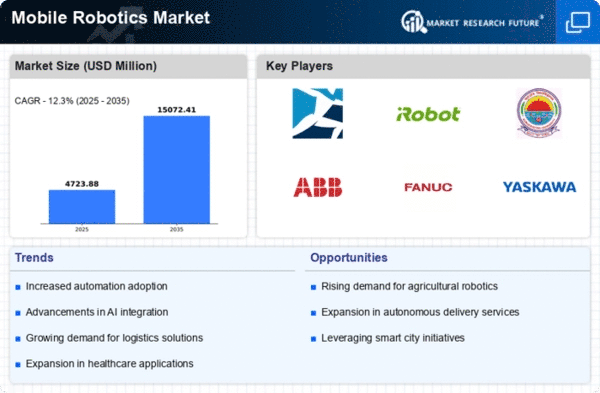
As per MRFR analysis, the Mobile Robotics Market Size was estimated at 4206.48 USD Million in 2024. The Mobile Robotics industry is projected to grow from 4723.97 USD Million in 2025 to 15072.41 USD Million by 2035, exhibiting a compound annual growth rate (CAGR) of 12.3 during the forecast period 2025 - 2035.

Key Market Trends & Highlights

The Mobile Robotics Market is experiencing robust growth driven by technological advancements and increasing automation demands.

  • The logistics segment remains the largest contributor to the Mobile Robotics Market, particularly in North America.
  • Asia-Pacific is emerging as the fastest-growing region, fueled by rapid industrialization and technological adoption.
  • Advancements in AI and machine learning are enhancing the capabilities and efficiency of mobile robots across various sectors.
  • Rising demand for automation and increased investment in research and development are key drivers propelling market expansion.

Market Size & Forecast

2024 Market Size 4206.48 (USD Million)
2035 Market Size 15072.41 (USD Million)
CAGR (2025 - 2035) 12.3%
Largest Regional Market Share in 2024 North America

Major Players

<p>Boston Dynamics (US), iRobot (US), KUKA (DE), ABB (CH), Fanuc (JP), Yaskawa Electric (JP), Omron (JP), Clearpath Robotics (CA), Mobile Industrial Robots (DK)</p>

Market Trends

The Mobile Robotics Market is currently experiencing a transformative phase, driven by advancements in artificial intelligence, machine learning, and sensor technologies. These innovations are enabling robots to perform complex tasks with greater autonomy and efficiency. Industries such as manufacturing, logistics, and healthcare are increasingly adopting mobile robots to enhance operational efficiency and reduce labor costs. The integration of robotics into various sectors appears to be reshaping traditional workflows, leading to improved productivity and safety. Furthermore, the growing demand for automation solutions is likely to propel the market forward, as organizations seek to remain competitive in an evolving landscape. In addition to technological advancements, the Mobile Robotics Market is also influenced by changing consumer preferences and the need for enhanced service delivery. As businesses strive to meet customer expectations, the deployment of mobile robots for tasks such as delivery, inventory management, and customer service is becoming more prevalent. This trend suggests a shift towards a more automated future, where robots play a crucial role in everyday operations. The ongoing research and development efforts in this field indicate a promising outlook for mobile robotics, with potential applications expanding across various industries and sectors.

Increased Adoption in Logistics

The Mobile Robotics Market is witnessing a surge in the utilization of robots within logistics and supply chain operations. Companies are increasingly deploying autonomous mobile robots to streamline processes such as inventory management, order fulfillment, and last-mile delivery. This trend reflects a broader shift towards automation, as businesses seek to enhance efficiency and reduce operational costs.

Advancements in AI and Machine Learning

Recent developments in artificial intelligence and machine learning are significantly impacting the Mobile Robotics Market. These technologies enable robots to learn from their environments, adapt to changing conditions, and perform tasks with minimal human intervention. As AI capabilities continue to evolve, the potential applications for mobile robots are expanding, leading to greater versatility and functionality.

Focus on Safety and Compliance

Safety and regulatory compliance are becoming increasingly important in the Mobile Robotics Market. Organizations are prioritizing the deployment of robots that adhere to safety standards and can operate alongside human workers without compromising safety. This trend indicates a growing awareness of the need for responsible automation, ensuring that mobile robots contribute positively to workplace environments.

Mobile Robotics Market Market Drivers

Growing E-commerce Sector

The rapid expansion of the e-commerce sector significantly influences the Global Mobile Robotics Market Industry. As online shopping continues to gain popularity, logistics and warehousing operations are increasingly adopting mobile robots to streamline order fulfillment processes. These robots facilitate efficient inventory management and last-mile delivery, addressing the growing consumer demand for faster service. The integration of mobile robotics in e-commerce operations not only enhances efficiency but also reduces labor costs. This trend is expected to contribute to the market's growth, aligning with the projected increase in market value to 150 USD Billion by 2035, reflecting the sector's evolving dynamics.

Technological Advancements

Technological advancements play a pivotal role in shaping the Global Mobile Robotics Market Industry. Innovations in artificial intelligence, machine learning, and sensor technologies enhance the capabilities of mobile robots, enabling them to navigate complex environments and perform intricate tasks. For instance, advancements in computer vision allow robots to identify and interact with objects more effectively. These developments not only improve the functionality of mobile robots but also expand their applications across diverse sectors. As technology continues to evolve, the market is expected to witness an influx of sophisticated robotic solutions, contributing to a projected market growth to 150 USD Billion by 2035.

Rising Demand for Automation

The Global Mobile Robotics Market Industry experiences a notable surge in demand for automation across various sectors, including manufacturing, logistics, and healthcare. As industries strive for enhanced efficiency and productivity, mobile robots are increasingly deployed to perform tasks such as material handling and delivery. This trend is supported by the projected market value of 49.0 USD Billion in 2024, indicating a robust growth trajectory. Companies are recognizing the potential of mobile robotics to reduce operational costs and improve service delivery, thereby driving investment in this technology. The ongoing shift towards automation is likely to propel the market further, as organizations seek to remain competitive.

Chart: Global Mobile Robotics Market Growth

This chart illustrates the projected growth trajectory of the Global Mobile Robotics Market Industry, highlighting key milestones such as the anticipated market value of 49.0 USD Billion in 2024 and the expected growth to 150 USD Billion by 2035. The chart also depicts the compound annual growth rate of 10.7% from 2025 to 2035, emphasizing the robust expansion of the market driven by various factors, including technological advancements and increased automation across industries.

Increased Investment in Research and Development

Investment in research and development is a critical driver for the Global Mobile Robotics Market Industry. Governments and private entities are allocating substantial resources to explore innovative robotic solutions that address specific industry challenges. This commitment to R&D fosters the development of advanced mobile robotics systems that can operate autonomously and efficiently. For example, various government initiatives aim to support the integration of robotics in sectors such as agriculture and healthcare, enhancing productivity and service quality. The anticipated compound annual growth rate of 10.7% from 2025 to 2035 underscores the importance of R&D in driving market expansion and technological progress.

Market Segment Insights

By Application: Logistics (Largest) vs. Healthcare (Fastest-Growing)

<p>The application segment of the Mobile Robotics Market reveals a significant distribution of market share across various sectors. Logistics stands out as the largest application, driven by the increasing demand for automation in warehousing and supply chain management. This has led to a higher adoption rate of mobile robots in logistics operations, streamlining processes and enhancing efficiency. Following logistics, healthcare is gaining traction, emerging as a rapidly growing segment due to the rising need for robotic solutions in patient care, surgery assistance, and hospital logistics, reflecting a shift towards automation in medical facilities.</p>

<p>Logistics: Dominant vs. Healthcare: Emerging</p>

<p>Logistics mobile robotics serves as the backbone of automation in supply chain operations, marking its position as a dominant force in the market. These robots significantly enhance operational efficiency, reduce labor costs, and minimize human error, making them essential in modern logistics. In contrast, the healthcare sector is witnessing an emergent trend towards the utilization of mobile robots to improve patient outcomes and hospital efficiency. This includes mobile robots for delivery services in hospitals and robotic surgical assistants. The increasing adoption in healthcare settings reflects a transformation driven by technological advancements and a growing emphasis on automation in patient care.</p>

By End Use: Industrial (Largest) vs. Healthcare (Fastest-Growing)

<p>The Mobile Robotics Market shows a diverse distribution among its end-use segments, with the Industrial sector dominating the market due to the increasing demand for automation in manufacturing and supply chains. It captures a significant portion of the market.Share.The Healthcare segment, while smaller, is rapidly growing as demand for robotics in care facilities and hospitals escalates, particularly with the rise of telepresence and robotic surgery applications. As industries look to streamline operations, the use of robots in various capacity strengthens their foothold, but healthcare's continuous innovations position it as a future leader.</p>

<p>Healthcare: Robotics in Surgery (Dominant) vs. Autonomous Delivery Robots (Emerging)</p>

<p>In the Mobile Robotics Market, robotics in surgery represents a dominant force, as it facilitates precise and less invasive procedures, improving patient outcomes and surgical efficiency. These robotic systems have received widespread adoption across hospitals due to the growing shift towards minimally invasive surgeries. Conversely, Autonomous Delivery Robots are an emerging market segment, gaining traction in healthcare and commercial sectors by automating the transport of supplies and medications within hospitals. While still in the early stages, this segment shows immense potential for growth as hospitals and delivery services seek efficient and effective logistics solutions. As automation expands, both segments are shaping the future landscape of robotics.</p>

By Type: Autonomous Mobile Robots (Largest) vs. Humanoid Robots (Fastest-Growing)

<p>In the Mobile Robotics Market, Autonomous Mobile Robots (AMRs) capture the largest share, leveraging their advanced navigation and operational capabilities across various sectors. They are primarily used in warehouses and manufacturing settings, ensuring efficient logistics and reducing human labor costs. In contrast, Humanoid Robots, while smaller in market share, are the fastest-growing segment, increasingly utilized in education, healthcare, and customer service due to their ability to interact naturally with humans and assist in everyday tasks.</p>

<p>Autonomous Mobile Robots (Dominant) vs. Humanoid Robots (Emerging)</p>

<p>Autonomous Mobile Robots are recognized as the dominant force in the Mobile Robotics Market, thanks to their reliance on sophisticated sensors and AI algorithms that enable efficient route planning and obstacle avoidance. These capabilities allow them to operate seamlessly within complex environments, driving their adoption in industries like e-commerce and manufacturing. On the other hand, Humanoid Robots represent an emerging segment, showcasing innovative advancements in artificial intelligence and human-robot interaction. Their design mimics human actions, making them suited for roles in education and therapy, promising substantial growth as they integrate more deeply into societal functions.</p>

By Technology: Artificial Intelligence (Largest) vs. Machine Learning (Fastest-Growing)

<p>The Mobile Robotics Market showcases a diverse distribution among its technology segments, with Artificial Intelligence leading as the largest contributor. It encompasses advanced algorithms that enhance robotic functionalities significantly. Following closely is Machine Learning, which is rapidly gaining traction due to its ability to allow robots to learn from data and improve performance over time. Other segments like Computer Vision, Sensor Technology, and Navigation Systems play crucial roles, yet their market shares are relatively smaller compared to the leading segments.</p>

<p>Technology: Artificial Intelligence (Dominant) vs. Machine Learning (Emerging)</p>

<p>Artificial Intelligence stands as the dominant force within the Mobile Robotics Market, providing versatile applications across various industries including warehousing, healthcare, and manufacturing. Its ability to perform complex tasks autonomously gives robots a significant advantage. Meanwhile, Machine Learning is emerging robustly, characterized by its capacity to improve decision-making and adaptability in dynamic environments. This technology revolutionizes how mobile robots operate, allowing customization and automation of processes. Together, AI and Machine Learning are driving innovation, with AI offering stability while Machine Learning ensures agility and responsiveness to changing market needs.</p>

By Component: Sensors (Largest) vs. Software (Fastest-Growing)

<p>In the Mobile Robotics Market, the component segment is typified by a distribution that heavily favors sensors, which command the largest market share. This is attributed to their essential role in enabling robots to perceive their environment and make intelligent decisions. Other components, while integral, such as actuators and control systems, hold a smaller share in comparison to sensors and are critical for facilitating movement and operational commands in robotic systems. On the other hand, software represents the fastest-growing component in the Mobile Robotics Market. As advances in artificial intelligence and machine learning continue to evolve, the demand for sophisticated software solutions is surging. This growth is driven by the increasing complexity of robotic applications that require advanced programming and adaptability, solidifying software's role as a pivotal factor in the market's trajectory.</p>

<p>Sensors (Dominant) vs. Software (Emerging)</p>

<p>Sensors are dominant in the Mobile Robotics Market due to their crucial function in environmental sensing, navigation, and obstacle avoidance, providing robots with the necessary data to function autonomously. They encompass various technologies, including LiDAR, cameras, and ultrasonic sensors, making them essential for contemporary robotic designs. In contrast, software represents an emerging trend, with a rapid adoption of AI-driven applications that improve efficiency, decision-making, and user interaction. The software landscape is characterized by an increasing number of applications tailored for specific robotic tasks, allowing for seamless integration of data from sensors and enabling more sophisticated operations, placing it at the forefront of innovation in the mobile robotics segment.</p>

Get more detailed insights about Mobile Robotics Market Research Report - Forecast 2035

Regional Insights

North America : Innovation and Market Leadership

North America continues to dominate the mobile robotics market, holding a significant share of 2100.0M in 2024. The region's growth is driven by advancements in automation technology, increasing demand for efficiency in manufacturing, and supportive government regulations promoting robotics integration. The presence of major players like Boston Dynamics and iRobot further fuels market expansion, as they innovate and introduce cutting-edge solutions to meet diverse industry needs. The United States stands as the leading country in this sector, with a robust competitive landscape characterized by key players such as KUKA and ABB. The market is witnessing a surge in investments aimed at enhancing robotic capabilities across various applications, including logistics and healthcare. As companies increasingly adopt mobile robotics to streamline operations, the region is poised for sustained growth, reinforcing its position as a global leader in robotics technology.

Europe : Emerging Robotics Powerhouse

Europe is rapidly emerging as a significant player in the mobile robotics market, with a market size of 1200.0M. The region benefits from strong governmental support for innovation and sustainability initiatives, which are driving the adoption of robotics across various sectors. Countries like Germany and France are at the forefront, leveraging advanced manufacturing capabilities and a skilled workforce to enhance productivity through automation. The competitive landscape in Europe is marked by the presence of established companies such as KUKA and ABB, which are leading the charge in developing innovative robotic solutions. The European market is characterized by a collaborative approach, with many firms engaging in partnerships to accelerate technological advancements. As the demand for automation continues to rise, Europe is well-positioned to capitalize on these trends, fostering a vibrant ecosystem for mobile robotics.

Asia-Pacific : Rapid Growth and Innovation

The Asia-Pacific region is witnessing rapid growth in the mobile robotics market, with a market size of 800.0M. This growth is primarily driven by increasing industrial automation, rising labor costs, and a growing focus on efficiency across various sectors. Countries like Japan and China are leading the charge, investing heavily in robotics technology to enhance manufacturing processes and logistics operations. The competitive landscape in Asia-Pacific is vibrant, with key players such as Fanuc and Yaskawa Electric making significant strides in innovation. The region is characterized by a mix of established companies and emerging startups, all vying for a share of the growing market. As the demand for mobile robotics solutions continues to escalate, Asia-Pacific is set to become a crucial hub for technological advancements in this field.

Middle East and Africa : Emerging Market Potential

The Middle East and Africa region is gradually emerging in the mobile robotics market, with a market size of 106.48M. The growth is driven by increasing investments in automation and smart technologies, particularly in sectors like logistics and healthcare. Governments are recognizing the potential of robotics to enhance operational efficiency and are implementing supportive policies to encourage adoption. Countries such as South Africa and the UAE are leading the way in integrating mobile robotics into various industries. The competitive landscape is evolving, with both local and international players entering the market to capitalize on emerging opportunities. As the region continues to develop its technological infrastructure, the mobile robotics market is expected to grow significantly, offering numerous opportunities for innovation and investment.

Key Players and Competitive Insights

The Mobile Robotics Market is currently characterized by a dynamic competitive landscape, driven by advancements in automation, artificial intelligence (AI), and the increasing demand for efficiency across various sectors. Key players such as Boston Dynamics (US), iRobot (US), and KUKA (DE) are strategically positioning themselves through innovation and partnerships. Boston Dynamics (US) continues to enhance its robotic capabilities, focusing on agility and versatility, while iRobot (US) emphasizes consumer robotics, particularly in home automation. KUKA (DE) is leveraging its expertise in industrial automation to expand its offerings in mobile robotics, indicating a trend towards integrated solutions that combine robotics with AI and machine learning. Collectively, these strategies are shaping a competitive environment that prioritizes technological advancement and operational efficiency.

In terms of business tactics, companies are increasingly localizing manufacturing to reduce supply chain vulnerabilities and optimize logistics. The market appears moderately fragmented, with a mix of established players and emerging startups. This fragmentation allows for diverse innovations but also intensifies competition among key players. The collective influence of these companies is significant, as they drive trends in automation and robotics, pushing the boundaries of what mobile robots can achieve in various applications.

In November 2025, Boston Dynamics (US) announced a partnership with a leading logistics firm to integrate its Spot robot into warehouse operations. This strategic move is expected to enhance operational efficiency by automating inventory management and reducing labor costs. The collaboration signifies a growing trend towards the adoption of mobile robotics in logistics, where efficiency and speed are paramount.

In October 2025, iRobot (US) launched a new line of advanced home cleaning robots equipped with AI-driven navigation systems. This product release not only showcases iRobot's commitment to innovation but also reflects the increasing consumer demand for smart home solutions. The integration of AI into their products is likely to enhance user experience and solidify iRobot's position in the consumer robotics market.

In September 2025, KUKA (DE) expanded its mobile robotics portfolio by acquiring a startup specializing in autonomous navigation technology. This acquisition is strategically important as it allows KUKA to enhance its existing offerings and provide more sophisticated solutions to its industrial clients. The move indicates a broader trend of consolidation in the market, where established players seek to bolster their technological capabilities through acquisitions.

As of December 2025, the Mobile Robotics Market is witnessing trends that emphasize digitalization, sustainability, and AI integration. Strategic alliances are becoming increasingly vital, as companies recognize the need to collaborate to stay competitive. The shift from price-based competition to a focus on innovation and technology is evident, with companies investing heavily in R&D to differentiate their offerings. Moving forward, competitive differentiation will likely hinge on the ability to deliver reliable, cutting-edge solutions that meet the evolving needs of consumers and industries alike.

Key Companies in the Mobile Robotics Market include

Industry Developments

  • Q2 2024: Agility Robotics opens new robot manufacturing facility in Oregon Agility Robotics announced the opening of its new manufacturing facility in Salem, Oregon, dedicated to producing its humanoid mobile robots for logistics and warehouse automation applications.
  • Q2 2024: ABB acquires Sevensense to boost mobile robot navigation capabilities ABB completed the acquisition of Swiss startup Sevensense, integrating its AI-powered visual navigation technology into ABB’s mobile robotics portfolio to enhance autonomous navigation in industrial environments.
  • Q2 2024: Locus Robotics Announces $50 Million Series E Funding Round Locus Robotics secured $50 million in Series E funding to accelerate the development and deployment of its autonomous mobile robots for warehouse and fulfillment operations.
  • Q3 2024: Geek+ and Körber Announce Strategic Partnership to Expand Mobile Robot Solutions in Europe Geek+ and Körber entered a strategic partnership to jointly deliver advanced autonomous mobile robot solutions for logistics and supply chain customers across Europe.
  • Q3 2024: SoftBank Robotics launches new mobile robot for retail inventory management SoftBank Robotics unveiled a new mobile robot designed for automated inventory tracking in retail stores, aiming to improve accuracy and reduce labor costs.
  • Q3 2024: Omron Opens New Robotics R&D Center in Singapore Omron inaugurated a new research and development center in Singapore focused on advancing mobile robotics technologies for industrial automation.
  • Q4 2024: Boston Dynamics secures $30 million contract with major US retailer for warehouse robots Boston Dynamics signed a $30 million contract to supply its autonomous mobile robots to a leading US retailer, supporting warehouse automation and logistics operations.
  • Q4 2024: KUKA appoints new CEO to lead mobile robotics expansion KUKA announced the appointment of a new CEO, tasked with driving the company’s growth in the mobile robotics sector and expanding its global footprint.
  • Q1 2025: Fetch Robotics launches next-generation AMR platform for manufacturing Fetch Robotics introduced its latest autonomous mobile robot platform, featuring enhanced payload capacity and advanced navigation for manufacturing environments.
  • Q1 2025: iRobot receives regulatory approval for new commercial cleaning robot iRobot obtained regulatory clearance for its new commercial mobile cleaning robot, enabling deployment in public and private facilities across North America.
  • Q2 2025: GreyOrange secures $40 million Series D funding to scale mobile robotics solutions GreyOrange raised $40 million in Series D funding to expand its mobile robotics offerings for warehouse automation and accelerate global market entry.
  • Q2 2025: SuperDroid Robots wins government contract for mobile surveillance robots SuperDroid Robots was awarded a government contract to supply mobile surveillance robots for security and monitoring applications.

Future Outlook

Mobile Robotics Market Future Outlook

<p>The Mobile Robotics Market is projected to grow at a 12.3% CAGR from 2024 to 2035, driven by advancements in AI, automation, and increasing demand for efficiency.</p>

New opportunities lie in:

  • <p>Development of autonomous delivery drones for urban logistics.</p>
  • <p>Integration of AI-driven analytics in robotic systems for enhanced decision-making.</p>
  • <p>Expansion of mobile robotic solutions in healthcare for patient monitoring.</p>

<p>By 2035, the Mobile Robotics Market is expected to be a pivotal sector, reflecting robust growth and innovation.</p>

Market Segmentation

Mobile Robotics Market Type Outlook

  • Autonomous Mobile Robots
  • Humanoid Robots
  • Aerial Robots
  • Ground Robots
  • Underwater Robots

Mobile Robotics Market End Use Outlook

  • Industrial
  • Commercial
  • Residential
  • Military
  • Healthcare

Mobile Robotics Market Component Outlook

  • Sensors
  • Actuators
  • Control Systems
  • Power Supply
  • Software

Mobile Robotics Market Technology Outlook

  • Artificial Intelligence
  • Machine Learning
  • Computer Vision
  • Sensor Technology
  • Navigation Systems

Mobile Robotics Market Application Outlook

  • Logistics
  • Healthcare
  • Agriculture
  • Manufacturing
  • Construction

Report Scope

MARKET SIZE 20244206.48(USD Million)
MARKET SIZE 20254723.97(USD Million)
MARKET SIZE 203515072.41(USD Million)
COMPOUND ANNUAL GROWTH RATE (CAGR)12.3% (2024 - 2035)
REPORT COVERAGERevenue Forecast, Competitive Landscape, Growth Factors, and Trends
BASE YEAR2024
Market Forecast Period2025 - 2035
Historical Data2019 - 2024
Market Forecast UnitsUSD Million
Key Companies ProfiledBoston Dynamics (US), iRobot (US), KUKA (DE), ABB (CH), Fanuc (JP), Yaskawa Electric (JP), Omron (JP), Clearpath Robotics (CA), Mobile Industrial Robots (DK)
Segments CoveredApplication, End Use, Type, Technology, Component
Key Market OpportunitiesIntegration of artificial intelligence enhances efficiency and adaptability in the Mobile Robotics Market.
Key Market DynamicsRising demand for automation drives innovation and competition in the mobile robotics sector across various industries.
Countries CoveredNorth America, Europe, APAC, South America, MEA

FAQs

What is the expected market size of the Global Mobile Robotics Market in 2024?

The Global Mobile Robotics Market is expected to be valued at 49.04 billion USD in 2024.

What is the projected market size for the Global Mobile Robotics Market by 2035?

By 2035, the Global Mobile Robotics Market is projected to reach a value of 150.0 billion USD.

What is the expected compound annual growth rate (CAGR) for the Global Mobile Robotics Market from 2025 to 2035?

The expected CAGR for the Global Mobile Robotics Market from 2025 to 2035 is 10.7%.

Which region held the largest market share in 2024 for the Mobile Robotics Market?

In 2024, North America held the largest market share, valued at 18.51 billion USD.

What will be the market size for the healthcare application within the Mobile Robotics Market in 2035?

The healthcare application within the Mobile Robotics Market is expected to reach 25.0 billion USD by 2035.

Which key players dominate the Mobile Robotics Market?

Major players in the Mobile Robotics Market include Mobile Industrial Robots, ABB, KUKA, Omron Adept Technologies, and iRobot.

What is the expected market size for the logistics application in 2024 within the Mobile Robotics Market?

The logistics application was valued at 12.0 billion USD in 2024 within the Mobile Robotics Market.

What is the estimated market size for the Asia Pacific region in 2035?

The estimated market size for the Asia Pacific region in 2035 is projected to be 30.36 billion USD.

How much is the agriculture segment expected to be valued in 2035?

The agriculture segment of the Mobile Robotics Market is expected to be valued at 18.0 billion USD by 2035.

What are the expected challenges and opportunities impacting the Mobile Robotics Market?

Challenges and opportunities in the Mobile Robotics Market include technological advancements, integration complexities, and rising demand across various sectors.

  1. SECTION I: EXECUTIVE SUMMARY AND KEY HIGHLIGHTS
    1. | 1.1 EXECUTIVE SUMMARY
  2. SECTION II: SCOPING, METHODOLOGY AND MARKET STRUCTURE
    1. | 2.1 MARKET INTRODUCTION
    2. | 2.2 RESEARCH METHODOLOGY
  3. SECTION III: QUALITATIVE ANALYSIS
    1. | 3.1 MARKET DYNAMICS
    2. | 3.2 MARKET FACTOR ANALYSIS
  4. SECTION IV: QUANTITATIVE ANALYSIS
    1. | 4.1 Semiconductor & Electronics, BY Application (USD Million)
    2. | 4.2 Semiconductor & Electronics, BY End Use (USD Million)
    3. | 4.3 Semiconductor & Electronics, BY Type (USD Million)
    4. | 4.4 Semiconductor & Electronics, BY Technology (USD Million)
    5. | 4.5 Semiconductor & Electronics, BY Component (USD Million)
    6. | 4.6 Semiconductor & Electronics, BY Region (USD Million)
  5. SECTION V: COMPETITIVE ANALYSIS
    1. | 5.1 Competitive Landscape
    2. | 5.2 Company Profiles
    3. | 5.3 Appendix

Mobile Robotics Market Segmentation

Market Segmentation Overview

  • Detailed segmentation data will be available in the full report
  • Comprehensive analysis by multiple parameters
  • Regional and country-level breakdowns
  • Market size forecasts by segment
Infographic

Free Sample Request

Kindly complete the form below to receive a free sample of this Report

Get Free Sample

Customer Strories

Compare Licence

×
Features License Type
Single User Multiuser License Enterprise User
Price $4,950 $5,950 $7,250
Maximum User Access Limit 1 User Upto 10 Users Unrestricted Access Throughout the Organization
Free Customization
Direct Access to Analyst
Deliverable Format
Platform Access
Discount on Next Purchase 10% 15% 15%
Printable Versions