Request Free Sample ×

Kindly complete the form below to receive a free sample of this Report

* Please use a valid business email

Leading companies partner with us for data-driven Insights

clients tt-cursor
Hero Background
English
Chinese
French
Japanese
Korean
German
Spanish

Mobile Radiography Systems Market Trends

ID: MRFR/HC/6101-HCR
110 Pages
Vikita Thakur
April 2026

Mobile Radiography Systems Market Research Report, by Type (In-Line, Battery-Powered), Imaging (Film, Computed Radiography, Direct Digital), Application (Orthopedic Imaging, Chest Imaging, Dental Imaging), End User, and Region — Forecast till 2035

Share:
Download PDF ×

We do not share your information with anyone. However, we may send you emails based on your report interest from time to time. You may contact us at any time to opt-out.

Mobile Radiography Systems Market Infographic
Purchase Options

Market Trends

Key Emerging Trends in the Mobile Radiography Systems Market

The demand for mobile radiography systems is on the rise because of the increasing requirement for portable investigative tools. These systems offer adaptability in persistent care by empowering imaging methods to be controlled at the bedside or in remote areas. This portability is especially significant in crisis circumstances and for patients with restricted adaptability. Mobile radiography systems are progressively incorporating remote network highlights, permitting consistent information move and image sharing. Cloud reconciliation works with real-time access to images, advancing partnership among healthcare professionals and empowering fast dynamic cycles. Market patterns show a developing accentuation on limiting radiation for the patients and healthcare suppliers. Manufacturers are incorporating portion decrease innovations, for example, high-level image handling algorithms and portion monitoring systems, to guarantee analytic precision while restricting radiation exposure. Healthcare offices are selecting financially smart arrangements by retrofitting existing radiography hardware with mobile abilities. This pattern permits healthcare suppliers to use the advantages of mobile radiography without critical interests in completely new systems, adding to generally market growth. Artificial intelligence is making advances into mobile radiography, offering automated image investigation and translation. Artificial intelligence algorithms help with recognizing abnormalities, working on indicative effectiveness, and lessening the weight on radiologists. This coordination is ready to alter how mobile radiography is used in clinical settings. Mobile radiography is seeing expanded reception all around the world, driven by the extension of mobile imaging administrations. Mobile imaging units outfitted with radiography systems are being sent in remote and underaided regions, giving access to analytic administrations where conventional foundation is restricted. Manageability is acquiring unique quality in the mobile radiography systems market, with makers incorporating eco-cooperative materials and energy-efficient advancements. This pattern lines up with the more extensive healthcare industry's obligation to diminishing its ecological effect.


Author
Author Profile
Vikita Thakur
Senior Research Analyst

She holds an experience of about 5+ years in market research and business consulting projects for sectors such as life sciences, medical devices, and healthcare IT. She possesses a robust background in data analysis, market estimation, competitive intelligence, pipeline analysis market trend identification, and consumer behavior insights. Her expertise lies in technical Sales support, client interaction and project management, designing and implementing market research studies, conducting competitive analysis, and synthesizing complex data into actionable recommendations that drive business growth.

Leave a Comment

FAQs

What is the projected market valuation of the Mobile Radiography Systems Market by 2035?

<p>The Mobile Radiography Systems Market is projected to reach a valuation of 16.81 USD Billion by 2035.</p>

What was the market valuation of Mobile Radiography Systems in 2024?

<p>In 2024, the overall market valuation for Mobile Radiography Systems was 8.79 USD Billion.</p>

What is the expected CAGR for the Mobile Radiography Systems Market during the forecast period 2025 - 2035?

<p>The expected CAGR for the Mobile Radiography Systems Market during the forecast period 2025 - 2035 is 6.07%.</p>

Which companies are considered key players in the Mobile Radiography Systems Market?

<p>Key players in the Mobile Radiography Systems Market include Siemens Healthineers, GE Healthcare, Philips Healthcare, and Canon Medical Systems.</p>

What are the main segments of the Mobile Radiography Systems Market?

<p>The main segments of the Mobile Radiography Systems Market include system type, power source, imaging type, application, and end user.</p>

How much is the General Radiography System segment expected to grow by 2035?

The General Radiography System segment is expected to grow from 3.5 USD Billion in 2024 to 6.5 USD Billion by 2035.

What is the projected growth for Digital Imaging in the Mobile Radiography Systems Market?

Digital Imaging is projected to grow from 5.28 USD Billion in 2024 to 10.08 USD Billion by 2035.

Which end user segment is expected to have the highest valuation by 2035?

The Hospitals &amp; Clinics end user segment is expected to reach a valuation of 6.73 USD Billion by 2035.

What is the anticipated growth for Battery-powered Mobile Radiography Systems by 2035?

Battery-powered Mobile Radiography Systems are anticipated to grow from 4.4 USD Billion in 2024 to 8.4 USD Billion by 2035.

What applications are driving growth in the Mobile Radiography Systems Market?

Applications such as imaging, image-guided procedures, and orthopedic imaging are driving growth in the Mobile Radiography Systems Market.

Market Summary

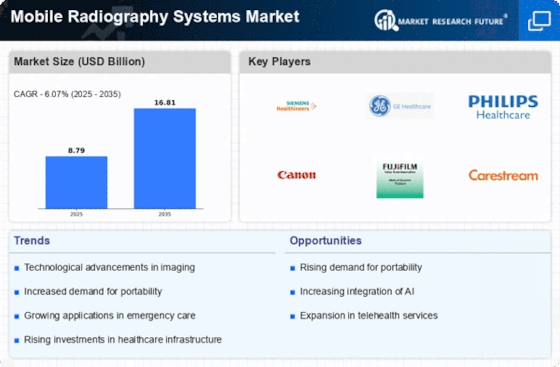
As per Market Research Future analysis, the Mobile Radiography Systems Market was estimated at 8.79 USD Billion in 2024. The Mobile Radiography Systems industry is projected to grow from 9.324 USD Billion in 2025 to 16.81 USD Billion by 2035, exhibiting a compound annual growth rate (CAGR) of 6.07% during the forecast period 2025 - 2035

Key Market Trends & Highlights

The Mobile Radiography Systems Market is experiencing robust growth driven by technological advancements and increasing demand for portable solutions.

  • North America remains the largest market for mobile radiography systems, driven by advanced healthcare infrastructure.
  • Asia-Pacific is emerging as the fastest-growing region, reflecting a surge in healthcare investments and modernization efforts.
  • General radiography systems dominate the market, while battery-powered mobile radiography systems are witnessing the fastest growth.
  • Technological advancements and the rising geriatric population are key drivers propelling market expansion.

Market Size & Forecast

2024 Market Size 8.79 (USD Billion)
2035 Market Size 16.81 (USD Billion)
CAGR (2025 - 2035) 6.07%
Largest Regional Market Share in 2024 Americas

Major Players

Siemens Healthineers (DE), GE Healthcare (US), Philips Healthcare (NL), Canon Medical Systems (JP), Fujifilm Medical Systems (JP), Carestream Health (US), Agfa HealthCare (BE), Hitachi Medical Systems (JP), Konica Minolta Healthcare (JP)

Market Trends

The Mobile Radiography Systems Market is currently experiencing a notable transformation, driven by advancements in technology and an increasing demand for portable imaging solutions. These systems are becoming essential in various healthcare settings, including emergency departments and remote locations, where traditional imaging equipment may not be readily available. The integration of digital technologies and wireless connectivity enhances the efficiency and accuracy of mobile radiography, allowing healthcare professionals to obtain high-quality images swiftly. Furthermore, the growing emphasis on patient-centered care is prompting healthcare facilities to adopt more flexible and accessible imaging options, thereby expanding the market's reach. In addition to technological advancements, the Mobile Radiography Systems Market is influenced by the rising prevalence of chronic diseases and the need for timely diagnosis. As healthcare providers strive to improve patient outcomes, the demand for mobile solutions that facilitate immediate imaging services is likely to increase. Moreover, the ongoing development of innovative features, such as artificial intelligence and advanced imaging algorithms, suggests a promising future for this market. Overall, the Mobile Radiography Systems Market appears poised for growth, driven by a combination of technological innovation and evolving healthcare needs.

Technological Advancements

The Mobile Radiography Systems Market is witnessing rapid technological advancements that enhance imaging capabilities. Innovations such as digital detectors and wireless transmission are improving image quality and workflow efficiency. These developments enable healthcare providers to deliver faster and more accurate diagnoses, which is crucial in emergency and critical care settings.

Increased Demand for Portability

There is a growing demand for portable imaging solutions within the Mobile Radiography Systems Market. Healthcare facilities are increasingly recognizing the benefits of mobile systems that can be easily transported to various locations. This trend is particularly evident in emergency medical services and rural healthcare, where access to traditional imaging equipment may be limited.

Focus on Patient-Centric Care

The Mobile Radiography Systems Market is also influenced by a shift towards patient-centric care. Healthcare providers are prioritizing accessibility and convenience for patients, leading to an increased adoption of mobile radiography systems. This trend reflects a broader movement within the healthcare industry to enhance patient experiences and outcomes.

Mobile Radiography Systems Market Market Drivers

Rising Geriatric Population

The Mobile Radiography Systems Market is significantly influenced by the rising geriatric population. As the global population ages, there is an increasing prevalence of chronic diseases that require regular imaging for monitoring and diagnosis. Mobile radiography systems offer a practical solution for elderly patients who may have mobility issues, allowing for imaging to be conducted in familiar environments such as nursing homes or at home. Market analysis indicates that the demand for mobile systems is likely to grow in tandem with the aging demographic, as healthcare providers seek to accommodate the needs of this population. This trend underscores the importance of mobile radiography in enhancing access to care for older adults.

Focus on Patient-Centric Care

The Mobile Radiography Systems Market is increasingly aligning with the focus on patient-centric care. Healthcare providers are prioritizing patient comfort and convenience, leading to a rise in the adoption of mobile radiography systems. These systems facilitate immediate imaging, which is crucial for timely diagnosis and treatment. The emphasis on reducing patient wait times and enhancing overall experience is driving the demand for mobile solutions. Furthermore, as healthcare systems strive to improve patient outcomes, the integration of mobile radiography into routine care is becoming more prevalent. This shift not only benefits patients but also supports healthcare providers in delivering high-quality care, thereby propelling the market forward.

Increased Demand for Portability

The Mobile Radiography Systems Market is witnessing a notable increase in demand for portable imaging solutions. Healthcare facilities are increasingly recognizing the benefits of mobile systems, particularly in emergency and critical care settings. The ability to perform radiographic examinations at the patient's bedside enhances patient comfort and reduces the need for transportation, which can be risky for critically ill patients. Market data suggests that the portable radiography segment is expected to grow at a robust rate, reflecting the shift towards more flexible healthcare delivery models. This trend is likely to be fueled by the growing emphasis on efficiency and patient-centered care, positioning mobile radiography systems as essential tools in modern healthcare.

Technological Advancements in Imaging

The Mobile Radiography Systems Market is experiencing a surge in technological advancements that enhance imaging capabilities. Innovations such as digital radiography and wireless technology are transforming traditional imaging methods. These advancements not only improve image quality but also reduce radiation exposure for patients. The integration of artificial intelligence in mobile systems is streamlining workflows, allowing for quicker diagnosis and treatment. According to recent data, the market for digital radiography is projected to grow significantly, indicating a shift towards more efficient imaging solutions. As healthcare providers seek to improve diagnostic accuracy and patient outcomes, the demand for advanced mobile radiography systems is likely to increase, driving the market forward.

Cost-Effectiveness of Mobile Solutions

The Mobile Radiography Systems Market is benefiting from the cost-effectiveness associated with mobile imaging solutions. Healthcare facilities are increasingly recognizing that mobile radiography can reduce operational costs by minimizing the need for extensive infrastructure and allowing for more efficient use of resources. The ability to conduct imaging on-site can lead to faster patient turnover and reduced hospital stays, which are critical factors in managing healthcare costs. Market data suggests that as healthcare systems continue to seek ways to optimize expenditures, the adoption of mobile radiography systems is likely to rise. This economic advantage positions mobile solutions as a viable option for healthcare providers aiming to enhance service delivery while maintaining financial sustainability.

Market Segment Insights

By System: General Radiography System (Largest) vs. Computed Radiography System (Fastest-Growing)

<p>The mobile radiography systems market exhibits a diversified segment distribution, with general radiography systems leading significantly in market share. This dominant segment leverages widespread applications across various healthcare settings, ensuring robust adoption and usage. On the other hand, computed radiography systems are gaining ground rapidly, with advancements in digital imaging technologies facilitating their use in mobile setups. This comparative growth is transforming the competitive landscape of mobile radiography systems.</p>

<p>General Radiography System (Dominant) vs. Computed Radiography System (Emerging)</p>

<p>The general radiography system is a staple in mobile radiography, known for its versatility and efficiency in various clinical environments. Its established market presence allows for seamless integration and dependable imaging services. Conversely, the computed radiography system represents an emerging technology trend, appealing to healthcare facilities aiming for enhanced imaging quality and workflow efficiencies. As these systems offer on-the-go imaging solutions and quicker turn-around times, they are becoming increasingly popular in emergency care settings, showcasing their potential to reshape mobile radiography practices.</p>

By Power Source: In-line mobile radiography systems (Largest) vs. Battery-powered mobile radiography systems (Fastest-Growing)

<p>In the Mobile Radiography Systems Market, the In-line mobile radiography systems account for a significant share, reflecting their established presence and reliability in various medical settings such as hospitals and clinics. Conversely, Battery-powered mobile radiography systems are gaining traction due to their mobility and versatility, allowing for enhanced patient care in diverse environments including emergency rooms, remote locations, and even in-home settings. As healthcare providers seek more efficient and flexible solutions, the distribution of market share between these two segments increasingly highlights the shift towards battery-powered solutions.</p>

<p>Power Source: In-line (Dominant) vs. Battery-powered (Emerging)</p>

<p>In-line mobile radiography systems are hailed for their robustness and consistent performance, offering uninterrupted service with their direct power connection. They are commonly utilized in stable environments where mobility is less of a concern. On the other hand, battery-powered mobile radiography systems represent a transformative shift in the sector, allowing for exceptional portability and ease of use in varying clinical settings. This segment is particularly appealing to healthcare providers aiming to deliver timely diagnostic services in situations where traditional systems may not be viable. The emergence of advanced battery technology and a focus on efficiency continues to drive their adoption, marking a significant evolution in radiographic practices.</p>

By Imaging Type: Digital (Largest) vs. Film (Fastest-Growing)

<p>In the Mobile Radiography Systems Market, the distribution of market share between imaging types reveals a significant preference for digital solutions over traditional film. Digital imaging currently dominates the landscape, attributed to its advanced technology, faster processing times, and enhanced image quality. Meanwhile, film-based solutions, despite a smaller share, are experiencing a resurgence among specific user demographics, who appreciate the tactile nature and reliability of film in varying conditions.</p>

<p>Imaging Type: Digital (Dominant) vs. Film (Emerging)</p>

<p>Digital imaging in the Mobile Radiography Systems Market is characterized by its incorporation of cutting-edge technology, allowing for instant image acquisition and processing. This segment benefits from the integration of artificial intelligence, enhancing diagnostic accuracy and workflow efficiency. On the other hand, film imaging, while considered traditional, is gaining renewed interest as it provides high-resolution images that some medical professionals still prefer. The growth of film as an emerging segment is driven by a niche demand for its robustness in mobile applications, particularly in resource-constrained settings. This juxtaposition highlights the evolving landscape of imaging technologies, catering to diverse user preferences.</p>

By Application: Imaging (Largest) vs. Chest Imaging (Fastest-Growing)

<p>In the Mobile Radiography Systems Market, the application segment is primarily dominated by Imaging, which holds the largest share due to its extensive usage across various healthcare facilities. This segment captures diverse applications, including emergency services and routine diagnostics, contributing significantly to its market presence. Following Imaging, Chest Imaging is growing rapidly, driven by the increasing prevalence of respiratory diseases and the rising demand for quick diagnostic solutions. Other segments like Orthopedic and <a href="https://www.marketresearchfuture.com/reports/dental-imaging-market-43630" target="_blank" title="dental imaging">Dental imaging</a> also play vital roles but remain smaller in comparison.</p>

<p>Chest Imaging (Dominant) vs. Dental Imaging (Emerging)</p>

<p>Chest Imaging is emerging as a dominant application in mobile radiography, primarily driven by a surge in pulmonary diseases and the need for immediate diagnostic capability in critical care settings. The technology's ability to deliver high-quality images on-the-go makes it an essential asset for emergency responders and outpatient facilities. In contrast, Dental Imaging is an emerging application, gaining popularity owing to advancements in image quality and the increasing adoption of mobile solutions by dental practices. Both segments highlight the ongoing evolution of mobile radiography, focusing on improving patient outcomes and diagnostic accuracy.</p>

By End User: Hospitals & Clinics (Largest) vs. Diagnostic Centers (Fastest-Growing)

<p>In the Mobile Radiography Systems Market, the distribution of market share among end users reveals that hospitals and clinics hold the largest portion, leveraging their extensive patient volumes and need for immediate imaging capabilities. The increasing integration of mobile radiography systems in these healthcare settings is attributed to the need for timely diagnosis and patient care, which in turn fosters higher demand and utilization within these facilities. Conversely, diagnostic centers, while currently holding a smaller market share, are rapidly gaining traction as they adopt mobile radiography systems to enhance their diagnostic capabilities and cater to a diverse patient population.</p>

<p>Hospitals & Clinics (Dominant) vs. Academic & Medical Research Institutes (Emerging)</p>

<p>Hospitals and clinics remain the dominant end user of mobile radiography systems, primarily due to their established infrastructure and routine imaging requirements for patient care. These facilities often feature numerous imaging departments and are increasingly investing in advanced technology to support on-the-go diagnostics. Meanwhile, academic and medical research institutes are emerging as a significant segment as they adopt mobile radiography for innovative research and training purposes. Their need for flexibility and access to advanced imaging technology makes them an important player, although still in the growth phase compared to the high-volume hospitals and clinics.</p>

Get more detailed insights about Mobile Radiography Systems Market Research Report – Global Forecast till 2035

Regional Insights

North America : Healthcare Innovation Leader

North America is the largest market for mobile radiography systems, holding approximately 45% of the global market share. The region's growth is driven by advanced healthcare infrastructure, increasing demand for portable imaging solutions, and supportive regulatory frameworks. The rising prevalence of chronic diseases and the need for timely diagnostics further fuel market expansion. Regulatory bodies are actively promoting the adoption of innovative medical technologies, enhancing market dynamics. The United States is the leading country in this region, with significant contributions from Canada. Major players like GE Healthcare and Siemens Healthineers dominate the competitive landscape, leveraging their technological advancements and extensive distribution networks. The presence of well-established healthcare facilities and a focus on research and development further strengthen the market position of these companies, ensuring continuous growth in mobile radiography systems.

Europe : Emerging Market Potential

Europe is witnessing significant growth in the mobile radiography systems market, accounting for approximately 30% of the global share. The increasing demand for efficient healthcare solutions, coupled with an aging population, drives this growth. Regulatory initiatives aimed at improving healthcare access and quality are also pivotal. Countries like Germany and the UK are at the forefront, implementing policies that encourage the adoption of advanced medical technologies, thus enhancing market potential. Germany leads the European market, followed closely by the UK and France. The competitive landscape is characterized by the presence of key players such as Philips Healthcare and Siemens Healthineers, who are investing in innovative technologies to meet the rising demand. Collaborations and partnerships among healthcare providers and technology firms are becoming common, further propelling the market forward. The focus on improving patient outcomes and operational efficiency remains a priority for stakeholders in this region.

Asia-Pacific : Rapidly Expanding Healthcare Sector

Asia-Pacific is emerging as a powerhouse in the mobile radiography systems market, holding around 20% of the global market share. The region's growth is driven by rapid urbanization, increasing healthcare expenditure, and a rising prevalence of chronic diseases. Governments are investing heavily in healthcare infrastructure, which is expected to catalyze the adoption of mobile imaging solutions. Regulatory support for innovative medical technologies is also enhancing market dynamics, making it a key area for future growth. China and Japan are the leading countries in this region, with significant contributions from India and Australia. The competitive landscape features major players like Canon Medical Systems and Fujifilm Medical Systems, who are focusing on technological advancements and strategic partnerships to capture market share. The increasing demand for portable imaging solutions in rural and underserved areas is further driving the growth of mobile radiography systems in this region, ensuring a robust market outlook.

Middle East and Africa : Emerging Healthcare Opportunities

The Middle East and Africa region is gradually developing in the mobile radiography systems market, accounting for about 5% of the global share. The growth is primarily driven by increasing healthcare investments, rising awareness of advanced diagnostic solutions, and a growing population. Governments are focusing on enhancing healthcare infrastructure, which is expected to boost the adoption of mobile radiography systems. Regulatory frameworks are evolving to support the integration of innovative technologies in healthcare settings. Countries like South Africa and the UAE are leading the market, with significant investments in healthcare technology. The competitive landscape includes key players such as Agfa HealthCare and Carestream Health, who are actively working to expand their presence in the region. The focus on improving healthcare access and quality is driving demand for mobile imaging solutions, making this region a promising market for future growth.

Key Players and Competitive Insights

The Mobile Radiography Systems Market is characterized by a dynamic competitive landscape, driven by technological advancements and increasing demand for portable imaging solutions. Key players such as Siemens Healthineers (Germany), GE Healthcare (US), and Philips Healthcare (Netherlands) are at the forefront, each adopting distinct strategies to enhance their market presence. Siemens Healthineers (Germany) emphasizes innovation through the development of advanced imaging technologies, while GE Healthcare (US) focuses on strategic partnerships to expand its product offerings. Philips Healthcare (Netherlands) is actively pursuing digital transformation initiatives, integrating AI capabilities into its radiography systems, thereby enhancing diagnostic accuracy and operational efficiency. Collectively, these strategies contribute to a competitive environment that is increasingly centered around technological differentiation and customer-centric solutions.

In terms of business tactics, companies are localizing manufacturing to reduce costs and improve supply chain efficiency. This approach is particularly relevant in a moderately fragmented market where multiple players vie for market share. The competitive structure is influenced by the collective actions of these key players, who are not only enhancing their product portfolios but also optimizing their operational frameworks to respond to evolving market demands.

In August 2025, GE Healthcare (US) announced a collaboration with a leading AI firm to integrate machine learning algorithms into its mobile radiography systems. This strategic move is poised to enhance diagnostic capabilities, allowing healthcare providers to make more informed decisions rapidly. The integration of AI is likely to position GE Healthcare as a leader in innovation within the mobile radiography sector, potentially attracting new clients seeking cutting-edge technology.

Similarly, in September 2025, Philips Healthcare (Netherlands) launched a new mobile radiography system that incorporates advanced imaging software designed to streamline workflow in emergency settings. This product introduction reflects Philips' commitment to addressing the needs of healthcare professionals in high-pressure environments. By enhancing the usability and efficiency of its systems, Philips is likely to strengthen its competitive edge in the market.

In October 2025, Siemens Healthineers (Germany) unveiled a new initiative aimed at sustainability, focusing on reducing the carbon footprint of its mobile radiography systems. This initiative not only aligns with global sustainability trends but also positions Siemens as a responsible leader in the healthcare technology sector. The emphasis on eco-friendly practices may resonate well with environmentally conscious healthcare providers, further differentiating Siemens in a crowded marketplace.

As of October 2025, the Mobile Radiography Systems Market is witnessing significant trends such as digitalization, sustainability, and the integration of artificial intelligence. These trends are reshaping the competitive landscape, with strategic alliances becoming increasingly important for driving innovation and enhancing product offerings. The shift from price-based competition to a focus on technological advancement and supply chain reliability is evident, suggesting that companies that prioritize innovation and sustainability will likely emerge as leaders in this evolving market.

Key Companies in the Mobile Radiography Systems Market include

Industry Developments

Future Outlook

Mobile Radiography Systems Market Future Outlook

The Mobile Radiography Systems Market is projected to grow at a 6.07% CAGR from 2025 to 2035, driven by technological advancements, increasing demand for portable imaging, and enhanced healthcare infrastructure.

New opportunities lie in:

  • Development of AI-integrated mobile radiography systems for improved diagnostics.
  • Expansion into emerging markets with tailored mobile solutions.
  • Partnerships with telemedicine platforms for remote imaging services.

By 2035, the market is expected to achieve substantial growth, reflecting evolving healthcare needs.

Market Segmentation

Mobile Radiography Systems Market System Outlook

  • General radiography system
  • Computed radiography (CT) system
  • Fluoroscopy system
  • Magnetic resonance imaging system
  • Others

Mobile Radiography Systems Market End User Outlook

  • Hospitals & Clinics
  • Academic & Medical Research Institutes
  • Diagnostic Centers

Mobile Radiography Systems Market Application Outlook

  • Imaging
  • Image-guided procedures & biopsies
  • Orthopedic imaging
  • Chest imaging
  • Dental imaging
  • Others

Mobile Radiography Systems Market Imaging Type Outlook

  • Film
  • Digital

Mobile Radiography Systems Market Power Source Outlook

  • In-line mobile radiography systems
  • Battery-powered mobile radiography systems

Report Scope

MARKET SIZE 2024 8.79(USD Billion)
MARKET SIZE 2025 9.324(USD Billion)
MARKET SIZE 2035 16.81(USD Billion)
COMPOUND ANNUAL GROWTH RATE (CAGR) 6.07% (2025 - 2035)
REPORT COVERAGE Revenue Forecast, Competitive Landscape, Growth Factors, and Trends
BASE YEAR 2024
Market Forecast Period 2025 - 2035
Historical Data 2019 - 2024
Market Forecast Units USD Billion
Key Companies Profiled Siemens Healthineers (DE), GE Healthcare (US), Philips Healthcare (NL), Canon Medical Systems (JP), Fujifilm Medical Systems (JP), Carestream Health (US), Agfa HealthCare (BE), Hitachi Medical Systems (JP), Konica Minolta Healthcare (JP)
Segments Covered Type
Key Market Opportunities Integration of artificial intelligence enhances diagnostic accuracy in the Mobile Radiography Systems Market.
Key Market Dynamics Technological advancements and regulatory changes drive innovation and competition in the Mobile Radiography Systems market.
Countries Covered North America, Europe, APAC, South America, MEA

FAQs

What is the projected market valuation of the Mobile Radiography Systems Market by 2035?

<p>The Mobile Radiography Systems Market is projected to reach a valuation of 16.81 USD Billion by 2035.</p>

What was the market valuation of Mobile Radiography Systems in 2024?

<p>In 2024, the overall market valuation for Mobile Radiography Systems was 8.79 USD Billion.</p>

What is the expected CAGR for the Mobile Radiography Systems Market during the forecast period 2025 - 2035?

<p>The expected CAGR for the Mobile Radiography Systems Market during the forecast period 2025 - 2035 is 6.07%.</p>

Which companies are considered key players in the Mobile Radiography Systems Market?

<p>Key players in the Mobile Radiography Systems Market include Siemens Healthineers, GE Healthcare, Philips Healthcare, and Canon Medical Systems.</p>

What are the main segments of the Mobile Radiography Systems Market?

<p>The main segments of the Mobile Radiography Systems Market include system type, power source, imaging type, application, and end user.</p>

How much is the General Radiography System segment expected to grow by 2035?

The General Radiography System segment is expected to grow from 3.5 USD Billion in 2024 to 6.5 USD Billion by 2035.

What is the projected growth for Digital Imaging in the Mobile Radiography Systems Market?

Digital Imaging is projected to grow from 5.28 USD Billion in 2024 to 10.08 USD Billion by 2035.

Which end user segment is expected to have the highest valuation by 2035?

The Hospitals &amp; Clinics end user segment is expected to reach a valuation of 6.73 USD Billion by 2035.

What is the anticipated growth for Battery-powered Mobile Radiography Systems by 2035?

Battery-powered Mobile Radiography Systems are anticipated to grow from 4.4 USD Billion in 2024 to 8.4 USD Billion by 2035.

What applications are driving growth in the Mobile Radiography Systems Market?

Applications such as imaging, image-guided procedures, and orthopedic imaging are driving growth in the Mobile Radiography Systems Market.

  1. SECTION I: EXECUTIVE SUMMARY AND KEY HIGHLIGHTS
    1. | 1.1 EXECUTIVE SUMMARY
    2. | | 1.1.1 Market Overview
    3. | | 1.1.2 Key Findings
    4. | | 1.1.3 Market Segmentation
    5. | | 1.1.4 Competitive Landscape
    6. | | 1.1.5 Challenges and Opportunities
    7. | | 1.1.6 Future Outlook
  2. SECTION II: SCOPING, METHODOLOGY AND MARKET STRUCTURE
    1. | 2.1 MARKET INTRODUCTION
    2. | | 2.1.1 Definition
    3. | | 2.1.2 Scope of the study
    4. | | | 2.1.2.1 Research Objective
    5. | | | 2.1.2.2 Assumption
    6. | | | 2.1.2.3 Limitations
    7. | 2.2 RESEARCH METHODOLOGY
    8. | | 2.2.1 Overview
    9. | | 2.2.2 Data Mining
    10. | | 2.2.3 Secondary Research
    11. | | 2.2.4 Primary Research
    12. | | | 2.2.4.1 Primary Interviews and Information Gathering Process
    13. | | | 2.2.4.2 Breakdown of Primary Respondents
    14. | | 2.2.5 Forecasting Model
    15. | | 2.2.6 Market Size Estimation
    16. | | | 2.2.6.1 Bottom-Up Approach
    17. | | | 2.2.6.2 Top-Down Approach
    18. | | 2.2.7 Data Triangulation
    19. | | 2.2.8 Validation
  3. SECTION III: QUALITATIVE ANALYSIS
    1. | 3.1 MARKET DYNAMICS
    2. | | 3.1.1 Overview
    3. | | 3.1.2 Drivers
    4. | | 3.1.3 Restraints
    5. | | 3.1.4 Opportunities
    6. | 3.2 MARKET FACTOR ANALYSIS
    7. | | 3.2.1 Value chain Analysis
    8. | | 3.2.2 Porter's Five Forces Analysis
    9. | | | 3.2.2.1 Bargaining Power of Suppliers
    10. | | | 3.2.2.2 Bargaining Power of Buyers
    11. | | | 3.2.2.3 Threat of New Entrants
    12. | | | 3.2.2.4 Threat of Substitutes
    13. | | | 3.2.2.5 Intensity of Rivalry
    14. | | 3.2.3 COVID-19 Impact Analysis
    15. | | | 3.2.3.1 Market Impact Analysis
    16. | | | 3.2.3.2 Regional Impact
    17. | | | 3.2.3.3 Opportunity and Threat Analysis
  4. SECTION IV: QUANTITATIVE ANALYSIS
    1. | 4.1 Healthcare, BY System (USD Billion)
    2. | | 4.1.1 General radiography system
    3. | | 4.1.2 Computed radiography (CT) system
    4. | | 4.1.3 Fluoroscopy system
    5. | | 4.1.4 Magnetic resonance imaging system
    6. | | 4.1.5 Others
    7. | 4.2 Healthcare, BY Power Source (USD Billion)
    8. | | 4.2.1 In-line mobile radiography systems
    9. | | 4.2.2 Battery-powered mobile radiography systems
    10. | 4.3 Healthcare, BY Imaging Type (USD Billion)
    11. | | 4.3.1 Film
    12. | | 4.3.2 Digital
    13. | 4.4 Healthcare, BY Application (USD Billion)
    14. | | 4.4.1 Imaging
    15. | | 4.4.2 Image-guided procedures & biopsies
    16. | | 4.4.3 Orthopedic imaging
    17. | | 4.4.4 Chest imaging
    18. | | 4.4.5 Dental imaging
    19. | | 4.4.6 Others
    20. | 4.5 Healthcare, BY End User (USD Billion)
    21. | | 4.5.1 Hospitals & Clinics
    22. | | 4.5.2 Academic & Medical Research Institutes
    23. | | 4.5.3 Diagnostic Centers
    24. | 4.6 Healthcare, BY Region (USD Billion)
    25. | | 4.6.1 North America
    26. | | | 4.6.1.1 US
    27. | | | 4.6.1.2 Canada
    28. | | 4.6.2 Europe
    29. | | | 4.6.2.1 Germany
    30. | | | 4.6.2.2 UK
    31. | | | 4.6.2.3 France
    32. | | | 4.6.2.4 Russia
    33. | | | 4.6.2.5 Italy
    34. | | | 4.6.2.6 Spain
    35. | | | 4.6.2.7 Rest of Europe
    36. | | 4.6.3 APAC
    37. | | | 4.6.3.1 China
    38. | | | 4.6.3.2 India
    39. | | | 4.6.3.3 Japan
    40. | | | 4.6.3.4 South Korea
    41. | | | 4.6.3.5 Malaysia
    42. | | | 4.6.3.6 Thailand
    43. | | | 4.6.3.7 Indonesia
    44. | | | 4.6.3.8 Rest of APAC
    45. | | 4.6.4 South America
    46. | | | 4.6.4.1 Brazil
    47. | | | 4.6.4.2 Mexico
    48. | | | 4.6.4.3 Argentina
    49. | | | 4.6.4.4 Rest of South America
    50. | | 4.6.5 MEA
    51. | | | 4.6.5.1 GCC Countries
    52. | | | 4.6.5.2 South Africa
    53. | | | 4.6.5.3 Rest of MEA
  5. SECTION V: COMPETITIVE ANALYSIS
    1. | 5.1 Competitive Landscape
    2. | | 5.1.1 Overview
    3. | | 5.1.2 Competitive Analysis
    4. | | 5.1.3 Market share Analysis
    5. | | 5.1.4 Major Growth Strategy in the Healthcare
    6. | | 5.1.5 Competitive Benchmarking
    7. | | 5.1.6 Leading Players in Terms of Number of Developments in the Healthcare
    8. | | 5.1.7 Key developments and growth strategies
    9. | | | 5.1.7.1 New Product Launch/Service Deployment
    10. | | | 5.1.7.2 Merger & Acquisitions
    11. | | | 5.1.7.3 Joint Ventures
    12. | | 5.1.8 Major Players Financial Matrix
    13. | | | 5.1.8.1 Sales and Operating Income
    14. | | | 5.1.8.2 Major Players R&D Expenditure. 2023
    15. | 5.2 Company Profiles
    16. | | 5.2.1 Siemens Healthineers (DE)
    17. | | | 5.2.1.1 Financial Overview
    18. | | | 5.2.1.2 Products Offered
    19. | | | 5.2.1.3 Key Developments
    20. | | | 5.2.1.4 SWOT Analysis
    21. | | | 5.2.1.5 Key Strategies
    22. | | 5.2.2 GE Healthcare (US)
    23. | | | 5.2.2.1 Financial Overview
    24. | | | 5.2.2.2 Products Offered
    25. | | | 5.2.2.3 Key Developments
    26. | | | 5.2.2.4 SWOT Analysis
    27. | | | 5.2.2.5 Key Strategies
    28. | | 5.2.3 Philips Healthcare (NL)
    29. | | | 5.2.3.1 Financial Overview
    30. | | | 5.2.3.2 Products Offered
    31. | | | 5.2.3.3 Key Developments
    32. | | | 5.2.3.4 SWOT Analysis
    33. | | | 5.2.3.5 Key Strategies
    34. | | 5.2.4 Canon Medical Systems (JP)
    35. | | | 5.2.4.1 Financial Overview
    36. | | | 5.2.4.2 Products Offered
    37. | | | 5.2.4.3 Key Developments
    38. | | | 5.2.4.4 SWOT Analysis
    39. | | | 5.2.4.5 Key Strategies
    40. | | 5.2.5 Fujifilm Medical Systems (JP)
    41. | | | 5.2.5.1 Financial Overview
    42. | | | 5.2.5.2 Products Offered
    43. | | | 5.2.5.3 Key Developments
    44. | | | 5.2.5.4 SWOT Analysis
    45. | | | 5.2.5.5 Key Strategies
    46. | | 5.2.6 Carestream Health (US)
    47. | | | 5.2.6.1 Financial Overview
    48. | | | 5.2.6.2 Products Offered
    49. | | | 5.2.6.3 Key Developments
    50. | | | 5.2.6.4 SWOT Analysis
    51. | | | 5.2.6.5 Key Strategies
    52. | | 5.2.7 Agfa HealthCare (BE)
    53. | | | 5.2.7.1 Financial Overview
    54. | | | 5.2.7.2 Products Offered
    55. | | | 5.2.7.3 Key Developments
    56. | | | 5.2.7.4 SWOT Analysis
    57. | | | 5.2.7.5 Key Strategies
    58. | | 5.2.8 Hitachi Medical Systems (JP)
    59. | | | 5.2.8.1 Financial Overview
    60. | | | 5.2.8.2 Products Offered
    61. | | | 5.2.8.3 Key Developments
    62. | | | 5.2.8.4 SWOT Analysis
    63. | | | 5.2.8.5 Key Strategies
    64. | | 5.2.9 Konica Minolta Healthcare (JP)
    65. | | | 5.2.9.1 Financial Overview
    66. | | | 5.2.9.2 Products Offered
    67. | | | 5.2.9.3 Key Developments
    68. | | | 5.2.9.4 SWOT Analysis
    69. | | | 5.2.9.5 Key Strategies
    70. | 5.3 Appendix
    71. | | 5.3.1 References
    72. | | 5.3.2 Related Reports
  6. LIST OF FIGURES
    1. | 6.1 MARKET SYNOPSIS
    2. | 6.2 NORTH AMERICA MARKET ANALYSIS
    3. | 6.3 US MARKET ANALYSIS BY SYSTEM
    4. | 6.4 US MARKET ANALYSIS BY POWER SOURCE
    5. | 6.5 US MARKET ANALYSIS BY IMAGING TYPE
    6. | 6.6 US MARKET ANALYSIS BY APPLICATION
    7. | 6.7 US MARKET ANALYSIS BY END USER
    8. | 6.8 CANADA MARKET ANALYSIS BY SYSTEM
    9. | 6.9 CANADA MARKET ANALYSIS BY POWER SOURCE
    10. | 6.10 CANADA MARKET ANALYSIS BY IMAGING TYPE
    11. | 6.11 CANADA MARKET ANALYSIS BY APPLICATION
    12. | 6.12 CANADA MARKET ANALYSIS BY END USER
    13. | 6.13 EUROPE MARKET ANALYSIS
    14. | 6.14 GERMANY MARKET ANALYSIS BY SYSTEM
    15. | 6.15 GERMANY MARKET ANALYSIS BY POWER SOURCE
    16. | 6.16 GERMANY MARKET ANALYSIS BY IMAGING TYPE
    17. | 6.17 GERMANY MARKET ANALYSIS BY APPLICATION
    18. | 6.18 GERMANY MARKET ANALYSIS BY END USER
    19. | 6.19 UK MARKET ANALYSIS BY SYSTEM
    20. | 6.20 UK MARKET ANALYSIS BY POWER SOURCE
    21. | 6.21 UK MARKET ANALYSIS BY IMAGING TYPE
    22. | 6.22 UK MARKET ANALYSIS BY APPLICATION
    23. | 6.23 UK MARKET ANALYSIS BY END USER
    24. | 6.24 FRANCE MARKET ANALYSIS BY SYSTEM
    25. | 6.25 FRANCE MARKET ANALYSIS BY POWER SOURCE
    26. | 6.26 FRANCE MARKET ANALYSIS BY IMAGING TYPE
    27. | 6.27 FRANCE MARKET ANALYSIS BY APPLICATION
    28. | 6.28 FRANCE MARKET ANALYSIS BY END USER
    29. | 6.29 RUSSIA MARKET ANALYSIS BY SYSTEM
    30. | 6.30 RUSSIA MARKET ANALYSIS BY POWER SOURCE
    31. | 6.31 RUSSIA MARKET ANALYSIS BY IMAGING TYPE
    32. | 6.32 RUSSIA MARKET ANALYSIS BY APPLICATION
    33. | 6.33 RUSSIA MARKET ANALYSIS BY END USER
    34. | 6.34 ITALY MARKET ANALYSIS BY SYSTEM
    35. | 6.35 ITALY MARKET ANALYSIS BY POWER SOURCE
    36. | 6.36 ITALY MARKET ANALYSIS BY IMAGING TYPE
    37. | 6.37 ITALY MARKET ANALYSIS BY APPLICATION
    38. | 6.38 ITALY MARKET ANALYSIS BY END USER
    39. | 6.39 SPAIN MARKET ANALYSIS BY SYSTEM
    40. | 6.40 SPAIN MARKET ANALYSIS BY POWER SOURCE
    41. | 6.41 SPAIN MARKET ANALYSIS BY IMAGING TYPE
    42. | 6.42 SPAIN MARKET ANALYSIS BY APPLICATION
    43. | 6.43 SPAIN MARKET ANALYSIS BY END USER
    44. | 6.44 REST OF EUROPE MARKET ANALYSIS BY SYSTEM
    45. | 6.45 REST OF EUROPE MARKET ANALYSIS BY POWER SOURCE
    46. | 6.46 REST OF EUROPE MARKET ANALYSIS BY IMAGING TYPE
    47. | 6.47 REST OF EUROPE MARKET ANALYSIS BY APPLICATION
    48. | 6.48 REST OF EUROPE MARKET ANALYSIS BY END USER
    49. | 6.49 APAC MARKET ANALYSIS
    50. | 6.50 CHINA MARKET ANALYSIS BY SYSTEM
    51. | 6.51 CHINA MARKET ANALYSIS BY POWER SOURCE
    52. | 6.52 CHINA MARKET ANALYSIS BY IMAGING TYPE
    53. | 6.53 CHINA MARKET ANALYSIS BY APPLICATION
    54. | 6.54 CHINA MARKET ANALYSIS BY END USER
    55. | 6.55 INDIA MARKET ANALYSIS BY SYSTEM
    56. | 6.56 INDIA MARKET ANALYSIS BY POWER SOURCE
    57. | 6.57 INDIA MARKET ANALYSIS BY IMAGING TYPE
    58. | 6.58 INDIA MARKET ANALYSIS BY APPLICATION
    59. | 6.59 INDIA MARKET ANALYSIS BY END USER
    60. | 6.60 JAPAN MARKET ANALYSIS BY SYSTEM
    61. | 6.61 JAPAN MARKET ANALYSIS BY POWER SOURCE
    62. | 6.62 JAPAN MARKET ANALYSIS BY IMAGING TYPE
    63. | 6.63 JAPAN MARKET ANALYSIS BY APPLICATION
    64. | 6.64 JAPAN MARKET ANALYSIS BY END USER
    65. | 6.65 SOUTH KOREA MARKET ANALYSIS BY SYSTEM
    66. | 6.66 SOUTH KOREA MARKET ANALYSIS BY POWER SOURCE
    67. | 6.67 SOUTH KOREA MARKET ANALYSIS BY IMAGING TYPE
    68. | 6.68 SOUTH KOREA MARKET ANALYSIS BY APPLICATION
    69. | 6.69 SOUTH KOREA MARKET ANALYSIS BY END USER
    70. | 6.70 MALAYSIA MARKET ANALYSIS BY SYSTEM
    71. | 6.71 MALAYSIA MARKET ANALYSIS BY POWER SOURCE
    72. | 6.72 MALAYSIA MARKET ANALYSIS BY IMAGING TYPE
    73. | 6.73 MALAYSIA MARKET ANALYSIS BY APPLICATION
    74. | 6.74 MALAYSIA MARKET ANALYSIS BY END USER
    75. | 6.75 THAILAND MARKET ANALYSIS BY SYSTEM
    76. | 6.76 THAILAND MARKET ANALYSIS BY POWER SOURCE
    77. | 6.77 THAILAND MARKET ANALYSIS BY IMAGING TYPE
    78. | 6.78 THAILAND MARKET ANALYSIS BY APPLICATION
    79. | 6.79 THAILAND MARKET ANALYSIS BY END USER
    80. | 6.80 INDONESIA MARKET ANALYSIS BY SYSTEM
    81. | 6.81 INDONESIA MARKET ANALYSIS BY POWER SOURCE
    82. | 6.82 INDONESIA MARKET ANALYSIS BY IMAGING TYPE
    83. | 6.83 INDONESIA MARKET ANALYSIS BY APPLICATION
    84. | 6.84 INDONESIA MARKET ANALYSIS BY END USER
    85. | 6.85 REST OF APAC MARKET ANALYSIS BY SYSTEM
    86. | 6.86 REST OF APAC MARKET ANALYSIS BY POWER SOURCE
    87. | 6.87 REST OF APAC MARKET ANALYSIS BY IMAGING TYPE
    88. | 6.88 REST OF APAC MARKET ANALYSIS BY APPLICATION
    89. | 6.89 REST OF APAC MARKET ANALYSIS BY END USER
    90. | 6.90 SOUTH AMERICA MARKET ANALYSIS
    91. | 6.91 BRAZIL MARKET ANALYSIS BY SYSTEM
    92. | 6.92 BRAZIL MARKET ANALYSIS BY POWER SOURCE
    93. | 6.93 BRAZIL MARKET ANALYSIS BY IMAGING TYPE
    94. | 6.94 BRAZIL MARKET ANALYSIS BY APPLICATION
    95. | 6.95 BRAZIL MARKET ANALYSIS BY END USER
    96. | 6.96 MEXICO MARKET ANALYSIS BY SYSTEM
    97. | 6.97 MEXICO MARKET ANALYSIS BY POWER SOURCE
    98. | 6.98 MEXICO MARKET ANALYSIS BY IMAGING TYPE
    99. | 6.99 MEXICO MARKET ANALYSIS BY APPLICATION
    100. | 6.100 MEXICO MARKET ANALYSIS BY END USER
    101. | 6.101 ARGENTINA MARKET ANALYSIS BY SYSTEM
    102. | 6.102 ARGENTINA MARKET ANALYSIS BY POWER SOURCE
    103. | 6.103 ARGENTINA MARKET ANALYSIS BY IMAGING TYPE
    104. | 6.104 ARGENTINA MARKET ANALYSIS BY APPLICATION
    105. | 6.105 ARGENTINA MARKET ANALYSIS BY END USER
    106. | 6.106 REST OF SOUTH AMERICA MARKET ANALYSIS BY SYSTEM
    107. | 6.107 REST OF SOUTH AMERICA MARKET ANALYSIS BY POWER SOURCE
    108. | 6.108 REST OF SOUTH AMERICA MARKET ANALYSIS BY IMAGING TYPE
    109. | 6.109 REST OF SOUTH AMERICA MARKET ANALYSIS BY APPLICATION
    110. | 6.110 REST OF SOUTH AMERICA MARKET ANALYSIS BY END USER
    111. | 6.111 MEA MARKET ANALYSIS
    112. | 6.112 GCC COUNTRIES MARKET ANALYSIS BY SYSTEM
    113. | 6.113 GCC COUNTRIES MARKET ANALYSIS BY POWER SOURCE
    114. | 6.114 GCC COUNTRIES MARKET ANALYSIS BY IMAGING TYPE
    115. | 6.115 GCC COUNTRIES MARKET ANALYSIS BY APPLICATION
    116. | 6.116 GCC COUNTRIES MARKET ANALYSIS BY END USER
    117. | 6.117 SOUTH AFRICA MARKET ANALYSIS BY SYSTEM
    118. | 6.118 SOUTH AFRICA MARKET ANALYSIS BY POWER SOURCE
    119. | 6.119 SOUTH AFRICA MARKET ANALYSIS BY IMAGING TYPE
    120. | 6.120 SOUTH AFRICA MARKET ANALYSIS BY APPLICATION
    121. | 6.121 SOUTH AFRICA MARKET ANALYSIS BY END USER
    122. | 6.122 REST OF MEA MARKET ANALYSIS BY SYSTEM
    123. | 6.123 REST OF MEA MARKET ANALYSIS BY POWER SOURCE
    124. | 6.124 REST OF MEA MARKET ANALYSIS BY IMAGING TYPE
    125. | 6.125 REST OF MEA MARKET ANALYSIS BY APPLICATION
    126. | 6.126 REST OF MEA MARKET ANALYSIS BY END USER
    127. | 6.127 KEY BUYING CRITERIA OF HEALTHCARE
    128. | 6.128 RESEARCH PROCESS OF MRFR
    129. | 6.129 DRO ANALYSIS OF HEALTHCARE
    130. | 6.130 DRIVERS IMPACT ANALYSIS: HEALTHCARE
    131. | 6.131 RESTRAINTS IMPACT ANALYSIS: HEALTHCARE
    132. | 6.132 SUPPLY / VALUE CHAIN: HEALTHCARE
    133. | 6.133 HEALTHCARE, BY SYSTEM, 2024 (% SHARE)
    134. | 6.134 HEALTHCARE, BY SYSTEM, 2024 TO 2035 (USD Billion)
    135. | 6.135 HEALTHCARE, BY POWER SOURCE, 2024 (% SHARE)
    136. | 6.136 HEALTHCARE, BY POWER SOURCE, 2024 TO 2035 (USD Billion)
    137. | 6.137 HEALTHCARE, BY IMAGING TYPE, 2024 (% SHARE)
    138. | 6.138 HEALTHCARE, BY IMAGING TYPE, 2024 TO 2035 (USD Billion)
    139. | 6.139 HEALTHCARE, BY APPLICATION, 2024 (% SHARE)
    140. | 6.140 HEALTHCARE, BY APPLICATION, 2024 TO 2035 (USD Billion)
    141. | 6.141 HEALTHCARE, BY END USER, 2024 (% SHARE)
    142. | 6.142 HEALTHCARE, BY END USER, 2024 TO 2035 (USD Billion)
    143. | 6.143 BENCHMARKING OF MAJOR COMPETITORS
  7. LIST OF TABLES
    1. | 7.1 LIST OF ASSUMPTIONS
    2. | | 7.1.1
    3. | 7.2 North America MARKET SIZE ESTIMATES; FORECAST
    4. | | 7.2.1 BY SYSTEM, 2025-2035 (USD Billion)
    5. | | 7.2.2 BY POWER SOURCE, 2025-2035 (USD Billion)
    6. | | 7.2.3 BY IMAGING TYPE, 2025-2035 (USD Billion)
    7. | | 7.2.4 BY APPLICATION, 2025-2035 (USD Billion)
    8. | | 7.2.5 BY END USER, 2025-2035 (USD Billion)
    9. | 7.3 US MARKET SIZE ESTIMATES; FORECAST
    10. | | 7.3.1 BY SYSTEM, 2025-2035 (USD Billion)
    11. | | 7.3.2 BY POWER SOURCE, 2025-2035 (USD Billion)
    12. | | 7.3.3 BY IMAGING TYPE, 2025-2035 (USD Billion)
    13. | | 7.3.4 BY APPLICATION, 2025-2035 (USD Billion)
    14. | | 7.3.5 BY END USER, 2025-2035 (USD Billion)
    15. | 7.4 Canada MARKET SIZE ESTIMATES; FORECAST
    16. | | 7.4.1 BY SYSTEM, 2025-2035 (USD Billion)
    17. | | 7.4.2 BY POWER SOURCE, 2025-2035 (USD Billion)
    18. | | 7.4.3 BY IMAGING TYPE, 2025-2035 (USD Billion)
    19. | | 7.4.4 BY APPLICATION, 2025-2035 (USD Billion)
    20. | | 7.4.5 BY END USER, 2025-2035 (USD Billion)
    21. | 7.5 Europe MARKET SIZE ESTIMATES; FORECAST
    22. | | 7.5.1 BY SYSTEM, 2025-2035 (USD Billion)
    23. | | 7.5.2 BY POWER SOURCE, 2025-2035 (USD Billion)
    24. | | 7.5.3 BY IMAGING TYPE, 2025-2035 (USD Billion)
    25. | | 7.5.4 BY APPLICATION, 2025-2035 (USD Billion)
    26. | | 7.5.5 BY END USER, 2025-2035 (USD Billion)
    27. | 7.6 Germany MARKET SIZE ESTIMATES; FORECAST
    28. | | 7.6.1 BY SYSTEM, 2025-2035 (USD Billion)
    29. | | 7.6.2 BY POWER SOURCE, 2025-2035 (USD Billion)
    30. | | 7.6.3 BY IMAGING TYPE, 2025-2035 (USD Billion)
    31. | | 7.6.4 BY APPLICATION, 2025-2035 (USD Billion)
    32. | | 7.6.5 BY END USER, 2025-2035 (USD Billion)
    33. | 7.7 UK MARKET SIZE ESTIMATES; FORECAST
    34. | | 7.7.1 BY SYSTEM, 2025-2035 (USD Billion)
    35. | | 7.7.2 BY POWER SOURCE, 2025-2035 (USD Billion)
    36. | | 7.7.3 BY IMAGING TYPE, 2025-2035 (USD Billion)
    37. | | 7.7.4 BY APPLICATION, 2025-2035 (USD Billion)
    38. | | 7.7.5 BY END USER, 2025-2035 (USD Billion)
    39. | 7.8 France MARKET SIZE ESTIMATES; FORECAST
    40. | | 7.8.1 BY SYSTEM, 2025-2035 (USD Billion)
    41. | | 7.8.2 BY POWER SOURCE, 2025-2035 (USD Billion)
    42. | | 7.8.3 BY IMAGING TYPE, 2025-2035 (USD Billion)
    43. | | 7.8.4 BY APPLICATION, 2025-2035 (USD Billion)
    44. | | 7.8.5 BY END USER, 2025-2035 (USD Billion)
    45. | 7.9 Russia MARKET SIZE ESTIMATES; FORECAST
    46. | | 7.9.1 BY SYSTEM, 2025-2035 (USD Billion)
    47. | | 7.9.2 BY POWER SOURCE, 2025-2035 (USD Billion)
    48. | | 7.9.3 BY IMAGING TYPE, 2025-2035 (USD Billion)
    49. | | 7.9.4 BY APPLICATION, 2025-2035 (USD Billion)
    50. | | 7.9.5 BY END USER, 2025-2035 (USD Billion)
    51. | 7.10 Italy MARKET SIZE ESTIMATES; FORECAST
    52. | | 7.10.1 BY SYSTEM, 2025-2035 (USD Billion)
    53. | | 7.10.2 BY POWER SOURCE, 2025-2035 (USD Billion)
    54. | | 7.10.3 BY IMAGING TYPE, 2025-2035 (USD Billion)
    55. | | 7.10.4 BY APPLICATION, 2025-2035 (USD Billion)
    56. | | 7.10.5 BY END USER, 2025-2035 (USD Billion)
    57. | 7.11 Spain MARKET SIZE ESTIMATES; FORECAST
    58. | | 7.11.1 BY SYSTEM, 2025-2035 (USD Billion)
    59. | | 7.11.2 BY POWER SOURCE, 2025-2035 (USD Billion)
    60. | | 7.11.3 BY IMAGING TYPE, 2025-2035 (USD Billion)
    61. | | 7.11.4 BY APPLICATION, 2025-2035 (USD Billion)
    62. | | 7.11.5 BY END USER, 2025-2035 (USD Billion)
    63. | 7.12 Rest of Europe MARKET SIZE ESTIMATES; FORECAST
    64. | | 7.12.1 BY SYSTEM, 2025-2035 (USD Billion)
    65. | | 7.12.2 BY POWER SOURCE, 2025-2035 (USD Billion)
    66. | | 7.12.3 BY IMAGING TYPE, 2025-2035 (USD Billion)
    67. | | 7.12.4 BY APPLICATION, 2025-2035 (USD Billion)
    68. | | 7.12.5 BY END USER, 2025-2035 (USD Billion)
    69. | 7.13 APAC MARKET SIZE ESTIMATES; FORECAST
    70. | | 7.13.1 BY SYSTEM, 2025-2035 (USD Billion)
    71. | | 7.13.2 BY POWER SOURCE, 2025-2035 (USD Billion)
    72. | | 7.13.3 BY IMAGING TYPE, 2025-2035 (USD Billion)
    73. | | 7.13.4 BY APPLICATION, 2025-2035 (USD Billion)
    74. | | 7.13.5 BY END USER, 2025-2035 (USD Billion)
    75. | 7.14 China MARKET SIZE ESTIMATES; FORECAST
    76. | | 7.14.1 BY SYSTEM, 2025-2035 (USD Billion)
    77. | | 7.14.2 BY POWER SOURCE, 2025-2035 (USD Billion)
    78. | | 7.14.3 BY IMAGING TYPE, 2025-2035 (USD Billion)
    79. | | 7.14.4 BY APPLICATION, 2025-2035 (USD Billion)
    80. | | 7.14.5 BY END USER, 2025-2035 (USD Billion)
    81. | 7.15 India MARKET SIZE ESTIMATES; FORECAST
    82. | | 7.15.1 BY SYSTEM, 2025-2035 (USD Billion)
    83. | | 7.15.2 BY POWER SOURCE, 2025-2035 (USD Billion)
    84. | | 7.15.3 BY IMAGING TYPE, 2025-2035 (USD Billion)
    85. | | 7.15.4 BY APPLICATION, 2025-2035 (USD Billion)
    86. | | 7.15.5 BY END USER, 2025-2035 (USD Billion)
    87. | 7.16 Japan MARKET SIZE ESTIMATES; FORECAST
    88. | | 7.16.1 BY SYSTEM, 2025-2035 (USD Billion)
    89. | | 7.16.2 BY POWER SOURCE, 2025-2035 (USD Billion)
    90. | | 7.16.3 BY IMAGING TYPE, 2025-2035 (USD Billion)
    91. | | 7.16.4 BY APPLICATION, 2025-2035 (USD Billion)
    92. | | 7.16.5 BY END USER, 2025-2035 (USD Billion)
    93. | 7.17 South Korea MARKET SIZE ESTIMATES; FORECAST
    94. | | 7.17.1 BY SYSTEM, 2025-2035 (USD Billion)
    95. | | 7.17.2 BY POWER SOURCE, 2025-2035 (USD Billion)
    96. | | 7.17.3 BY IMAGING TYPE, 2025-2035 (USD Billion)
    97. | | 7.17.4 BY APPLICATION, 2025-2035 (USD Billion)
    98. | | 7.17.5 BY END USER, 2025-2035 (USD Billion)
    99. | 7.18 Malaysia MARKET SIZE ESTIMATES; FORECAST
    100. | | 7.18.1 BY SYSTEM, 2025-2035 (USD Billion)
    101. | | 7.18.2 BY POWER SOURCE, 2025-2035 (USD Billion)
    102. | | 7.18.3 BY IMAGING TYPE, 2025-2035 (USD Billion)
    103. | | 7.18.4 BY APPLICATION, 2025-2035 (USD Billion)
    104. | | 7.18.5 BY END USER, 2025-2035 (USD Billion)
    105. | 7.19 Thailand MARKET SIZE ESTIMATES; FORECAST
    106. | | 7.19.1 BY SYSTEM, 2025-2035 (USD Billion)
    107. | | 7.19.2 BY POWER SOURCE, 2025-2035 (USD Billion)
    108. | | 7.19.3 BY IMAGING TYPE, 2025-2035 (USD Billion)
    109. | | 7.19.4 BY APPLICATION, 2025-2035 (USD Billion)
    110. | | 7.19.5 BY END USER, 2025-2035 (USD Billion)
    111. | 7.20 Indonesia MARKET SIZE ESTIMATES; FORECAST
    112. | | 7.20.1 BY SYSTEM, 2025-2035 (USD Billion)
    113. | | 7.20.2 BY POWER SOURCE, 2025-2035 (USD Billion)
    114. | | 7.20.3 BY IMAGING TYPE, 2025-2035 (USD Billion)
    115. | | 7.20.4 BY APPLICATION, 2025-2035 (USD Billion)
    116. | | 7.20.5 BY END USER, 2025-2035 (USD Billion)
    117. | 7.21 Rest of APAC MARKET SIZE ESTIMATES; FORECAST
    118. | | 7.21.1 BY SYSTEM, 2025-2035 (USD Billion)
    119. | | 7.21.2 BY POWER SOURCE, 2025-2035 (USD Billion)
    120. | | 7.21.3 BY IMAGING TYPE, 2025-2035 (USD Billion)
    121. | | 7.21.4 BY APPLICATION, 2025-2035 (USD Billion)
    122. | | 7.21.5 BY END USER, 2025-2035 (USD Billion)
    123. | 7.22 South America MARKET SIZE ESTIMATES; FORECAST
    124. | | 7.22.1 BY SYSTEM, 2025-2035 (USD Billion)
    125. | | 7.22.2 BY POWER SOURCE, 2025-2035 (USD Billion)
    126. | | 7.22.3 BY IMAGING TYPE, 2025-2035 (USD Billion)
    127. | | 7.22.4 BY APPLICATION, 2025-2035 (USD Billion)
    128. | | 7.22.5 BY END USER, 2025-2035 (USD Billion)
    129. | 7.23 Brazil MARKET SIZE ESTIMATES; FORECAST
    130. | | 7.23.1 BY SYSTEM, 2025-2035 (USD Billion)
    131. | | 7.23.2 BY POWER SOURCE, 2025-2035 (USD Billion)
    132. | | 7.23.3 BY IMAGING TYPE, 2025-2035 (USD Billion)
    133. | | 7.23.4 BY APPLICATION, 2025-2035 (USD Billion)
    134. | | 7.23.5 BY END USER, 2025-2035 (USD Billion)
    135. | 7.24 Mexico MARKET SIZE ESTIMATES; FORECAST
    136. | | 7.24.1 BY SYSTEM, 2025-2035 (USD Billion)
    137. | | 7.24.2 BY POWER SOURCE, 2025-2035 (USD Billion)
    138. | | 7.24.3 BY IMAGING TYPE, 2025-2035 (USD Billion)
    139. | | 7.24.4 BY APPLICATION, 2025-2035 (USD Billion)
    140. | | 7.24.5 BY END USER, 2025-2035 (USD Billion)
    141. | 7.25 Argentina MARKET SIZE ESTIMATES; FORECAST
    142. | | 7.25.1 BY SYSTEM, 2025-2035 (USD Billion)
    143. | | 7.25.2 BY POWER SOURCE, 2025-2035 (USD Billion)
    144. | | 7.25.3 BY IMAGING TYPE, 2025-2035 (USD Billion)
    145. | | 7.25.4 BY APPLICATION, 2025-2035 (USD Billion)
    146. | | 7.25.5 BY END USER, 2025-2035 (USD Billion)
    147. | 7.26 Rest of South America MARKET SIZE ESTIMATES; FORECAST
    148. | | 7.26.1 BY SYSTEM, 2025-2035 (USD Billion)
    149. | | 7.26.2 BY POWER SOURCE, 2025-2035 (USD Billion)
    150. | | 7.26.3 BY IMAGING TYPE, 2025-2035 (USD Billion)
    151. | | 7.26.4 BY APPLICATION, 2025-2035 (USD Billion)
    152. | | 7.26.5 BY END USER, 2025-2035 (USD Billion)
    153. | 7.27 MEA MARKET SIZE ESTIMATES; FORECAST
    154. | | 7.27.1 BY SYSTEM, 2025-2035 (USD Billion)
    155. | | 7.27.2 BY POWER SOURCE, 2025-2035 (USD Billion)
    156. | | 7.27.3 BY IMAGING TYPE, 2025-2035 (USD Billion)
    157. | | 7.27.4 BY APPLICATION, 2025-2035 (USD Billion)
    158. | | 7.27.5 BY END USER, 2025-2035 (USD Billion)
    159. | 7.28 GCC Countries MARKET SIZE ESTIMATES; FORECAST
    160. | | 7.28.1 BY SYSTEM, 2025-2035 (USD Billion)
    161. | | 7.28.2 BY POWER SOURCE, 2025-2035 (USD Billion)
    162. | | 7.28.3 BY IMAGING TYPE, 2025-2035 (USD Billion)
    163. | | 7.28.4 BY APPLICATION, 2025-2035 (USD Billion)
    164. | | 7.28.5 BY END USER, 2025-2035 (USD Billion)
    165. | 7.29 South Africa MARKET SIZE ESTIMATES; FORECAST
    166. | | 7.29.1 BY SYSTEM, 2025-2035 (USD Billion)
    167. | | 7.29.2 BY POWER SOURCE, 2025-2035 (USD Billion)
    168. | | 7.29.3 BY IMAGING TYPE, 2025-2035 (USD Billion)
    169. | | 7.29.4 BY APPLICATION, 2025-2035 (USD Billion)
    170. | | 7.29.5 BY END USER, 2025-2035 (USD Billion)
    171. | 7.30 Rest of MEA MARKET SIZE ESTIMATES; FORECAST
    172. | | 7.30.1 BY SYSTEM, 2025-2035 (USD Billion)
    173. | | 7.30.2 BY POWER SOURCE, 2025-2035 (USD Billion)
    174. | | 7.30.3 BY IMAGING TYPE, 2025-2035 (USD Billion)
    175. | | 7.30.4 BY APPLICATION, 2025-2035 (USD Billion)
    176. | | 7.30.5 BY END USER, 2025-2035 (USD Billion)
    177. | 7.31 PRODUCT LAUNCH/PRODUCT DEVELOPMENT/APPROVAL
    178. | | 7.31.1
    179. | 7.32 ACQUISITION/PARTNERSHIP
    180. | | 7.32.1

Healthcare Market Segmentation

Healthcare By System (USD Billion, 2025-2035)

  • General radiography system
  • Computed radiography (CT) system
  • Fluoroscopy system
  • Magnetic resonance imaging system
  • Others

Healthcare By Power Source (USD Billion, 2025-2035)

  • In-line mobile radiography systems
  • Battery-powered mobile radiography systems

Healthcare By Imaging Type (USD Billion, 2025-2035)

  • Film
  • Digital

Healthcare By Application (USD Billion, 2025-2035)

  • Imaging
  • Image-guided procedures & biopsies
  • Orthopedic imaging
  • Chest imaging
  • Dental imaging
  • Others

Healthcare By End User (USD Billion, 2025-2035)

  • Hospitals & Clinics
  • Academic & Medical Research Institutes
  • Diagnostic Centers
Infographic

Free Sample Request

Kindly complete the form below to receive a free sample of this Report

Get Free Sample

Customer Strories

Compare Licence

×
Features License Type
Single User Multiuser License Enterprise User
Price $4,950 $5,950 $7,250
Maximum User Access Limit 1 User Upto 10 Users Unrestricted Access Throughout the Organization
Free Customization
Direct Access to Analyst
Deliverable Format
Platform Access
Discount on Next Purchase 10% 15% 15%
Printable Versions
%>