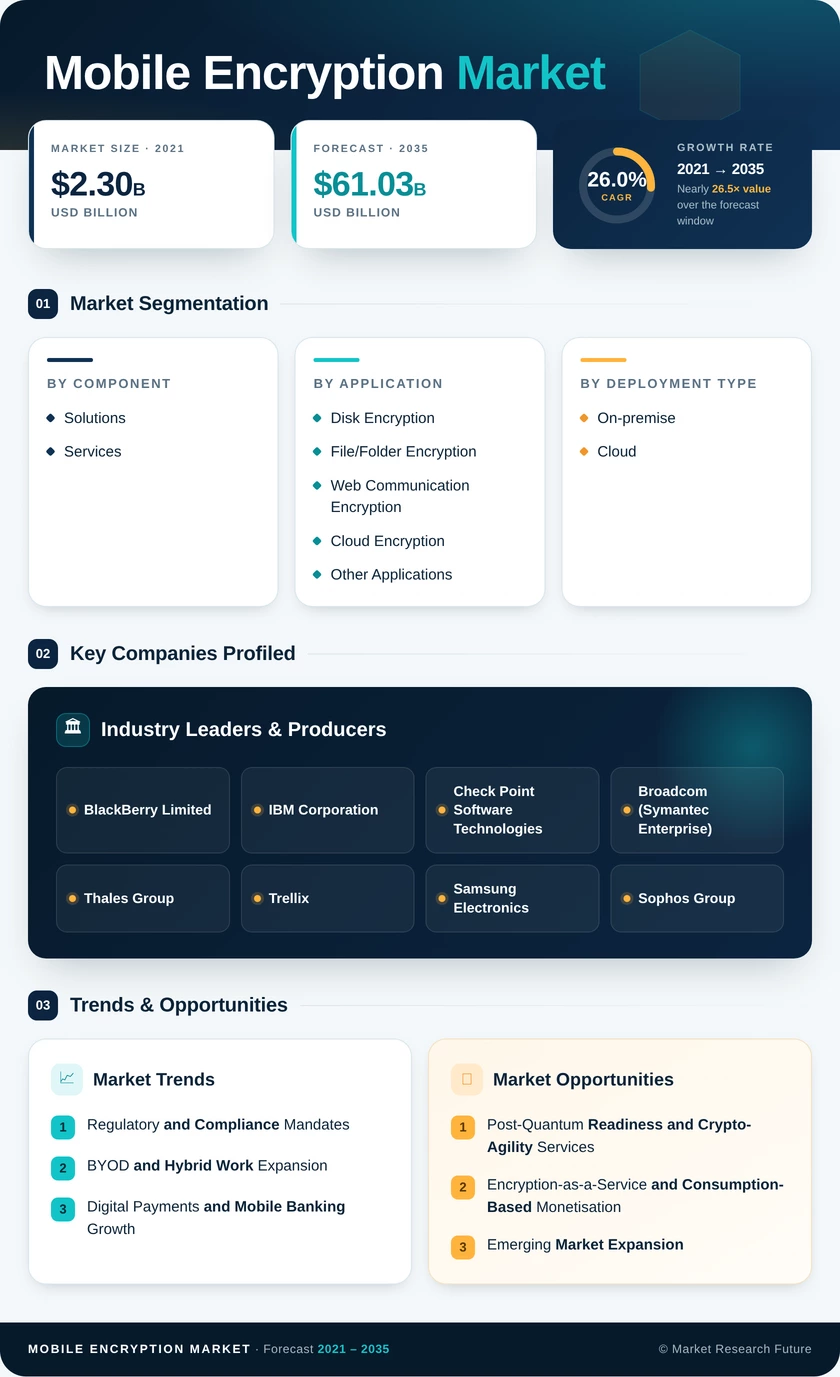
Market Segmentation Analysis
By Component
9.1.1 Solutions
9.1.2 Services
By Application
9.2.1 Disk Encryption
9.2.2 File/Folder Encryption
9.2.3 Web Communication Encryption
9.2.4 Cloud Encryption
9.2.5 Other Applications
By Deployment Type
9.3.1 On-premise
9.3.2 Cloud
By Enterprise Size
9.4.1 SMEs
9.4.2 Large Enterprises
By End Users
9.5.1 BFSI
9.5.2 Aerospace and Defense
9.5.3 Healthcare
9.5.4 Government and Public Sector
9.5.5 Telecom
9.5.6 Retail
9.5.7 Other End Users
| Dimension | Sub-Segments | Dominant Segment | Fastest Growing Segment |
| By Component | Solutions; Services | Solutions (68.5% share) | Services (28.4% CAGR) |
| By Application | Disk Encryption; File/Folder Encryption; Web Communication Encryption; Cloud Encryption; Other Applications | Disk Encryption (27.3% share) | Cloud Encryption (29.8% CAGR) |
| By Deployment Type | On-premise; Cloud | On-premise (52.6% share) | Cloud (28.9% CAGR) |
| By Enterprise Size | SMEs; Large Enterprises | Large Enterprises (65.4% share) | SMEs (29.6% CAGR) |
| By End Users | BFSI; Aerospace and Defense; Healthcare; Government and Public Sector; Telecom; Retail; Other End Users | BFSI (24.8% share) | Healthcare (28.7% CAGR) |
Market Segmentation Overview
By Component
| Sub-Segment | Key Trend |
| Solutions | Device-count licensing with multi-year renewal cycles in regulated accounts |
| Services | Migration, key consolidation and audit-evidence engagements scaling rapidly |
Solutions carry the larger revenue block because encryption platforms are licensed against enrolled device counts, and renewal behaviour in banking and defence accounts is close to automatic once auditors have accepted the control. Services expand faster because post-quantum inventory work, cross-platform key hierarchy consolidation and evidence preparation demand applied cryptography skills that buyers cannot recruit at scale. The practical effect is that suppliers increasingly win the licence on the strength of the services team attached to it.
By Application
| Sub-Segment | Key Trend |
| Disk Encryption | Baseline control accepted by auditors for data-at-rest obligations |
| File/Folder Encryption | Granular protection tied to data classification programmes |
| Web Communication Encryption | Executive and clinical messaging confidentiality requirements |
| Cloud Encryption | Customer-managed and hold-your-own-key architectures |
| Other Applications | Backup, container and specialised workload protection |
Disk Encryption leads this dimension because it answers the most frequently examined regulatory question with one deployable control, which makes it the first purchase in almost every programme. Cloud Encryption grows fastest as enterprises move data into provider infrastructure and then discover that audit defensibility depends on holding their own keys, a requirement that File/Folder Encryption alone does not satisfy. Web Communication Encryption occupies a narrower but durable position wherever message content itself carries legal or clinical sensitivity.
By Deployment Type
| Sub-Segment | Key Trend |
| On-premise | Internal key custody preferred by examined and sovereignty-bound buyers |
| Cloud | Managed key services and subscription pricing lower operational burden. |
On-premise holds the majority position because supervisory examiners in banking, defence and healthcare ask directly who controls key material, and an internally held answer is the simplest one to defend. Cloud grows faster as hardware security module services delivered by providers reach certification parity and as smaller buyers accept managed custody in exchange for removing operational complexity. Sovereignty rules in several European and Asian jurisdictions will keep a durable On-premise floor well past the projected crossover point.
By Enterprise Size
| Sub-Segment | Key Trend |
| SMEs | Per-device subscription pricing and managed delivery removing capital barriers |
| Large Enterprises | Multi-jurisdiction obligations forcing broad, uniform deployments |
Large Enterprises dominate spending because operating across several regulatory regimes forces them to configure to the strictest applicable standard everywhere, which widens deployment scope and raises per-seat configuration complexity. SMEs grow faster from a much smaller base as subscription pricing eliminates upfront licence cost and managed providers substitute for cryptography expertise these firms cannot staff. Supply-chain security clauses imposed by large customers are pulling smaller suppliers into deployments they would otherwise have postponed.
By End Users
| Sub-Segment | Key Trend |
| BFSI | Payment credential protection under supervisory examination |
| Aerospace and Defense | Evaluated commercial components replacing purpose-built secure handsets |
| Healthcare | Clinical data traversing clinician-owned devices under tightening rules |
| Government and Public Sector | National cryptographic modernisation programmes |
| Telecom | Subscriber data and privileged network management access |
| Retail | Point-of-sale and loyalty data protection obligations |
| Other End Users | Education, logistics and utilities deployments |
BFSI holds the leading share because supervisory examination gives security findings direct financial and licensing consequences, and because handset-resident payment credentials sit unambiguously within regulatory scope. Healthcare grows fastest as proposed rules would remove the addressable classification that let providers defer encryption, converting a large deferred-buyer population into mandatory purchasers. Aerospace and Defense sustains high absolute value through programmes substituting evaluated commercial devices for legacy purpose-built secure handsets.


 Noah Malgeri
Co-Founder

 Peter Groot koerkamp
Account and Business Manager

 Younghwan Choi
Senior Retail Manager

 Mark Irwin
Management Consultant

 Akif Moroglu
Strategy & Business Development Director

 Guilherme Gomes Martins
Product Management Director

 Joseph Aguayo
Sales Operations & Pricing Manager

 La Terria Dodd
Program Support Specialist

 Rob Kooiker
Group Product Manager HVAC & Fire Protection GMA