×
Request Free Sample ×

Kindly complete the form below to receive a free sample of this Report

* Please use a valid business email

Leading companies partner with us for data-driven Insights

clients tt-cursor
Hero Background
English
Chinese
French
Japanese
Korean
German
Spanish

Military Laser Rangefinder Market Share

ID: MRFR/AD/2874-CR
140 Pages
Swapnil Palwe
August 2019

Military Laser Rangefinder Market Size, Share, Industry Trend & Analysis Research Report Information by Product Type (Man-Portable and Vehicle-Mounted), Application (Weapon Guidance and Detection), Range (Up to 15 KM and Over 15 KM) and Region (North America, Europe, Asia-Pacific, Middle East & Africa and Latin America) - Forecast till 2032

Share:
Download PDF ×

We do not share your information with anyone. However, we may send you emails based on your report interest from time to time. You may contact us at any time to opt-out.

Military Laser Rangefinder Market Infographic
Purchase Options

Market Share

Military Laser Rangefinder Market Share Analysis

Military Laser Rangefinder Market: Simple BreakdownThe global military laser rangefinder market is divided into different parts based on the type of product, how it's used, the distance it can cover, and where in the world it's used.

Type of Product: Man-Portable Segment This part includes rangefinders that people can carry easily. In 2017, these made up the biggest part of the market, with 61.44% share, valued at USD 342.3 million. The prediction is that this segment will keep growing at a rate of 7.74% during the forecast period. How It's Used: Weapon Guidance Segment This category involves rangefinders used for guiding weapons. In 2017, it was the most significant part of the market, holding a 77.51% share, valued at USD 431.9 million. The expectation is that it will continue growing at a rate of 7.10% during the forecast period. Distance It Can Cover: Up to 15 Km Segment This part covers rangefinders that can measure distances up to 15 kilometers. In 2017, it was the largest part of the market, with a 71.77% share, valued at USD 399.9 million. The projection is that it will grow at a rate of 6.50% during the forecast period. These divisions help understand how different types of military laser rangefinders are used and where the market is heading.

The Changing Face of Warfare: SimplifiedThe way wars are fought has changed a lot in the last 20 years. Now, it's not just about having good weapons but also making sure they hit the right targets without causing too much extra damage. This is where advanced military laser rangefinders come in.One big reason for these high-tech rangefinders is the increase in missions against extremist groups all around the world. These rangefinders are like a team-up between special forces on the ground and attack aircraft. This partnership became important after the First Gulf War in 1990-1991. They realized that for certain missions, having laser rangefinder systems would make air strikes more accurate and deadly.These rangefinders are not just for big bombings; they're also used in surgical strikes against extremist and terrorist groups. In these cases, special forces on the ground can use the rangefinders to make sure they hit the target exactly where they want. This way, it's safer for the special forces, and there's less chance of causing extra damage to nearby areas.This kind of advanced technology has caught the attention of defense authorities worldwide because it's helping make military operations more precise and less risky for the people involved.  

Author
Swapnil Palwe
Team Lead - Research

With a technical background as Bachelor's in Mechanical Engineering, with MBA in Operations Management , Swapnil has 6+ years of experience in market research, consulting and analytics with the tasks of data mining, analysis, and project execution. He is the POC for our clients, for their consulting projects running under the Automotive/A&D domain. Swapnil has worked on major projects in verticals such as Aerospace & Defense, Automotive and many other domain projects. He has worked on projects for fortune 500 companies' syndicate and consulting projects along with several government projects.

Leave a Comment

FAQs

What is the anticipated market value of the global military laser rangefinder market?

Global military laser rangefinder market is estimated to acquire a market value of USD 1730.99 million during the forecast period from 2024 to 2032.

What is the expected CAGR of the global military laser rangefinder market?

Global military laser rangefinder market is expected to expand at a CAGR of 6.9% during the review period from 2024 to 2032.

Which region is predicted to dominate the global military laser rangefinder market?

North America is predicted to dominate the global military laser rangefinder market owing to the presence of established manufacturers and robust defense sector.

What is the segmentation of the global military laser rangefinder market?

The global military laser rangefinder market is segmented on the basis of application, type, and region.

Who are the established players of the global military laser rangefinder market?

Lockheed Martin Corporation (U.S.), Leonardo S.p.A (Italy), UTC Aerospace Systems (U.S.), and FLIR Systems (U.S.) are some of the established players in the global military laser rangefinder market.

Market Summary

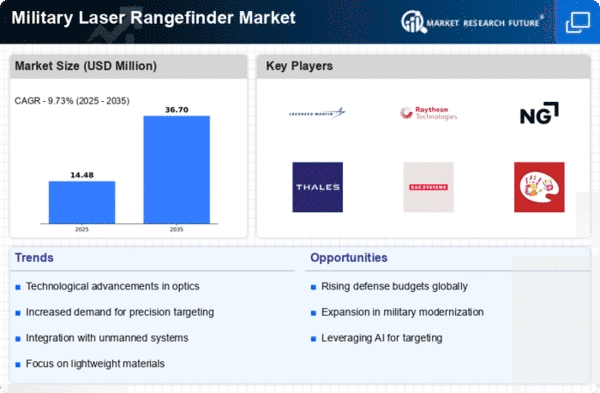
As per MRFR analysis, the Military Laser Rangefinder Market Size was estimated at 13.2 USD Million in 2024. The Military Laser Rangefinder industry is projected to grow from 14.5 USD Million in 2025 to 36.7 USD Million by 2035, exhibiting a compound annual growth rate (CAGR) of 9.73 during the forecast period 2025 - 2035.

Key Market Trends & Highlights

The Military Laser Rangefinder Market is poised for substantial growth driven by technological advancements and increased defense spending.

  • North America remains the largest market for military laser rangefinders, reflecting its robust defense budget and technological capabilities.
  • The Asia-Pacific region is emerging as the fastest-growing market, driven by increasing military modernization efforts and regional tensions.
  • Ground Forces represent the largest segment, while Unmanned Aerial Vehicles are witnessing the fastest growth due to their strategic advantages in modern warfare.
  • Technological advancements and increased defense spending are key drivers, alongside a growing demand for precision targeting in military operations.

Market Size & Forecast

2024 Market Size 13.2 (USD Million)
2035 Market Size 36.7 (USD Million)
CAGR (2025 - 2035) 9.73%
Largest Regional Market Share in 2024 North America

Major Players

Lockheed Martin (US), Raytheon Technologies (US), Northrop Grumman (US), Thales Group (FR), BAE Systems (GB), Leonardo (IT), Elbit Systems (IL), Hensoldt (DE), Rheinmetall (DE), L3Harris Technologies (US)

Market Trends

defense

Military Laser Rangefinder Market Market Drivers

Emerging Markets

Emerging markets are increasingly recognizing the importance of modernizing their military capabilities, contributing to the growth of the Global Military Laser Rangefinder Industry. Countries in regions such as Asia-Pacific and the Middle East are investing in advanced military technologies to bolster their defense systems. For instance, nations like India and Saudi Arabia are actively procuring laser rangefinders to enhance their artillery and reconnaissance capabilities. This trend indicates a shift in defense spending patterns, as emerging economies prioritize military modernization. As these markets continue to develop, they are expected to play a pivotal role in driving future growth in the laser rangefinder sector.

Rising Defense Budgets

In recent years, many countries have increased their defense budgets, which has a direct impact on the Global Military Laser Rangefinder Industry. Nations are investing in advanced military technologies to enhance their defense capabilities, particularly in response to evolving threats. For example, countries like the United States and China have allocated substantial funds for modernization programs, which include upgrading their artillery and reconnaissance systems. This trend is expected to sustain the market's growth trajectory, with projections indicating a market size of 2114.6 USD Million by 2035, driven by continued investments in military technology.

Market Growth Projections

The Global Military Laser Rangefinder Industry is poised for substantial growth, with projections indicating a market size of 949.5 USD Million in 2024 and an anticipated increase to 2114.6 USD Million by 2035. This growth reflects a compound annual growth rate (CAGR) of 7.55% from 2025 to 2035. The increasing demand for precision targeting systems, driven by advancements in technology and rising defense budgets, is likely to sustain this upward trajectory. As militaries worldwide continue to modernize their capabilities, the laser rangefinder market is expected to expand significantly, highlighting the critical role of these systems in contemporary military operations.

Technological Advancements

The Global Military Laser Rangefinder Industry is experiencing rapid technological advancements, particularly in the development of compact and lightweight systems. Innovations such as integrated GPS and advanced optics enhance accuracy and usability in various military applications. For instance, the introduction of laser rangefinders with improved target acquisition capabilities allows for effective engagement in diverse environments. This trend is likely to drive market growth, as militaries seek to modernize their equipment to maintain operational superiority. As a result, the market is projected to reach 949.5 USD Million in 2024, reflecting the increasing demand for sophisticated targeting solutions.

Increased Military Operations

The frequency of military operations globally has surged, necessitating the deployment of advanced targeting systems such as laser rangefinders. The Global Military Laser Rangefinder Industry benefits from this trend, as armed forces require precise measurement tools for effective engagement in combat scenarios. Operations in diverse terrains and conditions demand reliable equipment that can deliver accurate data in real-time. Consequently, the market is likely to expand as military organizations prioritize the acquisition of laser rangefinders to enhance operational effectiveness. This growing demand aligns with the projected CAGR of 7.55% for the period from 2025 to 2035.

Integration with Unmanned Systems

Market Segment Insights

By Application: Ground Forces (Largest) vs. Unmanned Aerial Vehicles (Fastest-Growing)

In the Military Laser Rangefinder Market, the application segments reveal a diverse landscape where Ground Forces hold a significant market share due to their extensive use of laser rangefinders for accuracy in targeting and navigation. Following Ground Forces, sectors such as Aviation, Naval, and Artillery also contribute notably to the market, albeit to a lesser extent. Each segment's unique requirements drive the adaptation and integration of laser rangefinding technology, shaping their overall contribution to the market.

Ground Forces (Dominant) vs. Unmanned Aerial Vehicles (Emerging)

The Ground Forces segment represents a dominant application area in the military laser rangefinder market, characterized by the necessity for precision targeting and situation awareness. Laser rangefinders enable ground troops to engage with greater accuracy, significantly enhancing operational efficiency. In contrast, the Unmanned Aerial Vehicles segment is emerging rapidly, driven by advancements in drone technology and automated systems. UAVs utilize laser rangefinders for tasks such as reconnaissance and strike missions. Their rapid adoption is supported by their increasing deployment in modern warfare scenarios and the ongoing integration of high-tech solutions, making them a pivotal component in contemporary military strategies.

By Technology: Time of Flight (Largest) vs. Phase Shift (Fastest-Growing)

The Military Laser Rangefinder Market is significantly influenced by various technology segments, with Time of Flight being the largest contributor. This technology captures the majority of the market share, owing to its accuracy and reliability in target distance measurement, often essential in military operations. Close behind is the Phase Shift technology, which has gained traction and is recognized as the fastest-growing segment. This rapid growth can be attributed to advancements in optical technologies and the increasing demand for precise measurement in complex environments. In terms of growth trends, the Military Laser Rangefinder Market is experiencing robust expansion fueled by innovations in laser technologies and digital signal processing. Phase Shift technology is expected to continue its ascent as defense forces seek improved accuracy and faster performance in their rangefinding equipment. Additionally, the integration of digital signal processing in laser rangefinders is enhancing the functionality and performance, making these devices more adaptive to various combat scenarios, thus driving market dynamics further.

Time of Flight: Largest vs. Phase Shift: Fastest-Growing

Time of Flight technology remains the dominant player in the Military Laser Rangefinder Market, characterized by its effectiveness in measuring the time taken by a laser beam to return after hitting a target. This precision makes it invaluable for military applications. In contrast, Phase Shift technology is emerging rapidly; it works by measuring phase differences in the returning light, allowing for quick and accurate readings. This segment is gaining popularity among military sectors due to its ability to deliver high-speed measurements under challenging conditions. The increased adoption of Phase Shift technology is driven by its lightweight design and improved accuracy, making it especially suitable for modern warfare scenarios.

By End Use: Defense Forces (Largest) vs. Government Agencies (Fastest-Growing)

In the Military Laser Rangefinder Market, the distribution of market share among the end-use segments reveals a significant dominance of the Defense Forces segment. This segment, catering to active military needs, encompasses a range of applications from target detection to precision aiming. Following closely are Government Agencies, which are increasingly integrating laser rangefinders into their operations for surveillance, reconnaissance, and other security needs. The growth trends in this market segment are robust, driven by technological advancements and an increasing focus on military modernization. Defense Forces will continue to leverage state-of-the-art laser rangefinder technology, while Government Agencies are rapidly adopting these devices to enhance their operational capabilities. This shift is fueled by the rising demand for effective border control and security measures in various regions, indicating a healthy growth trajectory for both segments.

Defense Forces: Dominant vs. Government Agencies: Emerging

The Defense Forces segment of the Military Laser Rangefinder Market is characterized by its extensive application in various military operations. This segment is crucial for modern warfare, providing capabilities in precise distance measurement critical for targeting and artillery deployment. Defense forces are consistently upgrading their equipment to include advanced laser rangefinders that integrate with other military technology for improved effectiveness. Meanwhile, the Government Agencies segment is emerging rapidly as a significant consumer of these technologies. They utilize laser rangefinders for a variety of applications including surveillance, response coordination, and emergency management. The convergence of these technologies and increased investment in security by various governments positions the Government Agencies segment for notable growth in the coming years.

Get more detailed insights about Military Laser Rangefinder Market Research Report Information - Forecast to 2035

Regional Insights

North America : Market Leader in Technology

North America is poised to maintain its leadership in the Military Laser Rangefinder market, holding a significant market share of 6.6 in 2024. The region's growth is driven by increasing defense budgets, technological advancements, and a focus on modernization of military equipment. Regulatory support for defense spending and innovation further catalyzes demand, ensuring a robust market environment. The United States stands as the primary contributor, with key players like Lockheed Martin, Raytheon Technologies, and Northrop Grumman leading the charge. The competitive landscape is characterized by continuous innovation and strategic partnerships, enhancing the capabilities of military forces. The presence of advanced research facilities and a strong defense industrial base solidifies North America's position in the global market.

Europe : Emerging Defense Innovations

Europe is witnessing a notable expansion in the Military Laser Rangefinder market, with a market size of 3.8. The growth is fueled by increasing defense expenditures among NATO countries and a rising emphasis on advanced military technologies. Regulatory frameworks promoting collaboration in defense projects and cross-border initiatives are also significant drivers of market demand. Leading countries such as Germany, France, and the UK are at the forefront, with companies like Thales Group and BAE Systems playing pivotal roles. The competitive landscape is marked by innovation and strategic alliances, enhancing the region's capabilities in defense technologies. The focus on joint military exercises and interoperability among European forces further strengthens the market position.

Asia-Pacific : Rapidly Growing Defense Sector

Asia-Pacific is emerging as a significant player in the Military Laser Rangefinder market, with a market size of 2.4. The region's growth is driven by increasing military budgets, geopolitical tensions, and a focus on modernization of armed forces. Countries are investing heavily in advanced technologies to enhance their defense capabilities, supported by favorable government policies and initiatives. Key players in this region include Elbit Systems and Hensoldt, with countries like India, China, and Japan leading the charge. The competitive landscape is characterized by a mix of domestic and international players, fostering innovation and technological advancements. The growing emphasis on defense collaborations and joint exercises among nations further propels market growth.

Middle East and Africa : Emerging Defense Investments

The Middle East and Africa region is gradually developing its Military Laser Rangefinder market, currently valued at 0.4. The growth is primarily driven by increasing defense budgets and a focus on enhancing military capabilities amid regional conflicts. Governments are prioritizing investments in advanced technologies to ensure national security, supported by international partnerships and collaborations. Countries like the UAE and South Africa are leading the market, with a growing presence of international defense contractors. The competitive landscape is evolving, with local firms beginning to emerge alongside established global players. The region's strategic importance and ongoing military modernization efforts are expected to drive future growth in the market.

Key Players and Competitive Insights

The Military Laser Rangefinder Market is characterized by a competitive landscape that is increasingly shaped by technological advancements and strategic collaborations. Key players such as Lockheed Martin (US), Raytheon Technologies (US), and Thales Group (FR) are at the forefront, leveraging innovation and partnerships to enhance their market positions. Lockheed Martin (US) focuses on integrating advanced sensor technologies into its rangefinders, which appears to be a strategic move to cater to the evolving demands of modern warfare. Meanwhile, Raytheon Technologies (US) emphasizes digital transformation, aiming to streamline operations and improve product offerings through cutting-edge software solutions. Thales Group (FR) is actively pursuing regional expansion, particularly in Asia-Pacific, to tap into emerging defense budgets and enhance its global footprint.The business tactics employed by these companies reflect a concerted effort to optimize supply chains and localize manufacturing. This approach not only reduces operational costs but also enhances responsiveness to regional market needs. The competitive structure of the market is moderately fragmented, with several players vying for market share. However, the collective influence of major companies like BAE Systems (GB) and Northrop Grumman (US) ensures that competition remains robust, driving innovation and technological advancements across the sector.

In November BAE Systems (GB) announced a strategic partnership with a leading technology firm to develop next-generation laser rangefinders that incorporate artificial intelligence (AI) capabilities. This collaboration is poised to enhance target acquisition and tracking accuracy, thereby providing a significant competitive edge in the battlefield. The integration of AI into rangefinding technology is likely to redefine operational effectiveness for military applications.

In October Northrop Grumman (US) unveiled a new line of compact laser rangefinders designed for unmanned aerial vehicles (UAVs). This product launch is indicative of the company's commitment to innovation and reflects a growing trend towards miniaturization in military technology. By catering to the UAV market, Northrop Grumman (US) positions itself strategically to meet the demands of modern military operations, which increasingly rely on drone technology.

In September Thales Group (FR) secured a multi-million € contract to supply advanced laser rangefinders to a European defense agency. This contract not only underscores Thales's strong market presence but also highlights the importance of strategic alliances in securing large-scale defense contracts. Such partnerships are essential for maintaining competitiveness in a market where government contracts often dictate success.

As of December the Military Laser Rangefinder Market is witnessing trends that emphasize digitalization, sustainability, and AI integration. The shift towards strategic alliances is reshaping the competitive landscape, as companies recognize the value of collaboration in driving innovation. Moving forward, competitive differentiation is likely to evolve from traditional price-based competition to a focus on technological advancements, reliability in supply chains, and the ability to deliver innovative solutions that meet the complex needs of modern military operations.

Key Companies in the Military Laser Rangefinder Market include

Industry Developments

Integration of artificial intelligence (AI) and machine learning (ML): Companies are increasingly incorporating AI and ML into their laser rangefinders to improve accuracy, speed, and target identification. For example, Elbit Systems' XACT-640 laser rangefinder uses AI to automatically detect and track targets, even in complex environments.

Miniaturization and lighter weight: Laser rangefinders are becoming smaller and lighter, making them more portable and easier to use for soldiers on the move. For example, Leonardo DRS's Lightweight Laser Designator Rangefinder (LLDR) weighs only 3.5 pounds.

Increased range and accuracy: Companies are developing laser rangefinders with longer ranges and higher accuracy. For example, Lockheed Martin's Sniper Advanced Targeting Pod (ATP) has a range of over 25 kilometers and can accurately measure the distance to targets within 1 meter.

COVID 19 impact

The Military Laser Rangefinder Market is no stranger to the impact of the COVID 19 pandemic. The manufacturing sector, including military laser rangefinder manufacturers, bore the brunt of COVID 19 lockdowns. The manufacturing rate declined drastically. Unavailability of funds and raw materials hit the Market hugely. Moreover, since all the nations' budget was channelized in COVID 19 and the economic recovery of the people, defense budgets accommodated very few military laser rangefinders and military laser designators. The growth rate and demand in the market plummeted to a new low.

However, in the post-pandemic era of this forecast period, military laser rangefinder manufacturers will see recovery and growth anew. The nations' attention is shifting towards strengthening defense and security. Thus, funds have started flowing into the military laser rangefinder market. Military binoculars with laser rangefinder, military laser designators, and military rangefinder binoculars will see more demand now with the pandemic in the past.

Future Outlook

Military Laser Rangefinder Market Future Outlook

The Military Laser Rangefinder Market is projected to grow at a 9.73% CAGR from 2025 to 2035, driven by advancements in technology, increasing defense budgets, and rising demand for precision targeting.

New opportunities lie in:

  • Integration of AI for enhanced target acquisition systems.
  • Development of compact, lightweight rangefinders for portable applications.
  • Expansion into emerging markets with tailored solutions for local defense needs.

By 2035, the Military Laser Rangefinder Market is expected to achieve substantial growth and technological advancements.

Market Segmentation

Military Laser Rangefinder Market End Use Outlook

  • Defense Forces
  • Government Agencies
  • Research Institutions
  • Private Security Firms
  • Commercial Applications

Military Laser Rangefinder Market Technology Outlook

  • Time of Flight
  • Phase Shift
  • Triangulation
  • Laser Range Finder
  • Digital Signal Processing

Military Laser Rangefinder Market Application Outlook

  • Artillery
  • Aviation
  • Naval
  • Ground Forces
  • Unmanned Aerial Vehicles

Report Scope

MARKET SIZE 202413.2(USD Million)
MARKET SIZE 202514.5(USD Million)
MARKET SIZE 203536.7(USD Million)
COMPOUND ANNUAL GROWTH RATE (CAGR)9.73% (2025 - 2035)
REPORT COVERAGERevenue Forecast, Competitive Landscape, Growth Factors, and Trends
BASE YEAR2024
Market Forecast Period2025 - 2035
Historical Data2019 - 2024
Market Forecast UnitsUSD Million
Key Companies ProfiledLockheed Martin (US), Raytheon Technologies (US), Northrop Grumman (US), Thales Group (FR), BAE Systems (GB), Leonardo (IT), Elbit Systems (IL), Hensoldt (DE), Rheinmetall (DE), L3Harris Technologies (US)
Segments CoveredApplication, Technology, End Use
Key Market OpportunitiesIntegration of advanced sensor technologies enhances accuracy and operational efficiency in the Military Laser Rangefinder Market.
Key Market DynamicsTechnological advancements and increasing defense budgets drive growth in the Military Laser Rangefinder Market.
Countries CoveredNorth America, Europe, APAC, South America, MEA

FAQs

What is the anticipated market value of the global military laser rangefinder market?

Global military laser rangefinder market is estimated to acquire a market value of USD 1730.99 million during the forecast period from 2024 to 2032.

What is the expected CAGR of the global military laser rangefinder market?

Global military laser rangefinder market is expected to expand at a CAGR of 6.9% during the review period from 2024 to 2032.

Which region is predicted to dominate the global military laser rangefinder market?

North America is predicted to dominate the global military laser rangefinder market owing to the presence of established manufacturers and robust defense sector.

What is the segmentation of the global military laser rangefinder market?

The global military laser rangefinder market is segmented on the basis of application, type, and region.

Who are the established players of the global military laser rangefinder market?

Lockheed Martin Corporation (U.S.), Leonardo S.p.A (Italy), UTC Aerospace Systems (U.S.), and FLIR Systems (U.S.) are some of the established players in the global military laser rangefinder market.

  1. SECTION I: EXECUTIVE SUMMARY AND KEY HIGHLIGHTS
    1. | 1.1 EXECUTIVE SUMMARY
    2. | 1.1.1 Market Overview
    3. | 1.1.2 Key Findings
    4. | 1.1.3 Market Segmentation
    5. | 1.1.4 Competitive Landscape
    6. | 1.1.5 Challenges and Opportunities
    7. | 1.1.6 Future Outlook
  2. SECTION II: SCOPING, METHODOLOGY AND MARKET STRUCTURE
    1. | 2.1 MARKET INTRODUCTION
    2. | 2.1.1 Definition
    3. | 2.1.2 Scope of the study
    4. |-- 2.1.2.1 Research Objective
    5. |-- 2.1.2.2 Assumption
    6. |-- 2.1.2.3 Limitations
    7. | 2.2 RESEARCH METHODOLOGY
    8. | 2.2.1 Overview
    9. | 2.2.2 Data Mining
    10. | 2.2.3 Secondary Research
    11. | 2.2.4 Primary Research
    12. |-- 2.2.4.1 Primary Interviews and Information Gathering Process
    13. |-- 2.2.4.2 Breakdown of Primary Respondents
    14. | 2.2.5 Forecasting Model
    15. | 2.2.6 Market Size Estimation
    16. |-- 2.2.6.1 Bottom-Up Approach
    17. |-- 2.2.6.2 Top-Down Approach
    18. | 2.2.7 Data Triangulation
    19. | 2.2.8 Validation
  3. SECTION III: QUALITATIVE ANALYSIS
    1. | 3.1 MARKET DYNAMICS
    2. | 3.1.1 Overview
    3. | 3.1.2 Drivers
    4. | 3.1.3 Restraints
    5. | 3.1.4 Opportunities
    6. | 3.2 MARKET FACTOR ANALYSIS
    7. | 3.2.1 Value chain Analysis
    8. | 3.2.2 Porter's Five Forces Analysis
    9. |-- 3.2.2.1 Bargaining Power of Suppliers
    10. |-- 3.2.2.2 Bargaining Power of Buyers
    11. |-- 3.2.2.3 Threat of New Entrants
    12. |-- 3.2.2.4 Threat of Substitutes
    13. |-- 3.2.2.5 Intensity of Rivalry
    14. | 3.2.3 COVID-19 Impact Analysis
    15. |-- 3.2.3.1 Market Impact Analysis
    16. |-- 3.2.3.2 Regional Impact
    17. |-- 3.2.3.3 Opportunity and Threat Analysis
  4. SECTION IV: QUANTITATIVE ANALYSIS
    1. | 4.1 Aerospace & Defense, BY Application (USD Million)
    2. | 4.1.1 Artillery
    3. | 4.1.2 Aviation
    4. | 4.1.3 Naval
    5. | 4.1.4 Ground Forces
    6. | 4.1.5 Unmanned Aerial Vehicles
    7. | 4.2 Aerospace & Defense, BY Technology (USD Million)
    8. | 4.2.1 Time of Flight
    9. | 4.2.2 Phase Shift
    10. | 4.2.3 Triangulation
    11. | 4.2.4 Laser Range Finder
    12. | 4.2.5 Digital Signal Processing
    13. | 4.3 Aerospace & Defense, BY End Use (USD Million)
    14. | 4.3.1 Defense Forces
    15. | 4.3.2 Government Agencies
    16. | 4.3.3 Research Institutions
    17. | 4.3.4 Private Security Firms
    18. | 4.3.5 Commercial Applications
    19. | 4.4 Aerospace & Defense, BY Region (USD Million)
    20. | 4.4.1 North America
    21. |-- 4.4.1.1 US
    22. |-- 4.4.1.2 Canada
    23. | 4.4.2 Europe
    24. |-- 4.4.2.1 Germany
    25. |-- 4.4.2.2 UK
    26. |-- 4.4.2.3 France
    27. |-- 4.4.2.4 Russia
    28. |-- 4.4.2.5 Italy
    29. |-- 4.4.2.6 Spain
    30. |-- 4.4.2.7 Rest of Europe
    31. | 4.4.3 APAC
    32. |-- 4.4.3.1 China
    33. |-- 4.4.3.2 India
    34. |-- 4.4.3.3 Japan
    35. |-- 4.4.3.4 South Korea
    36. |-- 4.4.3.5 Malaysia
    37. |-- 4.4.3.6 Thailand
    38. |-- 4.4.3.7 Indonesia
    39. |-- 4.4.3.8 Rest of APAC
    40. | 4.4.4 South America
    41. |-- 4.4.4.1 Brazil
    42. |-- 4.4.4.2 Mexico
    43. |-- 4.4.4.3 Argentina
    44. |-- 4.4.4.4 Rest of South America
    45. | 4.4.5 MEA
    46. |-- 4.4.5.1 GCC Countries
    47. |-- 4.4.5.2 South Africa
    48. |-- 4.4.5.3 Rest of MEA
  5. SECTION V: COMPETITIVE ANALYSIS
    1. | 5.1 Competitive Landscape
    2. | 5.1.1 Overview
    3. | 5.1.2 Competitive Analysis
    4. | 5.1.3 Market share Analysis
    5. | 5.1.4 Major Growth Strategy in the Aerospace & Defense
    6. | 5.1.5 Competitive Benchmarking
    7. | 5.1.6 Leading Players in Terms of Number of Developments in the Aerospace & Defense
    8. | 5.1.7 Key developments and growth strategies
    9. |-- 5.1.7.1 New Product Launch/Service Deployment
    10. |-- 5.1.7.2 Merger & Acquisitions
    11. |-- 5.1.7.3 Joint Ventures
    12. | 5.1.8 Major Players Financial Matrix
    13. |-- 5.1.8.1 Sales and Operating Income
    14. |-- 5.1.8.2 Major Players R&D Expenditure. 2023
    15. | 5.2 Company Profiles
    16. | 5.2.1 Lockheed Martin (US)
    17. |-- 5.2.1.1 Financial Overview
    18. |-- 5.2.1.2 Products Offered
    19. |-- 5.2.1.3 Key Developments
    20. |-- 5.2.1.4 SWOT Analysis
    21. |-- 5.2.1.5 Key Strategies
    22. | 5.2.2 Raytheon Technologies (US)
    23. |-- 5.2.2.1 Financial Overview
    24. |-- 5.2.2.2 Products Offered
    25. |-- 5.2.2.3 Key Developments
    26. |-- 5.2.2.4 SWOT Analysis
    27. |-- 5.2.2.5 Key Strategies
    28. | 5.2.3 Northrop Grumman (US)
    29. |-- 5.2.3.1 Financial Overview
    30. |-- 5.2.3.2 Products Offered
    31. |-- 5.2.3.3 Key Developments
    32. |-- 5.2.3.4 SWOT Analysis
    33. |-- 5.2.3.5 Key Strategies
    34. | 5.2.4 Thales Group (FR)
    35. |-- 5.2.4.1 Financial Overview
    36. |-- 5.2.4.2 Products Offered
    37. |-- 5.2.4.3 Key Developments
    38. |-- 5.2.4.4 SWOT Analysis
    39. |-- 5.2.4.5 Key Strategies
    40. | 5.2.5 BAE Systems (GB)
    41. |-- 5.2.5.1 Financial Overview
    42. |-- 5.2.5.2 Products Offered
    43. |-- 5.2.5.3 Key Developments
    44. |-- 5.2.5.4 SWOT Analysis
    45. |-- 5.2.5.5 Key Strategies
    46. | 5.2.6 Leonardo (IT)
    47. |-- 5.2.6.1 Financial Overview
    48. |-- 5.2.6.2 Products Offered
    49. |-- 5.2.6.3 Key Developments
    50. |-- 5.2.6.4 SWOT Analysis
    51. |-- 5.2.6.5 Key Strategies
    52. | 5.2.7 Elbit Systems (IL)
    53. |-- 5.2.7.1 Financial Overview
    54. |-- 5.2.7.2 Products Offered
    55. |-- 5.2.7.3 Key Developments
    56. |-- 5.2.7.4 SWOT Analysis
    57. |-- 5.2.7.5 Key Strategies
    58. | 5.2.8 Hensoldt (DE)
    59. |-- 5.2.8.1 Financial Overview
    60. |-- 5.2.8.2 Products Offered
    61. |-- 5.2.8.3 Key Developments
    62. |-- 5.2.8.4 SWOT Analysis
    63. |-- 5.2.8.5 Key Strategies
    64. | 5.2.9 Rheinmetall (DE)
    65. |-- 5.2.9.1 Financial Overview
    66. |-- 5.2.9.2 Products Offered
    67. |-- 5.2.9.3 Key Developments
    68. |-- 5.2.9.4 SWOT Analysis
    69. |-- 5.2.9.5 Key Strategies
    70. | 5.2.10 L3Harris Technologies (US)
    71. |-- 5.2.10.1 Financial Overview
    72. |-- 5.2.10.2 Products Offered
    73. |-- 5.2.10.3 Key Developments
    74. |-- 5.2.10.4 SWOT Analysis
    75. |-- 5.2.10.5 Key Strategies
    76. | 5.3 Appendix
    77. | 5.3.1 References
    78. | 5.3.2 Related Reports

Aerospace & Defense Market Segmentation

Aerospace & Defense By Application (USD Million, 2025-2035)

  • Artillery
  • Aviation
  • Naval
  • Ground Forces
  • Unmanned Aerial Vehicles

Aerospace & Defense By Technology (USD Million, 2025-2035)

  • Time of Flight
  • Phase Shift
  • Triangulation
  • Laser Range Finder
  • Digital Signal Processing

Aerospace & Defense By End Use (USD Million, 2025-2035)

  • Defense Forces
  • Government Agencies
  • Research Institutions
  • Private Security Firms
  • Commercial Applications
Infographic

Free Sample Request

Kindly complete the form below to receive a free sample of this Report

Get Free Sample

Customer Strories

Compare Licence

×
Features License Type
Single User Multiuser License Enterprise User
Price $4,950 $5,950 $7,250
Maximum User Access Limit 1 User Upto 10 Users Unrestricted Access Throughout the Organization
Free Customization
Direct Access to Analyst
Deliverable Format
Platform Access
Discount on Next Purchase 10% 15% 15%
Printable Versions