
Request Free Sample ×

Kindly complete the form below to receive a free sample of this Report

* Please use a valid business email

Leading companies partner with us for data-driven Insights

clients tt-cursor
Hero Background
English
Chinese
French
Japanese
Korean
German
Spanish

Military Aerospace Sensors Market Analysis

ID: MRFR/AD/8674-HCR
174 Pages
Abbas Raut
Last Updated: April 06, 2026

Military and Aerospace Sensors Market Size, Share, Industry Trend & Analysis Research Report Information Military and Aerospace Sensorsby Application (Intelligence and Reconnaissance Systems, Communication and Navigation, Electronic Warfare, Command Control), by Platform (Land, Airborne, Naval, and Space) and By Region outlook (North America, Europe, Asia-Pacific, And Rest Of The World) – Forecast Till 2035.

Share:
Download PDF ×

We do not share your information with anyone. However, we may send you emails based on your report interest from time to time. You may contact us at any time to opt-out.

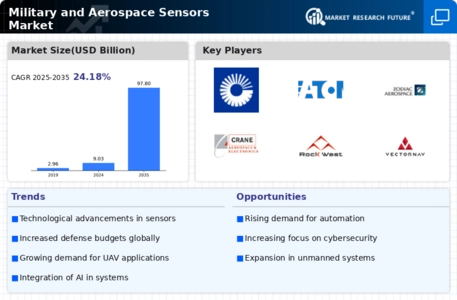
Military Aerospace Sensors Market Infographic
Purchase Options

Market Analysis

In-depth Analysis of Military Aerospace Sensors Market Industry Landscape

The Military and Aerospace Sensors Market operates within a dynamic landscape shaped by various factors that influence the procurement and integration of sensor technologies in defense and aerospace applications. One fundamental driver is the ongoing modernization efforts by military forces globally. As nations invest in upgrading their defense capabilities, the demand for advanced sensors that enhance situational awareness, intelligence, surveillance, and reconnaissance capabilities grows. The continuous need for cutting-edge technologies to maintain a strategic edge and address evolving threats contributes to the market's dynamism.

Technological advancements play a pivotal role in shaping the dynamics of the Military and Aerospace Sensors Market. The constant evolution of sensor technologies, including radar, infrared, acoustic, and electro-optical sensors, reflects the industry's commitment to innovation. Miniaturization, improved sensitivity, and integration of multifunctional capabilities are trends that impact the market dynamics, enabling sensors to be more effective in diverse and challenging operational environments.

World geopolitical agitations and threats to security accounts for the application of military and aerospace sensors. Many nations fund research into sensor technologies to enhance their defensive warfare competence and counter new vulnerabilities. Since the global security challenges are dynamic, asymmetric warfare, cyber threats, territorial disputes, the growing need for smart sensor systems that are able of real time data is triggered.

Strategic alliances and collaborations between the industries players and the defense organizations govern the market dynamics. Companies enter into partnerships to utilize knowledge, share resources and collaborate to solve complicated issues. Integrated sensor solutions result from a joint effort between the sensor manufacturers, the technology providers and the defense contractors in collusion, this streamlines the process of innovation and speeds up the development of sensor fusion. These alliances contribute to market dynamism by building a collaborative ecosystem focused on providing integral and interoperable sensor capabilities.

The dynamics of the Military and Aerospace Sensors Market are considerably influenced by budget allocations and the defense expenditure of governments throughout the world. Military budgets dictate the size and velocity of sensor acquisitions for varying defense programs. Overall, market dynamics are contingent on the economic objectives of states with defense forces actively pursuing cost- efficient technologies capable of providing quality sensor solutions. The sector needs to deal with the budget limitations, yet provide sensors that answer the demanding military specifications and operational demands.

The changing threatscape, most notably with cyber threats and electronic warfare, shapes the need for sensors with added features. Warfare techniques evolving track for networking and reliable security and restriction of Sensors in the market, Dynamics driven by requirements of sensors for intervening against electronic warfare strategies, trustworthy channels of communication and safe declaration of critical infrastructure from cyberwarfare. The electronic warfare civil and military was going through fundamental changes and the attachment of sensors would imply that the industry was responding in the most appropriate manner to the new trends in the wars.

Aerospace industry also supports the market dynamics whereby sensors are used in aircrafts for navigation, communication as well as safety systems. The sensing technology is increasing weakly due to its higher demands of accurate and solid data from flight control, navigation and surveillance in aerospace operation. The evolution of sensor technologies like synthetic aperture radar and lidar add the dynamics to the military and aerospace sensors market giving groundbreaking performance in both manned and unmanned aerial platforms.

One of the major changes resulting from the current trends of dev elopment includes the ing usage of unmanned systems such as drones and autonomous vehicles. Unmanned platforms are very much dependent on sensors; they deliver on the spot monitoring, which ensures navigation, targets acquisition and undertake mission execution.

The demand for multi-domain sensor integration, enabling seamless communication and coordination across land, air, sea, and space domains, is a dynamic trend in the Military and Aerospace Sensors Market. Military forces seek sensors that can provide a comprehensive and interconnected view of the battlespace, facilitating coordinated operations and decision-making across different operational domains. The integration of sensors that can operate in multiple domains contributes to the market's adaptability to modern warfare scenarios.

Environmental sustainability is emerging as a consideration in the market dynamics, with a focus on developing sensors that are energy-efficient and have minimal environmental impact. The industry is exploring eco-friendly materials, energy-efficient designs, and sustainable manufacturing practices to align with global initiatives for reducing the environmental footprint of defense and aerospace technologies.


Author
Author Profile
Abbas Raut
Research Analyst

Abbas Raut is a Senior Research Analyst with 5+ years of experience delivering data-driven insights and strategic recommendations across the Automotive and Aerospace & Defense sectors. He specializes in emerging technologies, industry value chains, and global market dynamics shaping the future of mobility and defense. In automotive, Abbas has led studies on EVs, charging stations, BMS, superchargers, and more, guiding stakeholders through electrification and regulatory shifts. In Aerospace & Defense, he has analyzed markets for military electronics, drones, radars, and electronic warfare solutions, supporting procurement and investment strategies. With expertise in market sizing, forecasting, benchmarking, and technology adoption, Abbas is known for transforming complex datasets into actionable insights that drive strategy, innovation, and growth.

Leave a Comment

FAQs

What is the projected market valuation for the Military and Aerospace Sensors Market in 2035?

<p>The projected market valuation for the Military and Aerospace Sensors Market in 2035 is 137.83 USD Billion.</p>

What was the overall market valuation for the Military and Aerospace Sensors Market in 2024?

<p>The overall market valuation for the Military and Aerospace Sensors Market in 2024 was 9.027 USD Billion.</p>

What is the expected CAGR for the Military and Aerospace Sensors Market from 2025 to 2035?

<p>The expected CAGR for the Military and Aerospace Sensors Market during the forecast period 2025 - 2035 is 28.12%.</p>

Which segment of the Military and Aerospace Sensors Market had the highest valuation in 2024?

<p>In 2024, the Intelligence and reconnaissance systems segment had the highest valuation at 2.5 USD Billion.</p>

What are the key application segments in the Military and Aerospace Sensors Market?

<p>The key application segments include Intelligence and reconnaissance systems, Communication and navigation, Electronic warfare, and Command Control.</p>

Which platform type is projected to dominate the Military and Aerospace Sensors Market by 2035?

<p>The Airborne platform type is projected to dominate the Military and Aerospace Sensors Market by 2035, with a valuation of 3.0 USD Billion in 2024.</p>

Who are the leading companies in the Military and Aerospace Sensors Market?

Leading companies in the Military and Aerospace Sensors Market include Lockheed Martin, Raytheon Technologies, Northrop Grumman, and BAE Systems.

What is the valuation of the Naval segment in the Military and Aerospace Sensors Market as of 2024?

The valuation of the Naval segment in the Military and Aerospace Sensors Market as of 2024 was 2.0 USD Billion.

How does the projected growth of the Military and Aerospace Sensors Market compare across different segments?

The projected growth varies, with the Intelligence and reconnaissance systems and Electronic warfare segments both valued at 2.5 USD Billion in 2024.

What is the significance of the projected market growth for stakeholders in the Military and Aerospace Sensors Market?

The projected market growth indicates substantial opportunities for stakeholders, with a potential increase to 137.83 USD Billion by 2035.

Market Summary

As per Market Research Future analysis, the Military and Aerospace Sensors Market was estimated at 9.027 USD Billion in 2024. The Military and Aerospace Sensors industry is projected to grow from 11.57 USD Billion in 2025 to 137.83 USD Billion by 2035, exhibiting a compound annual growth rate (CAGR) of 28.12% during the forecast period 2025 - 2035

Key Market Trends & Highlights

The Military and Aerospace Sensors Market is poised for substantial growth driven by technological advancements and increasing defense budgets.

  • The integration of AI and machine learning is transforming sensor capabilities across military applications.
  • North America remains the largest market, while the Asia-Pacific region is emerging as the fastest-growing area for military sensors.
  • Intelligence and reconnaissance systems dominate the market, whereas command control systems are experiencing the fastest growth.
  • Rising defense budgets and a growing demand for ISR capabilities are key drivers propelling market expansion.

Market Size & Forecast

2024 Market Size 9.027 (USD Billion)
2035 Market Size 137.83 (USD Billion)
CAGR (2025 - 2035) 28.12%
Largest Regional Market Share in 2024 North America

Major Players

Lockheed Martin (US), Raytheon Technologies (US), Northrop Grumman (US), BAE Systems (GB), Thales Group (FR), General Dynamics (US), Leonardo (IT), L3Harris Technologies (US), Honeywell International (US)

Market Trends

The Military and Aerospace Sensors Market is currently experiencing a transformative phase, driven by advancements in technology and increasing demand for enhanced situational awareness. The integration of artificial intelligence and machine learning into sensor systems appears to be a pivotal factor, enabling more accurate data collection and analysis. This evolution is likely to enhance operational efficiency and decision-making processes across various military and aerospace applications. Furthermore, the growing emphasis on unmanned systems and autonomous vehicles suggests a shift in focus towards sensors that can operate effectively in diverse environments, including challenging terrains and adverse weather conditions. In addition, the Military and Aerospace Sensors Market is witnessing a surge in investments aimed at developing next-generation sensor technologies. This trend indicates a broader recognition of the strategic importance of advanced sensing capabilities in maintaining national security and operational superiority. As nations prioritize modernization efforts, the demand for sophisticated sensors that can provide real-time intelligence and surveillance is expected to rise. Overall, the market landscape is evolving, with innovation and strategic investments shaping the future of military and aerospace sensing solutions.

Integration of AI and Machine Learning

The incorporation of artificial intelligence and machine learning into sensor technologies is reshaping the Military and Aerospace Sensors Market. These advancements facilitate improved data processing and analysis, leading to enhanced situational awareness and operational effectiveness.

Focus on Unmanned Systems

There is a noticeable shift towards sensors designed for unmanned systems and autonomous vehicles. This trend reflects the increasing reliance on these technologies for military operations, necessitating sensors that can function in various environments.

Investment in Next-Generation Technologies

A growing emphasis on developing next-generation sensor technologies is evident within the Military and Aerospace Sensors Market. This trend underscores the importance of advanced sensing capabilities in ensuring national security and operational readiness.

Military Aerospace Sensors Market Market Drivers

Rising Defense Budgets

The increasing defense budgets across various nations appear to be a primary driver for the Military and Aerospace Sensors Market. Countries are allocating substantial resources to enhance their military capabilities, which includes the procurement of advanced sensors. For instance, the defense budget of the United States is projected to exceed 700 billion dollars in 2025, reflecting a commitment to modernizing military equipment. This trend is mirrored in other nations, where governments are investing in sensor technologies to improve surveillance, reconnaissance, and combat effectiveness. The emphasis on national security and geopolitical tensions further fuels this growth, as nations seek to maintain a technological edge over potential adversaries. Consequently, the demand for sophisticated sensors is likely to rise, propelling the Military and Aerospace Sensors Market forward.

Technological Advancements

Technological advancements in sensor technologies are significantly influencing the Military and Aerospace Sensors Market. Innovations such as miniaturization, enhanced sensitivity, and improved data processing capabilities are enabling the development of more effective sensors. For example, the integration of photonic sensors and advanced radar systems is revolutionizing the way military operations are conducted. The market for military sensors is expected to grow at a compound annual growth rate of approximately 5.5% from 2025 to 2030, driven by these advancements. Furthermore, the incorporation of artificial intelligence and machine learning into sensor systems is enhancing their operational efficiency and decision-making capabilities. As these technologies continue to evolve, they are likely to create new opportunities and applications within the Military and Aerospace Sensors Market.

Emergence of Autonomous Systems

The emergence of autonomous systems is significantly shaping the Military and Aerospace Sensors Market. Unmanned aerial vehicles (UAVs) and other autonomous platforms are increasingly being deployed for various military applications, necessitating advanced sensor technologies. These systems require sophisticated sensors for navigation, target detection, and data collection, driving demand within the market. The UAV market alone is projected to reach over 40 billion dollars by 2026, highlighting the potential for growth in sensor technologies tailored for these platforms. As military forces adopt autonomous systems to enhance operational efficiency and reduce risks to personnel, the Military and Aerospace Sensors Market is likely to experience substantial growth, driven by the need for innovative sensor solutions.

Increased Focus on Cybersecurity

The heightened focus on cybersecurity is emerging as a crucial driver for the Military and Aerospace Sensors Market. As military operations become increasingly reliant on digital systems, the vulnerability to cyber threats has escalated. This necessitates the development of sensors that not only gather data but also ensure secure communication and data integrity. The market for cybersecurity solutions in military applications is projected to grow significantly, with investments aimed at protecting sensor networks from cyber attacks. This trend underscores the importance of integrating robust cybersecurity measures into sensor technologies, thereby enhancing their reliability and effectiveness. Consequently, the Military and Aerospace Sensors Market is likely to witness a surge in demand for sensors that incorporate advanced cybersecurity features.

Growing Demand for ISR Capabilities

The growing demand for Intelligence, Surveillance, and Reconnaissance (ISR) capabilities is a pivotal driver for the Military and Aerospace Sensors Market. Nations are increasingly recognizing the importance of ISR in modern warfare, leading to a surge in investments in sensor technologies that enhance situational awareness. The market for ISR sensors is expected to expand as military forces seek to improve their operational effectiveness and decision-making processes. For instance, the integration of advanced imaging sensors and real-time data analytics is transforming ISR operations, enabling forces to respond more swiftly to emerging threats. This trend is likely to continue, as the need for comprehensive surveillance and reconnaissance capabilities remains paramount in military strategies, thereby propelling the Military and Aerospace Sensors Market.

Market Segment Insights

By application: Intelligence and reconnaissance systems (Largest) vs. Command Control (Fastest-Growing)

Within the Military and Aerospace Sensors Market, the application segment reveals a diversified distribution of market share across various critical functions. Intelligence and reconnaissance systems hold the largest share, reflecting their essential role in modern military operations. This is followed by communication and navigation, electronic warfare, and command control systems, which collectively contribute to the market’s robust growth dynamics. Each segment caters to unique operational demands, underlining the importance of advanced sensors in enhancing military effectiveness. In recent years, the market has exhibited significant growth trends driven by escalating defense budgets and increased demand for advanced surveillance technologies. The rise of unmanned aerial vehicles (UAVs) has particularly bolstered the command control systems segment, marking it as the fastest-growing area due to its pivotal role in real-time data transmission and battlefield management. Furthermore, advancements in artificial intelligence and machine learning are paving the way for more sophisticated intelligence and reconnaissance systems, enhancing their effectiveness in various military applications.

Intelligence and reconnaissance systems (Dominant) vs. Communication and navigation (Emerging)

The dominant segment of intelligence and reconnaissance systems stands out as the backbone of the Military and Aerospace Sensors Market. These systems are integral to ensuring situational awareness and operational superiority in complex defense scenarios. They encompass diverse technologies, including advanced imaging, sensor fusion, and data analysis capabilities, aimed at providing timely intelligence for decision-making. In parallel, communication and navigation systems are emerging prominently due to increasing requirements for secure, efficient, and reliable communication channels. Enhanced by the proliferation of satellite navigation technology and secure communication protocols, this segment is rapidly advancing, enabling ground and aerial forces to coordinate more effectively in diverse operational environments.

By Platform Type: Land (Largest) vs. Airborne (Fastest-Growing)

In the Military and Aerospace Sensors Market, the platform type segment showcases a diverse distribution, with Land-based sensors dominating the market due to their extensive applications in ground-based military operations and security. This segment benefits from ongoing investments in modernization and technological advancements, ensuring robust growth and increasing reliance on these systems. Meanwhile, the Airborne segment, though smaller in market share compared to Land, is rapidly emerging as the fastest-growing category, largely driven by advancements in UAV technology and increasing defense spending by various nations.

Land (Dominant) vs. Airborne (Emerging)

The Land platform segment is characterized by its extensive deployment in traditional military operations, humanitarian missions, and surveillance applications, making it a reliable backbone for military forces. These sensors are designed to withstand harsh environments and provide real-time data, significantly enhancing situational awareness and decision-making processes on the ground. On the other hand, the Airborne segment is witnessing a surge in interest due to the need for advanced reconnaissance, intelligence gathering, and combat support. Incorporating technologies like synthetic aperture radar and electro-optical sensors, airborne systems are becoming increasingly integral to military strategies, marking a shift towards aerial dominance in future conflicts.

Get more detailed insights about Military and Aerospace Sensors Market Research Report - Global Forecast till 2035

Regional Insights

North America : Defense Innovation Leader

North America is the largest market for military and aerospace sensors, holding approximately 45% of the global market share. The region's growth is driven by increased defense budgets, technological advancements, and a focus on modernization of military capabilities. Regulatory support from government initiatives, such as the National Defense Authorization Act, further catalyzes demand for advanced sensor technologies. The United States is the leading country in this sector, with major players like Lockheed Martin, Raytheon Technologies, and Northrop Grumman dominating the landscape. The competitive environment is characterized by continuous innovation and partnerships between government and private sectors, ensuring a robust supply chain and advanced research capabilities. The presence of these key players solidifies North America's position as a global leader in military and aerospace sensors.

Europe : Emerging Defense Market

Europe is witnessing significant growth in the military and aerospace sensors market, accounting for approximately 30% of the global share. The region's demand is driven by increasing geopolitical tensions and a push for enhanced defense capabilities. Regulatory frameworks, such as the European Defence Fund, are fostering collaboration among member states to develop advanced sensor technologies, thereby boosting market growth. Key countries in this region include the United Kingdom, France, and Germany, where companies like BAE Systems and Thales Group are prominent. The competitive landscape is marked by a mix of established firms and innovative startups, focusing on cutting-edge technologies such as AI and IoT integration in sensor systems. This dynamic environment is crucial for meeting the evolving needs of military applications.

Asia-Pacific : Rapidly Growing Market

Asia-Pacific is emerging as a significant player in the military and aerospace sensors market, holding around 20% of the global market share. The region's growth is fueled by rising defense budgets, particularly in countries like China and India, as they modernize their military capabilities. Regulatory initiatives aimed at enhancing national security and technological advancements are also driving demand for sophisticated sensor systems. China, India, and Japan are the leading countries in this market, with a competitive landscape that includes both domestic and international players. Companies like Leonardo and L3Harris Technologies are expanding their presence in the region, focusing on partnerships and collaborations to enhance their technological offerings. The increasing emphasis on indigenous manufacturing further strengthens the market dynamics in Asia-Pacific.

Middle East and Africa : Strategic Defense Investments

The Middle East and Africa region is gradually developing its military and aerospace sensors market, accounting for about 5% of the global share. The growth is primarily driven by increasing security concerns and military modernization efforts among various nations. Regulatory support from governments aiming to enhance national security is also a key factor in the rising demand for advanced sensor technologies. Countries like the United Arab Emirates and South Africa are at the forefront of this market, with a competitive landscape that includes both local and international firms. The presence of key players such as Honeywell International is notable, as they focus on providing innovative solutions tailored to the unique needs of the region. The strategic investments in defense technologies are expected to bolster the market further in the coming years.

Key Players and Competitive Insights

Leading market players are investing heavily in research and development to expand their products and services, which will help the Military and Aerospace Sensors Market grow even more. Market competitors are also undertaking various strategic activities to expand their  footprint, with important market developments including new product launches, contractual agreements, mergers and acquisitions, higher investments, and collaboration with other organizations. The Military and Aerospace Sensors  industry must offer cost-effective items to expand and survive in a competitive environment.Manufacturing locally to minimize operational costs is one of the key business tactics manufacturers use in the  Military and Aerospace Sensors  industry to benefit clients and increase the market sector. The Military and Aerospace Sensors  industry has recently offered some of the most significant medical advantages. Major players in the Military and Aerospace Sensors Market include UTC Aerospace systems, Meggitt PLC, Eaton Corporation, Zodiac Aerospace, Crane Aerospace, Viooa Imaging Technology, Rockwest solution, Vectornav Technologies LLC., and Microflown AnvisaUTC Aerospace Systems was a leading  aerospace and defense company that designed, manufactured, and serviced a wide range of products for the aerospace industry. However, as of my last knowledge update in September 2021, UTC Aerospace Systems no longer exists as an independent entity.In 2018, United Technologies Corporation (UTC), the parent company of UTC Aerospace Systems, merged with Rockwell Collins, another major aerospace company, to form Collins Aerospace.The merger combined the strengths of both companies and created one of the largest suppliers of aerospace systems and components in the world.Collins Aerospace, a unit of Raytheon Technologies Corporation since Raytheon and United Technologies merged in 2020, focuses on providing advanced solutions for commercial and military customers. Their portfolio includes avionics, flight controls, landing gear systems, interior systems, propulsion systems, and various other aerospace products and services.Meggitt PLC is a  engineering company headquartered in the United Kingdom. It was founded in 1947 and has grown to become a significant player in the aerospace and defense industries. Meggitt operates in various segments, offering a wide range of products and services to its customers. Meggitt serves a wide range of customers, including commercial and business aircraft manufacturers, military aircraft and equipment manufacturers, defense agencies, and energy sector companies. Its products are integrated into various applications, such as fixed-wing aircraft, helicopters, land-based vehicles, and power generation systems.Meggitt operates on a  scale, with manufacturing facilities, research and development centers, and customer support offices in multiple countries. Its presence in key aerospace and defense markets worldwide allows the company to better serve its customers and meet their specific needs.

In September Parker completes its acquisition of Meggitt PLC with 6.3 billion Euros. With the exception of one-time expenses and deal-related amortization, the merger is anticipated to improve organic growth, strengthen cash flow, and increase Parker's earnings per share.Meggitt will increase growth opportunities through commercial aerospace recovery, anticipated  aircraft fleet renewal, and in emerging trends like electrification and low-carbon technologies. It will also add complementary technologies, increase Parker Aerospace's aftermarket mix through recurring revenue, and increase market share.

Key Companies in the Military Aerospace Sensors Market include

Industry Developments

In November 2023, Lockheed Martin plans to launch a new payload demonstrator called wideband electronically steerable antenna (ESA) on the Firefly Aerospace Alpha rocket. This demonstration aims to showcase how Lockheed Martin's technology may enhance the efficiency and speed of missions conducted in space. As per the company's announcement about the upcoming launch, the payload team anticipates that they will be able to calibrate this new ESA sensor much faster than traditional on-orbit sensors. Historically, it takes months to power on, fully calibrate, and prepare traditional sensors for their mission.

During this demonstration, the sensor was incorporated onto a Terran Orbital Nebula small satellite bus. The ESA payload, known as "Tantrum," is constructed utilizing a unique and adaptable design, incorporating dependable commercial components to enable efficient and rapid mass production. The initiative originates from Lockheed Martin Space's Ignite organization, a recently formed team with the objective of focusing on three primary missions: conducting exploratory research and development, expediting the advancement of technology, and presenting groundbreaking new products.

In June 2023, Druck, a Baker Hughes subsidiary and a prominent player in pressure measurement technology and equipment, unveiled the Druck NG3000 Pressure Sensors. These cutting-edge pressure sensors are specifically developed for the aircraft industry. Commercial and military aerospace customers now have the ability to use flight rated pressure sensors that can be easily configured within minutes using an online configurator tool. The Druck NG3000 Pressure Sensors by Baker Hughes have been meticulously engineered using advanced design tools to ensure the utmost accuracy and reliability.

These sensors incorporate the latest technology and offer customers the convenience of online configuration, eliminating the need for custom-made sensor solutions and the associated expenses and time constraints. Customers now have the ability to customize the configuration of Druck NG3000 Pressure Sensors according to their specific operating circumstances.

For Instance, May 2023

In order to identify businesses that may create novel speed-of-light sensors capable of collecting, characterizing, and transmitting nuclear weapon detonation events in gamma, electromagnetic pulse RF, and optical transmission light spectra, U.S. Air Force researchers are conducting a study of the market. Next-generation speed-of-light sensors are being developed in order to detect, characterize, and submit nuclear forensic data to national authorities.

For Instance, April 2023

In order to monitor the environment, U.S. military researchers are urging business to create quick-acting, dependable sensors that take use of microbes—tiny living creatures that are too tiny to be seen with the human eye. A broad agency announcement (HR001123S0027) for Tellus project, which aims to develop microbe-based sensors to keep an eye out for potential threats, pollutants, or changing environmental conditions, was released by DARPA officials in Arlington, Virginia, on Friday.

Tellus aims to define the range of chemical and physical stimuli, environmental conditions, options for the biologically encoded information processing, the kinds of output signals which can be generated, & theoretical stand-off/remote distances in which such signals can be detected by microbial sensors.

For Instance, April 2023

Recently, Slingshot Aerospace revealed plans for growing its Global Sensor Network, which would enable it to make 100 times more observations of the Low-Earth Orbit every day.  Slingshot intends to deploy over 80 new optical sensors by the end of this year, including ultra-wide field of vision sensors and personal telescopes. With more than 20 locations throughout the world, this will increase the network's overall sensor count to more than 200. In addition to many already existing locations throughout the world getting new sensors, the expansion comprises two new sites in the Southern Hemisphere.

The business claimed that its Global Sensor Network produces exact brightness and angle data that adds extra context to the current LEO radar tracking capability. Five times as many observations are possible with proprietary daytime LEO tracking capability as with night-only technologies.

For Instance, February 2023 Northrop Grunman pioneer in the field of aerospace and defense technology has recently completed the integration and testing of its first Electronically-Scanned Multifunction Reconfigurable Integrated Sensor (EMRIS), a brand-new ultra-wideband sensor. The sophisticated multifunction sensors from Northrop Grumman, like EMRIS, help warfighters make decisions faster and work together.

For Instance, September 2022  Parker completes its acquisition of Meggitt PLC with 6.3 billion Euros. With the exception of one-time expenses and deal-related amortization, the merger is anticipated to improve organic growth, strengthen cash flow, and increase Parker's earnings per share. Meggitt will increase growth opportunities through commercial aerospace recovery, anticipated  aircraft fleet renewal, and in emerging trends like electrification and low-carbon technologies. It will also add complementary technologies, increase Parker Aerospace's aftermarket mix through recurring revenue, and increase market share.

For Instance, June 2020 Among all industrial businesses, the U.S. aerospace industry continues to produce the greatest trade balance ($77.6 billion in 2019) and the second-highest volume of exports ($148 billion).  With aerospace exports growing at an average rate of 5.31 percent over the past 10 years and the aerospace trade balance rising at an average rate of 4.64 percent since 2010, this dominant position has not changed in decades.


Future Outlook

Military Aerospace Sensors Market Future Outlook

The Military and Aerospace Sensors Market is projected to grow at a 28.12% CAGR from 2025 to 2035, driven by advancements in technology, increased defense budgets, and rising demand for situational awareness.

New opportunities lie in:

  • Development of advanced multi-sensor fusion systems for enhanced battlefield awareness.
  • Integration of AI-driven analytics for predictive maintenance in aerospace applications.
  • Expansion of cybersecurity solutions tailored for military sensor networks.

By 2035, the market is expected to be robust, reflecting substantial growth and innovation.

Market Segmentation

Military Aerospace Sensors Market application Outlook

  • Intelligence and reconnaissance systems
  • Communication and navigation
  • Electronic warfare
  • Command Control

Military Aerospace Sensors Market Platform Type Outlook

  • Land
  • Airborne
  • Naval
  • Space

Report Scope

MARKET SIZE 2024 9.027(USD Billion)
MARKET SIZE 2025 11.57(USD Billion)
MARKET SIZE 2035 137.83(USD Billion)
COMPOUND ANNUAL GROWTH RATE (CAGR) 28.12% (2025 - 2035)
REPORT COVERAGE Revenue Forecast, Competitive Landscape, Growth Factors, and Trends
BASE YEAR 2024
Market Forecast Period 2025 - 2035
Historical Data 2019 - 2024
Market Forecast Units USD Billion
Key Companies Profiled Lockheed Martin (US), Raytheon Technologies (US), Northrop Grumman (US), BAE Systems (GB), Thales Group (FR), General Dynamics (US), Leonardo (IT), L3Harris Technologies (US), Honeywell International (US)
Segments Covered Application, Platform, Region outlook
Key Market Opportunities Integration of advanced artificial intelligence in Military and Aerospace Sensors Market enhances operational efficiency and decision-making.
Key Market Dynamics Technological advancements drive innovation in military and aerospace sensors, enhancing operational capabilities and performance.
Countries Covered North America, Europe, APAC, South America, MEA

FAQs

What is the projected market valuation for the Military and Aerospace Sensors Market in 2035?

<p>The projected market valuation for the Military and Aerospace Sensors Market in 2035 is 137.83 USD Billion.</p>

What was the overall market valuation for the Military and Aerospace Sensors Market in 2024?

<p>The overall market valuation for the Military and Aerospace Sensors Market in 2024 was 9.027 USD Billion.</p>

What is the expected CAGR for the Military and Aerospace Sensors Market from 2025 to 2035?

<p>The expected CAGR for the Military and Aerospace Sensors Market during the forecast period 2025 - 2035 is 28.12%.</p>

Which segment of the Military and Aerospace Sensors Market had the highest valuation in 2024?

<p>In 2024, the Intelligence and reconnaissance systems segment had the highest valuation at 2.5 USD Billion.</p>

What are the key application segments in the Military and Aerospace Sensors Market?

<p>The key application segments include Intelligence and reconnaissance systems, Communication and navigation, Electronic warfare, and Command Control.</p>

Which platform type is projected to dominate the Military and Aerospace Sensors Market by 2035?

<p>The Airborne platform type is projected to dominate the Military and Aerospace Sensors Market by 2035, with a valuation of 3.0 USD Billion in 2024.</p>

Who are the leading companies in the Military and Aerospace Sensors Market?

Leading companies in the Military and Aerospace Sensors Market include Lockheed Martin, Raytheon Technologies, Northrop Grumman, and BAE Systems.

What is the valuation of the Naval segment in the Military and Aerospace Sensors Market as of 2024?

The valuation of the Naval segment in the Military and Aerospace Sensors Market as of 2024 was 2.0 USD Billion.

How does the projected growth of the Military and Aerospace Sensors Market compare across different segments?

The projected growth varies, with the Intelligence and reconnaissance systems and Electronic warfare segments both valued at 2.5 USD Billion in 2024.

What is the significance of the projected market growth for stakeholders in the Military and Aerospace Sensors Market?

The projected market growth indicates substantial opportunities for stakeholders, with a potential increase to 137.83 USD Billion by 2035.

  1. SECTION I: EXECUTIVE SUMMARY AND KEY HIGHLIGHTS
    1. | 1.1 EXECUTIVE SUMMARY
    2. | | 1.1.1 Market Overview
    3. | | 1.1.2 Key Findings
    4. | | 1.1.3 Market Segmentation
    5. | | 1.1.4 Competitive Landscape
    6. | | 1.1.5 Challenges and Opportunities
    7. | | 1.1.6 Future Outlook
  2. SECTION II: SCOPING, METHODOLOGY AND MARKET STRUCTURE
    1. | 2.1 MARKET INTRODUCTION
    2. | | 2.1.1 Definition
    3. | | 2.1.2 Scope of the study
    4. | | | 2.1.2.1 Research Objective
    5. | | | 2.1.2.2 Assumption
    6. | | | 2.1.2.3 Limitations
    7. | 2.2 RESEARCH METHODOLOGY
    8. | | 2.2.1 Overview
    9. | | 2.2.2 Data Mining
    10. | | 2.2.3 Secondary Research
    11. | | 2.2.4 Primary Research
    12. | | | 2.2.4.1 Primary Interviews and Information Gathering Process
    13. | | | 2.2.4.2 Breakdown of Primary Respondents
    14. | | 2.2.5 Forecasting Model
    15. | | 2.2.6 Market Size Estimation
    16. | | | 2.2.6.1 Bottom-Up Approach
    17. | | | 2.2.6.2 Top-Down Approach
    18. | | 2.2.7 Data Triangulation
    19. | | 2.2.8 Validation
  3. SECTION III: QUALITATIVE ANALYSIS
    1. | 3.1 MARKET DYNAMICS
    2. | | 3.1.1 Overview
    3. | | 3.1.2 Drivers
    4. | | 3.1.3 Restraints
    5. | | 3.1.4 Opportunities
    6. | 3.2 MARKET FACTOR ANALYSIS
    7. | | 3.2.1 Value chain Analysis
    8. | | 3.2.2 Porter's Five Forces Analysis
    9. | | | 3.2.2.1 Bargaining Power of Suppliers
    10. | | | 3.2.2.2 Bargaining Power of Buyers
    11. | | | 3.2.2.3 Threat of New Entrants
    12. | | | 3.2.2.4 Threat of Substitutes
    13. | | | 3.2.2.5 Intensity of Rivalry
    14. | | 3.2.3 COVID-19 Impact Analysis
    15. | | | 3.2.3.1 Market Impact Analysis
    16. | | | 3.2.3.2 Regional Impact
    17. | | | 3.2.3.3 Opportunity and Threat Analysis
  4. SECTION IV: QUANTITATIVE ANALYSIS
    1. | 4.1 Aerospace & Defense, BY application (USD Billion)
    2. | | 4.1.1 Intelligence and reconnaissance systems
    3. | | 4.1.2 Communication and navigation
    4. | | 4.1.3 Electronic warfare
    5. | | 4.1.4 Command Control
    6. | 4.2 Aerospace & Defense, BY Platform Type (USD Billion)
    7. | | 4.2.1 Land
    8. | | 4.2.2 Airborne
    9. | | 4.2.3 Naval
    10. | | 4.2.4 Space
    11. | 4.3 Aerospace & Defense, BY Region (USD Billion)
    12. | | 4.3.1 North America
    13. | | | 4.3.1.1 US
    14. | | | 4.3.1.2 Canada
    15. | | 4.3.2 Europe
    16. | | | 4.3.2.1 Germany
    17. | | | 4.3.2.2 UK
    18. | | | 4.3.2.3 France
    19. | | | 4.3.2.4 Russia
    20. | | | 4.3.2.5 Italy
    21. | | | 4.3.2.6 Spain
    22. | | | 4.3.2.7 Rest of Europe
    23. | | 4.3.3 APAC
    24. | | | 4.3.3.1 China
    25. | | | 4.3.3.2 India
    26. | | | 4.3.3.3 Japan
    27. | | | 4.3.3.4 South Korea
    28. | | | 4.3.3.5 Malaysia
    29. | | | 4.3.3.6 Thailand
    30. | | | 4.3.3.7 Indonesia
    31. | | | 4.3.3.8 Rest of APAC
    32. | | 4.3.4 South America
    33. | | | 4.3.4.1 Brazil
    34. | | | 4.3.4.2 Mexico
    35. | | | 4.3.4.3 Argentina
    36. | | | 4.3.4.4 Rest of South America
    37. | | 4.3.5 MEA
    38. | | | 4.3.5.1 GCC Countries
    39. | | | 4.3.5.2 South Africa
    40. | | | 4.3.5.3 Rest of MEA
  5. SECTION V: COMPETITIVE ANALYSIS
    1. | 5.1 Competitive Landscape
    2. | | 5.1.1 Overview
    3. | | 5.1.2 Competitive Analysis
    4. | | 5.1.3 Market share Analysis
    5. | | 5.1.4 Major Growth Strategy in the Aerospace & Defense
    6. | | 5.1.5 Competitive Benchmarking
    7. | | 5.1.6 Leading Players in Terms of Number of Developments in the Aerospace & Defense
    8. | | 5.1.7 Key developments and growth strategies
    9. | | | 5.1.7.1 New Product Launch/Service Deployment
    10. | | | 5.1.7.2 Merger & Acquisitions
    11. | | | 5.1.7.3 Joint Ventures
    12. | | 5.1.8 Major Players Financial Matrix
    13. | | | 5.1.8.1 Sales and Operating Income
    14. | | | 5.1.8.2 Major Players R&D Expenditure. 2023
    15. | 5.2 Company Profiles
    16. | | 5.2.1 Lockheed Martin (US)
    17. | | | 5.2.1.1 Financial Overview
    18. | | | 5.2.1.2 Products Offered
    19. | | | 5.2.1.3 Key Developments
    20. | | | 5.2.1.4 SWOT Analysis
    21. | | | 5.2.1.5 Key Strategies
    22. | | 5.2.2 Raytheon Technologies (US)
    23. | | | 5.2.2.1 Financial Overview
    24. | | | 5.2.2.2 Products Offered
    25. | | | 5.2.2.3 Key Developments
    26. | | | 5.2.2.4 SWOT Analysis
    27. | | | 5.2.2.5 Key Strategies
    28. | | 5.2.3 Northrop Grumman (US)
    29. | | | 5.2.3.1 Financial Overview
    30. | | | 5.2.3.2 Products Offered
    31. | | | 5.2.3.3 Key Developments
    32. | | | 5.2.3.4 SWOT Analysis
    33. | | | 5.2.3.5 Key Strategies
    34. | | 5.2.4 BAE Systems (GB)
    35. | | | 5.2.4.1 Financial Overview
    36. | | | 5.2.4.2 Products Offered
    37. | | | 5.2.4.3 Key Developments
    38. | | | 5.2.4.4 SWOT Analysis
    39. | | | 5.2.4.5 Key Strategies
    40. | | 5.2.5 Thales Group (FR)
    41. | | | 5.2.5.1 Financial Overview
    42. | | | 5.2.5.2 Products Offered
    43. | | | 5.2.5.3 Key Developments
    44. | | | 5.2.5.4 SWOT Analysis
    45. | | | 5.2.5.5 Key Strategies
    46. | | 5.2.6 General Dynamics (US)
    47. | | | 5.2.6.1 Financial Overview
    48. | | | 5.2.6.2 Products Offered
    49. | | | 5.2.6.3 Key Developments
    50. | | | 5.2.6.4 SWOT Analysis
    51. | | | 5.2.6.5 Key Strategies
    52. | | 5.2.7 Leonardo (IT)
    53. | | | 5.2.7.1 Financial Overview
    54. | | | 5.2.7.2 Products Offered
    55. | | | 5.2.7.3 Key Developments
    56. | | | 5.2.7.4 SWOT Analysis
    57. | | | 5.2.7.5 Key Strategies
    58. | | 5.2.8 L3Harris Technologies (US)
    59. | | | 5.2.8.1 Financial Overview
    60. | | | 5.2.8.2 Products Offered
    61. | | | 5.2.8.3 Key Developments
    62. | | | 5.2.8.4 SWOT Analysis
    63. | | | 5.2.8.5 Key Strategies
    64. | | 5.2.9 Honeywell International (US)
    65. | | | 5.2.9.1 Financial Overview
    66. | | | 5.2.9.2 Products Offered
    67. | | | 5.2.9.3 Key Developments
    68. | | | 5.2.9.4 SWOT Analysis
    69. | | | 5.2.9.5 Key Strategies
    70. | 5.3 Appendix
    71. | | 5.3.1 References
    72. | | 5.3.2 Related Reports
  6. LIST OF FIGURES
    1. | 6.1 MARKET SYNOPSIS
    2. | 6.2 NORTH AMERICA MARKET ANALYSIS
    3. | 6.3 US MARKET ANALYSIS BY APPLICATION
    4. | 6.4 US MARKET ANALYSIS BY PLATFORM TYPE
    5. | 6.5 CANADA MARKET ANALYSIS BY APPLICATION
    6. | 6.6 CANADA MARKET ANALYSIS BY PLATFORM TYPE
    7. | 6.7 EUROPE MARKET ANALYSIS
    8. | 6.8 GERMANY MARKET ANALYSIS BY APPLICATION
    9. | 6.9 GERMANY MARKET ANALYSIS BY PLATFORM TYPE
    10. | 6.10 UK MARKET ANALYSIS BY APPLICATION
    11. | 6.11 UK MARKET ANALYSIS BY PLATFORM TYPE
    12. | 6.12 FRANCE MARKET ANALYSIS BY APPLICATION
    13. | 6.13 FRANCE MARKET ANALYSIS BY PLATFORM TYPE
    14. | 6.14 RUSSIA MARKET ANALYSIS BY APPLICATION
    15. | 6.15 RUSSIA MARKET ANALYSIS BY PLATFORM TYPE
    16. | 6.16 ITALY MARKET ANALYSIS BY APPLICATION
    17. | 6.17 ITALY MARKET ANALYSIS BY PLATFORM TYPE
    18. | 6.18 SPAIN MARKET ANALYSIS BY APPLICATION
    19. | 6.19 SPAIN MARKET ANALYSIS BY PLATFORM TYPE
    20. | 6.20 REST OF EUROPE MARKET ANALYSIS BY APPLICATION
    21. | 6.21 REST OF EUROPE MARKET ANALYSIS BY PLATFORM TYPE
    22. | 6.22 APAC MARKET ANALYSIS
    23. | 6.23 CHINA MARKET ANALYSIS BY APPLICATION
    24. | 6.24 CHINA MARKET ANALYSIS BY PLATFORM TYPE
    25. | 6.25 INDIA MARKET ANALYSIS BY APPLICATION
    26. | 6.26 INDIA MARKET ANALYSIS BY PLATFORM TYPE
    27. | 6.27 JAPAN MARKET ANALYSIS BY APPLICATION
    28. | 6.28 JAPAN MARKET ANALYSIS BY PLATFORM TYPE
    29. | 6.29 SOUTH KOREA MARKET ANALYSIS BY APPLICATION
    30. | 6.30 SOUTH KOREA MARKET ANALYSIS BY PLATFORM TYPE
    31. | 6.31 MALAYSIA MARKET ANALYSIS BY APPLICATION
    32. | 6.32 MALAYSIA MARKET ANALYSIS BY PLATFORM TYPE
    33. | 6.33 THAILAND MARKET ANALYSIS BY APPLICATION
    34. | 6.34 THAILAND MARKET ANALYSIS BY PLATFORM TYPE
    35. | 6.35 INDONESIA MARKET ANALYSIS BY APPLICATION
    36. | 6.36 INDONESIA MARKET ANALYSIS BY PLATFORM TYPE
    37. | 6.37 REST OF APAC MARKET ANALYSIS BY APPLICATION
    38. | 6.38 REST OF APAC MARKET ANALYSIS BY PLATFORM TYPE
    39. | 6.39 SOUTH AMERICA MARKET ANALYSIS
    40. | 6.40 BRAZIL MARKET ANALYSIS BY APPLICATION
    41. | 6.41 BRAZIL MARKET ANALYSIS BY PLATFORM TYPE
    42. | 6.42 MEXICO MARKET ANALYSIS BY APPLICATION
    43. | 6.43 MEXICO MARKET ANALYSIS BY PLATFORM TYPE
    44. | 6.44 ARGENTINA MARKET ANALYSIS BY APPLICATION
    45. | 6.45 ARGENTINA MARKET ANALYSIS BY PLATFORM TYPE
    46. | 6.46 REST OF SOUTH AMERICA MARKET ANALYSIS BY APPLICATION
    47. | 6.47 REST OF SOUTH AMERICA MARKET ANALYSIS BY PLATFORM TYPE
    48. | 6.48 MEA MARKET ANALYSIS
    49. | 6.49 GCC COUNTRIES MARKET ANALYSIS BY APPLICATION
    50. | 6.50 GCC COUNTRIES MARKET ANALYSIS BY PLATFORM TYPE
    51. | 6.51 SOUTH AFRICA MARKET ANALYSIS BY APPLICATION
    52. | 6.52 SOUTH AFRICA MARKET ANALYSIS BY PLATFORM TYPE
    53. | 6.53 REST OF MEA MARKET ANALYSIS BY APPLICATION
    54. | 6.54 REST OF MEA MARKET ANALYSIS BY PLATFORM TYPE
    55. | 6.55 KEY BUYING CRITERIA OF AEROSPACE & DEFENSE
    56. | 6.56 RESEARCH PROCESS OF MRFR
    57. | 6.57 DRO ANALYSIS OF AEROSPACE & DEFENSE
    58. | 6.58 DRIVERS IMPACT ANALYSIS: AEROSPACE & DEFENSE
    59. | 6.59 RESTRAINTS IMPACT ANALYSIS: AEROSPACE & DEFENSE
    60. | 6.60 SUPPLY / VALUE CHAIN: AEROSPACE & DEFENSE
    61. | 6.61 AEROSPACE & DEFENSE, BY APPLICATION, 2024 (% SHARE)
    62. | 6.62 AEROSPACE & DEFENSE, BY APPLICATION, 2024 TO 2035 (USD Billion)
    63. | 6.63 AEROSPACE & DEFENSE, BY PLATFORM TYPE, 2024 (% SHARE)
    64. | 6.64 AEROSPACE & DEFENSE, BY PLATFORM TYPE, 2024 TO 2035 (USD Billion)
    65. | 6.65 BENCHMARKING OF MAJOR COMPETITORS
  7. LIST OF TABLES
    1. | 7.1 LIST OF ASSUMPTIONS
    2. | | 7.1.1
    3. | 7.2 North America MARKET SIZE ESTIMATES; FORECAST
    4. | | 7.2.1 BY APPLICATION, 2025-2035 (USD Billion)
    5. | | 7.2.2 BY PLATFORM TYPE, 2025-2035 (USD Billion)
    6. | 7.3 US MARKET SIZE ESTIMATES; FORECAST
    7. | | 7.3.1 BY APPLICATION, 2025-2035 (USD Billion)
    8. | | 7.3.2 BY PLATFORM TYPE, 2025-2035 (USD Billion)
    9. | 7.4 Canada MARKET SIZE ESTIMATES; FORECAST
    10. | | 7.4.1 BY APPLICATION, 2025-2035 (USD Billion)
    11. | | 7.4.2 BY PLATFORM TYPE, 2025-2035 (USD Billion)
    12. | 7.5 Europe MARKET SIZE ESTIMATES; FORECAST
    13. | | 7.5.1 BY APPLICATION, 2025-2035 (USD Billion)
    14. | | 7.5.2 BY PLATFORM TYPE, 2025-2035 (USD Billion)
    15. | 7.6 Germany MARKET SIZE ESTIMATES; FORECAST
    16. | | 7.6.1 BY APPLICATION, 2025-2035 (USD Billion)
    17. | | 7.6.2 BY PLATFORM TYPE, 2025-2035 (USD Billion)
    18. | 7.7 UK MARKET SIZE ESTIMATES; FORECAST
    19. | | 7.7.1 BY APPLICATION, 2025-2035 (USD Billion)
    20. | | 7.7.2 BY PLATFORM TYPE, 2025-2035 (USD Billion)
    21. | 7.8 France MARKET SIZE ESTIMATES; FORECAST
    22. | | 7.8.1 BY APPLICATION, 2025-2035 (USD Billion)
    23. | | 7.8.2 BY PLATFORM TYPE, 2025-2035 (USD Billion)
    24. | 7.9 Russia MARKET SIZE ESTIMATES; FORECAST
    25. | | 7.9.1 BY APPLICATION, 2025-2035 (USD Billion)
    26. | | 7.9.2 BY PLATFORM TYPE, 2025-2035 (USD Billion)
    27. | 7.10 Italy MARKET SIZE ESTIMATES; FORECAST
    28. | | 7.10.1 BY APPLICATION, 2025-2035 (USD Billion)
    29. | | 7.10.2 BY PLATFORM TYPE, 2025-2035 (USD Billion)
    30. | 7.11 Spain MARKET SIZE ESTIMATES; FORECAST
    31. | | 7.11.1 BY APPLICATION, 2025-2035 (USD Billion)
    32. | | 7.11.2 BY PLATFORM TYPE, 2025-2035 (USD Billion)
    33. | 7.12 Rest of Europe MARKET SIZE ESTIMATES; FORECAST
    34. | | 7.12.1 BY APPLICATION, 2025-2035 (USD Billion)
    35. | | 7.12.2 BY PLATFORM TYPE, 2025-2035 (USD Billion)
    36. | 7.13 APAC MARKET SIZE ESTIMATES; FORECAST
    37. | | 7.13.1 BY APPLICATION, 2025-2035 (USD Billion)
    38. | | 7.13.2 BY PLATFORM TYPE, 2025-2035 (USD Billion)
    39. | 7.14 China MARKET SIZE ESTIMATES; FORECAST
    40. | | 7.14.1 BY APPLICATION, 2025-2035 (USD Billion)
    41. | | 7.14.2 BY PLATFORM TYPE, 2025-2035 (USD Billion)
    42. | 7.15 India MARKET SIZE ESTIMATES; FORECAST
    43. | | 7.15.1 BY APPLICATION, 2025-2035 (USD Billion)
    44. | | 7.15.2 BY PLATFORM TYPE, 2025-2035 (USD Billion)
    45. | 7.16 Japan MARKET SIZE ESTIMATES; FORECAST
    46. | | 7.16.1 BY APPLICATION, 2025-2035 (USD Billion)
    47. | | 7.16.2 BY PLATFORM TYPE, 2025-2035 (USD Billion)
    48. | 7.17 South Korea MARKET SIZE ESTIMATES; FORECAST
    49. | | 7.17.1 BY APPLICATION, 2025-2035 (USD Billion)
    50. | | 7.17.2 BY PLATFORM TYPE, 2025-2035 (USD Billion)
    51. | 7.18 Malaysia MARKET SIZE ESTIMATES; FORECAST
    52. | | 7.18.1 BY APPLICATION, 2025-2035 (USD Billion)
    53. | | 7.18.2 BY PLATFORM TYPE, 2025-2035 (USD Billion)
    54. | 7.19 Thailand MARKET SIZE ESTIMATES; FORECAST
    55. | | 7.19.1 BY APPLICATION, 2025-2035 (USD Billion)
    56. | | 7.19.2 BY PLATFORM TYPE, 2025-2035 (USD Billion)
    57. | 7.20 Indonesia MARKET SIZE ESTIMATES; FORECAST
    58. | | 7.20.1 BY APPLICATION, 2025-2035 (USD Billion)
    59. | | 7.20.2 BY PLATFORM TYPE, 2025-2035 (USD Billion)
    60. | 7.21 Rest of APAC MARKET SIZE ESTIMATES; FORECAST
    61. | | 7.21.1 BY APPLICATION, 2025-2035 (USD Billion)
    62. | | 7.21.2 BY PLATFORM TYPE, 2025-2035 (USD Billion)
    63. | 7.22 South America MARKET SIZE ESTIMATES; FORECAST
    64. | | 7.22.1 BY APPLICATION, 2025-2035 (USD Billion)
    65. | | 7.22.2 BY PLATFORM TYPE, 2025-2035 (USD Billion)
    66. | 7.23 Brazil MARKET SIZE ESTIMATES; FORECAST
    67. | | 7.23.1 BY APPLICATION, 2025-2035 (USD Billion)
    68. | | 7.23.2 BY PLATFORM TYPE, 2025-2035 (USD Billion)
    69. | 7.24 Mexico MARKET SIZE ESTIMATES; FORECAST
    70. | | 7.24.1 BY APPLICATION, 2025-2035 (USD Billion)
    71. | | 7.24.2 BY PLATFORM TYPE, 2025-2035 (USD Billion)
    72. | 7.25 Argentina MARKET SIZE ESTIMATES; FORECAST
    73. | | 7.25.1 BY APPLICATION, 2025-2035 (USD Billion)
    74. | | 7.25.2 BY PLATFORM TYPE, 2025-2035 (USD Billion)
    75. | 7.26 Rest of South America MARKET SIZE ESTIMATES; FORECAST
    76. | | 7.26.1 BY APPLICATION, 2025-2035 (USD Billion)
    77. | | 7.26.2 BY PLATFORM TYPE, 2025-2035 (USD Billion)
    78. | 7.27 MEA MARKET SIZE ESTIMATES; FORECAST
    79. | | 7.27.1 BY APPLICATION, 2025-2035 (USD Billion)
    80. | | 7.27.2 BY PLATFORM TYPE, 2025-2035 (USD Billion)
    81. | 7.28 GCC Countries MARKET SIZE ESTIMATES; FORECAST
    82. | | 7.28.1 BY APPLICATION, 2025-2035 (USD Billion)
    83. | | 7.28.2 BY PLATFORM TYPE, 2025-2035 (USD Billion)
    84. | 7.29 South Africa MARKET SIZE ESTIMATES; FORECAST
    85. | | 7.29.1 BY APPLICATION, 2025-2035 (USD Billion)
    86. | | 7.29.2 BY PLATFORM TYPE, 2025-2035 (USD Billion)
    87. | 7.30 Rest of MEA MARKET SIZE ESTIMATES; FORECAST
    88. | | 7.30.1 BY APPLICATION, 2025-2035 (USD Billion)
    89. | | 7.30.2 BY PLATFORM TYPE, 2025-2035 (USD Billion)
    90. | 7.31 PRODUCT LAUNCH/PRODUCT DEVELOPMENT/APPROVAL
    91. | | 7.31.1
    92. | 7.32 ACQUISITION/PARTNERSHIP
    93. | | 7.32.1

Aerospace & Defense Market Segmentation

Aerospace & Defense By application (USD Billion, 2025-2035)

  • Intelligence and reconnaissance systems
  • Communication and navigation
  • Electronic warfare
  • Command Control

Aerospace & Defense By Platform Type (USD Billion, 2025-2035)

  • Land
  • Airborne
  • Naval
  • Space
Infographic

Free Sample Request

Kindly complete the form below to receive a free sample of this Report

Get Free Sample

Customer Strories

Compare Licence

×
Features License Type
Single User Multiuser License Enterprise User
Price $4,950 $5,950 $7,250
Maximum User Access Limit 1 User Upto 10 Users Unrestricted Access Throughout the Organization
Free Customization
Direct Access to Analyst
Deliverable Format
Platform Access
Discount on Next Purchase 10% 15% 15%
Printable Versions