
Request Free Sample ×

Kindly complete the form below to receive a free sample of this Report

* Please use a valid business email

Leading companies partner with us for data-driven Insights

clients tt-cursor
Hero Background
English
Chinese
French
Japanese
Korean
German
Spanish

Micro VSAT Market Share

ID: MRFR/AD/10571-CR
128 Pages
Abbas Raut
Last Updated: January 13, 2026

Micro VSAT Market Size, Share, Industry Trend & Analysis Research Report Information By Frequency (Ku-Band, Ka-Band, X-Band, and Others), By Application (Airborne, Maritime, and Land), By Antenna Technology (Parabolic and Flat Panel), By Industry Vertical (Aviation, Energy & Power , Government, Military & Defense, Maritime, Oil & Gas, Construction & Infrastructure, Media & Entertainment, Mining, Others) And By Region (North America, Europe, Asia-Pacific, Middle East & Africa and South America) – Forecast Till 2035

Share:
Download PDF ×

We do not share your information with anyone. However, we may send you emails based on your report interest from time to time. You may contact us at any time to opt-out.

Micro VSAT Market Infographic
Purchase Options

Market Share

Micro VSAT Market Share Analysis

The Telemedicine system is a comprehensive solution that encompasses a hardware interface, software applications, and a communication channel, facilitating the exchange of information and enabling remote consultations between two geographically separated locations. This innovative approach plays a crucial role in transforming healthcare delivery, particularly in rural areas, by connecting healthcare providers and their patients to services available at distant locations, thereby promoting patient-centered healthcare.

Telehealth, a key component of the Telemedicine system, serves as a bridge that links rural providers with patients to remote healthcare services. The integration of telecommunication technologies is fundamental to the seamless functioning of telemedicine. Various terrestrial and satellite communication media are employed for connectivity, ensuring a reliable and efficient exchange of information. Among the essential elements of telemedicine, video conferencing stands out as a pivotal tool, enabling real-time interaction between participants.

The quality of a video conference is contingent on several factors, with the type of connectivity and available bandwidth playing a crucial role in determining its success. Video conferencing, essentially an interactive synchronous visual communication process, bears similarity to a traditional phone call but enhances communication by incorporating both video and audio components. The integration of Video Satellite Terminals (VSATs) adds another layer of efficiency to the telemedicine process.

A VSAT, a compact software-driven station equipped with an antenna typically ranging from 0.9 to 1.8 meters in length, serves as a critical component for data, video, or voice transmission via communication satellites. The ease of integration with computers or phones, support for common Ethernet and TCP/IP protocols, and the capability to send and receive signals from satellites make VSATs versatile tools in the telemedicine landscape. Notably, VSAT networks are particularly advantageous in reaching areas that are challenging to access or where traditional landlines are either prohibitively expensive, unavailable, or of subpar quality. This makes VSATs particularly well-suited for sparsely populated or geographically remote regions.

In terms of cost-effectiveness, VSAT networks present a compelling advantage. The implementation of a VSAT network typically incurs roughly half to one-third the cost of an equivalent Frame Relay network. Importantly, unlike terrestrial networks, the transmission costs associated with VSATs are not influenced by distance, time online, or the volume of data transmitted. This economic efficiency further enhances the viability of VSAT networks, making them a preferred choice for extending telemedicine services to areas with unique challenges.

In conclusion, the Telemedicine system, with its reliance on telehealth and innovative tools like VSATs, is revolutionizing healthcare delivery, especially in remote and underserved regions. The seamless integration of hardware, software, and effective communication channels enhances patient access to quality healthcare, overcoming geographical barriers and fostering a patient-centric approach. The cost-effectiveness and versatility of VSAT networks further contribute to the success of telemedicine initiatives, positioning them as invaluable tools in advancing healthcare accessibility and quality on a global scale.


Author
Author Profile
Abbas Raut
Research Analyst

Abbas Raut is a Senior Research Analyst with 5+ years of experience delivering data-driven insights and strategic recommendations across the Automotive and Aerospace & Defense sectors. He specializes in emerging technologies, industry value chains, and global market dynamics shaping the future of mobility and defense. In automotive, Abbas has led studies on EVs, charging stations, BMS, superchargers, and more, guiding stakeholders through electrification and regulatory shifts. In Aerospace & Defense, he has analyzed markets for military electronics, drones, radars, and electronic warfare solutions, supporting procurement and investment strategies. With expertise in market sizing, forecasting, benchmarking, and technology adoption, Abbas is known for transforming complex datasets into actionable insights that drive strategy, innovation, and growth.

Leave a Comment

FAQs

What is the projected market valuation of the Micro VSAT Market by 2035?

<p>The Micro VSAT Market is projected to reach a valuation of 2358.54 USD Million by 2035.</p>

What was the market valuation of the Micro VSAT Market in 2024?

<p>In 2024, the Micro VSAT Market had a valuation of 546.35 USD Million.</p>

What is the expected CAGR for the Micro VSAT Market during the forecast period 2025 - 2035?

<p>The expected CAGR for the Micro VSAT Market during the forecast period 2025 - 2035 is 14.22%.</p>

Which frequency segment is projected to have the highest valuation in the Micro VSAT Market?

<p>The Ka-Band frequency segment is projected to have a valuation ranging from 200.0 to 900.0 USD Million.</p>

What are the key applications driving the Micro VSAT Market?

Key applications driving the Micro VSAT Market include Land, Maritime, and Airborne, with Land projected to reach 1172.56 USD Million.

Which antenna technology segment is expected to dominate the Micro VSAT Market?

The Flat Panel antenna technology segment is expected to dominate, with a projected valuation of 1358.54 USD Million.

What industries are contributing to the growth of the Micro VSAT Market?

Industries such as Military &amp; Defense, Government, and Energy &amp; Power are contributing significantly, with Military &amp; Defense projected at 400.0 USD Million.

Who are the key players in the Micro VSAT Market?

Key players in the Micro VSAT Market include Hughes Network Systems, Viasat Inc., and Intelsat S.A.

What is the projected valuation range for the X-Band frequency segment?

The projected valuation range for the X-Band frequency segment is between 100.0 and 400.0 USD Million.

How does the Micro VSAT Market's growth compare across different industry verticals?

The Military &amp; Defense sector is expected to lead with a valuation of 400.0 USD Million, while sectors like Media &amp; Entertainment may reach 150.0 USD Million.

Market Summary

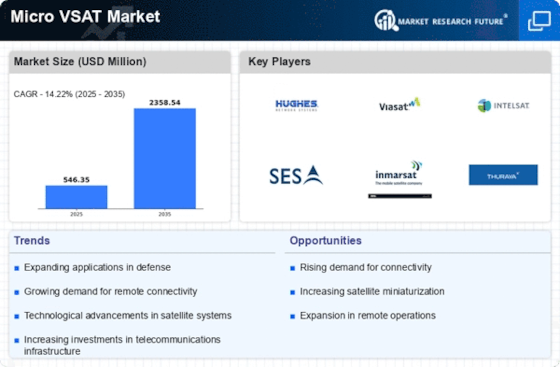
As per Market Research Future analysis, the Micro VSAT Market Size was estimated at 546.35 USD Million in 2024. The Micro VSAT industry is projected to grow from USD 624.04 Million in 2025 to USD 2358.54 Million by 2035, exhibiting a compound annual growth rate (CAGR) of 14.22% during the forecast period 2025 - 2035

Key Market Trends & Highlights

The Micro VSAT Market is poised for substantial growth driven by technological advancements and increasing connectivity demands.

  • North America remains the largest market for Micro VSAT Market solutions, reflecting a robust demand for advanced communication technologies.
  • Asia-Pacific is emerging as the fastest-growing region, indicating a rising need for reliable connectivity in remote areas.
  • The Ka-Band segment dominates the market, while the Ku-Band segment is experiencing rapid growth due to its cost-effectiveness.
  • Technological advancements and increased demand for connectivity are key drivers propelling the Micro VSAT Market forward.

Market Size & Forecast

2024 Market Size 546.35 (USD Million)
2035 Market Size 2358.54 (USD Million)
CAGR (2025 - 2035) 14.22%
Largest Regional Market Share in 2024 North America

Major Players

Hughes Network Systems (US), Viasat Inc. (US), Intelsat S.A. (US), SES S.A. (LU), Inmarsat Global Limited (GB), Thuraya Telecommunications Company (AE), Eutelsat Communications (FR), Iridium Communications Inc. (US), Telesat Canada (CA)

Market Trends

The Micro VSAT Market is currently experiencing a notable evolution, driven by advancements in satellite technology and increasing demand for reliable communication solutions. This market encompasses very small aperture terminals that facilitate satellite communications, particularly in remote and underserved regions. As organizations seek to enhance connectivity, the Micro VSAT Market appears poised for growth, with applications spanning various sectors, including telecommunications, defense, and maritime. The integration of innovative technologies, such as software-defined networking and enhanced signal processing, is likely to further propel market expansion. Moreover, the rising trend of digital transformation across industries is influencing the Micro VSAT Market. Companies are increasingly recognizing the necessity of robust communication infrastructure to support their operations. This shift is fostering a competitive landscape where service providers are compelled to offer more efficient and cost-effective solutions. As the demand for high-speed internet and seamless connectivity continues to rise, the Micro VSAT Market may witness a surge in investments and technological advancements, ultimately shaping its future trajectory.

Technological Advancements

The Micro VSAT Market is witnessing rapid technological advancements that enhance the performance and efficiency of satellite communications. Innovations in antenna design, modulation techniques, and signal processing are contributing to improved data transmission rates and reduced latency. These developments are likely to attract a broader range of users, including those in sectors such as agriculture, healthcare, and emergency response.

Increased Demand for Connectivity

There is a growing demand for reliable connectivity solutions in remote and rural areas, which is significantly impacting the Micro VSAT Market. As businesses and governments strive to bridge the digital divide, the need for effective communication tools becomes paramount. This trend suggests that Micro VSAT systems will play a crucial role in providing internet access and communication capabilities in underserved regions.

Focus on Cost-Effectiveness

Cost-effectiveness is emerging as a key consideration in the Micro VSAT Market. Organizations are increasingly seeking affordable solutions that do not compromise on quality or performance. This trend indicates a shift towards more competitive pricing models and service offerings, which may encourage wider adoption of Micro VSAT technology across various industries.

Micro VSAT Market Market Drivers

Regulatory Support for Micro VSAT Market Growth

Regulatory support is emerging as a crucial driver for the micro vsat Market, as governments and regulatory bodies recognize the importance of satellite communication. Policies aimed at promoting satellite technology and reducing barriers to entry are likely to foster market growth. For instance, initiatives to streamline licensing processes and allocate frequency bands for satellite operations can enhance the operational landscape for Micro VSAT Market providers. Additionally, international collaborations to improve satellite infrastructure are expected to bolster the market. As regulatory frameworks evolve to support innovation, the Micro VSAT Market is poised for expansion, with potential growth opportunities in emerging markets.

Technological Advancements in Micro VSAT Market

The Micro VSAT Market is experiencing rapid technological advancements that enhance satellite communication capabilities. Innovations such as high-throughput satellites (HTS) and low Earth orbit (LEO) satellite constellations are transforming the landscape. These technologies enable higher data rates and lower latency, which are crucial for applications in remote areas. The integration of advanced modulation techniques and software-defined networking is also improving the efficiency of satellite operations. As a result, the Micro VSAT Market is likely to witness increased adoption across various sectors, including maritime, aviation, and defense. The market is projected to grow at a compound annual growth rate (CAGR) of approximately 10% over the next five years, driven by these technological enhancements.

Focus on Cost-Effectiveness in Micro VSAT Market

Cost-effectiveness is a pivotal driver in the Micro VSAT Market, as organizations seek affordable solutions for satellite communication. The decreasing costs of satellite launches and advancements in technology have made Micro VSAT Market systems more accessible. This trend is particularly beneficial for small and medium-sized enterprises (SMEs) that require reliable communication without incurring substantial expenses. Furthermore, the operational efficiency of Micro VSAT Market systems allows for reduced maintenance costs, making them an attractive option for various applications. As a result, the Micro VSAT Market is likely to see increased adoption among SMEs and other cost-sensitive sectors, contributing to overall market growth.

Increased Demand for Connectivity in Micro VSAT Market

The Micro VSAT Market is witnessing a surge in demand for connectivity solutions, particularly in underserved regions. As businesses and governments seek to bridge the digital divide, the need for reliable satellite communication is becoming more pronounced. This demand is fueled by the growing reliance on internet services for education, healthcare, and commerce. According to recent estimates, the number of connected devices is expected to reach 75 billion by 2025, further driving the need for robust connectivity solutions. Micro VSAT Market systems, with their compact size and ease of deployment, are well-positioned to meet this demand. Consequently, the Micro VSAT Market is likely to expand significantly as more organizations recognize the value of satellite communication in enhancing connectivity.

Growing Applications in Diverse Sectors of Micro VSAT Market

The Micro VSAT Market is expanding due to its growing applications across diverse sectors. Industries such as oil and gas, mining, and disaster recovery are increasingly relying on satellite communication for real-time data transmission and operational efficiency. The ability of Micro VSAT Market systems to provide connectivity in remote and challenging environments makes them indispensable for these sectors. For instance, in the oil and gas industry, real-time monitoring of operations is critical for safety and efficiency. As more sectors recognize the advantages of Micro VSAT Market technology, the market is expected to grow, with projections indicating a potential increase in market size by 15% over the next few years.

Market Segment Insights

By Frequency: Ka-Band (Largest) vs. Ku-Band (Fastest-Growing)

In the Micro VSAT Market, the frequency segment is largely dominated by the Ku-Band, which has established itself as the leading choice for various applications such as satellite communications and broadband internet. This segment's market share reflects its widespread adoption in both residential and commercial sectors, making it a cornerstone of VSAT technology. Conversely, the Ka-Band segment is experiencing rapid growth, driven by increasing demand for higher bandwidth and enhanced data transmission capabilities. Its adoption is rising across sectors such as maritime and aviation, where higher performance is crucial for operational efficiency.

Frequency: Ku-Band (Dominant) vs. Ka-Band (Emerging)

The Ku-Band is well-recognized for its robust capabilities, providing reliable service and coverage, especially in regions with dense user bases. This frequency band has been pivotal for traditional VSAT operations, catering to a wide range of applications from remote monitoring to voice data transmissions. In contrast, the Ka-Band is an emerging player, offering improved bandwidth for faster data rates and lower latency. Its capabilities make it particularly appealing for applications requiring high-speed internet. The growing interest in IoT and high-definition streaming services is propelling the Ka-Band into the spotlight, making it a vital part of future connectivity solutions.

By Application: Airborne (Largest) vs. Maritime (Fastest-Growing)

The Micro VSAT Market application segment is dominated by the airborne segment, which accounts for the largest share due to its widespread adoption in military and commercial aviation. Companies are increasingly integrating satellite communication technologies in aircraft to facilitate real-time data transmission, enhancing operational efficiency. Meanwhile, the maritime sector is witnessing rapid growth, driven by the increasing demand for reliable connectivity for shipping, fishing, and leisure boating. This growing reliance on satellite communication solutions is reshaping how maritime enterprises operate, leading to a significant growth trajectory.

Airborne (Dominant) vs. Maritime (Emerging)

The Airborne segment of the Micro VSAT Market is characterized by its extensive use in various aviation applications, offering robust communication capabilities for both military and commercial uses. This segment remains dominant due to the rising need for consistent connectivity in remote operations, such as surveillance and monitoring. In contrast, the Maritime segment is emerging as a pivotal player, responding to the demand for seamless internet access in the global maritime industry. As shipping companies seek to enhance operational efficiencies and passenger experiences, <a href="https://www.marketresearchfuture.com/reports/maritime-vsat-market-7981" target="_blank">maritime vsat</a> systems are increasingly being adopted, positioning this segment for exponential growth.

By Antenna Technology: Parabolic (Largest) vs. Flat Panel (Fastest-Growing)

The Micro VSAT Market exhibits a notable division in antenna technology, with Parabolic antennas holding a significant portion of the market share. This traditional technology has long been favored for its wide coverage and superior performance in various operational environments. In contrast, Flat Panel antennas, while initially lagging behind in adoption, are rapidly gaining traction due to their enhanced portability and compact design, appealing to a growing base of modern users seeking efficiency and ease of use.

Antenna Technology: Parabolic (Dominant) vs. Flat Panel (Emerging)

Parabolic antennas are characterized by their curved, dish-like structures, providing excellent signal reception and transmission capabilities, making them a staple in the Micro VSAT Market. Their dominant market position stems from extensive usage in military and commercial applications where reliable connectivity is crucial. On the other hand, Flat Panel antennas represent an emerging trend, offering sleek designs and lightweight features that surpass the limitations of traditional antennas. These antennas are particularly attractive for mobile and remote applications, driving rapid growth as users increasingly prioritize space-saving solutions in their technology deployments.

By Industry Vertical: Aviation (Largest) vs. Maritime (Fastest-Growing)

The Micro VSAT Market shows a diverse distribution of market share across various industry verticals. Aviation leads as the largest segment due to high demand for reliable communication systems in air travel, where connectivity is crucial for flight operations and passenger experiences. Other significant segments include Government and Military & Defense, reflecting the critical nature of secure and continuous communication for national defense and emergency services. The Maritime sector, while smaller, is showing promising growth and represents the fastest-growing vertical as shipping lines and recreational boating increasingly rely on satellite communication for navigation and safety necessities.

Aviation (Dominant) vs. Maritime (Emerging)

Aviation's dominant position in the Micro VSAT Market stems from the industry's relentless pursuit of technological advancement and enhanced passenger experiences. Airlines require consistent and robust connectivity during flights, and VSAT technologies enable real-time data communication and in-flight services. On the other hand, the Maritime sector, considered an emerging player, is rapidly adopting VSAT systems to meet regulatory requirements and improve operational efficiency. With increasing global trade, shipping companies are investing in satellite communications to enhance navigation and onboard services, driving demand for Micro VSAT Market solutions in maritime operations.

Get more detailed insights about Micro VSAT Market Research Report—Global Forecast till 2035

Regional Insights

North America : Leading Innovation and Demand

North America is the largest market for Micro VSAT Market, holding approximately 45% of the global share. The region's growth is driven by increasing demand for high-speed internet in remote areas, advancements in satellite technology, and supportive regulatory frameworks. The U.S. and Canada are the primary contributors, with significant investments in satellite infrastructure and services, enhancing connectivity for various sectors including telecommunications and defense. The competitive landscape is robust, featuring key players such as Hughes Network Systems, Viasat Inc., and Intelsat S.A. These companies are at the forefront of innovation, offering advanced Micro VSAT Market solutions tailored to meet the needs of diverse industries. The presence of established firms and ongoing partnerships further solidify North America's position as a leader in the Micro VSAT Market.

Europe : Emerging Growth and Regulation

Europe is witnessing significant growth in the Micro VSAT Market, accounting for approximately 30% of the global share. The region benefits from stringent regulations promoting satellite communications and a growing demand for broadband services in rural areas. Countries like the UK, Germany, and France are leading this growth, driven by government initiatives aimed at enhancing digital connectivity and reducing the digital divide. The competitive landscape in Europe includes major players such as SES S.A. and Eutelsat Communications, which are actively expanding their service offerings. The presence of innovative startups and established companies fosters a dynamic market environment. Regulatory bodies are also playing a crucial role in facilitating market entry and ensuring compliance with international standards, thereby enhancing the overall growth trajectory of the Micro VSAT Market sector.

Asia-Pacific : Rapid Expansion and Adoption

Asia-Pacific is rapidly emerging as a significant player in the Micro VSAT Market, holding around 20% of the global share. The region's growth is fueled by increasing internet penetration, rising demand for mobile connectivity, and government initiatives promoting satellite communications. Countries like India and Australia are at the forefront, with substantial investments in satellite infrastructure to support various sectors, including agriculture and disaster management. The competitive landscape is characterized by a mix of established players and new entrants. Companies such as Inmarsat Global Limited and Iridium Communications are expanding their presence, while local firms are innovating to meet regional demands. The growing focus on digital transformation and smart city initiatives further propels the adoption of Micro VSAT Market solutions across the region, enhancing connectivity and service delivery.

Middle East and Africa : Untapped Potential and Growth

The Middle East and Africa region is gradually emerging in the Micro VSAT Market, currently holding about 5% of the global share. The growth is driven by increasing demand for reliable communication solutions in remote and underserved areas. Countries like South Africa and the UAE are leading the charge, with investments in satellite technology aimed at enhancing connectivity for various sectors, including education and healthcare. The competitive landscape is evolving, with both international and local players vying for market share. Companies such as Thuraya Telecommunications and Telesat Canada are making strides in the region, focusing on tailored solutions to meet local needs. The potential for growth is significant, as governments and organizations recognize the importance of satellite communications in bridging the digital divide and fostering economic development.

Key Players and Competitive Insights

With a strong presence across different verticals and geographies, the Micro VSAT Market is highly competitive and dominated by established, pure-play vendors. Over 30 vendors cater to this market, and they continually innovate their solutions to meet the evolving needs of businesses by adopting new technologies. These vendors have a robust geographic footprint and partner ecosystem to cater to diverse customer segments. The Micro VSAT Market is highly competitive, with many vendors offering similar products and services.
The major players in the market include L3Harris Technologies, Inc., General Dynamics Corporation, Ultra, KVH Industries, Inc., and Thales Group. Ultra employs R&D to create creative, mission-specific, customized technology solutions to its customers' most difficult problems. It collaborates with the world's leading prime contractors and the US DoD, UK MoD, and Australian DoD. It is diverse, with the top ten contracts accounting for 21% of 2020 revenue.
Thales Group has adopted various strategic initiatives to sustain its long-term revenue growth. The group has fast-tracked its research & development by employing about 40% of its total headcount. It continues to dominate the digital revolution through numerous strategic partnerships with innovative technology companies. Additionally, with the acquisition of Gemalto, it has enhanced its product portfolio while adding three major technologies, including digital security, biometrics, and digital identity, and secure connectivity for IoT and data protection and encryption.
The Micro VSAT Market is consolidated, increasing competition, acquisitions, mergers, and other strategic market developments and decisions to improve operational effectiveness.

Key Companies in the Micro VSAT Market include

Industry Developments

    • In August 2022, Intellian Technologies, Inc., had launched new t-Series and s-Series antennas to enhance the live television (TV) experience for those onboard maritime vessels.
    • In August 2022, Ovzon had received an order for the renewal of Ovzon’s SATCOM-as-a-Service from the UK MoD through the company’s partner Airbus. The 18-month renewal, valued at 1.1 MUSD, will start on September 1, 2022, and represents an extension of Ovzon’s services in specific regions worldwide.

Future Outlook

Micro VSAT Market Future Outlook

The Micro VSAT Market is projected to grow at a 14.22% CAGR from 2025 to 2035, driven by increasing demand for mobile connectivity and advancements in satellite technology.

New opportunities lie in:

  • Development of portable Micro VSAT Market units for remote operations
  • Integration of AI for enhanced data analytics in satellite communications
  • Partnerships with telecom providers for expanded service offerings

By 2035, the Micro VSAT Market is expected to achieve substantial growth and innovation.

Market Segmentation

Micro VSAT Market Frequency Outlook

  • Ku-Band
  • Ka-Band
  • X-Band
  • Others

Micro VSAT Market Application Outlook

  • Airborne
  • Maritime
  • Land

Micro VSAT Market Industry Vertical Outlook

  • Aviation
  • Energy & Power
  • Government
  • Military & Defense
  • Maritime
  • Oil & Gas
  • Construction & Infrastructure
  • Media & Entertainment
  • Mining
  • Others

Micro VSAT Market Antenna Technology Outlook

  • Parabolic
  • Flat Panel

Report Scope

MARKET SIZE 2024 546.35(USD Million)
MARKET SIZE 2025 624.04(USD Million)
MARKET SIZE 2035 2358.54(USD Million)
COMPOUND ANNUAL GROWTH RATE (CAGR) 14.22% (2025 - 2035)
REPORT COVERAGE Revenue Forecast, Competitive Landscape, Growth Factors, and Trends
BASE YEAR 2024
Market Forecast Period 2025 - 2035
Historical Data 2019 - 2024
Market Forecast Units USD Million
Key Companies Profiled Hughes Network Systems (US), Viasat Inc. (US), Intelsat S.A. (US), SES S.A. (LU), Inmarsat Global Limited (GB), Thuraya Telecommunications Company (AE), Eutelsat Communications (FR), Iridium Communications Inc. (US), Telesat Canada (CA)
Segments Covered Frequency, Application, Antenna Technology, Industry Vertical, Region
Key Market Opportunities Growing demand for reliable communication in remote areas drives innovation in the Micro VSAT Market.
Key Market Dynamics Rising demand for high-speed connectivity drives innovation and competition in the Micro Very Small Aperture Terminal market.
Countries Covered North America, Europe, APAC, South America, MEA

FAQs

What is the projected market valuation of the Micro VSAT Market by 2035?

<p>The Micro VSAT Market is projected to reach a valuation of 2358.54 USD Million by 2035.</p>

What was the market valuation of the Micro VSAT Market in 2024?

<p>In 2024, the Micro VSAT Market had a valuation of 546.35 USD Million.</p>

What is the expected CAGR for the Micro VSAT Market during the forecast period 2025 - 2035?

<p>The expected CAGR for the Micro VSAT Market during the forecast period 2025 - 2035 is 14.22%.</p>

Which frequency segment is projected to have the highest valuation in the Micro VSAT Market?

<p>The Ka-Band frequency segment is projected to have a valuation ranging from 200.0 to 900.0 USD Million.</p>

What are the key applications driving the Micro VSAT Market?

Key applications driving the Micro VSAT Market include Land, Maritime, and Airborne, with Land projected to reach 1172.56 USD Million.

Which antenna technology segment is expected to dominate the Micro VSAT Market?

The Flat Panel antenna technology segment is expected to dominate, with a projected valuation of 1358.54 USD Million.

What industries are contributing to the growth of the Micro VSAT Market?

Industries such as Military &amp; Defense, Government, and Energy &amp; Power are contributing significantly, with Military &amp; Defense projected at 400.0 USD Million.

Who are the key players in the Micro VSAT Market?

Key players in the Micro VSAT Market include Hughes Network Systems, Viasat Inc., and Intelsat S.A.

What is the projected valuation range for the X-Band frequency segment?

The projected valuation range for the X-Band frequency segment is between 100.0 and 400.0 USD Million.

How does the Micro VSAT Market's growth compare across different industry verticals?

The Military &amp; Defense sector is expected to lead with a valuation of 400.0 USD Million, while sectors like Media &amp; Entertainment may reach 150.0 USD Million.

  1. SECTION I: EXECUTIVE SUMMARY AND KEY HIGHLIGHTS
    1. | 1.1 EXECUTIVE SUMMARY
    2. | | 1.1.1 Market Overview
    3. | | 1.1.2 Key Findings
    4. | | 1.1.3 Market Segmentation
    5. | | 1.1.4 Competitive Landscape
    6. | | 1.1.5 Challenges and Opportunities
    7. | | 1.1.6 Future Outlook
  2. SECTION II: SCOPING, METHODOLOGY AND MARKET STRUCTURE
    1. | 2.1 MARKET INTRODUCTION
    2. | | 2.1.1 Definition
    3. | | 2.1.2 Scope of the study
    4. | | | 2.1.2.1 Research Objective
    5. | | | 2.1.2.2 Assumption
    6. | | | 2.1.2.3 Limitations
    7. | 2.2 RESEARCH METHODOLOGY
    8. | | 2.2.1 Overview
    9. | | 2.2.2 Data Mining
    10. | | 2.2.3 Secondary Research
    11. | | 2.2.4 Primary Research
    12. | | | 2.2.4.1 Primary Interviews and Information Gathering Process
    13. | | | 2.2.4.2 Breakdown of Primary Respondents
    14. | | 2.2.5 Forecasting Model
    15. | | 2.2.6 Market Size Estimation
    16. | | | 2.2.6.1 Bottom-Up Approach
    17. | | | 2.2.6.2 Top-Down Approach
    18. | | 2.2.7 Data Triangulation
    19. | | 2.2.8 Validation
  3. SECTION III: QUALITATIVE ANALYSIS
    1. | 3.1 MARKET DYNAMICS
    2. | | 3.1.1 Overview
    3. | | 3.1.2 Drivers
    4. | | 3.1.3 Restraints
    5. | | 3.1.4 Opportunities
    6. | 3.2 MARKET FACTOR ANALYSIS
    7. | | 3.2.1 Value chain Analysis
    8. | | 3.2.2 Porter's Five Forces Analysis
    9. | | | 3.2.2.1 Bargaining Power of Suppliers
    10. | | | 3.2.2.2 Bargaining Power of Buyers
    11. | | | 3.2.2.3 Threat of New Entrants
    12. | | | 3.2.2.4 Threat of Substitutes
    13. | | | 3.2.2.5 Intensity of Rivalry
    14. | | 3.2.3 COVID-19 Impact Analysis
    15. | | | 3.2.3.1 Market Impact Analysis
    16. | | | 3.2.3.2 Regional Impact
    17. | | | 3.2.3.3 Opportunity and Threat Analysis
  4. SECTION IV: QUANTITATIVE ANALYSIS
    1. | 4.1 Aerospace & Defense, BY Frequency (USD Million)
    2. | | 4.1.1 Ku-Band
    3. | | 4.1.2 Ka-Band
    4. | | 4.1.3 X-Band
    5. | | 4.1.4 Others
    6. | 4.2 Aerospace & Defense, BY Application (USD Million)
    7. | | 4.2.1 Airborne
    8. | | 4.2.2 Maritime
    9. | | 4.2.3 Land
    10. | 4.3 Aerospace & Defense, BY Antenna Technology (USD Million)
    11. | | 4.3.1 Parabolic
    12. | | 4.3.2 Flat Panel
    13. | 4.4 Aerospace & Defense, BY Industry Vertical (USD Million)
    14. | | 4.4.1 Aviation
    15. | | 4.4.2 Energy & Power
    16. | | 4.4.3 Government
    17. | | 4.4.4 Military & Defense
    18. | | 4.4.5 Maritime
    19. | | 4.4.6 Oil & Gas
    20. | | 4.4.7 Construction & Infrastructure
    21. | | 4.4.8 Media & Entertainment
    22. | | 4.4.9 Mining
    23. | | 4.4.10 Others
    24. | 4.5 Aerospace & Defense, BY Region (USD Million)
    25. | | 4.5.1 North America
    26. | | | 4.5.1.1 US
    27. | | | 4.5.1.2 Canada
    28. | | 4.5.2 Europe
    29. | | | 4.5.2.1 Germany
    30. | | | 4.5.2.2 UK
    31. | | | 4.5.2.3 France
    32. | | | 4.5.2.4 Russia
    33. | | | 4.5.2.5 Italy
    34. | | | 4.5.2.6 Spain
    35. | | | 4.5.2.7 Rest of Europe
    36. | | 4.5.3 APAC
    37. | | | 4.5.3.1 China
    38. | | | 4.5.3.2 India
    39. | | | 4.5.3.3 Japan
    40. | | | 4.5.3.4 South Korea
    41. | | | 4.5.3.5 Malaysia
    42. | | | 4.5.3.6 Thailand
    43. | | | 4.5.3.7 Indonesia
    44. | | | 4.5.3.8 Rest of APAC
    45. | | 4.5.4 South America
    46. | | | 4.5.4.1 Brazil
    47. | | | 4.5.4.2 Mexico
    48. | | | 4.5.4.3 Argentina
    49. | | | 4.5.4.4 Rest of South America
    50. | | 4.5.5 MEA
    51. | | | 4.5.5.1 GCC Countries
    52. | | | 4.5.5.2 South Africa
    53. | | | 4.5.5.3 Rest of MEA
  5. SECTION V: COMPETITIVE ANALYSIS
    1. | 5.1 Competitive Landscape
    2. | | 5.1.1 Overview
    3. | | 5.1.2 Competitive Analysis
    4. | | 5.1.3 Market share Analysis
    5. | | 5.1.4 Major Growth Strategy in the Aerospace & Defense
    6. | | 5.1.5 Competitive Benchmarking
    7. | | 5.1.6 Leading Players in Terms of Number of Developments in the Aerospace & Defense
    8. | | 5.1.7 Key developments and growth strategies
    9. | | | 5.1.7.1 New Product Launch/Service Deployment
    10. | | | 5.1.7.2 Merger & Acquisitions
    11. | | | 5.1.7.3 Joint Ventures
    12. | | 5.1.8 Major Players Financial Matrix
    13. | | | 5.1.8.1 Sales and Operating Income
    14. | | | 5.1.8.2 Major Players R&D Expenditure. 2023
    15. | 5.2 Company Profiles
    16. | | 5.2.1 Hughes Network Systems (US)
    17. | | | 5.2.1.1 Financial Overview
    18. | | | 5.2.1.2 Products Offered
    19. | | | 5.2.1.3 Key Developments
    20. | | | 5.2.1.4 SWOT Analysis
    21. | | | 5.2.1.5 Key Strategies
    22. | | 5.2.2 Viasat Inc. (US)
    23. | | | 5.2.2.1 Financial Overview
    24. | | | 5.2.2.2 Products Offered
    25. | | | 5.2.2.3 Key Developments
    26. | | | 5.2.2.4 SWOT Analysis
    27. | | | 5.2.2.5 Key Strategies
    28. | | 5.2.3 Intelsat S.A. (US)
    29. | | | 5.2.3.1 Financial Overview
    30. | | | 5.2.3.2 Products Offered
    31. | | | 5.2.3.3 Key Developments
    32. | | | 5.2.3.4 SWOT Analysis
    33. | | | 5.2.3.5 Key Strategies
    34. | | 5.2.4 SES S.A. (LU)
    35. | | | 5.2.4.1 Financial Overview
    36. | | | 5.2.4.2 Products Offered
    37. | | | 5.2.4.3 Key Developments
    38. | | | 5.2.4.4 SWOT Analysis
    39. | | | 5.2.4.5 Key Strategies
    40. | | 5.2.5 Inmarsat Global Limited (GB)
    41. | | | 5.2.5.1 Financial Overview
    42. | | | 5.2.5.2 Products Offered
    43. | | | 5.2.5.3 Key Developments
    44. | | | 5.2.5.4 SWOT Analysis
    45. | | | 5.2.5.5 Key Strategies
    46. | | 5.2.6 Thuraya Telecommunications Company (AE)
    47. | | | 5.2.6.1 Financial Overview
    48. | | | 5.2.6.2 Products Offered
    49. | | | 5.2.6.3 Key Developments
    50. | | | 5.2.6.4 SWOT Analysis
    51. | | | 5.2.6.5 Key Strategies
    52. | | 5.2.7 Eutelsat Communications (FR)
    53. | | | 5.2.7.1 Financial Overview
    54. | | | 5.2.7.2 Products Offered
    55. | | | 5.2.7.3 Key Developments
    56. | | | 5.2.7.4 SWOT Analysis
    57. | | | 5.2.7.5 Key Strategies
    58. | | 5.2.8 Iridium Communications Inc. (US)
    59. | | | 5.2.8.1 Financial Overview
    60. | | | 5.2.8.2 Products Offered
    61. | | | 5.2.8.3 Key Developments
    62. | | | 5.2.8.4 SWOT Analysis
    63. | | | 5.2.8.5 Key Strategies
    64. | | 5.2.9 Telesat Canada (CA)
    65. | | | 5.2.9.1 Financial Overview
    66. | | | 5.2.9.2 Products Offered
    67. | | | 5.2.9.3 Key Developments
    68. | | | 5.2.9.4 SWOT Analysis
    69. | | | 5.2.9.5 Key Strategies
    70. | 5.3 Appendix
    71. | | 5.3.1 References
    72. | | 5.3.2 Related Reports
  6. LIST OF FIGURES
    1. | 6.1 MARKET SYNOPSIS
    2. | 6.2 NORTH AMERICA MARKET ANALYSIS
    3. | 6.3 US MARKET ANALYSIS BY FREQUENCY
    4. | 6.4 US MARKET ANALYSIS BY APPLICATION
    5. | 6.5 US MARKET ANALYSIS BY ANTENNA TECHNOLOGY
    6. | 6.6 US MARKET ANALYSIS BY INDUSTRY VERTICAL
    7. | 6.7 CANADA MARKET ANALYSIS BY FREQUENCY
    8. | 6.8 CANADA MARKET ANALYSIS BY APPLICATION
    9. | 6.9 CANADA MARKET ANALYSIS BY ANTENNA TECHNOLOGY
    10. | 6.10 CANADA MARKET ANALYSIS BY INDUSTRY VERTICAL
    11. | 6.11 EUROPE MARKET ANALYSIS
    12. | 6.12 GERMANY MARKET ANALYSIS BY FREQUENCY
    13. | 6.13 GERMANY MARKET ANALYSIS BY APPLICATION
    14. | 6.14 GERMANY MARKET ANALYSIS BY ANTENNA TECHNOLOGY
    15. | 6.15 GERMANY MARKET ANALYSIS BY INDUSTRY VERTICAL
    16. | 6.16 UK MARKET ANALYSIS BY FREQUENCY
    17. | 6.17 UK MARKET ANALYSIS BY APPLICATION
    18. | 6.18 UK MARKET ANALYSIS BY ANTENNA TECHNOLOGY
    19. | 6.19 UK MARKET ANALYSIS BY INDUSTRY VERTICAL
    20. | 6.20 FRANCE MARKET ANALYSIS BY FREQUENCY
    21. | 6.21 FRANCE MARKET ANALYSIS BY APPLICATION
    22. | 6.22 FRANCE MARKET ANALYSIS BY ANTENNA TECHNOLOGY
    23. | 6.23 FRANCE MARKET ANALYSIS BY INDUSTRY VERTICAL
    24. | 6.24 RUSSIA MARKET ANALYSIS BY FREQUENCY
    25. | 6.25 RUSSIA MARKET ANALYSIS BY APPLICATION
    26. | 6.26 RUSSIA MARKET ANALYSIS BY ANTENNA TECHNOLOGY
    27. | 6.27 RUSSIA MARKET ANALYSIS BY INDUSTRY VERTICAL
    28. | 6.28 ITALY MARKET ANALYSIS BY FREQUENCY
    29. | 6.29 ITALY MARKET ANALYSIS BY APPLICATION
    30. | 6.30 ITALY MARKET ANALYSIS BY ANTENNA TECHNOLOGY
    31. | 6.31 ITALY MARKET ANALYSIS BY INDUSTRY VERTICAL
    32. | 6.32 SPAIN MARKET ANALYSIS BY FREQUENCY
    33. | 6.33 SPAIN MARKET ANALYSIS BY APPLICATION
    34. | 6.34 SPAIN MARKET ANALYSIS BY ANTENNA TECHNOLOGY
    35. | 6.35 SPAIN MARKET ANALYSIS BY INDUSTRY VERTICAL
    36. | 6.36 REST OF EUROPE MARKET ANALYSIS BY FREQUENCY
    37. | 6.37 REST OF EUROPE MARKET ANALYSIS BY APPLICATION
    38. | 6.38 REST OF EUROPE MARKET ANALYSIS BY ANTENNA TECHNOLOGY
    39. | 6.39 REST OF EUROPE MARKET ANALYSIS BY INDUSTRY VERTICAL
    40. | 6.40 APAC MARKET ANALYSIS
    41. | 6.41 CHINA MARKET ANALYSIS BY FREQUENCY
    42. | 6.42 CHINA MARKET ANALYSIS BY APPLICATION
    43. | 6.43 CHINA MARKET ANALYSIS BY ANTENNA TECHNOLOGY
    44. | 6.44 CHINA MARKET ANALYSIS BY INDUSTRY VERTICAL
    45. | 6.45 INDIA MARKET ANALYSIS BY FREQUENCY
    46. | 6.46 INDIA MARKET ANALYSIS BY APPLICATION
    47. | 6.47 INDIA MARKET ANALYSIS BY ANTENNA TECHNOLOGY
    48. | 6.48 INDIA MARKET ANALYSIS BY INDUSTRY VERTICAL
    49. | 6.49 JAPAN MARKET ANALYSIS BY FREQUENCY
    50. | 6.50 JAPAN MARKET ANALYSIS BY APPLICATION
    51. | 6.51 JAPAN MARKET ANALYSIS BY ANTENNA TECHNOLOGY
    52. | 6.52 JAPAN MARKET ANALYSIS BY INDUSTRY VERTICAL
    53. | 6.53 SOUTH KOREA MARKET ANALYSIS BY FREQUENCY
    54. | 6.54 SOUTH KOREA MARKET ANALYSIS BY APPLICATION
    55. | 6.55 SOUTH KOREA MARKET ANALYSIS BY ANTENNA TECHNOLOGY
    56. | 6.56 SOUTH KOREA MARKET ANALYSIS BY INDUSTRY VERTICAL
    57. | 6.57 MALAYSIA MARKET ANALYSIS BY FREQUENCY
    58. | 6.58 MALAYSIA MARKET ANALYSIS BY APPLICATION
    59. | 6.59 MALAYSIA MARKET ANALYSIS BY ANTENNA TECHNOLOGY
    60. | 6.60 MALAYSIA MARKET ANALYSIS BY INDUSTRY VERTICAL
    61. | 6.61 THAILAND MARKET ANALYSIS BY FREQUENCY
    62. | 6.62 THAILAND MARKET ANALYSIS BY APPLICATION
    63. | 6.63 THAILAND MARKET ANALYSIS BY ANTENNA TECHNOLOGY
    64. | 6.64 THAILAND MARKET ANALYSIS BY INDUSTRY VERTICAL
    65. | 6.65 INDONESIA MARKET ANALYSIS BY FREQUENCY
    66. | 6.66 INDONESIA MARKET ANALYSIS BY APPLICATION
    67. | 6.67 INDONESIA MARKET ANALYSIS BY ANTENNA TECHNOLOGY
    68. | 6.68 INDONESIA MARKET ANALYSIS BY INDUSTRY VERTICAL
    69. | 6.69 REST OF APAC MARKET ANALYSIS BY FREQUENCY
    70. | 6.70 REST OF APAC MARKET ANALYSIS BY APPLICATION
    71. | 6.71 REST OF APAC MARKET ANALYSIS BY ANTENNA TECHNOLOGY
    72. | 6.72 REST OF APAC MARKET ANALYSIS BY INDUSTRY VERTICAL
    73. | 6.73 SOUTH AMERICA MARKET ANALYSIS
    74. | 6.74 BRAZIL MARKET ANALYSIS BY FREQUENCY
    75. | 6.75 BRAZIL MARKET ANALYSIS BY APPLICATION
    76. | 6.76 BRAZIL MARKET ANALYSIS BY ANTENNA TECHNOLOGY
    77. | 6.77 BRAZIL MARKET ANALYSIS BY INDUSTRY VERTICAL
    78. | 6.78 MEXICO MARKET ANALYSIS BY FREQUENCY
    79. | 6.79 MEXICO MARKET ANALYSIS BY APPLICATION
    80. | 6.80 MEXICO MARKET ANALYSIS BY ANTENNA TECHNOLOGY
    81. | 6.81 MEXICO MARKET ANALYSIS BY INDUSTRY VERTICAL
    82. | 6.82 ARGENTINA MARKET ANALYSIS BY FREQUENCY
    83. | 6.83 ARGENTINA MARKET ANALYSIS BY APPLICATION
    84. | 6.84 ARGENTINA MARKET ANALYSIS BY ANTENNA TECHNOLOGY
    85. | 6.85 ARGENTINA MARKET ANALYSIS BY INDUSTRY VERTICAL
    86. | 6.86 REST OF SOUTH AMERICA MARKET ANALYSIS BY FREQUENCY
    87. | 6.87 REST OF SOUTH AMERICA MARKET ANALYSIS BY APPLICATION
    88. | 6.88 REST OF SOUTH AMERICA MARKET ANALYSIS BY ANTENNA TECHNOLOGY
    89. | 6.89 REST OF SOUTH AMERICA MARKET ANALYSIS BY INDUSTRY VERTICAL
    90. | 6.90 MEA MARKET ANALYSIS
    91. | 6.91 GCC COUNTRIES MARKET ANALYSIS BY FREQUENCY
    92. | 6.92 GCC COUNTRIES MARKET ANALYSIS BY APPLICATION
    93. | 6.93 GCC COUNTRIES MARKET ANALYSIS BY ANTENNA TECHNOLOGY
    94. | 6.94 GCC COUNTRIES MARKET ANALYSIS BY INDUSTRY VERTICAL
    95. | 6.95 SOUTH AFRICA MARKET ANALYSIS BY FREQUENCY
    96. | 6.96 SOUTH AFRICA MARKET ANALYSIS BY APPLICATION
    97. | 6.97 SOUTH AFRICA MARKET ANALYSIS BY ANTENNA TECHNOLOGY
    98. | 6.98 SOUTH AFRICA MARKET ANALYSIS BY INDUSTRY VERTICAL
    99. | 6.99 REST OF MEA MARKET ANALYSIS BY FREQUENCY
    100. | 6.100 REST OF MEA MARKET ANALYSIS BY APPLICATION
    101. | 6.101 REST OF MEA MARKET ANALYSIS BY ANTENNA TECHNOLOGY
    102. | 6.102 REST OF MEA MARKET ANALYSIS BY INDUSTRY VERTICAL
    103. | 6.103 KEY BUYING CRITERIA OF AEROSPACE & DEFENSE
    104. | 6.104 RESEARCH PROCESS OF MRFR
    105. | 6.105 DRO ANALYSIS OF AEROSPACE & DEFENSE
    106. | 6.106 DRIVERS IMPACT ANALYSIS: AEROSPACE & DEFENSE
    107. | 6.107 RESTRAINTS IMPACT ANALYSIS: AEROSPACE & DEFENSE
    108. | 6.108 SUPPLY / VALUE CHAIN: AEROSPACE & DEFENSE
    109. | 6.109 AEROSPACE & DEFENSE, BY FREQUENCY, 2024 (% SHARE)
    110. | 6.110 AEROSPACE & DEFENSE, BY FREQUENCY, 2024 TO 2035 (USD Million)
    111. | 6.111 AEROSPACE & DEFENSE, BY APPLICATION, 2024 (% SHARE)
    112. | 6.112 AEROSPACE & DEFENSE, BY APPLICATION, 2024 TO 2035 (USD Million)
    113. | 6.113 AEROSPACE & DEFENSE, BY ANTENNA TECHNOLOGY, 2024 (% SHARE)
    114. | 6.114 AEROSPACE & DEFENSE, BY ANTENNA TECHNOLOGY, 2024 TO 2035 (USD Million)
    115. | 6.115 AEROSPACE & DEFENSE, BY INDUSTRY VERTICAL, 2024 (% SHARE)
    116. | 6.116 AEROSPACE & DEFENSE, BY INDUSTRY VERTICAL, 2024 TO 2035 (USD Million)
    117. | 6.117 BENCHMARKING OF MAJOR COMPETITORS
  7. LIST OF TABLES
    1. | 7.1 LIST OF ASSUMPTIONS
    2. | | 7.1.1
    3. | 7.2 North America MARKET SIZE ESTIMATES; FORECAST
    4. | | 7.2.1 BY FREQUENCY, 2025-2035 (USD Million)
    5. | | 7.2.2 BY APPLICATION, 2025-2035 (USD Million)
    6. | | 7.2.3 BY ANTENNA TECHNOLOGY, 2025-2035 (USD Million)
    7. | | 7.2.4 BY INDUSTRY VERTICAL, 2025-2035 (USD Million)
    8. | 7.3 US MARKET SIZE ESTIMATES; FORECAST
    9. | | 7.3.1 BY FREQUENCY, 2025-2035 (USD Million)
    10. | | 7.3.2 BY APPLICATION, 2025-2035 (USD Million)
    11. | | 7.3.3 BY ANTENNA TECHNOLOGY, 2025-2035 (USD Million)
    12. | | 7.3.4 BY INDUSTRY VERTICAL, 2025-2035 (USD Million)
    13. | 7.4 Canada MARKET SIZE ESTIMATES; FORECAST
    14. | | 7.4.1 BY FREQUENCY, 2025-2035 (USD Million)
    15. | | 7.4.2 BY APPLICATION, 2025-2035 (USD Million)
    16. | | 7.4.3 BY ANTENNA TECHNOLOGY, 2025-2035 (USD Million)
    17. | | 7.4.4 BY INDUSTRY VERTICAL, 2025-2035 (USD Million)
    18. | 7.5 Europe MARKET SIZE ESTIMATES; FORECAST
    19. | | 7.5.1 BY FREQUENCY, 2025-2035 (USD Million)
    20. | | 7.5.2 BY APPLICATION, 2025-2035 (USD Million)
    21. | | 7.5.3 BY ANTENNA TECHNOLOGY, 2025-2035 (USD Million)
    22. | | 7.5.4 BY INDUSTRY VERTICAL, 2025-2035 (USD Million)
    23. | 7.6 Germany MARKET SIZE ESTIMATES; FORECAST
    24. | | 7.6.1 BY FREQUENCY, 2025-2035 (USD Million)
    25. | | 7.6.2 BY APPLICATION, 2025-2035 (USD Million)
    26. | | 7.6.3 BY ANTENNA TECHNOLOGY, 2025-2035 (USD Million)
    27. | | 7.6.4 BY INDUSTRY VERTICAL, 2025-2035 (USD Million)
    28. | 7.7 UK MARKET SIZE ESTIMATES; FORECAST
    29. | | 7.7.1 BY FREQUENCY, 2025-2035 (USD Million)
    30. | | 7.7.2 BY APPLICATION, 2025-2035 (USD Million)
    31. | | 7.7.3 BY ANTENNA TECHNOLOGY, 2025-2035 (USD Million)
    32. | | 7.7.4 BY INDUSTRY VERTICAL, 2025-2035 (USD Million)
    33. | 7.8 France MARKET SIZE ESTIMATES; FORECAST
    34. | | 7.8.1 BY FREQUENCY, 2025-2035 (USD Million)
    35. | | 7.8.2 BY APPLICATION, 2025-2035 (USD Million)
    36. | | 7.8.3 BY ANTENNA TECHNOLOGY, 2025-2035 (USD Million)
    37. | | 7.8.4 BY INDUSTRY VERTICAL, 2025-2035 (USD Million)
    38. | 7.9 Russia MARKET SIZE ESTIMATES; FORECAST
    39. | | 7.9.1 BY FREQUENCY, 2025-2035 (USD Million)
    40. | | 7.9.2 BY APPLICATION, 2025-2035 (USD Million)
    41. | | 7.9.3 BY ANTENNA TECHNOLOGY, 2025-2035 (USD Million)
    42. | | 7.9.4 BY INDUSTRY VERTICAL, 2025-2035 (USD Million)
    43. | 7.10 Italy MARKET SIZE ESTIMATES; FORECAST
    44. | | 7.10.1 BY FREQUENCY, 2025-2035 (USD Million)
    45. | | 7.10.2 BY APPLICATION, 2025-2035 (USD Million)
    46. | | 7.10.3 BY ANTENNA TECHNOLOGY, 2025-2035 (USD Million)
    47. | | 7.10.4 BY INDUSTRY VERTICAL, 2025-2035 (USD Million)
    48. | 7.11 Spain MARKET SIZE ESTIMATES; FORECAST
    49. | | 7.11.1 BY FREQUENCY, 2025-2035 (USD Million)
    50. | | 7.11.2 BY APPLICATION, 2025-2035 (USD Million)
    51. | | 7.11.3 BY ANTENNA TECHNOLOGY, 2025-2035 (USD Million)
    52. | | 7.11.4 BY INDUSTRY VERTICAL, 2025-2035 (USD Million)
    53. | 7.12 Rest of Europe MARKET SIZE ESTIMATES; FORECAST
    54. | | 7.12.1 BY FREQUENCY, 2025-2035 (USD Million)
    55. | | 7.12.2 BY APPLICATION, 2025-2035 (USD Million)
    56. | | 7.12.3 BY ANTENNA TECHNOLOGY, 2025-2035 (USD Million)
    57. | | 7.12.4 BY INDUSTRY VERTICAL, 2025-2035 (USD Million)
    58. | 7.13 APAC MARKET SIZE ESTIMATES; FORECAST
    59. | | 7.13.1 BY FREQUENCY, 2025-2035 (USD Million)
    60. | | 7.13.2 BY APPLICATION, 2025-2035 (USD Million)
    61. | | 7.13.3 BY ANTENNA TECHNOLOGY, 2025-2035 (USD Million)
    62. | | 7.13.4 BY INDUSTRY VERTICAL, 2025-2035 (USD Million)
    63. | 7.14 China MARKET SIZE ESTIMATES; FORECAST
    64. | | 7.14.1 BY FREQUENCY, 2025-2035 (USD Million)
    65. | | 7.14.2 BY APPLICATION, 2025-2035 (USD Million)
    66. | | 7.14.3 BY ANTENNA TECHNOLOGY, 2025-2035 (USD Million)
    67. | | 7.14.4 BY INDUSTRY VERTICAL, 2025-2035 (USD Million)
    68. | 7.15 India MARKET SIZE ESTIMATES; FORECAST
    69. | | 7.15.1 BY FREQUENCY, 2025-2035 (USD Million)
    70. | | 7.15.2 BY APPLICATION, 2025-2035 (USD Million)
    71. | | 7.15.3 BY ANTENNA TECHNOLOGY, 2025-2035 (USD Million)
    72. | | 7.15.4 BY INDUSTRY VERTICAL, 2025-2035 (USD Million)
    73. | 7.16 Japan MARKET SIZE ESTIMATES; FORECAST
    74. | | 7.16.1 BY FREQUENCY, 2025-2035 (USD Million)
    75. | | 7.16.2 BY APPLICATION, 2025-2035 (USD Million)
    76. | | 7.16.3 BY ANTENNA TECHNOLOGY, 2025-2035 (USD Million)
    77. | | 7.16.4 BY INDUSTRY VERTICAL, 2025-2035 (USD Million)
    78. | 7.17 South Korea MARKET SIZE ESTIMATES; FORECAST
    79. | | 7.17.1 BY FREQUENCY, 2025-2035 (USD Million)
    80. | | 7.17.2 BY APPLICATION, 2025-2035 (USD Million)
    81. | | 7.17.3 BY ANTENNA TECHNOLOGY, 2025-2035 (USD Million)
    82. | | 7.17.4 BY INDUSTRY VERTICAL, 2025-2035 (USD Million)
    83. | 7.18 Malaysia MARKET SIZE ESTIMATES; FORECAST
    84. | | 7.18.1 BY FREQUENCY, 2025-2035 (USD Million)
    85. | | 7.18.2 BY APPLICATION, 2025-2035 (USD Million)
    86. | | 7.18.3 BY ANTENNA TECHNOLOGY, 2025-2035 (USD Million)
    87. | | 7.18.4 BY INDUSTRY VERTICAL, 2025-2035 (USD Million)
    88. | 7.19 Thailand MARKET SIZE ESTIMATES; FORECAST
    89. | | 7.19.1 BY FREQUENCY, 2025-2035 (USD Million)
    90. | | 7.19.2 BY APPLICATION, 2025-2035 (USD Million)
    91. | | 7.19.3 BY ANTENNA TECHNOLOGY, 2025-2035 (USD Million)
    92. | | 7.19.4 BY INDUSTRY VERTICAL, 2025-2035 (USD Million)
    93. | 7.20 Indonesia MARKET SIZE ESTIMATES; FORECAST
    94. | | 7.20.1 BY FREQUENCY, 2025-2035 (USD Million)
    95. | | 7.20.2 BY APPLICATION, 2025-2035 (USD Million)
    96. | | 7.20.3 BY ANTENNA TECHNOLOGY, 2025-2035 (USD Million)
    97. | | 7.20.4 BY INDUSTRY VERTICAL, 2025-2035 (USD Million)
    98. | 7.21 Rest of APAC MARKET SIZE ESTIMATES; FORECAST
    99. | | 7.21.1 BY FREQUENCY, 2025-2035 (USD Million)
    100. | | 7.21.2 BY APPLICATION, 2025-2035 (USD Million)
    101. | | 7.21.3 BY ANTENNA TECHNOLOGY, 2025-2035 (USD Million)
    102. | | 7.21.4 BY INDUSTRY VERTICAL, 2025-2035 (USD Million)
    103. | 7.22 South America MARKET SIZE ESTIMATES; FORECAST
    104. | | 7.22.1 BY FREQUENCY, 2025-2035 (USD Million)
    105. | | 7.22.2 BY APPLICATION, 2025-2035 (USD Million)
    106. | | 7.22.3 BY ANTENNA TECHNOLOGY, 2025-2035 (USD Million)
    107. | | 7.22.4 BY INDUSTRY VERTICAL, 2025-2035 (USD Million)
    108. | 7.23 Brazil MARKET SIZE ESTIMATES; FORECAST
    109. | | 7.23.1 BY FREQUENCY, 2025-2035 (USD Million)
    110. | | 7.23.2 BY APPLICATION, 2025-2035 (USD Million)
    111. | | 7.23.3 BY ANTENNA TECHNOLOGY, 2025-2035 (USD Million)
    112. | | 7.23.4 BY INDUSTRY VERTICAL, 2025-2035 (USD Million)
    113. | 7.24 Mexico MARKET SIZE ESTIMATES; FORECAST
    114. | | 7.24.1 BY FREQUENCY, 2025-2035 (USD Million)
    115. | | 7.24.2 BY APPLICATION, 2025-2035 (USD Million)
    116. | | 7.24.3 BY ANTENNA TECHNOLOGY, 2025-2035 (USD Million)
    117. | | 7.24.4 BY INDUSTRY VERTICAL, 2025-2035 (USD Million)
    118. | 7.25 Argentina MARKET SIZE ESTIMATES; FORECAST
    119. | | 7.25.1 BY FREQUENCY, 2025-2035 (USD Million)
    120. | | 7.25.2 BY APPLICATION, 2025-2035 (USD Million)
    121. | | 7.25.3 BY ANTENNA TECHNOLOGY, 2025-2035 (USD Million)
    122. | | 7.25.4 BY INDUSTRY VERTICAL, 2025-2035 (USD Million)
    123. | 7.26 Rest of South America MARKET SIZE ESTIMATES; FORECAST
    124. | | 7.26.1 BY FREQUENCY, 2025-2035 (USD Million)
    125. | | 7.26.2 BY APPLICATION, 2025-2035 (USD Million)
    126. | | 7.26.3 BY ANTENNA TECHNOLOGY, 2025-2035 (USD Million)
    127. | | 7.26.4 BY INDUSTRY VERTICAL, 2025-2035 (USD Million)
    128. | 7.27 MEA MARKET SIZE ESTIMATES; FORECAST
    129. | | 7.27.1 BY FREQUENCY, 2025-2035 (USD Million)
    130. | | 7.27.2 BY APPLICATION, 2025-2035 (USD Million)
    131. | | 7.27.3 BY ANTENNA TECHNOLOGY, 2025-2035 (USD Million)
    132. | | 7.27.4 BY INDUSTRY VERTICAL, 2025-2035 (USD Million)
    133. | 7.28 GCC Countries MARKET SIZE ESTIMATES; FORECAST
    134. | | 7.28.1 BY FREQUENCY, 2025-2035 (USD Million)
    135. | | 7.28.2 BY APPLICATION, 2025-2035 (USD Million)
    136. | | 7.28.3 BY ANTENNA TECHNOLOGY, 2025-2035 (USD Million)
    137. | | 7.28.4 BY INDUSTRY VERTICAL, 2025-2035 (USD Million)
    138. | 7.29 South Africa MARKET SIZE ESTIMATES; FORECAST
    139. | | 7.29.1 BY FREQUENCY, 2025-2035 (USD Million)
    140. | | 7.29.2 BY APPLICATION, 2025-2035 (USD Million)
    141. | | 7.29.3 BY ANTENNA TECHNOLOGY, 2025-2035 (USD Million)
    142. | | 7.29.4 BY INDUSTRY VERTICAL, 2025-2035 (USD Million)
    143. | 7.30 Rest of MEA MARKET SIZE ESTIMATES; FORECAST
    144. | | 7.30.1 BY FREQUENCY, 2025-2035 (USD Million)
    145. | | 7.30.2 BY APPLICATION, 2025-2035 (USD Million)
    146. | | 7.30.3 BY ANTENNA TECHNOLOGY, 2025-2035 (USD Million)
    147. | | 7.30.4 BY INDUSTRY VERTICAL, 2025-2035 (USD Million)
    148. | 7.31 PRODUCT LAUNCH/PRODUCT DEVELOPMENT/APPROVAL
    149. | | 7.31.1
    150. | 7.32 ACQUISITION/PARTNERSHIP
    151. | | 7.32.1

Aerospace & Defense Market Segmentation

Aerospace & Defense By Frequency (USD Million, 2025-2035)

  • Ku-Band
  • Ka-Band
  • X-Band
  • Others

Aerospace & Defense By Application (USD Million, 2025-2035)

  • Airborne
  • Maritime
  • Land

Aerospace & Defense By Antenna Technology (USD Million, 2025-2035)

  • Parabolic
  • Flat Panel

Aerospace & Defense By Industry Vertical (USD Million, 2025-2035)

  • Aviation
  • Energy & Power
  • Government
  • Military & Defense
  • Maritime
  • Oil & Gas
  • Construction & Infrastructure
  • Media & Entertainment
  • Mining
  • Others
Infographic

Free Sample Request

Kindly complete the form below to receive a free sample of this Report

Get Free Sample

Customer Strories

Compare Licence

×
Features License Type
Single User Multiuser License Enterprise User
Price $4,950 $5,950 $7,250
Maximum User Access Limit 1 User Upto 10 Users Unrestricted Access Throughout the Organization
Free Customization
Direct Access to Analyst
Deliverable Format
Platform Access
Discount on Next Purchase 10% 15% 15%
Printable Versions