Request Free Sample ×

Kindly complete the form below to receive a free sample of this Report

* Please use a valid business email

Leading companies partner with us for data-driven Insights

clients tt-cursor
Hero Background
English
Chinese
French
Japanese
Korean
German
Spanish

Micro pump Market Share

ID: MRFR/MED/0792-CR
142 Pages
Nidhi Mandole
July 2019

Micropump Market Research Report Information By Product Type (Mechanical Micropump, Piezoelectric Micropump, Syringe Pump, Peristaltic Pump and Non-Mechanical Micropump), By Material (Polymer, Glass and Silicon), By Application (Drug Delivery Systems, Medical Device and In-Vitro Diagnostics), By End User (Biotechnology and Pharmaceutical Companies, Hospitals and Diagnostic Centers and Research Institutes), And By Region (North America, Europe, Asia-Pacific, And Rest Of The World) –Market Forecast Till 2035

Share:
Download PDF ×

We do not share your information with anyone. However, we may send you emails based on your report interest from time to time. You may contact us at any time to opt-out.

Micro pump Market Infographic
Purchase Options

Market Share

Micro pump Market Share Analysis

Unprecedented Surge in Global Point of Care Testing Fuels Micropump Demand

The global landscape of point of care testing (POCT) is undergoing a significant transformation, spurred by evolving lifestyles, an aging demographic, and the escalating prevalence of chronic diseases. POCT, a methodology involving diagnostic tests conducted in close proximity to the patient, is gaining widespread prominence for its ability to deliver immediate results outside the traditional laboratory setting. In this paradigm shift, micropumps have emerged as pivotal components in fortifying point of care services.

Micropumps, encompassing diaphragm pumps, peristaltic pumps, and syringe pumps, have become staples in research-oriented POCT devices. These pumps, renowned for their precise flow rate control, play a pivotal role in enhancing the accuracy and efficiency of diagnostic processes. A prime illustration is the peristaltic pumps crafted by Takasago Electric Inc., which offer a downsized iteration of laboratory pumps, featuring tubing as the sole wetted material. Conversely, micro-fabricated rotary displacement pumps, with their capacity for direct integration into fluidic cartridges, boast attributes such as compact dimensions, substantial flow rates, and extensive pressure ranges. However, their widespread adoption is hindered by complexities, elevated costs, and heightened power requirements, particularly in the context of practical POCT applications. The integration of pumps into detection instruments may further restrict the applicability of these devices for home care or field use.

POCT, rooted in microfluidic technology, is poised for remarkable growth, forecasting an ascent from USD 415.9 million in 2015 to an estimated USD 2,722.1 million by 2024, indicating a noteworthy CAGR of 20.4% during the forecast period. The trajectory of this growth is intrinsically linked to the evolution and widespread acceptance of clinical tests facilitated by microfluidic pumps. These pumps, serving as indispensable enablers, are anticipated to be key drivers in the ongoing revolution of point of care diagnostics. As this paradigm continues to redefine the contours of healthcare delivery, micropumps stand at the forefront of innovation, contributing to the efficiency and precision of diagnostic procedures across diverse settings and ultimately ushering in improved patient outcomes.


Author
Author Profile
Nidhi Mandole
Senior Research Analyst

She is an extremely curious individual currently working in Healthcare and Medical Devices Domain. Nidhi is comfortably versed in data centric research backed by healthcare educational background. She leverages extensive data mining and analytics tools such as Primary and Secondary Research, Statistical Analysis, Machine Learning, Data Modelling. Her key role also involves Technical Sales Support, Client Interaction and Project management within the Healthcare team. Lastly, she showcases extensive affinity towards learning new skills and remain fascinated in implementing them.

Leave a Comment

FAQs

What is the current valuation of the Micro pump Market as of 2024?

<p>The Micro pump Market was valued at approximately 2980.05 USD Million in 2024.</p>

What is the projected market size for the Micro pump Market by 2035?

<p>The market is expected to reach approximately 20575.17 USD Million by 2035.</p>

What is the expected CAGR for the Micro pump Market during the forecast period 2025 - 2035?

<p>The anticipated CAGR for the Micro pump Market during the forecast period is 19.2%.</p>

Which application segments are leading in the Micro pump Market?

<p>The leading application segments include Medical, Industrial, and Consumer Electronics, with valuations of 5000.0, 4000.0, and 6175.17 USD Million respectively.</p>

What are the key end-use segments in the Micro pump Market?

<p>Key end-use segments encompass Pharmaceuticals, Chemical Processing, and Water Treatment, with valuations of 6000.0, 4000.0, and 3500.0 USD Million respectively.</p>

Which types of micro pumps are most prevalent in the market?

<p>The prevalent types of micro pumps include Peristaltic, Diaphragm, and Gear Pumps, each valued at 4200.0 USD Million.</p>

What technologies are driving the Micro pump Market?

Driving technologies in the Micro pump Market include Electromechanical, Electromagnetic, and Nanotechnology, with valuations of 3500.0, 4200.0, and 5450.17 USD Million respectively.

Who are the key players in the Micro pump Market?

Key players in the Micro pump Market include Parker Hannifin, Cole-Parmer, and Idex Corporation, among others.

How does the Micro pump Market perform in the Automotive sector?

The Automotive sector is valued at approximately 2500.0 USD Million within the Micro pump Market.

What is the significance of the Consumer Electronics segment in the Micro pump Market?

The Consumer Electronics segment holds a valuation of 6175.17 USD Million, indicating its substantial role in the Micro pump Market.

Market Summary

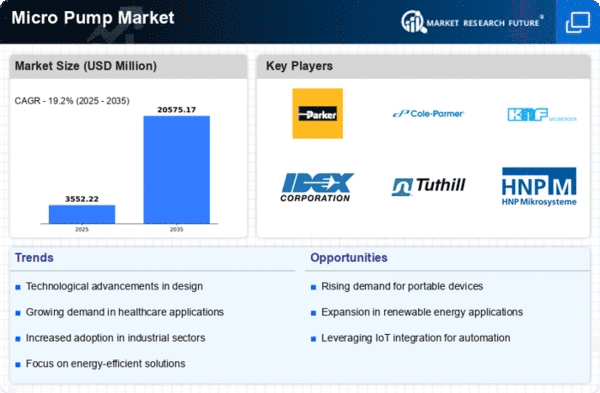
As per MRFR analysis, the Micro pump Market Size was estimated at 2980.05 USD Million in 2024. The Micro pump industry is projected to grow from 3552.28 USD Million in 2025 to 20575.17 USD Million by 2035, exhibiting a compound annual growth rate (CAGR) of 19.2% during the forecast period 2025 - 2035.

Key Market Trends & Highlights

The Micro pump Market is experiencing robust growth driven by technological advancements and increasing applications across various sectors.

  • Technological advancements are propelling the development of more efficient and compact micro pumps.
  • North America remains the largest market, while Asia-Pacific is emerging as the fastest-growing region for micro pump applications.
  • The medical segment dominates the market, whereas the industrial segment is witnessing rapid growth due to increased automation.
  • Rising demand in healthcare applications and a focus on environmental sustainability are key drivers influencing market expansion.

Market Size & Forecast

2024 Market Size 2980.05 (USD Million)
2035 Market Size 20575.17 (USD Million)
CAGR (2025 - 2035) 19.2%
Largest Regional Market Share in 2024 North America

Major Players

Parker Hannifin (US), Cole-Parmer (US), KNF Neuberger (DE), Idex Corporation (US), Tuthill Corporation (US), HNP Mikrosysteme (DE), Xavitech (SE), Flowserve Corporation (US), Micropump (US)

Market Trends

The Micro pump Market is currently experiencing a notable transformation, driven by advancements in technology and increasing demand across various sectors. This market encompasses a diverse range of applications, including medical devices, automotive systems, and industrial processes. The integration of micro pumps into these applications is enhancing efficiency and precision, which appears to be a key factor in their growing adoption. Furthermore, the trend towards miniaturization in technology is propelling the development of smaller, more efficient micro pumps, which could potentially lead to new applications and innovations in the field. In addition to technological advancements, the Micro pump Market is influenced by the rising focus on sustainability and eco-friendly solutions. Manufacturers are increasingly prioritizing the development of pumps that minimize energy consumption and reduce waste. This shift not only aligns with global environmental goals but also meets the expectations of consumers who are becoming more environmentally conscious. As the market evolves, it seems likely that these trends will continue to shape the landscape of micro pump applications, fostering a competitive environment that encourages innovation and growth.

Technological Advancements

The Micro pump Market is witnessing rapid technological innovations that enhance performance and efficiency. New materials and designs are being developed, allowing for greater precision and reliability in various applications. This trend is likely to drive further adoption across sectors such as healthcare and automotive.

Sustainability Initiatives

There is a growing emphasis on sustainability within the Micro pump Market, with manufacturers focusing on creating eco-friendly products. This includes the development of pumps that consume less energy and produce minimal waste, aligning with global environmental standards and consumer preferences.

Miniaturization Trends

The trend towards miniaturization is significantly impacting the Micro pump Market. Smaller, more compact pumps are being designed to fit into increasingly tight spaces, particularly in medical devices and portable applications. This evolution may open new avenues for innovation and application.

Micro pump Market Market Drivers

Market Growth Projections

The Global Micropump Market Industry is characterized by robust growth projections, with the market expected to expand significantly over the next decade. The market is anticipated to grow from 2.98 USD Billion in 2024 to an impressive 20.6 USD Billion by 2035. This growth trajectory suggests a compound annual growth rate (CAGR) of 19.2% from 2025 to 2035. Such projections indicate a strong demand for micropump technology across various sectors, driven by advancements in technology, increasing applications, and a focus on sustainability. This growth reflects the evolving landscape of the micropump industry and its critical role in addressing modern challenges.

Technological Advancements

The Global Micropump Market Industry is witnessing rapid technological advancements that enhance the efficiency and functionality of micropumps. Innovations in materials and design are leading to the development of more compact and energy-efficient devices. For instance, the integration of microelectromechanical systems (MEMS) technology is enabling the production of highly precise micropumps. These advancements are crucial as they cater to the increasing demand for miniaturized medical devices and lab-on-a-chip applications. As a result, the market is projected to grow from 2.98 USD Billion in 2024 to an estimated 20.6 USD Billion by 2035, reflecting a robust CAGR of 19.2% from 2025 to 2035.

Rising Demand in Healthcare

The Global Micropump Market Industry is significantly driven by the rising demand for advanced healthcare solutions. Micropumps play a pivotal role in drug delivery systems, enabling controlled and precise administration of medications. The increasing prevalence of chronic diseases necessitates innovative treatment methods, thereby propelling the adoption of micropumps in medical devices. For example, insulin delivery systems and wearable drug delivery devices are increasingly utilizing micropump technology. This trend is expected to contribute to the market's growth, with projections indicating a rise from 2.98 USD Billion in 2024 to 20.6 USD Billion by 2035, underscoring the critical role of micropumps in modern healthcare.

Emerging Markets and Global Expansion

The Global Micropump Market Industry is poised for growth due to the emergence of new markets and global expansion efforts. Developing regions are increasingly investing in healthcare infrastructure and advanced manufacturing capabilities, creating opportunities for micropump adoption. Countries in Asia-Pacific and Latin America are particularly noteworthy, as they experience rapid industrialization and urbanization. This trend is likely to drive demand for micropumps in various applications, from healthcare to industrial processes. The market is projected to grow from 2.98 USD Billion in 2024 to 20.6 USD Billion by 2035, indicating the potential for significant expansion in these emerging markets.

Environmental Sustainability Initiatives

The Global Micropump Market Industry is also influenced by the growing emphasis on environmental sustainability. As industries strive to reduce their carbon footprint, micropumps offer a solution for efficient fluid management, minimizing waste and energy consumption. For example, micropumps are being integrated into renewable energy systems, such as solar water pumping, which aligns with global sustainability goals. The increasing regulatory pressure for eco-friendly practices is likely to boost the adoption of micropump technology. This shift towards sustainability is expected to contribute to the market's growth, with projections indicating a rise from 2.98 USD Billion in 2024 to 20.6 USD Billion by 2035, reflecting the industry's commitment to environmentally responsible solutions.

Growing Applications in Industrial Processes

The Global Micropump Market Industry is experiencing growth due to the expanding applications of micropumps in various industrial processes. Industries such as pharmaceuticals, chemicals, and food and beverage are increasingly adopting micropump technology for precise fluid handling and dosing. For instance, micropumps are utilized in automated laboratory systems for accurate reagent dispensing, enhancing operational efficiency. This trend is likely to drive market growth, as industries seek to optimize processes and reduce waste. The anticipated growth trajectory from 2.98 USD Billion in 2024 to 20.6 USD Billion by 2035 indicates the increasing reliance on micropumps across diverse sectors, highlighting their versatility and importance.

Market Segment Insights

By Application: Medical (Largest) vs. Industrial (Fastest-Growing)

The Micro pump Market exhibits a diverse application landscape, with the Medical segment commanding the largest market share. This is driven by the increasing demand for precision drug delivery systems and the growing prevalence of chronic diseases requiring consistent medication. In contrast, the Industrial segment is witnessing rapid growth as manufacturers seek innovative solutions for fluid handling, enabling improved efficiency and automation in various processes.

Medical (Dominant) vs. Industrial (Emerging)

The Medical application segment of the Micro pump Market is characterized by advanced technologies that enable precise dosing and administration of pharmaceuticals, particularly in treatments requiring constant medication delivery. This dominance is underscored by the growing investment in healthcare infrastructure and the rising demand for medical devices. On the other hand, the Industrial segment is emerging with robust growth, driven by the need for compact, efficient pumps in sectors like manufacturing and chemical processing. These pumps are designed to handle a variety of fluids under different conditions, making them a crucial component for modern industrial applications.

By End Use: Pharmaceuticals (Largest) vs. Food and Beverage (Fastest-Growing)

<p>The Micro pump Market demonstrates a diverse distribution across its end-use segments. Pharmaceuticals hold the largest share, driven by increased demand for precise drug delivery systems. This segment is characterized by the need for high accuracy and reliability, which micro pumps provide in various applications, including metered dosing and infusions. Following closely are sectors like Food and Beverage, Chemical Processing, Water Treatment, and Electronics, each contributing significantly to the market, although with varying degrees of impact. In contrast, the Food and Beverage sector is emerging as the fastest-growing segment in the Micro pump Market. This growth is attributed to the rising demand for automation and precise ingredient delivery in food production and processing. The increasing focus on quality control and efficiency in food manufacturing further propels this growth, making it a dynamic area within the Micro pump landscape. As technology advances, additional end uses such as Chemical Processing, Water Treatment, and Electronics are also expanding their footprints, albeit at different rates of growth.</p>

<p>Pharmaceuticals: Dominant vs. Food and Beverage: Emerging</p>

<p>The Pharmaceuticals segment is a dominant force in the Micro pump Market, characterized by its critical role in advanced drug delivery systems. These pumps are engineered for high precision, enabling consistent and reliable dosage, a vital requirement in healthcare applications. The stringent regulatory standards in this industry also drive the adoption of micro pumps, as they help in minimizing errors associated with manual dispensing. Conversely, the Food and Beverage sector is rapidly emerging, emphasizing efficiency and accuracy in manufacturing processes. The demand for micro pumps here is spurred by trends toward automation and enhanced quality control, essential for maintaining standards in food safety and production. As consumers increasingly seek quick and reliable food options, the role of micro pumps in this sector is likely to grow significantly.</p>

By Type: Peristaltic Pump (Largest) vs. Diaphragm Pump (Fastest-Growing)

In the Micro pump Market, the <a href="https://www.marketresearchfuture.com/reports/peristaltic-pump-market-43372" target="_blank" title="peristaltic pump">Peristaltic Pump</a> holds the largest share due to its versatility and widespread applications in various industries such as pharmaceuticals, food and beverage, and chemical processing. This type of pump is ideal for transferring delicate fluids without contamination, making it highly preferred among users. On the other hand, the Diaphragm Pump is emerging as the fastest-growing segment, primarily driven by its ability to handle high-viscosity liquids and its suitability for applications demanding precise flow control. As industries continually innovate, the demand for diaphragm pumps is gaining momentum, drawing significant interest from manufacturers and end-users alike.

Peristaltic Pump (Dominant) vs. Diaphragm Pump (Emerging)

The Peristaltic Pump is recognized as a dominant player in the Micro pump Market due to its unique ability to handle a variety of fluids while ensuring cleanliness. It functions by utilizing a roller to compress a flexible tube, effectively moving the fluid through it, which minimizes the risk of contamination. This technology is particularly advantageous in sectors where hygiene is paramount, such as in medical or food applications. Conversely, the Diaphragm Pump is emerging rapidly, gaining traction for its effective handling of corrosive fluids and its suitability for applications in oil and gas, wastewater treatment, and process industries. Its design enhances reliability and safety, appealing to users looking for robust performance and efficiency.

By Technology: Electromechanical (Largest) vs. Piezoelectric (Fastest-Growing)

<p>In the Micro pump Market, the technology segment is characterized by diverse techniques including electromechanical, electromagnetic, piezoelectric, microelectromechanical systems, and nanotechnology. Among these, the electromechanical micro pumps hold the largest market share, catering to a range of applications due to their reliability and efficiency. <a href="https://www.marketresearchfuture.com/reports/piezoelectric-pump-market-41295" target="_blank" title="piezoelectric pump">Piezoelectric pumps</a>, however, are emerging rapidly, capitalizing on their compact size and precise fluid control capabilities, making them particularly appealing in medical and pharmaceutical applications. The growth of the micro pump market is driven by innovation in miniaturization and automated systems, with piezoelectric pumps showcasing the potential for rapid adoption across various sectors. These advancements are fueled by increasing demand for precise dosing systems and portable devices, alongside rising applications in biotechnology. The integration of nanotechnology also plays a pivotal role, creating opportunities for the development of more efficient and versatile micro pumps, amplifying the competitive landscape.</p>

<p>Micro Pump Technology: Electromechanical (Dominant) vs. Piezoelectric (Emerging)</p>

<p>Electromechanical micro pumps have established themselves as the dominant technology in the micro pump market due to their robust design and versatility in various applications, including automotive, healthcare, and industrial processes. Their ability to deliver reliable flow rates and operate under a wide range of pressures makes them suitable for high-performance tasks. Conversely, piezoelectric micro pumps are viewed as an emerging technology, gaining traction for their unique advantages, such as low power consumption, compact size, and precision in dispensing fluids. They are increasingly preferred in applications demanding high accuracy, such as in drug delivery systems and lab-on-a-chip devices. Both technologies are crucial in meeting the evolving needs of end-users, driving innovation and expansion in the micro pump sector.</p>

By Material: Plastic (Largest) vs. Metal (Fastest-Growing)

In the Micro pump Market, the material segment is characterized by several key components, primarily including Plastic, Metal, Ceramic, Silicone, and Composite. Among these, Plastic emerges as the largest segment, dominating the market share due to its lightweight, cost-effective properties and versatility in design. Meanwhile, Metal is recognized as the fastest-growing segment, driven by its durability and efficiency, with an increasing preference in precision applications requiring robust performance. The growth trends within the material segment reflect a broader shift towards advanced manufacturing techniques and material innovation. Plastic continues to hold its position due to ongoing developments enhancing its functionalities, whereas Metal is benefiting from rising demand in medical and industrial applications that prioritize strength and reliability. Furthermore, the emergence of Composite materials indicates a trend towards hybrid solutions that blend the strengths of multiple materials, catering to specific use cases in the Micro pump Market.

Plastic (Dominant) vs. Metal (Emerging)

Plastic, recognized as the dominant material in the Micro pump Market, is favored for its lightweight nature, customizable design possibilities, and resistance to corrosion. These attributes make it particularly suitable for applications in portable and consumer-oriented devices. As manufacturers strive for cost-effective solutions, Plastic becomes the go-to choice, offering various formulations tailored to specific performance requirements. On the other hand, Metal is regarded as an emerging force in the market, showcasing significant growth potential, especially in high-performance scenarios. Known for its structural integrity and thermal stability, Metal pumps are increasingly utilized in challenging environments, such as medical devices and industrial processes. Their durability appeals to sectors where product longevity and reliability are paramount, driving a solid growth trajectory within the segment.

Get more detailed insights about Micropump Market Research Report - Forecast till 2035

Regional Insights

North America : Market Leader in Micro Pumps

North America is poised to maintain its leadership in the micro pump market, holding a significant share of 1190.02M in 2024. The region's growth is driven by advancements in healthcare technology, increasing demand for precision fluid handling, and stringent regulatory standards that promote innovation. The presence of key players like Parker Hannifin and Flowserve Corporation further fuels market expansion, supported by government initiatives aimed at enhancing manufacturing capabilities. The United States stands out as the leading country in this sector, with a robust competitive landscape characterized by major companies such as Cole-Parmer and Idex Corporation. The focus on R&D and technological advancements has positioned North America as a hub for micro pump innovation. As the market evolves, collaborations and partnerships among key players are expected to enhance product offerings and meet the growing demand across various applications.

Europe : Emerging Market with Growth Potential

Europe is witnessing a burgeoning micro pump market, valued at 850.0M in 2024. The region's growth is propelled by increasing investments in healthcare and industrial automation, alongside a strong emphasis on sustainability and energy efficiency. Regulatory frameworks, such as the EU's Eco-Design Directive, are catalyzing innovation and driving demand for advanced micro pump solutions that meet stringent environmental standards. Germany and the UK are leading players in this market, with companies like KNF Neuberger and Tuthill Corporation making significant contributions. The competitive landscape is marked by a mix of established firms and innovative startups, fostering a dynamic environment for growth. As Europe continues to prioritize technological advancements and sustainability, the micro pump market is expected to thrive, offering new opportunities for both existing and emerging players.

Asia-Pacific : Rapid Growth in Emerging Economies

The Asia-Pacific region is experiencing rapid growth in the micro pump market, projected at 800.0M in 2024. This growth is driven by rising industrialization, increasing healthcare expenditures, and a growing demand for automation in various sectors. Countries like China and India are at the forefront, supported by government initiatives aimed at enhancing manufacturing capabilities and technological advancements in fluid handling solutions. China is emerging as a key player, with numerous local manufacturers entering the market, intensifying competition. The presence of global companies such as HNP Mikrosysteme and Micropump is also notable, as they seek to capitalize on the region's expanding market. As the demand for micro pumps continues to rise, the competitive landscape is expected to evolve, with innovations tailored to meet local needs and preferences.

Middle East and Africa : Niche Market with Growth Opportunities

The Middle East and Africa (MEA) region represents a niche market for micro pumps, valued at 140.03M in 2024. The growth in this region is primarily driven by increasing investments in healthcare infrastructure and industrial applications. Governments are focusing on diversifying their economies, which includes enhancing manufacturing capabilities and adopting advanced technologies in fluid management systems. Countries like South Africa and the UAE are leading the charge, with a growing number of local and international players entering the market. The competitive landscape is characterized by a mix of established firms and new entrants, creating opportunities for innovation and collaboration. As the region continues to develop, the micro pump market is expected to expand, driven by the need for efficient and reliable fluid handling solutions.

Key Players and Competitive Insights

The Micro pump Market is currently characterized by a dynamic competitive landscape, driven by technological advancements and increasing demand across various sectors, including healthcare, automotive, and industrial applications. Key players such as Parker Hannifin (US), KNF Neuberger (DE), and Idex Corporation (US) are strategically positioned to leverage innovation and operational efficiency. Parker Hannifin (US) focuses on enhancing its product portfolio through continuous research and development, while KNF Neuberger (DE) emphasizes sustainability in its manufacturing processes. Idex Corporation (US) has adopted a strategy of regional expansion, particularly in emerging markets, which appears to enhance its competitive edge. Collectively, these strategies contribute to a moderately fragmented market structure, where competition is intensifying as companies seek to differentiate themselves through technological advancements and customer-centric solutions.In terms of business tactics, companies are increasingly localizing manufacturing to reduce lead times and optimize supply chains. This approach not only enhances operational efficiency but also allows for greater responsiveness to regional market demands. The competitive structure of the Micro pump Market is moderately fragmented, with several key players exerting influence. The collective actions of these companies indicate a trend towards consolidation, as they seek to enhance their market presence and operational capabilities.

In November Parker Hannifin (US) announced the launch of a new line of micro pumps designed specifically for medical applications, which is expected to significantly enhance precision in drug delivery systems. This strategic move underscores the company's commitment to innovation and positions it favorably within the healthcare sector, where demand for advanced micro pump solutions is on the rise. The introduction of this product line may not only strengthen Parker Hannifin's market share but also set a new standard for performance in medical micro pumps.

In October KNF Neuberger (DE) unveiled a new eco-friendly micro pump that utilizes sustainable materials and energy-efficient technologies. This initiative reflects the growing emphasis on sustainability within the industry and aligns with global trends towards environmentally responsible manufacturing. By prioritizing sustainability, KNF Neuberger is likely to attract environmentally conscious customers and enhance its brand reputation, which could lead to increased market penetration.

In September Idex Corporation (US) completed the acquisition of a regional micro pump manufacturer, which is anticipated to bolster its production capabilities and expand its product offerings. This acquisition not only enhances Idex's operational footprint but also allows for greater integration of advanced technologies into its existing product lines. Such strategic moves are indicative of a broader trend towards consolidation in the Micro pump Market, as companies seek to enhance their competitive positioning through mergers and acquisitions.

As of December the Micro pump Market is witnessing significant trends towards digitalization, sustainability, and the integration of artificial intelligence (AI) in product development. Strategic alliances among key players are shaping the competitive landscape, fostering innovation and collaboration. The shift from price-based competition to a focus on technological advancement and supply chain reliability is becoming increasingly evident. Companies that prioritize innovation and sustainability are likely to emerge as leaders in this evolving market, as they adapt to changing consumer preferences and regulatory demands.

Key Companies in the Micro pump Market include

Industry Developments

March 2022 Medtronic plc has announced the availability of the MiniMed 780G system in India. The MiniMed 780G system is a next-generation closed-loop insulin pump device used to treat type 1 diabetes in patients aged 7 to 80. The device, which incorporates the company's most sophisticated SmartGuard technology, automates the delivery of both basal insulin and corrective boluses every five minutes, allowing people with diabetes to avoid highs and lows with more ease.

January 2022 Bartels Mikrotechnik GmbH, Inc introduced the mp6 family of micro-pumps. The mp6 series includes the mp6-Liq, mp6-gas, and mp6-gas+ models.

Future Outlook

Micro pump Market Future Outlook

The Micro pump Market is projected to grow at a 19.2% CAGR from 2025 to 2035, driven by advancements in medical technology, increased demand for precision fluid delivery, and expanding applications in various industries.

New opportunities lie in:

  • Development of smart micro pumps for IoT integration
  • Expansion into emerging markets with tailored solutions
  • Partnerships with pharmaceutical companies for drug delivery systems

By 2035, the Micro pump Market is expected to achieve substantial growth and innovation.

Market Segmentation

Micro pump Market Type Outlook

  • Peristaltic Pump
  • Diaphragm Pump
  • Gear Pump
  • Screw Pump
  • Magnetic Drive Pump

Micro pump Market End Use Outlook

  • Pharmaceuticals
  • Food and Beverage
  • Chemical Processing
  • Water Treatment
  • Agriculture

Micro pump Market Material Outlook

  • Plastic
  • Metal
  • Ceramic
  • Silicone
  • Composite

Micro pump Market Technology Outlook

  • Electromechanical
  • Electromagnetic
  • Piezoelectric
  • Mechanical
  • Hydraulic

Micro pump Market Application Outlook

  • Medical
  • Industrial
  • Automotive
  • Aerospace
  • Consumer Electronics

Report Scope

MARKET SIZE 2024 2980.05(USD Million)
MARKET SIZE 2025 3552.28(USD Million)
MARKET SIZE 2035 20575.17(USD Million)
COMPOUND ANNUAL GROWTH RATE (CAGR) 19.2% (2025 - 2035)
REPORT COVERAGE Revenue Forecast, Competitive Landscape, Growth Factors, and Trends
BASE YEAR 2024
Market Forecast Period 2025 - 2035
Historical Data 2019 - 2024
Market Forecast Units USD Million
Key Companies Profiled Parker Hannifin (US), Cole-Parmer (US), KNF Neuberger (DE), Idex Corporation (US), Tuthill Corporation (US), HNP Mikrosysteme (DE), Xavitech (SE), Flowserve Corporation (US), Micropump (US)
Segments Covered Application, End Use, Type, Technology, Material
Key Market Opportunities Advancements in miniaturization and automation drive growth in the Micro pump Market.
Key Market Dynamics Technological advancements and regulatory changes drive innovation and competition in the micro pump market.
Countries Covered North America, Europe, APAC, South America, MEA

FAQs

What is the current valuation of the Micro pump Market as of 2024?

<p>The Micro pump Market was valued at approximately 2980.05 USD Million in 2024.</p>

What is the projected market size for the Micro pump Market by 2035?

<p>The market is expected to reach approximately 20575.17 USD Million by 2035.</p>

What is the expected CAGR for the Micro pump Market during the forecast period 2025 - 2035?

<p>The anticipated CAGR for the Micro pump Market during the forecast period is 19.2%.</p>

Which application segments are leading in the Micro pump Market?

<p>The leading application segments include Medical, Industrial, and Consumer Electronics, with valuations of 5000.0, 4000.0, and 6175.17 USD Million respectively.</p>

What are the key end-use segments in the Micro pump Market?

<p>Key end-use segments encompass Pharmaceuticals, Chemical Processing, and Water Treatment, with valuations of 6000.0, 4000.0, and 3500.0 USD Million respectively.</p>

Which types of micro pumps are most prevalent in the market?

<p>The prevalent types of micro pumps include Peristaltic, Diaphragm, and Gear Pumps, each valued at 4200.0 USD Million.</p>

What technologies are driving the Micro pump Market?

Driving technologies in the Micro pump Market include Electromechanical, Electromagnetic, and Nanotechnology, with valuations of 3500.0, 4200.0, and 5450.17 USD Million respectively.

Who are the key players in the Micro pump Market?

Key players in the Micro pump Market include Parker Hannifin, Cole-Parmer, and Idex Corporation, among others.

How does the Micro pump Market perform in the Automotive sector?

The Automotive sector is valued at approximately 2500.0 USD Million within the Micro pump Market.

What is the significance of the Consumer Electronics segment in the Micro pump Market?

The Consumer Electronics segment holds a valuation of 6175.17 USD Million, indicating its substantial role in the Micro pump Market.

  1. SECTION I: EXECUTIVE SUMMARY AND KEY HIGHLIGHTS
    1. | 1.1 EXECUTIVE SUMMARY
    2. | | 1.1.1 Market Overview
    3. | | 1.1.2 Key Findings
    4. | | 1.1.3 Market Segmentation
    5. | | 1.1.4 Competitive Landscape
    6. | | 1.1.5 Challenges and Opportunities
    7. | | 1.1.6 Future Outlook
  2. SECTION II: SCOPING, METHODOLOGY AND MARKET STRUCTURE
    1. | 2.1 MARKET INTRODUCTION
    2. | | 2.1.1 Definition
    3. | | 2.1.2 Scope of the study
    4. | | | 2.1.2.1 Research Objective
    5. | | | 2.1.2.2 Assumption
    6. | | | 2.1.2.3 Limitations
    7. | 2.2 RESEARCH METHODOLOGY
    8. | | 2.2.1 Overview
    9. | | 2.2.2 Data Mining
    10. | | 2.2.3 Secondary Research
    11. | | 2.2.4 Primary Research
    12. | | | 2.2.4.1 Primary Interviews and Information Gathering Process
    13. | | | 2.2.4.2 Breakdown of Primary Respondents
    14. | | 2.2.5 Forecasting Model
    15. | | 2.2.6 Market Size Estimation
    16. | | | 2.2.6.1 Bottom-Up Approach
    17. | | | 2.2.6.2 Top-Down Approach
    18. | | 2.2.7 Data Triangulation
    19. | | 2.2.8 Validation
  3. SECTION III: QUALITATIVE ANALYSIS
    1. | 3.1 MARKET DYNAMICS
    2. | | 3.1.1 Overview
    3. | | 3.1.2 Drivers
    4. | | 3.1.3 Restraints
    5. | | 3.1.4 Opportunities
    6. | 3.2 MARKET FACTOR ANALYSIS
    7. | | 3.2.1 Value chain Analysis
    8. | | 3.2.2 Porter's Five Forces Analysis
    9. | | | 3.2.2.1 Bargaining Power of Suppliers
    10. | | | 3.2.2.2 Bargaining Power of Buyers
    11. | | | 3.2.2.3 Threat of New Entrants
    12. | | | 3.2.2.4 Threat of Substitutes
    13. | | | 3.2.2.5 Intensity of Rivalry
    14. | | 3.2.3 COVID-19 Impact Analysis
    15. | | | 3.2.3.1 Market Impact Analysis
    16. | | | 3.2.3.2 Regional Impact
    17. | | | 3.2.3.3 Opportunity and Threat Analysis
  4. SECTION IV: QUANTITATIVE ANALYSIS
    1. | 4.1 Healthcare, BY Application (USD Million)
    2. | | 4.1.1 Medical
    3. | | 4.1.2 Industrial
    4. | | 4.1.3 Automotive
    5. | | 4.1.4 Aerospace
    6. | | 4.1.5 Consumer Electronics
    7. | 4.2 Healthcare, BY End Use (USD Million)
    8. | | 4.2.1 Pharmaceuticals
    9. | | 4.2.2 Food and Beverage
    10. | | 4.2.3 Chemical Processing
    11. | | 4.2.4 Water Treatment
    12. | | 4.2.5 Electronics
    13. | 4.3 Healthcare, BY Type (USD Million)
    14. | | 4.3.1 Peristaltic Pump
    15. | | 4.3.2 Diaphragm Pump
    16. | | 4.3.3 Gear Pump
    17. | | 4.3.4 Screw Pump
    18. | | 4.3.5 Magnetic Drive Pump
    19. | 4.4 Healthcare, BY Technology (USD Million)
    20. | | 4.4.1 Electromechanical
    21. | | 4.4.2 Electromagnetic
    22. | | 4.4.3 Piezoelectric
    23. | | 4.4.4 Microelectromechanical Systems
    24. | | 4.4.5 Nanotechnology
    25. | 4.5 Healthcare, BY Region (USD Million)
    26. | | 4.5.1 North America
    27. | | | 4.5.1.1 US
    28. | | | 4.5.1.2 Canada
    29. | | 4.5.2 Europe
    30. | | | 4.5.2.1 Germany
    31. | | | 4.5.2.2 UK
    32. | | | 4.5.2.3 France
    33. | | | 4.5.2.4 Russia
    34. | | | 4.5.2.5 Italy
    35. | | | 4.5.2.6 Spain
    36. | | | 4.5.2.7 Rest of Europe
    37. | | 4.5.3 APAC
    38. | | | 4.5.3.1 China
    39. | | | 4.5.3.2 India
    40. | | | 4.5.3.3 Japan
    41. | | | 4.5.3.4 South Korea
    42. | | | 4.5.3.5 Malaysia
    43. | | | 4.5.3.6 Thailand
    44. | | | 4.5.3.7 Indonesia
    45. | | | 4.5.3.8 Rest of APAC
    46. | | 4.5.4 South America
    47. | | | 4.5.4.1 Brazil
    48. | | | 4.5.4.2 Mexico
    49. | | | 4.5.4.3 Argentina
    50. | | | 4.5.4.4 Rest of South America
    51. | | 4.5.5 MEA
    52. | | | 4.5.5.1 GCC Countries
    53. | | | 4.5.5.2 South Africa
    54. | | | 4.5.5.3 Rest of MEA
  5. SECTION V: COMPETITIVE ANALYSIS
    1. | 5.1 Competitive Landscape
    2. | | 5.1.1 Overview
    3. | | 5.1.2 Competitive Analysis
    4. | | 5.1.3 Market share Analysis
    5. | | 5.1.4 Major Growth Strategy in the Healthcare
    6. | | 5.1.5 Competitive Benchmarking
    7. | | 5.1.6 Leading Players in Terms of Number of Developments in the Healthcare
    8. | | 5.1.7 Key developments and growth strategies
    9. | | | 5.1.7.1 New Product Launch/Service Deployment
    10. | | | 5.1.7.2 Merger & Acquisitions
    11. | | | 5.1.7.3 Joint Ventures
    12. | | 5.1.8 Major Players Financial Matrix
    13. | | | 5.1.8.1 Sales and Operating Income
    14. | | | 5.1.8.2 Major Players R&D Expenditure. 2023
    15. | 5.2 Company Profiles
    16. | | 5.2.1 Parker Hannifin (US)
    17. | | | 5.2.1.1 Financial Overview
    18. | | | 5.2.1.2 Products Offered
    19. | | | 5.2.1.3 Key Developments
    20. | | | 5.2.1.4 SWOT Analysis
    21. | | | 5.2.1.5 Key Strategies
    22. | | 5.2.2 Cole-Parmer (US)
    23. | | | 5.2.2.1 Financial Overview
    24. | | | 5.2.2.2 Products Offered
    25. | | | 5.2.2.3 Key Developments
    26. | | | 5.2.2.4 SWOT Analysis
    27. | | | 5.2.2.5 Key Strategies
    28. | | 5.2.3 Idex Corporation (US)
    29. | | | 5.2.3.1 Financial Overview
    30. | | | 5.2.3.2 Products Offered
    31. | | | 5.2.3.3 Key Developments
    32. | | | 5.2.3.4 SWOT Analysis
    33. | | | 5.2.3.5 Key Strategies
    34. | | 5.2.4 HNP Mikrosysteme GmbH (DE)
    35. | | | 5.2.4.1 Financial Overview
    36. | | | 5.2.4.2 Products Offered
    37. | | | 5.2.4.3 Key Developments
    38. | | | 5.2.4.4 SWOT Analysis
    39. | | | 5.2.4.5 Key Strategies
    40. | | 5.2.5 Tecan Group (CH)
    41. | | | 5.2.5.1 Financial Overview
    42. | | | 5.2.5.2 Products Offered
    43. | | | 5.2.5.3 Key Developments
    44. | | | 5.2.5.4 SWOT Analysis
    45. | | | 5.2.5.5 Key Strategies
    46. | | 5.2.6 Xavitech (SE)
    47. | | | 5.2.6.1 Financial Overview
    48. | | | 5.2.6.2 Products Offered
    49. | | | 5.2.6.3 Key Developments
    50. | | | 5.2.6.4 SWOT Analysis
    51. | | | 5.2.6.5 Key Strategies
    52. | | 5.2.7 Kloehn (US)
    53. | | | 5.2.7.1 Financial Overview
    54. | | | 5.2.7.2 Products Offered
    55. | | | 5.2.7.3 Key Developments
    56. | | | 5.2.7.4 SWOT Analysis
    57. | | | 5.2.7.5 Key Strategies
    58. | | 5.2.8 Flowserve Corporation (US)
    59. | | | 5.2.8.1 Financial Overview
    60. | | | 5.2.8.2 Products Offered
    61. | | | 5.2.8.3 Key Developments
    62. | | | 5.2.8.4 SWOT Analysis
    63. | | | 5.2.8.5 Key Strategies
    64. | | 5.2.9 Micropump (US)
    65. | | | 5.2.9.1 Financial Overview
    66. | | | 5.2.9.2 Products Offered
    67. | | | 5.2.9.3 Key Developments
    68. | | | 5.2.9.4 SWOT Analysis
    69. | | | 5.2.9.5 Key Strategies
    70. | 5.3 Appendix
    71. | | 5.3.1 References
    72. | | 5.3.2 Related Reports
  6. LIST OF FIGURES
    1. | 6.1 MARKET SYNOPSIS
    2. | 6.2 NORTH AMERICA MARKET ANALYSIS
    3. | 6.3 US MARKET ANALYSIS BY APPLICATION
    4. | 6.4 US MARKET ANALYSIS BY END USE
    5. | 6.5 US MARKET ANALYSIS BY TYPE
    6. | 6.6 US MARKET ANALYSIS BY TECHNOLOGY
    7. | 6.7 CANADA MARKET ANALYSIS BY APPLICATION
    8. | 6.8 CANADA MARKET ANALYSIS BY END USE
    9. | 6.9 CANADA MARKET ANALYSIS BY TYPE
    10. | 6.10 CANADA MARKET ANALYSIS BY TECHNOLOGY
    11. | 6.11 EUROPE MARKET ANALYSIS
    12. | 6.12 GERMANY MARKET ANALYSIS BY APPLICATION
    13. | 6.13 GERMANY MARKET ANALYSIS BY END USE
    14. | 6.14 GERMANY MARKET ANALYSIS BY TYPE
    15. | 6.15 GERMANY MARKET ANALYSIS BY TECHNOLOGY
    16. | 6.16 UK MARKET ANALYSIS BY APPLICATION
    17. | 6.17 UK MARKET ANALYSIS BY END USE
    18. | 6.18 UK MARKET ANALYSIS BY TYPE
    19. | 6.19 UK MARKET ANALYSIS BY TECHNOLOGY
    20. | 6.20 FRANCE MARKET ANALYSIS BY APPLICATION
    21. | 6.21 FRANCE MARKET ANALYSIS BY END USE
    22. | 6.22 FRANCE MARKET ANALYSIS BY TYPE
    23. | 6.23 FRANCE MARKET ANALYSIS BY TECHNOLOGY
    24. | 6.24 RUSSIA MARKET ANALYSIS BY APPLICATION
    25. | 6.25 RUSSIA MARKET ANALYSIS BY END USE
    26. | 6.26 RUSSIA MARKET ANALYSIS BY TYPE
    27. | 6.27 RUSSIA MARKET ANALYSIS BY TECHNOLOGY
    28. | 6.28 ITALY MARKET ANALYSIS BY APPLICATION
    29. | 6.29 ITALY MARKET ANALYSIS BY END USE
    30. | 6.30 ITALY MARKET ANALYSIS BY TYPE
    31. | 6.31 ITALY MARKET ANALYSIS BY TECHNOLOGY
    32. | 6.32 SPAIN MARKET ANALYSIS BY APPLICATION
    33. | 6.33 SPAIN MARKET ANALYSIS BY END USE
    34. | 6.34 SPAIN MARKET ANALYSIS BY TYPE
    35. | 6.35 SPAIN MARKET ANALYSIS BY TECHNOLOGY
    36. | 6.36 REST OF EUROPE MARKET ANALYSIS BY APPLICATION
    37. | 6.37 REST OF EUROPE MARKET ANALYSIS BY END USE
    38. | 6.38 REST OF EUROPE MARKET ANALYSIS BY TYPE
    39. | 6.39 REST OF EUROPE MARKET ANALYSIS BY TECHNOLOGY
    40. | 6.40 APAC MARKET ANALYSIS
    41. | 6.41 CHINA MARKET ANALYSIS BY APPLICATION
    42. | 6.42 CHINA MARKET ANALYSIS BY END USE
    43. | 6.43 CHINA MARKET ANALYSIS BY TYPE
    44. | 6.44 CHINA MARKET ANALYSIS BY TECHNOLOGY
    45. | 6.45 INDIA MARKET ANALYSIS BY APPLICATION
    46. | 6.46 INDIA MARKET ANALYSIS BY END USE
    47. | 6.47 INDIA MARKET ANALYSIS BY TYPE
    48. | 6.48 INDIA MARKET ANALYSIS BY TECHNOLOGY
    49. | 6.49 JAPAN MARKET ANALYSIS BY APPLICATION
    50. | 6.50 JAPAN MARKET ANALYSIS BY END USE
    51. | 6.51 JAPAN MARKET ANALYSIS BY TYPE
    52. | 6.52 JAPAN MARKET ANALYSIS BY TECHNOLOGY
    53. | 6.53 SOUTH KOREA MARKET ANALYSIS BY APPLICATION
    54. | 6.54 SOUTH KOREA MARKET ANALYSIS BY END USE
    55. | 6.55 SOUTH KOREA MARKET ANALYSIS BY TYPE
    56. | 6.56 SOUTH KOREA MARKET ANALYSIS BY TECHNOLOGY
    57. | 6.57 MALAYSIA MARKET ANALYSIS BY APPLICATION
    58. | 6.58 MALAYSIA MARKET ANALYSIS BY END USE
    59. | 6.59 MALAYSIA MARKET ANALYSIS BY TYPE
    60. | 6.60 MALAYSIA MARKET ANALYSIS BY TECHNOLOGY
    61. | 6.61 THAILAND MARKET ANALYSIS BY APPLICATION
    62. | 6.62 THAILAND MARKET ANALYSIS BY END USE
    63. | 6.63 THAILAND MARKET ANALYSIS BY TYPE
    64. | 6.64 THAILAND MARKET ANALYSIS BY TECHNOLOGY
    65. | 6.65 INDONESIA MARKET ANALYSIS BY APPLICATION
    66. | 6.66 INDONESIA MARKET ANALYSIS BY END USE
    67. | 6.67 INDONESIA MARKET ANALYSIS BY TYPE
    68. | 6.68 INDONESIA MARKET ANALYSIS BY TECHNOLOGY
    69. | 6.69 REST OF APAC MARKET ANALYSIS BY APPLICATION
    70. | 6.70 REST OF APAC MARKET ANALYSIS BY END USE
    71. | 6.71 REST OF APAC MARKET ANALYSIS BY TYPE
    72. | 6.72 REST OF APAC MARKET ANALYSIS BY TECHNOLOGY
    73. | 6.73 SOUTH AMERICA MARKET ANALYSIS
    74. | 6.74 BRAZIL MARKET ANALYSIS BY APPLICATION
    75. | 6.75 BRAZIL MARKET ANALYSIS BY END USE
    76. | 6.76 BRAZIL MARKET ANALYSIS BY TYPE
    77. | 6.77 BRAZIL MARKET ANALYSIS BY TECHNOLOGY
    78. | 6.78 MEXICO MARKET ANALYSIS BY APPLICATION
    79. | 6.79 MEXICO MARKET ANALYSIS BY END USE
    80. | 6.80 MEXICO MARKET ANALYSIS BY TYPE
    81. | 6.81 MEXICO MARKET ANALYSIS BY TECHNOLOGY
    82. | 6.82 ARGENTINA MARKET ANALYSIS BY APPLICATION
    83. | 6.83 ARGENTINA MARKET ANALYSIS BY END USE
    84. | 6.84 ARGENTINA MARKET ANALYSIS BY TYPE
    85. | 6.85 ARGENTINA MARKET ANALYSIS BY TECHNOLOGY
    86. | 6.86 REST OF SOUTH AMERICA MARKET ANALYSIS BY APPLICATION
    87. | 6.87 REST OF SOUTH AMERICA MARKET ANALYSIS BY END USE
    88. | 6.88 REST OF SOUTH AMERICA MARKET ANALYSIS BY TYPE
    89. | 6.89 REST OF SOUTH AMERICA MARKET ANALYSIS BY TECHNOLOGY
    90. | 6.90 MEA MARKET ANALYSIS
    91. | 6.91 GCC COUNTRIES MARKET ANALYSIS BY APPLICATION
    92. | 6.92 GCC COUNTRIES MARKET ANALYSIS BY END USE
    93. | 6.93 GCC COUNTRIES MARKET ANALYSIS BY TYPE
    94. | 6.94 GCC COUNTRIES MARKET ANALYSIS BY TECHNOLOGY
    95. | 6.95 SOUTH AFRICA MARKET ANALYSIS BY APPLICATION
    96. | 6.96 SOUTH AFRICA MARKET ANALYSIS BY END USE
    97. | 6.97 SOUTH AFRICA MARKET ANALYSIS BY TYPE
    98. | 6.98 SOUTH AFRICA MARKET ANALYSIS BY TECHNOLOGY
    99. | 6.99 REST OF MEA MARKET ANALYSIS BY APPLICATION
    100. | 6.100 REST OF MEA MARKET ANALYSIS BY END USE
    101. | 6.101 REST OF MEA MARKET ANALYSIS BY TYPE
    102. | 6.102 REST OF MEA MARKET ANALYSIS BY TECHNOLOGY
    103. | 6.103 KEY BUYING CRITERIA OF HEALTHCARE
    104. | 6.104 RESEARCH PROCESS OF MRFR
    105. | 6.105 DRO ANALYSIS OF HEALTHCARE
    106. | 6.106 DRIVERS IMPACT ANALYSIS: HEALTHCARE
    107. | 6.107 RESTRAINTS IMPACT ANALYSIS: HEALTHCARE
    108. | 6.108 SUPPLY / VALUE CHAIN: HEALTHCARE
    109. | 6.109 HEALTHCARE, BY APPLICATION, 2024 (% SHARE)
    110. | 6.110 HEALTHCARE, BY APPLICATION, 2024 TO 2035 (USD Million)
    111. | 6.111 HEALTHCARE, BY END USE, 2024 (% SHARE)
    112. | 6.112 HEALTHCARE, BY END USE, 2024 TO 2035 (USD Million)
    113. | 6.113 HEALTHCARE, BY TYPE, 2024 (% SHARE)
    114. | 6.114 HEALTHCARE, BY TYPE, 2024 TO 2035 (USD Million)
    115. | 6.115 HEALTHCARE, BY TECHNOLOGY, 2024 (% SHARE)
    116. | 6.116 HEALTHCARE, BY TECHNOLOGY, 2024 TO 2035 (USD Million)
    117. | 6.117 BENCHMARKING OF MAJOR COMPETITORS
  7. LIST OF TABLES
    1. | 7.1 LIST OF ASSUMPTIONS
    2. | | 7.1.1
    3. | 7.2 North America MARKET SIZE ESTIMATES; FORECAST
    4. | | 7.2.1 BY APPLICATION, 2025-2035 (USD Million)
    5. | | 7.2.2 BY END USE, 2025-2035 (USD Million)
    6. | | 7.2.3 BY TYPE, 2025-2035 (USD Million)
    7. | | 7.2.4 BY TECHNOLOGY, 2025-2035 (USD Million)
    8. | 7.3 US MARKET SIZE ESTIMATES; FORECAST
    9. | | 7.3.1 BY APPLICATION, 2025-2035 (USD Million)
    10. | | 7.3.2 BY END USE, 2025-2035 (USD Million)
    11. | | 7.3.3 BY TYPE, 2025-2035 (USD Million)
    12. | | 7.3.4 BY TECHNOLOGY, 2025-2035 (USD Million)
    13. | 7.4 Canada MARKET SIZE ESTIMATES; FORECAST
    14. | | 7.4.1 BY APPLICATION, 2025-2035 (USD Million)
    15. | | 7.4.2 BY END USE, 2025-2035 (USD Million)
    16. | | 7.4.3 BY TYPE, 2025-2035 (USD Million)
    17. | | 7.4.4 BY TECHNOLOGY, 2025-2035 (USD Million)
    18. | 7.5 Europe MARKET SIZE ESTIMATES; FORECAST
    19. | | 7.5.1 BY APPLICATION, 2025-2035 (USD Million)
    20. | | 7.5.2 BY END USE, 2025-2035 (USD Million)
    21. | | 7.5.3 BY TYPE, 2025-2035 (USD Million)
    22. | | 7.5.4 BY TECHNOLOGY, 2025-2035 (USD Million)
    23. | 7.6 Germany MARKET SIZE ESTIMATES; FORECAST
    24. | | 7.6.1 BY APPLICATION, 2025-2035 (USD Million)
    25. | | 7.6.2 BY END USE, 2025-2035 (USD Million)
    26. | | 7.6.3 BY TYPE, 2025-2035 (USD Million)
    27. | | 7.6.4 BY TECHNOLOGY, 2025-2035 (USD Million)
    28. | 7.7 UK MARKET SIZE ESTIMATES; FORECAST
    29. | | 7.7.1 BY APPLICATION, 2025-2035 (USD Million)
    30. | | 7.7.2 BY END USE, 2025-2035 (USD Million)
    31. | | 7.7.3 BY TYPE, 2025-2035 (USD Million)
    32. | | 7.7.4 BY TECHNOLOGY, 2025-2035 (USD Million)
    33. | 7.8 France MARKET SIZE ESTIMATES; FORECAST
    34. | | 7.8.1 BY APPLICATION, 2025-2035 (USD Million)
    35. | | 7.8.2 BY END USE, 2025-2035 (USD Million)
    36. | | 7.8.3 BY TYPE, 2025-2035 (USD Million)
    37. | | 7.8.4 BY TECHNOLOGY, 2025-2035 (USD Million)
    38. | 7.9 Russia MARKET SIZE ESTIMATES; FORECAST
    39. | | 7.9.1 BY APPLICATION, 2025-2035 (USD Million)
    40. | | 7.9.2 BY END USE, 2025-2035 (USD Million)
    41. | | 7.9.3 BY TYPE, 2025-2035 (USD Million)
    42. | | 7.9.4 BY TECHNOLOGY, 2025-2035 (USD Million)
    43. | 7.10 Italy MARKET SIZE ESTIMATES; FORECAST
    44. | | 7.10.1 BY APPLICATION, 2025-2035 (USD Million)
    45. | | 7.10.2 BY END USE, 2025-2035 (USD Million)
    46. | | 7.10.3 BY TYPE, 2025-2035 (USD Million)
    47. | | 7.10.4 BY TECHNOLOGY, 2025-2035 (USD Million)
    48. | 7.11 Spain MARKET SIZE ESTIMATES; FORECAST
    49. | | 7.11.1 BY APPLICATION, 2025-2035 (USD Million)
    50. | | 7.11.2 BY END USE, 2025-2035 (USD Million)
    51. | | 7.11.3 BY TYPE, 2025-2035 (USD Million)
    52. | | 7.11.4 BY TECHNOLOGY, 2025-2035 (USD Million)
    53. | 7.12 Rest of Europe MARKET SIZE ESTIMATES; FORECAST
    54. | | 7.12.1 BY APPLICATION, 2025-2035 (USD Million)
    55. | | 7.12.2 BY END USE, 2025-2035 (USD Million)
    56. | | 7.12.3 BY TYPE, 2025-2035 (USD Million)
    57. | | 7.12.4 BY TECHNOLOGY, 2025-2035 (USD Million)
    58. | 7.13 APAC MARKET SIZE ESTIMATES; FORECAST
    59. | | 7.13.1 BY APPLICATION, 2025-2035 (USD Million)
    60. | | 7.13.2 BY END USE, 2025-2035 (USD Million)
    61. | | 7.13.3 BY TYPE, 2025-2035 (USD Million)
    62. | | 7.13.4 BY TECHNOLOGY, 2025-2035 (USD Million)
    63. | 7.14 China MARKET SIZE ESTIMATES; FORECAST
    64. | | 7.14.1 BY APPLICATION, 2025-2035 (USD Million)
    65. | | 7.14.2 BY END USE, 2025-2035 (USD Million)
    66. | | 7.14.3 BY TYPE, 2025-2035 (USD Million)
    67. | | 7.14.4 BY TECHNOLOGY, 2025-2035 (USD Million)
    68. | 7.15 India MARKET SIZE ESTIMATES; FORECAST
    69. | | 7.15.1 BY APPLICATION, 2025-2035 (USD Million)
    70. | | 7.15.2 BY END USE, 2025-2035 (USD Million)
    71. | | 7.15.3 BY TYPE, 2025-2035 (USD Million)
    72. | | 7.15.4 BY TECHNOLOGY, 2025-2035 (USD Million)
    73. | 7.16 Japan MARKET SIZE ESTIMATES; FORECAST
    74. | | 7.16.1 BY APPLICATION, 2025-2035 (USD Million)
    75. | | 7.16.2 BY END USE, 2025-2035 (USD Million)
    76. | | 7.16.3 BY TYPE, 2025-2035 (USD Million)
    77. | | 7.16.4 BY TECHNOLOGY, 2025-2035 (USD Million)
    78. | 7.17 South Korea MARKET SIZE ESTIMATES; FORECAST
    79. | | 7.17.1 BY APPLICATION, 2025-2035 (USD Million)
    80. | | 7.17.2 BY END USE, 2025-2035 (USD Million)
    81. | | 7.17.3 BY TYPE, 2025-2035 (USD Million)
    82. | | 7.17.4 BY TECHNOLOGY, 2025-2035 (USD Million)
    83. | 7.18 Malaysia MARKET SIZE ESTIMATES; FORECAST
    84. | | 7.18.1 BY APPLICATION, 2025-2035 (USD Million)
    85. | | 7.18.2 BY END USE, 2025-2035 (USD Million)
    86. | | 7.18.3 BY TYPE, 2025-2035 (USD Million)
    87. | | 7.18.4 BY TECHNOLOGY, 2025-2035 (USD Million)
    88. | 7.19 Thailand MARKET SIZE ESTIMATES; FORECAST
    89. | | 7.19.1 BY APPLICATION, 2025-2035 (USD Million)
    90. | | 7.19.2 BY END USE, 2025-2035 (USD Million)
    91. | | 7.19.3 BY TYPE, 2025-2035 (USD Million)
    92. | | 7.19.4 BY TECHNOLOGY, 2025-2035 (USD Million)
    93. | 7.20 Indonesia MARKET SIZE ESTIMATES; FORECAST
    94. | | 7.20.1 BY APPLICATION, 2025-2035 (USD Million)
    95. | | 7.20.2 BY END USE, 2025-2035 (USD Million)
    96. | | 7.20.3 BY TYPE, 2025-2035 (USD Million)
    97. | | 7.20.4 BY TECHNOLOGY, 2025-2035 (USD Million)
    98. | 7.21 Rest of APAC MARKET SIZE ESTIMATES; FORECAST
    99. | | 7.21.1 BY APPLICATION, 2025-2035 (USD Million)
    100. | | 7.21.2 BY END USE, 2025-2035 (USD Million)
    101. | | 7.21.3 BY TYPE, 2025-2035 (USD Million)
    102. | | 7.21.4 BY TECHNOLOGY, 2025-2035 (USD Million)
    103. | 7.22 South America MARKET SIZE ESTIMATES; FORECAST
    104. | | 7.22.1 BY APPLICATION, 2025-2035 (USD Million)
    105. | | 7.22.2 BY END USE, 2025-2035 (USD Million)
    106. | | 7.22.3 BY TYPE, 2025-2035 (USD Million)
    107. | | 7.22.4 BY TECHNOLOGY, 2025-2035 (USD Million)
    108. | 7.23 Brazil MARKET SIZE ESTIMATES; FORECAST
    109. | | 7.23.1 BY APPLICATION, 2025-2035 (USD Million)
    110. | | 7.23.2 BY END USE, 2025-2035 (USD Million)
    111. | | 7.23.3 BY TYPE, 2025-2035 (USD Million)
    112. | | 7.23.4 BY TECHNOLOGY, 2025-2035 (USD Million)
    113. | 7.24 Mexico MARKET SIZE ESTIMATES; FORECAST
    114. | | 7.24.1 BY APPLICATION, 2025-2035 (USD Million)
    115. | | 7.24.2 BY END USE, 2025-2035 (USD Million)
    116. | | 7.24.3 BY TYPE, 2025-2035 (USD Million)
    117. | | 7.24.4 BY TECHNOLOGY, 2025-2035 (USD Million)
    118. | 7.25 Argentina MARKET SIZE ESTIMATES; FORECAST
    119. | | 7.25.1 BY APPLICATION, 2025-2035 (USD Million)
    120. | | 7.25.2 BY END USE, 2025-2035 (USD Million)
    121. | | 7.25.3 BY TYPE, 2025-2035 (USD Million)
    122. | | 7.25.4 BY TECHNOLOGY, 2025-2035 (USD Million)
    123. | 7.26 Rest of South America MARKET SIZE ESTIMATES; FORECAST
    124. | | 7.26.1 BY APPLICATION, 2025-2035 (USD Million)
    125. | | 7.26.2 BY END USE, 2025-2035 (USD Million)
    126. | | 7.26.3 BY TYPE, 2025-2035 (USD Million)
    127. | | 7.26.4 BY TECHNOLOGY, 2025-2035 (USD Million)
    128. | 7.27 MEA MARKET SIZE ESTIMATES; FORECAST
    129. | | 7.27.1 BY APPLICATION, 2025-2035 (USD Million)
    130. | | 7.27.2 BY END USE, 2025-2035 (USD Million)
    131. | | 7.27.3 BY TYPE, 2025-2035 (USD Million)
    132. | | 7.27.4 BY TECHNOLOGY, 2025-2035 (USD Million)
    133. | 7.28 GCC Countries MARKET SIZE ESTIMATES; FORECAST
    134. | | 7.28.1 BY APPLICATION, 2025-2035 (USD Million)
    135. | | 7.28.2 BY END USE, 2025-2035 (USD Million)
    136. | | 7.28.3 BY TYPE, 2025-2035 (USD Million)
    137. | | 7.28.4 BY TECHNOLOGY, 2025-2035 (USD Million)
    138. | 7.29 South Africa MARKET SIZE ESTIMATES; FORECAST
    139. | | 7.29.1 BY APPLICATION, 2025-2035 (USD Million)
    140. | | 7.29.2 BY END USE, 2025-2035 (USD Million)
    141. | | 7.29.3 BY TYPE, 2025-2035 (USD Million)
    142. | | 7.29.4 BY TECHNOLOGY, 2025-2035 (USD Million)
    143. | 7.30 Rest of MEA MARKET SIZE ESTIMATES; FORECAST
    144. | | 7.30.1 BY APPLICATION, 2025-2035 (USD Million)
    145. | | 7.30.2 BY END USE, 2025-2035 (USD Million)
    146. | | 7.30.3 BY TYPE, 2025-2035 (USD Million)
    147. | | 7.30.4 BY TECHNOLOGY, 2025-2035 (USD Million)
    148. | 7.31 PRODUCT LAUNCH/PRODUCT DEVELOPMENT/APPROVAL
    149. | | 7.31.1
    150. | 7.32 ACQUISITION/PARTNERSHIP
    151. | | 7.32.1

Healthcare Market Segmentation

Healthcare By Application (USD Million, 2025-2035)

  • Medical
  • Industrial
  • Automotive
  • Aerospace
  • Consumer Electronics

Healthcare By End Use (USD Million, 2025-2035)

  • Pharmaceuticals
  • Food and Beverage
  • Chemical Processing
  • Water Treatment
  • Electronics

Healthcare By Type (USD Million, 2025-2035)

  • Peristaltic Pump
  • Diaphragm Pump
  • Gear Pump
  • Screw Pump
  • Magnetic Drive Pump

Healthcare By Technology (USD Million, 2025-2035)

  • Electromechanical
  • Electromagnetic
  • Piezoelectric
  • Microelectromechanical Systems
  • Nanotechnology
Infographic

Free Sample Request

Kindly complete the form below to receive a free sample of this Report

Get Free Sample

Customer Strories

Compare Licence

×
Features License Type
Single User Multiuser License Enterprise User
Price $4,950 $5,950 $7,250
Maximum User Access Limit 1 User Upto 10 Users Unrestricted Access Throughout the Organization
Free Customization
Direct Access to Analyst
Deliverable Format
Platform Access
Discount on Next Purchase 10% 15% 15%
Printable Versions
%>