Request Free Sample ×

Kindly complete the form below to receive a free sample of this Report

* Please use a valid business email

Leading companies partner with us for data-driven Insights

clients tt-cursor
Hero Background
English
Chinese
French
Japanese
Korean
German
Spanish

Micro-LED Display Market Trends

ID: MRFR/SEM/5508-CR
200 Pages
Ankit Gupta
December 2021

Micro LED Display Market Size, Share and Research Report By Application (Consumer Electronics, Advertising, Automotive Displays, Aerospace and Defense, Medical Diagnostics), By Product Type (Micro LED TVs, Wearable Displays, Smartphone Displays, Tablets and Laptops, Digital Signage), By Technology (Active Matrix Micro LED, Passive Matrix Micro LED, Reflective Micro LED, Transparent Micro-LED), By End Use (Residential, Commercial, Industrial, Healthcare, Transportation), and By Regional (North America, Europe, South America, Asia Pacific, Middle East and Africa) - Industry Forecast Till 2035

Share:
Download PDF ×

We do not share your information with anyone. However, we may send you emails based on your report interest from time to time. You may contact us at any time to opt-out.

Micro-LED Display Market Infographic
Purchase Options

Market Trends

Introduction

As we enter 2024, the micro-LED display market is undergoing a radical change, which is mainly due to the technological development, the changing regulatory environment, and the change of the consumers. The display technology is rapidly evolving, especially in resolution, energy efficiency, and the versatility of the form. The prevailing regulatory environment focusing on the environment and energy conservation has also prompted manufacturers to improve their products to meet the requirements of the environment. The change in consumers is also a major driving force for the micro-LED display. , so the future market is expected to become more mature.

Top Trends

  1. Increased Adoption in Consumer Electronics
    It is a major concern of the world to make use of the micro-LEDs in its products. By 2024, it is estimated that the micro-LED will represent more than 30 percent of the high-end televisions sold. The transition is due to the demand for superior image quality and energy savings. The cost of the displays, which will decrease with the increase in production, will make them accessible to a wider public.
  2. Advancements in Manufacturing Techniques
    Mass transfer technology has been developed to increase the scalability of micro-LEDs. Companies like PlayNitride are pioneering techniques that can reduce production costs and improve yields. This is vital for manufacturers, who can meet increasing demand without compromising on quality. The industry is likely to grow further as more efficient production methods are developed.
  3. Expansion into Automotive Displays
    The micro-LED display market is growing, especially in the automobile industry. The major players in this field are LG, AU Optronics, and Panasonic. The high brightness and contrast of micro-LEDs make them ideal for use outdoors. The trend towards advanced displays is likely to continue, with a major influence on the design and functionality of cars.
  4. Integration with Augmented and Virtual Reality
    Combined with micro LED technology, the visual experience of AR/VR devices is further enhanced by high-resolution displays. Intel and Google are investing in this area because they recognize the potential of the technology. The lightweight and flexible nature of micro LEDs opens up new design possibilities for wearables. In the future, it is likely that devices will become even more compact and energy efficient, which will further stimulate consumers’ interest.
  5. Government Support for Display Technology Innovation
    In the world of display technology, governments are putting money into research and development because of the economic potential. In countries like China and South Korea, the goal is to build up the domestic production capacity. This is supposed to speed up innovation and reduce dependence on foreign technology. The result could be a new competition between the local companies in the micro-LED market.
  6. Sustainability and Energy Efficiency Focus
    The LED market is moving toward energy-efficient and sustainable technology. The consumption of micro LEDs is much lower than that of conventional displays, and thus appeals to the most demanding consumers. As the laws on energy consumption become more and more strict, manufacturers will have to make sustainable production their main priority. This trend could also lead to the development of eco-friendly materials and production methods.
  7. Customization and Flexible Display Solutions
    Customization is a major selling point in the micro LED market, with many manufacturers offering tailor-made solutions for different applications. Like the aforementioned Xiaomi, flexible displays are also a major trend. The trend is expected to increase the degree of interactivity, and open up new markets in advertising and architecture. In the future, it is possible that the degree of flexibility will increase further.
  8. Rise of Smart Home Integration
    MICRO-LED displays are increasingly being integrated into smart home devices, thus enhancing the interactivity and the user experience. Brands are developing displays that can connect seamlessly with IoT devices and provide real-time information. This will boost the demand for multi-function displays in smart home devices. As the smart home market continues to evolve, MICRO-LEDs will likely play a key role in the user experience.
  9. Enhanced Gaming Experiences
    The gaming industry is making use of micro LED technology to provide a better gaming experience. Companies like Sony are concentrating on delivering a high refresh rate. With its low latency and high dynamic range, micro LED technology is well suited to this industry. As gaming grows, so too will the demand for better display technology. In the future, we may see more immersive gaming environments based on micro LED technology.
  10. Collaborations and Strategic Partnerships
    Strategic alliances between technology companies are becoming commonplace, with the aim of accelerating the development of micro-LEDs. Such alliances as that between Epistar and Micron are aimed at improving chip performance and display quality. They also allow the companies to share knowledge and resources, thereby accelerating innovation. Strategic alliances between companies can help to develop new display technology and the industry as a whole.

Conclusion: Navigating the Micro LED Landscape

Competition in the market for micro-LED displays will continue to grow in 2024, with both old and new companies competing for market share. The old companies are relying on their brand strength and technical strength to compete, while the new companies are relying on their innovation and speed to carve out their own niche. The development of the market is expected to be led by the development of consumer electronics and the development of the car industry in North America and Asia-Pacific. Those who want to be the leaders in the industry must rely on the integration of artificial intelligence, the automation of production, the use of green materials, and the flexibility of design. Strategic cooperation and research and development are the main ways to differentiate in this rapidly changing industry.


Author
Author Profile
Ankit Gupta
Team Lead - Research

Ankit Gupta is a seasoned market intelligence and strategic research professional with over six plus years of experience in the ICT and Semiconductor industries. With academic roots in Telecom, Marketing, and Electronics, he blends technical insight with business strategy. Ankit has led 200+ projects, including work for Fortune 500 clients like Microsoft and Rio Tinto, covering market sizing, tech forecasting, and go-to-market strategies. Known for bridging engineering and enterprise decision-making, his insights support growth, innovation, and investment planning across diverse technology markets.

Leave a Comment

FAQs

What is the projected market valuation of the Micro LED Display Market by 2035?

<p>The Micro LED Display Market is projected to reach a valuation of 8.511 USD Billion by 2035.</p>

What was the market valuation of the Micro LED Display Market in 2024?

<p>In 2024, the Micro LED Display Market had a valuation of 0.8507 USD Billion.</p>

What is the expected CAGR for the Micro LED Display Market during the forecast period 2025 - 2035?

<p>The expected CAGR for the Micro LED Display Market during the forecast period 2025 - 2035 is 23.29%.</p>

Which companies are considered key players in the Micro LED Display Market?

<p>Key players in the Micro LED Display Market include Samsung Electronics, Sony Corporation, Apple Inc., LG Display, and others.</p>

What are the main application segments of the Micro LED Display Market?

<p>The main application segments include Consumer Electronics, Advertising, Automotive Displays, Aerospace and Defense, and Medical Diagnostics.</p>

How does the market for Micro LED TVs compare to other product types?

<p>The market for Micro LED TVs is projected to grow from 0.1702 USD Billion in 2024 to 1.7005 USD Billion by 2035.</p>

What is the valuation of the Commercial end-use segment in the Micro LED Display Market?

<p>The Commercial end-use segment is expected to grow from 0.3401 USD Billion in 2024 to 3.4011 USD Billion by 2035.</p>

What technology types are included in the Micro LED Display Market?

<p>Technology types include Active Matrix Micro LED, Passive Matrix Micro LED, Reflective Micro LED, and Transparent Micro-LED.</p>

What is the projected growth for the Automotive Displays segment in the Micro LED Display Market?

<p>The Automotive Displays segment is expected to grow from 0.085 USD Billion in 2024 to 0.85 USD Billion by 2035.</p>

How does the Micro LED Display Market's growth potential compare to traditional display technologies?

<p>The Micro LED Display Market appears to have a higher growth potential compared to traditional display technologies, driven by advancements and increasing applications.</p>

Market Summary

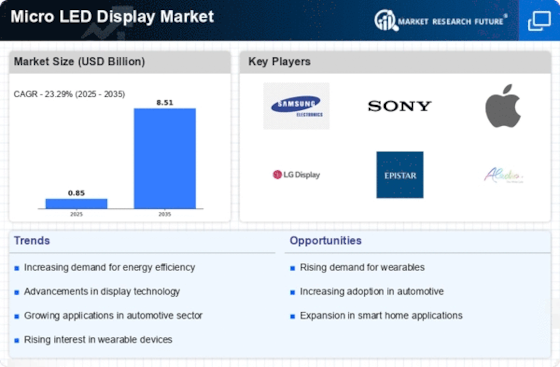
As per Market Research Future analysis, the Micro LED Display Market Size was estimated at 0.8507 USD Billion in 2024. The Micro LED Display industry is projected to grow from 1.049 USD Billion in 2025 to 8.511 USD Billion by 2035, exhibiting a compound annual growth rate (CAGR) of 23.29% during the forecast period 2025 - 2035

Key Market Trends & Highlights

The Micro LED Display Market is poised for substantial growth driven by technological advancements and increasing demand for high-quality displays.

  • North America remains the largest market for Micro LED displays, driven by robust consumer electronics demand. Asia-Pacific is the fastest-growing region, with rapid adoption of Micro LED technology in various applications. The Consumer Electronics segment dominates the market, while the Advertising segment is experiencing the fastest growth. Technological advancements and rising demand for high-quality displays are key drivers propelling the Micro LED display market forward.

Market Size & Forecast

2024 Market Size 0.8507 (USD Billion)
2035 Market Size 8.511 (USD Billion)
CAGR (2025 - 2035) 23.29%
Largest Regional Market Share in 2024 North America

Major Players

Samsung Electronics (KR), Sony Corporation (JP), Apple Inc. (US), LG Display (KR), Epistar Corporation (TW), Aledia (FR), Xiaomi Corporation (CN), JBD (CN), Innolux Corporation (TW)

Market Trends

The Micro LED Display Market is currently experiencing a transformative phase characterized by rapid technological advancements and increasing consumer demand for high-quality visual experiences. This market segment is gaining traction due to its potential to deliver superior brightness, contrast, and energy efficiency compared to traditional display technologies. As industries such as consumer electronics, automotive, and advertising embrace this innovative technology, the landscape is evolving. Companies are investing in research and development to enhance manufacturing processes, which may lead to cost reductions and wider adoption across various applications. Moreover, the Micro LED Display Market appears to be influenced by the growing trend of miniaturization in electronic devices. As manufacturers strive to create thinner and lighter products, the compact nature of micro LED technology aligns well with these objectives. Additionally, the increasing integration of smart technologies into everyday life suggests a promising future for micro LED displays in smart homes and IoT devices. Overall, the market is poised for growth, driven by advancements in technology and changing consumer preferences, which could reshape the visual display landscape in the coming years.

Technological Advancements

The Micro LED Display Market is witnessing continuous innovations in manufacturing techniques and materials. These advancements are likely to enhance the performance and reduce the production costs of micro LED displays, making them more accessible to a broader range of applications.

Rising Demand for High-Quality Displays

There is a growing consumer preference for high-resolution and vibrant displays across various sectors, including entertainment and advertising. This trend suggests that micro LED technology, with its superior image quality, may become increasingly favored over traditional display options.

Integration with Smart Technologies

The convergence of micro LED displays with smart technology is becoming more pronounced. As smart devices proliferate, the potential for micro LED displays to enhance user experiences in smart homes and connected environments appears promising.

Micro-LED Display Market Market Drivers

Technological Advancements in Micro LED Display Market

The Micro LED Display Market is experiencing rapid technological advancements that enhance display performance and efficiency. Innovations in microchip technology and manufacturing processes are leading to improved pixel density and color accuracy. For instance, the introduction of advanced epitaxial growth techniques has significantly reduced production costs, making micro LED displays more accessible. As a result, the market is projected to grow at a compound annual growth rate of approximately 30% over the next five years. These advancements not only improve the visual experience but also contribute to energy efficiency, which is increasingly important in consumer electronics. The integration of artificial intelligence in display technology further enhances user interaction, suggesting that the Micro LED Display Market is poised for substantial growth driven by these technological innovations.

Integration with Smart Technologies in Micro LED Display Market

The integration of micro LED displays with smart technologies is transforming the Micro LED Display Market. As smart devices proliferate, the need for displays that can seamlessly connect and interact with various platforms is becoming paramount. This integration allows for enhanced functionalities, such as voice control and smart home compatibility, which are increasingly sought after by consumers. The market for smart displays is projected to grow significantly, with micro LED technology playing a crucial role in this evolution. By 2025, it is anticipated that smart displays will account for a substantial portion of the overall display market, indicating a shift towards more interactive and connected viewing experiences. The Micro LED Display Market is thus likely to benefit from this trend as manufacturers develop products that cater to the growing demand for smart technology integration.

Rising Demand for High-Quality Displays in Micro LED Display Market

Consumer preferences are shifting towards high-quality displays, which is a key driver for the Micro LED Display Market. As consumers seek superior visual experiences for applications such as gaming, home entertainment, and professional displays, the demand for micro LED technology is surging. The market is expected to reach a valuation of over 10 billion dollars by 2026, reflecting a growing inclination towards displays that offer vibrant colors and high contrast ratios. This trend is particularly evident in sectors like automotive and advertising, where display quality can significantly impact consumer engagement. The Micro LED Display Market is thus responding to this demand by innovating and expanding product offerings to meet the expectations of discerning consumers.

Environmental Sustainability Trends Impacting Micro LED Display Market

Environmental sustainability is becoming a pivotal concern, influencing the Micro LED Display Market. As consumers and businesses alike prioritize eco-friendly products, the demand for displays that are energy-efficient and have a lower environmental impact is increasing. Micro LED technology is inherently more sustainable than traditional display technologies, as it consumes less power and has a longer lifespan. This aligns with global efforts to reduce electronic waste and carbon footprints. The market is likely to see a rise in products that emphasize sustainability, with manufacturers focusing on eco-friendly materials and production processes. By 2027, it is projected that sustainable products will constitute a significant share of the Micro LED Display Market, reflecting a shift towards environmentally responsible consumer choices.

Growing Applications in Various Industries within Micro LED Display Market

The Micro LED Display Market is witnessing a surge in applications across various sectors, including automotive, healthcare, and retail. This diversification is a significant driver of market growth, as micro LED technology offers unique advantages such as flexibility, lightweight design, and high brightness. In the automotive sector, for instance, micro LED displays are being utilized for advanced dashboard displays and infotainment systems, enhancing user experience and safety. In healthcare, these displays are being adopted for medical imaging and diagnostics, where clarity and precision are critical. The retail industry is also leveraging micro LED technology for dynamic advertising displays that attract consumer attention. This broadening of applications suggests that the Micro LED Display Market is not only expanding but also evolving to meet the specific needs of diverse sectors.

Market Segment Insights

By Application: Consumer Electronics (Largest) vs. Advertising (Fastest-Growing)

In the Micro LED Display Market, Consumer Electronics holds the largest share, owing to the increasing demand for high-resolution displays in devices like TVs, smartphones, and tablets. As consumers gravitate towards better screen performance and energy efficiency, this application segment lines up to dominate the market. Meanwhile, Advertising is quickly gaining ground, as businesses adopt Micro LED technology for eye-catching, vibrant billboards and displays to engage customers more effectively.

Application: Consumer Electronics (Dominant) vs. Advertising (Emerging)

The Consumer Electronics segment is characterized by its high penetration rate, driven by the shift towards larger and more advanced display technologies in everyday devices. Companies innovate to introduce Micro LED displays that offer superior brightness, color accuracy, and longevity. On the other hand, the Advertising segment is seeing rapid advancements as brands seek to leverage the attention-grabbing capabilities of Micro LED displays. This segment is marked by its adaptability and customization options, enabling businesses to create unique advertising experiences that stand out in competitive marketplaces. As advertising continues to evolve, Micro LED technology proves to be an essential tool for creating dynamic and impactful campaigns.

By Product Type: Micro LED TVs (Largest) vs. Wearable Displays (Fastest-Growing)

The Micro LED Display Market is characterized by a diverse range of product categories, with Micro LED TVs commanding the largest market share. They are followed by Digital Signage and Smartphone Displays, which also occupy significant portions of the market. Wearable Displays, while currently smaller in share, are rapidly gaining traction as technological advancements and consumer demand evolve. The segmentation reflects a competitive landscape, emphasizing innovation and targeted applications in various fields.

TVs (Dominant) vs. Wearable Displays (Emerging)

Micro LED TVs are at the forefront of the segment, offering superior picture quality and energy efficiency, making them popular among consumers seeking high-end viewing experiences. In contrast, Wearable Displays represent an emerging segment fueled by increasing interest in health, fitness, and augmented reality applications. This segment is gaining momentum due to the proliferation of smartwatches and fitness trackers that incorporate Micro LED technology, promising enhanced visibility and battery performance. As these products continue to evolve, they attract a new customer base, further diversifying the market.

By Technology: Active Matrix Micro LED (Largest) vs. Passive Matrix Micro LED (Fastest-Growing)

In the Micro LED Display Market, the Active Matrix Micro LED segment commands the largest share, leveraging its advanced capability to deliver superior image quality and responsiveness. This segment benefits from its application in high-end televisions and smartphones, making it a preferred choice among manufacturers. Conversely, the Passive Matrix Micro LED segment, while smaller in share, emerges as the fastest-growing due to its low cost and suitability for various consumer applications, including wearables and signage.

Technology: Active Matrix Micro LED (Dominant) vs. Passive Matrix Micro LED (Emerging)

Active Matrix Micro LED technology stands at the forefront of the Micro LED Display Market, characterized by its high resolution and impressive refresh rates. It is preferred for applications demanding superior performance, such as gaming and professional displays, due to the ability to control each pixel's illumination independently. On the other hand, Passive Matrix Micro LED represents an emerging trend focused on cost-effectiveness and simpler manufacturing processes. While it offers lower image quality compared to its active counterpart, its affordability drives rapid adoption in consumer electronics and various display formats.

By End Use: Residential (Largest) vs. Commercial (Fastest-Growing)

The Micro LED Display Market exhibits a diverse distribution across several end-use segments, with Residential holding the largest market share. This segment benefits from increasing adoption in homes for entertainment systems and smart home applications. The Commercial segment, while smaller in share, is recognized as the fastest-growing due to escalating demand for digital signage and advertising solutions. The Industrial segment has a steady presence, catering to operational displays, while Healthcare and Transportation also emerge as significant applications of Micro LED technology.

Residential (Dominant) vs. Commercial (Emerging)

The Residential segment dominates the Micro LED Display Market, driven by consumer preferences for high-quality visuals in home entertainment systems. This segment leverages Micro LED technology's advantages, such as enhanced brightness, energy efficiency, and superior contrast ratios, which appeal to homeowners looking for an immersive viewing experience. In contrast, the Commercial segment is seen as an emerging force, with businesses increasingly adopting Micro LEDs for vibrant displays and efficient advertising solutions. Factors such as lower operational costs and greater adaptability further fuel growth in this segment as companies seek innovative ways to engage their audiences.

Get more detailed insights about Micro-LED Display Market Research Report - Global Forecast till 2035

Regional Insights

The Micro LED Display Market experienced significant growth, with North America, Europe, South America, Asia Pacific, and the Middle East and Africa representing key regions. In 2024, North America was valued at 0.3 USD billion and is expected to reach 3.0 USD billion by 2035, reflecting its importance as a technological hub.

Europe followed closely with a valuation of 0.25 USD billion in 2024, increasing to 2.5 USD billion by 2035. The Asia Pacific region, valued at 0.2 USD billion in 2024, is expected to grow to 2.0 USD billion, highlighting its rapid adoption and demand for Micro LED technologies in various applications.

South America and the Middle East and Africa, while previously smaller markets valued at 0.05 USD billion each in 2024, are projected to grow to 0.5 USD billion, showcasing emerging market potential.

The robust growth in these regional markets is driven by increasing demand for high-resolution displays and advancements in display technologies, with North America and Europe holding significant shares due to their established electronics industry.

Overall, the Micro LED Display Market exhibited promising growth trends across all regions, with North America and Europe dominating in terms of market size and technological advancements.

Key Players and Competitive Insights

The Micro LED Display Market is experiencing significant growth, driven by the rapid advancement of display technology and the increasing demand for high-resolution displays across various sectors, including consumer electronics, automotive, and advertising.The competitive landscape of this market is characterized by several key players who are investing heavily in research and development to enhance their product offerings. The ability to leverage micro LED technology for higher brightness levels, lower power consumption, and improved color accuracy is positioning various companies at the forefront of this burgeoning market.Furthermore, strategic partnerships, mergers and acquisitions, and expansions into new geographic regions are common strategies employed by these market leaders to capture a larger share of the growing demand and to innovate solutions that meet the evolving needs of consumers and businesses alike.TCL has established a significant presence in the Micro LED Display Market through its commitment to innovation and technology integration. The company is known for its focus on developing cutting-edge display solutions that incorporate advanced micro LED technology.By leveraging its strong supply chain and manufacturing capabilities, TCL is able to produce micro LED displays that cater to a diverse range of applications, from high-end televisions to commercial displays. Its strengths lie in the ability to deliver high performance, exceptional picture quality, and energy efficiency, which resonate well with consumers seeking premium display experiences.The company's active involvement in strategic collaborations and its ongoing investment in enhancing production techniques are set to reinforce its competitive position in the global market.Sharp has also carved a distinct niche within the Micro LED Display Market, emphasizing its commitment to high-quality display technology and innovative products. With a rich heritage in display solutions, Sharp has developed a range of key products that utilize micro LED technology, aimed at enhancing user experiences across different sectors.The company is recognized for its robust research and development efforts, which support the creation of micro LED displays that offer high brightness, improved color accuracy, and longer lifespans. Sharp's market presence is strengthened by its solid partnerships and collaborations that aim to expand its technological reach globally.Furthermore, the company's focus on strategic mergers and acquisitions is indicative of its intent to enhance its capabilities in display technology and to integrate advanced solutions into its portfolio, thereby solidifying its standing in the highly competitive micro LED market.

Key Companies in the Micro-LED Display Market include

Industry Developments

  • Q2 2024: Samsung Unveils 2024 MICRO LED Lineup at CES Samsung announced the launch of its 2024 MICRO LED display lineup at CES 2024, introducing new screen sizes and improved manufacturing processes aimed at making micro-LED technology more accessible for consumer and commercial applications.
  • Q2 2024: Sony Launches New Generation of Crystal LED VERONA Micro-LED Displays for Virtual Production Sony introduced its latest Crystal LED VERONA micro-LED display series, targeting the virtual production and broadcast market, with enhanced brightness and color accuracy for professional studios.
  • Q2 2024: Apple Acquires Micro-LED Startup LuxVue Technology Apple confirmed the acquisition of LuxVue Technology, a micro-LED display startup, to accelerate the development of next-generation display technologies for its product lineup.
  • Q3 2024: BOE Technology Opens New Micro-LED Manufacturing Facility in Chongqing BOE Technology Group announced the opening of a new state-of-the-art micro-LED manufacturing plant in Chongqing, China, aimed at scaling up production for wearables and automotive displays.
  • Q3 2024: AUO and PlayNitride Announce Strategic Partnership for Micro-LED Mass Production AUO and PlayNitride entered a strategic partnership to jointly develop and mass-produce micro-LED displays, focusing on accelerating commercialization for consumer electronics and automotive applications.
  • Q3 2024: Meta Signs Multi-Year Supply Agreement with JBD for Micro-LED AR Displays Meta Platforms signed a multi-year supply agreement with Jade Bird Display (JBD) to secure micro-LED display components for its upcoming augmented reality (AR) devices.
  • Q4 2024: Mojo Vision Raises $45 Million to Scale Micro-LED Display Market Production Mojo Vision, a micro-LED display innovator, closed a $45 million funding round to expand its manufacturing capabilities and accelerate the commercialization of its ultra-small, high-brightness displays for wearables and AR devices.
  • Q4 2024: Sharp Announces Commercial Launch of Micro-LED TVs in Japan Sharp Corporation announced the commercial launch of its first micro-LED television models in Japan, marking the company's entry into the premium home display market with this next-generation technology.
  • Q1 2025: LG Display Appoints New CTO to Lead Micro-LED Technology Development LG Display appointed Dr. Kim Hyun-seok as Chief Technology Officer, tasking him with accelerating the company's micro-LED R&D and commercialization efforts.
  • Q1 2025: TCL CSOT Secures Major Automotive Micro-LED Display Market Contract with European Carmaker TCL China Star Optoelectronics Technology (CSOT) won a significant contract to supply micro-LED displays for digital dashboards and infotainment systems to a leading European automotive manufacturer.
  • Q2 2025: VueReal Opens New Micro-LED Pilot Production Line in Canada VueReal, a Canadian micro-LED technology company, inaugurated a new pilot production line to support the development and low-volume manufacturing of micro-LED displays for wearables and automotive applications.
  • Q2 2025: Apple Begins In-House Micro-LED Display Market Production for Next-Gen Apple Watch Apple started in-house production of micro-LED displays for its next-generation Apple Watch, aiming to improve brightness, efficiency, and durability compared to current OLED models.

Future Outlook

Micro-LED Display Market Future Outlook

The Micro LED Display Market is projected to grow at a 23.29% CAGR from 2025 to 2035, driven by advancements in display technology, increasing demand for high-resolution screens, and energy efficiency.

New opportunities lie in:

  • Development of customizable Micro LED solutions for automotive displays.</p><p>Expansion into wearable technology with integrated Micro LED displays.</p><p>Partnerships with content creators for immersive advertising experiences using Micro LED technology.

By 2035, the Micro LED Display Market is expected to be a dominant force in the global display industry.

Market Segmentation

Micro-LED Display Market End Use Outlook

  • Residential
  • Commercial
  • Industrial
  • Healthcare
  • Transportation

Micro-LED Display Market Technology Outlook

  • Active Matrix Micro LED
  • Passive Matrix Micro LED
  • Reflective Micro LED
  • Transparent Micro-LED

Micro-LED Display Market Application Outlook

  • Consumer Electronics
  • Advertising
  • Automotive Displays
  • Aerospace and Defense
  • Medical Diagnostics

Micro-LED Display Market Product Type Outlook

  • Micro LED TVs
  • Wearable Displays
  • Smartphone Displays
  • Tablets and Laptops
  • Digital Signage

Report Scope

MARKET SIZE 2024 0.8507(USD Billion)
MARKET SIZE 2025 1.049(USD Billion)
MARKET SIZE 2035 8.511(USD Billion)
COMPOUND ANNUAL GROWTH RATE (CAGR) 23.29% (2025 - 2035)
REPORT COVERAGE Revenue Forecast, Competitive Landscape, Growth Factors, and Trends
BASE YEAR 2024
Market Forecast Period 2025 - 2035
Historical Data 2019 - 2024
Market Forecast Units USD Billion
Key Companies Profiled Samsung Electronics (KR), Sony Corporation (JP), Apple Inc. (US), LG Display (KR), Epistar Corporation (TW), Aledia (FR), Xiaomi Corporation (CN), JBD (CN), Innolux Corporation (TW)
Segments Covered Application, Product Type, Technology, End Use, Regional
Key Market Opportunities Growing demand for high-resolution displays in consumer electronics drives innovation in the Micro LED Display Market.
Key Market Dynamics Rising demand for high-resolution displays drives innovation and competition in the Micro LED Display Market.
Countries Covered North America, Europe, APAC, South America, MEA

FAQs

What is the projected market valuation of the Micro LED Display Market by 2035?

<p>The Micro LED Display Market is projected to reach a valuation of 8.511 USD Billion by 2035.</p>

What was the market valuation of the Micro LED Display Market in 2024?

<p>In 2024, the Micro LED Display Market had a valuation of 0.8507 USD Billion.</p>

What is the expected CAGR for the Micro LED Display Market during the forecast period 2025 - 2035?

<p>The expected CAGR for the Micro LED Display Market during the forecast period 2025 - 2035 is 23.29%.</p>

Which companies are considered key players in the Micro LED Display Market?

<p>Key players in the Micro LED Display Market include Samsung Electronics, Sony Corporation, Apple Inc., LG Display, and others.</p>

What are the main application segments of the Micro LED Display Market?

<p>The main application segments include Consumer Electronics, Advertising, Automotive Displays, Aerospace and Defense, and Medical Diagnostics.</p>

How does the market for Micro LED TVs compare to other product types?

<p>The market for Micro LED TVs is projected to grow from 0.1702 USD Billion in 2024 to 1.7005 USD Billion by 2035.</p>

What is the valuation of the Commercial end-use segment in the Micro LED Display Market?

<p>The Commercial end-use segment is expected to grow from 0.3401 USD Billion in 2024 to 3.4011 USD Billion by 2035.</p>

What technology types are included in the Micro LED Display Market?

<p>Technology types include Active Matrix Micro LED, Passive Matrix Micro LED, Reflective Micro LED, and Transparent Micro-LED.</p>

What is the projected growth for the Automotive Displays segment in the Micro LED Display Market?

<p>The Automotive Displays segment is expected to grow from 0.085 USD Billion in 2024 to 0.85 USD Billion by 2035.</p>

How does the Micro LED Display Market's growth potential compare to traditional display technologies?

<p>The Micro LED Display Market appears to have a higher growth potential compared to traditional display technologies, driven by advancements and increasing applications.</p>

  1. SECTION I: EXECUTIVE SUMMARY AND KEY HIGHLIGHTS
    1. | 1.1 EXECUTIVE SUMMARY
    2. | | 1.1.1 Market Overview
    3. | | 1.1.2 Key Findings
    4. | | 1.1.3 Market Segmentation
    5. | | 1.1.4 Competitive Landscape
    6. | | 1.1.5 Challenges and Opportunities
    7. | | 1.1.6 Future Outlook
  2. SECTION II: SCOPING, METHODOLOGY AND MARKET STRUCTURE
    1. | 2.1 MARKET INTRODUCTION
    2. | | 2.1.1 Definition
    3. | | 2.1.2 Scope of the study
    4. | | | 2.1.2.1 Research Objective
    5. | | | 2.1.2.2 Assumption
    6. | | | 2.1.2.3 Limitations
    7. | 2.2 RESEARCH METHODOLOGY
    8. | | 2.2.1 Overview
    9. | | 2.2.2 Data Mining
    10. | | 2.2.3 Secondary Research
    11. | | 2.2.4 Primary Research
    12. | | | 2.2.4.1 Primary Interviews and Information Gathering Process
    13. | | | 2.2.4.2 Breakdown of Primary Respondents
    14. | | 2.2.5 Forecasting Model
    15. | | 2.2.6 Market Size Estimation
    16. | | | 2.2.6.1 Bottom-Up Approach
    17. | | | 2.2.6.2 Top-Down Approach
    18. | | 2.2.7 Data Triangulation
    19. | | 2.2.8 Validation
  3. SECTION III: QUALITATIVE ANALYSIS
    1. | 3.1 MARKET DYNAMICS
    2. | | 3.1.1 Overview
    3. | | 3.1.2 Drivers
    4. | | 3.1.3 Restraints
    5. | | 3.1.4 Opportunities
    6. | 3.2 MARKET FACTOR ANALYSIS
    7. | | 3.2.1 Value chain Analysis
    8. | | 3.2.2 Porter's Five Forces Analysis
    9. | | | 3.2.2.1 Bargaining Power of Suppliers
    10. | | | 3.2.2.2 Bargaining Power of Buyers
    11. | | | 3.2.2.3 Threat of New Entrants
    12. | | | 3.2.2.4 Threat of Substitutes
    13. | | | 3.2.2.5 Intensity of Rivalry
    14. | | 3.2.3 COVID-19 Impact Analysis
    15. | | | 3.2.3.1 Market Impact Analysis
    16. | | | 3.2.3.2 Regional Impact
    17. | | | 3.2.3.3 Opportunity and Threat Analysis
  4. SECTION IV: QUANTITATIVE ANALYSIS
    1. | 4.1 Semiconductor & Electronics, BY Application (USD Billion)
    2. | | 4.1.1 Consumer Electronics
    3. | | 4.1.2 Advertising
    4. | | 4.1.3 Automotive Displays
    5. | | 4.1.4 Aerospace and Defense
    6. | | 4.1.5 Medical Diagnostics
    7. | 4.2 Semiconductor & Electronics, BY Product Type (USD Billion)
    8. | | 4.2.1 Micro LED TVs
    9. | | 4.2.2 Wearable Displays
    10. | | 4.2.3 Smartphone Displays
    11. | | 4.2.4 Tablets and Laptops
    12. | | 4.2.5 Digital Signage
    13. | 4.3 Semiconductor & Electronics, BY Technology (USD Billion)
    14. | | 4.3.1 Active Matrix Micro LED
    15. | | 4.3.2 Passive Matrix Micro LED
    16. | | 4.3.3 Reflective Micro LED
    17. | | 4.3.4 Transparent Micro-LED
    18. | 4.4 Semiconductor & Electronics, BY End Use (USD Billion)
    19. | | 4.4.1 Residential
    20. | | 4.4.2 Commercial
    21. | | 4.4.3 Industrial
    22. | | 4.4.4 Healthcare
    23. | | 4.4.5 Transportation
    24. | 4.5 Semiconductor & Electronics, BY Region (USD Billion)
    25. | | 4.5.1 North America
    26. | | | 4.5.1.1 US
    27. | | | 4.5.1.2 Canada
    28. | | 4.5.2 Europe
    29. | | | 4.5.2.1 Germany
    30. | | | 4.5.2.2 UK
    31. | | | 4.5.2.3 France
    32. | | | 4.5.2.4 Russia
    33. | | | 4.5.2.5 Italy
    34. | | | 4.5.2.6 Spain
    35. | | | 4.5.2.7 Rest of Europe
    36. | | 4.5.3 APAC
    37. | | | 4.5.3.1 China
    38. | | | 4.5.3.2 India
    39. | | | 4.5.3.3 Japan
    40. | | | 4.5.3.4 South Korea
    41. | | | 4.5.3.5 Malaysia
    42. | | | 4.5.3.6 Thailand
    43. | | | 4.5.3.7 Indonesia
    44. | | | 4.5.3.8 Rest of APAC
    45. | | 4.5.4 South America
    46. | | | 4.5.4.1 Brazil
    47. | | | 4.5.4.2 Mexico
    48. | | | 4.5.4.3 Argentina
    49. | | | 4.5.4.4 Rest of South America
    50. | | 4.5.5 MEA
    51. | | | 4.5.5.1 GCC Countries
    52. | | | 4.5.5.2 South Africa
    53. | | | 4.5.5.3 Rest of MEA
  5. SECTION V: COMPETITIVE ANALYSIS
    1. | 5.1 Competitive Landscape
    2. | | 5.1.1 Overview
    3. | | 5.1.2 Competitive Analysis
    4. | | 5.1.3 Market share Analysis
    5. | | 5.1.4 Major Growth Strategy in the Semiconductor & Electronics
    6. | | 5.1.5 Competitive Benchmarking
    7. | | 5.1.6 Leading Players in Terms of Number of Developments in the Semiconductor & Electronics
    8. | | 5.1.7 Key developments and growth strategies
    9. | | | 5.1.7.1 New Product Launch/Service Deployment
    10. | | | 5.1.7.2 Merger & Acquisitions
    11. | | | 5.1.7.3 Joint Ventures
    12. | | 5.1.8 Major Players Financial Matrix
    13. | | | 5.1.8.1 Sales and Operating Income
    14. | | | 5.1.8.2 Major Players R&D Expenditure. 2023
    15. | 5.2 Company Profiles
    16. | | 5.2.1 Samsung Electronics (KR)
    17. | | | 5.2.1.1 Financial Overview
    18. | | | 5.2.1.2 Products Offered
    19. | | | 5.2.1.3 Key Developments
    20. | | | 5.2.1.4 SWOT Analysis
    21. | | | 5.2.1.5 Key Strategies
    22. | | 5.2.2 Sony Corporation (JP)
    23. | | | 5.2.2.1 Financial Overview
    24. | | | 5.2.2.2 Products Offered
    25. | | | 5.2.2.3 Key Developments
    26. | | | 5.2.2.4 SWOT Analysis
    27. | | | 5.2.2.5 Key Strategies
    28. | | 5.2.3 Apple Inc. (US)
    29. | | | 5.2.3.1 Financial Overview
    30. | | | 5.2.3.2 Products Offered
    31. | | | 5.2.3.3 Key Developments
    32. | | | 5.2.3.4 SWOT Analysis
    33. | | | 5.2.3.5 Key Strategies
    34. | | 5.2.4 LG Display (KR)
    35. | | | 5.2.4.1 Financial Overview
    36. | | | 5.2.4.2 Products Offered
    37. | | | 5.2.4.3 Key Developments
    38. | | | 5.2.4.4 SWOT Analysis
    39. | | | 5.2.4.5 Key Strategies
    40. | | 5.2.5 Epistar Corporation (TW)
    41. | | | 5.2.5.1 Financial Overview
    42. | | | 5.2.5.2 Products Offered
    43. | | | 5.2.5.3 Key Developments
    44. | | | 5.2.5.4 SWOT Analysis
    45. | | | 5.2.5.5 Key Strategies
    46. | | 5.2.6 Aledia (FR)
    47. | | | 5.2.6.1 Financial Overview
    48. | | | 5.2.6.2 Products Offered
    49. | | | 5.2.6.3 Key Developments
    50. | | | 5.2.6.4 SWOT Analysis
    51. | | | 5.2.6.5 Key Strategies
    52. | | 5.2.7 Xiaomi Corporation (CN)
    53. | | | 5.2.7.1 Financial Overview
    54. | | | 5.2.7.2 Products Offered
    55. | | | 5.2.7.3 Key Developments
    56. | | | 5.2.7.4 SWOT Analysis
    57. | | | 5.2.7.5 Key Strategies
    58. | | 5.2.8 JBD (CN)
    59. | | | 5.2.8.1 Financial Overview
    60. | | | 5.2.8.2 Products Offered
    61. | | | 5.2.8.3 Key Developments
    62. | | | 5.2.8.4 SWOT Analysis
    63. | | | 5.2.8.5 Key Strategies
    64. | | 5.2.9 Innolux Corporation (TW)
    65. | | | 5.2.9.1 Financial Overview
    66. | | | 5.2.9.2 Products Offered
    67. | | | 5.2.9.3 Key Developments
    68. | | | 5.2.9.4 SWOT Analysis
    69. | | | 5.2.9.5 Key Strategies
    70. | 5.3 Appendix
    71. | | 5.3.1 References
    72. | | 5.3.2 Related Reports
  6. LIST OF FIGURES
    1. | 6.1 MARKET SYNOPSIS
    2. | 6.2 NORTH AMERICA MARKET ANALYSIS
    3. | 6.3 US MARKET ANALYSIS BY APPLICATION
    4. | 6.4 US MARKET ANALYSIS BY PRODUCT TYPE
    5. | 6.5 US MARKET ANALYSIS BY TECHNOLOGY
    6. | 6.6 US MARKET ANALYSIS BY END USE
    7. | 6.7 CANADA MARKET ANALYSIS BY APPLICATION
    8. | 6.8 CANADA MARKET ANALYSIS BY PRODUCT TYPE
    9. | 6.9 CANADA MARKET ANALYSIS BY TECHNOLOGY
    10. | 6.10 CANADA MARKET ANALYSIS BY END USE
    11. | 6.11 EUROPE MARKET ANALYSIS
    12. | 6.12 GERMANY MARKET ANALYSIS BY APPLICATION
    13. | 6.13 GERMANY MARKET ANALYSIS BY PRODUCT TYPE
    14. | 6.14 GERMANY MARKET ANALYSIS BY TECHNOLOGY
    15. | 6.15 GERMANY MARKET ANALYSIS BY END USE
    16. | 6.16 UK MARKET ANALYSIS BY APPLICATION
    17. | 6.17 UK MARKET ANALYSIS BY PRODUCT TYPE
    18. | 6.18 UK MARKET ANALYSIS BY TECHNOLOGY
    19. | 6.19 UK MARKET ANALYSIS BY END USE
    20. | 6.20 FRANCE MARKET ANALYSIS BY APPLICATION
    21. | 6.21 FRANCE MARKET ANALYSIS BY PRODUCT TYPE
    22. | 6.22 FRANCE MARKET ANALYSIS BY TECHNOLOGY
    23. | 6.23 FRANCE MARKET ANALYSIS BY END USE
    24. | 6.24 RUSSIA MARKET ANALYSIS BY APPLICATION
    25. | 6.25 RUSSIA MARKET ANALYSIS BY PRODUCT TYPE
    26. | 6.26 RUSSIA MARKET ANALYSIS BY TECHNOLOGY
    27. | 6.27 RUSSIA MARKET ANALYSIS BY END USE
    28. | 6.28 ITALY MARKET ANALYSIS BY APPLICATION
    29. | 6.29 ITALY MARKET ANALYSIS BY PRODUCT TYPE
    30. | 6.30 ITALY MARKET ANALYSIS BY TECHNOLOGY
    31. | 6.31 ITALY MARKET ANALYSIS BY END USE
    32. | 6.32 SPAIN MARKET ANALYSIS BY APPLICATION
    33. | 6.33 SPAIN MARKET ANALYSIS BY PRODUCT TYPE
    34. | 6.34 SPAIN MARKET ANALYSIS BY TECHNOLOGY
    35. | 6.35 SPAIN MARKET ANALYSIS BY END USE
    36. | 6.36 REST OF EUROPE MARKET ANALYSIS BY APPLICATION
    37. | 6.37 REST OF EUROPE MARKET ANALYSIS BY PRODUCT TYPE
    38. | 6.38 REST OF EUROPE MARKET ANALYSIS BY TECHNOLOGY
    39. | 6.39 REST OF EUROPE MARKET ANALYSIS BY END USE
    40. | 6.40 APAC MARKET ANALYSIS
    41. | 6.41 CHINA MARKET ANALYSIS BY APPLICATION
    42. | 6.42 CHINA MARKET ANALYSIS BY PRODUCT TYPE
    43. | 6.43 CHINA MARKET ANALYSIS BY TECHNOLOGY
    44. | 6.44 CHINA MARKET ANALYSIS BY END USE
    45. | 6.45 INDIA MARKET ANALYSIS BY APPLICATION
    46. | 6.46 INDIA MARKET ANALYSIS BY PRODUCT TYPE
    47. | 6.47 INDIA MARKET ANALYSIS BY TECHNOLOGY
    48. | 6.48 INDIA MARKET ANALYSIS BY END USE
    49. | 6.49 JAPAN MARKET ANALYSIS BY APPLICATION
    50. | 6.50 JAPAN MARKET ANALYSIS BY PRODUCT TYPE
    51. | 6.51 JAPAN MARKET ANALYSIS BY TECHNOLOGY
    52. | 6.52 JAPAN MARKET ANALYSIS BY END USE
    53. | 6.53 SOUTH KOREA MARKET ANALYSIS BY APPLICATION
    54. | 6.54 SOUTH KOREA MARKET ANALYSIS BY PRODUCT TYPE
    55. | 6.55 SOUTH KOREA MARKET ANALYSIS BY TECHNOLOGY
    56. | 6.56 SOUTH KOREA MARKET ANALYSIS BY END USE
    57. | 6.57 MALAYSIA MARKET ANALYSIS BY APPLICATION
    58. | 6.58 MALAYSIA MARKET ANALYSIS BY PRODUCT TYPE
    59. | 6.59 MALAYSIA MARKET ANALYSIS BY TECHNOLOGY
    60. | 6.60 MALAYSIA MARKET ANALYSIS BY END USE
    61. | 6.61 THAILAND MARKET ANALYSIS BY APPLICATION
    62. | 6.62 THAILAND MARKET ANALYSIS BY PRODUCT TYPE
    63. | 6.63 THAILAND MARKET ANALYSIS BY TECHNOLOGY
    64. | 6.64 THAILAND MARKET ANALYSIS BY END USE
    65. | 6.65 INDONESIA MARKET ANALYSIS BY APPLICATION
    66. | 6.66 INDONESIA MARKET ANALYSIS BY PRODUCT TYPE
    67. | 6.67 INDONESIA MARKET ANALYSIS BY TECHNOLOGY
    68. | 6.68 INDONESIA MARKET ANALYSIS BY END USE
    69. | 6.69 REST OF APAC MARKET ANALYSIS BY APPLICATION
    70. | 6.70 REST OF APAC MARKET ANALYSIS BY PRODUCT TYPE
    71. | 6.71 REST OF APAC MARKET ANALYSIS BY TECHNOLOGY
    72. | 6.72 REST OF APAC MARKET ANALYSIS BY END USE
    73. | 6.73 SOUTH AMERICA MARKET ANALYSIS
    74. | 6.74 BRAZIL MARKET ANALYSIS BY APPLICATION
    75. | 6.75 BRAZIL MARKET ANALYSIS BY PRODUCT TYPE
    76. | 6.76 BRAZIL MARKET ANALYSIS BY TECHNOLOGY
    77. | 6.77 BRAZIL MARKET ANALYSIS BY END USE
    78. | 6.78 MEXICO MARKET ANALYSIS BY APPLICATION
    79. | 6.79 MEXICO MARKET ANALYSIS BY PRODUCT TYPE
    80. | 6.80 MEXICO MARKET ANALYSIS BY TECHNOLOGY
    81. | 6.81 MEXICO MARKET ANALYSIS BY END USE
    82. | 6.82 ARGENTINA MARKET ANALYSIS BY APPLICATION
    83. | 6.83 ARGENTINA MARKET ANALYSIS BY PRODUCT TYPE
    84. | 6.84 ARGENTINA MARKET ANALYSIS BY TECHNOLOGY
    85. | 6.85 ARGENTINA MARKET ANALYSIS BY END USE
    86. | 6.86 REST OF SOUTH AMERICA MARKET ANALYSIS BY APPLICATION
    87. | 6.87 REST OF SOUTH AMERICA MARKET ANALYSIS BY PRODUCT TYPE
    88. | 6.88 REST OF SOUTH AMERICA MARKET ANALYSIS BY TECHNOLOGY
    89. | 6.89 REST OF SOUTH AMERICA MARKET ANALYSIS BY END USE
    90. | 6.90 MEA MARKET ANALYSIS
    91. | 6.91 GCC COUNTRIES MARKET ANALYSIS BY APPLICATION
    92. | 6.92 GCC COUNTRIES MARKET ANALYSIS BY PRODUCT TYPE
    93. | 6.93 GCC COUNTRIES MARKET ANALYSIS BY TECHNOLOGY
    94. | 6.94 GCC COUNTRIES MARKET ANALYSIS BY END USE
    95. | 6.95 SOUTH AFRICA MARKET ANALYSIS BY APPLICATION
    96. | 6.96 SOUTH AFRICA MARKET ANALYSIS BY PRODUCT TYPE
    97. | 6.97 SOUTH AFRICA MARKET ANALYSIS BY TECHNOLOGY
    98. | 6.98 SOUTH AFRICA MARKET ANALYSIS BY END USE
    99. | 6.99 REST OF MEA MARKET ANALYSIS BY APPLICATION
    100. | 6.100 REST OF MEA MARKET ANALYSIS BY PRODUCT TYPE
    101. | 6.101 REST OF MEA MARKET ANALYSIS BY TECHNOLOGY
    102. | 6.102 REST OF MEA MARKET ANALYSIS BY END USE
    103. | 6.103 KEY BUYING CRITERIA OF SEMICONDUCTOR & ELECTRONICS
    104. | 6.104 RESEARCH PROCESS OF MRFR
    105. | 6.105 DRO ANALYSIS OF SEMICONDUCTOR & ELECTRONICS
    106. | 6.106 DRIVERS IMPACT ANALYSIS: SEMICONDUCTOR & ELECTRONICS
    107. | 6.107 RESTRAINTS IMPACT ANALYSIS: SEMICONDUCTOR & ELECTRONICS
    108. | 6.108 SUPPLY / VALUE CHAIN: SEMICONDUCTOR & ELECTRONICS
    109. | 6.109 SEMICONDUCTOR & ELECTRONICS, BY APPLICATION, 2024 (% SHARE)
    110. | 6.110 SEMICONDUCTOR & ELECTRONICS, BY APPLICATION, 2024 TO 2035 (USD Billion)
    111. | 6.111 SEMICONDUCTOR & ELECTRONICS, BY PRODUCT TYPE, 2024 (% SHARE)
    112. | 6.112 SEMICONDUCTOR & ELECTRONICS, BY PRODUCT TYPE, 2024 TO 2035 (USD Billion)
    113. | 6.113 SEMICONDUCTOR & ELECTRONICS, BY TECHNOLOGY, 2024 (% SHARE)
    114. | 6.114 SEMICONDUCTOR & ELECTRONICS, BY TECHNOLOGY, 2024 TO 2035 (USD Billion)
    115. | 6.115 SEMICONDUCTOR & ELECTRONICS, BY END USE, 2024 (% SHARE)
    116. | 6.116 SEMICONDUCTOR & ELECTRONICS, BY END USE, 2024 TO 2035 (USD Billion)
    117. | 6.117 BENCHMARKING OF MAJOR COMPETITORS
  7. LIST OF TABLES
    1. | 7.1 LIST OF ASSUMPTIONS
    2. | | 7.1.1
    3. | 7.2 North America MARKET SIZE ESTIMATES; FORECAST
    4. | | 7.2.1 BY APPLICATION, 2025-2035 (USD Billion)
    5. | | 7.2.2 BY PRODUCT TYPE, 2025-2035 (USD Billion)
    6. | | 7.2.3 BY TECHNOLOGY, 2025-2035 (USD Billion)
    7. | | 7.2.4 BY END USE, 2025-2035 (USD Billion)
    8. | 7.3 US MARKET SIZE ESTIMATES; FORECAST
    9. | | 7.3.1 BY APPLICATION, 2025-2035 (USD Billion)
    10. | | 7.3.2 BY PRODUCT TYPE, 2025-2035 (USD Billion)
    11. | | 7.3.3 BY TECHNOLOGY, 2025-2035 (USD Billion)
    12. | | 7.3.4 BY END USE, 2025-2035 (USD Billion)
    13. | 7.4 Canada MARKET SIZE ESTIMATES; FORECAST
    14. | | 7.4.1 BY APPLICATION, 2025-2035 (USD Billion)
    15. | | 7.4.2 BY PRODUCT TYPE, 2025-2035 (USD Billion)
    16. | | 7.4.3 BY TECHNOLOGY, 2025-2035 (USD Billion)
    17. | | 7.4.4 BY END USE, 2025-2035 (USD Billion)
    18. | 7.5 Europe MARKET SIZE ESTIMATES; FORECAST
    19. | | 7.5.1 BY APPLICATION, 2025-2035 (USD Billion)
    20. | | 7.5.2 BY PRODUCT TYPE, 2025-2035 (USD Billion)
    21. | | 7.5.3 BY TECHNOLOGY, 2025-2035 (USD Billion)
    22. | | 7.5.4 BY END USE, 2025-2035 (USD Billion)
    23. | 7.6 Germany MARKET SIZE ESTIMATES; FORECAST
    24. | | 7.6.1 BY APPLICATION, 2025-2035 (USD Billion)
    25. | | 7.6.2 BY PRODUCT TYPE, 2025-2035 (USD Billion)
    26. | | 7.6.3 BY TECHNOLOGY, 2025-2035 (USD Billion)
    27. | | 7.6.4 BY END USE, 2025-2035 (USD Billion)
    28. | 7.7 UK MARKET SIZE ESTIMATES; FORECAST
    29. | | 7.7.1 BY APPLICATION, 2025-2035 (USD Billion)
    30. | | 7.7.2 BY PRODUCT TYPE, 2025-2035 (USD Billion)
    31. | | 7.7.3 BY TECHNOLOGY, 2025-2035 (USD Billion)
    32. | | 7.7.4 BY END USE, 2025-2035 (USD Billion)
    33. | 7.8 France MARKET SIZE ESTIMATES; FORECAST
    34. | | 7.8.1 BY APPLICATION, 2025-2035 (USD Billion)
    35. | | 7.8.2 BY PRODUCT TYPE, 2025-2035 (USD Billion)
    36. | | 7.8.3 BY TECHNOLOGY, 2025-2035 (USD Billion)
    37. | | 7.8.4 BY END USE, 2025-2035 (USD Billion)
    38. | 7.9 Russia MARKET SIZE ESTIMATES; FORECAST
    39. | | 7.9.1 BY APPLICATION, 2025-2035 (USD Billion)
    40. | | 7.9.2 BY PRODUCT TYPE, 2025-2035 (USD Billion)
    41. | | 7.9.3 BY TECHNOLOGY, 2025-2035 (USD Billion)
    42. | | 7.9.4 BY END USE, 2025-2035 (USD Billion)
    43. | 7.10 Italy MARKET SIZE ESTIMATES; FORECAST
    44. | | 7.10.1 BY APPLICATION, 2025-2035 (USD Billion)
    45. | | 7.10.2 BY PRODUCT TYPE, 2025-2035 (USD Billion)
    46. | | 7.10.3 BY TECHNOLOGY, 2025-2035 (USD Billion)
    47. | | 7.10.4 BY END USE, 2025-2035 (USD Billion)
    48. | 7.11 Spain MARKET SIZE ESTIMATES; FORECAST
    49. | | 7.11.1 BY APPLICATION, 2025-2035 (USD Billion)
    50. | | 7.11.2 BY PRODUCT TYPE, 2025-2035 (USD Billion)
    51. | | 7.11.3 BY TECHNOLOGY, 2025-2035 (USD Billion)
    52. | | 7.11.4 BY END USE, 2025-2035 (USD Billion)
    53. | 7.12 Rest of Europe MARKET SIZE ESTIMATES; FORECAST
    54. | | 7.12.1 BY APPLICATION, 2025-2035 (USD Billion)
    55. | | 7.12.2 BY PRODUCT TYPE, 2025-2035 (USD Billion)
    56. | | 7.12.3 BY TECHNOLOGY, 2025-2035 (USD Billion)
    57. | | 7.12.4 BY END USE, 2025-2035 (USD Billion)
    58. | 7.13 APAC MARKET SIZE ESTIMATES; FORECAST
    59. | | 7.13.1 BY APPLICATION, 2025-2035 (USD Billion)
    60. | | 7.13.2 BY PRODUCT TYPE, 2025-2035 (USD Billion)
    61. | | 7.13.3 BY TECHNOLOGY, 2025-2035 (USD Billion)
    62. | | 7.13.4 BY END USE, 2025-2035 (USD Billion)
    63. | 7.14 China MARKET SIZE ESTIMATES; FORECAST
    64. | | 7.14.1 BY APPLICATION, 2025-2035 (USD Billion)
    65. | | 7.14.2 BY PRODUCT TYPE, 2025-2035 (USD Billion)
    66. | | 7.14.3 BY TECHNOLOGY, 2025-2035 (USD Billion)
    67. | | 7.14.4 BY END USE, 2025-2035 (USD Billion)
    68. | 7.15 India MARKET SIZE ESTIMATES; FORECAST
    69. | | 7.15.1 BY APPLICATION, 2025-2035 (USD Billion)
    70. | | 7.15.2 BY PRODUCT TYPE, 2025-2035 (USD Billion)
    71. | | 7.15.3 BY TECHNOLOGY, 2025-2035 (USD Billion)
    72. | | 7.15.4 BY END USE, 2025-2035 (USD Billion)
    73. | 7.16 Japan MARKET SIZE ESTIMATES; FORECAST
    74. | | 7.16.1 BY APPLICATION, 2025-2035 (USD Billion)
    75. | | 7.16.2 BY PRODUCT TYPE, 2025-2035 (USD Billion)
    76. | | 7.16.3 BY TECHNOLOGY, 2025-2035 (USD Billion)
    77. | | 7.16.4 BY END USE, 2025-2035 (USD Billion)
    78. | 7.17 South Korea MARKET SIZE ESTIMATES; FORECAST
    79. | | 7.17.1 BY APPLICATION, 2025-2035 (USD Billion)
    80. | | 7.17.2 BY PRODUCT TYPE, 2025-2035 (USD Billion)
    81. | | 7.17.3 BY TECHNOLOGY, 2025-2035 (USD Billion)
    82. | | 7.17.4 BY END USE, 2025-2035 (USD Billion)
    83. | 7.18 Malaysia MARKET SIZE ESTIMATES; FORECAST
    84. | | 7.18.1 BY APPLICATION, 2025-2035 (USD Billion)
    85. | | 7.18.2 BY PRODUCT TYPE, 2025-2035 (USD Billion)
    86. | | 7.18.3 BY TECHNOLOGY, 2025-2035 (USD Billion)
    87. | | 7.18.4 BY END USE, 2025-2035 (USD Billion)
    88. | 7.19 Thailand MARKET SIZE ESTIMATES; FORECAST
    89. | | 7.19.1 BY APPLICATION, 2025-2035 (USD Billion)
    90. | | 7.19.2 BY PRODUCT TYPE, 2025-2035 (USD Billion)
    91. | | 7.19.3 BY TECHNOLOGY, 2025-2035 (USD Billion)
    92. | | 7.19.4 BY END USE, 2025-2035 (USD Billion)
    93. | 7.20 Indonesia MARKET SIZE ESTIMATES; FORECAST
    94. | | 7.20.1 BY APPLICATION, 2025-2035 (USD Billion)
    95. | | 7.20.2 BY PRODUCT TYPE, 2025-2035 (USD Billion)
    96. | | 7.20.3 BY TECHNOLOGY, 2025-2035 (USD Billion)
    97. | | 7.20.4 BY END USE, 2025-2035 (USD Billion)
    98. | 7.21 Rest of APAC MARKET SIZE ESTIMATES; FORECAST
    99. | | 7.21.1 BY APPLICATION, 2025-2035 (USD Billion)
    100. | | 7.21.2 BY PRODUCT TYPE, 2025-2035 (USD Billion)
    101. | | 7.21.3 BY TECHNOLOGY, 2025-2035 (USD Billion)
    102. | | 7.21.4 BY END USE, 2025-2035 (USD Billion)
    103. | 7.22 South America MARKET SIZE ESTIMATES; FORECAST
    104. | | 7.22.1 BY APPLICATION, 2025-2035 (USD Billion)
    105. | | 7.22.2 BY PRODUCT TYPE, 2025-2035 (USD Billion)
    106. | | 7.22.3 BY TECHNOLOGY, 2025-2035 (USD Billion)
    107. | | 7.22.4 BY END USE, 2025-2035 (USD Billion)
    108. | 7.23 Brazil MARKET SIZE ESTIMATES; FORECAST
    109. | | 7.23.1 BY APPLICATION, 2025-2035 (USD Billion)
    110. | | 7.23.2 BY PRODUCT TYPE, 2025-2035 (USD Billion)
    111. | | 7.23.3 BY TECHNOLOGY, 2025-2035 (USD Billion)
    112. | | 7.23.4 BY END USE, 2025-2035 (USD Billion)
    113. | 7.24 Mexico MARKET SIZE ESTIMATES; FORECAST
    114. | | 7.24.1 BY APPLICATION, 2025-2035 (USD Billion)
    115. | | 7.24.2 BY PRODUCT TYPE, 2025-2035 (USD Billion)
    116. | | 7.24.3 BY TECHNOLOGY, 2025-2035 (USD Billion)
    117. | | 7.24.4 BY END USE, 2025-2035 (USD Billion)
    118. | 7.25 Argentina MARKET SIZE ESTIMATES; FORECAST
    119. | | 7.25.1 BY APPLICATION, 2025-2035 (USD Billion)
    120. | | 7.25.2 BY PRODUCT TYPE, 2025-2035 (USD Billion)
    121. | | 7.25.3 BY TECHNOLOGY, 2025-2035 (USD Billion)
    122. | | 7.25.4 BY END USE, 2025-2035 (USD Billion)
    123. | 7.26 Rest of South America MARKET SIZE ESTIMATES; FORECAST
    124. | | 7.26.1 BY APPLICATION, 2025-2035 (USD Billion)
    125. | | 7.26.2 BY PRODUCT TYPE, 2025-2035 (USD Billion)
    126. | | 7.26.3 BY TECHNOLOGY, 2025-2035 (USD Billion)
    127. | | 7.26.4 BY END USE, 2025-2035 (USD Billion)
    128. | 7.27 MEA MARKET SIZE ESTIMATES; FORECAST
    129. | | 7.27.1 BY APPLICATION, 2025-2035 (USD Billion)
    130. | | 7.27.2 BY PRODUCT TYPE, 2025-2035 (USD Billion)
    131. | | 7.27.3 BY TECHNOLOGY, 2025-2035 (USD Billion)
    132. | | 7.27.4 BY END USE, 2025-2035 (USD Billion)
    133. | 7.28 GCC Countries MARKET SIZE ESTIMATES; FORECAST
    134. | | 7.28.1 BY APPLICATION, 2025-2035 (USD Billion)
    135. | | 7.28.2 BY PRODUCT TYPE, 2025-2035 (USD Billion)
    136. | | 7.28.3 BY TECHNOLOGY, 2025-2035 (USD Billion)
    137. | | 7.28.4 BY END USE, 2025-2035 (USD Billion)
    138. | 7.29 South Africa MARKET SIZE ESTIMATES; FORECAST
    139. | | 7.29.1 BY APPLICATION, 2025-2035 (USD Billion)
    140. | | 7.29.2 BY PRODUCT TYPE, 2025-2035 (USD Billion)
    141. | | 7.29.3 BY TECHNOLOGY, 2025-2035 (USD Billion)
    142. | | 7.29.4 BY END USE, 2025-2035 (USD Billion)
    143. | 7.30 Rest of MEA MARKET SIZE ESTIMATES; FORECAST
    144. | | 7.30.1 BY APPLICATION, 2025-2035 (USD Billion)
    145. | | 7.30.2 BY PRODUCT TYPE, 2025-2035 (USD Billion)
    146. | | 7.30.3 BY TECHNOLOGY, 2025-2035 (USD Billion)
    147. | | 7.30.4 BY END USE, 2025-2035 (USD Billion)
    148. | 7.31 PRODUCT LAUNCH/PRODUCT DEVELOPMENT/APPROVAL
    149. | | 7.31.1
    150. | 7.32 ACQUISITION/PARTNERSHIP
    151. | | 7.32.1

Semiconductor & Electronics Market Segmentation

Semiconductor & Electronics By Application (USD Billion, 2025-2035)

  • Consumer Electronics
  • Advertising
  • Automotive Displays
  • Aerospace and Defense
  • Medical Diagnostics

Semiconductor & Electronics By Product Type (USD Billion, 2025-2035)

  • Micro LED TVs
  • Wearable Displays
  • Smartphone Displays
  • Tablets and Laptops
  • Digital Signage

Semiconductor & Electronics By Technology (USD Billion, 2025-2035)

  • Active Matrix Micro LED
  • Passive Matrix Micro LED
  • Reflective Micro LED
  • Transparent Micro-LED

Semiconductor & Electronics By End Use (USD Billion, 2025-2035)

  • Residential
  • Commercial
  • Industrial
  • Healthcare
  • Transportation
Infographic

Free Sample Request

Kindly complete the form below to receive a free sample of this Report

Get Free Sample

Customer Strories

Compare Licence

×
Features License Type
Single User Multiuser License Enterprise User
Price $4,950 $5,950 $7,250
Maximum User Access Limit 1 User Upto 10 Users Unrestricted Access Throughout the Organization
Free Customization
Direct Access to Analyst
Deliverable Format
Platform Access
Discount on Next Purchase 10% 15% 15%
Printable Versions
%>