Request Free Sample ×

Kindly complete the form below to receive a free sample of this Report

* Please use a valid business email

Leading companies partner with us for data-driven Insights

clients tt-cursor
Hero Background
English
Chinese
French
Japanese
Korean
German
Spanish

Micro Display Market Size

ID: MRFR/SEM/2756-HCR
200 Pages
Aarti Dhapte
Last Updated: April 06, 2026

Micro Display Market Size, Share and Research Report: By Application (Consumer Electronics, AerospaceDefense, Automotive, Healthcare, Retail), By Technology (Liquid Crystal Display, Micro-LED, Organic Light Emitting Diode, Digital Light Processing, Light Field Display), By End Use (Smartphones, Wearable Devices, Head-Up Displays, Virtual Reality, Augmented Reality), By Brightness Level (Standard Brightness, High Brightness, Ultra High Brightness), and By Regional (North America, Europe, South America, Asia Pacific, Middle East and Africa) - Industry Forecast Till 2035

Share:
Download PDF ×

We do not share your information with anyone. However, we may send you emails based on your report interest from time to time. You may contact us at any time to opt-out.

Micro Display Market Infographic
Purchase Options

Micro Display Size

Micro Display Market Growth Projections and Opportunities

The popularity of small, conservative electronic devices across several industries is one important factor. Micro screens are becoming standard components of smartphones, and other portable electronics as consumers gravitate toward smaller, more portable devices. The primary driver of the market's expansion is this spike in popularity, which encourages manufacturers to create and distribute mini displays that provide excellent visual clarity and high goals within constrained structural parameters. The market sees a continuous pursuit of improvements in brightness, contrast ratios, and power efficiency. To stay ahead of the curve, manufacturers integrate the newest advancements in display technology, such as microLED and natural light-discharging diode (OLED), into their products. These mechanical headways improve microdisplay exhibitions and address the growing demand for more dynamic and energy-efficient visual arrangements. The need for immersive experiences in gaming, entertainment, education, and business is propelling the use of tiny screens in AR and VR headsets. The micro display industry benefits from the growing need for high-quality, low-dormancy screens that provide a realistic and useful user experience as these developments receive widespread recognition. The automotive industry makes a significant contribution to the micro display market, particularly when it comes to the integration of revolutionary display innovations in automobiles. Expanded reality displays (VRDs) and head-up displays (HUDs) in cars provide drivers with critical information directly on the windshield, enhancing safety and reducing distractions. The need for tiny displays that can withstand the harsh conditions of the automotive environment while providing accurate and clear visual data is driven by the auto industry's responsibility to integrate smart displays in automobiles. The rising spotlight on energy proficiency is another market factor impacting the micro display market. With a developing accentuation on supportability, makers are creating energy-effective micro display arrangements that lessen power utilization without compromising execution. This lines up with the more extensive industry pattern towards eco-accommodating innovations and reverberates with customers and organizations looking for ecological display choices.
Micro Display Market Size Graph
Author
Author Profile
Aarti Dhapte
AVP - Research

A consulting professional focused on helping businesses navigate complex markets through structured research and strategic insights. I partner with clients to solve high-impact business problems across market entry strategy, competitive intelligence, and opportunity assessment. Over the course of my experience, I have led and contributed to 100+ market research and consulting engagements, delivering insights across multiple industries and geographies, and supporting strategic decisions linked to $500M+ market opportunities. My core expertise lies in building robust market sizing, forecasting, and commercial models (top-down and bottom-up), alongside deep-dive competitive and industry analysis. I have played a key role in shaping go-to-market strategies, investment cases, and growth roadmaps, enabling clients to make confident, data-backed decisions in dynamic markets.

Leave a Comment

FAQs

What is the projected market valuation of the Micro Display Market by 2035?

<p>The Micro Display Market is projected to reach a valuation of 3.687 USD Billion by 2035.</p>

What was the market valuation of the Micro Display Market in 2024?

<p>In 2024, the Micro Display Market had a valuation of 1.026 USD Billion.</p>

What is the expected CAGR for the Micro Display Market from 2025 to 2035?

<p>The expected CAGR for the Micro Display Market during the forecast period 2025 - 2035 is 12.33%.</p>

Which companies are considered key players in the Micro Display Market?

<p>Key players in the Micro Display Market include Sony, MicroVision, HoloLens, Oculus, Himax Technologies, LG Display, Samsung Electronics, Seiko Epson, and Apple.</p>

What are the main application segments of the Micro Display Market?

<p>The main application segments include Consumer Electronics, Aerospace and Defense, Automotive, Healthcare, and Retail.</p>

How does the Consumer Electronics segment perform in terms of market valuation?

<p>The Consumer Electronics segment is expected to grow from 0.4 USD Billion in 2024 to 1.4 USD Billion by 2035.</p>

What technologies are driving the Micro Display Market?

<p>Key technologies driving the market include Liquid Crystal Display, Micro-LED, Organic Light Emitting Diode, Digital Light Processing, and Light Field Display.</p>

What is the projected growth for the Automotive segment in the Micro Display Market?

<p>The Automotive segment is anticipated to increase from 0.2 USD Billion in 2024 to 0.8 USD Billion by 2035.</p>

Which end-use segments are expected to see significant growth in the Micro Display Market?

<p>Significant growth is expected in end-use segments such as Smartphones, Wearable Devices, Head-Up Displays, Virtual Reality, and Augmented Reality.</p>

What brightness levels are being targeted in the Micro Display Market?

<p>The market is focusing on various brightness levels, including Standard Brightness, High Brightness, and Ultra High Brightness, with respective growth projections.</p>

Market Summary

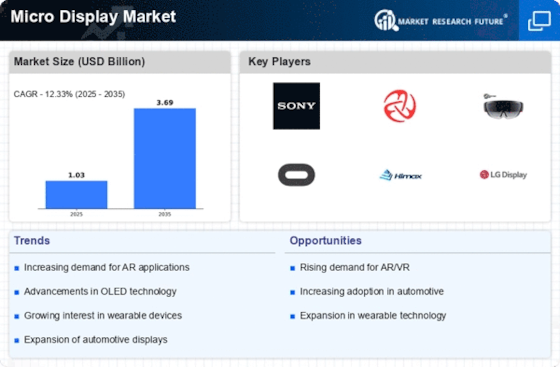
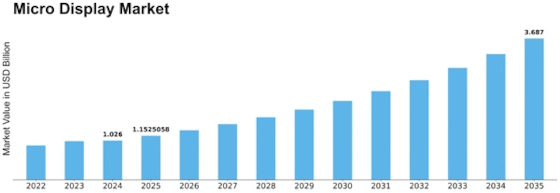
As per Market Research Future analysis, the Micro Display Market Size was estimated at 1.026 USD Billion in 2024. The Micro Display industry is projected to grow from 1.153 USD Billion in 2025 to 3.687 USD Billion by 2035, exhibiting a compound annual growth rate (CAGR) of 12.33% during the forecast period 2025 - 2035

Key Market Trends & Highlights

The Micro Display Market is poised for substantial growth driven by technological advancements and increasing applications across various sectors.

  • North America remains the largest market for micro displays, primarily fueled by advancements in consumer electronics.
  • The Asia-Pacific region is currently the fastest-growing market, reflecting a surge in demand for innovative display technologies.
  • Consumer electronics dominate the market, while the aerospace and defense segment is emerging rapidly due to its unique display requirements.
  • Technological innovations in micro displays and rising adoption in wearable devices are key drivers propelling market expansion.

Market Size & Forecast

2024 Market Size 1.026 (USD Billion)
2035 Market Size 3.687 (USD Billion)
CAGR (2025 - 2035) 12.33%
Largest Regional Market Share in 2024 North America

Major Players

Sony (JP), MicroVision (US), HoloLens (US), Oculus (US), Himax Technologies (TW), LG Display (KR), Samsung Electronics (KR), Seiko Epson (JP), Apple (US)

Market Trends

The Micro Display Market is currently experiencing a transformative phase, driven by advancements in technology and increasing demand across various sectors. This market encompasses miniature display technologies that are utilized in applications such as augmented reality, virtual reality, and head-mounted displays. The integration of micro displays into consumer electronics, automotive systems, and medical devices indicates a growing trend towards compact and efficient display solutions. As industries seek to enhance user experiences, the Micro Display Market appears poised for substantial growth, with innovations in resolution, brightness, and energy efficiency playing pivotal roles. Moreover, the competitive landscape of the Micro Display Market is evolving, as numerous players strive to capture market share through strategic partnerships and technological advancements. The rise of smart glasses and wearable devices further fuels interest in micro display technologies, suggesting a shift in consumer preferences towards more immersive and interactive experiences. As the market continues to expand, it is likely that new applications will emerge, potentially reshaping how information is presented and consumed across various platforms. The future of the Micro Display Market seems bright, with ongoing research and development efforts aimed at enhancing performance and functionality across diverse applications.

Technological Advancements

Recent innovations in micro display technology are driving the market forward. Enhanced resolution and improved brightness levels are making these displays more appealing for applications in augmented reality and virtual reality. As manufacturers invest in research and development, the capabilities of micro displays are expected to expand, potentially leading to new use cases.

Growing Demand in Consumer Electronics

The Micro Display Market is witnessing increased adoption in consumer electronics, particularly in smart devices and wearables. As consumers seek more compact and efficient solutions, the integration of micro displays into products like smart glasses and portable projectors is becoming more prevalent, indicating a shift in market dynamics.

Emerging Applications in Automotive and Medical Sectors

There is a notable trend towards the utilization of micro displays in automotive and medical applications. In vehicles, these displays are being integrated into heads-up displays and infotainment systems, while in healthcare, they are used in diagnostic equipment and surgical tools. This diversification suggests a broadening scope for micro display technologies.

Micro Display Market Market Drivers

Expansion in Automotive Displays

The Micro Display Market is experiencing expansion due to the increasing integration of micro displays in automotive applications. As vehicles become more technologically advanced, the demand for high-quality displays for navigation, infotainment, and heads-up displays is on the rise. Micro displays offer the advantage of compact size and high resolution, making them suitable for various automotive applications. The automotive display market is projected to grow significantly, with micro displays playing a crucial role in enhancing driver and passenger experiences. This trend indicates a shift towards more interactive and visually appealing interfaces in vehicles, thereby propelling the Micro Display Market forward.

Rising Adoption in Wearable Devices

The Micro Display Market is witnessing a notable increase in the adoption of micro displays in wearable devices. As consumers increasingly seek compact and efficient technology, manufacturers are integrating micro displays into smart glasses, fitness trackers, and other wearable gadgets. This trend is supported by the growing consumer preference for hands-free technology and real-time data access. According to recent estimates, the wearable technology market is expected to grow at a compound annual growth rate of over 20% in the coming years, which bodes well for the micro display segment. The integration of micro displays in wearables not only enhances functionality but also contributes to the overall aesthetic appeal, thereby driving demand within the Micro Display Market.

Growth in Medical Imaging Technologies

The Micro Display Market is benefiting from the growth in medical imaging technologies, where micro displays are increasingly utilized for diagnostic and surgical applications. High-resolution micro displays provide medical professionals with the clarity and detail necessary for accurate assessments. The demand for portable and efficient imaging devices is driving innovation in this sector, with micro displays being integrated into endoscopes, surgical microscopes, and other medical equipment. The medical imaging market is expected to expand significantly, with micro displays playing a pivotal role in enhancing the functionality and usability of medical devices. This trend underscores the importance of micro displays in the evolving landscape of healthcare technology, thereby bolstering the Micro Display Market.

Technological Innovations in Micro Displays

The Micro Display Market is currently experiencing a surge in technological innovations that enhance display quality and efficiency. Advancements in micro LED and OLED technologies are particularly noteworthy, as they offer superior brightness, contrast, and energy efficiency compared to traditional display technologies. For instance, micro LED displays are known for their ability to deliver high resolution and vibrant colors, making them ideal for applications in augmented reality and virtual reality. The market for micro displays is projected to reach approximately 3 billion USD by 2026, driven by these innovations. As manufacturers continue to invest in research and development, the Micro Display Market is likely to witness further enhancements that could redefine user experiences across various sectors.

Increasing Demand for High-Resolution Displays

The Micro Display Market is experiencing increasing demand for high-resolution displays across various sectors, including consumer electronics, automotive, and healthcare. As consumers and businesses alike seek enhanced visual experiences, the need for displays that offer superior resolution and clarity is paramount. Micro displays, with their ability to deliver high pixel density in compact form factors, are well-positioned to meet this demand. The market for high-resolution displays is projected to grow substantially, driven by advancements in display technologies and the rising popularity of applications such as virtual reality and augmented reality. This trend indicates a robust future for the Micro Display Market, as it adapts to the evolving needs of consumers and industries.

Market Segment Insights

By Application: Consumer Electronics (Largest) vs. Aerospace and Defense (Fastest-Growing)

The Micro Display Market shows a diverse application range, with Consumer Electronics commanding the largest share. This segment encompasses products like <a href="https://www.marketresearchfuture.com/reports/smartphone-market-8165" target="_blank" title="smartphone">smartphones</a>, tablets, and televisions which are driving substantial demand for micro displays due to their compact size and high resolution. Other segments, including Healthcare and Automotive, are also gaining traction, but Consumer Electronics remains at the forefront, reflecting significant consumer investment and technology adoption. In contrast, the Aerospace and Defense segment is emerging as the fastest-growing area within the Micro Display Market. Advancements in technology and the increase in defense expenditures globally are propelling demand for micro displays in applications such as heads-up displays and portable electronic devices used in flight. This surge indicates a shift in market dynamics, with significant growth driven by innovations and the need for advanced visual solutions.

Consumer Electronics (Dominant) vs. Aerospace and Defense (Emerging)

The Consumer Electronics segment is the dominant force in the Micro Display Market, characterized by its extensive use in everyday devices such as smartphones, wearable gadgets, and televisions. These applications require high pixel densities and energy-efficient performance, driving innovations in display technology. As manufacturers strive to enhance user experience with better display characteristics, the segment continues to expand rapidly. On the other hand, Aerospace and Defense is marked as an emerging segment, showcasing dynamic growth thanks to increasing demand for advanced display systems in military and civil aviation. This sector leverages micro displays for critical applications like HUDs, enabling pilots and operators to access vital information without diverting attention from their tasks. Its growth is further supported by technological advancements and prioritization of safety and efficiency in aviation.

By Technology: Liquid Crystal Display (Largest) vs. Micro-LED (Fastest-Growing)

In the Micro Display Market, Liquid Crystal Display (LCD) technology holds the largest market share, driven by its established presence and broad application across various sectors. It is commonly used in projectors, televisions, and eyewear due to its cost-effectiveness and high-quality display capabilities. Meanwhile, Micro-LED technology is rapidly gaining traction, presenting a promising alternative with superior luminescence and energy efficiency, appealing to both consumer and commercial segments.

Micro Display Market Technology: LCD (Dominant) vs. Micro-LED (Emerging)

Liquid Crystal Displays dominate the Micro Display Market due to their affordability, widespread use, and reliable performance in providing high-resolution images. Their versatility allows them to be adopted in various applications, from home entertainment to professional displays. On the other hand, Micro-LED, still in its emerging phase, showcases potential with its ability to deliver enhanced picture quality and longer lifespan, making it an attractive option for high-end devices. The rising demand for more advanced displays in sectors such as augmented reality and wearables fuels Micro-LED's growth, positioning it as a promising competitor to LCD technology.

By End Use: Smartphones (Largest) vs. Virtual Reality (Fastest-Growing)

In the Micro Display Market, the end use segment reveals a dynamic distribution of market share among diverse applications. Smartphones dominate the landscape owing to their widespread adoption and the integration of advanced micro display technologies. In comparison, wearable devices and head-up displays hold significant shares as well, catering to niche markets while augmented reality and virtual reality are emerging as critical players, slowly gaining traction among consumers especially in gaming and training applications. The growth trends within the end use segment are heavily influenced by technological advancements and consumer preferences shifting towards immersive experiences. Virtual reality is the fastest-growing application, driven by increased investments in gaming, education, and industrial training. Augmented reality is also witnessing remarkable growth, propelled by applications in retail and navigation, thereby reshaping how users interact with their environments through enhanced visual experiences.

Smartphones (Dominant) vs. Augmented Reality (Emerging)

The smartphone segment represents a dominant force within the Micro Display Market, characterized by its established presence and integration of high-resolution displays that enhance user experience for photography, gaming, and social interaction. These devices leverage micro displays for superior visual enhancement and battery efficiency, making them a go-to choice for consumers. Conversely, augmented reality is an emerging segment that attracts growing interest due to its ability to overlay digital information onto the physical world, fostering interactive experiences. It is witnessing substantial investment from tech giants seeking to innovate in consumer applications, such as gaming and education. As technology matures, augmented reality holds the potential to become a crucial component of daily technology usage, paralleling the smartphone's growth in relevance.

By Brightness Level: High Brightness (Largest) vs. Ultra High Brightness (Fastest-Growing)

In the Micro Display Market, the brightness level segment is prominently dominated by High Brightness displays, which have captured a substantial share due to their widespread application in various devices, including projectors and televisions. This segment is followed by Ultra High Brightness displays, which are gaining traction in niche markets that require enhanced visibility in challenging lighting conditions. Standard Brightness products, while essential, occupy a smaller portion of the market as newer technologies continue to push boundaries for higher brightness levels. The growth trends for the brightness level segment are driven by increasing demand for high-definition content and advancements in display technologies. Factors such as the rising prevalence of augmented reality (AR) and virtual reality (VR) applications significantly contribute to the adoption of Ultra High Brightness displays, which are being implemented in professional environments and immersive entertainment. Additionally, growing consumer expectations for superior visual experiences further propel the transition towards higher brightness levels across the market.

Brightness Levels: High Brightness (Dominant) vs. Ultra High Brightness (Emerging)

High Brightness displays serve as the backbone of the Micro Display Market, characterized by their ability to produce vivid images even in brightly lit environments. These displays are integral to consumer electronics, projection systems, and commercial applications, solidifying their dominant position. On the other hand, Ultra High Brightness displays are emerging as a key player, catering to specialized industries that demand exceptional clarity and visibility, such as outdoor advertising and high-end projection. The increasing integration of these advanced displays in new technologies, coupled with their capability to operate effectively in diverse lighting conditions, positions them favorably for rapid growth, appealing to sectors that prioritize performance and quality.

Get more detailed insights about Micro Display Market Research Report - Global Forecast 2035

Regional Insights

North America : Tech Innovation Leader

North America is the largest market for micro displays, holding approximately 45% of the global share. The region's growth is driven by advancements in technology, increasing demand for augmented reality (AR) and virtual reality (VR) applications, and supportive government initiatives. The presence of major tech companies and a robust investment landscape further catalyze market expansion. Regulatory frameworks promoting innovation also play a crucial role in shaping the market dynamics. The United States leads the North American market, with significant contributions from companies like Apple, Oculus, and MicroVision. Canada is also emerging as a key player, focusing on research and development in micro display technologies. The competitive landscape is characterized by rapid technological advancements and collaborations among industry leaders, ensuring a dynamic market environment.

Europe : Emerging Technology Hub

Europe is witnessing significant growth in the micro display market, accounting for approximately 30% of the global share. The region's demand is fueled by increasing investments in smart technologies, particularly in sectors like automotive and healthcare. Regulatory support for digital transformation and sustainability initiatives further enhances market prospects. Countries like Germany and the UK are at the forefront, driving innovation and adoption of micro display technologies across various applications. Germany is the leading country in Europe, with a strong focus on automotive displays and industrial applications. The UK follows closely, emphasizing AR and VR technologies. The competitive landscape is marked by collaborations between tech firms and research institutions, fostering innovation. Key players such as Sony and LG Display are actively involved in the European market, contributing to its growth and technological advancements.

Asia-Pacific : Rapid Growth Region

Asia-Pacific is rapidly emerging as a significant player in the micro display market, holding around 20% of the global share. The region's growth is driven by increasing consumer electronics demand, particularly in countries like China and Japan. The rise of smart devices and advancements in display technologies are key factors propelling market expansion. Additionally, government initiatives aimed at boosting technology adoption and manufacturing capabilities are crucial for the region's growth trajectory. China is the largest market in Asia-Pacific, with a strong focus on consumer electronics and gaming applications. Japan follows closely, with significant investments in AR and VR technologies. The competitive landscape is characterized by the presence of major players like Himax Technologies and Seiko Epson, who are actively innovating to meet the growing demand for micro displays. The region's dynamic market environment fosters collaboration and technological advancements among industry stakeholders.

Middle East and Africa : Emerging Market Potential

The Middle East and Africa region is gradually emerging in the micro display market, accounting for approximately 5% of the global share. The growth is primarily driven by increasing investments in technology and digital transformation initiatives across various sectors. Countries like the UAE and South Africa are leading the charge, focusing on enhancing their technological infrastructure and promoting innovation. Government support for tech startups and digital initiatives is also a significant catalyst for market growth. The UAE is at the forefront, with a strong emphasis on smart city projects and digital solutions. South Africa is also making strides in adopting micro display technologies, particularly in education and entertainment sectors. The competitive landscape is evolving, with local and international players collaborating to enhance their offerings. As the region continues to invest in technology, the micro display market is expected to witness substantial growth in the coming years.

Key Players and Competitive Insights

The Micro Display Market is currently characterized by a dynamic competitive landscape, driven by rapid technological advancements and increasing demand for high-resolution displays across various applications, including augmented reality (AR), virtual reality (VR), and automotive displays. Key players such as Sony (Japan), LG Display (South Korea), and Apple (United States) are strategically positioning themselves through innovation and partnerships. Sony (Japan) has focused on enhancing its micro OLED technology, which is pivotal for AR applications, while LG Display (South Korea) is investing heavily in OLED microdisplays for consumer electronics. Apple (United States) appears to be leveraging its ecosystem to integrate microdisplay technology into its upcoming AR devices, thereby shaping a competitive environment that emphasizes technological superiority and ecosystem integration.In terms of business tactics, companies are increasingly localizing manufacturing to mitigate supply chain disruptions and optimize costs. The Micro Display Market is moderately fragmented, with a mix of established players and emerging startups. This fragmentation allows for diverse innovation pathways, although the collective influence of major players like Samsung Electronics (South Korea) and Himax Technologies (Taiwan) is significant in setting industry standards and driving technological advancements.

In August Sony (Japan) announced a strategic partnership with a leading AR software developer to enhance its micro OLED technology for immersive experiences. This collaboration is expected to accelerate the development of next-generation AR headsets, positioning Sony as a frontrunner in the AR microdisplay segment. The strategic importance of this partnership lies in its potential to create a seamless integration of hardware and software, thereby enhancing user experience and driving market adoption.

In September LG Display (South Korea) unveiled its latest microdisplay technology at a global electronics trade show, showcasing advancements in resolution and energy efficiency. This launch is particularly significant as it underscores LG's commitment to maintaining its competitive edge in the OLED segment. By focusing on energy-efficient solutions, LG Display is likely to appeal to environmentally conscious consumers and businesses, aligning with broader sustainability trends in the industry.

In October Apple (United States) revealed plans to incorporate microdisplay technology into its next-generation AR glasses, aiming to create a more immersive user experience. This move is strategically important as it not only enhances Apple's product portfolio but also reinforces its position in the burgeoning AR market. By integrating microdisplays, Apple is likely to differentiate its offerings through superior display quality, which could lead to increased market share in the AR segment.

As of October the Micro Display Market is witnessing trends that emphasize digitalization, sustainability, and AI integration. Strategic alliances are increasingly shaping the competitive landscape, enabling companies to pool resources and expertise to drive innovation. The shift from price-based competition to a focus on technological differentiation and supply chain reliability is evident, suggesting that future competitive dynamics will hinge on the ability to innovate and deliver high-quality, sustainable products.

Key Companies in the Micro Display Market include

Industry Developments

The ground-breaking ECX350F, a 0.44-inch Full HD OLED micro display with a record-small 5.1-inch pixel pitch (~5,000 ppi) and a peak brightness of 10,000 cd/m², was unveiled by Sony Semiconductor Solutions in September 2024. Its small form factor and microlens-enhanced efficiency allow for slimmer AR glasses. In October 2024, samples were mailed out. Co-developed with Siemens and scheduled for release later in 2024, Sony unveiled an immersive XR headgear prototype in January 2024 that uses 4K OLED micro displays for industrial design and 3D content production.

Targeting the industrial and ADAS industries, Microvision revealed its Q1 2025 results and increased manufacturing capacity for its MOVIA L MEMS-based micro display engines in May 2025. Microvision raised its MOVIA L sensor production capacity in December 2024, citing high demand in the automotive and robotics industries. At SID 2025 in May 2025, Innolux demonstrated cutting-edge Micro-LED applications, such as gesture-enabled shop displays and transparent and mirrored high-PPI display walls. These advancements highlight continuous progress in micro display technologies, including OLED, LCoS, and Micro LED.

Future Outlook

Micro Display Market Future Outlook

The Micro Display Market is projected to grow at a 12.33% CAGR from 2025 to 2035, driven by advancements in technology, increasing demand for AR/VR applications, and rising <a href="https://www.marketresearchfuture.com/reports/consumer-electronics-market-66318" target="_blank" title="consumer electronics">consumer electronics</a>.

New opportunities lie in:

  • Development of high-resolution micro displays for augmented reality applications.
  • Expansion into automotive displays for enhanced driver assistance systems.
  • Integration of micro displays in wearable technology for health monitoring solutions.

By 2035, the Micro Display Market is expected to achieve substantial growth, solidifying its position as a key technology sector.

Market Segmentation

Micro Display Market End Use Outlook

  • Smartphones
  • Wearable Devices
  • Head-Up Displays
  • Virtual Reality
  • Augmented Reality

Micro Display Market Technology Outlook

  • Liquid Crystal Display
  • Micro-LED
  • Organic Light Emitting Diode
  • Digital Light Processing
  • Light Field Display

Micro Display Market Application Outlook

  • Consumer Electronics
  • Aerospace and Defense
  • Automotive
  • Healthcare
  • Retail

Micro Display Market Brightness Level Outlook

  • Standard Brightness
  • High Brightness
  • Ultra High Brightness

Report Scope

MARKET SIZE 2024 1.026(USD Billion)
MARKET SIZE 2025 1.153(USD Billion)
MARKET SIZE 2035 3.687(USD Billion)
COMPOUND ANNUAL GROWTH RATE (CAGR) 12.33% (2025 - 2035)
REPORT COVERAGE Revenue Forecast, Competitive Landscape, Growth Factors, and Trends
BASE YEAR 2024
Market Forecast Period 2025 - 2035
Historical Data 2019 - 2024
Market Forecast Units USD Billion
Key Companies Profiled Sony (JP), MicroVision (US), HoloLens (US), Oculus (US), Himax Technologies (TW), LG Display (KR), Samsung Electronics (KR), Seiko Epson (JP), Apple (US)
Segments Covered Application, Technology, End Use, Brightness Level, Regional
Key Market Opportunities Integration of Micro Display technology in augmented reality applications presents substantial growth potential.
Key Market Dynamics Rising demand for high-resolution displays drives innovation and competition in the Micro Display Market.
Countries Covered North America, Europe, APAC, South America, MEA

FAQs

What is the projected market valuation of the Micro Display Market by 2035?

<p>The Micro Display Market is projected to reach a valuation of 3.687 USD Billion by 2035.</p>

What was the market valuation of the Micro Display Market in 2024?

<p>In 2024, the Micro Display Market had a valuation of 1.026 USD Billion.</p>

What is the expected CAGR for the Micro Display Market from 2025 to 2035?

<p>The expected CAGR for the Micro Display Market during the forecast period 2025 - 2035 is 12.33%.</p>

Which companies are considered key players in the Micro Display Market?

<p>Key players in the Micro Display Market include Sony, MicroVision, HoloLens, Oculus, Himax Technologies, LG Display, Samsung Electronics, Seiko Epson, and Apple.</p>

What are the main application segments of the Micro Display Market?

<p>The main application segments include Consumer Electronics, Aerospace and Defense, Automotive, Healthcare, and Retail.</p>

How does the Consumer Electronics segment perform in terms of market valuation?

<p>The Consumer Electronics segment is expected to grow from 0.4 USD Billion in 2024 to 1.4 USD Billion by 2035.</p>

What technologies are driving the Micro Display Market?

<p>Key technologies driving the market include Liquid Crystal Display, Micro-LED, Organic Light Emitting Diode, Digital Light Processing, and Light Field Display.</p>

What is the projected growth for the Automotive segment in the Micro Display Market?

<p>The Automotive segment is anticipated to increase from 0.2 USD Billion in 2024 to 0.8 USD Billion by 2035.</p>

Which end-use segments are expected to see significant growth in the Micro Display Market?

<p>Significant growth is expected in end-use segments such as Smartphones, Wearable Devices, Head-Up Displays, Virtual Reality, and Augmented Reality.</p>

What brightness levels are being targeted in the Micro Display Market?

<p>The market is focusing on various brightness levels, including Standard Brightness, High Brightness, and Ultra High Brightness, with respective growth projections.</p>

  1. SECTION I: EXECUTIVE SUMMARY AND KEY HIGHLIGHTS
    1. | 1.1 EXECUTIVE SUMMARY
    2. | | 1.1.1 Market Overview
    3. | | 1.1.2 Key Findings
    4. | | 1.1.3 Market Segmentation
    5. | | 1.1.4 Competitive Landscape
    6. | | 1.1.5 Challenges and Opportunities
    7. | | 1.1.6 Future Outlook
  2. SECTION II: SCOPING, METHODOLOGY AND MARKET STRUCTURE
    1. | 2.1 MARKET INTRODUCTION
    2. | | 2.1.1 Definition
    3. | | 2.1.2 Scope of the study
    4. | | | 2.1.2.1 Research Objective
    5. | | | 2.1.2.2 Assumption
    6. | | | 2.1.2.3 Limitations
    7. | 2.2 RESEARCH METHODOLOGY
    8. | | 2.2.1 Overview
    9. | | 2.2.2 Data Mining
    10. | | 2.2.3 Secondary Research
    11. | | 2.2.4 Primary Research
    12. | | | 2.2.4.1 Primary Interviews and Information Gathering Process
    13. | | | 2.2.4.2 Breakdown of Primary Respondents
    14. | | 2.2.5 Forecasting Model
    15. | | 2.2.6 Market Size Estimation
    16. | | | 2.2.6.1 Bottom-Up Approach
    17. | | | 2.2.6.2 Top-Down Approach
    18. | | 2.2.7 Data Triangulation
    19. | | 2.2.8 Validation
  3. SECTION III: QUALITATIVE ANALYSIS
    1. | 3.1 MARKET DYNAMICS
    2. | | 3.1.1 Overview
    3. | | 3.1.2 Drivers
    4. | | 3.1.3 Restraints
    5. | | 3.1.4 Opportunities
    6. | 3.2 MARKET FACTOR ANALYSIS
    7. | | 3.2.1 Value chain Analysis
    8. | | 3.2.2 Porter's Five Forces Analysis
    9. | | | 3.2.2.1 Bargaining Power of Suppliers
    10. | | | 3.2.2.2 Bargaining Power of Buyers
    11. | | | 3.2.2.3 Threat of New Entrants
    12. | | | 3.2.2.4 Threat of Substitutes
    13. | | | 3.2.2.5 Intensity of Rivalry
    14. | | 3.2.3 COVID-19 Impact Analysis
    15. | | | 3.2.3.1 Market Impact Analysis
    16. | | | 3.2.3.2 Regional Impact
    17. | | | 3.2.3.3 Opportunity and Threat Analysis
  4. SECTION IV: QUANTITATIVE ANALYSIS
    1. | 4.1 Semiconductor & Electronics, BY Application (USD Billion)
    2. | | 4.1.1 Consumer Electronics
    3. | | 4.1.2 Aerospace and Defense
    4. | | 4.1.3 Automotive
    5. | | 4.1.4 Healthcare
    6. | | 4.1.5 Retail
    7. | 4.2 Semiconductor & Electronics, BY Technology (USD Billion)
    8. | | 4.2.1 Liquid Crystal Display
    9. | | 4.2.2 Micro-LED
    10. | | 4.2.3 Organic Light Emitting Diode
    11. | | 4.2.4 Digital Light Processing
    12. | | 4.2.5 Light Field Display
    13. | 4.3 Semiconductor & Electronics, BY End Use (USD Billion)
    14. | | 4.3.1 Smartphones
    15. | | 4.3.2 Wearable Devices
    16. | | 4.3.3 Head-Up Displays
    17. | | 4.3.4 Virtual Reality
    18. | | 4.3.5 Augmented Reality
    19. | 4.4 Semiconductor & Electronics, BY Brightness Level (USD Billion)
    20. | | 4.4.1 Standard Brightness
    21. | | 4.4.2 High Brightness
    22. | | 4.4.3 Ultra High Brightness
    23. | 4.5 Semiconductor & Electronics, BY Region (USD Billion)
    24. | | 4.5.1 North America
    25. | | | 4.5.1.1 US
    26. | | | 4.5.1.2 Canada
    27. | | 4.5.2 Europe
    28. | | | 4.5.2.1 Germany
    29. | | | 4.5.2.2 UK
    30. | | | 4.5.2.3 France
    31. | | | 4.5.2.4 Russia
    32. | | | 4.5.2.5 Italy
    33. | | | 4.5.2.6 Spain
    34. | | | 4.5.2.7 Rest of Europe
    35. | | 4.5.3 APAC
    36. | | | 4.5.3.1 China
    37. | | | 4.5.3.2 India
    38. | | | 4.5.3.3 Japan
    39. | | | 4.5.3.4 South Korea
    40. | | | 4.5.3.5 Malaysia
    41. | | | 4.5.3.6 Thailand
    42. | | | 4.5.3.7 Indonesia
    43. | | | 4.5.3.8 Rest of APAC
    44. | | 4.5.4 South America
    45. | | | 4.5.4.1 Brazil
    46. | | | 4.5.4.2 Mexico
    47. | | | 4.5.4.3 Argentina
    48. | | | 4.5.4.4 Rest of South America
    49. | | 4.5.5 MEA
    50. | | | 4.5.5.1 GCC Countries
    51. | | | 4.5.5.2 South Africa
    52. | | | 4.5.5.3 Rest of MEA
  5. SECTION V: COMPETITIVE ANALYSIS
    1. | 5.1 Competitive Landscape
    2. | | 5.1.1 Overview
    3. | | 5.1.2 Competitive Analysis
    4. | | 5.1.3 Market share Analysis
    5. | | 5.1.4 Major Growth Strategy in the Semiconductor & Electronics
    6. | | 5.1.5 Competitive Benchmarking
    7. | | 5.1.6 Leading Players in Terms of Number of Developments in the Semiconductor & Electronics
    8. | | 5.1.7 Key developments and growth strategies
    9. | | | 5.1.7.1 New Product Launch/Service Deployment
    10. | | | 5.1.7.2 Merger & Acquisitions
    11. | | | 5.1.7.3 Joint Ventures
    12. | | 5.1.8 Major Players Financial Matrix
    13. | | | 5.1.8.1 Sales and Operating Income
    14. | | | 5.1.8.2 Major Players R&D Expenditure. 2023
    15. | 5.2 Company Profiles
    16. | | 5.2.1 Sony (JP)
    17. | | | 5.2.1.1 Financial Overview
    18. | | | 5.2.1.2 Products Offered
    19. | | | 5.2.1.3 Key Developments
    20. | | | 5.2.1.4 SWOT Analysis
    21. | | | 5.2.1.5 Key Strategies
    22. | | 5.2.2 MicroVision (US)
    23. | | | 5.2.2.1 Financial Overview
    24. | | | 5.2.2.2 Products Offered
    25. | | | 5.2.2.3 Key Developments
    26. | | | 5.2.2.4 SWOT Analysis
    27. | | | 5.2.2.5 Key Strategies
    28. | | 5.2.3 HoloLens (US)
    29. | | | 5.2.3.1 Financial Overview
    30. | | | 5.2.3.2 Products Offered
    31. | | | 5.2.3.3 Key Developments
    32. | | | 5.2.3.4 SWOT Analysis
    33. | | | 5.2.3.5 Key Strategies
    34. | | 5.2.4 Oculus (US)
    35. | | | 5.2.4.1 Financial Overview
    36. | | | 5.2.4.2 Products Offered
    37. | | | 5.2.4.3 Key Developments
    38. | | | 5.2.4.4 SWOT Analysis
    39. | | | 5.2.4.5 Key Strategies
    40. | | 5.2.5 Himax Technologies (TW)
    41. | | | 5.2.5.1 Financial Overview
    42. | | | 5.2.5.2 Products Offered
    43. | | | 5.2.5.3 Key Developments
    44. | | | 5.2.5.4 SWOT Analysis
    45. | | | 5.2.5.5 Key Strategies
    46. | | 5.2.6 LG Display (KR)
    47. | | | 5.2.6.1 Financial Overview
    48. | | | 5.2.6.2 Products Offered
    49. | | | 5.2.6.3 Key Developments
    50. | | | 5.2.6.4 SWOT Analysis
    51. | | | 5.2.6.5 Key Strategies
    52. | | 5.2.7 Samsung Electronics (KR)
    53. | | | 5.2.7.1 Financial Overview
    54. | | | 5.2.7.2 Products Offered
    55. | | | 5.2.7.3 Key Developments
    56. | | | 5.2.7.4 SWOT Analysis
    57. | | | 5.2.7.5 Key Strategies
    58. | | 5.2.8 Seiko Epson (JP)
    59. | | | 5.2.8.1 Financial Overview
    60. | | | 5.2.8.2 Products Offered
    61. | | | 5.2.8.3 Key Developments
    62. | | | 5.2.8.4 SWOT Analysis
    63. | | | 5.2.8.5 Key Strategies
    64. | | 5.2.9 Apple (US)
    65. | | | 5.2.9.1 Financial Overview
    66. | | | 5.2.9.2 Products Offered
    67. | | | 5.2.9.3 Key Developments
    68. | | | 5.2.9.4 SWOT Analysis
    69. | | | 5.2.9.5 Key Strategies
    70. | 5.3 Appendix
    71. | | 5.3.1 References
    72. | | 5.3.2 Related Reports
  6. LIST OF FIGURES
    1. | 6.1 MARKET SYNOPSIS
    2. | 6.2 NORTH AMERICA MARKET ANALYSIS
    3. | 6.3 US MARKET ANALYSIS BY APPLICATION
    4. | 6.4 US MARKET ANALYSIS BY TECHNOLOGY
    5. | 6.5 US MARKET ANALYSIS BY END USE
    6. | 6.6 US MARKET ANALYSIS BY BRIGHTNESS LEVEL
    7. | 6.7 CANADA MARKET ANALYSIS BY APPLICATION
    8. | 6.8 CANADA MARKET ANALYSIS BY TECHNOLOGY
    9. | 6.9 CANADA MARKET ANALYSIS BY END USE
    10. | 6.10 CANADA MARKET ANALYSIS BY BRIGHTNESS LEVEL
    11. | 6.11 EUROPE MARKET ANALYSIS
    12. | 6.12 GERMANY MARKET ANALYSIS BY APPLICATION
    13. | 6.13 GERMANY MARKET ANALYSIS BY TECHNOLOGY
    14. | 6.14 GERMANY MARKET ANALYSIS BY END USE
    15. | 6.15 GERMANY MARKET ANALYSIS BY BRIGHTNESS LEVEL
    16. | 6.16 UK MARKET ANALYSIS BY APPLICATION
    17. | 6.17 UK MARKET ANALYSIS BY TECHNOLOGY
    18. | 6.18 UK MARKET ANALYSIS BY END USE
    19. | 6.19 UK MARKET ANALYSIS BY BRIGHTNESS LEVEL
    20. | 6.20 FRANCE MARKET ANALYSIS BY APPLICATION
    21. | 6.21 FRANCE MARKET ANALYSIS BY TECHNOLOGY
    22. | 6.22 FRANCE MARKET ANALYSIS BY END USE
    23. | 6.23 FRANCE MARKET ANALYSIS BY BRIGHTNESS LEVEL
    24. | 6.24 RUSSIA MARKET ANALYSIS BY APPLICATION
    25. | 6.25 RUSSIA MARKET ANALYSIS BY TECHNOLOGY
    26. | 6.26 RUSSIA MARKET ANALYSIS BY END USE
    27. | 6.27 RUSSIA MARKET ANALYSIS BY BRIGHTNESS LEVEL
    28. | 6.28 ITALY MARKET ANALYSIS BY APPLICATION
    29. | 6.29 ITALY MARKET ANALYSIS BY TECHNOLOGY
    30. | 6.30 ITALY MARKET ANALYSIS BY END USE
    31. | 6.31 ITALY MARKET ANALYSIS BY BRIGHTNESS LEVEL
    32. | 6.32 SPAIN MARKET ANALYSIS BY APPLICATION
    33. | 6.33 SPAIN MARKET ANALYSIS BY TECHNOLOGY
    34. | 6.34 SPAIN MARKET ANALYSIS BY END USE
    35. | 6.35 SPAIN MARKET ANALYSIS BY BRIGHTNESS LEVEL
    36. | 6.36 REST OF EUROPE MARKET ANALYSIS BY APPLICATION
    37. | 6.37 REST OF EUROPE MARKET ANALYSIS BY TECHNOLOGY
    38. | 6.38 REST OF EUROPE MARKET ANALYSIS BY END USE
    39. | 6.39 REST OF EUROPE MARKET ANALYSIS BY BRIGHTNESS LEVEL
    40. | 6.40 APAC MARKET ANALYSIS
    41. | 6.41 CHINA MARKET ANALYSIS BY APPLICATION
    42. | 6.42 CHINA MARKET ANALYSIS BY TECHNOLOGY
    43. | 6.43 CHINA MARKET ANALYSIS BY END USE
    44. | 6.44 CHINA MARKET ANALYSIS BY BRIGHTNESS LEVEL
    45. | 6.45 INDIA MARKET ANALYSIS BY APPLICATION
    46. | 6.46 INDIA MARKET ANALYSIS BY TECHNOLOGY
    47. | 6.47 INDIA MARKET ANALYSIS BY END USE
    48. | 6.48 INDIA MARKET ANALYSIS BY BRIGHTNESS LEVEL
    49. | 6.49 JAPAN MARKET ANALYSIS BY APPLICATION
    50. | 6.50 JAPAN MARKET ANALYSIS BY TECHNOLOGY
    51. | 6.51 JAPAN MARKET ANALYSIS BY END USE
    52. | 6.52 JAPAN MARKET ANALYSIS BY BRIGHTNESS LEVEL
    53. | 6.53 SOUTH KOREA MARKET ANALYSIS BY APPLICATION
    54. | 6.54 SOUTH KOREA MARKET ANALYSIS BY TECHNOLOGY
    55. | 6.55 SOUTH KOREA MARKET ANALYSIS BY END USE
    56. | 6.56 SOUTH KOREA MARKET ANALYSIS BY BRIGHTNESS LEVEL
    57. | 6.57 MALAYSIA MARKET ANALYSIS BY APPLICATION
    58. | 6.58 MALAYSIA MARKET ANALYSIS BY TECHNOLOGY
    59. | 6.59 MALAYSIA MARKET ANALYSIS BY END USE
    60. | 6.60 MALAYSIA MARKET ANALYSIS BY BRIGHTNESS LEVEL
    61. | 6.61 THAILAND MARKET ANALYSIS BY APPLICATION
    62. | 6.62 THAILAND MARKET ANALYSIS BY TECHNOLOGY
    63. | 6.63 THAILAND MARKET ANALYSIS BY END USE
    64. | 6.64 THAILAND MARKET ANALYSIS BY BRIGHTNESS LEVEL
    65. | 6.65 INDONESIA MARKET ANALYSIS BY APPLICATION
    66. | 6.66 INDONESIA MARKET ANALYSIS BY TECHNOLOGY
    67. | 6.67 INDONESIA MARKET ANALYSIS BY END USE
    68. | 6.68 INDONESIA MARKET ANALYSIS BY BRIGHTNESS LEVEL
    69. | 6.69 REST OF APAC MARKET ANALYSIS BY APPLICATION
    70. | 6.70 REST OF APAC MARKET ANALYSIS BY TECHNOLOGY
    71. | 6.71 REST OF APAC MARKET ANALYSIS BY END USE
    72. | 6.72 REST OF APAC MARKET ANALYSIS BY BRIGHTNESS LEVEL
    73. | 6.73 SOUTH AMERICA MARKET ANALYSIS
    74. | 6.74 BRAZIL MARKET ANALYSIS BY APPLICATION
    75. | 6.75 BRAZIL MARKET ANALYSIS BY TECHNOLOGY
    76. | 6.76 BRAZIL MARKET ANALYSIS BY END USE
    77. | 6.77 BRAZIL MARKET ANALYSIS BY BRIGHTNESS LEVEL
    78. | 6.78 MEXICO MARKET ANALYSIS BY APPLICATION
    79. | 6.79 MEXICO MARKET ANALYSIS BY TECHNOLOGY
    80. | 6.80 MEXICO MARKET ANALYSIS BY END USE
    81. | 6.81 MEXICO MARKET ANALYSIS BY BRIGHTNESS LEVEL
    82. | 6.82 ARGENTINA MARKET ANALYSIS BY APPLICATION
    83. | 6.83 ARGENTINA MARKET ANALYSIS BY TECHNOLOGY
    84. | 6.84 ARGENTINA MARKET ANALYSIS BY END USE
    85. | 6.85 ARGENTINA MARKET ANALYSIS BY BRIGHTNESS LEVEL
    86. | 6.86 REST OF SOUTH AMERICA MARKET ANALYSIS BY APPLICATION
    87. | 6.87 REST OF SOUTH AMERICA MARKET ANALYSIS BY TECHNOLOGY
    88. | 6.88 REST OF SOUTH AMERICA MARKET ANALYSIS BY END USE
    89. | 6.89 REST OF SOUTH AMERICA MARKET ANALYSIS BY BRIGHTNESS LEVEL
    90. | 6.90 MEA MARKET ANALYSIS
    91. | 6.91 GCC COUNTRIES MARKET ANALYSIS BY APPLICATION
    92. | 6.92 GCC COUNTRIES MARKET ANALYSIS BY TECHNOLOGY
    93. | 6.93 GCC COUNTRIES MARKET ANALYSIS BY END USE
    94. | 6.94 GCC COUNTRIES MARKET ANALYSIS BY BRIGHTNESS LEVEL
    95. | 6.95 SOUTH AFRICA MARKET ANALYSIS BY APPLICATION
    96. | 6.96 SOUTH AFRICA MARKET ANALYSIS BY TECHNOLOGY
    97. | 6.97 SOUTH AFRICA MARKET ANALYSIS BY END USE
    98. | 6.98 SOUTH AFRICA MARKET ANALYSIS BY BRIGHTNESS LEVEL
    99. | 6.99 REST OF MEA MARKET ANALYSIS BY APPLICATION
    100. | 6.100 REST OF MEA MARKET ANALYSIS BY TECHNOLOGY
    101. | 6.101 REST OF MEA MARKET ANALYSIS BY END USE
    102. | 6.102 REST OF MEA MARKET ANALYSIS BY BRIGHTNESS LEVEL
    103. | 6.103 KEY BUYING CRITERIA OF SEMICONDUCTOR & ELECTRONICS
    104. | 6.104 RESEARCH PROCESS OF MRFR
    105. | 6.105 DRO ANALYSIS OF SEMICONDUCTOR & ELECTRONICS
    106. | 6.106 DRIVERS IMPACT ANALYSIS: SEMICONDUCTOR & ELECTRONICS
    107. | 6.107 RESTRAINTS IMPACT ANALYSIS: SEMICONDUCTOR & ELECTRONICS
    108. | 6.108 SUPPLY / VALUE CHAIN: SEMICONDUCTOR & ELECTRONICS
    109. | 6.109 SEMICONDUCTOR & ELECTRONICS, BY APPLICATION, 2024 (% SHARE)
    110. | 6.110 SEMICONDUCTOR & ELECTRONICS, BY APPLICATION, 2024 TO 2035 (USD Billion)
    111. | 6.111 SEMICONDUCTOR & ELECTRONICS, BY TECHNOLOGY, 2024 (% SHARE)
    112. | 6.112 SEMICONDUCTOR & ELECTRONICS, BY TECHNOLOGY, 2024 TO 2035 (USD Billion)
    113. | 6.113 SEMICONDUCTOR & ELECTRONICS, BY END USE, 2024 (% SHARE)
    114. | 6.114 SEMICONDUCTOR & ELECTRONICS, BY END USE, 2024 TO 2035 (USD Billion)
    115. | 6.115 SEMICONDUCTOR & ELECTRONICS, BY BRIGHTNESS LEVEL, 2024 (% SHARE)
    116. | 6.116 SEMICONDUCTOR & ELECTRONICS, BY BRIGHTNESS LEVEL, 2024 TO 2035 (USD Billion)
    117. | 6.117 BENCHMARKING OF MAJOR COMPETITORS
  7. LIST OF TABLES
    1. | 7.1 LIST OF ASSUMPTIONS
    2. | | 7.1.1
    3. | 7.2 North America MARKET SIZE ESTIMATES; FORECAST
    4. | | 7.2.1 BY APPLICATION, 2025-2035 (USD Billion)
    5. | | 7.2.2 BY TECHNOLOGY, 2025-2035 (USD Billion)
    6. | | 7.2.3 BY END USE, 2025-2035 (USD Billion)
    7. | | 7.2.4 BY BRIGHTNESS LEVEL, 2025-2035 (USD Billion)
    8. | 7.3 US MARKET SIZE ESTIMATES; FORECAST
    9. | | 7.3.1 BY APPLICATION, 2025-2035 (USD Billion)
    10. | | 7.3.2 BY TECHNOLOGY, 2025-2035 (USD Billion)
    11. | | 7.3.3 BY END USE, 2025-2035 (USD Billion)
    12. | | 7.3.4 BY BRIGHTNESS LEVEL, 2025-2035 (USD Billion)
    13. | 7.4 Canada MARKET SIZE ESTIMATES; FORECAST
    14. | | 7.4.1 BY APPLICATION, 2025-2035 (USD Billion)
    15. | | 7.4.2 BY TECHNOLOGY, 2025-2035 (USD Billion)
    16. | | 7.4.3 BY END USE, 2025-2035 (USD Billion)
    17. | | 7.4.4 BY BRIGHTNESS LEVEL, 2025-2035 (USD Billion)
    18. | 7.5 Europe MARKET SIZE ESTIMATES; FORECAST
    19. | | 7.5.1 BY APPLICATION, 2025-2035 (USD Billion)
    20. | | 7.5.2 BY TECHNOLOGY, 2025-2035 (USD Billion)
    21. | | 7.5.3 BY END USE, 2025-2035 (USD Billion)
    22. | | 7.5.4 BY BRIGHTNESS LEVEL, 2025-2035 (USD Billion)
    23. | 7.6 Germany MARKET SIZE ESTIMATES; FORECAST
    24. | | 7.6.1 BY APPLICATION, 2025-2035 (USD Billion)
    25. | | 7.6.2 BY TECHNOLOGY, 2025-2035 (USD Billion)
    26. | | 7.6.3 BY END USE, 2025-2035 (USD Billion)
    27. | | 7.6.4 BY BRIGHTNESS LEVEL, 2025-2035 (USD Billion)
    28. | 7.7 UK MARKET SIZE ESTIMATES; FORECAST
    29. | | 7.7.1 BY APPLICATION, 2025-2035 (USD Billion)
    30. | | 7.7.2 BY TECHNOLOGY, 2025-2035 (USD Billion)
    31. | | 7.7.3 BY END USE, 2025-2035 (USD Billion)
    32. | | 7.7.4 BY BRIGHTNESS LEVEL, 2025-2035 (USD Billion)
    33. | 7.8 France MARKET SIZE ESTIMATES; FORECAST
    34. | | 7.8.1 BY APPLICATION, 2025-2035 (USD Billion)
    35. | | 7.8.2 BY TECHNOLOGY, 2025-2035 (USD Billion)
    36. | | 7.8.3 BY END USE, 2025-2035 (USD Billion)
    37. | | 7.8.4 BY BRIGHTNESS LEVEL, 2025-2035 (USD Billion)
    38. | 7.9 Russia MARKET SIZE ESTIMATES; FORECAST
    39. | | 7.9.1 BY APPLICATION, 2025-2035 (USD Billion)
    40. | | 7.9.2 BY TECHNOLOGY, 2025-2035 (USD Billion)
    41. | | 7.9.3 BY END USE, 2025-2035 (USD Billion)
    42. | | 7.9.4 BY BRIGHTNESS LEVEL, 2025-2035 (USD Billion)
    43. | 7.10 Italy MARKET SIZE ESTIMATES; FORECAST
    44. | | 7.10.1 BY APPLICATION, 2025-2035 (USD Billion)
    45. | | 7.10.2 BY TECHNOLOGY, 2025-2035 (USD Billion)
    46. | | 7.10.3 BY END USE, 2025-2035 (USD Billion)
    47. | | 7.10.4 BY BRIGHTNESS LEVEL, 2025-2035 (USD Billion)
    48. | 7.11 Spain MARKET SIZE ESTIMATES; FORECAST
    49. | | 7.11.1 BY APPLICATION, 2025-2035 (USD Billion)
    50. | | 7.11.2 BY TECHNOLOGY, 2025-2035 (USD Billion)
    51. | | 7.11.3 BY END USE, 2025-2035 (USD Billion)
    52. | | 7.11.4 BY BRIGHTNESS LEVEL, 2025-2035 (USD Billion)
    53. | 7.12 Rest of Europe MARKET SIZE ESTIMATES; FORECAST
    54. | | 7.12.1 BY APPLICATION, 2025-2035 (USD Billion)
    55. | | 7.12.2 BY TECHNOLOGY, 2025-2035 (USD Billion)
    56. | | 7.12.3 BY END USE, 2025-2035 (USD Billion)
    57. | | 7.12.4 BY BRIGHTNESS LEVEL, 2025-2035 (USD Billion)
    58. | 7.13 APAC MARKET SIZE ESTIMATES; FORECAST
    59. | | 7.13.1 BY APPLICATION, 2025-2035 (USD Billion)
    60. | | 7.13.2 BY TECHNOLOGY, 2025-2035 (USD Billion)
    61. | | 7.13.3 BY END USE, 2025-2035 (USD Billion)
    62. | | 7.13.4 BY BRIGHTNESS LEVEL, 2025-2035 (USD Billion)
    63. | 7.14 China MARKET SIZE ESTIMATES; FORECAST
    64. | | 7.14.1 BY APPLICATION, 2025-2035 (USD Billion)
    65. | | 7.14.2 BY TECHNOLOGY, 2025-2035 (USD Billion)
    66. | | 7.14.3 BY END USE, 2025-2035 (USD Billion)
    67. | | 7.14.4 BY BRIGHTNESS LEVEL, 2025-2035 (USD Billion)
    68. | 7.15 India MARKET SIZE ESTIMATES; FORECAST
    69. | | 7.15.1 BY APPLICATION, 2025-2035 (USD Billion)
    70. | | 7.15.2 BY TECHNOLOGY, 2025-2035 (USD Billion)
    71. | | 7.15.3 BY END USE, 2025-2035 (USD Billion)
    72. | | 7.15.4 BY BRIGHTNESS LEVEL, 2025-2035 (USD Billion)
    73. | 7.16 Japan MARKET SIZE ESTIMATES; FORECAST
    74. | | 7.16.1 BY APPLICATION, 2025-2035 (USD Billion)
    75. | | 7.16.2 BY TECHNOLOGY, 2025-2035 (USD Billion)
    76. | | 7.16.3 BY END USE, 2025-2035 (USD Billion)
    77. | | 7.16.4 BY BRIGHTNESS LEVEL, 2025-2035 (USD Billion)
    78. | 7.17 South Korea MARKET SIZE ESTIMATES; FORECAST
    79. | | 7.17.1 BY APPLICATION, 2025-2035 (USD Billion)
    80. | | 7.17.2 BY TECHNOLOGY, 2025-2035 (USD Billion)
    81. | | 7.17.3 BY END USE, 2025-2035 (USD Billion)
    82. | | 7.17.4 BY BRIGHTNESS LEVEL, 2025-2035 (USD Billion)
    83. | 7.18 Malaysia MARKET SIZE ESTIMATES; FORECAST
    84. | | 7.18.1 BY APPLICATION, 2025-2035 (USD Billion)
    85. | | 7.18.2 BY TECHNOLOGY, 2025-2035 (USD Billion)
    86. | | 7.18.3 BY END USE, 2025-2035 (USD Billion)
    87. | | 7.18.4 BY BRIGHTNESS LEVEL, 2025-2035 (USD Billion)
    88. | 7.19 Thailand MARKET SIZE ESTIMATES; FORECAST
    89. | | 7.19.1 BY APPLICATION, 2025-2035 (USD Billion)
    90. | | 7.19.2 BY TECHNOLOGY, 2025-2035 (USD Billion)
    91. | | 7.19.3 BY END USE, 2025-2035 (USD Billion)
    92. | | 7.19.4 BY BRIGHTNESS LEVEL, 2025-2035 (USD Billion)
    93. | 7.20 Indonesia MARKET SIZE ESTIMATES; FORECAST
    94. | | 7.20.1 BY APPLICATION, 2025-2035 (USD Billion)
    95. | | 7.20.2 BY TECHNOLOGY, 2025-2035 (USD Billion)
    96. | | 7.20.3 BY END USE, 2025-2035 (USD Billion)
    97. | | 7.20.4 BY BRIGHTNESS LEVEL, 2025-2035 (USD Billion)
    98. | 7.21 Rest of APAC MARKET SIZE ESTIMATES; FORECAST
    99. | | 7.21.1 BY APPLICATION, 2025-2035 (USD Billion)
    100. | | 7.21.2 BY TECHNOLOGY, 2025-2035 (USD Billion)
    101. | | 7.21.3 BY END USE, 2025-2035 (USD Billion)
    102. | | 7.21.4 BY BRIGHTNESS LEVEL, 2025-2035 (USD Billion)
    103. | 7.22 South America MARKET SIZE ESTIMATES; FORECAST
    104. | | 7.22.1 BY APPLICATION, 2025-2035 (USD Billion)
    105. | | 7.22.2 BY TECHNOLOGY, 2025-2035 (USD Billion)
    106. | | 7.22.3 BY END USE, 2025-2035 (USD Billion)
    107. | | 7.22.4 BY BRIGHTNESS LEVEL, 2025-2035 (USD Billion)
    108. | 7.23 Brazil MARKET SIZE ESTIMATES; FORECAST
    109. | | 7.23.1 BY APPLICATION, 2025-2035 (USD Billion)
    110. | | 7.23.2 BY TECHNOLOGY, 2025-2035 (USD Billion)
    111. | | 7.23.3 BY END USE, 2025-2035 (USD Billion)
    112. | | 7.23.4 BY BRIGHTNESS LEVEL, 2025-2035 (USD Billion)
    113. | 7.24 Mexico MARKET SIZE ESTIMATES; FORECAST
    114. | | 7.24.1 BY APPLICATION, 2025-2035 (USD Billion)
    115. | | 7.24.2 BY TECHNOLOGY, 2025-2035 (USD Billion)
    116. | | 7.24.3 BY END USE, 2025-2035 (USD Billion)
    117. | | 7.24.4 BY BRIGHTNESS LEVEL, 2025-2035 (USD Billion)
    118. | 7.25 Argentina MARKET SIZE ESTIMATES; FORECAST
    119. | | 7.25.1 BY APPLICATION, 2025-2035 (USD Billion)
    120. | | 7.25.2 BY TECHNOLOGY, 2025-2035 (USD Billion)
    121. | | 7.25.3 BY END USE, 2025-2035 (USD Billion)
    122. | | 7.25.4 BY BRIGHTNESS LEVEL, 2025-2035 (USD Billion)
    123. | 7.26 Rest of South America MARKET SIZE ESTIMATES; FORECAST
    124. | | 7.26.1 BY APPLICATION, 2025-2035 (USD Billion)
    125. | | 7.26.2 BY TECHNOLOGY, 2025-2035 (USD Billion)
    126. | | 7.26.3 BY END USE, 2025-2035 (USD Billion)
    127. | | 7.26.4 BY BRIGHTNESS LEVEL, 2025-2035 (USD Billion)
    128. | 7.27 MEA MARKET SIZE ESTIMATES; FORECAST
    129. | | 7.27.1 BY APPLICATION, 2025-2035 (USD Billion)
    130. | | 7.27.2 BY TECHNOLOGY, 2025-2035 (USD Billion)
    131. | | 7.27.3 BY END USE, 2025-2035 (USD Billion)
    132. | | 7.27.4 BY BRIGHTNESS LEVEL, 2025-2035 (USD Billion)
    133. | 7.28 GCC Countries MARKET SIZE ESTIMATES; FORECAST
    134. | | 7.28.1 BY APPLICATION, 2025-2035 (USD Billion)
    135. | | 7.28.2 BY TECHNOLOGY, 2025-2035 (USD Billion)
    136. | | 7.28.3 BY END USE, 2025-2035 (USD Billion)
    137. | | 7.28.4 BY BRIGHTNESS LEVEL, 2025-2035 (USD Billion)
    138. | 7.29 South Africa MARKET SIZE ESTIMATES; FORECAST
    139. | | 7.29.1 BY APPLICATION, 2025-2035 (USD Billion)
    140. | | 7.29.2 BY TECHNOLOGY, 2025-2035 (USD Billion)
    141. | | 7.29.3 BY END USE, 2025-2035 (USD Billion)
    142. | | 7.29.4 BY BRIGHTNESS LEVEL, 2025-2035 (USD Billion)
    143. | 7.30 Rest of MEA MARKET SIZE ESTIMATES; FORECAST
    144. | | 7.30.1 BY APPLICATION, 2025-2035 (USD Billion)
    145. | | 7.30.2 BY TECHNOLOGY, 2025-2035 (USD Billion)
    146. | | 7.30.3 BY END USE, 2025-2035 (USD Billion)
    147. | | 7.30.4 BY BRIGHTNESS LEVEL, 2025-2035 (USD Billion)
    148. | 7.31 PRODUCT LAUNCH/PRODUCT DEVELOPMENT/APPROVAL
    149. | | 7.31.1
    150. | 7.32 ACQUISITION/PARTNERSHIP
    151. | | 7.32.1

Semiconductor & Electronics Market Segmentation

Semiconductor & Electronics By Application (USD Billion, 2025-2035)

  • Consumer Electronics
  • Aerospace and Defense
  • Automotive
  • Healthcare
  • Retail

Semiconductor & Electronics By Technology (USD Billion, 2025-2035)

  • Liquid Crystal Display
  • Micro-LED
  • Organic Light Emitting Diode
  • Digital Light Processing
  • Light Field Display

Semiconductor & Electronics By End Use (USD Billion, 2025-2035)

  • Smartphones
  • Wearable Devices
  • Head-Up Displays
  • Virtual Reality
  • Augmented Reality

Semiconductor & Electronics By Brightness Level (USD Billion, 2025-2035)

  • Standard Brightness
  • High Brightness
  • Ultra High Brightness
Infographic

Free Sample Request

Kindly complete the form below to receive a free sample of this Report

Get Free Sample

Customer Strories

Compare Licence

×
Features License Type
Single User Multiuser License Enterprise User
Price $4,950 $5,950 $7,250
Maximum User Access Limit 1 User Upto 10 Users Unrestricted Access Throughout the Organization
Free Customization
Direct Access to Analyst
Deliverable Format
Platform Access
Discount on Next Purchase 10% 15% 15%
Printable Versions