×
Request Free Sample ×

Kindly complete the form below to receive a free sample of this Report

* Please use a valid business email

Leading companies partner with us for data-driven Insights

clients tt-cursor
Hero Background
English
Chinese
French
Japanese
Korean
German
Spanish

Methyl Soyate Market Share

ID: MRFR/CnM/2672-HCR
134 Pages
Anshula Mandaokar
October 2025

Methyl Soyate Market Research Report Information- By Application (Degreasers, Paint Stripper, Hand Cleaners, Ink Removal, and others), By End Use Industry (Paints & Coatings, Industrial & Domestic Cleaning, Printing Inks, Cosmetics & Personal Care, and others) and By Region- Forecast Till 2035

Share:
Download PDF ×

We do not share your information with anyone. However, we may send you emails based on your report interest from time to time. You may contact us at any time to opt-out.

Methyl Soyate Market Infographic
Purchase Options

Market Share

Methyl Soyate Market Share Analysis

The Methyl Soyate market uses various strategies to position and grow its market share. Methyl soyate firms use product differentiation to stand out from competitors. Optimizing production methods, assuring purity, or developing industrial-specific formulations may be needed. Companies emphasize these unique properties to attract clients seeking higher performance or specific traits and increase market share.

Methyl Soyate's market positioning depends on pricing. Companies may provide competitive pricing to attract cost-conscious customers and expand their market share. Alternatively, methyl soyate can be priced higher as a high-quality, eco-friendly solvent to entice clients ready to pay more. To position a brand and achieve market share, price and value must be balanced.

Distribution networks are crucial to Methyl Soyate's market share. Strong ties with distributors, producers, and end-users ensure product availability. This accessibility makes Methyl Soyate easier to source, increasing market share. Companies can also use digital platforms and internet channels to reach more customers than traditional distribution techniques.

Brand recognition and targeted marketing initiatives are key to Methyl Soyate market share positioning. A strong brand image and favorable product associations can greatly impact client preferences. Companies use industry-specific advertising, trade exhibitions, and internet promotions to increase brand awareness and market share.

The dynamic Methyl Soyate market requires innovation and adaptability. Offering cutting-edge solutions can help companies lead in technology and industry. Continuous innovation, new formulations with improved qualities, and eco-friendly options make market positioning more competitive, enticing clients seeking sophisticated and sustainable solvent solutions.

Methyl Soyate market share positioning also depends on collaboration and strategic alliances. Alliances with raw material suppliers, research institutions, and other industry participants can improve product quality, streamline manufacturing, and boost market share. These cooperation give Methyl Soyate a broad and competitive position.

Methyl Soyate market share positioning depends on global and regional factors. Understanding regional wants and preferences helps organizations customize their strategy to specific markets, making them more targeted and effective.

Author
Anshula Mandaokar
Team Lead - Research

Anshula Mandaokar holds an academic degree in Chemical Engineering and has been contributing to the field for more than 5 years. She has expertise in Market Research and Business Consulting and serves as a Team Lead for a reputed Market Research firm under the Chemicals and Materials domain spectrum. She has worked on multiple projects, generating explicit results in a quick turnaround time. Her understanding of data interpretation justifies her role as a leader.

Leave a Comment

FAQs

What is the forecast period of Methyl Soyate Market research report?

The forecast period for Methyl Soyate Market research report is 2025-2035

Which region will lead the global Methyl Soyate Market?

Global Methyl Soyate Market is dominated by APAC region.

Who are the key players in the Methyl Soyate Market?

The prominent players operating in the methyl soyate market include BASF SE (Germany), Stepan Company (U.S.), Cargill, Incorporated (U.S.), Camco Chemical Co. Inc. (U.S.), Florida Chemical Company (U.S.), Vertec BioSolvents (U.S.), Unicon Fibro Chemicals Pvt. Ltd. (India), and others.

Market Summary

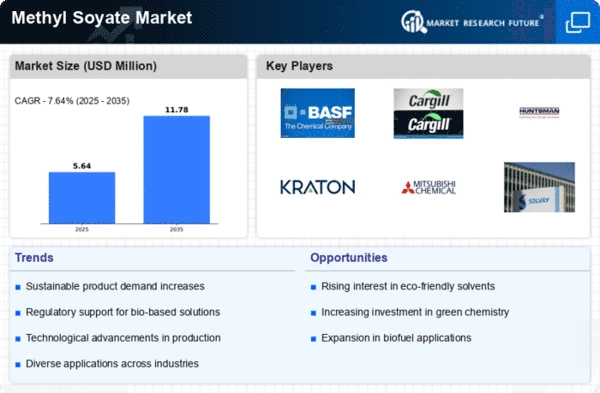
As per MRFR analysis, the Methyl Soyate Market Size was estimated at 5.24 USD Million in 2024. The Methyl Soyate industry is projected to grow from 5.64 in 2025 to 11.78 by 2035, exhibiting a compound annual growth rate (CAGR) of 7.64 during the forecast period 2025 - 2035.

Key Market Trends & Highlights

The Methyl Soyate Market is experiencing a robust shift towards sustainability and innovation.

  • North America remains the largest market for methyl soyate, driven by increasing demand for eco-friendly products.
  • The Asia-Pacific region is emerging as the fastest-growing market, fueled by rapid industrialization and environmental regulations.
  • In the solvent segment, methyl soyate is widely adopted due to its effectiveness and lower environmental impact, while the cleaner segment is witnessing the fastest growth as consumers prioritize health and safety.
  • Key market drivers include the rising demand for bio-based solvents and increased regulatory support for eco-friendly products.

Market Size & Forecast

2024 Market Size 5.24 (USD Million)
2035 Market Size 11.78 (USD Million)
CAGR (2025 - 2035) 7.64%
Largest Regional Market Share in 2024 North America

Major Players

BASF SE (DE), Cargill, Incorporated (US), Huntsman Corporation (US), Kraton Corporation (US), Mitsubishi Chemical Corporation (JP), Solvay S.A. (BE), The Dow Chemical Company (US), Univar Solutions Inc. (US)

Market Trends

The Methyl Soyate Market is currently experiencing a notable transformation, driven by increasing demand for sustainable and eco-friendly alternatives in various industries. This bio-based solvent, derived from soybean oil, is gaining traction due to its low toxicity and biodegradability, making it an attractive option for manufacturers seeking to reduce their environmental footprint. As industries such as coatings, adhesives, and cleaning products prioritize greener solutions, the Methyl Soyate Market appears poised for growth. Furthermore, regulatory frameworks promoting the use of renewable resources are likely to bolster market expansion, as companies adapt to stricter environmental standards. In addition to environmental considerations, the Methyl Soyate Market is influenced by advancements in technology and product formulations. Innovations in production processes may enhance the efficiency and cost-effectiveness of Methyl Soyate, thereby appealing to a broader range of applications. The increasing awareness of health and safety concerns among consumers is also propelling the shift towards safer chemical alternatives. As the market evolves, stakeholders must remain vigilant to emerging trends and consumer preferences, which could shape the future landscape of the Methyl Soyate Market.

Sustainability Focus

The emphasis on sustainable practices is reshaping the Methyl Soyate Market. Companies are increasingly adopting bio-based solvents to align with environmental goals, responding to consumer demand for greener products.

Technological Advancements

Innovations in production techniques are enhancing the efficiency of Methyl Soyate manufacturing. These advancements may lead to cost reductions and improved product quality, expanding its applicability across various sectors.

Health and Safety Awareness

Growing concerns regarding health and safety are driving the shift towards non-toxic alternatives. The Methyl Soyate Market is likely to benefit from this trend as consumers and industries prioritize safer chemical options.

Methyl Soyate Market Market Drivers

Market Growth Projections

The Global Methyl Soyate Market Industry is projected to experience substantial growth over the coming years. With a market value anticipated to reach 750 USD Million in 2024 and potentially doubling to 1500 USD Million by 2035, the industry is poised for a robust expansion. This growth trajectory is supported by a compound annual growth rate of 6.5% from 2025 to 2035, indicating a strong demand for methyl soyate across various applications. Factors such as increasing environmental regulations, rising consumer preferences for sustainable products, and advancements in production technologies are likely to contribute to this positive outlook. The Global Methyl Soyate Industry appears well-positioned to capitalize on these trends.

Expansion of End-use Industries

The Global Methyl Soyate Market Industry is significantly influenced by the expansion of end-use industries such as automotive, construction, and personal care. These sectors are increasingly incorporating methyl soyate into their formulations due to its favorable properties, including low toxicity and high solvency. For example, the automotive industry utilizes methyl soyate in paint and coatings, enhancing product performance while adhering to environmental regulations. This growing adoption across diverse applications is anticipated to drive the market's value to 1500 USD Million by 2035. Consequently, the Global Methyl Soyate Market Industry is poised for robust growth as it aligns with the evolving needs of various industries.

Regulatory Support and Incentives

The Global Methyl Soyate Market Industry benefits from supportive regulatory frameworks that encourage the use of renewable resources. Governments worldwide are implementing policies that promote the adoption of bio-based products, including methyl soyate. For instance, various countries have established tax incentives and subsidies for manufacturers utilizing sustainable materials. This regulatory backing not only enhances the market's growth potential but also fosters innovation in product development. As a result, the Global Methyl Soyate Market Industry is expected to witness a compound annual growth rate of 6.5% from 2025 to 2035, reflecting the positive impact of these initiatives on market dynamics.

Growing Demand for Bio-based Solvents

The Global Methyl Soyate Market Industry experiences a notable surge in demand for bio-based solvents, driven by increasing environmental awareness and regulatory pressures. Methyl soyate, derived from soybean oil, serves as a sustainable alternative to petroleum-based solvents. This shift aligns with global initiatives aimed at reducing carbon footprints and promoting green chemistry. As industries such as coatings, adhesives, and cleaning products adopt eco-friendly formulations, the market is projected to reach 750 USD Million in 2024. The emphasis on sustainability is likely to propel the Global Methyl Soyate Market Industry further, as consumers increasingly favor products that contribute to environmental conservation.

Technological Advancements in Production

Technological advancements in the production of methyl soyate are playing a crucial role in enhancing efficiency and reducing costs within the Global Methyl Soyate Market Industry. Innovations in extraction and processing techniques enable manufacturers to optimize yield and improve product quality. For instance, advancements in transesterification processes have led to higher purity levels of methyl soyate, making it more appealing for industrial applications. These improvements not only bolster the competitiveness of methyl soyate against traditional solvents but also contribute to the overall growth trajectory of the market. As production methods evolve, the Global Methyl Soyate Market Industry is likely to experience increased adoption and market penetration.

Rising Consumer Awareness and Preferences

Rising consumer awareness regarding health and environmental impacts is shaping the Global Methyl Soyate Market Industry. Consumers are increasingly seeking products that are safe for both human health and the environment, leading to a shift towards bio-based alternatives. This trend is evident in sectors such as personal care and household cleaning, where methyl soyate is favored for its non-toxic properties. As consumers prioritize sustainability, manufacturers are compelled to reformulate their products, integrating methyl soyate to meet these demands. This shift in consumer preferences is expected to further drive the growth of the Global Methyl Soyate Market Industry, reinforcing its position as a viable alternative in various applications.

Market Segment Insights

By Application: Solvent (Largest) vs. Cleaner (Fastest-Growing)

The Methyl Soyate Market is primarily driven by its application segments, with Solvents holding the largest market share. The versatility of methyl soyate as a solvent makes it a preferred choice across various industries, including coatings and cleaning products. Cleaners are rapidly gaining traction as the demand for environmentally friendly products increases, positioning them as the fastest-growing segment within the application category. Growth trends in the Methyl Soyate Market are influenced by several factors including regulatory support for bio-based products and a shift towards sustainable practices. Solvents continue to lead due to their widespread utility, but the cleaner segment is expanding significantly, driven by consumer demand for eco-friendly cleaning solutions. Other applications such as paints, coatings, adhesives, and fuel additives also contribute to market dynamics, although they currently represent a smaller share compared to the leading segments.

Solvent (Dominant) vs. Cleaner (Emerging)

The solvent segment of the Methyl Soyate Market is recognized for its dominant position due to its extensive range of applications in various industries like paints and coatings as well as cleaning products. Methyl soyate is favored because of its non-toxic nature and effectiveness as a solvent compared to traditional options. The cleaner segment, on the other hand, is emerging vigorously as consumers and industries alike gravitate towards sustainable practices. Featuring biodegradable properties, methyl soyate cleaners are gaining acceptance, especially in sectors focused on health and environmental safety. While solvents remain entrenched as the market leader, the progressive traction of cleaners indicates a substantial transformation in market preferences.

By End Use: Automotive (Largest) vs. Agriculture (Fastest-Growing)

In the Methyl Soyate Market, the end-use segments exhibit diverse characteristics, with automotive applications leading in market share due to the increasing demand for eco-friendly fuels and lubricants. The industrial segment closely follows, benefiting from the push towards sustainable industrial processes. Household and construction uses contribute to the market as well, though to a lesser extent, while agriculture proves to be a significant driver thanks to its rapidly growing applications in biopesticides and biofuels.

Automotive (Dominant) vs. Agriculture (Emerging)

The automotive segment dominates the Methyl Soyate Market, leveraging the trend toward renewable energy solutions in transportation. With regulations tightening on emissions and a shift towards sustainable automotive practices, methyl soyate serves as a vital alternative fuel option known for its biodegradable properties and lower environmental impact. Conversely, the agriculture sector is emerging as a significant player, driven by innovation in biopesticides and renewable energy sources for agricultural machinery. This segment's growth is fueled by increasing awareness of sustainable farming practices and the demand for products that enhance crop yields while minimizing chemical usage.

By Formulation Type: Conventional (Largest) vs. Bio-based (Fastest-Growing)

In the Methyl Soyate Market, the formulation type segment is characterized by a diverse distribution of market shares. The Conventional formulation holds the largest market share, driven by its long-established presence and widespread industrial applications. Conversely, the Bio-based formulation is gaining traction due to the increasing preference for sustainable and environmentally friendly products, appealing especially to consumers and businesses focused on reducing their ecological footprint. As the market evolves, Specialty and Hybrid formulations also carve out niches, catering to specific consumer needs and innovative applications. The growth trends in the formulation type segment reflect a shift towards sustainability and technological advancements. The Bio-based formulation is rapidly becoming the fastest-growing segment, propelled by heightened awareness regarding environmental issues and government regulations favoring renewable sources. In contrast, Conventional formulations maintain a stronghold, as they continue to offer reliability and cost-effectiveness. The Hybrid segment is emerging as a formidable player, bridging the gap between traditional and sustainable solutions, while Specialty formulations cater to increasingly sophisticated market demands, ensuring tailored solutions for diverse industries.

Conventional (Dominant) vs. Specialty (Emerging)

The Conventional formulation type remains the dominant player in the Methyl Soyate Market, characterized by its well-established manufacturing processes and widespread acceptance across various industrial sectors. This formulation is known for its reliable performance and cost-effectiveness, making it the go-to choice for numerous applications, especially where consistency and availability are crucial. On the other hand, the Specialty formulation is rapidly emerging, aimed at fulfilling specific market demands with unique properties like enhanced performance and specialized applications. This segment caters to niche markets, providing innovative solutions that appeal to industries seeking tailored formulations. As consumer preferences shift towards more diverse and specialized options, the Specialty segment's growth is driven by the need for customized solutions, thereby enhancing its importance in the overall market landscape.

By Distribution Channel: Direct Sales (Largest) vs. Online Sales (Fastest-Growing)

In the Methyl Soyate Market, distribution channels play a pivotal role in shaping market dynamics. Direct Sales currently dominate the market due to strong relationships between manufacturers and end-users, providing a consistent revenue stream. Online Sales has emerged as a vital segment, witnessing a surge in consumer interest and convenience, thus carving out a significant portion of the market share. As consumer purchasing behaviors shift towards digital platforms, Online Sales is positioned for rapid growth, driven by increased internet penetration and e-commerce adoption. Retail Sales and Wholesale remain essential, but they are adapting to the growing demand for online options, creating opportunities for hybrid models that leverage both direct and digital channels to enhance market presence.

Direct Sales (Dominant) vs. Online Sales (Emerging)

Direct Sales in the Methyl Soyate Market represent a long-standing channel that emphasizes personal engagement and trust, particularly within industrial applications. This segment benefits from established customer bases and offers tailored solutions that meet specific client needs. On the other hand, Online Sales are rapidly gaining traction, appealing to a broader consumer demographic that values convenience and accessibility. This channel is characterized by innovative marketing strategies and superior customer outreach. Though Direct Sales remain dominant, Online Sales are proving to be adaptable and responsive, positioning themselves as a critical emerging force in the industry. The ongoing trend towards online procurement signals a shift that may redefine traditional distribution methods in the Methyl Soyate Market.

Get more detailed insights about Methyl Soyate Market Research Report- Forecast till 2035

Regional Insights

North America : Market Leader in Methyl Soyate

North America is poised to maintain its leadership in the Methyl Soyate market, holding a significant market share of 2.62 in 2024. The region's growth is driven by increasing demand for bio-based solvents and stringent environmental regulations promoting sustainable products. The shift towards greener alternatives in various industries, including automotive and coatings, is further propelling market expansion. Regulatory support for renewable resources is a key catalyst for growth. The competitive landscape in North America is robust, featuring major players such as BASF SE, Cargill, and The Dow Chemical Company. These companies are investing in R&D to enhance product offerings and meet the rising demand for eco-friendly solutions. The U.S. leads the market, supported by favorable government policies and a strong manufacturing base. This dynamic environment positions North America as a critical hub for Methyl Soyate production and innovation.

Europe : Emerging Market with Potential

Europe's Methyl Soyate market is on the rise, with a market size of 1.25. The region is experiencing growth due to increasing environmental awareness and regulatory frameworks that favor sustainable products. The European Union's Green Deal and various national initiatives are driving demand for bio-based solvents, positioning Methyl Soyate as a viable alternative. The focus on reducing carbon footprints is a significant growth driver in this market. Leading countries in Europe include Germany, France, and the Netherlands, where key players like Solvay and Mitsubishi Chemical are actively expanding their operations. The competitive landscape is characterized by innovation and collaboration among industry stakeholders. As the market evolves, companies are focusing on developing new applications for Methyl Soyate, enhancing its appeal across various sectors. The European market is set to capitalize on these trends, fostering a sustainable future.

Asia-Pacific : Rapid Growth and Adoption

The Asia-Pacific region is witnessing significant growth in the Methyl Soyate market, with a market size of 1.0. This growth is driven by increasing industrialization, urbanization, and a rising demand for eco-friendly products. Countries like China and India are leading the charge, supported by government initiatives promoting sustainable practices. The region's focus on reducing reliance on fossil fuels is a key driver for the adoption of bio-based solvents like Methyl Soyate. China stands out as a major player in the Asia-Pacific market, with several local manufacturers emerging to meet the growing demand. The competitive landscape is evolving, with both domestic and international companies vying for market share. Key players such as Huntsman Corporation and Kraton Corporation are investing in capacity expansion and innovation to cater to the region's diverse needs. The Asia-Pacific market is set for robust growth as it embraces sustainable solutions.

Middle East and Africa : Emerging Market with Challenges

The Middle East and Africa (MEA) region is gradually emerging in the Methyl Soyate market, with a market size of 0.37. The growth is primarily driven by increasing awareness of sustainable products and the need for environmentally friendly alternatives in various industries. However, challenges such as limited production capacity and regulatory hurdles may hinder rapid growth. The region's focus on diversifying its economy away from oil dependency is also a significant factor influencing market dynamics. Countries like South Africa and the UAE are leading the way in adopting bio-based solvents. The competitive landscape is still developing, with few key players currently operating in the market. Companies are exploring opportunities to invest in local production facilities to meet the growing demand for Methyl Soyate. As the region continues to evolve, there is potential for significant growth in the coming years, driven by both local and international investments.

Key Players and Competitive Insights

The Methyl Soyate Market is currently characterized by a dynamic competitive landscape, driven by increasing demand for bio-based solvents and sustainable alternatives in various applications, including coatings, cleaning products, and personal care. Key players such as BASF SE (DE), Cargill, Incorporated (US), and Huntsman Corporation (US) are strategically positioned to leverage their extensive research and development capabilities, focusing on innovation and sustainability. These companies are actively pursuing partnerships and collaborations to enhance their product offerings and expand their market reach, thereby shaping a competitive environment that emphasizes eco-friendly solutions and technological advancements.In terms of business tactics, companies are increasingly localizing manufacturing to reduce transportation costs and enhance supply chain efficiency. The Methyl Soyate Market appears to be moderately fragmented, with several players vying for market share. The collective influence of major companies is significant, as they not only drive innovation but also set industry standards that smaller players must adhere to, thereby influencing overall market dynamics.

In November Cargill, Incorporated (US) announced the launch of a new line of bio-based solvents, including Methyl Soyate, aimed at the agricultural sector. This strategic move is likely to enhance Cargill's position in the market by catering to the growing demand for sustainable agricultural solutions, thereby aligning with global trends towards environmentally friendly practices. The introduction of these products may also facilitate Cargill's entry into new markets, further diversifying its portfolio.

In October BASF SE (DE) unveiled a partnership with a leading technology firm to develop advanced formulations of Methyl Soyate for industrial applications. This collaboration is indicative of BASF's commitment to innovation and sustainability, as it seeks to enhance the performance characteristics of its products while reducing environmental impact. The partnership may also provide BASF with a competitive edge by enabling it to offer tailored solutions that meet specific customer needs in various sectors.

In September Huntsman Corporation (US) expanded its production capacity for Methyl Soyate at its facility in Texas. This expansion is a strategic response to the increasing demand for bio-based solvents and reflects Huntsman's focus on optimizing its supply chain to meet customer needs more effectively. By increasing production capacity, Huntsman positions itself to capture a larger market share and respond swiftly to fluctuations in demand.

As of December the Methyl Soyate Market is witnessing trends that emphasize digitalization, sustainability, and the integration of artificial intelligence in production processes. Strategic alliances among key players are shaping the competitive landscape, fostering innovation and collaboration. The shift from price-based competition to a focus on technological advancements and supply chain reliability is becoming increasingly evident. Companies that prioritize innovation and sustainability are likely to differentiate themselves in this evolving market, suggesting a future where competitive advantage is defined by the ability to adapt to changing consumer preferences and regulatory landscapes.

Key Companies in the Methyl Soyate Market include

Industry Developments

Future Outlook

Methyl Soyate Market Future Outlook

The Methyl Soyate Market is projected to grow at a 7.64% CAGR from 2025 to 2035, driven by increasing demand for eco-friendly solvents and sustainable products.

New opportunities lie in:

  • Expansion into bio-based cleaning products
  • Development of customized formulations for industrial applications
  • Investment in renewable feedstock supply chains

By 2035, the Methyl Soyate Market is expected to achieve substantial growth and market penetration.

Market Segmentation

Methyl Soyate Market End Use Outlook

  • Automotive
  • Industrial
  • Household
  • Agriculture
  • Construction

Methyl Soyate Market Application Outlook

  • Solvent
  • Cleaner
  • Paints and Coatings
  • Adhesives
  • Fuel Additive

Methyl Soyate Market Formulation Type Outlook

  • Conventional
  • Bio-based
  • Hybrid
  • Specialty

Methyl Soyate Market Distribution Channel Outlook

  • Direct Sales
  • Online Sales
  • Retail Sales
  • Wholesale

Report Scope

MARKET SIZE 20245.24(USD Million)
MARKET SIZE 20255.64(USD Million)
MARKET SIZE 203511.78(USD Million)
COMPOUND ANNUAL GROWTH RATE (CAGR)7.64% (2025 - 2035)
REPORT COVERAGERevenue Forecast, Competitive Landscape, Growth Factors, and Trends
BASE YEAR2024
Market Forecast Period2025 - 2035
Historical Data2019 - 2024
Market Forecast UnitsUSD Million
Key Companies ProfiledBASF SE (DE), Cargill, Incorporated (US), Huntsman Corporation (US), Kraton Corporation (US), Mitsubishi Chemical Corporation (JP), Solvay S.A. (BE), The Dow Chemical Company (US), Univar Solutions Inc. (US)
Segments CoveredApplication, End Use, Formulation Type, Distribution Channel
Key Market OpportunitiesGrowing demand for sustainable solvents in various industries enhances opportunities in the Methyl Soyate Market.
Key Market DynamicsRising demand for sustainable solvents drives innovation and competition in the Methyl Soyate market.
Countries CoveredNorth America, Europe, APAC, South America, MEA

FAQs

What is the forecast period of Methyl Soyate Market research report?

The forecast period for Methyl Soyate Market research report is 2025-2035

Which region will lead the global Methyl Soyate Market?

Global Methyl Soyate Market is dominated by APAC region.

Who are the key players in the Methyl Soyate Market?

The prominent players operating in the methyl soyate market include BASF SE (Germany), Stepan Company (U.S.), Cargill, Incorporated (U.S.), Camco Chemical Co. Inc. (U.S.), Florida Chemical Company (U.S.), Vertec BioSolvents (U.S.), Unicon Fibro Chemicals Pvt. Ltd. (India), and others.

  1. SECTION I: EXECUTIVE SUMMARY AND KEY HIGHLIGHTS
    1. EXECUTIVE SUMMARY
      1. Market Overview
      2. Key Findings
      3. Market Segmentation
      4. Competitive Landscape
      5. Challenges and Opportunities
      6. Future Outlook
  2. SECTION II: SCOPING, METHODOLOGY AND MARKET STRUCTURE
    1. MARKET INTRODUCTION
      1. Definition
      2. Scope of the study
    2. RESEARCH METHODOLOGY
      1. Overview
      2. Data Mining
      3. Secondary Research
      4. Primary Research
      5. Forecasting Model
      6. Market Size Estimation
      7. Data Triangulation
      8. Validation
  3. SECTION III: QUALITATIVE ANALYSIS
    1. MARKET DYNAMICS
      1. Overview
      2. Drivers
      3. Restraints
      4. Opportunities
    2. MARKET FACTOR ANALYSIS
      1. Value chain Analysis
      2. Porter's Five Forces Analysis
      3. COVID-19 Impact Analysis
  4. SECTION IV: QUANTITATIVE ANALYSIS
    1. Chemicals and Materials, BY Application (USD Million)
      1. Solvent
      2. Cleaner
      3. Paints and Coatings
      4. Adhesives
      5. Fuel Additive
    2. Chemicals and Materials, BY End Use (USD Million)
      1. Automotive
      2. Industrial
      3. Household
      4. Agriculture
      5. Construction
    3. Chemicals and Materials, BY Formulation Type (USD Million)
      1. Conventional
      2. Bio-based
      3. Hybrid
      4. Specialty
    4. Chemicals and Materials, BY Distribution Channel (USD Million)
      1. Direct Sales
      2. Online Sales
      3. Retail Sales
      4. Wholesale
    5. Chemicals and Materials, BY Region (USD Million)
      1. North America
      2. Europe
      3. APAC
      4. South America
      5. MEA
  5. SECTION V: COMPETITIVE ANALYSIS
    1. Competitive Landscape
      1. Overview
      2. Competitive Analysis
      3. Market share Analysis
      4. Major Growth Strategy in the Chemicals and Materials
      5. Competitive Benchmarking
      6. Leading Players in Terms of Number of Developments in the Chemicals and Materials
      7. Key developments and growth strategies
      8. Major Players Financial Matrix
    2. Company Profiles
      1. BASF SE (DE)
      2. Cargill, Incorporated (US)
      3. Huntsman Corporation (US)
      4. Kraton Corporation (US)
      5. Mitsubishi Chemical Corporation (JP)
      6. Solvay S.A. (BE)
      7. The Dow Chemical Company (US)
      8. Univar Solutions Inc. (US)
    3. Appendix
      1. References
      2. Related Reports

Chemicals and Materials Market Segmentation

Chemicals and Materials By Application (USD Million, 2025-2035)

  • Solvent
  • Cleaner
  • Paints and Coatings
  • Adhesives
  • Fuel Additive

Chemicals and Materials By End Use (USD Million, 2025-2035)

  • Automotive
  • Industrial
  • Household
  • Agriculture
  • Construction

Chemicals and Materials By Formulation Type (USD Million, 2025-2035)

  • Conventional
  • Bio-based
  • Hybrid
  • Specialty

Chemicals and Materials By Distribution Channel (USD Million, 2025-2035)

  • Direct Sales
  • Online Sales
  • Retail Sales
  • Wholesale
Infographic

Free Sample Request

Kindly complete the form below to receive a free sample of this Report

Get Free Sample

Customer Strories

Compare Licence

×
Features License Type
Single User Multiuser License Enterprise User
Price $4,950 $5,950 $7,250
Maximum User Access Limit 1 User Upto 10 Users Unrestricted Access Throughout the Organization
Free Customization
Direct Access to Analyst
Deliverable Format
Platform Access
Discount on Next Purchase 10% 15% 15%
Printable Versions