×
Request Free Sample ×

Kindly complete the form below to receive a free sample of this Report

* Please use a valid business email

Leading companies partner with us for data-driven Insights

clients tt-cursor
Hero Background
English
Chinese
French
Japanese
Korean
German
Spanish

Methacrylate Monomers Market Share

ID: MRFR/CnM/2354-HCR
111 Pages
Chitranshi Jaiswal
October 2025

Methacrylate Monomers Market Research Report Information- by Derivatives (Behenyl Methacrylate, Tert-Butyl Methacrylate, Cyclohexyl Methacrylate, Iso-Decyl Methacrylate, Stearyl Methacrylate, and others), by Application (Coatings, Paints, Inks, Elastomers, Adhesives, and others), By End Use Industry (Architectural, Automotive & Aerospace, Marine, Construction, and others), and by Region - Forecast till 2035

Share:
Download PDF ×

We do not share your information with anyone. However, we may send you emails based on your report interest from time to time. You may contact us at any time to opt-out.

Methacrylate Monomers Market Infographic
×
Methacrylate Monomers Market Infographic Full View
Purchase Options

Market Share

Methacrylate Monomers Market Share Analysis

In the bustling arena of the methacrylate monomers market, companies employ a variety of strategies to establish their presence and capture market share. One predominant strategy is differentiation, where companies highlight the unique properties or applications of their methacrylate monomers to distinguish themselves from competitors. For instance, some companies may emphasize the exceptional adhesion, chemical resistance, or optical clarity of their monomers, making them particularly suitable for use in coatings, adhesives, or optical materials. By accentuating these distinctive features, companies can attract customers seeking high-quality and versatile monomers, thus carving out a niche within the market.

Cost leadership is another pivotal strategy, with companies striving to offer competitive pricing for their methacrylate monomers while maintaining profitability. Through efficient manufacturing processes, optimized supply chains, and economies of scale, these companies can provide monomers at lower costs compared to their rivals. This approach appeals to cost-conscious customers and industries looking to minimize production expenses without sacrificing performance or quality. By positioning themselves as cost-effective options, companies can capture market share among budget-conscious buyers and solidify their position in the market.

Moreover, companies may adopt a niche market strategy, targeting specialized segments or applications within the methacrylate monomers market. Instead of competing across the entire market spectrum, they focus their efforts on serving specific customer needs or addressing unique industry requirements. For example, a company might specialize in providing UV-curable methacrylate monomers for 3D printing applications, where rapid curing and excellent mechanical properties are essential. By catering to niche markets, companies can develop expertise, build strong customer relationships, and establish themselves as leaders within their chosen segments.

Branding and marketing play a crucial role in market share positioning strategies within the methacrylate monomers market. Building a strong brand identity helps companies differentiate themselves, cultivate customer loyalty, and command premium pricing. Through targeted marketing campaigns, companies can raise awareness about their products, communicate key benefits, and influence consumer perceptions. Whether through industry trade shows, digital advertising, or technical seminars, effective branding initiatives enhance visibility and drive demand for methacrylate monomers, ultimately contributing to market share expansion.

Strategic partnerships and collaborations also feature prominently in market share positioning strategies. By forming alliances with resin manufacturers, formulators, or end-users, companies can leverage complementary strengths and resources to gain a competitive edge. Collaborative ventures enable companies to access new markets, enhance product development capabilities, and stay ahead of technological advancements. Through strategic partnerships, companies can expand their market reach, capitalize on growth opportunities, and strengthen their position in the methacrylate monomers market.

Innovation serves as a cornerstone of market share positioning strategies in the methacrylate monomers market. Companies invest in research and development to introduce new formulations, improve production processes, or develop novel applications for methacrylate monomers. Whether it's developing monomers with enhanced performance characteristics, exploring sustainable sourcing options, or creating specialty monomers for niche applications, innovation drives differentiation and stimulates market growth. Companies that prioritize innovation can capture market share by offering cutting-edge solutions that meet the evolving needs of customers and industries.

Customer experience and service quality are also critical components of market share positioning strategies. Providing excellent technical support, formulation assistance, and logistics services fosters trust and loyalty among customers. Companies that prioritize customer satisfaction can differentiate themselves from competitors and build long-lasting relationships with clients. Positive experiences lead to repeat business, referrals, and positive word-of-mouth, ultimately contributing to market share expansion and sustained growth.

Author
Chitranshi Jaiswal
Research Analyst Level I

In her 3 years of experience in the market research field, she has handled critical cross-domain projects. She has an in-depth knowledge of market estimation & analysis, problem-solving, primary as well as secondary research, and team management.She holds an engineering degree and is an MBA professional from a well-known university, capable of evaluating the market and competitive conditions. An exceptional strategist with excellent communication skills and a passion for delivering cutting-edge & practical insights for the market. Proficient in multi-tasking, and can successfully deal with competing demands, while maintaining complete confidentiality. Generated business through active client and project development, networking, and high-quality responses. Her knowledge and skills have helped in making solid business decisions, securing funding from investors, and avoiding business failures.

Leave a Comment

FAQs

What are the key derivative types in the market?

Leading derivatives in the methacrylate monomers market include behenyl methacrylate, tert-butyl methacrylate, cyclohexyl methacrylate, iso-decyl methacrylate, stearyl methacrylate, and others.

What are the leading end users of methacrylate monomers?

Leading end users of methacrylate monomers include aerospace, marine, construction and architecture, automotive, and others.

What is the major driver for the market?

The growing demand for paints and coatings is the major driver for the market.

Which is the leading regional market?

Asia Pacific is likely to be the major regional market for methacrylate monomers over the forecast period.

What are the key players in the market?

Leading players in the market include Eastman, Sumitomo, and BASF, among others.

Market Summary

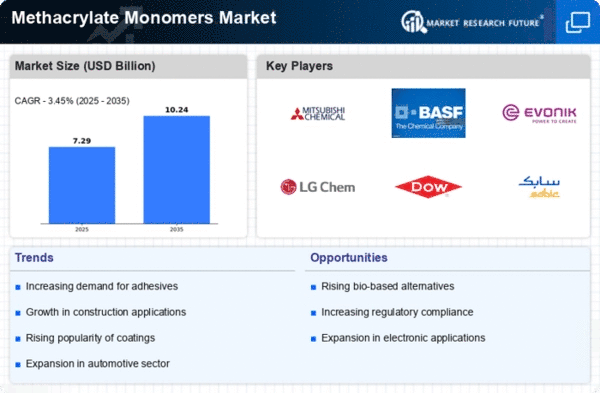
As per MRFR analysis, the Methacrylate Monomers Market Size was estimated at 7.05 USD Billion in 2024. The Methacrylate Monomers industry is projected to grow from 7.29 USD Billion in 2025 to 10.24 USD Billion by 2035, exhibiting a compound annual growth rate (CAGR) of 3.45 during the forecast period 2025 - 2035.

Key Market Trends & Highlights

The Methacrylate Monomers Market is poised for robust growth driven by diverse applications and sustainability initiatives.

  • North America remains the largest market for methacrylate monomers, reflecting strong demand across various sectors. The Asia-Pacific region is emerging as the fastest-growing market, fueled by rapid industrialization and urbanization. Adhesives continue to dominate the market, while the coatings segment is experiencing the fastest growth due to innovative applications. Key drivers include rising demand in the construction sector and an increasing focus on sustainable solutions.

Market Size & Forecast

2024 Market Size 7.05 (USD Billion)
2035 Market Size 10.24 (USD Billion)
CAGR (2025 - 2035) 3.45%
Largest Regional Market Share in 2024 North America

Major Players

<p>Mitsubishi Chemical Corporation (JP), BASF SE (DE), Evonik Industries AG (DE), LG Chem Ltd. (KR), Dow Inc. (US), SABIC (SA), Hexion Inc. (US), Kraton Corporation (US), Rohm and Haas Company (US)</p>

Market Trends

The Methacrylate Monomers Market is currently experiencing a dynamic phase characterized by evolving applications and increasing demand across various industries. This market encompasses a range of monomers that are integral to the production of polymers and resins, which are utilized in coatings, adhesives, and plastics. The versatility of methacrylate monomers allows for their incorporation into diverse formulations, enhancing product performance and durability. As industries continue to innovate, the need for high-quality materials that offer superior properties is driving growth in this sector. Moreover, sustainability considerations are becoming increasingly prominent within the Methacrylate Monomers Market. Manufacturers are exploring bio-based alternatives and eco-friendly production methods to meet regulatory requirements and consumer preferences. This shift towards greener solutions not only addresses environmental concerns but also opens new avenues for market expansion. The interplay between technological advancements and sustainability initiatives suggests a promising future for the Methacrylate Monomers Market, as stakeholders adapt to changing market dynamics and consumer expectations.

Sustainability Initiatives

The Methacrylate Monomers Market is witnessing a notable shift towards sustainable practices. Manufacturers are increasingly focusing on developing bio-based monomers and adopting eco-friendly production processes. This trend reflects a broader commitment to environmental responsibility and aligns with consumer demand for greener products.

Technological Advancements

Innovations in production techniques and formulation technologies are shaping the Methacrylate Monomers Market. Enhanced manufacturing processes are leading to improved product quality and performance. These advancements enable the development of specialized monomers that cater to specific industry needs, thereby expanding market opportunities.

Diverse Application Areas

The versatility of methacrylate monomers is driving their adoption across various sectors, including automotive, construction, and electronics. As industries seek materials that offer enhanced properties, the demand for methacrylate-based products is likely to grow, further diversifying the market landscape.

Methacrylate Monomers Market Market Drivers

Market Trends and Projections

The Global Methacrylate Monomers Market Industry is characterized by various trends and projections that reflect its dynamic nature. The market is expected to grow steadily, with a projected value of 19.0 USD Billion in 2024 and an anticipated increase to 35.5 USD Billion by 2035. This growth trajectory indicates a compound annual growth rate of 5.82% from 2025 to 2035. Factors such as rising demand in automotive and construction sectors, technological advancements, and increasing applications in medical devices contribute to this positive outlook. These trends suggest a robust future for the methacrylate monomers market, driven by innovation and evolving consumer needs.

Growth in Construction Activities

The Global Methacrylate Monomers Market Industry is significantly influenced by the growth in construction activities worldwide. Methacrylate monomers are utilized in various applications, including adhesives, sealants, and coatings, which are essential in modern construction projects. As urbanization accelerates and infrastructure development intensifies, the demand for high-performance materials is expected to rise. This trend is particularly evident in emerging economies, where rapid urban development is underway. The market is anticipated to benefit from this growth, with projections indicating a market size of 35.5 USD Billion by 2035, reflecting the increasing reliance on methacrylate-based products in construction.

Rising Demand in Automotive Sector

The Global Methacrylate Monomers Market Industry experiences a notable surge in demand driven by the automotive sector. Methacrylate monomers are integral in the production of lightweight and durable materials, which are increasingly utilized in vehicle manufacturing. As automotive manufacturers strive to enhance fuel efficiency and reduce emissions, the adoption of methacrylate-based composites is likely to grow. This trend is projected to contribute to the market's expansion, with the industry expected to reach 19.0 USD Billion in 2024. The automotive industry's shift towards sustainable materials further underscores the importance of methacrylate monomers in meeting regulatory standards and consumer preferences.

Technological Advancements in Production

Technological advancements in the production of methacrylate monomers are poised to drive the Global Methacrylate Monomers Market Industry forward. Innovations in manufacturing processes, such as the development of more efficient catalysts and greener production methods, enhance yield and reduce environmental impact. These advancements not only improve the cost-effectiveness of methacrylate monomers but also align with global sustainability goals. As manufacturers adopt these technologies, the market is likely to witness increased competitiveness and growth. The anticipated compound annual growth rate of 5.82% from 2025 to 2035 indicates a robust future for the industry, fueled by these technological improvements.

Increasing Applications in Medical Devices

The Global Methacrylate Monomers Market Industry is experiencing growth due to the increasing applications of methacrylate monomers in medical devices. These monomers are crucial in the production of biocompatible materials used in various medical applications, including dental products, orthopedic devices, and drug delivery systems. As the healthcare sector continues to evolve, the demand for innovative and reliable materials is likely to rise. The ability of methacrylate monomers to provide strength and durability while maintaining biocompatibility positions them favorably in the medical market. This trend suggests a promising future for the industry as it adapts to the growing needs of healthcare.

Environmental Regulations and Sustainability Initiatives

The Global Methacrylate Monomers Market Industry is increasingly shaped by environmental regulations and sustainability initiatives. Governments worldwide are implementing stricter regulations aimed at reducing the environmental impact of chemical production. This has led to a shift towards more sustainable practices within the methacrylate industry, including the development of bio-based monomers and eco-friendly production methods. Companies that prioritize sustainability are likely to gain a competitive edge, as consumers and industries alike become more environmentally conscious. This shift not only aligns with global sustainability goals but also positions the methacrylate monomers market for growth in the coming years.

Market Segment Insights

By Application: Adhesives (Largest) vs. Coatings (Fastest-Growing)

<p>In the Methacrylate Monomers Market, the 'Adhesives' segment holds the largest share among various applications, benefiting significantly from the booming <a href="https://www.marketresearchfuture.com/reports/construction-market-16065">construction</a> and automotive industries. This segment's strength lies in the increasing demand for high-performance adhesives with superior bonding capabilities that are critical in manufacturing processes. Additionally, 'Coatings' are emerging as the fastest-growing application, propelled by trends in sustainable and protective coating solutions across diverse sectors such as automotive, aerospace, and electronics.</p>

<p>Adhesives (Dominant) vs. Coatings (Emerging)</p>

<p>The 'Adhesives' segment in the Methacrylate Monomers Market is characterized by its dominance owing to its extensive applications in critical industries, including construction and automotive. This segment is favored for producing strong, durable adhesive solutions that cater to the demanding requirements of various manufacturing processes. Conversely, the 'Coatings' segment, while currently emerging, is rapidly gaining traction due to rising environmental concerns and the push towards eco-friendly products. This application benefits from innovations in formulation technologies that enhance performance and sustainability, indicating strong future growth as industries seek advanced coating solutions that offer protection and aesthetics.</p>

By End Use: Automotive (Largest) vs. Healthcare (Fastest-Growing)

<p>The Methacrylate Monomers Market showcases a diverse range of end-use applications, with Automotive leading in market share. The extensive use of methacrylate in automotive coatings and adhesives underpins its strong position. Following closely, the Healthcare sector is rapidly gaining traction, driven by the increasing adoption of methacrylate in medical devices and implants, highlighting its adaptability and versatility in various applications. As industries continue to innovate, the distribution of market share among these segments reflects their unique contributions to the overall growth of the methacrylate monomers market.</p>

<p>Automotive: Dominant vs. Healthcare: Emerging</p>

<p>In the Methacrylate Monomers Market, the automotive segment stands out as a dominant force, primarily due to its vast applications in manufacturing high-performance <a href="https://www.marketresearchfuture.com/reports/adhesives-sealants-market-792">adhesives and sealants</a>, and coatings that are imperative for modern vehicles. This segment benefits from advancements in automotive technology that emphasize durability and aesthetics. On the other hand, the healthcare segment is emerging rapidly, fueled by rising demand for medical devices and the development of novel therapeutic applications utilizing methacrylate compounds. This surge is supported by innovations in polymers and ongoing research, positioning healthcare as a pivotal sector in the future growth trajectory of methacrylate monomers.</p>

By Type: Methyl Methacrylate (Largest) vs. Butyl Methacrylate (Fastest-Growing)

<p>The Methacrylate Monomers Market showcases a distinctive distribution among its key segment values. Methyl Methacrylate (MMA) leads the market, attributed to its extensive application in coatings, adhesives, and PMMA production. Following MMA, Butyl Methacrylate has emerged with significant traction, thanks to its unique properties and rising demand in various applications including automotive and construction sectors. Ethyl Methacrylate, Benzyl Methacrylate, and Cyclohexyl Methacrylate follow, each holding niche positions within the market. While their shares are lower compared to MMA and Butyl, they offer specialized capabilities that cater to specific industries.</p>

<p>Butyl Methacrylate (Emerging) vs. Ethyl Methacrylate (Niche)</p>

<p>Methyl Methacrylate (MMA) dominates the Methacrylate Monomers Market due to its versatility and performance characteristics, making it a preferred choice for a range of industries from automotive to consumer goods. Butyl Methacrylate is recognized as an emerging star, characterized by its rapid growth rate driven by incremental adoption in applications that require flexibility and adhesion properties. Meanwhile, Ethyl Methacrylate holds a niche market position with specific applications that leverage its unique chemical makeup. Together, these monomers illustrate the diverse functional design characteristics available in the market, accommodating varying application needs and fostering innovation in product formulations.</p>

By Formulation: Waterborne (Largest) vs. UV-Curable (Fastest-Growing)

<p>In the Methacrylate Monomers Market, the formulation segment showcases diverse applications, with waterborne formulations holding the largest market share. These products are favored for their environmentally-friendly properties and compliance with stringent regulations, making them a preferred choice across various industries, particularly in coatings and adhesives. In comparison, UV-curable formulations have emerged as a dynamic force, driven by advancements in technology and their increasing applications in sectors requiring quick-drying solutions and high-performance finishes.</p>

<p>Waterborne (Dominant) vs. UV-Curable (Emerging)</p>

<p>Waterborne formulations dominate the Methacrylate Monomers Market due to their reduced volatile organic compounds (VOCs) and enhanced sustainability profiles, appealing to consumers and regulators alike. They are extensively used in architectural coatings, automotive finishes, and textiles, providing robust performance with lower environmental impact. On the other hand, UV-curable formulations represent the emerging aspect of the market, gaining traction thanks to their rapid curing processes and efficiency. These formulations find a stronghold in specialty applications, including printing inks and electronics, where speed and quality are paramount. This growth is supported by innovations in UV technology, making UV-curable options increasingly popular among manufacturers.</p>

By Functionality: Crosslinking Agents (Largest) vs. Impact Modifiers (Fastest-Growing)

<p>In the Methacrylate Monomers Market, the functionality segment is segmented into Crosslinking Agents, Reactive Diluents, Impact Modifiers, Stabilizers, and Fillers. Among these, Crosslinking Agents account for the largest market share due to their pivotal role in enhancing the durability and performance of various products, including coatings and adhesives. Impact Modifiers, while currently smaller in market share, are gaining traction thanks to their increasing application in producing materials with improved toughness and resilience, particularly in the automotive and construction industries.</p>

<p>Crosslinking Agents (Dominant) vs. Impact Modifiers (Emerging)</p>

<p>Crosslinking Agents remain a dominant force within the functionality segment of the Methacrylate Monomers Market. They are essential for forming robust polymer networks, thus improving the mechanical properties of end-use products. Their applications span various industries, particularly in coatings and adhesive formulations, making them indispensable for manufacturers seeking enhanced product performance. In contrast, Impact Modifiers are an emerging segment characterized by their ability to improve the impact resistance of materials without compromising other physical properties. As industries increasingly demand materials that withstand harsh conditions, the emphasis on Impact Modifiers has significantly increased, propelled by trends towards lightweight and high-performance applications.</p>

Get more detailed insights about Methacrylate Monomers Market Research Report- Forecast to 2035

Regional Insights

North America : Market Leader in Methacrylate

North America is poised to maintain its leadership in the Methacrylate Monomers market, holding a significant share of 3.52 in 2024. The region's growth is driven by robust demand from the automotive, construction, and electronics sectors, alongside favorable regulatory frameworks that promote innovation and sustainability. The increasing adoption of advanced materials and coatings further fuels market expansion, making it a key player in the global landscape. The competitive landscape in North America is characterized by the presence of major players such as Dow Inc., Mitsubishi Chemical Corporation, and Hexion Inc. These companies are investing heavily in R&D to enhance product offerings and meet evolving consumer demands. The U.S. remains the leading country, supported by a strong manufacturing base and technological advancements, ensuring a dynamic market environment.

Europe : Innovation and Sustainability Focus

Europe's Methacrylate Monomers market is projected to grow, with a market size of 2.1 in 2024. The region is witnessing increased demand driven by stringent environmental regulations and a shift towards sustainable materials. The European Union's commitment to reducing carbon emissions and promoting green chemistry is catalyzing innovation in the sector, encouraging manufacturers to develop eco-friendly alternatives and enhance production processes. Leading countries in this region include Germany, France, and the UK, where key players like BASF SE and Evonik Industries AG are actively engaged. The competitive landscape is marked by collaborations and partnerships aimed at advancing technology and expanding market reach. The presence of a well-established chemical industry further supports the growth of methacrylate monomers, positioning Europe as a significant market player.

Asia-Pacific : Emerging Market Potential

The Asia-Pacific region is emerging as a significant player in the Methacrylate Monomers market, with a market size of 1.3 in 2024. The growth is primarily driven by rapid industrialization, urbanization, and increasing demand from end-use industries such as automotive and construction. Additionally, favorable government policies and investments in infrastructure are expected to further boost market dynamics, making it a focal point for manufacturers and investors alike. Countries like China, Japan, and South Korea are leading the charge, with major companies such as LG Chem Ltd. and Mitsubishi Chemical Corporation establishing a strong foothold. The competitive landscape is characterized by a mix of local and international players, all vying for market share. As the region continues to develop, the demand for innovative and high-performance materials is set to rise, enhancing the market's attractiveness.

Middle East and Africa : Untapped Market Opportunities

The Middle East and Africa region represents an untapped market for Methacrylate Monomers, with a market size of 0.13 in 2024. The growth potential is driven by increasing industrial activities and a rising demand for construction materials. Governments in the region are investing in infrastructure projects, which is expected to create new opportunities for methacrylate applications in various sectors, including coatings and adhesives. Leading countries in this region include Saudi Arabia and South Africa, where local players are beginning to emerge. However, the competitive landscape remains relatively fragmented, with opportunities for international companies to enter and establish a presence. As the region continues to develop economically, the demand for methacrylate monomers is anticipated to grow, making it an attractive market for investment.

Key Players and Competitive Insights

The Methacrylate Monomers Market is characterized by a dynamic competitive landscape, driven by innovation, sustainability, and strategic partnerships. Key players such as Mitsubishi Chemical Corporation (Japan), BASF SE (Germany), and Dow Inc. (US) are at the forefront, each adopting distinct strategies to enhance their market positioning. Mitsubishi Chemical Corporation (Japan) focuses on expanding its product portfolio through research and development, while BASF SE (Germany) emphasizes sustainability initiatives, aiming to reduce its carbon footprint. Dow Inc. (US) is leveraging digital transformation to optimize its operations, thereby enhancing efficiency and customer engagement. Collectively, these strategies contribute to a competitive environment that is increasingly focused on innovation and sustainability.In terms of business tactics, companies are localizing manufacturing to better serve regional markets and optimize supply chains for efficiency. The Methacrylate Monomers Market appears moderately fragmented, with several key players exerting considerable influence. This structure allows for competitive dynamics where innovation and operational excellence are paramount, as companies strive to differentiate themselves in a crowded marketplace.

In November BASF SE (Germany) announced a significant investment in a new production facility aimed at increasing its capacity for methacrylate monomers. This strategic move is expected to enhance BASF's ability to meet growing demand in the automotive and construction sectors, aligning with its sustainability goals by utilizing advanced, eco-friendly production technologies. The investment underscores BASF's commitment to maintaining a competitive edge through capacity expansion and innovation.

In October Dow Inc. (US) launched a new line of bio-based methacrylate monomers, which are derived from renewable resources. This initiative not only reflects Dow's commitment to sustainability but also positions the company to capture a growing segment of environmentally conscious consumers. The introduction of bio-based products is likely to enhance Dow's market share and appeal to customers seeking sustainable alternatives.

In September Mitsubishi Chemical Corporation (Japan) entered into a strategic partnership with a leading technology firm to develop advanced digital solutions for its manufacturing processes. This collaboration aims to integrate AI and IoT technologies, enhancing operational efficiency and product quality. Such initiatives indicate a broader trend within the industry towards digitalization, which is becoming increasingly critical for maintaining competitiveness.

As of December the Methacrylate Monomers Market is witnessing trends that emphasize digitalization, sustainability, and strategic alliances. Companies are increasingly focusing on innovation and technology integration to differentiate themselves, moving away from traditional price-based competition. The current landscape suggests that future competitive differentiation will hinge on the ability to innovate and ensure supply chain reliability, as well as the capacity to respond to evolving consumer preferences for sustainable products.

Key Companies in the Methacrylate Monomers Market include

Industry Developments

Future Outlook

Methacrylate Monomers Market Future Outlook

<p>The Methacrylate Monomers Market is projected to grow at a 3.45% CAGR from 2024 to 2035, driven by increasing demand in automotive and construction sectors.</p>

New opportunities lie in:

  • <p>Expansion into bio-based methacrylate monomers for sustainable product lines. Development of customized formulations for specific industrial applications. Investment in advanced manufacturing technologies to enhance production efficiency.</p>

<p>By 2035, the Methacrylate Monomers Market is expected to achieve robust growth and diversification.</p>

Market Segmentation

Methacrylate Monomers Market Type Outlook

  • Methyl Methacrylate
  • Butyl Methacrylate
  • Ethyl Methacrylate
  • Benzyl Methacrylate
  • Cyclohexyl Methacrylate

Methacrylate Monomers Market End Use Outlook

  • Automotive
  • Construction
  • Electronics
  • Healthcare
  • Aerospace

Methacrylate Monomers Market Application Outlook

  • Adhesives
  • Coatings
  • Plastics
  • Textiles
  • Composites

Methacrylate Monomers Market Formulation Outlook

  • Waterborne
  • Solventborne
  • Powder Coatings
  • UV-Curable
  • Thermoplastic

Methacrylate Monomers Market Functionality Outlook

  • Crosslinking Agents
  • Reactive Diluents
  • Impact Modifiers
  • Stabilizers
  • Fillers

Report Scope

MARKET SIZE 2024 7.05(USD Billion)
MARKET SIZE 2025 7.29(USD Billion)
MARKET SIZE 2035 10.24(USD Billion)
COMPOUND ANNUAL GROWTH RATE (CAGR) 3.45% (2025 - 2035)
REPORT COVERAGE Revenue Forecast, Competitive Landscape, Growth Factors, and Trends
BASE YEAR 2024
Market Forecast Period 2025 - 2035
Historical Data 2019 - 2024
Market Forecast Units USD Billion
Key Companies Profiled Mitsubishi Chemical Corporation (JP), BASF SE (DE), Evonik Industries AG (DE), LG Chem Ltd. (KR), Dow Inc. (US), SABIC (SA), Hexion Inc. (US), Kraton Corporation (US), Rohm and Haas Company (US)
Segments Covered Application, End Use, Type, Formulation, Functionality
Key Market Opportunities Growing demand for sustainable and bio-based alternatives in the Methacrylate Monomers Market.
Key Market Dynamics Rising demand for sustainable materials drives innovation and competition in the Methacrylate Monomers Market.
Countries Covered North America, Europe, APAC, South America, MEA

FAQs

What are the key derivative types in the market?

Leading derivatives in the methacrylate monomers market include behenyl methacrylate, tert-butyl methacrylate, cyclohexyl methacrylate, iso-decyl methacrylate, stearyl methacrylate, and others.

What are the leading end users of methacrylate monomers?

Leading end users of methacrylate monomers include aerospace, marine, construction and architecture, automotive, and others.

What is the major driver for the market?

The growing demand for paints and coatings is the major driver for the market.

Which is the leading regional market?

Asia Pacific is likely to be the major regional market for methacrylate monomers over the forecast period.

What are the key players in the market?

Leading players in the market include Eastman, Sumitomo, and BASF, among others.

  1. SECTION I: EXECUTIVE SUMMARY AND KEY HIGHLIGHTS
    1. | 1.1 EXECUTIVE SUMMARY
  2. SECTION II: SCOPING, METHODOLOGY AND MARKET STRUCTURE
    1. | 2.1 MARKET INTRODUCTION
    2. | 2.2 RESEARCH METHODOLOGY
  3. SECTION III: QUALITATIVE ANALYSIS
    1. | 3.1 MARKET DYNAMICS
    2. | 3.2 MARKET FACTOR ANALYSIS
  4. SECTION IV: QUANTITATIVE ANALYSIS
    1. | 4.1 Chemicals and Materials, BY Application (USD Billion)
    2. | 4.2 Chemicals and Materials, BY End Use (USD Billion)
    3. | 4.3 Chemicals and Materials, BY Type (USD Billion)
    4. | 4.4 Chemicals and Materials, BY Formulation (USD Billion)
    5. | 4.5 Chemicals and Materials, BY Functionality (USD Billion)
    6. | 4.6 Chemicals and Materials, BY Region (USD Billion)
  5. SECTION V: COMPETITIVE ANALYSIS
    1. | 5.1 Competitive Landscape
    2. | 5.2 Company Profiles
    3. | 5.3 Appendix

Methacrylate Monomers Market Segmentation

Market Segmentation Overview

  • Detailed segmentation data will be available in the full report
  • Comprehensive analysis by multiple parameters
  • Regional and country-level breakdowns
  • Market size forecasts by segment
Infographic

Free Sample Request

Kindly complete the form below to receive a free sample of this Report

Get Free Sample

Customer Strories

Compare Licence

×
Features License Type
Single User Multiuser License Enterprise User
Price $4,950 $5,950 $7,250
Maximum User Access Limit 1 User Upto 10 Users Unrestricted Access Throughout the Organization
Free Customization
Direct Access to Analyst
Deliverable Format
Platform Access
Discount on Next Purchase 10% 15% 15%
Printable Versions