×
Request Free Sample ×

Kindly complete the form below to receive a free sample of this Report

* Please use a valid business email

Leading companies partner with us for data-driven Insights

clients tt-cursor
Hero Background
English
Chinese
French
Japanese
Korean
German
Spanish

Metal Roofing Market Size

ID: MRFR/PCM/5092-CR
135 Pages
Sakshi Gupta
February 2024

Metal Roofing Market Research Report Information by Metal Type (Copper, Aluminum, Zinc, Steel), By Product Type (Panel, Corrugated, Tile, Shingle), By End User (Residential, Commercial, Industrial), and by Region (North America, South America, Europe, Asia Pacific, And Middle East & Africa) –Market Forecast Till 2035

Share:
Download PDF ×

We do not share your information with anyone. However, we may send you emails based on your report interest from time to time. You may contact us at any time to opt-out.

Metal Roofing Market Infographic
Purchase Options

Metal Roofing Size

Metal Roofing Market Growth Projections and Opportunities

Numerous market variables interact to define the dynamics of the metal roofing industry, affecting demand, production, and general market trends. A thorough analysis of these crucial elements offers insightful information about the forces influencing the metal roofing market.

Growth of the Construction Industry: The demand for metal roofing is greatly impacted by the construction industry's expansion, which is being driven by urbanization and infrastructure development. Construction trends, encompassing residential, commercial, and industrial projects, are intimately associated with market dynamics.

Trends in Energy Efficiency: Metal roofing materials are in high demand as energy-efficient building solutions become more and more important. Adoption of cool roofing technologies that improve energy efficiency and lower cooling costs has an impact on market dynamics.

Durability and longevity: The dynamics of the market are influenced by the lifespan and durability of metal roofing materials. Materials with a long service life, resistance to weathering, and low maintenance requirements are prioritized by end users.

Technological Developments in Coating and Finishing: The metal roofing market is impacted by ongoing advancements in coating and finishing technologies. New developments lead to the creation of metal roofing materials that are more aesthetically pleasing, corrosion resistant, and color-retaining.

Residential Roofing Trends: The metal roofing market is shaped by trends in residential building, such as a desire for contemporary styles and eco-friendly materials. The growing use of metal roofing in residential applications has an impact on market dynamics.

Commercial and Industrial Applications: Features like high span capabilities and design flexibility are what fuel the need for metal roofing in these sectors. The particular needs of non-residential constructions, such as factories, warehouses, and retail establishments, influence market dynamics.

Severe Weather: The ability of metal roofing to withstand severe weather, including hurricanes, hailstorms, and wildfires, has an impact on market dynamics. End users who live in areas where extreme weather is common look for roofing materials that offer exceptional protection and longevity.
Metal Roofing Market Size Graph
Author
Sakshi Gupta
Team Lead - Research

Currently a Team Lead in consumer goods, FMCG, and F&B, she translates rigorous research into decisive strategy. She develops GTM roadmaps, pricing architectures, and competitive benchmarks for companies across Europe, the US, and APAC. She synthesize insights, align cross-functional teams, and drive execution from brief to measurable outcomes. She leads end-to-end engagements with crisp analysis, compelling storytelling, and a strong command of Power BI, Tableau, SQL, and advanced research platforms.

Leave a Comment

FAQs

What is the projected market valuation of the Metal Roofing Market by 2035?

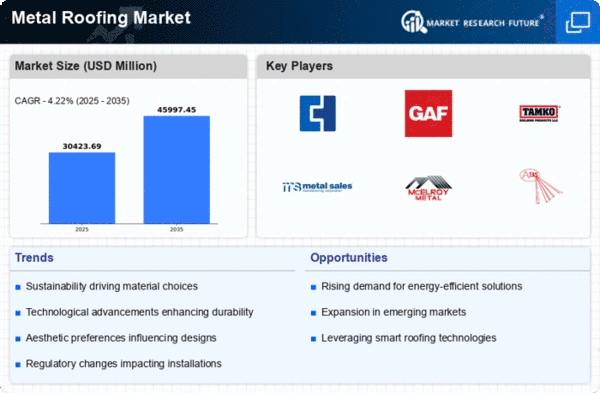
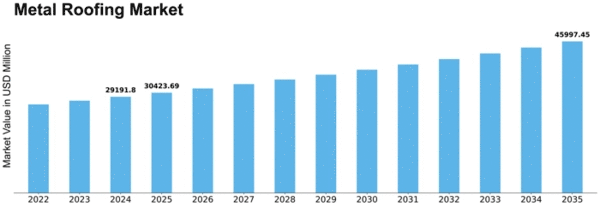
<p>The Metal Roofing Market is projected to reach a valuation of approximately 45997.45 USD Million by 2035.</p>

What was the overall market valuation of the Metal Roofing Market in 2024?

<p>In 2024, the overall market valuation of the Metal Roofing Market was 29191.8 USD Million.</p>

What is the expected CAGR for the Metal Roofing Market during the forecast period 2025 - 2035?

<p>The expected CAGR for the Metal Roofing Market during the forecast period 2025 - 2035 is 4.22%.</p>

Which application segment had the highest valuation in the Metal Roofing Market in 2024?

<p>In 2024, the Residential application segment had the highest valuation at approximately 16000.0 USD Million.</p>

What are the key materials used in the Metal Roofing Market?

<p>The key materials in the Metal Roofing Market include Steel, Aluminum, Copper, and Zinc.</p>

Which roofing style segment is projected to grow the most by 2035?

<p>The Standing Seam roofing style segment is projected to grow significantly, reaching an estimated valuation of 15000.0 USD Million by 2035.</p>

What was the valuation of the Commercial application segment in 2024?

The valuation of the Commercial application segment in 2024 was approximately 12000.0 USD Million.

How does the Retrofit installation method compare to New Construction in terms of valuation?

In 2024, the Retrofit installation method had a valuation of approximately 16500.0 USD Million, which is slightly lower than the New Construction segment at 18300.0 USD Million.

Who are the key players in the Metal Roofing Market?

Key players in the Metal Roofing Market include CertainTeed, GAF, Tamko Building Products, and Metal Sales Manufacturing Corporation.

What is the projected valuation for the Agricultural segment by 2035?

The Agricultural segment is projected to reach a valuation of approximately 4977.45 USD Million by 2035.

Market Summary

As per MRFR analysis, the Metal Roofing Market Size was estimated at 27.8 USD Billion in 2024. The Metal Roofing industry is projected to grow from 29.2 USD Billion in 2025 to 48 USD Billion by 2035, exhibiting a compound annual growth rate (CAGR) of 5.1% during the forecast period 2025 - 2035.

Key Market Trends & Highlights

The Metal Roofing Market is experiencing robust growth driven by sustainability and technological advancements.

  • North America remains the largest market for metal roofing, driven by increasing demand for durable and energy-efficient solutions. The Asia-Pacific region is emerging as the fastest-growing market, fueled by rapid urbanization and infrastructure development. The residential segment continues to dominate the market, while the commercial segment is witnessing the fastest growth due to rising construction activities. Key market drivers include a strong focus on sustainability and advancements in technology, enhancing the appeal of both steel and aluminum roofing options.

Market Size & Forecast

2024 Market Size 27.8(USD Billion)
2035 Market Size 48(USD Billion)
CAGR (2025 - 2035) 5.1%
Largest Regional Market Share in 2024 North America

Major Players

Kingspan Group plc, BlueScope Steel Limited, NCI Building Systems (MBCI), CertainTeed Roofing, Metal Sales Manufacturing Corporation, McElroy Metal, ATAS International, Carlisle SynTec Systems, and Bilka., Berridge Manufacturing Company

Market Trends

The Metal Roofing Market is currently experiencing a notable transformation, driven by a combination of environmental considerations and advancements in technology. As sustainability becomes a focal point for both consumers and manufacturers, metal roofing systems are increasingly recognized for their durability and energy efficiency. This shift appears to be influencing a growing preference for metal materials over traditional options, as they offer longer lifespans and reduced maintenance costs. Furthermore, the integration of innovative designs and finishes is enhancing the aesthetic appeal of metal roofs, making them a viable choice for a diverse range of architectural styles. These combined factors continue to positively influence the overall metal roofing market size and long-term growth outlook.

In addition to sustainability, the Metal Roofing Market is witnessing a surge in demand due to the rising awareness of climate resilience. Metal roofs are known for their ability to withstand extreme weather conditions, which is becoming increasingly relevant in today's changing climate. This trend suggests that homeowners and builders are prioritizing materials that not only provide protection but also contribute to energy savings. As the market evolves, it is likely that the focus on eco-friendly practices and climate adaptability will continue to shape the future landscape of metal roofing solutions.

Sustainability Focus

The metal roofing market. is increasingly influenced by a strong emphasis on sustainability. Consumers are gravitating towards eco-friendly materials that minimize environmental impact. Metal roofs, known for their recyclability and energy efficiency, align well with these values, leading to a growing preference for such solutions.

Technological Advancements

Innovations in manufacturing processes and materials are reshaping the metal roofing market. . Enhanced coatings and finishes are improving durability and aesthetic appeal, while new installation techniques are streamlining the construction process. These advancements are likely to attract a broader customer base.

Aesthetic Versatility

The aesthetic appeal of metal roofing is becoming a significant trend, as manufacturers offer a variety of styles, colors, and finishes. This versatility allows homeowners and builders to select roofing solutions that not only meet functional requirements but also enhance the overall visual appeal of properties.

Metal Roofing Market Market Drivers

Durability and Longevity

Durability remains a pivotal factor influencing the Global Metal Roofing Market Industry. Metal roofs are renowned for their longevity, often lasting over 50 years with minimal maintenance. This characteristic appeals to both residential and commercial property owners seeking long-term investments. The ability of metal roofing to withstand extreme weather conditions, such as heavy rain, snow, and high winds, further enhances its appeal. As a result, the market is likely to experience growth as more consumers recognize the cost-effectiveness of investing in durable roofing solutions. This trend suggests that the Global Metal Roofing Market could see a compound annual growth rate of 4.18% from 2025 to 2035.

Market Growth Projections

The Global Metal Roofing Market Industry is poised for substantial growth, with projections indicating a market value of 29.2 USD Billion in 2024 and an anticipated increase to 45.8 USD Billion by 2035. This growth trajectory suggests a compound annual growth rate of 4.18% from 2025 to 2035. Such figures reflect the increasing adoption of metal roofing solutions across various sectors, driven by factors such as sustainability, durability, and technological advancements. The market's expansion is indicative of a broader trend towards energy-efficient and long-lasting building materials, positioning metal roofing as a key player in the construction industry.

Technological Advancements

Technological advancements play a crucial role in shaping the Global Metal Roofing Market Industry. Innovations in manufacturing processes and materials have led to the development of lightweight, high-strength metal roofing options that are easier to install and more efficient. Additionally, advancements in coatings and finishes enhance the aesthetic appeal and performance of metal roofs, making them more attractive to consumers. These technological improvements not only increase the lifespan of metal roofs but also contribute to energy efficiency. As a result, the market is expected to expand, with projections indicating a growth to 45.8 USD Billion by 2035, driven by these advancements.

Rising Construction Activities

The Global Metal Roofing Market Industry is significantly influenced by the rising construction activities across the globe. Urbanization and population growth are leading to increased demand for residential and commercial buildings, which in turn drives the need for roofing materials. Metal roofing, known for its durability and energy efficiency, is becoming a preferred choice among builders and architects. This trend is particularly pronounced in developing regions where infrastructure development is accelerating. As construction activities continue to rise, the demand for metal roofing is expected to grow, contributing to the overall expansion of the market.

Government Initiatives and Regulations

Government initiatives and regulations aimed at promoting energy efficiency and sustainable building practices are pivotal in shaping the Global Metal Roofing Market Industry. Many governments worldwide are implementing policies that encourage the use of energy-efficient materials in construction. These regulations often include incentives for builders and homeowners who choose sustainable roofing options, such as metal roofs. As these initiatives gain traction, they are likely to stimulate demand for metal roofing solutions. Consequently, the market is expected to benefit from these supportive policies, further solidifying the role of government in driving market growth.

Sustainability and Environmental Concerns

The Global Metal Roofing Market Industry is increasingly driven by sustainability and environmental considerations. Metal roofing materials are often recyclable, which aligns with the growing demand for eco-friendly construction practices. As consumers and builders prioritize sustainable options, metal roofing emerges as a favorable choice. This trend is particularly evident in regions where regulations promote green building standards. The shift towards energy-efficient roofing solutions is expected to bolster the market, as metal roofs can reflect solar heat, thereby reducing energy consumption. Consequently, the Global Metal Roofing Market is projected to reach 29.2 USD Billion in 2024, highlighting the importance of sustainability in driving market growth.

Market Segment Insights

By Application: Residential (Largest) vs. Commercial (Fastest-Growing)

In the metal roofing market. , the 'Residential' segment holds the largest market share, driven by the increasing demand for durable and energy-efficient roofing solutions among homeowners. Meanwhile, the 'Commercial' segment is the fastest-growing segment, fueled by the rising construction of commercial buildings and warehouses, which prioritize metal roofs for their longevity and low maintenance costs. The unique properties of metal roofing materials make them an attractive choice for both new and retrofitted structures in these applications.

Residential (Dominant) vs. Commercial (Emerging)

The Residential application segment is characterized by its strong demand for metal roofs, which offer versatility in design and enhanced durability, appealing to homeowners looking for long-lasting solutions. As sustainability becomes a priority, more homeowners are opting for metal roofs that reflect energy efficiency and reduce long-term costs. Conversely, the Commercial application segment is gaining momentum as businesses recognize the cost benefits and aesthetic improvements associated with metal roofing. It is increasingly viewed as an emerging segment due to its association with modern architecture and improved resistance to harsh environmental conditions, indicating a shift towards metal solutions in commercial spaces.

By Material Type: Steel (Largest) vs. Aluminum (Fastest-Growing)

In the Metal Roofing Market, the distribution of market share among material types reveals that Steel dominates significantly, known for its durability and cost-effectiveness. Following Steel, <a href="https://www.marketresearchfuture.com/reports/aluminum-market-2031" target="_blank" title="aluminum">Aluminum</a> has not only gained traction but is also recognized for its lightweight properties and resistance to corrosion, making it an attractive option for residential and commercial applications. Copper and Zinc, though smaller in terms of market share, contribute uniquely to niche markets with their aesthetic appeal and longevity.

Steel (Dominant) vs. Aluminum (Emerging)

Steel, as the dominant material in the Metal Roofing Market, is praised for its strength and long lifespan, often preferred in industrial and commercial sectors. Its ability to withstand extreme weather conditions without succumbing to deterioration adds to its appeal. In contrast, Aluminum is emerging rapidly, favored for its lightweight nature and variety of finishes that enhance architectural aesthetics. As environmental concerns rise, Aluminum's recyclability and energy efficiency during production further bolster its market position, making it a viable alternative especially in eco-conscious projects.

By Roofing Style: Standing Seam (Largest) vs. Shingle (Fastest-Growing)

<p>In the Metal Roofing Market, the 'Roofing Style' segment showcases a diverse competition among four primary types: Standing Seam, Corrugated, Shingle, and Tile. Among these, Standing Seam stands out as the largest market share holder, favored for its sleek aesthetic and durability, while Shingle roofing has recently gained traction as the fastest-growing segment. Corrugated and Tile styles, while respected, cater to more niche markets yet maintain a loyal customer base.</p>

<p>Standing Seam (Dominant) vs. Shingle (Emerging)</p>

<p>The Standing Seam roofing style is characterized by its vertical panels that interlock, creating a weather-resistant barrier ideal for various climates. Its dominance in the market is due to its longevity, low maintenance, and energy efficiency attributes, appealing particularly to both residential and commercial sectors. Conversely, Shingle roofing is emerging rapidly, attracting customers with its affordability and ease of installation. This style provides a traditional appearance and is often perceived as a cost-effective alternative, leading to its growing popularity in the market, particularly among homeowners seeking budget-friendly options.</p>

By Installation Method: New Construction (Largest) vs. Retrofit (Fastest-Growing)

In the Metal Roofing Market, the installation method segment exhibits a diverse share distribution among its key categories: New Construction, Retrofit, and Repair. New Construction holds the largest share, driven by the increase in residential and commercial building projects, while Retrofit is rapidly gaining traction due to the growing need for building energy efficiency and sustainable solutions. Repair represents a stable yet essential aspect of the market, catering to the maintenance needs of existing metal roofing systems. The growth trends within this segment are increasingly influenced by the green building movement, prompting builders to adopt metal roofing for its durability and energy efficiency. The Retrofit method, in particular, stands out as the fastest-growing segment, fueled by government incentives and rising consumer awareness about energy savings. Consequently, the market is witnessing a shift towards innovative installation techniques that enhance the appeal and performance of metal roofing systems.

New Construction (Dominant) vs. Retrofit (Emerging)

The New Construction segment in the Metal Roofing Market is characterized by its dominance, as builders and developers prioritize metal roofing solutions for new commercial and residential projects. This preference is largely attributed to the longevity, low maintenance, and energy efficiency that metal roofing offers. In contrast, the Retrofit segment emerges as a significant player, driven by the need to upgrade existing structures with more sustainable and energy-efficient materials. Homeowners and businesses are increasingly recognizing the advantages of modern metal roofing, such as improved insulation and reduced energy costs. As this segment grows, it attracts investments focused on innovative materials and installation methods, making it a focal point for companies looking to excel in the competitive market.

By Coating Type: Galvanized (Largest) vs. Kynar (Fastest-Growing)

The Metal Roofing Market presents a diverse range of coating types, with galvanized coatings holding the largest share. Their popularity can be attributed to their excellent corrosion resistance and longevity, making them a preferred choice for various construction projects. Following galvanized, Galvalume and polyester coatings also play significant roles, providing options for both aesthetic and functional uses. Kynar, while a smaller segment, is rapidly gaining traction due to its advanced performance characteristics and aesthetic value, appealing to high-end construction applications.

Coating Type: Galvanized (Dominant) vs. Kynar (Emerging)

Galvanized coatings are widely recognized as the dominant segment in the Metal Roofing Market, primarily because of their remarkable durability and proven performance in diverse weather conditions. These coatings offer outstanding corrosion resistance, making them suitable for industrial and residential buildings alike. Meanwhile, Kynar coatings are emerging rapidly, known for their superior color retention and fade resistance. This makes Kynar a preferred option for projects requiring not only functionality but also aesthetic appeal. As the market trends lean towards high-performance solutions, Kynar's share is expected to grow, catering to those looking for premium metal roofing solutions.

Get more detailed insights about Metal Roofing Market Research Report – Global Forecast to 2035

Regional Insights

North America : Market Leader in Metal Roofing

North America is poised to maintain its leadership in the metal roofing market, holding a significant share of 14500.0 million. The growth is driven by increasing construction activities, a shift towards sustainable building materials, and favorable regulations promoting energy efficiency. The demand for metal roofing is further fueled by its durability and low maintenance costs, making it a preferred choice among builders and homeowners alike. The United States is the primary market in this region, with key players like CertainTeed, GAF, and Tamko Building Products leading the competitive landscape. These companies are innovating with new materials and technologies to enhance product offerings. The presence of established manufacturers and a robust distribution network contribute to the region's strong market position, ensuring a steady supply of high-quality metal roofing solutions.

Europe : Emerging Market with Growth Potential

Europe's metal roofing market is valued at 9000.0 million, driven by increasing urbanization and a growing emphasis on sustainable construction practices. Regulatory frameworks across various countries are encouraging the adoption of energy-efficient materials, which is a significant catalyst for market growth. The demand for metal roofing is also rising due to its aesthetic appeal and longevity, making it a popular choice in both residential and commercial sectors. Leading countries in this region include Germany, France, and the UK, where the competitive landscape is characterized by both established players and new entrants. Companies like Berridge Manufacturing and Fabral are making strides in innovation and product development. The market is witnessing a trend towards customization and eco-friendly solutions, aligning with the EU's sustainability goals. "The European market is increasingly recognizing the benefits of metal roofing as a sustainable building solution," European Commission report.

Asia-Pacific : Rapid Growth in Emerging Economies

The Asia-Pacific region, with a market size of 5000.0 million, is experiencing rapid growth in the metal roofing sector, driven by urbanization and infrastructure development. Countries like China and India are witnessing a construction boom, leading to increased demand for durable and cost-effective roofing solutions. Government initiatives promoting green building practices are also contributing to the market's expansion, as metal roofing aligns with sustainability goals. China stands out as the leading country in this market, with significant investments in construction and manufacturing. The competitive landscape includes both local and international players, with companies focusing on innovation and quality. The presence of key players is enhancing market dynamics, as they adapt to the unique needs of the region. The growing awareness of energy-efficient materials is expected to further boost the demand for metal roofing in the coming years.

Middle East and Africa : Emerging Market with Unique Challenges

The Middle East and Africa region, valued at 1691.8 million, is gradually emerging in the metal roofing market, driven by increasing construction activities and urbanization. The demand for metal roofing is being propelled by its durability and resistance to harsh weather conditions, which are prevalent in many areas. Additionally, government initiatives aimed at improving infrastructure are acting as catalysts for market growth, despite challenges such as economic fluctuations. Leading countries in this region include South Africa and the UAE, where the competitive landscape is evolving. Local manufacturers are increasingly entering the market, while international players are also establishing a presence. The focus is on providing cost-effective and high-quality solutions to meet the growing demand. The region's unique climatic conditions necessitate specialized products, further driving innovation in the metal roofing sector.

Key Players and Competitive Insights

The Metal Roofing Market is currently characterized by a dynamic competitive landscape, driven by factors such as increasing demand for energy-efficient building materials, heightened awareness of sustainability, and the growing trend of residential and commercial construction. Key players like CertainTeed (US), GAF (US), and Tamko Building Products (US) are strategically positioned to leverage these trends. CertainTeed (US) focuses on innovation in product development, particularly in energy-efficient roofing solutions, while GAF (US) emphasizes partnerships with contractors to enhance market penetration. Tamko Building Products (US) has been expanding its product line to include more environmentally friendly options, thereby aligning with the market's sustainability focus. Collectively, these strategies contribute to a competitive environment that is increasingly oriented towards innovation and sustainability.In terms of business tactics, companies are localizing manufacturing to reduce lead times and optimize supply chains, which is crucial in a moderately fragmented market. This approach not only enhances operational efficiency but also allows for better responsiveness to regional market demands. The competitive structure is shaped by the collective influence of these key players, who are increasingly adopting advanced technologies to streamline operations and improve product offerings.
In November CertainTeed (US) announced the launch of a new line of solar-integrated metal roofing products, which is expected to significantly enhance their market share in the sustainable roofing segment. This strategic move underscores the company's commitment to innovation and positions it favorably against competitors who are also venturing into solar solutions. The integration of solar technology into roofing products may attract environmentally conscious consumers and commercial clients alike.
In October GAF (US) expanded its partnership with a leading construction technology firm to develop a digital platform aimed at improving project management for roofing contractors. This initiative is likely to streamline operations and enhance customer engagement, thereby solidifying GAF's position in the market. The emphasis on digital transformation reflects a broader trend within the industry, where technology is increasingly seen as a critical differentiator.
In September Tamko Building Products (US) launched a new initiative focused on recycling metal roofing materials, which aligns with the growing demand for sustainable building practices. This initiative not only enhances the company's sustainability credentials but also positions it as a leader in the circular economy within the roofing sector. Such strategic actions are indicative of a shift towards more responsible manufacturing practices, which are becoming essential in today's market.
As of December the Metal Roofing Market is witnessing trends such as digitalization, sustainability, and the integration of AI technologies. Strategic alliances are increasingly shaping the competitive landscape, as companies seek to enhance their capabilities and market reach. The evolution of competitive differentiation appears to be moving away from price-based competition towards a focus on innovation, technology, and supply chain reliability. This shift suggests that companies that prioritize these aspects are likely to thrive in the future.

Key Companies in the Metal Roofing Market include

Industry Developments

  • In March 2023, McElroy Metal Introduces Modern-Rib Metal Panel: Modern-Rib from McElroy Metal combines the economics of an exposed fastener panel along with major ribs that simulate the aesthetics of standing seam panels. Modern-Rib adds beauty and sophisticated styling to residential roofs and post-frame structures with a 3/4” rib.
  • In February 2023, Cornerstone Building Brands, the largest manufacturer of exterior building products in North America, announced a new partnership with D.I. Roof Seamers that will offer its MBCI customers greater access to the latest in seamer equipment for its industry-leading standing seam profiles. Through D.I. Roof Seamers, MBCI now offers customers better seaming equipment with the newest features and expertise direct from the seamer manufacturer.
  • In July 2022, Petersen continues to expand the reach of its trusted PAC-CLAD brand by opening a manufacturing facility in Bonney Lake, Wash. The 57,000-sq.-ft. facility shipped its first order in May, and will be fully operational in early 2023.

Future Outlook

Metal Roofing Market Future Outlook

The Metal Roofing Market is projected to grow at a 5.1% CAGR from 2025 to 2035, driven by sustainability trends, energy efficiency demands, and technological advancements.

New opportunities lie in:

  • <p>Expansion into emerging markets with tailored metal roofing solutions. Development of energy-efficient roofing systems integrating solar technology. Partnerships with construction firms for bundled roofing and installation services.</p>

By 2035, the Metal Roofing Market is expected to solidify its position as a leader in sustainable building materials.

Market Segmentation

Metal Roofing Market Application Outlook

  • Residential
  • Commercial
  • Industrial
  • Agricultural

Metal Roofing Market Coating Type Outlook

  • Galvanized
  • Galvalume
  • Polyester
  • Kynar

Metal Roofing Market Material Type Outlook

  • Steel
  • Aluminum
  • Copper
  • Zinc

Metal Roofing Market Roofing Style Outlook

  • Standing Seam
  • Corrugated
  • Shingle
  • Tile

Metal Roofing Market Installation Method Outlook

  • New Construction
  • Retrofit
  • Repair

Report Scope

MARKET SIZE 2024 27.8(USD Billion)
MARKET SIZE 2025 29.2(USD Billion)
MARKET SIZE 2035 48(USD Billion)
COMPOUND ANNUAL GROWTH RATE (CAGR) 5.1% (2025 - 2035)
REPORT COVERAGE Revenue Forecast, Competitive Landscape, Growth Factors, and Trends
BASE YEAR 2024
Market Forecast Period 2025 - 2035
Historical Data 2019 - 2024
Market Forecast Units USD Billion
Key Companies Profiled Kingspan Group plc, BlueScope Steel Limited, NCI Building Systems (MBCI), CertainTeed Roofing, Metal Sales Manufacturing Corporation, McElroy Metal, ATAS International, Carlisle SynTec Systems, and Bilka., Berridge Manufacturing Company.
Segments Covered Application, Material Type, Roofing Style, Installation Method, Coating Type
Key Market Opportunities Growing demand for energy-efficient and sustainable building materials in the Metal Roofing Market.
Key Market Dynamics Rising demand for energy-efficient solutions drives innovation and competition in the metal roofing sector.
Countries Covered North America, Europe, APAC, South America, MEA

FAQs

What is the projected market valuation of the Metal Roofing Market by 2035?

<p>The Metal Roofing Market is projected to reach a valuation of approximately 45997.45 USD Million by 2035.</p>

What was the overall market valuation of the Metal Roofing Market in 2024?

<p>In 2024, the overall market valuation of the Metal Roofing Market was 29191.8 USD Million.</p>

What is the expected CAGR for the Metal Roofing Market during the forecast period 2025 - 2035?

<p>The expected CAGR for the Metal Roofing Market during the forecast period 2025 - 2035 is 4.22%.</p>

Which application segment had the highest valuation in the Metal Roofing Market in 2024?

<p>In 2024, the Residential application segment had the highest valuation at approximately 16000.0 USD Million.</p>

What are the key materials used in the Metal Roofing Market?

<p>The key materials in the Metal Roofing Market include Steel, Aluminum, Copper, and Zinc.</p>

Which roofing style segment is projected to grow the most by 2035?

<p>The Standing Seam roofing style segment is projected to grow significantly, reaching an estimated valuation of 15000.0 USD Million by 2035.</p>

What was the valuation of the Commercial application segment in 2024?

The valuation of the Commercial application segment in 2024 was approximately 12000.0 USD Million.

How does the Retrofit installation method compare to New Construction in terms of valuation?

In 2024, the Retrofit installation method had a valuation of approximately 16500.0 USD Million, which is slightly lower than the New Construction segment at 18300.0 USD Million.

Who are the key players in the Metal Roofing Market?

Key players in the Metal Roofing Market include CertainTeed, GAF, Tamko Building Products, and Metal Sales Manufacturing Corporation.

What is the projected valuation for the Agricultural segment by 2035?

The Agricultural segment is projected to reach a valuation of approximately 4977.45 USD Million by 2035.

  1. SECTION I: EXECUTIVE SUMMARY AND KEY HIGHLIGHTS
    1. | 1.1 EXECUTIVE SUMMARY
    2. | | 1.1.1 Market Overview
    3. | | 1.1.2 Key Findings
    4. | | 1.1.3 Market Segmentation
    5. | | 1.1.4 Competitive Landscape
    6. | | 1.1.5 Challenges and Opportunities
    7. | | 1.1.6 Future Outlook
  2. SECTION II: SCOPING, METHODOLOGY AND MARKET STRUCTURE
    1. | 2.1 MARKET INTRODUCTION
    2. | | 2.1.1 Definition
    3. | | 2.1.2 Scope of the study
    4. | | | 2.1.2.1 Research Objective
    5. | | | 2.1.2.2 Assumption
    6. | | | 2.1.2.3 Limitations
    7. | 2.2 RESEARCH METHODOLOGY
    8. | | 2.2.1 Overview
    9. | | 2.2.2 Data Mining
    10. | | 2.2.3 Secondary Research
    11. | | 2.2.4 Primary Research
    12. | | | 2.2.4.1 Primary Interviews and Information Gathering Process
    13. | | | 2.2.4.2 Breakdown of Primary Respondents
    14. | | 2.2.5 Forecasting Model
    15. | | 2.2.6 Market Size Estimation
    16. | | | 2.2.6.1 Bottom-Up Approach
    17. | | | 2.2.6.2 Top-Down Approach
    18. | | 2.2.7 Data Triangulation
    19. | | 2.2.8 Validation
  3. SECTION III: QUALITATIVE ANALYSIS
    1. | 3.1 MARKET DYNAMICS
    2. | | 3.1.1 Overview
    3. | | 3.1.2 Drivers
    4. | | 3.1.3 Restraints
    5. | | 3.1.4 Opportunities
    6. | 3.2 MARKET FACTOR ANALYSIS
    7. | | 3.2.1 Value chain Analysis
    8. | | 3.2.2 Porter's Five Forces Analysis
    9. | | | 3.2.2.1 Bargaining Power of Suppliers
    10. | | | 3.2.2.2 Bargaining Power of Buyers
    11. | | | 3.2.2.3 Threat of New Entrants
    12. | | | 3.2.2.4 Threat of Substitutes
    13. | | | 3.2.2.5 Intensity of Rivalry
    14. | | 3.2.3 COVID-19 Impact Analysis
    15. | | | 3.2.3.1 Market Impact Analysis
    16. | | | 3.2.3.2 Regional Impact
    17. | | | 3.2.3.3 Opportunity and Threat Analysis
  4. SECTION IV: QUANTITATIVE ANALYSIS
    1. | 4.1 Packaging & Transport, BY Application (USD Million)
    2. | | 4.1.1 Residential
    3. | | 4.1.2 Commercial
    4. | | 4.1.3 Industrial
    5. | | 4.1.4 Agricultural
    6. | 4.2 Packaging & Transport, BY Material Type (USD Million)
    7. | | 4.2.1 Steel
    8. | | 4.2.2 Aluminum
    9. | | 4.2.3 Copper
    10. | | 4.2.4 Zinc
    11. | 4.3 Packaging & Transport, BY Roofing Style (USD Million)
    12. | | 4.3.1 Standing Seam
    13. | | 4.3.2 Corrugated
    14. | | 4.3.3 Shingle
    15. | | 4.3.4 Tile
    16. | 4.4 Packaging & Transport, BY Installation Method (USD Million)
    17. | | 4.4.1 New Construction
    18. | | 4.4.2 Retrofit
    19. | | 4.4.3 Repair
    20. | 4.5 Packaging & Transport, BY Region (USD Million)
    21. | | 4.5.1 North America
    22. | | | 4.5.1.1 US
    23. | | | 4.5.1.2 Canada
    24. | | 4.5.2 Europe
    25. | | | 4.5.2.1 Germany
    26. | | | 4.5.2.2 UK
    27. | | | 4.5.2.3 France
    28. | | | 4.5.2.4 Russia
    29. | | | 4.5.2.5 Italy
    30. | | | 4.5.2.6 Spain
    31. | | | 4.5.2.7 Rest of Europe
    32. | | 4.5.3 APAC
    33. | | | 4.5.3.1 China
    34. | | | 4.5.3.2 India
    35. | | | 4.5.3.3 Japan
    36. | | | 4.5.3.4 South Korea
    37. | | | 4.5.3.5 Malaysia
    38. | | | 4.5.3.6 Thailand
    39. | | | 4.5.3.7 Indonesia
    40. | | | 4.5.3.8 Rest of APAC
    41. | | 4.5.4 South America
    42. | | | 4.5.4.1 Brazil
    43. | | | 4.5.4.2 Mexico
    44. | | | 4.5.4.3 Argentina
    45. | | | 4.5.4.4 Rest of South America
    46. | | 4.5.5 MEA
    47. | | | 4.5.5.1 GCC Countries
    48. | | | 4.5.5.2 South Africa
    49. | | | 4.5.5.3 Rest of MEA
  5. SECTION V: COMPETITIVE ANALYSIS
    1. | 5.1 Competitive Landscape
    2. | | 5.1.1 Overview
    3. | | 5.1.2 Competitive Analysis
    4. | | 5.1.3 Market share Analysis
    5. | | 5.1.4 Major Growth Strategy in the Packaging & Transport
    6. | | 5.1.5 Competitive Benchmarking
    7. | | 5.1.6 Leading Players in Terms of Number of Developments in the Packaging & Transport
    8. | | 5.1.7 Key developments and growth strategies
    9. | | | 5.1.7.1 New Product Launch/Service Deployment
    10. | | | 5.1.7.2 Merger & Acquisitions
    11. | | | 5.1.7.3 Joint Ventures
    12. | | 5.1.8 Major Players Financial Matrix
    13. | | | 5.1.8.1 Sales and Operating Income
    14. | | | 5.1.8.2 Major Players R&D Expenditure. 2023
    15. | 5.2 Company Profiles
    16. | | 5.2.1 CertainTeed (US)
    17. | | | 5.2.1.1 Financial Overview
    18. | | | 5.2.1.2 Products Offered
    19. | | | 5.2.1.3 Key Developments
    20. | | | 5.2.1.4 SWOT Analysis
    21. | | | 5.2.1.5 Key Strategies
    22. | | 5.2.2 GAF (US)
    23. | | | 5.2.2.1 Financial Overview
    24. | | | 5.2.2.2 Products Offered
    25. | | | 5.2.2.3 Key Developments
    26. | | | 5.2.2.4 SWOT Analysis
    27. | | | 5.2.2.5 Key Strategies
    28. | | 5.2.3 Tamko Building Products (US)
    29. | | | 5.2.3.1 Financial Overview
    30. | | | 5.2.3.2 Products Offered
    31. | | | 5.2.3.3 Key Developments
    32. | | | 5.2.3.4 SWOT Analysis
    33. | | | 5.2.3.5 Key Strategies
    34. | | 5.2.4 Metal Sales Manufacturing Corporation (US)
    35. | | | 5.2.4.1 Financial Overview
    36. | | | 5.2.4.2 Products Offered
    37. | | | 5.2.4.3 Key Developments
    38. | | | 5.2.4.4 SWOT Analysis
    39. | | | 5.2.4.5 Key Strategies
    40. | | 5.2.5 McElroy Metal (US)
    41. | | | 5.2.5.1 Financial Overview
    42. | | | 5.2.5.2 Products Offered
    43. | | | 5.2.5.3 Key Developments
    44. | | | 5.2.5.4 SWOT Analysis
    45. | | | 5.2.5.5 Key Strategies
    46. | | 5.2.6 ATAS International (US)
    47. | | | 5.2.6.1 Financial Overview
    48. | | | 5.2.6.2 Products Offered
    49. | | | 5.2.6.3 Key Developments
    50. | | | 5.2.6.4 SWOT Analysis
    51. | | | 5.2.6.5 Key Strategies
    52. | | 5.2.7 Fabral (US)
    53. | | | 5.2.7.1 Financial Overview
    54. | | | 5.2.7.2 Products Offered
    55. | | | 5.2.7.3 Key Developments
    56. | | | 5.2.7.4 SWOT Analysis
    57. | | | 5.2.7.5 Key Strategies
    58. | | 5.2.8 Everlast Metals (US)
    59. | | | 5.2.8.1 Financial Overview
    60. | | | 5.2.8.2 Products Offered
    61. | | | 5.2.8.3 Key Developments
    62. | | | 5.2.8.4 SWOT Analysis
    63. | | | 5.2.8.5 Key Strategies
    64. | | 5.2.9 Berridge Manufacturing Company (US)
    65. | | | 5.2.9.1 Financial Overview
    66. | | | 5.2.9.2 Products Offered
    67. | | | 5.2.9.3 Key Developments
    68. | | | 5.2.9.4 SWOT Analysis
    69. | | | 5.2.9.5 Key Strategies
    70. | 5.3 Appendix
    71. | | 5.3.1 References
    72. | | 5.3.2 Related Reports
  6. LIST OF FIGURES
    1. | 6.1 MARKET SYNOPSIS
    2. | 6.2 NORTH AMERICA MARKET ANALYSIS
    3. | 6.3 US MARKET ANALYSIS BY APPLICATION
    4. | 6.4 US MARKET ANALYSIS BY MATERIAL TYPE
    5. | 6.5 US MARKET ANALYSIS BY ROOFING STYLE
    6. | 6.6 US MARKET ANALYSIS BY INSTALLATION METHOD
    7. | 6.7 CANADA MARKET ANALYSIS BY APPLICATION
    8. | 6.8 CANADA MARKET ANALYSIS BY MATERIAL TYPE
    9. | 6.9 CANADA MARKET ANALYSIS BY ROOFING STYLE
    10. | 6.10 CANADA MARKET ANALYSIS BY INSTALLATION METHOD
    11. | 6.11 EUROPE MARKET ANALYSIS
    12. | 6.12 GERMANY MARKET ANALYSIS BY APPLICATION
    13. | 6.13 GERMANY MARKET ANALYSIS BY MATERIAL TYPE
    14. | 6.14 GERMANY MARKET ANALYSIS BY ROOFING STYLE
    15. | 6.15 GERMANY MARKET ANALYSIS BY INSTALLATION METHOD
    16. | 6.16 UK MARKET ANALYSIS BY APPLICATION
    17. | 6.17 UK MARKET ANALYSIS BY MATERIAL TYPE
    18. | 6.18 UK MARKET ANALYSIS BY ROOFING STYLE
    19. | 6.19 UK MARKET ANALYSIS BY INSTALLATION METHOD
    20. | 6.20 FRANCE MARKET ANALYSIS BY APPLICATION
    21. | 6.21 FRANCE MARKET ANALYSIS BY MATERIAL TYPE
    22. | 6.22 FRANCE MARKET ANALYSIS BY ROOFING STYLE
    23. | 6.23 FRANCE MARKET ANALYSIS BY INSTALLATION METHOD
    24. | 6.24 RUSSIA MARKET ANALYSIS BY APPLICATION
    25. | 6.25 RUSSIA MARKET ANALYSIS BY MATERIAL TYPE
    26. | 6.26 RUSSIA MARKET ANALYSIS BY ROOFING STYLE
    27. | 6.27 RUSSIA MARKET ANALYSIS BY INSTALLATION METHOD
    28. | 6.28 ITALY MARKET ANALYSIS BY APPLICATION
    29. | 6.29 ITALY MARKET ANALYSIS BY MATERIAL TYPE
    30. | 6.30 ITALY MARKET ANALYSIS BY ROOFING STYLE
    31. | 6.31 ITALY MARKET ANALYSIS BY INSTALLATION METHOD
    32. | 6.32 SPAIN MARKET ANALYSIS BY APPLICATION
    33. | 6.33 SPAIN MARKET ANALYSIS BY MATERIAL TYPE
    34. | 6.34 SPAIN MARKET ANALYSIS BY ROOFING STYLE
    35. | 6.35 SPAIN MARKET ANALYSIS BY INSTALLATION METHOD
    36. | 6.36 REST OF EUROPE MARKET ANALYSIS BY APPLICATION
    37. | 6.37 REST OF EUROPE MARKET ANALYSIS BY MATERIAL TYPE
    38. | 6.38 REST OF EUROPE MARKET ANALYSIS BY ROOFING STYLE
    39. | 6.39 REST OF EUROPE MARKET ANALYSIS BY INSTALLATION METHOD
    40. | 6.40 APAC MARKET ANALYSIS
    41. | 6.41 CHINA MARKET ANALYSIS BY APPLICATION
    42. | 6.42 CHINA MARKET ANALYSIS BY MATERIAL TYPE
    43. | 6.43 CHINA MARKET ANALYSIS BY ROOFING STYLE
    44. | 6.44 CHINA MARKET ANALYSIS BY INSTALLATION METHOD
    45. | 6.45 INDIA MARKET ANALYSIS BY APPLICATION
    46. | 6.46 INDIA MARKET ANALYSIS BY MATERIAL TYPE
    47. | 6.47 INDIA MARKET ANALYSIS BY ROOFING STYLE
    48. | 6.48 INDIA MARKET ANALYSIS BY INSTALLATION METHOD
    49. | 6.49 JAPAN MARKET ANALYSIS BY APPLICATION
    50. | 6.50 JAPAN MARKET ANALYSIS BY MATERIAL TYPE
    51. | 6.51 JAPAN MARKET ANALYSIS BY ROOFING STYLE
    52. | 6.52 JAPAN MARKET ANALYSIS BY INSTALLATION METHOD
    53. | 6.53 SOUTH KOREA MARKET ANALYSIS BY APPLICATION
    54. | 6.54 SOUTH KOREA MARKET ANALYSIS BY MATERIAL TYPE
    55. | 6.55 SOUTH KOREA MARKET ANALYSIS BY ROOFING STYLE
    56. | 6.56 SOUTH KOREA MARKET ANALYSIS BY INSTALLATION METHOD
    57. | 6.57 MALAYSIA MARKET ANALYSIS BY APPLICATION
    58. | 6.58 MALAYSIA MARKET ANALYSIS BY MATERIAL TYPE
    59. | 6.59 MALAYSIA MARKET ANALYSIS BY ROOFING STYLE
    60. | 6.60 MALAYSIA MARKET ANALYSIS BY INSTALLATION METHOD
    61. | 6.61 THAILAND MARKET ANALYSIS BY APPLICATION
    62. | 6.62 THAILAND MARKET ANALYSIS BY MATERIAL TYPE
    63. | 6.63 THAILAND MARKET ANALYSIS BY ROOFING STYLE
    64. | 6.64 THAILAND MARKET ANALYSIS BY INSTALLATION METHOD
    65. | 6.65 INDONESIA MARKET ANALYSIS BY APPLICATION
    66. | 6.66 INDONESIA MARKET ANALYSIS BY MATERIAL TYPE
    67. | 6.67 INDONESIA MARKET ANALYSIS BY ROOFING STYLE
    68. | 6.68 INDONESIA MARKET ANALYSIS BY INSTALLATION METHOD
    69. | 6.69 REST OF APAC MARKET ANALYSIS BY APPLICATION
    70. | 6.70 REST OF APAC MARKET ANALYSIS BY MATERIAL TYPE
    71. | 6.71 REST OF APAC MARKET ANALYSIS BY ROOFING STYLE
    72. | 6.72 REST OF APAC MARKET ANALYSIS BY INSTALLATION METHOD
    73. | 6.73 SOUTH AMERICA MARKET ANALYSIS
    74. | 6.74 BRAZIL MARKET ANALYSIS BY APPLICATION
    75. | 6.75 BRAZIL MARKET ANALYSIS BY MATERIAL TYPE
    76. | 6.76 BRAZIL MARKET ANALYSIS BY ROOFING STYLE
    77. | 6.77 BRAZIL MARKET ANALYSIS BY INSTALLATION METHOD
    78. | 6.78 MEXICO MARKET ANALYSIS BY APPLICATION
    79. | 6.79 MEXICO MARKET ANALYSIS BY MATERIAL TYPE
    80. | 6.80 MEXICO MARKET ANALYSIS BY ROOFING STYLE
    81. | 6.81 MEXICO MARKET ANALYSIS BY INSTALLATION METHOD
    82. | 6.82 ARGENTINA MARKET ANALYSIS BY APPLICATION
    83. | 6.83 ARGENTINA MARKET ANALYSIS BY MATERIAL TYPE
    84. | 6.84 ARGENTINA MARKET ANALYSIS BY ROOFING STYLE
    85. | 6.85 ARGENTINA MARKET ANALYSIS BY INSTALLATION METHOD
    86. | 6.86 REST OF SOUTH AMERICA MARKET ANALYSIS BY APPLICATION
    87. | 6.87 REST OF SOUTH AMERICA MARKET ANALYSIS BY MATERIAL TYPE
    88. | 6.88 REST OF SOUTH AMERICA MARKET ANALYSIS BY ROOFING STYLE
    89. | 6.89 REST OF SOUTH AMERICA MARKET ANALYSIS BY INSTALLATION METHOD
    90. | 6.90 MEA MARKET ANALYSIS
    91. | 6.91 GCC COUNTRIES MARKET ANALYSIS BY APPLICATION
    92. | 6.92 GCC COUNTRIES MARKET ANALYSIS BY MATERIAL TYPE
    93. | 6.93 GCC COUNTRIES MARKET ANALYSIS BY ROOFING STYLE
    94. | 6.94 GCC COUNTRIES MARKET ANALYSIS BY INSTALLATION METHOD
    95. | 6.95 SOUTH AFRICA MARKET ANALYSIS BY APPLICATION
    96. | 6.96 SOUTH AFRICA MARKET ANALYSIS BY MATERIAL TYPE
    97. | 6.97 SOUTH AFRICA MARKET ANALYSIS BY ROOFING STYLE
    98. | 6.98 SOUTH AFRICA MARKET ANALYSIS BY INSTALLATION METHOD
    99. | 6.99 REST OF MEA MARKET ANALYSIS BY APPLICATION
    100. | 6.100 REST OF MEA MARKET ANALYSIS BY MATERIAL TYPE
    101. | 6.101 REST OF MEA MARKET ANALYSIS BY ROOFING STYLE
    102. | 6.102 REST OF MEA MARKET ANALYSIS BY INSTALLATION METHOD
    103. | 6.103 KEY BUYING CRITERIA OF PACKAGING & TRANSPORT
    104. | 6.104 RESEARCH PROCESS OF MRFR
    105. | 6.105 DRO ANALYSIS OF PACKAGING & TRANSPORT
    106. | 6.106 DRIVERS IMPACT ANALYSIS: PACKAGING & TRANSPORT
    107. | 6.107 RESTRAINTS IMPACT ANALYSIS: PACKAGING & TRANSPORT
    108. | 6.108 SUPPLY / VALUE CHAIN: PACKAGING & TRANSPORT
    109. | 6.109 PACKAGING & TRANSPORT, BY APPLICATION, 2024 (% SHARE)
    110. | 6.110 PACKAGING & TRANSPORT, BY APPLICATION, 2024 TO 2035 (USD Million)
    111. | 6.111 PACKAGING & TRANSPORT, BY MATERIAL TYPE, 2024 (% SHARE)
    112. | 6.112 PACKAGING & TRANSPORT, BY MATERIAL TYPE, 2024 TO 2035 (USD Million)
    113. | 6.113 PACKAGING & TRANSPORT, BY ROOFING STYLE, 2024 (% SHARE)
    114. | 6.114 PACKAGING & TRANSPORT, BY ROOFING STYLE, 2024 TO 2035 (USD Million)
    115. | 6.115 PACKAGING & TRANSPORT, BY INSTALLATION METHOD, 2024 (% SHARE)
    116. | 6.116 PACKAGING & TRANSPORT, BY INSTALLATION METHOD, 2024 TO 2035 (USD Million)
    117. | 6.117 BENCHMARKING OF MAJOR COMPETITORS
  7. LIST OF TABLES
    1. | 7.1 LIST OF ASSUMPTIONS
    2. | | 7.1.1
    3. | 7.2 North America MARKET SIZE ESTIMATES; FORECAST
    4. | | 7.2.1 BY APPLICATION, 2025-2035 (USD Million)
    5. | | 7.2.2 BY MATERIAL TYPE, 2025-2035 (USD Million)
    6. | | 7.2.3 BY ROOFING STYLE, 2025-2035 (USD Million)
    7. | | 7.2.4 BY INSTALLATION METHOD, 2025-2035 (USD Million)
    8. | 7.3 US MARKET SIZE ESTIMATES; FORECAST
    9. | | 7.3.1 BY APPLICATION, 2025-2035 (USD Million)
    10. | | 7.3.2 BY MATERIAL TYPE, 2025-2035 (USD Million)
    11. | | 7.3.3 BY ROOFING STYLE, 2025-2035 (USD Million)
    12. | | 7.3.4 BY INSTALLATION METHOD, 2025-2035 (USD Million)
    13. | 7.4 Canada MARKET SIZE ESTIMATES; FORECAST
    14. | | 7.4.1 BY APPLICATION, 2025-2035 (USD Million)
    15. | | 7.4.2 BY MATERIAL TYPE, 2025-2035 (USD Million)
    16. | | 7.4.3 BY ROOFING STYLE, 2025-2035 (USD Million)
    17. | | 7.4.4 BY INSTALLATION METHOD, 2025-2035 (USD Million)
    18. | 7.5 Europe MARKET SIZE ESTIMATES; FORECAST
    19. | | 7.5.1 BY APPLICATION, 2025-2035 (USD Million)
    20. | | 7.5.2 BY MATERIAL TYPE, 2025-2035 (USD Million)
    21. | | 7.5.3 BY ROOFING STYLE, 2025-2035 (USD Million)
    22. | | 7.5.4 BY INSTALLATION METHOD, 2025-2035 (USD Million)
    23. | 7.6 Germany MARKET SIZE ESTIMATES; FORECAST
    24. | | 7.6.1 BY APPLICATION, 2025-2035 (USD Million)
    25. | | 7.6.2 BY MATERIAL TYPE, 2025-2035 (USD Million)
    26. | | 7.6.3 BY ROOFING STYLE, 2025-2035 (USD Million)
    27. | | 7.6.4 BY INSTALLATION METHOD, 2025-2035 (USD Million)
    28. | 7.7 UK MARKET SIZE ESTIMATES; FORECAST
    29. | | 7.7.1 BY APPLICATION, 2025-2035 (USD Million)
    30. | | 7.7.2 BY MATERIAL TYPE, 2025-2035 (USD Million)
    31. | | 7.7.3 BY ROOFING STYLE, 2025-2035 (USD Million)
    32. | | 7.7.4 BY INSTALLATION METHOD, 2025-2035 (USD Million)
    33. | 7.8 France MARKET SIZE ESTIMATES; FORECAST
    34. | | 7.8.1 BY APPLICATION, 2025-2035 (USD Million)
    35. | | 7.8.2 BY MATERIAL TYPE, 2025-2035 (USD Million)
    36. | | 7.8.3 BY ROOFING STYLE, 2025-2035 (USD Million)
    37. | | 7.8.4 BY INSTALLATION METHOD, 2025-2035 (USD Million)
    38. | 7.9 Russia MARKET SIZE ESTIMATES; FORECAST
    39. | | 7.9.1 BY APPLICATION, 2025-2035 (USD Million)
    40. | | 7.9.2 BY MATERIAL TYPE, 2025-2035 (USD Million)
    41. | | 7.9.3 BY ROOFING STYLE, 2025-2035 (USD Million)
    42. | | 7.9.4 BY INSTALLATION METHOD, 2025-2035 (USD Million)
    43. | 7.10 Italy MARKET SIZE ESTIMATES; FORECAST
    44. | | 7.10.1 BY APPLICATION, 2025-2035 (USD Million)
    45. | | 7.10.2 BY MATERIAL TYPE, 2025-2035 (USD Million)
    46. | | 7.10.3 BY ROOFING STYLE, 2025-2035 (USD Million)
    47. | | 7.10.4 BY INSTALLATION METHOD, 2025-2035 (USD Million)
    48. | 7.11 Spain MARKET SIZE ESTIMATES; FORECAST
    49. | | 7.11.1 BY APPLICATION, 2025-2035 (USD Million)
    50. | | 7.11.2 BY MATERIAL TYPE, 2025-2035 (USD Million)
    51. | | 7.11.3 BY ROOFING STYLE, 2025-2035 (USD Million)
    52. | | 7.11.4 BY INSTALLATION METHOD, 2025-2035 (USD Million)
    53. | 7.12 Rest of Europe MARKET SIZE ESTIMATES; FORECAST
    54. | | 7.12.1 BY APPLICATION, 2025-2035 (USD Million)
    55. | | 7.12.2 BY MATERIAL TYPE, 2025-2035 (USD Million)
    56. | | 7.12.3 BY ROOFING STYLE, 2025-2035 (USD Million)
    57. | | 7.12.4 BY INSTALLATION METHOD, 2025-2035 (USD Million)
    58. | 7.13 APAC MARKET SIZE ESTIMATES; FORECAST
    59. | | 7.13.1 BY APPLICATION, 2025-2035 (USD Million)
    60. | | 7.13.2 BY MATERIAL TYPE, 2025-2035 (USD Million)
    61. | | 7.13.3 BY ROOFING STYLE, 2025-2035 (USD Million)
    62. | | 7.13.4 BY INSTALLATION METHOD, 2025-2035 (USD Million)
    63. | 7.14 China MARKET SIZE ESTIMATES; FORECAST
    64. | | 7.14.1 BY APPLICATION, 2025-2035 (USD Million)
    65. | | 7.14.2 BY MATERIAL TYPE, 2025-2035 (USD Million)
    66. | | 7.14.3 BY ROOFING STYLE, 2025-2035 (USD Million)
    67. | | 7.14.4 BY INSTALLATION METHOD, 2025-2035 (USD Million)
    68. | 7.15 India MARKET SIZE ESTIMATES; FORECAST
    69. | | 7.15.1 BY APPLICATION, 2025-2035 (USD Million)
    70. | | 7.15.2 BY MATERIAL TYPE, 2025-2035 (USD Million)
    71. | | 7.15.3 BY ROOFING STYLE, 2025-2035 (USD Million)
    72. | | 7.15.4 BY INSTALLATION METHOD, 2025-2035 (USD Million)
    73. | 7.16 Japan MARKET SIZE ESTIMATES; FORECAST
    74. | | 7.16.1 BY APPLICATION, 2025-2035 (USD Million)
    75. | | 7.16.2 BY MATERIAL TYPE, 2025-2035 (USD Million)
    76. | | 7.16.3 BY ROOFING STYLE, 2025-2035 (USD Million)
    77. | | 7.16.4 BY INSTALLATION METHOD, 2025-2035 (USD Million)
    78. | 7.17 South Korea MARKET SIZE ESTIMATES; FORECAST
    79. | | 7.17.1 BY APPLICATION, 2025-2035 (USD Million)
    80. | | 7.17.2 BY MATERIAL TYPE, 2025-2035 (USD Million)
    81. | | 7.17.3 BY ROOFING STYLE, 2025-2035 (USD Million)
    82. | | 7.17.4 BY INSTALLATION METHOD, 2025-2035 (USD Million)
    83. | 7.18 Malaysia MARKET SIZE ESTIMATES; FORECAST
    84. | | 7.18.1 BY APPLICATION, 2025-2035 (USD Million)
    85. | | 7.18.2 BY MATERIAL TYPE, 2025-2035 (USD Million)
    86. | | 7.18.3 BY ROOFING STYLE, 2025-2035 (USD Million)
    87. | | 7.18.4 BY INSTALLATION METHOD, 2025-2035 (USD Million)
    88. | 7.19 Thailand MARKET SIZE ESTIMATES; FORECAST
    89. | | 7.19.1 BY APPLICATION, 2025-2035 (USD Million)
    90. | | 7.19.2 BY MATERIAL TYPE, 2025-2035 (USD Million)
    91. | | 7.19.3 BY ROOFING STYLE, 2025-2035 (USD Million)
    92. | | 7.19.4 BY INSTALLATION METHOD, 2025-2035 (USD Million)
    93. | 7.20 Indonesia MARKET SIZE ESTIMATES; FORECAST
    94. | | 7.20.1 BY APPLICATION, 2025-2035 (USD Million)
    95. | | 7.20.2 BY MATERIAL TYPE, 2025-2035 (USD Million)
    96. | | 7.20.3 BY ROOFING STYLE, 2025-2035 (USD Million)
    97. | | 7.20.4 BY INSTALLATION METHOD, 2025-2035 (USD Million)
    98. | 7.21 Rest of APAC MARKET SIZE ESTIMATES; FORECAST
    99. | | 7.21.1 BY APPLICATION, 2025-2035 (USD Million)
    100. | | 7.21.2 BY MATERIAL TYPE, 2025-2035 (USD Million)
    101. | | 7.21.3 BY ROOFING STYLE, 2025-2035 (USD Million)
    102. | | 7.21.4 BY INSTALLATION METHOD, 2025-2035 (USD Million)
    103. | 7.22 South America MARKET SIZE ESTIMATES; FORECAST
    104. | | 7.22.1 BY APPLICATION, 2025-2035 (USD Million)
    105. | | 7.22.2 BY MATERIAL TYPE, 2025-2035 (USD Million)
    106. | | 7.22.3 BY ROOFING STYLE, 2025-2035 (USD Million)
    107. | | 7.22.4 BY INSTALLATION METHOD, 2025-2035 (USD Million)
    108. | 7.23 Brazil MARKET SIZE ESTIMATES; FORECAST
    109. | | 7.23.1 BY APPLICATION, 2025-2035 (USD Million)
    110. | | 7.23.2 BY MATERIAL TYPE, 2025-2035 (USD Million)
    111. | | 7.23.3 BY ROOFING STYLE, 2025-2035 (USD Million)
    112. | | 7.23.4 BY INSTALLATION METHOD, 2025-2035 (USD Million)
    113. | 7.24 Mexico MARKET SIZE ESTIMATES; FORECAST
    114. | | 7.24.1 BY APPLICATION, 2025-2035 (USD Million)
    115. | | 7.24.2 BY MATERIAL TYPE, 2025-2035 (USD Million)
    116. | | 7.24.3 BY ROOFING STYLE, 2025-2035 (USD Million)
    117. | | 7.24.4 BY INSTALLATION METHOD, 2025-2035 (USD Million)
    118. | 7.25 Argentina MARKET SIZE ESTIMATES; FORECAST
    119. | | 7.25.1 BY APPLICATION, 2025-2035 (USD Million)
    120. | | 7.25.2 BY MATERIAL TYPE, 2025-2035 (USD Million)
    121. | | 7.25.3 BY ROOFING STYLE, 2025-2035 (USD Million)
    122. | | 7.25.4 BY INSTALLATION METHOD, 2025-2035 (USD Million)
    123. | 7.26 Rest of South America MARKET SIZE ESTIMATES; FORECAST
    124. | | 7.26.1 BY APPLICATION, 2025-2035 (USD Million)
    125. | | 7.26.2 BY MATERIAL TYPE, 2025-2035 (USD Million)
    126. | | 7.26.3 BY ROOFING STYLE, 2025-2035 (USD Million)
    127. | | 7.26.4 BY INSTALLATION METHOD, 2025-2035 (USD Million)
    128. | 7.27 MEA MARKET SIZE ESTIMATES; FORECAST
    129. | | 7.27.1 BY APPLICATION, 2025-2035 (USD Million)
    130. | | 7.27.2 BY MATERIAL TYPE, 2025-2035 (USD Million)
    131. | | 7.27.3 BY ROOFING STYLE, 2025-2035 (USD Million)
    132. | | 7.27.4 BY INSTALLATION METHOD, 2025-2035 (USD Million)
    133. | 7.28 GCC Countries MARKET SIZE ESTIMATES; FORECAST
    134. | | 7.28.1 BY APPLICATION, 2025-2035 (USD Million)
    135. | | 7.28.2 BY MATERIAL TYPE, 2025-2035 (USD Million)
    136. | | 7.28.3 BY ROOFING STYLE, 2025-2035 (USD Million)
    137. | | 7.28.4 BY INSTALLATION METHOD, 2025-2035 (USD Million)
    138. | 7.29 South Africa MARKET SIZE ESTIMATES; FORECAST
    139. | | 7.29.1 BY APPLICATION, 2025-2035 (USD Million)
    140. | | 7.29.2 BY MATERIAL TYPE, 2025-2035 (USD Million)
    141. | | 7.29.3 BY ROOFING STYLE, 2025-2035 (USD Million)
    142. | | 7.29.4 BY INSTALLATION METHOD, 2025-2035 (USD Million)
    143. | 7.30 Rest of MEA MARKET SIZE ESTIMATES; FORECAST
    144. | | 7.30.1 BY APPLICATION, 2025-2035 (USD Million)
    145. | | 7.30.2 BY MATERIAL TYPE, 2025-2035 (USD Million)
    146. | | 7.30.3 BY ROOFING STYLE, 2025-2035 (USD Million)
    147. | | 7.30.4 BY INSTALLATION METHOD, 2025-2035 (USD Million)
    148. | 7.31 PRODUCT LAUNCH/PRODUCT DEVELOPMENT/APPROVAL
    149. | | 7.31.1
    150. | 7.32 ACQUISITION/PARTNERSHIP
    151. | | 7.32.1

Packaging & Transport Market Segmentation

Packaging & Transport By Application (USD Million, 2025-2035)

  • Residential
  • Commercial
  • Industrial
  • Agricultural

Packaging & Transport By Material Type (USD Million, 2025-2035)

  • Steel
  • Aluminum
  • Copper
  • Zinc

Packaging & Transport By Roofing Style (USD Million, 2025-2035)

  • Standing Seam
  • Corrugated
  • Shingle
  • Tile

Packaging & Transport By Installation Method (USD Million, 2025-2035)

  • New Construction
  • Retrofit
  • Repair
Infographic

Free Sample Request

Kindly complete the form below to receive a free sample of this Report

Get Free Sample

Customer Strories

Compare Licence

×
Features License Type
Single User Multiuser License Enterprise User
Price $4,950 $5,950 $7,250
Maximum User Access Limit 1 User Upto 10 Users Unrestricted Access Throughout the Organization
Free Customization
Direct Access to Analyst
Deliverable Format
Platform Access
Discount on Next Purchase 10% 15% 15%
Printable Versions