×
Hero Background
English
Chinese
French
Japanese
Korean
German
Spanish

Metal Replacement Market Size

ID: MRFR/CnM/10249-HCR
111 Pages
Sejal Akre
October 2025

Metal Replacement Market Research Report: Information By End Use (Automotive, Aerospace & Defense, Construction, Healthcare, and Others), By Type (Engineering Plastics and Composites), and By Region (North America, Europe, Asia-Pacific, and Rest of The World) – Market Forecast Till 2035

Share:
Download PDF ×

We do not share your information with anyone. However, we may send you emails based on your report interest from time to time. You may contact us at any time to opt-out.

Metal Replacement Market Infographic
Purchase Options

Metal Replacement Size

Metal Replacement Market Growth Projections and Opportunities

The Metal Replacement Market likes many other commodities market is quite sensitive to a number of issues that help realize its potential or put the brakes on potentialities. A growing need for lightweight materials that are found in many leading industries is one of the fundamental factors. While industries are powering their efforts to improve the efficiency of fuel and the overall weight in applications, like, the automotive and aerospace, the tendency to be using composite materials, polymers, and advanced ceramics as metal to be removed is rising.

In addition, the market is subject to the need of the non-corrosive materials due to the stress. Industries now being to be aware of traditional metals' corrosion, thus go after non-traditional materials with much better durability. Sector like construction is specially one where metal replacement materials being used so much because of their ability to withstand corrosion or harsh environmental conditions.

Metal Replacement industry size stood at approx. USD 160.5 Billion in year 2022. Growth of chemical industry market, Metal replacements, is predicted to rise from USD 175.7 billion in 2023 to USD 363.2 billion by 2032 with a compound annual growth rate (CAGR) of 9.50%.

Moreover, the National Replacement Market is figuratively designed by the rising interest on environment protection and eco-sustainability. Metals like aluminum, magnesium, as well as the new generation of polymers are gaining popularity as replacements for conventional metals because of preserving the environment and recycling process form. Such shift complements worldwide development of green products and processes (ecofriendliness); the expanding metal replacement industry takes advantage of the situation.

Besides, the constant introduction of innovative and technologically advanced materials is another major factor that is significantly affecting the current market. Researchers and craft makers continue to spearhead the processes of extraction and synthesis of materials that boast of such high strengths, heat resistance, and general performances compared to common metals. Additionally, this never-ending technical upgrade offers industries a more various choice of substituting metal with different materials, depending on their needs.

On top of that, the price factor matters so much that it can be considered as the main stimuli of the Metal Replacement Market. The high prices associated with high-tech materials are often overcome by the long-term benefits like cost savings due to low maintenance or longer equipment lifespan which, in turn, lead to quicker ROI. When companies target ways for cutting their costs and simultaneously reducing expenses for operational activities, economic applicability of synthesized biomass materials becomes a critical issue which is at issue for their adoption.
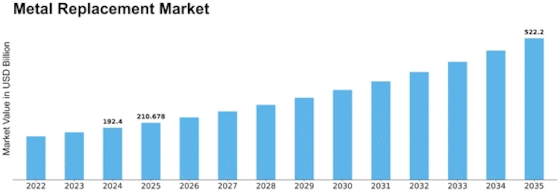

Metal Replacement Market Size Graph
Author
Sejal Akre
Senior Research Analyst

She has over 5 years of rich experience, in market research and consulting providing valuable market insights to client. Hands on expertise in management consulting, and extensive knowledge in domain including ICT, Automotive & Transportation and Aerospace & Defense. She is skilled in Go-to market strategy, industry analysis, market sizing, in depth company profiling, competitive intelligence & benchmarking and value chain amongst others.

Leave a Comment

FAQs

What is the projected market valuation of the Metal Replacement Market by 2035?

The Metal Replacement Market is projected to reach a valuation of 522.2 USD Billion by 2035.

What was the market valuation of the Metal Replacement Market in 2024?

In 2024, the overall market valuation was 192.4 USD Billion.

What is the expected CAGR for the Metal Replacement Market during the forecast period 2025 - 2035?

The expected CAGR for the Metal Replacement Market during the forecast period 2025 - 2035 is 9.5%.

Which segments are included in the Metal Replacement Market analysis?

The segments in the Metal Replacement Market include Automotive, Aerospace & Defense, Construction, Healthcare, and Others.

What are the projected valuations for the Automotive segment by 2035?

The Automotive segment is projected to grow from 45.0 USD Billion to 120.0 USD Billion by 2035.

How does the Aerospace & Defense segment perform in the Metal Replacement Market?

The Aerospace & Defense segment is expected to increase from 30.0 USD Billion to 80.0 USD Billion by 2035.

Market Summary

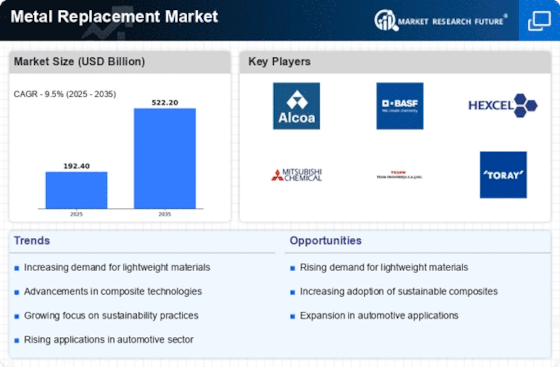
As per MRFR analysis, the Metal Replacement Market Size was estimated at 192.4 USD Billion in 2024. The Metal Replacement industry is projected to grow from 210.68 in 2025 to 522.2 by 2035, exhibiting a compound annual growth rate (CAGR) of 9.5 during the forecast period 2025 - 2035.

Key Market Trends & Highlights

The Metal Replacement Market is poised for substantial growth driven by sustainability and technological advancements.

  • North America remains the largest market for metal replacement, driven by robust automotive and engineering sectors.
  • Asia-Pacific is emerging as the fastest-growing region, fueled by increasing demand for lightweight materials in various industries.
  • The automotive segment continues to dominate the market, while the aerospace and defense segment is experiencing rapid growth due to innovation.
  • Sustainability initiatives and regulatory compliance are key drivers propelling the adoption of metal replacement solutions.

Market Size & Forecast

2024 Market Size 192.4 (USD Billion)
2035 Market Size 522.2 (USD Billion)
CAGR (2025 - 2035) 9.5%
Largest Regional Market Share in 2024 Asia Pacific

Major Players

<p>Alcoa (US), BASF (DE), Hexcel Corporation (US), Mitsubishi Chemical Corporation (JP), Teijin Limited (JP), Toray Industries (JP), SABIC (SA), DuPont (US), Covestro (DE)</p>

Market Trends

The Metal Replacement Market is currently experiencing a transformative phase, driven by the increasing demand for lightweight materials across various industries. This shift is largely influenced by the need for enhanced fuel efficiency in automotive applications and the pursuit of sustainability in manufacturing processes. As companies seek to reduce their carbon footprints, the adoption of advanced composites and polymers is becoming more prevalent. These materials not only offer weight reduction but also exhibit superior performance characteristics, which are essential in meeting modern engineering requirements. Moreover, the Metal Replacement Market is witnessing a surge in innovation, with ongoing research and development efforts aimed at improving material properties and expanding application areas. Industries such as aerospace, automotive, and consumer goods are increasingly integrating metal replacement solutions to enhance product performance and durability. This trend suggests a growing recognition of the potential benefits that non-metal materials can provide, including corrosion resistance and design flexibility. As the market evolves, it appears poised for further growth, driven by technological advancements and changing consumer preferences.

Sustainability Initiatives

The Metal Replacement Market is increasingly influenced by sustainability initiatives, as companies strive to minimize environmental impact. This trend is characterized by the adoption of eco-friendly materials and processes, which align with global efforts to combat climate change. Manufacturers are exploring alternatives to traditional metals, focusing on materials that are recyclable and have a lower carbon footprint.

Technological Advancements

Technological advancements play a crucial role in shaping the Metal Replacement Market. Innovations in material science are leading to the development of high-performance composites and polymers that can effectively replace metals in various applications. These advancements not only enhance product performance but also open new avenues for design and manufacturing.

Growing Automotive Sector

The automotive sector is a significant driver of the Metal Replacement Market, as manufacturers seek to improve fuel efficiency and reduce vehicle weight. This trend is prompting the exploration of lightweight materials that can replace traditional metals, thereby enhancing overall vehicle performance. As the automotive industry evolves, the demand for metal replacement solutions is expected to rise.

Metal Replacement Market Market Drivers

Consumer Preferences

Consumer preferences are evolving, significantly impacting the Metal Replacement Market. There is a noticeable shift towards products that are not only high-performing but also environmentally friendly. Consumers are increasingly aware of the environmental implications of their purchases, leading to a demand for sustainable alternatives to traditional metals. This trend is particularly pronounced in sectors such as consumer electronics and home appliances, where lightweight and durable materials are preferred. Market data suggests that products utilizing metal replacement materials are gaining traction, as they often offer enhanced performance and lower environmental impact. Manufacturers are responding to this shift by incorporating metal replacement solutions into their product lines, thereby aligning with consumer expectations. As preferences continue to evolve, the Metal Replacement Market is likely to adapt, fostering a more sustainable and consumer-centric approach.

Regulatory Compliance

Regulatory compliance is increasingly influencing the Metal Replacement Market. Governments worldwide are implementing stringent regulations aimed at reducing emissions and promoting the use of sustainable materials. These regulations compel manufacturers to seek alternatives to traditional metals, which often contribute to higher emissions during production and use. As a result, there is a growing demand for materials that meet these regulatory standards while offering comparable performance. The Metal Replacement Market is responding by innovating and developing materials that not only comply with regulations but also provide enhanced functionality. This shift is particularly evident in industries such as construction and transportation, where compliance with environmental standards is critical. The need for regulatory compliance is likely to drive further investment in research and development, fostering innovation within the Metal Replacement Market.

Growing Automotive Sector

The automotive sector's expansion is a significant driver for the Metal Replacement Market. With the increasing demand for fuel-efficient and high-performance vehicles, manufacturers are increasingly turning to lightweight materials to enhance vehicle efficiency. The shift towards electric vehicles (EVs) further amplifies this trend, as reducing weight is essential for maximizing battery performance and range. Recent statistics indicate that the use of lightweight materials in automotive applications is expected to rise substantially, with projections suggesting a market growth rate of over 10% annually. This trend is prompting automotive companies to explore innovative metal replacement solutions, such as carbon fiber and advanced plastics, which not only reduce weight but also improve safety and performance. As the automotive industry continues to evolve, the Metal Replacement Market is likely to experience sustained growth driven by these developments.

Sustainability Initiatives

The increasing emphasis on sustainability is a pivotal driver for the Metal Replacement Market. As industries strive to reduce their carbon footprint, the demand for lightweight materials that can replace traditional metals is surging. This shift is particularly evident in sectors such as automotive and aerospace, where manufacturers are adopting materials like composites and polymers to enhance fuel efficiency and reduce emissions. According to recent data, the market for lightweight materials is projected to grow significantly, indicating a robust trend towards sustainable practices. Companies are investing in research and development to innovate and create eco-friendly alternatives, which further propels the Metal Replacement Market. This focus on sustainability not only aligns with regulatory requirements but also meets consumer demand for greener products, thereby fostering a more sustainable future.

Technological Advancements

Technological advancements play a crucial role in shaping the Metal Replacement Market. Innovations in material science and engineering have led to the development of advanced composites and alloys that offer superior performance compared to traditional metals. For instance, the introduction of 3D printing technology has revolutionized manufacturing processes, allowing for the creation of complex geometries that were previously unattainable. This has resulted in reduced material waste and lower production costs, making metal replacement solutions more accessible. Furthermore, advancements in nanotechnology are enhancing the properties of materials, leading to lighter and stronger alternatives. The integration of smart materials that can adapt to environmental changes is also gaining traction. As these technologies continue to evolve, they are expected to drive the Metal Replacement Market forward, offering new opportunities for manufacturers and consumers alike.

Market Segment Insights

By End Use: Automotive (Largest) vs. Aerospace & Defense (Fastest-Growing)

<p>The Metal Replacement Market displays a diverse distribution across various end-use segments, with the Automotive sector holding the largest share. This dominance can be attributed to the increasing adoption of lightweight materials aimed at enhancing fuel efficiency and reducing emissions. In contrast, the Aerospace & Defense segment is experiencing rapid growth, driven by advancements in material technology and the demand for improved performance and durability in aerospace applications. Furthermore, the Construction and Healthcare sectors are also contributing to the market, albeit at a slower pace. The Construction sector benefits from a growing emphasis on sustainability and energy-efficient materials, while the Healthcare segment is gradually adopting metal replacements for medical devices. The overall growth in these segments is propelled by innovation and increasing awareness regarding the benefits of metal replacement materials.</p>

<p>Automotive (Dominant) vs. Aerospace & Defense (Emerging)</p>

<p>The Automotive segment is distinctly characterized by the extensive use of metal replacement materials such as composites and polymers, which significantly enhance vehicle performance and reduce overall weight. This significant dominance is fueled by stringent fuel economy regulations and consumer preference for lighter vehicles. In contrast, the Aerospace & Defense sector is emerging with a strong forward momentum, leveraging high-performance composites that offer exceptional strength-to-weight ratios. Here, the focus is on reducing aircraft weight for improved fuel efficiency and lower operational costs. The growing demand for advanced aircraft and defense systems is driving technological innovations within this segment, marking it as one of the most promising areas within the Metal Replacement Market.</p>

By Type: Engineering Plastics (Largest) vs. Composites (Fastest-Growing)

<p>The Metal Replacement Market has seen a diverse segmentation, with Engineering Plastics emerging as the largest segment. This segment enjoys a significant market share, primarily due to its widespread application in automotive, aerospace, and industrial manufacturing, where durability and lightweight properties are crucial. On the other hand, the Composites segment, while smaller in share, is rapidly gaining traction due to its increasing use in performance-critical applications, further driven by technological advancements in manufacturing processes.</p>

<p>Engineering Plastics (Dominant) vs. Composites (Emerging)</p>

<p>Engineering Plastics represent the dominant force in the Metal Replacement Market, recognized for their exceptional strength-to-weight ratio, chemical resistance, and versatility. These materials, such as polycarbonate and nylon, are extensively utilized in applications demanding high-performance characteristics, ensuring long-term reliability and efficiency. Conversely, the Composites segment, though emerging, is carving out its niche through innovations in material science that enhance the mechanical properties while reducing weight. This segment is particularly popular in sectors like automotive and aerospace, where lighter parts can lead to improved fuel efficiency and performance, positioning Composites as a formidable contender for future market growth.</p>

Get more detailed insights about Metal Replacement Market Research Report—Global Forecast till 2035

Regional Insights

North America : Innovation and Demand Surge

North America is the largest market for metal replacement, holding approximately 40% of the global share. The region's growth is driven by increasing demand in aerospace, automotive, and consumer goods sectors, alongside stringent regulations promoting lightweight materials. The push for sustainability and energy efficiency further catalyzes market expansion, with innovations in composite materials leading the way. The United States and Canada are the leading countries in this market, with major players like Alcoa and Hexcel Corporation driving competition. The presence of advanced manufacturing facilities and a strong focus on R&D contribute to a robust competitive landscape. Additionally, government initiatives supporting advanced materials research bolster the market's growth potential.

Europe : Sustainability and Innovation Focus

Europe is the second-largest market for metal replacement, accounting for around 30% of the global market share. The region's growth is fueled by stringent environmental regulations and a strong emphasis on sustainability. Countries are increasingly adopting lightweight materials to enhance energy efficiency in transportation and construction, driving demand for metal replacement solutions. Germany, France, and the UK are at the forefront of this market, with key players like BASF and Covestro leading the charge. The competitive landscape is characterized by a mix of established companies and innovative startups focusing on advanced materials. Collaborative efforts between industry and academia further enhance the region's capabilities in developing cutting-edge solutions.

Asia-Pacific : Rapid Growth and Adoption

Asia-Pacific is witnessing rapid growth in the metal replacement market, driven by increasing industrialization and urbanization. The region holds approximately 25% of the global market share, with countries like China and Japan leading the charge. The demand for lightweight materials in automotive and aerospace sectors is propelling market expansion, supported by government initiatives promoting advanced manufacturing technologies. China is the largest market in the region, with significant contributions from companies like Mitsubishi Chemical and Teijin Limited. The competitive landscape is evolving, with both domestic and international players vying for market share. Investments in R&D and collaborations with research institutions are enhancing the region's capabilities in innovative material solutions.

Middle East and Africa : Resource-Rich and Emerging Market

The Middle East and Africa region is gradually emerging in the metal replacement market, holding about 5% of the global share. The growth is primarily driven by increasing investments in infrastructure and construction projects, alongside a rising awareness of the benefits of lightweight materials. Governments are beginning to recognize the importance of advanced materials in enhancing energy efficiency and sustainability in various sectors. Countries like South Africa and the UAE are leading the way, with a growing presence of key players such as SABIC. The competitive landscape is still developing, with opportunities for both local and international companies to establish a foothold. As the region continues to invest in modernization and technological advancements, the demand for metal replacement solutions is expected to rise significantly.

Key Players and Competitive Insights

Leading market players are investing heavily in research and development in order to expand their product lines, which will help the Metal Replacement Market, grow even more. Market participants are also undertaking a variety of strategic activities to expand their global footprint, with important market developments including new product launches, contractual agreements, mergers and acquisitions, higher investments, and collaboration with other organizations. To expand and survive in a more competitive and rising market climate, Metal Replacement industry must offer cost-effective items.

Manufacturing locally to minimize operational costs is one of the key business tactics used by manufacturers in the global Metal Replacement industry to benefit clients and increase the market sector. In recent years, the Metal Replacement industry has offered some of the most significant advantages to medicine. Major players in the Metal Replacement Market, including A.K.

Industries Inc., Asahi Kasei Corporation, Aztec Plastic Company, BASF SE, Celanese Corporation, China Jushi Co.Ltd., DOMO Chemicals GmbH, DuPont de Nemours Inc., SGL Carbon SE, Solvay S.A., Toray Industries Inc., and Victrex plc, are attempting to increase market demand by investing in research and development operations.

A chemical corporation is BASF SE (BASF). Chemicals, polymers, crop protection products, and performance goods are produced, marketed, and sold by it. Solvents, adhesives, surfactants, fuel additives, electronic chemicals, pigments, paints, food additives, fungicides, and herbicides are among the company's product offerings. Construction, furniture and wood, agricultural, electronics and electrical, paints and coatings, automotive, home care, nutrition, chemicals, and other industries are among the many that the company serves. R&D is conducted by BASF in collaboration with international clients, partners, and scientists. A global network of production sites supports the company's operations.

It is present throughout North America, Europe, Asia Pacific, South America, Africa, and the Middle East. The headquarters of BASF are in Ludwigshafen, Germany. BASF SE introduced bio-based polyurethane foam in November 2021. Weight loss is possible with this product, which has a density of 120g/L. It is created using castor oil and is becoming more and more popular with companies that make instrument panels, doors, furniture, and car interiors.

The carbon fibre composite manufacturing method was created by 9T Labs with the goal of making performance parts easier to use and more widely available. Engineers can efficiently build drones and prostheses thanks to the company's technology, which can print carbon fibre composite parts and combines a material process with high-quality sensor technology and production flexibility. Additive Fusion Technology (AFT), a three-step manufacturing workflow created by 9T Labs in January 2023, allows for the automated and cost-competitive production of composite products.

The design and analysis of a part using the Fibrify design software from 9T Labs is the first step in this approach. The next step involves depositing a unidirectional tape filament in 9T Labs' Build Module to produce continuous fiber-reinforced preforms. After that, the Fusion Module from 9T Labs is used to compress-mold these preforms. In the final consolidation stage, the preforms are combined, voids are removed, and lightweight, very durable net-shape parts are produced.

Key Companies in the Metal Replacement Market market include

Industry Developments

September 2018: The market's most popular trending item is bio-plastic. Some nations are attempting to commercialise it. Qatar has begun to distribute bioplastic bags. Starch from cassava as well as other renewable materials are used to make this bioplastic. 100% biodegradable means it won't affect the environment. This bag is safe for animals to eat without harming them.

Future Outlook

Metal Replacement Market Future Outlook

<p>The Metal Replacement Market is projected to grow at a 9.5% CAGR from 2024 to 2035, driven by advancements in materials technology and increasing demand for lightweight solutions.</p>

New opportunities lie in:

  • <p>Development of advanced composite materials for automotive applications.</p>
  • <p>Expansion into renewable energy sectors with lightweight structural components.</p>
  • <p>Integration of smart materials for enhanced performance in aerospace.</p>

<p>By 2035, the Metal Replacement Market is expected to achieve substantial growth, driven by innovation and diverse applications.</p>

Market Segmentation

Metal Replacement Market Type Outlook

  • Engineering Plastics
  • Composites

Metal Replacement Market End Use Outlook

  • Automotive
  • Aerospace & Defense
  • Construction
  • Healthcare
  • Others

Report Scope

MARKET SIZE 2024192.4(USD Billion)
MARKET SIZE 2025210.68(USD Billion)
MARKET SIZE 2035522.2(USD Billion)
COMPOUND ANNUAL GROWTH RATE (CAGR)9.5% (2024 - 2035)
REPORT COVERAGERevenue Forecast, Competitive Landscape, Growth Factors, and Trends
BASE YEAR2024
Market Forecast Period2025 - 2035
Historical Data2019 - 2024
Market Forecast UnitsUSD Billion
Key Companies ProfiledMarket analysis in progress
Segments CoveredMarket segmentation analysis in progress
Key Market OpportunitiesAdvancements in lightweight composites drive growth in the Metal Replacement Market.
Key Market DynamicsRising demand for lightweight materials drives innovation and competition in the Metal Replacement Market.
Countries CoveredNorth America, Europe, APAC, South America, MEA

FAQs

What is the projected market valuation of the Metal Replacement Market by 2035?

The Metal Replacement Market is projected to reach a valuation of 522.2 USD Billion by 2035.

What was the market valuation of the Metal Replacement Market in 2024?

In 2024, the overall market valuation was 192.4 USD Billion.

What is the expected CAGR for the Metal Replacement Market during the forecast period 2025 - 2035?

The expected CAGR for the Metal Replacement Market during the forecast period 2025 - 2035 is 9.5%.

Which segments are included in the Metal Replacement Market analysis?

The segments in the Metal Replacement Market include Automotive, Aerospace & Defense, Construction, Healthcare, and Others.

What are the projected valuations for the Automotive segment by 2035?

The Automotive segment is projected to grow from 45.0 USD Billion to 120.0 USD Billion by 2035.

How does the Aerospace & Defense segment perform in the Metal Replacement Market?

The Aerospace & Defense segment is expected to increase from 30.0 USD Billion to 80.0 USD Billion by 2035.

  1. SECTION I: EXECUTIVE SUMMARY AND KEY HIGHLIGHTS
    1. EXECUTIVE SUMMARY
      1. Market Overview
      2. Key Findings
      3. Market Segmentation
      4. Competitive Landscape
      5. Challenges and Opportunities
      6. Future Outlook
  2. SECTION II: SCOPING, METHODOLOGY AND MARKET STRUCTURE
    1. MARKET INTRODUCTION
      1. Definition
      2. Scope of the study
    2. RESEARCH METHODOLOGY
      1. Overview
      2. Data Mining
      3. Secondary Research
      4. Primary Research
      5. Forecasting Model
      6. Market Size Estimation
      7. Data Triangulation
      8. Validation
  3. SECTION III: QUALITATIVE ANALYSIS
    1. MARKET DYNAMICS
      1. Overview
      2. Drivers
      3. Restraints
      4. Opportunities
    2. MARKET FACTOR ANALYSIS
      1. Value chain Analysis
      2. Porter's Five Forces Analysis
      3. COVID-19 Impact Analysis
  4. SECTION IV: QUANTITATIVE ANALYSIS
    1. Chemicals and Materials, BY End Use (USD Billion)
      1. Automotive
      2. Aerospace & Defense
      3. Construction
      4. Healthcare
      5. Others
    2. Chemicals and Materials, BY Type (USD Billion)
      1. Engineering Plastics
      2. Composites
    3. Chemicals and Materials, BY Region (USD Billion)
      1. North America
      2. Europe
      3. APAC
      4. South America
      5. MEA
  5. SECTION V: COMPETITIVE ANALYSIS
    1. Competitive Landscape
      1. Overview
      2. Competitive Analysis
      3. Market share Analysis
      4. Major Growth Strategy in the Chemicals and Materials
      5. Competitive Benchmarking
      6. Leading Players in Terms of Number of Developments in the Chemicals and Materials
      7. Key developments and growth strategies
      8. Major Players Financial Matrix
    2. Company Profiles
      1. Alcoa (US)
      2. BASF (DE)
      3. Hexcel Corporation (US)
      4. Mitsubishi Chemical Corporation (JP)
      5. Teijin Limited (JP)
      6. Toray Industries (JP)
      7. SABIC (SA)
      8. DuPont (US)
      9. Covestro (DE)
    3. Appendix
      1. References
      2. Related Reports
  6. LIST OF FIGURES
    1. MARKET SYNOPSIS
    2. NORTH AMERICA MARKET ANALYSIS
    3. US MARKET ANALYSIS BY END USE
    4. US MARKET ANALYSIS BY TYPE
    5. CANADA MARKET ANALYSIS BY END USE
    6. CANADA MARKET ANALYSIS BY TYPE
    7. EUROPE MARKET ANALYSIS
    8. GERMANY MARKET ANALYSIS BY END USE
    9. GERMANY MARKET ANALYSIS BY TYPE
    10. UK MARKET ANALYSIS BY END USE
    11. UK MARKET ANALYSIS BY TYPE
    12. FRANCE MARKET ANALYSIS BY END USE
    13. FRANCE MARKET ANALYSIS BY TYPE
    14. RUSSIA MARKET ANALYSIS BY END USE
    15. RUSSIA MARKET ANALYSIS BY TYPE
    16. ITALY MARKET ANALYSIS BY END USE
    17. ITALY MARKET ANALYSIS BY TYPE
    18. SPAIN MARKET ANALYSIS BY END USE
    19. SPAIN MARKET ANALYSIS BY TYPE
    20. REST OF EUROPE MARKET ANALYSIS BY END USE
    21. REST OF EUROPE MARKET ANALYSIS BY TYPE
    22. APAC MARKET ANALYSIS
    23. CHINA MARKET ANALYSIS BY END USE
    24. CHINA MARKET ANALYSIS BY TYPE
    25. INDIA MARKET ANALYSIS BY END USE
    26. INDIA MARKET ANALYSIS BY TYPE
    27. JAPAN MARKET ANALYSIS BY END USE
    28. JAPAN MARKET ANALYSIS BY TYPE
    29. SOUTH KOREA MARKET ANALYSIS BY END USE
    30. SOUTH KOREA MARKET ANALYSIS BY TYPE
    31. MALAYSIA MARKET ANALYSIS BY END USE
    32. MALAYSIA MARKET ANALYSIS BY TYPE
    33. THAILAND MARKET ANALYSIS BY END USE
    34. THAILAND MARKET ANALYSIS BY TYPE
    35. INDONESIA MARKET ANALYSIS BY END USE
    36. INDONESIA MARKET ANALYSIS BY TYPE
    37. REST OF APAC MARKET ANALYSIS BY END USE
    38. REST OF APAC MARKET ANALYSIS BY TYPE
    39. SOUTH AMERICA MARKET ANALYSIS
    40. BRAZIL MARKET ANALYSIS BY END USE
    41. BRAZIL MARKET ANALYSIS BY TYPE
    42. MEXICO MARKET ANALYSIS BY END USE
    43. MEXICO MARKET ANALYSIS BY TYPE
    44. ARGENTINA MARKET ANALYSIS BY END USE
    45. ARGENTINA MARKET ANALYSIS BY TYPE
    46. REST OF SOUTH AMERICA MARKET ANALYSIS BY END USE
    47. REST OF SOUTH AMERICA MARKET ANALYSIS BY TYPE
    48. MEA MARKET ANALYSIS
    49. GCC COUNTRIES MARKET ANALYSIS BY END USE
    50. GCC COUNTRIES MARKET ANALYSIS BY TYPE
    51. SOUTH AFRICA MARKET ANALYSIS BY END USE
    52. SOUTH AFRICA MARKET ANALYSIS BY TYPE
    53. REST OF MEA MARKET ANALYSIS BY END USE
    54. REST OF MEA MARKET ANALYSIS BY TYPE
    55. KEY BUYING CRITERIA OF CHEMICALS AND MATERIALS
    56. RESEARCH PROCESS OF MRFR
    57. DRO ANALYSIS OF CHEMICALS AND MATERIALS
    58. DRIVERS IMPACT ANALYSIS: CHEMICALS AND MATERIALS
    59. RESTRAINTS IMPACT ANALYSIS: CHEMICALS AND MATERIALS
    60. SUPPLY / VALUE CHAIN: CHEMICALS AND MATERIALS
    61. CHEMICALS AND MATERIALS, BY END USE, 2024 (% SHARE)
    62. CHEMICALS AND MATERIALS, BY END USE, 2024 TO 2035 (USD Billion)
    63. CHEMICALS AND MATERIALS, BY TYPE, 2024 (% SHARE)
    64. CHEMICALS AND MATERIALS, BY TYPE, 2024 TO 2035 (USD Billion)
    65. BENCHMARKING OF MAJOR COMPETITORS
  7. LIST OF TABLES
    1. LIST OF ASSUMPTIONS
    2. North America MARKET SIZE ESTIMATES; FORECAST
      1. BY END USE, 2025-2035 (USD Billion)
      2. BY TYPE, 2025-2035 (USD Billion)
    3. US MARKET SIZE ESTIMATES; FORECAST
      1. BY END USE, 2025-2035 (USD Billion)
      2. BY TYPE, 2025-2035 (USD Billion)
    4. Canada MARKET SIZE ESTIMATES; FORECAST
      1. BY END USE, 2025-2035 (USD Billion)
      2. BY TYPE, 2025-2035 (USD Billion)
    5. Europe MARKET SIZE ESTIMATES; FORECAST
      1. BY END USE, 2025-2035 (USD Billion)
      2. BY TYPE, 2025-2035 (USD Billion)
    6. Germany MARKET SIZE ESTIMATES; FORECAST
      1. BY END USE, 2025-2035 (USD Billion)
      2. BY TYPE, 2025-2035 (USD Billion)
    7. UK MARKET SIZE ESTIMATES; FORECAST
      1. BY END USE, 2025-2035 (USD Billion)
      2. BY TYPE, 2025-2035 (USD Billion)
    8. France MARKET SIZE ESTIMATES; FORECAST
      1. BY END USE, 2025-2035 (USD Billion)
      2. BY TYPE, 2025-2035 (USD Billion)
    9. Russia MARKET SIZE ESTIMATES; FORECAST
      1. BY END USE, 2025-2035 (USD Billion)
      2. BY TYPE, 2025-2035 (USD Billion)
    10. Italy MARKET SIZE ESTIMATES; FORECAST
      1. BY END USE, 2025-2035 (USD Billion)
      2. BY TYPE, 2025-2035 (USD Billion)
    11. Spain MARKET SIZE ESTIMATES; FORECAST
      1. BY END USE, 2025-2035 (USD Billion)
      2. BY TYPE, 2025-2035 (USD Billion)
    12. Rest of Europe MARKET SIZE ESTIMATES; FORECAST
      1. BY END USE, 2025-2035 (USD Billion)
      2. BY TYPE, 2025-2035 (USD Billion)
    13. APAC MARKET SIZE ESTIMATES; FORECAST
      1. BY END USE, 2025-2035 (USD Billion)
      2. BY TYPE, 2025-2035 (USD Billion)
    14. China MARKET SIZE ESTIMATES; FORECAST
      1. BY END USE, 2025-2035 (USD Billion)
      2. BY TYPE, 2025-2035 (USD Billion)
    15. India MARKET SIZE ESTIMATES; FORECAST
      1. BY END USE, 2025-2035 (USD Billion)
      2. BY TYPE, 2025-2035 (USD Billion)
    16. Japan MARKET SIZE ESTIMATES; FORECAST
      1. BY END USE, 2025-2035 (USD Billion)
      2. BY TYPE, 2025-2035 (USD Billion)
    17. South Korea MARKET SIZE ESTIMATES; FORECAST
      1. BY END USE, 2025-2035 (USD Billion)
      2. BY TYPE, 2025-2035 (USD Billion)
    18. Malaysia MARKET SIZE ESTIMATES; FORECAST
      1. BY END USE, 2025-2035 (USD Billion)
      2. BY TYPE, 2025-2035 (USD Billion)
    19. Thailand MARKET SIZE ESTIMATES; FORECAST
      1. BY END USE, 2025-2035 (USD Billion)
      2. BY TYPE, 2025-2035 (USD Billion)
    20. Indonesia MARKET SIZE ESTIMATES; FORECAST
      1. BY END USE, 2025-2035 (USD Billion)
      2. BY TYPE, 2025-2035 (USD Billion)
    21. Rest of APAC MARKET SIZE ESTIMATES; FORECAST
      1. BY END USE, 2025-2035 (USD Billion)
      2. BY TYPE, 2025-2035 (USD Billion)
    22. South America MARKET SIZE ESTIMATES; FORECAST
      1. BY END USE, 2025-2035 (USD Billion)
      2. BY TYPE, 2025-2035 (USD Billion)
    23. Brazil MARKET SIZE ESTIMATES; FORECAST
      1. BY END USE, 2025-2035 (USD Billion)
      2. BY TYPE, 2025-2035 (USD Billion)
    24. Mexico MARKET SIZE ESTIMATES; FORECAST
      1. BY END USE, 2025-2035 (USD Billion)
      2. BY TYPE, 2025-2035 (USD Billion)
    25. Argentina MARKET SIZE ESTIMATES; FORECAST
      1. BY END USE, 2025-2035 (USD Billion)
      2. BY TYPE, 2025-2035 (USD Billion)
    26. Rest of South America MARKET SIZE ESTIMATES; FORECAST
      1. BY END USE, 2025-2035 (USD Billion)
      2. BY TYPE, 2025-2035 (USD Billion)
    27. MEA MARKET SIZE ESTIMATES; FORECAST
      1. BY END USE, 2025-2035 (USD Billion)
      2. BY TYPE, 2025-2035 (USD Billion)
    28. GCC Countries MARKET SIZE ESTIMATES; FORECAST
      1. BY END USE, 2025-2035 (USD Billion)
      2. BY TYPE, 2025-2035 (USD Billion)
    29. South Africa MARKET SIZE ESTIMATES; FORECAST
      1. BY END USE, 2025-2035 (USD Billion)
      2. BY TYPE, 2025-2035 (USD Billion)
    30. Rest of MEA MARKET SIZE ESTIMATES; FORECAST
      1. BY END USE, 2025-2035 (USD Billion)
      2. BY TYPE, 2025-2035 (USD Billion)
    31. PRODUCT LAUNCH/PRODUCT DEVELOPMENT/APPROVAL
    32. ACQUISITION/PARTNERSHIP

Metal Replacement Market Segmentation

Metal Replacement End Use Outlook (USD Billion, 2018-2032)

  • Automotive
  • Aerospace & Defense
  • Construction
  • Healthcare
  • Others

Metal Replacement Type Outlook (USD Billion, 2018-2032)

  • Engineering Plastics
  • Composites

Metal Replacement Regional Outlook (USD Billion, 2018-2032)

  • North America Outlook (USD Billion, 2018-2032)

    • Metal Replacement by End Use
      • Automotive
      • Aerospace & Defense
      • Construction
      • Healthcare
      • Others
    • Metal Replacement by Type
      • Engineering Plastics
      • Composites
    • US Outlook (USD Billion, 2018-2032)

    • Metal Replacement by End Use
      • Automotive
      • Aerospace & Defense
      • Construction
      • Healthcare
      • Others
    • Metal Replacement by Type
      • Engineering Plastics
      • Composites
    • Canada Outlook (USD Billion, 2018-2032)

    • Metal Replacement by End Use
      • Automotive
      • Aerospace & Defense
      • Construction
      • Healthcare
      • Others
    • Metal Replacement by Type
      • Engineering Plastics
      • Composites
  • Europe Outlook (USD Billion, 2018-2032)

    • Metal Replacement by End Use
      • Automotive
      • Aerospace & Defense
      • Construction
      • Healthcare
      • Others
    • Metal Replacement by Type
      • Engineering Plastics
      • Composites
    • Germany Outlook (USD Billion, 2018-2032)

    • Metal Replacement by End Use
      • Automotive
      • Aerospace & Defense
      • Construction
      • Healthcare
      • Others
    • Metal Replacement by Type
      • Engineering Plastics
      • Composites
    • France Outlook (USD Billion, 2018-2032)

    • Metal Replacement by End Use
      • Automotive
      • Aerospace & Defense
      • Construction
      • Healthcare
      • Others
    • Metal Replacement by Type
      • Engineering Plastics
      • Composites
    • UK Outlook (USD Billion, 2018-2032)

    • Metal Replacement by End Use
      • Automotive
      • Aerospace & Defense
      • Construction
      • Healthcare
      • Others
    • Metal Replacement by Type
      • Engineering Plastics
      • Composites
    • Italy Outlook (USD Billion, 2018-2032)

    • Metal Replacement by End Use
      • Automotive
      • Aerospace & Defense
      • Construction
      • Healthcare
      • Others
    • Metal Replacement by Type
      • Engineering Plastics
      • Composites
    • Spain Outlook (USD Billion, 2018-2032)

    • Metal Replacement by End Use
      • Automotive
      • Aerospace & Defense
      • Construction
      • Healthcare
      • Others
    • Metal Replacement by Type
      • Engineering Plastics
      • Composites
    • Rest Of Europe Outlook (USD Billion, 2018-2032)

    • Metal Replacement by End Use
      • Automotive
      • Aerospace & Defense
      • Construction
      • Healthcare
      • Others
    • Metal Replacement by Type
      • Engineering Plastics
      • Composites
  • Asia-Pacific Outlook (USD Billion, 2018-2032)

    • Metal Replacement by End Use
      • Automotive
      • Aerospace & Defense
      • Construction
      • Healthcare
      • Others
    • Metal Replacement by Type
      • Engineering Plastics
      • Composites
    • China Outlook (USD Billion, 2018-2032)

    • Metal Replacement by End Use
      • Automotive
      • Aerospace & Defense
      • Construction
      • Healthcare
      • Others
    • Metal Replacement by Type
      • Engineering Plastics
      • Composites
    • Japan Outlook (USD Billion, 2018-2032)

    • Metal Replacement by End Use
      • Automotive
      • Aerospace & Defense
      • Construction
      • Healthcare
      • Others
    • Metal Replacement by Type
      • Engineering Plastics
      • Composites
    • India Outlook (USD Billion, 2018-2032)

    • Metal Replacement by End Use
      • Automotive
      • Aerospace & Defense
      • Construction
      • Healthcare
      • Others
    • Metal Replacement by Type
      • Engineering Plastics
      • Composites
    • Australia Outlook (USD Billion, 2018-2032)

    • Metal Replacement by End Use
      • Automotive
      • Aerospace & Defense
      • Construction
      • Healthcare
      • Others
    • Metal Replacement by Type
      • Engineering Plastics
      • Composites
    • Rest of Asia-Pacific Outlook (USD Billion, 2018-2032)

    • Metal Replacement by End Use
      • Automotive
      • Aerospace & Defense
      • Construction
      • Healthcare
      • Others
    • Metal Replacement by Type
      • Engineering Plastics
      • Composites
  • Rest of the World Outlook (USD Billion, 2018-2032)

    • Metal Replacement by End Use
      • Automotive
      • Aerospace & Defense
      • Construction
      • Healthcare
      • Others
    • Metal Replacement by Type
      • Engineering Plastics
      • Composites
    • Middle East Outlook (USD Billion, 2018-2032)

    • Metal Replacement by End Use
      • Automotive
      • Aerospace & Defense
      • Construction
      • Healthcare
      • Others
    • Metal Replacement by Type
      • Engineering Plastics
      • Composites
    • Africa Outlook (USD Billion, 2018-2032)

    • Metal Replacement by End Use
      • Automotive
      • Aerospace & Defense
      • Construction
      • Healthcare
      • Others
    • Metal Replacement by Type
      • Engineering Plastics
      • Composites
    • Latin America Outlook (USD Billion, 2018-2032)

    • Metal Replacement by End Use
      • Automotive
      • Aerospace & Defense
      • Construction
      • Healthcare
      • Others
    • Metal Replacement by Type
      • Engineering Plastics
      • Composites
Infographic

Free Sample Request

Kindly complete the form below to receive a free sample of this Report

Get Free Sample

Customer Strories

Compare Licence

×
Features License Type
Single User Multiuser License Enterprise User
Price $4,950 $5,950 $7,250
Maximum User Access Limit 1 User Upto 10 Users Unrestricted Access Throughout the Organization
Free Customization
Direct Access to Analyst
Deliverable Format
Platform Access
Discount on Next Purchase 10% 15% 15%
Printable Versions