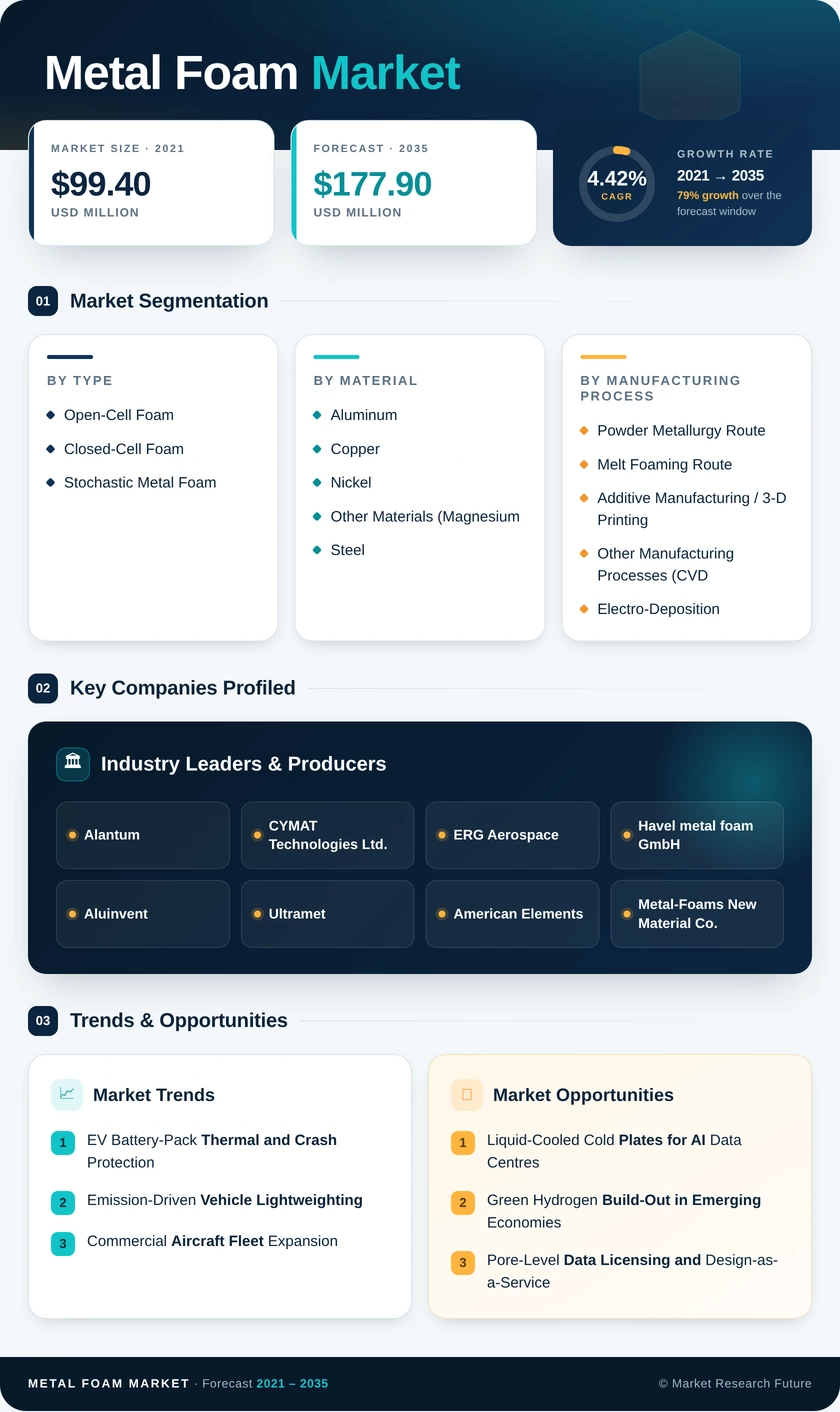
Segmentation Quick Reference
| Dimension | Sub-Segments | Dominant Segment | Fastest Growing Segment |
|---|
| By Type | Open-Cell Foam; Closed-Cell Foam; Stochastic Metal Foam | Open-Cell Foam (51.1% share) | Stochastic Metal Foam (5.6% CAGR) |
| By Material | Aluminum; Copper; Nickel; Other Materials (Magnesium, Steel, Alloys) | Aluminum (59.9% share) | Nickel (6.0% CAGR) |
| By Manufacturing Process | Powder Metallurgy Route; Melt Foaming Route; Additive Manufacturing / 3-D Printing; Other Manufacturing Processes (CVD and Electro-Deposition, etc.) | Powder Metallurgy Route (58.1% share) | Additive Manufacturing / 3-D Printing (8.9% CAGR) |
| By Application | Automotive; Aerospace; Industrial Machines; Construction; Biomedical; Other Applications (Marine and Rail, Energy and Power, etc.) | Automotive (40.2% share) | Other Applications (Marine and Rail, Energy and Power, etc.) (5.4% CAGR) |
| By Region | Asia-Pacific; North America; Europe; South America; Middle-East and Africa | Asia-Pacific (42.6% share) | Asia-Pacific (42.6% share) |
Market Segmentation Overview
| Sub-Segment | Key Trend |
|---|
| Open-Cell Foam | Integration into battery cold plates and server cooling loops |
| Closed-Cell Foam | Use in crash absorbers, bulkheads and buoyancy modules. |
| Stochastic Metal Foam | Lower-cost random-pore panels for large vehicle parts |
Open-Cell Foam leads because coolant can pass through its connected pores, which closed structures cannot offer. Stochastic Metal Foam grows fastest as automakers trade pore uniformity for cheaper large-format underbody panels. Closed-Cell Foam holds steady wherever gas-tight cells are needed for buoyancy or fluid resistance.
| Sub-Segment | Key Trend |
|---|
| Aluminum | Recycled-content grades for low-carbon procurement |
| Copper | Foam inserts for high-density electronics cooling |
| Nickel | Electrodes and current collectors for hydrogen systems |
| Other Materials (Magnesium, Steel, Alloys) | Blast armour, marine and high-temperature parts |
Aluminum leads on density, recyclability and mature supply. Nickel grows fastest because alkaline electrolysers and fuel cells use porous nickel as a core functional layer, and hydrogen funding is lifting order books. Copper keeps a premium niche where conductivity matters more than mass.
| Sub-Segment | Key Trend |
|---|
| Powder Metallurgy Route | Near-net-shape parts for automotive crash boxes |
| Melt Foaming Route | Large billets for façades and marine fenders |
| Additive Manufacturing / 3-D Printing | Graded lattices for implants and aerospace brackets |
| Other Manufacturing Processes (CVD and Electro-Deposition, etc.) | Thin nickel sheet and micro-channel heat sinks. |
Powder Metallurgy Route leads because sintering lines deliver favourable unit costs on high-volume automotive parts. Additive Manufacturing / 3-D Printing grows fastest by producing pore gradients and patient-specific geometries that moulds and melt foaming cannot reproduce. Melt Foaming Route remains the default for large-format billets.
| Sub-Segment | Key Trend |
|---|
| Automotive | Battery cradles, bumper beams and NVH dampers in EVs |
| Aerospace | Cabin retrofits and acoustic liners |
| Industrial Machines | Vibration damping and servo-drive cooling |
| Construction | Fire-resistant and acoustic façade panels |
| Biomedical | Porous titanium and tantalum implants |
| Other Applications (Marine and Rail, Energy and Power, etc.) | Hydrogen hardware, rail crash modules and marine coolers |
Automotive leads because EV platforms use foam for both crash protection and battery thermal control. Other Applications (Marine and Rail, Energy and Power, etc.) grow fastest as electrolysers, hydrogen trucks and rail crash modules move into fleet-scale procurement. Aerospace and Biomedical add premium-priced demand that is shielded by certification requirements.


 Noah Malgeri
Co-Founder

 Peter Groot koerkamp
Account and Business Manager

 Younghwan Choi
Senior Retail Manager

 Mark Irwin
Management Consultant

 Akif Moroglu
Strategy & Business Development Director

 Guilherme Gomes Martins
Product Management Director

 Joseph Aguayo
Sales Operations & Pricing Manager

 La Terria Dodd
Program Support Specialist

 Rob Kooiker
Group Product Manager HVAC & Fire Protection GMA