×
Request Free Sample ×

Kindly complete the form below to receive a free sample of this Report

* Please use a valid business email

Leading companies partner with us for data-driven Insights

clients tt-cursor
Hero Background
English
Chinese
French
Japanese
Korean
German
Spanish

Metal Fiber Market Size

ID: MRFR/CnM/1960-HCR
135 Pages
Anshula Mandaokar
October 2025

Metal Fiber Market Research Report Information by Type (Nickel, Aluminum, Copper, Iron, Silver, and Others), by Application (Filtration, ESD/EMI Protection, Hot Glass Manipulation, Heating, Specialties, and Others), by Technology (Bundle Drawing, Foil Shaving, Melt Spinning, and Machining), by End User (Automotive, Textiles, Plastic, Glass, and Others), and by Region (North America, Europe, Asia-Pacific, Latin America, and Middle East & Africa)—Forecast till 2035

Share:
Download PDF ×

We do not share your information with anyone. However, we may send you emails based on your report interest from time to time. You may contact us at any time to opt-out.

Metal Fiber Market Infographic
Purchase Options

Metal Fiber Size

Metal Fiber Market Growth Projections and Opportunities

Metal Fiber Market is projected to be worth USD 4.5 billion by 2030, registering a CAGR of 9.30% during the forecast period (2022-2030).

Industrial Applications: Metal fibers find extensive use in industrial applications such as filtration, insulation, reinforcement, and conductive materials. The versatility and unique properties of metal fibers, including high strength, conductivity, and heat resistance, make them indispensable in industries such as aerospace, automotive, electronics, and construction, influencing market demand.

Technological Advancements: Continuous advancements in manufacturing processes, material science, and fiber production technologies drive innovation in the metal fiber market. Adoption of advanced techniques such as electrospinning, melt spinning, and vapor deposition enhances fiber quality, consistency, and performance, shaping market trends and product development.

Demand from Aerospace and Defense Industries: The aerospace and defense industries are major consumers of metal fibers for applications such as composites, thermal management, electromagnetic shielding, and ballistic protection. As these industries seek lightweight, high-performance materials for aircraft, spacecraft, and military equipment, the demand for metal fibers continues to grow, influencing market dynamics.

Automotive Industry Requirements: Metal fibers are used in automotive applications such as catalytic converters, brake pads, gaskets, and acoustic insulation. As automotive manufacturers strive to improve vehicle performance, fuel efficiency, and safety, the demand for metal fibers for lightweighting, noise reduction, and thermal management purposes increases, driving market growth.

Healthcare Sector Demand: Metal fibers find applications in the healthcare sector for medical textiles, wound dressings, surgical implants, and diagnostic devices. The biocompatibility, antimicrobial properties, and durability of metal fibers make them suitable for medical applications, influencing market demand and product innovation in the healthcare sector.

Environmental Regulations and Sustainability: Adherence to environmental regulations and sustainability standards is essential for manufacturers of metal fibers to ensure responsible production practices. Compliance with regulations related to waste management, energy efficiency, and emissions reduction influences market competitiveness and customer preferences for eco-friendly materials.

Consumer Electronics Market Trends: Metal fibers are used in consumer electronics for applications such as electromagnetic interference (EMI) shielding, flexible circuits, and touchscreens. As consumer electronics devices become smaller, lighter, and more advanced, the demand for metal fibers for electromagnetic compatibility and functional applications increases, driving market demand.

Cost and Pricing Dynamics: The cost-effectiveness of metal fibers compared to alternative materials influences market adoption and pricing strategies. Factors such as raw material costs, production efficiency, and economies of scale impact pricing dynamics and market competitiveness, influencing purchasing decisions and market trends.

Global Economic Conditions: The overall economic conditions, including GDP growth, industrial output, and consumer spending patterns, influence the demand for metal fibers across different regions. Economic stability, infrastructure development, and manufacturing activity impact market demand, investment decisions, and market expansion opportunities within the metal fiber market.

Market Competition and Innovation: The competitive landscape within the metal fiber market, characterized by the presence of key players, technological advancements, and market share distribution, influences market dynamics. Manufacturers need to innovate, differentiate their offerings, and collaborate with industry partners to address evolving customer needs and gain a competitive edge in the market.
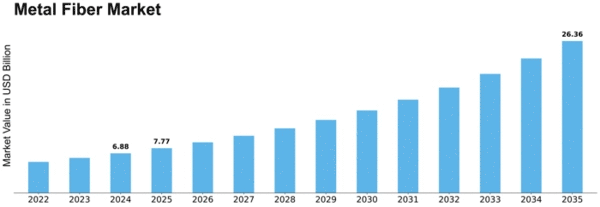
Metal Fiber Market Size Graph
Author
Anshula Mandaokar
Team Lead - Research

Anshula Mandaokar holds an academic degree in Chemical Engineering and has been contributing to the field for more than 5 years. She has expertise in Market Research and Business Consulting and serves as a Team Lead for a reputed Market Research firm under the Chemicals and Materials domain spectrum. She has worked on multiple projects, generating explicit results in a quick turnaround time. Her understanding of data interpretation justifies her role as a leader.

Leave a Comment

FAQs

What was the metal fiber market valuation in 2035?

The valuation was USD 4.5 billion.

What CAGR, the metal fiber market could achieve during the forecast period of 2024-2035?

The market could achieve 9.30% CAGR during the forecast period of 2025-2035.

What factors can hold back the metal fiber market?

The metal fiber market has restraints like rigidity, lack of flexibility, and high manufacturing cost.

Name the end users taking part in the metal fiber market?

The metal fiber market has end users like textiles, automotive, glass, plastic, and others.

Which region would lead the metal fiber market growth?

North America would dominate the global metal fiber market.

Market Summary

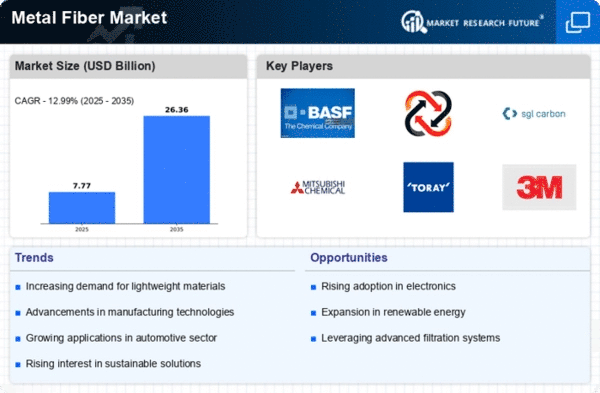
As per MRFR analysis, the Metal Fiber Market Size was estimated at 6.88 USD Billion in 2024. The Metal Fiber industry is projected to grow from 7.77 USD Billion in 2025 to 26.36 USD Billion by 2035, exhibiting a compound annual growth rate (CAGR) of 12.99 during the forecast period 2025 - 2035.

Key Market Trends & Highlights

The Metal Fiber Market is experiencing robust growth driven by technological advancements and increasing demand across various sectors.

  • Technological advancements are propelling innovations in the Metal Fiber Market, particularly in North America, which remains the largest market. The Asia-Pacific region is emerging as the fastest-growing area, driven by rising applications in aerospace and thermal management. Customization and specialization are becoming increasingly important, particularly in the automotive segment, which is currently the largest. Key market drivers include the rising demand in the automotive sector and advancements in manufacturing technologies, which are shaping the future of the Metal Fiber Market.

Market Size & Forecast

2024 Market Size 6.88 (USD Billion)
2035 Market Size 26.36 (USD Billion)
CAGR (2025 - 2035) 12.99%
Largest Regional Market Share in 2024 Asia-Pacific

Major Players

<p>BASF SE (DE), Hollingsworth &amp; Vose Company (US), SGL Carbon SE (DE), Mitsubishi Chemical Corporation (JP), Toray Industries, Inc. (JP), 3M Company (US), Parker Hannifin Corporation (US), Lindemann GmbH (DE)</p>

Market Trends

The Metal Fiber Market is currently experiencing a notable transformation, driven by advancements in technology and increasing demand across various industries. The integration of metal fibers into products enhances their performance, durability, and efficiency. This market is characterized by a diverse range of applications, including automotive, aerospace, electronics, and textiles. As industries seek to improve their products, the utilization of metal fibers appears to be a strategic choice, potentially leading to enhanced product offerings and competitive advantages. Furthermore, the growing emphasis on sustainability and eco-friendly materials is likely to influence the Metal Fiber Market, as manufacturers explore innovative solutions that align with environmental standards. In addition, the Metal Fiber Market is witnessing a shift towards customization and specialized applications. Companies are increasingly focusing on developing tailored solutions to meet specific customer needs, which may drive innovation and foster collaboration among stakeholders. The rise of smart technologies and the Internet of Things (IoT) could further propel the demand for metal fibers, as these materials are essential for creating advanced, interconnected systems. Overall, the Metal Fiber Market seems poised for growth, with various factors contributing to its evolution and expansion in the coming years.

Technological Advancements

The Metal Fiber Market is significantly influenced by ongoing technological innovations. These advancements facilitate the development of new manufacturing processes and applications, enhancing the performance characteristics of metal fibers. As industries adopt cutting-edge technologies, the demand for high-quality metal fibers is likely to increase, leading to improved product offerings.

Sustainability Focus

There is a growing emphasis on sustainability within the Metal Fiber Market. Manufacturers are increasingly seeking eco-friendly materials and processes to reduce their environmental impact. This trend may drive the adoption of recycled metal fibers and promote the development of sustainable production methods, aligning with global environmental goals.

Customization and Specialization

The trend towards customization is becoming more pronounced in the Metal Fiber Market. Companies are focusing on creating specialized solutions tailored to meet unique customer requirements. This shift may encourage innovation and collaboration among industry players, ultimately enhancing the market's adaptability and responsiveness to changing demands.

Metal Fiber Market Market Drivers

Growing Applications in Aerospace

The aerospace sector is emerging as a key driver for the Global Metal Fiber Market Industry, as manufacturers seek materials that can withstand extreme conditions while maintaining lightweight properties. Metal fibers are utilized in various applications, including thermal protection systems and structural components. The increasing focus on fuel efficiency and safety in aviation is likely to bolster demand for metal fibers. As the industry evolves, the market is expected to witness a compound annual growth rate (CAGR) of 9.33% from 2025 to 2035, highlighting the potential for growth within the Global Metal Fiber Market Industry.

Rising Demand in Automotive Sector

The Global Metal Fiber Market Industry experiences a notable surge in demand from the automotive sector, driven by the need for lightweight materials that enhance fuel efficiency. Metal fibers, known for their strength and durability, are increasingly utilized in manufacturing components such as brake pads and exhaust systems. This trend is projected to contribute significantly to the market's growth, with the industry expected to reach 2.63 USD Billion in 2024. As automotive manufacturers seek to comply with stringent emissions regulations, the adoption of metal fibers is likely to expand, indicating a robust future for the Global Metal Fiber Market Industry.

Increased Focus on Energy Efficiency

The Global Metal Fiber Market Industry is significantly influenced by the rising emphasis on energy efficiency across various sectors. Metal fibers are employed in applications such as insulation and filtration, contributing to reduced energy consumption and improved operational efficiency. Industries are increasingly adopting these materials to meet regulatory standards and sustainability goals. This trend is expected to drive the market's expansion, with projections indicating a growth trajectory that could see the industry valued at 2.63 USD Billion in 2024. The shift towards energy-efficient solutions underscores the relevance of metal fibers in contemporary manufacturing.

Emerging Markets and Global Expansion

Emerging markets are playing a pivotal role in the growth of the Global Metal Fiber Market Industry. Countries in Asia-Pacific and Latin America are witnessing increased industrialization, leading to heightened demand for metal fibers in various applications. The expansion of manufacturing capabilities in these regions is likely to create new opportunities for market players. As these markets develop, the Global Metal Fiber Market Industry could experience substantial growth, potentially reaching 7.02 USD Billion by 2035. This trend indicates a shift in global manufacturing dynamics, with metal fibers becoming integral to diverse industries.

Advancements in Manufacturing Technologies

Technological innovations in manufacturing processes are propelling the Global Metal Fiber Market Industry forward. Advanced techniques such as 3D printing and laser sintering enable the production of complex geometries and customized metal fiber components. These advancements not only enhance product performance but also reduce waste and production costs. As industries increasingly adopt these technologies, the market is poised for substantial growth, potentially reaching 7.02 USD Billion by 2035. The integration of smart manufacturing practices further indicates a transformative phase for the Global Metal Fiber Market Industry, fostering efficiency and sustainability.

Market Segment Insights

By Application: Automotive (Largest) vs. Aerospace (Fastest-Growing)

<p>The Metal Fiber Market is segmented into various applications, with automotive leading in market share due to its extensive use in vehicle manufacturing for components that require enhanced durability and lightweight structures. The aerospace sector follows closely, yet it is rapidly gaining momentum owing to the increasing demand for advanced materials in aircraft design. Other segments such as electronics, industrial, and medical contribute significantly but do not match the dominance of automotive and aerospace.</p>

<p>Automotive: Dominant vs. Aerospace: Emerging</p>

<p>The automotive sector is characterized by its significant volume consumption of metal fibers for parts such as exhaust systems and structural components, allowing for weight reduction and improved fuel efficiency. In contrast, the aerospace segment, while currently smaller, is emerging with various innovations in aircraft manufacturing, focusing on lightweight materials that provide superior strength and thermal resistance. With the growth of electric aviation and an increase in air travel, aerospace is poised to capture a larger market share over the coming years, driven by technological advancements and heightened safety regulations.</p>

By End Use: Filtration (Largest) vs. Thermal Management (Fastest-Growing)

<p>In the Metal Fiber Market, the end use segment is primarily dominated by filtration applications, which account for the largest share. This segment benefits from the growing demand for effective filtration solutions in various industries, including automotive, aerospace, and electronics. Furthermore, thermal management applications are gaining traction, as they provide critical advantages in heat dissipation, particularly in high-performance environments. As a result, there is a notable shift towards materials capable of providing advanced filtration and thermal management solutions.</p>

<p>Filtration (Dominant) vs. Thermal Management (Emerging)</p>

<p>Filtration is currently the dominant segment in the Metal Fiber Market, characterized by its extensive use in both industrial and residential applications. This segment excels in providing high-quality filtration solutions that enhance performance and efficiency in diverse environments. On the other hand, thermal management is an emerging segment that is rapidly gaining importance due to its integral role in electronic devices and automotive components. The need for efficient heat dissipation solutions drives innovations in metal fiber technologies that enable superior thermal regulation. As industries become more performance-oriented, the demand for both filtration and thermal management solutions is expected to grow, influencing future market dynamics.</p>

By Material Type: Stainless Steel (Largest) vs. Carbon Fiber (Fastest-Growing)

<p>The Metal Fiber Market exhibits a diverse composition across various material types, with Stainless Steel holding the largest market share due to its widespread applications in construction and manufacturing. Other materials like Copper and Aluminum also contribute significantly, catering to the electrical and automotive sectors respectively. Carbon Fiber, although currently smaller in share, is gaining traction rapidly owing to its lightweight properties and strength, making it increasingly popular in aerospace and automotive applications. Looking ahead, the growth trends in the Metal Fiber Market indicate a strong shift towards advanced materials such as Carbon Fiber, which is positioned as the fastest-growing segment driven by rising demand for lightweight and high-strength materials. Innovations in production techniques and the increasing focus on sustainability are paving the way for materials like Aluminum and Nickel to gain prominence, complemented by their recyclable characteristics that align with environmental priorities.</p>

Stainless Steel (Dominant) vs. Copper (Emerging)

Stainless Steel has established itself as the dominant material in the Metal Fiber Market, attributed to its versatility, durability, and corrosion resistance. This material is extensively used in various high-demand applications including construction, automotive, and medical devices. On the other hand, Copper is emerging as a significant player, leveraging its excellent conductive properties. It has seen increasing use in electrical applications and renewable energy sectors, particularly with the growth of electric vehicles and energy-efficient infrastructures. With advancements in material processing technologies, both materials are anticipated to further expand their market shares, catering to evolving industry demands.

By Form: Woven Fabrics (Largest) vs. Non-Woven Fabrics (Fastest-Growing)

In the Metal Fiber Market, the form segment is witnessing a diverse distribution among woven fabrics, non-woven fabrics, metal mesh, fibers, and composites. Woven fabrics currently hold the largest share due to their established applications in industrial and technical textiles, providing strength and durability. Non-woven fabrics, on the other hand, are rapidly gaining traction, particularly in applications that require enhanced performance, which has made it the fastest-growing segment in this market.

Woven Fabrics (Dominant) vs. Non-Woven Fabrics (Emerging)

Woven fabrics in the Metal Fiber Market are characterized by their interlacing of metal fibers, resulting in robust textile structures that cater to high-performance requirements. Their dominant position is attributed to applications in protective clothing, insulation, and various industrial uses, ensuring longevity and reliability. Conversely, non-woven fabrics are emerging prominently, primarily due to their versatility and ease of production. They are increasingly used in automotive, healthcare, and filtration applications, capitalizing on their lightweight nature and cost-effectiveness while meeting growing demands for specialized properties.

Get more detailed insights about Metal Fiber Market Research Report - Global Forecast till 2035

Regional Insights

North America : Innovation and Demand Growth

The North American metal fiber market is poised for growth, driven by increasing demand in aerospace, automotive, and electronics sectors. With a market size of $1.5 billion, the region is witnessing a surge in applications requiring lightweight and high-strength materials. Regulatory support for advanced manufacturing technologies is further catalyzing this growth, as companies seek to innovate and enhance product performance. Leading countries like the US and Canada are at the forefront, with key players such as 3M Company and Parker Hannifin Corporation driving competition. The presence of established manufacturers and a robust supply chain contribute to a dynamic market landscape. As industries increasingly adopt metal fibers for their unique properties, North America is set to solidify its position as a key player in the global market.

Europe : Sustainable Manufacturing Focus

Europe's metal fiber market, valued at $1.8 billion, is characterized by a strong emphasis on sustainability and innovation. The region is experiencing growth due to stringent regulations promoting eco-friendly manufacturing processes and materials. This regulatory environment is encouraging investments in research and development, particularly in countries like Germany and France, which are leading the charge in adopting advanced metal fiber technologies. Germany, home to major players like BASF SE and SGL Carbon SE, is a key market driver. The competitive landscape is marked by a focus on high-performance applications in automotive and aerospace sectors. As European manufacturers prioritize sustainability, the demand for metal fibers is expected to rise, positioning the region as a leader in the global market.

Asia-Pacific : Emerging Market Leader

Asia-Pacific is the largest market for metal fibers, with a remarkable size of $3.5 billion. The region's growth is fueled by rapid industrialization, increasing demand in electronics, and automotive sectors. Countries like Japan and China are leading this surge, supported by favorable government policies and investments in advanced manufacturing technologies. The region's market share reflects a strong trend towards lightweight materials that enhance product efficiency and performance. Japan, with key players like Mitsubishi Chemical Corporation and Toray Industries, is at the forefront of innovation in metal fiber applications. The competitive landscape is vibrant, with numerous local and international companies vying for market share. As the region continues to expand its manufacturing capabilities, the demand for metal fibers is expected to grow significantly, solidifying its global leadership position.

Middle East and Africa : Emerging Opportunities

The Middle East and Africa (MEA) metal fiber market, valued at $0.08 billion, is in its nascent stages but shows promising growth potential. The region is gradually adopting advanced materials in construction and manufacturing sectors, driven by infrastructural developments and increasing industrial activities. Government initiatives aimed at diversifying economies are also contributing to the demand for innovative materials like metal fibers. Countries such as South Africa and the UAE are emerging as key players in this market. While the competitive landscape is still developing, the presence of international companies is beginning to shape the market dynamics. As local industries evolve and seek advanced solutions, the MEA region is expected to witness a gradual increase in metal fiber adoption, paving the way for future growth.

Key Players and Competitive Insights

The Metal Fiber Market is currently characterized by a dynamic competitive landscape, driven by increasing demand across various sectors such as automotive, aerospace, and electronics. Key players are actively engaging in strategies that emphasize innovation, sustainability, and regional expansion. For instance, BASF SE (DE) has been focusing on enhancing its product portfolio through advanced material science, while 3M Company (US) is leveraging its extensive research capabilities to develop high-performance metal fibers. These strategies not only bolster their market positions but also contribute to a more competitive environment, as companies strive to differentiate themselves through technological advancements and sustainable practices.In terms of business tactics, companies are increasingly localizing manufacturing to reduce lead times and optimize supply chains. This approach appears to be particularly effective in a moderately fragmented market, where the collective influence of key players shapes pricing strategies and product availability. The competitive structure is evolving, with companies like Hollingsworth & Vose Company (US) and SGL Carbon SE (DE) adopting supply chain optimization techniques to enhance operational efficiency and responsiveness to market demands.


In November Mitsubishi Chemical Corporation (JP) announced a strategic partnership with a leading automotive manufacturer to develop lightweight metal fiber composites aimed at improving fuel efficiency. This collaboration is significant as it not only aligns with the growing trend towards sustainability in the automotive sector but also positions Mitsubishi as a key player in the development of innovative materials that meet stringent regulatory standards.Similarly, in October 2025, Toray Industries, Inc. (JP) unveiled a new line of metal fibers designed for use in high-temperature applications, targeting the aerospace industry. This launch is indicative of Toray's commitment to innovation and its strategic focus on high-value markets, which could potentially enhance its competitive edge in a sector that demands advanced materials capable of withstanding extreme conditions.Furthermore, in September 2025, Parker Hannifin Corporation (US) expanded its manufacturing capabilities in Europe, aiming to cater to the increasing demand for metal fibers in the region. This expansion not only reflects Parker's strategic intent to localize production but also underscores the importance of regional responsiveness in a competitive landscape where supply chain reliability is paramount.


As of December current trends in the Metal Fiber Market are increasingly defined by digitalization, sustainability, and the integration of AI technologies. Strategic alliances are becoming more prevalent, as companies recognize the need to collaborate in order to innovate and meet evolving customer demands. The competitive differentiation is likely to shift from traditional price-based competition towards a focus on innovation, technological advancements, and supply chain reliability, suggesting that companies that prioritize these aspects will be better positioned for future success.

Key Companies in the Metal Fiber Market include

Industry Developments

Future Outlook

Metal Fiber Market Future Outlook

<p>The Metal Fiber Market is projected to grow at a 12.99% CAGR from 2025 to 2035, driven by advancements in manufacturing technologies, increasing demand in automotive applications, and rising adoption in electronics.</p>

New opportunities lie in:

  • <p>Development of high-performance metal fiber composites for aerospace applications. Expansion into emerging markets with tailored metal fiber solutions. Investment in R&amp;D for innovative metal fiber production techniques.</p>

<p>By 2035, the Metal Fiber Market is expected to achieve substantial growth, solidifying its position as a key industry player.</p>

Market Segmentation

Metal Fiber Market Form Outlook

  • Woven Fabrics
  • Non-Woven Fabrics
  • Metal Mesh
  • Fibers
  • Composites

Metal Fiber Market End Use Outlook

  • Filtration
  • Thermal Management
  • Electromagnetic Shielding
  • Reinforcement
  • Heating Elements

Metal Fiber Market Application Outlook

  • Automotive
  • Aerospace
  • Electronics
  • Industrial
  • Medical

Metal Fiber Market Material Type Outlook

  • Stainless Steel
  • Copper
  • Aluminum
  • Nickel
  • Carbon Fiber

Report Scope

MARKET SIZE 2024 6.88(USD Billion)
MARKET SIZE 2025 7.77(USD Billion)
MARKET SIZE 2035 26.36(USD Billion)
COMPOUND ANNUAL GROWTH RATE (CAGR) 12.99% (2025 - 2035)
REPORT COVERAGE Revenue Forecast, Competitive Landscape, Growth Factors, and Trends
BASE YEAR 2024
Market Forecast Period 2025 - 2035
Historical Data 2019 - 2024
Market Forecast Units USD Billion
Key Companies Profiled BASF SE (DE), Hollingsworth & Vose Company (US), SGL Carbon SE (DE), Mitsubishi Chemical Corporation (JP), Toray Industries, Inc. (JP), 3M Company (US), Parker Hannifin Corporation (US), Lindemann GmbH (DE)
Segments Covered Application, End Use, Material Type, Form
Key Market Opportunities Growing demand for lightweight materials in automotive and aerospace sectors drives innovation in the Metal Fiber Market.
Key Market Dynamics Rising demand for lightweight materials drives innovation and competition in the metal fiber market.
Countries Covered North America, Europe, APAC, South America, MEA

FAQs

What was the metal fiber market valuation in 2035?

The valuation was USD 4.5 billion.

What CAGR, the metal fiber market could achieve during the forecast period of 2024-2035?

The market could achieve 9.30% CAGR during the forecast period of 2025-2035.

What factors can hold back the metal fiber market?

The metal fiber market has restraints like rigidity, lack of flexibility, and high manufacturing cost.

Name the end users taking part in the metal fiber market?

The metal fiber market has end users like textiles, automotive, glass, plastic, and others.

Which region would lead the metal fiber market growth?

North America would dominate the global metal fiber market.

  1. SECTION I: EXECUTIVE SUMMARY AND KEY HIGHLIGHTS
    1. | 1.1 EXECUTIVE SUMMARY
    2. | 1.1.1 Market Overview
    3. | 1.1.2 Key Findings
    4. | 1.1.3 Market Segmentation
    5. | 1.1.4 Competitive Landscape
    6. | 1.1.5 Challenges and Opportunities
    7. | 1.1.6 Future Outlook
  2. SECTION II: SCOPING, METHODOLOGY AND MARKET STRUCTURE
    1. | 2.1 MARKET INTRODUCTION
    2. | 2.1.1 Definition
    3. | 2.1.2 Scope of the study
    4. |-- 2.1.2.1 Research Objective
    5. |-- 2.1.2.2 Assumption
    6. |-- 2.1.2.3 Limitations
    7. | 2.2 RESEARCH METHODOLOGY
    8. | 2.2.1 Overview
    9. | 2.2.2 Data Mining
    10. | 2.2.3 Secondary Research
    11. | 2.2.4 Primary Research
    12. |-- 2.2.4.1 Primary Interviews and Information Gathering Process
    13. |-- 2.2.4.2 Breakdown of Primary Respondents
    14. | 2.2.5 Forecasting Model
    15. | 2.2.6 Market Size Estimation
    16. |-- 2.2.6.1 Bottom-Up Approach
    17. |-- 2.2.6.2 Top-Down Approach
    18. | 2.2.7 Data Triangulation
    19. | 2.2.8 Validation
  3. SECTION III: QUALITATIVE ANALYSIS
    1. | 3.1 MARKET DYNAMICS
    2. | 3.1.1 Overview
    3. | 3.1.2 Drivers
    4. | 3.1.3 Restraints
    5. | 3.1.4 Opportunities
    6. | 3.2 MARKET FACTOR ANALYSIS
    7. | 3.2.1 Value chain Analysis
    8. | 3.2.2 Porter's Five Forces Analysis
    9. |-- 3.2.2.1 Bargaining Power of Suppliers
    10. |-- 3.2.2.2 Bargaining Power of Buyers
    11. |-- 3.2.2.3 Threat of New Entrants
    12. |-- 3.2.2.4 Threat of Substitutes
    13. |-- 3.2.2.5 Intensity of Rivalry
    14. | 3.2.3 COVID-19 Impact Analysis
    15. |-- 3.2.3.1 Market Impact Analysis
    16. |-- 3.2.3.2 Regional Impact
    17. |-- 3.2.3.3 Opportunity and Threat Analysis
  4. SECTION IV: QUANTITATIVE ANALYSIS
    1. | 4.1 Chemicals and Materials, BY Application (USD Billion)
    2. | 4.1.1 Automotive
    3. | 4.1.2 Aerospace
    4. | 4.1.3 Electronics
    5. | 4.1.4 Industrial
    6. | 4.1.5 Medical
    7. | 4.2 Chemicals and Materials, BY End Use (USD Billion)
    8. | 4.2.1 Filtration
    9. | 4.2.2 Thermal Management
    10. | 4.2.3 Electromagnetic Shielding
    11. | 4.2.4 Reinforcement
    12. | 4.2.5 Heating Elements
    13. | 4.3 Chemicals and Materials, BY Material Type (USD Billion)
    14. | 4.3.1 Stainless Steel
    15. | 4.3.2 Copper
    16. | 4.3.3 Aluminum
    17. | 4.3.4 Nickel
    18. | 4.3.5 Carbon Fiber
    19. | 4.4 Chemicals and Materials, BY Form (USD Billion)
    20. | 4.4.1 Woven Fabrics
    21. | 4.4.2 Non-Woven Fabrics
    22. | 4.4.3 Metal Mesh
    23. | 4.4.4 Fibers
    24. | 4.4.5 Composites
    25. | 4.5 Chemicals and Materials, BY Region (USD Billion)
    26. | 4.5.1 North America
    27. |-- 4.5.1.1 US
    28. |-- 4.5.1.2 Canada
    29. | 4.5.2 Europe
    30. |-- 4.5.2.1 Germany
    31. |-- 4.5.2.2 UK
    32. |-- 4.5.2.3 France
    33. |-- 4.5.2.4 Russia
    34. |-- 4.5.2.5 Italy
    35. |-- 4.5.2.6 Spain
    36. |-- 4.5.2.7 Rest of Europe
    37. | 4.5.3 APAC
    38. |-- 4.5.3.1 China
    39. |-- 4.5.3.2 India
    40. |-- 4.5.3.3 Japan
    41. |-- 4.5.3.4 South Korea
    42. |-- 4.5.3.5 Malaysia
    43. |-- 4.5.3.6 Thailand
    44. |-- 4.5.3.7 Indonesia
    45. |-- 4.5.3.8 Rest of APAC
    46. | 4.5.4 South America
    47. |-- 4.5.4.1 Brazil
    48. |-- 4.5.4.2 Mexico
    49. |-- 4.5.4.3 Argentina
    50. |-- 4.5.4.4 Rest of South America
    51. | 4.5.5 MEA
    52. |-- 4.5.5.1 GCC Countries
    53. |-- 4.5.5.2 South Africa
    54. |-- 4.5.5.3 Rest of MEA
  5. SECTION V: COMPETITIVE ANALYSIS
    1. | 5.1 Competitive Landscape
    2. | 5.1.1 Overview
    3. | 5.1.2 Competitive Analysis
    4. | 5.1.3 Market share Analysis
    5. | 5.1.4 Major Growth Strategy in the Chemicals and Materials
    6. | 5.1.5 Competitive Benchmarking
    7. | 5.1.6 Leading Players in Terms of Number of Developments in the Chemicals and Materials
    8. | 5.1.7 Key developments and growth strategies
    9. |-- 5.1.7.1 New Product Launch/Service Deployment
    10. |-- 5.1.7.2 Merger & Acquisitions
    11. |-- 5.1.7.3 Joint Ventures
    12. | 5.1.8 Major Players Financial Matrix
    13. |-- 5.1.8.1 Sales and Operating Income
    14. |-- 5.1.8.2 Major Players R&D Expenditure. 2023
    15. | 5.2 Company Profiles
    16. | 5.2.1 BASF SE (DE)
    17. |-- 5.2.1.1 Financial Overview
    18. |-- 5.2.1.2 Products Offered
    19. |-- 5.2.1.3 Key Developments
    20. |-- 5.2.1.4 SWOT Analysis
    21. |-- 5.2.1.5 Key Strategies
    22. | 5.2.2 Hollingsworth & Vose Company (US)
    23. |-- 5.2.2.1 Financial Overview
    24. |-- 5.2.2.2 Products Offered
    25. |-- 5.2.2.3 Key Developments
    26. |-- 5.2.2.4 SWOT Analysis
    27. |-- 5.2.2.5 Key Strategies
    28. | 5.2.3 SGL Carbon SE (DE)
    29. |-- 5.2.3.1 Financial Overview
    30. |-- 5.2.3.2 Products Offered
    31. |-- 5.2.3.3 Key Developments
    32. |-- 5.2.3.4 SWOT Analysis
    33. |-- 5.2.3.5 Key Strategies
    34. | 5.2.4 Mitsubishi Chemical Corporation (JP)
    35. |-- 5.2.4.1 Financial Overview
    36. |-- 5.2.4.2 Products Offered
    37. |-- 5.2.4.3 Key Developments
    38. |-- 5.2.4.4 SWOT Analysis
    39. |-- 5.2.4.5 Key Strategies
    40. | 5.2.5 Toray Industries, Inc. (JP)
    41. |-- 5.2.5.1 Financial Overview
    42. |-- 5.2.5.2 Products Offered
    43. |-- 5.2.5.3 Key Developments
    44. |-- 5.2.5.4 SWOT Analysis
    45. |-- 5.2.5.5 Key Strategies
    46. | 5.2.6 3M Company (US)
    47. |-- 5.2.6.1 Financial Overview
    48. |-- 5.2.6.2 Products Offered
    49. |-- 5.2.6.3 Key Developments
    50. |-- 5.2.6.4 SWOT Analysis
    51. |-- 5.2.6.5 Key Strategies
    52. | 5.2.7 Parker Hannifin Corporation (US)
    53. |-- 5.2.7.1 Financial Overview
    54. |-- 5.2.7.2 Products Offered
    55. |-- 5.2.7.3 Key Developments
    56. |-- 5.2.7.4 SWOT Analysis
    57. |-- 5.2.7.5 Key Strategies
    58. | 5.2.8 Lindemann GmbH (DE)
    59. |-- 5.2.8.1 Financial Overview
    60. |-- 5.2.8.2 Products Offered
    61. |-- 5.2.8.3 Key Developments
    62. |-- 5.2.8.4 SWOT Analysis
    63. |-- 5.2.8.5 Key Strategies
    64. | 5.3 Appendix
    65. | 5.3.1 References
    66. | 5.3.2 Related Reports

Chemicals and Materials Market Segmentation

Chemicals and Materials By Application (USD Billion, 2025-2035)

  • Automotive
  • Aerospace
  • Electronics
  • Industrial
  • Medical

Chemicals and Materials By End Use (USD Billion, 2025-2035)

  • Filtration
  • Thermal Management
  • Electromagnetic Shielding
  • Reinforcement
  • Heating Elements

Chemicals and Materials By Material Type (USD Billion, 2025-2035)

  • Stainless Steel
  • Copper
  • Aluminum
  • Nickel
  • Carbon Fiber

Chemicals and Materials By Form (USD Billion, 2025-2035)

  • Woven Fabrics
  • Non-Woven Fabrics
  • Metal Mesh
  • Fibers
  • Composites
Infographic

Free Sample Request

Kindly complete the form below to receive a free sample of this Report

Get Free Sample

Customer Strories

Compare Licence

×
Features License Type
Single User Multiuser License Enterprise User
Price $4,950 $5,950 $7,250
Maximum User Access Limit 1 User Upto 10 Users Unrestricted Access Throughout the Organization
Free Customization
Direct Access to Analyst
Deliverable Format
Platform Access
Discount on Next Purchase 10% 15% 15%
Printable Versions