×
Request Free Sample ×

Kindly complete the form below to receive a free sample of this Report

* Please use a valid business email

Leading companies partner with us for data-driven Insights

clients tt-cursor
Hero Background
English
Chinese
French
Japanese
Korean
German
Spanish

Metal Carboxylates Market Size

ID: MRFR/CnM/6953-CR
203 Pages
Anshula Mandaokar
March 2023

Metal Carboxylates Market Research Report Information By product Type (Primary Drier Metals, Through Drier Metals, Auxiliary Drier Metals, Cobalt, Manganese, Iron and others), By Application (Catalysts, Lubricant Additives, Driers, Plastic Stabilizers, Polyester Accelerators, Fuel Additives, and Others) And By Region (North America, Europe, Asia-Pacific, Latin America And Middle East & Africa) - Forecast Till 2035

Share:
Download PDF ×

We do not share your information with anyone. However, we may send you emails based on your report interest from time to time. You may contact us at any time to opt-out.

Metal Carboxylates Market Infographic
×
Metal Carboxylates Market Infographic Full View
Purchase Options

Metal Carboxylates Size

Metal Carboxylates Market Growth Projections and Opportunities

Various factors influence the growth and dynamics of the Metal Carboxylates Market. The fact that metal carboxylates are used widely as catalysts and stabilizers in the production of polymers, resins and coatings is a key driver. These compounds, known as metal soaps, have excellent catalytic as well as stabilizing properties which are essential in the manufacturing processes of many industrial products.

On the other hand, the demand for metal carboxylates is influenced by the growth in end-use industries such as paints and coatings, plastics and adhesives which has led to market expansion. In 2021, Metal Carboxylates Market Size was valued at USD 5,271 million. The Metal Carboxylates market size will grow from USD 5,271.6 million in 2022 to USD 7,964.2 million in 2030 at a CAGR of 5.28%.

Additionally, construction industry especially contributes to shaping of this market of metal carboxylates. This results into coatings with long lasting attributes that enhance durability and aesthetic appeal on architectural structures since these agents are extensively employed as driers alongside paints or varnishes [8]. Worldwide increase in construction activities caused by urbanization coupled with infrastructural development and rehabilitation projects drives up demand for metal carboxylates based corrosion resistant coatings with improved drying times.

Moreover, automotive sector is one of themajor consumer areas for metal carboxylates since they find wide usage within automobiles’ coating industry . These substances act like cross linkers or stabilizers that help enhance performance properties including adhesion strength resistance against rusting or weathering resistance [8]. Automobile manufacturers increasingly put emphasis on excellence finishings together with durability thereby raising demand for metallic salt catalysts applicable to automobile paints.

The overall growth of chemical industry is also contributing factor for metal carboxylates due to its application in different chemical processes. Metal carboxylates function as catalysts and reaction accelerators during the synthesis of polymers, polyesters and other chemicals. The vast range of applications for metal carboxylates make them vital components in chemical manufacturing which determines the overall market dynamics.

Moreover, the global shift towards environmentally friendly solutions and regulatory considerations also impact on the metal carboxylates market. The demand for metal carboxylates that are eco-friendly is rising due to tightening environmental regulations. Manufacturers are developing formulations that contain no heavy metals and are low in volatile organic compounds (VOC) to comply with environment regulations as well as cater for the preference of industries and consumers who prefer sustainable products.

Consequently, some challenges may be faced by the metal carboxylate market due to some factors such as fluctuation in prices of raw materials notably metals along with economic uncertainties that might occur. This can also affect production costs of these substances[3]. On the other hand, general economic instability may cause changes within industry thereby influencing overall consumption levels for all types of these compounds.
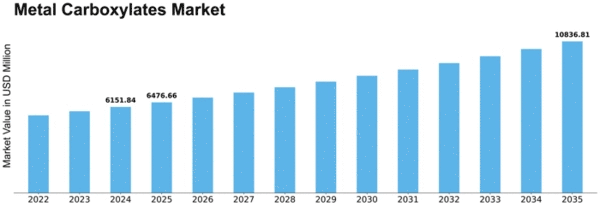
Metal Carboxylates Market Size Graph
Author
Anshula Mandaokar
Team Lead - Research

Anshula Mandaokar holds an academic degree in Chemical Engineering and has been contributing to the field for more than 5 years. She has expertise in Market Research and Business Consulting and serves as a Team Lead for a reputed Market Research firm under the Chemicals and Materials domain spectrum. She has worked on multiple projects, generating explicit results in a quick turnaround time. Her understanding of data interpretation justifies her role as a leader.

Leave a Comment

FAQs

How much is the Metal Carboxylates market?

USD 6,151.84 million in 2024

How Big is the U.S Metal Carboxylates market?

USD 1074 million

What is the growth rate of the Metal Carboxylates market?

5.3%

Which region held the largest market share in the Metal Carboxylates market?

Asia-Pacific

Who are the key players in the Metal Carboxylates market?

Organometals, DIC CORPORATION, DURA Chemicals, Inc., NICHIA CORPORATION, Comar Chemicals, EGE KIMYA, The Shepherd Chemical Company, Borchers Inc., Baerlocher, Patcham, Nihon Kagayu Sangyo, and Others

Market Summary

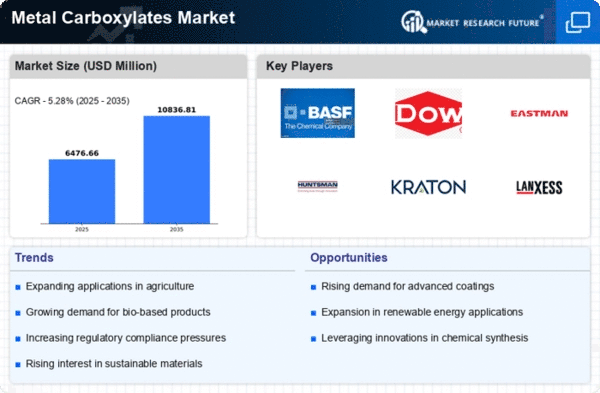
As per MRFR analysis, the Metal Carboxylates Market Size was estimated at 6151.84 USD Million in 2024. The Metal Carboxylates industry is projected to grow from 6476.78 USD Million in 2025 to 10836.81 USD Million by 2035, exhibiting a compound annual growth rate (CAGR) of 5.28 during the forecast period 2025 - 2035.

Key Market Trends & Highlights

The Metal Carboxylates Market is poised for growth driven by sustainability and technological advancements.

  • The market is experiencing a notable shift towards sustainability, influencing production and consumption patterns. Technological advancements are enhancing the efficiency and performance of metal carboxylates across various applications. North America remains the largest market, while Asia-Pacific is emerging as the fastest-growing region in this sector. Rising demand in emerging economies and regulatory support for sustainability initiatives are key drivers propelling market expansion.

Market Size & Forecast

2024 Market Size 6151.84 (USD Million)
2035 Market Size 10836.81 (USD Million)
CAGR (2025 - 2035) 5.28%
Largest Regional Market Share in 2024 North America

Major Players

<p>BASF SE (DE), DOW Chemical Company (US), Eastman Chemical Company (US), Huntsman Corporation (US), Kraton Corporation (US), Lanxess AG (DE), Mitsubishi Chemical Corporation (JP), Solvay S.A. (BE), Wacker Chemie AG (DE)</p>

Market Trends

The Metal Carboxylates Market is currently experiencing a dynamic phase characterized by evolving applications and increasing demand across various industries. These compounds, which are metal salts of carboxylic acids, find utility in sectors such as coatings, plastics, and agriculture. The versatility of metal carboxylates, particularly in enhancing product performance and stability, appears to drive their adoption. Furthermore, the growing emphasis on sustainable practices and eco-friendly materials may influence the market landscape, as manufacturers seek alternatives that align with environmental regulations and consumer preferences. In addition, the Metal Carboxylates Market seems poised for growth due to advancements in technology and innovation. Research and development efforts are likely to yield new formulations and applications, potentially expanding the scope of metal carboxylates in emerging markets. As industries increasingly prioritize efficiency and effectiveness, the demand for high-performance additives is expected to rise. Overall, the Metal Carboxylates Market reflects a complex interplay of factors that could shape its trajectory in the coming years.

Sustainability Focus

The Metal Carboxylates Market is witnessing a notable shift towards sustainable practices. Manufacturers are increasingly prioritizing eco-friendly formulations, which aligns with global trends in environmental responsibility. This focus on sustainability may drive innovation in product development, leading to the creation of greener alternatives that meet regulatory standards.

Technological Advancements

Technological progress is playing a crucial role in the evolution of the Metal Carboxylates Market. Innovations in production processes and formulation techniques are likely to enhance the performance characteristics of these compounds. As a result, industries may benefit from improved efficiency and effectiveness in their applications.

Diverse Applications

The versatility of metal carboxylates is contributing to their expanding applications across various sectors. From agriculture to coatings, these compounds are being utilized in a range of products. This diversification may lead to increased demand as industries recognize the benefits of incorporating metal carboxylates into their formulations.

Metal Carboxylates Market Market Drivers

Rising Demand in Agriculture

The Global Metal Carboxylates Market Industry is experiencing a surge in demand due to the increasing utilization of metal carboxylates as effective agricultural additives. These compounds serve as essential components in fertilizers and pesticides, enhancing nutrient absorption and crop yield. As global food production needs escalate, driven by population growth and changing dietary patterns, the market for metal carboxylates is projected to grow. This trend is particularly evident in regions with intensive agricultural practices, where the market is expected to contribute significantly to the overall growth of the industry.

Growth in Coatings and Paints Sector

The Global Metal Carboxylates Market Industry benefits from the expanding coatings and paints sector, where metal carboxylates are utilized as drying agents and catalysts. The increasing demand for high-performance coatings in automotive, construction, and industrial applications drives this growth. As environmental regulations become more stringent, the shift towards eco-friendly and low-VOC formulations further propels the adoption of metal carboxylates. This sector is anticipated to play a crucial role in the market's expansion, with projections indicating a market value of 6.15 USD Billion in 2024, reflecting the growing significance of these compounds in modern coatings.

Emerging Markets and Global Expansion

The Global Metal Carboxylates Market Industry is poised for growth as emerging markets, particularly in Asia-Pacific and Latin America, continue to expand their industrial bases. Increased urbanization and economic development in these regions are driving demand for metal carboxylates across various applications, including agriculture, coatings, and pharmaceuticals. As these markets mature, the adoption of advanced chemical products is likely to rise, further fueling the industry's growth. This trend suggests a promising outlook for metal carboxylates, as they become integral to the evolving industrial landscape in these regions.

Advancements in Chemical Manufacturing

Technological advancements in chemical manufacturing processes are poised to enhance the production efficiency of metal carboxylates, thereby impacting the Global Metal Carboxylates Market Industry positively. Innovations such as green chemistry and sustainable production methods are likely to reduce costs and improve yield. This evolution in manufacturing practices aligns with global sustainability goals, making metal carboxylates more appealing to manufacturers and consumers alike. As these advancements continue, the market is expected to witness a compound annual growth rate of 5.28% from 2025 to 2035, indicating a robust future for the industry.

Increasing Applications in Pharmaceuticals

The Global Metal Carboxylates Market Industry is witnessing growth due to the expanding applications of metal carboxylates in the pharmaceutical sector. These compounds are utilized as intermediates in drug synthesis and as stabilizers in formulations. The rising demand for innovative drug delivery systems and the development of new therapeutics are driving this trend. As pharmaceutical companies seek to enhance the efficacy and stability of their products, the role of metal carboxylates becomes increasingly critical. This sector's growth is expected to contribute significantly to the overall market, particularly as the industry anticipates reaching a value of 10.8 USD Billion by 2035.

Market Segment Insights

By Application: Additives (Largest) vs. Lubricants (Fastest-Growing)

<p>In the Metal Carboxylates Market, the application segment is characterized by a diverse range of uses, with additives holding the largest share. Additives are crucial in enhancing the properties of end products, enabling better functionality and performance across various industries. Meanwhile, <a href="https://www.marketresearchfuture.com/reports/lubricants-market-5449">lubricants</a> are gaining attention as the fastest-growing application segment, driven by the increasing demand for high-performance machinery and automotive components. This emerging segment is witnessing rapid innovation and adaptability, catering to the specifics of modern machinery requirements. Growth trends within the application segment reflect a robust demand for high-quality and efficient solutions. The drive towards sustainability and eco-friendliness is also influencing the market, prompting the concurrent development of bio-based metal carboxylates. As industries continue to explore new technologies and enhanced formulations, catalysts and stabilizers are also seeing steady growth, albeit at a slower rate compared to lubricants, which are revolutionizing product applications through innovative formulations and performance improvements.</p>

<p>Additives (Dominant) vs. Lubricants (Emerging)</p>

<p>Additives in the Metal Carboxylates Market play a dominant role by providing essential enhancements to chemical and material properties, ensuring that products meet industry standards and customer expectations. This segment encompasses a variety of chemicals that improve stability, performance, and lifespan of products. On the other hand, lubricants represent an emerging sector responding rapidly to the technological advancements in machinery and automotive industries. Their performance is increasingly vital to ensuring efficiency and reducing wear and tear within mechanical systems. The growth of this segment is propelled by the rising emphasis on green lubricants and performance-enhancing additives, which align with global sustainability trends. Therefore, while additives remain a cornerstone of the market, lubricants are quickly carving out their niche as essential components in modern industrial applications.</p>

By End Use Industry: Automotive (Largest) vs. Agriculture (Fastest-Growing)

<p>In the Metal Carboxylates Market, the end-use industry distribution is notably diverse, with automotive applications commanding a substantial share. This segment leverages metal carboxylates for various functions, including corrosion resistance and as catalysts in manufacturing processes. Meanwhile, agriculture is emerging rapidly, fueled by the rising demand for agrochemicals and more efficient farming practices, indicating a shift in market dynamics towards this sector.</p>

<p>Automotive (Dominant) vs. Agriculture (Emerging)</p>

<p>The automotive segment stands out as the dominant force in the Metal Carboxylates Market, utilized extensively in coatings and additives due to its excellent properties for enhancing durability and performance. On the other hand, the agriculture segment is marked as emerging, driven by increasing awareness of sustainable farming practices and the need for advanced agricultural chemicals. The growing push towards biopesticides and eco-friendly choices in farming is elevating the role of metal carboxylates in enhancing crop yield and ensuring environmental compliance.</p>

By Type: Sodium Carboxylates (Largest) vs. Zinc Carboxylates (Fastest-Growing)

<p>In the Metal Carboxylates Market, Sodium Carboxylates have emerged as the largest segment, commanding a significant market share due to their versatile applications in industries such as coatings, lubricants, and personal care products. Following closely are Calcium and Zinc Carboxylates, which also hold substantial shares, while Copper and Magnesium Carboxylates represent a smaller yet important portion of the market, appealing to niche applications. This segmentation illustrates the varied demand patterns for metal carboxylates across different sectors, with Sodium Carboxylates leading the way.</p>

<p>Sodium Carboxylates (Dominant) vs. Zinc Carboxylates (Emerging)</p>

<p>Sodium Carboxylates are recognized for their extensive use in the formulation of detergents, surfactants, and as stabilizers, making them a dominant force in the Metal Carboxylates Market. Their efficiency and cost-effectiveness facilitate wide adoption across various industrial applications. In contrast, Zinc Carboxylates are emerging as a rapidly growing segment due to increasing demand for eco-friendly and sustainable solutions in coatings and agricultural sectors. They offer unique properties, such as enhanced thermal stability and environmental benefits, positioning them favorably in a market that increasingly favors green chemistry. This dynamic illustrates how traditional dominance can be challenged by innovative and emerging alternatives.</p>

By Form: Liquid (Largest) vs. Powder (Fastest-Growing)

<p>In the Metal Carboxylates Market, the 'Form' segment is primarily dominated by the Liquid category, which holds a significant market share due to its versatility and applicability across various industries, including coatings, adhesives, and agriculture. This segment benefits from the ease of incorporation in formulations and its effectiveness as a precursor in chemical processes. The Powder and Granular forms are also notable, catering to specific use-cases where physical characteristics of metal carboxylates matter, thus diversifying the market further.</p>

<p>Liquid (Dominant) vs. Powder (Emerging)</p>

<p>The Liquid form of metal carboxylates is recognized as the dominant segment within the market, owing to its unique properties that enhance solubility and reactivity in diverse applications. It is widely favored in sectors like agrochemicals and industrial coatings, where seamless incorporation is vital. Meanwhile, the Powder form, while currently classified as emerging, is gaining traction due to its ease of handling and specific application advantages in areas like battery technology and catalysis. As industries seek more adaptable options, the Powder form is expected to experience rapid growth, driven by innovation and a shift towards more efficient production methods.</p>

By Functionality: Corrosion Inhibitors (Largest) vs. Dispersants (Fastest-Growing)

<p>In the Metal Carboxylates Market, the functionality segment is notably varied, with Corrosion Inhibitors holding a significant share due to their essential role in maintaining metal integrity across various applications. On the other hand, Dispersants are emerging rapidly, driven by increasing demand in industries such as automotive and manufacturing, where they aid in enhancing product performance by preventing agglomeration of particles. Surface Modifiers and Emulsifiers, while important, currently occupy minor shares in comparison to the leading roles played by Corrosion Inhibitors and the rising contribution of Dispersants.</p>

<p>Corrosion Inhibitors (Dominant) vs. Surface Modifiers (Emerging)</p>

<p>Corrosion Inhibitors are paramount in the Metal Carboxylates Market, primarily utilized to prevent corrosion in metals used in harsh environments. Their widespread application across industries such as automotive, construction, and marine enhances their market strength, positioning them as the dominant functionality segment. Conversely, Surface Modifiers are gaining traction as an emerging segment, offering improvements in adhesion and surface properties of various products. The increased focus on enhancing product durability and performance drives their adoption. As manufacturers seek advancements in product efficacy, Surface Modifiers are expected to experience significant growth, appealing particularly to sectors aiming for innovative solutions in coatings and treatments.</p>

Get more detailed insights about Metal Carboxylates Market Global Research Report - Forecast till 2035

Regional Insights

North America : Market Leader in Metal Carboxylates

North America is poised to maintain its leadership in the Metal Carboxylates market, holding a significant share of 3075.92 million in 2024. The region's growth is driven by increasing demand in various applications, including coatings and plastics, alongside stringent environmental regulations promoting the use of eco-friendly products. The presence of major players like DOW Chemical and BASF SE further fuels market expansion, supported by innovation and technological advancements. The United States stands as the largest market, contributing significantly to the regional revenue. Key players such as Eastman Chemical and Huntsman Corporation are actively investing in R&D to enhance product offerings. The competitive landscape is characterized by strategic partnerships and mergers, aimed at increasing market penetration. With a robust regulatory framework encouraging sustainable practices, North America is set for continued growth in the Metal Carboxylates sector.

Europe : Emerging Market with Growth Potential

Europe's Metal Carboxylates market is valued at 1845.1 million, reflecting a growing trend towards sustainable and innovative chemical solutions. The region's growth is propelled by increasing demand in automotive and construction sectors, alongside regulatory frameworks that promote the use of environmentally friendly materials. The European Union's commitment to sustainability and circular economy principles is a key driver for market expansion, encouraging investments in green technologies. Germany and France are leading countries in this market, with significant contributions from companies like Lanxess AG and Solvay S.A. The competitive landscape is marked by a focus on innovation and compliance with stringent regulations. The presence of established players and a strong emphasis on R&D are vital for maintaining competitiveness. As the market evolves, collaboration among industry stakeholders will be crucial for addressing emerging challenges and opportunities.

Asia-Pacific : Rapid Growth in Emerging Economies

The Asia-Pacific region, valued at 1500.0 million, is witnessing rapid growth in the Metal Carboxylates market, driven by increasing industrialization and urbanization. Countries like China and India are experiencing a surge in demand for metal carboxylates in various applications, including agriculture and pharmaceuticals. The region's growth is further supported by favorable government policies and investments in infrastructure, which are enhancing production capabilities and market accessibility. China is the dominant player in this market, with significant contributions from local manufacturers and multinational corporations. The competitive landscape is characterized by a mix of established companies and emerging players, all vying for market share. Key players such as Mitsubishi Chemical and Wacker Chemie AG are focusing on innovation and sustainability to meet the growing demand. As the market matures, strategic collaborations and technological advancements will play a crucial role in shaping its future.

Middle East and Africa : Emerging Market with Unique Challenges

The Middle East and Africa region, valued at 730.82 million, presents unique opportunities and challenges in the Metal Carboxylates market. The growth is driven by increasing industrial activities and a rising demand for specialty chemicals in various sectors, including construction and agriculture. However, the market faces challenges such as regulatory hurdles and economic fluctuations that can impact growth. Despite these challenges, the region is gradually adopting sustainable practices, which is expected to drive future growth. Countries like South Africa and the UAE are emerging as key players in this market, with a growing number of local manufacturers entering the space. The competitive landscape is evolving, with both local and international companies striving to establish a foothold. As the market develops, investment in infrastructure and technology will be essential for enhancing production capabilities and meeting the increasing demand for metal carboxylates.

Key Players and Competitive Insights

The Metal Carboxylates Market is currently characterized by a dynamic competitive landscape, driven by increasing demand across various applications, including agriculture, pharmaceuticals, and plastics. Key players such as BASF SE (Germany), DOW Chemical Company (US), and Eastman Chemical Company (US) are strategically positioned to leverage their extensive product portfolios and innovative capabilities. BASF SE (Germany) focuses on sustainability and digital transformation, aiming to enhance operational efficiency and reduce environmental impact. Meanwhile, DOW Chemical Company (US) emphasizes regional expansion and partnerships to strengthen its market presence, while Eastman Chemical Company (US) invests in research and development to drive product innovation, collectively shaping a competitive environment that prioritizes sustainability and technological advancement.The business tactics employed by these companies include localizing manufacturing and optimizing supply chains to enhance responsiveness to market demands. The competitive structure of the Metal Carboxylates Market appears moderately fragmented, with several key players exerting influence over market dynamics. This fragmentation allows for a diverse range of products and innovations, fostering competition that drives advancements in quality and performance.


In November BASF SE (Germany) announced the launch of a new line of bio-based metal carboxylates, aimed at reducing carbon emissions in agricultural applications. This strategic move not only aligns with global sustainability goals but also positions BASF as a leader in eco-friendly solutions, potentially attracting environmentally conscious customers and enhancing brand loyalty.


In October DOW Chemical Company (US) entered into a strategic partnership with a leading agricultural technology firm to develop advanced formulations of metal carboxylates for crop protection. This collaboration is likely to enhance DOW's product offerings and expand its market reach, reflecting a trend towards integrated solutions in the agricultural sector.


In September Eastman Chemical Company (US) completed the acquisition of a specialty chemicals manufacturer, which included a portfolio of metal carboxylates. This acquisition is expected to bolster Eastman's capabilities in producing high-performance materials, thereby enhancing its competitive edge in the market and allowing for greater innovation in product development.


As of December current competitive trends in the Metal Carboxylates Market indicate a strong focus on digitalization, sustainability, and the integration of artificial intelligence in production processes. Strategic alliances are increasingly shaping the landscape, enabling companies to pool resources and expertise to drive innovation. The shift from price-based competition to a focus on technological advancement and supply chain reliability is evident, suggesting that future competitive differentiation will hinge on the ability to innovate and respond to evolving market needs.

Key Companies in the Metal Carboxylates Market include

Industry Developments

February 2021 DIC Corporation has commenced a partnership with Good Chemistry Company—a Canadian start-up based in Vancouver, British Columbia. Good Chemistry is building a platform that integrates quantum computing, artificial intelligence (AI) and cloud computing, to perform quantum chemistry simulations, with the goal of leveraging quantum technology to expand its materials development business.

April 2021 Arxada, a leading global specialty chemicals business, has combined with Troy Corporation, a global leader in microbial control solutions and performance additives. The combination creates a comprehensive and innovative offering in Arxada’s Microbial Control Solutions (‘MCS’) business, enabling the delivery of new solutions and value-added services to customers. Arxada will benefit from Troy’s technical expertise, trusted customer relationships and broad portfolio of performance products as well as its long history of innovation, including the invention of 3-iodo propynyl butyl carbamate (IPBC).

Troy brings five new production sites across the world, four Research and Development centers, and approximately 650 employees, enhancing Arxada’s commercial presence across the globe to further accelerate the Company’s innovation capabilities and better serve customer needs.

March 2021 Baerlocher is expanding its production site in Dewas in the Indian state of Madhya Pradesh. After the last expansion at the beginning of the year 2020, this new expansion is a strong commitment for the engagement of the Baerlocher Group in India.

Future Outlook

Metal Carboxylates Market Future Outlook

<p>The Metal Carboxylates Market is projected to grow at a 5.28% CAGR from 2025 to 2035, driven by increasing demand in agriculture, pharmaceuticals, and coatings.</p>

New opportunities lie in:

  • <p>Development of biodegradable metal carboxylates for sustainable applications. Expansion into emerging markets with tailored product offerings. Investment in R&amp;D for innovative formulations targeting specific industries.</p>

<p>By 2035, the Metal Carboxylates Market is expected to achieve robust growth, reflecting evolving industry needs.</p>

Market Segmentation

Metal Carboxylates Market Form Outlook

  • Liquid
  • Solid
  • Powder
  • Granular

Metal Carboxylates Market Type Outlook

  • Sodium Carboxylates
  • Calcium Carboxylates
  • Zinc Carboxylates
  • Copper Carboxylates
  • Magnesium Carboxylates

Metal Carboxylates Market Application Outlook

  • Catalysts
  • Stabilizers
  • Additives
  • Coatings
  • Lubricants

Metal Carboxylates Market Functionality Outlook

  • Corrosion Inhibitors
  • Surface Modifiers
  • Dispersants
  • Emulsifiers

Metal Carboxylates Market End Use Industry Outlook

  • Automotive
  • Construction
  • Agriculture
  • Electronics
  • Textiles

Report Scope

MARKET SIZE 2024 6151.84(USD Million)
MARKET SIZE 2025 6476.78(USD Million)
MARKET SIZE 2035 10836.81(USD Million)
COMPOUND ANNUAL GROWTH RATE (CAGR) 5.28% (2025 - 2035)
REPORT COVERAGE Revenue Forecast, Competitive Landscape, Growth Factors, and Trends
BASE YEAR 2024
Market Forecast Period 2025 - 2035
Historical Data 2019 - 2024
Market Forecast Units USD Million
Key Companies Profiled BASF SE (DE), DOW Chemical Company (US), Eastman Chemical Company (US), Huntsman Corporation (US), Kraton Corporation (US), Lanxess AG (DE), Mitsubishi Chemical Corporation (JP), Solvay S.A. (BE), Wacker Chemie AG (DE)
Segments Covered Application, End Use Industry, Type, Form, Functionality
Key Market Opportunities Growing demand for sustainable coatings and additives in the Metal Carboxylates Market presents significant opportunities.
Key Market Dynamics Rising demand for eco-friendly coatings drives innovation and competition in the Metal Carboxylates Market.
Countries Covered North America, Europe, APAC, South America, MEA

FAQs

How much is the Metal Carboxylates market?

USD 6,151.84 million in 2024

How Big is the U.S Metal Carboxylates market?

USD 1074 million

What is the growth rate of the Metal Carboxylates market?

5.3%

Which region held the largest market share in the Metal Carboxylates market?

Asia-Pacific

Who are the key players in the Metal Carboxylates market?

Organometals, DIC CORPORATION, DURA Chemicals, Inc., NICHIA CORPORATION, Comar Chemicals, EGE KIMYA, The Shepherd Chemical Company, Borchers Inc., Baerlocher, Patcham, Nihon Kagayu Sangyo, and Others

  1. SECTION I: EXECUTIVE SUMMARY AND KEY HIGHLIGHTS
    1. | 1.1 EXECUTIVE SUMMARY
    2. | 1.1.1 Market Overview
    3. | 1.1.2 Key Findings
    4. | 1.1.3 Market Segmentation
    5. | 1.1.4 Competitive Landscape
    6. | 1.1.5 Challenges and Opportunities
    7. | 1.1.6 Future Outlook
  2. SECTION II: SCOPING, METHODOLOGY AND MARKET STRUCTURE
    1. | 2.1 MARKET INTRODUCTION
    2. | 2.1.1 Definition
    3. | 2.1.2 Scope of the study
    4. |-- 2.1.2.1 Research Objective
    5. |-- 2.1.2.2 Assumption
    6. |-- 2.1.2.3 Limitations
    7. | 2.2 RESEARCH METHODOLOGY
    8. | 2.2.1 Overview
    9. | 2.2.2 Data Mining
    10. | 2.2.3 Secondary Research
    11. | 2.2.4 Primary Research
    12. |-- 2.2.4.1 Primary Interviews and Information Gathering Process
    13. |-- 2.2.4.2 Breakdown of Primary Respondents
    14. | 2.2.5 Forecasting Model
    15. | 2.2.6 Market Size Estimation
    16. |-- 2.2.6.1 Bottom-Up Approach
    17. |-- 2.2.6.2 Top-Down Approach
    18. | 2.2.7 Data Triangulation
    19. | 2.2.8 Validation
  3. SECTION III: QUALITATIVE ANALYSIS
    1. | 3.1 MARKET DYNAMICS
    2. | 3.1.1 Overview
    3. | 3.1.2 Drivers
    4. | 3.1.3 Restraints
    5. | 3.1.4 Opportunities
    6. | 3.2 MARKET FACTOR ANALYSIS
    7. | 3.2.1 Value chain Analysis
    8. | 3.2.2 Porter's Five Forces Analysis
    9. |-- 3.2.2.1 Bargaining Power of Suppliers
    10. |-- 3.2.2.2 Bargaining Power of Buyers
    11. |-- 3.2.2.3 Threat of New Entrants
    12. |-- 3.2.2.4 Threat of Substitutes
    13. |-- 3.2.2.5 Intensity of Rivalry
    14. | 3.2.3 COVID-19 Impact Analysis
    15. |-- 3.2.3.1 Market Impact Analysis
    16. |-- 3.2.3.2 Regional Impact
    17. |-- 3.2.3.3 Opportunity and Threat Analysis
  4. SECTION IV: QUANTITATIVE ANALYSIS
    1. | 4.1 Chemicals and Materials, BY Application (USD Million)
    2. | 4.1.1 Catalysts
    3. | 4.1.2 Stabilizers
    4. | 4.1.3 Additives
    5. | 4.1.4 Coatings
    6. | 4.1.5 Lubricants
    7. | 4.2 Chemicals and Materials, BY End Use Industry (USD Million)
    8. | 4.2.1 Automotive
    9. | 4.2.2 Construction
    10. | 4.2.3 Agriculture
    11. | 4.2.4 Electronics
    12. | 4.2.5 Textiles
    13. | 4.3 Chemicals and Materials, BY Type (USD Million)
    14. | 4.3.1 Sodium Carboxylates
    15. | 4.3.2 Calcium Carboxylates
    16. | 4.3.3 Zinc Carboxylates
    17. | 4.3.4 Copper Carboxylates
    18. | 4.3.5 Magnesium Carboxylates
    19. | 4.4 Chemicals and Materials, BY Form (USD Million)
    20. | 4.4.1 Liquid
    21. | 4.4.2 Solid
    22. | 4.4.3 Powder
    23. | 4.4.4 Granular
    24. | 4.5 Chemicals and Materials, BY Functionality (USD Million)
    25. | 4.5.1 Corrosion Inhibitors
    26. | 4.5.2 Surface Modifiers
    27. | 4.5.3 Dispersants
    28. | 4.5.4 Emulsifiers
    29. | 4.6 Chemicals and Materials, BY Region (USD Million)
    30. | 4.6.1 North America
    31. |-- 4.6.1.1 US
    32. |-- 4.6.1.2 Canada
    33. | 4.6.2 Europe
    34. |-- 4.6.2.1 Germany
    35. |-- 4.6.2.2 UK
    36. |-- 4.6.2.3 France
    37. |-- 4.6.2.4 Russia
    38. |-- 4.6.2.5 Italy
    39. |-- 4.6.2.6 Spain
    40. |-- 4.6.2.7 Rest of Europe
    41. | 4.6.3 APAC
    42. |-- 4.6.3.1 China
    43. |-- 4.6.3.2 India
    44. |-- 4.6.3.3 Japan
    45. |-- 4.6.3.4 South Korea
    46. |-- 4.6.3.5 Malaysia
    47. |-- 4.6.3.6 Thailand
    48. |-- 4.6.3.7 Indonesia
    49. |-- 4.6.3.8 Rest of APAC
    50. | 4.6.4 South America
    51. |-- 4.6.4.1 Brazil
    52. |-- 4.6.4.2 Mexico
    53. |-- 4.6.4.3 Argentina
    54. |-- 4.6.4.4 Rest of South America
    55. | 4.6.5 MEA
    56. |-- 4.6.5.1 GCC Countries
    57. |-- 4.6.5.2 South Africa
    58. |-- 4.6.5.3 Rest of MEA
  5. SECTION V: COMPETITIVE ANALYSIS
    1. | 5.1 Competitive Landscape
    2. | 5.1.1 Overview
    3. | 5.1.2 Competitive Analysis
    4. | 5.1.3 Market share Analysis
    5. | 5.1.4 Major Growth Strategy in the Chemicals and Materials
    6. | 5.1.5 Competitive Benchmarking
    7. | 5.1.6 Leading Players in Terms of Number of Developments in the Chemicals and Materials
    8. | 5.1.7 Key developments and growth strategies
    9. |-- 5.1.7.1 New Product Launch/Service Deployment
    10. |-- 5.1.7.2 Merger & Acquisitions
    11. |-- 5.1.7.3 Joint Ventures
    12. | 5.1.8 Major Players Financial Matrix
    13. |-- 5.1.8.1 Sales and Operating Income
    14. |-- 5.1.8.2 Major Players R&D Expenditure. 2023
    15. | 5.2 Company Profiles
    16. | 5.2.1 BASF SE (DE)
    17. |-- 5.2.1.1 Financial Overview
    18. |-- 5.2.1.2 Products Offered
    19. |-- 5.2.1.3 Key Developments
    20. |-- 5.2.1.4 SWOT Analysis
    21. |-- 5.2.1.5 Key Strategies
    22. | 5.2.2 DOW Chemical Company (US)
    23. |-- 5.2.2.1 Financial Overview
    24. |-- 5.2.2.2 Products Offered
    25. |-- 5.2.2.3 Key Developments
    26. |-- 5.2.2.4 SWOT Analysis
    27. |-- 5.2.2.5 Key Strategies
    28. | 5.2.3 Eastman Chemical Company (US)
    29. |-- 5.2.3.1 Financial Overview
    30. |-- 5.2.3.2 Products Offered
    31. |-- 5.2.3.3 Key Developments
    32. |-- 5.2.3.4 SWOT Analysis
    33. |-- 5.2.3.5 Key Strategies
    34. | 5.2.4 Huntsman Corporation (US)
    35. |-- 5.2.4.1 Financial Overview
    36. |-- 5.2.4.2 Products Offered
    37. |-- 5.2.4.3 Key Developments
    38. |-- 5.2.4.4 SWOT Analysis
    39. |-- 5.2.4.5 Key Strategies
    40. | 5.2.5 Kraton Corporation (US)
    41. |-- 5.2.5.1 Financial Overview
    42. |-- 5.2.5.2 Products Offered
    43. |-- 5.2.5.3 Key Developments
    44. |-- 5.2.5.4 SWOT Analysis
    45. |-- 5.2.5.5 Key Strategies
    46. | 5.2.6 Lanxess AG (DE)
    47. |-- 5.2.6.1 Financial Overview
    48. |-- 5.2.6.2 Products Offered
    49. |-- 5.2.6.3 Key Developments
    50. |-- 5.2.6.4 SWOT Analysis
    51. |-- 5.2.6.5 Key Strategies
    52. | 5.2.7 Mitsubishi Chemical Corporation (JP)
    53. |-- 5.2.7.1 Financial Overview
    54. |-- 5.2.7.2 Products Offered
    55. |-- 5.2.7.3 Key Developments
    56. |-- 5.2.7.4 SWOT Analysis
    57. |-- 5.2.7.5 Key Strategies
    58. | 5.2.8 Solvay S.A. (BE)
    59. |-- 5.2.8.1 Financial Overview
    60. |-- 5.2.8.2 Products Offered
    61. |-- 5.2.8.3 Key Developments
    62. |-- 5.2.8.4 SWOT Analysis
    63. |-- 5.2.8.5 Key Strategies
    64. | 5.2.9 Wacker Chemie AG (DE)
    65. |-- 5.2.9.1 Financial Overview
    66. |-- 5.2.9.2 Products Offered
    67. |-- 5.2.9.3 Key Developments
    68. |-- 5.2.9.4 SWOT Analysis
    69. |-- 5.2.9.5 Key Strategies
    70. | 5.3 Appendix
    71. | 5.3.1 References
    72. | 5.3.2 Related Reports

Chemicals and Materials Market Segmentation

Chemicals and Materials By Application (USD Million, 2025-2035)

  • Catalysts
  • Stabilizers
  • Additives
  • Coatings
  • Lubricants

Chemicals and Materials By End Use Industry (USD Million, 2025-2035)

  • Automotive
  • Construction
  • Agriculture
  • Electronics
  • Textiles

Chemicals and Materials By Type (USD Million, 2025-2035)

  • Sodium Carboxylates
  • Calcium Carboxylates
  • Zinc Carboxylates
  • Copper Carboxylates
  • Magnesium Carboxylates

Chemicals and Materials By Form (USD Million, 2025-2035)

  • Liquid
  • Solid
  • Powder
  • Granular

Chemicals and Materials By Functionality (USD Million, 2025-2035)

  • Corrosion Inhibitors
  • Surface Modifiers
  • Dispersants
  • Emulsifiers
Infographic

Free Sample Request

Kindly complete the form below to receive a free sample of this Report

Get Free Sample

Customer Strories

Compare Licence

×
Features License Type
Single User Multiuser License Enterprise User
Price $4,950 $5,950 $7,250
Maximum User Access Limit 1 User Upto 10 Users Unrestricted Access Throughout the Organization
Free Customization
Direct Access to Analyst
Deliverable Format
Platform Access
Discount on Next Purchase 10% 15% 15%
Printable Versions