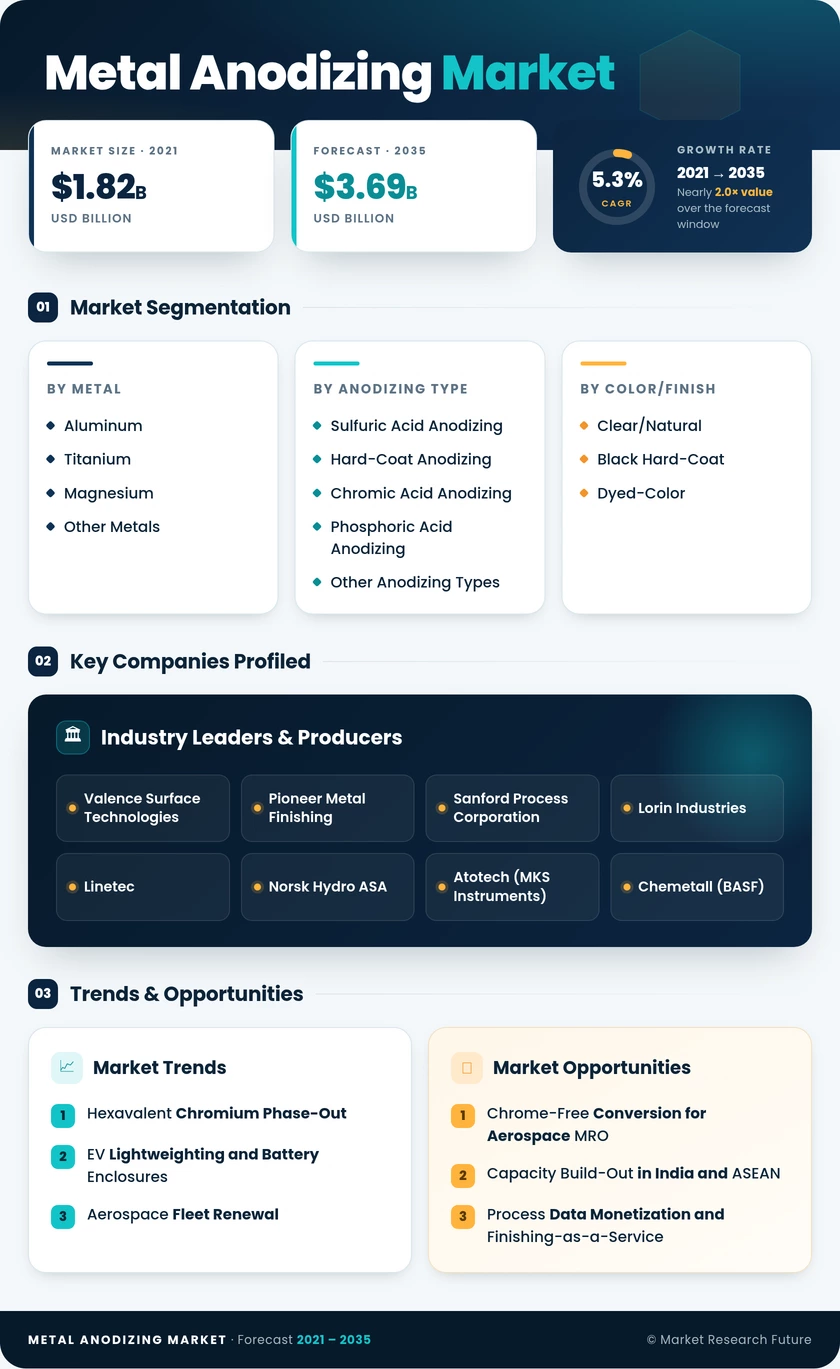
Segmentation Quick Reference
| Dimension | Sub-Segments | Dominant Segment | Fastest Growing Segment |
|---|---|---|---|
| By Metal | Aluminum; Titanium; Magnesium; Other Metals | Aluminum (61.8% share) | Titanium (6.4% CAGR) |
| By Anodizing Type | Sulfuric Acid Anodizing; Hard-Coat Anodizing; Chromic Acid Anodizing; Phosphoric Acid Anodizing; Other Anodizing Types | Sulfuric Acid Anodizing (50.4% share) | Hard-Coat Anodizing (6.5% CAGR) |
| By Color/Finish | Clear/Natural; Black Hard-Coat; Dyed-Color | Clear/Natural (45.2% share) | Black Hard-Coat (6.7% CAGR) |
| By End-Use Industry | Automotive; Aerospace and Defense; Electronics and Semiconductors; Construction; Medical Devices; Other End-Use Industries | Automotive (32.2% share) | Aerospace and Defense (7.2% CAGR) |
| By Region | North America; Europe; Asia-Pacific; South America; Middle East & Africa | Asia-Pacific (43.8% share) | Middle East & Africa (6.0% CAGR) |
Market Segmentation Overview
The four dimensions below structure the Metal Anodizing Market analysis in Section 9.
By Metal
| Sub-Segment | Key Trend |
|---|---|
| Aluminum | EV castings and battery enclosures sustain high-volume lines |
| Titanium | Color-coded implants and defense parts drive premium demand |
| Magnesium | Citrate-based electrolytes aim to solve pitting |
| Other Metals | Zinc holds decorative niches against powder coating |
Aluminum leads because its cost and established process windows suit high-volume automotive, electronics and building work. Titanium grows fastest, since implant makers and defense primes pay for dye-free color identification and strength-to-weight performance. Magnesium and Other Metals stay small until process stability improves enough to justify finishing cost.
By Anodizing Type
| Sub-Segment | Key Trend |
|---|---|
| Sulfuric Acid Anodizing | Thin-film variants replace chromic acid on aircraft parts |
| Hard-Coat Anodizing | Thicker layers specified for robotics and energy storage |
| Chromic Acid Anodizing | Contracting under EU and US chromium rules |
| Phosphoric Acid Anodizing | Essential for adhesive-bonding preparation |
| Other Anodizing Types | Boric-sulfuric and tartaric-sulfuric gain aerospace approvals |
Sulfuric Acid Anodizing keeps the lead on low reagent cost and its role as the main chromic acid replacement. Hard-Coat Anodizing grows fastest because robotics, semiconductor carriers and battery trays need thick, abrasion-tolerant oxide. Chromic Acid Anodizing shrinks as restrictions tighten, transferring volume to sulfuric and Other Anodizing Types.
By Color/Finish
| Sub-Segment | Key Trend |
|---|---|
| Clear/Natural | Façade and rail interiors favor natural metal appearance |
| Black Hard-Coat | Electronics value emissivity and uniform branding |
| Dyed-Color | Zinc-modified dyes extend outdoor lightfastness |
Clear/Natural dominates because architectural and industrial buyers want durable protection without changing metal appearance. Black Hard-Coat grows fastest as data-center and telecom hardware need heat emissivity plus consistent visual identity. Dyed-Color retains steady architectural and consumer demand, helped by better lightfastness for outdoor use.
By End-Use Industry
| Sub-Segment | Key Trend |
|---|---|
| Automotive | Battery enclosures offset flat vehicle production |
| Aerospace and Defense | Chrome-free mandates and fleet renewal |
| Electronics and Semiconductors | Hard-coat heat sinks for 5G radios |
| Construction | Anodized curtain walls for low maintenance |
| Medical Devices | ISO 13485-validated titanium lines |
| Other End-Use Industries | Marine and offshore energy weight savings |
Automotive leads on trim, roof rails and EV battery enclosures, though growth moderates as global vehicle output plateaus. Aerospace and Defense grows fastest because chrome-free specifications and new aircraft programs require requalified anodizing on aluminum-lithium and titanium parts. Medical Devices and Electronics and Semiconductors add high-margin volume behind the two leaders.


 Noah Malgeri
Co-Founder

 Peter Groot koerkamp
Account and Business Manager

 Younghwan Choi
Senior Retail Manager

 Mark Irwin
Management Consultant

 Akif Moroglu
Strategy & Business Development Director

 Guilherme Gomes Martins
Product Management Director

 Joseph Aguayo
Sales Operations & Pricing Manager

 La Terria Dodd
Program Support Specialist

 Rob Kooiker
Group Product Manager HVAC & Fire Protection GMA