×
Request Free Sample ×

Kindly complete the form below to receive a free sample of this Report

* Please use a valid business email

Leading companies partner with us for data-driven Insights

clients tt-cursor
Hero Background
English
Chinese
French
Japanese
Korean
German
Spanish

Meta Xylene Market Trends

ID: MRFR/CnM/9405-HCR
100 Pages
Anshula Mandaokar
October 2025

Meta-xylene Market Research Report Information By Application (Isophthalic Acid, 2,4 and 2,6 xylidine, Solvents, Others) End Use (Construction, Packaging, Automotive, Others) Forecast 2030

Share:
Download PDF ×

We do not share your information with anyone. However, we may send you emails based on your report interest from time to time. You may contact us at any time to opt-out.

Meta Xylene Market Infographic
Purchase Options

Market Trends

Key Emerging Trends in the Meta Xylene Market

Currently there are significant trends taking place within the Meta-Xylene Market reflecting demand movements specifically in petrochemical, chemical & resin sectors. This particular isomer is widely employed in manufacturing various chemicals, resins and solvents. A growing trend observed in this market is increased demand for Meta-Xylene used in Polyethylene Terephthalate (PET) resins production. Packaging industry growth that comes up through plastic bottles and containers demand has made Meta-Xylene a key part of manufacturing PET resins. The original approach is in line with the general shift towards lighter and more environmentally friendly packaging solutions, which confirms the relevance of Meta-Xylene in supporting sustainable packaging practices.

Furthermore, chemical industry has been instrumental in shaping trends within the Meta-Xylene market. Growing demand for meta-xylene as a result of increasing production of isocyanates that are essential components in manufacturing polyurethane foams and coatings. On the other hand, construction, automotive and furniture industries depend heavily on polyurethane products thereby influencing use of Meta-Xylene in isocyanate production. This development synchronizes with energy efficient insulation materials being focused by construction industry and the lightweighting requirements from automobile sector.

Advances in technology contribute to these trends seen within the Meta-Xylene Market. Companies are continuously trying to improve their processes; hence R&D focuses on bettering production process such as optimizing yield and improving overall efficiency of making-meta xylene. Most notably, new catalyst technologies along with feedstock utilization have taken center stage in providing sustainable alternatives while reducing environmental footprints associated with meta-xylene. Technological advances improve market adaptation capacity as well as efficiency towards offering outcomes suitable for different industry’s changing needs.

Besides, the resin industry is shaping up market trends in Meta-Xylene. Alkyd resins are some of the numerous resins that are manufactured from meta-xylene as one of its raw materials and they are used in many paints, coatings and adhesives. In order to make these resins more eco-friendly and comply with environmental regulations set by authorities like the EPA this has led to a shift towards sustainable and low-VOC (volatile organic compound) formulations requiring key chemical ingredients such as Meta-Xylene. The regulatory considerations are among the key drivers behind Meta-Xylene market trends. This sector operates under various guidelines on environment conservation, safety at workplace, and product quality. These developments have influenced the use and production of Meta-Xylene in different applications, which focus on conformity with international standards and certifications like those set by Environmental Protection Agency (EPA) or Occupational Safety Health Administration (OSHA).

Moreover, there have been shifts in the Meta-Xylene market due to increasing concerns about hygiene and sanitation occasioned by global health crisis. Such disinfectants can only be produced using meta-xylene as one of their base stocks hence making it be used in meeting the need for effective cleaning solutions while responding to common health issues.

Author
Anshula Mandaokar
Team Lead - Research

Anshula Mandaokar holds an academic degree in Chemical Engineering and has been contributing to the field for more than 5 years. She has expertise in Market Research and Business Consulting and serves as a Team Lead for a reputed Market Research firm under the Chemicals and Materials domain spectrum. She has worked on multiple projects, generating explicit results in a quick turnaround time. Her understanding of data interpretation justifies her role as a leader.

Leave a Comment

FAQs

What would the growth rate global Meta-xylene Market register in the future?

The global Meta-xylene Market would register a growth of 4.5%.

What is the projected market value of the global meta-xylene market?

The meta-xylene market is projected to reach USD 1,800 million in 2035

What is Meta-xylene and its major application?

Meta-xylene is an aromatic hydrocarbon mainly used in the production of Isophthalic.

Which region has the highest growth in Global Meta-xylene Industry?

Asia-Pacific has the highest growth in Global Meta-xylene Market

Who are the key players in the Global Meta-xylene Market?

Avantor, Compania Espanola De Petroleos, Chevron Phillips Chemical Company, Exxonmobil Honeywell International Inc., Lotte Chemical, Merck KGaA, Mitsubishi gas chemical company inc., Parchem fine & specialty chemicals, Shell Chemicals LTD, TCI Chemicals (India) Pvt. Ltd are the key players in the Global Meta-xylene Market.

Market Summary

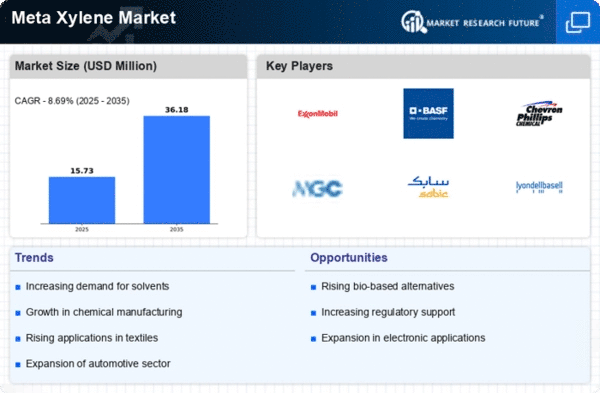
As per MRFR analysis, the Meta Xylene Market Size was estimated at 14.47 USD Million in 2024. The Meta Xylene industry is projected to grow from 15.73 USD Million in 2025 to 36.18 USD Million by 2035, exhibiting a compound annual growth rate (CAGR) of 8.69 during the forecast period 2025 - 2035.

Key Market Trends & Highlights

The Meta Xylene Market is poised for robust growth driven by diverse applications and sustainability initiatives.

  • North America remains the largest market for Meta Xylene, driven by its extensive chemical manufacturing base. The Asia-Pacific region is emerging as the fastest-growing market, fueled by increasing industrialization and urbanization. The solvent segment dominates the market, while the chemical intermediate segment is experiencing rapid growth due to evolving applications. Key market drivers include rising demand in the automotive sector and regulatory support for chemical innovations.

Market Size & Forecast

2024 Market Size 14.47 (USD Million)
2035 Market Size 36.18 (USD Million)
CAGR (2025 - 2035) 8.69%
Largest Regional Market Share in 2024 Asia-Pacific

Major Players

<p>ExxonMobil (US), BASF (DE), Chevron Phillips Chemical (US), Mitsubishi Gas Chemical (JP), SABIC (SA), LyondellBasell Industries (US), Reliance Industries (IN), Eastman Chemical Company (US), Formosa Plastics Corporation (TW)</p>

Market Trends

The Meta Xylene Market is currently experiencing a dynamic phase characterized by evolving demand patterns and technological advancements. This sector, integral to the production of various chemicals and materials, appears to be influenced by a multitude of factors including environmental regulations, shifts in consumer preferences, and innovations in production processes. As industries increasingly prioritize sustainability, the Meta Xylene Market is likely adapting to these changes, potentially leading to the development of greener alternatives and more efficient manufacturing techniques. Furthermore, the global push towards reducing carbon footprints may drive investments in cleaner technologies, thereby reshaping the competitive landscape. In addition, the Meta Xylene Market seems to be witnessing a rise in applications across diverse sectors such as automotive, textiles, and pharmaceuticals. This diversification indicates a broader acceptance and integration of meta xylene in various industrial processes. As companies strive to enhance product performance and meet regulatory standards, the demand for high-purity meta xylene is expected to grow. Overall, the Meta Xylene Market is poised for transformation, with emerging trends suggesting a future that balances economic growth with environmental responsibility.

Sustainability Initiatives

The Meta Xylene Market is increasingly influenced by sustainability initiatives, as companies seek to minimize their environmental impact. This trend may lead to the adoption of eco-friendly production methods and the development of bio-based alternatives, aligning with global efforts to combat climate change.

Technological Advancements

Innovations in production technologies are reshaping the Meta Xylene Market. Enhanced processes that improve efficiency and reduce waste are becoming more prevalent, potentially leading to cost savings and higher quality products, which could attract new market entrants.

Diverse Applications

The expansion of applications for meta xylene across various industries is notable. From automotive to pharmaceuticals, the versatility of this compound suggests a growing market presence, as businesses explore new uses that leverage its unique properties.

Meta Xylene Market Market Drivers

Rising Demand in Chemical Industry

The Global Meta-xylene market Industry experiences a notable surge in demand driven by its extensive applications in the chemical sector. Meta-xylene serves as a precursor for producing various chemicals, including isophthalic acid, which is essential for manufacturing polyester resins and fibers. As the global chemical industry expands, particularly in emerging economies, the demand for meta-xylene is projected to increase. In 2024, the market is valued at approximately 1.42 USD Billion, reflecting the growing reliance on meta-xylene in chemical production. This trend is likely to continue, positioning the Global Meta-xylene market Industry for sustained growth.

Market Segment Insights

By Application: Solvent (Largest) vs. Chemical Intermediate (Fastest-Growing)

<p>In the Meta Xylene Market, the application segment exhibits a diversified share distribution among its core values, namely Solvent, Chemical Intermediate, Fuel Additive, and Polymer Production. The Solvent segment holds the largest proportion of the market, reflecting its extensive use in various industrial and consumer applications. In contrast, while Fuel Additive and Polymer Production maintain significant positions, they do not match the volume projected for Solvents and Chemical Intermediates. As market dynamics evolve, the Chemical Intermediate application is identified as the fastest-growing segment. This growth is bolstered by rising demand for high-performance chemicals in various sectors—including paints, coatings, and adhesives—along with a shift towards sustainable practices encouraging the adoption of bio-based intermediate solutions.</p>

<p>Chemical Intermediate (Dominant) vs. Fuel Additive (Emerging)</p>

<p>In the Meta Xylene Market, the Chemical Intermediate segment has emerged as a dominant player, primarily due to its critical role in manufacturing a variety of valuable chemicals. Its applications range from producing solvents, resins, and plastics to enhancing fuels' performance. The continuous evolution of industries alongside strict regulatory standards has propelled this segment's growth as manufacturers seek innovative solutions that optimize efficiency and environmental compatibility. Conversely, the Fuel Additive segment, while still essential, is considered emergent as it adapts to the growing trends towards cleaner fuels and sustainability. Fuel additives are increasingly being developed to reduce emissions and improve fuel efficiency, making them a rising focus in the automotive and aerospace sectors.</p>

By End Use Industry: Automotive (Largest) vs. Pharmaceuticals (Fastest-Growing)

<p>The Meta Xylene market displays a diverse landscape across various end-use industries. Among these, the automotive sector stands out as the largest consumer of Meta Xylene due to its extensive applications in producing high-performance components and coatings. Meanwhile, the pharmaceutical industry is emerging rapidly, utilizing Meta Xylene for synthesizing vital chemical compounds and pharmaceuticals, reflecting a substantial shift in market dynamics.</p>

<p>Automotive (Dominant) vs. Pharmaceuticals (Emerging)</p>

<p>The automotive segment is characterized by its robust demand for high-grade chemicals, including Meta Xylene, which plays a critical role in the manufacturing of automotive coatings and plastics that require durability and performance. This segment is steadily growing as innovations in vehicle design and manufacturing increase the need for efficient chemical solutions. In contrast, the pharmaceuticals sector is experiencing accelerated growth, driven by the rising demand for advanced healthcare solutions and the ongoing development of new drugs. The versatility of Meta Xylene in pharmaceutical applications positions it as an emerging player in a highly competitive industry, reflecting the increasing significance of chemical compounds in modern medicine.</p>

By Purity Level: High Purity (Largest) vs. Technical Grade (Fastest-Growing)

<p>In the Meta Xylene Market, the purity level segments exhibit distinct market share distributions. High Purity takes the lead, holding the largest market share compared to Standard Purity and Technical Grade. Standard Purity follows closely, serving specific applications where premium purity is not a requirement. Technical Grade, while having a smaller market share, is on the rise as it caters to various industrial needs that prioritize cost-efficiency over purity.</p>

<p>High Purity (Dominant) vs. Technical Grade (Emerging)</p>

<p>High Purity meta xylene is recognized for its superior quality and is extensively utilized in high-end applications such as pharmaceuticals and electronics, where impurities can lead to significant issues. This segment maintains its dominance due to strict regulatory standards on product quality. On the other hand, Technical Grade is emerging as a viable option for industries looking for more cost-effective solutions. Its growing acceptance is driven by manufacturing sectors that prioritize price sensitivity while still meeting quality standards, particularly in non-critical applications.</p>

By Distribution Channel: Direct Sales (Largest) vs. Distributors (Fastest-Growing)

<p>In the Meta Xylene Market, the distribution channel segment is primarily dominated by direct sales, which cater to a wide range of end-users and large-scale manufacturing facilities. This approach allows for significant control over the supply chain and customer relationships, contributing to its status as the largest segment. Distributors, on the other hand, are quickly gaining traction by providing flexible solutions and a wider reach to various customer segments, thus solidifying their position within the market.</p>

<p>Direct Sales (Dominant) vs. Distributors (Emerging)</p>

<p>Direct sales remain the dominant distribution channel in the Meta Xylene Market, characterized by significant engagement with customers and tailored service offerings. Companies utilizing direct sales benefit from direct communication, ensuring client needs are met promptly and effectively. In contrast, distributors are emerging as a vital channel by facilitating broader market access and quicker response times to market demands. The resilience of distributors lies in their ability to stock a variety of products and ensure timely delivery, catering to both local and international markets, making them an essential link in the supply chain.</p>

Get more detailed insights about Meta-Xylene Market Research Report—Global Forecast till 2035

Regional Insights

North America : Stable Growth Environment

The North American Meta Xylene market is projected to grow steadily, driven by increasing demand in the petrochemical sector and favorable regulatory frameworks. With a market size of $3.0 billion, the region benefits from a robust industrial base and technological advancements. The focus on sustainable practices and environmental regulations is also catalyzing growth, as companies seek to innovate and reduce emissions. Leading countries like the US and Canada are home to major players such as ExxonMobil and Chevron Phillips Chemical, which dominate the market landscape. The competitive environment is characterized by strategic partnerships and investments in R&D, aimed at enhancing production efficiency and product quality. The presence of established firms ensures a stable supply chain, further supporting market growth.

Europe : Innovation and Sustainability Focus

Europe's Meta Xylene market, valued at $2.5 billion, is characterized by a strong emphasis on innovation and sustainability. Regulatory frameworks, such as the REACH regulation, are driving companies to adopt greener technologies and processes. The demand for high-quality chemicals in various applications, including automotive and packaging, is also a significant growth driver, contributing to the region's market share. Germany, France, and the UK are leading countries in this market, with key players like BASF and LyondellBasell Industries at the forefront. The competitive landscape is marked by collaborations and joint ventures aimed at enhancing product offerings and market reach. The focus on circular economy principles is reshaping the industry, encouraging companies to invest in sustainable practices and technologies.

Asia-Pacific : Emerging Market Leader

Asia-Pacific is the largest market for Meta Xylene, with a remarkable size of $8.5 billion, driven by rapid industrialization and urbanization. The region's growth is fueled by increasing demand from the automotive and electronics sectors, alongside supportive government policies promoting chemical manufacturing. The market is expected to continue expanding as countries invest in infrastructure and technology to enhance production capabilities. China, Japan, and India are the leading countries in this market, hosting major players like Mitsubishi Gas Chemical and Reliance Industries. The competitive landscape is dynamic, with companies focusing on capacity expansion and technological advancements to meet rising demand. The presence of a diverse range of manufacturers ensures a competitive environment, fostering innovation and efficiency in production processes.

Middle East and Africa : Resource-Rich Opportunities

The Middle East and Africa region, with a market size of $0.47 billion, presents unique opportunities in the Meta Xylene market, driven by abundant natural resources and growing industrial sectors. The region's strategic location and investment in petrochemical infrastructure are key growth drivers. Additionally, government initiatives aimed at diversifying economies are fostering a conducive environment for market expansion. Countries like Saudi Arabia and South Africa are pivotal in this market, with companies such as SABIC leading the charge. The competitive landscape is evolving, with new entrants and established firms vying for market share. The focus on enhancing production capabilities and sustainability practices is shaping the future of the Meta Xylene market in this region.

Key Players and Competitive Insights

The Meta Xylene Market is currently characterized by a competitive landscape that is both dynamic and multifaceted. Key growth drivers include the increasing demand for high-purity meta xylene in the production of paraxylene and other derivatives, alongside the rising applications in the automotive and chemical industries. Major players such as ExxonMobil (US), BASF (DE), and Chevron Phillips Chemical (US) are strategically positioned to leverage their extensive operational capabilities and technological advancements. ExxonMobil (US) focuses on innovation in refining processes, while BASF (DE) emphasizes sustainability in its production methods. Chevron Phillips Chemical (US) is actively pursuing regional expansion to enhance its market presence, which collectively shapes a competitive environment that is increasingly reliant on technological prowess and operational efficiency.In terms of business tactics, companies are localizing manufacturing to reduce logistics costs and optimize supply chains. The market structure appears moderately fragmented, with several key players exerting influence over pricing and production standards. This fragmentation allows for a variety of competitive strategies, as companies seek to differentiate themselves through quality, service, and technological advancements.


In November BASF (DE) announced a significant investment in a new production facility aimed at increasing its meta xylene output by 20%. This strategic move is expected to enhance BASF's capacity to meet the growing demand for high-purity meta xylene, particularly in Asia, where consumption rates are surging. The investment underscores BASF's commitment to maintaining a competitive edge through capacity expansion and innovation in production techniques.


In October Chevron Phillips Chemical (US) entered into a strategic partnership with a leading technology firm to develop advanced digital solutions for its manufacturing processes. This collaboration aims to integrate AI and machine learning into production, potentially increasing efficiency and reducing operational costs. Such initiatives reflect a broader trend within the industry towards digital transformation, which is likely to redefine operational paradigms in the Meta Xylene Market.


In September ExxonMobil (US) launched a new sustainability initiative focused on reducing carbon emissions associated with its meta xylene production. This initiative includes the implementation of carbon capture technologies and the use of renewable energy sources. By prioritizing sustainability, ExxonMobil not only addresses regulatory pressures but also aligns with the growing consumer demand for environmentally responsible products, thereby enhancing its market positioning.


As of December the Meta Xylene Market is witnessing trends that emphasize digitalization, sustainability, and technological integration. Strategic alliances are increasingly shaping the competitive landscape, allowing companies to pool resources and expertise. The shift from price-based competition to a focus on innovation, technology, and supply chain reliability is becoming evident. Moving forward, competitive differentiation will likely hinge on the ability to adapt to these trends, with companies that prioritize technological advancements and sustainable practices poised to lead the market.

Key Companies in the Meta Xylene Market include

Industry Developments

Future Outlook

Meta Xylene Market Future Outlook

<p>The Meta Xylene Market is projected to grow at an 8.69% CAGR from 2025 to 2035, driven by increasing demand in the chemical and automotive sectors.</p>

New opportunities lie in:

  • <p>Expansion into emerging markets with tailored product offerings. Investment in advanced recycling technologies for sustainable production. Development of high-purity meta xylene for specialized applications.</p>

<p>By 2035, the Meta Xylene Market is expected to achieve robust growth, solidifying its position in the global chemical industry.</p>

Market Segmentation

Meta Xylene Market Application Outlook

  • Solvent
  • Chemical Intermediate
  • Fuel Additive
  • Polymer Production

Meta Xylene Market Purity Level Outlook

  • High Purity
  • Standard Purity
  • Technical Grade

Meta Xylene Market End Use Industry Outlook

  • Automotive
  • Pharmaceuticals
  • Agriculture
  • Paints and Coatings

Meta Xylene Market Distribution Channel Outlook

  • Direct Sales
  • Distributors
  • Online Sales

Report Scope

MARKET SIZE 2024 14.47(USD Million)
MARKET SIZE 2025 15.73(USD Million)
MARKET SIZE 2035 36.18(USD Million)
COMPOUND ANNUAL GROWTH RATE (CAGR) 8.69% (2025 - 2035)
REPORT COVERAGE Revenue Forecast, Competitive Landscape, Growth Factors, and Trends
BASE YEAR 2024
Market Forecast Period 2025 - 2035
Historical Data 2019 - 2024
Market Forecast Units USD Million
Key Companies Profiled ExxonMobil (US), BASF (DE), Chevron Phillips Chemical (US), Mitsubishi Gas Chemical (JP), SABIC (SA), LyondellBasell Industries (US), Reliance Industries (IN), Eastman Chemical Company (US), Formosa Plastics Corporation (TW)
Segments Covered Application, End Use Industry, Purity Level, Distribution Channel
Key Market Opportunities Growing demand for eco-friendly solvents in the Meta Xylene Market presents significant opportunities for innovation.
Key Market Dynamics Rising demand for eco-friendly solvents drives innovation and competition in the Meta Xylene market.
Countries Covered North America, Europe, APAC, South America, MEA

FAQs

What would the growth rate global Meta-xylene Market register in the future?

The global Meta-xylene Market would register a growth of 4.5%.

What is the projected market value of the global meta-xylene market?

The meta-xylene market is projected to reach USD 1,800 million in 2035

What is Meta-xylene and its major application?

Meta-xylene is an aromatic hydrocarbon mainly used in the production of Isophthalic.

Which region has the highest growth in Global Meta-xylene Industry?

Asia-Pacific has the highest growth in Global Meta-xylene Market

Who are the key players in the Global Meta-xylene Market?

Avantor, Compania Espanola De Petroleos, Chevron Phillips Chemical Company, Exxonmobil Honeywell International Inc., Lotte Chemical, Merck KGaA, Mitsubishi gas chemical company inc., Parchem fine &amp; specialty chemicals, Shell Chemicals LTD, TCI Chemicals (India) Pvt. Ltd are the key players in the Global Meta-xylene Market.

  1. SECTION I: EXECUTIVE SUMMARY AND KEY HIGHLIGHTS |
    1. EXECUTIVE SUMMARY |
      1. Market Overview |
      2. Key Findings |
      3. Market Segmentation |
      4. Competitive Landscape |
      5. Challenges and Opportunities |
      6. Future Outlook 2
  2. SECTION II: SCOPING, METHODOLOGY AND MARKET STRUCTURE |
    1. MARKET INTRODUCTION |
      1. Definition |
      2. Scope of the study |--
    2. RESEARCH METHODOLOGY |
      1. Overview |
      2. Data Mining |
      3. Secondary Research |
      4. Primary Research |--
      5. Forecasting Model |
      6. Market Size Estimation |--
      7. Data Triangulation |
      8. Validation 3
  3. SECTION III: QUALITATIVE ANALYSIS |
    1. MARKET DYNAMICS |
      1. Overview |
      2. Drivers |
      3. Restraints |
      4. Opportunities |
    2. MARKET FACTOR ANALYSIS |
      1. Value chain Analysis |
      2. Porter's Five Forces Analysis |--
      3. COVID-19 Impact Analysis |--
  4. SECTION IV: QUANTITATIVE ANALYSIS |
    1. Chemicals and Materials, BY Application (USD Million) |
      1. Solvent |
      2. Chemical Intermediate |
      3. Fuel Additive |
      4. Polymer Production |
    2. Chemicals and Materials, BY End Use Industry (USD Million) |
      1. Automotive |
      2. Pharmaceuticals |
      3. Agriculture |
      4. Paints and Coatings |
    3. Chemicals and Materials, BY Purity Level (USD Million) |
      1. High Purity |
      2. Standard Purity |
      3. Technical Grade |
    4. Chemicals and Materials, BY Distribution Channel (USD Million) |
      1. Direct Sales |
      2. Distributors |
      3. Online Sales |
    5. Chemicals and Materials, BY Region (USD Million) |
      1. North America |--
      2. Europe |--
      3. APAC |--
      4. South America |--
      5. MEA |--
  5. SECTION V: COMPETITIVE ANALYSIS |
    1. Competitive Landscape |
      1. Overview |
      2. Competitive Analysis |
      3. Market share Analysis |
      4. Major Growth Strategy in the Chemicals and Materials |
      5. Competitive Benchmarking |
      6. Leading Players in Terms of Number of Developments in the Chemicals and Materials |
      7. Key developments and growth strategies |--
      8. Major Players Financial Matrix |--
    2. Company Profiles |
      1. ExxonMobil (US) |--
      2. BASF (DE) |--
      3. Chevron Phillips Chemical (US) |--
      4. Mitsubishi Gas Chemical (JP) |--
      5. SABIC (SA) |--
      6. LyondellBasell Industries (US) |--
      7. Reliance Industries (IN) |--
      8. Eastman Chemical Company (US) |--
      9. Formosa Plastics Corporation (TW) |--
    3. Appendix |
      1. References |
      2. Related Reports

Chemicals and Materials Market Segmentation

Chemicals and Materials By Application (USD Million, 2025-2035)

  • Solvent
  • Chemical Intermediate
  • Fuel Additive
  • Polymer Production

Chemicals and Materials By End Use Industry (USD Million, 2025-2035)

  • Automotive
  • Pharmaceuticals
  • Agriculture
  • Paints and Coatings

Chemicals and Materials By Purity Level (USD Million, 2025-2035)

  • High Purity
  • Standard Purity
  • Technical Grade

Chemicals and Materials By Distribution Channel (USD Million, 2025-2035)

  • Direct Sales
  • Distributors
  • Online Sales
Infographic

Free Sample Request

Kindly complete the form below to receive a free sample of this Report

Get Free Sample

Customer Strories

Compare Licence

×
Features License Type
Single User Multiuser License Enterprise User
Price $4,950 $5,950 $7,250
Maximum User Access Limit 1 User Upto 10 Users Unrestricted Access Throughout the Organization
Free Customization
Direct Access to Analyst
Deliverable Format
Platform Access
Discount on Next Purchase 10% 15% 15%
Printable Versions