×
Hero Background
English
Chinese
French
Japanese
Korean
German
Spanish

Mendelian Disorders Testing Market Trends

ID: MRFR/LS/4053-HCR
90 Pages
Kinjoll Dey
October 2025

Mendelian disorders testing market research report: by test type (carrier testing, diagnostic testing, new-born screening), by disorder (cystic fibrosis, sickle cell anemia), by end-user (hospitals, ascs, specialized clinics) – Global forecast till 2035

Share:
Download PDF ×

We do not share your information with anyone. However, we may send you emails based on your report interest from time to time. You may contact us at any time to opt-out.

Mendelian Disorders Testing Market Infographic
Purchase Options

Market Trends

Key Emerging Trends in the Mendelian Disorders Testing Market

The demand for Mendelian Disorders testing in the United States has been steadily increasing, reflecting a growing recognition of the significance of genetic testing in healthcare. Mendelian Disorders, also known as monogenic disorders, are caused by mutations in a single gene and often have a clear inheritance pattern. This market demand surge can be attributed to various factors, including advancements in genetic testing technologies, heightened awareness of the role of genetics in health, and an increasing prevalence of Mendelian Disorders within the population.

Advancements in genetic testing technologies have played a pivotal role in driving the demand for Mendelian Disorders testing in the US. The field of genomics has witnessed remarkable progress, with the development of high-throughput sequencing technologies, such as next-generation sequencing (NGS). These technologies enable comprehensive analysis of an individual's genetic makeup, allowing healthcare professionals to identify specific gene mutations associated with Mendelian Disorders more efficiently and accurately. As the cost of genetic testing continues to decrease, it has become more accessible to a broader range of individuals, contributing to the growing demand for Mendelian Disorders testing.

There has been a notable increase in public awareness regarding the role of genetics in determining health outcomes. This heightened awareness is driven by factors such as increased media coverage of genetic discoveries, educational initiatives, and the growing popularity of direct-to-consumer genetic testing services. As individuals become more informed about the potential genetic underpinnings of certain health conditions, there is a corresponding increase in demand for Mendelian Disorders testing to assess and understand their own genetic risk factors.

The prevalence of Mendelian Disorders within the population has also contributed significantly to the rising demand for testing services. With an increasing understanding of the genetic basis of various diseases, healthcare professionals are better equipped to identify individuals at risk of Mendelian Disorders and provide targeted genetic testing. This proactive approach to healthcare, focusing on early identification and intervention, has driven the demand for testing services to prevent or manage these disorders effectively.

The US Mendelian Disorders testing market is witnessing a surge in the development and availability of genetic testing panels tailored to specific disorders. These panels allow for the simultaneous analysis of multiple genes associated with a particular Mendelian Disorder, streamlining the testing process and providing comprehensive insights. This trend is especially crucial for conditions with overlapping symptoms, enabling more accurate and timely diagnoses.

In addition to traditional healthcare settings, the demand for Mendelian Disorders testing has extended to research and pharmaceutical sectors. Genetic testing plays a vital role in the identification of potential therapeutic targets and the development of personalized medicine. The collaboration between research institutions, pharmaceutical companies, and genetic testing laboratories has fueled innovation and expanded the scope of Mendelian Disorders testing applications.

As the demand for Mendelian Disorders testing continues to rise, there is a growing emphasis on genetic counseling services to support individuals and families in understanding and interpreting their test results. Genetic counselors play a crucial role in helping individuals make informed decisions about their healthcare based on their genetic information, contributing to a more comprehensive and patient-centered approach to genetic testing.


Author
Kinjoll Dey
Research Analyst Level I

He is an extremely curious individual currently working in Healthcare and Medical Devices Domain. Kinjoll is comfortably versed in data centric research backed by healthcare educational background. He leverages extensive data mining and analytics tools such as Primary and Secondary Research, Statistical Analysis, Machine Learning, Data Modelling. His key role also involves Technical Sales Support, Client Interaction and Project management within the Healthcare team. Lastly, he showcases extensive affinity towards learning new skills and remain fascinated in implementing them.

Leave a Comment

FAQs

What is the current valuation of the Mendelian Disorders Testing Market?

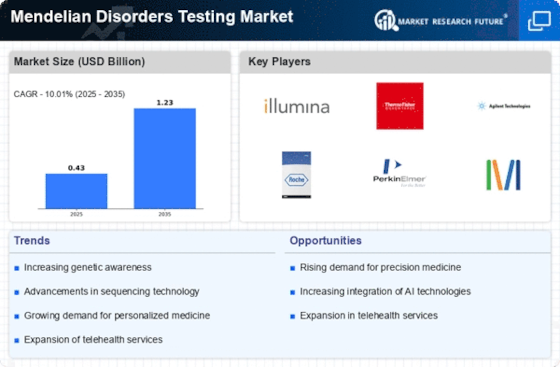
The Mendelian Disorders Testing Market was valued at 0.43 USD Billion in 2024.

What is the projected market size for the Mendelian Disorders Testing Market by 2035?

The market is projected to reach 1.228 USD Billion by 2035.

What is the expected CAGR for the Mendelian Disorders Testing Market during the forecast period?

The expected CAGR for the market from 2025 to 2035 is 10.01%.

Which companies are considered key players in the Mendelian Disorders Testing Market?

Key players include Illumina, Thermo Fisher Scientific, Agilent Technologies, and F. Hoffmann-La Roche.

What are the main segments of the Mendelian Disorders Testing Market?

The main segments include carrier testing, diagnostic testing, newborn screening, and prenatal testing.

Market Summary

As per MRFR analysis, the Mendelian Disorders Testing Market was estimated at 0.43 USD Billion in 2024. The Mendelian Disorders Testing industry is projected to grow from 0.473 in 2025 to 1.228 by 2035, exhibiting a compound annual growth rate (CAGR) of 10.01 during the forecast period 2025 - 2035.

Key Market Trends & Highlights

The Mendelian Disorders Testing Market is poised for substantial growth driven by technological advancements and increasing awareness.

  • North America remains the largest market for Mendelian disorders testing, driven by robust healthcare infrastructure and high demand for genetic testing.

  • The Asia-Pacific region is emerging as the fastest-growing market, fueled by rising healthcare investments and increasing awareness of genetic disorders.
  • Carrier testing continues to dominate the market, while diagnostic testing is experiencing rapid growth due to advancements in technology.
  • Key market drivers include technological advancements in genetic testing and the rising prevalence of Mendelian disorders, which are propelling demand across various segments.

Market Size & Forecast

2024 Market Size 0.43 (USD Billion)
2035 Market Size 1.228 (USD Billion)
CAGR (2025 - 2035) 10.01%
Largest Regional Market Share in 2024 Americas

Major Players

<p>Illumina (US), Thermo Fisher Scientific (US), Agilent Technologies (US), F. Hoffmann-La Roche (CH), PerkinElmer (US), Myriad Genetics (US), Invitae (US), GeneDx (US), Sema4 (US)</p>

Market Trends

The Mendelian Disorders Testing Market is currently experiencing a notable evolution, driven by advancements in genetic research and technology. As understanding of genetic conditions deepens, the demand for accurate and efficient testing methods is increasing. This market encompasses a range of services, including carrier screening, prenatal testing, and diagnostic testing for various Mendelian disorders. The integration of next-generation sequencing technologies is particularly influential, as it enhances the ability to identify genetic mutations with greater precision. Furthermore, the growing awareness of genetic disorders among healthcare providers and patients is likely to propel market growth, as individuals seek proactive measures for health management. In addition, the regulatory landscape surrounding genetic testing is evolving, which may impact the Mendelian Disorders Testing Market. Regulatory bodies are increasingly focusing on ensuring the accuracy and reliability of genetic tests, which could lead to improved standards and practices within the industry. Moreover, collaborations between academic institutions and biotechnology companies are fostering innovation, potentially leading to the development of novel testing methodologies. As the market continues to mature, it appears poised for further expansion, driven by technological advancements and a heightened focus on personalized medicine.

Technological Advancements in Genetic Testing

The Mendelian Disorders Testing Market is witnessing rapid technological progress, particularly with the advent of next-generation sequencing. This innovation allows for comprehensive analysis of genetic material, enabling the identification of mutations associated with various disorders. As these technologies become more accessible, they are likely to enhance the accuracy and efficiency of testing, thereby attracting more patients and healthcare providers.

Increased Awareness and Demand for Genetic Testing

There is a growing recognition of the importance of genetic testing among both healthcare professionals and the general public. This heightened awareness is driving demand for testing services, as individuals seek to understand their genetic predispositions. Consequently, the Mendelian Disorders Testing Market is expected to expand as more people opt for carrier screening and diagnostic testing.

Regulatory Developments and Standardization

The regulatory environment surrounding genetic testing is evolving, with an emphasis on ensuring the reliability and accuracy of tests. Regulatory bodies are likely to implement stricter guidelines, which may lead to improved quality standards in the Mendelian Disorders Testing Market. This focus on standardization could enhance consumer confidence and promote wider adoption of testing services.

Mendelian Disorders Testing Market Market Drivers

Rising Prevalence of Mendelian Disorders

The increasing prevalence of Mendelian disorders is a critical factor driving the Mendelian Disorders Testing Market. Conditions such as cystic fibrosis, sickle cell disease, and Huntington's disease are becoming more recognized, leading to a greater need for effective diagnostic solutions. Epidemiological studies indicate that approximately 1 in 200 individuals are affected by a Mendelian disorder, underscoring the urgency for comprehensive testing options. As awareness of these conditions grows, so does the demand for genetic testing services that can provide accurate diagnoses and inform treatment decisions. This rising prevalence is likely to stimulate market growth, as healthcare systems strive to address the needs of affected populations.

Regulatory Developments and Standardization

The Mendelian Disorders Testing Market is influenced by evolving regulatory frameworks aimed at ensuring the safety and efficacy of genetic testing. Regulatory bodies are increasingly focusing on standardizing testing procedures and validating the accuracy of results. This is particularly crucial as the market expands, with numerous new testing services entering the landscape. Enhanced regulations not only foster consumer trust but also encourage innovation among testing providers. As a result, companies are investing in compliance and quality assurance measures, which may lead to improved testing outcomes. The establishment of clear guidelines is anticipated to facilitate market growth, as stakeholders navigate the complexities of genetic testing.


Technological Advancements in Genetic Testing

The Mendelian Disorders Testing Market is experiencing a transformative phase due to rapid technological advancements. Innovations such as next-generation sequencing (NGS) and CRISPR gene editing are revolutionizing the landscape of genetic testing. These technologies enable more accurate and efficient identification of genetic mutations associated with Mendelian disorders. For instance, NGS allows for the simultaneous analysis of multiple genes, significantly reducing the time and cost associated with traditional testing methods. As a result, the market is projected to grow at a compound annual growth rate (CAGR) of approximately 12% over the next five years. This growth is driven by the increasing adoption of these advanced technologies in clinical settings, enhancing diagnostic capabilities and patient outcomes.

Increased Awareness and Demand for Genetic Testing

The rising awareness regarding genetic disorders and the benefits of early diagnosis is propelling the Mendelian Disorders Testing Market forward. Educational initiatives and advocacy from healthcare professionals have led to a heightened understanding of genetic testing among the public. This awareness is reflected in the increasing demand for testing services, as individuals seek proactive measures for health management. According to recent surveys, nearly 60% of individuals express interest in genetic testing for hereditary conditions. This trend is likely to continue, as more people recognize the importance of genetic information in making informed healthcare decisions. Consequently, the market is expected to expand, driven by this growing consumer demand.

Integration of Genetic Testing in Clinical Practice

The integration of Mendelian disorders testing into routine clinical practice is a significant driver for the Mendelian Disorders Testing Market. Healthcare providers are increasingly recognizing the value of genetic testing in diagnosing and managing hereditary conditions. This integration is supported by clinical guidelines recommending genetic testing for specific patient populations, thereby enhancing the overall quality of care. As healthcare systems adopt personalized medicine approaches, the demand for genetic testing is expected to rise. Furthermore, the collaboration between genetic testing laboratories and healthcare providers is likely to streamline the testing process, making it more accessible to patients. This trend is indicative of a broader shift towards precision medicine, which is anticipated to bolster market growth.

Market Segment Insights

Mendelian Disorders Testing Market Type Insights

On the basis of the test type, the Mendelian disorders testing market is segmented into carrier testing, diagnostic testing, new-born screening, predictive & pre-symptomatic testing, prenatal testing, and others

Mendelian Disorders Testing Market Disorder Type Insights

On the basis of the disorder type, the mendelian disorders testing market is segmented into cystic fibrosis, sickle cell anemia, severe combined immunodeficiency (SCID), Tay-Sachs disorder, polycystic kidney disorder, Gaucher's disease, Huntington's disease, neurofibromatosis, thalassemia, familial hypercholesterolemia, and others

Mendelian Disorders Testing Market End-User Insights

On the basis of the end user, the mendelian disorders testing market is segmented into hospitals, ambulatory surgical centers (ASCs), and specialized clinics.

Get more detailed insights about Mendelian Disorders Testing Market Research Report- Global Forecast till 2035

Regional Insights

North America : Leading Innovation and Research

North America is the largest market for Mendelian disorders testing, accounting for approximately 45% of the global market share. The region's growth is driven by advanced healthcare infrastructure, increasing awareness of genetic disorders, and supportive regulatory frameworks. The demand for personalized medicine and genetic testing is on the rise, further propelled by government initiatives promoting research and development in genomics. The United States is the leading country in this market, with significant contributions from key players such as Illumina, Thermo Fisher Scientific, and Myriad Genetics. The competitive landscape is characterized by continuous innovation and strategic partnerships among these companies. Canada also plays a vital role, with increasing investments in genetic research and testing services, enhancing the overall market dynamics.

Europe : Regulatory Support and Growth

Europe is the second-largest market for Mendelian disorders testing, holding around 30% of the global market share. The region benefits from robust healthcare systems and increasing government support for genetic research. Regulatory bodies are actively promoting the integration of genetic testing into clinical practice, which is driving demand. The European Union's initiatives to standardize genetic testing protocols are also contributing to market growth. Leading countries in this region include Germany, France, and the United Kingdom, where significant investments in healthcare technology are being made. The competitive landscape features major players like F. Hoffmann-La Roche and Agilent Technologies, which are focusing on innovative solutions to enhance testing accuracy. The presence of numerous startups in the genetic testing space is also fostering a dynamic market environment.

Asia-Pacific : Emerging Market Potential

Asia-Pacific is witnessing rapid growth in the Mendelian disorders testing market, accounting for approximately 20% of the global share. The region's growth is fueled by increasing healthcare expenditure, rising awareness of genetic disorders, and advancements in technology. Countries like China and India are leading this growth, driven by government initiatives to enhance healthcare access and promote genetic research. China is the largest market in the region, with significant investments in biotechnology and genetic testing infrastructure. India is also emerging as a key player, with a growing number of diagnostic laboratories offering genetic testing services. The competitive landscape is evolving, with both established companies and new entrants focusing on innovative testing solutions to meet the rising demand.

Middle East and Africa : Untapped Market Opportunities

The Middle East and Africa region is gradually emerging in the Mendelian disorders testing market, holding about 5% of the global share. The growth is driven by increasing awareness of genetic disorders and the need for advanced healthcare solutions. Governments are beginning to recognize the importance of genetic testing, leading to initiatives aimed at improving healthcare infrastructure and access to genetic services. Countries like South Africa and the UAE are at the forefront of this growth, with investments in healthcare technology and genetic research. The competitive landscape is still developing, with a mix of local and international players entering the market. The presence of key players is expected to increase as demand for genetic testing rises, creating new opportunities for growth in the region.

Key Companies in the Mendelian Disorders Testing Market market include

Industry Developments

Future Outlook

Mendelian Disorders Testing Market Future Outlook

<p>The Mendelian Disorders Testing Market is projected to grow at a 10.01% CAGR from 2024 to 2035, driven by advancements in genetic research, increasing awareness, and technological innovations.</p>

New opportunities lie in:

  • <p>Development of AI-driven genetic analysis platforms</p>
  • <p>Expansion of telehealth services for remote testing</p>
  • <p>Partnerships with healthcare providers for integrated testing solutions</p>

<p>By 2035, the market is expected to be robust, driven by innovation and strategic partnerships.</p>

Market Segmentation

Mendelian Disorders Testing Market Type Outlook

  • carrier testing
  • diagnostic testing
  • new-born screening
  • predictive & pre-symptomatic testing
  • prenatal testing
  • others

Mendelian Disorders Testing Market End User Outlook

  • hospitals
  • ambulatory surgical centers (ASCs)
  • specialized clinics

Mendelian Disorders Testing Market Disorder Type Outlook

  • cystic fibrosis
  • sickle cell anemia
  • severe combined immunodeficiency (SCID)
  • Tay-Sachs disorder
  • polycystic kidney disorder
  • Gaucher's disease
  • Huntington's disease
  • neurofibromatosis
  • thalassemia
  • familial hypercholesterolemia
  • others

Report Scope

MARKET SIZE 20240.43(USD Billion)
MARKET SIZE 20250.473(USD Billion)
MARKET SIZE 20351.228(USD Billion)
COMPOUND ANNUAL GROWTH RATE (CAGR)10.01% (2024 - 2035)
REPORT COVERAGERevenue Forecast, Competitive Landscape, Growth Factors, and Trends
BASE YEAR2024
Market Forecast Period2025 - 2035
Historical Data2019 - 2024
Market Forecast UnitsUSD Billion
Key Companies ProfiledMarket analysis in progress
Segments CoveredMarket segmentation analysis in progress
Key Market OpportunitiesAdvancements in genomic technologies enhance accuracy and accessibility in the Mendelian Disorders Testing Market.
Key Market DynamicsRising demand for personalized medicine drives innovation and competition in the Mendelian Disorders Testing market.
Countries CoveredNorth America, Europe, APAC, South America, MEA

FAQs

What is the current valuation of the Mendelian Disorders Testing Market?

The Mendelian Disorders Testing Market was valued at 0.43 USD Billion in 2024.

What is the projected market size for the Mendelian Disorders Testing Market by 2035?

The market is projected to reach 1.228 USD Billion by 2035.

What is the expected CAGR for the Mendelian Disorders Testing Market during the forecast period?

The expected CAGR for the market from 2025 to 2035 is 10.01%.

Which companies are considered key players in the Mendelian Disorders Testing Market?

Key players include Illumina, Thermo Fisher Scientific, Agilent Technologies, and F. Hoffmann-La Roche.

What are the main segments of the Mendelian Disorders Testing Market?

The main segments include carrier testing, diagnostic testing, newborn screening, and prenatal testing.

  1. SECTION I: EXECUTIVE SUMMARY AND KEY HIGHLIGHTS
    1. EXECUTIVE SUMMARY
      1. Market Overview
      2. Key Findings
      3. Market Segmentation
      4. Competitive Landscape
      5. Challenges and Opportunities
      6. Future Outlook
  2. SECTION II: SCOPING, METHODOLOGY AND MARKET STRUCTURE
    1. MARKET INTRODUCTION
      1. Definition
      2. Scope of the study
    2. RESEARCH METHODOLOGY
      1. Overview
      2. Data Mining
      3. Secondary Research
      4. Primary Research
      5. Forecasting Model
      6. Market Size Estimation
      7. Data Triangulation
      8. Validation
  3. SECTION III: QUALITATIVE ANALYSIS
    1. MARKET DYNAMICS
      1. Overview
      2. Drivers
      3. Restraints
      4. Opportunities
    2. MARKET FACTOR ANALYSIS
      1. Value chain Analysis
      2. Porter's Five Forces Analysis
      3. COVID-19 Impact Analysis
  4. SECTION IV: QUANTITATIVE ANALYSIS
    1. Healthcare, BY Type (USD Billion)
      1. carrier testing
      2. diagnostic testing
      3. new-born screening
      4. predictive & pre-symptomatic testing
      5. prenatal testing
      6. others
    2. Healthcare, BY Disorder Type (USD Billion)
      1. cystic fibrosis
      2. sickle cell anemia
      3. severe combined immunodeficiency (SCID)
      4. Tay-Sachs disorder
      5. polycystic kidney disorder
      6. Gaucher's disease
      7. Huntington's disease
      8. neurofibromatosis
      9. thalassemia
      10. familial hypercholesterolemia
      11. others
    3. Healthcare, BY End User (USD Billion)
      1. hospitals
      2. ambulatory surgical centers (ASCs)
      3. specialized clinics
    4. Healthcare, BY Region (USD Billion)
      1. North America
      2. Europe
      3. APAC
      4. South America
      5. MEA
  5. SECTION V: COMPETITIVE ANALYSIS
    1. Competitive Landscape
      1. Overview
      2. Competitive Analysis
      3. Market share Analysis
      4. Major Growth Strategy in the Healthcare
      5. Competitive Benchmarking
      6. Leading Players in Terms of Number of Developments in the Healthcare
      7. Key developments and growth strategies
      8. Major Players Financial Matrix
    2. Company Profiles
      1. Illumina (US)
      2. Thermo Fisher Scientific (US)
      3. Agilent Technologies (US)
      4. F. Hoffmann-La Roche (CH)
      5. PerkinElmer (US)
      6. Myriad Genetics (US)
      7. Invitae (US)
      8. GeneDx (US)
      9. Sema4 (US)
    3. Appendix
      1. References
      2. Related Reports
  6. LIST OF FIGURES
    1. MARKET SYNOPSIS
    2. NORTH AMERICA MARKET ANALYSIS
    3. US MARKET ANALYSIS BY TYPE
    4. US MARKET ANALYSIS BY DISORDER TYPE
    5. US MARKET ANALYSIS BY END USER
    6. CANADA MARKET ANALYSIS BY TYPE
    7. CANADA MARKET ANALYSIS BY DISORDER TYPE
    8. CANADA MARKET ANALYSIS BY END USER
    9. EUROPE MARKET ANALYSIS
    10. GERMANY MARKET ANALYSIS BY TYPE
    11. GERMANY MARKET ANALYSIS BY DISORDER TYPE
    12. GERMANY MARKET ANALYSIS BY END USER
    13. UK MARKET ANALYSIS BY TYPE
    14. UK MARKET ANALYSIS BY DISORDER TYPE
    15. UK MARKET ANALYSIS BY END USER
    16. FRANCE MARKET ANALYSIS BY TYPE
    17. FRANCE MARKET ANALYSIS BY DISORDER TYPE
    18. FRANCE MARKET ANALYSIS BY END USER
    19. RUSSIA MARKET ANALYSIS BY TYPE
    20. RUSSIA MARKET ANALYSIS BY DISORDER TYPE
    21. RUSSIA MARKET ANALYSIS BY END USER
    22. ITALY MARKET ANALYSIS BY TYPE
    23. ITALY MARKET ANALYSIS BY DISORDER TYPE
    24. ITALY MARKET ANALYSIS BY END USER
    25. SPAIN MARKET ANALYSIS BY TYPE
    26. SPAIN MARKET ANALYSIS BY DISORDER TYPE
    27. SPAIN MARKET ANALYSIS BY END USER
    28. REST OF EUROPE MARKET ANALYSIS BY TYPE
    29. REST OF EUROPE MARKET ANALYSIS BY DISORDER TYPE
    30. REST OF EUROPE MARKET ANALYSIS BY END USER
    31. APAC MARKET ANALYSIS
    32. CHINA MARKET ANALYSIS BY TYPE
    33. CHINA MARKET ANALYSIS BY DISORDER TYPE
    34. CHINA MARKET ANALYSIS BY END USER
    35. INDIA MARKET ANALYSIS BY TYPE
    36. INDIA MARKET ANALYSIS BY DISORDER TYPE
    37. INDIA MARKET ANALYSIS BY END USER
    38. JAPAN MARKET ANALYSIS BY TYPE
    39. JAPAN MARKET ANALYSIS BY DISORDER TYPE
    40. JAPAN MARKET ANALYSIS BY END USER
    41. SOUTH KOREA MARKET ANALYSIS BY TYPE
    42. SOUTH KOREA MARKET ANALYSIS BY DISORDER TYPE
    43. SOUTH KOREA MARKET ANALYSIS BY END USER
    44. MALAYSIA MARKET ANALYSIS BY TYPE
    45. MALAYSIA MARKET ANALYSIS BY DISORDER TYPE
    46. MALAYSIA MARKET ANALYSIS BY END USER
    47. THAILAND MARKET ANALYSIS BY TYPE
    48. THAILAND MARKET ANALYSIS BY DISORDER TYPE
    49. THAILAND MARKET ANALYSIS BY END USER
    50. INDONESIA MARKET ANALYSIS BY TYPE
    51. INDONESIA MARKET ANALYSIS BY DISORDER TYPE
    52. INDONESIA MARKET ANALYSIS BY END USER
    53. REST OF APAC MARKET ANALYSIS BY TYPE
    54. REST OF APAC MARKET ANALYSIS BY DISORDER TYPE
    55. REST OF APAC MARKET ANALYSIS BY END USER
    56. SOUTH AMERICA MARKET ANALYSIS
    57. BRAZIL MARKET ANALYSIS BY TYPE
    58. BRAZIL MARKET ANALYSIS BY DISORDER TYPE
    59. BRAZIL MARKET ANALYSIS BY END USER
    60. MEXICO MARKET ANALYSIS BY TYPE
    61. MEXICO MARKET ANALYSIS BY DISORDER TYPE
    62. MEXICO MARKET ANALYSIS BY END USER
    63. ARGENTINA MARKET ANALYSIS BY TYPE
    64. ARGENTINA MARKET ANALYSIS BY DISORDER TYPE
    65. ARGENTINA MARKET ANALYSIS BY END USER
    66. REST OF SOUTH AMERICA MARKET ANALYSIS BY TYPE
    67. REST OF SOUTH AMERICA MARKET ANALYSIS BY DISORDER TYPE
    68. REST OF SOUTH AMERICA MARKET ANALYSIS BY END USER
    69. MEA MARKET ANALYSIS
    70. GCC COUNTRIES MARKET ANALYSIS BY TYPE
    71. GCC COUNTRIES MARKET ANALYSIS BY DISORDER TYPE
    72. GCC COUNTRIES MARKET ANALYSIS BY END USER
    73. SOUTH AFRICA MARKET ANALYSIS BY TYPE
    74. SOUTH AFRICA MARKET ANALYSIS BY DISORDER TYPE
    75. SOUTH AFRICA MARKET ANALYSIS BY END USER
    76. REST OF MEA MARKET ANALYSIS BY TYPE
    77. REST OF MEA MARKET ANALYSIS BY DISORDER TYPE
    78. REST OF MEA MARKET ANALYSIS BY END USER
    79. KEY BUYING CRITERIA OF HEALTHCARE
    80. RESEARCH PROCESS OF MRFR
    81. DRO ANALYSIS OF HEALTHCARE
    82. DRIVERS IMPACT ANALYSIS: HEALTHCARE
    83. RESTRAINTS IMPACT ANALYSIS: HEALTHCARE
    84. SUPPLY / VALUE CHAIN: HEALTHCARE
    85. HEALTHCARE, BY TYPE, 2024 (% SHARE)
    86. HEALTHCARE, BY TYPE, 2024 TO 2035 (USD Billion)
    87. HEALTHCARE, BY DISORDER TYPE, 2024 (% SHARE)
    88. HEALTHCARE, BY DISORDER TYPE, 2024 TO 2035 (USD Billion)
    89. HEALTHCARE, BY END USER, 2024 (% SHARE)
    90. HEALTHCARE, BY END USER, 2024 TO 2035 (USD Billion)
    91. BENCHMARKING OF MAJOR COMPETITORS
  7. LIST OF TABLES
    1. LIST OF ASSUMPTIONS
    2. North America MARKET SIZE ESTIMATES; FORECAST
      1. BY TYPE, 2025-2035 (USD Billion)
      2. BY DISORDER TYPE, 2025-2035 (USD Billion)
      3. BY END USER, 2025-2035 (USD Billion)
    3. US MARKET SIZE ESTIMATES; FORECAST
      1. BY TYPE, 2025-2035 (USD Billion)
      2. BY DISORDER TYPE, 2025-2035 (USD Billion)
      3. BY END USER, 2025-2035 (USD Billion)
    4. Canada MARKET SIZE ESTIMATES; FORECAST
      1. BY TYPE, 2025-2035 (USD Billion)
      2. BY DISORDER TYPE, 2025-2035 (USD Billion)
      3. BY END USER, 2025-2035 (USD Billion)
    5. Europe MARKET SIZE ESTIMATES; FORECAST
      1. BY TYPE, 2025-2035 (USD Billion)
      2. BY DISORDER TYPE, 2025-2035 (USD Billion)
      3. BY END USER, 2025-2035 (USD Billion)
    6. Germany MARKET SIZE ESTIMATES; FORECAST
      1. BY TYPE, 2025-2035 (USD Billion)
      2. BY DISORDER TYPE, 2025-2035 (USD Billion)
      3. BY END USER, 2025-2035 (USD Billion)
    7. UK MARKET SIZE ESTIMATES; FORECAST
      1. BY TYPE, 2025-2035 (USD Billion)
      2. BY DISORDER TYPE, 2025-2035 (USD Billion)
      3. BY END USER, 2025-2035 (USD Billion)
    8. France MARKET SIZE ESTIMATES; FORECAST
      1. BY TYPE, 2025-2035 (USD Billion)
      2. BY DISORDER TYPE, 2025-2035 (USD Billion)
      3. BY END USER, 2025-2035 (USD Billion)
    9. Russia MARKET SIZE ESTIMATES; FORECAST
      1. BY TYPE, 2025-2035 (USD Billion)
      2. BY DISORDER TYPE, 2025-2035 (USD Billion)
      3. BY END USER, 2025-2035 (USD Billion)
    10. Italy MARKET SIZE ESTIMATES; FORECAST
      1. BY TYPE, 2025-2035 (USD Billion)
      2. BY DISORDER TYPE, 2025-2035 (USD Billion)
      3. BY END USER, 2025-2035 (USD Billion)
    11. Spain MARKET SIZE ESTIMATES; FORECAST
      1. BY TYPE, 2025-2035 (USD Billion)
      2. BY DISORDER TYPE, 2025-2035 (USD Billion)
      3. BY END USER, 2025-2035 (USD Billion)
    12. Rest of Europe MARKET SIZE ESTIMATES; FORECAST
      1. BY TYPE, 2025-2035 (USD Billion)
      2. BY DISORDER TYPE, 2025-2035 (USD Billion)
      3. BY END USER, 2025-2035 (USD Billion)
    13. APAC MARKET SIZE ESTIMATES; FORECAST
      1. BY TYPE, 2025-2035 (USD Billion)
      2. BY DISORDER TYPE, 2025-2035 (USD Billion)
      3. BY END USER, 2025-2035 (USD Billion)
    14. China MARKET SIZE ESTIMATES; FORECAST
      1. BY TYPE, 2025-2035 (USD Billion)
      2. BY DISORDER TYPE, 2025-2035 (USD Billion)
      3. BY END USER, 2025-2035 (USD Billion)
    15. India MARKET SIZE ESTIMATES; FORECAST
      1. BY TYPE, 2025-2035 (USD Billion)
      2. BY DISORDER TYPE, 2025-2035 (USD Billion)
      3. BY END USER, 2025-2035 (USD Billion)
    16. Japan MARKET SIZE ESTIMATES; FORECAST
      1. BY TYPE, 2025-2035 (USD Billion)
      2. BY DISORDER TYPE, 2025-2035 (USD Billion)
      3. BY END USER, 2025-2035 (USD Billion)
    17. South Korea MARKET SIZE ESTIMATES; FORECAST
      1. BY TYPE, 2025-2035 (USD Billion)
      2. BY DISORDER TYPE, 2025-2035 (USD Billion)
      3. BY END USER, 2025-2035 (USD Billion)
    18. Malaysia MARKET SIZE ESTIMATES; FORECAST
      1. BY TYPE, 2025-2035 (USD Billion)
      2. BY DISORDER TYPE, 2025-2035 (USD Billion)
      3. BY END USER, 2025-2035 (USD Billion)
    19. Thailand MARKET SIZE ESTIMATES; FORECAST
      1. BY TYPE, 2025-2035 (USD Billion)
      2. BY DISORDER TYPE, 2025-2035 (USD Billion)
      3. BY END USER, 2025-2035 (USD Billion)
    20. Indonesia MARKET SIZE ESTIMATES; FORECAST
      1. BY TYPE, 2025-2035 (USD Billion)
      2. BY DISORDER TYPE, 2025-2035 (USD Billion)
      3. BY END USER, 2025-2035 (USD Billion)
    21. Rest of APAC MARKET SIZE ESTIMATES; FORECAST
      1. BY TYPE, 2025-2035 (USD Billion)
      2. BY DISORDER TYPE, 2025-2035 (USD Billion)
      3. BY END USER, 2025-2035 (USD Billion)
    22. South America MARKET SIZE ESTIMATES; FORECAST
      1. BY TYPE, 2025-2035 (USD Billion)
      2. BY DISORDER TYPE, 2025-2035 (USD Billion)
      3. BY END USER, 2025-2035 (USD Billion)
    23. Brazil MARKET SIZE ESTIMATES; FORECAST
      1. BY TYPE, 2025-2035 (USD Billion)
      2. BY DISORDER TYPE, 2025-2035 (USD Billion)
      3. BY END USER, 2025-2035 (USD Billion)
    24. Mexico MARKET SIZE ESTIMATES; FORECAST
      1. BY TYPE, 2025-2035 (USD Billion)
      2. BY DISORDER TYPE, 2025-2035 (USD Billion)
      3. BY END USER, 2025-2035 (USD Billion)
    25. Argentina MARKET SIZE ESTIMATES; FORECAST
      1. BY TYPE, 2025-2035 (USD Billion)
      2. BY DISORDER TYPE, 2025-2035 (USD Billion)
      3. BY END USER, 2025-2035 (USD Billion)
    26. Rest of South America MARKET SIZE ESTIMATES; FORECAST
      1. BY TYPE, 2025-2035 (USD Billion)
      2. BY DISORDER TYPE, 2025-2035 (USD Billion)
      3. BY END USER, 2025-2035 (USD Billion)
    27. MEA MARKET SIZE ESTIMATES; FORECAST
      1. BY TYPE, 2025-2035 (USD Billion)
      2. BY DISORDER TYPE, 2025-2035 (USD Billion)
      3. BY END USER, 2025-2035 (USD Billion)
    28. GCC Countries MARKET SIZE ESTIMATES; FORECAST
      1. BY TYPE, 2025-2035 (USD Billion)
      2. BY DISORDER TYPE, 2025-2035 (USD Billion)
      3. BY END USER, 2025-2035 (USD Billion)
    29. South Africa MARKET SIZE ESTIMATES; FORECAST
      1. BY TYPE, 2025-2035 (USD Billion)
      2. BY DISORDER TYPE, 2025-2035 (USD Billion)
      3. BY END USER, 2025-2035 (USD Billion)
    30. Rest of MEA MARKET SIZE ESTIMATES; FORECAST
      1. BY TYPE, 2025-2035 (USD Billion)
      2. BY DISORDER TYPE, 2025-2035 (USD Billion)
      3. BY END USER, 2025-2035 (USD Billion)
    31. PRODUCT LAUNCH/PRODUCT DEVELOPMENT/APPROVAL
    32. ACQUISITION/PARTNERSHIP

Mendelian Disorders Testing Market Segmentation

Market Segmentation Overview

  • Detailed segmentation data will be available in the full report
  • Comprehensive analysis by multiple parameters
  • Regional and country-level breakdowns
  • Market size forecasts by segment
Infographic

Free Sample Request

Kindly complete the form below to receive a free sample of this Report

Get Free Sample

Customer Strories

Compare Licence

×
Features License Type
Single User Multiuser License Enterprise User
Price $4,950 $5,950 $7,250
Maximum User Access Limit 1 User Upto 10 Users Unrestricted Access Throughout the Organization
Free Customization
Direct Access to Analyst
Deliverable Format
Platform Access
Discount on Next Purchase 10% 15% 15%
Printable Versions