

×
Request Free Sample ×

Kindly complete the form below to receive a free sample of this Report

* Please use a valid business email

Leading companies partner with us for data-driven Insights

clients tt-cursor
Hero Background
English
Chinese
French
Japanese
Korean
German
Spanish

MENA Solar Energy Market Analysis

ID: MRFR/EnP/12438-HCR
128 Pages
Garvit Vyas
October 2025

MENA Solar Energy Market Research Report Information By Technology (Concentrated Solar Power Systems and Photovoltaic Systems), By Application (Residential, Commercial, and Industrial), By Solar Module (Polycrystalline, Cadmium Telluride, Amorphous Silicon Cells, Monocrystalline, and Others), By End-Use (Electricity Generation, Lighting, Heating, and Charging) –and MENA Market Forecast Till 2035

Share:
Download PDF ×

We do not share your information with anyone. However, we may send you emails based on your report interest from time to time. You may contact us at any time to opt-out.

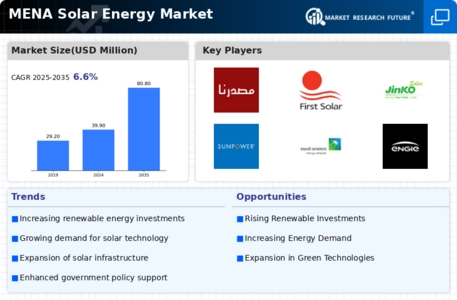
MENA Solar Energy Market Infographic
×
MENA Solar Energy Market Infographic Full View
Purchase Options

Market Analysis

In-depth Analysis of MENA Solar Energy Market Industry Landscape

The MENA (Middle East and North Africa) region is experiencing a significant shift in its energy landscape, particularly in the realm of solar power. Market dynamics in the MENA solar energy sector are characterized by a combination of factors, including policy initiatives, technological advancements, investment trends, and regional cooperation. Governments across the region are increasingly recognizing the importance of renewable energy sources, such as solar, in diversifying their energy mix, reducing dependency on fossil fuels, and mitigating climate change.

One of the key drivers shaping the MENA solar energy market is supportive government policies and initiatives. Many countries in the region have introduced ambitious renewable energy targets and incentive programs to promote the adoption of solar power. For example, feed-in tariffs, tax incentives, and subsidies are commonly used mechanisms to attract investment and stimulate growth in the solar sector. These policies create a favorable environment for both domestic and international investors, driving market expansion and innovation.

Technological advancements play a crucial role in enhancing the competitiveness of solar energy in the MENA region. The declining cost of solar photovoltaic (PV) technology, coupled with improvements in efficiency and reliability, has made solar power increasingly affordable and accessible. Innovations in energy storage solutions, such as battery storage, are also contributing to the integration of solar energy into the grid, addressing intermittency challenges and enabling greater flexibility in energy supply.

Investment trends reflect growing confidence in the MENA solar energy market as a lucrative investment opportunity. Private sector investment, including from both local and international firms, is pouring into utility-scale solar projects, rooftop solar installations, and solar manufacturing facilities. Venture capital and private equity funding are supporting startups and innovative ventures in the solar space, driving technological innovation and market disruption.

Regional cooperation initiatives are fostering collaboration among MENA countries to leverage their collective resources and expertise in advancing solar energy development. Platforms like the Arab Renewable Energy Commission and the Gulf Cooperation Council are facilitating knowledge sharing, capacity building, and joint investment projects in solar power. By pooling their resources and coordinating their efforts, countries in the region can accelerate the transition to a more sustainable and resilient energy system.

Challenges remain in realizing the full potential of the MENA solar energy market. Despite significant progress, regulatory barriers, bureaucratic hurdles, and political instability in some countries continue to hinder investment and project development. Grid infrastructure constraints and limited access to financing also pose challenges to the scalability of solar power deployment. Addressing these challenges will require continued collaboration between governments, businesses, and other stakeholders to create an enabling environment for solar energy investment and deployment.

The MENA solar energy market is experiencing dynamic growth driven by supportive policies, technological advancements, investment trends, and regional cooperation. As countries in the region strive to diversify their energy sources and transition to a more sustainable energy future, solar power is poised to play a central role in meeting growing electricity demand, reducing greenhouse gas emissions, and promoting economic development. With the right policies, investments, and collaborative efforts, the MENA region can unlock the full potential of its abundant solar resources and emerge as a global leader in renewable energy.

Author
Garvit Vyas
Analyst

Explore the profile of Garvit Vyas, one of our esteemed authors at Market Research Future, and access their expert research contributions in the field of market research and industry analysis

Leave a Comment

FAQs

What is the current valuation of the MEA Solar Energy Market?

<p>As of 2024, the MEA Solar Energy Market was valued at 1.12 USD Billion.</p>

What is the projected market valuation for the MEA Solar Energy Market in 2035?

<p>The market is projected to reach a valuation of 2.11 USD Billion by 2035.</p>

What is the expected CAGR for the MEA Solar Energy Market during the forecast period?

<p>The expected CAGR for the MEA Solar Energy Market from 2025 to 2035 is 5.89%.</p>

Which companies are considered key players in the MEA Solar Energy Market?

<p>Key players in the market include First Solar, JinkoSolar, Trina Solar, and Canadian Solar, among others.</p>

How does the residential segment perform in the MEA Solar Energy Market?

<p>The residential segment was valued between 0.25 and 0.48 USD Billion in 2024.</p>

What is the valuation range for the commercial segment in the MEA Solar Energy Market?

<p>In 2024, the commercial segment was valued between 0.2 and 0.4 USD Billion.</p>

What are the projected values for the industrial segment by 2035?

<p>The industrial segment is expected to grow to a valuation between 0.3 and 0.6 USD Billion by 2035.</p>

Market Summary

As per analysis, the MEA Solar Energy Market is projected to grow from USD 1.20 Billion in 2025 to USD 2.11 Billion by 2035, exhibiting a compound annual growth rate (CAGR) of 5.89% during the forecast period (2025 - 2035).

Key Market Trends & Highlights

The MEA Solar Energy Market is poised for substantial growth driven by technological advancements and supportive policies.

  • Investment in solar infrastructure is witnessing a notable increase across the MEA region, particularly in the GCC.
  • Technological advancements in photovoltaic solutions are enhancing efficiency and reducing costs, making solar energy more accessible.
  • Policy support and regulatory frameworks are evolving, fostering a conducive environment for solar energy development in South Africa.
  • The growing energy demand and abundant solar resources in the MEA region are key drivers propelling the market forward.

Market Size & Forecast

2024 Market Size 1.12 (USD Billion)
2035 Market Size 2.11 (USD Billion)
CAGR (2025 - 2035) 5.89%

Major Players

<p>First Solar (US), JinkoSolar (CN), Trina Solar (CN), Sungrow Power Supply (CN), Canadian Solar (CA), LONGi Green Energy (CN), Enel Green Power (IT), TotalEnergies (FR), ACWA Power (SA)</p>

Market Trends

The MEA Solar Energy Market is currently experiencing a transformative phase characterized by a growing emphasis on renewable energy sources. Countries within the Middle East and Africa are increasingly recognizing the potential of solar energy to address energy demands while simultaneously reducing carbon emissions. This shift is driven by a combination of favorable climatic conditions, technological advancements, and supportive government policies aimed at promoting sustainable energy solutions. As a result, investments in solar infrastructure are on the rise, with both public and private sectors actively participating in the development of solar projects. Moreover, the MEA region is witnessing a diversification of solar technologies, including photovoltaic systems and concentrated solar power. This diversification is indicative of a broader trend towards innovation and efficiency in energy production. The integration of solar energy into national grids is becoming more prevalent, enhancing energy security and reliability. Additionally, the collaboration between governments and international organizations is fostering knowledge sharing and capacity building, which are essential for the long-term sustainability of the MEA Solar Energy Market. Overall, the current landscape suggests a promising future for solar energy in the region, with potential for significant growth and development in the coming years.

Increased Investment in Solar Infrastructure

The MEA Solar Energy Market is witnessing a surge in investments aimed at enhancing solar infrastructure. Governments and private entities are allocating resources to develop large-scale solar farms and smaller distributed generation systems. This trend reflects a commitment to harnessing solar energy as a primary source of power, thereby reducing reliance on fossil fuels.

Technological Advancements in Solar Solutions

Innovations in solar technology are playing a crucial role in the MEA Solar Energy Market. The introduction of more efficient photovoltaic cells and energy storage solutions is enabling better energy capture and utilization. These advancements are likely to enhance the overall performance and reliability of solar energy systems in the region.

Policy Support and Regulatory Frameworks

The MEA Solar Energy Market is benefiting from supportive government policies and regulatory frameworks that encourage solar energy adoption. Initiatives such as feed-in tariffs, tax incentives, and renewable energy targets are being implemented to stimulate growth. This supportive environment is essential for attracting investments and fostering a sustainable solar energy ecosystem.

MENA Solar Energy Market Market Drivers

Abundant Solar Resources in MEA

The MEA Solar Energy Market benefits from an abundance of solar resources, with many countries in the region receiving high levels of solar irradiance. For example, regions such as the Arabian Peninsula experience over 3,000 hours of sunshine annually, making them ideal for solar energy generation. This natural advantage positions the MEA region as a global leader in solar energy potential. Countries like the United Arab Emirates and Saudi Arabia are capitalizing on this resource by investing in large-scale solar projects, such as the Mohammed bin Rashid Al Maktoum Solar Park, which aims to generate 5,000 MW by 2030. The availability of such vast solar resources not only supports the growth of the MEA Solar Energy Market but also encourages international investments and partnerships.

Government Incentives and Subsidies

The MEA Solar Energy Market is significantly influenced by government incentives and subsidies aimed at promoting renewable energy adoption. Many governments in the region have implemented favorable policies to encourage solar energy investments. For instance, the Saudi Vision 2030 initiative aims to diversify the economy and reduce dependence on oil, with a target of generating 58.7 GW of renewable energy, primarily from solar sources. Similarly, the Egyptian government has introduced feed-in tariffs to attract private investments in solar projects. These incentives not only lower the financial barriers for investors but also stimulate the growth of the solar energy sector. As a result, the MEA Solar Energy Market is likely to witness accelerated growth, driven by supportive regulatory frameworks and financial mechanisms.

Growing Energy Demand in MEA Region

The MEA Solar Energy Market is experiencing a surge in energy demand, driven by rapid urbanization and population growth. As countries in the Middle East and Africa continue to develop, the need for reliable and sustainable energy sources becomes increasingly critical. For instance, the International Energy Agency projects that electricity demand in the MEA region could rise by over 60 percent by 2040. This growing demand presents a substantial opportunity for solar energy solutions, as they offer a clean and renewable alternative to traditional fossil fuels. Governments are recognizing this potential, leading to increased investments in solar infrastructure. Consequently, the MEA Solar Energy Market is likely to expand significantly, as stakeholders seek to meet the rising energy needs while addressing environmental concerns.

Technological Innovations in Solar Energy

The MEA Solar Energy Market is poised for growth due to ongoing technological innovations in solar energy solutions. Advancements in photovoltaic technology, energy storage systems, and smart grid integration are enhancing the efficiency and reliability of solar energy systems. For example, the introduction of bifacial solar panels, which capture sunlight on both sides, has the potential to increase energy output significantly. Additionally, energy storage technologies, such as lithium-ion batteries, are becoming more affordable and efficient, enabling better management of solar energy supply and demand. These innovations not only improve the performance of solar installations but also make solar energy more competitive with traditional energy sources. Consequently, the MEA Solar Energy Market is likely to benefit from these technological advancements, attracting more investments and facilitating wider adoption of solar solutions.

Regional Climate Initiatives and Sustainability Goals

The MEA Solar Energy Market is increasingly shaped by regional climate initiatives and sustainability goals. Many countries in the MEA region are committing to reducing greenhouse gas emissions and transitioning to cleaner energy sources. For instance, the United Arab Emirates has set a target to generate 50 percent of its energy from clean sources by 2050. Such commitments are driving investments in solar energy projects, as they align with global sustainability trends. Furthermore, international agreements, such as the Paris Agreement, encourage MEA countries to adopt renewable energy solutions to meet their climate targets. This growing emphasis on sustainability not only enhances the credibility of the MEA Solar Energy Market but also attracts foreign investments and partnerships, fostering a more robust solar energy ecosystem.

Market Segment Insights

By Application: Residential (Largest) vs. Utility (Fastest-Growing)

<p>In the MEA Solar Energy Market, the application segment showcases a diverse range of uses, with residential solar energy systems dominating the overall market. This segment is particularly popular among homeowners seeking sustainable energy solutions, contributing significantly to the market's growth. In contrast, the utility scale applications, characterized by large-scale solar farms, represent the fastest-growing segment as governments and private investors increasingly recognize the potential of solar energy to meet energy demands.</p>

<p>Residential (Dominant) vs. Utility (Emerging)</p>

<p>The residential segment is the most established in the MEA Solar Energy Market, where individual homeowners invest in solar panels not only for energy savings but also for eco-friendly living. This segment thrives in regions with high solar irradiance, enabling effective energy generation. On the other hand, the utility scale segment is emerging rapidly, driven by governmental incentives and the need for reliable energy sources. Utility-scale solar projects are often backed by significant investments, making them a key contributor to the renewable energy landscape in the Middle East and Africa, complementing traditional energy sources.</p>

By Technology: Photovoltaic (Largest) vs. Concentrated Solar Power (Fastest-Growing)

<p>In the MEA Solar Energy Market, the technology segment showcases a diverse distribution of contributions to overall energy generation. Photovoltaic (PV) technology holds a substantial market share, establishing itself as the largest segment due to its widespread applicability and declining costs. Concentrated Solar Power (CSP), while smaller in market size, is rapidly gaining traction and shows potential for significant growth within the region.</p>

<p>Technology: PV (Dominant) vs. CSP (Emerging)</p>

<p>Photovoltaic (PV) technology remains the dominant force in the MEA Solar Energy Market, primarily driven by its scalability and adaptability for various applications, including residential and commercial installations. PV systems are favored due to their easy maintenance and cost-effectiveness, which cater well to the diverse climatic conditions across the Middle East and Africa. Conversely, Concentrated Solar Power (CSP) is emerging as a crucial player, leveraging the intense solar irradiance available in the region. CSP technology, although still developing, focuses on large-scale installations and enhanced energy storage solutions, positioning it as a future cornerstone in renewable energy advancements.</p>

By End Use: Electricity Generation (Largest) vs. Water Heating (Fastest-Growing)

<p>The MEA Solar Energy Market demonstrates a diverse distribution among its end-use segments. Electricity Generation holds the largest market share, driven by increasing demand for renewable energy sources to meet electricity needs across the region. Following closely are segments like Heating and Cooling, which also significantly contribute to the overall market, while Water Heating emerges as a rapidly growing segment due to a rising awareness of energy efficiency and solar technology advancements. Analyzing growth trends, Electricity Generation continues to benefit from government initiatives promoting solar energy adoption, bolstered by technological innovations. In contrast, Water Heating is gaining momentum as consumers seek sustainable solutions for domestic and commercial energy use. As the region expands its focus on renewable energy, these segments are expected to see varying rates of growth, reflecting shifting priorities towards environmentally friendly practices.</p>

<p>Electricity Generation (Dominant) vs. Transportation (Emerging)</p>

<p>In the context of the MEA Solar Energy Market, Electricity Generation stands out as the dominant segment. It is characterized by robust infrastructure and significant investments that underline its role in the energy transition. Utilities and independent power producers harness solar technologies to meet escalating energy requirements. On the other hand, Transportation is labeled as an emerging segment with potential growth. This sector is beginning to adopt solar energy for powering electric vehicles and sustainability initiatives. The interplay between these segments showcases a fundamental shift in energy consumption patterns, with Electricity Generation leading the way and Transportation poised to harness solar innovations for cleaner travel solutions.</p>

Get more detailed insights about MENA Solar Energy Market Research Report – Forecast till 2035

Regional Insights

GCC : A Hub for Renewable Innovation

The GCC region holds a commanding 56% market share in the MEA solar energy sector, valued at approximately $12 billion in 2024. Key growth drivers include abundant sunlight, government initiatives like Saudi Arabia's Vision 2030, and substantial investments in solar infrastructure. Demand is surging due to rising energy consumption and a shift towards sustainable energy solutions, supported by favorable regulatory frameworks and incentives for solar projects.

South Africa : Diverse Applications Drive Growth

South Africa commands a 32% share of the MEA solar market, valued at around $7 billion in 2024. The growth is fueled by increasing electricity demand, particularly in urban areas like Johannesburg and Cape Town, and government policies promoting renewable energy. The Renewable Energy Independent Power Producer Procurement Programme (REIPPPP) has been pivotal in attracting investments and fostering local manufacturing of solar components.

Rest of MEA : Potential Beyond Established Regions

The Rest of MEA holds a 24% market share, valued at approximately $5 billion in 2024. This sub-region is characterized by diverse energy needs and varying levels of solar adoption. Countries like Kenya and Egypt are witnessing growth due to supportive policies and international partnerships. However, challenges such as infrastructure deficits and regulatory hurdles remain. Local players are increasingly collaborating with The Solar Energy penetration.

Key Players and Competitive Insights

The Solar Energy Market is currently characterized by a dynamic competitive landscape, driven by increasing demand for renewable energy solutions and supportive government policies across the MEA region. Key players are actively pursuing strategies that emphasize innovation, regional expansion, and strategic partnerships to enhance their market positioning. For instance, First Solar (US) has focused on advancing its thin-film solar technology, which is expected to improve efficiency and reduce costs. Meanwhile, JinkoSolar (CN) is expanding its manufacturing capabilities in the region, aiming to localize production and reduce supply chain vulnerabilities. These strategies collectively contribute to a competitive environment that is increasingly focused on technological advancement and operational efficiency.

In terms of business tactics, companies are increasingly localizing manufacturing to mitigate supply chain disruptions and optimize logistics. The market structure appears moderately fragmented, with several key players exerting influence over their respective segments. This fragmentation allows for a variety of competitive strategies, as companies seek to differentiate themselves through innovation and localized operations.

In December 2025, Trina Solar (CN) announced a partnership with a leading energy provider in the UAE to develop a large-scale solar project. This collaboration is significant as it not only enhances Trina Solar's footprint in the region but also aligns with the UAE's ambitious renewable energy targets. Such partnerships are likely to bolster Trina's market presence and contribute to the overall growth of solar energy capacity in the MEA region.

In November 2025, Canadian Solar (CA) unveiled plans to invest $200 million in a new manufacturing facility in South Africa. This strategic move is indicative of the company's commitment to localizing production and tapping into the growing demand for solar solutions in the African market. By establishing a manufacturing base in South Africa, Canadian Solar aims to reduce costs and improve delivery times, thereby enhancing its competitive edge.

In October 2025, ACWA Power (SA) secured a contract to develop a 1 GW solar power plant in Egypt, which is expected to be one of the largest in the region. This project underscores ACWA Power's strategic focus on large-scale renewable energy projects and its role in supporting Egypt's energy transition. The successful execution of such projects could position ACWA Power as a leader in the MEA solar market.

As of January 2026, current trends in the Solar Energy Market are increasingly defined by digitalization, sustainability, and the integration of AI technologies. Strategic alliances among key players are shaping the competitive landscape, fostering innovation and collaboration. Looking ahead, it is anticipated that competitive differentiation will evolve, with a shift from price-based competition to a focus on technological innovation, supply chain reliability, and sustainable practices. This evolution suggests that companies that prioritize these aspects are likely to gain a competitive advantage in the rapidly changing market.

Key Companies in the MENA Solar Energy Market include

Industry Developments

January 2023: Oman Power and Water Procurement Company (OPWP) announced solar energy projects Manah 1 and 2 worth USD 777 million. The project is likely to procure 2 million solar PV panels. It will jointly produce a total of 1,000MW, which is set to come up by the end of 2025 on a 15 million sq m area within the Governorate of A'Dakhiliyah.

Future Outlook

MENA Solar Energy Market Future Outlook

The MEA Solar Energy Market is projected to grow at a 5.89% CAGR from 2025 to 2035, driven by technological advancements, regulatory support, and increasing energy demands.

New opportunities lie in:

  • Development of integrated solar-plus-storage solutions for commercial sectors.
  • Expansion of solar leasing models to enhance accessibility for residential customers.
  • Investment in solar-powered desalination plants to address water scarcity.

By 2035, the MEA Solar Energy Market is expected to be robust, driven by innovation and strategic investments.

Market Segmentation

MENA Solar Energy Market End Use Outlook

  • Electricity Generation
  • Heating
  • Cooling
  • Water Heating
  • Transportation

MENA Solar Energy Market Technology Outlook

  • Photovoltaic
  • Concentrated Solar Power
  • Solar Thermal
  • Bifacial Solar Panels
  • Building-integrated Photovoltaics

MENA Solar Energy Market Application Outlook

  • Residential
  • Commercial
  • Industrial
  • Utility
  • Off-grid

Report Scope

MARKET SIZE 20241.12(USD Billion)
MARKET SIZE 20251.2(USD Billion)
MARKET SIZE 20352.11(USD Billion)
COMPOUND ANNUAL GROWTH RATE (CAGR)5.89% (2024 - 2035)
REPORT COVERAGERevenue Forecast, Competitive Landscape, Growth Factors, and Trends
BASE YEAR2024
Market Forecast Period2025 - 2035
Historical Data2019 - 2024
Market Forecast UnitsUSD Billion
Key Companies ProfiledFirst Solar (US), JinkoSolar (CN), Trina Solar (CN), Sungrow Power Supply (CN), Canadian Solar (CA), LONGi Green Energy (CN), Enel Green Power (IT), TotalEnergies (FR), ACWA Power (SA)
Segments CoveredApplication, Technology, End Use
Key Market OpportunitiesExpansion of solar energy infrastructure driven by favorable regulatory frameworks and increasing energy demand in the MEA region.
Key Market DynamicsGrowing investment in solar technology driven by regional energy diversification and sustainability initiatives in the MEA.
Countries CoveredGCC Countries, South Africa, Rest of MEA

FAQs

What is the current valuation of the MEA Solar Energy Market?

<p>As of 2024, the MEA Solar Energy Market was valued at 1.12 USD Billion.</p>

What is the projected market valuation for the MEA Solar Energy Market in 2035?

<p>The market is projected to reach a valuation of 2.11 USD Billion by 2035.</p>

What is the expected CAGR for the MEA Solar Energy Market during the forecast period?

<p>The expected CAGR for the MEA Solar Energy Market from 2025 to 2035 is 5.89%.</p>

Which companies are considered key players in the MEA Solar Energy Market?

<p>Key players in the market include First Solar, JinkoSolar, Trina Solar, and Canadian Solar, among others.</p>

How does the residential segment perform in the MEA Solar Energy Market?

<p>The residential segment was valued between 0.25 and 0.48 USD Billion in 2024.</p>

What is the valuation range for the commercial segment in the MEA Solar Energy Market?

<p>In 2024, the commercial segment was valued between 0.2 and 0.4 USD Billion.</p>

What are the projected values for the industrial segment by 2035?

<p>The industrial segment is expected to grow to a valuation between 0.3 and 0.6 USD Billion by 2035.</p>

  1. EXECUTIVE SUMMARY
  2. MARKET INTRODUCTION
    1. Definition
    2. Scope of the Study
      1. Research Objective
      2. Assumptions
      3. Limitations
  3. RESEARCH METHODOLOGY
    1. Overview
    2. Data Mining
    3. Secondary Research
    4. Primary Research
      1. Primary Interviews and Information Gathering Process
      2. Breakdown of Primary Respondents
    5. Forecasting Model
    6. Market Size Estimation
      1. Bottom-Up Approach
      2. Top-Down Approach
    7. Data Triangulation
    8. Validation
  4. MARKET DYNAMICS
    1. Overview
    2. Drivers
    3. Restraints
    4. Opportunities
  5. MARKET FACTOR ANALYSIS
    1. Value Chain Analysis
    2. Porter’s Five Forces Analysis
      1. Bargaining Power of Suppliers
      2. Bargaining Power of Buyers
      3. Threat of New Entrants
      4. Threat of Substitutes
      5. Intensity of Rivalry
    3. COVID-19 Impact Analysis
      1. Market Impact Analysis
      2. Regional Impact
      3. Opportunity and Threat Analysis
  6. MENA SOLAR ENERGY MARKET, BY TECHNOLOGY
    1. Overview
    2. Photovoltaic Systems
    3. Concentrated Solar Power Systems
  7. MENA SOLAR ENERGY MARKET, BY SOLAR MODULE
    1. Overview
    2. Monocrystalline
    3. Polycrystalline
    4. Cadmium Telluride
    5. Amorphous Silicon Cells
    6. Others
  8. MENA SOLAR ENERGY MARKET, BY APPLICATION
    1. Overview
    2. Residential
    3. Commercial
    4. Industrial
  9. MENA SOLAR ENERGY MARKET, BY END-USE
    1. Overview
    2. Electricity Generation
    3. Lighting
    4. Heating
    5. Charging
  10. MENA SOLAR ENERGY MARKET, BY REGION
    1. Overview
    2. MENA
      1. UAE (United Arab Emirates)
      2. Oman, Kingdom of Saudi Arabia
      3. Kuwait (GCC)
      4. Jordan
      5. Lebanon
      6. Egypt
      7. Tunisia
      8. Morocco
      9. Algeria
  11. COMPETITIVE LANDSCAPE
    1. Overview
    2. Competitive Analysis
    3. Market Share Analysis
    4. Major Growth Strategy in the MENA Solar Energy Market,
    5. Competitive Benchmarking
    6. Leading Players in Terms of Number of Developments in the MENA Solar Energy Market,
    7. Key developments and Growth Strategies
      1. New Product Launch/Service Deployment
      2. Merger & Acquisitions
      3. Joint Ventures
    8. Major Players Financial Matrix
      1. Sales & Operating Income, 2022
      2. Major Players R&D Expenditure. 2022
  12. COMPANY PROFILES
    1. ACWA Power
      1. Company Overview
      2. Financial Overview
      3. Products Offered
      4. Key Developments
      5. SWOT Analysis
      6. Key Strategies
    2. MASDAR (ABU DHABI FUTURE ENERGY COMPANY)
      1. Company Overview
      2. Financial Overview
      3. Products Offered
      4. Key Developments
      5. SWOT Analysis
      6. Key Strategies
    3. First Solar
      1. Company Overview
      2. Financial Overview
      3. Products Offered
      4. Key Developments
      5. SWOT Analysis
      6. Key Strategies
    4. JinkoSolar
      1. Company Overview
      2. Financial Overview
      3. Products Offered
      4. Key Developments
      5. SWOT Analysis
      6. Key Strategies
    5. SunPower
      1. Company Overview
      2. Financial Overview
      3. Products Offered
      4. Key Developments
      5. SWOT Analysis
      6. Key Strategies
    6. DEWA (Dubai Electricity and Water Authority)
      1. Company Overview
      2. Financial Overview
      3. Products Offered
      4. Key Developments
      5. SWOT Analysis
      6. Key Strategies
    7. Saudi Aramco
      1. Company Overview
      2. Financial Overview
      3. Products Offered
      4. Key Developments
      5. SWOT Analysis
      6. Key Strategies
    8. Scatec Solar
      1. Company Overview
      2. Financial Overview
      3. Products Offered
      4. Key Developments
      5. SWOT Analysis
      6. Key Strategies
    9. ACWAPower
      1. Company Overview
      2. Financial Overview
      3. Products Offered
      4. Key Developments
      5. SWOT Analysis
      6. Key Strategies
    10. Engie
      1. Company Overview
      2. Financial Overview
      3. Products Offered
      4. Key Developments
      5. SWOT Analysis
      6. Key Strategies
  13. APPENDIX
    1. References
    2. Related Reports
  14. LIST OF TABLES
  15. MENA: AUTOMOTIVE LUBRICANTS MARKET, BY TECHNOLOGY, 2018-2032 (USD BILLION)
  16. MENA: AUTOMOTIVE LUBRICANTS MARKET, BY SOLAR MODULE, 2018-2032 (USD BILLION)
  17. MENA: AUTOMOTIVE LUBRICANTS MARKET, BY APPLICATION, 2018-2032 (USD BILLION)
  18. MENA: AUTOMOTIVE LUBRICANTS MARKET, BY END-USE, 2018-2032 (USD BILLION)
  19. UAE (UNITED ARAB EMIRATES): AUTOMOTIVE LUBRICANTS MARKET, BY TECHNOLOGY, 2018-2032 (USD BILLION)
  20. UAE (UNITED ARAB EMIRATES): AUTOMOTIVE LUBRICANTS MARKET, BY SOLAR MODULE, 2018-2032 (USD BILLION)
  21. UAE (UNITED ARAB EMIRATES): AUTOMOTIVE LUBRICANTS MARKET, BY APPLICATION, 2018-2032 (USD BILLION)
  22. UAE (UNITED ARAB EMIRATES): AUTOMOTIVE LUBRICANTS MARKET, BY END-USE, 2018-2032 (USD BILLION)
  23. OMAN: AUTOMOTIVE LUBRICANTS MARKET, BY TECHNOLOGY, 2018-2032 (USD BILLION)
  24. OMAN: AUTOMOTIVE LUBRICANTS MARKET, BY SOLAR MODULE, 2018-2032 (USD BILLION)
  25. OMAN: AUTOMOTIVE LUBRICANTS MARKET, BY APPLICATION, 2018-2032 (USD BILLION)
  26. OMAN: AUTOMOTIVE LUBRICANTS MARKET, BY END-USE, 2018-2032 (USD BILLION)
  27. KINGDOM OF SAUDI ARABIA: AUTOMOTIVE LUBRICANTS MARKET, BY TECHNOLOGY, 2018-2032 (USD BILLION)
  28. KINGDOM OF SAUDI ARABIA: AUTOMOTIVE LUBRICANTS MARKET, BY SOLAR MODULE, 2018-2032 (USD BILLION)
  29. KINGDOM OF SAUDI ARABIA: AUTOMOTIVE LUBRICANTS MARKET, BY APPLICATION, 2018-2032 (USD BILLION)
  30. KINGDOM OF SAUDI ARABIA: AUTOMOTIVE LUBRICANTS MARKET, BY END-USE, 2018-2032 (USD BILLION)
  31. KUWAIT (GCC): AUTOMOTIVE LUBRICANTS MARKET, BY TECHNOLOGY, 2018-2032 (USD BILLION)
  32. KUWAIT (GCC): AUTOMOTIVE LUBRICANTS MARKET, BY SOLAR MODULE, 2018-2032 (USD BILLION)
  33. KUWAIT (GCC): AUTOMOTIVE LUBRICANTS MARKET, BY APPLICATION, 2018-2032 (USD BILLION)
  34. KUWAIT (GCC): AUTOMOTIVE LUBRICANTS MARKET, BY END-USE, 2018-2032 (USD BILLION)
  35. JORDAN: AUTOMOTIVE LUBRICANTS MARKET, BY TECHNOLOGY, 2018-2032 (USD BILLION)
  36. JORDAN: AUTOMOTIVE LUBRICANTS MARKET, BY SOLAR MODULE, 2018-2032 (USD BILLION)
  37. JORDAN: AUTOMOTIVE LUBRICANTS MARKET, BY APPLICATION, 2018-2032 (USD BILLION)
  38. JORDAN: AUTOMOTIVE LUBRICANTS MARKET, BY END-USE, 2018-2032 (USD BILLION)
  39. LEBANON: AUTOMOTIVE LUBRICANTS MARKET, BY TECHNOLOGY, 2018-2032 (USD BILLION)
  40. LEBANON: AUTOMOTIVE LUBRICANTS MARKET, BY SOLAR MODULE, 2018-2032 (USD BILLION)
  41. LEBANON: AUTOMOTIVE LUBRICANTS MARKET, BY APPLICATION, 2018-2032 (USD BILLION)
  42. LEBANON: AUTOMOTIVE LUBRICANTS MARKET, BY END-USE, 2018-2032 (USD BILLION)
  43. EGYPT: AUTOMOTIVE LUBRICANTS MARKET, BY TECHNOLOGY, 2018-2032 (USD BILLION)
  44. EGYPT: AUTOMOTIVE LUBRICANTS MARKET, BY SOLAR MODULE, 2018-2032 (USD BILLION)
  45. EGYPT: AUTOMOTIVE LUBRICANTS MARKET, BY APPLICATION, 2018-2032 (USD BILLION)
  46. EGYPT: AUTOMOTIVE LUBRICANTS MARKET, BY END-USE, 2018-2032 (USD BILLION)
  47. TUNISIA: AUTOMOTIVE LUBRICANTS MARKET, BY TECHNOLOGY, 2018-2032 (USD BILLION)
  48. TUNISIA: AUTOMOTIVE LUBRICANTS MARKET, BY SOLAR MODULE, 2018-2032 (USD BILLION)
  49. TUNISIA: AUTOMOTIVE LUBRICANTS MARKET, BY APPLICATION, 2018-2032 (USD BILLION)
  50. TUNISIA: AUTOMOTIVE LUBRICANTS MARKET, BY END-USE, 2018-2032 (USD BILLION)
  51. MOROCCO: AUTOMOTIVE LUBRICANTS MARKET, BY TECHNOLOGY, 2018-2032 (USD BILLION)
  52. MOROCCO: AUTOMOTIVE LUBRICANTS MARKET, BY SOLAR MODULE, 2018-2032 (USD BILLION)
  53. MOROCCO: AUTOMOTIVE LUBRICANTS MARKET, BY APPLICATION, 2018-2032 (USD BILLION)
  54. MOROCCO: AUTOMOTIVE LUBRICANTS MARKET, BY END-USE, 2018-2032 (USD BILLION)
  55. ALGERIA: AUTOMOTIVE LUBRICANTS MARKET, BY TECHNOLOGY, 2018-2032 (USD BILLION)
  56. ALGERIA: AUTOMOTIVE LUBRICANTS MARKET, BY SOLAR MODULE, 2018-2032 (USD BILLION)
  57. ALGERIA: AUTOMOTIVE LUBRICANTS MARKET, BY APPLICATION, 2018-2032 (USD BILLION)
  58. ALGERIA: AUTOMOTIVE LUBRICANTS MARKET, BY END-USE, 2018-2032 (USD BILLION)
  59. LIST OF FIGURES
  60. RESEARCH PROCESS
  61. MARKET STRUCTURE FOR THE MENA SOLAR ENERGY MARKET
  62. MARKET DYNAMICS FOR THE MENA SOLAR ENERGY MARKET
  63. MENA: AUTOMOTIVE LUBRICANTS MARKET, SHARE (%), BY REGION, 2022
  64. MENA SOLAR ENERGY MARKET: COMPANY SHARE ANALYSIS, 2022 (%)
  65. ACWA POWER: FINANCIAL OVERVIEW SNAPSHOT
  66. ACWA POWER: SWOT ANALYSIS
  67. MASDAR (ABU DHABI FUTURE ENERGY COMPANY): FINANCIAL OVERVIEW SNAPSHOT
  68. MASDAR (ABU DHABI FUTURE ENERGY COMPANY): SWOT ANALYSIS
  69. FIRST SOLAR: FINANCIAL OVERVIEW SNAPSHOT
  70. FIRST SOLAR: SWOT ANALYSIS
  71. JINKOSOLAR: FINANCIAL OVERVIEW SNAPSHOT
  72. JINKOSOLAR: SWOT ANALYSIS
  73. SUNPOWER.: FINANCIAL OVERVIEW SNAPSHOT
  74. SUNPOWER.: SWOT ANALYSIS
  75. DEWA (DUBAI ELECTRICITY AND WATER AUTHORITY): FINANCIAL OVERVIEW SNAPSHOT
  76. DEWA (DUBAI ELECTRICITY AND WATER AUTHORITY): SWOT ANALYSIS
  77. SAUDI ARAMCO: FINANCIAL OVERVIEW SNAPSHOT
  78. SAUDI ARAMCO: SWOT ANALYSIS
  79. SCATEC SOLAR: FINANCIAL OVERVIEW SNAPSHOT
  80. SCATEC SOLAR: SWOT ANALYSIS
  81. ACWAPOWER: FINANCIAL OVERVIEW SNAPSHOT
  82. ACWAPOWER: SWOT ANALYSIS
  83. ENGIE: FINANCIAL OVERVIEW SNAPSHOT
  84. ENGIE: SWOT ANALYSIS

MENA Solar Energy Market Segmentation

Market Segmentation Overview

  • Detailed segmentation data will be available in the full report
  • Comprehensive analysis by multiple parameters
  • Regional and country-level breakdowns
  • Market size forecasts by segment
Infographic

Free Sample Request

Kindly complete the form below to receive a free sample of this Report

Get Free Sample

Customer Strories

Compare Licence

×
Features License Type
Single User Multiuser License Enterprise User
Price $4,950 $5,950 $7,250
Maximum User Access Limit 1 User Upto 10 Users Unrestricted Access Throughout the Organization
Free Customization
Direct Access to Analyst
Deliverable Format
Platform Access
Discount on Next Purchase 10% 15% 15%
Printable Versions














