
×
Hero Background
English
Chinese
French
Japanese
Korean
German
Spanish

Membranes Market Size

ID: MRFR/CnM/9276-CR
111 Pages
Chitranshi Jaiswal
July 2025

Membranes Market Research Report Information by Material (Polymeric Materials (Polyamide (PA), Polyethersulfone (PES), Polysulfone (PS), Polyvinylidene Fluoride (PVDF), Cellulose Acetate (CA), Others), Ceramic (Alumina (Al₂O₃), Titania (TiO₂), Zirconia (ZrO₂), Others), Others), by Production Technology (Phase Inversion Processes (Non-Solvent Induced Phase Separation (NIPS) and Thermally Induced Phase Separation (TIPS)), Spinning Methods (Dry-Jet Wet Spinning, Melt Spinning, Other)), by Membrane Type (Microfiltration (MF), Ultrafiltration (UF... read more

Share:
Download PDF ×

We do not share your information with anyone. However, we may send you emails based on your report interest from time to time. You may contact us at any time to opt-out.

Membranes Market Infographic
Purchase Options

Membranes Size

Membranes Market Growth Projections and Opportunities

The membranes market is dependent upon the impact of various variables that on the whole add to its extension, mechanical movements, and execution in different areas. Industry members actually should appreciate these market factors to successfully explore snags, hold onto worthwhile conditions, and adjust to creating patterns. Absence of Water and Treatment Necessities: Expanding overall water shortage concerns impel the requirement for membranes in the field of water remediation. Film advances, including reverse assimilation and ultrafiltration, are vital in tending to the growing worries in regard to water quality and shortage by guaranteeing the arrangement of spotless and consumable water. Treatment of Wastewater and Guidelines: The interest in films in wastewater treatment is driven by the basic for mindful wastewater the executives and tough ecological guidelines. As well as advancing maintainable water reuse and really treating modern and metropolitan profluent, membrane processes additionally stick to administrative prerequisites. Drawn out Extension of Drug Applications: The interest in membranes is impacted by the drug business' outstanding development, explicitly in applications like filtration and detachment. By ensuring the quality and immaculateness of drug items, membrane innovations are irreplaceable to the drug producing process. The Biotechnology Area Is Extending: The powerful biotechnology industry is profoundly reliant upon membrane innovations for a huge number of purposes, like the detachment and filtration of proteins. Biotechnology layer request is affected by the necessity for adaptable and viable partition techniques in the development of biopharmaceuticals. Mechanical Progressions in Desalination: The expanded conspicuousness of desalination as an answer for freshwater deficiencies has prompted a flood popular for membrane, explicitly those used backward assimilation desalination. Desalination innovation and film material progressions add to the development of the market by fulfilling the overall interest for freshwater creation. Expanding Accentuation on the Handling of Food and Refreshments: Film request is driven by the food and refreshment industry's accentuation on quality, wellbeing, and handling effectiveness. The market for membrane filtration is extending because of its broad application in different cycles, including drink explanation, dairy handling, and food fixing focus. Effectiveness in Energy Partition of Gas: Gas partition strategies that are energy effective, like the development of nitrogen and the purging of petroleum gas, depend vigorously on membranes. The energy business’s appeal for layer advancements comes from their ability to offer affordable and biologically practical gas partition arrangements. Expanding Natural Maintainability Mindfulness: As natural maintainability cognizance increments, market elements are affected. By goodness of their naturally positive attributes rather than regular partition innovations, membranes are acquiring notoriety as businesses endeavor to execute maintainable methodologies that moderate their biological effect. Advancements in Film Material Innovation: Constant mechanical advancement in membranes materials is a critical consideration for the improvement of execution and proficiency. Material progressions, for example, the production of nanocomposite membranes and superior execution polymers, expand the general functionalities and upper hand of layer advances.
Membranes Market Size Graph
Author
Chitranshi Jaiswal
Research Analyst Level I

In her 3 years of experience in the market research field, she has handled critical cross-domain projects. She has an in-depth knowledge of market estimation & analysis, problem-solving, primary as well as secondary research, and team management.She holds an engineering degree and is an MBA professional from a well-known university, capable of evaluating the market and competitive conditions. An exceptional strategist with excellent communication skills and a passion for delivering cutting-edge & practical insights for the market. Proficient in multi-tasking, and can successfully deal with competing demands, while maintaining complete confidentiality. Generated business through active client and project development, networking, and high-quality responses. Her knowledge and skills have helped in making solid business decisions, securing funding from investors, and avoiding business failures.

Leave a Comment

FAQs

What is the current valuation of the Membranes Market as of 2025?

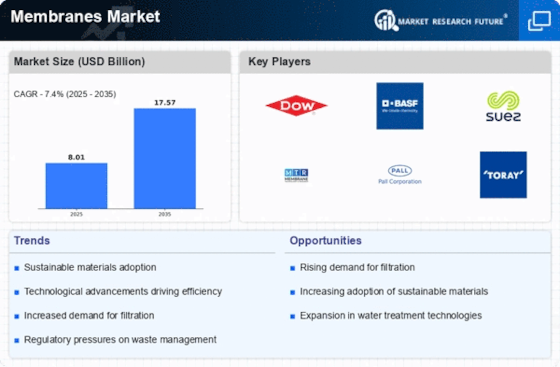
The Membranes Market is valued at approximately 8.01 USD Billion in 2024.

What is the projected market size for the Membranes Market by 2035?

The market is expected to reach a valuation of 17.57 USD Billion by 2035.

What is the expected CAGR for the Membranes Market during the forecast period 2025 - 2035?

The anticipated CAGR for the Membranes Market during the forecast period is 7.4%.

Which companies are considered key players in the Membranes Market?

Key players in the Membranes Market include Dow, BASF, Suez, and Pall Corporation, among others.

What are the primary segments of the Membranes Market based on material type?

The primary segments based on material type include Polymeric Materials, Ceramic, and Others, with Polymeric Materials valued at 4.0 to 9.0 USD Billion.

Market Summary

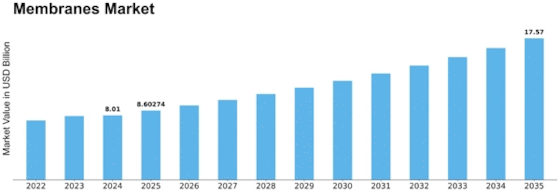
As per MRFR analysis, the Membranes Market Size was estimated at 8.01 USD Billion in 2024. The Membranes industry is projected to grow from 8.603 USD Billion in 2025 to 17.57 USD Billion by 2035, exhibiting a compound annual growth rate (CAGR) of 7.4 during the forecast period 2025 - 2035.

Key Market Trends & Highlights

The Membranes Market is poised for substantial growth driven by technological advancements and increasing demand for sustainable solutions.

  • Technological advancements in membrane materials are reshaping the landscape of the Membranes Market.
  • North America remains the largest market, while Asia-Pacific is emerging as the fastest-growing region.
  • Polymeric materials dominate the market, whereas ceramic membranes are witnessing rapid growth.
  • Key drivers include increasing water scarcity and regulatory pressures pushing for sustainable water treatment solutions.

Market Size & Forecast

2024 Market Size 8.01 (USD Billion)
2035 Market Size 17.57 (USD Billion)
CAGR (2025 - 2035) 7.4%
Largest Regional Market Share in 2024 North America

Major Players

<p>Dow (US), BASF (DE), Suez (FR), Membrane Technology and Research (US), Pall Corporation (US), Toray Industries (JP), Hydranautics (US), Koch Membrane Systems (US), GE Water & Process Technologies (US)</p>

Market Trends

The Membranes Market is currently experiencing a dynamic evolution, driven by various factors including technological advancements and increasing environmental concerns. The demand for efficient separation processes in industries such as water treatment, food and beverage, and pharmaceuticals is on the rise. This trend is likely to continue as industries seek sustainable solutions to meet regulatory requirements and consumer expectations. Furthermore, innovations in membrane materials and designs are enhancing performance, leading to broader applications across diverse sectors. As a result, the Membranes Market appears poised for substantial growth in the coming years, with a focus on enhancing efficiency and reducing environmental impact. In addition to technological progress, the Membranes Market is influenced by shifting consumer preferences towards eco-friendly products. Companies are increasingly investing in research and development to create membranes that not only perform effectively but also minimize waste and energy consumption. This shift towards sustainability is likely to drive competition among manufacturers, encouraging them to adopt greener practices. Overall, the Membranes Market is at a pivotal point, where innovation and sustainability converge to shape its future trajectory.

Technological Advancements in Membrane Materials

Recent innovations in membrane materials are transforming the Membranes Market. New polymers and composite materials are being developed to enhance permeability and selectivity, which could lead to improved efficiency in various applications. These advancements may also facilitate the creation of membranes that are more resistant to fouling, thereby extending their operational lifespan.

Growing Demand for Water Treatment Solutions

The increasing global focus on water scarcity and quality is driving demand for advanced membrane technologies in water treatment. Membranes Market are becoming essential in desalination and wastewater treatment processes, suggesting a robust growth trajectory for this segment. This trend indicates a shift towards more sustainable water management practices.

Shift Towards Sustainable Practices

There is a noticeable trend towards sustainability within the Membranes Market, as companies strive to develop eco-friendly products. This shift is likely to influence manufacturing processes, with an emphasis on reducing energy consumption and waste. As environmental regulations tighten, the adoption of sustainable membrane technologies may become a competitive differentiator.

Membranes Market Market Drivers

Shift Towards Renewable Energy Applications

The Membranes Market is increasingly influenced by the shift towards renewable energy applications, particularly in hydrogen production and fuel cells. Membrane technologies play a vital role in enhancing the efficiency of these energy systems by facilitating selective ion transport and separation processes. As the world moves towards cleaner energy sources, the demand for membranes in energy applications is expected to rise. The market for membranes in energy applications is anticipated to grow significantly, driven by the global push for sustainable energy solutions and the need for innovative technologies.

Increasing Water Scarcity and Treatment Needs

The Membranes Market is significantly influenced by the rising concerns over water scarcity and the need for effective water treatment solutions. As populations grow and industrial activities expand, the demand for clean water is escalating. Membrane technologies, such as reverse osmosis and ultrafiltration, are becoming essential in addressing these challenges. The market for water treatment membranes is expected to reach USD 10 billion by 2026, reflecting a robust growth trajectory. This increasing demand is prompting investments in membrane research and development, further propelling the market forward.

Regulatory Pressures and Environmental Standards

The Membranes Market is also shaped by stringent regulatory pressures and environmental standards aimed at reducing pollution and promoting sustainable practices. Governments worldwide are implementing regulations that necessitate the use of advanced filtration technologies in various sectors, including wastewater treatment and industrial processes. These regulations are driving the adoption of membrane technologies, as they offer efficient solutions for contaminant removal. The market is likely to benefit from these regulatory frameworks, as companies seek to comply with environmental standards while enhancing operational efficiency.

Technological Innovations in Membrane Manufacturing

The Membranes Market is experiencing a surge in technological innovations that enhance membrane performance and efficiency. Advanced manufacturing techniques, such as electrospinning and 3D printing, are being adopted to create membranes with superior filtration capabilities. These innovations not only improve the separation processes but also reduce production costs, making membranes more accessible for various applications. The introduction of smart membranes, which can adapt to changing conditions, is also gaining traction. As a result, the market is projected to grow at a compound annual growth rate of approximately 8% over the next five years, driven by these advancements in technology.

Rising Demand in Healthcare and Pharmaceutical Sectors

The Membranes Market is witnessing a notable increase in demand from the healthcare and pharmaceutical sectors. Membrane technologies are crucial for applications such as drug purification, sterile filtration, and bioprocessing. The growing emphasis on biopharmaceuticals and personalized medicine is further propelling the need for advanced membrane solutions. The healthcare sector is projected to account for a significant share of the membranes market, with an estimated growth rate of 7% annually. This trend underscores the importance of membranes in ensuring product quality and safety in the pharmaceutical industry.

Market Segment Insights

By Material: Polymeric Materials (Largest) vs. Ceramic (Fastest-Growing)

<p>In the Membranes Market, the distribution among materials reveals that Polymeric Materials continue to dominate, holding a significant share due to their versatility and cost-effectiveness. Their applications across various sectors, including water treatment and industrial processes, reinforce their prevalence. Conversely, Ceramic membranes are emerging rapidly, driven by their superior performance in filtration applications, especially in harsh environments. This growing acceptance within industries requiring high durability sets the stage for their increased market presence. The growth trends in this segment are being significantly influenced by advancements in manufacturing technologies and rising investments in membrane technologies. The increasing demand for high-quality filtration processes has led to a shift towards more effective materials, with Ceramic materials being recognized for their performance efficiency. Furthermore, innovations in Polymeric membranes are enhancing their capabilities, allowing them to capture a wider market as they adapt to evolving application requirements.</p>

<p>Materials: Polymeric (Dominant) vs. Ceramic (Emerging)</p>

<p>Polymeric materials are the dominant force in the Membranes Market, characterized by their flexibility, affordability, and adaptability for numerous applications. They are extensively used in sectors like wastewater treatment, food and beverage processing, and pharmaceuticals, owing to their excellent filtering capabilities and ease of production. Meanwhile, Ceramic membranes are emerging as a robust alternative, offering superior chemical resistance and thermal stability, which are crucial for challenging industrial processes. Their increasing adoption is fueled by advancements in material technology that enhance membrane performance and lifespan, making them ideal for high-stakes applications. As industries push for more efficient filtration solutions, the demand for both Polymeric and Ceramic materials is anticipated to rise, reflecting a dynamic interplay between dominance and emerging potential.</p>

By Production Technology: Phase Inversion Processes (Largest) vs. Spinning Methods (Fastest-Growing)

<p>Within the Membranes Market, the Phase Inversion Processes dominate the landscape as a primary production technology. This segment significantly influences the market share due to its maturity and widespread application in various industries. Particularly prized for its efficiency and ability to produce a diverse range of membrane characteristics, Phase Inversion Processes remain the backbone of conventional membrane fabrication. In contrast, the Spinning Methods segment is rapidly gaining traction, appealing to niche applications and innovative industries requiring specialized membrane attributes.</p>

<p>Production Technology: Phase Inversion Processes (Dominant) vs. Spinning Methods (Emerging)</p>

<p>Phase Inversion Processes are integral to the Membranes Market, known for their effectiveness in producing high-performance membranes used across water treatment, healthcare, and food processing. This method allows for precise control of membrane properties and enables the creation of various pore structures. On the other hand, Spinning Methods represent an emerging technology with the potential for rapid growth, primarily driven by advancements in material science and the demand for lightweight, flexible membranes in applications like textile and electronics. As manufacturers pivot towards versatile production techniques, Spinning Methods are positioned to carve out a significant market share.</p>

By Membrane Type: Reverse Osmosis (Largest) vs. Ultrafiltration (Fastest-Growing)

<p>The Membranes Market showcases a diverse distribution of market share among various membrane types, with Reverse Osmosis (RO) leading as the largest segment. Its widespread application in desalination and water purification drives significant adoption across industries. Ultrafiltration (UF), while smaller in comparison, is rapidly gaining traction, particularly in the food and beverage industry due to its efficiency in separating large molecules and particulates. Growth trends for these membrane types are influenced by rising water scarcity and increasing demand for quality water solutions. RO is cemented in its dominance, thanks to ongoing technological advancements, while UF is emerging as a faster-growing option in sectors focused on eco-friendly processes and reduced energy consumption. Such factors highlight the dynamic nature of the Membranes Market and its adaptation to evolving needs.</p>

<p>Microfiltration (Dominant) vs. Nanofiltration (Emerging)</p>

<p>In the Membranes Market, Microfiltration (MF) stands out as a dominant segment, particularly valued for its ability to filter out larger pathogens and suspended particles, making it essential in various applications like wastewater treatment and drinking water purification. On the other hand, Nanofiltration (NF) is positioned as an emerging technology, attractive for its selective permeation of small molecules and divalent ions. This specificity enables NF membranes to play a crucial role in industries such as food processing and pharmaceutical manufacturing, where precision is vital. Both MF and NF complement each other, catering to a wide array of needs, with MF focusing on broader filtration while NF addresses finer separations.</p>

By Configuration: Hollow Fiber (Largest) vs. Flat Sheet (Fastest-Growing)

<p>The Membranes Market is characterized by diverse configuration types that cater to various applications across industries. As of now, the Hollow Fiber segment holds the largest market share, attributed to its efficiency and high permeation rates, making it a preferred choice for water treatment and food processing applications. On the other hand, the Flat Sheet configuration is rapidly gaining traction, showcasing significant growth potential as industries seek more adaptable and space-efficient solutions.</p>

<p>Hollow Fiber (Dominant) vs. Flat Sheet (Emerging)</p>

<p>Hollow Fiber membranes are recognized for their superior filtration capabilities, particularly in microfiltration and ultrafiltration processes, which are crucial in wastewater treatment and biotechnology. This type is dominant due to its high surface area and performance efficiency. In contrast, Flat Sheet membranes are emerging as versatile alternatives, allowing for easier installation and maintenance. They are particularly suited for applications that require compact designs and higher flexibility, thus accelerating their adoption. This shift towards Flat Sheet technologies is driven by increasing demand for customizable filtration solutions in various sectors, making them a significant player in the evolving membranes market.</p>

By Modification Techniques: Surface Treatments (Largest) vs. Others (Fastest-Growing)

<p>The Modification Techniques segment in the Membranes Market is primarily divided into Surface Treatments and Others. Surface Treatments holds the largest share, driven by its widespread application across multiple industries such as water treatment, pharmaceuticals, and food processing. As industries continue to prioritize efficiency and performance, Surface Treatments are favored for their ability to enhance membrane functionality and lifespan. Meanwhile, the Others segment, which includes innovative and lesser-known modification techniques, is experiencing rapid growth. This is primarily due to the rising research and development efforts aimed at discovering novel membrane technologies that offer enhanced selectivity and permeability.</p>

<p>Modification Techniques: Surface Treatments (Dominant) vs. Others (Emerging)</p>

<p>Surface Treatments are established as the dominant force within the Modification Techniques segment of the Membranes Market. This technique offers enhancements such as anti-fouling properties and improved chemical resistance, making membranes more durable and effective across various applications. Conversely, the Others segment, characterized by emerging modification techniques, is gaining traction as new materials and methods are developed. Innovations in this area are expected to lead to more efficient membranes that can operate under extreme conditions, thus meeting the growing demands of industries like oil and gas, biotechnology, and energy. Overall, Surface Treatments remain crucial for established applications, while Others represent the potential for disruptive advancements.</p>

By Distribution Channel: Distributors & Dealers (Largest) vs. Online Retailers (Fastest-Growing)

<p>In the Membranes Market, the distribution of market share among different channels reveals a clear dominance of Distributors & Dealers, who play a crucial role in bridging the gap between manufacturers and end-users. This channel benefits from established relationships with customers and extensive logistical capabilities, making it a favored choice for most membrane purchasers. Meanwhile, Online Retailers are increasingly gaining traction, leveraging the ease of access and the growing trend of e-commerce to reach both industrial and individual consumers. The growth trends in this segment highlight a shifting landscape, with Online Retailers emerging as the fastest-growing channel due to the acceleration of digital transformation in purchasing behavior. Factors driving this change include the convenience of online transactions, comprehensive product offerings, and the ability to easily compare prices and specifications. The rise of digital marketing strategies also plays a significant role in attracting diverse customer bases, further enhancing the relevance of Online Retailers in the Membranes Market.</p>

<p>Distributors & Dealers (Dominant) vs. Online Retailers (Emerging)</p>

<p>Distributors & Dealers in the Membranes Market hold a dominant position due to their extensive networks and established trust with various industries that require membrane technology. Their ability to stock a wide range of products and provide timely delivery solutions gives them a competitive advantage. This channel is often preferred by manufacturers for ensuring that products reach different sectors effectively. On the other hand, Online Retailers represent an emerging force, offering a new purchasing paradigm that caters to tech-savvy customers. While still building brand recognition, these retailers benefit from the ability to showcase products on digital platforms, streamline the buying process, and reach global audiences, making them a formidable contender in the evolving Membranes Market.</p>

By Size: Large Membrane Modules (Largest) vs. Small Membrane Modules (Fastest-Growing)

<p>In the membranes market, large membrane modules command a significant share, primarily due to their widespread use in industrial applications such as water treatment, chemical processing, and food and beverage production. These modules provide high throughput and efficiency, making them a preferred choice for large-scale operations. On the other hand, small membrane modules are gaining traction in niche applications and residential uses, where space and flexibility are major concerns. Their market share is gradually increasing as more consumers and businesses recognize their benefits in smaller-scale operations. Growth trends in the membranes market indicate a shift towards sustainability and efficiency. Large membrane modules are optimizing processes in large industries, driven by regulations mandating the reduction of waste and emissions. Conversely, the rise of small membrane modules is fueled by increasing demand for modular solutions in decentralized water treatment systems and small-scale industrial processes. This dual growth is shaping the market landscape, emphasizing the importance of various module sizes to meet diverse customer needs.</p>

<p>Large Membrane Modules (Dominant) vs. Medium Membrane Modules (Emerging)</p>

<p>Large membrane modules dominate the membranes market, known for their capacity to handle large volumes of fluids and their effectiveness in industrial settings. These modules are characterized by their robust design and efficiency, which allows them to perform under demanding conditions. They are extensively used in sectors such as wastewater treatment, where high throughput is critical. On the other hand, medium membrane modules are emerging as key players, bridging the gap between large and small modules. They provide flexibility and scalability for medium-sized operations while maintaining a decent level of efficiency. This makes them attractive for industries looking to optimize performance without the burden of investing in larger systems. As industries increasingly focus on balancing efficiency with space and cost considerations, the appeal of medium membrane modules is expected to grow.</p>

By Application: Water and Wastewater Treatment (Largest) vs. Medical Technology (Fastest-Growing)

<p>The membranes market is primarily driven by applications in water and wastewater treatment, which holds the largest market share among all segments. This sector includes the use of various membrane technologies like microfiltration, ultrafiltration, and reverse osmosis, catering to the demand for clean and safe water. On the other hand, the medical technology sector is rapidly gaining traction due to increasing healthcare needs, innovative treatment processes, and advancements in biotechnologies, making it a critical future growth area for membrane technologies.</p>

<p>Water Treatment (Dominant) vs. Medical Technology (Emerging)</p>

<p>In the membranes market, water treatment applications are dominant, leveraging advanced technologies for effective filtration, separation, and purification processes. These membranes are crucial for municipal and industrial applications, addressing growing environmental concerns related to water quality. Conversely, the medical technology sector is emerging as a significant market segment, driven by heightened healthcare demands, such as drug delivery and diagnostics. Innovations in biocompatible materials and improved membrane performance are expanding their applications in healthcare, paving the way for new developments and increased adoption in various medical processes.</p>

Get more detailed insights about Membranes Market Research Report – Forecast Till 2035

Regional Insights

North America : Innovation and Sustainability Focus

North America is the largest market for membranes, holding approximately 40% of the global share. The region's growth is driven by increasing demand for water treatment solutions, stringent environmental regulations, and advancements in membrane technology. The U.S. and Canada are the primary contributors, with a strong emphasis on sustainable practices and innovative solutions in various applications, including industrial and municipal water treatment. The competitive landscape in North America is robust, featuring key players such as Dow, Pall Corporation, and GE Water & Process Technologies. These companies are at the forefront of technological advancements, focusing on enhancing membrane efficiency and reducing operational costs. The presence of established firms and ongoing investments in R&D further solidify North America's position as a leader in the membranes market.

Europe : Regulatory-Driven Market Growth

Europe is the second-largest market for membranes, accounting for approximately 30% of the global share. The region's growth is significantly influenced by stringent regulations aimed at improving water quality and promoting sustainable practices. Countries like Germany and France are leading the charge, with increasing investments in wastewater treatment and desalination projects, driven by the EU's commitment to environmental sustainability. The competitive landscape in Europe is characterized by the presence of major players such as BASF and Suez. These companies are actively involved in developing innovative membrane technologies to meet regulatory standards and enhance performance. The focus on circular economy principles and resource recovery is shaping the market, making Europe a hub for advanced membrane solutions.

Asia-Pacific : Emerging Market Potential

Asia-Pacific is witnessing rapid growth in the membranes market, driven by increasing industrialization and urbanization. The region holds approximately 25% of the global market share, with countries like China and India leading the demand for advanced water treatment solutions. Government initiatives aimed at improving water infrastructure and addressing pollution are key growth drivers, alongside rising awareness of environmental issues. The competitive landscape in Asia-Pacific is evolving, with both local and international players like Toray Industries and Hydranautics making significant strides. The market is characterized by a mix of established companies and emerging startups focusing on innovative membrane technologies. The growing emphasis on sustainable practices and efficient water management is expected to further boost market growth in this region.

Middle East and Africa : Resource Management Challenges

The Middle East and Africa region is increasingly focusing on membrane technologies to address water scarcity challenges, holding approximately 5% of the global market share. Countries like Saudi Arabia and South Africa are investing heavily in desalination and wastewater treatment projects, driven by the need for sustainable water management solutions. The region's arid climate and growing population are significant factors propelling market demand. The competitive landscape is marked by a mix of local and international players, with companies like Koch Membrane Systems and Membrane Technology and Research actively participating in the market. The emphasis on innovative solutions to tackle water scarcity and improve water quality is shaping the future of the membranes market in this region, making it a critical area for investment and development.

Key Players and Competitive Insights

Many global, regional, and local vendors characterize the Membranes Market. The market is highly competitive, with all the players competing to gain market share. Intense competition, rapid advances in technology, frequent changes in government policies, and environmental regulations are key factors that confront market growth. The vendors compete based on cost, product quality, reliability, and government regulations. Vendors must provide cost-efficient, high-quality products to survive and succeed in an intensely competitive market.

The major competitors in the market are Toray Industries, LG Chem, ALSYS Group, Culligan, AXEON Water, Pentair, Asahi Kasei Corporation, Hydranautics, DuPont, Veolia are among others. The Membranes Market is a consolidated market due to increasing competition, acquisitions, mergers and other strategic market developments and decisions to improve operational effectiveness.

Key Companies in the Membranes Market market include

Industry Developments

22-January-2025: The Veolia Group has completed the full acquisition of the gas-fired power plant in Gönyű, located in northeastern Hungary, which plays a vital role in regulating the Hungarian electricity grid. The deal, which involved Veolia and the German energy company Uniper Group, was finalized on January 6, according to an announcement by the French company, as reported by Világgazdaság. This transaction was concluded nearly a year after the initial agreement between the two companies. 

The plant, with a capacity of 430 megawatts, has become a key part of Veolia’s energy regulation portfolio. In February 2024, Veolia Invest Hungary and Uniper Group had signed a sale and purchase agreement for the acquisition of 100% of Uniper Hungary Energetikai Kft. The transaction was finalized earlier this month following the completion of all necessary permit approvals.

19-January-2024: LG Chem announced the completion of its acquisition of AVEO Oncology, a biopharmaceutical company specializing in oncology treatments. The all-cash transaction, valued at $571 million on a fully diluted basis, strengthens LG Chem Life Sciences' commercial presence in the United States. This merger not only diversifies LG Chem's pipeline but also enhances its capabilities in the oncology field by integrating AVEO's expertise and resources.

15-November-2024: Toray Industries announced the introduction of the Cat XQ330 mobile diesel generator set, a new power solution for standby and prime power applications that meets U.S. EPA Tier 4 Final emission standards.

21-March-2022: Tocopilla, a coastal city in Chile along the Pacific Ocean, faced the challenge of securing a sustainable water source. The city's water supply relied on surface sources from nearby mountains, but these ecosystems are highly sensitive and vulnerable to disturbances caused by heavy rainfall, steep slopes, and erodible soils, which contribute to surface water pollution. To address the growing demand for a reliable drinking water supply, a desalination plant was established to convert seawater into potable water using Nitto Hydranautics' reverse osmosis membrane technology.

This initiative made Tocopilla the first city in Chile to adopt a more sustainable membrane-based approach to water consumption.

Future Outlook

Membranes Market Future Outlook

<p>The Membranes Market is projected to grow at a 7.4% CAGR from 2024 to 2035, driven by increasing demand for water treatment, energy efficiency, and technological advancements.</p>

New opportunities lie in:

  • <p>Development of advanced filtration membranes for industrial applications.</p>
  • <p>Expansion into emerging markets with tailored membrane solutions.</p>
  • <p>Integration of smart technologies for real-time monitoring and maintenance.</p>

<p>By 2035, the Membranes Market is expected to achieve substantial growth, reflecting evolving industry needs.</p>

Market Segmentation

Membranes Market Size Outlook

  • Large Membrane Modules
  • Medium Membrane Modules
  • Small Membrane Modules

Membranes Market Material Outlook

  • Polymeric Materials
  • Ceramic
  • Others

Membranes Market Application Outlook

  • Medical Technology (MedTech) & Healthcare
  • Pharmaceutical & Biotechnology
  • Water and Wastewater Treatment
  • Oil & Gas
  • Energy Sector
  • Food & Beverage
  • Pollution Control
  • Specialized Industrial Applications

Membranes Market Configuration Outlook

  • Hollow Fiber
  • Flat Sheet
  • Others

Membranes Market Membrane Type Outlook

  • Microfiltration (MF)
  • Ultrafiltration (UF)
  • Nanofiltration (NF)
  • Reverse Osmosis (RO)

Membranes Market Distribution Channel Outlook

  • Direct OEMs
  • Distributors & Dealers
  • Online Retailers
  • Others

Membranes Market Production Technology Outlook

  • Phase Inversion Processes
  • Spinning Methods

Membranes Market Modification Techniques Outlook

  • Surface Treatments
  • Others

Report Scope

MARKET SIZE 20248.01(USD Billion)
MARKET SIZE 20258.603(USD Billion)
MARKET SIZE 203517.57(USD Billion)
COMPOUND ANNUAL GROWTH RATE (CAGR)7.4% (2024 - 2035)
REPORT COVERAGERevenue Forecast, Competitive Landscape, Growth Factors, and Trends
BASE YEAR2024
Market Forecast Period2025 - 2035
Historical Data2019 - 2024
Market Forecast UnitsUSD Billion
Key Companies ProfiledMarket analysis in progress
Segments CoveredMarket segmentation analysis in progress
Key Market OpportunitiesAdvancements in membrane technology enhance water purification and energy efficiency in the Membranes Market.
Key Market DynamicsRising demand for water treatment solutions drives innovation and competition in the membranes market.
Countries CoveredNorth America, Europe, APAC, South America, MEA

FAQs

What is the current valuation of the Membranes Market as of 2025?

The Membranes Market is valued at approximately 8.01 USD Billion in 2024.

What is the projected market size for the Membranes Market by 2035?

The market is expected to reach a valuation of 17.57 USD Billion by 2035.

What is the expected CAGR for the Membranes Market during the forecast period 2025 - 2035?

The anticipated CAGR for the Membranes Market during the forecast period is 7.4%.

Which companies are considered key players in the Membranes Market?

Key players in the Membranes Market include Dow, BASF, Suez, and Pall Corporation, among others.

What are the primary segments of the Membranes Market based on material type?

The primary segments based on material type include Polymeric Materials, Ceramic, and Others, with Polymeric Materials valued at 4.0 to 9.0 USD Billion.

  1. SECTION I: EXECUTIVE SUMMARY AND KEY HIGHLIGHTS
    1. EXECUTIVE SUMMARY
      1. Market Overview
      2. Key Findings
      3. Market Segmentation
      4. Competitive Landscape
      5. Challenges and Opportunities
      6. Future Outlook
  2. SECTION II: SCOPING, METHODOLOGY AND MARKET STRUCTURE
    1. MARKET INTRODUCTION
      1. Definition
      2. Scope of the study
    2. RESEARCH METHODOLOGY
      1. Overview
      2. Data Mining
      3. Secondary Research
      4. Primary Research
      5. Forecasting Model
      6. Market Size Estimation
      7. Data Triangulation
      8. Validation
  3. SECTION III: QUALITATIVE ANALYSIS
    1. MARKET DYNAMICS
      1. Overview
      2. Drivers
      3. Restraints
      4. Opportunities
    2. MARKET FACTOR ANALYSIS
      1. Value chain Analysis
      2. Porter's Five Forces Analysis
      3. COVID-19 Impact Analysis
  4. SECTION IV: QUANTITATIVE ANALYSIS
    1. Chemicals and Materials, BY Material (USD Billion)
      1. Polymeric Materials
      2. Ceramic
      3. Others
    2. Chemicals and Materials, BY Production Technology (USD Billion)
      1. Phase Inversion Processes
      2. Spinning Methods
    3. Chemicals and Materials, BY Membrane Type (USD Billion)
      1. Microfiltration (MF)
      2. Ultrafiltration (UF)
      3. Nanofiltration (NF)
      4. Reverse Osmosis (RO)
    4. Chemicals and Materials, BY Configuration (USD Billion)
      1. Hollow Fiber
      2. Flat Sheet
      3. Others
    5. Chemicals and Materials, BY Modification Techniques (USD Billion)
      1. Surface Treatments
      2. Others
    6. Chemicals and Materials, BY Distribution Channel (USD Billion)
      1. Direct OEMs
      2. Distributors & Dealers
      3. Online Retailers
      4. Others
    7. Chemicals and Materials, BY Size (USD Billion)
      1. Large Membrane Modules
      2. Medium Membrane Modules
      3. Small Membrane Modules
    8. Chemicals and Materials, BY Application (USD Billion)
      1. Medical Technology (MedTech) & Healthcare
      2. Pharmaceutical & Biotechnology
      3. Water and Wastewater Treatment
      4. Oil & Gas
      5. Energy Sector
      6. Food & Beverage
      7. Pollution Control
      8. Specialized Industrial Applications
    9. Chemicals and Materials, BY Region (USD Billion)
      1. North America
      2. Europe
      3. APAC
      4. South America
      5. MEA
  5. SECTION V: COMPETITIVE ANALYSIS
    1. Competitive Landscape
      1. Overview
      2. Competitive Analysis
      3. Market share Analysis
      4. Major Growth Strategy in the Chemicals and Materials
      5. Competitive Benchmarking
      6. Leading Players in Terms of Number of Developments in the Chemicals and Materials
      7. Key developments and growth strategies
      8. Major Players Financial Matrix
    2. Company Profiles
      1. Dow (US)
      2. BASF (DE)
      3. Suez (FR)
      4. Membrane Technology and Research (US)
      5. Pall Corporation (US)
      6. Toray Industries (JP)
      7. Hydranautics (US)
      8. Koch Membrane Systems (US)
      9. GE Water & Process Technologies (US)
    3. Appendix
      1. References
      2. Related Reports
  6. LIST OF FIGURES
    1. MARKET SYNOPSIS
    2. NORTH AMERICA MARKET ANALYSIS
    3. US MARKET ANALYSIS BY MATERIAL
    4. US MARKET ANALYSIS BY PRODUCTION TECHNOLOGY
    5. US MARKET ANALYSIS BY MEMBRANE TYPE
    6. US MARKET ANALYSIS BY CONFIGURATION
    7. US MARKET ANALYSIS BY MODIFICATION TECHNIQUES
    8. US MARKET ANALYSIS BY DISTRIBUTION CHANNEL
    9. US MARKET ANALYSIS BY SIZE
    10. US MARKET ANALYSIS BY APPLICATION
    11. CANADA MARKET ANALYSIS BY MATERIAL
    12. CANADA MARKET ANALYSIS BY PRODUCTION TECHNOLOGY
    13. CANADA MARKET ANALYSIS BY MEMBRANE TYPE
    14. CANADA MARKET ANALYSIS BY CONFIGURATION
    15. CANADA MARKET ANALYSIS BY MODIFICATION TECHNIQUES
    16. CANADA MARKET ANALYSIS BY DISTRIBUTION CHANNEL
    17. CANADA MARKET ANALYSIS BY SIZE
    18. CANADA MARKET ANALYSIS BY APPLICATION
    19. EUROPE MARKET ANALYSIS
    20. GERMANY MARKET ANALYSIS BY MATERIAL
    21. GERMANY MARKET ANALYSIS BY PRODUCTION TECHNOLOGY
    22. GERMANY MARKET ANALYSIS BY MEMBRANE TYPE
    23. GERMANY MARKET ANALYSIS BY CONFIGURATION
    24. GERMANY MARKET ANALYSIS BY MODIFICATION TECHNIQUES
    25. GERMANY MARKET ANALYSIS BY DISTRIBUTION CHANNEL
    26. GERMANY MARKET ANALYSIS BY SIZE
    27. GERMANY MARKET ANALYSIS BY APPLICATION
    28. UK MARKET ANALYSIS BY MATERIAL
    29. UK MARKET ANALYSIS BY PRODUCTION TECHNOLOGY
    30. UK MARKET ANALYSIS BY MEMBRANE TYPE
    31. UK MARKET ANALYSIS BY CONFIGURATION
    32. UK MARKET ANALYSIS BY MODIFICATION TECHNIQUES
    33. UK MARKET ANALYSIS BY DISTRIBUTION CHANNEL
    34. UK MARKET ANALYSIS BY SIZE
    35. UK MARKET ANALYSIS BY APPLICATION
    36. FRANCE MARKET ANALYSIS BY MATERIAL
    37. FRANCE MARKET ANALYSIS BY PRODUCTION TECHNOLOGY
    38. FRANCE MARKET ANALYSIS BY MEMBRANE TYPE
    39. FRANCE MARKET ANALYSIS BY CONFIGURATION
    40. FRANCE MARKET ANALYSIS BY MODIFICATION TECHNIQUES
    41. FRANCE MARKET ANALYSIS BY DISTRIBUTION CHANNEL
    42. FRANCE MARKET ANALYSIS BY SIZE
    43. FRANCE MARKET ANALYSIS BY APPLICATION
    44. RUSSIA MARKET ANALYSIS BY MATERIAL
    45. RUSSIA MARKET ANALYSIS BY PRODUCTION TECHNOLOGY
    46. RUSSIA MARKET ANALYSIS BY MEMBRANE TYPE
    47. RUSSIA MARKET ANALYSIS BY CONFIGURATION
    48. RUSSIA MARKET ANALYSIS BY MODIFICATION TECHNIQUES
    49. RUSSIA MARKET ANALYSIS BY DISTRIBUTION CHANNEL
    50. RUSSIA MARKET ANALYSIS BY SIZE
    51. RUSSIA MARKET ANALYSIS BY APPLICATION
    52. ITALY MARKET ANALYSIS BY MATERIAL
    53. ITALY MARKET ANALYSIS BY PRODUCTION TECHNOLOGY
    54. ITALY MARKET ANALYSIS BY MEMBRANE TYPE
    55. ITALY MARKET ANALYSIS BY CONFIGURATION
    56. ITALY MARKET ANALYSIS BY MODIFICATION TECHNIQUES
    57. ITALY MARKET ANALYSIS BY DISTRIBUTION CHANNEL
    58. ITALY MARKET ANALYSIS BY SIZE
    59. ITALY MARKET ANALYSIS BY APPLICATION
    60. SPAIN MARKET ANALYSIS BY MATERIAL
    61. SPAIN MARKET ANALYSIS BY PRODUCTION TECHNOLOGY
    62. SPAIN MARKET ANALYSIS BY MEMBRANE TYPE
    63. SPAIN MARKET ANALYSIS BY CONFIGURATION
    64. SPAIN MARKET ANALYSIS BY MODIFICATION TECHNIQUES
    65. SPAIN MARKET ANALYSIS BY DISTRIBUTION CHANNEL
    66. SPAIN MARKET ANALYSIS BY SIZE
    67. SPAIN MARKET ANALYSIS BY APPLICATION
    68. REST OF EUROPE MARKET ANALYSIS BY MATERIAL
    69. REST OF EUROPE MARKET ANALYSIS BY PRODUCTION TECHNOLOGY
    70. REST OF EUROPE MARKET ANALYSIS BY MEMBRANE TYPE
    71. REST OF EUROPE MARKET ANALYSIS BY CONFIGURATION
    72. REST OF EUROPE MARKET ANALYSIS BY MODIFICATION TECHNIQUES
    73. REST OF EUROPE MARKET ANALYSIS BY DISTRIBUTION CHANNEL
    74. REST OF EUROPE MARKET ANALYSIS BY SIZE
    75. REST OF EUROPE MARKET ANALYSIS BY APPLICATION
    76. APAC MARKET ANALYSIS
    77. CHINA MARKET ANALYSIS BY MATERIAL
    78. CHINA MARKET ANALYSIS BY PRODUCTION TECHNOLOGY
    79. CHINA MARKET ANALYSIS BY MEMBRANE TYPE
    80. CHINA MARKET ANALYSIS BY CONFIGURATION
    81. CHINA MARKET ANALYSIS BY MODIFICATION TECHNIQUES
    82. CHINA MARKET ANALYSIS BY DISTRIBUTION CHANNEL
    83. CHINA MARKET ANALYSIS BY SIZE
    84. CHINA MARKET ANALYSIS BY APPLICATION
    85. INDIA MARKET ANALYSIS BY MATERIAL
    86. INDIA MARKET ANALYSIS BY PRODUCTION TECHNOLOGY
    87. INDIA MARKET ANALYSIS BY MEMBRANE TYPE
    88. INDIA MARKET ANALYSIS BY CONFIGURATION
    89. INDIA MARKET ANALYSIS BY MODIFICATION TECHNIQUES
    90. INDIA MARKET ANALYSIS BY DISTRIBUTION CHANNEL
    91. INDIA MARKET ANALYSIS BY SIZE
    92. INDIA MARKET ANALYSIS BY APPLICATION
    93. JAPAN MARKET ANALYSIS BY MATERIAL
    94. JAPAN MARKET ANALYSIS BY PRODUCTION TECHNOLOGY
    95. JAPAN MARKET ANALYSIS BY MEMBRANE TYPE
    96. JAPAN MARKET ANALYSIS BY CONFIGURATION
    97. JAPAN MARKET ANALYSIS BY MODIFICATION TECHNIQUES
    98. JAPAN MARKET ANALYSIS BY DISTRIBUTION CHANNEL
    99. JAPAN MARKET ANALYSIS BY SIZE
    100. JAPAN MARKET ANALYSIS BY APPLICATION
    101. SOUTH KOREA MARKET ANALYSIS BY MATERIAL
    102. SOUTH KOREA MARKET ANALYSIS BY PRODUCTION TECHNOLOGY
    103. SOUTH KOREA MARKET ANALYSIS BY MEMBRANE TYPE
    104. SOUTH KOREA MARKET ANALYSIS BY CONFIGURATION
    105. SOUTH KOREA MARKET ANALYSIS BY MODIFICATION TECHNIQUES
    106. SOUTH KOREA MARKET ANALYSIS BY DISTRIBUTION CHANNEL
    107. SOUTH KOREA MARKET ANALYSIS BY SIZE
    108. SOUTH KOREA MARKET ANALYSIS BY APPLICATION
    109. MALAYSIA MARKET ANALYSIS BY MATERIAL
    110. MALAYSIA MARKET ANALYSIS BY PRODUCTION TECHNOLOGY
    111. MALAYSIA MARKET ANALYSIS BY MEMBRANE TYPE
    112. MALAYSIA MARKET ANALYSIS BY CONFIGURATION
    113. MALAYSIA MARKET ANALYSIS BY MODIFICATION TECHNIQUES
    114. MALAYSIA MARKET ANALYSIS BY DISTRIBUTION CHANNEL
    115. MALAYSIA MARKET ANALYSIS BY SIZE
    116. MALAYSIA MARKET ANALYSIS BY APPLICATION
    117. THAILAND MARKET ANALYSIS BY MATERIAL
    118. THAILAND MARKET ANALYSIS BY PRODUCTION TECHNOLOGY
    119. THAILAND MARKET ANALYSIS BY MEMBRANE TYPE
    120. THAILAND MARKET ANALYSIS BY CONFIGURATION
    121. THAILAND MARKET ANALYSIS BY MODIFICATION TECHNIQUES
    122. THAILAND MARKET ANALYSIS BY DISTRIBUTION CHANNEL
    123. THAILAND MARKET ANALYSIS BY SIZE
    124. THAILAND MARKET ANALYSIS BY APPLICATION
    125. INDONESIA MARKET ANALYSIS BY MATERIAL
    126. INDONESIA MARKET ANALYSIS BY PRODUCTION TECHNOLOGY
    127. INDONESIA MARKET ANALYSIS BY MEMBRANE TYPE
    128. INDONESIA MARKET ANALYSIS BY CONFIGURATION
    129. INDONESIA MARKET ANALYSIS BY MODIFICATION TECHNIQUES
    130. INDONESIA MARKET ANALYSIS BY DISTRIBUTION CHANNEL
    131. INDONESIA MARKET ANALYSIS BY SIZE
    132. INDONESIA MARKET ANALYSIS BY APPLICATION
    133. REST OF APAC MARKET ANALYSIS BY MATERIAL
    134. REST OF APAC MARKET ANALYSIS BY PRODUCTION TECHNOLOGY
    135. REST OF APAC MARKET ANALYSIS BY MEMBRANE TYPE
    136. REST OF APAC MARKET ANALYSIS BY CONFIGURATION
    137. REST OF APAC MARKET ANALYSIS BY MODIFICATION TECHNIQUES
    138. REST OF APAC MARKET ANALYSIS BY DISTRIBUTION CHANNEL
    139. REST OF APAC MARKET ANALYSIS BY SIZE
    140. REST OF APAC MARKET ANALYSIS BY APPLICATION
    141. SOUTH AMERICA MARKET ANALYSIS
    142. BRAZIL MARKET ANALYSIS BY MATERIAL
    143. BRAZIL MARKET ANALYSIS BY PRODUCTION TECHNOLOGY
    144. BRAZIL MARKET ANALYSIS BY MEMBRANE TYPE
    145. BRAZIL MARKET ANALYSIS BY CONFIGURATION
    146. BRAZIL MARKET ANALYSIS BY MODIFICATION TECHNIQUES
    147. BRAZIL MARKET ANALYSIS BY DISTRIBUTION CHANNEL
    148. BRAZIL MARKET ANALYSIS BY SIZE
    149. BRAZIL MARKET ANALYSIS BY APPLICATION
    150. MEXICO MARKET ANALYSIS BY MATERIAL
    151. MEXICO MARKET ANALYSIS BY PRODUCTION TECHNOLOGY
    152. MEXICO MARKET ANALYSIS BY MEMBRANE TYPE
    153. MEXICO MARKET ANALYSIS BY CONFIGURATION
    154. MEXICO MARKET ANALYSIS BY MODIFICATION TECHNIQUES
    155. MEXICO MARKET ANALYSIS BY DISTRIBUTION CHANNEL
    156. MEXICO MARKET ANALYSIS BY SIZE
    157. MEXICO MARKET ANALYSIS BY APPLICATION
    158. ARGENTINA MARKET ANALYSIS BY MATERIAL
    159. ARGENTINA MARKET ANALYSIS BY PRODUCTION TECHNOLOGY
    160. ARGENTINA MARKET ANALYSIS BY MEMBRANE TYPE
    161. ARGENTINA MARKET ANALYSIS BY CONFIGURATION
    162. ARGENTINA MARKET ANALYSIS BY MODIFICATION TECHNIQUES
    163. ARGENTINA MARKET ANALYSIS BY DISTRIBUTION CHANNEL
    164. ARGENTINA MARKET ANALYSIS BY SIZE
    165. ARGENTINA MARKET ANALYSIS BY APPLICATION
    166. REST OF SOUTH AMERICA MARKET ANALYSIS BY MATERIAL
    167. REST OF SOUTH AMERICA MARKET ANALYSIS BY PRODUCTION TECHNOLOGY
    168. REST OF SOUTH AMERICA MARKET ANALYSIS BY MEMBRANE TYPE
    169. REST OF SOUTH AMERICA MARKET ANALYSIS BY CONFIGURATION
    170. REST OF SOUTH AMERICA MARKET ANALYSIS BY MODIFICATION TECHNIQUES
    171. REST OF SOUTH AMERICA MARKET ANALYSIS BY DISTRIBUTION CHANNEL
    172. REST OF SOUTH AMERICA MARKET ANALYSIS BY SIZE
    173. REST OF SOUTH AMERICA MARKET ANALYSIS BY APPLICATION
    174. MEA MARKET ANALYSIS
    175. GCC COUNTRIES MARKET ANALYSIS BY MATERIAL
    176. GCC COUNTRIES MARKET ANALYSIS BY PRODUCTION TECHNOLOGY
    177. GCC COUNTRIES MARKET ANALYSIS BY MEMBRANE TYPE
    178. GCC COUNTRIES MARKET ANALYSIS BY CONFIGURATION
    179. GCC COUNTRIES MARKET ANALYSIS BY MODIFICATION TECHNIQUES
    180. GCC COUNTRIES MARKET ANALYSIS BY DISTRIBUTION CHANNEL
    181. GCC COUNTRIES MARKET ANALYSIS BY SIZE
    182. GCC COUNTRIES MARKET ANALYSIS BY APPLICATION
    183. SOUTH AFRICA MARKET ANALYSIS BY MATERIAL
    184. SOUTH AFRICA MARKET ANALYSIS BY PRODUCTION TECHNOLOGY
    185. SOUTH AFRICA MARKET ANALYSIS BY MEMBRANE TYPE
    186. SOUTH AFRICA MARKET ANALYSIS BY CONFIGURATION
    187. SOUTH AFRICA MARKET ANALYSIS BY MODIFICATION TECHNIQUES
    188. SOUTH AFRICA MARKET ANALYSIS BY DISTRIBUTION CHANNEL
    189. SOUTH AFRICA MARKET ANALYSIS BY SIZE
    190. SOUTH AFRICA MARKET ANALYSIS BY APPLICATION
    191. REST OF MEA MARKET ANALYSIS BY MATERIAL
    192. REST OF MEA MARKET ANALYSIS BY PRODUCTION TECHNOLOGY
    193. REST OF MEA MARKET ANALYSIS BY MEMBRANE TYPE
    194. REST OF MEA MARKET ANALYSIS BY CONFIGURATION
    195. REST OF MEA MARKET ANALYSIS BY MODIFICATION TECHNIQUES
    196. REST OF MEA MARKET ANALYSIS BY DISTRIBUTION CHANNEL
    197. REST OF MEA MARKET ANALYSIS BY SIZE
    198. REST OF MEA MARKET ANALYSIS BY APPLICATION
    199. KEY BUYING CRITERIA OF CHEMICALS AND MATERIALS
    200. RESEARCH PROCESS OF MRFR
    201. DRO ANALYSIS OF CHEMICALS AND MATERIALS
    202. DRIVERS IMPACT ANALYSIS: CHEMICALS AND MATERIALS
    203. RESTRAINTS IMPACT ANALYSIS: CHEMICALS AND MATERIALS
    204. SUPPLY / VALUE CHAIN: CHEMICALS AND MATERIALS
    205. CHEMICALS AND MATERIALS, BY MATERIAL, 2024 (% SHARE)
    206. CHEMICALS AND MATERIALS, BY MATERIAL, 2024 TO 2035 (USD Billion)
    207. CHEMICALS AND MATERIALS, BY PRODUCTION TECHNOLOGY, 2024 (% SHARE)
    208. CHEMICALS AND MATERIALS, BY PRODUCTION TECHNOLOGY, 2024 TO 2035 (USD Billion)
    209. CHEMICALS AND MATERIALS, BY MEMBRANE TYPE, 2024 (% SHARE)
    210. CHEMICALS AND MATERIALS, BY MEMBRANE TYPE, 2024 TO 2035 (USD Billion)
    211. CHEMICALS AND MATERIALS, BY CONFIGURATION, 2024 (% SHARE)
    212. CHEMICALS AND MATERIALS, BY CONFIGURATION, 2024 TO 2035 (USD Billion)
    213. CHEMICALS AND MATERIALS, BY MODIFICATION TECHNIQUES, 2024 (% SHARE)
    214. CHEMICALS AND MATERIALS, BY MODIFICATION TECHNIQUES, 2024 TO 2035 (USD Billion)
    215. CHEMICALS AND MATERIALS, BY DISTRIBUTION CHANNEL, 2024 (% SHARE)
    216. CHEMICALS AND MATERIALS, BY DISTRIBUTION CHANNEL, 2024 TO 2035 (USD Billion)
    217. CHEMICALS AND MATERIALS, BY SIZE, 2024 (% SHARE)
    218. CHEMICALS AND MATERIALS, BY SIZE, 2024 TO 2035 (USD Billion)
    219. CHEMICALS AND MATERIALS, BY APPLICATION, 2024 (% SHARE)
    220. CHEMICALS AND MATERIALS, BY APPLICATION, 2024 TO 2035 (USD Billion)
    221. BENCHMARKING OF MAJOR COMPETITORS
  7. LIST OF TABLES
    1. LIST OF ASSUMPTIONS
    2. North America MARKET SIZE ESTIMATES; FORECAST
      1. BY MATERIAL, 2025-2035 (USD Billion)
      2. BY PRODUCTION TECHNOLOGY, 2025-2035 (USD Billion)
      3. BY MEMBRANE TYPE, 2025-2035 (USD Billion)
      4. BY CONFIGURATION, 2025-2035 (USD Billion)
      5. BY MODIFICATION TECHNIQUES, 2025-2035 (USD Billion)
      6. BY DISTRIBUTION CHANNEL, 2025-2035 (USD Billion)
      7. BY SIZE, 2025-2035 (USD Billion)
      8. BY APPLICATION, 2025-2035 (USD Billion)
    3. US MARKET SIZE ESTIMATES; FORECAST
      1. BY MATERIAL, 2025-2035 (USD Billion)
      2. BY PRODUCTION TECHNOLOGY, 2025-2035 (USD Billion)
      3. BY MEMBRANE TYPE, 2025-2035 (USD Billion)
      4. BY CONFIGURATION, 2025-2035 (USD Billion)
      5. BY MODIFICATION TECHNIQUES, 2025-2035 (USD Billion)
      6. BY DISTRIBUTION CHANNEL, 2025-2035 (USD Billion)
      7. BY SIZE, 2025-2035 (USD Billion)
      8. BY APPLICATION, 2025-2035 (USD Billion)
    4. Canada MARKET SIZE ESTIMATES; FORECAST
      1. BY MATERIAL, 2025-2035 (USD Billion)
      2. BY PRODUCTION TECHNOLOGY, 2025-2035 (USD Billion)
      3. BY MEMBRANE TYPE, 2025-2035 (USD Billion)
      4. BY CONFIGURATION, 2025-2035 (USD Billion)
      5. BY MODIFICATION TECHNIQUES, 2025-2035 (USD Billion)
      6. BY DISTRIBUTION CHANNEL, 2025-2035 (USD Billion)
      7. BY SIZE, 2025-2035 (USD Billion)
      8. BY APPLICATION, 2025-2035 (USD Billion)
    5. Europe MARKET SIZE ESTIMATES; FORECAST
      1. BY MATERIAL, 2025-2035 (USD Billion)
      2. BY PRODUCTION TECHNOLOGY, 2025-2035 (USD Billion)
      3. BY MEMBRANE TYPE, 2025-2035 (USD Billion)
      4. BY CONFIGURATION, 2025-2035 (USD Billion)
      5. BY MODIFICATION TECHNIQUES, 2025-2035 (USD Billion)
      6. BY DISTRIBUTION CHANNEL, 2025-2035 (USD Billion)
      7. BY SIZE, 2025-2035 (USD Billion)
      8. BY APPLICATION, 2025-2035 (USD Billion)
    6. Germany MARKET SIZE ESTIMATES; FORECAST
      1. BY MATERIAL, 2025-2035 (USD Billion)
      2. BY PRODUCTION TECHNOLOGY, 2025-2035 (USD Billion)
      3. BY MEMBRANE TYPE, 2025-2035 (USD Billion)
      4. BY CONFIGURATION, 2025-2035 (USD Billion)
      5. BY MODIFICATION TECHNIQUES, 2025-2035 (USD Billion)
      6. BY DISTRIBUTION CHANNEL, 2025-2035 (USD Billion)
      7. BY SIZE, 2025-2035 (USD Billion)
      8. BY APPLICATION, 2025-2035 (USD Billion)
    7. UK MARKET SIZE ESTIMATES; FORECAST
      1. BY MATERIAL, 2025-2035 (USD Billion)
      2. BY PRODUCTION TECHNOLOGY, 2025-2035 (USD Billion)
      3. BY MEMBRANE TYPE, 2025-2035 (USD Billion)
      4. BY CONFIGURATION, 2025-2035 (USD Billion)
      5. BY MODIFICATION TECHNIQUES, 2025-2035 (USD Billion)
      6. BY DISTRIBUTION CHANNEL, 2025-2035 (USD Billion)
      7. BY SIZE, 2025-2035 (USD Billion)
      8. BY APPLICATION, 2025-2035 (USD Billion)
    8. France MARKET SIZE ESTIMATES; FORECAST
      1. BY MATERIAL, 2025-2035 (USD Billion)
      2. BY PRODUCTION TECHNOLOGY, 2025-2035 (USD Billion)
      3. BY MEMBRANE TYPE, 2025-2035 (USD Billion)
      4. BY CONFIGURATION, 2025-2035 (USD Billion)
      5. BY MODIFICATION TECHNIQUES, 2025-2035 (USD Billion)
      6. BY DISTRIBUTION CHANNEL, 2025-2035 (USD Billion)
      7. BY SIZE, 2025-2035 (USD Billion)
      8. BY APPLICATION, 2025-2035 (USD Billion)
    9. Russia MARKET SIZE ESTIMATES; FORECAST
      1. BY MATERIAL, 2025-2035 (USD Billion)
      2. BY PRODUCTION TECHNOLOGY, 2025-2035 (USD Billion)
      3. BY MEMBRANE TYPE, 2025-2035 (USD Billion)
      4. BY CONFIGURATION, 2025-2035 (USD Billion)
      5. BY MODIFICATION TECHNIQUES, 2025-2035 (USD Billion)
      6. BY DISTRIBUTION CHANNEL, 2025-2035 (USD Billion)
      7. BY SIZE, 2025-2035 (USD Billion)
      8. BY APPLICATION, 2025-2035 (USD Billion)
    10. Italy MARKET SIZE ESTIMATES; FORECAST
      1. BY MATERIAL, 2025-2035 (USD Billion)
      2. BY PRODUCTION TECHNOLOGY, 2025-2035 (USD Billion)
      3. BY MEMBRANE TYPE, 2025-2035 (USD Billion)
      4. BY CONFIGURATION, 2025-2035 (USD Billion)
      5. BY MODIFICATION TECHNIQUES, 2025-2035 (USD Billion)
      6. BY DISTRIBUTION CHANNEL, 2025-2035 (USD Billion)
      7. BY SIZE, 2025-2035 (USD Billion)
      8. BY APPLICATION, 2025-2035 (USD Billion)
    11. Spain MARKET SIZE ESTIMATES; FORECAST
      1. BY MATERIAL, 2025-2035 (USD Billion)
      2. BY PRODUCTION TECHNOLOGY, 2025-2035 (USD Billion)
      3. BY MEMBRANE TYPE, 2025-2035 (USD Billion)
      4. BY CONFIGURATION, 2025-2035 (USD Billion)
      5. BY MODIFICATION TECHNIQUES, 2025-2035 (USD Billion)
      6. BY DISTRIBUTION CHANNEL, 2025-2035 (USD Billion)
      7. BY SIZE, 2025-2035 (USD Billion)
      8. BY APPLICATION, 2025-2035 (USD Billion)
    12. Rest of Europe MARKET SIZE ESTIMATES; FORECAST
      1. BY MATERIAL, 2025-2035 (USD Billion)
      2. BY PRODUCTION TECHNOLOGY, 2025-2035 (USD Billion)
      3. BY MEMBRANE TYPE, 2025-2035 (USD Billion)
      4. BY CONFIGURATION, 2025-2035 (USD Billion)
      5. BY MODIFICATION TECHNIQUES, 2025-2035 (USD Billion)
      6. BY DISTRIBUTION CHANNEL, 2025-2035 (USD Billion)
      7. BY SIZE, 2025-2035 (USD Billion)
      8. BY APPLICATION, 2025-2035 (USD Billion)
    13. APAC MARKET SIZE ESTIMATES; FORECAST
      1. BY MATERIAL, 2025-2035 (USD Billion)
      2. BY PRODUCTION TECHNOLOGY, 2025-2035 (USD Billion)
      3. BY MEMBRANE TYPE, 2025-2035 (USD Billion)
      4. BY CONFIGURATION, 2025-2035 (USD Billion)
      5. BY MODIFICATION TECHNIQUES, 2025-2035 (USD Billion)
      6. BY DISTRIBUTION CHANNEL, 2025-2035 (USD Billion)
      7. BY SIZE, 2025-2035 (USD Billion)
      8. BY APPLICATION, 2025-2035 (USD Billion)
    14. China MARKET SIZE ESTIMATES; FORECAST
      1. BY MATERIAL, 2025-2035 (USD Billion)
      2. BY PRODUCTION TECHNOLOGY, 2025-2035 (USD Billion)
      3. BY MEMBRANE TYPE, 2025-2035 (USD Billion)
      4. BY CONFIGURATION, 2025-2035 (USD Billion)
      5. BY MODIFICATION TECHNIQUES, 2025-2035 (USD Billion)
      6. BY DISTRIBUTION CHANNEL, 2025-2035 (USD Billion)
      7. BY SIZE, 2025-2035 (USD Billion)
      8. BY APPLICATION, 2025-2035 (USD Billion)
    15. India MARKET SIZE ESTIMATES; FORECAST
      1. BY MATERIAL, 2025-2035 (USD Billion)
      2. BY PRODUCTION TECHNOLOGY, 2025-2035 (USD Billion)
      3. BY MEMBRANE TYPE, 2025-2035 (USD Billion)
      4. BY CONFIGURATION, 2025-2035 (USD Billion)
      5. BY MODIFICATION TECHNIQUES, 2025-2035 (USD Billion)
      6. BY DISTRIBUTION CHANNEL, 2025-2035 (USD Billion)
      7. BY SIZE, 2025-2035 (USD Billion)
      8. BY APPLICATION, 2025-2035 (USD Billion)
    16. Japan MARKET SIZE ESTIMATES; FORECAST
      1. BY MATERIAL, 2025-2035 (USD Billion)
      2. BY PRODUCTION TECHNOLOGY, 2025-2035 (USD Billion)
      3. BY MEMBRANE TYPE, 2025-2035 (USD Billion)
      4. BY CONFIGURATION, 2025-2035 (USD Billion)
      5. BY MODIFICATION TECHNIQUES, 2025-2035 (USD Billion)
      6. BY DISTRIBUTION CHANNEL, 2025-2035 (USD Billion)
      7. BY SIZE, 2025-2035 (USD Billion)
      8. BY APPLICATION, 2025-2035 (USD Billion)
    17. South Korea MARKET SIZE ESTIMATES; FORECAST
      1. BY MATERIAL, 2025-2035 (USD Billion)
      2. BY PRODUCTION TECHNOLOGY, 2025-2035 (USD Billion)
      3. BY MEMBRANE TYPE, 2025-2035 (USD Billion)
      4. BY CONFIGURATION, 2025-2035 (USD Billion)
      5. BY MODIFICATION TECHNIQUES, 2025-2035 (USD Billion)
      6. BY DISTRIBUTION CHANNEL, 2025-2035 (USD Billion)
      7. BY SIZE, 2025-2035 (USD Billion)
      8. BY APPLICATION, 2025-2035 (USD Billion)
    18. Malaysia MARKET SIZE ESTIMATES; FORECAST
      1. BY MATERIAL, 2025-2035 (USD Billion)
      2. BY PRODUCTION TECHNOLOGY, 2025-2035 (USD Billion)
      3. BY MEMBRANE TYPE, 2025-2035 (USD Billion)
      4. BY CONFIGURATION, 2025-2035 (USD Billion)
      5. BY MODIFICATION TECHNIQUES, 2025-2035 (USD Billion)
      6. BY DISTRIBUTION CHANNEL, 2025-2035 (USD Billion)
      7. BY SIZE, 2025-2035 (USD Billion)
      8. BY APPLICATION, 2025-2035 (USD Billion)
    19. Thailand MARKET SIZE ESTIMATES; FORECAST
      1. BY MATERIAL, 2025-2035 (USD Billion)
      2. BY PRODUCTION TECHNOLOGY, 2025-2035 (USD Billion)
      3. BY MEMBRANE TYPE, 2025-2035 (USD Billion)
      4. BY CONFIGURATION, 2025-2035 (USD Billion)
      5. BY MODIFICATION TECHNIQUES, 2025-2035 (USD Billion)
      6. BY DISTRIBUTION CHANNEL, 2025-2035 (USD Billion)
      7. BY SIZE, 2025-2035 (USD Billion)
      8. BY APPLICATION, 2025-2035 (USD Billion)
    20. Indonesia MARKET SIZE ESTIMATES; FORECAST
      1. BY MATERIAL, 2025-2035 (USD Billion)
      2. BY PRODUCTION TECHNOLOGY, 2025-2035 (USD Billion)
      3. BY MEMBRANE TYPE, 2025-2035 (USD Billion)
      4. BY CONFIGURATION, 2025-2035 (USD Billion)
      5. BY MODIFICATION TECHNIQUES, 2025-2035 (USD Billion)
      6. BY DISTRIBUTION CHANNEL, 2025-2035 (USD Billion)
      7. BY SIZE, 2025-2035 (USD Billion)
      8. BY APPLICATION, 2025-2035 (USD Billion)
    21. Rest of APAC MARKET SIZE ESTIMATES; FORECAST
      1. BY MATERIAL, 2025-2035 (USD Billion)
      2. BY PRODUCTION TECHNOLOGY, 2025-2035 (USD Billion)
      3. BY MEMBRANE TYPE, 2025-2035 (USD Billion)
      4. BY CONFIGURATION, 2025-2035 (USD Billion)
      5. BY MODIFICATION TECHNIQUES, 2025-2035 (USD Billion)
      6. BY DISTRIBUTION CHANNEL, 2025-2035 (USD Billion)
      7. BY SIZE, 2025-2035 (USD Billion)
      8. BY APPLICATION, 2025-2035 (USD Billion)
    22. South America MARKET SIZE ESTIMATES; FORECAST
      1. BY MATERIAL, 2025-2035 (USD Billion)
      2. BY PRODUCTION TECHNOLOGY, 2025-2035 (USD Billion)
      3. BY MEMBRANE TYPE, 2025-2035 (USD Billion)
      4. BY CONFIGURATION, 2025-2035 (USD Billion)
      5. BY MODIFICATION TECHNIQUES, 2025-2035 (USD Billion)
      6. BY DISTRIBUTION CHANNEL, 2025-2035 (USD Billion)
      7. BY SIZE, 2025-2035 (USD Billion)
      8. BY APPLICATION, 2025-2035 (USD Billion)
    23. Brazil MARKET SIZE ESTIMATES; FORECAST
      1. BY MATERIAL, 2025-2035 (USD Billion)
      2. BY PRODUCTION TECHNOLOGY, 2025-2035 (USD Billion)
      3. BY MEMBRANE TYPE, 2025-2035 (USD Billion)
      4. BY CONFIGURATION, 2025-2035 (USD Billion)
      5. BY MODIFICATION TECHNIQUES, 2025-2035 (USD Billion)
      6. BY DISTRIBUTION CHANNEL, 2025-2035 (USD Billion)
      7. BY SIZE, 2025-2035 (USD Billion)
      8. BY APPLICATION, 2025-2035 (USD Billion)
    24. Mexico MARKET SIZE ESTIMATES; FORECAST
      1. BY MATERIAL, 2025-2035 (USD Billion)
      2. BY PRODUCTION TECHNOLOGY, 2025-2035 (USD Billion)
      3. BY MEMBRANE TYPE, 2025-2035 (USD Billion)
      4. BY CONFIGURATION, 2025-2035 (USD Billion)
      5. BY MODIFICATION TECHNIQUES, 2025-2035 (USD Billion)
      6. BY DISTRIBUTION CHANNEL, 2025-2035 (USD Billion)
      7. BY SIZE, 2025-2035 (USD Billion)
      8. BY APPLICATION, 2025-2035 (USD Billion)
    25. Argentina MARKET SIZE ESTIMATES; FORECAST
      1. BY MATERIAL, 2025-2035 (USD Billion)
      2. BY PRODUCTION TECHNOLOGY, 2025-2035 (USD Billion)
      3. BY MEMBRANE TYPE, 2025-2035 (USD Billion)
      4. BY CONFIGURATION, 2025-2035 (USD Billion)
      5. BY MODIFICATION TECHNIQUES, 2025-2035 (USD Billion)
      6. BY DISTRIBUTION CHANNEL, 2025-2035 (USD Billion)
      7. BY SIZE, 2025-2035 (USD Billion)
      8. BY APPLICATION, 2025-2035 (USD Billion)
    26. Rest of South America MARKET SIZE ESTIMATES; FORECAST
      1. BY MATERIAL, 2025-2035 (USD Billion)
      2. BY PRODUCTION TECHNOLOGY, 2025-2035 (USD Billion)
      3. BY MEMBRANE TYPE, 2025-2035 (USD Billion)
      4. BY CONFIGURATION, 2025-2035 (USD Billion)
      5. BY MODIFICATION TECHNIQUES, 2025-2035 (USD Billion)
      6. BY DISTRIBUTION CHANNEL, 2025-2035 (USD Billion)
      7. BY SIZE, 2025-2035 (USD Billion)
      8. BY APPLICATION, 2025-2035 (USD Billion)
    27. MEA MARKET SIZE ESTIMATES; FORECAST
      1. BY MATERIAL, 2025-2035 (USD Billion)
      2. BY PRODUCTION TECHNOLOGY, 2025-2035 (USD Billion)
      3. BY MEMBRANE TYPE, 2025-2035 (USD Billion)
      4. BY CONFIGURATION, 2025-2035 (USD Billion)
      5. BY MODIFICATION TECHNIQUES, 2025-2035 (USD Billion)
      6. BY DISTRIBUTION CHANNEL, 2025-2035 (USD Billion)
      7. BY SIZE, 2025-2035 (USD Billion)
      8. BY APPLICATION, 2025-2035 (USD Billion)
    28. GCC Countries MARKET SIZE ESTIMATES; FORECAST
      1. BY MATERIAL, 2025-2035 (USD Billion)
      2. BY PRODUCTION TECHNOLOGY, 2025-2035 (USD Billion)
      3. BY MEMBRANE TYPE, 2025-2035 (USD Billion)
      4. BY CONFIGURATION, 2025-2035 (USD Billion)
      5. BY MODIFICATION TECHNIQUES, 2025-2035 (USD Billion)
      6. BY DISTRIBUTION CHANNEL, 2025-2035 (USD Billion)
      7. BY SIZE, 2025-2035 (USD Billion)
      8. BY APPLICATION, 2025-2035 (USD Billion)
    29. South Africa MARKET SIZE ESTIMATES; FORECAST
      1. BY MATERIAL, 2025-2035 (USD Billion)
      2. BY PRODUCTION TECHNOLOGY, 2025-2035 (USD Billion)
      3. BY MEMBRANE TYPE, 2025-2035 (USD Billion)
      4. BY CONFIGURATION, 2025-2035 (USD Billion)
      5. BY MODIFICATION TECHNIQUES, 2025-2035 (USD Billion)
      6. BY DISTRIBUTION CHANNEL, 2025-2035 (USD Billion)
      7. BY SIZE, 2025-2035 (USD Billion)
      8. BY APPLICATION, 2025-2035 (USD Billion)
    30. Rest of MEA MARKET SIZE ESTIMATES; FORECAST
      1. BY MATERIAL, 2025-2035 (USD Billion)
      2. BY PRODUCTION TECHNOLOGY, 2025-2035 (USD Billion)
      3. BY MEMBRANE TYPE, 2025-2035 (USD Billion)
      4. BY CONFIGURATION, 2025-2035 (USD Billion)
      5. BY MODIFICATION TECHNIQUES, 2025-2035 (USD Billion)
      6. BY DISTRIBUTION CHANNEL, 2025-2035 (USD Billion)
      7. BY SIZE, 2025-2035 (USD Billion)
      8. BY APPLICATION, 2025-2035 (USD Billion)
    31. PRODUCT LAUNCH/PRODUCT DEVELOPMENT/APPROVAL
    32. ACQUISITION/PARTNERSHIP

Membranes Product Outlook (USD Billion, 2018-2032)

Freac Sand

Resin-Coated Proppant

Ceramic Proppant

Membranes Application Outlook (USD Billion, 2018-2032)

Shale Gas

Tight Gas

Coal Bed Methane

Membranes Regional Outlook (USD Billion, 2018-2032)

North America Outlook (USD Billion, 2018-2032)

North America Membranes by Product

Freac Sand

Resin-Coated Proppant

Ceramic Proppant

North America Membranes by Application

Shale Gas

Tight Gas

Coal Bed Methane

US Outlook (USD Billion, 2018-2032)

US Membranes by Product

Freac Sand

Resin-Coated Proppant

Ceramic Proppant

US Membranes by Application

Shale Gas

Tight Gas

Coal Bed Methane

CANADA Outlook (USD Billion, 2018-2032)

CANADA Membranes by Product

Freac Sand

Resin-Coated Proppant

Ceramic Proppant

CANADA Membranes by Application

Shale Gas

Tight Gas

Coal Bed Methane

Europe Outlook (USD Billion, 2018-2032)

Europe Membranes by Product

Freac Sand

Resin-Coated Proppant

Ceramic Proppant

Europe Membranes by Application

Shale Gas

Tight Gas

Coal Bed Methane

Germany Outlook (USD Billion, 2018-2032)

Germany Membranes by Product

Freac Sand

Resin-Coated Proppant

Ceramic Proppant

Germany Membranes by Application

Shale Gas

Tight Gas

Coal Bed Methane

France Outlook (USD Billion, 2018-2032)

France Membranes by Product

Freac Sand

Resin-Coated Proppant

Ceramic Proppant

France Membranes by Application

Shale Gas

Tight Gas

Coal Bed Methane

UKOutlook (USD Billion, 2018-2032)

UK Membranes by Product

Freac Sand

Resin-Coated Proppant

Ceramic Proppant

UK Membranes by Application

Shale Gas

Tight Gas

Coal Bed Methane

ITALY Outlook (USD Billion, 2018-2032)

ITALY Membranes by Product

Freac Sand

Resin-Coated Proppant

Ceramic Proppant

ITALY Membranes by Application

Shale Gas

Tight Gas

Coal Bed Methane

SPAINOutlook (USD Billion, 2018-2032)

Spain Membranes by Product

Freac Sand

Resin-Coated Proppant

Ceramic Proppant

Spain Membranes by Application

Shale Gas

Tight Gas

Coal Bed Methane

Rest Of EuropeOutlook (USD Billion, 2018-2032)

Rest Of Europe Membranes by Product

Freac Sand

Resin-Coated Proppant

Ceramic Proppant

REST OF EUROPE Membranes by Application

Shale Gas

Tight Gas

Coal Bed Methane

Asia-Pacific Outlook (USD Billion, 2018-2032)

Asia-Pacific Membranes by Product

Freac Sand

Resin-Coated Proppant

Ceramic Proppant

Asia-Pacific Membranes by Application

Shale Gas

Tight Gas

Coal Bed Methane

China Outlook (USD Billion, 2018-2032)

China Membranes by Product

Freac Sand

Resin-Coated Proppant

Ceramic Proppant

China Membranes by Application

Shale Gas

Tight Gas

Coal Bed Methane

Japan Outlook (USD Billion, 2018-2032)

Japan Membranes by Product

Freac Sand

Resin-Coated Proppant

Ceramic Proppant

Japan Membranes by Application

Shale Gas

Tight Gas

Coal Bed Methane

India Outlook (USD Billion, 2018-2032)

India Membranes by Product

Freac Sand

Resin-Coated Proppant

Ceramic Proppant

India Membranes by Application

Shale Gas

Tight Gas

Coal Bed Methane

Australia Outlook (USD Billion, 2018-2032)

Australia Membranes by Product

Freac Sand

Resin-Coated Proppant

Ceramic Proppant

Australia Membranes by Application

Shale Gas

Tight Gas

Coal Bed Methane

Rest of Asia-Pacific Outlook (USD Billion, 2018-2032)

Rest of Asia-Pacific Membranes by Product

Freac Sand

Resin-Coated Proppant

Ceramic Proppant

Rest of Asia-Pacific Membranes by Application

Shale Gas

Tight Gas

Coal Bed Methane

Rest of the World Outlook (USD Billion, 2018-2032)

Rest of the World Membranes by Product

Freac Sand

Resin-Coated Proppant

Ceramic Proppant

Rest of the World Membranes by Application

Shale Gas

Tight Gas

Coal Bed Methane

Middle East Outlook (USD Billion, 2018-2032)

Middle East Membranes by Product

Freac Sand

Resin-Coated Proppant

Ceramic Proppant

Middle East Membranes by Application

Shale Gas

Tight Gas

Coal Bed Methane

Africa Outlook (USD Billion, 2018-2032)

Africa Membranes by Product

Freac Sand

Resin-Coated Proppant

Ceramic Proppant

Africa Membranes by Application

Shale Gas

Tight Gas

Coal Bed Methane

Latin America Outlook (USD Billion, 2018-2032)

Latin America Membranes by Product

Freac Sand

Resin-Coated Proppant

Ceramic Proppant

Latin America Membranes by Application

Shale Gas

Tight Gas

Coal Bed Methane

Infographic

Free Sample Request

Kindly complete the form below to receive a free sample of this Report

Get Free Sample

Customer Strories

Compare Licence

×
Features License Type
Single User Multiuser License Enterprise User
Price $4,950 $5,950 $7,250
Maximum User Access Limit 1 User Upto 10 Users Unrestricted Access Throughout the Organization
Free Customization
Direct Access to Analyst
Deliverable Format
Platform Access
Discount on Next Purchase 10% 15% 15%
Printable Versions