Request Free Sample ×

Kindly complete the form below to receive a free sample of this Report

* Please use a valid business email

Leading companies partner with us for data-driven Insights

clients tt-cursor
Hero Background
English
Chinese
French
Japanese
Korean
German
Spanish

Medically prescribed apps Market Trends

ID: MRFR/HCIT/0268-HCR
117 Pages
Nidhi Mandole
April 2026

Medically Prescribed Apps Market Research Report Information By Type (Wellness Management Apps, Diseases Specific Apps), Devices (Smartphone, Tablet Computer), Operating System (Windows, Android) Application (Diabetes Management) -Forecast till 2035

Share:
Download PDF ×

We do not share your information with anyone. However, we may send you emails based on your report interest from time to time. You may contact us at any time to opt-out.

Medically prescribed apps Market Infographic
Purchase Options

Market Trends

Key Emerging Trends in the Medically prescribed apps Market

The Medically prescribed app Market is experiencing a speedy increase, driven by the convergence of healthcare and technology. As physicians increasingly prescribe virtual fitness applications, analyzing key market developments gives insights into the evolving panorama of Medically prescribed apps, providing a singular method of patient care. The COVID-19 pandemic has improved the adoption of far-flung patient tracking and telehealth services. Medically prescribed apps play a pivotal role in those tasks, permitting healthcare vendors to remotely reveal affected persons' fitness, deliver digital consultations, and optimize care transport, particularly for persistent disorder control. Medically prescribed apps are transferring closer to imparting personalized treatment plans. There is a growing emphasis on mental fitness and well-being within the Medically prescribed app market. Applications addressing pressure, anxiety, and depression are gaining recognition, with healthcare carriers prescribing digital equipment to help mental health interventions and promote typical well-being. Gamification capabilities are increasing every day in medically prescribed apps to decorate affected persons' engagement. Incorporating sport-like elements, together with demanding situations, rewards, and interactive interfaces, encourages customers to adhere to remedy plans, adopt healthy behaviors, and actively take part in their healthcare journey. Regulatory compliance and records security are important tendencies in the market. As the use of Medically prescribed apps expands, there may be a heightened recognition of adhering to regulatory standards, together with FDA approval for positive digital therapeutics. The development of prescription and repayment models for Medically prescribed apps is gaining traction. Some healthcare structures are exploring mechanisms for physicians to prescribe those apps formally, and insurers are exploring repayment techniques, growing a greater dependent framework for the mixing of virtual fitness equipment into mainstream healthcare. The integration of Medically prescribed apps with wearable gadgets and sensors is a prevailing trend. Wearables offer actual-time fitness information, allowing non-stop monitoring and feedback for both patients and healthcare vendors. Medically prescribed apps are more and more incorporating capabilities for affected persons' education and adherence tracking. Interactive content, reminders, and development monitoring equipment assist patients in understanding their conditions better and adhering to treatment plans, contributing to progressed health outcomes. The medically prescribed app market is expanding globally, with a focus on global markets.


Author
Author Profile
Nidhi Mandole
Senior Research Analyst

She is an extremely curious individual currently working in Healthcare and Medical Devices Domain. Nidhi is comfortably versed in data centric research backed by healthcare educational background. She leverages extensive data mining and analytics tools such as Primary and Secondary Research, Statistical Analysis, Machine Learning, Data Modelling. Her key role also involves Technical Sales Support, Client Interaction and Project management within the Healthcare team. Lastly, she showcases extensive affinity towards learning new skills and remain fascinated in implementing them.

Leave a Comment

FAQs

What is the current valuation of the Medically prescribed apps Market?

<p>The market valuation reached 14.27 USD Billion in 2024.</p>

What is the projected market size for the Medically prescribed apps Market by 2035?

<p>The market is expected to grow to 25.97 USD Billion by 2035.</p>

What is the expected CAGR for the Medically prescribed apps Market during the forecast period?

<p>The anticipated CAGR for the market from 2025 to 2035 is 5.55%.</p>

Which segments are driving growth in the Medically prescribed apps Market?

<p>Key segments include Chronic Disease Management, Mental Health, and Health Tracking, with valuations ranging from 3.0 to 7.47 USD Billion.</p>

Who are the key players in the Medically prescribed apps Market?

<p>Prominent players include Epic Systems, Cerner Corporation, and Medtronic, among others.</p>

What are the primary applications of medically prescribed apps?

Applications encompass Chronic Disease Management, Medication Adherence, and Remote Patient Monitoring, with varying market sizes.

How do end users influence the Medically prescribed apps Market?

End users such as Healthcare Providers and Patients contribute significantly, with market sizes of 9.0 and 7.0 USD Billion, respectively.

What technologies are utilized in the Medically prescribed apps Market?

Technologies include Mobile Applications, Web Applications, and Telehealth Platforms, with valuations between 1.77 and 9.0 USD Billion.

What is the growth potential for wearable devices in the Medically prescribed apps Market?

Wearable devices are projected to grow, with a market size expected to reach 4.0 USD Billion by 2035.

How do pharmaceutical companies fit into the Medically prescribed apps Market?

Pharmaceutical Companies are expected to see market sizes between 2.5 and 4.5 USD Billion, indicating their role in this sector.

Market Summary

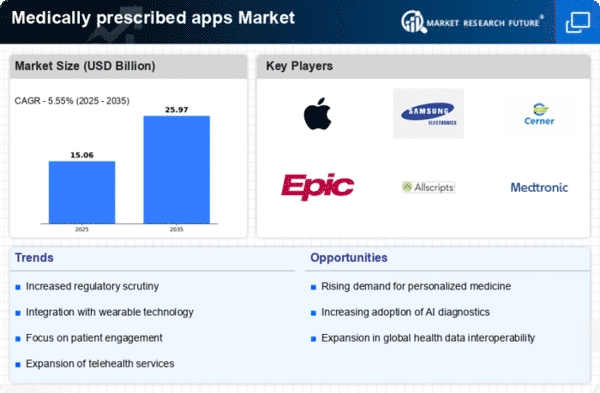
As per MRFR analysis, the Medically prescribed apps Market Size was estimated at 14.27 USD Billion in 2024. The Medically prescribed apps industry is projected to grow from 15.23 USD Billion in 2025 to 25.97 USD Billion by 2035, exhibiting a compound annual growth rate (CAGR) of 5.55% during the forecast period 2025 - 2035.

Key Market Trends & Highlights

The Medically prescribed apps market is experiencing robust growth driven by technological advancements and increasing consumer acceptance.

  • Integration with wearable devices is becoming a prevalent trend, enhancing user engagement and data collection.
  • There is a notable focus on mental health solutions, reflecting the growing awareness of mental well-being among users.
  • Enhanced data security measures are being prioritized to protect sensitive health information, fostering trust in digital health solutions.
  • Rising demand for chronic disease management and regulatory support are key drivers propelling market expansion in North America and Asia-Pacific.

Market Size & Forecast

2024 Market Size 14.27 (USD Billion)
2035 Market Size 25.97 (USD Billion)
CAGR (2025 - 2035) 5.55%
Largest Regional Market Share in 2024 North America

Major Players

Apple Inc (US), Samsung Electronics (KR), Cerner Corporation (US), Epic Systems Corporation (US), Allscripts Healthcare Solutions (US), Medtronic plc (IE), Philips Healthcare (NL), IBM Watson Health (US), Siemens Healthineers (DE)

Market Trends

The Medically prescribed apps Market is currently experiencing a notable evolution, driven by advancements in technology and a growing emphasis on patient-centered care. Healthcare providers increasingly recognize the potential of mobile applications to enhance treatment adherence, monitor patient health, and facilitate communication between patients and clinicians. This shift towards digital health solutions appears to be reshaping traditional healthcare delivery models, as more practitioners integrate these tools into their practice. Furthermore, regulatory bodies are beginning to establish frameworks that support the safe and effective use of these applications, which may further bolster their adoption in clinical settings. In addition, the Medically prescribed apps Market seems to be influenced by the rising demand for personalized healthcare solutions. Patients are increasingly seeking tailored experiences that cater to their specific health needs, which could lead to a surge in the development of specialized applications. As the market continues to mature, it is likely that collaboration between technology developers and healthcare professionals will intensify, fostering innovation and improving patient outcomes. Overall, the Medically prescribed apps Market is poised for substantial growth, reflecting broader trends in digital health and the ongoing transformation of healthcare delivery systems.

Integration with Wearable Devices

The Medically prescribed apps Market is witnessing a trend towards integration with wearable technology. This synergy allows for real-time health monitoring and data collection, enhancing the overall patient experience. By connecting apps with devices such as smartwatches and fitness trackers, healthcare providers can gain valuable insights into patient health, potentially leading to more informed treatment decisions.

Focus on Mental Health Solutions

There is a growing emphasis on mental health within the Medically prescribed apps Market. Applications designed to support mental well-being are gaining traction, as they offer tools for therapy, mindfulness, and stress management. This trend reflects a broader societal recognition of the importance of mental health, suggesting that these solutions may become integral to comprehensive healthcare.

Enhanced Data Security Measures

As the Medically prescribed apps Market expands, concerns regarding data privacy and security are becoming increasingly prominent. Developers are prioritizing robust security measures to protect sensitive patient information. This focus on data security not only complies with regulatory requirements but also builds trust among users, which is essential for the sustained growth of the market.

Medically prescribed apps Market Market Drivers

Growing Aging Population

The growing aging population represents a significant driver for the Global Medically Prescribed Apps Market Industry. As the global demographic landscape shifts, older adults are increasingly seeking solutions to manage their health conditions effectively. Medically prescribed apps Market cater to this demographic by offering features such as medication reminders, appointment scheduling, and health monitoring. This trend is particularly relevant as the aging population is more likely to experience chronic diseases, necessitating ongoing management. The demand for user-friendly and accessible health solutions is expected to drive market growth, aligning with the overall expansion of the healthcare technology sector.

Market Growth Projections

The Global Medically Prescribed Apps Market Industry is projected to experience substantial growth in the coming years. With a market value expected to reach 15.2 USD Billion in 2024 and potentially soar to 87.2 USD Billion by 2035, the industry is on a robust growth trajectory. This growth is underpinned by a compound annual growth rate (CAGR) of 17.2% from 2025 to 2035. Such projections indicate a strong demand for innovative healthcare solutions that enhance patient engagement and improve health outcomes. The convergence of technology and healthcare is likely to play a pivotal role in shaping the future landscape of this market.

Increased Focus on Mental Health

The Global Medically Prescribed Apps Market Industry is witnessing an increased focus on mental health, driving the development and adoption of apps designed to support mental well-being. With rising awareness of mental health issues, healthcare providers are increasingly prescribing apps that offer therapeutic exercises, mood tracking, and teletherapy options. This trend is particularly relevant as mental health conditions become more prevalent globally. The incorporation of evidence-based practices into these apps enhances their credibility and effectiveness, thereby attracting more users. As a result, the market is poised for significant growth, aligning with the overall expansion of the healthcare technology sector.

Integration with Wearable Technology

The integration of medically prescribed apps with wearable technology is a pivotal driver in the Global Medically Prescribed Apps Market Industry. Wearables such as smartwatches and fitness trackers provide real-time health data, which can be seamlessly synced with prescribed apps. This synergy enhances the ability of healthcare providers to monitor patients' health metrics effectively. For example, a patient using a glucose monitoring device can have their data automatically uploaded to a diabetes management app, allowing for timely interventions. This integration not only improves patient engagement but also supports the anticipated market growth, potentially reaching 87.2 USD Billion by 2035.

Rising Demand for Remote Patient Monitoring

The Global Medically Prescribed Apps Market Industry experiences a notable surge in demand for remote patient monitoring solutions. As healthcare systems increasingly prioritize patient-centered care, these apps facilitate continuous health tracking and management. For instance, patients with chronic conditions can utilize apps to monitor vital signs and medication adherence, thereby enhancing their overall health outcomes. This trend is reflected in the projected market growth, with the industry expected to reach 15.2 USD Billion in 2024. The convenience and accessibility offered by these apps are likely to drive further adoption, contributing to a robust CAGR of 17.2% from 2025 to 2035.

Regulatory Support and Reimbursement Policies

Regulatory support and favorable reimbursement policies are crucial factors propelling the Global Medically Prescribed Apps Market Industry. Governments and health authorities are increasingly recognizing the value of digital health solutions, leading to the establishment of guidelines that facilitate app development and deployment. For instance, some countries have implemented reimbursement frameworks for prescribed health apps, encouraging healthcare providers to integrate these solutions into their practice. This regulatory backing not only enhances the credibility of medically prescribed apps but also incentivizes their adoption among patients and providers alike. Such developments are likely to contribute to the market's projected growth trajectory.

Market Segment Insights

By Application: Chronic Disease Management (Largest) vs. Mental Health (Fastest-Growing)

The Medically prescribed apps market is notably characterized by diverse application segments. Chronic Disease Management holds the largest share, underscoring its crucial role in managing long-term health conditions. Following closely are Mental Health apps, rapidly gaining traction as more individuals recognize the importance of mental wellness. Medication Adherence, Telehealth Services, and Health Monitoring also form key parts of this segment, each contributing to a holistic approach to healthcare through digital tools.

Chronic Disease Management (Dominant) vs. Mental Health (Emerging)

Chronic Disease Management apps remain a dominant force in the Medically prescribed apps market, as they provide patients with essential tools for monitoring and managing conditions like diabetes and hypertension. These applications often feature personalized care plans and reminders, fostering adherence to treatment protocols. In contrast, Mental Health apps are emerging rapidly, catalyzed by increased public awareness and reduction of stigma surrounding mental health issues. They offer services such as therapy sessions, mood tracking, and mindfulness exercises, attracting users seeking mental well-being support. The juxtaposition of these applications illustrates a shift towards holistic health considerations in patient care.

By End User: Healthcare Providers (Largest) vs. Patients (Fastest-Growing)

<p>In the medically prescribed apps market, the distribution of market share is predominantly led by healthcare providers, who leverage these applications to enhance patient care and streamline operations. This segment holds the largest share, utilizing apps for patient monitoring, telehealth services, and medical record management. On the other hand, the patient segment is gaining momentum, as an increasing number of individuals turn to these apps for managing their health conditions, accessing prescribed treatments, and seeking guidance, positioning themselves as a fast-growing element of the market.</p>

<p>Healthcare Providers: Dominant vs. Patients: Emerging</p>

<p>Healthcare providers represent the dominant force in the medically prescribed apps market due to their established infrastructure and strong engagement in digital health initiatives. These providers utilize apps for improving efficiency, patient engagement, and adherence to prescribed treatments. Conversely, the patients' segment is emerging rapidly, fueled by a consumer-centric approach to health management. Patients are increasingly adopting mobile apps that allow them to take charge of their health, monitor prescriptions, and interact with their healthcare providers. This shift towards patient empowerment is driving growth in app adoption among this demographic.</p>

By Technology: Mobile Applications (Largest) vs. Wearable Devices (Fastest-Growing)

In the Medically prescribed apps Market, mobile applications currently hold the largest share, significantly surpassing other segments like web applications and wearable devices. Mobile apps are widely adopted due to their accessibility and user-friendly interfaces, directly catering to patients' needs and preferences. Web applications, while useful, lag behind in terms of user engagement and market penetration compared to their mobile counterparts. Growth trends indicate that wearable devices are emerging as the fastest-growing segment, driven by advancements in technology and increasing consumer interest in health monitoring. The integration of wearable devices with mobile applications offers seamless data tracking and patient engagement, which is crucial in managing chronic conditions and enhancing overall patient outcomes.

Mobile Applications: Dominant vs. Wearable Devices: Emerging

Mobile applications dominate the Medically prescribed apps Market, characterized by their extensive user base and versatile functionalities. They offer a range of services such as medication reminders, telehealth features, and personalized health tracking, making them indispensable for both patients and healthcare providers. On the other hand, wearable devices represent an emerging segment with promising growth potential. They are particularly appealing due to their ability to provide real-time health data and analytics, which facilitate proactive health management. As telehealth becomes more integral to patient care, the synergies between mobile applications and wearable devices are expected to improve patient engagement and adherence to treatment plans.

By User Demographics: Age Group (Largest) vs. Income Levels (Fastest-Growing)

In the Medically prescribed apps market, age groups represent the largest segment, with older adults, especially those aged 50 and above, making up a significant portion of users. This demographic has increasingly embraced technology for managing their health, leading to a robust market share. In contrast, income levels, while holding a smaller share currently, are witnessing rapid growth as higher-income groups show considerable interest in premium medically prescribed applications, reflecting their willingness to invest in health management solutions. As the market evolves, trends indicate that the demand for medically prescribed apps is expanding across diverse age groups, particularly among young adults aged 18-30. This demographic is becoming more health-conscious and tech-savvy, driving growth. Additionally, marketing strategies targeting higher-income brackets are layered with premium offerings and features, attracting users who seek sophisticated health solutions. These trends suggest a dynamic interaction between various age and income segments in shaping the future landscape of the Medically prescribed apps market.

Age Group: 50+ (Dominant) vs. Income Levels: High-income (Emerging)

The age group of 50 and above is the dominant segment within the Medically prescribed apps market, characterized by a growing recognition of health management through technology. Users in this demographic prioritize apps that assist in managing chronic conditions and medication adherence. Their engagement with technology is facilitated by user-friendly interfaces that cater to their specific health needs. Conversely, high-income users represent an emerging segment, rapidly gaining traction by opting for advanced features and personalized health solutions offered by premium apps. High-income individuals are often more willing to invest in technology that can enhance their health outcomes, resulting in a burgeoning market of sophisticated medically prescribed applications targeting this customer base. The interplay between these two segments shapes the strategic direction of product offerings.

By Regulatory Compliance: HIPAA Compliance (Largest) vs. FDA Approval (Fastest-Growing)

The Medically prescribed apps Market reveals a competitive landscape where HIPAA Compliance holds the largest market share among the different regulatory compliance categories, due to its critical role in safeguarding patient data and maintaining privacy standards. On the other hand, FDA Approval is emerging as the fastest-growing segment, driven by increasing regulatory scrutiny and the need for apps to demonstrate safety and efficacy in clinical settings, leading to innovation and development in this area. As healthcare becomes more digitized, the demand for regulatory compliance grows significantly. The push for HIPAA Compliance is propelled by healthcare organizations and app developers' commitment to protecting sensitive patient information as mandated by law. Meanwhile, FDA Approval is gaining traction as more medically prescribed apps aim for recognition as legitimate therapeutic devices, pushing companies to invest in meeting rigorous safety and effectiveness standards, thus promoting technological advancements in the field.

HIPAA Compliance (Dominant) vs. FDA Approval (Emerging)

Within the Medically prescribed apps Market, HIPAA Compliance stands as the dominant regulatory standard, ensuring that patient information is securely handled and protected against breaches. This regulatory requirement is crucial for apps that deal with sensitive health data, as it builds trust with users and healthcare providers. In contrast, FDA Approval represents an emerging segment where apps seek to gain governmental endorsement for safety and efficacy, reflecting a shift in market dynamics. Companies are increasingly pursuing this path to enhance their credibility and compete with traditional medical solutions. The intersection of HIPAA Compliance and FDA Approval paints a picture of a complex regulatory environment that is essential for the sustained growth and acceptance of medically prescribed applications.

Get more detailed insights about Medically prescribed apps Market Research Report-Forecast till 2035

Regional Insights

North America : Leading Market Innovators

North America continues to lead the medically prescribed apps market, holding a significant share of 7.5 billion in 2024. The growth is driven by increasing smartphone penetration, a rising focus on telehealth, and supportive regulatory frameworks. The demand for personalized healthcare solutions is also on the rise, with more patients seeking mobile health applications to manage chronic conditions effectively. Regulatory bodies are promoting digital health initiatives, further catalyzing market expansion. The competitive landscape in North America is robust, featuring key players such as Apple Inc, Cerner Corporation, and Epic Systems Corporation. These companies are at the forefront of innovation, developing advanced applications that integrate seamlessly with existing healthcare systems. The U.S. is the largest market, followed by Canada, where government initiatives are encouraging the adoption of digital health solutions. This region's strong investment in healthcare technology positions it as a global leader in the medically prescribed apps sector.

Europe : Emerging Digital Health Solutions

Europe's medically prescribed apps market is projected to reach 3.8 billion by 2025, driven by increasing healthcare digitization and a growing emphasis on patient-centered care. Regulatory support, such as the EU's Digital Health Strategy, is fostering innovation and ensuring compliance with data protection laws. The demand for remote monitoring and telemedicine solutions is rising, particularly in the wake of the COVID-19 pandemic, which has accelerated the adoption of digital health technologies across the continent. Leading countries in this region include Germany, the UK, and France, where significant investments in healthcare IT are being made. Key players like Siemens Healthineers and Philips Healthcare are actively developing solutions tailored to meet local healthcare needs. The competitive landscape is characterized by a mix of established companies and innovative startups, all vying to capture market share in this rapidly evolving sector. The European market is poised for substantial growth as healthcare providers increasingly embrace digital transformation.

Asia-Pacific : Rapidly Growing Market Potential

The Asia-Pacific region is witnessing a surge in the medically prescribed apps market, projected to reach 2.8 billion by 2025. This growth is fueled by rising smartphone adoption, increasing health awareness, and government initiatives promoting digital health solutions. Countries like China and India are leading the charge, with significant investments in healthcare technology and infrastructure. The regulatory environment is becoming more favorable, encouraging the development and use of mobile health applications. In this competitive landscape, major players such as Samsung Electronics and Medtronic are expanding their presence, focusing on innovative solutions that cater to local healthcare needs. The region is characterized by a diverse market, with varying levels of adoption and regulatory frameworks across countries. As healthcare providers increasingly recognize the value of digital health tools, the Asia-Pacific market is set to experience significant growth in the coming years, driven by both demand and innovation.

Middle East and Africa : Emerging Market Opportunities

The Middle East and Africa (MEA) region is gradually emerging in the medically prescribed apps market, with a projected size of 0.17 billion by 2025. The growth is primarily driven by increasing smartphone penetration and a rising demand for healthcare accessibility. Governments in the region are beginning to recognize the importance of digital health solutions, leading to initiatives aimed at improving healthcare delivery through technology. The regulatory landscape is evolving, with more focus on data privacy and security in health applications. Countries like South Africa and the UAE are at the forefront of this growth, with investments in healthcare infrastructure and technology. The competitive landscape is still developing, with both local startups and international players exploring opportunities in this market. As awareness of the benefits of medically prescribed apps increases, the MEA region is expected to see a gradual but steady rise in adoption rates, paving the way for future growth.

Key Players and Competitive Insights

The Medically prescribed apps Market is currently characterized by a dynamic competitive landscape, driven by rapid technological advancements and an increasing emphasis on patient-centric healthcare solutions. Key players such as Apple Inc (US), Cerner Corporation (US), and Medtronic plc (IE) are strategically positioning themselves through innovation and partnerships. Apple Inc (US) has focused on integrating health monitoring features into its devices, enhancing user engagement and data collection capabilities. Cerner Corporation (US) has been actively pursuing partnerships with healthcare providers to expand its digital health solutions, thereby reinforcing its market presence. Medtronic plc (IE) is leveraging its expertise in medical devices to develop apps that complement its product offerings, indicating a trend towards holistic healthcare solutions that integrate both hardware and software.The business tactics employed by these companies reflect a moderately fragmented market structure, where collaboration and strategic alliances play a crucial role. Localizing manufacturing and optimizing supply chains are common strategies aimed at enhancing operational efficiency and responsiveness to market demands. The collective influence of these key players shapes a competitive environment that encourages innovation while also addressing regulatory challenges and patient privacy concerns.

In November Apple Inc (US) announced the launch of a new health app that utilizes AI to provide personalized health insights based on user data. This strategic move not only enhances Apple's ecosystem but also positions the company as a leader in the integration of AI within health applications. The app's ability to analyze vast amounts of health data could potentially lead to improved patient outcomes and increased user loyalty.

In October Cerner Corporation (US) expanded its partnership with a major hospital network to implement its cloud-based health management system. This collaboration is significant as it allows Cerner to enhance its service offerings and reach a broader patient base. By integrating its solutions into the hospital's operations, Cerner is likely to improve care coordination and patient engagement, which are critical in today's healthcare landscape.

In September Medtronic plc (IE) launched a new app designed to support diabetes management, which integrates seamlessly with its insulin delivery systems. This initiative underscores Medtronic's commitment to providing comprehensive solutions for chronic disease management. The app's real-time data sharing capabilities may empower patients to make informed decisions about their health, thereby enhancing the overall effectiveness of their treatment plans.

As of December the Medically prescribed apps Market is witnessing trends such as digitalization, AI integration, and a growing focus on sustainability. Strategic alliances among key players are increasingly shaping the competitive landscape, fostering innovation and enhancing service delivery. The shift from price-based competition to a focus on technological advancement and supply chain reliability is evident. Moving forward, competitive differentiation will likely hinge on the ability to innovate and deliver integrated healthcare solutions that prioritize patient outcomes.

Key Companies in the Medically prescribed apps Market include

Industry Developments

Future Outlook

Medically prescribed apps Market Future Outlook

The Medically prescribed apps Market is projected to grow at a 5.55% CAGR from 2025 to 2035, driven by technological advancements, increasing healthcare digitization, and rising patient engagement.

New opportunities lie in:

  • Integration of AI-driven diagnostics within apps
  • Partnerships with healthcare providers for subscription models
  • Development of personalized treatment plans through app analytics

By 2035, the market is expected to be robust, reflecting substantial growth and innovation.

Market Segmentation

Medically prescribed apps Market End Use Outlook

  • Healthcare Providers
  • Patients
  • Pharmaceutical Companies
  • Insurance Companies

Medically prescribed apps Market Technology Outlook

  • Mobile Applications
  • Web Applications
  • Wearable Devices
  • Cloud-Based Solutions

Medically prescribed apps Market Application Outlook

  • Chronic Disease Management
  • Mental Health
  • Medication Adherence
  • Telehealth Services
  • Health Monitoring

Medically prescribed apps Market User Demographics Outlook

  • Age Groups
  • Gender
  • Income Levels
  • Education Levels

Medically prescribed apps Market Regulatory Compliance Outlook

  • HIPAA Compliance
  • FDA Approval
  • Data Security Standards
  • Patient Privacy Regulations

Report Scope

MARKET SIZE 2024 14.27(USD Billion)
MARKET SIZE 2025 15.23(USD Billion)
MARKET SIZE 2035 25.97(USD Billion)
COMPOUND ANNUAL GROWTH RATE (CAGR) 5.55% (2025 - 2035)
REPORT COVERAGE Revenue Forecast, Competitive Landscape, Growth Factors, and Trends
BASE YEAR 2024
Market Forecast Period 2025 - 2035
Historical Data 2019 - 2024
Market Forecast Units USD Billion
Key Companies Profiled Apple Inc (US), Samsung Electronics (KR), Cerner Corporation (US), Epic Systems Corporation (US), Allscripts Healthcare Solutions (US), Medtronic plc (IE), Philips Healthcare (NL), IBM Watson Health (US), Siemens Healthineers (DE)
Segments Covered Application, End Use, Technology, User Demographics, Regulatory Compliance
Key Market Opportunities Integration of artificial intelligence enhances patient adherence in the Medically prescribed apps Market.
Key Market Dynamics Rising demand for personalized healthcare drives innovation and competition in the medically prescribed apps market.
Countries Covered North America, Europe, APAC, South America, MEA

FAQs

What is the current valuation of the Medically prescribed apps Market?

<p>The market valuation reached 14.27 USD Billion in 2024.</p>

What is the projected market size for the Medically prescribed apps Market by 2035?

<p>The market is expected to grow to 25.97 USD Billion by 2035.</p>

What is the expected CAGR for the Medically prescribed apps Market during the forecast period?

<p>The anticipated CAGR for the market from 2025 to 2035 is 5.55%.</p>

Which segments are driving growth in the Medically prescribed apps Market?

<p>Key segments include Chronic Disease Management, Mental Health, and Health Tracking, with valuations ranging from 3.0 to 7.47 USD Billion.</p>

Who are the key players in the Medically prescribed apps Market?

<p>Prominent players include Epic Systems, Cerner Corporation, and Medtronic, among others.</p>

What are the primary applications of medically prescribed apps?

Applications encompass Chronic Disease Management, Medication Adherence, and Remote Patient Monitoring, with varying market sizes.

How do end users influence the Medically prescribed apps Market?

End users such as Healthcare Providers and Patients contribute significantly, with market sizes of 9.0 and 7.0 USD Billion, respectively.

What technologies are utilized in the Medically prescribed apps Market?

Technologies include Mobile Applications, Web Applications, and Telehealth Platforms, with valuations between 1.77 and 9.0 USD Billion.

What is the growth potential for wearable devices in the Medically prescribed apps Market?

Wearable devices are projected to grow, with a market size expected to reach 4.0 USD Billion by 2035.

How do pharmaceutical companies fit into the Medically prescribed apps Market?

Pharmaceutical Companies are expected to see market sizes between 2.5 and 4.5 USD Billion, indicating their role in this sector.

  1. SECTION I: EXECUTIVE SUMMARY AND KEY HIGHLIGHTS
    1. | 1.1 EXECUTIVE SUMMARY
    2. | | 1.1.1 Market Overview
    3. | | 1.1.2 Key Findings
    4. | | 1.1.3 Market Segmentation
    5. | | 1.1.4 Competitive Landscape
    6. | | 1.1.5 Challenges and Opportunities
    7. | | 1.1.6 Future Outlook
  2. SECTION II: SCOPING, METHODOLOGY AND MARKET STRUCTURE
    1. | 2.1 MARKET INTRODUCTION
    2. | | 2.1.1 Definition
    3. | | 2.1.2 Scope of the study
    4. | | | 2.1.2.1 Research Objective
    5. | | | 2.1.2.2 Assumption
    6. | | | 2.1.2.3 Limitations
    7. | 2.2 RESEARCH METHODOLOGY
    8. | | 2.2.1 Overview
    9. | | 2.2.2 Data Mining
    10. | | 2.2.3 Secondary Research
    11. | | 2.2.4 Primary Research
    12. | | | 2.2.4.1 Primary Interviews and Information Gathering Process
    13. | | | 2.2.4.2 Breakdown of Primary Respondents
    14. | | 2.2.5 Forecasting Model
    15. | | 2.2.6 Market Size Estimation
    16. | | | 2.2.6.1 Bottom-Up Approach
    17. | | | 2.2.6.2 Top-Down Approach
    18. | | 2.2.7 Data Triangulation
    19. | | 2.2.8 Validation
  3. SECTION III: QUALITATIVE ANALYSIS
    1. | 3.1 MARKET DYNAMICS
    2. | | 3.1.1 Overview
    3. | | 3.1.2 Drivers
    4. | | 3.1.3 Restraints
    5. | | 3.1.4 Opportunities
    6. | 3.2 MARKET FACTOR ANALYSIS
    7. | | 3.2.1 Value chain Analysis
    8. | | 3.2.2 Porter's Five Forces Analysis
    9. | | | 3.2.2.1 Bargaining Power of Suppliers
    10. | | | 3.2.2.2 Bargaining Power of Buyers
    11. | | | 3.2.2.3 Threat of New Entrants
    12. | | | 3.2.2.4 Threat of Substitutes
    13. | | | 3.2.2.5 Intensity of Rivalry
    14. | | 3.2.3 COVID-19 Impact Analysis
    15. | | | 3.2.3.1 Market Impact Analysis
    16. | | | 3.2.3.2 Regional Impact
    17. | | | 3.2.3.3 Opportunity and Threat Analysis
  4. SECTION IV: QUANTITATIVE ANALYSIS
    1. | 4.1 Healthcare, BY Application (USD Billion)
    2. | | 4.1.1 Chronic Disease Management
    3. | | 4.1.2 Mental Health
    4. | | 4.1.3 Medication Adherence
    5. | | 4.1.4 Remote Patient Monitoring
    6. | | 4.1.5 Health Tracking
    7. | 4.2 Healthcare, BY End User (USD Billion)
    8. | | 4.2.1 Healthcare Providers
    9. | | 4.2.2 Patients
    10. | | 4.2.3 Pharmaceutical Companies
    11. | | 4.2.4 Insurance Companies
    12. | | 4.2.5 Research Institutions
    13. | 4.3 Healthcare, BY Technology (USD Billion)
    14. | | 4.3.1 Mobile Applications
    15. | | 4.3.2 Web Applications
    16. | | 4.3.3 Wearable Devices
    17. | | 4.3.4 Telehealth Platforms
    18. | | 4.3.5 Cloud-Based Solutions
    19. | 4.4 Healthcare, BY Region (USD Billion)
    20. | | 4.4.1 North America
    21. | | | 4.4.1.1 US
    22. | | | 4.4.1.2 Canada
    23. | | 4.4.2 Europe
    24. | | | 4.4.2.1 Germany
    25. | | | 4.4.2.2 UK
    26. | | | 4.4.2.3 France
    27. | | | 4.4.2.4 Russia
    28. | | | 4.4.2.5 Italy
    29. | | | 4.4.2.6 Spain
    30. | | | 4.4.2.7 Rest of Europe
    31. | | 4.4.3 APAC
    32. | | | 4.4.3.1 China
    33. | | | 4.4.3.2 India
    34. | | | 4.4.3.3 Japan
    35. | | | 4.4.3.4 South Korea
    36. | | | 4.4.3.5 Malaysia
    37. | | | 4.4.3.6 Thailand
    38. | | | 4.4.3.7 Indonesia
    39. | | | 4.4.3.8 Rest of APAC
    40. | | 4.4.4 South America
    41. | | | 4.4.4.1 Brazil
    42. | | | 4.4.4.2 Mexico
    43. | | | 4.4.4.3 Argentina
    44. | | | 4.4.4.4 Rest of South America
    45. | | 4.4.5 MEA
    46. | | | 4.4.5.1 GCC Countries
    47. | | | 4.4.5.2 South Africa
    48. | | | 4.4.5.3 Rest of MEA
  5. SECTION V: COMPETITIVE ANALYSIS
    1. | 5.1 Competitive Landscape
    2. | | 5.1.1 Overview
    3. | | 5.1.2 Competitive Analysis
    4. | | 5.1.3 Market share Analysis
    5. | | 5.1.4 Major Growth Strategy in the Healthcare
    6. | | 5.1.5 Competitive Benchmarking
    7. | | 5.1.6 Leading Players in Terms of Number of Developments in the Healthcare
    8. | | 5.1.7 Key developments and growth strategies
    9. | | | 5.1.7.1 New Product Launch/Service Deployment
    10. | | | 5.1.7.2 Merger & Acquisitions
    11. | | | 5.1.7.3 Joint Ventures
    12. | | 5.1.8 Major Players Financial Matrix
    13. | | | 5.1.8.1 Sales and Operating Income
    14. | | | 5.1.8.2 Major Players R&D Expenditure. 2023
    15. | 5.2 Company Profiles
    16. | | 5.2.1 Epic Systems (US)
    17. | | | 5.2.1.1 Financial Overview
    18. | | | 5.2.1.2 Products Offered
    19. | | | 5.2.1.3 Key Developments
    20. | | | 5.2.1.4 SWOT Analysis
    21. | | | 5.2.1.5 Key Strategies
    22. | | 5.2.2 Cerner Corporation (US)
    23. | | | 5.2.2.1 Financial Overview
    24. | | | 5.2.2.2 Products Offered
    25. | | | 5.2.2.3 Key Developments
    26. | | | 5.2.2.4 SWOT Analysis
    27. | | | 5.2.2.5 Key Strategies
    28. | | 5.2.3 Allscripts Healthcare Solutions (US)
    29. | | | 5.2.3.1 Financial Overview
    30. | | | 5.2.3.2 Products Offered
    31. | | | 5.2.3.3 Key Developments
    32. | | | 5.2.3.4 SWOT Analysis
    33. | | | 5.2.3.5 Key Strategies
    34. | | 5.2.4 Athenahealth (US)
    35. | | | 5.2.4.1 Financial Overview
    36. | | | 5.2.4.2 Products Offered
    37. | | | 5.2.4.3 Key Developments
    38. | | | 5.2.4.4 SWOT Analysis
    39. | | | 5.2.4.5 Key Strategies
    40. | | 5.2.5 Medtronic (US)
    41. | | | 5.2.5.1 Financial Overview
    42. | | | 5.2.5.2 Products Offered
    43. | | | 5.2.5.3 Key Developments
    44. | | | 5.2.5.4 SWOT Analysis
    45. | | | 5.2.5.5 Key Strategies
    46. | | 5.2.6 Philips (NL)
    47. | | | 5.2.6.1 Financial Overview
    48. | | | 5.2.6.2 Products Offered
    49. | | | 5.2.6.3 Key Developments
    50. | | | 5.2.6.4 SWOT Analysis
    51. | | | 5.2.6.5 Key Strategies
    52. | | 5.2.7 IBM Watson Health (US)
    53. | | | 5.2.7.1 Financial Overview
    54. | | | 5.2.7.2 Products Offered
    55. | | | 5.2.7.3 Key Developments
    56. | | | 5.2.7.4 SWOT Analysis
    57. | | | 5.2.7.5 Key Strategies
    58. | | 5.2.8 Siemens Healthineers (DE)
    59. | | | 5.2.8.1 Financial Overview
    60. | | | 5.2.8.2 Products Offered
    61. | | | 5.2.8.3 Key Developments
    62. | | | 5.2.8.4 SWOT Analysis
    63. | | | 5.2.8.5 Key Strategies
    64. | | 5.2.9 GE Healthcare (US)
    65. | | | 5.2.9.1 Financial Overview
    66. | | | 5.2.9.2 Products Offered
    67. | | | 5.2.9.3 Key Developments
    68. | | | 5.2.9.4 SWOT Analysis
    69. | | | 5.2.9.5 Key Strategies
    70. | 5.3 Appendix
    71. | | 5.3.1 References
    72. | | 5.3.2 Related Reports
  6. LIST OF FIGURES
    1. | 6.1 MARKET SYNOPSIS
    2. | 6.2 NORTH AMERICA MARKET ANALYSIS
    3. | 6.3 US MARKET ANALYSIS BY APPLICATION
    4. | 6.4 US MARKET ANALYSIS BY END USER
    5. | 6.5 US MARKET ANALYSIS BY TECHNOLOGY
    6. | 6.6 CANADA MARKET ANALYSIS BY APPLICATION
    7. | 6.7 CANADA MARKET ANALYSIS BY END USER
    8. | 6.8 CANADA MARKET ANALYSIS BY TECHNOLOGY
    9. | 6.9 EUROPE MARKET ANALYSIS
    10. | 6.10 GERMANY MARKET ANALYSIS BY APPLICATION
    11. | 6.11 GERMANY MARKET ANALYSIS BY END USER
    12. | 6.12 GERMANY MARKET ANALYSIS BY TECHNOLOGY
    13. | 6.13 UK MARKET ANALYSIS BY APPLICATION
    14. | 6.14 UK MARKET ANALYSIS BY END USER
    15. | 6.15 UK MARKET ANALYSIS BY TECHNOLOGY
    16. | 6.16 FRANCE MARKET ANALYSIS BY APPLICATION
    17. | 6.17 FRANCE MARKET ANALYSIS BY END USER
    18. | 6.18 FRANCE MARKET ANALYSIS BY TECHNOLOGY
    19. | 6.19 RUSSIA MARKET ANALYSIS BY APPLICATION
    20. | 6.20 RUSSIA MARKET ANALYSIS BY END USER
    21. | 6.21 RUSSIA MARKET ANALYSIS BY TECHNOLOGY
    22. | 6.22 ITALY MARKET ANALYSIS BY APPLICATION
    23. | 6.23 ITALY MARKET ANALYSIS BY END USER
    24. | 6.24 ITALY MARKET ANALYSIS BY TECHNOLOGY
    25. | 6.25 SPAIN MARKET ANALYSIS BY APPLICATION
    26. | 6.26 SPAIN MARKET ANALYSIS BY END USER
    27. | 6.27 SPAIN MARKET ANALYSIS BY TECHNOLOGY
    28. | 6.28 REST OF EUROPE MARKET ANALYSIS BY APPLICATION
    29. | 6.29 REST OF EUROPE MARKET ANALYSIS BY END USER
    30. | 6.30 REST OF EUROPE MARKET ANALYSIS BY TECHNOLOGY
    31. | 6.31 APAC MARKET ANALYSIS
    32. | 6.32 CHINA MARKET ANALYSIS BY APPLICATION
    33. | 6.33 CHINA MARKET ANALYSIS BY END USER
    34. | 6.34 CHINA MARKET ANALYSIS BY TECHNOLOGY
    35. | 6.35 INDIA MARKET ANALYSIS BY APPLICATION
    36. | 6.36 INDIA MARKET ANALYSIS BY END USER
    37. | 6.37 INDIA MARKET ANALYSIS BY TECHNOLOGY
    38. | 6.38 JAPAN MARKET ANALYSIS BY APPLICATION
    39. | 6.39 JAPAN MARKET ANALYSIS BY END USER
    40. | 6.40 JAPAN MARKET ANALYSIS BY TECHNOLOGY
    41. | 6.41 SOUTH KOREA MARKET ANALYSIS BY APPLICATION
    42. | 6.42 SOUTH KOREA MARKET ANALYSIS BY END USER
    43. | 6.43 SOUTH KOREA MARKET ANALYSIS BY TECHNOLOGY
    44. | 6.44 MALAYSIA MARKET ANALYSIS BY APPLICATION
    45. | 6.45 MALAYSIA MARKET ANALYSIS BY END USER
    46. | 6.46 MALAYSIA MARKET ANALYSIS BY TECHNOLOGY
    47. | 6.47 THAILAND MARKET ANALYSIS BY APPLICATION
    48. | 6.48 THAILAND MARKET ANALYSIS BY END USER
    49. | 6.49 THAILAND MARKET ANALYSIS BY TECHNOLOGY
    50. | 6.50 INDONESIA MARKET ANALYSIS BY APPLICATION
    51. | 6.51 INDONESIA MARKET ANALYSIS BY END USER
    52. | 6.52 INDONESIA MARKET ANALYSIS BY TECHNOLOGY
    53. | 6.53 REST OF APAC MARKET ANALYSIS BY APPLICATION
    54. | 6.54 REST OF APAC MARKET ANALYSIS BY END USER
    55. | 6.55 REST OF APAC MARKET ANALYSIS BY TECHNOLOGY
    56. | 6.56 SOUTH AMERICA MARKET ANALYSIS
    57. | 6.57 BRAZIL MARKET ANALYSIS BY APPLICATION
    58. | 6.58 BRAZIL MARKET ANALYSIS BY END USER
    59. | 6.59 BRAZIL MARKET ANALYSIS BY TECHNOLOGY
    60. | 6.60 MEXICO MARKET ANALYSIS BY APPLICATION
    61. | 6.61 MEXICO MARKET ANALYSIS BY END USER
    62. | 6.62 MEXICO MARKET ANALYSIS BY TECHNOLOGY
    63. | 6.63 ARGENTINA MARKET ANALYSIS BY APPLICATION
    64. | 6.64 ARGENTINA MARKET ANALYSIS BY END USER
    65. | 6.65 ARGENTINA MARKET ANALYSIS BY TECHNOLOGY
    66. | 6.66 REST OF SOUTH AMERICA MARKET ANALYSIS BY APPLICATION
    67. | 6.67 REST OF SOUTH AMERICA MARKET ANALYSIS BY END USER
    68. | 6.68 REST OF SOUTH AMERICA MARKET ANALYSIS BY TECHNOLOGY
    69. | 6.69 MEA MARKET ANALYSIS
    70. | 6.70 GCC COUNTRIES MARKET ANALYSIS BY APPLICATION
    71. | 6.71 GCC COUNTRIES MARKET ANALYSIS BY END USER
    72. | 6.72 GCC COUNTRIES MARKET ANALYSIS BY TECHNOLOGY
    73. | 6.73 SOUTH AFRICA MARKET ANALYSIS BY APPLICATION
    74. | 6.74 SOUTH AFRICA MARKET ANALYSIS BY END USER
    75. | 6.75 SOUTH AFRICA MARKET ANALYSIS BY TECHNOLOGY
    76. | 6.76 REST OF MEA MARKET ANALYSIS BY APPLICATION
    77. | 6.77 REST OF MEA MARKET ANALYSIS BY END USER
    78. | 6.78 REST OF MEA MARKET ANALYSIS BY TECHNOLOGY
    79. | 6.79 KEY BUYING CRITERIA OF HEALTHCARE
    80. | 6.80 RESEARCH PROCESS OF MRFR
    81. | 6.81 DRO ANALYSIS OF HEALTHCARE
    82. | 6.82 DRIVERS IMPACT ANALYSIS: HEALTHCARE
    83. | 6.83 RESTRAINTS IMPACT ANALYSIS: HEALTHCARE
    84. | 6.84 SUPPLY / VALUE CHAIN: HEALTHCARE
    85. | 6.85 HEALTHCARE, BY APPLICATION, 2024 (% SHARE)
    86. | 6.86 HEALTHCARE, BY APPLICATION, 2024 TO 2035 (USD Billion)
    87. | 6.87 HEALTHCARE, BY END USER, 2024 (% SHARE)
    88. | 6.88 HEALTHCARE, BY END USER, 2024 TO 2035 (USD Billion)
    89. | 6.89 HEALTHCARE, BY TECHNOLOGY, 2024 (% SHARE)
    90. | 6.90 HEALTHCARE, BY TECHNOLOGY, 2024 TO 2035 (USD Billion)
    91. | 6.91 BENCHMARKING OF MAJOR COMPETITORS
  7. LIST OF TABLES
    1. | 7.1 LIST OF ASSUMPTIONS
    2. | | 7.1.1
    3. | 7.2 North America MARKET SIZE ESTIMATES; FORECAST
    4. | | 7.2.1 BY APPLICATION, 2025-2035 (USD Billion)
    5. | | 7.2.2 BY END USER, 2025-2035 (USD Billion)
    6. | | 7.2.3 BY TECHNOLOGY, 2025-2035 (USD Billion)
    7. | 7.3 US MARKET SIZE ESTIMATES; FORECAST
    8. | | 7.3.1 BY APPLICATION, 2025-2035 (USD Billion)
    9. | | 7.3.2 BY END USER, 2025-2035 (USD Billion)
    10. | | 7.3.3 BY TECHNOLOGY, 2025-2035 (USD Billion)
    11. | 7.4 Canada MARKET SIZE ESTIMATES; FORECAST
    12. | | 7.4.1 BY APPLICATION, 2025-2035 (USD Billion)
    13. | | 7.4.2 BY END USER, 2025-2035 (USD Billion)
    14. | | 7.4.3 BY TECHNOLOGY, 2025-2035 (USD Billion)
    15. | 7.5 Europe MARKET SIZE ESTIMATES; FORECAST
    16. | | 7.5.1 BY APPLICATION, 2025-2035 (USD Billion)
    17. | | 7.5.2 BY END USER, 2025-2035 (USD Billion)
    18. | | 7.5.3 BY TECHNOLOGY, 2025-2035 (USD Billion)
    19. | 7.6 Germany MARKET SIZE ESTIMATES; FORECAST
    20. | | 7.6.1 BY APPLICATION, 2025-2035 (USD Billion)
    21. | | 7.6.2 BY END USER, 2025-2035 (USD Billion)
    22. | | 7.6.3 BY TECHNOLOGY, 2025-2035 (USD Billion)
    23. | 7.7 UK MARKET SIZE ESTIMATES; FORECAST
    24. | | 7.7.1 BY APPLICATION, 2025-2035 (USD Billion)
    25. | | 7.7.2 BY END USER, 2025-2035 (USD Billion)
    26. | | 7.7.3 BY TECHNOLOGY, 2025-2035 (USD Billion)
    27. | 7.8 France MARKET SIZE ESTIMATES; FORECAST
    28. | | 7.8.1 BY APPLICATION, 2025-2035 (USD Billion)
    29. | | 7.8.2 BY END USER, 2025-2035 (USD Billion)
    30. | | 7.8.3 BY TECHNOLOGY, 2025-2035 (USD Billion)
    31. | 7.9 Russia MARKET SIZE ESTIMATES; FORECAST
    32. | | 7.9.1 BY APPLICATION, 2025-2035 (USD Billion)
    33. | | 7.9.2 BY END USER, 2025-2035 (USD Billion)
    34. | | 7.9.3 BY TECHNOLOGY, 2025-2035 (USD Billion)
    35. | 7.10 Italy MARKET SIZE ESTIMATES; FORECAST
    36. | | 7.10.1 BY APPLICATION, 2025-2035 (USD Billion)
    37. | | 7.10.2 BY END USER, 2025-2035 (USD Billion)
    38. | | 7.10.3 BY TECHNOLOGY, 2025-2035 (USD Billion)
    39. | 7.11 Spain MARKET SIZE ESTIMATES; FORECAST
    40. | | 7.11.1 BY APPLICATION, 2025-2035 (USD Billion)
    41. | | 7.11.2 BY END USER, 2025-2035 (USD Billion)
    42. | | 7.11.3 BY TECHNOLOGY, 2025-2035 (USD Billion)
    43. | 7.12 Rest of Europe MARKET SIZE ESTIMATES; FORECAST
    44. | | 7.12.1 BY APPLICATION, 2025-2035 (USD Billion)
    45. | | 7.12.2 BY END USER, 2025-2035 (USD Billion)
    46. | | 7.12.3 BY TECHNOLOGY, 2025-2035 (USD Billion)
    47. | 7.13 APAC MARKET SIZE ESTIMATES; FORECAST
    48. | | 7.13.1 BY APPLICATION, 2025-2035 (USD Billion)
    49. | | 7.13.2 BY END USER, 2025-2035 (USD Billion)
    50. | | 7.13.3 BY TECHNOLOGY, 2025-2035 (USD Billion)
    51. | 7.14 China MARKET SIZE ESTIMATES; FORECAST
    52. | | 7.14.1 BY APPLICATION, 2025-2035 (USD Billion)
    53. | | 7.14.2 BY END USER, 2025-2035 (USD Billion)
    54. | | 7.14.3 BY TECHNOLOGY, 2025-2035 (USD Billion)
    55. | 7.15 India MARKET SIZE ESTIMATES; FORECAST
    56. | | 7.15.1 BY APPLICATION, 2025-2035 (USD Billion)
    57. | | 7.15.2 BY END USER, 2025-2035 (USD Billion)
    58. | | 7.15.3 BY TECHNOLOGY, 2025-2035 (USD Billion)
    59. | 7.16 Japan MARKET SIZE ESTIMATES; FORECAST
    60. | | 7.16.1 BY APPLICATION, 2025-2035 (USD Billion)
    61. | | 7.16.2 BY END USER, 2025-2035 (USD Billion)
    62. | | 7.16.3 BY TECHNOLOGY, 2025-2035 (USD Billion)
    63. | 7.17 South Korea MARKET SIZE ESTIMATES; FORECAST
    64. | | 7.17.1 BY APPLICATION, 2025-2035 (USD Billion)
    65. | | 7.17.2 BY END USER, 2025-2035 (USD Billion)
    66. | | 7.17.3 BY TECHNOLOGY, 2025-2035 (USD Billion)
    67. | 7.18 Malaysia MARKET SIZE ESTIMATES; FORECAST
    68. | | 7.18.1 BY APPLICATION, 2025-2035 (USD Billion)
    69. | | 7.18.2 BY END USER, 2025-2035 (USD Billion)
    70. | | 7.18.3 BY TECHNOLOGY, 2025-2035 (USD Billion)
    71. | 7.19 Thailand MARKET SIZE ESTIMATES; FORECAST
    72. | | 7.19.1 BY APPLICATION, 2025-2035 (USD Billion)
    73. | | 7.19.2 BY END USER, 2025-2035 (USD Billion)
    74. | | 7.19.3 BY TECHNOLOGY, 2025-2035 (USD Billion)
    75. | 7.20 Indonesia MARKET SIZE ESTIMATES; FORECAST
    76. | | 7.20.1 BY APPLICATION, 2025-2035 (USD Billion)
    77. | | 7.20.2 BY END USER, 2025-2035 (USD Billion)
    78. | | 7.20.3 BY TECHNOLOGY, 2025-2035 (USD Billion)
    79. | 7.21 Rest of APAC MARKET SIZE ESTIMATES; FORECAST
    80. | | 7.21.1 BY APPLICATION, 2025-2035 (USD Billion)
    81. | | 7.21.2 BY END USER, 2025-2035 (USD Billion)
    82. | | 7.21.3 BY TECHNOLOGY, 2025-2035 (USD Billion)
    83. | 7.22 South America MARKET SIZE ESTIMATES; FORECAST
    84. | | 7.22.1 BY APPLICATION, 2025-2035 (USD Billion)
    85. | | 7.22.2 BY END USER, 2025-2035 (USD Billion)
    86. | | 7.22.3 BY TECHNOLOGY, 2025-2035 (USD Billion)
    87. | 7.23 Brazil MARKET SIZE ESTIMATES; FORECAST
    88. | | 7.23.1 BY APPLICATION, 2025-2035 (USD Billion)
    89. | | 7.23.2 BY END USER, 2025-2035 (USD Billion)
    90. | | 7.23.3 BY TECHNOLOGY, 2025-2035 (USD Billion)
    91. | 7.24 Mexico MARKET SIZE ESTIMATES; FORECAST
    92. | | 7.24.1 BY APPLICATION, 2025-2035 (USD Billion)
    93. | | 7.24.2 BY END USER, 2025-2035 (USD Billion)
    94. | | 7.24.3 BY TECHNOLOGY, 2025-2035 (USD Billion)
    95. | 7.25 Argentina MARKET SIZE ESTIMATES; FORECAST
    96. | | 7.25.1 BY APPLICATION, 2025-2035 (USD Billion)
    97. | | 7.25.2 BY END USER, 2025-2035 (USD Billion)
    98. | | 7.25.3 BY TECHNOLOGY, 2025-2035 (USD Billion)
    99. | 7.26 Rest of South America MARKET SIZE ESTIMATES; FORECAST
    100. | | 7.26.1 BY APPLICATION, 2025-2035 (USD Billion)
    101. | | 7.26.2 BY END USER, 2025-2035 (USD Billion)
    102. | | 7.26.3 BY TECHNOLOGY, 2025-2035 (USD Billion)
    103. | 7.27 MEA MARKET SIZE ESTIMATES; FORECAST
    104. | | 7.27.1 BY APPLICATION, 2025-2035 (USD Billion)
    105. | | 7.27.2 BY END USER, 2025-2035 (USD Billion)
    106. | | 7.27.3 BY TECHNOLOGY, 2025-2035 (USD Billion)
    107. | 7.28 GCC Countries MARKET SIZE ESTIMATES; FORECAST
    108. | | 7.28.1 BY APPLICATION, 2025-2035 (USD Billion)
    109. | | 7.28.2 BY END USER, 2025-2035 (USD Billion)
    110. | | 7.28.3 BY TECHNOLOGY, 2025-2035 (USD Billion)
    111. | 7.29 South Africa MARKET SIZE ESTIMATES; FORECAST
    112. | | 7.29.1 BY APPLICATION, 2025-2035 (USD Billion)
    113. | | 7.29.2 BY END USER, 2025-2035 (USD Billion)
    114. | | 7.29.3 BY TECHNOLOGY, 2025-2035 (USD Billion)
    115. | 7.30 Rest of MEA MARKET SIZE ESTIMATES; FORECAST
    116. | | 7.30.1 BY APPLICATION, 2025-2035 (USD Billion)
    117. | | 7.30.2 BY END USER, 2025-2035 (USD Billion)
    118. | | 7.30.3 BY TECHNOLOGY, 2025-2035 (USD Billion)
    119. | 7.31 PRODUCT LAUNCH/PRODUCT DEVELOPMENT/APPROVAL
    120. | | 7.31.1
    121. | 7.32 ACQUISITION/PARTNERSHIP
    122. | | 7.32.1

Healthcare Market Segmentation

Healthcare By Application (USD Billion, 2025-2035)

  • Chronic Disease Management
  • Mental Health
  • Medication Adherence
  • Remote Patient Monitoring
  • Health Tracking

Healthcare By End User (USD Billion, 2025-2035)

  • Healthcare Providers
  • Patients
  • Pharmaceutical Companies
  • Insurance Companies
  • Research Institutions

Healthcare By Technology (USD Billion, 2025-2035)

  • Mobile Applications
  • Web Applications
  • Wearable Devices
  • Telehealth Platforms
  • Cloud-Based Solutions
Infographic

Free Sample Request

Kindly complete the form below to receive a free sample of this Report

Get Free Sample

Customer Strories

Compare Licence

×
Features License Type
Single User Multiuser License Enterprise User
Price $4,950 $5,950 $7,250
Maximum User Access Limit 1 User Upto 10 Users Unrestricted Access Throughout the Organization
Free Customization
Direct Access to Analyst
Deliverable Format
Platform Access
Discount on Next Purchase 10% 15% 15%
Printable Versions
%>