Request Free Sample ×

Kindly complete the form below to receive a free sample of this Report

* Please use a valid business email

Leading companies partner with us for data-driven Insights

clients tt-cursor
Hero Background
English
Chinese
French
Japanese
Korean
German
Spanish

Medical Tourniquets Market Analysis

ID: MRFR/MED/6897-HCR
111 Pages
Vikita Thakur
Last Updated: April 06, 2026

Medical Tourniquets Market Research Report Information By Type (Tourniquet Systems, Tourniquet Cuffs, Tourniquet Accessories), By Application (Lower-Limb Tourniquets, Upper-Limb Tourniquets) and By End-User (Hospitals and Trauma Centers, Ambulatory Surgery Centers, Others) - Global Forecast to 2035

Share:
Download PDF ×

We do not share your information with anyone. However, we may send you emails based on your report interest from time to time. You may contact us at any time to opt-out.

Medical Tourniquets Market Infographic
Purchase Options

Market Analysis

In-depth Analysis of Medical Tourniquets Market Industry Landscape

Modern medical technologies and an emphasis on emergency medicine have transformed the tourniquet industry in recent years. The military utilized tourniquets, but now private healthcare uses them, growing the industry.

Accidents, injuries, and operations are driving up medical tourniquet demand, affecting the industry. Emergency responders, hospitals, and military healthcare staff drive market growth.

The market has changed greatly due to bandage technological advances. Pneumatic and computer tourniquets are used in many healthcare settings because they are more precise and easy to use. These innovative innovations address the requirement for functional, user-friendly technology. People realize how crucial tourniquets are to halt major bleeding, hence the industry has expanded. Training programs have helped physicians, first responders, and average people regard tourniquets as lifesaving. This boosts market demand. Legal atmosphere affects medical tourniquet market. Companies adopt quality standards because strict restrictions ensure product safety and efficacy. Entering and remaining in a market requires following the rules. Medical tourniquet firms are both well-known and new, making the market competitive. Mergers, acquisitions, and collaborations help organizations enhance their goods and expand globally. Health care has helped emerging economies expand their markets. People are learning about modern medical equipment and spending more on healthcare. This allows market players to enter new markets. Despite advances in technology, cost still drives market responses. Medical tourniquets must be affordable, especially in low-cost areas. Low-cost choices offer firms an advantage over competition. Market participants increasingly prioritize customization and product differentiation. Tourniquets with remote monitoring or ergonomic shapes may fulfill healthcare demands and preferences. The COVID-19 pandemic demonstrated the need of flexible supply chains. Supply chain issues such raw material shortages and transportation issues have hurt the medical tourniquet business. Companies are adapting to these difficulties to ensure client delivery. Telemedicine has also transformed the tourniquet market. Patients and caregivers may require tourniquets and other medical instruments during remote medical visits. New healthcare delivery methods alter the market. As environmental concerns grow, the medical device industry is interested in eco-friendly goods and manufacturing processes. Sustainable market participants may appeal to healthcare and environmentalists.


Author
Author Profile
Vikita Thakur
Senior Research Analyst

She holds an experience of about 5+ years in market research and business consulting projects for sectors such as life sciences, medical devices, and healthcare IT. She possesses a robust background in data analysis, market estimation, competitive intelligence, pipeline analysis market trend identification, and consumer behavior insights. Her expertise lies in technical Sales support, client interaction and project management, designing and implementing market research studies, conducting competitive analysis, and synthesizing complex data into actionable recommendations that drive business growth.

Leave a Comment

FAQs

What is the current valuation of the Medical Tourniquets Market as of 2025?

<p>The Medical Tourniquets Market is valued at approximately 795.73 USD Million in 2024.</p>

What is the projected market size for the Medical Tourniquets Market by 2035?

<p>The market is projected to reach approximately 1779.69 USD Million by 2035.</p>

What is the expected CAGR for the Medical Tourniquets Market during the forecast period 2025 - 2035?

<p>The expected CAGR for the Medical Tourniquets Market during the forecast period 2025 - 2035 is 7.55%.</p>

Which application segment is expected to show significant growth in the Medical Tourniquets Market?

<p>The Emergency Medical Services segment, valued at 364.12 USD Million, is expected to show significant growth.</p>

What types of tourniquets are included in the Medical Tourniquets Market?

<p>The market includes Elastic, Non-Elastic, Pneumatic, and Digital Tourniquets, with Pneumatic Tourniquets valued at 546.0 USD Million.</p>

Which distribution channel is projected to have the highest valuation in the Medical Tourniquets Market?

Direct Sales is projected to have the highest valuation, estimated at 600.0 USD Million.

What materials are commonly used in the production of medical tourniquets?

Common materials include Latex, Rubber, Plastic, and Metal, with Plastic tourniquets valued at 540.0 USD Million.

Who are the key players in the Medical Tourniquets Market?

Key players include North American Rescue, Z-Medica, Medline Industries, and B. Braun Melsungen AG.

What end-use segments are included in the Medical Tourniquets Market analysis?

End-use segments include Hospitals, Ambulatory Surgical Centers, and Home Healthcare, with Hospitals valued at 726.12 USD Million.

How does the Medical Tourniquets Market perform in the Sports Medicine segment?

The Sports Medicine segment is valued at 360.0 USD Million, indicating a robust market presence.

Market Summary

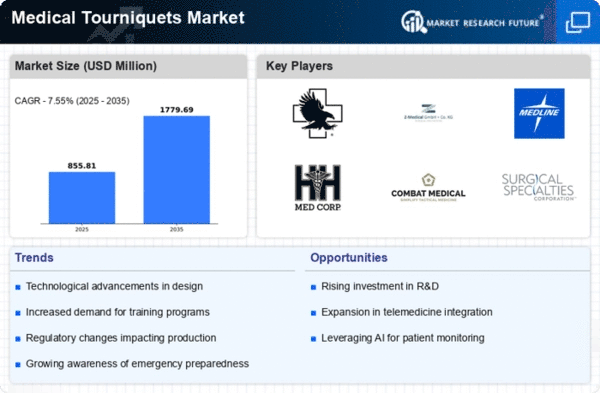
As per MRFR analysis, the Medical Tourniquets Market Size was estimated at 795.73 USD Million in 2024. The Medical Tourniquets industry is projected to grow from 864.93 in 2025 to 1779.69 by 2035, exhibiting a compound annual growth rate (CAGR) of 7.55% during the forecast period 2025 - 2035.

Key Market Trends & Highlights

The Medical Tourniquets Market is poised for substantial growth driven by technological advancements and increasing awareness of hemorrhage control.

  • North America remains the largest market for medical tourniquets, driven by a robust healthcare infrastructure and high demand for emergency medical services.
  • The Asia-Pacific region is emerging as the fastest-growing market, fueled by rising healthcare expenditures and increasing awareness of trauma care.
  • Emergency Medical Services represent the largest segment, while Sports Medicine is witnessing rapid growth due to heightened participation in athletic activities.
  • Key market drivers include the rising incidence of trauma cases and advancements in medical technology, which are enhancing the effectiveness of hemorrhage control solutions.

Market Size & Forecast

2024 Market Size 795.73 (USD Million)
2035 Market Size 1779.69 (USD Million)
CAGR (2025 - 2035) 7.55%
Largest Regional Market Share in 2024 North America

Major Players

North American Rescue (US), Z-Medica (US), Medline Industries (US), H&H Medical Corporation (US), Combat Medical Systems (US), Surgical Specialties Corporation (US), Smith & Nephew (GB), B. Braun Melsungen AG (DE), Teleflex Incorporated (US)

Market Trends

The Medical Tourniquets Market is currently experiencing a notable evolution, driven by advancements in technology and an increasing awareness of the importance of effective hemorrhage control in emergency situations. The growing prevalence of trauma cases, coupled with a rising emphasis on patient safety, has led to heightened demand for innovative tourniquet solutions. Manufacturers are focusing on developing products that are not only efficient but also user-friendly, ensuring that both medical professionals and laypersons can utilize them effectively. Furthermore, the integration of smart technologies into tourniquet designs appears to enhance their functionality, potentially improving patient outcomes in critical scenarios. In addition to technological advancements, the Medical Tourniquets Market is influenced by regulatory changes and the establishment of guidelines aimed at standardizing the use of these devices. As healthcare systems worldwide strive to improve emergency response protocols, the adoption of standardized tourniquet practices is likely to gain traction. This trend may lead to increased collaboration between manufacturers and healthcare providers, fostering innovation and ensuring that products meet the evolving needs of the market. Overall, the Medical Tourniquets Market seems poised for growth, driven by a combination of technological innovation, regulatory support, and a commitment to enhancing patient care in emergency situations.

Technological Advancements

The Medical Tourniquets Market is witnessing a surge in technological innovations, with manufacturers developing advanced materials and designs that enhance the effectiveness and ease of use of tourniquets. These innovations may include features such as quick-release mechanisms and integrated monitoring systems, which could improve the overall performance of these devices in emergency situations.

Regulatory Developments

Recent regulatory changes are shaping the Medical Tourniquets Market, as authorities establish guidelines to standardize the use of tourniquets in clinical settings. This trend may encourage manufacturers to align their products with these regulations, fostering a more uniform approach to hemorrhage control across various healthcare systems.

Increased Awareness and Training

There is a growing emphasis on training healthcare professionals and the general public in the proper use of tourniquets. This heightened awareness could lead to a broader acceptance of these devices, ultimately driving demand in the Medical Tourniquets Market as more individuals recognize their importance in emergency care.

Medical Tourniquets Market Market Drivers

Market Growth Projections

The Global Medical Tourniquets Market Industry is poised for substantial growth, with projections indicating a market value of 0.38 USD Billion in 2024 and a potential increase to 0.76 USD Billion by 2035. This growth trajectory suggests a compound annual growth rate of 6.49% from 2025 to 2035, reflecting the increasing demand for effective hemorrhage control solutions. Factors such as rising trauma cases, advancements in medical technology, and enhanced awareness contribute to this positive outlook. The market's expansion is likely to be driven by both healthcare providers and consumers seeking reliable and innovative tourniquet options.

Regulatory Support and Guidelines

Regulatory support and established guidelines are crucial drivers for the Global Medical Tourniquets Market Industry. Government health agencies are increasingly recognizing the importance of tourniquets in emergency medical protocols. For example, updated guidelines from health authorities advocate for the use of tourniquets in severe bleeding scenarios, thereby legitimizing their application in clinical settings. This regulatory backing not only enhances the credibility of tourniquet use but also encourages manufacturers to innovate and improve their products. As a result, the market is likely to expand, driven by both compliance with regulations and the need for effective hemorrhage control solutions.

Advancements in Medical Technology

Technological advancements play a pivotal role in shaping the Global Medical Tourniquets Market Industry. Innovations in materials and design have led to the development of more effective and user-friendly tourniquets. For instance, the introduction of lightweight, durable materials enhances portability and ease of use in emergency situations. Furthermore, smart tourniquets equipped with sensors for real-time monitoring of blood flow are emerging, potentially revolutionizing trauma care. As healthcare providers increasingly adopt these advanced solutions, the market is likely to experience substantial growth, reflecting the ongoing evolution of medical technology and its application in emergency medicine.

Military and Tactical Applications

The Global Medical Tourniquets Market Industry is significantly influenced by military and tactical applications. Armed forces worldwide prioritize hemorrhage control in combat situations, leading to increased procurement of advanced tourniquet systems. Military training programs emphasize the importance of effective bleeding control, resulting in a consistent demand for high-quality tourniquets. This sector's growth is expected to contribute to the overall market expansion, as military applications often drive innovations that eventually find their way into civilian use. The ongoing need for reliable medical equipment in tactical environments underscores the potential for sustained growth in the tourniquet market.

Increasing Prevalence of Trauma Cases

The Global Medical Tourniquets Market Industry is witnessing growth due to the rising incidence of trauma cases worldwide. According to various health organizations, road traffic accidents and workplace injuries contribute significantly to the demand for effective hemorrhage control solutions. As trauma cases increase, the need for medical tourniquets becomes more pronounced, particularly in emergency medical services. This trend is expected to drive the market value to approximately 0.38 USD Billion in 2024, with projections indicating a potential doubling to 0.76 USD Billion by 2035. The anticipated compound annual growth rate of 6.49% from 2025 to 2035 further underscores the urgency for innovative tourniquet solutions.

Growing Awareness and Training Programs

The Global Medical Tourniquets Market Industry is benefiting from increased awareness and training programs focused on hemorrhage control. Organizations, including government health agencies and non-profits, are actively promoting the importance of tourniquet use in saving lives during emergencies. Training initiatives, often targeting first responders and laypersons, emphasize the correct application of tourniquets. This heightened awareness is likely to enhance the adoption of medical tourniquets, contributing to market growth. As more individuals become trained in their use, the demand for quality tourniquets is expected to rise, further solidifying their role in emergency medical care.

Market Segment Insights

By Application: Emergency Medical Services (Largest) vs. Military (Fastest-Growing)

<p>In the Medical Tourniquets Market, the application segment exhibits a diverse market share among various fields including Emergency Medical Services, Military, Sports Medicine, Home Care, and Hospitals. Emergency Medical Services is recognized as the largest segment, reflecting the critical need for tourniquets in pre-hospital emergency care. The Military segment continues to grow rapidly, fueled by increasing investments in defense and advancements in battlefield medical technologies.</p>

<p>Emergency Medical Services (Dominant) vs. Military (Emerging)</p>

<p>The Emergency Medical Services application segment stands as the dominant force in the Medical Tourniquets Market, driven by the essential use of tourniquets in life-saving scenarios. This segment sees widespread adoption due to regulatory mandates and ongoing training programs aimed at improving emergency response. Conversely, the Military segment is emerging fast, gaining traction due to heightened military engagement globally and a clear focus on providing effective combat medical solutions. The development of specialized military tourniquets tailored for armored environments reflects this segment's growth potential, creating a unique market niche that caters to the needs of armed forces.</p>

By Type: Elastic Tourniquets (Largest) vs. Pneumatic Tourniquets (Fastest-Growing)

The medical tourniquets market exhibits diverse segment values with elastic tourniquets leading the market share due to their widespread usage in emergency medical procedures. They are favored for their ease of application and effectiveness in acute bleeding situations. Non-elastic tourniquets, while important, hold a smaller market share as they are less adaptable compared to their elastic counterparts. In contrast, pneumatic tourniquets, with their advanced mechanisms for blood flow control, are gaining traction and rapidly increasing their market presence. The growth trends in the medical tourniquets market are significantly influenced by advancements in technology and increasing awareness regarding effective trauma management. Pneumatic tourniquets are recognized as the fastest-growing segment, driven by the rising demand for precision in medical treatments and innovations in design. Additionally, the proliferation of training programs for healthcare professionals regarding tourniquet application contributes to these growth dynamics, underlining the evolving landscape of emergency medical care.

Elastic Tourniquets (Dominant) vs. Digital Tourniquets (Emerging)

Elastic tourniquets dominate the medical tourniquets market primarily due to their versatility and ease of use across various medical settings, including battlefield and emergency rooms. Their capacity to effectively control bleeding and simple application process makes them a preferred choice among healthcare providers. Conversely, digital tourniquets are an emerging segment characterized by innovative features such as automated inflation and monitoring capabilities. While they currently hold a lesser market share, their development reflects the industry's push towards technologically advanced solutions aimed at enhancing patient outcomes and efficiency in emergency interventions. As healthcare facilities continue to integrate more technology, digital tourniquets are poised to see significant growth in adoption.

By End Use: Hospitals (Largest) vs. Trauma Centers (Fastest-Growing)

The Medical Tourniquets Market reveals a varied distribution of market share across end-use segments. Hospitals remain the largest segment, driven by their critical role in emergency and surgical procedures where tourniquets are essential. Following closely are trauma centers, which are gaining prominence due to the rising incidences of traumatic injuries requiring immediate intervention. Ambulatory surgical centers and home healthcare also hold significance, but they are comparatively smaller in terms of market share.

Hospitals: Critical (Dominant) vs. Trauma Centers (Emerging)

In the Medical Tourniquets Market, hospitals represent the dominant force, utilizing tourniquets in a range of surgical procedures and trauma care practices. Their extensive equipment budgets and commitment to patient safety fuel consistent demand for advanced tourniquet solutions. On the other hand, trauma centers are emerging as a crucial segment, experiencing rapid growth due to increasing urban accidents and gunshot wounds that necessitate quick medical response. This segment focuses on specialized products tailored for immediate trauma care, thus expanding the applicability and technological innovation of medical tourniquets.

By Material: Latex (Largest) vs. Plastic (Fastest-Growing)

<p>In the Medical Tourniquets Market, the material segment displays varied distribution among its key components. Latex dominates this sector due to its widespread use and exceptional elasticity, making it a preferred choice among healthcare professionals. Rubber, while still significant, is gradually being overshadowed by the rise in demand for plastic materials, appealing to a new generation of medical practitioners seeking lightweight and cost-effective solutions. Meanwhile, metal tourniquets maintain a niche market due to their sturdiness and durability, essential for specific medical scenarios. The growth trends in this segment reveal an increasing shift towards plastic materials, which are being adopted rapidly due to their lighter weight, flexibility, and ease of use. This trend is driven by innovation and the need for efficient medical tools, particularly in emergency settings. As healthcare settings become more dynamic and the focus on patient comfort intensifies, the shift from traditional materials like latex and rubber to more innovative choices such as plastic is likely to accelerate, indicating a transformative phase for the market.</p>

<p>Material: Latex (Dominant) vs. Plastic (Emerging)</p>

<p>Latex tourniquets continue to maintain their dominance in the Medical Tourniquets Market, celebrated for their flexibility and effectiveness in clinical settings. They are often the first choice for medical professionals, providing a reliable fastening mechanism that has stood the test of time. In contrast, plastic tourniquets are emerging as a forward-thinking alternative, particularly appreciated for their lightweight nature and cost advantages. Being disposable, they align well with modern hygiene practices, catering to the growing demand for innovative medical solutions that focus on patient safety and comfort. As the healthcare landscape evolves, both materials play crucial yet distinct roles, highlighting a diverse market that caters to different medical needs.</p>

By Distribution Channel: Online Retail (Largest) vs. Medical Supply Stores (Fastest-Growing)

<p>In the Medical Tourniquets Market, distribution channel dynamics reveal a clear leader in Online Retail. This segment boasts the largest share due to the growing trend of consumers opting for online shopping, which offers convenience and often a wider selection of products. Medical supply stores also play a significant role in the distribution of tourniquets, capturing a robust share, yet they are followed closely by traditional retail avenues such as pharmacies and direct sales methods that contribute to diversified access points for these essential <a href="https://www.marketresearchfuture.com/reports/medical-devices-market-2869" target="_blank" title="medical devices">medical devices</a>.</p>

<p>Online Retail (Dominant) vs. Medical Supply Stores (Emerging)</p>

<p>Online Retail serves as the dominant force in the Medical Tourniquets Market, allowing for swift access to a variety of products including specialized tourniquets that may not be available locally. The ease of online ordering coupled with enhanced delivery options has resulted in a shift toward digital purchasing behaviors among consumers. In contrast, Medical Supply Stores represent an emerging segment, characterized by their specialized knowledge and ability to offer personalized service. These stores are increasingly adapting to market demands by improving their inventories and technology, positioning themselves as essential resources for healthcare providers and emergency services.</p>

Get more detailed insights about Medical Tourniquets Market Research Report - Global Forecast till 2035

Regional Insights

North America : Market Leader in Innovation

North America is poised to maintain its leadership in the medical tourniquets market, holding a significant share of 397.0 million in 2024. The growth is driven by increasing demand for advanced medical devices, stringent regulations ensuring safety, and a rising number of trauma cases. The region's robust healthcare infrastructure and investment in R&D further catalyze market expansion. Regulatory bodies are actively promoting the adoption of innovative medical solutions, enhancing market dynamics. The competitive landscape in North America is characterized by the presence of key players such as North American Rescue, Z-Medica, and Medline Industries. These companies are focusing on product innovation and strategic partnerships to enhance their market position. The U.S. is the leading country, accounting for the majority of the market share, supported by a high prevalence of injuries and a well-established healthcare system. The emphasis on emergency preparedness is also driving demand for effective tourniquet solutions.

Europe : Emerging Market with Growth Potential

Europe's medical tourniquets market is projected to grow significantly, with a market size of 250.0 million in 2024. The growth is fueled by increasing awareness of trauma care, advancements in medical technology, and supportive regulations from health authorities. The European Union's focus on improving emergency medical services and trauma care standards is a key driver for market expansion. Additionally, the rising incidence of road accidents and sports injuries is further propelling demand for effective tourniquet solutions. Leading countries in Europe include Germany, the UK, and France, where the presence of established healthcare systems and key players like B. Braun Melsungen AG and Smith & Nephew enhances market dynamics. The competitive landscape is marked by innovation and collaboration among companies to develop advanced products. Regulatory frameworks in Europe are becoming increasingly stringent, ensuring that medical devices meet high safety and efficacy standards. "The European Commission emphasizes the importance of effective trauma care in its health policies," states a recent report.

Asia-Pacific : Rapidly Growing Market Segment

The Asia-Pacific medical tourniquets market is witnessing rapid growth, with a market size of 130.0 million in 2024. This growth is driven by increasing healthcare expenditure, rising awareness of emergency medical services, and a growing population. Countries like China and India are investing heavily in healthcare infrastructure, which is expected to boost the demand for medical devices, including tourniquets. Additionally, government initiatives aimed at improving trauma care are further catalyzing market growth. China and India are the leading countries in this region, with a significant presence of both local and international players. Companies are focusing on expanding their product offerings and enhancing distribution networks to capture the growing market. The competitive landscape is evolving, with new entrants emerging alongside established firms. However, challenges such as regulatory hurdles and varying healthcare standards across countries may impact market dynamics.

Middle East and Africa : Emerging Market with Challenges

The Middle East and Africa medical tourniquets market is relatively small, with a market size of 18.73 million in 2024. However, it is gradually gaining traction due to increasing awareness of trauma care and the need for effective emergency medical solutions. The growth is supported by government initiatives aimed at improving healthcare infrastructure and emergency response systems. Additionally, rising incidences of accidents and conflicts in the region are driving demand for medical tourniquets. Countries like South Africa and the UAE are leading the market, with a growing number of healthcare facilities adopting advanced medical devices. The competitive landscape is characterized by a mix of local and international players, focusing on product availability and affordability. However, challenges such as limited access to healthcare and regulatory barriers may hinder market growth. "The WHO emphasizes the need for improved emergency care in the region to save lives," highlights a recent health report.

Key Players and Competitive Insights

The Medical Tourniquets Market is characterized by a dynamic competitive landscape, driven by increasing demand for advanced medical devices and a growing emphasis on trauma care. Key players such as North American Rescue (US), Z-Medica (US), and Smith & Nephew (GB) are strategically positioned to leverage innovation and operational efficiency. North American Rescue (US) focuses on developing high-quality, tactical medical solutions, while Z-Medica (US) emphasizes the integration of advanced hemostatic technologies into their product lines. Smith & Nephew (GB) is enhancing its portfolio through strategic partnerships and acquisitions, thereby reinforcing its market presence. Collectively, these strategies contribute to a competitive environment that is increasingly focused on technological advancement and customer-centric solutions.In terms of business tactics, companies are localizing manufacturing to reduce lead times and optimize supply chains, which is particularly crucial in the context of global disruptions. The market structure appears moderately fragmented, with several players vying for market share, yet a few dominant firms are establishing a stronghold through innovation and strategic collaborations. This competitive structure allows for a diverse range of products and solutions, catering to various segments within the medical tourniquet domain.

In November North American Rescue (US) announced the launch of a new line of tourniquets designed specifically for military applications, which underscores their commitment to innovation in high-stakes environments. This strategic move not only enhances their product offerings but also positions them as a leader in the tactical medical equipment sector, potentially increasing their market share among defense contractors and military organizations.

In October Z-Medica (US) expanded its distribution network by partnering with a leading healthcare provider in Europe, aiming to enhance accessibility to its innovative hemostatic products. This partnership is likely to facilitate greater penetration into the European market, aligning with Z-Medica's strategy to broaden its global footprint and meet the rising demand for effective bleeding control solutions.

In September Smith & Nephew (GB) completed the acquisition of a small medical device firm specializing in advanced wound care technologies. This acquisition is strategically significant as it allows Smith & Nephew to integrate cutting-edge technologies into its existing product lines, thereby enhancing its competitive edge in the medical tourniquet market and expanding its overall product portfolio.

As of December the competitive trends in the Medical Tourniquets Market are increasingly defined by digitalization, sustainability, and the integration of artificial intelligence (AI) into product development. Strategic alliances are becoming more prevalent, as companies recognize the value of collaboration in driving innovation and enhancing supply chain resilience. Looking ahead, competitive differentiation is likely to evolve from traditional price-based competition to a focus on technological innovation, reliability, and sustainability in supply chains, reflecting a broader shift in market dynamics.

Key Companies in the Medical Tourniquets Market include

Industry Developments

Future Outlook

Medical Tourniquets Market Future Outlook

The Medical Tourniquets Market is projected to grow at a 7.55% CAGR from 2025 to 2035, driven by advancements in emergency medical services and increasing awareness of trauma care.

New opportunities lie in:

  • Development of smart tourniquets with integrated monitoring technology.
  • Expansion into emerging markets with tailored product offerings.
  • Partnerships with healthcare providers for training and product integration.

By 2035, the Medical Tourniquets Market is expected to be robust, reflecting substantial growth and innovation.

Market Segmentation

Medical Tourniquets Market Type Outlook

  • Elastic Tourniquets
  • Non-Elastic Tourniquets
  • Pneumatic Tourniquets
  • Digital Tourniquets

Medical Tourniquets Market End Use Outlook

  • Hospitals
  • Ambulatory Surgical Centers
  • Trauma Centers
  • Home Healthcare

Medical Tourniquets Market Material Outlook

  • Latex
  • Rubber
  • Plastic
  • Metal

Medical Tourniquets Market Application Outlook

  • Emergency Medical Services
  • Military
  • Sports Medicine
  • Home Care
  • Hospital

Medical Tourniquets Market Distribution Channel Outlook

  • Online
  • Offline
  • Direct Sales

Report Scope

MARKET SIZE 2024 795.73(USD Million)
MARKET SIZE 2025 864.93(USD Million)
MARKET SIZE 2035 1779.69(USD Million)
COMPOUND ANNUAL GROWTH RATE (CAGR) 7.55% (2025 - 2035)
REPORT COVERAGE Revenue Forecast, Competitive Landscape, Growth Factors, and Trends
BASE YEAR 2024
Market Forecast Period 2025 - 2035
Historical Data 2019 - 2024
Market Forecast Units USD Million
Key Companies Profiled North American Rescue (US), Z-Medica (US), Medline Industries (US), H&H Medical Corporation (US), Combat Medical Systems (US), Surgical Specialties Corporation (US), Smith & Nephew (GB), B. Braun Melsungen AG (DE), Teleflex Incorporated (US)
Segments Covered Application, Type, End Use, Material, Distribution Channel
Key Market Opportunities Integration of advanced materials and smart technology enhances efficacy in the Medical Tourniquets Market.
Key Market Dynamics Rising demand for advanced medical tourniquets driven by regulatory changes and technological innovations in emergency care.
Countries Covered North America, Europe, APAC, South America, MEA

FAQs

What is the current valuation of the Medical Tourniquets Market as of 2025?

<p>The Medical Tourniquets Market is valued at approximately 795.73 USD Million in 2024.</p>

What is the projected market size for the Medical Tourniquets Market by 2035?

<p>The market is projected to reach approximately 1779.69 USD Million by 2035.</p>

What is the expected CAGR for the Medical Tourniquets Market during the forecast period 2025 - 2035?

<p>The expected CAGR for the Medical Tourniquets Market during the forecast period 2025 - 2035 is 7.55%.</p>

Which application segment is expected to show significant growth in the Medical Tourniquets Market?

<p>The Emergency Medical Services segment, valued at 364.12 USD Million, is expected to show significant growth.</p>

What types of tourniquets are included in the Medical Tourniquets Market?

<p>The market includes Elastic, Non-Elastic, Pneumatic, and Digital Tourniquets, with Pneumatic Tourniquets valued at 546.0 USD Million.</p>

Which distribution channel is projected to have the highest valuation in the Medical Tourniquets Market?

Direct Sales is projected to have the highest valuation, estimated at 600.0 USD Million.

What materials are commonly used in the production of medical tourniquets?

Common materials include Latex, Rubber, Plastic, and Metal, with Plastic tourniquets valued at 540.0 USD Million.

Who are the key players in the Medical Tourniquets Market?

Key players include North American Rescue, Z-Medica, Medline Industries, and B. Braun Melsungen AG.

What end-use segments are included in the Medical Tourniquets Market analysis?

End-use segments include Hospitals, Ambulatory Surgical Centers, and Home Healthcare, with Hospitals valued at 726.12 USD Million.

How does the Medical Tourniquets Market perform in the Sports Medicine segment?

The Sports Medicine segment is valued at 360.0 USD Million, indicating a robust market presence.

  1. SECTION I: EXECUTIVE SUMMARY AND KEY HIGHLIGHTS
    1. | 1.1 EXECUTIVE SUMMARY
    2. | | 1.1.1 Market Overview
    3. | | 1.1.2 Key Findings
    4. | | 1.1.3 Market Segmentation
    5. | | 1.1.4 Competitive Landscape
    6. | | 1.1.5 Challenges and Opportunities
    7. | | 1.1.6 Future Outlook
  2. SECTION II: SCOPING, METHODOLOGY AND MARKET STRUCTURE
    1. | 2.1 MARKET INTRODUCTION
    2. | | 2.1.1 Definition
    3. | | 2.1.2 Scope of the study
    4. | | | 2.1.2.1 Research Objective
    5. | | | 2.1.2.2 Assumption
    6. | | | 2.1.2.3 Limitations
    7. | 2.2 RESEARCH METHODOLOGY
    8. | | 2.2.1 Overview
    9. | | 2.2.2 Data Mining
    10. | | 2.2.3 Secondary Research
    11. | | 2.2.4 Primary Research
    12. | | | 2.2.4.1 Primary Interviews and Information Gathering Process
    13. | | | 2.2.4.2 Breakdown of Primary Respondents
    14. | | 2.2.5 Forecasting Model
    15. | | 2.2.6 Market Size Estimation
    16. | | | 2.2.6.1 Bottom-Up Approach
    17. | | | 2.2.6.2 Top-Down Approach
    18. | | 2.2.7 Data Triangulation
    19. | | 2.2.8 Validation
  3. SECTION III: QUALITATIVE ANALYSIS
    1. | 3.1 MARKET DYNAMICS
    2. | | 3.1.1 Overview
    3. | | 3.1.2 Drivers
    4. | | 3.1.3 Restraints
    5. | | 3.1.4 Opportunities
    6. | 3.2 MARKET FACTOR ANALYSIS
    7. | | 3.2.1 Value chain Analysis
    8. | | 3.2.2 Porter's Five Forces Analysis
    9. | | | 3.2.2.1 Bargaining Power of Suppliers
    10. | | | 3.2.2.2 Bargaining Power of Buyers
    11. | | | 3.2.2.3 Threat of New Entrants
    12. | | | 3.2.2.4 Threat of Substitutes
    13. | | | 3.2.2.5 Intensity of Rivalry
    14. | | 3.2.3 COVID-19 Impact Analysis
    15. | | | 3.2.3.1 Market Impact Analysis
    16. | | | 3.2.3.2 Regional Impact
    17. | | | 3.2.3.3 Opportunity and Threat Analysis
  4. SECTION IV: QUANTITATIVE ANALYSIS
    1. | 4.1 Healthcare, BY Application (USD Million)
    2. | | 4.1.1 Emergency Medical Services
    3. | | 4.1.2 Military
    4. | | 4.1.3 Sports Medicine
    5. | | 4.1.4 Home Care
    6. | | 4.1.5 Hospital
    7. | 4.2 Healthcare, BY Type (USD Million)
    8. | | 4.2.1 Elastic Tourniquets
    9. | | 4.2.2 Non-Elastic Tourniquets
    10. | | 4.2.3 Pneumatic Tourniquets
    11. | | 4.2.4 Digital Tourniquets
    12. | 4.3 Healthcare, BY End Use (USD Million)
    13. | | 4.3.1 Hospitals
    14. | | 4.3.2 Ambulatory Surgical Centers
    15. | | 4.3.3 Trauma Centers
    16. | | 4.3.4 Home Healthcare
    17. | 4.4 Healthcare, BY Material (USD Million)
    18. | | 4.4.1 Latex
    19. | | 4.4.2 Rubber
    20. | | 4.4.3 Plastic
    21. | | 4.4.4 Metal
    22. | 4.5 Healthcare, BY Distribution Channel (USD Million)
    23. | | 4.5.1 Online Retail
    24. | | 4.5.2 Medical Supply Stores
    25. | | 4.5.3 Direct Sales
    26. | | 4.5.4 Pharmacies
    27. | 4.6 Healthcare, BY Region (USD Million)
    28. | | 4.6.1 North America
    29. | | | 4.6.1.1 US
    30. | | | 4.6.1.2 Canada
    31. | | 4.6.2 Europe
    32. | | | 4.6.2.1 Germany
    33. | | | 4.6.2.2 UK
    34. | | | 4.6.2.3 France
    35. | | | 4.6.2.4 Russia
    36. | | | 4.6.2.5 Italy
    37. | | | 4.6.2.6 Spain
    38. | | | 4.6.2.7 Rest of Europe
    39. | | 4.6.3 APAC
    40. | | | 4.6.3.1 China
    41. | | | 4.6.3.2 India
    42. | | | 4.6.3.3 Japan
    43. | | | 4.6.3.4 South Korea
    44. | | | 4.6.3.5 Malaysia
    45. | | | 4.6.3.6 Thailand
    46. | | | 4.6.3.7 Indonesia
    47. | | | 4.6.3.8 Rest of APAC
    48. | | 4.6.4 South America
    49. | | | 4.6.4.1 Brazil
    50. | | | 4.6.4.2 Mexico
    51. | | | 4.6.4.3 Argentina
    52. | | | 4.6.4.4 Rest of South America
    53. | | 4.6.5 MEA
    54. | | | 4.6.5.1 GCC Countries
    55. | | | 4.6.5.2 South Africa
    56. | | | 4.6.5.3 Rest of MEA
  5. SECTION V: COMPETITIVE ANALYSIS
    1. | 5.1 Competitive Landscape
    2. | | 5.1.1 Overview
    3. | | 5.1.2 Competitive Analysis
    4. | | 5.1.3 Market share Analysis
    5. | | 5.1.4 Major Growth Strategy in the Healthcare
    6. | | 5.1.5 Competitive Benchmarking
    7. | | 5.1.6 Leading Players in Terms of Number of Developments in the Healthcare
    8. | | 5.1.7 Key developments and growth strategies
    9. | | | 5.1.7.1 New Product Launch/Service Deployment
    10. | | | 5.1.7.2 Merger & Acquisitions
    11. | | | 5.1.7.3 Joint Ventures
    12. | | 5.1.8 Major Players Financial Matrix
    13. | | | 5.1.8.1 Sales and Operating Income
    14. | | | 5.1.8.2 Major Players R&D Expenditure. 2023
    15. | 5.2 Company Profiles
    16. | | 5.2.1 North American Rescue (US)
    17. | | | 5.2.1.1 Financial Overview
    18. | | | 5.2.1.2 Products Offered
    19. | | | 5.2.1.3 Key Developments
    20. | | | 5.2.1.4 SWOT Analysis
    21. | | | 5.2.1.5 Key Strategies
    22. | | 5.2.2 Z-Medica (US)
    23. | | | 5.2.2.1 Financial Overview
    24. | | | 5.2.2.2 Products Offered
    25. | | | 5.2.2.3 Key Developments
    26. | | | 5.2.2.4 SWOT Analysis
    27. | | | 5.2.2.5 Key Strategies
    28. | | 5.2.3 Medline Industries (US)
    29. | | | 5.2.3.1 Financial Overview
    30. | | | 5.2.3.2 Products Offered
    31. | | | 5.2.3.3 Key Developments
    32. | | | 5.2.3.4 SWOT Analysis
    33. | | | 5.2.3.5 Key Strategies
    34. | | 5.2.4 H&H Medical Corporation (US)
    35. | | | 5.2.4.1 Financial Overview
    36. | | | 5.2.4.2 Products Offered
    37. | | | 5.2.4.3 Key Developments
    38. | | | 5.2.4.4 SWOT Analysis
    39. | | | 5.2.4.5 Key Strategies
    40. | | 5.2.5 Combat Medical Systems (US)
    41. | | | 5.2.5.1 Financial Overview
    42. | | | 5.2.5.2 Products Offered
    43. | | | 5.2.5.3 Key Developments
    44. | | | 5.2.5.4 SWOT Analysis
    45. | | | 5.2.5.5 Key Strategies
    46. | | 5.2.6 Surgical Specialties Corporation (US)
    47. | | | 5.2.6.1 Financial Overview
    48. | | | 5.2.6.2 Products Offered
    49. | | | 5.2.6.3 Key Developments
    50. | | | 5.2.6.4 SWOT Analysis
    51. | | | 5.2.6.5 Key Strategies
    52. | | 5.2.7 Civco Medical Solutions (US)
    53. | | | 5.2.7.1 Financial Overview
    54. | | | 5.2.7.2 Products Offered
    55. | | | 5.2.7.3 Key Developments
    56. | | | 5.2.7.4 SWOT Analysis
    57. | | | 5.2.7.5 Key Strategies
    58. | | 5.2.8 Tactical Medical Solutions (US)
    59. | | | 5.2.8.1 Financial Overview
    60. | | | 5.2.8.2 Products Offered
    61. | | | 5.2.8.3 Key Developments
    62. | | | 5.2.8.4 SWOT Analysis
    63. | | | 5.2.8.5 Key Strategies
    64. | | 5.2.9 B. Braun Melsungen AG (DE)
    65. | | | 5.2.9.1 Financial Overview
    66. | | | 5.2.9.2 Products Offered
    67. | | | 5.2.9.3 Key Developments
    68. | | | 5.2.9.4 SWOT Analysis
    69. | | | 5.2.9.5 Key Strategies
    70. | 5.3 Appendix
    71. | | 5.3.1 References
    72. | | 5.3.2 Related Reports
  6. LIST OF FIGURES
    1. | 6.1 MARKET SYNOPSIS
    2. | 6.2 NORTH AMERICA MARKET ANALYSIS
    3. | 6.3 US MARKET ANALYSIS BY APPLICATION
    4. | 6.4 US MARKET ANALYSIS BY TYPE
    5. | 6.5 US MARKET ANALYSIS BY END USE
    6. | 6.6 US MARKET ANALYSIS BY MATERIAL
    7. | 6.7 US MARKET ANALYSIS BY DISTRIBUTION CHANNEL
    8. | 6.8 CANADA MARKET ANALYSIS BY APPLICATION
    9. | 6.9 CANADA MARKET ANALYSIS BY TYPE
    10. | 6.10 CANADA MARKET ANALYSIS BY END USE
    11. | 6.11 CANADA MARKET ANALYSIS BY MATERIAL
    12. | 6.12 CANADA MARKET ANALYSIS BY DISTRIBUTION CHANNEL
    13. | 6.13 EUROPE MARKET ANALYSIS
    14. | 6.14 GERMANY MARKET ANALYSIS BY APPLICATION
    15. | 6.15 GERMANY MARKET ANALYSIS BY TYPE
    16. | 6.16 GERMANY MARKET ANALYSIS BY END USE
    17. | 6.17 GERMANY MARKET ANALYSIS BY MATERIAL
    18. | 6.18 GERMANY MARKET ANALYSIS BY DISTRIBUTION CHANNEL
    19. | 6.19 UK MARKET ANALYSIS BY APPLICATION
    20. | 6.20 UK MARKET ANALYSIS BY TYPE
    21. | 6.21 UK MARKET ANALYSIS BY END USE
    22. | 6.22 UK MARKET ANALYSIS BY MATERIAL
    23. | 6.23 UK MARKET ANALYSIS BY DISTRIBUTION CHANNEL
    24. | 6.24 FRANCE MARKET ANALYSIS BY APPLICATION
    25. | 6.25 FRANCE MARKET ANALYSIS BY TYPE
    26. | 6.26 FRANCE MARKET ANALYSIS BY END USE
    27. | 6.27 FRANCE MARKET ANALYSIS BY MATERIAL
    28. | 6.28 FRANCE MARKET ANALYSIS BY DISTRIBUTION CHANNEL
    29. | 6.29 RUSSIA MARKET ANALYSIS BY APPLICATION
    30. | 6.30 RUSSIA MARKET ANALYSIS BY TYPE
    31. | 6.31 RUSSIA MARKET ANALYSIS BY END USE
    32. | 6.32 RUSSIA MARKET ANALYSIS BY MATERIAL
    33. | 6.33 RUSSIA MARKET ANALYSIS BY DISTRIBUTION CHANNEL
    34. | 6.34 ITALY MARKET ANALYSIS BY APPLICATION
    35. | 6.35 ITALY MARKET ANALYSIS BY TYPE
    36. | 6.36 ITALY MARKET ANALYSIS BY END USE
    37. | 6.37 ITALY MARKET ANALYSIS BY MATERIAL
    38. | 6.38 ITALY MARKET ANALYSIS BY DISTRIBUTION CHANNEL
    39. | 6.39 SPAIN MARKET ANALYSIS BY APPLICATION
    40. | 6.40 SPAIN MARKET ANALYSIS BY TYPE
    41. | 6.41 SPAIN MARKET ANALYSIS BY END USE
    42. | 6.42 SPAIN MARKET ANALYSIS BY MATERIAL
    43. | 6.43 SPAIN MARKET ANALYSIS BY DISTRIBUTION CHANNEL
    44. | 6.44 REST OF EUROPE MARKET ANALYSIS BY APPLICATION
    45. | 6.45 REST OF EUROPE MARKET ANALYSIS BY TYPE
    46. | 6.46 REST OF EUROPE MARKET ANALYSIS BY END USE
    47. | 6.47 REST OF EUROPE MARKET ANALYSIS BY MATERIAL
    48. | 6.48 REST OF EUROPE MARKET ANALYSIS BY DISTRIBUTION CHANNEL
    49. | 6.49 APAC MARKET ANALYSIS
    50. | 6.50 CHINA MARKET ANALYSIS BY APPLICATION
    51. | 6.51 CHINA MARKET ANALYSIS BY TYPE
    52. | 6.52 CHINA MARKET ANALYSIS BY END USE
    53. | 6.53 CHINA MARKET ANALYSIS BY MATERIAL
    54. | 6.54 CHINA MARKET ANALYSIS BY DISTRIBUTION CHANNEL
    55. | 6.55 INDIA MARKET ANALYSIS BY APPLICATION
    56. | 6.56 INDIA MARKET ANALYSIS BY TYPE
    57. | 6.57 INDIA MARKET ANALYSIS BY END USE
    58. | 6.58 INDIA MARKET ANALYSIS BY MATERIAL
    59. | 6.59 INDIA MARKET ANALYSIS BY DISTRIBUTION CHANNEL
    60. | 6.60 JAPAN MARKET ANALYSIS BY APPLICATION
    61. | 6.61 JAPAN MARKET ANALYSIS BY TYPE
    62. | 6.62 JAPAN MARKET ANALYSIS BY END USE
    63. | 6.63 JAPAN MARKET ANALYSIS BY MATERIAL
    64. | 6.64 JAPAN MARKET ANALYSIS BY DISTRIBUTION CHANNEL
    65. | 6.65 SOUTH KOREA MARKET ANALYSIS BY APPLICATION
    66. | 6.66 SOUTH KOREA MARKET ANALYSIS BY TYPE
    67. | 6.67 SOUTH KOREA MARKET ANALYSIS BY END USE
    68. | 6.68 SOUTH KOREA MARKET ANALYSIS BY MATERIAL
    69. | 6.69 SOUTH KOREA MARKET ANALYSIS BY DISTRIBUTION CHANNEL
    70. | 6.70 MALAYSIA MARKET ANALYSIS BY APPLICATION
    71. | 6.71 MALAYSIA MARKET ANALYSIS BY TYPE
    72. | 6.72 MALAYSIA MARKET ANALYSIS BY END USE
    73. | 6.73 MALAYSIA MARKET ANALYSIS BY MATERIAL
    74. | 6.74 MALAYSIA MARKET ANALYSIS BY DISTRIBUTION CHANNEL
    75. | 6.75 THAILAND MARKET ANALYSIS BY APPLICATION
    76. | 6.76 THAILAND MARKET ANALYSIS BY TYPE
    77. | 6.77 THAILAND MARKET ANALYSIS BY END USE
    78. | 6.78 THAILAND MARKET ANALYSIS BY MATERIAL
    79. | 6.79 THAILAND MARKET ANALYSIS BY DISTRIBUTION CHANNEL
    80. | 6.80 INDONESIA MARKET ANALYSIS BY APPLICATION
    81. | 6.81 INDONESIA MARKET ANALYSIS BY TYPE
    82. | 6.82 INDONESIA MARKET ANALYSIS BY END USE
    83. | 6.83 INDONESIA MARKET ANALYSIS BY MATERIAL
    84. | 6.84 INDONESIA MARKET ANALYSIS BY DISTRIBUTION CHANNEL
    85. | 6.85 REST OF APAC MARKET ANALYSIS BY APPLICATION
    86. | 6.86 REST OF APAC MARKET ANALYSIS BY TYPE
    87. | 6.87 REST OF APAC MARKET ANALYSIS BY END USE
    88. | 6.88 REST OF APAC MARKET ANALYSIS BY MATERIAL
    89. | 6.89 REST OF APAC MARKET ANALYSIS BY DISTRIBUTION CHANNEL
    90. | 6.90 SOUTH AMERICA MARKET ANALYSIS
    91. | 6.91 BRAZIL MARKET ANALYSIS BY APPLICATION
    92. | 6.92 BRAZIL MARKET ANALYSIS BY TYPE
    93. | 6.93 BRAZIL MARKET ANALYSIS BY END USE
    94. | 6.94 BRAZIL MARKET ANALYSIS BY MATERIAL
    95. | 6.95 BRAZIL MARKET ANALYSIS BY DISTRIBUTION CHANNEL
    96. | 6.96 MEXICO MARKET ANALYSIS BY APPLICATION
    97. | 6.97 MEXICO MARKET ANALYSIS BY TYPE
    98. | 6.98 MEXICO MARKET ANALYSIS BY END USE
    99. | 6.99 MEXICO MARKET ANALYSIS BY MATERIAL
    100. | 6.100 MEXICO MARKET ANALYSIS BY DISTRIBUTION CHANNEL
    101. | 6.101 ARGENTINA MARKET ANALYSIS BY APPLICATION
    102. | 6.102 ARGENTINA MARKET ANALYSIS BY TYPE
    103. | 6.103 ARGENTINA MARKET ANALYSIS BY END USE
    104. | 6.104 ARGENTINA MARKET ANALYSIS BY MATERIAL
    105. | 6.105 ARGENTINA MARKET ANALYSIS BY DISTRIBUTION CHANNEL
    106. | 6.106 REST OF SOUTH AMERICA MARKET ANALYSIS BY APPLICATION
    107. | 6.107 REST OF SOUTH AMERICA MARKET ANALYSIS BY TYPE
    108. | 6.108 REST OF SOUTH AMERICA MARKET ANALYSIS BY END USE
    109. | 6.109 REST OF SOUTH AMERICA MARKET ANALYSIS BY MATERIAL
    110. | 6.110 REST OF SOUTH AMERICA MARKET ANALYSIS BY DISTRIBUTION CHANNEL
    111. | 6.111 MEA MARKET ANALYSIS
    112. | 6.112 GCC COUNTRIES MARKET ANALYSIS BY APPLICATION
    113. | 6.113 GCC COUNTRIES MARKET ANALYSIS BY TYPE
    114. | 6.114 GCC COUNTRIES MARKET ANALYSIS BY END USE
    115. | 6.115 GCC COUNTRIES MARKET ANALYSIS BY MATERIAL
    116. | 6.116 GCC COUNTRIES MARKET ANALYSIS BY DISTRIBUTION CHANNEL
    117. | 6.117 SOUTH AFRICA MARKET ANALYSIS BY APPLICATION
    118. | 6.118 SOUTH AFRICA MARKET ANALYSIS BY TYPE
    119. | 6.119 SOUTH AFRICA MARKET ANALYSIS BY END USE
    120. | 6.120 SOUTH AFRICA MARKET ANALYSIS BY MATERIAL
    121. | 6.121 SOUTH AFRICA MARKET ANALYSIS BY DISTRIBUTION CHANNEL
    122. | 6.122 REST OF MEA MARKET ANALYSIS BY APPLICATION
    123. | 6.123 REST OF MEA MARKET ANALYSIS BY TYPE
    124. | 6.124 REST OF MEA MARKET ANALYSIS BY END USE
    125. | 6.125 REST OF MEA MARKET ANALYSIS BY MATERIAL
    126. | 6.126 REST OF MEA MARKET ANALYSIS BY DISTRIBUTION CHANNEL
    127. | 6.127 KEY BUYING CRITERIA OF HEALTHCARE
    128. | 6.128 RESEARCH PROCESS OF MRFR
    129. | 6.129 DRO ANALYSIS OF HEALTHCARE
    130. | 6.130 DRIVERS IMPACT ANALYSIS: HEALTHCARE
    131. | 6.131 RESTRAINTS IMPACT ANALYSIS: HEALTHCARE
    132. | 6.132 SUPPLY / VALUE CHAIN: HEALTHCARE
    133. | 6.133 HEALTHCARE, BY APPLICATION, 2024 (% SHARE)
    134. | 6.134 HEALTHCARE, BY APPLICATION, 2024 TO 2035 (USD Million)
    135. | 6.135 HEALTHCARE, BY TYPE, 2024 (% SHARE)
    136. | 6.136 HEALTHCARE, BY TYPE, 2024 TO 2035 (USD Million)
    137. | 6.137 HEALTHCARE, BY END USE, 2024 (% SHARE)
    138. | 6.138 HEALTHCARE, BY END USE, 2024 TO 2035 (USD Million)
    139. | 6.139 HEALTHCARE, BY MATERIAL, 2024 (% SHARE)
    140. | 6.140 HEALTHCARE, BY MATERIAL, 2024 TO 2035 (USD Million)
    141. | 6.141 HEALTHCARE, BY DISTRIBUTION CHANNEL, 2024 (% SHARE)
    142. | 6.142 HEALTHCARE, BY DISTRIBUTION CHANNEL, 2024 TO 2035 (USD Million)
    143. | 6.143 BENCHMARKING OF MAJOR COMPETITORS
  7. LIST OF TABLES
    1. | 7.1 LIST OF ASSUMPTIONS
    2. | | 7.1.1
    3. | 7.2 North America MARKET SIZE ESTIMATES; FORECAST
    4. | | 7.2.1 BY APPLICATION, 2025-2035 (USD Million)
    5. | | 7.2.2 BY TYPE, 2025-2035 (USD Million)
    6. | | 7.2.3 BY END USE, 2025-2035 (USD Million)
    7. | | 7.2.4 BY MATERIAL, 2025-2035 (USD Million)
    8. | | 7.2.5 BY DISTRIBUTION CHANNEL, 2025-2035 (USD Million)
    9. | 7.3 US MARKET SIZE ESTIMATES; FORECAST
    10. | | 7.3.1 BY APPLICATION, 2025-2035 (USD Million)
    11. | | 7.3.2 BY TYPE, 2025-2035 (USD Million)
    12. | | 7.3.3 BY END USE, 2025-2035 (USD Million)
    13. | | 7.3.4 BY MATERIAL, 2025-2035 (USD Million)
    14. | | 7.3.5 BY DISTRIBUTION CHANNEL, 2025-2035 (USD Million)
    15. | 7.4 Canada MARKET SIZE ESTIMATES; FORECAST
    16. | | 7.4.1 BY APPLICATION, 2025-2035 (USD Million)
    17. | | 7.4.2 BY TYPE, 2025-2035 (USD Million)
    18. | | 7.4.3 BY END USE, 2025-2035 (USD Million)
    19. | | 7.4.4 BY MATERIAL, 2025-2035 (USD Million)
    20. | | 7.4.5 BY DISTRIBUTION CHANNEL, 2025-2035 (USD Million)
    21. | 7.5 Europe MARKET SIZE ESTIMATES; FORECAST
    22. | | 7.5.1 BY APPLICATION, 2025-2035 (USD Million)
    23. | | 7.5.2 BY TYPE, 2025-2035 (USD Million)
    24. | | 7.5.3 BY END USE, 2025-2035 (USD Million)
    25. | | 7.5.4 BY MATERIAL, 2025-2035 (USD Million)
    26. | | 7.5.5 BY DISTRIBUTION CHANNEL, 2025-2035 (USD Million)
    27. | 7.6 Germany MARKET SIZE ESTIMATES; FORECAST
    28. | | 7.6.1 BY APPLICATION, 2025-2035 (USD Million)
    29. | | 7.6.2 BY TYPE, 2025-2035 (USD Million)
    30. | | 7.6.3 BY END USE, 2025-2035 (USD Million)
    31. | | 7.6.4 BY MATERIAL, 2025-2035 (USD Million)
    32. | | 7.6.5 BY DISTRIBUTION CHANNEL, 2025-2035 (USD Million)
    33. | 7.7 UK MARKET SIZE ESTIMATES; FORECAST
    34. | | 7.7.1 BY APPLICATION, 2025-2035 (USD Million)
    35. | | 7.7.2 BY TYPE, 2025-2035 (USD Million)
    36. | | 7.7.3 BY END USE, 2025-2035 (USD Million)
    37. | | 7.7.4 BY MATERIAL, 2025-2035 (USD Million)
    38. | | 7.7.5 BY DISTRIBUTION CHANNEL, 2025-2035 (USD Million)
    39. | 7.8 France MARKET SIZE ESTIMATES; FORECAST
    40. | | 7.8.1 BY APPLICATION, 2025-2035 (USD Million)
    41. | | 7.8.2 BY TYPE, 2025-2035 (USD Million)
    42. | | 7.8.3 BY END USE, 2025-2035 (USD Million)
    43. | | 7.8.4 BY MATERIAL, 2025-2035 (USD Million)
    44. | | 7.8.5 BY DISTRIBUTION CHANNEL, 2025-2035 (USD Million)
    45. | 7.9 Russia MARKET SIZE ESTIMATES; FORECAST
    46. | | 7.9.1 BY APPLICATION, 2025-2035 (USD Million)
    47. | | 7.9.2 BY TYPE, 2025-2035 (USD Million)
    48. | | 7.9.3 BY END USE, 2025-2035 (USD Million)
    49. | | 7.9.4 BY MATERIAL, 2025-2035 (USD Million)
    50. | | 7.9.5 BY DISTRIBUTION CHANNEL, 2025-2035 (USD Million)
    51. | 7.10 Italy MARKET SIZE ESTIMATES; FORECAST
    52. | | 7.10.1 BY APPLICATION, 2025-2035 (USD Million)
    53. | | 7.10.2 BY TYPE, 2025-2035 (USD Million)
    54. | | 7.10.3 BY END USE, 2025-2035 (USD Million)
    55. | | 7.10.4 BY MATERIAL, 2025-2035 (USD Million)
    56. | | 7.10.5 BY DISTRIBUTION CHANNEL, 2025-2035 (USD Million)
    57. | 7.11 Spain MARKET SIZE ESTIMATES; FORECAST
    58. | | 7.11.1 BY APPLICATION, 2025-2035 (USD Million)
    59. | | 7.11.2 BY TYPE, 2025-2035 (USD Million)
    60. | | 7.11.3 BY END USE, 2025-2035 (USD Million)
    61. | | 7.11.4 BY MATERIAL, 2025-2035 (USD Million)
    62. | | 7.11.5 BY DISTRIBUTION CHANNEL, 2025-2035 (USD Million)
    63. | 7.12 Rest of Europe MARKET SIZE ESTIMATES; FORECAST
    64. | | 7.12.1 BY APPLICATION, 2025-2035 (USD Million)
    65. | | 7.12.2 BY TYPE, 2025-2035 (USD Million)
    66. | | 7.12.3 BY END USE, 2025-2035 (USD Million)
    67. | | 7.12.4 BY MATERIAL, 2025-2035 (USD Million)
    68. | | 7.12.5 BY DISTRIBUTION CHANNEL, 2025-2035 (USD Million)
    69. | 7.13 APAC MARKET SIZE ESTIMATES; FORECAST
    70. | | 7.13.1 BY APPLICATION, 2025-2035 (USD Million)
    71. | | 7.13.2 BY TYPE, 2025-2035 (USD Million)
    72. | | 7.13.3 BY END USE, 2025-2035 (USD Million)
    73. | | 7.13.4 BY MATERIAL, 2025-2035 (USD Million)
    74. | | 7.13.5 BY DISTRIBUTION CHANNEL, 2025-2035 (USD Million)
    75. | 7.14 China MARKET SIZE ESTIMATES; FORECAST
    76. | | 7.14.1 BY APPLICATION, 2025-2035 (USD Million)
    77. | | 7.14.2 BY TYPE, 2025-2035 (USD Million)
    78. | | 7.14.3 BY END USE, 2025-2035 (USD Million)
    79. | | 7.14.4 BY MATERIAL, 2025-2035 (USD Million)
    80. | | 7.14.5 BY DISTRIBUTION CHANNEL, 2025-2035 (USD Million)
    81. | 7.15 India MARKET SIZE ESTIMATES; FORECAST
    82. | | 7.15.1 BY APPLICATION, 2025-2035 (USD Million)
    83. | | 7.15.2 BY TYPE, 2025-2035 (USD Million)
    84. | | 7.15.3 BY END USE, 2025-2035 (USD Million)
    85. | | 7.15.4 BY MATERIAL, 2025-2035 (USD Million)
    86. | | 7.15.5 BY DISTRIBUTION CHANNEL, 2025-2035 (USD Million)
    87. | 7.16 Japan MARKET SIZE ESTIMATES; FORECAST
    88. | | 7.16.1 BY APPLICATION, 2025-2035 (USD Million)
    89. | | 7.16.2 BY TYPE, 2025-2035 (USD Million)
    90. | | 7.16.3 BY END USE, 2025-2035 (USD Million)
    91. | | 7.16.4 BY MATERIAL, 2025-2035 (USD Million)
    92. | | 7.16.5 BY DISTRIBUTION CHANNEL, 2025-2035 (USD Million)
    93. | 7.17 South Korea MARKET SIZE ESTIMATES; FORECAST
    94. | | 7.17.1 BY APPLICATION, 2025-2035 (USD Million)
    95. | | 7.17.2 BY TYPE, 2025-2035 (USD Million)
    96. | | 7.17.3 BY END USE, 2025-2035 (USD Million)
    97. | | 7.17.4 BY MATERIAL, 2025-2035 (USD Million)
    98. | | 7.17.5 BY DISTRIBUTION CHANNEL, 2025-2035 (USD Million)
    99. | 7.18 Malaysia MARKET SIZE ESTIMATES; FORECAST
    100. | | 7.18.1 BY APPLICATION, 2025-2035 (USD Million)
    101. | | 7.18.2 BY TYPE, 2025-2035 (USD Million)
    102. | | 7.18.3 BY END USE, 2025-2035 (USD Million)
    103. | | 7.18.4 BY MATERIAL, 2025-2035 (USD Million)
    104. | | 7.18.5 BY DISTRIBUTION CHANNEL, 2025-2035 (USD Million)
    105. | 7.19 Thailand MARKET SIZE ESTIMATES; FORECAST
    106. | | 7.19.1 BY APPLICATION, 2025-2035 (USD Million)
    107. | | 7.19.2 BY TYPE, 2025-2035 (USD Million)
    108. | | 7.19.3 BY END USE, 2025-2035 (USD Million)
    109. | | 7.19.4 BY MATERIAL, 2025-2035 (USD Million)
    110. | | 7.19.5 BY DISTRIBUTION CHANNEL, 2025-2035 (USD Million)
    111. | 7.20 Indonesia MARKET SIZE ESTIMATES; FORECAST
    112. | | 7.20.1 BY APPLICATION, 2025-2035 (USD Million)
    113. | | 7.20.2 BY TYPE, 2025-2035 (USD Million)
    114. | | 7.20.3 BY END USE, 2025-2035 (USD Million)
    115. | | 7.20.4 BY MATERIAL, 2025-2035 (USD Million)
    116. | | 7.20.5 BY DISTRIBUTION CHANNEL, 2025-2035 (USD Million)
    117. | 7.21 Rest of APAC MARKET SIZE ESTIMATES; FORECAST
    118. | | 7.21.1 BY APPLICATION, 2025-2035 (USD Million)
    119. | | 7.21.2 BY TYPE, 2025-2035 (USD Million)
    120. | | 7.21.3 BY END USE, 2025-2035 (USD Million)
    121. | | 7.21.4 BY MATERIAL, 2025-2035 (USD Million)
    122. | | 7.21.5 BY DISTRIBUTION CHANNEL, 2025-2035 (USD Million)
    123. | 7.22 South America MARKET SIZE ESTIMATES; FORECAST
    124. | | 7.22.1 BY APPLICATION, 2025-2035 (USD Million)
    125. | | 7.22.2 BY TYPE, 2025-2035 (USD Million)
    126. | | 7.22.3 BY END USE, 2025-2035 (USD Million)
    127. | | 7.22.4 BY MATERIAL, 2025-2035 (USD Million)
    128. | | 7.22.5 BY DISTRIBUTION CHANNEL, 2025-2035 (USD Million)
    129. | 7.23 Brazil MARKET SIZE ESTIMATES; FORECAST
    130. | | 7.23.1 BY APPLICATION, 2025-2035 (USD Million)
    131. | | 7.23.2 BY TYPE, 2025-2035 (USD Million)
    132. | | 7.23.3 BY END USE, 2025-2035 (USD Million)
    133. | | 7.23.4 BY MATERIAL, 2025-2035 (USD Million)
    134. | | 7.23.5 BY DISTRIBUTION CHANNEL, 2025-2035 (USD Million)
    135. | 7.24 Mexico MARKET SIZE ESTIMATES; FORECAST
    136. | | 7.24.1 BY APPLICATION, 2025-2035 (USD Million)
    137. | | 7.24.2 BY TYPE, 2025-2035 (USD Million)
    138. | | 7.24.3 BY END USE, 2025-2035 (USD Million)
    139. | | 7.24.4 BY MATERIAL, 2025-2035 (USD Million)
    140. | | 7.24.5 BY DISTRIBUTION CHANNEL, 2025-2035 (USD Million)
    141. | 7.25 Argentina MARKET SIZE ESTIMATES; FORECAST
    142. | | 7.25.1 BY APPLICATION, 2025-2035 (USD Million)
    143. | | 7.25.2 BY TYPE, 2025-2035 (USD Million)
    144. | | 7.25.3 BY END USE, 2025-2035 (USD Million)
    145. | | 7.25.4 BY MATERIAL, 2025-2035 (USD Million)
    146. | | 7.25.5 BY DISTRIBUTION CHANNEL, 2025-2035 (USD Million)
    147. | 7.26 Rest of South America MARKET SIZE ESTIMATES; FORECAST
    148. | | 7.26.1 BY APPLICATION, 2025-2035 (USD Million)
    149. | | 7.26.2 BY TYPE, 2025-2035 (USD Million)
    150. | | 7.26.3 BY END USE, 2025-2035 (USD Million)
    151. | | 7.26.4 BY MATERIAL, 2025-2035 (USD Million)
    152. | | 7.26.5 BY DISTRIBUTION CHANNEL, 2025-2035 (USD Million)
    153. | 7.27 MEA MARKET SIZE ESTIMATES; FORECAST
    154. | | 7.27.1 BY APPLICATION, 2025-2035 (USD Million)
    155. | | 7.27.2 BY TYPE, 2025-2035 (USD Million)
    156. | | 7.27.3 BY END USE, 2025-2035 (USD Million)
    157. | | 7.27.4 BY MATERIAL, 2025-2035 (USD Million)
    158. | | 7.27.5 BY DISTRIBUTION CHANNEL, 2025-2035 (USD Million)
    159. | 7.28 GCC Countries MARKET SIZE ESTIMATES; FORECAST
    160. | | 7.28.1 BY APPLICATION, 2025-2035 (USD Million)
    161. | | 7.28.2 BY TYPE, 2025-2035 (USD Million)
    162. | | 7.28.3 BY END USE, 2025-2035 (USD Million)
    163. | | 7.28.4 BY MATERIAL, 2025-2035 (USD Million)
    164. | | 7.28.5 BY DISTRIBUTION CHANNEL, 2025-2035 (USD Million)
    165. | 7.29 South Africa MARKET SIZE ESTIMATES; FORECAST
    166. | | 7.29.1 BY APPLICATION, 2025-2035 (USD Million)
    167. | | 7.29.2 BY TYPE, 2025-2035 (USD Million)
    168. | | 7.29.3 BY END USE, 2025-2035 (USD Million)
    169. | | 7.29.4 BY MATERIAL, 2025-2035 (USD Million)
    170. | | 7.29.5 BY DISTRIBUTION CHANNEL, 2025-2035 (USD Million)
    171. | 7.30 Rest of MEA MARKET SIZE ESTIMATES; FORECAST
    172. | | 7.30.1 BY APPLICATION, 2025-2035 (USD Million)
    173. | | 7.30.2 BY TYPE, 2025-2035 (USD Million)
    174. | | 7.30.3 BY END USE, 2025-2035 (USD Million)
    175. | | 7.30.4 BY MATERIAL, 2025-2035 (USD Million)
    176. | | 7.30.5 BY DISTRIBUTION CHANNEL, 2025-2035 (USD Million)
    177. | 7.31 PRODUCT LAUNCH/PRODUCT DEVELOPMENT/APPROVAL
    178. | | 7.31.1
    179. | 7.32 ACQUISITION/PARTNERSHIP
    180. | | 7.32.1

Healthcare Market Segmentation

Healthcare By Application (USD Million, 2025-2035)

  • Emergency Medical Services
  • Military
  • Sports Medicine
  • Home Care
  • Hospital

Healthcare By Type (USD Million, 2025-2035)

  • Elastic Tourniquets
  • Non-Elastic Tourniquets
  • Pneumatic Tourniquets
  • Digital Tourniquets

Healthcare By End Use (USD Million, 2025-2035)

  • Hospitals
  • Ambulatory Surgical Centers
  • Trauma Centers
  • Home Healthcare

Healthcare By Material (USD Million, 2025-2035)

  • Latex
  • Rubber
  • Plastic
  • Metal

Healthcare By Distribution Channel (USD Million, 2025-2035)

  • Online Retail
  • Medical Supply Stores
  • Direct Sales
  • Pharmacies
Infographic

Free Sample Request

Kindly complete the form below to receive a free sample of this Report

Get Free Sample

Customer Strories

Compare Licence

×
Features License Type
Single User Multiuser License Enterprise User
Price $4,950 $5,950 $7,250
Maximum User Access Limit 1 User Upto 10 Users Unrestricted Access Throughout the Organization
Free Customization
Direct Access to Analyst
Deliverable Format
Platform Access
Discount on Next Purchase 10% 15% 15%
Printable Versions