Request Free Sample ×

Kindly complete the form below to receive a free sample of this Report

* Please use a valid business email

Leading companies partner with us for data-driven Insights

clients tt-cursor
Hero Background
English
Chinese
French
Japanese
Korean
German
Spanish

Medical Simulation Market Trends

ID: MRFR/MED/10808-HCR
200 Pages
Vikita Thakur
April 2026

Medical Simulation Market Research Report: Size, Share, Trend Analysis By Types (Simulation Software, Simulation Equipment, Simulation Models), By Applications (Surgical Simulation, Patient Simulation, Procedural Simulation, Virtual Reality Simulation), By End Use (Hospitals, Academic Institutions, Military Organizations, Healthcare Providers), By Technology (High-Fidelity Simulation, Low-Fidelity Simulation, Virtual Simulation) and By Regional (North America, Europe, South America, Asia Pacific, Middle East and Africa) - Growth Outlook & Industry Forecast 2025 To 2035

Share:
Download PDF ×

We do not share your information with anyone. However, we may send you emails based on your report interest from time to time. You may contact us at any time to opt-out.

Medical Simulation Market Infographic
Purchase Options

Market Trends

Key Emerging Trends in the Medical Simulation Market

One trend driving growth in the field of medical simulations is patient safety through training and skill enhancement without any risk factors present.Simulation allows healthcare workers to practice safely before doing so on human patients leading to improved health results and fewer errors.

Also integration of virtual reality (VR) and augmented reality (AR) into medical simulations will be a major trend.An immersive virtual or real experience where doctors can simulate all elements contained in their respective fields has been enabled by this.Useful examples include: surgical simulations or simply virtual patient consultations and so on, thus VR and AR have transformed medical education into a more responsive and interactive platform for acquisition of skills and retention of knowledge.

Another important trend in medical simulation is simulation based learning as an important tool in continuous professional development. Always it is difficult for the healthcare professionals to keep up with the latest advances in medical procedures, technologies as well as treatment protocols. Medical simulations provide a flexible and accessible way through which professionals can sharpen their skills, learn new techniques or adapt to emerging medical practices. Such trends are very vital especially in areas that require constant training activities like surgery, emergency medicine or critical care.

Again there is also an increasing adoption of simulation in team training which defines the dynamics within the market. Healthcare is interdisciplinary at most times therefore effective communication among team members is crucial for ensuring quality patient care. Team-based simulated scenarios build team work skills among healthcare providers such as communication strategies collaboration and crisis management abilities. This change explains increased emphasis on non-technical expertise delivery of healthcare.

Also, the market is experiencing a surge in the demand for mobile and portable simulation solutions. Mobile simulation platforms provide convenience for on-the-go training while healthcare professionals and students desire flexibility in their learning environments. These types of solutions allow users to access simulation scenarios on different devices, enabling them learn outside traditional classroom settings as well as promoting self-directed learning.

Moreover, modern simulation technologies have been enhanced with data analytics and debriefing capabilities which foster medical simulations development. Simulation platforms now offer detailed performance metrics and feedback that enable learners to assess their skills, identify areas they need to improve on, and track progress over time. This focus on performance analytics resonates with health care trend towards evidence-based practice and continuous quality improvement.


Author
Author Profile
Vikita Thakur
Senior Research Analyst

She holds an experience of about 5+ years in market research and business consulting projects for sectors such as life sciences, medical devices, and healthcare IT. She possesses a robust background in data analysis, market estimation, competitive intelligence, pipeline analysis market trend identification, and consumer behavior insights. Her expertise lies in technical Sales support, client interaction and project management, designing and implementing market research studies, conducting competitive analysis, and synthesizing complex data into actionable recommendations that drive business growth.

Leave a Comment

FAQs

What is the current valuation of the Medical Simulation Market as of 2024?

<p>The Medical Simulation Market was valued at 2.743 USD Billion in 2024.</p>

What is the projected market size for the Medical Simulation Market by 2035?

The Medical Simulation Market is projected to reach 15.72 USD Billion by 2035.

What is the expected CAGR for the Medical Simulation Market during the forecast period 2025 - 2035?

<p>The expected CAGR for the Medical Simulation Market during 2025 - 2035 is 17.2%.</p>

Which segment of the Medical Simulation Market is expected to grow the most by 2035?

<p>The Simulation Equipment segment is projected to grow from 1.1 USD Billion in 2024 to 6.5 USD Billion by 2035.</p>

What are the key applications driving the Medical Simulation Market?

Key applications in the Medical Simulation Market include Surgical Simulation, Patient Simulation, Procedural Simulation, and Virtual Reality Simulation.

Which end-use segment is anticipated to dominate the Medical Simulation Market by 2035?

<p>Healthcare Providers are expected to dominate, growing from 0.961 USD Billion in 2024 to 5.59 USD Billion by 2035.</p>

Who are the leading players in the Medical Simulation Market?

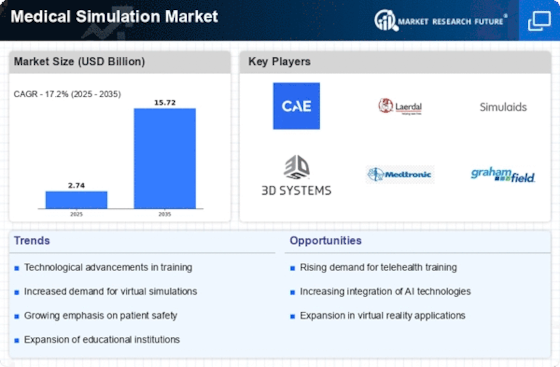
<p>Key players include CAE Healthcare, Laerdal Medical, Simulaids, and 3D Systems.</p>

What is the valuation of the Surgical Simulation segment in 2024?

<p>The Surgical Simulation segment was valued at 0.823 USD Billion in 2024.</p>

How does the market for High-Fidelity Simulation compare to Low-Fidelity Simulation?

<p>High-Fidelity Simulation was valued at 1.371 USD Billion in 2024, while Low-Fidelity Simulation was valued at 0.823 USD Billion.</p>

What technological advancements are influencing the Medical Simulation Market?

<p>Technological advancements in High-Fidelity, Low-Fidelity, and Virtual Simulation are significantly influencing market growth.</p>

Market Summary

According to Market Research Future analysis, the Medical Simulation Market size was valued at USD 2.743 Billion in 2024. The market is projected to grow from USD 3.214 Billion in 2025 to USD 15.72 Billion by 2035, exhibiting a CAGR of 17.2% during the forecast period 2025-2035. North America led the market with over 45% share, generating around USD 1.2 billion in revenue.
 
Rising emphasis on patient safety, clinical skill improvement, and reduced training errors is driving adoption of advanced medical simulation platforms globally. Integration of virtual technologies enhances competency-based education, improving healthcare outcomes and accelerating modern medical workforce readiness across institutions worldwide.
 
According to the World Health Organization (WHO), unsafe healthcare practices contribute to nearly 134 million adverse events annually in low- and middle-income countries, leading to millions of preventable complications. Medical simulation helps reduce these risks by enabling safe, repetitive clinical training without patient exposure, improving skill accuracy and safety outcomes significantly across healthcare systems.

Key Market Trends & Highlights

The Medical Simulation Market is poised for substantial growth driven by technological advancements and increasing educational needs.

  • North America leads with over 45% global revenue share in 2024 due to advanced healthcare simulation adoption. Europe holds 30% share valued at USD 0.82B in 2024, ranking second largest regional medical simulation market. Surgical simulation dominates applications due to widespread surgical training adoption across hospitals and academic medical institutions globally. VR and AI integration rapidly accelerating simulation adoption, enhancing realism and improving clinical training effectiveness worldwide.

Market Size & Forecast

2024 Market Size 2.743 (USD Billion)
2035 Market Size 15.72 (USD Billion)
CAGR (2025 - 2035) 17.2%
Largest Regional Market Share in 2024 North America

Major Players

Companies such as CAE Healthcare (CA), Laerdal Medical (NO), <a href="https://www.simulaids.co.uk/?srsltid=AfmBOop2C729tFb4oR1q7CUwl7KuO-7Yc5kkRqr_fq-yTm4-biuEpeIs">Simulaids</a> (US), 3D Systems (US), <a href="https://www.medtronic.com/en-us/healthcare-professionals/products.html">Medtronic</a> (US), Graham-Field Health Products (US), Koken (JP), Surgical Science (SE), VirtaMed (CH) are some of the major participants in the global market.

Market Trends

The Medical Simulation Market is currently experiencing a transformative phase, characterized by rapid advancements in technology and an increasing emphasis on patient safety and training efficacy. The integration of virtual reality and augmented reality into simulation training is reshaping how healthcare professionals acquire skills.

This evolution not only enhances the realism of training scenarios but also allows for a more immersive learning experience. Furthermore, the growing recognition of the importance of hands-on practice in medical education is driving demand for sophisticated simulation tools that can replicate real-life medical situations.

As a result, educational institutions and healthcare organizations are investing significantly in simulation technologies to improve training outcomes and ensure better preparedness among medical personnel. In addition to technological advancements, the market is witnessing a shift towards collaborative training environments.

Interprofessional education, which encourages teamwork among various healthcare disciplines, is becoming increasingly prevalent. This approach fosters communication and collaboration skills essential for effective patient care. Moreover, the rising focus on cost-effective training solutions is prompting organizations to adopt simulation-based learning as a viable alternative to traditional methods.

Overall, the market appears poised for continued growth, driven by innovations in technology and a commitment to enhancing the quality of healthcare education.

Technological Integration

The market is seeing a notable trend towards the incorporation of advanced technologies such as virtual reality and artificial intelligence. These innovations enhance the realism of training scenarios, allowing healthcare professionals to practice in lifelike environments. This trend not only improves skill acquisition but also boosts confidence among trainees, ultimately leading to better patient outcomes.

The WHO Global Health Observatory highlights that healthcare systems face a projected shortage of 10 million health workers by 2030, especially in low-resource regions. Simulation technologies help bridge this gap by enabling scalable training using AI-driven virtual environments, reducing dependency on physical clinical exposure while improving workforce readiness and competence globally.

Interprofessional Education

There is a growing emphasis on interprofessional education within the market. This approach encourages collaboration among various healthcare disciplines, fostering essential communication and teamwork skills. By simulating real-world scenarios that require joint efforts, training programs are better preparing healthcare professionals for the complexities of patient care.

The Pan American Health Organization (PAHO) reports that nearly 80% of medical errors are linked to poor communication and teamwork failures in clinical settings. Interprofessional simulation-based education significantly reduces these risks by replicating real-world collaborative scenarios, improving coordination between doctors, nurses, and allied health professionals, leading to safer and more efficient patient care delivery.

Cost-Effective Solutions

The market is increasingly focusing on cost-effective training solutions. Organizations are recognizing the financial benefits of simulation-based learning compared to traditional methods. This trend is likely to drive the adoption of simulation technologies, as institutions seek to optimize their training budgets while still ensuring high-quality education for medical personnel.

According to UNICEF healthcare training assessments, simulation-based learning can reduce training-related clinical resource utilization by up to 30–40% in healthcare education programs, especially in developing regions. This cost efficiency enables institutions to train more healthcare professionals with limited infrastructure while maintaining safety standards and improving long-term healthcare system sustainability.

Medical Simulation Market Market Drivers

Growing Adoption of Telemedicine

The rise of telemedicine is reshaping the landscape of healthcare delivery and is a notable driver in the Medical Simulation Market. As telehealth services become more prevalent, there is a corresponding need for training healthcare professionals in remote patient management and virtual consultations. Simulation technologies can effectively prepare practitioners for these new modalities, ensuring they are equipped to deliver quality care in a digital environment.
 
The telemedicine market is projected to reach 459.8 billion by 2030, indicating a substantial shift in healthcare practices. This transition necessitates the integration of simulation training to familiarize professionals with telehealth tools and techniques, thereby enhancing the overall effectiveness of the market.

Increased Focus on Patient Safety

The heightened emphasis on patient safety is a critical driver in the Medical Simulation Market. Healthcare organizations are increasingly prioritizing safety protocols to reduce medical errors and improve patient outcomes. Simulation training allows healthcare professionals to practice emergency procedures and critical care scenarios without jeopardizing patient safety.
 
This focus is underscored by studies indicating that simulation-based training can reduce errors by up to 50%. As regulatory bodies and accreditation organizations advocate for improved training standards, the demand for simulation-based education is expected to rise. Consequently, healthcare institutions are investing in simulation technologies to enhance their training programs, thereby fostering growth in the market.

Advancements in Simulation Technology

Technological advancements are significantly influencing the Medical Simulation Market. Innovations such as virtual reality (VR), augmented reality (AR), and artificial intelligence (AI) are transforming traditional training methods. For instance, VR simulations provide immersive experiences that enhance learning and retention.
 
The integration of AI allows for personalized training experiences, adapting to the learner's pace and skill level. According to recent data, the market for VR in healthcare is projected to grow at a compound annual growth rate of 30% through 2026. These advancements not only improve the quality of training but also increase the accessibility of simulation-based education. As technology continues to evolve, the market is likely to expand, offering more sophisticated and effective training solutions.

Regulatory and Accreditation Requirements

Regulatory and accreditation requirements are increasingly influencing the Medical Simulation Market. Healthcare institutions are mandated to adhere to specific training standards to ensure the competency of their staff. Simulation-based training is often a key component in meeting these standards, as it provides a structured and measurable approach to skill development.
 
Organizations such as the Accreditation Council for Graduate Medical Education emphasize the importance of simulation in residency training programs. As these requirements become more stringent, healthcare providers are likely to invest more in simulation technologies to comply with regulations and improve training outcomes. This trend is expected to drive growth in the market, as institutions seek to enhance their educational offerings.

Rising Demand for Healthcare Professionals

The increasing demand for healthcare professionals is a pivotal driver in the market. As populations age and chronic diseases become more prevalent, the need for skilled healthcare workers intensifies. This demand is reflected in the projected growth of the healthcare workforce, which is expected to reach 18 million by 2030.
 
Medical simulation serves as a crucial tool in training these professionals, allowing them to practice and refine their skills in a risk-free environment. The ability to simulate real-life scenarios enhances learning outcomes and prepares healthcare workers for the complexities of patient care. Consequently, educational institutions and healthcare organizations are investing in simulation technologies to meet this growing demand, thereby propelling the Medical Simulation Market forward.

Market Segment Insights

By Type: Simulation Software (Largest) vs. Simulation Equipment (Fastest-Growing)

In the global Medical Simulation Market, the distribution segment reveals that simulation software holds the largest share, attributed to its essential role in training healthcare professionals through realistic virtual environments. This segment has gained traction as institutions aim to enhance skill acquisition and competency through digital solutions. On the other hand, simulation equipment, encompassing physical tools, manikins, and advanced devices, is rapidly gaining prominence, reflecting the industry's shift towards more hands-on training methodologies that complement theoretical learning. The growth of the simulation software segment is driven by increasing investments in healthcare education technology and the demand for innovative learning platforms. Conversely, the equipment segment shows unprecedented growth fueled by advancements in technology, creating more lifelike scenarios for practitioners. Factors such as the rising number of medical training programs and the increasing emphasis on patient safety further contribute to the expanding need for both software and equipment in medical simulations.

Simulation Software (Dominant) vs. Simulation Models (Emerging)

Simulation software remains the dominant force in the global Medical Simulation Market, recognized for its ability to provide scalable and flexible learning opportunities. Healthcare providers leverage these digital platforms for cost-effective training, allowing simulation of various medical scenarios without requiring physical resources. In contrast, simulation models, while emerging, are gaining attention for their tactile learning advantages and improved user engagement. These models simulate real-life patient interactions and procedural tasks, appealing to hands-on learners. As both segments evolve, simulation software's foundational role and the rising relevance of simulation models are expected to shape the future of medical education, leading to a more integrated approach that enhances both theoretical knowledge and practical skills.

By Application: Surgical Simulation (Largest) vs. Virtual Reality Simulation (Fastest-Growing)

The application segment is dominated by Surgical Simulation, which holds a significant Medical Simulation Market share of 45% due to its broad adoption in medical training for surgeons. Patient Simulation follows closely, providing essential training that replicates real-life scenarios faced by healthcare professionals. Procedural Simulation and Virtual Reality Simulation are also gaining traction, but they currently represent a smaller portion of the market, primarily used for specific applications in training healthcare providers.

Surgical Simulation (Dominant) vs. Virtual Reality Simulation (Emerging)

Surgical Simulation remains the dominant application in the market share, reflecting a strong reliance on realistic training environments for surgical procedures. This segment leverages advanced technologies and anatomical models to offer comprehensive training experiences, which are crucial for surgical proficiency. Meanwhile, Virtual Reality Simulation is emerging as a transformative force, offering immersive environments for training that enhance learning and retention. This application is witnessing rapid growth, driven by technological advancements in VR, which provide healthcare professionals with realistic interactive scenarios that improve decision-making and clinical skills. As healthcare evolves, the integration of these simulation methods will increasingly shape the future of medical training.

By End Use: Hospitals (Largest) vs. Academic Institutions (Fastest-Growing)

The market demonstrates a diverse utilization landscape across multiple segments, notably hospitals, academic institutions, military organizations, and healthcare providers. Among these, hospitals command the largest Medical Simulation Market share at 50%, driven by the increasing need for advanced training methodologies and realistic patient care scenarios. Academic institutions follow, contributing significantly to the market, bolstered by growing educational programs focused on simulation training in medical fields. Military organizations and healthcare providers also play important roles, albeit on a smaller scale, contributing to a segmented yet growing market.

Hospitals: Dominant vs. Academic Institutions: Emerging

Hospitals represent a dominant force in the market share, utilizing advanced simulation technologies to enhance clinical training and improve patient outcomes. Their large infrastructure allows extensive use of simulation for surgical training, emergency response, and patient safety protocols. In contrast, academic institutions are emerging as a key player, leveraging simulation to prepare future healthcare professionals with hands-on experience. Their investment in simulation technologies is significantly increasing, aimed at integrating practical training into curriculums. This balance showcases hospitals as an essential pillar in the market, while academic institutions are becoming crucial for innovation and development of future medical talent.

By Technology: High-Fidelity Simulation (Largest) vs. Virtual Simulation (Fastest-Growing)

The market is witnessing a diverse distribution among its technology segments. High-fidelity simulation currently leads the Medical Simulation Market with a 55% share, characterized by its ability to provide realistic training scenarios. In contrast, Low-Fidelity Simulation holds a smaller share, focusing on cost-effectiveness and basic skills training. Virtual Simulation, although not as established, is becoming increasingly relevant as technology advances, particularly in accessibility and enhanced learning environments.

Technology: High-Fidelity Simulation (Dominant) vs. Virtual Simulation (Emerging)

High-Fidelity Simulation is recognized as the dominant technology in the market share, largely due to its immersive and realistic training capabilities. It allows healthcare professionals to practice complex procedures in a risk-free environment, enhancing their skills effectively. On the other hand, Virtual Simulation is emerging rapidly, leveraging advancements in digital technology to create engaging learning experiences. Its flexibility and accessibility make it an attractive option for educational institutions and healthcare providers seeking innovative training solutions. The growing trend towards remote learning is significantly propelling the adoption of Virtual Simulation, positioning it as a key player in the future of medical training.

Get more detailed insights about Medical Simulation Market Research Report—Global Forecast till 2035

Regional Insights

North America : Innovation and Leadership Hub

North America dominated the global Medical Simulation Market in 2024, reaching a market size of USD 1.2 billion. The region benefits from a high demand for innovative training solutions, supported by regulatory bodies emphasizing the importance of simulation in medical training. The U.S. is the largest market, followed by Canada, which is rapidly expanding its simulation capabilities to enhance healthcare outcomes. 

The competitive landscape in North America is robust, featuring key players like CAE Healthcare, 3D Systems, and Medtronic. These companies are at the forefront of technological advancements, offering a range of simulation products that cater to various medical fields. The presence of leading educational institutions further fuels market growth, as they increasingly adopt simulation-based training methodologies to improve clinical skills and patient safety.

The World Health Organization (WHO) reports that unsafe care affects 1 in 10 patients globally, reinforcing the need for advanced clinical training systems. North America’s strong adoption of simulation technologies is supported by healthcare systems aiming to reduce preventable harm and improve outcomes, especially in regions with high training standards and medical innovation capacity.

Europe : Growing Adoption and Regulation

Europe Medical Simulation Market is witnessing significant growth in the, accounting for approximately 30% of the global share. The region's expansion is driven by increasing investments in healthcare education and a growing emphasis on patient safety. Regulatory frameworks across countries like Germany and the UK are promoting the integration of simulation in medical training, enhancing the quality of healthcare professionals. The demand for innovative training solutions is further supported by government initiatives aimed at improving healthcare delivery. Leading countries in Europe include Germany, the UK, and France, where the presence of established companies like Laerdal Medical and Surgical Science is notable. The competitive landscape is characterized by collaborations between educational institutions and simulation providers, fostering innovation and improving training methodologies. The market is also influenced by the rising number of medical schools adopting simulation-based curricula, ensuring a steady demand for advanced simulation technologies.

Asia-Pacific : Emerging Market Potential

Asia-Pacific is emerging as a significant player in the market, holding around 20% of the global share. The region's growth is fueled by increasing healthcare expenditures, a rising number of medical institutions, and a growing awareness of the benefits of simulation-based training. Countries like China and India are leading this growth, supported by government initiatives aimed at enhancing medical education and training standards. The demand for high-quality healthcare services is driving the adoption of advanced simulation technologies in the region.

China and India are at the forefront of this market, with a growing number of local and international players entering the space. Companies like Koken and VirtaMed are expanding their presence, offering innovative solutions tailored to the unique needs of the region. The competitive landscape is evolving, with partnerships between educational institutions and simulation providers becoming increasingly common, ensuring that medical professionals are well-equipped to meet the challenges of modern healthcare.

Middle East and Africa : Untapped Market Opportunities

The Middle East and Africa region is gradually recognizing the importance of medical simulation, currently holding about 5% of the global market share. The growth is driven by increasing investments in healthcare infrastructure and a rising demand for skilled healthcare professionals. Countries like the UAE and South Africa are leading the way, with government initiatives aimed at improving medical training and education. The region's focus on enhancing healthcare quality is catalyzing the adoption of simulation technologies in medical training.

In the competitive landscape, local players are beginning to emerge, alongside international companies looking to establish a foothold in this untapped market. The presence of key players is still limited, but partnerships with educational institutions are on the rise, fostering innovation and improving training methodologies. As the region continues to invest in healthcare, the demand for medical simulation solutions is expected to grow significantly in the coming years.

Key Players and Competitive Insights

The Medical Simulation Market is currently characterized by a dynamic competitive landscape, driven by technological advancements and an increasing emphasis on training efficacy in healthcare. Key players such as CAE Healthcare (Canada), Laerdal Medical (Norway), and 3D Systems (United States) are at the forefront, each adopting distinct strategies to enhance their market positioning. CAE Healthcare (Canada) focuses on innovation through the development of high-fidelity simulators that integrate advanced technologies, while Laerdal Medical (Norway) emphasizes partnerships with educational institutions to expand its reach and influence in medical training.
 
Meanwhile, 3D Systems (United States) is leveraging its expertise in 3D printing to create customized simulation models, thereby enhancing the realism of training scenarios. Collectively, these strategies contribute to a competitive environment that prioritizes technological integration and educational collaboration. In terms of business tactics, companies are increasingly localizing manufacturing to reduce costs and improve supply chain efficiency. The market appears moderately fragmented, with a mix of established players and emerging startups.
 
This fragmentation allows for diverse offerings, yet the collective influence of key players like Medtronic (United States) and Surgical Science (Sweden) is significant, as they set benchmarks for quality and innovation that smaller firms often strive to meet. In August 2025, CAE Healthcare (Canada) announced a strategic partnership with a leading medical university to develop a new line of simulation-based training programs. This collaboration is poised to enhance the educational experience for medical students, providing them with access to cutting-edge simulation technology that reflects real-world scenarios. Such partnerships not only bolster CAE's product offerings but also reinforce its commitment to advancing medical education through practical training solutions.
 
In September 2025, Laerdal Medical (Norway) launched a new digital platform designed to facilitate remote learning and simulation training. This initiative is particularly relevant in the context of evolving educational needs, as it allows healthcare professionals to engage in training from various locations. The platform's introduction signifies Laerdal's proactive approach to digital transformation, positioning the company as a leader in accessible medical education.
 
In July 2025, 3D Systems (United States) unveiled a new suite of 3D-printed anatomical models tailored for surgical training. This innovation not only enhances the realism of simulations but also allows for personalized training experiences based on individual patient anatomy. The strategic importance of this development lies in its potential to improve surgical outcomes by providing trainees with a more accurate representation of the human body, thereby fostering better preparedness for real-life procedures.
 
As of October 2025, the market is witnessing a shift towards digitalization, sustainability, and the integration of artificial intelligence. These trends are reshaping competitive dynamics, as companies increasingly form strategic alliances to enhance their technological capabilities and market reach. The focus appears to be shifting from price-based competition to differentiation through innovation and reliability in supply chains. This evolution suggests that future competitive advantages will likely hinge on the ability to deliver cutting-edge solutions that meet the complex demands of modern healthcare training.

Key Companies in the Medical Simulation Market include

Industry Developments

The Global Medical Simulation Market has been witnessing significant advancements and growth recently. A notable development is the increasing collaboration between companies such as CAE Healthcare and Laerdal Medical, aimed at enhancing their simulation training solutions to meet rising demands for healthcare provider educational needs. In October 2023, Gaumard Scientific launched an advanced patient simulator that is expected to improve surgical training and teaching methodologies. Furthermore, in September 2023, Simbionix announced the expansion of its product offerings to include virtual reality solutions specifically tailored for surgical training, reflecting ongoing trends towards immersive technologies.

The market has been bolstered by a surge in demand for innovative simulation tools, with Zimmer Biomet and Medtronic investing heavily in Research and Development to refine simulation platforms. Merger and acquisition activity has also become prominent, with MockingBird acquiring smaller simulation technology firms in August 2023 to broaden its portfolio. In terms of market valuation, organizations have reported significant revenue growth driven by increased adoption across educational institutions and healthcare facilities globally, indicating a strong upward trend in the sector, particularly over the last two years.

Future Outlook

Medical Simulation Market Future Outlook

According to the Medical Simulation Market report the market is projected to grow at a 17.2% CAGR from 2024 to 2035, driven by technological advancements, increasing healthcare demands, and enhanced training methodologies.

New opportunities lie in:

  • <p>Development of virtual reality training modules for surgical procedures. Expansion of mobile simulation units for remote healthcare training. Partnerships with educational institutions for integrated simulation curricula.</p>

By 2035, the Medical Simulation Market size is expected to be robust, reflecting substantial growth and innovation.

Market Segmentation

Medical Simulation Market Type Outlook

  • Simulation Software
  • Simulation Equipment
  • Simulation Models

Medical Simulation Market End Use Outlook

  • Hospitals
  • Academic Institutions
  • Military Organizations
  • Healthcare Providers

Medical Simulation Market Technology Outlook

  • High-Fidelity Simulation
  • Low-Fidelity Simulation
  • Virtual Simulation

Medical Simulation Market Application Outlook

  • Surgical Simulation
  • Patient Simulation
  • Procedural Simulation
  • Virtual Reality Simulation

Report Scope

MARKET SIZE 2024 2.743(USD Billion)
MARKET SIZE 2025 3.214(USD Billion)
MARKET SIZE 2035 15.72(USD Billion)
COMPOUND ANNUAL GROWTH RATE (CAGR) 17.2% (2025 - 2035)
REPORT COVERAGE Revenue Forecast, Competitive Landscape, Growth Factors, and Trends
BASE YEAR 2024
Market Forecast Period 2025 - 2035
Historical Data 2019 - 2024
Market Forecast Units USD Billion
Key Companies Profiled CAE Healthcare (CA), Laerdal Medical (NO), Simulaids (US), 3D Systems (US), Medtronic (US), Graham-Field Health Products (US), Koken (JP), Surgical Science (SE), VirtaMed (CH)
Segments Covered Types, Applications, End Use, Technology, Regional
Key Market Opportunities Integration of virtual reality and artificial intelligence enhances training effectiveness in the market.
Key Market Dynamics Technological advancements drive innovation in medical simulation, enhancing training efficacy and expanding market applications.
Countries Covered North America, Europe, APAC, South America, MEA

FAQs

What is the current valuation of the Medical Simulation Market as of 2024?

<p>The Medical Simulation Market was valued at 2.743 USD Billion in 2024.</p>

What is the projected market size for the Medical Simulation Market by 2035?

The Medical Simulation Market is projected to reach 15.72 USD Billion by 2035.

What is the expected CAGR for the Medical Simulation Market during the forecast period 2025 - 2035?

<p>The expected CAGR for the Medical Simulation Market during 2025 - 2035 is 17.2%.</p>

Which segment of the Medical Simulation Market is expected to grow the most by 2035?

<p>The Simulation Equipment segment is projected to grow from 1.1 USD Billion in 2024 to 6.5 USD Billion by 2035.</p>

What are the key applications driving the Medical Simulation Market?

Key applications in the Medical Simulation Market include Surgical Simulation, Patient Simulation, Procedural Simulation, and Virtual Reality Simulation.

Which end-use segment is anticipated to dominate the Medical Simulation Market by 2035?

<p>Healthcare Providers are expected to dominate, growing from 0.961 USD Billion in 2024 to 5.59 USD Billion by 2035.</p>

Who are the leading players in the Medical Simulation Market?

<p>Key players include CAE Healthcare, Laerdal Medical, Simulaids, and 3D Systems.</p>

What is the valuation of the Surgical Simulation segment in 2024?

<p>The Surgical Simulation segment was valued at 0.823 USD Billion in 2024.</p>

How does the market for High-Fidelity Simulation compare to Low-Fidelity Simulation?

<p>High-Fidelity Simulation was valued at 1.371 USD Billion in 2024, while Low-Fidelity Simulation was valued at 0.823 USD Billion.</p>

What technological advancements are influencing the Medical Simulation Market?

<p>Technological advancements in High-Fidelity, Low-Fidelity, and Virtual Simulation are significantly influencing market growth.</p>

  1. SECTION I: EXECUTIVE SUMMARY AND KEY HIGHLIGHTS |
    1. EXECUTIVE SUMMARY | |
      1. Market Overview | |
      2. Key Findings | |
      3. Market Segmentation | |
      4. Competitive Landscape | |
      5. Challenges and Opportunities | |
      6. Future Outlook 2
  2. SECTION II: SCOPING, METHODOLOGY AND MARKET STRUCTURE |
    1. MARKET INTRODUCTION | |
      1. Definition | |
      2. Scope of the study | | |
    2. RESEARCH METHODOLOGY | |
      1. Overview | |
      2. Data Mining | |
      3. Secondary Research | |
      4. Primary Research | | |
      5. Forecasting Model | |
      6. Market Size Estimation | | |
      7. Data Triangulation | |
      8. Validation 3
  3. SECTION III: QUALITATIVE ANALYSIS |
    1. MARKET DYNAMICS | |
      1. Overview | |
      2. Drivers | |
      3. Restraints | |
      4. Opportunities |
    2. MARKET FACTOR ANALYSIS | |
      1. Value chain Analysis | |
      2. Porter's Five Forces Analysis | | |
      3. COVID-19 Impact Analysis | | |
  4. SECTION IV: QUANTITATIVE ANALYSIS |
    1. Healthcare, BY Type (USD Billion) | |
      1. Simulation Software | |
      2. Simulation Equipment | |
      3. Simulation Models |
    2. Healthcare, BY Application (USD Billion) | |
      1. Surgical Simulation | |
      2. Patient Simulation | |
      3. Procedural Simulation | |
      4. Virtual Reality Simulation |
    3. Healthcare, BY End Use (USD Billion) | |
      1. Hospitals | |
      2. Academic Institutions | |
      3. Military Organizations | |
      4. Healthcare Providers |
    4. Healthcare, BY Technology (USD Billion) | |
      1. High-Fidelity Simulation | |
      2. Low-Fidelity Simulation | |
      3. Virtual Simulation |
    5. Healthcare, BY Region (USD Billion) | |
      1. North America | | |
      2. Europe | | |
      3. APAC | | |
      4. South America | | |
      5. MEA | | |
  5. SECTION V: COMPETITIVE ANALYSIS |
    1. Competitive Landscape | |
      1. Overview | |
      2. Competitive Analysis | |
      3. Market share Analysis | |
      4. Major Growth Strategy in the Healthcare | |
      5. Competitive Benchmarking | |
      6. Leading Players in Terms of Number of Developments in the Healthcare | |
      7. Key developments and growth strategies | | |
      8. Major Players Financial Matrix | | |
    2. Company Profiles | |
      1. CAE Healthcare (CA) | | |
      2. Laerdal Medical (NO) | | |
      3. Simulaids (US) | | |
      4. 3D Systems (US) | | |
      5. Medtronic (US) | | |
      6. Graham-Field Health Products (US) | | |
      7. Koken (JP) | | |
      8. Surgical Science (SE) | | |
      9. VirtaMed (CH) | | |
    3. Appendix | |
      1. References | |
      2. Related Reports 6 LIST OF FIGURES |
    4. MARKET SYNOPSIS |
    5. NORTH AMERICA MARKET ANALYSIS |
    6. US MARKET ANALYSIS BY TYPE |
    7. US MARKET ANALYSIS BY APPLICATION |
    8. US MARKET ANALYSIS BY END USE |
    9. US MARKET ANALYSIS BY TECHNOLOGY |
    10. CANADA MARKET ANALYSIS BY TYPE |
    11. CANADA MARKET ANALYSIS BY APPLICATION |
    12. CANADA MARKET ANALYSIS BY END USE |
    13. CANADA MARKET ANALYSIS BY TECHNOLOGY |
    14. EUROPE MARKET ANALYSIS |
    15. GERMANY MARKET ANALYSIS BY TYPE |
    16. GERMANY MARKET ANALYSIS BY APPLICATION |
    17. GERMANY MARKET ANALYSIS BY END USE |
    18. GERMANY MARKET ANALYSIS BY TECHNOLOGY |
    19. UK MARKET ANALYSIS BY TYPE |
    20. UK MARKET ANALYSIS BY APPLICATION |
    21. UK MARKET ANALYSIS BY END USE |
    22. UK MARKET ANALYSIS BY TECHNOLOGY |
    23. FRANCE MARKET ANALYSIS BY TYPE |
    24. FRANCE MARKET ANALYSIS BY APPLICATION |
    25. FRANCE MARKET ANALYSIS BY END USE |
    26. FRANCE MARKET ANALYSIS BY TECHNOLOGY |
    27. RUSSIA MARKET ANALYSIS BY TYPE |
    28. RUSSIA MARKET ANALYSIS BY APPLICATION |
    29. RUSSIA MARKET ANALYSIS BY END USE |
    30. RUSSIA MARKET ANALYSIS BY TECHNOLOGY |
    31. ITALY MARKET ANALYSIS BY TYPE |
    32. ITALY MARKET ANALYSIS BY APPLICATION |
    33. ITALY MARKET ANALYSIS BY END USE |
    34. ITALY MARKET ANALYSIS BY TECHNOLOGY |
    35. SPAIN MARKET ANALYSIS BY TYPE |
    36. SPAIN MARKET ANALYSIS BY APPLICATION |
    37. SPAIN MARKET ANALYSIS BY END USE |
    38. SPAIN MARKET ANALYSIS BY TECHNOLOGY |
    39. REST OF EUROPE MARKET ANALYSIS BY TYPE |
    40. REST OF EUROPE MARKET ANALYSIS BY APPLICATION |
    41. REST OF EUROPE MARKET ANALYSIS BY END USE |
    42. REST OF EUROPE MARKET ANALYSIS BY TECHNOLOGY |
    43. APAC MARKET ANALYSIS |
    44. CHINA MARKET ANALYSIS BY TYPE |
    45. CHINA MARKET ANALYSIS BY APPLICATION |
    46. CHINA MARKET ANALYSIS BY END USE |
    47. CHINA MARKET ANALYSIS BY TECHNOLOGY |
    48. INDIA MARKET ANALYSIS BY TYPE |
    49. INDIA MARKET ANALYSIS BY APPLICATION |
    50. INDIA MARKET ANALYSIS BY END USE |
    51. INDIA MARKET ANALYSIS BY TECHNOLOGY |
    52. JAPAN MARKET ANALYSIS BY TYPE |
    53. JAPAN MARKET ANALYSIS BY APPLICATION |
    54. JAPAN MARKET ANALYSIS BY END USE |
    55. JAPAN MARKET ANALYSIS BY TECHNOLOGY |
    56. SOUTH KOREA MARKET ANALYSIS BY TYPE |
    57. SOUTH KOREA MARKET ANALYSIS BY APPLICATION |
    58. SOUTH KOREA MARKET ANALYSIS BY END USE |
    59. SOUTH KOREA MARKET ANALYSIS BY TECHNOLOGY |
    60. MALAYSIA MARKET ANALYSIS BY TYPE |
    61. MALAYSIA MARKET ANALYSIS BY APPLICATION |
    62. MALAYSIA MARKET ANALYSIS BY END USE |
    63. MALAYSIA MARKET ANALYSIS BY TECHNOLOGY |
    64. THAILAND MARKET ANALYSIS BY TYPE |
    65. THAILAND MARKET ANALYSIS BY APPLICATION |
    66. THAILAND MARKET ANALYSIS BY END USE |
    67. THAILAND MARKET ANALYSIS BY TECHNOLOGY |
    68. INDONESIA MARKET ANALYSIS BY TYPE |
    69. INDONESIA MARKET ANALYSIS BY APPLICATION |
    70. INDONESIA MARKET ANALYSIS BY END USE |
    71. INDONESIA MARKET ANALYSIS BY TECHNOLOGY |
    72. REST OF APAC MARKET ANALYSIS BY TYPE |
    73. REST OF APAC MARKET ANALYSIS BY APPLICATION |
    74. REST OF APAC MARKET ANALYSIS BY END USE |
    75. REST OF APAC MARKET ANALYSIS BY TECHNOLOGY |
    76. SOUTH AMERICA MARKET ANALYSIS |
    77. BRAZIL MARKET ANALYSIS BY TYPE |
    78. BRAZIL MARKET ANALYSIS BY APPLICATION |
    79. BRAZIL MARKET ANALYSIS BY END USE |
    80. BRAZIL MARKET ANALYSIS BY TECHNOLOGY |
    81. MEXICO MARKET ANALYSIS BY TYPE |
    82. MEXICO MARKET ANALYSIS BY APPLICATION |
    83. MEXICO MARKET ANALYSIS BY END USE |
    84. MEXICO MARKET ANALYSIS BY TECHNOLOGY |
    85. ARGENTINA MARKET ANALYSIS BY TYPE |
    86. ARGENTINA MARKET ANALYSIS BY APPLICATION |
    87. ARGENTINA MARKET ANALYSIS BY END USE |
    88. ARGENTINA MARKET ANALYSIS BY TECHNOLOGY |
    89. REST OF SOUTH AMERICA MARKET ANALYSIS BY TYPE |
    90. REST OF SOUTH AMERICA MARKET ANALYSIS BY APPLICATION |
    91. REST OF SOUTH AMERICA MARKET ANALYSIS BY END USE |
    92. REST OF SOUTH AMERICA MARKET ANALYSIS BY TECHNOLOGY |
    93. MEA MARKET ANALYSIS |
    94. GCC COUNTRIES MARKET ANALYSIS BY TYPE |
    95. GCC COUNTRIES MARKET ANALYSIS BY APPLICATION |
    96. GCC COUNTRIES MARKET ANALYSIS BY END USE |
    97. GCC COUNTRIES MARKET ANALYSIS BY TECHNOLOGY |
    98. SOUTH AFRICA MARKET ANALYSIS BY TYPE |
    99. SOUTH AFRICA MARKET ANALYSIS BY APPLICATION |
    100. SOUTH AFRICA MARKET ANALYSIS BY END USE |
    101. SOUTH AFRICA MARKET ANALYSIS BY TECHNOLOGY |
    102. REST OF MEA MARKET ANALYSIS BY TYPE |
    103. REST OF MEA MARKET ANALYSIS BY APPLICATION |
    104. REST OF MEA MARKET ANALYSIS BY END USE |
    105. REST OF MEA MARKET ANALYSIS BY TECHNOLOGY |
    106. KEY BUYING CRITERIA OF HEALTHCARE |
    107. RESEARCH PROCESS OF MRFR |
    108. DRO ANALYSIS OF HEALTHCARE |
    109. DRIVERS IMPACT ANALYSIS: HEALTHCARE |
    110. RESTRAINTS IMPACT ANALYSIS: HEALTHCARE |
    111. SUPPLY / VALUE CHAIN: HEALTHCARE |
    112. HEALTHCARE, BY TYPE, 2024 (% SHARE) |
    113. HEALTHCARE, BY TYPE, 2024 TO 2035 (USD Billion) |
    114. HEALTHCARE, BY APPLICATION, 2024 (% SHARE) |
    115. HEALTHCARE, BY APPLICATION, 2024 TO 2035 (USD Billion) |
    116. HEALTHCARE, BY END USE, 2024 (% SHARE) |
    117. HEALTHCARE, BY END USE, 2024 TO 2035 (USD Billion) |
    118. HEALTHCARE, BY TECHNOLOGY, 2024 (% SHARE) |
    119. HEALTHCARE, BY TECHNOLOGY, 2024 TO 2035 (USD Billion) |
    120. BENCHMARKING OF MAJOR COMPETITORS 7 LIST OF TABLES |
    121. LIST OF ASSUMPTIONS | |
      1. |
    122. North America MARKET SIZE ESTIMATES; FORECAST | |
      1. BY TYPE, 2025-2035 (USD Billion) | |
      2. BY APPLICATION, 2025-2035 (USD Billion) | |
      3. BY END USE, 2025-2035 (USD Billion) | |
      4. BY TECHNOLOGY, 2025-2035 (USD Billion) |
    123. US MARKET SIZE ESTIMATES; FORECAST | |
      1. BY TYPE, 2025-2035 (USD Billion) | |
      2. BY APPLICATION, 2025-2035 (USD Billion) | |
      3. BY END USE, 2025-2035 (USD Billion) | |
      4. BY TECHNOLOGY, 2025-2035 (USD Billion) |
    124. Canada MARKET SIZE ESTIMATES; FORECAST | |
      1. BY TYPE, 2025-2035 (USD Billion) | |
      2. BY APPLICATION, 2025-2035 (USD Billion) | |
      3. BY END USE, 2025-2035 (USD Billion) | |
      4. BY TECHNOLOGY, 2025-2035 (USD Billion) |
    125. Europe MARKET SIZE ESTIMATES; FORECAST | |
      1. BY TYPE, 2025-2035 (USD Billion) | |
      2. BY APPLICATION, 2025-2035 (USD Billion) | |
      3. BY END USE, 2025-2035 (USD Billion) | |
      4. BY TECHNOLOGY, 2025-2035 (USD Billion) |
    126. Germany MARKET SIZE ESTIMATES; FORECAST | |
      1. BY TYPE, 2025-2035 (USD Billion) | |
      2. BY APPLICATION, 2025-2035 (USD Billion) | |
      3. BY END USE, 2025-2035 (USD Billion) | |
      4. BY TECHNOLOGY, 2025-2035 (USD Billion) |
    127. UK MARKET SIZE ESTIMATES; FORECAST | |
      1. BY TYPE, 2025-2035 (USD Billion) | |
      2. BY APPLICATION, 2025-2035 (USD Billion) | |
      3. BY END USE, 2025-2035 (USD Billion) | |
      4. BY TECHNOLOGY, 2025-2035 (USD Billion) |
    128. France MARKET SIZE ESTIMATES; FORECAST | |
      1. BY TYPE, 2025-2035 (USD Billion) | |
      2. BY APPLICATION, 2025-2035 (USD Billion) | |
      3. BY END USE, 2025-2035 (USD Billion) | |
      4. BY TECHNOLOGY, 2025-2035 (USD Billion) |
    129. Russia MARKET SIZE ESTIMATES; FORECAST | |
      1. BY TYPE, 2025-2035 (USD Billion) | |
      2. BY APPLICATION, 2025-2035 (USD Billion) | |
      3. BY END USE, 2025-2035 (USD Billion) | |
      4. BY TECHNOLOGY, 2025-2035 (USD Billion) |
    130. Italy MARKET SIZE ESTIMATES; FORECAST | |
      1. BY TYPE, 2025-2035 (USD Billion) | |
      2. BY APPLICATION, 2025-2035 (USD Billion) | |
      3. BY END USE, 2025-2035 (USD Billion) | |
      4. BY TECHNOLOGY, 2025-2035 (USD Billion) |
    131. Spain MARKET SIZE ESTIMATES; FORECAST | |
      1. BY TYPE, 2025-2035 (USD Billion) | |
      2. BY APPLICATION, 2025-2035 (USD Billion) | |
      3. BY END USE, 2025-2035 (USD Billion) | |
      4. BY TECHNOLOGY, 2025-2035 (USD Billion) |
    132. Rest of Europe MARKET SIZE ESTIMATES; FORECAST | |
      1. BY TYPE, 2025-2035 (USD Billion) | |
      2. BY APPLICATION, 2025-2035 (USD Billion) | |
      3. BY END USE, 2025-2035 (USD Billion) | |
      4. BY TECHNOLOGY, 2025-2035 (USD Billion) |
    133. APAC MARKET SIZE ESTIMATES; FORECAST | |
      1. BY TYPE, 2025-2035 (USD Billion) | |
      2. BY APPLICATION, 2025-2035 (USD Billion) | |
      3. BY END USE, 2025-2035 (USD Billion) | |
      4. BY TECHNOLOGY, 2025-2035 (USD Billion) |
    134. China MARKET SIZE ESTIMATES; FORECAST | |
      1. BY TYPE, 2025-2035 (USD Billion) | |
      2. BY APPLICATION, 2025-2035 (USD Billion) | |
      3. BY END USE, 2025-2035 (USD Billion) | |
      4. BY TECHNOLOGY, 2025-2035 (USD Billion) |
    135. India MARKET SIZE ESTIMATES; FORECAST | |
      1. BY TYPE, 2025-2035 (USD Billion) | |
      2. BY APPLICATION, 2025-2035 (USD Billion) | |
      3. BY END USE, 2025-2035 (USD Billion) | |
      4. BY TECHNOLOGY, 2025-2035 (USD Billion) |
    136. Japan MARKET SIZE ESTIMATES; FORECAST | |
      1. BY TYPE, 2025-2035 (USD Billion) | |
      2. BY APPLICATION, 2025-2035 (USD Billion) | |
      3. BY END USE, 2025-2035 (USD Billion) | |
      4. BY TECHNOLOGY, 2025-2035 (USD Billion) |
    137. South Korea MARKET SIZE ESTIMATES; FORECAST | |
      1. BY TYPE, 2025-2035 (USD Billion) | |
      2. BY APPLICATION, 2025-2035 (USD Billion) | |
      3. BY END USE, 2025-2035 (USD Billion) | |
      4. BY TECHNOLOGY, 2025-2035 (USD Billion) |
    138. Malaysia MARKET SIZE ESTIMATES; FORECAST | |
      1. BY TYPE, 2025-2035 (USD Billion) | |
      2. BY APPLICATION, 2025-2035 (USD Billion) | |
      3. BY END USE, 2025-2035 (USD Billion) | |
      4. BY TECHNOLOGY, 2025-2035 (USD Billion) |
    139. Thailand MARKET SIZE ESTIMATES; FORECAST | |
      1. BY TYPE, 2025-2035 (USD Billion) | |
      2. BY APPLICATION, 2025-2035 (USD Billion) | |
      3. BY END USE, 2025-2035 (USD Billion) | |
      4. BY TECHNOLOGY, 2025-2035 (USD Billion) |
    140. Indonesia MARKET SIZE ESTIMATES; FORECAST | |
      1. BY TYPE, 2025-2035 (USD Billion) | |
      2. BY APPLICATION, 2025-2035 (USD Billion) | |
      3. BY END USE, 2025-2035 (USD Billion) | |
      4. BY TECHNOLOGY, 2025-2035 (USD Billion) |
    141. Rest of APAC MARKET SIZE ESTIMATES; FORECAST | |
      1. BY TYPE, 2025-2035 (USD Billion) | |
      2. BY APPLICATION, 2025-2035 (USD Billion) | |
      3. BY END USE, 2025-2035 (USD Billion) | |
      4. BY TECHNOLOGY, 2025-2035 (USD Billion) |
    142. South America MARKET SIZE ESTIMATES; FORECAST | |
      1. BY TYPE, 2025-2035 (USD Billion) | |
      2. BY APPLICATION, 2025-2035 (USD Billion) | |
      3. BY END USE, 2025-2035 (USD Billion) | |
      4. BY TECHNOLOGY, 2025-2035 (USD Billion) |
    143. Brazil MARKET SIZE ESTIMATES; FORECAST | |
      1. BY TYPE, 2025-2035 (USD Billion) | |
      2. BY APPLICATION, 2025-2035 (USD Billion) | |
      3. BY END USE, 2025-2035 (USD Billion) | |
      4. BY TECHNOLOGY, 2025-2035 (USD Billion) |
    144. Mexico MARKET SIZE ESTIMATES; FORECAST | |
      1. BY TYPE, 2025-2035 (USD Billion) | |
      2. BY APPLICATION, 2025-2035 (USD Billion) | |
      3. BY END USE, 2025-2035 (USD Billion) | |
      4. BY TECHNOLOGY, 2025-2035 (USD Billion) |
    145. Argentina MARKET SIZE ESTIMATES; FORECAST | |
      1. BY TYPE, 2025-2035 (USD Billion) | |
      2. BY APPLICATION, 2025-2035 (USD Billion) | |
      3. BY END USE, 2025-2035 (USD Billion) | |
      4. BY TECHNOLOGY, 2025-2035 (USD Billion) |
    146. Rest of South America MARKET SIZE ESTIMATES; FORECAST | |
      1. BY TYPE, 2025-2035 (USD Billion) | |
      2. BY APPLICATION, 2025-2035 (USD Billion) | |
      3. BY END USE, 2025-2035 (USD Billion) | |
      4. BY TECHNOLOGY, 2025-2035 (USD Billion) |
    147. MEA MARKET SIZE ESTIMATES; FORECAST | |
      1. BY TYPE, 2025-2035 (USD Billion) | |
      2. BY APPLICATION, 2025-2035 (USD Billion) | |
      3. BY END USE, 2025-2035 (USD Billion) | |
      4. BY TECHNOLOGY, 2025-2035 (USD Billion) |
    148. GCC Countries MARKET SIZE ESTIMATES; FORECAST | |
      1. BY TYPE, 2025-2035 (USD Billion) | |
      2. BY APPLICATION, 2025-2035 (USD Billion) | |
      3. BY END USE, 2025-2035 (USD Billion) | |
      4. BY TECHNOLOGY, 2025-2035 (USD Billion) |
    149. South Africa MARKET SIZE ESTIMATES; FORECAST | |
      1. BY TYPE, 2025-2035 (USD Billion) | |
      2. BY APPLICATION, 2025-2035 (USD Billion) | |
      3. BY END USE, 2025-2035 (USD Billion) | |
      4. BY TECHNOLOGY, 2025-2035 (USD Billion) |
    150. Rest of MEA MARKET SIZE ESTIMATES; FORECAST | |
      1. BY TYPE, 2025-2035 (USD Billion) | |
      2. BY APPLICATION, 2025-2035 (USD Billion) | |
      3. BY END USE, 2025-2035 (USD Billion) | |
      4. BY TECHNOLOGY, 2025-2035 (USD Billion) |
    151. PRODUCT LAUNCH/PRODUCT DEVELOPMENT/APPROVAL | |
      1. |
    152. ACQUISITION/PARTNERSHIP | |

Healthcare Market Segmentation

Healthcare By Type (USD Billion, 2025-2035)

  • Simulation Software
  • Simulation Equipment
  • Simulation Models

Healthcare By Application (USD Billion, 2025-2035)

  • Surgical Simulation
  • Patient Simulation
  • Procedural Simulation
  • Virtual Reality Simulation

Healthcare By End Use (USD Billion, 2025-2035)

  • Hospitals
  • Academic Institutions
  • Military Organizations
  • Healthcare Providers

Healthcare By Technology (USD Billion, 2025-2035)

  • High-Fidelity Simulation
  • Low-Fidelity Simulation
  • Virtual Simulation
Infographic

Free Sample Request

Kindly complete the form below to receive a free sample of this Report

Get Free Sample

Customer Strories

Compare Licence

×
Features License Type
Single User Multiuser License Enterprise User
Price $4,950 $5,950 $7,250
Maximum User Access Limit 1 User Upto 10 Users Unrestricted Access Throughout the Organization
Free Customization
Direct Access to Analyst
Deliverable Format
Platform Access
Discount on Next Purchase 10% 15% 15%
Printable Versions
%>