Medical Packaging Market (2026 - 2035)

Medical Packaging Market Research Report Information By Material (Glass, Plastics, Paper and Paperboard, Metals, and Other Materials), By Product Type (Bottles and Containers, Blister Packs, Vials and Ampoules, Cartridges and Pre-Filled Syringes, Pouches, and Other Product Types), By Packaging Level (Primary Packaging, Secondary Packaging, and Tertiary Packaging), and By End-user (Pharmaceutical Manufacturing, Medical-Device OEMs, Nutraceutical and OTC, Hospitals and Clinics, and Home Healthcare) – Forecast Till 2035.
ID: MRFR/PCM/0349-HCR 111 Pages Snehal Singh Last Updated: October 12, 2026
Medical Packaging Market
Market Size
Forecast Period2026-2035
CAGR (2026-2035)5.63%
2025 Market SizeUSD 150.9 Billion
2035 Market SizeUSD 261.0 Billion
Key Players
Amcor plc
West Pharmaceutical Services
Gerresheimer AG
AptarGroup
SCHOTT Pharma AG
Stevanato Group
Opportunities
  • Recycle-Ready Mono-Material Blisters
  • Emerging-Market Capacity Build-Out
  • Connected Packs and Adherence Data Services

Medical Packaging Market Summary

The Medical Packaging Market was valued at USD 150.9 Billion in 2025 and is projected to reach USD 159.4 Billion in 2026, climbing to USD 261.0 Billion by 2035 at a CAGR of 5.63% over 2026–2035. Two policy catalysts anchor the outlook. The U.S. Drug Supply Chain Security Act (DSCSA) has pushed interoperable, unit-level serialization onto every prescription pack moving through American distribution , and Regulation (EU) 2025/40 sets recyclability requirements for packaging placed on the EU market from 2030 [2]. Injectable demand adds a third push, with GLP-1 therapies absorbing glass cartridge and autoinjector capacity faster than suppliers can build it.

Technology change is redefining what a drug or device pack must do. PVC and cold-form aluminium blisters are giving way to mono-material polyolefin and PET-EVOH laminates, and bulk vials washed and sterilized at the filler are being displaced by ready-to-use nested containers. Capital is following the shift: SCHOTT Pharma has committed USD 371 million to a North Carolina syringe plant [3], and Gerresheimer allocated roughly USD 180 million to its Georgia molding and vial expansion . Within pharmaceutical packaging, primary containers now absorb most engineering effort because biologics tolerate almost no extractables.

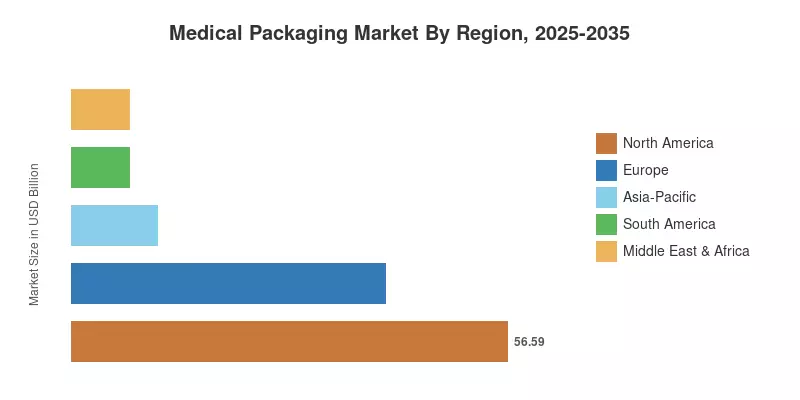
North America leads the Medical Packaging Market with a 37.5% share in 2025, supported by the world's largest biologics pipeline and strict FDA container-closure expectations. Asia-Pacific is the fastest-growing region at a 7.4% CAGR, led by Indian generic exports and China's drive for domestic injectable supply. Europe ranks second, where recyclability rules and the EU Medical Device Regulation are forcing redesigns across drug and device lines. Over the next decade, value will concentrate in high-barrier, traceable, and recyclable formats rather than raw unit volume.

Key Report Takeaways

• By Material

  • Plastics hold a 64.8% share of the Medical Packaging Market in 2025, reflecting low cost and processing flexibility across bottles, IV bags, and blister films.
  • Glass is the fastest-growing material at a 9.2% CAGR, lifted by biologics and GLP-1 injectables that require low-leachable borosilicate.

• By Product Type

  • Bottles and Containers account for a 37.1% share, the largest product type, anchored by oral solid dose and liquid formats.
  • Blister Packs grow at a 7.7% CAGR as recycle-ready mono-material structures replace PVC.

• By Packaging Level

  • Primary Packaging represents a 56.2% share of the Medical Packaging Market, driven by pharmacopoeia rules for drug-contact layers
  • Tertiary Packaging expands at a 7.2% CAGR on cold-chain and serialized shipper demand

• By End-user

  • Pharmaceutical Manufacturing holds a 33.9% share, the largest buyer group
  • Medical-Device OEMs generate USD 37.1 Billion in 2025 demand for trays, lids, and sterile barrier systems
  • Nutraceutical and OTC is the fastest-growing end-user at an 8.5% CAGR

• By Region

  • North America leads with a 37.5% share in 2025
  • Europe represents USD 40.7 billion in 2025
  • Asia-Pacific grows fastest at a 7.4% CAGR

Market Size and Forecast (2021–2035)

Market Research Future built the Medical Packaging Market series from a bottom-up count of container, closure, film, and shipper volumes by end use, multiplied by regional average selling prices and cross-checked against reported segment revenues of more than 40 suppliers, national trade statistics, and over 350 primary interviews with converters, drug makers, and device OEMs. Forecast years combine therapy pipeline data with regulatory timelines.
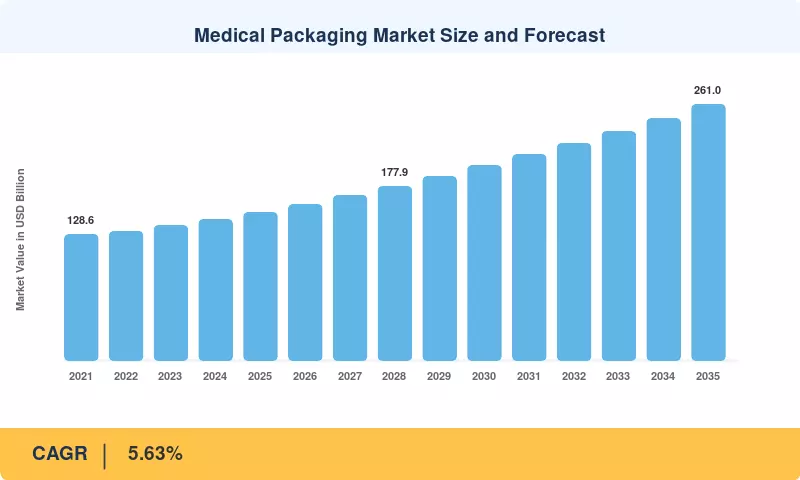
Medical Packaging Market Size and Forecast
Our Impact

Enabled $4.3B Revenue Impact for Fortune 500 and Leading Multinationals

Partnering with 2000+ Global Organizations Each Year

30K+ Citations by Top-Tier Firms in the Industry

Driver Impact Analysis

Driver ~% Impact on CAGR Geographic Relevance Impact Timeline
Biologics and GLP-1 injectable pipeline +1.4% Global; North America and Europe core Long-term (≥4 yr)
Ageing populations and chronic disease burden +1.0% Global; Japan, Europe, China Long-term (≥4 yr)
Serialization and track-and-trace mandates +0.9% North America, Europe, Middle East Short-term (≤2 yr)
Asia-Pacific generic and CDMO capacity expansion +0.8% India, China, South Korea Medium-term (2–4 yr)
Recyclability regulation driving material redesign +0.7% Europe, North America Medium-term (2–4 yr)
Home healthcare and direct-to-patient distribution +0.6% North America, Europe Short-term (≤2 yr)


Biologics and GLP-1 Injectable Pipeline

IQVIA projects global medicine spending to approach USD 2.2 trillion by 2028, with obesity drugs and biologics among the largest contributors [5]. Each of these therapies ships in high-value glass or polymer syringes, cartridges, and vials rather than low-cost bottles. Novo Holdings' USD 16.5 billion acquisition of Catalent, completed in December 2024, shows how far drug owners will go to secure fill-finish capacity [15]. Container suppliers benefit directly, because every new fill line needs qualified primary components years before launch.

Ageing Populations and Chronic Disease Burden

The World Health Organization expects the global population aged 60 and older to reach 2.1 billion by 2050 [6]. Noncommunicable diseases already account for about 74% of deaths worldwide, and their treatment relies on long-duration regimens such as insulin, anticoagulants, and inhaled therapies. Chronic care multiplies pack counts per patient and favors unit-dose, easy-open, and adherence-friendly formats. Japan, Western Europe, and coastal China show the sharpest demographic pressure and the highest per-capita consumption of dosed packs.

Serialization and Track-and-Trace Mandates

DSCSA requires electronic, interoperable tracing at the package level, with FDA exemptions for smaller trading partners phasing out through 2025 and 2026 . The EU Falsified Medicines Directive has required a unique identifier and anti-tampering device on prescription packs since February 2019 , and Saudi Arabia runs a national drug track-and-trace platform [20]. Market Research Future interviews indicate serialization and tamper features add roughly 3–5% to secondary carton costs, a recurring revenue lift for converters.

Asia-Pacific Generic and CDMO Capacity Expansion

India exported about USD 27.8 billion of pharmaceuticals in fiscal 2023–24 and backs further capacity through a production-linked incentive scheme worth INR 15,000 crore . Every export-oriented plant needs pharmacopoeia-compliant bottles, blisters, and vials, plus export barcoding. China is building domestic glass tubing and prefilled syringe supply to reduce import dependence. South Korean CDMOs are adding biologics fill-finish suites, extending demand for premium primary containers across the region.

Recyclability Regulation Driving Material Redesign

Regulation (EU) 2025/40 requires packaging to be recyclable by 2030, with contact-sensitive medicinal formats granted longer timelines rather than a permanent exemption [2]. Brand owners are already replacing PVC blisters and multi-material laminates. Amcor reports its recycle-ready polyethylene blister system cuts the carbon footprint by up to 70% versus conventional PVC structures while maintaining a moisture barrier [14]. Redesign cycles create a wave of requalification spending that favors suppliers with validated mono-material portfolios.

Home Healthcare and Direct-to-Patient Distribution

U.S. home health care spending reached about USD 147 billion in 2023, according to CMS National Health Expenditure data [8]. Specialty pharmacies now ship biologics, infusion supplies, and self-test kits straight to patients' doors. That channel needs pre-labeled pouches, insulated mailers, and intuitive opening features designed for untrained users. Converters that pair consumer-grade usability with validated temperature control are winning share in this fast-moving distribution route.

Restraints Impact Analysis

Restraint ~% Impact on CAGR Geographic Relevance Impact Timeline
Resin and borosilicate tubing price volatility −0.6% Global Short-term (≤2 yr)
Lengthy validation and requalification cycles −0.5% North America, Europe Medium-term (2–4 yr)
Recycling infrastructure gaps for multilayer formats −0.4% Europe, Asia-Pacific Medium-term (2–4 yr)
Glass container capacity bottlenecks −0.4% Global Short-term (≤2 yr)
PFAS and fluoropolymer phase-outs −0.3% Europe, North America Long-term (≥4 yr)


Resin and Borosilicate Tubing Price Volatility

Glass melting and polymer production are energy-intensive, and the 2022 European gas crisis sent wholesale prices to record highs, according to sources [9]. Converters with fixed-price supply contracts absorbed margin losses, while others imposed surcharges that delayed customer orders. Polypropylene and PET prices remain tied to crude and naphtha swings. Volatility makes long-term pricing agreements harder to strike and can push buyers to defer non-critical redesign projects.

Lengthy Validation and Requalification Cycles

Any change to a sterile barrier system must be revalidated against ISO 11607 performance and stability requirements [11]. The EU extended Medical Device Regulation transition deadlines to 2027 and 2028 through Regulation (EU) 2023/607 because notified-body capacity could not keep pace [10]. Requalification typically takes 12–24 months, slowing adoption of new materials and locking in incumbent formats even when better options exist.

Recycling Infrastructure Gaps for Multilayer Formats

Only roughly 9% of plastic garbage is recycled worldwide, according to OECD figures [12]. Hospital waste streams are frequently burned for infection control, and municipal sorting systems seldom accept high-barrier laminates that combine foil, PET, and specialist coatings. Recyclable-by-design claims may fail compliance tests in the absence of collecting infrastructure, requiring brand owners to make expensive reformulations and delaying the adoption of sustainable formats.


Glass Container Capacity Bottlenecks

Since GLP-1 volumes increased, demand for borosilicate cartridges and syringes has exceeded capacity; SCHOTT Pharma reports multi-year investment initiatives to close the gap [3]. During the height of shortages, lead times for several formats exceeded a year. Regardless of underlying demand, short-term supply constraints limit exports because it takes two to three years to commission new tube furnaces and forming lines.


PFAS and Fluoropolymer Phase-Outs

ECHA's 2023 universal PFAS restriction proposal covers roughly 10,000 substances, including fluoropolymer coatings used on stoppers, blister films, and device components [13]. Replacement chemistries must match chemical inertness and barrier performance before regulators accept them. The resulting R&D and validation burden raises costs and introduces uncertainty for suppliers with fluoropolymer-dependent product lines.

Medical Packaging Market Opportunities

Recycle-Ready Mono-Material Blisters

Billions of PVC and aluminum blister units are being replaced as a result of European recyclability regulations [2]. Because there is less regulatory requalification for generic and over-the-counter brands, suppliers of polyethylene or polypropylene blisters that meet moisture-vapor transfer criteria can first gain conversion volume from these brands. Before mono-material formats become the norm, early adopters can secure multi-year supply agreements.


Emerging-Market Capacity Build-Out

In areas with limited local supply, pharmaceutical exports from India, contract manufacturing in Southeast Asia, and Gulf localization initiatives under Saudi Vision 2030 are driving increased demand for compliant primary containers [20]. Long lead times and import taxes are avoided by international suppliers who construct or collaborate on local plants. Through 2035, these regions will account for the majority of the medical packaging market's white space.


Connected Packs and Adherence Data Services

NFC tags and printed sensors embedded in blister cards and caps can record dosing events and feed clinician dashboards. Poor adherence costs health systems heavily, giving payers and drug makers reason to pay for verified dosing data. Packaging suppliers can move beyond unit pricing into subscription analytics and outcomes-based contracts, a new revenue model built on data rather than material.

Ready-to-Use Containers and Sterile Packaging Services

EU GMP Annex 1, effective since August 2023, raised contamination-control expectations for aseptic filling . Pre-washed, pre-sterilized nested vials and syringes let drug makers skip in-house washing and depyrogenation, cutting capital spend and changeover time. Suppliers bundling containers with validated sterile packaging services gain stickier, higher-margin relationships with biologics and cell therapy fillers.

Reusable Cold-Chain Shipper Fleets

Biologics shipped at 2–8 °C need validated insulated shippers, most of which are discarded after a single trip. Reusable shipper pools with tracking, cleaning, and requalification services reduce waste and cost per shipment. Logistics-integrated packaging providers can operate these fleets as a service, earning recurring fees tied to shipment volume.

Medical Packaging Market Future Outlook

Connected Packs and AI-Driven Quality Control

By detecting cosmetic and particle flaws at line speed, machine vision with AI defect detection is taking the place of manual inspection on vial, syringe, and blister lines. NFC-capable packs will provide dosage information to telehealth systems on the patient's end. Packaging will become a data source rather than a passive container during the next ten years, and providers will compete on software and analytics in addition to materials [5].


Drug-Device Combination Products

The distinction between a container and a device is blurred by autoinjectors, on-body injectors, and smart inhalers. High-viscosity biologics require larger cartridges and specific polymers for wearable injectors. Because combination goods must comply with both medicine and device regulations at the same time, this convergence increases regulatory complexity while rewarding suppliers who possess both primary container competence and device engineering capabilities [10].


Circular Materials and Sustainability Reporting

The Corporate Sustainability Reporting Directive requires large companies to disclose Scope 3 emissions, putting packaging footprints under auditor scrutiny [22]. Pharmaceutical brand owners are setting supplier carbon targets and recycled-content goals where safety rules allow. By 2035, recyclability will be a baseline tender requirement in Europe and increasingly in North America [2][12].

Supply Chain Regionalization and Resilience

Pandemic shortages and trade tensions pushed buyers to dual-source and regionalize critical components. Suppliers are responding with plants close to fill-finish clusters in North Carolina, Ireland, India, and South Korea. Over the next decade, regional redundancy will matter as much as unit cost in supplier selection across the Medical Packaging Market [3].

Regional Market Share Analysis

Region Key Metric (2025) Primary Investment Themes
North America 37.5% share Biologics and GLP-1 fill-finish, DSCSA compliance, onshoring
Europe USD 40.7 Billion Recyclable redesign, Annex 1 upgrades, MDR requalification
Asia-Pacific 7.4% CAGR Generic exports, domestic glass capacity, CDMO expansion
South America 5.0% share Serialization rollout, local generic production
Middle East & Africa USD 7.5 Billion Pharmaceutical localization, national track-and-trace
Total USD 150.9 Billion —

Regional dynamics in the Medical Packaging Market reflect where biologics are developed, where generics are produced, and how quickly each jurisdiction enforces traceability and sustainability rules.


North America

Country Key Metric (2025) Key Driver
United States 86.0% share of region Biologics pipeline and DSCSA serialization
Canada 6.1% CAGR Biosimilar adoption and provincial drug programs
Mexico USD 2.4 Billion Nearshored device and generic manufacturing


The United States dominates regional demand through its concentration of biologics developers and GLP-1 producers. SCHOTT Pharma's North Carolina syringe plant and Gerresheimer's Georgia expansion show suppliers investing close to American fill-finish clusters [3]. DSCSA requirements continue to drive secondary carton and aggregation upgrades . Mexico benefits as device OEMs shift tray and pouch sourcing nearer to U.S. assembly lines, while Canada's growth tracks provincial biosimilar switching policies.

Europe

Country Key Metric (2025) Key Driver
Germany 24.5% share of region Glass and device manufacturing base
United Kingdom USD 6.8 Billion Life sciences investment and NHS procurement
France 5.2% CAGR Vaccine and biologics production
Italy 11.0% share of region Glass vial and syringe converters
Spain USD 3.3 Billion Generic manufacturing and exports
Rest of Europe 4.9% CAGR Nordic biologics and Swiss CDMOs


Europe combines the strictest sustainability rules with a deep manufacturing base for glass and device components. Regulation (EU) 2025/40 and the Corporate Sustainability Reporting Directive push brand owners to quantify and cut packaging impacts [2][22]. Annex 1 compliance spending continues across aseptic sites . Germany and Italy host major glass converters, while the EU MDR extension keeps device tray requalification active through 2028 [10].

Asia-Pacific

Country Key Metric (2025) Key Driver
China 38.0% share of region Domestic injectable and glass self-sufficiency
Japan USD 7.9 Billion Ageing population and unit-dose preferences
India 9.6% CAGR Generic exports and PLI incentives
South Korea 7.5% share of region Biologics CDMO expansion
Australia USD 1.9 Billion Hospital procurement and clinical trials
Rest of Asia-Pacific 7.1% CAGR Southeast Asian contract manufacturing


China anchors regional volume and is building domestic borosilicate tubing and prefilled syringe capacity to cut import reliance. India's production-linked incentive scheme and USD 27.8 billion export base sustain demand for compliant bottles and blisters . Japan's ageing population favors unit-dose and easy-open formats, while South Korean CDMOs add premium biologics containers. Regional suppliers are moving up from commodity bottles to high-value injectable components.

South America

Country Key Metric (2025) Key Driver
Brazil 52.0% share of region National drug traceability system
Argentina 5.4% CAGR Local generic production
Rest of South America USD 2.1 Billion Public health procurement


Brazil leads the region, with ANVISA's national medicine control system driving serialization investment on secondary packs . Local generic production in Brazil and Argentina relies heavily on bottles and blisters. Currency swings and import duties encourage local converting capacity, though high-value glass and polymer injectable components remain largely imported.

Middle East & Africa

Country Key Metric (2025) Key Driver
Saudi Arabia USD 1.6 Billion Vision 2030 pharmaceutical localization
United Arab Emirates 7.8% CAGR Healthcare hub and logistics infrastructure
South Africa 18.0% share of region Generic manufacturing and vaccine production
Rest of Middle East & Africa 5.6% CAGR Donor-funded medicine programs


Saudi Arabia's localization targets and its national drug track-and-trace platform are pulling converters to build regional capacity [20]. The UAE serves as a cold-chain distribution hub for the Gulf and East Africa. South Africa hosts the continent's most developed generic and vaccine production, while donor-funded programs sustain demand for durable, heat-tolerant packs across sub-Saharan markets.

Medical Packaging Market By Region, 2025-2035

Medical Packaging Market Segmentation

By Material

Segment Key Metric (2025) Primary Demand Driver
Glass 9.2% CAGR Biologics and GLP-1 injectables
Plastics 64.8% share Cost efficiency and processing flexibility
Paper and Paperboard USD 13.0 Billion Secondary cartons and recyclability rules
Metals 4.1% share Aerosol inhalers and foil lidding
Other Materials 6.2% CAGR Bio-based polymers and specialty composites


Material choice in the Medical Packaging Market follows therapeutic sensitivity. Plastics hold a 64.8% share because bottles, IV bags, droppers, and blister films depend on cheap, formable polymers. Glass grows fastest at a 9.2% CAGR, since biologics and peptide injectables need borosilicate containers with minimal ion leaching. Paper and Paperboard benefit from recyclability rules in secondary cartons, while Metals remain tied to pressurized inhalers and foil lidding.

By Product Type

Segment Key Metric (2025) Primary Demand Driver
Bottles and Containers 37.1% share Oral solid dose and liquid formulations
Blister Packs 7.7% CAGR Mono-material redesign and adherence packs
Vials and Ampoules USD 21.4 Billion Lyophilized and injectable drugs
Cartridges and Pre-Filled Syringes USD 18.9 Billion GLP-1 and biologic self-injection
Pouches 10.3% share Device sterility and home diagnostics
Other Product Types USD 11.0 Billion Tubes, closures, and smart desiccant packs


Product formats in the Medical Packaging Market reflect dosage form and delivery route. Bottles and Containers lead with a 37.1% share, carrying most oral solids and liquids worldwide. Blister Packs grow fastest at a 7.7% CAGR as recycle-ready polyethylene designs replace PVC and adherence cards gain traction. Cartridges and Pre-Filled Syringes are absorbing GLP-1 volumes, while Vials and Ampoules remain essential for lyophilized drugs, and Pouches serve device sterility and mailed diagnostics.

By Packaging Level

Segment Key Metric (2025) Primary Demand Driver
Primary Packaging 56.2% share Drug-contact compliance and barrier needs
Secondary Packaging USD 45.4 Billion Serialization and tamper evidence
Tertiary Packaging 7.2% CAGR Cold-chain shipping and direct-to-patient logistics


Packaging level shapes where value sits in the Medical Packaging Market. Primary Packaging holds a 56.2% share because drug-contact layers carry the strictest pharmacopoeia and extractables requirements. Tertiary Packaging grows fastest at a 7.2% CAGR, driven by validated cold-chain shippers with phase-change materials and IoT loggers. Secondary Packaging acts as the serialization node, linking unique identifiers to primary units under DSCSA and EU rules.

By End-user

Segment Key Metric (2025) Primary Demand Driver
Pharmaceutical Manufacturing 33.9% share Branded and generic drug production
Medical-Device OEMs USD 37.1 Billion Sterile trays and barrier systems
Nutraceutical and OTC 8.5% CAGR Preventive health spending
Hospitals and Clinics 15.2% share Single-use sterile supplies
Home Healthcare 7.9% CAGR Direct-to-patient therapies


Buyer mix in the Medical Packaging Market is broadening. Pharmaceutical Manufacturing remains the largest buyer with a 33.9% share, purchasing bottles, blisters, vials, and cartons across branded and generic lines. Nutraceutical and OTC grows fastest at an 8.5% CAGR, as supplement brands seek shelf appeal while meeting child-resistant closure rules. Medical-Device OEMs require ESD-safe sterile trays, while Home Healthcare drives pre-labeled pouches for self-administered therapy.

Competitive Benchmarking

The Medical Packaging Market is fragmented, with an estimated Herfindahl-Hirschman Index below 500 and the top five suppliers holding roughly 20–26% of revenue. Concentration is higher in niches: borosilicate syringes, elastomer stoppers, and ready-to-use nested containers are dominated by a handful of firms with proprietary processes. Flexible films and bottles remain crowded with regional converters competing on cost and service.

Company Est. Revenue Share Range Key Offerings for Medical Packaging Market Strategic Positioning
Amcor plc ~7–10% Flexible films, recycle-ready blister laminates, rigid containers Scale leader expanded through Berry Global combination
West Pharmaceutical Services ~3–5% Elastomer stoppers, polymer containers, delivery components Premium injectable components for biologics
Becton, Dickinson and Company ~3–5% Hypak and Neopak prefillable syringes Prefillable syringe volume leader
Gerresheimer AG ~2–4% Molded and tubular glass vials, syringes, inhalers Integrated glass and plastic systems provider
AptarGroup ~2–4% Nasal sprays, dispensing systems, active desiccant packs Drug delivery and active packaging specialist
SCHOTT Pharma AG ~2–3% Glass and polymer syringes, cartridges, RTU vials Borosilicate leader expanding U.S. capacity
Stevanato Group ~1–3% EZ-fill nested vials, syringes, cartridges Ready-to-fill and inspection systems
Sonoco Products ~1–2% Thermoformed trays and rigid containers Device and consumer health converter
Huhtamaki Oyj ~1–2% Blister lidding foils and flexible laminates Flexible packaging with recyclable focus
TekniPlex ~1–2% Recyclable blister films, tubing, medical compounds Material science-led specialist


Recent News & Developments

  • European Commission (March 2023): Adopted Regulation (EU) 2023/607, extending MDR transition deadlines to 2027 and 2028 and prolonging demand for device tray requalification [10]
  • European Commission (August 2023): Revised EU GMP Annex 1 took effect, raising contamination-control standards and accelerating adoption of ready-to-use sterile containers
  • SCHOTT Pharma (September 2023): Listed on the Frankfurt Stock Exchange, raising capital for syringe and cartridge capacity aimed at biologics and GLP-1 demand [3]
  • Gerresheimer (May 2024): Agreed to acquire Bormioli Pharma, adding Italian glass and plastic container capacity to its portfolio
  • U.S. FDA (November 2024): DSCSA stabilization period ended, with tiered exemptions for smaller trading partners extending into 2025 and 2026
  • European Union (January 2025): Published Regulation (EU) 2025/40, setting 2030 recyclability requirements that will reshape blister and film design [2]
  • Amcor (April 2025): Completed its all-stock combination with Berry Global, creating the largest supplier in the Medical Packaging Market by revenue [14]

Medical Packaging Market Report Scope

Parameter Details
Market Scope Covers primary, secondary, and tertiary containers, closures, films, and shippers used for drugs, biologics, devices, and nutraceuticals across manufacturer, hospital, and home-care channels
Study Period 2021–2035
Base Year 2025
Historical Data 2021–2024
Forecast Period 2026–2035
Market Size in 2025 USD 150.9 Billion
Market Size in 2035 USD 261.0 Billion
CAGR (2026–2035) 5.63%
Fastest Growing Segments Glass (9.2% CAGR); Nutraceutical and OTC (8.5% CAGR); Blister Packs (7.7% CAGR); Tertiary Packaging (7.2% CAGR)
Regions Covered North America, Europe, South America, Asia Pacific, Middle East and Africa and ROW
Companies Profiled Amcor plc, West Pharmaceutical Services, Becton Dickinson and Company, Gerresheimer AG, AptarGroup, SCHOTT Pharma AG, Stevanato Group, Sonoco Products, Huhtamaki Oyj, TekniPlex
Valuation Currency USD Billion
Methodology 350+ primary expert interviews; bottom-up market sizing; top-down validation; data triangulation; scenario-based forecasting; real-time project tracking

FAQs

How should buyers evaluate suppliers in the Medical Packaging Market?
Prioritize suppliers holding ISO 15378 certification, which applies GMP principles specifically to primary drug-contact materials. Request extractables and leachables data packages upfront, because generating them after selection can delay regulatory filings by several months .
Why is switching container suppliers difficult in the Medical Packaging Market?
A primary-container change usually triggers a regulatory variation or prior-approval supplement plus fresh stability data. Drug makers therefore dual-source at launch, and suppliers in the Medical Packaging Market often hold a product for its entire commercial life [18].
Are cyclic olefin polymers replacing glass for biologics?
Cyclic olefin polymer syringes are gaining ground in high-value biologics because they resist breakage and release no alkali ions. Glass still wins on cost, gas barrier, and compatibility with installed filling lines, so polymer adoption stays selective [19].
Which emerging use cases are attracting investment in the Medical Packaging Market?
Cryogenic bags and vials for cell and gene therapies, which must survive storage below −150 °C, are drawing new capital. Decentralized clinical-trial kits shipped directly to patients form a second growth niche [5].
What role do contract packaging organizations play?
Contract packagers run secondary assembly, serialization, and clinical labeling for drug makers that avoid in-house lines. Their role grows as SKU counts multiply, because short regional runs are uneconomic on dedicated high-speed equipment .
How do tariffs influence sourcing decisions?
Tariffs on Chinese-origin resins, glass, and components raise landed costs for U.S. buyers and speed qualification of Mexican, Indian, and domestic suppliers. Because requalification is slow, effects appear in sourcing strategy over two to three years [18].
What should investors watch in the Medical Packaging Market?
Track utilization at borosilicate tubing and ready-to-use container plants, since tight supply supports pricing. Margin leaders usually own proprietary coatings, polymers, or delivery platforms rather than commodity converting assets [3].
Author
Author Author Profile Snehal Singh LinkedIn Manager - Research
High acumen in analyzing complex macro & micro markets with more than 6 years of work experience in the field of market research. By implementing her analytical skills in forecasting and estimation into market research reports, she has expertise in Packaging, Construction, and Equipment domains. She handles a team size of 20-25 resources and ensures smooth running of the projects, associated marketing activities, and client servicing.

Research Approach


Secondary Research

The secondary research process involved comprehensive analysis of regulatory frameworks, international standards databases, peer-reviewed engineering journals, and authoritative healthcare packaging organizations. Key sources included the US Food & Drug Administration (FDA) 21 CFR Part 820 Quality System Regulations and ISO 11607 standards for sterile packaging, the European Medicines Agency (EMA) packaging guidelines and EU Medical Device Regulation (MDR) Annex I requirements, the International Organization for Standardization (ISO 11607-1/-2, ISO 13485, ISO 15378), ASTM International (F2097 Standard Guide for Design and Evaluation of Primary Flexible Packaging for Medical Products), the Parenteral Drug Association (PDA) technical reports, the Institute of Packaging Professionals (IoPP) medical packaging committee guidelines, the World Health Organization (WHO) prequalification packaging standards, the Environmental Protection Agency (EPA) regulations on medical waste packaging, the Association for Packaging and Processing Technologies (PMMI) market data, the National Institutes of Health (NIH) National Center for Biotechnology Information (NCBI/PubMed) for biocompatibility studies, the Centers for Disease Control and Prevention (CDC) infection control packaging guidelines, Health Canada Medical Devices Directorate packaging requirements, the UK Medicines and Healthcare products Regulatory Agency (MHRA), the Japan Ministry of Health, Labour and Welfare (MHLW) packaging standards, and national health ministry reports from key markets. These sources were utilized to collect regulatory compliance data, sterilization validation studies, material barrier property research, pharmaceutical packaging statistics, and competitive landscape analysis for plastics, Tyvek, molded fiber, aluminum, and glass packaging technologies.


Primary Research

In the primary research process, qualitative and quantitative insights regarding material innovation trends, sterilization compatibility, and regulatory conformance pathways were obtained through interviews with supply-side and demand-side stakeholders. The supply-side sources consist of CEOs, VPs of Manufacturing Operations, Heads of R&D for Barrier Technologies, regulatory affairs directors, and commercial directors from flexible packaging manufacturers, rigid tray producers, medical foam converters, and sterile barrier material suppliers. Quality assurance managers from diagnostic kit producers, procurement directors from multinational pharmaceutical companies, supply chain heads from Class II and Class III medical device manufacturers, sterilization service providers (EtO, gamma, e-beam), and packaging engineers from contract manufacturing organizations (CMOs) comprised demand-side sources.

Primary Respondent Breakdown:

• By Designation: C-level Executives (32%), Director Level (30%), Others (38%)

• By Region: North America (32%), Europe (30%), Asia-Pacific (28%), Rest of World (10%)


Market Size Estimation

Global market valuation was derived through production volume mapping and revenue analysis across sterile and non-sterile packaging categories. The methodology included:

• Identification of 50+ key manufacturers across North America, Europe, Asia-Pacific, and Latin America specializing in primary, secondary, and tertiary medical packaging

• Product mapping across material categories including polyethylene (PE), polypropylene (PP), polyethylene terephthalate (PET), Tyvek, medical-grade papers, aluminum foils, molded fibers, and glass

• Analysis of reported and modeled annual revenues specific to medical packaging portfolios, excluding food and consumer packaging divisions

• Coverage of manufacturers representing 75-80% of global market share in 2024, including Amcor, Sealed Air, Berry Global, DuPont, West Pharmaceutical Services, Mitsubishi Chemical, Klöckner Pentaplast, and 3M

• Extrapolation using bottom-up (production volume × average selling price by country/region across pharmaceutical, device, and diagnostic applications) and top-down (manufacturer revenue validation against end-user procurement data) approaches to derive segment-specific valuations for pouches, trays, blister packs, vials, and container systems

Download Free Sample

Kindly complete the form below to receive a free sample of this Report

Download PDF ×

We do not share your information with anyone. However, we may send you emails based on your report interest from time to time. You may contact us at any time to opt-out.


















