Request Free Sample ×

Kindly complete the form below to receive a free sample of this Report

* Please use a valid business email

Leading companies partner with us for data-driven Insights

clients tt-cursor
Hero Background
English
Chinese
French
Japanese
Korean
German
Spanish

Medical Ceramics Market Trends

ID: MRFR/MED/4274-CR
155 Pages
Vikita Thakur
March 2021

Medical Ceramics Market Research Report Information By Type (Bioinert Ceramics, Bioactive Ceramics, Bioresorbable Ceramics, Piezoceramics), By Application (Dental Applications, Orthopedic Applications, Cardiovascular, Medical Devices, Plastic Surgery), By End-User (Hospitals & Clinics, Specialty Centers), And By Region (North America, Europe, Asia-Pacific, And Rest Of The World) - Growth & Industry Forecast 2025 To 2035

Share:
Download PDF ×

We do not share your information with anyone. However, we may send you emails based on your report interest from time to time. You may contact us at any time to opt-out.

Medical Ceramics Market Infographic
Purchase Options

Market Trends

Key Emerging Trends in the Medical Ceramics Market

The medical ceramics market has changed due to advances in materials, technology, and healthcare sector desire for biocompatible solutions. Continuous ceramic material innovation improves strength, durability, and body compatibility, driving this trend.

The medical ceramics business is also seeing 3D printing technologies grow. This novel manufacturing method permits accurate manufacture of complicated ceramic structures, providing patient-specific solutions. 3D-printed ceramic implants for dental restoration or joint replacements provide accuracy and customisation previously unattainable. This trend matches the rising interest in customized medicine, which tailors treatments to patient needs to better outcomes.

Bioactive ceramics are also growing in popularity. Ceramics can promote cell adhesion and tissue regeneration in biological tissues. By stimulating tissue development and integration, bioactive ceramics are useful in bone transplants and dental materials. This trend shows the industry's focus on replacing damaged tissues and encouraging the body's natural recovery.

Ceramics are being used in chronic illness management with material developments. This trend includes implantable medical gadgets like ceramic-based diabetic glucose sensors. Ceramics are biocompatible and inert, making them appropriate for long-term implantation. This development mirrors a wider move toward improved materials in chronic disease management and monitoring systems.

Medical ceramics regulations and standards also influence market trends. Due to increased attention on medical device safety and efficacy, strict regulations ensure that healthcare ceramics satisfy quality and safety criteria. This movement emphasises medical ceramics' durability and performance, encouraging confidence among healthcare professionals and patients.

Medical ceramics is also expanding geographically, especially in emerging nations. Advanced medical technology, particularly ceramics, are in demand as emerging countries enhance healthcare infrastructure. Medical ceramics are available in these sectors because better healthcare solutions, especially in orthopedics and dentistry, are needed.

Sustainability and eco-friendliness of medical ceramics are impacting market developments. Ceramic materials with a lower environmental impact are in demand as the global focus on environmental impact grows. This trend corresponds with healthcare and manufacturing's drive toward sustainable practices, indicating the industry's commitment to environmental sustainability.


Author
Author Profile
Vikita Thakur
Senior Research Analyst

She holds an experience of about 5+ years in market research and business consulting projects for sectors such as life sciences, medical devices, and healthcare IT. She possesses a robust background in data analysis, market estimation, competitive intelligence, pipeline analysis market trend identification, and consumer behavior insights. Her expertise lies in technical Sales support, client interaction and project management, designing and implementing market research studies, conducting competitive analysis, and synthesizing complex data into actionable recommendations that drive business growth.

Leave a Comment

FAQs

What is the projected market valuation of The Global Medical Ceramics by 2035?

<p>The projected market valuation for The Global Medical Ceramics by 2035 is 40.03 USD Billion.</p>

What was the market valuation of The Global Medical Ceramics in 2024?

<p>The overall market valuation of The Global Medical Ceramics was 22.37 USD Billion in 2024.</p>

What is the expected CAGR for The Global Medical Ceramics during the forecast period 2025 - 2035?

<p>The expected CAGR for The Global Medical Ceramics during the forecast period 2025 - 2035 is 5.43%.</p>

Which companies are considered key players in The Global Medical Ceramics?

<p>Key players in The Global Medical Ceramics include CeramTec GmbH, Kyocera Corporation, Stryker Corporation, and Zimmer Biomet Holdings, Inc.</p>

What are the main types of ceramics in The Global Medical Ceramics?

<p>The main types of ceramics in The Global Medical Ceramics include Bioinert Ceramics, Bioactive Ceramics, Bioresorbable Ceramics, and Piezoceramics.</p>

How much is the Bioactive Ceramics segment projected to grow by 2035?

<p>The Bioactive Ceramics segment is projected to grow from 7.0 USD Billion in 2024 to 12.0 USD Billion by 2035.</p>

What applications are driving growth in The Global Medical Ceramics?

Applications driving growth in The Global Medical Ceramics include Dental Applications, Orthopedic Applications, and Medical Devices.

What is the projected valuation for the Orthopedic Applications segment by 2035?

The projected valuation for the Orthopedic Applications segment is expected to reach 9.0 USD Billion by 2035.

Which end-user segments are expected to dominate The Global Medical Ceramics?

The end-user segments expected to dominate The Global Medical Ceramics include Hospitals &amp; Clinics and Specialty Centers.

What is the projected growth for the Specialty Centers segment by 2035?

The Specialty Centers segment is projected to grow from 12.37 USD Billion in 2024 to 22.03 USD Billion by 2035.

Market Summary

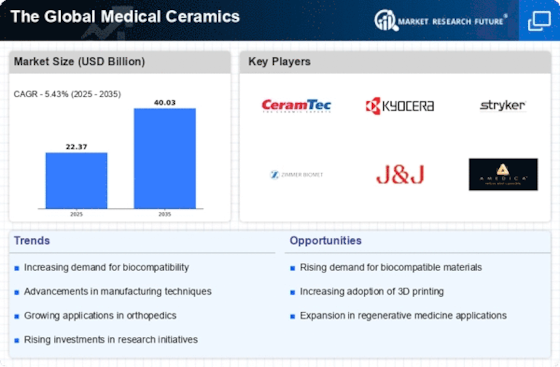
As per MRFR analysis, the Global Medical Ceramics Market size was valued at USD 22.37 Billion in 2024. The market is projected to grow from USD 23.59 Billion in 2025 to USD 40.03 Billion by 2035, exhibiting a CAGR of 5.43% during the forecast period 2025-2035. North America led the market with over 40% share, generating around USD 8.9 billion in revenue.
 
The Medical Ceramics Market is expanding due to rising demand for biocompatible materials in orthopedic, dental, and cardiovascular applications. Key trends include advancements in ceramic composites, growing adoption in implantable medical devices, and increasing research in tissue engineering and regenerative medicine to improve patient outcomes and device longevity.
 
According to the World Health Organization, musculoskeletal disorders affect over 1.71 billion people worldwide, driving demand for orthopedic implants and biocompatible ceramics.

Key Market Trends & Highlights

The Global Medical Ceramics Market is poised for substantial growth driven by technological advancements and increasing demand for biocompatible materials.

  • North America remains the largest market for medical ceramics, driven by advanced healthcare infrastructure and innovation. The Asia-Pacific region is emerging as the fastest-growing market, fueled by rising healthcare investments and a growing population. Bioinert ceramics dominate the market, particularly in dental applications, which are currently the largest segment. Technological innovations in medical ceramics and the increasing prevalence of chronic diseases are key drivers propelling market expansion.

Market Size & Forecast

2024 Market Size 22.37 (USD Billion)
2035 Market Size 40.03 (USD Billion)
CAGR (2025 - 2035) 5.43%
Largest Regional Market Share in 2024 North America

Major Players

Companies such as CeramTec GmbH (DE), Kyocera Corporation (JP), Stryker Corporation (US), Zimmer Biomet Holdings, Inc. (US), DePuy Synthes (US), <a href="https://ctlamedica.com/portfolio/">Amedica Corporation</a> (US), Morgan Advanced Materials plc (GB), Noritake Co., Limited (JP), <a href="https://www.coorstek.com/en/industries/medical/">CoorsTek, Inc.</a> (US) are some of the major participants in the global market.

Market Trends

The medical ceramics market is currently experiencing a notable transformation, driven by advancements in material science and increasing demand for biocompatible materials. This sector encompasses a wide range of applications, including dental implants, orthopedic devices, and surgical instruments. The emphasis on patient safety and the need for durable, long-lasting solutions appear to be propelling innovations in ceramic materials. Furthermore, the integration of technology in manufacturing processes is likely enhancing the precision and quality of medical ceramics, thereby expanding their applicability in various medical fields.

In addition, the growing awareness of the benefits associated with ceramic materials, such as their resistance to wear and corrosion, suggests a positive outlook for the medical ceramics market forecast. As healthcare providers seek to improve patient outcomes, the adoption of advanced ceramics is expected to rise. The medical ceramics market seems poised for growth, with ongoing research and development efforts likely to yield new products and applications that meet the evolving needs of the healthcare industry. This dynamic environment indicates a promising future for stakeholders involved in this sector.

Technological Advancements in Manufacturing

Recent innovations in manufacturing techniques are reshaping the medical ceramics market. Enhanced processes, such as additive manufacturing and precision machining, are enabling the production of complex geometries and customized solutions. This trend is likely to improve the performance and functionality of medical ceramics, catering to specific patient needs.

Rising Demand for Biocompatible Materials

The increasing focus on patient safety and comfort is driving the demand for biocompatible ceramics in medical applications. These materials are known for their compatibility with human tissue, which is essential for implants and prosthetics. As healthcare providers prioritize patient-centered solutions, this trend is expected to gain momentum, shaping medical ceramics market trends.

Expansion of Application Areas

The medical ceramics market is witnessing a expansion in application areas beyond traditional uses. Emerging fields such as regenerative medicine and dental applications are increasingly incorporating advanced ceramics. This diversification suggests a broader acceptance and integration of ceramic materials in various medical disciplines.

Medical Ceramics Market Market Drivers

Advancements in Research and Development

Ongoing advancements in research and development are playing a crucial role in shaping The Global Medical Ceramics Industry. Researchers are exploring new materials and composites that enhance the properties of ceramics, such as strength, durability, and biocompatibility. This focus on innovation is likely to lead to the introduction of next-generation medical ceramics that can better meet the demands of various applications, including dental and orthopedic implants.
 
Furthermore, collaborations between academic institutions and industry players are fostering a culture of innovation, which may result in the commercialization of novel ceramic products. As the market continues to evolve, the potential for breakthroughs in medical ceramics could significantly impact the overall growth trajectory of the industry.

Increasing Prevalence of Chronic Diseases

The rising incidence of chronic diseases, such as diabetes and cardiovascular disorders, is likely to drive the demand for medical ceramics in various applications, including orthopedic and dental implants. The Global Medical Ceramics Industry is experiencing a surge in demand for biocompatible materials that can withstand the physiological environment while promoting healing.
 
According to recent estimates, the orthopedic ceramics segment is expected to account for a significant share of the market, driven by the increasing number of joint replacement surgeries. This trend suggests that as the global population ages, the need for durable and effective medical ceramics will continue to grow, thereby enhancing the overall market landscape.

Technological Innovations in Medical Ceramics

The emergence of advanced manufacturing techniques, such as additive manufacturing and precision machining, appears to be a pivotal driver in The Global Medical Ceramics Industry. These innovations facilitate the production of complex geometries and customized implants, enhancing the performance and integration of ceramic materials in medical applications. For instance, the ability to create patient-specific implants has been linked to improved surgical outcomes and patient satisfaction.
 
Furthermore, the market for advanced ceramics is projected to grow at a compound annual growth rate of approximately 7.5% over the next five years, indicating a robust demand for these technologies. As manufacturers continue to invest in research and development, the potential for new applications and improved product performance in The Global Medical Ceramics Industry remains substantial.

Growing Focus on Minimally Invasive Procedures

The shift towards minimally invasive surgical techniques is reshaping the landscape of The Global Medical Ceramics Industry. As healthcare providers seek to reduce patient recovery times and improve surgical outcomes, the demand for advanced ceramic materials that can be utilized in less invasive procedures is increasing. Medical ceramics, known for their strength and biocompatibility, are being integrated into various surgical tools and implants.
 
This trend is supported by the increasing number of procedures performed globally, with minimally invasive surgeries projected to grow at a rate of 8% annually. Consequently, The Global Medical Ceramics Industry is likely to benefit from this paradigm shift, as manufacturers adapt their offerings to meet the evolving needs of healthcare professionals.

Rising Investment in Healthcare Infrastructure

The expansion of healthcare infrastructure in emerging economies is anticipated to bolster The Global Medical Ceramics Industry. Governments and private entities are increasingly investing in healthcare facilities, which is likely to enhance access to advanced medical technologies, including ceramics. This investment trend is particularly evident in regions experiencing rapid urbanization and population growth, where the demand for quality healthcare services is escalating.
 
As a result, the market for medical ceramics is expected to witness significant growth, with projections indicating a potential increase in market size by over 10% in the next five years. This influx of capital into healthcare infrastructure may lead to greater adoption of innovative medical ceramics, thereby transforming the industry landscape.

Market Segment Insights

By Type: Bioinert Ceramics (Largest) vs. Bioactive Ceramics (Fastest-Growing)

The medical ceramics market showcases a diverse range of segment values, with Bioinert Ceramics leading the market as the largest segment. This segment comprises materials that do not interact with biological tissues and are primarily used for implants and prosthetics. Bioactive Ceramics, while smaller in medical ceramics market share, are rapidly gaining traction due to their ability to bond with bone and promote healing, making them the fastest-growing segment in the industry. Growth trends in the medical ceramics segment are driven by increasing demand for advanced biocompatible materials in medical devices and implants. The shift towards minimally invasive procedures and enhanced patient outcomes has accelerated the adoption of Bioactive Ceramics. Furthermore, advancements in technology and material science are constant catalysts for innovation, paving the way for the expansion of both Bioinert and Bioactive segments in the foreseeable future.

Bioinert Ceramics (Dominant) vs. Bioactive Ceramics (Emerging)

Bioinert Ceramics stand out as the dominant segment in The global market share due to their stable and non-reactive nature. These ceramics are extensively utilized in orthopedic and <a title="dental implants" href="https://www.marketresearchfuture.com/reports/dental-implants-market-2753" target="_blank" rel="noopener">dental implants</a>, particularly where the primary requirement is mechanical stability without adverse reactions. In contrast, Bioactive Ceramics, while classified as emerging, are progressively redefining their market presence. They exhibit unique properties that facilitate chemical interaction with bone, thereby enhancing osseointegration and stimulating natural healing processes. The increasing preference among healthcare professionals for materials that not only support structural integrity but also encourage biological repair mechanisms significantly drives the growth of Bioactive Ceramics.

By Application: Dental Applications (Largest) vs. Orthopedic Applications (Fastest-Growing)

The Global Medical Ceramics Market showcases a diverse range of applications with significant market share distribution. The Dental Applications segment stands out as the largest, driven by the increasing demand for dental restoration and aesthetic procedures. Orthopedic Applications, while smaller in comparison, are experiencing rapid growth due to advancements in implant technology and an aging population that requires <a title="joint replacement" href="https://www.marketresearchfuture.com/reports/joint-replacement-market-43209" target="_blank" rel="noopener">joint replacements</a>. This dynamic between the two segments illustrates the varied needs within the healthcare system. In recent years, growth trends reveal that the Orthopedic Applications segment is quickly gaining traction. Factors such as rising incidences of orthopedic surgeries, coupled with technological innovations in ceramic materials, are propelling this segment forward. As preferences shift towards less invasive and more biocompatible materials, their adoption in surgical procedures is expected to surge, making orthopedic ceramics a crucial area of focus for future market development.

Dental Applications (Dominant) vs. Cardiovascular (Emerging)

The Dental Applications segment is the dominant force within The global market share, primarily attributed to its established role in restorative dental procedures such as crowns, bridges, and implants. The precision and biocompatibility of ceramics make them ideal for these uses, ensuring patient satisfaction and optimal outcomes. On the other hand, the Cardiovascular segment is emerging, with increasing applications in heart valve repair and other cardiovascular devices. Though still in the developmental phase, the use of ceramics in this field is gaining attention due to their strength and potential for reduced thrombogenicity, indicating a shift towards innovative solutions in cardiovascular treatment. Together, these segments reflect the diverse applications of ceramics in modern medical practices.

By End User: Hospitals & Clinics (Largest) vs. Specialty Centers (Fastest-Growing)

In The Global Medical Ceramics Market, Hospitals and Clinics represent the largest end-user segment, showcasing robust adoption of medical ceramics due to their extensive application in diverse treatments. This segment captures a significant market share, as these healthcare facilities prioritize patient outcomes and utilize advanced ceramics in various surgical procedures, diagnostics, and prosthetics. Specialty Centers, on the other hand, have emerged rapidly, driven by the increasing demand for specific medical interventions and tailored treatments that leverage the unique properties of medical ceramics.

End Users: Hospitals &amp; Clinics (Dominant) vs. Specialty Centers (Emerging)

Hospitals and Clinics dominate The Global Medical Ceramics Market by utilizing advanced ceramic materials in numerous applications, including orthopedic implants, dental prosthetics, and surgical tools. Their comprehensive infrastructure and focus on patient care ensure consistent demand for innovative ceramic solutions. Conversely, Specialty Centers are considered an emerging segment, expanding rapidly as they cater to niche medical needs. These centers employ cutting-edge ceramic technologies for specialized treatments, such as craniofacial reconstruction and minimally invasive surgeries. The rise of Specialty Centers reflects a shift towards personalized medicine, where the unique properties of medical ceramics provide significant advantages, thus capturing the interest of both practitioners and patients.

Get more detailed insights about Medical Ceramics Market Research Report - Forecast till 2035

Regional Insights

By Region, the study provides market insights into North America, Europe, Asia-Pacific and the Rest of the World. The North America Medical Ceramics Market accounted for USD 9.20 billion in 2022 and is expected to exhibit a significant CAGR growth during the study period. According to the INTERNATIONAL OSTEOPOROSIS FOUNDATION, there were 2 million osteoporosis sufferers in Canada in 2017, and this is predicted to rise to 4 million by 2030.

According to research conducted in North America, among the 0.38 million female Medicare seniors who had fractures, 10% had another fracture within a year, 18% within two years, and 31% within five years.

Source Secondary Research, Primary Research, MRFR Database and Analyst Review

Europe Medical Ceramics Market occupied a sizeable portion of the worldwide market. This may be because more people are getting hip and knee replacements, more items are available in the area, and a lot of older adults. The Organisation for Economic Co-operation and Development (OECD) said that Switzerland, Finland, Luxembourg, Germany, Austria, and Belgium had among the highest rates of hip and knee replacement surgeries in the area in 2021. Further, the Germany market of Medical Ceramics Market held the largest market share, and the U.K. market of Medical Ceramics Market was the fastest-growing market in the European Region.

Due to the rising number of patients with decreased bone density and back pain needing treatment, Asia Pacific Medical Ceramics Market is anticipated to expand at a faster CAGR throughout the projection period. Moreover, the China market of Medical Ceramics Market held the largest market share, and the India Medical Ceramics Market was the fastest-growing market in the Asia-Pacific region.

Key Players and Competitive Insights

Leading market players are investing a lot of money in R&D to expand their product portfolios, which will spur further market growth for Medical Ceramics Market. With significant industry changes, including new product releases, contractual agreements, mergers and acquisitions, increased investments, and collaboration with other organizations, market developments are also undertaking various strategic activities to expand their presence. To grow and remain in a market that is becoming increasingly competitive, Medical Ceramics industry competitors must provide affordable products.
 
Manufacturing locally to cut operational costs is one of the main business tactics the Medical Ceramics industry uses to serve customers and increase the market sector. The Medical Ceramics industry has recently given medicine some of the most important advantages.
 
The Medical Ceramics Market markets major players such as Zimmer Biomet Holdings, Inc. (U.S.), Institut Straumann AG (Switzerland), 3M (U.S.), DePuy Synthes (U.S.), Stryker (U.S.), CoorsTek, Inc. (U.S.), CeramTec (Germany), Nobel Biocare (Switzerland), Kyocera Corporation (Japan), and Rauschert Group (Germany), and others are working on expanding the market demand by investing in research and development activities. 
 
Advanced ceramic components are developed and produced by CeramTec. The goods are utilized in various applications, particularly in the chemical, automotive, equipment and machine building, medical technology, electronics, and equipment and machine manufacturing sectors. The US FDA approved CeramTec's innovative ceramic complete knee replacement system in 2022.
 
The industry's partner for cutting-edge parts and components made of high-performance ceramics is DOCERAM GmbH. Doceram Medical Ceramics Market and Nobel Biocare announced an extended partnership in creating premium restorative solutions on November 3, 2020. Nobel Biocare and DOCERAM Medical Ceramics Market's expertise is being combined to provide more flexible and high-quality restorative options for consumers.

Key Companies in the Medical Ceramics Market include

Industry Developments

    • June 2022 The US FDA has authorized the innovative ceramic full-knee replacement system created by CeramTec, a German business that creates and manufactures ceramic components.
    • January 2021 CeramTec Group acquired Dentalpoint AG, a Swiss company. This makes investing in the growing market for metal-free dental prosthetics easier.

.webp

Future Outlook

Medical Ceramics Market Future Outlook

The Medical Ceramics Market size is projected to reach USD 40.03 Billion by 2035, growing at a CAGR of 5.43%

New opportunities lie in:

  • <p>Development of bioactive ceramic implants for enhanced patient outcomes. Expansion into emerging markets with tailored product offerings. Integration of smart ceramics in medical devices for real-time monitoring.</p>

By 2035, the market is expected to solidify its position as a leader in innovative medical solutions.

Market Segmentation

Medical Ceramics Market Type Outlook

  • Bioinert Ceramics
  • Bioactive Ceramics
  • Bioresorbable Ceramics
  • Piezoceramics

Medical Ceramics Market End User Outlook

  • Hospitals & Clinics
  • Specialty Centers

Medical Ceramics Market Application Outlook

  • Dental Applications
  • Orthopedic Applications
  • Cardiovascular
  • Medical Devices
  • Plastic Surgery

Report Scope

MARKET SIZE 2024 22.37(USD Billion)
MARKET SIZE 2025 23.59(USD Billion)
MARKET SIZE 2035 40.03(USD Billion)
COMPOUND ANNUAL GROWTH RATE (CAGR) 5.43% (2025 - 2035)
REPORT COVERAGE Revenue Forecast, Competitive Landscape, Growth Factors, and Trends
BASE YEAR 2024
Market Forecast Period 2025 - 2035
Historical Data 2019 - 2024
Market Forecast Units USD Billion
Key Companies Profiled CeramTec GmbH (DE), Kyocera Corporation (JP), Stryker Corporation (US), Zimmer Biomet Holdings, Inc. (US), DePuy Synthes (US), Amedica Corporation (US), Morgan Advanced Materials plc (GB), Noritake Co., Limited (JP), CoorsTek, Inc. (US)
Segments Covered Type, Application, End-User, Region
Key Market Opportunities Advancements in biocompatible materials enhance applications in The Global Medical Ceramics.
Key Market Dynamics Rising demand for advanced biocompatible materials drives innovation in medical ceramics applications and manufacturing processes.
Countries Covered North America, Europe, APAC, South America, MEA

FAQs

What is the projected market valuation of The Global Medical Ceramics by 2035?

<p>The projected market valuation for The Global Medical Ceramics by 2035 is 40.03 USD Billion.</p>

What was the market valuation of The Global Medical Ceramics in 2024?

<p>The overall market valuation of The Global Medical Ceramics was 22.37 USD Billion in 2024.</p>

What is the expected CAGR for The Global Medical Ceramics during the forecast period 2025 - 2035?

<p>The expected CAGR for The Global Medical Ceramics during the forecast period 2025 - 2035 is 5.43%.</p>

Which companies are considered key players in The Global Medical Ceramics?

<p>Key players in The Global Medical Ceramics include CeramTec GmbH, Kyocera Corporation, Stryker Corporation, and Zimmer Biomet Holdings, Inc.</p>

What are the main types of ceramics in The Global Medical Ceramics?

<p>The main types of ceramics in The Global Medical Ceramics include Bioinert Ceramics, Bioactive Ceramics, Bioresorbable Ceramics, and Piezoceramics.</p>

How much is the Bioactive Ceramics segment projected to grow by 2035?

<p>The Bioactive Ceramics segment is projected to grow from 7.0 USD Billion in 2024 to 12.0 USD Billion by 2035.</p>

What applications are driving growth in The Global Medical Ceramics?

Applications driving growth in The Global Medical Ceramics include Dental Applications, Orthopedic Applications, and Medical Devices.

What is the projected valuation for the Orthopedic Applications segment by 2035?

The projected valuation for the Orthopedic Applications segment is expected to reach 9.0 USD Billion by 2035.

Which end-user segments are expected to dominate The Global Medical Ceramics?

The end-user segments expected to dominate The Global Medical Ceramics include Hospitals &amp; Clinics and Specialty Centers.

What is the projected growth for the Specialty Centers segment by 2035?

The Specialty Centers segment is projected to grow from 12.37 USD Billion in 2024 to 22.03 USD Billion by 2035.

  1. SECTION I: EXECUTIVE SUMMARY AND KEY HIGHLIGHTS |
    1. EXECUTIVE SUMMARY | |
      1. Market Overview | |
      2. Key Findings | |
      3. Market Segmentation | |
      4. Competitive Landscape | |
      5. Challenges and Opportunities | |
      6. Future Outlook 2
  2. SECTION II: SCOPING, METHODOLOGY AND MARKET STRUCTURE |
    1. MARKET INTRODUCTION | |
      1. Definition | |
      2. Scope of the study | | |
    2. RESEARCH METHODOLOGY | |
      1. Overview | |
      2. Data Mining | |
      3. Secondary Research | |
      4. Primary Research | | |
      5. Forecasting Model | |
      6. Market Size Estimation | | |
      7. Data Triangulation | |
      8. Validation 3
  3. SECTION III: QUALITATIVE ANALYSIS |
    1. MARKET DYNAMICS | |
      1. Overview | |
      2. Drivers | |
      3. Restraints | |
      4. Opportunities |
    2. MARKET FACTOR ANALYSIS | |
      1. Value chain Analysis | |
      2. Porter's Five Forces Analysis | | |
      3. COVID-19 Impact Analysis | | |
  4. SECTION IV: QUANTITATIVE ANALYSIS |
    1. Healthcare, BY Type (USD Billion) | |
      1. Bioinert Ceramics | |
      2. Bioactive Ceramics | |
      3. Bioresorbable Ceramics | |
      4. Piezoceramics |
    2. Healthcare, BY Application (USD Billion) | |
      1. Dental Applications | |
      2. Orthopedic Applications | |
      3. Cardiovascular | |
      4. Medical Devices | |
      5. Plastic Surgery |
    3. Healthcare, BY End User (USD Billion) | |
      1. Hospitals & Clinics | |
      2. Specialty Centers |
    4. Healthcare, BY Region (USD Billion) | |
      1. North America | | |
      2. Europe | | |
      3. APAC | | |
      4. South America | | |
      5. MEA | | |
  5. SECTION V: COMPETITIVE ANALYSIS |
    1. Competitive Landscape | |
      1. Overview | |
      2. Competitive Analysis | |
      3. Market share Analysis | |
      4. Major Growth Strategy in the Healthcare | |
      5. Competitive Benchmarking | |
      6. Leading Players in Terms of Number of Developments in the Healthcare | |
      7. Key developments and growth strategies | | |
      8. Major Players Financial Matrix | | |
    2. Company Profiles | |
      1. CeramTec GmbH (DE) | | |
      2. Kyocera Corporation (JP) | | |
      3. Stryker Corporation (US) | | |
      4. Zimmer Biomet Holdings, Inc. (US) | | |
      5. DePuy Synthes (US) | | |
      6. Amedica Corporation (US) | | |
      7. Morgan Advanced Materials plc (GB) | | |
      8. Noritake Co., Limited (JP) | | |
      9. CoorsTek, Inc. (US) | | |
    3. Appendix | |
      1. References | |
      2. Related Reports 6 LIST OF FIGURES |
    4. MARKET SYNOPSIS |
    5. NORTH AMERICA MARKET ANALYSIS |
    6. US MARKET ANALYSIS BY TYPE |
    7. US MARKET ANALYSIS BY APPLICATION |
    8. US MARKET ANALYSIS BY END USER |
    9. CANADA MARKET ANALYSIS BY TYPE |
    10. CANADA MARKET ANALYSIS BY APPLICATION |
    11. CANADA MARKET ANALYSIS BY END USER |
    12. EUROPE MARKET ANALYSIS |
    13. GERMANY MARKET ANALYSIS BY TYPE |
    14. GERMANY MARKET ANALYSIS BY APPLICATION |
    15. GERMANY MARKET ANALYSIS BY END USER |
    16. UK MARKET ANALYSIS BY TYPE |
    17. UK MARKET ANALYSIS BY APPLICATION |
    18. UK MARKET ANALYSIS BY END USER |
    19. FRANCE MARKET ANALYSIS BY TYPE |
    20. FRANCE MARKET ANALYSIS BY APPLICATION |
    21. FRANCE MARKET ANALYSIS BY END USER |
    22. RUSSIA MARKET ANALYSIS BY TYPE |
    23. RUSSIA MARKET ANALYSIS BY APPLICATION |
    24. RUSSIA MARKET ANALYSIS BY END USER |
    25. ITALY MARKET ANALYSIS BY TYPE |
    26. ITALY MARKET ANALYSIS BY APPLICATION |
    27. ITALY MARKET ANALYSIS BY END USER |
    28. SPAIN MARKET ANALYSIS BY TYPE |
    29. SPAIN MARKET ANALYSIS BY APPLICATION |
    30. SPAIN MARKET ANALYSIS BY END USER |
    31. REST OF EUROPE MARKET ANALYSIS BY TYPE |
    32. REST OF EUROPE MARKET ANALYSIS BY APPLICATION |
    33. REST OF EUROPE MARKET ANALYSIS BY END USER |
    34. APAC MARKET ANALYSIS |
    35. CHINA MARKET ANALYSIS BY TYPE |
    36. CHINA MARKET ANALYSIS BY APPLICATION |
    37. CHINA MARKET ANALYSIS BY END USER |
    38. INDIA MARKET ANALYSIS BY TYPE |
    39. INDIA MARKET ANALYSIS BY APPLICATION |
    40. INDIA MARKET ANALYSIS BY END USER |
    41. JAPAN MARKET ANALYSIS BY TYPE |
    42. JAPAN MARKET ANALYSIS BY APPLICATION |
    43. JAPAN MARKET ANALYSIS BY END USER |
    44. SOUTH KOREA MARKET ANALYSIS BY TYPE |
    45. SOUTH KOREA MARKET ANALYSIS BY APPLICATION |
    46. SOUTH KOREA MARKET ANALYSIS BY END USER |
    47. MALAYSIA MARKET ANALYSIS BY TYPE |
    48. MALAYSIA MARKET ANALYSIS BY APPLICATION |
    49. MALAYSIA MARKET ANALYSIS BY END USER |
    50. THAILAND MARKET ANALYSIS BY TYPE |
    51. THAILAND MARKET ANALYSIS BY APPLICATION |
    52. THAILAND MARKET ANALYSIS BY END USER |
    53. INDONESIA MARKET ANALYSIS BY TYPE |
    54. INDONESIA MARKET ANALYSIS BY APPLICATION |
    55. INDONESIA MARKET ANALYSIS BY END USER |
    56. REST OF APAC MARKET ANALYSIS BY TYPE |
    57. REST OF APAC MARKET ANALYSIS BY APPLICATION |
    58. REST OF APAC MARKET ANALYSIS BY END USER |
    59. SOUTH AMERICA MARKET ANALYSIS |
    60. BRAZIL MARKET ANALYSIS BY TYPE |
    61. BRAZIL MARKET ANALYSIS BY APPLICATION |
    62. BRAZIL MARKET ANALYSIS BY END USER |
    63. MEXICO MARKET ANALYSIS BY TYPE |
    64. MEXICO MARKET ANALYSIS BY APPLICATION |
    65. MEXICO MARKET ANALYSIS BY END USER |
    66. ARGENTINA MARKET ANALYSIS BY TYPE |
    67. ARGENTINA MARKET ANALYSIS BY APPLICATION |
    68. ARGENTINA MARKET ANALYSIS BY END USER |
    69. REST OF SOUTH AMERICA MARKET ANALYSIS BY TYPE |
    70. REST OF SOUTH AMERICA MARKET ANALYSIS BY APPLICATION |
    71. REST OF SOUTH AMERICA MARKET ANALYSIS BY END USER |
    72. MEA MARKET ANALYSIS |
    73. GCC COUNTRIES MARKET ANALYSIS BY TYPE |
    74. GCC COUNTRIES MARKET ANALYSIS BY APPLICATION |
    75. GCC COUNTRIES MARKET ANALYSIS BY END USER |
    76. SOUTH AFRICA MARKET ANALYSIS BY TYPE |
    77. SOUTH AFRICA MARKET ANALYSIS BY APPLICATION |
    78. SOUTH AFRICA MARKET ANALYSIS BY END USER |
    79. REST OF MEA MARKET ANALYSIS BY TYPE |
    80. REST OF MEA MARKET ANALYSIS BY APPLICATION |
    81. REST OF MEA MARKET ANALYSIS BY END USER |
    82. KEY BUYING CRITERIA OF HEALTHCARE |
    83. RESEARCH PROCESS OF MRFR |
    84. DRO ANALYSIS OF HEALTHCARE |
    85. DRIVERS IMPACT ANALYSIS: HEALTHCARE |
    86. RESTRAINTS IMPACT ANALYSIS: HEALTHCARE |
    87. SUPPLY / VALUE CHAIN: HEALTHCARE |
    88. HEALTHCARE, BY TYPE, 2024 (% SHARE) |
    89. HEALTHCARE, BY TYPE, 2024 TO 2035 (USD Billion) |
    90. HEALTHCARE, BY APPLICATION, 2024 (% SHARE) |
    91. HEALTHCARE, BY APPLICATION, 2024 TO 2035 (USD Billion) |
    92. HEALTHCARE, BY END USER, 2024 (% SHARE) |
    93. HEALTHCARE, BY END USER, 2024 TO 2035 (USD Billion) |
    94. BENCHMARKING OF MAJOR COMPETITORS 7 LIST OF TABLES |
    95. LIST OF ASSUMPTIONS | |
      1. |
    96. North America MARKET SIZE ESTIMATES; FORECAST | |
      1. BY TYPE, 2025-2035 (USD Billion) | |
      2. BY APPLICATION, 2025-2035 (USD Billion) | |
      3. BY END USER, 2025-2035 (USD Billion) |
    97. US MARKET SIZE ESTIMATES; FORECAST | |
      1. BY TYPE, 2025-2035 (USD Billion) | |
      2. BY APPLICATION, 2025-2035 (USD Billion) | |
      3. BY END USER, 2025-2035 (USD Billion) |
    98. Canada MARKET SIZE ESTIMATES; FORECAST | |
      1. BY TYPE, 2025-2035 (USD Billion) | |
      2. BY APPLICATION, 2025-2035 (USD Billion) | |
      3. BY END USER, 2025-2035 (USD Billion) |
    99. Europe MARKET SIZE ESTIMATES; FORECAST | |
      1. BY TYPE, 2025-2035 (USD Billion) | |
      2. BY APPLICATION, 2025-2035 (USD Billion) | |
      3. BY END USER, 2025-2035 (USD Billion) |
    100. Germany MARKET SIZE ESTIMATES; FORECAST | |
      1. BY TYPE, 2025-2035 (USD Billion) | |
      2. BY APPLICATION, 2025-2035 (USD Billion) | |
      3. BY END USER, 2025-2035 (USD Billion) |
    101. UK MARKET SIZE ESTIMATES; FORECAST | |
      1. BY TYPE, 2025-2035 (USD Billion) | |
      2. BY APPLICATION, 2025-2035 (USD Billion) | |
      3. BY END USER, 2025-2035 (USD Billion) |
    102. France MARKET SIZE ESTIMATES; FORECAST | |
      1. BY TYPE, 2025-2035 (USD Billion) | |
      2. BY APPLICATION, 2025-2035 (USD Billion) | |
      3. BY END USER, 2025-2035 (USD Billion) |
    103. Russia MARKET SIZE ESTIMATES; FORECAST | |
      1. BY TYPE, 2025-2035 (USD Billion) | |
      2. BY APPLICATION, 2025-2035 (USD Billion) | |
      3. BY END USER, 2025-2035 (USD Billion) |
    104. Italy MARKET SIZE ESTIMATES; FORECAST | |
      1. BY TYPE, 2025-2035 (USD Billion) | |
      2. BY APPLICATION, 2025-2035 (USD Billion) | |
      3. BY END USER, 2025-2035 (USD Billion) |
    105. Spain MARKET SIZE ESTIMATES; FORECAST | |
      1. BY TYPE, 2025-2035 (USD Billion) | |
      2. BY APPLICATION, 2025-2035 (USD Billion) | |
      3. BY END USER, 2025-2035 (USD Billion) |
    106. Rest of Europe MARKET SIZE ESTIMATES; FORECAST | |
      1. BY TYPE, 2025-2035 (USD Billion) | |
      2. BY APPLICATION, 2025-2035 (USD Billion) | |
      3. BY END USER, 2025-2035 (USD Billion) |
    107. APAC MARKET SIZE ESTIMATES; FORECAST | |
      1. BY TYPE, 2025-2035 (USD Billion) | |
      2. BY APPLICATION, 2025-2035 (USD Billion) | |
      3. BY END USER, 2025-2035 (USD Billion) |
    108. China MARKET SIZE ESTIMATES; FORECAST | |
      1. BY TYPE, 2025-2035 (USD Billion) | |
      2. BY APPLICATION, 2025-2035 (USD Billion) | |
      3. BY END USER, 2025-2035 (USD Billion) |
    109. India MARKET SIZE ESTIMATES; FORECAST | |
      1. BY TYPE, 2025-2035 (USD Billion) | |
      2. BY APPLICATION, 2025-2035 (USD Billion) | |
      3. BY END USER, 2025-2035 (USD Billion) |
    110. Japan MARKET SIZE ESTIMATES; FORECAST | |
      1. BY TYPE, 2025-2035 (USD Billion) | |
      2. BY APPLICATION, 2025-2035 (USD Billion) | |
      3. BY END USER, 2025-2035 (USD Billion) |
    111. South Korea MARKET SIZE ESTIMATES; FORECAST | |
      1. BY TYPE, 2025-2035 (USD Billion) | |
      2. BY APPLICATION, 2025-2035 (USD Billion) | |
      3. BY END USER, 2025-2035 (USD Billion) |
    112. Malaysia MARKET SIZE ESTIMATES; FORECAST | |
      1. BY TYPE, 2025-2035 (USD Billion) | |
      2. BY APPLICATION, 2025-2035 (USD Billion) | |
      3. BY END USER, 2025-2035 (USD Billion) |
    113. Thailand MARKET SIZE ESTIMATES; FORECAST | |
      1. BY TYPE, 2025-2035 (USD Billion) | |
      2. BY APPLICATION, 2025-2035 (USD Billion) | |
      3. BY END USER, 2025-2035 (USD Billion) |
    114. Indonesia MARKET SIZE ESTIMATES; FORECAST | |
      1. BY TYPE, 2025-2035 (USD Billion) | |
      2. BY APPLICATION, 2025-2035 (USD Billion) | |
      3. BY END USER, 2025-2035 (USD Billion) |
    115. Rest of APAC MARKET SIZE ESTIMATES; FORECAST | |
      1. BY TYPE, 2025-2035 (USD Billion) | |
      2. BY APPLICATION, 2025-2035 (USD Billion) | |
      3. BY END USER, 2025-2035 (USD Billion) |
    116. South America MARKET SIZE ESTIMATES; FORECAST | |
      1. BY TYPE, 2025-2035 (USD Billion) | |
      2. BY APPLICATION, 2025-2035 (USD Billion) | |
      3. BY END USER, 2025-2035 (USD Billion) |
    117. Brazil MARKET SIZE ESTIMATES; FORECAST | |
      1. BY TYPE, 2025-2035 (USD Billion) | |
      2. BY APPLICATION, 2025-2035 (USD Billion) | |
      3. BY END USER, 2025-2035 (USD Billion) |
    118. Mexico MARKET SIZE ESTIMATES; FORECAST | |
      1. BY TYPE, 2025-2035 (USD Billion) | |
      2. BY APPLICATION, 2025-2035 (USD Billion) | |
      3. BY END USER, 2025-2035 (USD Billion) |
    119. Argentina MARKET SIZE ESTIMATES; FORECAST | |
      1. BY TYPE, 2025-2035 (USD Billion) | |
      2. BY APPLICATION, 2025-2035 (USD Billion) | |
      3. BY END USER, 2025-2035 (USD Billion) |
    120. Rest of South America MARKET SIZE ESTIMATES; FORECAST | |
      1. BY TYPE, 2025-2035 (USD Billion) | |
      2. BY APPLICATION, 2025-2035 (USD Billion) | |
      3. BY END USER, 2025-2035 (USD Billion) |
    121. MEA MARKET SIZE ESTIMATES; FORECAST | |
      1. BY TYPE, 2025-2035 (USD Billion) | |
      2. BY APPLICATION, 2025-2035 (USD Billion) | |
      3. BY END USER, 2025-2035 (USD Billion) |
    122. GCC Countries MARKET SIZE ESTIMATES; FORECAST | |
      1. BY TYPE, 2025-2035 (USD Billion) | |
      2. BY APPLICATION, 2025-2035 (USD Billion) | |
      3. BY END USER, 2025-2035 (USD Billion) |
    123. South Africa MARKET SIZE ESTIMATES; FORECAST | |
      1. BY TYPE, 2025-2035 (USD Billion) | |
      2. BY APPLICATION, 2025-2035 (USD Billion) | |
      3. BY END USER, 2025-2035 (USD Billion) |
    124. Rest of MEA MARKET SIZE ESTIMATES; FORECAST | |
      1. BY TYPE, 2025-2035 (USD Billion) | |
      2. BY APPLICATION, 2025-2035 (USD Billion) | |
      3. BY END USER, 2025-2035 (USD Billion) |
    125. PRODUCT LAUNCH/PRODUCT DEVELOPMENT/APPROVAL | |
      1. |
    126. ACQUISITION/PARTNERSHIP | |

Healthcare Market Segmentation

Healthcare By Type (USD Billion, 2025-2035)

  • Bioinert Ceramics
  • Bioactive Ceramics
  • Bioresorbable Ceramics
  • Piezoceramics

Healthcare By Application (USD Billion, 2025-2035)

  • Dental Applications
  • Orthopedic Applications
  • Cardiovascular
  • Medical Devices
  • Plastic Surgery

Healthcare By End User (USD Billion, 2025-2035)

  • Hospitals & Clinics
  • Specialty Centers
Infographic

Free Sample Request

Kindly complete the form below to receive a free sample of this Report

Get Free Sample

Customer Strories

Compare Licence

×
Features License Type
Single User Multiuser License Enterprise User
Price $4,950 $5,950 $7,250
Maximum User Access Limit 1 User Upto 10 Users Unrestricted Access Throughout the Organization
Free Customization
Direct Access to Analyst
Deliverable Format
Platform Access
Discount on Next Purchase 10% 15% 15%
Printable Versions
%>