×
Request Free Sample ×

Kindly complete the form below to receive a free sample of this Report

* Please use a valid business email

Leading companies partner with us for data-driven Insights

clients tt-cursor
Hero Background
English
Chinese
French
Japanese
Korean
German
Spanish

Medical Billing Outsourcing Market Trends

ID: MRFR/MED/6152-HCR
200 Pages
Rahul Gotadki
February 2026

Medical Billing Outsourcing Market Research Report: Size, Share, Trend Analysis By Service Type (Claim Management, Coding Services, Billing and Collections, Denial Management, Accounts Receivable), By End Users (Hospitals, Physicians, Ambulatory Surgery Centers, Diagnostic Labs, Other Healthcare Providers), By Deployment Type (On-Premises, Cloud-Based, Hybrid), By Geographic Scope (North America, Europe, Asia Pacific, Latin America, Middle East and Africa) and By Regional - Competitor Industry Analysis and Trends Forecast Till 2035

Share:
Download PDF ×

We do not share your information with anyone. However, we may send you emails based on your report interest from time to time. You may contact us at any time to opt-out.

Medical Billing Outsourcing Market Infographic
Purchase Options

Market Trends

Key Emerging Trends in the Medical Billing Outsourcing Market

The dynamic healthcare sector, technological advancements, and increasing focus on efficiency in revenue cycle management have altered the Medical Billing Outsourcing Market. The market is embracing automated billing systems. Healthcare providers are using automation through machine learning and artificial intelligence to expedite billing procedures and decrease mistakes as well as increasing financial transaction efficiency.

Complex healthcare laws, revisions of billing codes have increased demand for outsourcing. Healthcare billing is well understood by medical billing outsourcing firms which abide by the rules and optimize reimbursement. This assists healthcare practitioners who would rather concentrate on patient care while seeking professionals to outsource their billing to.

In terms of the Medical Billing Outsourcing Market, global value-based care, outcome-driven reimbursement models influence it most. From fee-for-service to value-based health care changes require precise, timely payment mechanisms reflective of quality patient care and outcomes. Outsourcing partners help health service providers adapt to changing payment models and address challenges that come with them in terms of managing payments.

Outsourcing services are also incorporating revenue cycle management (RCM) besides medical billing. RCM outsourcing handles the entire revenue cycle ranging from patients’ registration to claim processing up to payments made. This unified approach simplifies financial operations for health system outsourcers thereby boosting demand for such services.

Another significant trend within the industry is EHR deployment. EHR systems can be easily linked with by outsourced partners as healthcare providers switch from paper records to electronic records. It improves data accuracy, reduces billing mistakes and streamlines communication between outsourced partners and healthcare providers.

Moreover, there’s a high need specialized flexible-outsourcing solutions. Increasingly more popular are outsourced services tailored for each size or specialization or location of a given healthcare provider.Healthcare organizations can customize these services according to their needs and aligning them with their strategy.

The cost driven medical billing outsourcing.Healthcare organizations delegating billings save money through reduced personnel costs, lowering training expenses as well as technology costs. The economical merits will be much appreciated by smaller healthcare clinics and facilities that are trying to align their resources properly.


Author
Rahul Gotadki
Research Manager

He holds an experience of about 9+ years in Market Research and Business Consulting, working under the spectrum of Life Sciences and Healthcare domains. Rahul conceptualizes and implements a scalable business strategy and provides strategic leadership to the clients. His expertise lies in market estimation, competitive intelligence, pipeline analysis, customer assessment, etc.

Leave a Comment

FAQs

What is the projected market valuation of the Medical Billing Outsourcing Market by 2035?

<p>The Medical Billing Outsourcing Market is projected to reach a valuation of 43.26 USD Billion by 2035.</p>

What was the market valuation of the Medical Billing Outsourcing Market in 2024?

<p>In 2024, the market valuation of the Medical Billing Outsourcing Market was 15.48 USD Billion.</p>

What is the expected CAGR for the Medical Billing Outsourcing Market during the forecast period 2025 - 2035?

<p>The expected CAGR for the Medical Billing Outsourcing Market during the forecast period 2025 - 2035 is 9.79%.</p>

Which service type segment is projected to have the highest valuation by 2035?

<p>The Billing and Collections service type segment is projected to reach 11.2 USD Billion by 2035.</p>

What are the key players in the Medical Billing Outsourcing Market?

<p>Key players in the Medical Billing Outsourcing Market include Optum, Cognizant, GeBBS Healthcare Solutions, and Vee Technologies.</p>

How does the market valuation for Cloud-Based deployment compare to On-Premises deployment by 2035?

<p>By 2035, the market valuation for Cloud-Based deployment is projected to be 20.0 USD Billion, compared to 14.0 USD Billion for On-Premises deployment.</p>

What is the projected market size for the Hospitals end-user segment by 2035?

<p>The Hospitals end-user segment is projected to reach a market size of 14.0 USD Billion by 2035.</p>

Which end-user segment is expected to grow the least by 2035?

<p>The Diagnostic Labs end-user segment is expected to grow the least, reaching 5.0 USD Billion by 2035.</p>

What is the projected valuation for the Denial Management service type by 2035?

<p>The Denial Management service type is projected to reach a valuation of 5.6 USD Billion by 2035.</p>

How does the market size for Accounts Receivable compare to Coding Services by 2035?

<p>By 2035, the market size for Accounts Receivable is projected to be 10.16 USD Billion, compared to 7.8 USD Billion for Coding Services.</p>

Market Summary

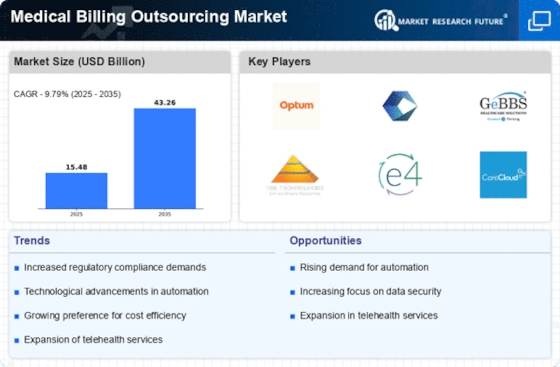
According to MRFR analysis, the Medical Billing Outsourcing Market Size was valued at USD 15.48 Billion in 2024. The market is projected to grow from USD 17.0 Billion in 2025 to USD 43.26 Billion by 2035, registering a CAGR of 9.7% during the forecast 2025–2035. North America led the market with over 60% share, generating around USD 60.08 billion in revenue.    
Growth in the medical billing outsourcing market is driven by increasing administrative workload in healthcare facilities, rising demand for cost-efficient revenue cycle management, and growing adoption of healthcare IT solutions. Key trends include automation of billing processes, AI-powered coding systems, and expansion of cloud-based platforms improving operational efficiency and claim accuracy.

Key Market Trends & Highlights

The Medical Billing Outsourcing Market is experiencing robust growth driven by technological advancements and increasing demand for healthcare services.

  • Technological integration is reshaping the landscape of medical billing outsourcing, enhancing efficiency and accuracy. North America remains the largest market, while the Asia-Pacific region is emerging as the fastest-growing area for medical billing services. Claim management continues to dominate the market, whereas coding services are witnessing the fastest growth due to evolving healthcare regulations. Rising demand for healthcare services and a focus on regulatory compliance are key drivers propelling the market forward.

Market Size & Forecast

2024 Market Size 15.48 (USD Billion)
2035 Market Size 43.26 (USD Billion)
CAGR (2025 - 2035) 9.79%
Largest Regional Market Share in 2024 North America

Major Players

Companies such as <a href="https://business.optum.com/en/insights/benefits-outsourcing-medical-billing.html">Optum (US)</a>, <a href="https://www.cognizantrcm.com/">Cognizant (</a>US), GeBBS Healthcare Solutions (US), Vee Technologies (US), eCatalyst Healthcare Solutions (US), MediGain (US), Visionary RCM (US), nThrive (US), Quest Diagnostics (US) are some of the major participants in the Global Medical Billing Outsourcing Market.

Market Trends

The Medical Billing Outsourcing Market is currently experiencing a transformative phase, driven by the increasing complexity of healthcare regulations and the need for cost-effective solutions. Healthcare providers are increasingly recognizing the advantages of outsourcing billing processes to specialized firms, which can enhance efficiency and accuracy. This trend appears to be fueled by the growing demand for streamlined operations, allowing healthcare organizations to focus on patient care rather than administrative tasks.

Furthermore, advancements in technology, such as automation and artificial intelligence, are likely to play a pivotal role in shaping the future of this market. As these technologies evolve, they may offer innovative solutions that improve billing accuracy and reduce turnaround times. In addition, the Medical Billing Outsourcing Market seems to be influenced by the rising emphasis on data security and compliance. With stringent regulations governing patient information, outsourcing partners are expected to adhere to high standards of data protection. This focus on compliance may drive healthcare providers to seek partnerships with firms that demonstrate robust security measures. Overall, the Medical Billing Outsourcing Market is poised for growth, as organizations increasingly turn to external experts to navigate the complexities of billing and reimbursement processes.

Technological Integration

The integration of advanced technologies into the Medical Billing Outsourcing Market is becoming increasingly prevalent. Automation and artificial intelligence are being utilized to enhance billing accuracy and efficiency, allowing for quicker processing times and reduced errors. This trend suggests that outsourcing firms are likely to invest in innovative solutions to meet the evolving needs of healthcare providers.

Focus on Compliance and Security

As regulations surrounding patient data become more stringent, the Medical Billing Outsourcing Market is witnessing a heightened focus on compliance and security. Healthcare providers are increasingly seeking outsourcing partners that prioritize data protection and adhere to regulatory standards. This trend indicates a shift towards more secure and compliant billing practices.

Cost Efficiency and Resource Allocation

The pursuit of cost efficiency is a driving force in the Medical Billing Outsourcing Market. Healthcare organizations are recognizing the potential for significant savings by outsourcing billing functions. This trend suggests that providers may allocate resources more effectively, allowing them to concentrate on core healthcare services while outsourcing administrative tasks.

Medical Billing Outsourcing Market Market Drivers

Focus on Regulatory Compliance

The emphasis on regulatory compliance is a significant driver of the Medical Billing Outsourcing Market. Healthcare providers face a complex landscape of regulations, including HIPAA and various payer requirements, which necessitate meticulous attention to billing practices. Outsourcing billing services allows organizations to leverage the expertise of specialized firms that are well-versed in compliance issues.
 
This not only mitigates the risk of costly penalties but also ensures that billing practices align with current regulations. As compliance becomes increasingly critical, the Medical Billing Outsourcing Market is poised for growth, as more providers seek to ensure adherence to regulatory standards while focusing on core healthcare services.

Increased Focus on Patient Experience

The growing emphasis on patient experience is influencing the Medical Billing Outsourcing Market. Healthcare providers are recognizing that streamlined billing processes contribute to overall patient satisfaction. Complicated billing practices can lead to confusion and frustration among patients, potentially impacting their perception of care. By outsourcing billing services, providers can ensure that patients receive clear and accurate billing information, enhancing their overall experience.
 
This focus on patient-centric care is driving healthcare organizations to seek efficient billing solutions that align with their commitment to quality service. As patient experience becomes a priority, the Medical Billing Outsourcing Market is expected to expand as providers invest in outsourcing to improve their billing processes.

Rising Demand for Healthcare Services

The increasing demand for healthcare services is a primary driver of the Medical Billing Outsourcing Market. As populations age and chronic diseases become more prevalent, healthcare providers are experiencing a surge in patient volume. This trend necessitates efficient billing processes to manage the growing complexity of claims and reimbursements.
 
According to recent data, healthcare spending is projected to rise significantly, leading to an estimated increase in the outsourcing of billing services. Providers are increasingly turning to outsourcing to streamline operations, reduce administrative burdens, and enhance revenue cycle management. Consequently, the Medical Billing Outsourcing Market is likely to expand as healthcare organizations seek to improve their financial performance while maintaining high-quality patient care.

Cost Reduction and Financial Optimization

Cost reduction remains a pivotal driver in the Medical Billing Outsourcing Market. Healthcare organizations are under constant pressure to optimize their financial performance while managing operational costs. Outsourcing billing functions can lead to significant savings by reducing the need for in-house staff and infrastructure. Studies indicate that organizations that outsource their billing processes can achieve a reduction in operational costs by up to 30%.
 
This financial incentive is compelling for many providers, prompting them to consider outsourcing as a viable strategy for enhancing profitability. As the need for financial optimization continues to grow, the Medical Billing Outsourcing Market is likely to see increased adoption of these services.

Technological Advancements in Billing Solutions

Technological advancements are reshaping the Medical Billing Outsourcing Market, driving efficiency and accuracy in billing processes. Innovations such as artificial intelligence, machine learning, and advanced analytics are being integrated into billing systems, enabling faster processing and reduced errors. These technologies facilitate real-time data analysis, which can enhance decision-making and improve revenue cycle management.
 
As healthcare organizations increasingly adopt these technologies, the demand for outsourcing billing services is expected to rise. The Medical Billing Outsourcing Market is likely to benefit from these advancements, as providers seek to leverage technology to optimize their billing operations and improve overall financial health.

Market Segment Insights

By Service Type: Claim Management (Largest) vs. Coding Services (Fastest-Growing)

The Medical Billing Outsourcing Market exhibits a diverse array of service type segments, with <a href="https://www.marketresearchfuture.com/reports/healthcare-claims-management-market-6376">healthcare Claim Management</a> leading the way in terms of market share. This segment has become the cornerstone of outsourcing strategies for healthcare providers, allowing them to manage their claims processes more efficiently. Following closely are Coding Services, which are witnessing a surge in demand due to the increasing complexity of medical codes and compliance requirements. Other significant segments include Billing and Collections, Denial Management, and Accounts Receivable, which each hold essential roles in enhancing revenue cycle management.

Claim Management: Dominant vs. Coding Services: Emerging

Claim Management stands as the dominant force in the Medical Billing Outsourcing Market, characterized by its critical role in ensuring timely reimbursements and minimizing claim denials. The sector benefits from mature processes and methodologies, allowing healthcare providers to focus on patient care while outsourcing claims-related tasks. In contrast, Coding Services are recognized as the emerging segment, driven by technological advancements and regulatory changes, leading to a shift towards more specialized coding professionals. Coding Services are evolving rapidly, often integrating advanced software solutions to improve accuracy and efficiency, making them vital in the overall revenue cycle, thereby driving the medical coding market.

By End User: Hospitals (Largest) vs. Physicians (Fastest-Growing)

In the Medical Billing Outsourcing Market, Hospitals represent the largest segment, commanding a significant share due to their extensive patient base and complex billing processes. This segment relies heavily on outsourcing for efficiency, specialized knowledge, and compliance with regulations. Physicians, on the other hand, are rapidly emerging as a key segment in the market, with increasing trends towards outsourcing their billing operations to reduce administrative burdens and increase focus on patient care. Their smaller size compared to hospitals often leads to agility in adopting medical billing outsourced solutions. The growth of the Medical Billing Outsourcing Market is driven by the increasing complexity of billing procedures, rising healthcare costs, and the demand for improved revenue cycle management. Hospitals are investing in advanced outsourcing solutions to streamline their processes and enhance operational efficiency. Meanwhile, the adoption of technology-driven solutions has made it easier for smaller practices, such as physicians and <a title="ambulatory surgery centers" href="https://www.marketresearchfuture.com/reports/ambulatory-surgery-centers-market-65898" target="_blank" rel="noopener">ambulatory surgery centers</a>, to enter medical billing outsourced arrangements, resulting in faster market growth. The evolving healthcare landscape further pushes various healthcare providers to seek outsourcing as a viable option to manage billing effectively.

Hospitals (Dominant) vs. Ambulatory Surgery Centers (Emerging)

In the Medical Billing Outsourcing Market, Hospitals are dominant due to their established infrastructure and significant patient volume, which necessitates sophisticated billing systems and makes outsourcing an attractive option for managing complexity. They leverage outsourcing to not only enhance efficiency but also to maintain compliance with healthcare regulations. Conversely, Ambulatory Surgery Centers (ASCs) are an emerging segment that is gaining momentum within this space. ASCs are increasingly recognizing the benefits of outsourcing billing to enhance their operational efficiency and reduce overhead cost of medical billing services. The growth in ASCs can be attributed to the rising preference for outpatient surgical procedures, which leads to more streamlined billing needs. As ASCs evolve, their demand for specialized billing services tailored to outpatient care will likely increase, positioning them as a pivotal player in the Medical Billing Outsourcing Market.

By Deployment Type: Cloud-Based (Largest) vs. On-Premises (Fastest-Growing)

In the Medical Billing Outsourcing Market, the deployment types are primarily categorized into Cloud-Based, On-Premises, and Hybrid. Among these, Cloud-Based solutions have emerged as the dominant deployment type, capturing the largest share of the market. Its popularity is attributed to the increasing demand for scalability, flexibility, and cost-effectiveness that these solutions offer to healthcare providers. On-Premises solutions follow, but they are rapidly gaining traction due to organizations' desires for greater control and customization of their billing processes. The growth trends for the deployment type segment indicate a significant shift towards Cloud-Based services, which are driven by the rising adoption of digital transformation initiatives in healthcare. However, On-Premises solutions are witnessing the fastest growth as healthcare organizations seek to minimize disruptions while transitioning to new technologies. This dual trend suggests that while Cloud-Based options will continue to dominate, the On-Premises model is adapting to contemporary market demands for an integrated and customizable billing solution.

Cloud-Based (Dominant) vs. On-Premises (Emerging)

Cloud-Based solutions for medical billing outsourcing are characterized by their flexibility, scalability, and ease of access, making them particularly appealing for healthcare organizations looking to streamline their billing processes. Offering real-time data access and analytics, these platforms empower providers to make informed decisions swiftly. In contrast, On-Premises solutions, while traditionally seen as more rigid, are emerging as a strong alternative. They provide a heightened level of control and customization, which is crucial for organizations that have specific compliance and security requirements. As such, while Cloud-Based solutions currently dominate the market landscape, the On-Premises model is evolving to meet the changing preferences and needs of healthcare providers.

Get more detailed insights about Medical Billing Outsourcing Market Research Report – Global Forecast till 2035

Regional Insights

North America : Healthcare Innovation Leader

North America leads in the Medical Billing Outsourcing Market Size, accounting for over 60% of the global revenue in 2024. The region's growth is driven by increasing healthcare cost of medical billing services, a shift towards value-based care, and stringent regulatory requirements. The demand for efficient billing processes and compliance with regulations like HIPAA further catalyzes market expansion. The U.S. is the primary contributor, followed by Canada, which is rapidly adopting outsourcing solutions to enhance operational efficiency.

The competitive landscape in North America is robust, featuring key players such as Optum, Cognizant, and GeBBS Healthcare Solutions. These medical billing outsourcing companies leverage advanced technologies like AI and machine learning to streamline billing processes. The presence of a well-established healthcare infrastructure and a high demand for specialized services positions North America as a leader in the medical billing outsourcing market. The focus on improving patient outcomes and reducing administrative burdens continues to drive innovation in the medical billing industry.

Europe : Emerging Market Potential

Europe Medical Billing Outsourcing Market was valued at USD 3.87 billion in 2024, making it the second-largest regional market with a 25% share. The region's expansion is fueled by increasing healthcare expenditures, a growing aging population, and the need for cost-effective billing solutions. Regulatory frameworks, such as GDPR, are also shaping the market by emphasizing data protection and compliance, which in turn drives demand for outsourcing services. Countries like Germany and the UK are leading this growth, with a strong focus on digital transformation in healthcare.

The competitive landscape in Europe is evolving, with key players like Cognizant and Vee Technologies establishing a strong presence. The market is characterized by a mix of local and international firms, all vying for a share of the growing demand for efficient billing solutions. The emphasis on patient-centric care and the integration of technology in billing processes are key trends shaping the future of medical billing outsourcing in Europe.

Asia-Pacific : Rapidly Growing Market

Asia-Pacific is emerging as a significant player in the medical billing outsourcing market, holding around 10% of the global share. The region's growth is driven by rising healthcare needs, increasing investments in healthcare infrastructure, and a growing trend towards outsourcing non-core functions. Countries like India and China are at the forefront, leveraging their large workforce and cost advantages to attract global clients. Regulatory support and government initiatives to improve healthcare services further bolster market growth.

The competitive landscape in Asia-Pacific is marked by a mix of established players and new entrants. Medical billing outsourcing companies like GeBBS Healthcare Solutions and Vee Technologies are expanding their operations in the region, focusing on providing tailored solutions to meet local demands. The increasing adoption of technology in healthcare billing processes is also a key trend, enhancing efficiency and accuracy in billing operations, which is crucial for sustaining growth in this dynamic market.

Middle East and Africa : Untapped Market Opportunities

The Middle East and Africa region is gradually emerging in the medical billing outsourcing market, currently holding about 5% of the global share. The growth is driven by increasing healthcare investments, a rising population, and the need for efficient billing solutions. Countries like South Africa and the UAE are leading the charge, with government initiatives aimed at improving healthcare services and infrastructure. The regulatory environment is also evolving, encouraging the adoption of outsourcing medical billing practices to enhance operational efficiency. The competitive landscape in this region is still developing, with a mix of local and international players entering the market.

Medical billing outsourcing companies are focusing on building partnerships and expanding their service offerings to cater to the unique needs of the region. The emphasis on improving healthcare delivery and reducing administrative burdens is driving the demand for outsourcing medical billing, presenting significant opportunities for growth in the coming years.

Key Players and Competitive Insights

The Medical Billing Outsourcing Market is currently characterized by a dynamic competitive landscape, driven by the increasing complexity of healthcare regulations and the need for cost efficiency among healthcare providers. Major players such as Optum (US), Cognizant (US), and GeBBS Healthcare Solutions (US) are strategically positioning themselves through a combination of technological innovation and service diversification. Optum (US) focuses on integrating advanced analytics and artificial intelligence into its billing processes, enhancing accuracy and efficiency. Meanwhile, Cognizant (US) emphasizes partnerships with healthcare organizations to expand its service offerings, thereby strengthening its market presence. Collectively, these strategies contribute to a competitive environment that is increasingly reliant on technological advancements and customer-centric solutions.
 
The market structure appears moderately fragmented, with numerous players vying for market share. Key business tactics include localizing medical billing outsourcing services to meet regional regulatory requirements and optimizing supply chains to enhance service delivery. The influence of major players is significant, as their operational strategies often set benchmarks for smaller firms, thereby shaping overall market dynamics. This competitive structure fosters an environment where innovation and adaptability are paramount for success.
 
In August 2025, GeBBS Healthcare Solutions (US) announced a strategic partnership with a leading telehealth provider to enhance its medical billing outsourcing services for virtual care. This collaboration is likely to position GeBBS at the forefront of the telehealth billing segment, addressing the growing demand for efficient billing solutions in this rapidly evolving sector. The partnership underscores the importance of adapting to new healthcare delivery models, which could significantly enhance GeBBS's competitive edge.
 
In September 2025, Vee Technologies (US) launched a new AI-driven platform aimed at automating the medical billing process. This initiative is expected to streamline operations and reduce errors, thereby improving client satisfaction. The introduction of such technology not only reflects Vee Technologies' commitment to innovation but also highlights the broader trend of digital transformation within the industry, which is essential for maintaining competitiveness in a technology-driven market.
 
In October 2025, nThrive (US) expanded its service portfolio by acquiring a smaller firm specializing in revenue cycle management solutions. This acquisition is anticipated to enhance nThrive's capabilities in providing comprehensive billing services, thereby allowing it to better serve its clients. Such strategic moves indicate a trend towards consolidation in the market, where larger firms seek to bolster their service offerings through acquisitions, thereby increasing their market share and operational efficiency.

As of October 2025, the Medical Billing Outsourcing Market is witnessing a pronounced shift towards digitalization, with trends such as AI integration and sustainability becoming increasingly prominent. Strategic alliances are playing a crucial role in shaping the competitive landscape, as companies collaborate to leverage each other's strengths. Looking ahead, it seems that competitive differentiation will increasingly hinge on innovation and technological advancements rather than merely price competition. The focus appears to be shifting towards enhancing service reliability and operational efficiency, which are likely to become the new benchmarks for success in this evolving market.

Key Companies in the Medical Billing Outsourcing Market include

Industry Developments

The Global Medical Billing Outsourcing Market has witnessed significant developments recently, particularly with companies such as eCatalyst Healthcare Solutions and Vee Technologies expanding their service offerings to accommodate rising healthcare demands and technological advancements. There has been noteworthy growth in market valuations, with firms like Cognizant and Optum reporting substantial revenue increases due to the rising adoption of cloud-based billing solutions. In September 2023, R1 RCM announced its acquisition of a key software firm to enhance its billing processes, reinforcing its position in the market amid increasing competition.

Additionally, Athenahealth and Conifer Health Solutions have been in strategic partnerships to improve their operational efficiency and expand their customer bases. Major events in the past couple of years have included the continued integration of artificial intelligence in billing practices, which has made processes more efficient. Furthermore, in March 2022, GeBBS Healthcare Solutions secured a series of contracts aimed at diversifying its client portfolio, reflecting robust growth and increased demand for medical billing outsourcing services in the medical billing sector globally.

Overall, these developments illustrate a rapidly evolving landscape focused on innovation and efficiency to meet the needs of healthcare providers and patients alike.

Future Outlook

Medical Billing Outsourcing Market Future Outlook

The Medical Billing Outsourcing Market size is projected to reach USD 43.26 Billion by 2035, growing at a CAGR of 9.7%.

New opportunities lie in:

  • <p>Integration of AI-driven analytics for billing accuracy Expansion into telehealth billing services Development of customized billing solutions for niche healthcare providers</p>

By 2035, the market is expected to be robust, reflecting substantial growth and innovation.

Market Segmentation

Medical Billing Outsourcing Market End User Outlook

  • Hospitals
  • Physicians
  • Ambulatory Surgery Centers
  • Diagnostic Labs
  • Other Healthcare Providers

Medical Billing Outsourcing Market Service Type Outlook

  • Claim Management
  • Coding Services
  • Billing and Collections
  • Denial Management
  • Accounts Receivable

Medical Billing Outsourcing Market Deployment Type Outlook

  • On-Premises
  • Cloud-Based
  • Hybrid

Report Scope

MARKET SIZE 2024 15.48(USD Billion)
MARKET SIZE 2025 17.0(USD Billion)
MARKET SIZE 2035 43.26(USD Billion)
COMPOUND ANNUAL GROWTH RATE (CAGR) 9.79% (2025 - 2035)
REPORT COVERAGE Revenue Forecast, Competitive Landscape, Growth Factors, and Trends
BASE YEAR 2024
Market Forecast Period 2025 - 2035
Historical Data 2019 - 2024
Market Forecast Units USD Billion
Key Companies Profiled Optum (US), Cognizant (US), GeBBS Healthcare Solutions (US), Vee Technologies (US), eCatalyst Healthcare Solutions (US), MediGain (US), Visionary RCM (US), nThrive (US), Quest Diagnostics (US)
Segments Covered Service Type, End Users, Deployment Type, Geographic Scope, Regional - Competitor Industry Analysis and Trends Forecast Till 2035
Key Market Opportunities Integration of artificial intelligence enhances efficiency in the Medical Billing Outsourcing Market.
Key Market Dynamics Rising demand for cost efficiency drives competitive forces in the Medical Billing Outsourcing Market.
Countries Covered North America, Europe, APAC, South America, MEA

FAQs

What is the projected market valuation of the Medical Billing Outsourcing Market by 2035?

<p>The Medical Billing Outsourcing Market is projected to reach a valuation of 43.26 USD Billion by 2035.</p>

What was the market valuation of the Medical Billing Outsourcing Market in 2024?

<p>In 2024, the market valuation of the Medical Billing Outsourcing Market was 15.48 USD Billion.</p>

What is the expected CAGR for the Medical Billing Outsourcing Market during the forecast period 2025 - 2035?

<p>The expected CAGR for the Medical Billing Outsourcing Market during the forecast period 2025 - 2035 is 9.79%.</p>

Which service type segment is projected to have the highest valuation by 2035?

<p>The Billing and Collections service type segment is projected to reach 11.2 USD Billion by 2035.</p>

What are the key players in the Medical Billing Outsourcing Market?

<p>Key players in the Medical Billing Outsourcing Market include Optum, Cognizant, GeBBS Healthcare Solutions, and Vee Technologies.</p>

How does the market valuation for Cloud-Based deployment compare to On-Premises deployment by 2035?

<p>By 2035, the market valuation for Cloud-Based deployment is projected to be 20.0 USD Billion, compared to 14.0 USD Billion for On-Premises deployment.</p>

What is the projected market size for the Hospitals end-user segment by 2035?

<p>The Hospitals end-user segment is projected to reach a market size of 14.0 USD Billion by 2035.</p>

Which end-user segment is expected to grow the least by 2035?

<p>The Diagnostic Labs end-user segment is expected to grow the least, reaching 5.0 USD Billion by 2035.</p>

What is the projected valuation for the Denial Management service type by 2035?

<p>The Denial Management service type is projected to reach a valuation of 5.6 USD Billion by 2035.</p>

How does the market size for Accounts Receivable compare to Coding Services by 2035?

<p>By 2035, the market size for Accounts Receivable is projected to be 10.16 USD Billion, compared to 7.8 USD Billion for Coding Services.</p>

  1. SECTION I: EXECUTIVE SUMMARY AND KEY HIGHLIGHTS
    1. | 1.1 EXECUTIVE SUMMARY
    2. | | 1.1.1 Market Overview
    3. | | 1.1.2 Key Findings
    4. | | 1.1.3 Market Segmentation
    5. | | 1.1.4 Competitive Landscape
    6. | | 1.1.5 Challenges and Opportunities
    7. | | 1.1.6 Future Outlook
  2. SECTION II: SCOPING, METHODOLOGY AND MARKET STRUCTURE
    1. | 2.1 MARKET INTRODUCTION
    2. | | 2.1.1 Definition
    3. | | 2.1.2 Scope of the study
    4. | | | 2.1.2.1 Research Objective
    5. | | | 2.1.2.2 Assumption
    6. | | | 2.1.2.3 Limitations
    7. | 2.2 RESEARCH METHODOLOGY
    8. | | 2.2.1 Overview
    9. | | 2.2.2 Data Mining
    10. | | 2.2.3 Secondary Research
    11. | | 2.2.4 Primary Research
    12. | | | 2.2.4.1 Primary Interviews and Information Gathering Process
    13. | | | 2.2.4.2 Breakdown of Primary Respondents
    14. | | 2.2.5 Forecasting Model
    15. | | 2.2.6 Market Size Estimation
    16. | | | 2.2.6.1 Bottom-Up Approach
    17. | | | 2.2.6.2 Top-Down Approach
    18. | | 2.2.7 Data Triangulation
    19. | | 2.2.8 Validation
  3. SECTION III: QUALITATIVE ANALYSIS
    1. | 3.1 MARKET DYNAMICS
    2. | | 3.1.1 Overview
    3. | | 3.1.2 Drivers
    4. | | 3.1.3 Restraints
    5. | | 3.1.4 Opportunities
    6. | 3.2 MARKET FACTOR ANALYSIS
    7. | | 3.2.1 Value chain Analysis
    8. | | 3.2.2 Porter's Five Forces Analysis
    9. | | | 3.2.2.1 Bargaining Power of Suppliers
    10. | | | 3.2.2.2 Bargaining Power of Buyers
    11. | | | 3.2.2.3 Threat of New Entrants
    12. | | | 3.2.2.4 Threat of Substitutes
    13. | | | 3.2.2.5 Intensity of Rivalry
    14. | | 3.2.3 COVID-19 Impact Analysis
    15. | | | 3.2.3.1 Market Impact Analysis
    16. | | | 3.2.3.2 Regional Impact
    17. | | | 3.2.3.3 Opportunity and Threat Analysis
  4. SECTION IV: QUANTITATIVE ANALYSIS
    1. | 4.1 Healthcare, BY Service Type (USD Billion)
    2. | | 4.1.1 Claim Management
    3. | | 4.1.2 Coding Services
    4. | | 4.1.3 Billing and Collections
    5. | | 4.1.4 Denial Management
    6. | | 4.1.5 Accounts Receivable
    7. | 4.2 Healthcare, BY End User (USD Billion)
    8. | | 4.2.1 Hospitals
    9. | | 4.2.2 Physicians
    10. | | 4.2.3 Ambulatory Surgery Centers
    11. | | 4.2.4 Diagnostic Labs
    12. | | 4.2.5 Other Healthcare Providers
    13. | 4.3 Healthcare, BY Deployment Type (USD Billion)
    14. | | 4.3.1 On-Premises
    15. | | 4.3.2 Cloud-Based
    16. | | 4.3.3 Hybrid
    17. | 4.4 Healthcare, BY Region (USD Billion)
    18. | | 4.4.1 North America
    19. | | | 4.4.1.1 US
    20. | | | 4.4.1.2 Canada
    21. | | 4.4.2 Europe
    22. | | | 4.4.2.1 Germany
    23. | | | 4.4.2.2 UK
    24. | | | 4.4.2.3 France
    25. | | | 4.4.2.4 Russia
    26. | | | 4.4.2.5 Italy
    27. | | | 4.4.2.6 Spain
    28. | | | 4.4.2.7 Rest of Europe
    29. | | 4.4.3 APAC
    30. | | | 4.4.3.1 China
    31. | | | 4.4.3.2 India
    32. | | | 4.4.3.3 Japan
    33. | | | 4.4.3.4 South Korea
    34. | | | 4.4.3.5 Malaysia
    35. | | | 4.4.3.6 Thailand
    36. | | | 4.4.3.7 Indonesia
    37. | | | 4.4.3.8 Rest of APAC
    38. | | 4.4.4 South America
    39. | | | 4.4.4.1 Brazil
    40. | | | 4.4.4.2 Mexico
    41. | | | 4.4.4.3 Argentina
    42. | | | 4.4.4.4 Rest of South America
    43. | | 4.4.5 MEA
    44. | | | 4.4.5.1 GCC Countries
    45. | | | 4.4.5.2 South Africa
    46. | | | 4.4.5.3 Rest of MEA
  5. SECTION V: COMPETITIVE ANALYSIS
    1. | 5.1 Competitive Landscape
    2. | | 5.1.1 Overview
    3. | | 5.1.2 Competitive Analysis
    4. | | 5.1.3 Market share Analysis
    5. | | 5.1.4 Major Growth Strategy in the Healthcare
    6. | | 5.1.5 Competitive Benchmarking
    7. | | 5.1.6 Leading Players in Terms of Number of Developments in the Healthcare
    8. | | 5.1.7 Key developments and growth strategies
    9. | | | 5.1.7.1 New Product Launch/Service Deployment
    10. | | | 5.1.7.2 Merger & Acquisitions
    11. | | | 5.1.7.3 Joint Ventures
    12. | | 5.1.8 Major Players Financial Matrix
    13. | | | 5.1.8.1 Sales and Operating Income
    14. | | | 5.1.8.2 Major Players R&D Expenditure. 2023
    15. | 5.2 Company Profiles
    16. | | 5.2.1 Optum (US)
    17. | | | 5.2.1.1 Financial Overview
    18. | | | 5.2.1.2 Products Offered
    19. | | | 5.2.1.3 Key Developments
    20. | | | 5.2.1.4 SWOT Analysis
    21. | | | 5.2.1.5 Key Strategies
    22. | | 5.2.2 Cognizant (US)
    23. | | | 5.2.2.1 Financial Overview
    24. | | | 5.2.2.2 Products Offered
    25. | | | 5.2.2.3 Key Developments
    26. | | | 5.2.2.4 SWOT Analysis
    27. | | | 5.2.2.5 Key Strategies
    28. | | 5.2.3 GeBBS Healthcare Solutions (US)
    29. | | | 5.2.3.1 Financial Overview
    30. | | | 5.2.3.2 Products Offered
    31. | | | 5.2.3.3 Key Developments
    32. | | | 5.2.3.4 SWOT Analysis
    33. | | | 5.2.3.5 Key Strategies
    34. | | 5.2.4 Vee Technologies (US)
    35. | | | 5.2.4.1 Financial Overview
    36. | | | 5.2.4.2 Products Offered
    37. | | | 5.2.4.3 Key Developments
    38. | | | 5.2.4.4 SWOT Analysis
    39. | | | 5.2.4.5 Key Strategies
    40. | | 5.2.5 eCatalyst Healthcare Solutions (US)
    41. | | | 5.2.5.1 Financial Overview
    42. | | | 5.2.5.2 Products Offered
    43. | | | 5.2.5.3 Key Developments
    44. | | | 5.2.5.4 SWOT Analysis
    45. | | | 5.2.5.5 Key Strategies
    46. | | 5.2.6 MediGain (US)
    47. | | | 5.2.6.1 Financial Overview
    48. | | | 5.2.6.2 Products Offered
    49. | | | 5.2.6.3 Key Developments
    50. | | | 5.2.6.4 SWOT Analysis
    51. | | | 5.2.6.5 Key Strategies
    52. | | 5.2.7 Visionary RCM (US)
    53. | | | 5.2.7.1 Financial Overview
    54. | | | 5.2.7.2 Products Offered
    55. | | | 5.2.7.3 Key Developments
    56. | | | 5.2.7.4 SWOT Analysis
    57. | | | 5.2.7.5 Key Strategies
    58. | | 5.2.8 nThrive (US)
    59. | | | 5.2.8.1 Financial Overview
    60. | | | 5.2.8.2 Products Offered
    61. | | | 5.2.8.3 Key Developments
    62. | | | 5.2.8.4 SWOT Analysis
    63. | | | 5.2.8.5 Key Strategies
    64. | | 5.2.9 Quest Diagnostics (US)
    65. | | | 5.2.9.1 Financial Overview
    66. | | | 5.2.9.2 Products Offered
    67. | | | 5.2.9.3 Key Developments
    68. | | | 5.2.9.4 SWOT Analysis
    69. | | | 5.2.9.5 Key Strategies
    70. | 5.3 Appendix
    71. | | 5.3.1 References
    72. | | 5.3.2 Related Reports
  6. LIST OF FIGURES
    1. | 6.1 MARKET SYNOPSIS
    2. | 6.2 NORTH AMERICA MARKET ANALYSIS
    3. | 6.3 US MARKET ANALYSIS BY SERVICE TYPE
    4. | 6.4 US MARKET ANALYSIS BY END USER
    5. | 6.5 US MARKET ANALYSIS BY DEPLOYMENT TYPE
    6. | 6.6 CANADA MARKET ANALYSIS BY SERVICE TYPE
    7. | 6.7 CANADA MARKET ANALYSIS BY END USER
    8. | 6.8 CANADA MARKET ANALYSIS BY DEPLOYMENT TYPE
    9. | 6.9 EUROPE MARKET ANALYSIS
    10. | 6.10 GERMANY MARKET ANALYSIS BY SERVICE TYPE
    11. | 6.11 GERMANY MARKET ANALYSIS BY END USER
    12. | 6.12 GERMANY MARKET ANALYSIS BY DEPLOYMENT TYPE
    13. | 6.13 UK MARKET ANALYSIS BY SERVICE TYPE
    14. | 6.14 UK MARKET ANALYSIS BY END USER
    15. | 6.15 UK MARKET ANALYSIS BY DEPLOYMENT TYPE
    16. | 6.16 FRANCE MARKET ANALYSIS BY SERVICE TYPE
    17. | 6.17 FRANCE MARKET ANALYSIS BY END USER
    18. | 6.18 FRANCE MARKET ANALYSIS BY DEPLOYMENT TYPE
    19. | 6.19 RUSSIA MARKET ANALYSIS BY SERVICE TYPE
    20. | 6.20 RUSSIA MARKET ANALYSIS BY END USER
    21. | 6.21 RUSSIA MARKET ANALYSIS BY DEPLOYMENT TYPE
    22. | 6.22 ITALY MARKET ANALYSIS BY SERVICE TYPE
    23. | 6.23 ITALY MARKET ANALYSIS BY END USER
    24. | 6.24 ITALY MARKET ANALYSIS BY DEPLOYMENT TYPE
    25. | 6.25 SPAIN MARKET ANALYSIS BY SERVICE TYPE
    26. | 6.26 SPAIN MARKET ANALYSIS BY END USER
    27. | 6.27 SPAIN MARKET ANALYSIS BY DEPLOYMENT TYPE
    28. | 6.28 REST OF EUROPE MARKET ANALYSIS BY SERVICE TYPE
    29. | 6.29 REST OF EUROPE MARKET ANALYSIS BY END USER
    30. | 6.30 REST OF EUROPE MARKET ANALYSIS BY DEPLOYMENT TYPE
    31. | 6.31 APAC MARKET ANALYSIS
    32. | 6.32 CHINA MARKET ANALYSIS BY SERVICE TYPE
    33. | 6.33 CHINA MARKET ANALYSIS BY END USER
    34. | 6.34 CHINA MARKET ANALYSIS BY DEPLOYMENT TYPE
    35. | 6.35 INDIA MARKET ANALYSIS BY SERVICE TYPE
    36. | 6.36 INDIA MARKET ANALYSIS BY END USER
    37. | 6.37 INDIA MARKET ANALYSIS BY DEPLOYMENT TYPE
    38. | 6.38 JAPAN MARKET ANALYSIS BY SERVICE TYPE
    39. | 6.39 JAPAN MARKET ANALYSIS BY END USER
    40. | 6.40 JAPAN MARKET ANALYSIS BY DEPLOYMENT TYPE
    41. | 6.41 SOUTH KOREA MARKET ANALYSIS BY SERVICE TYPE
    42. | 6.42 SOUTH KOREA MARKET ANALYSIS BY END USER
    43. | 6.43 SOUTH KOREA MARKET ANALYSIS BY DEPLOYMENT TYPE
    44. | 6.44 MALAYSIA MARKET ANALYSIS BY SERVICE TYPE
    45. | 6.45 MALAYSIA MARKET ANALYSIS BY END USER
    46. | 6.46 MALAYSIA MARKET ANALYSIS BY DEPLOYMENT TYPE
    47. | 6.47 THAILAND MARKET ANALYSIS BY SERVICE TYPE
    48. | 6.48 THAILAND MARKET ANALYSIS BY END USER
    49. | 6.49 THAILAND MARKET ANALYSIS BY DEPLOYMENT TYPE
    50. | 6.50 INDONESIA MARKET ANALYSIS BY SERVICE TYPE
    51. | 6.51 INDONESIA MARKET ANALYSIS BY END USER
    52. | 6.52 INDONESIA MARKET ANALYSIS BY DEPLOYMENT TYPE
    53. | 6.53 REST OF APAC MARKET ANALYSIS BY SERVICE TYPE
    54. | 6.54 REST OF APAC MARKET ANALYSIS BY END USER
    55. | 6.55 REST OF APAC MARKET ANALYSIS BY DEPLOYMENT TYPE
    56. | 6.56 SOUTH AMERICA MARKET ANALYSIS
    57. | 6.57 BRAZIL MARKET ANALYSIS BY SERVICE TYPE
    58. | 6.58 BRAZIL MARKET ANALYSIS BY END USER
    59. | 6.59 BRAZIL MARKET ANALYSIS BY DEPLOYMENT TYPE
    60. | 6.60 MEXICO MARKET ANALYSIS BY SERVICE TYPE
    61. | 6.61 MEXICO MARKET ANALYSIS BY END USER
    62. | 6.62 MEXICO MARKET ANALYSIS BY DEPLOYMENT TYPE
    63. | 6.63 ARGENTINA MARKET ANALYSIS BY SERVICE TYPE
    64. | 6.64 ARGENTINA MARKET ANALYSIS BY END USER
    65. | 6.65 ARGENTINA MARKET ANALYSIS BY DEPLOYMENT TYPE
    66. | 6.66 REST OF SOUTH AMERICA MARKET ANALYSIS BY SERVICE TYPE
    67. | 6.67 REST OF SOUTH AMERICA MARKET ANALYSIS BY END USER
    68. | 6.68 REST OF SOUTH AMERICA MARKET ANALYSIS BY DEPLOYMENT TYPE
    69. | 6.69 MEA MARKET ANALYSIS
    70. | 6.70 GCC COUNTRIES MARKET ANALYSIS BY SERVICE TYPE
    71. | 6.71 GCC COUNTRIES MARKET ANALYSIS BY END USER
    72. | 6.72 GCC COUNTRIES MARKET ANALYSIS BY DEPLOYMENT TYPE
    73. | 6.73 SOUTH AFRICA MARKET ANALYSIS BY SERVICE TYPE
    74. | 6.74 SOUTH AFRICA MARKET ANALYSIS BY END USER
    75. | 6.75 SOUTH AFRICA MARKET ANALYSIS BY DEPLOYMENT TYPE
    76. | 6.76 REST OF MEA MARKET ANALYSIS BY SERVICE TYPE
    77. | 6.77 REST OF MEA MARKET ANALYSIS BY END USER
    78. | 6.78 REST OF MEA MARKET ANALYSIS BY DEPLOYMENT TYPE
    79. | 6.79 KEY BUYING CRITERIA OF HEALTHCARE
    80. | 6.80 RESEARCH PROCESS OF MRFR
    81. | 6.81 DRO ANALYSIS OF HEALTHCARE
    82. | 6.82 DRIVERS IMPACT ANALYSIS: HEALTHCARE
    83. | 6.83 RESTRAINTS IMPACT ANALYSIS: HEALTHCARE
    84. | 6.84 SUPPLY / VALUE CHAIN: HEALTHCARE
    85. | 6.85 HEALTHCARE, BY SERVICE TYPE, 2024 (% SHARE)
    86. | 6.86 HEALTHCARE, BY SERVICE TYPE, 2024 TO 2035 (USD Billion)
    87. | 6.87 HEALTHCARE, BY END USER, 2024 (% SHARE)
    88. | 6.88 HEALTHCARE, BY END USER, 2024 TO 2035 (USD Billion)
    89. | 6.89 HEALTHCARE, BY DEPLOYMENT TYPE, 2024 (% SHARE)
    90. | 6.90 HEALTHCARE, BY DEPLOYMENT TYPE, 2024 TO 2035 (USD Billion)
    91. | 6.91 BENCHMARKING OF MAJOR COMPETITORS
  7. LIST OF TABLES
    1. | 7.1 LIST OF ASSUMPTIONS
    2. | | 7.1.1
    3. | 7.2 North America MARKET SIZE ESTIMATES; FORECAST
    4. | | 7.2.1 BY SERVICE TYPE, 2025-2035 (USD Billion)
    5. | | 7.2.2 BY END USER, 2025-2035 (USD Billion)
    6. | | 7.2.3 BY DEPLOYMENT TYPE, 2025-2035 (USD Billion)
    7. | 7.3 US MARKET SIZE ESTIMATES; FORECAST
    8. | | 7.3.1 BY SERVICE TYPE, 2025-2035 (USD Billion)
    9. | | 7.3.2 BY END USER, 2025-2035 (USD Billion)
    10. | | 7.3.3 BY DEPLOYMENT TYPE, 2025-2035 (USD Billion)
    11. | 7.4 Canada MARKET SIZE ESTIMATES; FORECAST
    12. | | 7.4.1 BY SERVICE TYPE, 2025-2035 (USD Billion)
    13. | | 7.4.2 BY END USER, 2025-2035 (USD Billion)
    14. | | 7.4.3 BY DEPLOYMENT TYPE, 2025-2035 (USD Billion)
    15. | 7.5 Europe MARKET SIZE ESTIMATES; FORECAST
    16. | | 7.5.1 BY SERVICE TYPE, 2025-2035 (USD Billion)
    17. | | 7.5.2 BY END USER, 2025-2035 (USD Billion)
    18. | | 7.5.3 BY DEPLOYMENT TYPE, 2025-2035 (USD Billion)
    19. | 7.6 Germany MARKET SIZE ESTIMATES; FORECAST
    20. | | 7.6.1 BY SERVICE TYPE, 2025-2035 (USD Billion)
    21. | | 7.6.2 BY END USER, 2025-2035 (USD Billion)
    22. | | 7.6.3 BY DEPLOYMENT TYPE, 2025-2035 (USD Billion)
    23. | 7.7 UK MARKET SIZE ESTIMATES; FORECAST
    24. | | 7.7.1 BY SERVICE TYPE, 2025-2035 (USD Billion)
    25. | | 7.7.2 BY END USER, 2025-2035 (USD Billion)
    26. | | 7.7.3 BY DEPLOYMENT TYPE, 2025-2035 (USD Billion)
    27. | 7.8 France MARKET SIZE ESTIMATES; FORECAST
    28. | | 7.8.1 BY SERVICE TYPE, 2025-2035 (USD Billion)
    29. | | 7.8.2 BY END USER, 2025-2035 (USD Billion)
    30. | | 7.8.3 BY DEPLOYMENT TYPE, 2025-2035 (USD Billion)
    31. | 7.9 Russia MARKET SIZE ESTIMATES; FORECAST
    32. | | 7.9.1 BY SERVICE TYPE, 2025-2035 (USD Billion)
    33. | | 7.9.2 BY END USER, 2025-2035 (USD Billion)
    34. | | 7.9.3 BY DEPLOYMENT TYPE, 2025-2035 (USD Billion)
    35. | 7.10 Italy MARKET SIZE ESTIMATES; FORECAST
    36. | | 7.10.1 BY SERVICE TYPE, 2025-2035 (USD Billion)
    37. | | 7.10.2 BY END USER, 2025-2035 (USD Billion)
    38. | | 7.10.3 BY DEPLOYMENT TYPE, 2025-2035 (USD Billion)
    39. | 7.11 Spain MARKET SIZE ESTIMATES; FORECAST
    40. | | 7.11.1 BY SERVICE TYPE, 2025-2035 (USD Billion)
    41. | | 7.11.2 BY END USER, 2025-2035 (USD Billion)
    42. | | 7.11.3 BY DEPLOYMENT TYPE, 2025-2035 (USD Billion)
    43. | 7.12 Rest of Europe MARKET SIZE ESTIMATES; FORECAST
    44. | | 7.12.1 BY SERVICE TYPE, 2025-2035 (USD Billion)
    45. | | 7.12.2 BY END USER, 2025-2035 (USD Billion)
    46. | | 7.12.3 BY DEPLOYMENT TYPE, 2025-2035 (USD Billion)
    47. | 7.13 APAC MARKET SIZE ESTIMATES; FORECAST
    48. | | 7.13.1 BY SERVICE TYPE, 2025-2035 (USD Billion)
    49. | | 7.13.2 BY END USER, 2025-2035 (USD Billion)
    50. | | 7.13.3 BY DEPLOYMENT TYPE, 2025-2035 (USD Billion)
    51. | 7.14 China MARKET SIZE ESTIMATES; FORECAST
    52. | | 7.14.1 BY SERVICE TYPE, 2025-2035 (USD Billion)
    53. | | 7.14.2 BY END USER, 2025-2035 (USD Billion)
    54. | | 7.14.3 BY DEPLOYMENT TYPE, 2025-2035 (USD Billion)
    55. | 7.15 India MARKET SIZE ESTIMATES; FORECAST
    56. | | 7.15.1 BY SERVICE TYPE, 2025-2035 (USD Billion)
    57. | | 7.15.2 BY END USER, 2025-2035 (USD Billion)
    58. | | 7.15.3 BY DEPLOYMENT TYPE, 2025-2035 (USD Billion)
    59. | 7.16 Japan MARKET SIZE ESTIMATES; FORECAST
    60. | | 7.16.1 BY SERVICE TYPE, 2025-2035 (USD Billion)
    61. | | 7.16.2 BY END USER, 2025-2035 (USD Billion)
    62. | | 7.16.3 BY DEPLOYMENT TYPE, 2025-2035 (USD Billion)
    63. | 7.17 South Korea MARKET SIZE ESTIMATES; FORECAST
    64. | | 7.17.1 BY SERVICE TYPE, 2025-2035 (USD Billion)
    65. | | 7.17.2 BY END USER, 2025-2035 (USD Billion)
    66. | | 7.17.3 BY DEPLOYMENT TYPE, 2025-2035 (USD Billion)
    67. | 7.18 Malaysia MARKET SIZE ESTIMATES; FORECAST
    68. | | 7.18.1 BY SERVICE TYPE, 2025-2035 (USD Billion)
    69. | | 7.18.2 BY END USER, 2025-2035 (USD Billion)
    70. | | 7.18.3 BY DEPLOYMENT TYPE, 2025-2035 (USD Billion)
    71. | 7.19 Thailand MARKET SIZE ESTIMATES; FORECAST
    72. | | 7.19.1 BY SERVICE TYPE, 2025-2035 (USD Billion)
    73. | | 7.19.2 BY END USER, 2025-2035 (USD Billion)
    74. | | 7.19.3 BY DEPLOYMENT TYPE, 2025-2035 (USD Billion)
    75. | 7.20 Indonesia MARKET SIZE ESTIMATES; FORECAST
    76. | | 7.20.1 BY SERVICE TYPE, 2025-2035 (USD Billion)
    77. | | 7.20.2 BY END USER, 2025-2035 (USD Billion)
    78. | | 7.20.3 BY DEPLOYMENT TYPE, 2025-2035 (USD Billion)
    79. | 7.21 Rest of APAC MARKET SIZE ESTIMATES; FORECAST
    80. | | 7.21.1 BY SERVICE TYPE, 2025-2035 (USD Billion)
    81. | | 7.21.2 BY END USER, 2025-2035 (USD Billion)
    82. | | 7.21.3 BY DEPLOYMENT TYPE, 2025-2035 (USD Billion)
    83. | 7.22 South America MARKET SIZE ESTIMATES; FORECAST
    84. | | 7.22.1 BY SERVICE TYPE, 2025-2035 (USD Billion)
    85. | | 7.22.2 BY END USER, 2025-2035 (USD Billion)
    86. | | 7.22.3 BY DEPLOYMENT TYPE, 2025-2035 (USD Billion)
    87. | 7.23 Brazil MARKET SIZE ESTIMATES; FORECAST
    88. | | 7.23.1 BY SERVICE TYPE, 2025-2035 (USD Billion)
    89. | | 7.23.2 BY END USER, 2025-2035 (USD Billion)
    90. | | 7.23.3 BY DEPLOYMENT TYPE, 2025-2035 (USD Billion)
    91. | 7.24 Mexico MARKET SIZE ESTIMATES; FORECAST
    92. | | 7.24.1 BY SERVICE TYPE, 2025-2035 (USD Billion)
    93. | | 7.24.2 BY END USER, 2025-2035 (USD Billion)
    94. | | 7.24.3 BY DEPLOYMENT TYPE, 2025-2035 (USD Billion)
    95. | 7.25 Argentina MARKET SIZE ESTIMATES; FORECAST
    96. | | 7.25.1 BY SERVICE TYPE, 2025-2035 (USD Billion)
    97. | | 7.25.2 BY END USER, 2025-2035 (USD Billion)
    98. | | 7.25.3 BY DEPLOYMENT TYPE, 2025-2035 (USD Billion)
    99. | 7.26 Rest of South America MARKET SIZE ESTIMATES; FORECAST
    100. | | 7.26.1 BY SERVICE TYPE, 2025-2035 (USD Billion)
    101. | | 7.26.2 BY END USER, 2025-2035 (USD Billion)
    102. | | 7.26.3 BY DEPLOYMENT TYPE, 2025-2035 (USD Billion)
    103. | 7.27 MEA MARKET SIZE ESTIMATES; FORECAST
    104. | | 7.27.1 BY SERVICE TYPE, 2025-2035 (USD Billion)
    105. | | 7.27.2 BY END USER, 2025-2035 (USD Billion)
    106. | | 7.27.3 BY DEPLOYMENT TYPE, 2025-2035 (USD Billion)
    107. | 7.28 GCC Countries MARKET SIZE ESTIMATES; FORECAST
    108. | | 7.28.1 BY SERVICE TYPE, 2025-2035 (USD Billion)
    109. | | 7.28.2 BY END USER, 2025-2035 (USD Billion)
    110. | | 7.28.3 BY DEPLOYMENT TYPE, 2025-2035 (USD Billion)
    111. | 7.29 South Africa MARKET SIZE ESTIMATES; FORECAST
    112. | | 7.29.1 BY SERVICE TYPE, 2025-2035 (USD Billion)
    113. | | 7.29.2 BY END USER, 2025-2035 (USD Billion)
    114. | | 7.29.3 BY DEPLOYMENT TYPE, 2025-2035 (USD Billion)
    115. | 7.30 Rest of MEA MARKET SIZE ESTIMATES; FORECAST
    116. | | 7.30.1 BY SERVICE TYPE, 2025-2035 (USD Billion)
    117. | | 7.30.2 BY END USER, 2025-2035 (USD Billion)
    118. | | 7.30.3 BY DEPLOYMENT TYPE, 2025-2035 (USD Billion)
    119. | 7.31 PRODUCT LAUNCH/PRODUCT DEVELOPMENT/APPROVAL
    120. | | 7.31.1
    121. | 7.32 ACQUISITION/PARTNERSHIP
    122. | | 7.32.1

Healthcare Market Segmentation

Healthcare By Service Type (USD Billion, 2025-2035)

  • Claim Management
  • Coding Services
  • Billing and Collections
  • Denial Management
  • Accounts Receivable

Healthcare By End User (USD Billion, 2025-2035)

  • Hospitals
  • Physicians
  • Ambulatory Surgery Centers
  • Diagnostic Labs
  • Other Healthcare Providers

Healthcare By Deployment Type (USD Billion, 2025-2035)

  • On-Premises
  • Cloud-Based
  • Hybrid
Infographic

Free Sample Request

Kindly complete the form below to receive a free sample of this Report

Get Free Sample

Customer Strories

Compare Licence

×
Features License Type
Single User Multiuser License Enterprise User
Price $4,950 $5,950 $7,250
Maximum User Access Limit 1 User Upto 10 Users Unrestricted Access Throughout the Organization
Free Customization
Direct Access to Analyst
Deliverable Format
Platform Access
Discount on Next Purchase 10% 15% 15%
Printable Versions