Request Free Sample ×

Kindly complete the form below to receive a free sample of this Report

* Please use a valid business email

Leading companies partner with us for data-driven Insights

clients tt-cursor
Hero Background
English
Chinese
French
Japanese
Korean
German
Spanish

Maritime Decarbonization Market Analysis

ID: MRFR/EnP/12375-HCR
128 Pages
Chitranshi Jaiswal
March 2026

Maritime Decarbonization Market Research Report Information by Renewable Fuel Type (Green Ammonia, Hydrogen, Biomethanol) By Application (Ships, Ports, and Others) and By Region - Growth & Industry Forecast to 2035

Share:
Download PDF ×

We do not share your information with anyone. However, we may send you emails based on your report interest from time to time. You may contact us at any time to opt-out.

Maritime decarbonization Market Infographic
Purchase Options

Market Analysis

In-depth Analysis of Maritime decarbonization Market Industry Landscape

The market dynamics of maritime decarbonization have undergone significant shifts in recent years, driven by a global imperative to reduce greenhouse gas emissions and address climate change. The maritime industry, historically reliant on fossil fuels, is facing increasing pressure to transition towards more sustainable and eco-friendly practices. This shift is primarily influenced by regulatory measures, public awareness, and the development of innovative technologies.

Regulatory interventions play a pivotal role in shaping the maritime decarbonization market dynamics. Various international bodies and governments have introduced stringent regulations to limit the emissions from ships. The International Maritime Organization (IMO), for instance, has implemented the International Maritime Organization Initial Strategy on the Reduction of Greenhouse Gas Emissions from Ships. This strategy outlines clear targets for reducing carbon intensity and total emissions from the global shipping industry. As a result, ship owners and operators are compelled to adopt cleaner technologies and invest in alternative fuels to comply with these regulations.

Public awareness and societal expectations also contribute significantly to the market dynamics of maritime decarbonization. Concerns about climate change and environmental sustainability have gained prominence among consumers, investors, and stakeholders. This heightened awareness has led to increased scrutiny of the maritime industry's environmental impact, prompting companies to prioritize decarbonization efforts. In response to consumer demands for greener practices, companies are exploring and investing in technologies that reduce carbon emissions and improve overall sustainability in their operations.

Innovation and technological advancements are driving transformative changes in the maritime decarbonization market. The development of cleaner propulsion technologies, such as hydrogen fuel cells, ammonia-based systems, and electrification, is gaining traction. These innovations aim to replace or supplement traditional fossil fuel-powered engines, providing viable alternatives for the maritime sector. Additionally, advancements in energy storage systems, energy efficiency measures, and the integration of digital technologies are contributing to the overall efficiency and sustainability of maritime operations.

The financial landscape is also playing a crucial role in shaping the market dynamics of maritime decarbonization. Financial incentives, subsidies, and grants provided by governments and international organizations encourage companies to invest in sustainable technologies. The availability of financing options for the adoption of green technologies reduces the economic barriers associated with transitioning to cleaner practices. Furthermore, investors are increasingly prioritizing companies with robust environmental, social, and governance (ESG) practices, encouraging maritime businesses to align their strategies with sustainability goals.

Despite these positive market dynamics, challenges persist in the maritime decarbonization landscape. The high upfront costs of adopting new technologies, uncertainty surrounding the availability and scalability of alternative fuels, and the need for substantial infrastructure developments pose hurdles to widespread implementation. Additionally, the transition to cleaner practices requires collaboration across the entire maritime ecosystem, involving shipbuilders, fuel suppliers, regulators, and other stakeholders.

The market dynamics of maritime decarbonization are characterized by a complex interplay of regulatory, societal, technological, and financial factors. The industry is undergoing a profound transformation as it seeks to address environmental concerns and comply with stringent emission reduction targets. The success of this transition hinges on collaborative efforts, technological innovation, and strategic investments that align with both environmental sustainability and economic viability. As the maritime sector navigates these challenges, the evolution towards a more sustainable and decarbonized future remains a critical imperative for the industry and the planet as a whole.

Author
Author Profile
Chitranshi Jaiswal
Team Lead - Research

Chitranshi is a Team Leader in the Chemicals & Materials (CnM) and Energy & Power (EnP) domains, with 6+ years of experience in market research. She leads and mentors teams to deliver cross-domain projects that equip clients with actionable insights and growth strategies. She is skilled in market estimation, forecasting, competitive benchmarking, and both primary & secondary research, enabling her to turn complex data into decision-ready insights. An engineer and MBA professional, she combines technical expertise with strategic acumen to solve dynamic market challenges. Chitranshi has successfully managed projects that support market entry, investment planning, and competitive positioning, while building strong client relationships. Certified in Advanced Excel & Power BI she leverages data-driven approaches to ensure accuracy, clarity, and impactful outcomes.

Leave a Comment

FAQs

What is the projected market valuation of the Maritime Decarbonization Market by 2035?

<p>The projected market valuation for the Maritime Decarbonization Market is 44.31 USD Billion by 2035.</p>

What was the market valuation of the Maritime Decarbonization Market in 2024?

<p>The overall market valuation was 16.15 USD Billion in 2024.</p>

What is the expected CAGR for the Maritime Decarbonization Market during the forecast period 2025 - 2035?

<p>The expected CAGR for the Maritime Decarbonization Market during the forecast period 2025 - 2035 is 9.61%.</p>

Which fuel types are projected to drive growth in the Maritime Decarbonization Market?

<p>Fuel types projected to drive growth include Green Ammonia, Hydrogen, and Bio-methanol, with valuations ranging from 3.0 to 24.31 USD Billion.</p>

What applications are included in the Maritime Decarbonization Market segments?

<p>Applications in the Maritime Decarbonization Market include Ships, Ports, and Others, with valuations from 3.15 to 22.0 USD Billion.</p>

Who are the key players in the Maritime Decarbonization Market?

<p>Key players in the Maritime Decarbonization Market include Maersk, CMA CGM, Hapag-Lloyd, MSC, NYK Line, Evergreen Marine, COSCO Shipping, and Hanjin Shipping.</p>

How does the market valuation for Ships compare to that for Ports in 2025?

In 2025, the market valuation for Ships is expected to reach 22.0 USD Billion, whereas Ports may reach 15.0 USD Billion.

What is the potential impact of Bio-methanol on the Maritime Decarbonization Market?

Bio-methanol could significantly impact the market, with projected valuations increasing from 9.15 to 24.31 USD Billion.

What trends are influencing the Maritime Decarbonization Market in 2025?

Trends influencing the market include the shift towards sustainable fuel types and the increasing regulatory pressure on emissions.

How are the investments in Maritime Decarbonization expected to evolve by 2035?

Investments in Maritime Decarbonization are likely to evolve significantly, reflecting the projected market growth to 44.31 USD Billion by 2035.

Market Summary

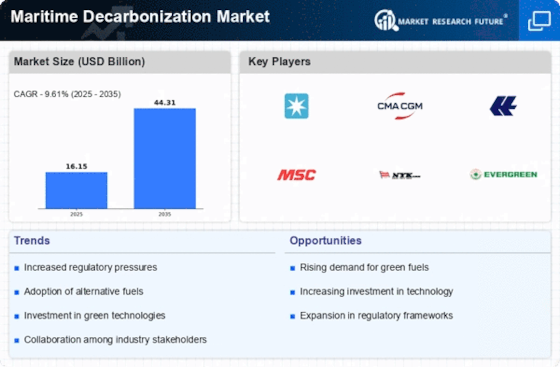
As per Market Research Future analysis, the Maritime Decarbonization Market was estimated at 16.15 USD Billion in 2024. The Maritime Decarbonization industry is projected to grow from 17.7 USD Billion in 2025 to 44.31 USD Billion by 2035, exhibiting a compound annual growth rate (CAGR) of 9.6% during the forecast period 2025 - 2035

Key Market Trends & Highlights

The Maritime Decarbonization Market is poised for transformative growth driven by innovative technologies and regulatory frameworks.

  • The emergence of alternative fuels, particularly green ammonia, is reshaping the maritime landscape. Technological innovations are enhancing emission reduction capabilities across the shipping sector. Regulatory pressures and incentives are increasingly influencing investment decisions in sustainable shipping technologies. Investment in sustainable shipping technologies and growing consumer demand for eco-friendly shipping are key drivers propelling market expansion.

Market Size & Forecast

2024 Market Size 16.15 (USD Billion)
2035 Market Size 44.31 (USD Billion)
CAGR (2025 - 2035) 9.61%
Largest Regional Market Share in 2024 North America

Major Players

<a href="https://www.maersk.com/sustainability/our-esg-priorities/climate-change/decarbonising-ocean-shipping">Maersk </a>(DK), CMA CGM (FR), Hapag-Lloyd (DE), MSC (CH), NYK Line (JP), Evergreen Marine (TW), <a href="https://en.coscoshipping.com/col/col6923/art/2025/art_8a73e29819ac451498b9923284f1dd5a.html">COSCO Shipping</a> (CN), Hanjin Shipping (KR)

Market Trends

The Maritime Decarbonization Market is currently undergoing a transformative phase, driven by the urgent need to reduce greenhouse gas emissions from the shipping sector. This market is characterized by a growing emphasis on sustainable practices, innovative technologies, and regulatory frameworks aimed at achieving carbon neutrality. Stakeholders, including shipowners, manufacturers, and policymakers, are increasingly collaborating to develop solutions that align with global climate goals. The transition towards cleaner fuels, such as hydrogen and ammonia, appears to be gaining traction, as these alternatives offer promising pathways to minimize the carbon footprint of maritime operations. Moreover, the Maritime Decarbonization Market is witnessing a surge in investments directed towards research and development. This trend suggests a collective recognition of the necessity for advanced technologies that can enhance energy efficiency and reduce emissions. The integration of digital solutions, such as data analytics and artificial intelligence, is likely to play a pivotal role in optimizing vessel performance and operational efficiency. As the industry navigates this complex landscape, the focus on decarbonization is expected to reshape traditional business models, fostering a more sustainable maritime ecosystem in the years to come.

Emergence of Alternative Fuels

The shift towards alternative fuels is becoming increasingly prominent within the Maritime Decarbonization Market. Stakeholders are exploring options such as hydrogen, ammonia, and biofuels, which may provide cleaner energy sources for vessels. This trend indicates a potential departure from conventional fossil fuels, aligning with global sustainability objectives.

Technological Innovations

Technological advancements are playing a crucial role in the Maritime Decarbonization Market. Innovations in energy efficiency, such as wind-assisted propulsion and advanced hull designs, are being developed to reduce fuel consumption. These technologies could significantly contribute to lowering emissions and enhancing operational performance.

Regulatory Pressures and Incentives

Regulatory frameworks are increasingly influencing the Maritime Decarbonization Market. Governments and international bodies are implementing stricter emissions regulations and offering incentives for adopting greener technologies. This trend suggests that compliance with environmental standards is becoming a key driver for industry transformation.

Maritime decarbonization Market Market Drivers

International Regulatory Frameworks

The establishment of international regulatory frameworks is a pivotal driver in the Maritime Decarbonization Market. Organizations such as the International Maritime Organization (IMO) have set ambitious targets to reduce greenhouse gas emissions from shipping by at least 50% by 2050. These regulations create a structured environment that compels shipping companies to adopt cleaner technologies and practices. Compliance with these regulations often requires significant investment in new technologies, which can be a barrier for some companies. However, those that adapt are likely to gain a competitive edge, thus stimulating growth within the Maritime Decarbonization Market.

Investment in Sustainable Shipping Technologies

The Maritime Decarbonization Market is witnessing a surge in investment directed towards sustainable shipping technologies. This trend is largely driven by the need to reduce greenhouse gas emissions and comply with international regulations. According to recent data, investments in green technologies, such as wind-assisted propulsion and energy-efficient hull designs, have increased by approximately 30% over the past year. These advancements not only contribute to environmental sustainability but also enhance operational efficiency, thereby attracting more stakeholders to the market. As shipping companies seek to modernize their fleets, the demand for innovative solutions is likely to grow, further propelling the Maritime Decarbonization Market.

Technological Advancements in Emission Reduction

Technological advancements play a crucial role in shaping the Maritime Decarbonization Market. Innovations such as carbon capture and storage systems, as well as the development of hydrogen fuel cells, are emerging as viable solutions for reducing emissions. The market for these technologies is projected to grow substantially, with estimates suggesting a compound annual growth rate of over 20% in the coming years. These advancements not only help in meeting regulatory requirements but also enhance the overall efficiency of maritime operations. As more companies adopt these technologies, the Maritime Decarbonization Market is likely to experience accelerated growth.

Growing Consumer Demand for Eco-Friendly Shipping

Consumer preferences are shifting towards eco-friendly shipping options, significantly impacting the Maritime Decarbonization Market. As awareness of climate change and environmental issues rises, consumers are increasingly favoring companies that demonstrate a commitment to sustainability. This shift is reflected in the growing number of businesses adopting carbon-neutral shipping practices. Reports indicate that nearly 60% of consumers are willing to pay a premium for products shipped via environmentally responsible methods. Consequently, shipping companies are compelled to invest in decarbonization strategies to meet this demand, thereby driving growth in the Maritime Decarbonization Market.

Collaboration and Partnerships in the Shipping Sector

Collaboration and partnerships among stakeholders in the shipping sector are increasingly influencing the Maritime Decarbonization Market. Shipping companies, technology providers, and research institutions are joining forces to develop and implement innovative solutions for decarbonization. Such collaborations can lead to shared resources, knowledge exchange, and reduced costs, making it easier for companies to transition to greener practices. Recent initiatives have shown that partnerships can accelerate the development of alternative fuels and energy-efficient technologies. As these collaborative efforts gain momentum, they are expected to significantly contribute to the growth of the Maritime Decarbonization Market.

Market Segment Insights

By Fuel Type: Green Ammonia (Largest) vs. Hydrogen (Fastest-Growing)

In the Maritime Decarbonization Market, the Fuel Type segment exhibits a varied distribution of market share among Green Ammonia, Hydrogen, and Bio-methanol. Currently, Green Ammonia commands the largest portion of the segment, owing to its favorable characteristics and rising adoption among shipping companies seeking sustainable solutions. In contrast, Hydrogen has emerged as a strong contender, attracting significant interest for its potential to support zero-emission goals, particularly in long-distance maritime transport. Bio-methanol, while a lower share holder in this competitive landscape, is gradually gaining traction due to its compatibility with existing marine engines and infrastructure. As the world focuses on greener shipping practices, the growth trends within this segment are dictated by stringent regulations and escalating environmental concerns. Green Ammonia is being championed as a crucial alternative due to its ability to be produced from renewable sources, thus reducing reliance on fossil fuels. Hydrogen, being recognized as the fastest-growing fuel type, is fueled by technological advancements and increased investments in infrastructure. Meanwhile, Bio-methanol continues to benefit from its established presence in the industry, appealing to stakeholders looking for transition fuels. These dynamics contribute to a rapidly evolving maritime sector moving toward decarbonization.

Green Ammonia (Dominant) vs. Hydrogen (Emerging)

In the context of the Maritime Decarbonization Market, <a href="https://www.marketresearchfuture.com/reports/green-ammonia-market-11519">Green Ammonia</a> can be classified as the dominant fuel type. Its unique properties, such as high energy density and the ability to utilize existing ammonia infrastructure, make it an attractive choice for ship operators looking to reduce carbon emissions effectively. Also, being produced from renewable energy sources positions Green Ammonia favorably against traditional fossil fuels. On the flip side, Hydrogen is emerging as a pivotal player in this sector. With its versatility and ability to produce zero emissions when burned, Hydrogen garners increased attention as an alternative fuel. However, the need for extensive infrastructure development and technological advancements to enhance storage and handling still poses challenges for its widespread adoption. Together, these fuel types represent a competitive landscape driving the maritime industry towards sustainable practices.

By Application: Ships (Largest) vs. Ports (Fastest-Growing)

In the Maritime Decarbonization Market, the application segment is significantly dominated by Ships, which hold the largest market share. This dominance is primarily attributed to the growing emphasis on greening shipping operations and compliance with strict environmental regulations. Ports are emerging as a crucial segment, poised for rapid growth as they implement innovative technologies to reduce their <a href="https://www.marketresearchfuture.com/reports/carbon-footprint-management-market-11312">carbon footprint</a> and enhance sustainability practices.

Ships (Dominant) vs. Ports (Emerging)

The Ships segment is characterized by a wide range of vessels that prioritize decarbonization solutions, from container ships to bulk carriers. With the maritime industry being a major contributor to greenhouse gas emissions, significant investments are directed toward retrofitting existing ships and developing green technologies for new builds. Conversely, the Ports segment, while currently smaller, is rapidly evolving as ports adopt cleaner energy sources and smart infrastructure initiatives. This shift is driven by the need for ports to accommodate greener shipping practices and their own operational efficiencies, positioning them as a dynamic area of growth in the maritime sector.

Get more detailed insights about Maritime Decarbonization Market Research Report—Global Forecast till 2035

Regional Insights

North America : Innovation and Regulation Hub

North America is poised to lead the maritime decarbonization market, driven by stringent regulations and a strong push for sustainable practices. The U.S. and Canada are the largest markets, collectively holding approximately 45% of the market share. Key drivers include government incentives for green technologies and increasing demand for eco-friendly shipping solutions. The region's commitment to reducing greenhouse gas emissions is further supported by initiatives from the Environmental Protection Agency (EPA). The competitive landscape features major players like Maersk and CMA CGM, alongside emerging companies focused on innovative decarbonization technologies. The U.S. is particularly active in research and development, fostering partnerships between private companies and government agencies. This collaboration enhances the region's ability to implement cutting-edge solutions, ensuring a robust market presence in the global maritime sector.

Europe : Sustainability Leader in Shipping

Europe is a frontrunner in the maritime decarbonization market, with a market share of approximately 35%. The European Union's Green Deal and the International Maritime Organization's (IMO) regulations are pivotal in driving demand for sustainable shipping practices. Countries like Germany and the Netherlands are leading the charge, supported by investments in green technologies and infrastructure. The region's commitment to achieving net-zero emissions by 2050 is a significant catalyst for market growth. The competitive landscape is characterized by established players such as Hapag-Lloyd and MSC, alongside innovative startups focusing on alternative fuels and energy-efficient vessels. The presence of major shipping hubs in ports like Rotterdam and Hamburg enhances the region's strategic advantage. Collaborative efforts among stakeholders, including governments and industry leaders, are essential for advancing decarbonization initiatives and maintaining Europe's leadership in the maritime sector.

Asia-Pacific : Emerging Powerhouse in Shipping

The Asia-Pacific region is rapidly emerging as a significant player in the maritime decarbonization market, holding approximately 15% of the global market share. Countries like China and Japan are at the forefront, driven by increasing regulatory pressures and a growing demand for sustainable shipping solutions. The region's economic growth and expanding trade routes are key factors propelling the adoption of decarbonization technologies. Government initiatives aimed at reducing emissions are also contributing to market expansion. The competitive landscape features major shipping companies such as COSCO Shipping and NYK Line, which are investing heavily in green technologies. The presence of large manufacturing hubs and busy shipping lanes enhances the region's strategic importance. Collaborative efforts between governments and industry stakeholders are crucial for fostering innovation and ensuring the successful implementation of decarbonization strategies in the maritime sector.

Middle East and Africa : Resource-Rich Frontier for Shipping

The Middle East and Africa region is gradually recognizing the importance of maritime decarbonization, currently holding about 5% of the global market share. The region's vast natural resources and strategic shipping routes present significant opportunities for growth. Countries like the UAE and South Africa are beginning to implement regulations aimed at reducing emissions, driven by international commitments and local environmental concerns. The potential for investment in green technologies is substantial, as the region seeks to diversify its economies. The competitive landscape is still developing, with key players like Hanjin Shipping and emerging local companies focusing on sustainable practices. The region's unique geographical advantages, including proximity to major trade routes, position it well for future growth in the maritime decarbonization market. Collaborative efforts among governments and industry stakeholders will be essential to harness the region's potential and drive sustainable shipping practices.

Key Players and Competitive Insights

The Maritime decarbonization Market is a dynamic and competitive industry encompassing various players offering a wide range of advanced and efficient Maritime decarbonization Market technology to meet the growing demand across numerous applications. This market is segmented by Maritime decarbonization Market fuel type, application, and region. Key drivers of market growth include The increasing adoption of energy efficiency measures, such as slow steaming and waste heat recovery, driven by their crucial role in enabling various technological advancements. Furthermore, the Maritime decarbonization Market is dominated by major players such as Shell, Wartsilla, CMA CGM Group, Maersk, and others. These companies’ leaders have a strong global presence and offer an extensive array of Maritime decarbonization Industry. They compete on factors such as technological advancement, R&D, and innovation. These key players are actively involved in research and development activities to introduce new Maritime decarbonization Market technologies and expand their product portfolios through strategic initiatives like mergers, acquisitions, partnerships, and collaborations with other industry participants. The Maritime decarbonization Market has also felt the impact of the COVID-19 pandemic, leading to fluctuations in demand and supply chain disruptions. However, as the global economy gradually recovers, the market is expected to rebound, driven by the growing reliance on Maritime decarbonizations in essential technologies. The market's future prospects are promising, with Maritime decarbonizations set to play a pivotal role in the ongoing technological transformations and innovations, making them an integral technology of the evolving global industrial landscape. Shell: Shell plc (Shell), formerly Royal Dutch Shell Plc, is an integrated oil & gas company. The company explores and produces oil & gas from conventional fields and sources such as tight rock, shale & coal formations. It operates refining & petrochemical complexes across the world. Shell’s product offerings include lubricants, bitumen, and liquefied petroleum gas; and petrochemical products such as raw materials for plastics, coatings, and detergents. The company’s reporting segments are integrated gas, upstream, oil products, chemicals, and corporate. The company is a major producer of biofuel in Brazil. It also has interests in various liquefied natural gas (LNG) and gas-to-liquids (GTL) projects. Moreover, the company has its operations in over 70 countries. The company markets its products directly and indirectly through distributors in Europe, Asia, Oceania, Africa, North America, and South America. CMA CGM Group: CMA CGM Group is a French multinational transportation and logistics company headquartered in Marseille, France. It is the world's third-largest container shipping company by TEUs (twenty-foot equivalent units). CMA CGM Group operates a fleet of over 500 vessels and has a presence in over 160 countries. The company provides a wide range of shipping and logistics services, including container shipping, terminal operations, inland transportation, and logistics solutions. In September 2023, CMA CGM and Maersk collaborated to accelerate the decarbonization of the shipping industry. This collaboration marks a significant turning point in the industry's decarbonization. The company will speed the development of innovative solutions and technology, helping our industry to meet its CO2 reduction targets, by merging the know-how and expertise of two leading figures in the maritime industry. The company is excited about new members joining them. Maersk seeks to expedite the green transition in logistics and shipping, and in order to do so, the company needs robust support from industry partners. The company is happy to have CMA CGM as an ally, and this shows that when we work together via committed relationships and efforts, a real and promising route towards a sustainable future can be seen.

Key Companies in the Maritime decarbonization Market include

Industry Developments

Future Outlook

Maritime decarbonization Market Future Outlook

The Maritime Decarbonization Market is projected to grow at a 9.61% CAGR from 2025 to 2035, driven by regulatory pressures, technological advancements, and increasing environmental awareness.

New opportunities lie in:

  • <p>Development of hydrogen fuel cell technology for marine applications. Investment in carbon capture and storage solutions for shipping. Expansion of renewable energy sources for port operations.</p>

By 2035, the market is expected to be robust, driven by innovative solutions and regulatory compliance.

Market Segmentation

Maritime decarbonization Market Fuel Type Outlook

  • Green Ammonia
  • Hydrogen
  • Bio-methanol

Maritime decarbonization Market Application Outlook

  • Ships
  • Ports
  • Others

Report Scope

MARKET SIZE 2024 16.15(USD Billion)
MARKET SIZE 2025 17.7(USD Billion)
MARKET SIZE 2035 44.31(USD Billion)
COMPOUND ANNUAL GROWTH RATE (CAGR) 9.61% (2025 - 2035)
REPORT COVERAGE Revenue Forecast, Competitive Landscape, Growth Factors, and Trends
BASE YEAR 2024
Market Forecast Period 2025 - 2035
Historical Data 2019 - 2024
Market Forecast Units USD Billion
Key Companies Profiled Maersk (DK), CMA CGM (FR), Hapag-Lloyd (DE), MSC (CH), NYK Line (JP), Evergreen Marine (TW), COSCO Shipping (CN), Hanjin Shipping (KR)
Segments Covered Renewable Fuel Type, Application, Region -Global Forecast to 2035
Key Market Opportunities Adoption of alternative fuels and innovative technologies to reduce greenhouse gas emissions in the Maritime Decarbonization Market.
Key Market Dynamics Rising regulatory pressures drive innovation in alternative fuels and technologies for maritime decarbonization.
Countries Covered North America, Europe, APAC, South America, MEA

FAQs

What is the projected market valuation of the Maritime Decarbonization Market by 2035?

<p>The projected market valuation for the Maritime Decarbonization Market is 44.31 USD Billion by 2035.</p>

What was the market valuation of the Maritime Decarbonization Market in 2024?

<p>The overall market valuation was 16.15 USD Billion in 2024.</p>

What is the expected CAGR for the Maritime Decarbonization Market during the forecast period 2025 - 2035?

<p>The expected CAGR for the Maritime Decarbonization Market during the forecast period 2025 - 2035 is 9.61%.</p>

Which fuel types are projected to drive growth in the Maritime Decarbonization Market?

<p>Fuel types projected to drive growth include Green Ammonia, Hydrogen, and Bio-methanol, with valuations ranging from 3.0 to 24.31 USD Billion.</p>

What applications are included in the Maritime Decarbonization Market segments?

<p>Applications in the Maritime Decarbonization Market include Ships, Ports, and Others, with valuations from 3.15 to 22.0 USD Billion.</p>

Who are the key players in the Maritime Decarbonization Market?

<p>Key players in the Maritime Decarbonization Market include Maersk, CMA CGM, Hapag-Lloyd, MSC, NYK Line, Evergreen Marine, COSCO Shipping, and Hanjin Shipping.</p>

How does the market valuation for Ships compare to that for Ports in 2025?

In 2025, the market valuation for Ships is expected to reach 22.0 USD Billion, whereas Ports may reach 15.0 USD Billion.

What is the potential impact of Bio-methanol on the Maritime Decarbonization Market?

Bio-methanol could significantly impact the market, with projected valuations increasing from 9.15 to 24.31 USD Billion.

What trends are influencing the Maritime Decarbonization Market in 2025?

Trends influencing the market include the shift towards sustainable fuel types and the increasing regulatory pressure on emissions.

How are the investments in Maritime Decarbonization expected to evolve by 2035?

Investments in Maritime Decarbonization are likely to evolve significantly, reflecting the projected market growth to 44.31 USD Billion by 2035.

  1. SECTION I: EXECUTIVE SUMMARY AND KEY HIGHLIGHTS
    1. | 1.1 EXECUTIVE SUMMARY
    2. | | 1.1.1 Market Overview
    3. | | 1.1.2 Key Findings
    4. | | 1.1.3 Market Segmentation
    5. | | 1.1.4 Competitive Landscape
    6. | | 1.1.5 Challenges and Opportunities
    7. | | 1.1.6 Future Outlook
  2. SECTION II: SCOPING, METHODOLOGY AND MARKET STRUCTURE
    1. | 2.1 MARKET INTRODUCTION
    2. | | 2.1.1 Definition
    3. | | 2.1.2 Scope of the study
    4. | | | 2.1.2.1 Research Objective
    5. | | | 2.1.2.2 Assumption
    6. | | | 2.1.2.3 Limitations
    7. | 2.2 RESEARCH METHODOLOGY
    8. | | 2.2.1 Overview
    9. | | 2.2.2 Data Mining
    10. | | 2.2.3 Secondary Research
    11. | | 2.2.4 Primary Research
    12. | | | 2.2.4.1 Primary Interviews and Information Gathering Process
    13. | | | 2.2.4.2 Breakdown of Primary Respondents
    14. | | 2.2.5 Forecasting Model
    15. | | 2.2.6 Market Size Estimation
    16. | | | 2.2.6.1 Bottom-Up Approach
    17. | | | 2.2.6.2 Top-Down Approach
    18. | | 2.2.7 Data Triangulation
    19. | | 2.2.8 Validation
  3. SECTION III: QUALITATIVE ANALYSIS
    1. | 3.1 MARKET DYNAMICS
    2. | | 3.1.1 Overview
    3. | | 3.1.2 Drivers
    4. | | 3.1.3 Restraints
    5. | | 3.1.4 Opportunities
    6. | 3.2 MARKET FACTOR ANALYSIS
    7. | | 3.2.1 Value chain Analysis
    8. | | 3.2.2 Porter's Five Forces Analysis
    9. | | | 3.2.2.1 Bargaining Power of Suppliers
    10. | | | 3.2.2.2 Bargaining Power of Buyers
    11. | | | 3.2.2.3 Threat of New Entrants
    12. | | | 3.2.2.4 Threat of Substitutes
    13. | | | 3.2.2.5 Intensity of Rivalry
    14. | | 3.2.3 COVID-19 Impact Analysis
    15. | | | 3.2.3.1 Market Impact Analysis
    16. | | | 3.2.3.2 Regional Impact
    17. | | | 3.2.3.3 Opportunity and Threat Analysis
  4. SECTION IV: QUANTITATIVE ANALYSIS
    1. | 4.1 Energy & Power, BY Fuel Type (USD Billion)
    2. | | 4.1.1 Green Ammonia
    3. | | 4.1.2 Hydrogen
    4. | | 4.1.3 Bio-methanol
    5. | 4.2 Energy & Power, BY Application (USD Billion)
    6. | | 4.2.1 Ships
    7. | | 4.2.2 Ports
    8. | | 4.2.3 Others
    9. | 4.3 Energy & Power, BY Region (USD Billion)
    10. | | 4.3.1 North America
    11. | | | 4.3.1.1 US
    12. | | | 4.3.1.2 Canada
    13. | | 4.3.2 Europe
    14. | | | 4.3.2.1 Germany
    15. | | | 4.3.2.2 UK
    16. | | | 4.3.2.3 France
    17. | | | 4.3.2.4 Russia
    18. | | | 4.3.2.5 Italy
    19. | | | 4.3.2.6 Spain
    20. | | | 4.3.2.7 Rest of Europe
    21. | | 4.3.3 APAC
    22. | | | 4.3.3.1 China
    23. | | | 4.3.3.2 India
    24. | | | 4.3.3.3 Japan
    25. | | | 4.3.3.4 South Korea
    26. | | | 4.3.3.5 Malaysia
    27. | | | 4.3.3.6 Thailand
    28. | | | 4.3.3.7 Indonesia
    29. | | | 4.3.3.8 Rest of APAC
    30. | | 4.3.4 South America
    31. | | | 4.3.4.1 Brazil
    32. | | | 4.3.4.2 Mexico
    33. | | | 4.3.4.3 Argentina
    34. | | | 4.3.4.4 Rest of South America
    35. | | 4.3.5 MEA
    36. | | | 4.3.5.1 GCC Countries
    37. | | | 4.3.5.2 South Africa
    38. | | | 4.3.5.3 Rest of MEA
  5. SECTION V: COMPETITIVE ANALYSIS
    1. | 5.1 Competitive Landscape
    2. | | 5.1.1 Overview
    3. | | 5.1.2 Competitive Analysis
    4. | | 5.1.3 Market share Analysis
    5. | | 5.1.4 Major Growth Strategy in the Energy & Power
    6. | | 5.1.5 Competitive Benchmarking
    7. | | 5.1.6 Leading Players in Terms of Number of Developments in the Energy & Power
    8. | | 5.1.7 Key developments and growth strategies
    9. | | | 5.1.7.1 New Product Launch/Service Deployment
    10. | | | 5.1.7.2 Merger & Acquisitions
    11. | | | 5.1.7.3 Joint Ventures
    12. | | 5.1.8 Major Players Financial Matrix
    13. | | | 5.1.8.1 Sales and Operating Income
    14. | | | 5.1.8.2 Major Players R&D Expenditure. 2023
    15. | 5.2 Company Profiles
    16. | | 5.2.1 Maersk (DK)
    17. | | | 5.2.1.1 Financial Overview
    18. | | | 5.2.1.2 Products Offered
    19. | | | 5.2.1.3 Key Developments
    20. | | | 5.2.1.4 SWOT Analysis
    21. | | | 5.2.1.5 Key Strategies
    22. | | 5.2.2 CMA CGM (FR)
    23. | | | 5.2.2.1 Financial Overview
    24. | | | 5.2.2.2 Products Offered
    25. | | | 5.2.2.3 Key Developments
    26. | | | 5.2.2.4 SWOT Analysis
    27. | | | 5.2.2.5 Key Strategies
    28. | | 5.2.3 Hapag-Lloyd (DE)
    29. | | | 5.2.3.1 Financial Overview
    30. | | | 5.2.3.2 Products Offered
    31. | | | 5.2.3.3 Key Developments
    32. | | | 5.2.3.4 SWOT Analysis
    33. | | | 5.2.3.5 Key Strategies
    34. | | 5.2.4 MSC (CH)
    35. | | | 5.2.4.1 Financial Overview
    36. | | | 5.2.4.2 Products Offered
    37. | | | 5.2.4.3 Key Developments
    38. | | | 5.2.4.4 SWOT Analysis
    39. | | | 5.2.4.5 Key Strategies
    40. | | 5.2.5 NYK Line (JP)
    41. | | | 5.2.5.1 Financial Overview
    42. | | | 5.2.5.2 Products Offered
    43. | | | 5.2.5.3 Key Developments
    44. | | | 5.2.5.4 SWOT Analysis
    45. | | | 5.2.5.5 Key Strategies
    46. | | 5.2.6 Evergreen Marine (TW)
    47. | | | 5.2.6.1 Financial Overview
    48. | | | 5.2.6.2 Products Offered
    49. | | | 5.2.6.3 Key Developments
    50. | | | 5.2.6.4 SWOT Analysis
    51. | | | 5.2.6.5 Key Strategies
    52. | | 5.2.7 COSCO Shipping (CN)
    53. | | | 5.2.7.1 Financial Overview
    54. | | | 5.2.7.2 Products Offered
    55. | | | 5.2.7.3 Key Developments
    56. | | | 5.2.7.4 SWOT Analysis
    57. | | | 5.2.7.5 Key Strategies
    58. | | 5.2.8 Hanjin Shipping (KR)
    59. | | | 5.2.8.1 Financial Overview
    60. | | | 5.2.8.2 Products Offered
    61. | | | 5.2.8.3 Key Developments
    62. | | | 5.2.8.4 SWOT Analysis
    63. | | | 5.2.8.5 Key Strategies
    64. | 5.3 Appendix
    65. | | 5.3.1 References
    66. | | 5.3.2 Related Reports
  6. LIST OF FIGURES
    1. | 6.1 MARKET SYNOPSIS
    2. | 6.2 NORTH AMERICA MARKET ANALYSIS
    3. | 6.3 US MARKET ANALYSIS BY FUEL TYPE
    4. | 6.4 US MARKET ANALYSIS BY APPLICATION
    5. | 6.5 CANADA MARKET ANALYSIS BY FUEL TYPE
    6. | 6.6 CANADA MARKET ANALYSIS BY APPLICATION
    7. | 6.7 EUROPE MARKET ANALYSIS
    8. | 6.8 GERMANY MARKET ANALYSIS BY FUEL TYPE
    9. | 6.9 GERMANY MARKET ANALYSIS BY APPLICATION
    10. | 6.10 UK MARKET ANALYSIS BY FUEL TYPE
    11. | 6.11 UK MARKET ANALYSIS BY APPLICATION
    12. | 6.12 FRANCE MARKET ANALYSIS BY FUEL TYPE
    13. | 6.13 FRANCE MARKET ANALYSIS BY APPLICATION
    14. | 6.14 RUSSIA MARKET ANALYSIS BY FUEL TYPE
    15. | 6.15 RUSSIA MARKET ANALYSIS BY APPLICATION
    16. | 6.16 ITALY MARKET ANALYSIS BY FUEL TYPE
    17. | 6.17 ITALY MARKET ANALYSIS BY APPLICATION
    18. | 6.18 SPAIN MARKET ANALYSIS BY FUEL TYPE
    19. | 6.19 SPAIN MARKET ANALYSIS BY APPLICATION
    20. | 6.20 REST OF EUROPE MARKET ANALYSIS BY FUEL TYPE
    21. | 6.21 REST OF EUROPE MARKET ANALYSIS BY APPLICATION
    22. | 6.22 APAC MARKET ANALYSIS
    23. | 6.23 CHINA MARKET ANALYSIS BY FUEL TYPE
    24. | 6.24 CHINA MARKET ANALYSIS BY APPLICATION
    25. | 6.25 INDIA MARKET ANALYSIS BY FUEL TYPE
    26. | 6.26 INDIA MARKET ANALYSIS BY APPLICATION
    27. | 6.27 JAPAN MARKET ANALYSIS BY FUEL TYPE
    28. | 6.28 JAPAN MARKET ANALYSIS BY APPLICATION
    29. | 6.29 SOUTH KOREA MARKET ANALYSIS BY FUEL TYPE
    30. | 6.30 SOUTH KOREA MARKET ANALYSIS BY APPLICATION
    31. | 6.31 MALAYSIA MARKET ANALYSIS BY FUEL TYPE
    32. | 6.32 MALAYSIA MARKET ANALYSIS BY APPLICATION
    33. | 6.33 THAILAND MARKET ANALYSIS BY FUEL TYPE
    34. | 6.34 THAILAND MARKET ANALYSIS BY APPLICATION
    35. | 6.35 INDONESIA MARKET ANALYSIS BY FUEL TYPE
    36. | 6.36 INDONESIA MARKET ANALYSIS BY APPLICATION
    37. | 6.37 REST OF APAC MARKET ANALYSIS BY FUEL TYPE
    38. | 6.38 REST OF APAC MARKET ANALYSIS BY APPLICATION
    39. | 6.39 SOUTH AMERICA MARKET ANALYSIS
    40. | 6.40 BRAZIL MARKET ANALYSIS BY FUEL TYPE
    41. | 6.41 BRAZIL MARKET ANALYSIS BY APPLICATION
    42. | 6.42 MEXICO MARKET ANALYSIS BY FUEL TYPE
    43. | 6.43 MEXICO MARKET ANALYSIS BY APPLICATION
    44. | 6.44 ARGENTINA MARKET ANALYSIS BY FUEL TYPE
    45. | 6.45 ARGENTINA MARKET ANALYSIS BY APPLICATION
    46. | 6.46 REST OF SOUTH AMERICA MARKET ANALYSIS BY FUEL TYPE
    47. | 6.47 REST OF SOUTH AMERICA MARKET ANALYSIS BY APPLICATION
    48. | 6.48 MEA MARKET ANALYSIS
    49. | 6.49 GCC COUNTRIES MARKET ANALYSIS BY FUEL TYPE
    50. | 6.50 GCC COUNTRIES MARKET ANALYSIS BY APPLICATION
    51. | 6.51 SOUTH AFRICA MARKET ANALYSIS BY FUEL TYPE
    52. | 6.52 SOUTH AFRICA MARKET ANALYSIS BY APPLICATION
    53. | 6.53 REST OF MEA MARKET ANALYSIS BY FUEL TYPE
    54. | 6.54 REST OF MEA MARKET ANALYSIS BY APPLICATION
    55. | 6.55 KEY BUYING CRITERIA OF ENERGY & POWER
    56. | 6.56 RESEARCH PROCESS OF MRFR
    57. | 6.57 DRO ANALYSIS OF ENERGY & POWER
    58. | 6.58 DRIVERS IMPACT ANALYSIS: ENERGY & POWER
    59. | 6.59 RESTRAINTS IMPACT ANALYSIS: ENERGY & POWER
    60. | 6.60 SUPPLY / VALUE CHAIN: ENERGY & POWER
    61. | 6.61 ENERGY & POWER, BY FUEL TYPE, 2024 (% SHARE)
    62. | 6.62 ENERGY & POWER, BY FUEL TYPE, 2024 TO 2035 (USD Billion)
    63. | 6.63 ENERGY & POWER, BY APPLICATION, 2024 (% SHARE)
    64. | 6.64 ENERGY & POWER, BY APPLICATION, 2024 TO 2035 (USD Billion)
    65. | 6.65 BENCHMARKING OF MAJOR COMPETITORS
  7. LIST OF TABLES
    1. | 7.1 LIST OF ASSUMPTIONS
    2. | | 7.1.1
    3. | 7.2 North America MARKET SIZE ESTIMATES; FORECAST
    4. | | 7.2.1 BY FUEL TYPE, 2025-2035 (USD Billion)
    5. | | 7.2.2 BY APPLICATION, 2025-2035 (USD Billion)
    6. | 7.3 US MARKET SIZE ESTIMATES; FORECAST
    7. | | 7.3.1 BY FUEL TYPE, 2025-2035 (USD Billion)
    8. | | 7.3.2 BY APPLICATION, 2025-2035 (USD Billion)
    9. | 7.4 Canada MARKET SIZE ESTIMATES; FORECAST
    10. | | 7.4.1 BY FUEL TYPE, 2025-2035 (USD Billion)
    11. | | 7.4.2 BY APPLICATION, 2025-2035 (USD Billion)
    12. | 7.5 Europe MARKET SIZE ESTIMATES; FORECAST
    13. | | 7.5.1 BY FUEL TYPE, 2025-2035 (USD Billion)
    14. | | 7.5.2 BY APPLICATION, 2025-2035 (USD Billion)
    15. | 7.6 Germany MARKET SIZE ESTIMATES; FORECAST
    16. | | 7.6.1 BY FUEL TYPE, 2025-2035 (USD Billion)
    17. | | 7.6.2 BY APPLICATION, 2025-2035 (USD Billion)
    18. | 7.7 UK MARKET SIZE ESTIMATES; FORECAST
    19. | | 7.7.1 BY FUEL TYPE, 2025-2035 (USD Billion)
    20. | | 7.7.2 BY APPLICATION, 2025-2035 (USD Billion)
    21. | 7.8 France MARKET SIZE ESTIMATES; FORECAST
    22. | | 7.8.1 BY FUEL TYPE, 2025-2035 (USD Billion)
    23. | | 7.8.2 BY APPLICATION, 2025-2035 (USD Billion)
    24. | 7.9 Russia MARKET SIZE ESTIMATES; FORECAST
    25. | | 7.9.1 BY FUEL TYPE, 2025-2035 (USD Billion)
    26. | | 7.9.2 BY APPLICATION, 2025-2035 (USD Billion)
    27. | 7.10 Italy MARKET SIZE ESTIMATES; FORECAST
    28. | | 7.10.1 BY FUEL TYPE, 2025-2035 (USD Billion)
    29. | | 7.10.2 BY APPLICATION, 2025-2035 (USD Billion)
    30. | 7.11 Spain MARKET SIZE ESTIMATES; FORECAST
    31. | | 7.11.1 BY FUEL TYPE, 2025-2035 (USD Billion)
    32. | | 7.11.2 BY APPLICATION, 2025-2035 (USD Billion)
    33. | 7.12 Rest of Europe MARKET SIZE ESTIMATES; FORECAST
    34. | | 7.12.1 BY FUEL TYPE, 2025-2035 (USD Billion)
    35. | | 7.12.2 BY APPLICATION, 2025-2035 (USD Billion)
    36. | 7.13 APAC MARKET SIZE ESTIMATES; FORECAST
    37. | | 7.13.1 BY FUEL TYPE, 2025-2035 (USD Billion)
    38. | | 7.13.2 BY APPLICATION, 2025-2035 (USD Billion)
    39. | 7.14 China MARKET SIZE ESTIMATES; FORECAST
    40. | | 7.14.1 BY FUEL TYPE, 2025-2035 (USD Billion)
    41. | | 7.14.2 BY APPLICATION, 2025-2035 (USD Billion)
    42. | 7.15 India MARKET SIZE ESTIMATES; FORECAST
    43. | | 7.15.1 BY FUEL TYPE, 2025-2035 (USD Billion)
    44. | | 7.15.2 BY APPLICATION, 2025-2035 (USD Billion)
    45. | 7.16 Japan MARKET SIZE ESTIMATES; FORECAST
    46. | | 7.16.1 BY FUEL TYPE, 2025-2035 (USD Billion)
    47. | | 7.16.2 BY APPLICATION, 2025-2035 (USD Billion)
    48. | 7.17 South Korea MARKET SIZE ESTIMATES; FORECAST
    49. | | 7.17.1 BY FUEL TYPE, 2025-2035 (USD Billion)
    50. | | 7.17.2 BY APPLICATION, 2025-2035 (USD Billion)
    51. | 7.18 Malaysia MARKET SIZE ESTIMATES; FORECAST
    52. | | 7.18.1 BY FUEL TYPE, 2025-2035 (USD Billion)
    53. | | 7.18.2 BY APPLICATION, 2025-2035 (USD Billion)
    54. | 7.19 Thailand MARKET SIZE ESTIMATES; FORECAST
    55. | | 7.19.1 BY FUEL TYPE, 2025-2035 (USD Billion)
    56. | | 7.19.2 BY APPLICATION, 2025-2035 (USD Billion)
    57. | 7.20 Indonesia MARKET SIZE ESTIMATES; FORECAST
    58. | | 7.20.1 BY FUEL TYPE, 2025-2035 (USD Billion)
    59. | | 7.20.2 BY APPLICATION, 2025-2035 (USD Billion)
    60. | 7.21 Rest of APAC MARKET SIZE ESTIMATES; FORECAST
    61. | | 7.21.1 BY FUEL TYPE, 2025-2035 (USD Billion)
    62. | | 7.21.2 BY APPLICATION, 2025-2035 (USD Billion)
    63. | 7.22 South America MARKET SIZE ESTIMATES; FORECAST
    64. | | 7.22.1 BY FUEL TYPE, 2025-2035 (USD Billion)
    65. | | 7.22.2 BY APPLICATION, 2025-2035 (USD Billion)
    66. | 7.23 Brazil MARKET SIZE ESTIMATES; FORECAST
    67. | | 7.23.1 BY FUEL TYPE, 2025-2035 (USD Billion)
    68. | | 7.23.2 BY APPLICATION, 2025-2035 (USD Billion)
    69. | 7.24 Mexico MARKET SIZE ESTIMATES; FORECAST
    70. | | 7.24.1 BY FUEL TYPE, 2025-2035 (USD Billion)
    71. | | 7.24.2 BY APPLICATION, 2025-2035 (USD Billion)
    72. | 7.25 Argentina MARKET SIZE ESTIMATES; FORECAST
    73. | | 7.25.1 BY FUEL TYPE, 2025-2035 (USD Billion)
    74. | | 7.25.2 BY APPLICATION, 2025-2035 (USD Billion)
    75. | 7.26 Rest of South America MARKET SIZE ESTIMATES; FORECAST
    76. | | 7.26.1 BY FUEL TYPE, 2025-2035 (USD Billion)
    77. | | 7.26.2 BY APPLICATION, 2025-2035 (USD Billion)
    78. | 7.27 MEA MARKET SIZE ESTIMATES; FORECAST
    79. | | 7.27.1 BY FUEL TYPE, 2025-2035 (USD Billion)
    80. | | 7.27.2 BY APPLICATION, 2025-2035 (USD Billion)
    81. | 7.28 GCC Countries MARKET SIZE ESTIMATES; FORECAST
    82. | | 7.28.1 BY FUEL TYPE, 2025-2035 (USD Billion)
    83. | | 7.28.2 BY APPLICATION, 2025-2035 (USD Billion)
    84. | 7.29 South Africa MARKET SIZE ESTIMATES; FORECAST
    85. | | 7.29.1 BY FUEL TYPE, 2025-2035 (USD Billion)
    86. | | 7.29.2 BY APPLICATION, 2025-2035 (USD Billion)
    87. | 7.30 Rest of MEA MARKET SIZE ESTIMATES; FORECAST
    88. | | 7.30.1 BY FUEL TYPE, 2025-2035 (USD Billion)
    89. | | 7.30.2 BY APPLICATION, 2025-2035 (USD Billion)
    90. | 7.31 PRODUCT LAUNCH/PRODUCT DEVELOPMENT/APPROVAL
    91. | | 7.31.1
    92. | 7.32 ACQUISITION/PARTNERSHIP
    93. | | 7.32.1

Energy & Power Market Segmentation

Energy & Power By Fuel Type (USD Billion, 2025-2035)

  • Green Ammonia
  • Hydrogen
  • Bio-methanol

Energy & Power By Application (USD Billion, 2025-2035)

  • Ships
  • Ports
  • Others
Infographic

Free Sample Request

Kindly complete the form below to receive a free sample of this Report

Get Free Sample

Customer Strories

Compare Licence

×
Features License Type
Single User Multiuser License Enterprise User
Price $4,950 $5,950 $7,250
Maximum User Access Limit 1 User Upto 10 Users Unrestricted Access Throughout the Organization
Free Customization
Direct Access to Analyst
Deliverable Format
Platform Access
Discount on Next Purchase 10% 15% 15%
Printable Versions